Archive for November, 2010

Monday: 11.29.2010

Javier Vazquez Joins the Marlins

My least favorite move of the Hot Stove season last winter was the Atlanta Braves trade of Javier Vazquez to the New York Yankees. First off, I just didn’t like the return the Braves got for Vazquez who was coming off of a brilliant season, the best of his career. Upon further review, Arodys Vizcaino is a much more heralded prospect than I originally realized so that helped the deal. He is just 19 though, so he’s far from a sure thing.

And judging the trade as a whole now after the 2010 season and into the 2011 Hot Stove really shifts the advantage to the Braves. Not only was Vazquez a total flop in New York (5.32 ERA, 1.40 WHIP, nearly -3.0 K and 2.0+ BB difference in his per 9 IP rates), but the Braves were able to flip Michael Dunn, another part of the package from New York, to the Florida Marlins for Dan Uggla.

At the time though, I mostly disliked deal from a selfish fantasy baseball angle. I bought in heavily on Vazquez in the spring of 2009 and reaped significant benefits from his Cy Young-quality season and planned to do the same in 2010 as a well-priced keeper in NL-Only leagues only to have that plan dashed with the trade. Granted, no one cares about my fantasy fortunes one way or another, but Vazquez shifting back to the American League was a loss globally as his best work had always come in National League.

Over the weekend, Vazquez and the Florida Marlins agreed on a 1-year deal worth $7 million with both a full no-trade clause and a clause stating that the Marlins can’t offer him arbitration next winter. The former isn’t terribly worrisome as I’m sure Vazquez would waive it to go to a contender (non-New York division) if the Marlins were languishing through a terrible season and looking to move him. The latter is definitely a significant concession for the Marlins, but in return they no doubt got to drop the price on the contract.

It would have been nice to have the compensation pick potential, but I don’t think it should have been a deal breaker so I applaud the Marlins for making sure they got a discount in return for the arbitration concession. Early reports had teams offering Vazquez a 2-year pact worth about $20 million, but Vazquez refused to look at anything more than a year so the Marlins landed a $3 million dollar discount for the two clauses Vazquez wanted.

It’s hard to pin a value on Vazquez for 2011 and that could result in his being severely discounted as he was heading into 2009. The struggles he had in New York last year weren’t necessarily unexpected as many predicted a substantial drop in value, but the level to which he struggled was a surprise. He has always been home run prone and that was only exacerbated in Yankee Stadium with a career-worst 1.8 HR/9. His home run rate climbed from the previous year during his first stint with New York so I’m not sure what the Yankees were expecting with an even more homer-friendly home park.

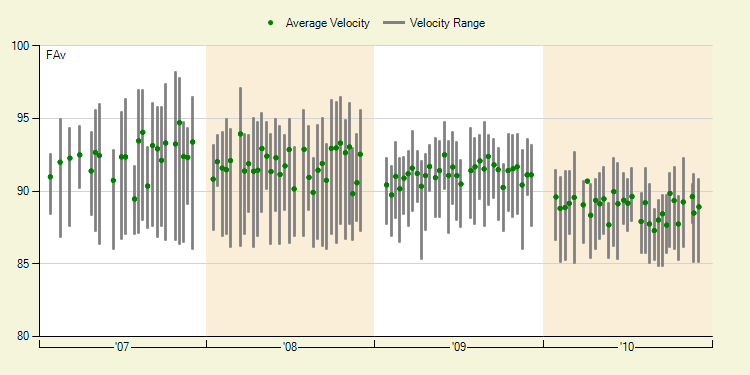
The most alarming factor from his 2010 meltdown was the drop in velocity. This has become a hot topic since rumors of his signing began swirling including a deeper look at it from FanGraphs.com writer Dave Cameron. Cameron isn’t hopeful that he can regain the lost speed and without it, he isn’t sure Vazquez can be of much value.

Given his career workload, I wouldn’t bet on Vazquez’s fastball ever coming back. And if it doesn’t, well, the Marlins just risked $7 million in the hopes that he can teach himself how to pitch without his main weapon. That’s a pretty substantial risk for a team that isn’t exactly rolling in money.

Here’s a chart from FanGraphs showing the drop in velocity:

A drop in fastball velocity is never a good thing, so I won’t try to make that case, but I’m not sure that it is a complete doomsday scenario if his velocity plateaus at the new level. He still has a plus changeup and a plus curveball to fall back on. Instead of relying more on fastball generated swings & misses, he will need to become a better “pitcher”, more crafty if you will. His flyball tendencies (41% career rate, 0.96 career GB/FB rate) won’t hurt him nearly as much in Sun Life Stadium as they did in Yankee Stadium and his strikeout and walk rates are more likely to move back toward his career rates than they are to stay where they were in 2010 just by virtue of the fact that he is back in the National League.

I wouldn’t make too many judgments based solely on his disastrous 2010 when he is also a year removed from a season that earned him Cy Young consideration. Plus he has a bit of a Bret Saberhagen thing going with every other year ERA spikes and drops and though I’d be reticent to bet on a theory like that, he has done it every year since 2000. I’m definitely willing to invest in his 13-season track record as opposed to shying away based on his worst year since his rookie year of 1998. If a sub .500 record and 4.67 ERA in 2008 held his value down going into 2009 despite strong supporting skills, then I can’t imagine having to pay much to take a chance heading into 2011 after the bottom fell out on his numbers in 2010.

Vazquez will be on my radar for 2011 and he won’t need to post a 2009 line to return a profit.

Monday: 11.15.2010

AFL Scouting Report – Brandon Belt, SF

I remember seeing Brandon Belt (1B) here at the University of Texas in a handful of games I attended across the 2008 and 2009 seasons.  My thought coming away was always, “How is he not better?”  He definitely looked like a ballplayer and he would have good plays here & there, but terribly inconsistent. He hit a pedestrian-for-college .321 in 124 games but showed exceptional plate discipline (67 BB to 74 K) and a modicum of gap power.  The only thing that really jumped off of the stat page was his 15 steals in 2009.  You just don’t expect 6’5”/195 first basemen to run much at all let alone swipe double digit bags.

To be 100% honest, I kind of forgot him once he left.  It wasn’t until early this summer that I saw he was in the San Francisco system putting together a solid beginning to the season.  Earlier this month I saw him at the Arizona Fall League in Phoenix and came away with a completely different outlook on him.  I learned from some scouts that the Giants completely reworked his swing from the ground up in hopes of better utilizing his plate discipline and extracting the power locked up in that sizable frame.

The results were amazing as he raked through three levels in his first professional season with the majority of his time with San Jose in High-A where hit posted a .383/.492/.628 line in 77 games.  That earned him a promotion to AA where stayed hot to the tune of .337/.413/.623 in 46 games.  He was again promoted, this time to AAA and though the batting average dropped he still went .229/.393/.563 in 13 games.  Be wary of the tiny sample as 3-4 extra hits would’ve taken his average up to the .290-.310 range so the .229 is very misleading.

He has stayed hot this fall (.392/.449/.658 w/14 XBH out of 31) and looked very sharp in the three games I saw him play.  He took what the pitchers gave him whether it meant blooping a ball over the shortstop’s head for a single or smashing a mistake into the gap for a double or working a walk.  His approach is very crisp.  Here is a look at the swings from his at-bats slowed down:

As for Belt moving forward, I see him with a Joey Votto-lite ceiling.  I’m not sure he can consistently hit .320 like Votto, rather closer to .290 perhaps sprinkling a .300+ season in as his luck fluctuates, but he will likely manage .400 on-base percentages with his plate patience.  For power, I have him more in the low 20s while I see Votto capable of stringing together some low 30s seasons together (his high 30s 2010 had some favorable luck behind it).  And the two meet in the road the speed as they are both adept at swiping bags despite their looks suggesting otherwise.

Barring a huge spring, Belt will likely start 2011 at AAA and get some more seasoning, but he can’t be long for the minors if he keeps raking as he did in 2010.  He is primarily a first baseman, but he played a little rightfield in his AAA stint.  If he can adequately play either position, his chances to reach the majors sooner increase as the Giants are far from locked in at first or either corner outfield spot.

Here is another video of his whole at-bats. It is a bit sped up which I didn’t do on purpose, but it happened three different times when I uploaded it so I just left it:

Tuesday: 11.9.2010

Top 24 for 2011 – Part 3

Part 3 of my look at the top 24 players for the 2011 season.

Part 1
Part 2

In the homestretch of my top 24 with the entire first round left. Remember when viewing these top 12 picks that a lot of my process involves the highest floors just as much as the highest ceilings. Sure, I want the guy who can explode for the transcendent season, but what I really want is the guy whose “bad” season is still pretty damn good (see also: Rodriguez, Alex).

12. Troy Tulowitzki, SS, COL – T3 (middle name Trever) is a very good player on the cusp of entering his prime and though he has three good seasons out of the four he has been in the league, he still hasn’t cracked 100 RBIs, he has only topped 11 stolen bases once and though his .290 career average is damn good, 2010 was his only season above .300 (he hit .315).  Mix in significant injury risk as he has missed 40 and 51 games in two of the last three seasons and there is reason for concern with Tulowitzki.  On the plus side, he will be just 26 years old next year, he has home run totals of 24, 27 and 32 in three of the last four seasons and he plays the thinnest position in fantasy baseball.  Don’t just extrapolate T3’s 2010 to a full season of at-bats when projecting him for 2011, that would be very dangerous.  He needed an otherworldly month of September that included 15 home runs and 40 RBIs to put up a full season’s worth of numbers in 122 games.  I would view his 2010 as a full season expectation for 2011.

11. David Wright, 3B, NYM – Well that’s more like it.  Wright’s 2010 season was back to what we have come to expect from the third baseman as he raised his power totals from 10 HR/72 RBI to 29 HR/103 RBI and the only real expense from 2009’s line was the stolen bases dropping from 27 to 19.  It was a great fantasy baseball season, but there are some concerns from a real life baseball standpoint in that he set a career-high in strikeouts at 161 (21 higher than last year’s career-high mark of 140) and his walk rate continued to tumble.  His 2007 peak of 13.2% has dropped yearly with the sharpest drop coming from 2009 to 2010 as he shaved off 1.7% to 10.3%, second-worst in his career.  For me, we are splitting hairs a bit to freak out on the latter as his 10.3% rate was still among the Nation League’s best (24th overall).  Wright remains a superstar in his prime and a few more strikeouts aren’t going to cut into his value much when he is putting as complete a line as he does, even if the stolen bases taper off to the 13-17 range.

10. Carlos Gonzalez, OF, COL – I am probably a little lower on him that most, but remember what I said back in Part 1 about not overrating the most recent season one way or another.  And like I mentioned again at the outset of this piece, a player’s floor is important to me, too.  As a 25-year old with one full season and just 319 games in all under his belt, would it surprise if Gonzalez seriously regressed from his breakout 2010 season?  His batting average was significantly inflated by a .384 BABIP (.355 career, .333 career-high before ’10)  and he enjoyed the 7th-best home run per flyball rate in baseball (20.4%) which masked a drop in flyballs from his 2009 mark.  All that said, he’s not some fluke scrub who came out of nowhere (3-time Baseball America top 32 prospect: 32, 18, 22 from 2006-2008) so just because I’m entertaining the notion that he could regress significantly, I am not saying it’s 100% that he will.  If pressed for a stat line on his 2011 season, I would be somewhere in the neighborhood of .291 AVG, 98 R, 26 HR, 102 RBI, 22 SB.  He still cracks the top 12 with ease because his ceiling is a season that matches or even exceeds 2010, he is that talented.

9. Alex Rodriguez, 3B, NYY – A-Rod has started on the slow decline that is the twilight of his career, but even a pair of his worst seasons are good as many players out there.  The batting average dipped (.270) to the lowest it has been since 1995 when he wasn’t yet a full time player, but he still banged out 30 HR and 125 RBI in 137 games.  With just four stolen bases on seven tries, the end may be here for A-Rod as a runner, but he may have another sneaky 12 SB season in him once 100% healthy again.  I think 2010 serves as his floor for the next 2-3 years though .300 and 35 are both in play in everything breaks in his favor in a given a year.  You’re not drafting A-Rod for upside anymore, you’re taking him to mitigate early round risk and have a bankable stat line from your first round pick.

8. Robinson Cano, 2B, NYY – All the raving about Cano’s 2010 season has me a bit puzzled.  It’s not that I don’t believe he deserves accolades for a brilliant season, it’s that I’m wondering where these plaudits were last year.  Essentially Cano’s stock has risen significantly thanks to 24 RBIs and 27 walks because outside of those two improvements, his 2010 was the same as his 2009.  Cano is a 4-category superstar in the midst of his prime and he is worthy of your first round pick.  I think he’s a first rounder on his numbers alone as he doesn’t really gain much from position scarcity.  There is this perception that second base is thin, but just as I did last year, I think it is one of the deeper positions even once you get past Cano, the 18th ranked Chase Utley and a healthy Dustin Pedroia.

7. Joey Votto, 1B, CIN – If I may pat myself on the back for a moment, one of my big predictions for 2010 was that Votto would hit 35 home runs and knock in 120.  He hit 2 more home runs and knocked in just seven less.  I am happy to say I was firmly entrenched on Votto bandwagon and took him well above his third round (29th overall) ADP last year in two separate leagues.  But enough about me because let’s be honest, no one gives a damn about me & my leagues.  I love Votto again for 2011, but be careful if you’re betting on a repeat season.  His home run boost was driven by a major league best 25% HR per flyball rate.  He was at 18% the two years before so he is scheduled for a regression especially considering that he actually coupled the major HR/FB rate with a 4% drop in his flyball rate.  He is more of a 30 HR hitter and there is nothing wrong with that.  Especially when you are hitting .320+ with 100+ runs scored & driven in.  I realize first base is really deep, but that mean that you should ignore the immense star power and take a lesser player just because they play a more scarce position.

6. Evan Longoria, 3B, TB – On the surface, Longoria’s 2010 season might feel like a disappointment.  It is probably because he was a chic MVP pick, but then by season’s end his home run total had dropped by 11 from 2009 to “just” 22.  So he didn’t have the career year many expected (including yours truly), but he was hardly anything close to a failure.  Remember that we are in a different era for offense and 22 home runs is legitimate once again.  Yes, his 33 HR season was excellent, but his 22 HR season was still very good; the total was good for 7th-most among all third basemen.  Longoria has put together three brilliant seasons and he is still a year away from his prime meaning we likely haven’t seen his best.

5. Ryan Braun, OF, MIL – Here is another great example of the high floor theory I am talking about.  The 2010 season was Braun’s worst, but there was nothing bad about it as he hit .304 with 25 HR, 103 RBI, 101 R and 14 stolen bases.  When your lowest OPS in four seasons is .866, you are an awesome player.  That is exactly what Braun is and at age 27, he is either a year into or just starting his prime depending on what range you consider the prime to be for a player.  An underrated factor to Braun’s greatness is his sustained health.  He has played 151, 158 and 157 games the last three years and he played 113 of 118 possible games in his rookie season after coming up in late May.  That kind of reliability is hard to find these days so that definitely earned Braun an extra boost in these rankings.

4. Carl Crawford, OF, FA – The biggest free agent hitter available this offseason, I don’t feel like Crawford’s value will move much one way or another based on his new home.  Crawford has always been a speed/batting average superstar with a smattering of power, but since moving down to the 2-3 spots in the lineup, he has become a legitimate five category stud and there is no reason to believe he won’t continue to play that way for the next 2-3 years at the very least.  He is averaging .299 AVG, 13 HR, 70 RBI, 93 R and 50 SB the last eight years despite the inclusion of a washed out 2008 season where he played just 109 games thanks to injuries.  Crawford was inexplicably outside of the top 12 in ADP last year (15th overall), but there is no way he will end up there this year.

3. Miguel Cabrera, 1B, DET – This is not a homer pick, not in the slightest.  Cabrera is .320-34-120 in the bank and it doesn’t matter what position you are getting those numbers at, they are elite.  His stability is even better than Braun’s as Cabrera has averaged 158 games in seven seasons since becoming a full-time player.  That is pretty much unheard of in today’s game.  With so many seasons in the .320-34-120 range, it isn’t farfetched to believe that Cabrera has a career year where he goes .330-45-140 in his holster still.  Again, I don’t really care that he plays at the deepest position in the game, when the numbers are that good and that consistent and the player is still in his prime, he is automatically a top 5 pick.

2. Hanley Ramirez, SS, FLO – When you look Ramirez’s stat line from 2010, it is easy to say he disappointed, but did he really?  No, he wasn’t the 2nd-best player in baseball as he was drafted to be, but anyone who thinks they can predict exactly where a player will finish in any given year is ridiculous.  You first round player is picked that high because you are expecting a high quality, minimal variance stat line that will serve as the beginning foundation for your team.  If they happen to finish exactly where you drafted them in the overall rankings, that is a bonus; not an expectation.  A big reason that Ramirez is draft so highly is because of the scarcity at shortstop and all he did last year was hit for the 2nd-best average among shortstops (.300), deliver the most stolen bases (32), score the 2nd-most runs (92), hit the 4th-most home runs (21) and drive in the 5th-most runs (76) despite playing a career-low 142 games.  I wouldn’t criticize anyone taking Ramirez first overall, but for me we have seen his career year (2007) and while he probably has at least one more 30+ home run season in him, I doubt he has any more 50+ stolen base ones.

1. Albert Pujols, 1B, STL – Why try to fix what isn’t broken?  I am not sure how anyone but Pujols could occupy the top spot until he gives us a discernible reason to replace him.  One of his nicknames is “The Machine” and he continues to live up to it year in and year out with incredible numbers.  I hope we don’t have to sit through another offseason hearing about his balky elbow and how this is now the year that it will catch up to him.  Maybe it is, but until he falters from his perch as the best in the game, he deserves to be picked first in just about any league format you can create.  Even with a middling supporting cast, Pujols managed to lead the league in runs scored and driven in because when you are the best, your supporting cast doesn’t matter.

Friday: 11.5.2010

Top 24 for 2011 – Part 2

Part 2 of my look at the top 24 players for the 2011 season.

Part 1

19. Chase Utley, 2B, PHI – Placing Utley on this list was tough. After just 115 games last year, I think health is a valid concern, but as he pushes deeper into his 30s (32 next year) I am worried he will become similar to Chipper Jones in that he’s excellent when on the field, but how often will he be on the field? The injury concern was enough for me to bump him down to 19 because I’m aiming to mitigate risk with my early picks. You can’t win the draft in the first two rounds, but you can lose it.

18. Mark Teixeira, 1B, NYY – I am not going to overreact to the .256 batting average this past season because a) batting average is largely overrated and he was just a hit a week away (26 in all) from a .300 average and b) his other fantasy relevant numbers (R, HR, RBI for Teix) were right in line with what we have come to expect from Teix. His overwhelming consistency keeps him firmly in the top 24 despite the incredible depth at first base.

17. Ryan Zimmerman, 3B, WAS – It is hard not to be impressed with the first five full seasons of Zimmerman’s career with just one down year (injury-riddled 2008 w/106 games played) and consistent 20+ homer power and ~.290 batting average in the other four. Once you factor in that he will be just 26 in 2011, his career line becomes even more impressive and the best may very well be ahead of him in the coming years. That combination of a very adequate floor (20 HR, 85 RBI, .280 AVG) and likely unreached ceiling (35-120-.320 perhaps?) makes him a very intriguing player next year.

16. Andrew McCutchen, OF, PIT – This is one of “my calls” in that the statistics alone don’t support Cutch over a host of other guys I could have included here, but I still chose him because I think 2010 (94 R, 16 HR, 56 RBI, 33 SB, .286 AVG) is far from his upside and pretty close to what could reasonably be considered his floor. An improvement season could yield a 20 HR, 40 SB, .300 AVG season which would definitely warrant this mid-2nd round rating. He may still be a year away from a true breakout, but I’d rather be a year early than a year late.

15. Josh Hamilton, OF, TEX – Don’t look so surprised. Honestly, Hamilton is fortunate to be ranked this highly. The .359 batting average was fueled by a gaudy .399 BABIP that almost certainly won’t be repeated in 2011. Mix in a massive injury risk and an unprecedented situation where someone has aged their body in a very unpredictable way and you have an early round that could absolutely blow up in your face. When he is healthy and playing, few are better, but you have a games played log of 90, 156, 89 and 133 since his comeback. Proceed with caution.

14. Roy Halladay, SP, PHI – The only other starting pitcher to crack the list, Halladay is the gold standard when it comes to mound men. Everyone expected him to crush it his first year in the National League and he did not disappoint in the least. Pitching is the single most volatile position in the game, but Halladay is quantifiable money in the bank. If any one pitcher could get me to break my “no pitchers drafted early” rule, it would be Halladay, not only because I like him quite a bit, but because he is unquestionably the best pitcher in baseball and like fine wine seems to get better with age (34 in 2011).

13. Matt Holliday, OF, STL – This is another high floor over high ceiling pick as Holliday is a bankable 100 runs, mid-20s home runs, 100 RBIs and .310 batting average year in and year out. If all the luck were to go into his favor for an entire season, he could push 30 homers with a .325 batting average and 110 in each of the counting stats, but in lieu of that he just keeps plugging away with a very capable line. The stolen bases may finally stop dropping (28, 14, 9 last 3 seasons), but they are far more likely to hold than reverse course back upward.

Next: 12-1

Thursday: 11.4.2010

Top 24 for 2011 – Part 1

With the MLB season officially completed on Monday night, we can start looking ahead to the 2011 season and how the top players line up. This season was as interesting as any in recent history because the movement among the top players was heavy. A lot of young players had excellent seasons while some of the old guard faltered just a bit creating openings within the top 24.

How much stock can you put into any one season for better or worse? Obviously a lot of players will make many of their decisions off of the 2010 season which is dangerous game. I fell into that trap last year when overrating both Matt Kemp & Joe Mauer, who both fell flat on their faces in 2010. Though I will consider 2010 a lot in making my decisions about who belongs in the top 24, I will also strongly consider a player’s track record & career trajectory based on age and health.

Make no mistake that my process has always combined the previous season with the track record & career trajectory analysis of a player when deciding where they should go in the following season, but I fell in love with Mauer’s excellent season leading me to put him in the first round in the initial iteration of this article last year. As spring approached and drafts/auctions began, I tempered my Mauer love realizing the error of my ways with respect to him as a first rounder.

With Kemp, I expected improvement on his stellar 2009 season, but instead he regressed back to a slightly lesser version his 2008 line which is still pretty good, but most certainly a face plant considering where he went in most drafts. Neither he nor Mauer truly tanked the teams of fantasy owners who drafted them, though they did severely disappoint given the cost to said owners. Kemp will actually just be entering his prime in 2011 so if the .249 average and 19 stolen bases (after back-to-back years with 30+) tank his value then he could be something of a sleeper of the early rounds a la Josh Hamilton in 2010.

The uncertainty at the top given the surging results of the new guard combined with the lagging results of the old guard create the potential for Kemp/Mauer situations in a list looking at next year’s top 24, but I will be cognizant of that and you will see it with the ranking of a few such players. With all of that said, let’s get to the double dozen.

24. Alex Rios, OF, CWS/Shin-Soo Choo, OF, CLE – There just isn’t much difference between these two so I decided to slot both of them in at the 24th spot, but I could have just as easily expanding the list to 25 players. Looking at their 2010 lines shows Rios with a stolen base edge and Choo with a batting average edge. Personally, I’d take the former, but in terms of overall value it’s splitting hairs. Choo is also a little younger, though, so there may be a shred more upside with him. On the whole, there isn’t much separating these two AL Central outfielders so I’ve got them tied for the end of the 2nd round.

23. Matt Kemp, OF, LAD – No, Kemp did not live up to his draft slot this year and yes, he did hit a dismal .249, but he wasn’t waiver wire fodder. He ripped a career high 28 home runs. His runs scored, driven in and stolen bases all fell precipitously, but his totals of 82, 89 and 19 in those categories didn’t kill anyone’s team. And he has been as reliable as any player in recent memory in terms of playing time logging 155, 159 and 162 games the last three years. To top it all off, he will be 26 this year and could finally put up the monster 30-30 year everyone was looking for this year.

22. Felix Hernandez, SP, SEA – Let’s get one thing straight: I don’t take starting pitchers in the first two rounds. However, just because I personally avoid the risk associated with them doesn’t mean it doesn’t happen and I will cover them in this list because there are a few who deserve to be mentioned. King Felix is a workhorse superstar with five straight seasons of 30+ starts including back-to-back Cy Young worthy seasons. Now here’s the jaw-dropper: he will be 25 years old next year. With a 2.25 ERA and 1.06 WHIP in 250 innings, Hernandez likely won’t improve his numbers next year, but taking a pitcher this early is in an investment in stability in a ridiculously unstable market.

21. Adrian Gonzalez, 1B, SDP – I realize first base is deep, everyone realizes it, but that doesn’t mean that they can’t be taken early. A handful of first basemen made this list starting with Gonzalez. A lot of his presence on this list has to do with consistency. He’s .280-30-100 in the bank with ceiling for more, as evidenced by his 40-home run season back in 2009. The lineup around him stifles the runs scored and even the runs driven in to a point given his incredible power should probably be yielding closer to 110 RBIs or more. The fact that San Diego was in contention right down to the wire last year could compel them to go out and make stark improvements to their lineup which would only help A-Gonz and of course if their fortunes go the other way, he could be dealt.

20. Kevin Youkilis, 3B/1B, BOS – He managed just 102 games in 2010 thanks to a thumb injury that eventually required surgery, but the injury should have no lasting effects in 2011 and thus he makes the list with ease. He might not quite make it with 1B-only on his resume, but the 3B eligibility for Youk is a prime asset. High 20s power and a .300 average go well together and they go even better with 90+ runs scored and driven in on a potent team like the Red Sox. Youkilis is going to miss games at various points in the season which hurts his value in a head-to-head formats, but as long as he keeps putting up a full season’s line in his 140-145 games, then he has at least another year or two among the elite.

Next: 19-13