Finished off what was a good week with a horrible day and I just don’t feel much like writing. I did get some stuff done on my lunch break at work toward the completion of those posts I referenced in the upcoming schedule from today’s earlier post.
I don’t usually post on the weekend, but I may on this weekend. At the very least I’ll have time to complete a lot of those upcoming pieces making next week a big one.
I got a couple of emails the last day or two asking about the Donation Jersey Contest related to the Starting Pitcher Guide. Instead of charging, I wanted to give users of the SP Guide the option to donate to the Guide if they saw fit. In exchange for the donation, you not only get the Guide of course, but you also get entered into a drawing for a Tim Lincecum or Justin Verlander jersey. I will do the drawing shortly after Opening Day (which is March 31st). This gives everyone a legitimate chance to read through the Guide and truly decide if they want to donate and enter the contest.
I wanted to sincerely thank all of you who have already donated. I am truly grateful that you deemed the project worthy of your hard-earned money. It’s a really cool feeling when people make that kind of commentary on your work by choosing to give their money for the product. So all of you who have donated, thank you very much and also sit tight as you are entered into the drawing. Anyone still interested, there is time and there is no threshold donation to get you in. If you donate, you’re in. I will probably record the drawing on my FlipCam and throw it up on YouTube. Like I said, that will be in early April sometime so enjoy the book and good luck in your drafts & auctions that are coming up.
I feel like days should extend to 26 or 27 hours in late February then into March as there is just so much going on. I’ve got nearly 30 hours of podcasts to catch up on and the oldest one is about a week old so it’s not like I’ve let it accumulate. My Read It Later app is bubbling over with content. My “to do” writing list has plenty to take care of on it. My book list is growing (and adding another next week when Jonah Keri’s Extra 2% comes out). The release of MLB 2K11 is next week. Plus I’ve got a 30 Clubs in 30 Days (Kansas City) on the DVR as well as some Spring Training baseball I’d like to check out.
And all that is before fantasy draft prep which will begin in earnest next week as keeper lists start to roll in. Jeez. So much to do and so little time. Especially when you factor in my regular job and sleeping. Oh well, no need to complain. It’s better than being bored out of your mind. February to Opening Day is one of my favorite times of the year despite the fact that I hate winter weather. It’s not really that bad in Texas plus it’s usually done by the beginning of March.
Ian Casselberry has a very perceptive post on willful ignorance and how it is oftentimes downright annoying. I deal with the dismissiveness of Twitter a lot when discussing sports with people. They always say some derivation of “I don’t care who’s eating a sandwich on their couch” as if that’s all you can find on Twitter. Yes, it started as essentially a place of Facebook statuses, but it’s become SO MUCH more.
Yet despite how often they dismiss it as useless, they come to me just as often for news on trade deadline action and various other breaking news because they know I’ll read about it on Twitter well before it’s up on ESPN.com. For some of the dissenters, I’ve watched them morph from Twitter hater to Twitter user. Instead of rubbing it in, I just nod to myself quietly. As Ian says, it’s not for everybody, but anyone dismissing it as useless out of hand has no idea what they are talking about and comes across as pretty stupid.
Are you trying to curb your enthusiasm for your baseball team, but struggling to do so as you read countless glowing and optimistic reports about them from Spring Training? Grey Papke does the dirty work for you with his “Why Your Baseball Team Sucks” piece. It’s a perfect dose of reality to temper your expectations for the upcoming season.
After reading up more on the Zach Sanders piece I shared yesterday on Fantasy Value Above Replacement, I realized it is essentially an extension of something our friends at FB Junkie threw out earlier last month with “Why Not Fantasy VORP?”. So if you read FB Junkie’s piece back on February 1st, use Sanders’ as a fleshing out of their notion behind fantasy value.
Justin Bopp of Beyond the Boxscore has put together an easy to use Baseball Stat Acronym Pronunciation Guide. I disagree with the BABIP as I just say it like a work “Ba-bip”, but otherwise he’s pretty spot on.
Sticking at BtB for a moment, Chris Spurlock has offered a great article covering in detail the changes to the bats in college baseball and making it easily digestible whether you’re a math novice or hardcore mathlete. As mentioned in the article, this should be good news for MLB, primarily from a scouting angle. While it would suck if it really hurt the college game which is a niche sport already, I am glad it is an improvement for MLB. Prospect scouting will still be an inexact science rife with failure even at the high end of the draft, but at least it’s a step in the right direction. Plus I’ve always been someone who enjoys a 3-2 game, so a lowered offensive output in the college game won’t keep me away from following my Longhorns and watching them live a couple times a year.
Ray Guilfoyle of FakeTeams released his catcher rankings today and there were some surprises to be sure. Regardless of whether or not you agree with his ranking of the top guys, one thing remains clear to me: catcher has some depth to it. Sure there are still stars at the top, but if you miss out on the Mauers and Poseys, you’re not toast.
Mike Fast from Baseball Prospectus has a cool piece up (for free) looking at the accuracy of Baseball Info Solutions pitch locations. If you like second, third and even fourth level baseball analysis, in other words really detailed stuff, then you’ll love Fast’s work. This particular piece has a stunning revelation about the data and specifically it’s usage at FanGraphs.
The San Diego Padres are going to have a tough time replicating their 2010 success (success being relative here as they fell short of the NL West crown on the last day of the season despite leading for quite some time throughout the season) with the loss of their one great hitter Adrian Gonzalez, but there is reason for optimism in the future. John Sickelsbreaks down their top two pitching prospects, Simon Castro and Casey Kelly (acquired in the Gonzalez trade), in his Prospect Smackdown series.
This one is nearly a month old, but it got put on the back-burner once I went into full SP guide mode there in early-to-mid February, so in case you missed Jon Weisman’s look at the upcoming “Moneyball” movie, I suggest you take a read. I have been in the minority with him in that I have been very excited about the movie from the moment I heard it was being made. It’s gone through a lot, but I think it can be good. I hadn’t thought of the links to a very popular 2010 movie that Weisman mentions in the piece. I’d love to see it emulate the success of that film, but even if it doesn’t I think it can be a success in its own right.
One of the best guys over at CBS as far as I’m concerned is Al Melchior. He’s definitely a stats-heavy guy which is something I inherently lean toward (though he favors taking pitching relatively early so we disagree heavily there), but also the interactive graphics used in his pieces at CBS are fantastic. The latest is one on positional scarcity and it has a really fun chart to play with at the bottom. Al is part of the CBS podcasts, too and they just recently finished their positional previews. They have moved onto Sleepers and Breakouts. I’d presume that a Busts episode is next as each of the positional podcasts had a Sleepers, Breakouts and Busts portion within it.
One of my favorite things of the fantasy preseason is articles where industry members participate in a mock and then do a write up on their team with the thought process behind each pick. I find them more helpful than just seeing a list of where everyone went. In fact, I find the latter next to useless as the flow of a draft, while not as dynamic as that of an auction, is still dynamic nonetheless and it’s hard to get a feel for why things happened without some commentary. Cory Schwartz participated in a mock picking from the 9-spot and breaks down his draft for us.
Come Chat Tonight: I am still planning on a hosting a chat here at paulsporer.com soon, but tonight I will be chatting at Rotojunkie at 7 PM Eastern. It will have a pitcher tilt to it of course, but as with my first chat here at the site, I will answer anything fantasy baseball-related.
Baseball Apps: Need to get your iPhone and iPad baseball ready for the season? Take a look at these baseball apps that should get you well equipped to enjoy the season on the go.
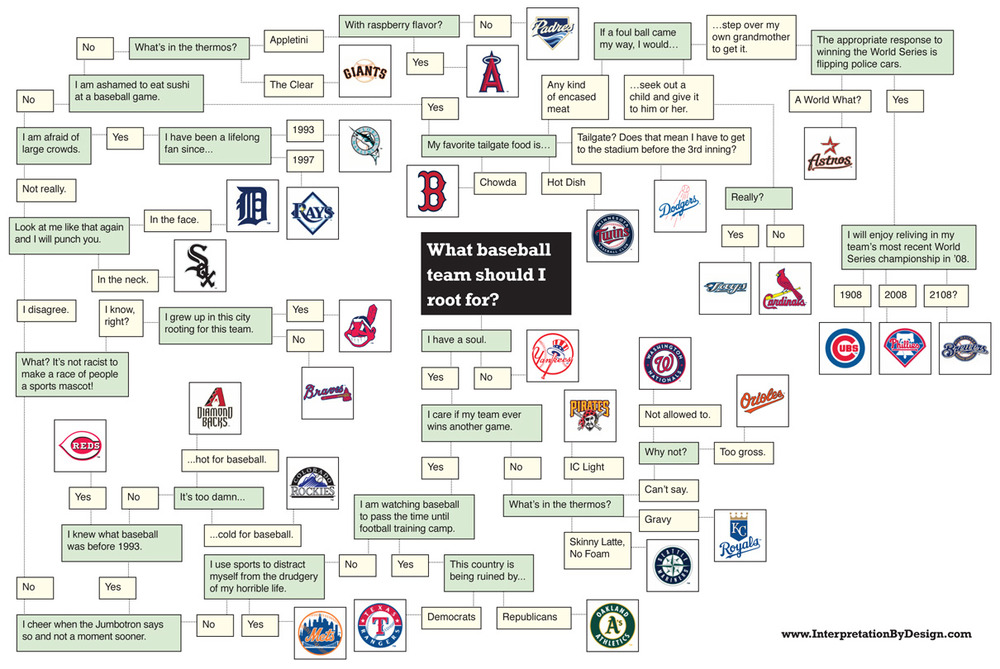
You’ve No Doubt Seen This: But just in case, the baseball fan flowchart is a funny image floating around the blogosphere and Twitterverse.
Remember When… …Lance Johnson was a triples machine? From 1991-1996, Johnson led the league in triples for five of six seasons and hit 12 in the off year (1995, when he had an absurd power surge with 10 HR after never topping 3 before). I was upset when he left the AL before the 1996 season (10 team AL-Only league) because he had a career year including 50 stolen bases, 117 runs scored, .333 average and 69 RBIs, all career highs. His nine homers were close to a career high.
It’s purely coincidental that the first two of these segments happen to be about Chicago White Sox, but “One Dog” was a key cog of my early fantasy teams (probably explains why I didn’t win any titles as a kid) and again because I watched a lot of WGN when the Tigers weren’t on, I was very familiar with Johnson and the Sox.
Despite playing three fewer seasons, Johnson has one more career triple than Kenny Lofton (117 to 116). I found that pretty surprising, but Lofton only had two double-digit seasons in triples and they were 11 years apart (league-high 13 in ’95 and then 12 in ’06). Of course Lofton has nearly twice as many stolen bases (622/327), nearly four times as many home runs (130/34) and had a significantly higher success rate on the base paths (80%/76%), though both were really good.
Knowledge Bomb: Here is an absurd statistic from Mike Axisa about Hall of Famer Greg Maddux. Absurd might even be an understatement. It’s just unfathomably great. Are you ready for this? You may have already seen it, but it resonates even on second and third viewing:
As Scott Van Pelt & Ryen Russillo say on their radio show, “let that soak in your mentals for a minute”. That’s so amazing. Only another 160 saw a 2-0 count. Maddux was just not a fan of getting behind. He only retired in 2008 so he is still a few years from getting on the Hall of Fame ballot and while it’s already a joke, the HoF voters would thoroughly embarrass themselves yet again if they made Maddux sit through another round of voting instead of putting him in on the first ballot.
A much-needed break from writing culminates with the kickoff of March in today’s Daily Dose. I absolutely loved putting together the Starting Pitcher Guide, but there was no doubt it was laborious. So I just needed a break from punching the keys for a bit. I’ve got a lot of things to share, so let’s get started:
First off, a huge “thank you” to everyone who has downloaded the SP Guide and made it, in my opinion at least, a resounding success thus far. It has topped 1,000 downloads in less than a week and the feedback has been pleasing. I did read through and try to edit the typos and such, but I did miss a few. I’m going to run through again and fix those, but I think (hope) it doesn’t take away from the analysis in the work. Unfortunately, that’s part of the price of admission with a self-published labor of love, but the ones I found weren’t overly egregious and hopefully I can be granted a little leeway.
Another sincere “thank you” for making my first chat a success, too. I was blown away by the activity and a chat I wasn’t sure would last 30 minutes ended up going three hours. I’m planning another one soon after there has been time to digest the book a bit and foster some questions after digging into the material. I’m more than open to debate on the rankings and analysis. I’d be foolish not to be, of course. The only thing I would ask is that you come prepared with more than just “I don’t like this guy!” There were some great debates in the first chat, most of which centered around Dan Haren.
Some of these links are a little older, but I wanted to share them just the same:
Scott McKinney over at Royals Review did an amazing piece on the success & failure rates of top prospects. This is especially important to Royals fans in light of their wave of immense talent on the cusp. The simple fact is that several guys in this can’t-miss class for the Royals will in fact miss. They may not miss completely, but they will be elite starter prospects who turn into relievers or stud middle of the lineup of hitters who spend a year or two starting before becoming part-timers struggling to get 400+ at-bats. The trick is guessing which ones. Now, this isn’t the end of the world, Royals fans. It’s a fact of life, but the upside is that the Royals have so many quality prospects that even with the failure rates, they should still turn out several useful big leaguers that will be a part of their next winning team.
Baseball America has released their annual Top 100 prospects list and it’s free to view over at their site. The Royals have three in the Top 10, five in Top 20 and nine in the entire list. I believe that is a record and like I said, that bodes well for the Royals even though four or more will fail to meet expectations. When you take the buckshot approach, the high failure rate hurts a lot less.
Royals Review is the gift that keeps giving as the now viral Jason Kendall blow up is hilarious and worth checking out again even if you’ve already heard/read it. When in doubt, rewind yourself.
This piece about some of the best names in baseball history was the first piece I’d ever read by SB Nation’s Jon Bois. I was instantly a fan and he may have topped his “best names” piece with an excellent series that has just kicked off called “Letters from Spring Training”. He has done the Seattle Mariners, Los Angeles Angels and Oakland Athletics so far. The content is remarkably funny and the hidden gems for me were the taglines under the letterhead, so don’t skip over those. They change with each letter.
As the sabermetrics movement slowly advances across the baseball landscape, one of the more popular next-level stats is Batting Average on Balls in Play (BABIP). As it gains steam, the definition and usage has become a bit bastardized and it has essentially been boiled down to a “luck factor” whereby pitchers automatically gravitate to .300 and hitters set their own over time, but generally fall in the .300-ish area as well. That’s not exactly true and ESPN’s Tristan Cockroft does an excellent job putting together a primer on BABIP. Not all BABIP is created equally and not all pitchers HAVE to regress to .300. This is especially important in light of judging the 2010 performances of pitchers. It’s a must-read.
Derrick Goold of the St. Louis Post-Dispatch has a profile piece on Bill James, one of my absolute favorite subjects. Like so many of this generation, the writing of James took my love and thirst for baseball to another level. I still read the Historical Baseball Abstract before bed at various times.
Speaking of James, his protégé (if that phrase is fair) Rob Neyer was interviewed by Erik Hahmann of DRaysBay. For those baseball fans and writers who maybe didn’t catch James Fever and try to soak up all things James to satiate their love for baseball, then it’s likely that Neyer stands atop or at least very near the top of the list of influences on fandom or raison d’etre for writers. His recent move from ESPN to SBNation caused quite a stir in the Twitterverse and Blogosphere as many wrote of what he meant to them in their relationship with baseball.
Whether a fantasy baseball player or just a baseball fan, you should peruse Will Carroll’s Team Health Reports over at Sports Illustrated.
There was a Francoeur Fest today as Joe Posnanski, Craig Calcaterra and Sam Mellinger all wrote about Royals outfielder Jeff Francoeur. A lot of it centers around just how likable the guy is regardless of the fact that his skills on the field don’t quite measure up. I remember back in 2006 watching a Spring Training game on ESPN with the Atlanta Braves playing who knows who and they showed a lot of interview footage of Francoeur, both alone and alongside Chipper Jones. This was on the heels of Francoeur’s 70 game rookie debut in which he tore the league up hitting .300/.336/.549 with 14 home runs and 45 RBIs in 274 plate appearances.
I remember really liking just about everything Francoeur had to say and seeing him as one of the game’s next great stars. I tabbed him as a breakout candidate that season and scooped him up wherever I could. He didn’t quite live up to expectations though he did hit 29 home runs with 103 runs driven in, so I wasn’t totally bummed from a fantasy perspective, but the .260 average and alarmingly bad .293 on-base percentage were a sign of things to come. Still, I just enjoyed so much about him as a person that I figured he would iron things as a 23-year old in 2007 and then get his star career going.
He was better in 2007 trading 10 home runs for 33 average points and, more importantly, 45 on-base points. I definitely thought he breaking through, but at age 24 he sunk badly lowering every significant number on his stat line. Since then, he has yet to post another league average season according to OPS+ (72, 93, 85). I’m not the least bit surprised that he is still eminently likable and for that reason alone, I continue to root for him, though I’ve long since learned my lesson about allowing him to fill a precious outfield spot on my fantasy baseball roster.
With an unsettled back end of the rotation, the Yankees have allegedly been in talks with the Twins to acquire Francisco Liriano. As a Tigers fan, I would love to see this happen. The Yankees has some excellent prospects to offer up in return so the Twins might profit in the future, but for the here & now David Brown believes this would decimate their 2011 chances for the Central title. I completely agree, especially in a tight division with my beloved Tigers as well as the South-Siders of Chicago.
Cory Schwartz and Mike Siano have released their annual All-Overrated and All-Underrated teams for the 2011 season. They have some similar choices and there is also an accompanying Fantasy 411 podcast now available in iTunes which no doubt goes into detail why they picked who they picked (I’ve not yet listened, saving that for my drive to softball tonight).
Lucky Crumpler has put together a great piece surrounding auction strategies and tactics over at Advanced Fantasy Baseball.com. It’s comprehensive and thorough, a must-read for auction veterans and beginners alike. AFB is run by Jon Williams and he does an excellent job so I’d recommend the site as a whole, but Lucky’s piece is a great jumping off point if it is your first experience with the site.
Knowledge Bomb: Today’s KB addresses someone I missed in the Starting Pitcher’s Guide. Now you’re probably wondering how, with 546 pitchers profiled, I actually MISSED someone, but I went back and forth on this guy before ultimately passing him over. Now it appears as though he could finagle some starts. It still seems highly unlikely that he would win a starting job in the Cubs rotation, but here are my thoughts on him just the same:
Andrew Cashner (Age in 2011: 24, Highest Level in 2010: MLB) – Cashner blazed through AA and AAA en route to the majors with his best performance to date albeit in just 57 innings. His control was very sharp (2.4 BB/9 after 3.8 in ’09) and his strikeout rate jumped to better than one an inning (9.3 K/9). The Top 100 prospect according to Baseball America only relieved in the majors, throwing 54 innings in 53 appearances with modest results. His ERA and WHIP were high thanks in part to a gaudy 5.0 walk rate and unfairly elevated 15.7% HR/FB rate (league average is 9%), especially considering he had a 48% groundball rate.
He maintained his near 1 K/IP rate from the minors striking out 8.3 batters per game. He doesn’t figure to have a bead on a rotation spot with the Cubs’ 1-5 pretty well set barring injuries, but he started in 39 of his 43 minor league appearances and with his three-pitch arsenal, that is something that remains in the cards. For now, he could be a valuable $1 middle reliever in deeper NL-Only leagues with his high strikeout potential (though only if the control comes way down and his luck evens out on the HR/FB rate), otherwise keep an eye out for injuries or severe underperformance that would open up a potential spot for Cashner in the Cubs rotation.
If you feel anyone else was left out of the book that really SHOULD have been included, please let me know and I will give my thoughts on them. There were some guys on the cusp that I thought had even weaker cases than Cashner so I left them out.


 Baseball By Paul