


As we turn the calendar on the first full month of the baseball season, the trade wires will begin firing up in earnest as teams maneuver to plug holes left by the spate of injuries and slow starts around the majors. On the other end of those struggling are the superlatives who are off to record-setting starts.
Slotting one of those players into your lineup is a cure many would love to administer to their team. Of course it is those who are doing the best that can be toughest to trade for in terms of trade value. Will they continue? If not, how much will they fall off? How much should one month boost their trade value as compared to where they were drafted or what their salary was in the auction?
These questions and more are what lie ahead for owners as they contemplate offers and discuss a myriad of trade possibilities. I am going to look at 10 of the best performers thus far (five hitters, five pitchers) and work through an exercise whereby we try to figure what exactly is “left” for them. In other words, what are they going to offer you if you trade for them?
An owner who traded for Ubaldo Jimenez after his sick April in which he threw 24.3 innings of 0.79 ball with 31 strikeouts winning all five of his starts got back 187.3 innings of 3.27 ERA with 14 wins in 28 starts. A far cry from his April work, but still very useful especially to a team in need of pitching. But at what cost? If his trade mate charged him a Roy Halladay price then he may not have been so happy as he didn’t get the sub-3.00 excellence linked to baseball’s best pitcher.
We will look at the five pitchers today. First we will see what they would have left if they merely managed to end the 2011 season with their three year average of statistics. Then we will take a look at they still have in the tank as compared against a favorable projection based on their first month, their previous high watermark season and some personal projection from yours truly.
PITCHERS
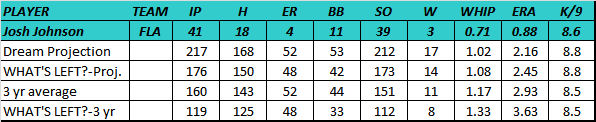
Johnson’s three year has injury time missed built into it since he made just 14 starts in 2008 and 28 a year ago. It skews things a bit, but it shouldn’t be glossed over since he is a legitimate injury risk (what pitcher isn’t?). Coming into the season there were some injury grumblings about him similar to those of Adam Wainwright.
So far he has not only avoided them entirely, but put together a six start stretch that has just been downright absurd in terms of quality. If he were to have a second straight career year, there would essentially be a 2010 Clay Buchholz with more strikeouts left in the tank. Buchholz threw 174 innings with a 2.33 ERA and 1.20 WHIP last year. So call it a Buchholz-plus.
However if he were to succumb to any injury and just meet his three year average, which is a hell of an average for the rate stats mind you, he would be pretty “meh” from here on out. Think 2010 Hisanori Takahashi. The Mets swingman threw 122 innings with a 3.60 ERA and 1.30 WHIP along with 114 strikeouts.
That’s obviously a pessimistic look as you never really want to project injury for someone, but you need to build that into your cost when trading for Johnson. If your trade partner is unwilling to build in some sort of discount for very real injury risk associated with Johnson then you might be better off looking elsewhere.

Weaver has been a workhorse the last three years getting better year over year increasing his starts and innings while also improving most of his other numbers in the process, too. As such, many may see this surge as a continuation of what he has been doing the last several years.
Of course it doesn’t always work that way. In fact, it is much smarter to predict a regression to the mean than it is continued excellence. If he put up a line equal to his three year average, it would still be one of the best seasons of his career, yet owners getting him now would be saddled with some pretty pedestrian numbers. Imagine something similar to 2010 Kevin Slowey.
I love Slowey, but the price you would have to pay to get a Slowey clone from here on out what would be pretty outrageous. I actually don’t see Weaver dropping that much over the remainder of the season, but given how often we see players regress to their average, it certainly isn’t out of the realm of possibilities.
I actually see something of a Ubaldian season for Weaver which is essentially what the dream projection give him. He “struggled” in his start on Monday (notching the baseline of a quality start, 6 IP/3 ER), but when that is your worst start of the year so far, you’re doing just fine.
Keep in mind that if Weaver “only” matches his line from last year (except for wins… if he only managed 13 after getting six in the first month, that’d be really unfortunate), you are due for 173 innings of 3.50 ERA and 1.15 WHIP with 178 strikeouts. A very strong line to be sure, but perhaps not as impactful as you might be hoping given the price paid. I am not saying don’t trade for him, I actually think he is pretty safe as pitchers go, but don’t let your trade partner gouge you, either.
In an AL-Only league I play in, I saw him get traded for Nelson Cruz which I thought was quite fair on both sides. In fact, looking at his CBS page, I see he was part of another trade in some other league with Cruz who was paired with Brian Roberts while Yadier Molina was sent back with Weaver.

Haren is known for slow second halves waiting until after the All-Star Break to regress to his mean. After several years of this trend, he reversed it last year. Saddled with gobs of bad luck in Arizona throughout the first half, he was traded to the Angels just before the trade deadline and pitched masterfully down the stretch posting a 2.87 ERA in 94 innings.
He has maintained that high level of pitching into this year, but still some are reticent because of his history of slowing down as the season wears on. Personally, I would leverage that in my favor to drive the price down a bit.
Though his ERA has regressed in the second half many times throughout his career, he isn’t a completely useless shlub. His strong strikeout rates hold up well regardless of time period and his WHIP often stays well above average, too. Plus, there are still two months before the second half of the season. If you trade for Haren now, you could still get plenty of goodness and then flip him yourself if you truly are afraid of the second half.
Haren is an especially great target for teams struggling in WHIP. While it is still technically early, we are getting close to the point where massive ERA and WHIP deficits can’t be easily fixed with a move or two. Innings are piling up and if you’re too far away from the rest of the pack, you will need two or three star arms to fix it and trading for that would likely decimate you elsewhere rendering the moves useless.
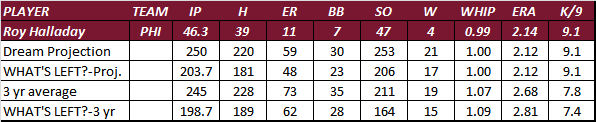
How do you make a dream projection for this guy? Use 1968 Bob Gibson as a reference point? Without getting too ridiculous, I just decided to stick with what he has done so far this year and project it for the entire season. That would still qualify as a career year, but barely after his amazing 2010.
Even his three year average is absurd and if that’s “all” did in 2011, he would still almost certainly be the best pitcher in baseball from here on out. The simple fact is you’re going to have to pay to get him and if you can somehow avoid paying the price of your first round pick or top dollar offensive asset, then do the trade.
Of course, I doubt that will happen. Perusing the CBS trades shows us that he has been dealt for Joey Votto, Ryan Braun and Hanley Ramirez most recently. If your pitching needs help and he is who you seek, you better hope your offense can sustain respectability without its best player or else there is no point doing the trade. That is to say if you’re going to lose as many points taking player X out of your offense as you’d get by adding Halladay to your pitching, then look elsewhere to fix your pitching woes.
By the way, if he ended this season with his three year average, he would essentially be 2010 David Price with 10 fewer innings from here on out. We are a month into the season and what he has left is the equivalent of one of the best pitchers in baseball from last year.
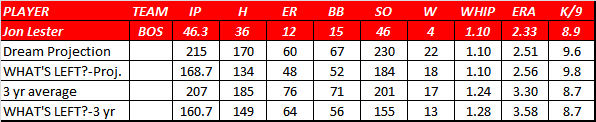
Last but not at all the least is Lester. A popular pick for the American League Cy Young, including mine, he is showing why so many thought he could bring home the hardware this year. Outside of Halladay, he has the least downside in his profile should he “only” reach his three year average by season’s end. Part of that is because his ERA and WHIP aren’t as good as the others right now, but the other part is because his three year average is very strong.
He has become one of the most consistent aces in the game and as a 27-year old entering his physical prime, many believed he would take a significant step forward to make a bid for American League’s best pitcher. If he were to reach that lofty goal, he would probably be near or better than the dream projection.
That would make him, in my estimation, the best of this group to trade for considering he likely won’t cost as much as Halladay does and his upside as compared to what he has already done is the best of the bunch, too.
He has been involved in some insane trades at CBS in that if you were able to get similar value, you should jump at the chance. Twice today he was dealt straight up for Tim Hudson. Other straight up deals include ones for: Alex Gordon (!!!), Jose Reyes, Ryan Howard and Justin Verlander.
I won’t share every single one, but just looking at the first page of these trades, they all seem to favor the team getting Lester except for the one where Lester and Howard Kendrick cost the owner Miguel Cabrera and Jake Arrieta. That is pretty even, though I generally prefer to get the superstar hitter in trades. Of course if you need pitching, that isn’t always possible.
—
I hope this exercise helps you in your trade endeavors as you try to assess exactly what you are getting back in your mega-deal. Next, I will look at some hitters who are on fire and perform the same exercise.
You may also be interested in reading the piece by Daniel Moroz over at Beyond the Boxscore that looks at how April’s top pitchers from previous years finish the season.


 Baseball By Paul