Archive for ‘Data & News’

Tuesday: 06.24.2008

Player Focus 6.24.08

Elijah Dukes Continues to Hit; Smacks Third Bomb
I don’t really know why the Washington Nationals have Elijah Dukes. Yes, he does have talent, quite a bit in fact and he is only 23 years old. But when you consider the tumult he had been through in 2007 season prior to winter trade that send him to DC, you have to wonder if he would (or will?) be worth the trouble for a team in need of stability as they try to rise from the ashes of the Montreal franchise. Nevertheless, it is hard to argue with Dukes’ production in his first full month since coming off of the disabled list. He has a .310/.403/.506 line 87 June at-bats including three home runs and 13 runs batted in. He is not afraid to take a walk either, which is very encouraging, especially for a 23-year old. It’s not hard to stand out in that lineup, but he’s been a very rare bright spot amongst a collection of hitters that makes the San Diego Padres look like Murderer’s Row.

Hawpe Unstoppable Since Returning from DL
Few players are outdoing Dukes in June, but Colorado’s Brad Hawpe is certainly one that is since he came back from injury on June 6th. A Baseball By Paul favorite, Hawpe is up to a June line of .328/.443/.707 after a 2-for-4 effort on Tuesday night. A monthly breakdown seems to suggest he might’ve needed that DL-stint a little sooner:

Either way, the time off seems to have served him well and he’s now back to being the immensely productive and equally underrated third banana of the 3H force in the Colorado lineup as Matt Holliday & Todd Helton steal the bulk of the headlines.

More updates tomorrow and I should finally have that long-promised piece on SPs up as well.

Wednesday: 06.18.2008

Did You Know?

As I was pouring over stats for an article I’ll publish tomorrow, I found some very interesting tidbits that I thought I’d share with everyone:

-The Philadelphia Phillies are the only team to have had the same five pitchers start every game this season. Cole Hamels, Brett Myers, Jamie Moyer, Adam Eaton and Kyle Kendrick make up the team’s 74 starts.

-Of those qualified for the ERA title, there are 42 pitchers with an ERA below 4.00. All of 2007 saw 40 such pitchers.

-Coming into April 14th, Jason Kendall was hitting .405 across his first 37 at-bats. He is hitting .254 after compiling another 176 at-bats.

-Carlos Quentin is on pace for 38 home runs, 127 runs batted in and nine stolen bases. Eric Byrnes is on pace for 13 home runs, 51 runs batted in and nine stolen bases.

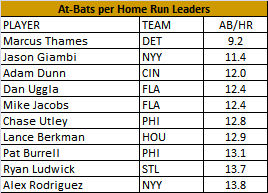
-With an 0-for-3 effort on today, Marcus Thames’ home runs in a streak is still alive. The torrid pace (last eight hits have been home runs) helped give him a nine at-bats per home run rate! Obviously, that’ll even out as he garners more and more playing time, but it is pretty impressive. Here are the top in AB/HR from a pool of the top 40 home run hitters so far this season:

-We all knew it at the time, but as the season wears on the Miguel Tejada trade just looks better and better for Baltimore. Tejada has been his regular declining self on pace for 20 home runs, which is fine enough. Baltimore got centerpiece Luke Scott, who is on pace for 28 home runs and looks to be finally putting it all together. In addition, they got Matt Albers and Dennis Sarfate who have contributed 75 strong innings out of the bullpen. Troy Patton was also a part of the deal, but has yet to pitch for the O’s. Albers, Sarfate and Scott have been three key players in Baltimore’s very surprising success that has them two games over .500.

-Three players have over 30 stolen bases so far this season (Jacoby Ellsbury, Willy Taveras and Ichiro Suzuki with 34, 31 and 30, respectively). This time last year, Reyes was blowing away the field with 38 and the next closest total was a trio with 22 stolen bases.

-In their best year ever, Carl Crawford has actually been one of the worst performers on the Tampa Bay Rays. After three straight seasons of .800+ OPS, he is at .681 through Wednesday.

-Adrian Gonzalez is on pace for 44 home runs. He hit a total of 54 in 2006 and 2007 combined.

-On May 11th, Emil Brown had 33 RBIs… he has 4 since.

-Freddy Sanchez has the worst OPS amongst players qualified for the batting title with a .564. He posted an .851 in 2006 when he won a batting title and then a solid, if unspectacular follow-up of .785 last year. Off-season shoulder surgery is the likely culprit for a busted 2008.

-Of those qualified for the batting title, nobody is below .200. Last year, Richie Sexson ( .198 ) and Elijah Dukes ( .191 ) were below the Mendoza Line at this point in the season. They are doing their best to get there against as Dukes is hitting .226 and Sexson is at .219.

Look for a study on starting pitchers to come out tomorrow in this space…

Tuesday: 06.17.2008

Player Focus 6.17.08

Marcus Thames Displaying Elite Power
That headline is actually nothing new. Marcus Thames has been a bona fide, top of the line power threat. In fact, during his 12 seasons covering both the minor and major leagues, Thames has a .224 Isolated Power in 4351 at-bats. When you go a step further and parse it down to just his 1088 major league at-bats yields a .262 Iso, that’s more than Hank Aaron and Ken Griffey Jr. I don’t mention that to imply he’s anywhere close to the player those gentlemen are and were, rather to give you an idea of the kind of power this guy has in that bat. More topical to today’s Player Focus is the fact that Thames’ last seven hits have been home runs, including numbers 11 and 12 tonight in San Francisco.

The Carlos Guillen Outfield Experiment appears to have been short-lived and Brent Clevlen doesn’t yet have the skills to produce consistently at the major league level meaning there should be at-bats available for Thames either out in left field or at designated hitter for the foreseeable future. In only 18 of the 32 games he played in from April 3rd to June 1st did he get three or more at-bats. His recent streak has included 11 such instances. Seeing 26 and 18 home runs in 348 and 269 at-bat seasons in 2006 and 2007 leaves many to wonder what he could do with 450+ at-bats. (For the record, those seasons pace out to 34 and 30 home runs with 450 at-bats).

For more on Thames, check out this piece over at Fantasy Baseball Generals…

Speaking of Enormous Power Potential…
Remember when Ryan Howard was up for 2008 Fantasy Disappointment of the Season? Perhaps it was during his May low point when he had a .163/.286/.333 with six home runs in 123 at-bats. That was May 7th and he might’ve been available for pennies on the dollar. After joining Marcus Thames and Carlos Beltran in the two-home run club tonight, that is no longer the case. Well, it hasn’t been the case for awhile now, but tonight’s effort that gives him four home runs and 13 RBIs in his last four games seals it.

This is one of the countless examples of the adage “It’s a marathon, not a sprint” with regards to the baseball season. Yet every year, fantasy players across the nation will desperately look for reasons why their stud is struggling and try to justify selling low instead of giving established players a legitimate shot to do what they do best. Injury concerns and/or age are about the only things that could get me to give up on an established, but struggling hitter before June. There are exceptions to just about everything, but 29-year old former MVPs don’t just lose it and Howard has shown that in the past month & 10 days.

Thursday: 06.12.2008

Player Focus 6.12.08

Carlos Gomez Ready to Run Again?
There were mixed feelings about Carlos Gomez, the Twins’ centerpiece in the Johan Santana trade, coming into the season. At 22, concerns centered around the fact that perhaps the Twins were rushing him just to show that the trade wasn’t a bad idea, but he made them look great with a fast start out of gate (no pun intended). Gomez was providing Jose Reyes-type speed with tons of early stolen bases, but then he just stopped running for some reason.

Despite a paltry .300 on-base percentage, Gomez racked up 16 stolen bases in the first month and a half of the season. The .269 average was hardly Earth-shattering, but it kept him from Michael Bourn-like liability (.224 average/24 SBs) in every category but stolen bases. Prior to last night’s stolen base, Gomez had a disgusting 1-for-7 success rate in almost a month’s time. The average was strong and he included some unexpected bombs, but the lack of stolen bases has been a huge disappointment after that start. On the whole, he is still on pace for 44 stolen bases and with the May power surge, 12 home runs as well. Owners of his services would undoubtedly consider 2008 a smashing success if he were able to achieve those numbers by season’s end.

Pitching Dominates the League Wednesday Night
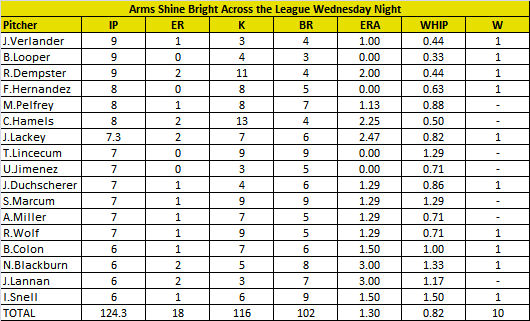
Perhaps it was just because several of these performances found their way onto my fantasy teams, but I don’t remember the last night that this many pitchers were on their game. There were 17 really strong games thrown on Wednesday and it’s not like all of the #1s were going; only five of the gems were out of bona fide aces.

Three complete games and three others going eight innings. All told there were nearly 14 games of 1.30 ERA ball (124.3 IP divided by nine). Reliever turned starter Braden Looper turned in the game of the night with a complete game shutout as Hernandez, Lincecum and Jimenez joined him by holding their opponents to no runs. Cole Hamels paced the crew with 13 strikeouts and Ryan Dempster (!) was close behind 11 of his own. No one posted worse than a 3.00 ERA meaning any combination of this group yielded a very impressive evening for your fantasy team.

A Painful Season Continues…
The disabling of Victor Martinez, Albert Pujols and Alfonso Soriano continued the 2008 ravaging of fantasy baseball teams. There was a message board this morning about the overwhelming rash of key players missed for periods of time due to injury this season and it was jaw-dropping to see.

I wouldn’t even begin to pretend to have an answer as to what is going on or even speculate just to feel like there is a specific reason. What I do know is that having a couple of these players on a roster can decimate a team’s chances. Seeing 14 starting pitchers on the list offers just one more (of the hundreds) reason not to invest heavily in “surefire” aces. Injuries happen, but this seems more like a season-end list of them as opposed to one we’d see nearly two and a half months into the season.

Tuesday: 06.10.2008

One is the Lonliest Number

Last week, the 2008 MLB Amateur Draft was held and the Tampa Bay Rays made Tim Beckham the #1 overall pick. The high school shortstop joins Josh Hamilton, Delmon Young and last year’s David Price as the fourth player to be drafted first overall by the Rays franchise. The two most recent, Price and Beckham, are the only ones still with the team, but Hamilton and Young are having successful seasons in Texas & Minnesota, respectively. Combine that with Price’s early success (1.16 ERA through four starts) and the Rays have a pretty solid track record with #1 overall picks.

It’s not necessarily a simple thing to achieve. Sure, when an Alex Rodriguez or Ken Griffey Jr. is sitting out there, it sure looks like a slam-dunk in hindsight. It is perceived that the baseball draft delivers more busts from the top slot than any other major sport. That could be due to the fact that it’s almost always a hike through the minors for a draft pick before we see them on the team or it could just be another one of the many misnomers embedded into the general sports landscape that often go unchecked. Until now.

I looked at the #1 overall picks during the 20-year period from 1987 to 2006 in each of the four major sports. Looking at both longevity and impact, I graded their career on a scale from 0-10. From around 2002 to 2006, the lower grades are due more to incompleteness of career than anything else. A rating of 2 from a 2002 draftee is not the same as a 2 from 1992. I didn’t factor potential into the ratings for these more recent players either, they were all loaded with potential or else they wouldn’t have been selected first. Baseball’s Matt Bush & Brien Taylor are the only 0 scores of the 80 players, so essentially we’re looking at a 1-10 scale:

0: Historically renowned busts.

1-4: For those with a completed career, they never amounted to much of anything. Some of them knocked around for awhile, but that was due more to someone buying into the potential as opposed to any legitimate production they had put up. Those with a year or two under their belt and score below 5 are players that haven’t made a huge impact yet. The 1s probably won’t, while the 2s, 3s and 4s have shown something and definitely enough to avoid the dreaded bust label that is often doled far too soon in this instant gratification society that sports lives in today.

5-7: Completed careers in this range were viable players with a number of high quality seasons on their record, but never delivered the overwhelming excellence expected of an overall #1. They might’ve had a season as the best player on their team, but they weren’t ever considered the best at their position if even for a season. Solid pieces, but not franchise players.

8-10: They panned out. These picks yielded (or current yield) solid production for an extended period of time. Usually, they were/are legitimate superstars that not only represent their franchise, but oftentimes their sport.

Based on this scale, which sport delivers the most busts atop the draft? We’ll countdown from the league with the best success rate to lowest of the four.

Basketball
Not surprisingly, the NBA has the best success rate amongst #1 overall picks during the 20-year period studied. Any league that is going to have just two rounds in its draft had better have some talent concentrated at the top or else how would the bottom feeders replenish? The league tends to favor size since, as the adage goes, you can’t teach size. And for the most part, that size has panned out. In the 20 seasons looked at, I scored five 10s and four 9s. Only three players scored below a 5, the most recent being 2001’s Kwame Brown (1). Overall, the league scored a 7.0 average with 12 of the 20 players still in the league and seven of the remaining eight playing between 10-15 seasons (Michael Olowokandi, 9):

LeBron James (6’8”), Allen Iverson (6’0”), Elton Brand (6’8”), Glenn Robinson (6’7”) and Larry Johnson (6’6”) are the only five players of the 20 that are less than 6 feet, 9 inches. Eight of the players are measured at 6 feet, 11 inches or better. Though the five below produced three superstars (James, Iverson and Brand), it appears that adhering to the draft size first mantra of the NBA is a relatively safe bet.

Hockey
Many of you likely won’t recognize several of the 20 names listed in the hockey table found below so you will have to trust my judgment on the quality of these players. With nine players in the 8-10 range, including five 10s, the front office men in the NHL are doing their homework. Even more impressive is that only four of the 20 players are out of hockey. Only four players (not the same four, but some overlap) rated below six. Despite the strength of their drafts, they fell just short of the NBA with a 6.9 overall average.

The two decade block is bookended with a pair of superstars on each end. Crosby and Ovechkin (though Crosby significantly more so) are the face of the NHL right now. Granted that face isn’t seen all that much, the Stanley Cup Finals that included Crosby facing the league’s best team over the past 10-15 years (Detroit) was on the best rated in recent memory. On that other end, Modano and Sundin are among the tops to ever lace ‘em up.

Baseball
Well there goes the suspense! Baseball is not the stingiest league in delivering premier players from the top spot, but that doesn’t mean you are assured a bona fide producer if you happen to land the top choice. There are three 10s among the list and there hasn’t been one since 1993 (Alex Rodriguez). In fairness to my favorite game, players can and very often do take much longer to develop into superstars meaning the likes of Justin Upton, Delmon Young, Joe Mauer, Adrian Gonzalez and the resurrected Josh Hamilton could all climb the ranks in the upcoming 5-7 years. For now, MLB rates a 4.7 average thanks housing both 0 rankings and eight others below 4. Of course, this won’t shock any familiar with the game. Baseball talent is so deep that the league holds a draft (50 rounds) more than seven times longer than hockey and football and 25 times as long as basketball. A team can bomb a #1 overall pick but hit on six or seven more of the remaining 49 picks and consider it a successful draft. From 1987 to 2006, the average number of players to make it to the major leagues 170 from an average of 1520 players drafted (11%).

Only two of the eight picks from 1999-2006 look like they are going to fail as top picks. Hochevar, Upton and Young really deserve incomplete grades because the sample sizes to date are just far too small. Same could be said for Gonzalez, Mauer and Hamilton to a degree in we’re being honest. The Tigers could’ve used current GM Dave Dombrowski back in 1997 when they idiotically selected Matt Anderson. Perhaps he’d have seen the potential in Anderson’s teammate, Lance Berkman, who went to the Houston Astros 15 picks later.

Football
Easily the most popular draft of the four, the annual gathering in New York offers the biggest dud rate. Consider right off the bat that only seven of the last 20 top picks are even in the game and one is in federal prison. Given the physical demands of the game, it’s not terribly surprising that so few are still in the game. Ten of the 12 players drafted from 1987 to 1998 played 10 or more seasons so I don’t mean to downplay the overall quality of these #1 picks more than necessary. The 4.6 average is nipping at the heels of baseball’s score to get out of the cellar, but back-to-back bombs from the Browns in 1999 and 2000 with Tim Couch and Courtney Brown certainly haven’t helped matters.

Eli Manning’s recent Super Bowl win was good enough for a 1-point boost. I’m not sold on him moving much higher than a five over the course of his career; I just don’t think he has the smarts that his brother displays. Carson Palmer and Mario Williams are two guys I think could rise into the 8-10 range very soon, but that is the league’s best bet for growth as Alex Smith doesn’t appear to be much.

So not a ton of shocking conclusions drawn here. Basketball needs to deliver the best talent from its draft picks unless it wants the same teams to dominate year-in and year-out. Meanwhile, football holds a 53-man roster and baseball holds a 25-man roster plus several minor league teams therefore the talent runs deep and the stage is set for it to developed over time, especially in baseball. Hockey has a seven round draft like football, but age is not as necessary as it is in football and baseball. You will never see a 19-year or 20-year old stealing headlines in baseball and it’s not possible in football. And though it is big, important news in basketball and hockey, it isn’t a once-in-a-blue-moon situation.

The Tampa Bay Rays have the deck stacked against them when it comes to Tim Beckham’s success given the current career paths of their previous three #1s, but a strong organization that properly handles its kids can overcome “the odds” and the Rays are definitely showing they have what it takes to be considered a first class minor league system.

Thursday: 06.5.2008

National League All-Stars Through May

After posting my American League All-Stars yesterday, I’ll head over to the Senior Circuit today. Let’s get right into it:

Catcher
Brian McCann, Atlanta Braves – This one was really tough because McCann and Geovany Soto have nearly identical statistics. The difference maker for me was that McCann has struck out 31 fewer times (53 to 22) than the Cubs rookie. That discipline has been key in McCann getting back to the level of production exhibited in his breakout 2006 season.

Honorable Mention: Geovany Soto, Chicago Cubs
– He is only 12 points behind McCann in OPS and they each have the same 30 extra base hits (19 2B, 1 3B and 10 HR) while Soto holds a six RBI edge with 39. He became such a hot sleeper in the off-season that come draft time he actually lost his sleeper status. Prior to last year, he was a virtual unknown, but a 26-home run season in Iowa put him on the radar. Consider that during his previous 1574 at-bats in the minors, he had all of 25 home runs.

First Base
Lance Berkman, Houston Astros – There might not be a deeper position in baseball than first base in the National League, yet Berkman still managed to separate himself from the competition. He has a 1.213 OPS powered by 41 extra base hits (out of 84 total hits) including 17 home runs. The lineup around him has cashed in several times as Berkman leads the league with 57 runs scored. As if all of that weren’t enough, he also has a 0.94 strikeout-to-walk ratio and 10 stolen bases! If Vegas put odds on a Triple Crown winner, his would be the smallest of the bunch. (Or is it highest? Whatever conveys they’d be the toughest to win money on…)

Honorable Mentions: I have to give a pair of these, both are very deserving.
Albert Pujols, St. Louis Cardinals – Congratulations is in order for all of those fantasy owners that didn’t buy into the preseason hype that he’d miss massive time this season. He’s been his usual MVP-self.

Adrian Gonzalez, San Diego
– He is showing amazing power this season, PETCO park be damned. Eight years ago, he was the #1 overall pick for the Florida Marlins in the 2000 Amateur Draft. He is now paying dividends on the elite status that comes with being the first pick.

Second Base
Chase Utley, Philadelphia Phillies – Do I even need to expound upon this selection? Utley is one home run away from last season’s total. Not pace, total. There isn’t a category he is failing in as he has also chipped in six stolen bases to go with all the incredible run production. Provided he continues to rake through September, his 2008 season might unequivocally place him in the top 5 for 2009.

Honorable Mention: Dan Uggla, Florida Marlins
– Ouch, talk about getting Magglio’d! Uggla is having a tremendous season as he sets his sights on a third straight season of home run improvement. Unfortunately, he is being overshadowed by the otherworldly season being turned in by Utley.

Third Base
Chipper Jones, Atlanta Braves – Another walkaway win that needs little explanation. Jones is chasing down .400, but it’s far from an empty batting average. He also has 13 home runs, 38 runs batted in and 42 runs scored. Did I mention he is getting on base almost 50% of the time? Thanks in large part (well the large part is probably the .411 average, but you get the point) to 35 walks against just 22 strikeouts he has a .494 on-base percentage.

Honorable Mention: David Wright, New York Mets – He has been the superstar that we all expected coming into the season; a legitimate across-the-board threat that has done his best to keep the Mets above water. His .286 batting average isn’t blowing anyone away, but it’s hardly damaging and once a few more hits fall his way, he’ll be well into the .300s again.

Shortstop
Hanley Ramirez, Florida Marlins – Debates raged on over the off-season as to whether or not Ramirez could be worthy of the #1 overall pick given his power-speed combination, but then some injury concerns bubbled up regarding his shoulder and the #1 overall talk stopped. Now he is running a near 30 HR-40 SB pace and is once again one of the best players in the game.

Honorable Mention: Jose Reyes, New York Mets
– A solid, if unspectacular year for Reyes thus far that lacks the overwhelming, dominating speed. The power surge just about makes up for the speed dip.

Outfield
I’m resisting a strong temptation to put the entire Pirates outfield as my NL All-Star Outfield. I don’t think it’d be completely unreasonable, but I’m resisting it even still. For as excellent as the infield is, the outfield is less-than-stellar.
Nate McLouth, Pittsburgh Pirates – Since August 1st of last year, McLouth has 23 home runs and 21 stolen bases with a .299/.396/.565 line. Like Soto, his sleeper status was just about erased by the time draft season rolled around. Nevertheless, he was one of the league’s best players in April.

Ryan Ludwick, St. Louis Cardinals – Yep, I did it. I know he hasn’t played full time the entire year, but he qualifies for the batting title and has the best OPS among National League outfielders. His overwhelming power has never been an unknown, but he has never really been given the playing time in the majors to succeed.

Jason Bay, Pittsburgh Pirates – OK, so I still took two out of three. Bay was a colossal failure last year, but he regained his batting eye and it’s led to a rebound. Last year, he walked a total of 59 times. This year, he is already at 41 and he is on pace for a career-high. His five stolen bases tops his 2007 total by one and the 13 home runs put him on pace for a career-high 36 at year’s end. Welcome back, Mr. Bay.

Honorable Mentions:
Pat Burrell, Philadelphia Phillies
– Every year the guy mashes in April with a .943 OPS and 13 home runs across 225 at-bats during the past three years. This year was no different with a 1.135 OPS and eight home runs in 89 April at-bats. During the same three year period, he tails off significantly in May from a batting average standpoint but remains a viable on-base and power threat. This year was no different with a .227 average but .378 OBP and five home runs over 88 May at-bats. The guy is a model of consistency for inconsistent. He might frustrate you, but if you’re a Roto owner and you get him just ride his ups and downs out and you’ll get what you paid for by the end of the season.

Aaron Rowand, San Francisco Giants – Everyone expected a huge drop off with the move to San Fran because of a worse park and far worse lineup. Rowand continues to excel and should he keep pace, he will actually improve upon his batting average and RBI totals.

Ryan Braun, Milwaukee Brewers – In proving last year was no fluke, Braun is on pace for 43 home runs and 126 runs batted in with a .299 average. He hasn’t shown nearly the same plate discipline of a year ago, but he is getting the job done and justifying his late first-early second round status.

Starting Pitchers
Edinson Volquez, Cincinnati Reds – I can’t remember a trade in recent memory ever working out so well for both teams. Josh Hamilton for Edinson Volquez was one of the sidenote moves of the off-season, but it has yielded two of the young season’s best stories. Volquez’ walks remain scary, but his other peripherals show he can live with the shaky control.

Tim Lincecum, San Francisco Giants
– This is why you don’t chase wins. The knock on Lincecum all off-season was that he’d be a great asset to ratios and strikeouts, but wouldn’t notch many wins at all on the Giants. He’s been an asset in the ratios and strikeouts, but he’s gotten the team support good enough to rack up seven wins. So unpredictable is this stat that it’ll make you absolutely crazy trying to figure it out. Draft skills.

Brandon Webb, Arizona Diamondbacks – Ho-hum, another dominating season for Webb. All the talk of Peavy and Johan as hands down 1-2 left Webb undervalued by comparison given how absurdly reliable he has been over the past few seasons. He is enjoying his fourth straight season of increases in the strikeouts per nine yet has kept a flat line of consistency across his pitches per inning, plate appearance and game numbers.

Middle Relief Pitchers
Hong Chih-Kuo, Los Angeles Dodgers – He is a pitching version of a utility infielder. He can start, long relieve, short relieve and he could probably close. And he can do all of those things very well, he’s not just some rubber-armed clown that the Dodgers ride. He has a 10.3 K/9, a 1.4 BB/9 and a 0.68 ERA as a reliever.

Carlos Marmol, Chicago Cubs
– He has closer stuff, but given that the most high pressure situations usually come before the ninth inning, he might be a more valuable asset to the Cubs as their 7th/8th inning guy. He was amazing last year and things haven’t changed much for 2008. His control can be shaky, but it’s hard to complain when you see the 13.5 K/9 rate.

Closer
Kerry Wood, Chicago Cubs – For most, it’s been a matter of if, not when for Wood losing the closer’s job due to injury or ineffectiveness. But Wood has taken to the new role very well and it looks like the only thing that could slow him down is the injury bug he is all too accustomed with during his career. Most impressive about how season thus far is the 6:1 K:BB rate. The 16 saves are tied for the National League’s best with Jose Valverde and Brian Wilson. Of those three, his 2.78 ERA is the best.

Thursday: 06.5.2008

Great Read

Ever take those internet journeys where you start off looking for one thing and wind up somewhere totally different, but you’re glad you ended up there? That is exactly how I found this debate between two stat guys & two scout guys conducted by Alan Schwarz at Baseball America over three years ago. In fact, I don’t even remember what I was first looking for… something baseball related I’d bet. I never caught this conversation the first time around during the whole “Moneyball” dustup. It’d be really interesting to get the four guys back for a follow-up and see how they’ve progressed with their stances on everything. At any rate, I thought it’d be topical given today’s amateur draft at 1 PM on ESPN.

Wednesday: 06.4.2008

American League All Stars through May

We’re still over a month away from the Midsummer Classic in the Bronx, but with two full months passed, I wanted to start looking at who I’d put on the All-Star team for each league at this point in the season. For this practice, I’m just going to cover the starter and then an honorable mention. I’m not going to adhere to the every-team-gets-a-player rule since I’m not picking the full team and my picks are going to be in line with the thinking that almost all of the weight is given to the games played this year, that way I’m in line with how the game usually plays out. One final note is that I’m more concerned with fantasy production that “real” baseball production meaning defense is factored in much less. I’ll look at the American League tonight:

Catcher
Joe Mauer, Minnesota Twins – His lack of power doesn’t preclude him from the All-Star Game and hey, he finally got that first home run this week! He has the best OPS of catchers qualified for the batting title (.826), though it’s powered by his .411 OBP that is just four points shy of his slugging percentage. Anyone with a 0.5 K:BB is going to find their way into my lineup.

Honorable Mention: Dioner Navarro, Tampa Bay Rays – He missed some time due to injury, but anyone that adds 158 points to their OPS from the previous season is going to get a look from me. Of course, if the OPS move is from .500 to .658, I don’t care. But .642 to .800 shows some solid improvement if only in a limited sample.

First Base
Kevin Youkilis, Boston Red Sox – What isn’t he doing so far this year? He’s hitting for power as his nine home runs are just seven away from his 2007 total. He hasn’t stopped hitting for average or taking bases on balls with a .305 average and .373 on-base percentage. And he’s displayed some solid speed with two triples and three stolen bases! At least at first base, there is quite a bit more competition than the catcher position we just covered. Even still, Youk has set himself from that competition with great showing across the board.

Honorable Mention: Jason Giambi, New York Yankees
– Spare me the “he’s hitting .253” pleas because a mere three more hits would have him right near .280 and there’d be nothing gripe about on that front. His comeback season has only seen 154 at-bats thus far, but he has 11 home runs already. His fantastic batting eye hasn’t failed him either as he carries a 0.9 K:BB. Yes, that is similar to Mauer in that they both have more walks than strikeouts! What’s more impressive about it from Giambi’s standpoint is he is a power hitter, a profile prone to striking out.

Second Base
Ian Kinsler, Texas Rangers – Anyone familiar with my fantasy axioms knows how much I LOVE power/speed combos. Kinsler fits that bill. I think there might some published work floating around the net that saw me predicting a 30-30 season for him last year. He went 20-20, but only got to play 130 games thanks to injury. I’ll lean on that excuse as the reason he felt short! He has picked up right where he left off with seven home runs and 16 runs batted in. He has more than half the extra base hits he had a season ago with less than half the games played.

Honorable Mention: Jose Lopez, Seattle Mariners
– This pick assumes standard league settings that use batting average and not on-base percentage, in which case I’d take Brian Roberts or Placido Polanco. At any rate, Lopez is hitting nearly .300 while scoring as many runs as can be expected on that ball club and including a pinch of power with four home runs.

Third Base
Alex Rodriguez, New York Yankees – But Paul, he doesn’t even have enough at-bats to qualify for the batting title! But reader, he is still leaps and bounds better than anyone else at the position in the American League. His eight home runs place him third behind Adrian Beltre and Joe Crede. Beltre has five more home runs in about 80 more at-bats while Crede has a whopping one more in about 40 more. He has a much better average and OBP than either and he’s right there or ahead of both in runs scored and driven in. His six steals are best amongst them as well, just for good measure. He’s the best player in the game.

Honorable Mention: Mike Lowell, Boston Red Sox – As much as it pains me to put a Yankee and Red Sock as the two picks, I have to be objective about it. Lowell also missed time yet he has still put up the numbers worthy of inclusion to this discussion. He has come off the career-year numbers set last year, but even heading back down near career norms still make him a great option.

Shortstop
Michael Young, Texas Rangers – You want to take about position scarcity? Take a look at shortstop in the American League! Even lowering qualifications down to just 100 at-bats still couldn’t yield a shortstop with an OPS over .800. The Senior Circuit churns out eight such players with the same filter. Nevertheless, Young is about as steady as they come in this game. Looking for a bankable .300 average and 9-14 home runs at short? Pick Young. He’s the type of set it and forget it producer that makes roto players sleep a little easier at night.

Honorable Mention:
None – a homely bunch to say the least.

Outfield

Josh Hamilton, Texas Rangers
– Do I really need to go into details? The kid is positioning himself for a Triple Crown this season (though he is VERY unlikely to get it). That alone is enough to put him in this game and be pleased with his growth. Throw in the story of where he has come from after being a #1 overall pick turned bust turned budding superstar and you’ve got a nice Hollywood movie on your hands. Hamilton is baseball’s MVP right now and he needs only his numbers to back that up, the story is surplus.

Carlos Quentin, Chicago White Sox – Imagine if the Arizona Diamondbacks still had him and he was coming into his own in their lineup instead of Chicago’s! He’s being Magglio’d by Hamilton so far this season. Being Magglio’d, for the uninitiated, is when you’re having an amazing year that would be praised and lauded non-stop during most seasons but gets overshadowed by someone having an off-the-charts season at the same time. A-Rod managed to have a good enough season last year that Magglio Ordonez’ career year was back-burner fodder. Quentin has 15 home runs and 50 RBIs in 198 at-bats so far this season which is one home run better and just 13 RBIs short of his career totals in 395 previous at-bats with the D’Backs.

Grady Sizemore, Cleveland Indians – As with Giambi, I don’t want to hear about his batting average being .253 because he’s just five hits away from a .280 average. I know he didn’t get those five hits so we shouldn’t pretend that he did; the point of saying that is to illustrate how misleading batting average can be when context isn’t given. All he has done is slug 11 home runs and score 32 while driving in another 30 (in that garbage lineup) with 14 stolen bases from the leadoff spot. And an OBP league doesn’t even notice the batting average since he has a tremendous eye that has helped him get a .371 on-base percentage. He remains one of the best players in fantasy baseball. I ranked him 12th overall in my preseason Top 100 Rankings and I stand by that ranking. The kid is a bona fide franchise player.

Honorable Mentions:
Manny Ramirez, Boston Red Sox
– Left for dead after an un-Manny-like 2007, all he has done so far this year is pace himself for another .300-30-100 season. Manny being Manny indeed.

Magglio Ordonez, Detroit Tigers – You’ll get no argument from me that last year was absolutely a career year, but admission of that for some seemed to them to thinking that Ordonez would be a 2008 flop. He has been the only constant in the heavily disappointing Tigers lineup.

Jacoby Ellsbury, Boston Red Sox – Leading the league in stolen bases while putting up solid numbers everywhere else is worthy of attention and it has nothing to do with Red Sox bias (I’m not a fan of the insufferable Red Sox Nation). My friend, who owns him in our AL-Only, has been talking this kid up for a couple of years now and Ellsbury is making my buddy look smarter by the day.

Starting Pitchers
Cliff Lee, Cleveland Indians – Even the non-believers have a hard time punching holes in Lee’s season-to-date performance. Even the poor outing tonight only raised his ERA to 2.45. Beyond that he has a splendid strikeout-to-walk ratio at 5.4 powered by a 7.6 K/9 – his highest since 2004 (8.1). He is riding a career high 1.46 groundball rate to the Promised Land. Considering he has ranged between .71 and .79 his entire career, a regression could be in the future for him. Nevertheless, if the game is today, he gets the ball.

Roy Halladay, Toronto Blue Jays
– Speaking of amazing K:BB ratios.. Halladay is back to his elite levels from 2003 and 2005 with his 6.17 K:BB ratio of 2008. He has used improvements in both strikeouts and walks per nine to achieve the excellent ratio. Despite moving from 5.6 to 7.1 in K/9, he is actually throwing one fewer pitcher per inning, down to 13.8. This has helped him finish five of his 12 starts putting him on pace to crush the seven complete games he had in 2007. The guy is extremely reliable and his ability to pitch, as opposed to throw, portends a career well into his late-30s. He gets the strikeout when he needs it, but he doesn’t rely on it exclusively.

John Danks, Chicago White Sox – The southpaw is coming along much faster than expected after a rough rookie season. In those 139 innings last year, he had some solid indicators, but it seemed like the 23-year old would need another year or two of seasoning before he could be relied upon in the fantasy landscape. Thus far, he’s shown that thought process to be a load of crap. Danks has 180’d from a 0.8 to 1.64 groundball rate while keeping his strikeouts per nine at just over seven. He has shaved nearly an entire walk off of his rate down to 2.6 helping instill confidence that his first 63 innings of 2008 are no fluke. Anyone looking to towards the future already would be wise to invest in him for their keeper leagues.

Middle Relief Pitchers
Jesse Carlson, Toronto Blue Jays – What can you say about a rookie that handles high pressure situations with a 9.1 K/9 rate and strikes out nearly three times as many batter as he walks (2.9) all the while doing a great job at preventing runners from scoring (1.59 ERA)? You can say he is a middle relief All-Star as far as I’m concerned. With middle relievers, you could hand out 15 spots easily, but Carlson holds up well against anyone else.

Santiago Casilla, Oakland Athletics – I realize he is on the disabled list, but his excellence prior to the stint shouldn’t go unnoticed. It took him forever to even give up a run and even still, it’s happened just twice. In his 19.3 innings, he has 22 strikeouts and four walks. It’s a real shame that he got hurt because who knows where his numbers would be otherwise.

Closer
Mariano Rivera, New York Yankees – 0.36 ERA, 0.50 WHIP, 13.0 K/BB, 9 K/9 and 0.7 BB/9. The 38-year old Rivera was left for dead a season ago because he “only” saved 30 games and had an ERA above 3.00 for the first time ever. Nobody bothered to notice that he had his highest strikeout rate since 1996 and walked all of 12 batters in just over 71 innings. His four blown saves were right in line with what he usually does in a season. I am no fan of the Yankees, but I won’t let my dislike for them prevent from bettering my team with their players. Rivera was an absolute bargain in just about every league this year and this record setting effort is emphatically letting everyone know that he’s not done yet.

I’ll look at the NL tomorrow and perhaps some awards races on Friday. Thanks to everyone for your responses on the power piece. I got some great emails and I really appreciated the feedback overall.

Sunday: 06.1.2008

Baseball’s Power Outage

(Editor’s Note: Click on charts for a better view when necessary)

At this time last year, Troy Glaus, Victor Martinez and B.J. Upton each had eight home runs for the year. This year the trio has combined for just five! This fact, among others, has led a bevy of analysts, bloggers and radio hosts to spend ample time hypothesizing about what has brought about the current “power outage” in baseball. Oftentimes the conclusion is that the game has been cleaned up and thus gotten weaker. Is that just the convenient answer that we want to be true or is there some sort of legitimacy to it? Since we can’t really prove whether or not it’s true given the lack of evidence around who was and who wasn’t on PEDs the past several years, this answer will always be largely conjecture. What we can do, however, is take a look at the numbers and see just how much the power has dropped off around the league.

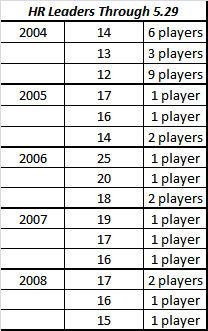
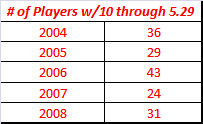
To get an idea of how much, if any, power has dissipated from the game, I looked at several things: Slugging Percentage, Home Runs and Doubles. I also looked at weather just to see if anything interesting struck me, but I don’t think that would come into play until late in the year. I went back to 2004 giving me a complete four-year sampling to compare the first two months of 2008 against. First, I’ll show some of the simpler data I compiled that probably doesn’t have huge correlations year-over-year but can be “fun” to look at when discussing these kinds of things. The following charts focus on the concentration of home runs meaning they fail in giving us the scope we need to judge how far up or down the league’s power is or isn’t right now. What they do offer is an interesting look into how the premier hitters performed during the period studied.
10 or more HR
Judging by those two charts, 2006 was a huge power year all around. Two players had 20 or more home runs and a whopping 43 had 10 or more, both are easily the best of all years studied. Sidenote: 2006 was the second hottest year in the United States on record. The above charts might lead you to believe that 2008 has been a more fruitful power year than 2007 and all the talk is just bluster. And this is why we must dig deeper.

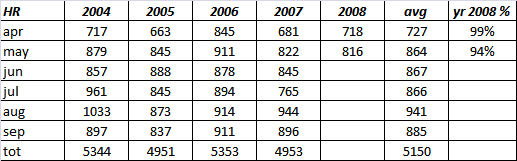
Let’s examine the home run totals a bit more to get more perspective. I took home runs totals by month from 2004 through May of 2008 and then looked at the average of each month. From there, I compared the 2008 April and May totals against the average to see how they stood up. Though the grumblings of a power outage started in earnest during April, the 718 home runs hit reached 99% to the April average (727) and totaled 37 more than April 2007 (681). In fact, outside of the home run happy 2006 season (845 April HRs), the 718 home runs hit this past April was the biggest total of the years studied.

May, however, was a different story. Though just six off of the mark of 2007’s May, the 816 home runs reached just 94% of the average and qualified as the lowest total of the years studied. From 2004-2007, home runs saw a 20% increase from April to May. This year, there was only a 14% increase month-over-month bringing the five year average down to +18%. If the season follows pace and assumes the same percentage gains and losses established from 2004-2007, then there would be about 4900 home runs in 2008, the lowest of the years studied by over 50 home runs.
Month-Over-Month HR Changes
So the data centered around home run output leaves us with an uneven answer. April home run output was strong by comparison despite that month usually being excused due to inclement weather while the uptick generally enjoyed by the league in May was decidedly absent in 2008 despite the concentration of power being stronger or at least as strong as previous seasons.

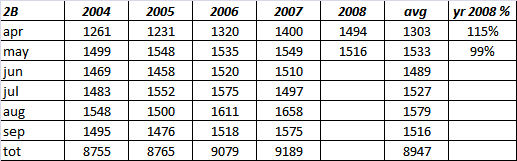
Let’s move onto doubles because contrary to popular belief, power isn’t only about home runs. Legitimate power can and will result in a boatload of double as well. April 2008 gave us the highest double output of all the years studied by far meaning that heading into May it seemed that the assumed power outage had little behind it. The double output in May was only 99% of the average from the sample size once again lending credence those in favor of a power outage.

At this point in my study, I still felt rather uncertain about the results. Some of you probably see where I’m going with this, but I chose present these numbers first because it is primarily what the so-called experts and pundits choose to focus on when decrying the drop of power in the media. These raw totals told me that April was on pace with history and any drops experienced in May appeared negligible. The preceding charts were contrary to everything that the very first chart I put together showed me:
Slugging Percentage by month
Even though the doubles and home runs totals from April and May suggested that things weren’t all that bad, both months had a depressed slugging percentage when compared against the previous four seasons. Mind you, I’m well aware of the fact that doubles and home runs aren’t the only variables included in slugging percentage, but they are the most common components with the biggest impact. The impact of singles is small as is the frequency of triples. Now we’re nearly 900 words into the piece and we only really needed one chart to show us that power is in fact down in baseball for 2008.

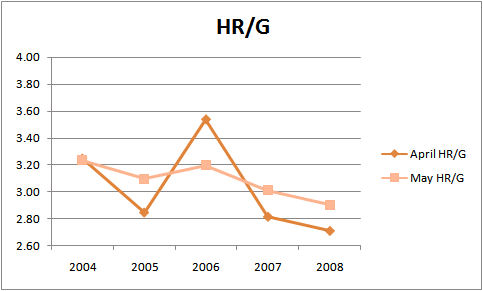
The key was obviously to look at things on a per game basis. Given the random weather patterns in both April and May that cause both rain outs and snow outs leading to various scheduling changes, the raw totals won’t always deliver the full story. Let’s take a look at both home runs and doubles on a per game across the past five seasons in April & May to see how prominent a decline in power has struck the league this year:

The talking heads got one right, folks. They may not have taken the best path (total numbers), but the two charts found above clearly show that there is a legitimate power decline in the game of baseball right now. Is it because of the crackdown on PEDs? As I mentioned at the very beginning, that is an impossible question to completely answer with the data we have in front of us. The game’s biggest fans that took the constant black eyes bestowed upon the game to heart absolutely want it a crackdown on PEDs to be the answer for the decline. Perhaps the powers in charge have altered the ball back into the favor of pitchers?

After all, 31 starting pitchers have earned run averages below 3.50. And 19 starting pitchers have FIP measures below 3.50. Four of the pitchers with a FIP below 3.50 have an ERA above 3.50 essentially meaning they have been bitten by some bad luck. Unfortunately, I was unable to find an easy way to put together the data to see how many players had similar figures in previous seasons. For all of 2007, only 17 pitchers were on the right side of 3.50 in the ERA category and only nine of them held a <3.50 FIP.

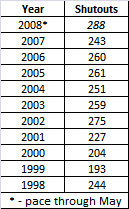
Lastly with regards to pitching, consider that there have already been 96 shutouts this season including nine from the pitiful Detroit Tigers thought in the off-season to be capable of chasing down 1000+ runs scored. Last year, there were 243 shutouts total (40.5 per month). Through May 31st, we’ve already seen 96 shutouts this year. If the 2008 pace holds (48 per month), then we would see 288 shutouts, easily the highest total in the 30-team era:

With four months of play left, the bulk of which will be played in the hottest weather of the year, it is difficult to make any sweeping conclusions. One thing is certain right now, power is down and the margin is statistically valid. For all the heat that Bud Selig takes, it does seem that his concerted effort to crackdown on PEDs in baseball is paying some dividends. Warning track power is the story of the season as are the many wall-scraping home runs that have been a point of consternation through the first two months. So frequent are these close calls that the talk of instant replay on some level in baseball is being heavily discussed nearly as much as the Power Outage of 2008.

Sunday: 06.1.2008

Player Focus 6.1.08

I spent the past two evening researching for an article I’ll post on Monday which is why I didn’t have any updates for Friday or Saturday. All of the data needed has been collected so I’ll finish writing the piece of post late tonight so it’s available on Monday morning. For now, some player looks:

Chipper Jones Rebounds from 0-fer with 2 hits
There has never been a question of Chipper Jones’ talent. And until 2004, he was on track to be a surefire first-ballot Hall of Famer, but then the injury bit him, and bit hard. From 1995 to 2003, Jones played less than 153 games just once and it was 140 of Atlanta’s 144 games during the strike shortened 1995. Since then he hasn’t played 137 in any season. The first year that he lost to injuries was also his worst ever despite 30 home runs and 96 RBIs as he hit just .248. The .847 OPS he had that season just goes to show how amazing of a player Jones is even in a down season.

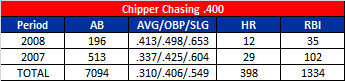
Last year saw Jones net 500 at-bats for the first time since 2003 and he responded with a brilliant season that included 29 home runs and a .337 batting average. He has carried over that excellence in the early part of 2008, hitting over .400 at the June 1st post. With a 2-for-3 (and 3 walks) effort on Saturday, Jones rebounded from an 0-for-5 to ensure he would enter June above the famed .400 mark. Ted Williams’ .406 from 1941 stands as the last time the feat was accomplished and I’m not going out on a limb when I say that it will still be the last time when the 2009 season opens up.
Chipper Jones\' Quest for .400
I’m comfortable trotting out the same reasons against a .400 season that we see anytime anyone is flirting with the mark into late May/early June. The primary of those being that the media pressure as the calendar flipped to September would be too much for ANY man to handle. In this day and age of over-analysis for even the most minor of stories, can you imagine the amount of coverage that would be given to a feat that hasn’t been accomplished in 67 years?! If you thought ESPN was obnoxious now…

It bears mentioning again that hitting a baseball is so difficult that the elite are permitted to fail 7-of-10 times to achieve their status. Despite how hard it is to accumulate hits, we’re now asking for more than one in most games because a simple 1-for-4 or even 1-for-3 effort will lower his batting average! Consider that Williams “only” hit .406 in 456 at-bats and he’s widely regarded as the best hitter the game has seen. Jones’ feat would probably require at least 50 more at-bats and even if he approached the 450 at-bat mark with a .406 average, that’s a pretty small margin of error for that homestretch. Finally, Jones has a great batting eye, but it’s not good enough to propel a run at .400. He has a 14% walk percentage for his career which shouldn’t be scoffed at, it’s tremendous. The 15% rate through May 31st is a big reason why he has been on base at a nearly 50% clip so far this season. Again, it falls short when you start talking about a .400 season… by a lot! Williams posted a remarkable 24% walk percentage during his magical run at .400 and a 21% rate for his illustrious career. Sorry Braves fan, it just isn’t happening.

Ricky Nolasco on Fire of Late
In 2006, the Florida Marlins had to have been impressed by their 23-year old rookie who had put together a solid 11-11 season with a 4.82 ERA in 140 innings. There was plenty of room for improvement, no doubt, but it was definitely a nice foundation to build upon. An elbow injury limited him to 21.3 innings in 2007 making this year his second season for all intents and purposes. He came out of the bullpen for his first two appearances and tossed 5.7 scoreless innings. He joined the rotation on April 11th and promptly allowed five earned runs in five innings, but managed a win nonetheless. His second start was even worse with six earned runs in 4.7 innings and eventually the loss. In the eight starts since then, he has allowed more than three runs just once lowering his ERA nearly two runs in the span from 6.46 to 4.48.

His peripherals over the past three starts are in line with his 2006 totals. In the end, Nolasco likely isn’t a pitcher that should be relied upon to do much more than what he did in 2006. He could shave up to half a run off of the ERA and settle in around 4.30, but that likely stands as the upside at this point. I would tread VERY cautiously in standard mixed league formats (i.e. 10-12 teams), while those over 12 teams with reserve rosters might want to consider stashing him. I doubt he’s available in NL-Only leagues, but he should obviously be picked up if he is on the wire during your transaction period.