Archive for ‘Data & News’

Wednesday: 08.13.2008

Home Run Derby Curse?

I doubt it’s anywhere near as strong as the Madden video game cover curse, but it seems that some home run derby participants in recent years have prolonged power outages immediately following the event. My study that follows wasn’t terribly in-depth or scientific. It was spurred because the Tigers are playing losing to the Toronto Blue Jays this week and I thought about Alex Rios‘ lack of home runs since participating in last year’s contest. Those memories also called to mind the first real collapse I remember and that was of Bobby Abreu. He not only participated in the 2005 event at Comerica Park, but he owned the sucker. He hasn’t been the same power threat since.

The problem with the instances is that they are too few to represent a trend yet and there is no way of figuring out who it might get next. Lance Berkman was in his 4th derby this year, but he never collapsed following the derby as he has this season. Did he collapse because of the derby this year? Unfortunately, I don’t have an answer on that front.

At any rate, Berkman and fellow competitor Dan Uggla are in the throes of a potential home run derby-induced power outage with a combined five home runs between them since the All-Star Break after mashing 55 prior to the Midsummer Classic. Below, I look at five other recent cases of Post-Home Run Derby Syndrome (PHRDS—pronounced “Freds”):
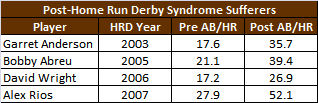
Garret Anderson, 2003 – While Abreu is who I remember first noticing the syndrome impacting, it looks like Anderson was his predecessor! In that 2003 season, Anderson hit 29 home runs. He hasn’t topped 20 in the five seasons since, coming no closer than within 12 to that 2003 mark. The 2003 season was the fifth season in a row with 21+ home runs including a 35-home run campaign and back-to-back 29s. Granted, Anderson has battled injuries and of course, Father Time since that Home Run Derby victory, but power is an old-person skill and he has topped 500 at-bats twice.

Bobby Abreu, 2005 – The year he won that Home Run Derby in Detroit marked his seventh straight season of 20+ home runs. He even mixed in seasons of 30 and 31. He was a bona fide superstar with his 5-category production. If you played on-base percentage in your league, he was worth even more as he routinely topped .400 bolstered by 100+ walks in each of those aforementioned seven seasons. Since that fateful night, he has 52 home runs over 3.5 seasons (about 15 per). He, like Anderson, is obviously getting older, but still power is a skill you usually carry until retirement if it’s something you displayed prominently during your prime. Plus he has continue to run, hit for high average and draw tons of walks so he isn’t battling injury and his skills haven’t just left him. PHRDS claims another!

David Wright, 2006 – Wright struggled after the break of that 2006 season and then went homer-less in April to open 2007, but after that he was pretty much back on track. As a superstar still awaiting his prime, he beat PHRDS, but it’s as rare as Magic Johnson and his AIDS. I include Wright mainly to give hope to the Rios owners out there worried about their wannabe star, who is now in his prime and could struggle to reach double-digit home runs this season.

Alex Rios, 2007 – This case of PHRDS just snuck up on me! I saw Rios fizzle after the break last year, it impacted several of my teams since I absolutely love the guy. Instead of diagnose a case of chronic PHRDS, I attributed it to Alex being Alex as he perennially fades after the break (his OPS is 112 points lower after the All-Star Break from 2005-2007). No he didn’t have a staph infection to fall back on and it briefly crossed my mind that it might be PHRDS, but as an avid Rios supporter, I was in sheer denial. Even this past winter, as I prepared my lists and forecasts, it again crossed my mind that perhaps Rios was in the clutches of PHRDS and might not be the 25+ homer breakout I wanted him to be in 2008. I shouldn’t have ignored that little voice that was screaming at me.

To you Berkman and Uggla owners that have dropped points in home runs and RBIs since the break, I feel for you. Watching a family member suffer from PHRDS as it controls their central power system is heartbreaking. You just want to go out to that mound and lob one in there for them to send 400 feet the other way, but you can’t. You just have to hope and pray that it will go into remission. Berkman is no spring chicken at 32 while Uggla is 30 raising the same age concerns that plagued the first two sufferers of chronic PHRDS. I do believe that both can pull themselves out the proverbial fire; Berkman because he is an amazing hitter that can & will make necessary adjustments when he not going right and Uggla because he corkscrews himself into the batters box about three inches on nearly every swing… but honestly, who knows. We’ll just have to visit daily and monitor their vitals. PHRDS is a cruel, cruel bitch and takes away fantasy titles and gobs of cash along with your favorite player’s power.

Monday: 08.11.2008

The Next Tier: 2009

I woke up to a couple of emails asking me who’s knocking on the door of the first round, so I’ll cover a second group that I really like again in 2009. It is another group of 12 that could represent the second round, but they won’t be in any particular order. (Note: no pitchers are included as I usually leave them to their own listing. When I do a composite Top 50 or 100, pitchers will be included)

The guy mentioned all but once in the six emails I received about the list was Matt Holliday and I completely understand. The guy is a beast, but the uncertainty surrounding his whereabouts for 2009 have me reticent to place him in that first tier. From 2005-2007, the difference in OPS between home & away was almost 300 points. This year, it’s just over 200. He’s hardly a shmuck outside of Coors Field, but he definitely gains a boatload of his value from making his home there. If and when he’s guaranteed to play 2009 in Coors Field, he’ll jump into that top level.

Many are quick to say Lance Berkman can’t sustain what he is doing this year, but I don’t believe that to be true. First of all, he’s well off of his torrid pace from the late spring/early summer so he’s pacing to a .333-128-31-109-20 season right now. The speed is only real anomaly in this bunch and it’d be wise to pay for a max of 10 steals and enjoy anything else as gravy. Meanwhile the rest of the stat line is plenty attainable. With one home run and five double since the All-Star Break, it is looking like the Home Run Derby has claimed another victim. He’s a bankable .300-100-30-100 and that’s very valuable.

Speaking of reliable numbers, Berkman’s teammate Carlos Lee is as steady as they get. The speed dipped a bit this season, but prior to 2008 he had logged five straight double-digit SB seasons. Meanwhile, there probably isn’t a steadier .300-100-30-100 trend-line on the market. He will turn 33 during next season, but age doesn’t sap the skills he has proven to own since joining the elite ranks.

Basically an outfield version of Brandon Phillips right down to the inability to take a walk, Corey Hart is another across-the-board talent you love to have in your lineup. Some plate patience would give him several more chances on base to push that stolen base total above 30. He will be 26-years old at the beginning of next season, his third full one in the majors, and he should be ready to bust out completely.

Are you getting tired of seeing five category guys yet? Sorry, I just love laying the foundation for a fantasy team by getting a good bit of everything. Nick Markakis is on pace to raise his OPS by nearly 40 points from last year by season’s end and the huge increase in plate discipline (already more walks than all of last season) points to a superstar in the making. He will be 25-years old next year and he might be ready to reach that 30-home run plateau. Keeper league rebuilders would be well-served to do all they can to make Markakis their anchor.

It’s impossible not to be disappointed by the utter collapse of B.J. Upton‘s power this season. In his final season of second base-eligibility, many believed a 30-home run season was in order after he whacked 24 in 474 at-bats last year. Instead, he’s become a punchless speed demon showing a surprising amount of plate patience. He could top 50 stole bases, but will struggle to reach double digits in home runs while almost assuredly walking 100+ times. I think lingering shoulder pain has sapped his power and it won’t fully return until 2009. He will turn 24 in 10 days and should be undervalued heading into 2009. A 20-30 season is very possible.

It is tough to follow up a 50-home run/119-RBI season and barring a huge August/September surge, Prince Fielder‘s encore will be somewhere in the 35-95 range. Make no mistake that there is nothing wrong with that, but undoubtedly a disappointment to his fantasy owners. He is just getting going though and if his value takes even the slightest bump due to this season, then you need to be ready to pounce. He has similar run production to Ryan Howard without being the horrific batting average anchor.

There was/is no bigger bust in 2008 than the reigning National League MVP, Jimmy Rollins. Like Upton, his power disappeared. Unlike Upton, he has a much stronger track record of the power making the disappearance more startling. He, again like Upton, is almost assuredly playing through nagging injuries that go unnoticed by the fans yet tremendously impact a player’s numbers. His speed hasn’t faded and he hit .286 or better in every month except June so you can be confident in a 2009 rebound. He is another former first rounder that is almost sure to be undervalued which just creates a great opportunity for his 2009 owners. Don’t be the shortsighted one at the table that focuses too heavily on a disappointing 2008 campaign.

His first season in his “prime” didn’t go according to plan for Carl Crawford and now he’s going to miss some time with a hand injury further damaging his 2008 totals. His problem this year were the declines in speed and average. He doesn’t blow you away with his R, HR and RBI totals, but the given 50-.300 is where sets himself apart. Even if he were playing, he was only pacing to 34-.273. That Rays offense should get even better in 2009 and Crawford will be a beneficiary as well as a catalyst to that success. He might not be a 50-base stealer anymore, but he could be headed for 100 runs, 20 home runs and 100 runs batted in if he settles in at the 3-hole behind Upton and ahead of Evan Longoria.

Don’t tell Adrian Gonzalez that he plays in a pitcher’s paradise. Enjoying a breakout season this year, Gonzalez is establishing himself as a reliable .285-30-100 first baseman despite playing half of his games in the cavernous Petco Park. Granted, he does a lot more damage on the road so you could only imagine what he’d be if he played in a neutral or hitter-friendly yard. He’ll be 27 early in the 2009 season and he isn’t terribly flashy, but his kind of consistency is great as he has one sub-.800 OPS month in his past seven and just four in his last 15. The potential for 35-120 is there as his 2008 pace shows, but the lack of a huge downside gives him underrated appeal.

My pick for the 2008 NL MVP was shipped back to the AL before he had a chance to make a miraculous run to prove me right, but Mark Teixeira is another reliable that does pretty darn well even in “disappointment” seasons. Everyone is waiting for the 40-home run season again and he would have likely given us another one last year had he been able to get the 644 at-bats he had during the 43-HR campaign of 2005, but his 30-105 in less than 500 at-bats was sufficient. Two common themes amongst this group have been 5-category guys and reliable production. Big Teix is the latter to the point where you can add .285-100-30-100 to your team’s bottom line once you acquire him. He is even a bigger stud in OBP leagues because he knows how to draw a walk.

I have gone round and round with myself about whether to put Derrek Lee, Carlos Beltran or somebody else all together here in the last spot. I know Lee isn’t a 40-home run hitter like his 2005 season, but at this point I’m not sure he’s a 30-home run hitter, either. Meanwhile, Beltran is pacing for a huge power drop in 2008. He is 11 off of his 2007 total despite almost 70 more at-bats. When you’re putting up 35-25 or 40-20, it’s easy to overlook a .275 batting average, but not when you’re headed for 20-25. If Milton Bradley could stay healthy, I would have no reservations about putting him here… alas he can’t. If we were talking strictly OBP leagues, entertaining the idea of Pat Burrell or Adam Dunn here would be a no-brainer… alas we’re not. I’ll go with someone I advocated heavily this past off-season, Alfonso Soriano. At 32, he is hardly old and his pace of .299-70-28-76-15 in 399 at-bats is just amazing. Hitting leadoff eats into the RBI totals, but it is tough to find flaws in 100-30-80-25.

Enjoy!

Sunday: 08.10.2008

The 1st Round: 2009

With just under two months left in the season, there won’t be a great deal of change on the fantasy landscape that will thoroughly impact how I view the first round for the 2009 season. Obviously there can and likely will be plenty of change over the late fall and winter months, but for now I wanted to look at how this season has impacted the top of my rankings for next year thus far. For contextual purposes, let’s see who I had in the top 12 heading into the season. Here are the first 12 from my last Top 100 Rankings posted on February 26th:

I’m not too upset by that list. Jimmy Rollins has been an all-out bust, but I don’t think there were any glaring indicators within his statistics that suggested this kind of collapse from excellence. After all, he’s the reigning National League MVP. He has missed 25 games, but even pacing him out with those 25 games would still point to a huge drop-off from last year’s production.

Missing 50 games has kept Alfonso Soriano from justifying the 7th overall rating, but his production while playing has backed up my ranking. I saw him being underrated in a lot of drafts and auctions and his end of season numbers will likely lead those that undervalued him to believe it was the right move even though his depressed numbers are due to his missing 31% of the season. He could be a great star value going into next year.

The fervor about a potential Albert Pujols injury definitely impacted my rankings, but how could it not? There was hardly a neutral report about it let alone a positive one. No one expected the Cardinals to hang around in the race like they have and as such, it was feared that any sign at injury would send Pujols to the operating table rather than gutting it out for a 5th place team.

I chickened out a bit by not ranking Grady Sizemore in that top 12 despite how much I love his game. I took him 8th and 10th in two separate leagues this past March, but I think I was scared off by the lack of runs batted in because he was a leadoff hitter. The mediocre batting average also gave me some pause.

Now onto next year. Who’s moved up? Who’s moved down?

Hanley Ramirez plays some pretty horrible shortstop, but thankfully that has no impact on fantasy owners across the world and even if he does move to a new position, he will still be shortstop-eligible for all of the 2009 season. His unreal numbers combined with that eligibility & his age (26 next year) give him the top spot. The speed and average are on pace to take a hit this year, but he still in the midst of a great season and entering his prime. The Marlins might do well to bat Ramirez third on a more regular basis next year despite the results during that experiment this year. Of course with only 56 at-bats, sample size caveats do apply.

Without a burst in the final six weeks, Alex Rodriguez will fail to reach 100+ runs batted in for the first time since 1997, his second full season. Of course, he is also on pace to register fewer than 500 at-bats for the first time in his career outside of his 1994 and 1995 cups of coffee with the Mariners. The fact that he still might go .315-100-35-100-20 is what makes him so amazing. I still wouldn’t fault someone for taking him 1st given his reliability.

As I mentioned earlier, the only reason Albert Pujols was rated 10th on my pre-season rankings was because I bought into the potential of huge time missed because of injury. Instead, Pujols has been absolutely amazing with incredible counting stats and .350 batting average that trails only Chipper Jones for the best in baseball. Pacing at 32 home runs for the second straight season suggests that the elbow might still be sapping his power as he had three straight 40+ home run seasons before 2007.

Going from 30-34 to 30-19 seems like a huge drop off, but it’s really not that bad. David Wright is quietly enjoying another superstar season despite being on pace to cut 44% from his stolen base total of 2007. Hitters in the 3-hole rarely run a TON so it’s not surprising to see Wright’s speed fade a bit since he’s been there all season. As his career trajectory continues upward, Wright’s already a bankable star in any format and the 2009 marks the beginning of his traditional prime.

I know the average lacks (as I noted above), but you just can’t ignore the total package that Grady Sizemore offers. Sizemore remains a 3-hole hitter trapped in a leadoff hitter’s body. For fantasy purposes, even though a move down in the lineup might improve his RBI totals, it’d almost certainly take away some speed (similar to Wright) so if I have him in a keeper league or want to acquire him for 2009, I’m hoping he remains the leadoff hitter for Cleveland. Like Wright, Sizemore enters his prime next year.

On May 31st, Chase Utley hit his 8th home run of that month and his 5th in six games; he has 10 since (including one today). For roto players, the composite stats are what matter most when the season ends, but head-to-head leaguers have to be troubled by his power outage. He is on pace for 40 home runs, but that would take 11 home runs over the final six weeks meaning he’d need to get back on track in a hurry. Mentioning his dip in power isn’t meant to take anything away from his season, he is still the gold standard for second base.

Is anyone playing better baseball than Miguel Cabrera since the beginning of July? Well there are a few in the conversation, but of players with 125+ plate appearances since then he is 1st in RBI, t3rd in HR, 9th in OPS and 11th in AVG. He was written off after a pedestrian (by his standards) first three months, but has used the last 2+ months to show why he is one of the game’s best hitters. With a full year in the American League under his belt, look for Cabrera to return to pre-2008 levels and perhaps beyond in 2009. I think he’ll be in contention for the MVP next year. That is 70% objective and 30% complete homerism as a Tigers fan.

I thought Ryan Braun would regress a bit this season given his free-swinging ways. Whoops. I still rated him 17th overall, but I short-changed him by a good bit. He has yet to slow down since bursting onto the scene in May of last year. As outfielder only next year, there might be a perception of a drop in value but given that third base is probably a bit deeper than the outfield it shouldn’t really dent his composite value. The flexibility is always nice regardless of the positions, especially in daily leagues, but losing shortstop eligibility from someone like Carlos Guillen is more damaging than Braun’s loss of 3B-qualification.

There has only been one standings-changer in stolen bases this year and it hasn’t been Jose Reyes. His 37 swipes are nothing to sneeze at, but Willy Tavares is (yes, I’m about to do this…) running away with the category with 51 despite over 100 fewer at-bats than Reyes and Ichiro. Even still, Reyes is pacing to improve his power and hitting totals with legitimate increases in home runs, RBIs and batting average. After three straight increases in stolen bases, he is on pace to drop 33% off of his 2007 total and since the bulk of his value is derived from that speed, he takes a hit in the rankings.

Would you believe that I took some heat in reader emails after ranking Ian Kinsler 53rd in my preseason Top 100? Hindsight is obviously 20/15, but I’m a sucker for power-speed combos and despite not playing more than 130 in either of his first two seasons, I liked what I had seen from Kinsler. Though his overall power is pacing to a drop (scheduled to match his 2007 20-HR total despite nearly 200 more at-bats), he could add as many as 50 points to his batting average if he holds pace as well as significant in the other counting stats aside from home runs. He will be 25 next year and could build upon this breakout campaign.

It has been a storybook leap into superstardom for Josh Hamilton, but as a former #1 overall pick, we knew he had the talent and potential. No one expected him to cash in that potential so quickly upon his return to the game after a tumultuous seven years from being drafted in 1999 by the Tampa Bay Devil Rays to 2007 as a Rule V pick of the Cincinnati Reds. Rating him 11th is due in large part to the fact this highest production category, RBIs, is one of the most volatile for hitters. I think he has erased the question marks about lack of experience and whether he can sustain production at the major league level. He could be headed for a series of .300-100-35-110-5 seasons similar to Carlos Lee with a little less speed.

Speaking of resurgent players, Brandon Phllips is putting the finishing touches on his third straight very good season after being put out to pasture in 2005. He hasn’t exactly battled the same sorts of things that Hamilton has, but he is another top prospect that initially flopped and was then written off. Still amazingly only 27, Phillips is in the throes of his prime and despite pacing down a few ticks in his production, he is a very reliable power-speed combination with legitimate 35-35 potential.

Feel free to leave comments on the initial 2009 Top 12. It’s sure to change and see adjustments in the lead up to next season, but this is my first look at how things are shaping up for the following season. October will see the first version of 2009’s Top 100 followed by several other lists over the winter.

Wednesday: 08.6.2008

So As to Better Serve My Readers…

I’ll just stop watching the Tigers lose because it puts me in such a sour mood that I just want to go to bed. I have the research done for two different pieces about pitching, but another laid egg by my favorite baseball team left me wanting to do little more than just go to bed. Well that and I am REALLY tired. Is it football season yet? Nevermind, that’ll just bring more Brett Favre talk. Has there been a more worthless story to use the lead on in recent history? A newless news story.

Monday: 08.4.2008

A Few Notes…

– He didn’t run tonight despite three hits, but Emilio Bonifacio is a burner that is now in the Washington Nationals’ lineup likely for the balance of the year. He stole 21 bases in the minors this year. Not only does he offer a known commodity in stolen bases, but he plays second base as well. He’s a great waiver option if he’s still available.

-Most attention in the AL RoY race has gone to Evan Longoria (with good reason), but a 2-for-4 effort that included a homer and two runs batted in brings David Murphy up to 15 bombs and 73 (!) runs batted in.

Huston Street has apparently fallen out of favor as the primary closer in Oakland. Why they didn’t deal him then is beyond me. Opportunities could be spread very thin between Jerry Blevins, Santiago Casilla, Joey Devine and Brad Ziegler making it very tough on fantasy owners. Casilla is my favorite, but I think Devine is the favorite in Oakland. Ziegler is interesting because he has yet to yield a run, but his peripherals aren’t that impressive.

-In other Oakland news, they sent down Dana Eveland, who was obliterated by opposing hitters in all of July and blowup start in August. He was replaced on the roster by Dan Meyer, though it doesn’t look like Meyer will jump into the rotation. He pitched four sparkling innings of mop-up on Monday night in relief of a shaky Sean Gallagher. He struck out three and allowed just four hits.

More notes Tuesday morning/afternoon and an extended piece Tuesday night…

Sunday: 08.3.2008

Post All-Star Break Bums

It has taken me awhile, but I had some other writing commitments to fulfill before I could sit down and hammer this out. A few weeks ago, I covered the best hitters for the 2nd half over the past three seasons. That group of players has shown a penchant for performing very well after the All-Star Break. Whether or not some sort of switch comes on for them or if it’s anything more than a mere coincidence is up for debate. I feel that using a three-year sample does show that at least something is going on that should be noticed. Some players can’t stand the cold and need the blistering heat of July and August to get their bat going.

Conversely, there is a group of players that don’t fare nearly as well after the break. Fatigue could be a big reason for this ineptitude. Given the way I gathered the data here, it could just be that they aren’t very good players in the first place. I pulled the sub-.750 OPS players with 200+ at-bats after the break from 2005-2007 and then isolated the players that appeared more than once. The first set of players are the ones that appeared all three times.

There isn’t much Earth-moving information contained in the above table. You have a catcher, several middle infielders and Pedro Feliz as the three-time offenders. All of them fare worse after the break than they do prior to it, but not a single one is a prime fantasy contributor to begin with, so while they might be in your lineup depending on league settings they aren’t part of a foundation.

The group of 25 players that follows appeared twice in the three-year span studied and within this list you will find some star power. The bulk of the list is still marginal mixed league talent and role playing single league players, but it isn’t completely useless to have a beat on who typically fades down the stretch.

Notice immediately two of this year’s best players in Justin Morneau and Kevin Youkilis. Thus far, both are bucking their trend handily. Morneau has a .255 average since the break, but a power surge has led to a .979 OPS with four home runs and 19 RBIs. Youkilis has had a similar power output with five home runs and a .961 OPS since the break. It’s too early to say they have eliminated that trend from their profile as there are still two months of play left in the season.

There are a lot of speedsters in this list and that is more a product of the fact that they don’t post very high OPS figures in general because they aren’t very powerful. That’s why I included the numbers before the break as a backdrop. I wouldn’t want someone to just see the names and think that the player is a guaranteed sell. Jose Reyes for example doesn’t experience a precipitous fall in production from one half to the next. Since they only appeared in two of the three seasons studied, that third season could have been a huge year that has their composite OPS over the .750-mark.

I would like to look at the biggest drop-offs for the second half on a percentage basis as opposed to just the players that are below a particular figure. I think a project like that will take much longer and might something suited for the off-season with the 2006-2008 data. We shall see.

Thursday: 07.31.2008

Ramirez to the Dodgers; Bay to the Sox

The biggest chips being discussed today finally moved and presented great FAAB players for both the AL and NL as Manny Ramirez and Jason Bay switched leagues in a 3-way deal between Boston, Los Angeles and Pittsburgh.

(Posted at 3:58 pm)

How can you not like Ramirez?!?! This was taken at last night’s game:

Thursday: 07.31.2008

Bay to the Rays

An MLB.com source is reporting that Jason Bay headed to the Tampa Bay Rays for prospects Reid Brignac and Jeff Neimann.

(Posted: 2:14 PM)

The same website posted above is now saying that the Bay deal might not be as done as originally perceived. Neimann or Brignac is believed to have been untouchable in trade talks which would be holding things up. At this point, it’s unknown since there are multiple reports on both sides.

(Posted at 2:51 PM)

Thursday: 07.31.2008

Griffey to the White Sox

Sources have told me that Ken Griffey Jr. is headed to the White Sox. No word yet on what has returned to the Cincinnati Reds.

Today promises to be a fast-n-furious Trade Deadline! (Posted at 7:51 AM)

Edit to add: An MLB.com Blog is confirming the Griffey deal pending his approval. (Posted at 8:21 AM)

Edit to add: It’s now awaiting Selig’s approval and Nick Masset and Danny Richar have been named as the returning pieces for the Reds. (Posted at 2:20 PM)

Thursday: 07.24.2008

The Last 365

Fantasy owners (and baseball fans in general for that matter) make a lot decisions and engage in a host of arguments based on different sized samples of data. The first thing that someone disagreeing with an assertion will generally look at is the sample size. If you tout an unknown commodity after a hot week, you’re likely to get hammered for putting far too much stock into a 7-day period. Sometimes when we’re on the side that wants to be right, we’ll ignore obvious sample size issues in hopes of not being called out.

What is a big enough sample size? Honestly, that depends on what you’re asserting or trying to prove. If you look back at a .417/.489/.590 week of a player you chose over the .231/.300/.378 player for your head-to-head league match, then you can pound your chest a little bit because you clearly made the right decision. But if the latter player is clearly the better player and you let that week make you chose player A again then you start getting yourself into trouble.

Does a month offer enough data to start making judgments on players? Again, it’s going to depend at what you’re hoping to accomplish. At the beginning of the seasons, fantasy team owners across the world are hypersensitive to the highs and lows that their players (and even those not on their team) are going through. Entering May 1st, Emil Brown had 25 RBIs. He has 49 through Wednesday. Josh Willingham was hitting .341, but he has .167 since (missed all of May) to leave him at .260 on the season.

Most are familiar with the awful start of C.C. Sabathia, but it bears mentioning that he was 1-4 with a 7.88 ERA. After a complete game shutout of the Cardinals tonight, he is 10-8 with a 3.30 ERA. How many watched as the owner of Sabathia in their league dealt him for a quarter of his true value because it wasn’t just a bad start or two, but rather a month? Furthermore, how many watch Mark Hendrickson get picked up because of a 4-1 start with a 3.68 ERA for the Marlins? You start looking for reasons, however flimsy, to believe these things to be true. For someone like Hendrickson, it was the previous track record of Florida arms and the home stadium that all of sudden made him worthwhile. Sabathia was out of shape and his workload had caught up to him.

If a player has an established track record (of success or failure), then you shouldn’t begin to take numbers seriously until June 1st rolls around if they are going against that previously established record. Even at that point, you should be cautious of making hasty moves that could end up hurting you in the long run. Remember that on June 1st, there are still FOUR months in a fantasy baseball season. I’m not suggesting you have to stand pat until two months or more into the season, rather that it can be foolish that make moves because of numbers posted in the first 2-2 1/2 months into the season if they are inexplicably against years of unlike data. I grant that there are variables to this line of thinking that can come into play. Injuries, age, team situation (lineup/ballpark/playing time) are primary amongst these factors.

I have spent the last 500+ words telling you which time periods aren’t long enough to make, so what time period of statistics do I find suitable enough to make judgments off of for players who performing against career norms? I think a year’s worth of data is pretty solid. Meaning if a guy has a great 1st half, how is he looking against his peers when it is combined with his previous season’s second half? Believe it or not, a half season of data—no matter how good or bad—can be a fluke especially when it’s complete contrary to a player’s history that spans much more than a half season.

I’m going to post some of the 365-day Leaderboards so we can get a better idea of who has been performing the best over the past “season” worth of games. Plenty of this year’s top performers will be found within these lists, but others not currently atop the league leaders for 2008 will be scattered across these lists as well. This exercise isn’t meant to be a predictive measure so much as it is a better look who has been performing the best for a more sustained period of time than just the nearly four months of the 2008 season.

This set of lists covers the Top 25 across the main roto categories of home runs, runs batted in, stolen bases and runs scored. I took OPS instead of batting average because I (as many do) find it a better measure of a player’s value. I realize average or even on-base percentage are used in fantasy scoring, but went with the OPS anyway.

Again, I’m not looking at these to be predictive of the final two months of the season, instead just another set of data to chew on when judging talent. Most of the names found within the above listings have been getting it done for a full season’s worth of plate appearances and it wouldn’t be a horrible idea to rely on them to get it done for you during the final two months of the season.

I leave for Philadelphia tomorrow and I’ll be gone until Sunday evening. While I hope to have some stuff up during that time period, I’m unsure if I’ll have time for much of anything. When I get back, I’ll most assuredly report on my trip to Citizen’s Bank Ballpark as the Phillies play host to the Atlanta Braves. I think we’re down for at least Saturday’s matchup which features Cole Hamels against Jo-Jo Reyes. We might go to the Kyle Kendrick-Jair Jurrjens showdown on Friday evening as well, but that is TBD at this point.