Archive for ‘Fantasy Baseball’

Wednesday: 07.2.2008

Player Focus 7.2.08

I’m at work, so the charts won’t be available. But here is a look at a few players:

The D-Cab Stops Here
Get out and walk! Baltimore Orioles pitcher Daniel Cabrera teased, as he often does, that he was finally putting it all together and cashing in on the gobs of talent he so obviously possesses. Then the calendar turned to June. It was a month during which Cabrera went from 3.60 ERA/1.28 WHIP to 4.53 ERA/1.41 WHIP. How did he do it? The same way he always does: a complete and utter lack of control. A 4.6 BB/9 rate is going to make life tough on anybody as evidenced by a truly horrible 7.06 ERA from Cabrera. He started five games in June and went 0-3 walking three or more in all but one start. During that start, he yielded eight hits in six innings so he was still tattooed for six earned runs. If you bought him in May, shame on me—I should’ve been here to warn you that it was a mirage. If you still own him, shame on you—he’s just not very good.

Longoria As Good As Advertised
Fantasy baseball league owners are always looking for the next big thing: the Ryan Braun of 2007 or Francisco Liriano of 2006 lightning in a bottle surge that propels a team up the standings ladder. There are dozens of “can’t miss” prospects that miss… and miss badly. Tampa Bay’s Evan Longoria was a can’t miss prospect that found himself first or second on just about all of the top prospect lists heading into the season and he has handsomely rewarded the pundits and forecasters. In a world of can’t misses that continually disappoint, Longoria’s rookie campaign has been a refreshing smash hit.

His line of .268/.343/.521 with 15 home runs, 47 runs batted in, 42 runs scored and five stolen bases would be a nice end of season performance, but he’s got three more months left to produce!!! I’d be remiss if I didn’t thank Jacoby Ellsbury, Geovany Soto and Joey Votto for their delivering on expectations as well. They all showed a taste of what to expect with their cups of coffee last year which alleviated at least some of the risk.

More on Chasing Wins…
One more point I left out of the piece on chasing wins that I absolutely meant to include on Monday: Tim Lincecum is something of a poster boy for the volatility & unpredictability of wins. Just about every magazine, website and projection sheet around was high on Lincecum’s skills but all cautioned that he’d be short on wins because of his participation on the San Francisco Giants, perceived to be one of the league’s worst heading into the season.

Well folks, he’s 9-1. He had seven wins all of last season, so I understand where the pundits were coming from, but it’s a fallacious argument from the start. If you drafted a slightly lesser pitcher on a better team because you were afraid of not garnering enough wins with Lincecum, then you did yourself a disservice. Always acquire the top skills first and foremost. Teammate Jonathan Sanchez has eight wins as well.

Monday: 06.30.2008

Chasing Wins is Stupid

It gets said time and time again during every single fantasy baseball season, but it’s just foolish to chase wins. Making trades or pick-ups based solely on the idea of acquiring wins is a losing proposition almost every single time. Think about it, you’re acquiring one piece (albeit a substantial piece) of an amazingly large puzzle that determines whether or not a team wins. Too often, fantasy owners are expectant of wins from their pitchers with strong ratios (ERA & WHIP) without giving enough consideration to the other factors, specifically how well the starter pitcher’s team performs for him while they are batting. The adage that you can’t win a game 0-0 has often been used when talking about excellent starting pitchers that have terrible offense behind them. This is primarily why it is stupid to chase wins. But if you are going to do it, at least do it right.

Shaun Marcum has a 2.65 ERA and 1.00 WHIP this season, yet he’s just 5-4 in 15 starts. Kyle Kendrick has a 4.59 and 1.44 WHIP yet he is 7-3 in 16 starts. The point of that exercise isn’t to suggest that you should want Kendrick over Marcum; rather it exemplifies the “unfairness” of win distribution at times. Marcum should probably have 10+ wins given how well he has pitched and Kendrick should be the one with four or five victories. Livan Hernandez and his 5.22 ERA has yielded eight wins, but Scott Olsen and his 3.47 ERA has netted a meager four wins.

So what is the “right” way to chase a category not worth chasing? It comes down to information, specifically information that goes beyond earned run averages and WHIP ratios. I do not encourage ignoring either of those because regardless of how many wins you need, you can’t blow up those ratios just to maybe grab a handful of elusive wins. The key information necessary is Run Support. Run Support is the amount of runs a pitcher’s offense is scoring for him while he is the pitcher of record. It is calculated like an ERA, that is to say, it’s also based off of a nine inning average.

For the piece, I took starters with 80 or more innings this season and sorted them by their Run Support. I broke the 105 qualifying pitchers into two groups. The ones with good Run Support are those getting 5.00+ runs and the rest are those getting “bad” Run Support. Using that measure splits the group very evenly with 54 pitchers falling under the good column and the remaining 51 being part of the bad group.

Here are the findings of the study:
• The good group is averaging 7.3 wins apiece on an average of 16.3 starts, 12 of which are resulting in decisions (74%)
• The bad group is averaging 5.1 wins apiece on an average of 16.2 starts, 11.3 of which are resulting in decisions (70%)
• The good group has a composite ERA of 4.16 and composite WHIP of 1.36 in 5280 innings
• The bad group has a composite ERA of 4.07 and composite WHIP of 1.33 in 5077.3 innings
• Of those in the good group, eight have fewer than six wins (15%)
• Of those in the bad group, 32 have fewer than six wins (63%)

So what does this all mean? It means, obviously, that Run Support is a key factor in determining wins and losses regardless of a pitcher’s performance (that is, ERA & WHIP). Now that doesn’t mean I advocate grabbing a group of shlocks with good run support and try to pile up a ton of wins. To wit, those with good Run Support but an ERA of 4.40 or worse are averaging five wins while those below are enjoying an average of eight wins. The pitcher’s performance still matters so don’t just roll the dice on lesser pitchers playing for supposedly high-octane offenses and assume that will be enough. Take the time to see who is getting the support and make your decisions accordingly.

Chasing wins isn’t for me. I will still take the better peripheral performance 100 out of 100 times. Give me Shaun Marcum (five wins), John Danks (five) and Greg Maddux (three) before Ted Lilly (eight wins), Kyle Kendrick (seven) and Oliver Perez (six). That said, you can listen to any fantasy baseball radio show or peruse any fantasy baseball message board and find plenty of threads that say, “I needed wins, so I grabbed Mike Pelfrey since he’s on the Mets and they have a great offense.” A great offense isn’t equal to all pitchers. Kyle Kendrick tops the list at 8.13 runs, but teammates Adam Eaton, Cole Hamels and Brett Myers are all on the list of pitchers getting poor run support despite Philadelphia being the league’s 4th-best team in terms of runs scored.

The only area with more volatility than wins is saves and both can make you gray or worse yet, bald if you try to acquire them directly instead of trusting skills to be rewarded in the long run. Consider that of the 24 pitchers to win 15 or more games last year, only two had an ERA above 4.40 by season’s end (8%). That was a five-year low that followed 2006’s high watermark of 26% during the timeframe. Looking at the eight-win pitchers here at the halfway point shows that 12% of them have an ERA over 4.40.

Conclusion: Chasing wins is stupid.

Tuesday: 06.24.2008

Player Focus 6.24.08

Elijah Dukes Continues to Hit; Smacks Third Bomb
I don’t really know why the Washington Nationals have Elijah Dukes. Yes, he does have talent, quite a bit in fact and he is only 23 years old. But when you consider the tumult he had been through in 2007 season prior to winter trade that send him to DC, you have to wonder if he would (or will?) be worth the trouble for a team in need of stability as they try to rise from the ashes of the Montreal franchise. Nevertheless, it is hard to argue with Dukes’ production in his first full month since coming off of the disabled list. He has a .310/.403/.506 line 87 June at-bats including three home runs and 13 runs batted in. He is not afraid to take a walk either, which is very encouraging, especially for a 23-year old. It’s not hard to stand out in that lineup, but he’s been a very rare bright spot amongst a collection of hitters that makes the San Diego Padres look like Murderer’s Row.

Hawpe Unstoppable Since Returning from DL
Few players are outdoing Dukes in June, but Colorado’s Brad Hawpe is certainly one that is since he came back from injury on June 6th. A Baseball By Paul favorite, Hawpe is up to a June line of .328/.443/.707 after a 2-for-4 effort on Tuesday night. A monthly breakdown seems to suggest he might’ve needed that DL-stint a little sooner:

Either way, the time off seems to have served him well and he’s now back to being the immensely productive and equally underrated third banana of the 3H force in the Colorado lineup as Matt Holliday & Todd Helton steal the bulk of the headlines.

More updates tomorrow and I should finally have that long-promised piece on SPs up as well.

Monday: 06.23.2008

Player Focus 6.23.08

Nick Johnson Could Be Done Until 2009
You’d have to be heartless not to feel at least a little sympathy for Washington Nationals’ first baseman Nick Johnson. Coming off of a career year in which he finally managed 500 at-bats (500 on the dot, in fact), he is staring another season-ending injury in the face. His talent has never been in question as evidenced by last year’s strong numbers across the board. I always wondered what he’d do with a full season given his excellent discipline, ability to hit for average and 20-25 HR power. Last year in those 500 at-bats he posted a .290/.428/.520 with 23 home runs, 77 runs batted in and 100 runs scored. He chipped in 10 steals for fun! He also walked 110 times against 99 strikeouts.

He was struggling a bit with the batting average early this year (.220), but still had a disgusting .415 on-base percentage (disgusting being awesome in this instance, of course) thanks to his tremendous batting eye and it’s not foolish to believe his average would’ve improved drastically as the season wore on. He hit the 15-day DL with a torn tendon in his right wrist on May 15th, which unfortunately didn’t surprise anyone. Now, reports are out that he will have surgery on that right wrist and it could (read: will) sideline him for the rest of the season.

He’s missed 46% of his team’s games since he became a full-time player in 2001. There is a lot of time between now and the 2009 fantasy drafts, but if you draft him with an expectation of more than 90-100 games, you’re only fooling yourself. From a fantasy perspective, Dmitri Young is going to enjoy the job security especially with a .929 OPS in June.

Felix Hernandez Hits Grand Slam; Gets Hurt
It had been 37 years since an American League pitcher has hit a grand slam until Seattle’s Felix Hernandez took Johan Santana (of all people) deep in Monday night’s game, but then he suffered a sprained ankle while making a play on Carlos Beltran at homeplate. As if the M’s weren’t enough of a disaster this season, now their only steady piece gets hurt. If he’s out for a period of time, they could just start shipping pieces left & right including Erik Bedard. Hell, they might do that even if he doesn’t miss a single start. Hernandez is finally putting it all together with a 2.87 ERA and 1.29 WHIP in 103.3 innings prior to tonight’s start. He has struck out 7.9 and walked 3.3 batters per nine innings. He had suffered five straight losses prior to his current 4-game winning streak. Tonight he’ll grab a no-decision.

Tuesday: 06.17.2008

Player Focus 6.17.08

Marcus Thames Displaying Elite Power
That headline is actually nothing new. Marcus Thames has been a bona fide, top of the line power threat. In fact, during his 12 seasons covering both the minor and major leagues, Thames has a .224 Isolated Power in 4351 at-bats. When you go a step further and parse it down to just his 1088 major league at-bats yields a .262 Iso, that’s more than Hank Aaron and Ken Griffey Jr. I don’t mention that to imply he’s anywhere close to the player those gentlemen are and were, rather to give you an idea of the kind of power this guy has in that bat. More topical to today’s Player Focus is the fact that Thames’ last seven hits have been home runs, including numbers 11 and 12 tonight in San Francisco.

The Carlos Guillen Outfield Experiment appears to have been short-lived and Brent Clevlen doesn’t yet have the skills to produce consistently at the major league level meaning there should be at-bats available for Thames either out in left field or at designated hitter for the foreseeable future. In only 18 of the 32 games he played in from April 3rd to June 1st did he get three or more at-bats. His recent streak has included 11 such instances. Seeing 26 and 18 home runs in 348 and 269 at-bat seasons in 2006 and 2007 leaves many to wonder what he could do with 450+ at-bats. (For the record, those seasons pace out to 34 and 30 home runs with 450 at-bats).

For more on Thames, check out this piece over at Fantasy Baseball Generals…

Speaking of Enormous Power Potential…
Remember when Ryan Howard was up for 2008 Fantasy Disappointment of the Season? Perhaps it was during his May low point when he had a .163/.286/.333 with six home runs in 123 at-bats. That was May 7th and he might’ve been available for pennies on the dollar. After joining Marcus Thames and Carlos Beltran in the two-home run club tonight, that is no longer the case. Well, it hasn’t been the case for awhile now, but tonight’s effort that gives him four home runs and 13 RBIs in his last four games seals it.

This is one of the countless examples of the adage “It’s a marathon, not a sprint” with regards to the baseball season. Yet every year, fantasy players across the nation will desperately look for reasons why their stud is struggling and try to justify selling low instead of giving established players a legitimate shot to do what they do best. Injury concerns and/or age are about the only things that could get me to give up on an established, but struggling hitter before June. There are exceptions to just about everything, but 29-year old former MVPs don’t just lose it and Howard has shown that in the past month & 10 days.

Thursday: 06.12.2008

Player Focus 6.12.08

Carlos Gomez Ready to Run Again?
There were mixed feelings about Carlos Gomez, the Twins’ centerpiece in the Johan Santana trade, coming into the season. At 22, concerns centered around the fact that perhaps the Twins were rushing him just to show that the trade wasn’t a bad idea, but he made them look great with a fast start out of gate (no pun intended). Gomez was providing Jose Reyes-type speed with tons of early stolen bases, but then he just stopped running for some reason.

Despite a paltry .300 on-base percentage, Gomez racked up 16 stolen bases in the first month and a half of the season. The .269 average was hardly Earth-shattering, but it kept him from Michael Bourn-like liability (.224 average/24 SBs) in every category but stolen bases. Prior to last night’s stolen base, Gomez had a disgusting 1-for-7 success rate in almost a month’s time. The average was strong and he included some unexpected bombs, but the lack of stolen bases has been a huge disappointment after that start. On the whole, he is still on pace for 44 stolen bases and with the May power surge, 12 home runs as well. Owners of his services would undoubtedly consider 2008 a smashing success if he were able to achieve those numbers by season’s end.

Pitching Dominates the League Wednesday Night
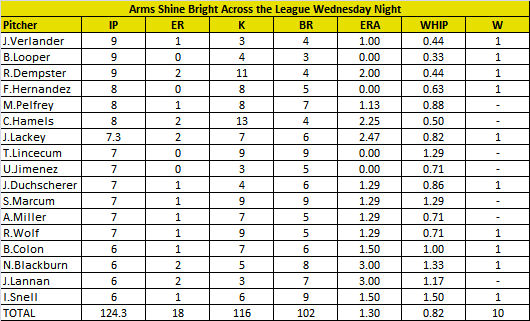
Perhaps it was just because several of these performances found their way onto my fantasy teams, but I don’t remember the last night that this many pitchers were on their game. There were 17 really strong games thrown on Wednesday and it’s not like all of the #1s were going; only five of the gems were out of bona fide aces.

Three complete games and three others going eight innings. All told there were nearly 14 games of 1.30 ERA ball (124.3 IP divided by nine). Reliever turned starter Braden Looper turned in the game of the night with a complete game shutout as Hernandez, Lincecum and Jimenez joined him by holding their opponents to no runs. Cole Hamels paced the crew with 13 strikeouts and Ryan Dempster (!) was close behind 11 of his own. No one posted worse than a 3.00 ERA meaning any combination of this group yielded a very impressive evening for your fantasy team.

A Painful Season Continues…
The disabling of Victor Martinez, Albert Pujols and Alfonso Soriano continued the 2008 ravaging of fantasy baseball teams. There was a message board this morning about the overwhelming rash of key players missed for periods of time due to injury this season and it was jaw-dropping to see.

I wouldn’t even begin to pretend to have an answer as to what is going on or even speculate just to feel like there is a specific reason. What I do know is that having a couple of these players on a roster can decimate a team’s chances. Seeing 14 starting pitchers on the list offers just one more (of the hundreds) reason not to invest heavily in “surefire” aces. Injuries happen, but this seems more like a season-end list of them as opposed to one we’d see nearly two and a half months into the season.

Thursday: 06.5.2008

National League All-Stars Through May

After posting my American League All-Stars yesterday, I’ll head over to the Senior Circuit today. Let’s get right into it:

Catcher
Brian McCann, Atlanta Braves – This one was really tough because McCann and Geovany Soto have nearly identical statistics. The difference maker for me was that McCann has struck out 31 fewer times (53 to 22) than the Cubs rookie. That discipline has been key in McCann getting back to the level of production exhibited in his breakout 2006 season.

Honorable Mention: Geovany Soto, Chicago Cubs
– He is only 12 points behind McCann in OPS and they each have the same 30 extra base hits (19 2B, 1 3B and 10 HR) while Soto holds a six RBI edge with 39. He became such a hot sleeper in the off-season that come draft time he actually lost his sleeper status. Prior to last year, he was a virtual unknown, but a 26-home run season in Iowa put him on the radar. Consider that during his previous 1574 at-bats in the minors, he had all of 25 home runs.

First Base
Lance Berkman, Houston Astros – There might not be a deeper position in baseball than first base in the National League, yet Berkman still managed to separate himself from the competition. He has a 1.213 OPS powered by 41 extra base hits (out of 84 total hits) including 17 home runs. The lineup around him has cashed in several times as Berkman leads the league with 57 runs scored. As if all of that weren’t enough, he also has a 0.94 strikeout-to-walk ratio and 10 stolen bases! If Vegas put odds on a Triple Crown winner, his would be the smallest of the bunch. (Or is it highest? Whatever conveys they’d be the toughest to win money on…)

Honorable Mentions: I have to give a pair of these, both are very deserving.
Albert Pujols, St. Louis Cardinals – Congratulations is in order for all of those fantasy owners that didn’t buy into the preseason hype that he’d miss massive time this season. He’s been his usual MVP-self.

Adrian Gonzalez, San Diego
– He is showing amazing power this season, PETCO park be damned. Eight years ago, he was the #1 overall pick for the Florida Marlins in the 2000 Amateur Draft. He is now paying dividends on the elite status that comes with being the first pick.

Second Base
Chase Utley, Philadelphia Phillies – Do I even need to expound upon this selection? Utley is one home run away from last season’s total. Not pace, total. There isn’t a category he is failing in as he has also chipped in six stolen bases to go with all the incredible run production. Provided he continues to rake through September, his 2008 season might unequivocally place him in the top 5 for 2009.

Honorable Mention: Dan Uggla, Florida Marlins
– Ouch, talk about getting Magglio’d! Uggla is having a tremendous season as he sets his sights on a third straight season of home run improvement. Unfortunately, he is being overshadowed by the otherworldly season being turned in by Utley.

Third Base
Chipper Jones, Atlanta Braves – Another walkaway win that needs little explanation. Jones is chasing down .400, but it’s far from an empty batting average. He also has 13 home runs, 38 runs batted in and 42 runs scored. Did I mention he is getting on base almost 50% of the time? Thanks in large part (well the large part is probably the .411 average, but you get the point) to 35 walks against just 22 strikeouts he has a .494 on-base percentage.

Honorable Mention: David Wright, New York Mets – He has been the superstar that we all expected coming into the season; a legitimate across-the-board threat that has done his best to keep the Mets above water. His .286 batting average isn’t blowing anyone away, but it’s hardly damaging and once a few more hits fall his way, he’ll be well into the .300s again.

Shortstop
Hanley Ramirez, Florida Marlins – Debates raged on over the off-season as to whether or not Ramirez could be worthy of the #1 overall pick given his power-speed combination, but then some injury concerns bubbled up regarding his shoulder and the #1 overall talk stopped. Now he is running a near 30 HR-40 SB pace and is once again one of the best players in the game.

Honorable Mention: Jose Reyes, New York Mets
– A solid, if unspectacular year for Reyes thus far that lacks the overwhelming, dominating speed. The power surge just about makes up for the speed dip.

Outfield
I’m resisting a strong temptation to put the entire Pirates outfield as my NL All-Star Outfield. I don’t think it’d be completely unreasonable, but I’m resisting it even still. For as excellent as the infield is, the outfield is less-than-stellar.
Nate McLouth, Pittsburgh Pirates – Since August 1st of last year, McLouth has 23 home runs and 21 stolen bases with a .299/.396/.565 line. Like Soto, his sleeper status was just about erased by the time draft season rolled around. Nevertheless, he was one of the league’s best players in April.

Ryan Ludwick, St. Louis Cardinals – Yep, I did it. I know he hasn’t played full time the entire year, but he qualifies for the batting title and has the best OPS among National League outfielders. His overwhelming power has never been an unknown, but he has never really been given the playing time in the majors to succeed.

Jason Bay, Pittsburgh Pirates – OK, so I still took two out of three. Bay was a colossal failure last year, but he regained his batting eye and it’s led to a rebound. Last year, he walked a total of 59 times. This year, he is already at 41 and he is on pace for a career-high. His five stolen bases tops his 2007 total by one and the 13 home runs put him on pace for a career-high 36 at year’s end. Welcome back, Mr. Bay.

Honorable Mentions:
Pat Burrell, Philadelphia Phillies
– Every year the guy mashes in April with a .943 OPS and 13 home runs across 225 at-bats during the past three years. This year was no different with a 1.135 OPS and eight home runs in 89 April at-bats. During the same three year period, he tails off significantly in May from a batting average standpoint but remains a viable on-base and power threat. This year was no different with a .227 average but .378 OBP and five home runs over 88 May at-bats. The guy is a model of consistency for inconsistent. He might frustrate you, but if you’re a Roto owner and you get him just ride his ups and downs out and you’ll get what you paid for by the end of the season.

Aaron Rowand, San Francisco Giants – Everyone expected a huge drop off with the move to San Fran because of a worse park and far worse lineup. Rowand continues to excel and should he keep pace, he will actually improve upon his batting average and RBI totals.

Ryan Braun, Milwaukee Brewers – In proving last year was no fluke, Braun is on pace for 43 home runs and 126 runs batted in with a .299 average. He hasn’t shown nearly the same plate discipline of a year ago, but he is getting the job done and justifying his late first-early second round status.

Starting Pitchers
Edinson Volquez, Cincinnati Reds – I can’t remember a trade in recent memory ever working out so well for both teams. Josh Hamilton for Edinson Volquez was one of the sidenote moves of the off-season, but it has yielded two of the young season’s best stories. Volquez’ walks remain scary, but his other peripherals show he can live with the shaky control.

Tim Lincecum, San Francisco Giants
– This is why you don’t chase wins. The knock on Lincecum all off-season was that he’d be a great asset to ratios and strikeouts, but wouldn’t notch many wins at all on the Giants. He’s been an asset in the ratios and strikeouts, but he’s gotten the team support good enough to rack up seven wins. So unpredictable is this stat that it’ll make you absolutely crazy trying to figure it out. Draft skills.

Brandon Webb, Arizona Diamondbacks – Ho-hum, another dominating season for Webb. All the talk of Peavy and Johan as hands down 1-2 left Webb undervalued by comparison given how absurdly reliable he has been over the past few seasons. He is enjoying his fourth straight season of increases in the strikeouts per nine yet has kept a flat line of consistency across his pitches per inning, plate appearance and game numbers.

Middle Relief Pitchers
Hong Chih-Kuo, Los Angeles Dodgers – He is a pitching version of a utility infielder. He can start, long relieve, short relieve and he could probably close. And he can do all of those things very well, he’s not just some rubber-armed clown that the Dodgers ride. He has a 10.3 K/9, a 1.4 BB/9 and a 0.68 ERA as a reliever.

Carlos Marmol, Chicago Cubs
– He has closer stuff, but given that the most high pressure situations usually come before the ninth inning, he might be a more valuable asset to the Cubs as their 7th/8th inning guy. He was amazing last year and things haven’t changed much for 2008. His control can be shaky, but it’s hard to complain when you see the 13.5 K/9 rate.

Closer
Kerry Wood, Chicago Cubs – For most, it’s been a matter of if, not when for Wood losing the closer’s job due to injury or ineffectiveness. But Wood has taken to the new role very well and it looks like the only thing that could slow him down is the injury bug he is all too accustomed with during his career. Most impressive about how season thus far is the 6:1 K:BB rate. The 16 saves are tied for the National League’s best with Jose Valverde and Brian Wilson. Of those three, his 2.78 ERA is the best.

Wednesday: 06.4.2008

American League All Stars through May

We’re still over a month away from the Midsummer Classic in the Bronx, but with two full months passed, I wanted to start looking at who I’d put on the All-Star team for each league at this point in the season. For this practice, I’m just going to cover the starter and then an honorable mention. I’m not going to adhere to the every-team-gets-a-player rule since I’m not picking the full team and my picks are going to be in line with the thinking that almost all of the weight is given to the games played this year, that way I’m in line with how the game usually plays out. One final note is that I’m more concerned with fantasy production that “real” baseball production meaning defense is factored in much less. I’ll look at the American League tonight:

Catcher
Joe Mauer, Minnesota Twins – His lack of power doesn’t preclude him from the All-Star Game and hey, he finally got that first home run this week! He has the best OPS of catchers qualified for the batting title (.826), though it’s powered by his .411 OBP that is just four points shy of his slugging percentage. Anyone with a 0.5 K:BB is going to find their way into my lineup.

Honorable Mention: Dioner Navarro, Tampa Bay Rays – He missed some time due to injury, but anyone that adds 158 points to their OPS from the previous season is going to get a look from me. Of course, if the OPS move is from .500 to .658, I don’t care. But .642 to .800 shows some solid improvement if only in a limited sample.

First Base
Kevin Youkilis, Boston Red Sox – What isn’t he doing so far this year? He’s hitting for power as his nine home runs are just seven away from his 2007 total. He hasn’t stopped hitting for average or taking bases on balls with a .305 average and .373 on-base percentage. And he’s displayed some solid speed with two triples and three stolen bases! At least at first base, there is quite a bit more competition than the catcher position we just covered. Even still, Youk has set himself from that competition with great showing across the board.

Honorable Mention: Jason Giambi, New York Yankees
– Spare me the “he’s hitting .253” pleas because a mere three more hits would have him right near .280 and there’d be nothing gripe about on that front. His comeback season has only seen 154 at-bats thus far, but he has 11 home runs already. His fantastic batting eye hasn’t failed him either as he carries a 0.9 K:BB. Yes, that is similar to Mauer in that they both have more walks than strikeouts! What’s more impressive about it from Giambi’s standpoint is he is a power hitter, a profile prone to striking out.

Second Base
Ian Kinsler, Texas Rangers – Anyone familiar with my fantasy axioms knows how much I LOVE power/speed combos. Kinsler fits that bill. I think there might some published work floating around the net that saw me predicting a 30-30 season for him last year. He went 20-20, but only got to play 130 games thanks to injury. I’ll lean on that excuse as the reason he felt short! He has picked up right where he left off with seven home runs and 16 runs batted in. He has more than half the extra base hits he had a season ago with less than half the games played.

Honorable Mention: Jose Lopez, Seattle Mariners
– This pick assumes standard league settings that use batting average and not on-base percentage, in which case I’d take Brian Roberts or Placido Polanco. At any rate, Lopez is hitting nearly .300 while scoring as many runs as can be expected on that ball club and including a pinch of power with four home runs.

Third Base
Alex Rodriguez, New York Yankees – But Paul, he doesn’t even have enough at-bats to qualify for the batting title! But reader, he is still leaps and bounds better than anyone else at the position in the American League. His eight home runs place him third behind Adrian Beltre and Joe Crede. Beltre has five more home runs in about 80 more at-bats while Crede has a whopping one more in about 40 more. He has a much better average and OBP than either and he’s right there or ahead of both in runs scored and driven in. His six steals are best amongst them as well, just for good measure. He’s the best player in the game.

Honorable Mention: Mike Lowell, Boston Red Sox – As much as it pains me to put a Yankee and Red Sock as the two picks, I have to be objective about it. Lowell also missed time yet he has still put up the numbers worthy of inclusion to this discussion. He has come off the career-year numbers set last year, but even heading back down near career norms still make him a great option.

Shortstop
Michael Young, Texas Rangers – You want to take about position scarcity? Take a look at shortstop in the American League! Even lowering qualifications down to just 100 at-bats still couldn’t yield a shortstop with an OPS over .800. The Senior Circuit churns out eight such players with the same filter. Nevertheless, Young is about as steady as they come in this game. Looking for a bankable .300 average and 9-14 home runs at short? Pick Young. He’s the type of set it and forget it producer that makes roto players sleep a little easier at night.

Honorable Mention:
None – a homely bunch to say the least.

Outfield

Josh Hamilton, Texas Rangers
– Do I really need to go into details? The kid is positioning himself for a Triple Crown this season (though he is VERY unlikely to get it). That alone is enough to put him in this game and be pleased with his growth. Throw in the story of where he has come from after being a #1 overall pick turned bust turned budding superstar and you’ve got a nice Hollywood movie on your hands. Hamilton is baseball’s MVP right now and he needs only his numbers to back that up, the story is surplus.

Carlos Quentin, Chicago White Sox – Imagine if the Arizona Diamondbacks still had him and he was coming into his own in their lineup instead of Chicago’s! He’s being Magglio’d by Hamilton so far this season. Being Magglio’d, for the uninitiated, is when you’re having an amazing year that would be praised and lauded non-stop during most seasons but gets overshadowed by someone having an off-the-charts season at the same time. A-Rod managed to have a good enough season last year that Magglio Ordonez’ career year was back-burner fodder. Quentin has 15 home runs and 50 RBIs in 198 at-bats so far this season which is one home run better and just 13 RBIs short of his career totals in 395 previous at-bats with the D’Backs.

Grady Sizemore, Cleveland Indians – As with Giambi, I don’t want to hear about his batting average being .253 because he’s just five hits away from a .280 average. I know he didn’t get those five hits so we shouldn’t pretend that he did; the point of saying that is to illustrate how misleading batting average can be when context isn’t given. All he has done is slug 11 home runs and score 32 while driving in another 30 (in that garbage lineup) with 14 stolen bases from the leadoff spot. And an OBP league doesn’t even notice the batting average since he has a tremendous eye that has helped him get a .371 on-base percentage. He remains one of the best players in fantasy baseball. I ranked him 12th overall in my preseason Top 100 Rankings and I stand by that ranking. The kid is a bona fide franchise player.

Honorable Mentions:
Manny Ramirez, Boston Red Sox
– Left for dead after an un-Manny-like 2007, all he has done so far this year is pace himself for another .300-30-100 season. Manny being Manny indeed.

Magglio Ordonez, Detroit Tigers – You’ll get no argument from me that last year was absolutely a career year, but admission of that for some seemed to them to thinking that Ordonez would be a 2008 flop. He has been the only constant in the heavily disappointing Tigers lineup.

Jacoby Ellsbury, Boston Red Sox – Leading the league in stolen bases while putting up solid numbers everywhere else is worthy of attention and it has nothing to do with Red Sox bias (I’m not a fan of the insufferable Red Sox Nation). My friend, who owns him in our AL-Only, has been talking this kid up for a couple of years now and Ellsbury is making my buddy look smarter by the day.

Starting Pitchers
Cliff Lee, Cleveland Indians – Even the non-believers have a hard time punching holes in Lee’s season-to-date performance. Even the poor outing tonight only raised his ERA to 2.45. Beyond that he has a splendid strikeout-to-walk ratio at 5.4 powered by a 7.6 K/9 – his highest since 2004 (8.1). He is riding a career high 1.46 groundball rate to the Promised Land. Considering he has ranged between .71 and .79 his entire career, a regression could be in the future for him. Nevertheless, if the game is today, he gets the ball.

Roy Halladay, Toronto Blue Jays
– Speaking of amazing K:BB ratios.. Halladay is back to his elite levels from 2003 and 2005 with his 6.17 K:BB ratio of 2008. He has used improvements in both strikeouts and walks per nine to achieve the excellent ratio. Despite moving from 5.6 to 7.1 in K/9, he is actually throwing one fewer pitcher per inning, down to 13.8. This has helped him finish five of his 12 starts putting him on pace to crush the seven complete games he had in 2007. The guy is extremely reliable and his ability to pitch, as opposed to throw, portends a career well into his late-30s. He gets the strikeout when he needs it, but he doesn’t rely on it exclusively.

John Danks, Chicago White Sox – The southpaw is coming along much faster than expected after a rough rookie season. In those 139 innings last year, he had some solid indicators, but it seemed like the 23-year old would need another year or two of seasoning before he could be relied upon in the fantasy landscape. Thus far, he’s shown that thought process to be a load of crap. Danks has 180’d from a 0.8 to 1.64 groundball rate while keeping his strikeouts per nine at just over seven. He has shaved nearly an entire walk off of his rate down to 2.6 helping instill confidence that his first 63 innings of 2008 are no fluke. Anyone looking to towards the future already would be wise to invest in him for their keeper leagues.

Middle Relief Pitchers
Jesse Carlson, Toronto Blue Jays – What can you say about a rookie that handles high pressure situations with a 9.1 K/9 rate and strikes out nearly three times as many batter as he walks (2.9) all the while doing a great job at preventing runners from scoring (1.59 ERA)? You can say he is a middle relief All-Star as far as I’m concerned. With middle relievers, you could hand out 15 spots easily, but Carlson holds up well against anyone else.

Santiago Casilla, Oakland Athletics – I realize he is on the disabled list, but his excellence prior to the stint shouldn’t go unnoticed. It took him forever to even give up a run and even still, it’s happened just twice. In his 19.3 innings, he has 22 strikeouts and four walks. It’s a real shame that he got hurt because who knows where his numbers would be otherwise.

Closer
Mariano Rivera, New York Yankees – 0.36 ERA, 0.50 WHIP, 13.0 K/BB, 9 K/9 and 0.7 BB/9. The 38-year old Rivera was left for dead a season ago because he “only” saved 30 games and had an ERA above 3.00 for the first time ever. Nobody bothered to notice that he had his highest strikeout rate since 1996 and walked all of 12 batters in just over 71 innings. His four blown saves were right in line with what he usually does in a season. I am no fan of the Yankees, but I won’t let my dislike for them prevent from bettering my team with their players. Rivera was an absolute bargain in just about every league this year and this record setting effort is emphatically letting everyone know that he’s not done yet.

I’ll look at the NL tomorrow and perhaps some awards races on Friday. Thanks to everyone for your responses on the power piece. I got some great emails and I really appreciated the feedback overall.

Sunday: 06.1.2008

Player Focus 6.1.08

I spent the past two evening researching for an article I’ll post on Monday which is why I didn’t have any updates for Friday or Saturday. All of the data needed has been collected so I’ll finish writing the piece of post late tonight so it’s available on Monday morning. For now, some player looks:

Chipper Jones Rebounds from 0-fer with 2 hits
There has never been a question of Chipper Jones’ talent. And until 2004, he was on track to be a surefire first-ballot Hall of Famer, but then the injury bit him, and bit hard. From 1995 to 2003, Jones played less than 153 games just once and it was 140 of Atlanta’s 144 games during the strike shortened 1995. Since then he hasn’t played 137 in any season. The first year that he lost to injuries was also his worst ever despite 30 home runs and 96 RBIs as he hit just .248. The .847 OPS he had that season just goes to show how amazing of a player Jones is even in a down season.

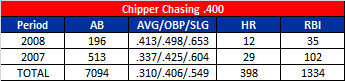
Last year saw Jones net 500 at-bats for the first time since 2003 and he responded with a brilliant season that included 29 home runs and a .337 batting average. He has carried over that excellence in the early part of 2008, hitting over .400 at the June 1st post. With a 2-for-3 (and 3 walks) effort on Saturday, Jones rebounded from an 0-for-5 to ensure he would enter June above the famed .400 mark. Ted Williams’ .406 from 1941 stands as the last time the feat was accomplished and I’m not going out on a limb when I say that it will still be the last time when the 2009 season opens up.
Chipper Jones\' Quest for .400
I’m comfortable trotting out the same reasons against a .400 season that we see anytime anyone is flirting with the mark into late May/early June. The primary of those being that the media pressure as the calendar flipped to September would be too much for ANY man to handle. In this day and age of over-analysis for even the most minor of stories, can you imagine the amount of coverage that would be given to a feat that hasn’t been accomplished in 67 years?! If you thought ESPN was obnoxious now…

It bears mentioning again that hitting a baseball is so difficult that the elite are permitted to fail 7-of-10 times to achieve their status. Despite how hard it is to accumulate hits, we’re now asking for more than one in most games because a simple 1-for-4 or even 1-for-3 effort will lower his batting average! Consider that Williams “only” hit .406 in 456 at-bats and he’s widely regarded as the best hitter the game has seen. Jones’ feat would probably require at least 50 more at-bats and even if he approached the 450 at-bat mark with a .406 average, that’s a pretty small margin of error for that homestretch. Finally, Jones has a great batting eye, but it’s not good enough to propel a run at .400. He has a 14% walk percentage for his career which shouldn’t be scoffed at, it’s tremendous. The 15% rate through May 31st is a big reason why he has been on base at a nearly 50% clip so far this season. Again, it falls short when you start talking about a .400 season… by a lot! Williams posted a remarkable 24% walk percentage during his magical run at .400 and a 21% rate for his illustrious career. Sorry Braves fan, it just isn’t happening.

Ricky Nolasco on Fire of Late
In 2006, the Florida Marlins had to have been impressed by their 23-year old rookie who had put together a solid 11-11 season with a 4.82 ERA in 140 innings. There was plenty of room for improvement, no doubt, but it was definitely a nice foundation to build upon. An elbow injury limited him to 21.3 innings in 2007 making this year his second season for all intents and purposes. He came out of the bullpen for his first two appearances and tossed 5.7 scoreless innings. He joined the rotation on April 11th and promptly allowed five earned runs in five innings, but managed a win nonetheless. His second start was even worse with six earned runs in 4.7 innings and eventually the loss. In the eight starts since then, he has allowed more than three runs just once lowering his ERA nearly two runs in the span from 6.46 to 4.48.

His peripherals over the past three starts are in line with his 2006 totals. In the end, Nolasco likely isn’t a pitcher that should be relied upon to do much more than what he did in 2006. He could shave up to half a run off of the ERA and settle in around 4.30, but that likely stands as the upside at this point. I would tread VERY cautiously in standard mixed league formats (i.e. 10-12 teams), while those over 12 teams with reserve rosters might want to consider stashing him. I doubt he’s available in NL-Only leagues, but he should obviously be picked up if he is on the wire during your transaction period.

Thursday: 05.29.2008

Caught Empty-Handed?

During the preparation season (October to March if you’re like me), there are tons of debates that get looked at from every possible angle. One that comes up annually is position scarcity. Is it better to have the best at a scarce position or just fill the gap with something moderately adequate and hope that maybe you capture a breakout season in a bottle? This year it was quite clear that catcher was the thinnest position. (Note: I also believed outfield to be far more scarce than many believed, but it’s a different beast in that some of the game’s top producers are outfielders and stocking up on them early doesn’t carry the potential disadvantages of getting a top catcher early on.)

It was viewed as the 4 M’s and then the rest. Russell Martin, Victor Martinez, Joe Mauer and Brian McCann were the elite while almost anything else was table scraps by comparison. Geovany Soto and J.R. Towles were appealing rookies that got a lot of attention based mostly on potential. So back to our question, would you be paying the premium for an M or waiting on the flotsam? I’ve always been firmly entrenched in the flotsam camp. I’m not saying I get the absolute worst of the worst, but I’m definitely hoping to get two $1 lottery tickets in the auction. That is, two $1 catchers that have some level of silver lining that could lead to a quality season. At most, I’ll budget $10 to fill the two catcher spots. In my draft leagues, I usually designate a set of value guys and take them once only a couple of teams need catchers.

To me, spending the extra resources (draft pick or auction dollars) to maybe get top quality production at catcher just isn’t worth it. The 4 M’s are some quality baseball players, but it’s not like I get them AND the same outfield or the same trio of corner infielders that I would’ve gotten by not investing those extra resources. My point is, your team will take the hit somewhere. Is it better to take the hit in catcher or any other position? The answer, plain and simple, is any other position. And there are several reasons for this answer.

First is that the position is a defensive one; hitting is secondary for almost every catcher. Regardless of how well they hit, a catcher’s first job is to run the pitching staff and quarterback the defense… or at least it will be if the manager has his way. That doesn’t mean that they care less about hitting, but their management is likely to ignore some struggles at the dish if they are calling their games remarkably well and engineering a crisp defensive unit. It’s a very cerebral position that puts a lot on a guy’s plate and sometimes the hitting gets pushed to the side. Ever notice how many former catchers are currently managing teams?

Second is that the position takes a toll on the body! One of the reason it is hard to get quality numbers out of catchers is because they just don’t play as much as other players so they can’t pile up counting stats. Usually it’s simply the nature of being a catcher is conducive to planned off days, but oftentimes injuries occur and they miss extended periods of time. There is a reason that players move from behind the dish after a few seasons. Craig Biggio started out as a catcher and so did Carlos Delgado & B.J. Surhoff. Neither would’ve lasted as long as they did (or are in Delgado’s case) without moving to a new position. Victor Martinez played 30 games at 1st base a season ago and 22 the season before that—he is slowly making the transition. Already this year he has four games logged as a first baseman.

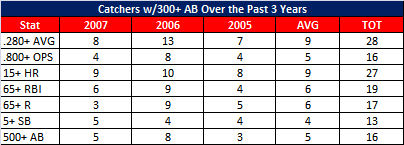
Reasons 1 and 2 lead to volatility in the already depressed production of players at that position. To put it simply: too much can go wrong when investing heavily in catchers at the expense of another position. Consider the following table:

2005-2007 Catchers Production

Ouch, that’s pretty awful, isn’t it? So what’s my point? Looking at the three year averages of production across the key statistics in fantasy baseball, there isn’t even enough at any statistic for one per team in a 10-team league. And 12+ team leagues are far more common meaning things are even thinner in your average league. That coupled with the fact that there are no sure things at catcher (isn’t that right, Mr. Martinez?) means you should avoid investing heavily at the position. The best way to optimize your chances for winning is to mitigate the risk. You can’t play it safe across the board, but when taking risks you assess the level of risk against the potential reward.

When analyzing catcher, the risk-reward says you’re better off with Dioner Navarro and Chris Snyder at a dollar apiece or a late round pick than Russell Martin or Victor Martinez for several dollars (varies greatly by league) or in the first 2-3 rounds. Navarro was brutal last year with a .641 OPS, but digging deeper reveals an .815 OPS after the break. Most owners would only see his overall numbers and probably laugh when you roster him for a $1 or in the reserve rounds of your draft. Now he has an .862 OPS in 118 at-bats. Snyder’s 13 home runs from 2007 likely had him on more radars than Navarro, but the .252 average and 47 RBIs likely kept his draft position and auction price low. His .889 post-break OPS, powered by a .386 on-base, screamed buy to me and now I’m enjoying his .842 OPS and 26 RBIs in several leagues.

Both of these players may look like hindsight 20-20 picks and I can’t necessarily prove that they aren’t so you’ll have to trust me. I’m simply making a point that a little extra homework can save resources from being wasted and enhance your chances for winning your league. Even if that same homework results in a Carlos Ruiz (.595 OPS) or Kurt Suzuki (.614 OPS), it freed up resources (in the form of auction dollars or your higher level draft picks) that ensured you weren’t stuck relying on an Andruw Jones or Eric Byrnes as a #1 or #2 outfielder. Acquiring a top catcher means you will have to cut corners elsewhere and it’s wiser to cut corners at catcher than it is at any other position. By the way, the mention of Martin may draw the ire of some who look at his line and say he’s doing just fine. He hasn’t been abysmal, but he’s on pace for 9 HR and 12 SB when many projected a near 20-20 season again after last year’s 19 HR-21 SB. Factor in the price paid to get him (leagues in which he was a keeper notwithstanding) and he is whatever the level is just before “abysmal”.

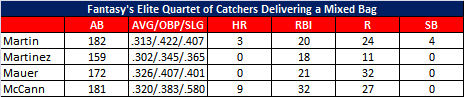
As the calendar flips to June, the preseason catcher quartet shows the one ranked 4th producing the best by a landslide:

I’ve already covered Martin. Mauer has been a bust in the power department since day 1 for the most part so his homerless streak isn’t terribly surprising, but the owners that have 0 HR-11 R-18 RBI out of Martinez thus far probably get sick every morning when they sift through the boxscores. The only one on par with McCann thus far? The rookie of course. Geovany Soto has McCann matched in home runs with 9 to go with his 36 RBIs, 21 runs scored and .301/.396/.563 line. Three of the four catchers widely regarded as the only sure things available are vastly under performing against expectations and the fourth was often rated the lowest only further showing how uncertain the position can be for fantasy owners.

This subject will be revisited throughout the season and at length again in the off-season.