Archive for ‘Off-Season’

Sunday: 12.5.2010

The Nationals Land Their Whale

In recent winters, the Washington Nationals have thrown their hat into the ring for several big name free agents, most notably Mark Teixeira during the 2008-2009 winter, but in the end, they were left telling their fans, “Hey, at least we tried and that shows our commitment to winning, right? … RIGHT???”  A Nats fan honest with himself probably realized that while the effort was nice, it was probably for the better that they didn’t come away victorious.  After all, how much positive impact would big a signing like Teixeira really have on a team like the Nationals?

If anything, it may have been detrimental to the team as a whole as a few more wins could have cost them the chance to draft then sign two of the most highly touted prospects ever in the past two drafts, first Stephen Strasburg and then Bryce Harper; both #1 overall picks.  The world got a taste of what Strasburg could be this year before he was cut down with an injury that has led to Tommy John Surgery while Harper made the most of his limited time in the Arizona Fall League and continued to draw rave reviews about his potential.

Both of their franchise players are at least a year away (and Harper is probably two or more) so would it behoove the Nationals front office to again put their best forward with some of the winter’s premier free agents?  The answer for them was a resounding yes with the surprise signing of outfielder Jayson Werth to a 7-year, $126 million dollar mega-contract.  A jaw dropper to be sure.  I’ll say out front that I don’t much care for the deal and it is less about the money than the length and player.

As a Detroit Tigers fan, I’m well aware that sometimes teams have to pay a little more because of their situation and/or city (definitely both for the Tigers pre-2006, now just the latter), but I would have liked to see the Nats go for a more calculated risk.  In the winter of 2004, the Tigers signed Ivan Rodriguez to a 4-year, $40 million dollar deal on the heels of a disgustingly bad season during which they nearly set the MLB record for losses (43-119).  Though Rodriguez was 32 years old, he was coming off of a great year for the World Series champion Florida Marlins and had a lengthy track record of excellence behind him.

A year later they took a much bigger chance and signed Magglio Ordonez to a massive 5-year, $75 million dollar deal after a season during which he played just 52 games thanks a severe left knee injury.  They had protection built in just in case Ordonez didn’t heal properly, but it was still a big risk and they were betting that he would return to something close to the .300-30-100 level he’d established from 1999-2003.  I don’t think anyone expected Ordonez to earn 100% of the contract (and he didn’t, even with the MVP-worthy 2007 season), but the Tigers really just needed him to not suck and along with Rodriguez, create a culture that was conducive to acquiring even more of the many missing pieces.  He didn’t suck, hitting .320/.382/.495 with 90 HR and 422 RBI over the life of the 5-year deal.

The Nats need Werth not to suck more than they need to him to earn him 100% of his huge deal, but they made it that much harder by going seven years for a guy whose track record is just two *full* seasons deep (as well as an excellent 134-game campaign on his ledger).  He was riddled by injuries from 2003-2007 (and missed the 2006 season entirely) and though he has shown the talent in the last three seasons that led to four top 100 rankings by Baseball America (’99, ’00, ’02, ’03), he’s far from a sure thing going forward.

He can be a 2.5-3.0 WAR player (think Hunter Pence, Alfonso Soriano, Nick Markakis level from 2010) after the first year or two of the deal as long as he is playing 140+ games a season because at least then he is not dead money on the disabled list.  Sure, the Nats are hoping he can continue to pump out 5.0 WAR seasons as he has over the last three, but you have to be realistic about a 32-year old late bloomer.  The last thing the Nats want to see is Werth out of the lineup with injuries just as their core is coming together.  Given that there is a pretty decent chance that that could happen, I think the deal was altogether ill-advised.

I’d have rather seen the Nationals blow Carl Crawford out of the water with a 7-year deal than take the consolation prize before the grand prize has even been given out.  But if Werth had to be the guy, I’d have much rather seen 5-years, $95 million taking it from $18mil to $19mil per but slicing off two years.  I genuinely hope it works out for the Nationals, but the odds are stacked rather heavily against it.

Monday: 11.29.2010

Javier Vazquez Joins the Marlins

My least favorite move of the Hot Stove season last winter was the Atlanta Braves trade of Javier Vazquez to the New York Yankees. First off, I just didn’t like the return the Braves got for Vazquez who was coming off of a brilliant season, the best of his career. Upon further review, Arodys Vizcaino is a much more heralded prospect than I originally realized so that helped the deal. He is just 19 though, so he’s far from a sure thing.

And judging the trade as a whole now after the 2010 season and into the 2011 Hot Stove really shifts the advantage to the Braves. Not only was Vazquez a total flop in New York (5.32 ERA, 1.40 WHIP, nearly -3.0 K and 2.0+ BB difference in his per 9 IP rates), but the Braves were able to flip Michael Dunn, another part of the package from New York, to the Florida Marlins for Dan Uggla.

At the time though, I mostly disliked deal from a selfish fantasy baseball angle. I bought in heavily on Vazquez in the spring of 2009 and reaped significant benefits from his Cy Young-quality season and planned to do the same in 2010 as a well-priced keeper in NL-Only leagues only to have that plan dashed with the trade. Granted, no one cares about my fantasy fortunes one way or another, but Vazquez shifting back to the American League was a loss globally as his best work had always come in National League.

Over the weekend, Vazquez and the Florida Marlins agreed on a 1-year deal worth $7 million with both a full no-trade clause and a clause stating that the Marlins can’t offer him arbitration next winter. The former isn’t terribly worrisome as I’m sure Vazquez would waive it to go to a contender (non-New York division) if the Marlins were languishing through a terrible season and looking to move him. The latter is definitely a significant concession for the Marlins, but in return they no doubt got to drop the price on the contract.

It would have been nice to have the compensation pick potential, but I don’t think it should have been a deal breaker so I applaud the Marlins for making sure they got a discount in return for the arbitration concession. Early reports had teams offering Vazquez a 2-year pact worth about $20 million, but Vazquez refused to look at anything more than a year so the Marlins landed a $3 million dollar discount for the two clauses Vazquez wanted.

It’s hard to pin a value on Vazquez for 2011 and that could result in his being severely discounted as he was heading into 2009. The struggles he had in New York last year weren’t necessarily unexpected as many predicted a substantial drop in value, but the level to which he struggled was a surprise. He has always been home run prone and that was only exacerbated in Yankee Stadium with a career-worst 1.8 HR/9. His home run rate climbed from the previous year during his first stint with New York so I’m not sure what the Yankees were expecting with an even more homer-friendly home park.

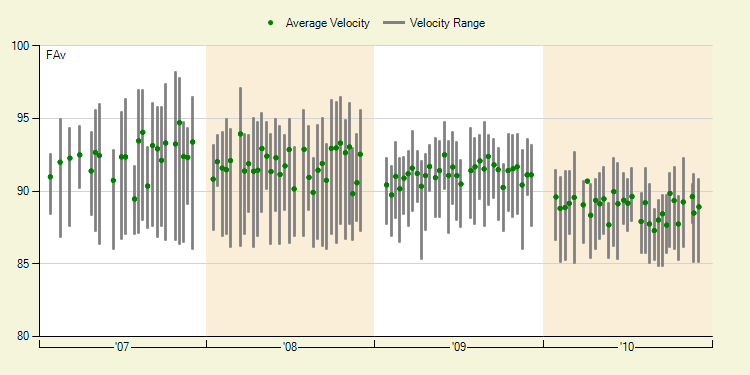
The most alarming factor from his 2010 meltdown was the drop in velocity. This has become a hot topic since rumors of his signing began swirling including a deeper look at it from FanGraphs.com writer Dave Cameron. Cameron isn’t hopeful that he can regain the lost speed and without it, he isn’t sure Vazquez can be of much value.

Given his career workload, I wouldn’t bet on Vazquez’s fastball ever coming back. And if it doesn’t, well, the Marlins just risked $7 million in the hopes that he can teach himself how to pitch without his main weapon. That’s a pretty substantial risk for a team that isn’t exactly rolling in money.

Here’s a chart from FanGraphs showing the drop in velocity:

A drop in fastball velocity is never a good thing, so I won’t try to make that case, but I’m not sure that it is a complete doomsday scenario if his velocity plateaus at the new level. He still has a plus changeup and a plus curveball to fall back on. Instead of relying more on fastball generated swings & misses, he will need to become a better “pitcher”, more crafty if you will. His flyball tendencies (41% career rate, 0.96 career GB/FB rate) won’t hurt him nearly as much in Sun Life Stadium as they did in Yankee Stadium and his strikeout and walk rates are more likely to move back toward his career rates than they are to stay where they were in 2010 just by virtue of the fact that he is back in the National League.

I wouldn’t make too many judgments based solely on his disastrous 2010 when he is also a year removed from a season that earned him Cy Young consideration. Plus he has a bit of a Bret Saberhagen thing going with every other year ERA spikes and drops and though I’d be reticent to bet on a theory like that, he has done it every year since 2000. I’m definitely willing to invest in his 13-season track record as opposed to shying away based on his worst year since his rookie year of 1998. If a sub .500 record and 4.67 ERA in 2008 held his value down going into 2009 despite strong supporting skills, then I can’t imagine having to pay much to take a chance heading into 2011 after the bottom fell out on his numbers in 2010.

Vazquez will be on my radar for 2011 and he won’t need to post a 2009 line to return a profit.

Monday: 11.15.2010

AFL Scouting Report – Brandon Belt, SF

I remember seeing Brandon Belt (1B) here at the University of Texas in a handful of games I attended across the 2008 and 2009 seasons.  My thought coming away was always, “How is he not better?”  He definitely looked like a ballplayer and he would have good plays here & there, but terribly inconsistent. He hit a pedestrian-for-college .321 in 124 games but showed exceptional plate discipline (67 BB to 74 K) and a modicum of gap power.  The only thing that really jumped off of the stat page was his 15 steals in 2009.  You just don’t expect 6’5”/195 first basemen to run much at all let alone swipe double digit bags.

To be 100% honest, I kind of forgot him once he left.  It wasn’t until early this summer that I saw he was in the San Francisco system putting together a solid beginning to the season.  Earlier this month I saw him at the Arizona Fall League in Phoenix and came away with a completely different outlook on him.  I learned from some scouts that the Giants completely reworked his swing from the ground up in hopes of better utilizing his plate discipline and extracting the power locked up in that sizable frame.

The results were amazing as he raked through three levels in his first professional season with the majority of his time with San Jose in High-A where hit posted a .383/.492/.628 line in 77 games.  That earned him a promotion to AA where stayed hot to the tune of .337/.413/.623 in 46 games.  He was again promoted, this time to AAA and though the batting average dropped he still went .229/.393/.563 in 13 games.  Be wary of the tiny sample as 3-4 extra hits would’ve taken his average up to the .290-.310 range so the .229 is very misleading.

He has stayed hot this fall (.392/.449/.658 w/14 XBH out of 31) and looked very sharp in the three games I saw him play.  He took what the pitchers gave him whether it meant blooping a ball over the shortstop’s head for a single or smashing a mistake into the gap for a double or working a walk.  His approach is very crisp.  Here is a look at the swings from his at-bats slowed down:

As for Belt moving forward, I see him with a Joey Votto-lite ceiling.  I’m not sure he can consistently hit .320 like Votto, rather closer to .290 perhaps sprinkling a .300+ season in as his luck fluctuates, but he will likely manage .400 on-base percentages with his plate patience.  For power, I have him more in the low 20s while I see Votto capable of stringing together some low 30s seasons together (his high 30s 2010 had some favorable luck behind it).  And the two meet in the road the speed as they are both adept at swiping bags despite their looks suggesting otherwise.

Barring a huge spring, Belt will likely start 2011 at AAA and get some more seasoning, but he can’t be long for the minors if he keeps raking as he did in 2010.  He is primarily a first baseman, but he played a little rightfield in his AAA stint.  If he can adequately play either position, his chances to reach the majors sooner increase as the Giants are far from locked in at first or either corner outfield spot.

Here is another video of his whole at-bats. It is a bit sped up which I didn’t do on purpose, but it happened three different times when I uploaded it so I just left it:

Tuesday: 11.9.2010

Top 24 for 2011 – Part 3

Part 3 of my look at the top 24 players for the 2011 season.

Part 1
Part 2

In the homestretch of my top 24 with the entire first round left. Remember when viewing these top 12 picks that a lot of my process involves the highest floors just as much as the highest ceilings. Sure, I want the guy who can explode for the transcendent season, but what I really want is the guy whose “bad” season is still pretty damn good (see also: Rodriguez, Alex).

12. Troy Tulowitzki, SS, COL – T3 (middle name Trever) is a very good player on the cusp of entering his prime and though he has three good seasons out of the four he has been in the league, he still hasn’t cracked 100 RBIs, he has only topped 11 stolen bases once and though his .290 career average is damn good, 2010 was his only season above .300 (he hit .315).  Mix in significant injury risk as he has missed 40 and 51 games in two of the last three seasons and there is reason for concern with Tulowitzki.  On the plus side, he will be just 26 years old next year, he has home run totals of 24, 27 and 32 in three of the last four seasons and he plays the thinnest position in fantasy baseball.  Don’t just extrapolate T3’s 2010 to a full season of at-bats when projecting him for 2011, that would be very dangerous.  He needed an otherworldly month of September that included 15 home runs and 40 RBIs to put up a full season’s worth of numbers in 122 games.  I would view his 2010 as a full season expectation for 2011.

11. David Wright, 3B, NYM – Well that’s more like it.  Wright’s 2010 season was back to what we have come to expect from the third baseman as he raised his power totals from 10 HR/72 RBI to 29 HR/103 RBI and the only real expense from 2009’s line was the stolen bases dropping from 27 to 19.  It was a great fantasy baseball season, but there are some concerns from a real life baseball standpoint in that he set a career-high in strikeouts at 161 (21 higher than last year’s career-high mark of 140) and his walk rate continued to tumble.  His 2007 peak of 13.2% has dropped yearly with the sharpest drop coming from 2009 to 2010 as he shaved off 1.7% to 10.3%, second-worst in his career.  For me, we are splitting hairs a bit to freak out on the latter as his 10.3% rate was still among the Nation League’s best (24th overall).  Wright remains a superstar in his prime and a few more strikeouts aren’t going to cut into his value much when he is putting as complete a line as he does, even if the stolen bases taper off to the 13-17 range.

10. Carlos Gonzalez, OF, COL – I am probably a little lower on him that most, but remember what I said back in Part 1 about not overrating the most recent season one way or another.  And like I mentioned again at the outset of this piece, a player’s floor is important to me, too.  As a 25-year old with one full season and just 319 games in all under his belt, would it surprise if Gonzalez seriously regressed from his breakout 2010 season?  His batting average was significantly inflated by a .384 BABIP (.355 career, .333 career-high before ’10)  and he enjoyed the 7th-best home run per flyball rate in baseball (20.4%) which masked a drop in flyballs from his 2009 mark.  All that said, he’s not some fluke scrub who came out of nowhere (3-time Baseball America top 32 prospect: 32, 18, 22 from 2006-2008) so just because I’m entertaining the notion that he could regress significantly, I am not saying it’s 100% that he will.  If pressed for a stat line on his 2011 season, I would be somewhere in the neighborhood of .291 AVG, 98 R, 26 HR, 102 RBI, 22 SB.  He still cracks the top 12 with ease because his ceiling is a season that matches or even exceeds 2010, he is that talented.

9. Alex Rodriguez, 3B, NYY – A-Rod has started on the slow decline that is the twilight of his career, but even a pair of his worst seasons are good as many players out there.  The batting average dipped (.270) to the lowest it has been since 1995 when he wasn’t yet a full time player, but he still banged out 30 HR and 125 RBI in 137 games.  With just four stolen bases on seven tries, the end may be here for A-Rod as a runner, but he may have another sneaky 12 SB season in him once 100% healthy again.  I think 2010 serves as his floor for the next 2-3 years though .300 and 35 are both in play in everything breaks in his favor in a given a year.  You’re not drafting A-Rod for upside anymore, you’re taking him to mitigate early round risk and have a bankable stat line from your first round pick.

8. Robinson Cano, 2B, NYY – All the raving about Cano’s 2010 season has me a bit puzzled.  It’s not that I don’t believe he deserves accolades for a brilliant season, it’s that I’m wondering where these plaudits were last year.  Essentially Cano’s stock has risen significantly thanks to 24 RBIs and 27 walks because outside of those two improvements, his 2010 was the same as his 2009.  Cano is a 4-category superstar in the midst of his prime and he is worthy of your first round pick.  I think he’s a first rounder on his numbers alone as he doesn’t really gain much from position scarcity.  There is this perception that second base is thin, but just as I did last year, I think it is one of the deeper positions even once you get past Cano, the 18th ranked Chase Utley and a healthy Dustin Pedroia.

7. Joey Votto, 1B, CIN – If I may pat myself on the back for a moment, one of my big predictions for 2010 was that Votto would hit 35 home runs and knock in 120.  He hit 2 more home runs and knocked in just seven less.  I am happy to say I was firmly entrenched on Votto bandwagon and took him well above his third round (29th overall) ADP last year in two separate leagues.  But enough about me because let’s be honest, no one gives a damn about me & my leagues.  I love Votto again for 2011, but be careful if you’re betting on a repeat season.  His home run boost was driven by a major league best 25% HR per flyball rate.  He was at 18% the two years before so he is scheduled for a regression especially considering that he actually coupled the major HR/FB rate with a 4% drop in his flyball rate.  He is more of a 30 HR hitter and there is nothing wrong with that.  Especially when you are hitting .320+ with 100+ runs scored & driven in.  I realize first base is really deep, but that mean that you should ignore the immense star power and take a lesser player just because they play a more scarce position.

6. Evan Longoria, 3B, TB – On the surface, Longoria’s 2010 season might feel like a disappointment.  It is probably because he was a chic MVP pick, but then by season’s end his home run total had dropped by 11 from 2009 to “just” 22.  So he didn’t have the career year many expected (including yours truly), but he was hardly anything close to a failure.  Remember that we are in a different era for offense and 22 home runs is legitimate once again.  Yes, his 33 HR season was excellent, but his 22 HR season was still very good; the total was good for 7th-most among all third basemen.  Longoria has put together three brilliant seasons and he is still a year away from his prime meaning we likely haven’t seen his best.

5. Ryan Braun, OF, MIL – Here is another great example of the high floor theory I am talking about.  The 2010 season was Braun’s worst, but there was nothing bad about it as he hit .304 with 25 HR, 103 RBI, 101 R and 14 stolen bases.  When your lowest OPS in four seasons is .866, you are an awesome player.  That is exactly what Braun is and at age 27, he is either a year into or just starting his prime depending on what range you consider the prime to be for a player.  An underrated factor to Braun’s greatness is his sustained health.  He has played 151, 158 and 157 games the last three years and he played 113 of 118 possible games in his rookie season after coming up in late May.  That kind of reliability is hard to find these days so that definitely earned Braun an extra boost in these rankings.

4. Carl Crawford, OF, FA – The biggest free agent hitter available this offseason, I don’t feel like Crawford’s value will move much one way or another based on his new home.  Crawford has always been a speed/batting average superstar with a smattering of power, but since moving down to the 2-3 spots in the lineup, he has become a legitimate five category stud and there is no reason to believe he won’t continue to play that way for the next 2-3 years at the very least.  He is averaging .299 AVG, 13 HR, 70 RBI, 93 R and 50 SB the last eight years despite the inclusion of a washed out 2008 season where he played just 109 games thanks to injuries.  Crawford was inexplicably outside of the top 12 in ADP last year (15th overall), but there is no way he will end up there this year.

3. Miguel Cabrera, 1B, DET – This is not a homer pick, not in the slightest.  Cabrera is .320-34-120 in the bank and it doesn’t matter what position you are getting those numbers at, they are elite.  His stability is even better than Braun’s as Cabrera has averaged 158 games in seven seasons since becoming a full-time player.  That is pretty much unheard of in today’s game.  With so many seasons in the .320-34-120 range, it isn’t farfetched to believe that Cabrera has a career year where he goes .330-45-140 in his holster still.  Again, I don’t really care that he plays at the deepest position in the game, when the numbers are that good and that consistent and the player is still in his prime, he is automatically a top 5 pick.

2. Hanley Ramirez, SS, FLO – When you look Ramirez’s stat line from 2010, it is easy to say he disappointed, but did he really?  No, he wasn’t the 2nd-best player in baseball as he was drafted to be, but anyone who thinks they can predict exactly where a player will finish in any given year is ridiculous.  You first round player is picked that high because you are expecting a high quality, minimal variance stat line that will serve as the beginning foundation for your team.  If they happen to finish exactly where you drafted them in the overall rankings, that is a bonus; not an expectation.  A big reason that Ramirez is draft so highly is because of the scarcity at shortstop and all he did last year was hit for the 2nd-best average among shortstops (.300), deliver the most stolen bases (32), score the 2nd-most runs (92), hit the 4th-most home runs (21) and drive in the 5th-most runs (76) despite playing a career-low 142 games.  I wouldn’t criticize anyone taking Ramirez first overall, but for me we have seen his career year (2007) and while he probably has at least one more 30+ home run season in him, I doubt he has any more 50+ stolen base ones.

1. Albert Pujols, 1B, STL – Why try to fix what isn’t broken?  I am not sure how anyone but Pujols could occupy the top spot until he gives us a discernible reason to replace him.  One of his nicknames is “The Machine” and he continues to live up to it year in and year out with incredible numbers.  I hope we don’t have to sit through another offseason hearing about his balky elbow and how this is now the year that it will catch up to him.  Maybe it is, but until he falters from his perch as the best in the game, he deserves to be picked first in just about any league format you can create.  Even with a middling supporting cast, Pujols managed to lead the league in runs scored and driven in because when you are the best, your supporting cast doesn’t matter.

Friday: 11.5.2010

Top 24 for 2011 – Part 2

Part 2 of my look at the top 24 players for the 2011 season.

Part 1

19. Chase Utley, 2B, PHI – Placing Utley on this list was tough. After just 115 games last year, I think health is a valid concern, but as he pushes deeper into his 30s (32 next year) I am worried he will become similar to Chipper Jones in that he’s excellent when on the field, but how often will he be on the field? The injury concern was enough for me to bump him down to 19 because I’m aiming to mitigate risk with my early picks. You can’t win the draft in the first two rounds, but you can lose it.

18. Mark Teixeira, 1B, NYY – I am not going to overreact to the .256 batting average this past season because a) batting average is largely overrated and he was just a hit a week away (26 in all) from a .300 average and b) his other fantasy relevant numbers (R, HR, RBI for Teix) were right in line with what we have come to expect from Teix. His overwhelming consistency keeps him firmly in the top 24 despite the incredible depth at first base.

17. Ryan Zimmerman, 3B, WAS – It is hard not to be impressed with the first five full seasons of Zimmerman’s career with just one down year (injury-riddled 2008 w/106 games played) and consistent 20+ homer power and ~.290 batting average in the other four. Once you factor in that he will be just 26 in 2011, his career line becomes even more impressive and the best may very well be ahead of him in the coming years. That combination of a very adequate floor (20 HR, 85 RBI, .280 AVG) and likely unreached ceiling (35-120-.320 perhaps?) makes him a very intriguing player next year.

16. Andrew McCutchen, OF, PIT – This is one of “my calls” in that the statistics alone don’t support Cutch over a host of other guys I could have included here, but I still chose him because I think 2010 (94 R, 16 HR, 56 RBI, 33 SB, .286 AVG) is far from his upside and pretty close to what could reasonably be considered his floor. An improvement season could yield a 20 HR, 40 SB, .300 AVG season which would definitely warrant this mid-2nd round rating. He may still be a year away from a true breakout, but I’d rather be a year early than a year late.

15. Josh Hamilton, OF, TEX – Don’t look so surprised. Honestly, Hamilton is fortunate to be ranked this highly. The .359 batting average was fueled by a gaudy .399 BABIP that almost certainly won’t be repeated in 2011. Mix in a massive injury risk and an unprecedented situation where someone has aged their body in a very unpredictable way and you have an early round that could absolutely blow up in your face. When he is healthy and playing, few are better, but you have a games played log of 90, 156, 89 and 133 since his comeback. Proceed with caution.

14. Roy Halladay, SP, PHI – The only other starting pitcher to crack the list, Halladay is the gold standard when it comes to mound men. Everyone expected him to crush it his first year in the National League and he did not disappoint in the least. Pitching is the single most volatile position in the game, but Halladay is quantifiable money in the bank. If any one pitcher could get me to break my “no pitchers drafted early” rule, it would be Halladay, not only because I like him quite a bit, but because he is unquestionably the best pitcher in baseball and like fine wine seems to get better with age (34 in 2011).

13. Matt Holliday, OF, STL – This is another high floor over high ceiling pick as Holliday is a bankable 100 runs, mid-20s home runs, 100 RBIs and .310 batting average year in and year out. If all the luck were to go into his favor for an entire season, he could push 30 homers with a .325 batting average and 110 in each of the counting stats, but in lieu of that he just keeps plugging away with a very capable line. The stolen bases may finally stop dropping (28, 14, 9 last 3 seasons), but they are far more likely to hold than reverse course back upward.

Next: 12-1

Thursday: 11.4.2010

Top 24 for 2011 – Part 1

With the MLB season officially completed on Monday night, we can start looking ahead to the 2011 season and how the top players line up. This season was as interesting as any in recent history because the movement among the top players was heavy. A lot of young players had excellent seasons while some of the old guard faltered just a bit creating openings within the top 24.

How much stock can you put into any one season for better or worse? Obviously a lot of players will make many of their decisions off of the 2010 season which is dangerous game. I fell into that trap last year when overrating both Matt Kemp & Joe Mauer, who both fell flat on their faces in 2010. Though I will consider 2010 a lot in making my decisions about who belongs in the top 24, I will also strongly consider a player’s track record & career trajectory based on age and health.

Make no mistake that my process has always combined the previous season with the track record & career trajectory analysis of a player when deciding where they should go in the following season, but I fell in love with Mauer’s excellent season leading me to put him in the first round in the initial iteration of this article last year. As spring approached and drafts/auctions began, I tempered my Mauer love realizing the error of my ways with respect to him as a first rounder.

With Kemp, I expected improvement on his stellar 2009 season, but instead he regressed back to a slightly lesser version his 2008 line which is still pretty good, but most certainly a face plant considering where he went in most drafts. Neither he nor Mauer truly tanked the teams of fantasy owners who drafted them, though they did severely disappoint given the cost to said owners. Kemp will actually just be entering his prime in 2011 so if the .249 average and 19 stolen bases (after back-to-back years with 30+) tank his value then he could be something of a sleeper of the early rounds a la Josh Hamilton in 2010.

The uncertainty at the top given the surging results of the new guard combined with the lagging results of the old guard create the potential for Kemp/Mauer situations in a list looking at next year’s top 24, but I will be cognizant of that and you will see it with the ranking of a few such players. With all of that said, let’s get to the double dozen.

24. Alex Rios, OF, CWS/Shin-Soo Choo, OF, CLE – There just isn’t much difference between these two so I decided to slot both of them in at the 24th spot, but I could have just as easily expanding the list to 25 players. Looking at their 2010 lines shows Rios with a stolen base edge and Choo with a batting average edge. Personally, I’d take the former, but in terms of overall value it’s splitting hairs. Choo is also a little younger, though, so there may be a shred more upside with him. On the whole, there isn’t much separating these two AL Central outfielders so I’ve got them tied for the end of the 2nd round.

23. Matt Kemp, OF, LAD – No, Kemp did not live up to his draft slot this year and yes, he did hit a dismal .249, but he wasn’t waiver wire fodder. He ripped a career high 28 home runs. His runs scored, driven in and stolen bases all fell precipitously, but his totals of 82, 89 and 19 in those categories didn’t kill anyone’s team. And he has been as reliable as any player in recent memory in terms of playing time logging 155, 159 and 162 games the last three years. To top it all off, he will be 26 this year and could finally put up the monster 30-30 year everyone was looking for this year.

22. Felix Hernandez, SP, SEA – Let’s get one thing straight: I don’t take starting pitchers in the first two rounds. However, just because I personally avoid the risk associated with them doesn’t mean it doesn’t happen and I will cover them in this list because there are a few who deserve to be mentioned. King Felix is a workhorse superstar with five straight seasons of 30+ starts including back-to-back Cy Young worthy seasons. Now here’s the jaw-dropper: he will be 25 years old next year. With a 2.25 ERA and 1.06 WHIP in 250 innings, Hernandez likely won’t improve his numbers next year, but taking a pitcher this early is in an investment in stability in a ridiculously unstable market.

21. Adrian Gonzalez, 1B, SDP – I realize first base is deep, everyone realizes it, but that doesn’t mean that they can’t be taken early. A handful of first basemen made this list starting with Gonzalez. A lot of his presence on this list has to do with consistency. He’s .280-30-100 in the bank with ceiling for more, as evidenced by his 40-home run season back in 2009. The lineup around him stifles the runs scored and even the runs driven in to a point given his incredible power should probably be yielding closer to 110 RBIs or more. The fact that San Diego was in contention right down to the wire last year could compel them to go out and make stark improvements to their lineup which would only help A-Gonz and of course if their fortunes go the other way, he could be dealt.

20. Kevin Youkilis, 3B/1B, BOS – He managed just 102 games in 2010 thanks to a thumb injury that eventually required surgery, but the injury should have no lasting effects in 2011 and thus he makes the list with ease. He might not quite make it with 1B-only on his resume, but the 3B eligibility for Youk is a prime asset. High 20s power and a .300 average go well together and they go even better with 90+ runs scored and driven in on a potent team like the Red Sox. Youkilis is going to miss games at various points in the season which hurts his value in a head-to-head formats, but as long as he keeps putting up a full season’s line in his 140-145 games, then he has at least another year or two among the elite.

Next: 19-13

Wednesday: 10.20.2010

Carl Crawford a Tiger?

Look who rises from the grave like a Phoenix after over 3 months of no posts. I’m not going to delve into why I fell off the map. The important thing is that I am back and I didn’t just use a fake catchy headline to get your attention. There is at least something to this. How much I don’t really know though we will know pretty quickly into the Hot Stove season following the World Series.

The notion of Tampa Bay Rays free agent leftfielder Carl Crawford coming to the Tigers came from Buster Olney during his appearance on the Bill Simmons’ podcast, the BS Report (10/11 episode). The two were discussing Crawford who is likely to be the most coveted hitter this offseason and of course Simmons was curious about Boston’s prospects for signing him. Olney mentioned that they would go hard for him and then mentioned three teams who would also be gunning for him: Los Angeles Angels, Chicago White Sox and our very own Detroit Tigers. He didn’t expound on the prospect of any of the other team besides Boston so there isn’t a ton to go off of and thus not a ton to get overly excited about at this juncture.

With so much money coming off of the books (Magglio Ordonez, Dontrelle Willis, Nate Robertson, Jeremy Bonderman, Gerald Laird, Johnny Damon, Brandon Inge and Adam Everett), the Tigers should be able to get in on the best free agents, financially speaking. This isn’t a shmuck team they are trying to attract free agents too, either. Crawford is the type of game-changing signing that makes an entire offseason. He’d be a perfect fit for the Tigers given what ailed them during this 81-81 season of 2010.

He’s a defensive superstar out in leftfield and the combination of he and Austin Jackson would not only be a marked improvement, but it would also offer some stability out there coming out of a season that saw seven different guys log time in leftfield and six patrol rightfield. There were four guys who logged serious time at each corner outfield while the five remaining players played just a few games.

If Crawford were brought in, that would leave rightfield to Brennan Boesch for the most part (even if Magglio is re-signed, I don’t think it would be to be a full-time RF’er). He was a negative value fielder and though the hardcore sabermetricians suggest not putting too much stock into one year of defensive data, I’m not surprised Boesch came out with a negative rating. There were too many times he just made the wrong play. That said, I would be fine with him out there because a) I think you could reasonably expect improvements from a 26-year old and b) despite the second half collapse, I still want his bat in the bottom four of the lineup.

According to FanGraphs.com UZR (Ultimate Zone Rating) for 2010, Jackson was the 4th-best centerfielder in the American League and 6th-best overall, while Crawford was the 2nd-best leftfielder in all of baseball behind only Brett Gardner of the Yankees. In fact, Crawford’s UZR was the 3rd-best in all of baseball, regardless of position (Gardner, Jay Bruce).

Crawford would already be a major addition before you even get into his contributions at the plate, which are vast & many. I consider Crawford a 5-tool player, though some overlook him because they don’t realize that he actually does contribute a decent bit of power. This past season he popped a career-high 19 home runs and he has been in double digits in 6 of his 8 full seasons and in the mid-to-upper teens for 4 of those. Everyone knows about his dynamic speed as he has topped 50 five times, four of which led the league. This year he didn’t reach the mark (47), but no one is complaining.

He would be a perfect #2 hitter behind Jackson who would actually do what we all expect Damon to do this year and much, much more (ed. note: no one was banking on Damon to steal or hit triples like Crawford does, not at 36, but I expected twice as many home runs as the eight he logged and a batting average better than .271). He could also hit 3rd if needed, though that would likely sap some of stolen base prowess with Cabrera hitting behind him. But let’s not put the cart before the horse too much more here and just settle on the fact that Crawford would be a MASSIVE addition, one that would make the offseason a complete success almost regardless of whatever other moves were made.

Luring him won’t be easy, but I certainly hope the Tigers are in on the bidding as Olney suggested.

Wednesday: 03.31.2010

2010 Echelons of Starting Pitching: Part 11

It’s finally done! After 27,776 words, the 11 part epic on starting pitchers is complete. Below is final piece that covers the upper echelon, the cream of the crop, the aces. Here are the other 10 parts and I hope you’ve enjoyed the series.

Part 1
Part 2
Part 3
Part 4
Part 5
Part 6
Part 7
Part 8
Part 9
Part 10

Echelon 1 – Aces

15. Josh Johnson, 26, Florida Marlins – Johnson finally got a full season of play under his belt and he did not disappoint. He improved significantly upon the skills he had shown in his previous 272 innings spread across four years since 2005. The results were a 15-5 record with a 3.23 ERA, 1.16 WHIP, 8.2 K/9 and 3.3 K/BB. Don’t think that his presence on a small market team will leave him under the radar. He is toting a 71 ADP, good for 13th among starting pitchers. At 26, there’s reason to believe there is actually another level of improvement left in Johnson’s game, but even a carbon copy of 2009 would easily be enough to lead your staff in 2010. One potential concern is the 122 inning spike from ’08 to ’09, but I wouldn’t dismiss based on that as there is no solid evidence that a spike automatically yields a dip in performance. If you have an equally excellent starter in mind with Johnson and that pitcher doesn’t have the spike, then maybe you let it be the deciding factor.

14. Tommy Hanson, 23, Atlanta Braves – His rookie season couldn’t have possibly went better if you scripted it. Well maybe in the script he wouldn’t have been completely jipped out of the Rookie of the Year Award that he most certainly deserved ahead of Chris Coghlan. And yet he finished behind Coghlan AND J.A. Happ. Sweet brains, voters. At any rate, Hanson met the lofty expectations set upon him and dominated the league to the tune of a 2.89 ERA with a 2.5 K/BB rate in 128 innings. There is no doubt more to come from the former Top 5 prospect, too. His ERA was a bit fortunate last year, but his strikeout and walk rates could very improve with a year under his belt and offset any correction forthcoming and lead to another sub-3.00 ERA. I wouldn’t bet on the sub-3.00 ERA, rather I’d look for something around 3.30-3.50, but don’t be surprised if he tops a 3.0 K/BB and throws up another absurd season across the board.

13. Adam Wainwright, 28, St. Louis Cardinals – I have been a huge fan of Wainwright’s since for three years now. I really liked him coming into the 2007 season after watching his nasty stuff shut down my Tigers at the end of games in the 2006 World Series. I have continued to drive the Wainwright Bandwagon and last year was the biggest payoff yet with a Cy Young-worthy season that yielded 19 wins, a 2.63 ERA and a career-best 8.2 K/9 rate. He flat out ridiculous in the second half with a 1.97 ERA and 1.11 WHIP in 119 innings as every facet of his game improved down the stretch. He built up to this point with small steps each year since 2007 and now 2010 will be a “do it again” season where he will be asked to show that his elite status is for real. There is nothing within his profile to suggest he won’t be able to meet that challenge. He is also a great example of how sometimes it takes even the highly touted prospects a while to develop. He was a 4-time Top 100 Baseball America prospect from 2001 to 2004, but he didn’t even get going in the majors as a starter until 2007. Now, he’s an ace-level frontline starter for one of the best teams in baseball.

12. Jon Lester, 26, Boston Red Sox – There was really only one improvement from 2008 to 2009 for Lester. Of course, it was massive as he raised his K/9 from 6.5 to an eye-popping 10.0. Oddly enough, it didn’t yield any improvement in his ERA (3.21 in ‘08, 3.41 last year), but adding 73 strikeouts absolutely raised his fantasy value. A guy with this kind of incredible stuff on a team like the Red Sox is pure gold. They have a tremendous defense as well as a very supportive offense which should put him in line to win more often than not. There’s no reason to believe a spike in K rate would be fluky and as such Lester moved into the bona fide ace list for 2010. Bid with confidence.

11. Cole Hamels, 26, Philadelphia Phillies – Hamels had identical skills from 2008 to 2009 yet his ERA rose from 3.09 to 4.32 thanks to an overcorrection on his fortunate hit rate from 2008. Everyone seems content to blame the ERA jump on the high workload from 2008 that included a World Series run, but I really don’t think that was it. His skills didn’t depreciate at all; in fact he actually trimmed his walk rate slightly leading a jump in K/BB. The beauty of his 2009 “struggles” is that he is now a tremendous value for 2010. His 98 ADP has him sitting as the 20th SP off the board. He has Top 5 skills and I would have put him higher if it weren’t for the amazing depth at the top. There are just so many quality arms this year that there are really clusters of like pitchers more than ever, especially in these final two echelons. Hamels is a huge value in 2010, but don’t let him sit too long or else someone will snap him up before you can.

10. Wandy Rodriguez, 31, Houston Astros – What exactly does Wandy have to do to get some legitimate credit for his work? He has improved his K/BB rate every year since 2005 and his ERA every year since 2006 and his HR/9 has improved or stayed flat each year since 2005 yet he is still the 28th SP off the board with a 126 ADP. I realize he plays for a garbage team so it’s hard to see much win potential, but if that’s how you pick your starting pitchers then you should find a different game because that’s a fool errand to be sure. He may not have the name recognition or the high profile team, but Rodriguez is most certainly among the elite starting pitchers in baseball with a skillset that continues to improve and could see yet another uptick in 2010. Enjoy the huge profit he turns as he gets passed over by your entire league several times over.

9. Johan Santana, 31, New York Mets – He hasn’t posted the elite K/9 rate for two years settling in at 7.9 after six years between 9.2 and 11.4, but you’d think he was at 4.2 K/9 the way some talk about him. Last year was a tough year for him including missed time to injury, but he is said to be 100% healthy for 2010 and that means another Johan-esque season. He posted a league-best 2.53 ERA with the 7.9 K/9 two years ago so even though your bottom line isn’t getting 235+ strikeouts, he can still log 200 with a sub-3.00 ERA and double-digit wins. His WHIP trend hasn’t been promising having gone up yearly since 2004, but even with that he has only topped out at 1.21 which is still Top 15 among starting pitchers. Another reason I still really like Santana is that he has at least one more insane season in his arm and the downside of investing in him in hopes of being the benefactor of that season is very slight. I wouldn’t be happy if he only pitched 167 innings like he did last year, but if that’s a bad season then I’m investing in him every chance I get.

8. Justin Verlander, 27, Detroit Tigers – I wonder how many times a pitcher has gone from leading the league in losses one year to leading the league in wins the very next. But that is exactly what Verlander did as his 2009 picked up where 2007 left off. The biggest improvement in Verlander’s game was mental, at least as far as I could tell. He labored through April (6.75), but was pitching pretty well below the surface (10.9 K/9, 3.8 K/BB) so instead of letting the ERA get to him and imploding his whole season, he handled the adversity with maturity and he was virtually unhittable for the remainder of the season. There is some concern about his high pitch count games and his batters faced total, but I think it could be a bit overblown. Yes there were several pitch counts into 100s, but he wasn’t struggling through those starts or pitching tired, his arm wasn’t being slagged. He was still throwing fluidly and bringing it at 97-100 MPH. Pitch counts and innings totals on their own mean little, it’s the state of the pitcher as they get higher that matters. I’m not just being a homer, either. I watched every one of his games during the season and watched them again on MLB.tv this offseason so I stand behind the analysis. Overall, he only threw 39 more innings than in 2008 and he’s no longer in the age range that is most at risk for high inning counts year after year.

7. Josh Beckett, 30, Boston Red Sox – Is Beckett actually so good that he has become a boring pick at age 30!? It’s really hard to believe he has a 5.01 ERA season on his resume when you consider that his K/BB has never been below 2.1 and sits at 3.1 for his career. This is as consistent a profile as you can find for a starting pitcher and I am actually surprised that he is the 15th SP off the board, especially on such a high profile team like the Red Sox. He’s got a sub-3.00 ERA season lurking in there somewhere, it could be 2010.

6. Dan Haren, 29, Arizona Diamondbacks – Everyone knows that Haren’s seasons are often a tale of two halves where his ERA seems to rise year after year once the All-Star Break hits. But let’s not confuse that fade with some kind of skills implosion where you should instantly deal him in June. His ERA split was 2.19/4.09 from the first half to the second, but he had equal 7-5 records, still notched 110 strikeouts in 114 innings and his WHIP was still a very solid 1.20. Trying to trade Haren around the All-Star Break is probably a stupid idea when it comes right down to it because anyone with a brain knows about his second half “swoons” and you probably won’t get enough value to merit trading an ace starter. So instead of trying to outsmart yourself, just hang onto Haren and get ready for a fourth straight brilliant season of mid-teens wins, sub-3.50 ERA, 200+ Ks and 1.20 or better WHIP.

5. Zack Greinke, 26, Kansas City Royals – It was really nice to see the Cy Young voters actually get it right for once and make sure the American League’s best pitcher got the award even though he only had 16 wins. Greinke absolutely deserved the award with an amazing season that included a mind-numbing 9.5 K/9 rate. In fact, his K/9 has risen yearly since 2005 and while it might have peaked in 2009, no one is complaining with a better than one per inning rate. Greinke’s ERA can and probably will move up a full run in 2010 and he will still be an unquestioned ace, that’s just how good he was in 2009. Don’t worry about trying to guess how many wins he will get with the Royals and just draft him for his dazzling skillset.

4. C.C. Sabathia, 29, New York Yankees – There isn’t a lot left to be said about Sabathia. He is as consistent as they come having logged fewer than 193 innings just twice in his career and those were seasons of 188 and 180 innings, respectively. His 3.37 ERA last year was the highest mark in four years and he hasn’t had a WHIP higher than 1.17 in the same span. He’s a perennial Cy Young candidate with plenty left in the tank and he deserves every bit of his Top 5 ranking. The ridiculous offense behind him does set him up to potentially garner more wins than the average starter, but his ability to go deep into games has always put him in position for the decision so adding the league’s best offense only makes things better.

3. Tim Lincecum, 26, San Francisco Giants – This is pretty blasphemous to some I presume, huh? I’m not down on Lincecum just because I put him here; I just think there is a pair of guys who could top him in 2010. I think he will be truly remarkably yet again, but the other two will be their league’s Cy Young winners. With a pair of seasons like the two Lincecum has had, I can see why some are tempted to take him in the first round of their draft. It’s not something I would ever do, with him or the other two guys yet to be listed, but I can understand it. The fact that he got better from 2008 to 2009 is just sickening. Some skeptics are still predicting a breakdown in the near future, but I don’t see him as any more susceptible than every other pitcher. His ERA might tick above 3.00 this year, but he is still a mortal lock for at least 240 strikeouts.

2. Felix Hernandez, 24, Seattle Mariners – How is he only 24 years old?? Last year he finally put it all together for the world class season everyone had been expecting for a few years now. As young as he is, there is no reason to believe he won’t continue to improve, too. He’s got the best profile for continued growth, too: power/groundballer. A 2009 carbon copy would not surprise me, nor would improvement upon last year’s elite season. He’s going 5th among starting pitchers in the latest ADP, but I would only take one guy ahead of him…

1. Roy Halladay, 33, Philadelphia Phillies – Matthew Berry of ESPN put in his bold predictions column that Halladay could win 25 games this year and I couldn’t agree more. He doesn’t strikeout as many as Tim Lincecum or even Felix Hernandez, but he had back-to- back ERAs of 2.78 and 2.79 in the American League East. Re-read that last part again. His walk rate has been above 1.9 once in the last seven years and his WHIP has been above 1.19 just twice in the last nine years (1.24, 1.35). In other words, he is the game’s best pitcher and now he moves into an easier division in the much easier league. He may begin challenging Lincecum and Hernandez in strikeouts with the cozier environment. And he can definitely challenge the 25-win mark that Berry floated out there for him. If you want to venture out and grab a starting pitcher early, make it Halladay.

Tuesday: 03.30.2010

2010 Echelons of Starting Pitching: Part 10

This part finishes off Echelon 2 and then Part 11 will be Echelon 1 all by itself.

Part 1
Part 2
Part 3
Part 4
Part 5
Part 6
Part 7
Part 8
Part 9

Echelon 2, Part II – Kings

25. Chad Billingsley, 25, Los Angeles Dodgers – A brilliant 2008 season left many wondering the heights Billingsley would reach in 2009 as he had lowered his ERA and BB/9 while raising K/9 each year in the league to that point. Well the strikeout and walk rates ticked a bit in the wrong direction, but the ERA unnecessarily shot up (4.03) nearly a full run thanks to a very unlucky second half. Despite the uptick in ERA, he isn’t being overlooked by the fantasy community as his ADP (123rd) puts him 27th among starting pitchers. Clayton Kershaw gets most of the attention, and with good reason, but the Dodgers have dual aces with him and Billingsley. If you miss out on Kershaw, grab Billingsley 2 ½ rounds later.

24. Kevin Slowey, 26, Minnesota Twins – I really hate that Slowey pitches for the Minnesota Twins. I am a huge fan of him as a player, but his success is a detriment to my team, the Detroit Tigers. I just pray for him to be on the losing end of 2-1 battles against the Tigers that way my team wins and my fantasy team gets some value out of it. I was very high on Slowey last year (21st) and I remain so this year as you can see with the top 25 ranking. He is coming back from an injury riddled 2009 where a 4.86 ERA has driven down his value. He’s the 53rd SP off the board on the latest ADP list which is absolutely crazy. He posted his second season in a row with a 5.0 K/BB and took his strikeout rate up over seven to 7.4 which over the course of a 200 inning season would be about 165 strikeouts. He has yet to post an ERA below 3.99 because the longball still plagues him. That is the hurdle between Slowey and a sub-3.50 ERA season. He was excellent at limiting home runs in the minors so getting that skill to translate to the majors seems to be within the scope of his talent. His skillset is too good to be posting 4.00 ERAs and I think at age 26 with 318 innings under his belt, Slowey finally puts together a complete breakout season.

23. Scott Baker, 28, Minnesota Twins – He and Kevin Slowey are thought to be synonymous with one another so why not bundle them together here on the list? I’m not just doing it for the sake of ease or anything, either. I believe they belong together and Baker is just a bit further along so he gets the nod over Slowey. His K/BB is 3.4 for his career and has only once been below that mark (2.3 in 54 innings back in 2005). His K/9 rate has been above 7.0 for two straight seasons and he has managed to pound the strike zone without being overly hittable. After posting back-to-back hit rates above 10.0 in 2006 and 2007, Baker now pushed back below 9.0 for two straight seasons while sacrificing only somewhat on the walk rate (1.8 BB/9 06-07; 2.2 08-09). Baker isn’t coming at quite the discount of Slowey, but he is still a nice value as the 33rd starting pitcher off the board.

22. Jake Peavy, 29, Chicago White Sox – Moving from PETCO and the National League to US Cellular and the American League is about as drastic a move as you can make for a starting pitcher, but Peavy isn’t former teammate Chris Young who needed PETCO to have any real success at all. I am not foolish enough to think we will see sub-3.00 ERAs like we saw four out of the last six years from Peavy, but I don’t think he becomes Daniel Cabrera, either. Yes he did benefit from PETCO, everyone does, but for his career he has managed a 3.79 ERA, 1.29 WHIP, 8.3 K/9 and 2.6 K/BB in 622 road innings. Peavy has the talent of a top 10 pitcher, but moving to the AL will make it tougher to post those overwhelming top 10 numbers in 2010. Luckily he’s coming as the 23rd SP off the board.

21. Cliff Lee, 31, Seattle Mariners – I moved him down a bit because of the strained ab that will likely put him on the DL to start the season. It is problematic enough that the M’s have been rumored to be searching for another pitcher perhaps even bringing back Jarrod Washburn. Obviously I don’t think it will be catastrophic because I still rated him 21st, but injuries are scary for a pitcher, especially an elite one. Lee’s ADP is still very high at 57, making him the 10th SP off the board. There is absolutely no way I would go that high for him with the insane depth at SP this year. Fanball.com’s Ray Flowers said he saw Lee go in the 11th round of an NFBC draft this past weekend which I think it veers toward the other end of the spectrum as I’d take him in the 8th-9th without worrying. Nothing within his skillset scares me even the move back to the American League, so if he does get a clean bill of health with a defined timetable for how long the strain will shelve him between now and your draft day, bump him back up into the top 15 without question.

20. Clayton Kershaw, 22, Los Angeles Dodgers – Tough to resist the urge to place him much higher than 20th, but he’s not a finished product just yet. That is scary for the rest of baseball because of how great he is already. He has a tendency to labor at times and rack up his pitch count which limited him to just 5.7 IP per start. His control would abandon him and lead to those blown up pitch counts and he ended up walking 4.8 batters per nine. When you strikeout nearly 10 batters per nine (9.7 K/9), you can sustain that kind of walk rate but you’re only going to post a sub-3.00 ERA with that walk rate if you have a very fortunate hit rate. In fact, Kershaw led all of baseball with a miniscule 6.3 H/9. He was aided by a 27% hit rate, but that isn’t overwhelmingly lucky so the correction won’t do much damage to him, especially if he does see some gain in his control. Overall, this is a very strong profile that will only get better as he continues to learn at the major league level. There may be hiccups here & there, but nothing devastating. Look for his first 200+ inning season in 2010.

19. Javier Vazquez, 34, New York Yankees – I was so upset when the Yankees reacquired Vazquez this past offseason. Not because it’s the Yankees getting better or anything silly like that (though they did give back virtually nothing… get real with Melky Cabrera), but because Vazquez is a Cy Young candidate in the National League just as he was last year. There was tough competition so he didn’t quite nab the award, but he was one of my best predictions from 2009 as I rated him 18th. Headed back to the Bronx has scared many because of his results the last time he was a Yankee (4.91 ERA), but he’s a different pitcher five years later and even though his ERA was bad the first time around, he still had a 2.5 K/BB rate. The move back to the AL hasn’t put him at any type of discount because he joined the highest profile team and that’s fine. I don’t think he will be the 12th SP as his ADP projects, but I do think he will be much better than he was the first time around for the Yankees back in 2004.

18. Ricky Nolasco, 27, Florida Marlins – You are reacting one of two ways to seeing Nolasco this high: a) “WHAT?!?! This guy had a 5.06 ERA last year and you are ranking him 18th overall!?!???!” Or b) “Dangit, even Paul is onto Nolasco’s awesomeness, there’s no way I am going to sneak him despite that 5.06 ERA last year.” Nolasco is Exhibit A of why ERA isn’t at all representative of a pitcher’s effectiveness. It can tell you if a pitcher has been good or bad at times, but looking at it alone will get you in trouble. Nolasco posted a career best 9.5 K/9 offsetting the minor bump in BB/9 to 2.1 giving him his second straight season of 4.4 K/BB rate. Nolasco was sent down at the end of May when his ERA was 9.07 and he had given up eight runs in back-to-back starts of fewer than four innings. He worked out some kinks, came back and for the final four months of the seasons he went 141 innings with a 3.83 ERA, 1.08 WHIP, 10.1 K/9 and 5.1 BB/9. He posted those fantastic numbers even with three starts in which he gave up 7, 7 and 10 runs. Nolasco has the skills of a sub-3.50 ERA pitcher with 200 strikeouts. Don’t let him sit out there too long in your draft.

17. Ubaldo Jimenez, 26, Colorado Rockies – If I had told you a few years ago that soon there would be a pitcher from the Colorado Rockies who would crack the top 20 of a starting pitchers list, you would have laughed in my face. Yet here we are. Jimenez has tamed Coors Field for 506 innings so if you’re still skeptical, you’re obviously never going to be convinced. Last year was a big step forward as he pushed his K/9 up over eight (8.2) and posted his first sub-4.0 BB/9 (3.5). Not only is he a high strikeout power pitcher, but he also has a fantastic groundball rate (54% and 53% the last two years) that allows him to rack up outs in spades. Simply put, he’s got the best kind of profile to invest regardless of his home stadium. Go the extra dollar.

16. Chris Carpenter, 35, St. Louis Cardinals – Carpenter probably single-handedly won some fantasy leagues with the overwhelming value he delivered last year. He was definitely a late round, low dollar pick up having essentially missed two full seasons (21 IP across 2007 and 2008) and he went out and threw 193 brilliant innings and nearly won the Cy Young Award. The only reason I have him this low is because the injury risk is always present with him, especially at his age. Plus, as I’ve mentioned a thousand times already, the pool of starting pitching is so deep that you can place someone with Carpenter’s talent at 16th and it’s not out of place. Another reason he’s a tick lower than the next 15 is that he doesn’t strikeout a ton of batters. He’s no slouch with a 6.7 K/9 last year and better than 7.5 in each of his last three full seasons prior to last year, but as you will soon see those ahead of him are posting strikeout rates better than 7.5 ranging as high as 10.0.

Tuesday: 03.30.2010

2010 Echelons of Starting Pitching: Part 9

We are now entering the big guns you can build your staff around. Most of echelon two can lead a staff depending on your strategy. If you decide the let the truly elite arms pass by with their gaudy price tags, then a foundation around a couple of these guys will get the job done. In an AL or NL Only league, a lot of these guys are more than adequate #1s if you choose to stockpile hitting early on. Either way, this group shows just how deep starting pitching is for 2010.

Part 1
Part 2
Part 3
Part 4
Part 5
Part 6
Part 7
Part 8

Echelon 2 – Anchormen

52. Jair Jurrjens, 24, Atlanta Braves – No one, myself included, thinks he can sustain a 2.60 ERA with the peripherals he displayed last year. He limits home runs very well (0.5, 0.6 last two years) and sits right at the acceptable 2.0 K/BB rate so it’s not like I expect his ERA to jump to 5.00 or something crazy. He is much more of a 3.68 ERA pitcher (his 2008 mark) than 2.60 (his 2009 mark) so don’t pay for the cost of the latter. Unfortunately, that’s his market value right now as he’s going 32nd among starting pitchers (ahead of Scott Baker, Brett Anderson) and 142nd overall. At that price, I’m passing without question.

51. Carlos Zambrano, 29, Chicago Cubs – Though Zambrano has never posted an ERA north of 4.00, he is still a very scary investment on draft day. His K/BB has been below 2.0 each of the last four years, but it is on the rise since 2007 so perhaps he’s headed back over 2.0 in 2010. After five straight years easily surpassing 200 innings from 2003 to 2007, Zambrano has pitched 189 and 169 the last two years, respectively. He is a risky proposition, but he is still immensely talented capable of piling up strikeouts with a good ERA. He could pay huge dividends at the right price, but right now he is at cost or too expensive as the 163rd player off the board (39th SP).

50. Johnny Cueto, 24, Cincinnati Reds – A tale of two halves for Cueto as he posted a 2.70 ERA/1.12 WHIP in the first half but labored to a 7.00/1.72 second half including a DL stint. Overall this is still a good skills profile worth investing in with the home run rate being the final piece of the puzzle to a sub-4.00 ERA season. At 24, it may not come in 2010, but there are still plenty of strikeouts and a 4.20 ERA available here.

49. Brandon Webb, 31, Arizona Diamondbacks – He is supposed to return by the end of April, but how good will he be right out of the gate? Webb proves exactly how volatile and unpredictable starting pitchers are because coming into 2009, there were few if any pitchers thought to be more reliable than him. Then he got hurt after a poor four inning start and hasn’t pitched since. I’m reticent to completely write him off even if he misses the entire first month, but not at his current price: 146 ADP, 33rd among SPs. Aces who return 100% from injury at a discount are what make a championship season so keep track of Webb’s value in your league and be ready to pounce if he falls too far.

48. John Danks, 25, Chicago White Sox
– His skillset dropped off a bit from his breakout 2008, but he was still very valuable. His HR/9 seems to be the key to his success right now with the 0.7 of 2008 really aiding him en route to a 3.32 ERA. Last year it ballooned to 1.3 but his ERA didn’t rise in concert. His second half K/9 (5.5) is alarming, but it was 8.2 in the first half so unless injury is the answer, it’s kind of silly to overreact to an arbitrary period because of its recency. I’ve heard some down reports on Danks this year, but his market price isn’t reflecting that as he’s going off the board as the 37th starting pitcher. I don’t mind Danks for 2010, but only at the right price.

47. Ted Lilly, 34, Chicago Cubs – Lilly has had three straight excellent seasons posting K/BB rates of 3.2, 2.9 and 4.2. He enters 2010 banged up with mid-April as his expected return time, but that hasn’t discounted him at all as he’s going 44th among starting pitchers with a 173 ADP. It’s always risky to latch onto someone who is already injured, but this isn’t expected to linger so I would proceed as scheduled.

46. Gavin Floyd, 27, Chicago White Sox – No one believed his 2008 breakout season because the skills were a bit shaky with a 2.0 K/BB and 1.3 HR/9, but then he went out and did even better in 2009 (2.8, 1.0) despite not getting the ERA to show for it (4.06). He got better as the season wore on including an 8.1 K/9 and 3.9 K/BB in the second half showing the is still another level of growth for Floyd. Home runs have always been an issue as they destroyed him in his early years (2.0+ twice, 1.7 another year), but he has reigned that in quite a bit despite still teetering on the acceptable 1.0 rate. I think his strikeout and walk rates will step up again in 2010 allowing him to overcome a 1.3 HR/9.

45. Roy Oswalt, 32, Houston Astros – Oswalt suffered his worst season ERA-wise (4.12), but he still posted a 3.3 K/BB rate so the skills are intact. He’s laboring through a minor hamstring tweak, but it doesn’t appear serious so I wouldn’t downgrade him based on that. As the 36th SP off the board, I’m a little concerned with his price, but I still see a bounceback season so you could reasonably invest around that ADP if you didn’t like the other names on the board at that point.

44. Daisuke Matsuzaka, 29, Boston Red Sox – I still believe. Not everyone does, but his ADP is 47th among starting pitchers so I am right in line with the marketplace here. The walks remain the biggest hurdle to believable stardom for Matsuzaka, but even in lieu of him getting a handle on that he offers a load of strikeouts with super-high win potential as part of the Red Sox. I’d never encourage chasing wins, but he showed in 2008 that imperfect skills could still net 18 wins. Last year was an injury throwaway, so focus more on 2007 and 2008 when assessing his value. Also check the injury report, of course. It doesn’t look like he will start the season in the rotation so perhaps the few weeks on the DL will bring a discount at the draft table.

43. Jeff Niemann, 27, Tampa Bay Rays – He managed a 3.98 ERA in the first half despite weak skills (5.1 K/9, 4.0 BB/9), but then the skills caught up big time (7.1 K/9, 2.1 BB/9) in the second half and the ERA lagged (3.90). He is a bit under the radar in a rotation of studs, but he looks poised for a huge season based on his 102-inning second half. I would take any of the five starters from Tampa Bay as part of my rotation this year, but Niemann’s price (55th SP, 216 ADP) is especially appealing.

42. Edwin Jackson, 26, Arizona Diamondbacks – It took a while, but Jackson delivered on the promise of a 3-time Top 100 prospect from 2003 to 2005. After a brilliant first half, Jackson came back to the pack a bit, but now he moves to the National League where his K rate could reach 8.0 per nine. His success will be determined by his HR/9 rate. In the first half when it was at 0.7, his ERA was at 2.50, but then it skyrocketed to 1.7 and his ERA approached 5.00 at 4.76. It is hard to believe he’s just 26 years old as it seems like he’s been around forever. His 2009 season was just the beginning for E-Jax.

41. A.J. Burnett, 33, New York Yankees – Prior to 2008, the knock on Burnett was his inability to stay healthy. Sure he had a great strikeout rate and at times looked like one of the two-three best starters in the game, but he averaged just 158 IP from 2004-2007. But 2008 was a contract year so perhaps Burnett would make it through to impress potential suitors. In fact, he did just that throwing a career-high 221 innings while racking up 18 wins (also a career-high) and eventually coaxing the Yankees to open their wallets for a fat contract. In his first season with them, he managed his second straight 200+ IP season, a career first. Finally this immensely talented arm is taking his turn every fifth day, everything is great, right? Wrong. Burnett has had an ERA over 4.00 in each of the past two years and last year saw a dip in K/9 and jumps in BB/9 and HR/9. The former resulted in a league-high 97 walks and 17 wild pitches. Of course, 200 IP of 4.00 ERA with mid-to-high teens wins and 190+ strikeouts is hardly chopped liver, but don’t just draft based on his name. He has become a liability in WHIP at this point and needs to be downgraded for it.

40. David Price, 24, Tampa Bay Rays – He gets crushed because he failed to meet an unrealistic set of expectations, but 128 league average innings isn’t awful for a rookie. His adjustments from the first half to the second showed his maturity and ability make adjustments. He had terrible control yet a great strikeout rate in the first half, but that yielded a 4.70 ERA and 1.64 WHIP. In the second half, his strikeout rate dropped from 9.6 to 5.9, but his walk rate plummeted from an absurd 6.3 to 2.4 resulting in a 2.4 K/BB rate despite the average K rate. This guy is as good as advertised, you just can’t expect every phenom prospect to post a sub-3.00 ERA with 190 strikeouts as soon as they reach the majors. I like Price to take a huge step forward into 2010.

39. Max Scherzer, 25, Detroit Tigers – What is not to like about a guy who strikes out a batter per inning while walking fewer than 3.5 per nine? Apparently something if you ask the Arizona brass because they seemingly couldn’t wait to unload him. Of course, it’s not like they got nothing in return (Edwin Jackson, specifically), but this is an ace in the making. That’s not just biased Tigers fan talking, either. Scherzer might lose some strikeouts coming over to the American League, but he is still going to be force at missing bats. Look for him to reach 190 strikeouts and post an ERA between 3.75 and 4.00 in his best season yet.

38. Francisco Liriano, 26, Minnesota Twins – The Twins apparently flirted with moving Liriano to the bullpen to take over for injured star closer Joe Nathan. Thankfully they have come to their senses and decided to leave him in the rotation where he should once again flourish. He won’t be posting the 2.16 ERA he had in 2006, but a sub-4.00 ERA with 160 strikeouts in 175 innings will fit quite nicely into any rotation, especially as the 56th SP off the board at a 218 ADP. Liriano is inexplicably going after Joba Chamberlain and Andy Pettitte, who are vastly overvalued right now.

37. Jorge de la Rosa, 29, Colorado Rockies – His breakout season wasn’t fully rewarded as his first half ERA (5.66) was much worse than he deserved thanks to unfortunate hit and strand rates. A correction in the second half led to an excellent 12-2 record with 106 Ks, 3.38 ERA and 1.29 WHIP in 104 innings. A blistering K rate plus a 45%+ groundball rate make up the best kind of profile to invest in. I think some people are still afraid to invest in Rockies pitchers, but I’m more than happy to take de la Rosa before his 188 ADP. I can’t help but wonder why the Kansas City Royals ever got rid of de la Rosa, but then again it’s the Royals.

36. Rich Harden, 28, Texas Rangers – He wasn’t quite as good as his 2008 ERA of 2.07 suggested nor was he as bad as his 2009 ERA of 4.09 suggested. Both years his skills were that of a mid-3.00s guy with an insane strikeout rate (11.0!!!). You know injuries are a concern for a guy when back-to-back 140 inning years are considered progress. He just can’t be relied on for a full season and as such, a top 10 talent is pushed down to a top 40 ranking.

35. Ryan Dempster, 32, Chicago Cubs – Skeptics were out in full force after a breakout 2008 season and while I expected some regression from his sub-3.00 ERA season, I didn’t hate him. I rated him 56th and said: “The workload spike theorists are probably having a field day with Dempster’s 140 IP jump though the impact may be lessened due to age and the fact that he has topped 200 IP in the past. A lot of strikeouts with a 3.90 ERA and 1.35 WHIP is still a very good line so bid with that in mind.” He went 3.65, 1.31 with 172 Ks. I see no reason not to bet on more of the same in 2010.

34. Matt Cain, 25, San Francisco Giants – Cain is going to get his owners in trouble sooner or later. His ERA consistently outpaces his underlying stats and yet the projected regression never hits. In fact, last year he shaved nearly a full run off of his ERA down below 3.00 despite another drop in K/9 (third straight year) and a second straight jump in HR/9. His control improved down to a healthy 3.0 BB/9 and he will need to hold or improve on that metric to enjoy upper level success again in 2010, especially if he plans on once again cutting into his strikeout rate. Rest assured that despite the negative tilt to this capsule, I recognize that Cain is a very good pitcher. He is a workhorse with three straight 200+ inning seasons so you can rely on him every fifth day, just don’t be surprised if his ERA starts pushing toward 4.00.

33. John Lackey, 31, Boston Red Sox – Lackey has been a personal favorite for years, but I don’t let my personal biases affect my fantasy strategies. Lackey has missed significant time to injury for two straight seasons and the move from Los Angeles to Boston bumps him down several spots before a pitch is even thrown. He’s never been an overpowering force with strikeouts having been above 7.9 just once in his career and right around 7.2 each of the last three years. I love the 3.0+ K/BB for the past three years and he will definitely need it in Boston to avoid an ERA north of 4.00.

32. Jered Weaver, 27, Los Angeles Angels – I think Weaver is constantly viewed as a disappointment because he hasn’t been able to replicate his 2.56 ERA and 1.03 WHIP from his rookie season in the three years since. Of course those figures were luck driven to be that low because his peripheral skills have been virtually the same every single year of his career, including that sparkling 123 inning debut. Weaver is prone to the longball as an extreme flyball pitcher and that is what keeps his ERA up above 3.75 instead of down closer to 3.25 where a groundballer with his other skills might reside. He has settled in at this level, but that doesn’t mean he isn’t worth every nickel he costs on draft day. View his reliability as a skill.

31. Scott Kazmir, 26, Los Angeles Angels – It was a tiny sample (36 IP), but it was nice to see Kazmir rebound after being traded to LA. He’s a rich man’s Rich Harden (pun somewhat intended) right now having topped 200 IP just once and below 155 in three of his five seasons. His health is my only concern when it comes to wondering if he can be an elite starter or not. I don’t really about 5.92 ERA in 111 IP with Tampa Bay last year from a skills perspective as it was tied to injury. He’s coming at a discount as the 42nd SP off the board behind the likes of Carlos Zambrano, Edwin Jackson, Jair Jurrjens and Brandon Webb. Pass on that whole group and take a calculated risk on Kazmir.

30. Aaron Harang, 32, Cincinnati Reds – After establishing himself as one of the most reliable starters in the game from 2005 to 2007, Harang labored through his toughest years as a pro in 2008 as his ERA rose over a run to 4.78 and he had a league-leading 17 losses. Things weren’t much better in 2009 and when it was all over, Harang had been saddled with back-to-back six win seasons despite some really sharp skills that included 3.0 and 3.3 K/BB rates in 2008 and 2009, respectively. He had some bad luck mixed in with an increasing HR/9 rate, but overall this wasn’t a 4.20+ ERA, six win pitcher. He is said to be at 100% health and poised to return to his 05-07 form once again. Best yet is he’s dirt cheap right now as the 65th SP drafted with a 240 ADP.

29. Yovani Gallardo, 24, Milwaukee Brewers – It’s hard not to get excited about a K/9 near 10.0 (9.9 in 186 IP) from a 24-year old starter. The control was a bit off last year up over 1.5 walks per game from his 3.0 mark in 2007 (he was also at 3.0 in 2008, but that was an injury shortened season of 24 IP). And it was especially high in the second half at 5.3 BB/9 in 82 innings, which led to a near-5.00 ERA. That said, he was returning from a lost season and there was enough of his top shelf skill on display to feel confident about him moving forward. Even wonder what it would be like if Rich Harden could go 185+ IP? Gallardo’s 2010 could emulate what that would look like.

28. James Shields, 28, Tampa Bay Rays – When is two straight years of increased BB/9 not really a bad thing? When you are going from 1.5 to 1.7 to 2.1. Despite the increases, Shields still has elite level control. That said, it’s never a good thing when a skill is eroding, however slight the erosion may be. Shields was also a bit more hittable in 2009 and it led to his first 4.00+ ERA in three seasons. But as with Jered Weaver, Shields’ reliability (215, 215, 220 IP since 2007) is a skill that shouldn’t go unnoticed. He possesses an excellent K/BB rate having topped 6.7 K/9 in each of his four seasons so that despite being a control artist, he’s not a drag on your strikeout totals. He’s not a flashy pick by any stretch of the imagination, but that doesn’t make him a bad buy for your rotation.

27. Matt Garza, 26, Tampa Bay Rays – Having seen him in person and many, many times on TV, I can confidently say that Garza has some of the best stuff in all of baseball and his stats are about to catch up to that stuff as he continues to mature and learn more about how to pitch. We saw the first step last year as he began to strike more batters out throughout the year, but as especially as the year wore on. His K/9 jumped more than two strikeouts to 8.4 and he was at 9.2 in the second half. A 15 win-200 strikeout-3.50 ERA season is well within reach for Garza in 2010 and the fantasy community knows it as he has a 115 ADP as the 24th SP off the board.

26. Brett Anderson, 22, Oakland A’s – He was a very integral piece of the package sent from Arizona to Oakland for Dan Haren and his rookie season showed why the A’s were so interested. Of course, they also got Chris Carter, Carlos Gonzalez, Aaron Cunningham, Dana Eveland and Greg Smith out of the deal, but Anderson, Carter & Gonzalez were the big ticket items. Anderson was a groundball pitcher (51%) with excellent strikeout ability (7.7 K/9) that actually improved as the season wore on (8.7 in 2nd half) whereas most rookies usually hit a wall and fade in that first 162-game grind. After such an impressive debut, Anderson caught the eye of many and has become the sleeper du jour of the fantasy baseball industry, which in turn has made him anything but a sleeper. I am not at all dissuaded by the press he is receiving, though as I’m still targeting him because despite the raised profile he is still coming in as the 35th SP off the board at 153 ADP.

Ten more from this echelon and then the aces…