


I’m still recovering from my trip to Phoenix for the Arizona Fall League and BaseballHQ.com’s First Pitch Forums so I’ve got just a quick post before bed. Football and baseball will be back in full swing tomorrow. More refinements to the NFL week-in-review piece and even more AFL videos. For now, enjoy the artistic stylings of Texas Rangers prospect, Tanner Scheppers.
Tuesday: 11.3.2009
2010 Focus: Buster Posey
On the heels of the Matt Wieters profile from Saturday, I wanted to briefly discuss another hot catching prospect for 2010: San Francisco’s Buster Posey. Posey played some great baseball throughout his career at Florida State University, but it was his senior year that really put him on the map and led to his being picked 5th overall by the Giants in 2008. He had a video-game-on-beginner-level-esque line hitting .463/.566/.879 in 68 games with 26 home runs, 93 RBIs, 89 runs scored, 57 walks and just 29 strikeouts. Only once in his three years with the Seminoles did he strikeout more than he walked (as freshman in 2006: 45 K, 38 BB).
He had an insignificant 37 at-bat sample across two levels after being drafted in ’08, but it didn’t keep him from earning a spot among baseball’s top prospects coming into 2009 (14th). He didn’t disappoint putting together a .326/.428/.540 line with 13 home runs, 56 RBIs, 36 extra bases hits in all and a 1:1 K:BB ratio (45 apiece) in 291 at-bats at High A-San Jose. He skipped AA and went directly to AAA-Fresno and picked up right where he left off with a .321/.391/.511 with five home runs and 22 RBIs in 131 at-bats. All told, he has hit .327/.421/.538 with 19 home runs, 86 RBIs and a 1.02 K:BB rate (72:70) in his minor league career spanning 459 at-bats.
I can’t see how he has anything else to prove in the minors. Of course, Wieters had a .355/.454/.600 line with 27 home runs, 91 RBIs and a 0.93 K:BB rate (76:82) in 530 minor league at-bats in 2008 and still started 2009 in AAA-Norfolk. Bengie Molina’s contract is up, Pablo Sandoval is just fine at first or third base and Posey served his obligatory stint in AAA, so why wouldn’t he break camp with the big league team? So let’s operate under the assumption that Posey is a 2010 major leaguer, now what? Now is the time when we think back a few months (actually, eight) and remember the outlandish projections for Wieters, some of which even built in a quick AAA stint and then we recall what happened over the six months from April through September as Wieters failed to come close to the figures even if you pro-rate out the first two months since he wasn’t called up until May 29th.
The simple fact is that Posey would be an exception to the historical trend if he had an exemplary rookie season. As I covered in the Wieters profile, catchers rarely put together top tier debuts. And the ones that have had legitimate success in recent history had much more seasoning than either Wieters or Posey before reaching the big leagues. Geovany Soto labored through 2255 minor league at-bats and was a 25-year old rookie. Mike Piazza had more than three times as many minor league at-bats as Posey and almost two and a half times that of Wieters. Same with the other rookies of the year who played catcher since 1987:
| Min Lg. Abs | vs. Posey | vs. Wieters | |
| Santiago | 1654 | 3.6 | 2.9 |
| Alomar | 1933 | 4.2 | 3.3 |
| Piazza | 1390 | 3.0 | 2.4 |
| Soto | 1959 | 4.3 | 3.4 |
With such strong evidence in front of my face, I refuse to foolishly ignore it and predict magical things for Posey in 2010. I will, however, start Posey’s projection by giving him the full-time job. The incumbent, Molina, hit .265 with 20 home runs and 80 RBIs which looks alright on the surface, but then you see the .285 on-base percentage and start vomiting as if you’d just downed a gallon of ipecac before you can even get to the 87 OPS+. If that wasn’t bad enough, he has just one season above 100 OPS+ (108 in 2005 when he was an on-base “machine” at .336). There isn’t a single viable reason for San Francisco to bring the 35-year old back. It wouldn’t hurt for them to bring in a savvy vet to help Posey along, but I don’t think someone like Molina wants to be a second fiddle playing maybe two times a week. Perhaps his brother, Jose, would be interested in such a role. Regardless of who’s backing him up, I can guarantee one thing: Buster Posey will be overvalued for 2010.
Posey in 2009: .118-1-0-0-0*
Posey in 2010: .296-56-11-64-9
(* – Posey had a whopping 17 at-bats late last season)
Saturday: 10.31.2009
2010 Focus: Matt Wieters
If someone asks you how you thought Matt Wieters performed in 2009, your answer will likely give the questioner a lot of insight into how you rated Wieters coming into the season. If you say something like, “Oh that stupid bum ruined my team. He was a total bust!”, then it is clear that you were part of the (HUGE) group that massively overrated the rookie backstop. If your answer is more along the lines of, “Well he wasn’t anything terribly special, but his September/October gave us a taste of why he was the consensus #1 prospect coming into the season.”
You didn’t have to search very far to find a favorable outlook for Wieters in 2009. Joe Mauer with power was the tagline as projections ranged as high as 30+ home runs while many fell in the mid-20s. Even Bill James initially put Wieters down for 24 with 85 RBIs and a .311 batting average. This piece over at FanGraphs.com openly encouraged reaching for him in drafts. And there were countless others using different ways to say the same thing: Wieters will be an instant hit in the major leagues.
I can honestly say I’m not using 20/15 hindsight to chastise those that were over the top in their predictions of Wieters. I was in the vocal minority that believed it was a foolish risk to jump headfirst into a marriage with Wieters with expectations of an All-Star caliber season. I expressed this belief on Twitter and on a pair of message boards I used to frequent. I also marveled at Wieters’ draft position being above Chris Iannetta’s in this review of a mock draft I was in. While I was decidedly wrong on Iannetta, it does show that I’m not blowing smoke re: Wieters.
Razzball was on target, too. Any outlet that suggested caution with Wieters wasn’t downing his merits as a top prospect in the grand scheme, just tempering expectations for his debut season. It is one thing to move from the minors to majors as a position player in the infield or outfield and it is quite another to do so behind the plate. Geovany Soto’s surprise 2008 season was fresh in the minds of those highest on Wieters with the rationale that if Soto can do what he did, the better, more heralded Wieters can TOP those numbers.
What you may not realize is that Wieters’ debut wasn’t abnormal of what we should expect from a rookie catcher. And while he wasn’t exemplary, he wasn’t a bust either. Over the past 20 years, there have been just seven catchers to log 300+ at-bats in their first season (note: the Play Index doesn’t differentiate between rookie qualified and 1st seasons, so while Mike Piazza and Geovany Soto [and others I’m sure] had excellent rookie seasons, they weren’t factored in because of the PI limitations). Of those seven, Kenji Johjima posted the best Adjusted OPS (OPS+) with a 103 and he was 95 years old (actually, 30). Wieters’ 95 OPS+ was 4th. Rarely is a catcher even given a legitimate chance out of the chute and in the instances where they are, there isn’t instance success at the dish. Furthering the point, in the last 30 years, there have been four Rookie of Year winners (Soto, Piazza, Sandy Alomar and Benito Santiago) that played catcher.
So that’s all the long way of saying that my relatively high opinion of Wieters hasn’t changed based on his first 354 at-bats. In 2010, he will take a big step toward the lofty projections heaped upon him last year. He still might not do the .300-30-100 dream season many foresee now and for years to come, but he should build off of the positives he showed throughout the season and specifically in final month of the season while learning from struggles he experienced upon being called up. His value will vary from league to league with some downing him after last year while others boost him as a perfect post-hype sleeper candidate. I don’t think he will have much sleeper value because he certainly hasn’t fallen off the radar. Sure, there is a contingent that over drafted him and might swear off of him, but the phrase is “hell hath no fury like a woman scorned,” not “like a fantasy baseball owner scorned” so that group should just get over their own stupid move and realize that Wieters is a much wiser pick this year than he was in 2009.
Wieters in 2009: .288-35-9-43-0
Wieters in 2010*: .292-86-25-82-0
(*–this assumes Wieters is moved up in the order batting 4th or 5th with some combination of Nick Markakis, Adam Jones and Nolan Reimold flanking or ahead of him. )
Friday: 10.30.2009
2010 Focus: Carlos Beltran
When you lose 81 games on your season, you tend to be forgotten by a large group of the fantasy baseball population. And it doesn’t matter if you’re a bona fide superstar like Carlos Beltran either. He made the 2009 All-Star team, but he won’t show up near the top of any 2009 leaderboards and though he played 19 games in September, those were meaningless ones for the out-of-contention Mets so he was absent from the public eye virtually all summer. It would be a BIG mistake to forget about Carlos Beltran for 2010. (And by forget, I don’t mean he’ll go in the 12th round. He’s a 2nd round guy in most leagues and his 81 games missed could drop him as many as two rounds. Injury bounce backs make championship seasons. Just ask Aaron Hill and Chris Carpenter owners.)
Barring injury-shortened seasons, Beltran has had 100+ RBIs in all but one season, 100+ runs scored in all but two, 23+ stolen bases in all two and 22+ home runs in all but one. His 2000 and 2009 seasons were cut to 98 and 81 games, respectively while 2005, his first in New York, is the only real “bust” season on his record. He played 151 games, so you can’t classify it as injury-shortened, but he battled nagging injuries throughout that year because he didn’t want to sit out for extended periods of time as he wanted to justify his new fat contract in the spotlight of New York.
Since that debut season, he has posted a .286/.379/.531 line with 111 home runs, 386 runs scored, 388 RBIs, 77 stolen bases and a 136 OPS+ in 1978 at-bats. He will turn 33 shortly after the 2010 season starts which is an automatic red flag for some, but if you get caught up in age too much without any context for the individual player then you will do yourself a huge disservice. A-Rod turns 34 in 2010 and you’d better believe that he is still a first round pick. The age factor would be viable if Beltran was showing any signs of slowing down, but he had seasons of 150, 126, 129 OPS+ leading into 2009. And he was on a killer pace with a 141 OPS+ before getting hurt this year. He may run less, but no one should be looking for much more than 20 these days anyway. The last four years prior to 2009 have yielded two low 20s and two high teens outputs (17, 18, 23, 25 since 2005).
So what should we expect from a 2010 Beltran? Based on where he has been since 2004, it would be unwise to bet on the .325 average we saw in a half season of 2009 or even anything close to that. Had he held that pace, it would have been a career high and 51 points than the .274 he has established since 2004. He will earn a high OBP with his eye and there is never a shortage of extra base hits pumping his SLG up. I expect something along the lines of: .280/.375/.510 with 100 runs, 24 home runs, 115 RBIs and 23 stolen bases. That is an elite season worthy of at least a 2nd round pick, if not a late 1st depending on your league size.
Don’t believe it’s anything special? Since 2005 there have only been 10 seasons where a player scored 100 runs, drove in 100 runs, hit 20+ home runs and stole 20+ bases. One of them belongs to Beltran (2008) while Alex Rodriguez and Bobby Abreu are the only two players to repeat the feat. The other five players are among the elite, too: Jason Bay (2005), Ryan Braun (2009), Hanley Ramirez (2009), Alfonso Soriano (2005) and David Wright (2007).
In the last 10 years, there have only 15 instances of that season and Beltran owns five of them. Even loosening the criteria to R>=90, HR>=20, SB>=15 and RBI>=90 shows how amazing Beltran has been. There have been 45 of those seasons since 2000 and he is second to A-Rod (eight) with seven. While I wouldn’t be surprised if Beltran is discounted in drafts because of his age and injury, don’t chance it by letting him hang out there too long. I’d rather lock him up on my terms than keep waiting and hoping he falls. For auction leagues, Beltran is the perfect kind of player to target. His cost is front and center so you will know if there is a discount to be had or not.
Beltran in 2009: .325-50-10-48-11
Beltran in 2010: .280-100-24-115-23
Monday: 06.8.2009
Roy Halladay: The Complete Picture
It wasn’t always bubblegum and lollipops for the American League’s best pitcher. Roy Halladay notched his major league-leading 10th win of the season on Sunday with a complete game shutout of the Kansas City Royals. The complete game was his third of the season and second of the week as he continues to prove beyond a shadow of a doubt that he is the junior circuit’s best pitcher. In fact he is right on the heels of Johan Santana for baseball’s best overall. It was an up-&-down path to stardom for Halladay, though.
He came to the majors for a cup of coffee in 1998 getting just two starts totaling 14 innings. He made the club the following season as a 22 year old and went 8-7 in 149 innings with an incredibly lucky 3.92 ERA. He had essentially a 1.0 K:BB rate with 82 strikeouts against 79 walks and allowed better than a hit per inning for a 1.57 WHIP. You can understand why I declared his ERA so fortunate. Things came to a head the following season as he maintained his 1.0 K:BB ratio and was decimated to the tune of a 10.64 ERA and 2.20 WHIP in 68 innings of work. He stayed down for the rest of the year save three relief appearances in September.
Then he had to work his way up from High-A at the beginning of the 2001 season. Toronto’s 1999 #1 prospect according to Baseball America was essentially in remedial classes as a 24-year old working his way back to the bigs from High-A, where he was a reliever. He made seven starts between AA and AAA before coming back up in July. In his first appearance (a 1st inning bailout of Esteban Loaiza, who had given up 5 runs in just 1/3 of an inning), he was destroyed, allowing six runs in 2+ innings of work and it looked like all of his hard work was for naught. But the Blue Jays stuck with him. He had come a long way having displayed the best control of his career during the minor league stints of 2000 and 2001. And though just 71 innings of work, his strikeouts were way up, too.
The rest, as they say, is history. He started 16 times the rest of 2001 and put together a 5-3 record with a 2.71 ERA, 1.10 WHIP, 8.3 K/9 and 1.9 BB/9 in 103 very strong innings. The next season he made the All-Star team and he followed that up with a Cy Young Award winning performance. His only hiccups in the run up to becoming one of baseball’s elite were a bum right shoulder in 2004 that limited him to 133 innings and a freak accident broken leg the year after that again held him under 150 innings (141.7). Since 2002, he has been the gold standard for complete games with his 40 (including Sunday’s) standing as a major league best in that timeframe (Livan Hernandez and CC Sabathia, 28).
Outside of just being fascinating on its own accord, I wanted to write about Halladay on the heels on my piece of patience that I wrote yesterday. I’m not suggesting you should’ve held over Halladay yearly since 1999 if you owned him, but rather that you can’t just write off young players at the first sign of distress. Halladay was a highly thought of prospect, but it took 336 innings spanning parts of four years for him to really break through. Today’s fantasy owner would’ve discarded him after the 2000 meltdown and then been baffled by his emergence two years later. In fact, it’s unfair to limit it to just fantasy owners. The baseball watching public and media would’ve behaved similarly on both fronts. This is speaking generally of course, as there are pockets of people and certain outlets that don’t hastily judge prospects on minuscule samples.
Brandon Phillips is another example. He was a highly touted prospect for several years ranking 9th, 2nd, 1st and 1st in his organization from 2000-2003. He was in the top 20 for all baseball in 2002 (20th) and 2003 (7th). After a 31 AB stint in 2002, he came up for over 100 games in 2003, but struggled mightily in 370 at-bats. In fact, he put up a .206/.246/.310 line in his first 432 at-bats spanning parts of four seasons, but 86% of those at-bats came in one season as a 22 year old. Alas, the Indians gave up on him and let him go in a trade at the beginning of the 2006 season. He finally got a full season’s worth of work at the age of 25 and performed quite well with 17 HR, 25 SB and a .276/.324/.427 line. He got even better in his age 26 season, going 30-30 and garnering a shred of MVP consideration. He had paid dividends on the prospects from the early 2000s and it’s not like he was a late bloomer at 25, just that the Indians were wildly impatient.
The latest iteration could be happening before our eyes in the form of Edwin Jackson. Drafted by the Los Angeles Dodgers at age 17 back in 2001, it feels like Jackson has been around forever. The Dodgers afforded him a whopping 75 innings in the big leagues before discarding him at the age of 22 to the Rays for Danyz Baez and Lance Carter. The Rays gave him a sample even larger than Halladay’s 336 innings as they saw him through 381 innings spanning three seasons with varying degrees of success. The only thing is, they didn’t stick around for the payoff. Instead they dealt him to Detroit for Matt Joyce. Jackson is enjoying a career year at age 25 (just like Halladay) thanks in large part to massively improved control (just like Halladay). In fact, Jackson has improved his walk rate four straight seasons going from 6.2 BB/9 in 2006 to 2.1 BB/9 through 83 innings in 2009. I’m not saying Jackson is going to be the next Roy Halladay based on 83 excellent innings of work, but there are some nice similarities.
In fact, when I started this piece, it was for the sole purpose of showing Halladay’s path and how it had bumps in the road to stardom. As many of you may know, I’m a diehard Detroit Tigers fan so I don’t want this coming off as a spin job to say my favorite team’s new shiny toy is headed towards the top 3 starting pitchers in all of baseball in the coming years. Jackson is just one of many examples that shows that major league teams are sometimes hasty in their judgment of youngsters and expect too much of kids that haven’t fully matured. That effect trickles down to the fantasy baseball community and creates these seasons deemed as “out of nowhere” that shock everyone even if the player was highly thought of coming up through the minors and is still very young. They are actually just breakouts due to the maturation of mid-20s players. Not everyone will come up and be Ryan Braun, Tim Lincecum or Evan Longoria.
Ervin Santana went through this last year. His breakout was seen as a “rising from the dead” because he had been solid if unspectacular in his first two seasons and then hit a major road bump in season three with a 5.76 ERA in 2007. That season included a trip back to AAA to try and “fix” him. The thing is, his skills hadn’t just fallen off of a cliff that year. He was actually striking out more than ever (7.6 K/9) leading to his career-best K:BB ratio of 2.2. The walks were up a tick at 3.5 BB/9, but he wasn’t nearly as broken as was perceived. Then last year, his control improved dramatically and he had a breakout season at age 25. So far this year he has stumbled out of the gate after starting the season on the disabled list. Two flameout starts have inflated his numbers, but he took a huge step forward on Friday with 8 and 2/3rds of 1-run ball against the Detroit Tigers. It was the first start I had seen of his all year and he looked so 2008 as he brought the boom, boom pow on the Tigers. (I really won’t blame if you stop reading and never come here again after that…)
Who will be the next player written off at far too young an age only to meet or exceed his prospect promise?
Thursday: 06.4.2009
Trade Targets – Pitching
This was the final part of what ended up being a 3-part series that appeared on Owner’s Edge at fanball.com –
Finishing up my series of trade targets leaves me with just the mound men to cover. As a refresher or for anyone that didn’t read either of the first two installments that covered the infield and outfield: this isn’t just a group of buy low targets; there are some buy at-cost and even some buy high, too. This group just brings value in some form or fashion to your team, so let’s get to them.
Scott Baker, Minnesota Twins – Since about late April, I have been furiously beating the drum to buy low on Baker and his teammate Kevin Slowey. The window has closed on Slowey, as he is 4-0 with a 2.40 ERA and 1.19 WHIP in five starts since May 12th. His season ERA is now below 4.00 at 3.97. But Baker hasn’t quite gotten on track like Mr. Slowey. He appeared to be turning the corner with a May 8th outing that included seven shutout innings but followed that up with nine earned runs allowed in his next two starts spanning 11 innings of work. Then he threw 8.1 strong against Milwaukee, but followed it up by allowing four in 5.2. That has been his “thing” thus far for 2009. Four runs in 5.2 equates to a 6.32 ERA, which is his season ERA. But alas, he finds himself on this list. I’m a sucker for anyone with ridiculous control. Baker walked six in 38 innings during May; Daniel Cabrera walks six during the National Anthem. Baker is also striking out 6.7 batters per nine, which is a very reasonable rate. His numbers are in line, but he is being punished by a ridiculous home run rate that WILL come down. He’s at 2.4 HR/9 so far this season, but his career number through 2008 is 1.1 HR/9.
A.J. Burnett, New York Yankees – The haters and naysayers are out in full force screaming, “I TOLD YOU SO!!!” regarding the Burnett signing. But the Yankees may (and probably will) have the last laugh. Burnett hates the first half of the season for some reason. From 2006-2008, Burnett has a 4.64 ERA before the All-Star Break, yet a 3.28 after. He is coming off of back-to-back nice starts and three strong out of his last four, so his cost probably isn’t as low as it was after his May 22nd start when his ERA reached a sky-high 5.28, but his overall numbers are still unappealing at 4.69 for the ERA and 1.39 for the WHIP. In leagues counting strikeouts, he has at least been delivering some value during his struggles. If you get him now, you’re looking at 130 strikeouts and an ERA around 3.20 with a chance at a boatload of wins in 140 or so innings. One key factor is health, as he has never had back-to-back 200-inning seasons, but health aside, I think he will improve his numbers without question.
John Danks, Chicago White Sox – It would appear as though Danks’ 2008 bubble has burst when you look at his 4.80 ERA/1.47 WHIP combo, but the skills are in line for a strong rebound. His strikeouts are up (8.3), as are the groundballs (0.99 G/F ratio), both of which are great indicators. The walks are up too much at 3.6, but that is inflated by two terrible outings in which he yielded six and four runs, respectively, in separate six-inning outings. Though I’m not a huge fan of this practice, if you take those out, his BB/9 is back at the 2.6 it was at last year. With the outings, it’s at 3.6. Simply put, everything points to a journey back into the 2008 realm for Danks, and soon. Acquire confidently.
Jorge De la Rosa, Colorado Rockies – de la Rosa was one of “my guys” coming into the season. Ya know, the guys that you love that aren’t getting much pub so you can usually get them cheaply; in other words – a sleeper, but a legitimate one unlike a Nelson Cruz that touched every radar out there by the time draft season hit. Through his May 15th start, I was looking like a genius. I hadn’t counted my chickens before they hatched given how early into the season we were, but I was enjoying his success on several of my fantasy teams. Then the wheels came off. De la Rosa has been thrashed in his three starts since May 15th, allowing 18 runs in 12 innings while walking 10 and allowing 18 base hits. He has struck out 12, but even that can’t cover the damage he has done in a short time. His season ERA is now up to 5.43 and the WHIP is at 1.43. He is still striking out better than a batter per inning at 9.5 K/9, which keeps him above the 2.0 threshold aimed for in K:BB ratio despite a 4.3 BB/9 rate. I would probably hold off in mixed leagues without reserve lists, but he is probably dirt cheap in NL-only leagues and makes for a nice addition to the strikeout totals even while he works out the kinks elsewhere in the arsenal.
Jon Lester, Boston Red Sox – This is one of the more higher profile buy low candidates due to name, past success and the team he plays for, but he is still coming at a discount thanks to a 5.65 ERA and 1.55 WHIP. His peripherals suggest neither of those numbers should be anywhere near that high. He is striking out batters at an amazing 10.2 per nine clip while walking just 3.3, good for a 3.1 strikeout-to-walk ratio. Home runs have eaten him alive so far, as he is just three away from his 2008 total. His HR/9 (1.5) rate is 2.5x his 2008 mark of 0.6. A correction in that figure combined with these peripherals would yield a sharp drop in his ugly ERA and WHIP totals. Take him at any discount you can get right now, because he is not long for this level of ineptitude. In fact, he has two strong outings sandwiching a dud over his past three, so the wheels of the turnaround may already be in motion. He does have a worthy opponent Saturday in his next start when the Texas Rangers head to Fenway.
Roy Oswalt, Houston Astros – They say that history has a way of repeating itself and Oswalt’s beginning to 2009 when compared to 2008 seems to play that adage out. Oswalt posted a 4.68 ERA and 1.38 WHIP during the first half last year spanning 115 innings. He has been similarly shaky again in 2009 with a 4.28 ERA and 1.34 WHIP through 69-plus innings of work. Yet his indicators are very strong and almost identical to 2008’s first half indicators. He is striking out 7.2 batters per nine (7.3 in ’08) and walking 2.5 (2.1 in ’08). Like several others covered already, the home run ball has been the bane of existence so far in 2009 and it was in 2008, too. Only once had Oswalt posted a HR/9 rate at or above 1.0 and that was an injury-shortened season in 2003 in which he pitched just 127 innings. He posted a 1.4 HR/9 rate in the first half but cut it back down 0.5 during his incredible second half run. With his skills in order, that once again appears to be the sticking point to success for Oswalt and once he gets that in order he will return to the elite class of bankable starting pitchers. His value may never be lower, so now is the time to buy, especially since his price probably jumped a tick after his latest outing in which he threw seven innings of one-run ball with eight strikeouts.
Carl Pavano, Cleveland Indians – How hard is it to erase a one-inning, nine-run shellacking? Pavano threw 45 innings of 3.60 ERA work in the month of May and his ERA is still sitting at 5.29. That opening week abomination is likely still overshadowing the progress Pavano has made into a viable fantasy starter. He has a sparkling 3.9 K:BB ratio thanks to a career-high 7.1 K/9 rate. His ability to hold those strikeout gains will determine how far he goes in 2009 since the control has never been in question. He is in a no-pressure situation in Cleveland and it almost seems as if he relishes sticking it to the Yankees with every passing successful start. He gave up more than three runs just once in May and has walked more than two only once since the ugly debut. Pavano might still be on the wire in many leagues, which, of course, would obviously eliminate the need to trade for him, but it shouldn’t be hard to spin a discount from any owner looking at his gaudy ERA and factoring his injury history and lack of a legitimate track record outside of that magical 2003. Of course, that means there is also an inherent risk involved for you if you acquire him, but his skills support an ERA comeback.
CC Sabathia, New York Yankees – Most of the names included on this list have qualified as buy-low candidates in some form or fashion, which wasn’t always the case on the two hitter lists. Those lists had guys performing well that I still recommended chasing down and CC is probably the first to fit that bill for the pitchers. That said, there is still a legitimate upside in that strikeout rate that you’re buying low on. He is at 6.5 K/9 right now, a figure he hasn’t touched since 2004. The best has yet to come for him in 2009 despite his 3.46 ERA and 1.14 WHIP. He is a top dollar ace that will command a premier hitter or a package of 2-3 quality talents, but he can begin to repair a broken down pitching staff. If he gets on the kind of run he had with Milwaukee last year, he can single-handedly lead you up your league’s standings.
Also Look Into:
— Aaron Harang, Cincinnati Reds – He appears to be all the way back from 2008’s washout, yet the ERA isn’t as pretty as it should be with a 4.1 strikeout-to-walk ratio. I’d pay full price, but you might be able to get a bargain thanks to a 4.19 ERA.
— Rich Harden, Chicago Cubs – Unsurprisingly on the DL right now, Harden has a surprisingly mammoth (for him) ERA of 4.74. Yes, he has walked 4.4 per nine, but that’s tolerable when you’re striking out 11 per nine innings. He’s ALWAYS going to be an injury risk, but the reward can be huge as fantasy owners learned last year in his 25 brilliant starts.
— Koji Uehara, Baltimore Orioles – Slated to be back in a week, Uehara has displayed pinpoint control (1.9 BB/9) and solid ability to miss bats (6.7 K/9). Though much lesser heralded than Kenshin Kawakami in terms of imports, he has definitely outshone him to date.
— Jordan Zimmermann, Washington Nationals – He won’t be too discounted in keeper leagues despite a 6.07 ERA, but he’s worth targeting either way. He just can’t keep an ERA that high while striking out more than a batter per inning (9.2 K/9) and walking fewer than 3.0 batters per nine (2.7 BB/9).
Wednesday: 06.3.2009
Trade Targets – Offense
This appeared as a two-part piece on Owner’s Edge at fanball.com –
CATCHER
Bengie Molina, San Francisco Giants – Molina started the 2009 season on fire with a .329 average, four home runs and 18 RBI, but he has since fallen on hard times with a .194 average in May with another four home runs and still three days left in the month. Molina has been a viable hitter at the catcher position since 2003, averaging 16 home runs, 71 RBI and a .284 batting average. In virtually all six of those seasons, he has had at least one flameout month. Last year he had an awful July. Two years ago, it was also July. He just so happened to have his bad month early on this year, but that creates a potential buying opportunity with his average down to .253. Now with the eight home runs and 30 RBI, which pace out to 29 and 107, respectively, he won’t be free, but it is definitely worth looking into his cost from your league’s Molina owner. Just don’t accidentally email the owner that has Jose Molina.
Also look into: Joe Mauer – I realize he’s the world’s hottest hitter right now, but he’s not a fluke. I know he won’t continue to hit .425, but he can hit .350 as he did in 2006 and that alone is worth investing in even if you don’t think the power is legit. Assuming he gets about 360 more at-bats, hitting .350 for the season would leave him hitting .333 the rest of the year. Hitting .324 for the year, so a 100-point drop from where he is, would still leave him as a .300 hitter from here on out. If the price isn’t obscene, get him.
FIRST BASE
Ryan Howard, Philadelphia Phillies – With his batting average at .263, there is little risk at him hurting you there. He’s likely to stay steady there and in a dream scenario, he could improve. Regardless, you’re getting Howard for the power. His 12 home runs is a fine number, but at a pace of 43, it’s well off of his three-year average of 51. That number is inflated by the 58 from his MVP season, but he has averaged 48 the last two years, so any way you slice it he is a bit off of his usual home run pace. There are 32-35 home runs coming from Howard over the remainder of the season and there are few players offering that kind of production two months into the season. Howard is the Carl Crawford or Jacoby Ellsbury of home runs. Generally one guy can’t carry you through the home run leaderboard, but Howard is capable of it.
Also look into: Lance Berkman – His run production paces are strong at 37 home runs and 104 RBI, but the .229 batting average should offer a discount.
SECOND BASE
Placido Polanco, Detroit Tigers – He has been a batting average machine throughout his career, but especially so in Detroit. He came over from Philadelphia in the middle of 2005 and hit .338 in 86 games. From there he hit .295, .341 and .307 in his three full seasons with the Tigers. He is currently at just .269, but he’s been 22 points better from April to May and he improved his average 10 points in the three-game set with Kansas City. He reminds me of Freddy Sanchez last year. It just didn’t make sense for Sanchez to be struggling so much, so I targeted him in the 2nd half and he went on to .346 after the All-Star break.
Also look into: Jose Lopez – He’s like a penny stock at this point. He can’t get much worse, so if you have a reserve roster, you might as well scoop him up for a song and stash until to see if he gets right over the next 5-7 weeks. I recommend him primarily for AL-only leagues and mixed leagues with more than 12 teams.
SHORTSTOP
Alexei Ramirez, Chicago White Sox – The 4-for-7 showing in Chicago’s thrashing of the Angels on Monday might’ve caught his owner’s attention and given him hope of a turnaround, but he is still definitely not going for full price. Remember folks, he did this last year, as he was hitting .244 through May. From June on he hit .303 with 19 home runs and 70 RBI. He hit .355, .341 and .308 during the summer months before again falling on hard times in September with a .211 average, but he still hit six home runs and stole three bases that month. He is a streaky player. We have seen this type of player before and we will see it again, yet for some reason the fantasy baseball community still falls for it and counts the player out when they are down and then puts them in the Hall of Fame when they’re at their peak. These guys are nauseating in head-to-head leagues, but roto owners just need to display patience and they will be rewarded. Take advantage of the fact that so many fantasy owners can’t practice that
patience.
Also look into: Troy Tulowitzki – He is also very streaky and it is hard to believe he could suck this bad all year long. The only way to go is up for him.
THIRD BASE
David Wright, New York Mets – There is so little star power at the hot corner that I considered just putting “The Stars” despite the fact that they are all performing remarkably well. Wright is hitting .345 with 11 stolen bases, so he is offering big value despite just three home runs and he won’t come cheaply, but given the dearth of bankable talent at third right now, it’s worth looking into his price tag. With Aramis Ramirez on the shelf and Alex Rodriguez fresh off of it, Wright is in slim company with Evan Longoria, Ryan Zimmerman, Michael Young and Chipper Jones standing as the stars of the position. Other contributors have stepped up, but it’s uncertain how they will hold up: Casey Blake (nine homers), Pedro Feliz (.307 average), Brandon Inge (12 homers) and Mark Reynolds (13 homers/10 steals). I’d prefer the star power at position where it is thin.
Also look into: Alex Gordon – He is still out until late June/early July and it’s always risky acquiring players that are on the disabled list, but his price could be rock bottom and he could deliver a nice boost in the second half of the season.
———–
OUTFIELD
Carlos Lee, Houston Astros – Lee is the model of consistency, an undervalued skill in the fantasy landscape. He is a bankable .300-30-100 line the only deviations being a .265 average in 2005 and 28 home runs last year, but that came in just 115 games, so he’d have easily smashed the 30-homer mark had he met his five-year average games played figure of 159. As it is, he has averaged 151 games over the past six seasons with a line of .295, 32 HR, 110 RBI, 90 runs and 12 steals. He’s just a tick off the power numbers at a pace of 29-99 and the speed is way down with just one stolen base, but his remarkably steady history suggests he will get back on track. There is no discount to be had, but if you’re looking to implant a star into your lineup, go for Lee.
B.J. Upton, Tampa Bay Rays – A cursory look at Upton suggests he has been awful this season with a .212 average, two home runs and a worthless nine RBI. It’s been awful, there is no denying that, but the speed has kept him fantasy-relevant. His 16 steals put him on pace for 54 this season and there is nothing to suggest he won’t continue to run. If he gets everything else back on track, the OBP will shoot up and increase his stolen base opportunities, giving him a legitimate shot to top 60 bags. He has also scored 32 runs putting him on pace to net 107. Runs are often overlooked and a 100+ pace for someone doing this horribly is pretty good. Like the stolen bases, imagine the potential for runs scored as he improves and begins to get on pace more often. The ugly .212-2-9 line leads to a discount on the appetizing 32 runs and 16 steals.
Ryan Braun, Milwaukee Brewers – Like Lee, Braun isn’t struggling and definitely doesn’t qualify as a buy-low candidate, but his career to date would suggest that a huge four months is on the horizon. He has “just” nine home runs so far with months of five and four to start the season, respectively. It isn’t unreasonable to believe he has 24+ home runs in the bank, as seven of his 10 months prior to 2009 saw Braun hit six or more home runs. That baseline alone would be good 24, but within those 10 months are four with 9+ homers, meaning he could have as many as 30 on deck without it being a huge stretch. Like Lee, Braun also runs a good bit and he’s on pace for 10 right now after seasons of 15 and 14 in 2007 and 2008, respectively. Essentially, Braun shapes up as a younger Lee, meaning the ceiling could even be a tick or two higher. Buy!
Also Look Into:
— Matt Holliday, Oakland A’s – The naysayers couldn’t WAIT to pump their chest about Holliday after a horrid April that saw him hit .240 with just one home run, but that shortsighted foolishness was obliterated in May as he put up a .291/.416/.456 line with five homers. He’s NOT going to put up Colorado numbers, but he’s not just going to become Endy Chavez, either. He might still carry a discount.
— Magglio Ordonez, Detroit Tigers – Still in the throes of a power outage, Maggs hit .315 in May after a .241 April. He has averaged 24 homers per year for the past three seasons and there doesn’t appear to be any discernible injuries that would lead me to believe he won’t display 20-homer power this season. He should also end the season at or above .300, leaving some nice growth there, too. Play up the seven-homer, 66-RBI pace to depress his cost.
— Andre Ethier, Los Angeles Dodgers – By now most realize the impact that Manny Ramirez has on Ethier and the proof is in the pudding, as Ethier dropped from a .976 OPS in April to .601 in May. You could probably parlay Ethier’s struggles into a discount and ride it out for the next month until Ramirez comes back in early July.
Tuesday: 05.26.2009
Around the Diamond – 5.25.09
A look around most of the diamond for this Memorial Day, 2009 –
FIRST BASE
Is it just me or is Ryan Howard quietly having a very nice season? With 2 HR on Monday, he is now on pace for 45 with 124 RBI and 113 runs scored—essentially a carbon copy of 2008 without the slow start that caused many to overreact and like sell him for pennies on the dollar. He is headed for a fourth straight 40-HR year and I see no reason to believe he won’t make it. In my latest piece at Owner’s Edge, I talked about trying to determine what stats a player has a left and using that to make decisions about whether or not to trade for him. In Howard’s case, he probably has about 30-33 HRs left as he will likely reach the low to mid 40s. He hasn’t hit 10 HR in either month yet, but he has 6 such months in the past two years meaning at least one is likely coming. He won’t come at any discount as he’s performing rather well, but if you need power you should definitely inquire about Howard.
SECOND BASE
Freddy Sanchez had an extraordinary game tonight against the Chicago Cubs rapping out six hits in six at-bats and falling a triple shy of the season’s 5th cycle. He moved his batting average 23 points with the performance up to .320. He was a nice value in many leagues this year because he was judged off of his composite batting average from 2008 of .271. He no doubt earned that average, but a closer look at his splits showed how much he improved after a horrible first half in which he hit .233. He was likely still recovering from his 2007 shoulder surgery and he appeared to be back at full health during a second half in which he hit a more Freddy Sanchez-like .321 in 243 ABs. His fantasy value is often underrated because it is tied primarily to the batting average. Last year was no doubt a disappointment, but if you made it through his tough first half, then he was a major asset down the stretch.
SHORTSTOP
Don’t look now, but here comes the Cuban Missile, Alexei Ramirez. He extended his hit streak to four games with a blistering 4-for-7 performance, all of which were singles, along with 3 RBI and 3 runs scored. His .243 average is new high point for the season; in fact the .226 he had coming into today was a high point, as well. The 4-for-7 probably drew his owner’s attention, but you could still get him at a nice discount and now is the prime time to buy. Well, yesterday or three days ago was the prime time to buy, but today still works well.
PITCHER
Wandy Rodriguez owners got away with one today. He got pretty beat up allowing 12 base runners in just 4 innings, but all six runs he allowed were unearned. Tom Seaver has said that in a given season with 30 starts, a pitcher will have their best start for 10 starts, mediocre stuff for 10 and then they just won’t have it for the other 10. It’s how they get through the starts without their best stuff that will determine their season. Wa-Rod escaped one of his bad starts with a no decision and it didn’t even impact his impact is ERA negatively. In fact, he IMPROVED his ERA w/4 clean innings.
On the other hand, Rodriguez’s counterpart, Aaron Harang, was recently profiled in a fantasy article at CBS about how his brilliant complete game 3-hitter against Pittsburgh has held down his WHIP and perhaps deceived those that own him and those looking into possibly owning him. The author, Al Melchoir, went through a series of starters and pinpointed how one good or bad start was drastically impacting their numbers and likely leading to a skewed view of that player. All starts combined Harang had a 1.23 WHIP, but when you lift the complete game 3-hitter, he shoots up to 1.39. Melchoir suggested that those nine starts are likely more predictive of what’s to come and wouldn’t you know it he put on 11 in five innings of work. He managed the win thanks to Houston’s defensive deficiencies, but there is reason for caution with a 9.7 H/9 rate. The ERA is still strong and he has netted 5 wins, so he will probably still draw a fair return, but I do think it might be a nice time to entertain moving him.
Friday: 05.22.2009
Around the Diamond – 5.22.09
Let’s go Around the Diamond:
FIRST BASE
Adrian Gonzalez hit his 16th home run, which is excellent for him, but why in the world is he getting ANYTHING to hit right now? He’s the only major league hitter in their lineup right now. OK, maybe Scott Hairston with his .978 OPS and 5 HR & 5 SB in 107 ABs. But seriously, I cannot understand how Gonzalez has avoided the Barry Bonds treatment given how well he is doing, especially on the road. Anyway it’s great news for his fantasy baseball owners as he continues smash the ball. Meanwhile his Padres have won 7 straight and skyrocketed up to 2nd in the NL West.
SECOND BASE
It has been an awful quarter-season for the Cleveland Indians despite Cliff Lee following up his Cy Young season very nicely with a 2.90 ERA so far, Victor Martinez rising from the depths of last season with 7 HR already and Shin-Soo Choo proving his second half from 2008 was legitimate. Asdrubal Cabrera, like Choo, is showing that his .306 batting average & 8 HR performance in the second half of last year was a precursor for things to come. He has taken his .319 average, .380 on-base percentage and seven stolen bases to the leadoff spot in place of the struggling Grady Sizemore. The HR power hasn’t been there yet, but he is on pace for 46 2Bs. Most impressive about his 7 SBs so far is the 100% SB rate after going just 4-for-8 last year.
SHORTSTOP
It’s been a career quarter-season for Tampa Bay’s Jason Bartlett as he has already set a career high in home runs with 6 and could top his career high of 23 SB by the All-Star Break given how often the Rays run. Did I mention he is also hitting .375, good for 2nd-best in all of baseball? I told you it was the makings of a career year.
THIRD BASE
Mike Fontenot is losing at-bats to the likes of Bobby Scales thanks to a .140 May average in 50 at-bats. He was sharp in limited play last year which pumped up the expectations for him with full time at-bats coming into 2009, but so far he has been a limited power source while offering nothing else. His struggles appear to be a microcosm of the Cubs’ season so far. They are the 10th-best offense in the National League in terms of OPS and only five regulars have enough at-bats to qualify for the Batting Average title. Fontenot is better than a sub-Mendoza .193 batting average, but it will be hard for him to correct the issues from the bench. I wouldn’t cut bait just yet as nearly half of his hits (10 of 23) have gone for extra bases and he has nearly a 100-point split between his average and on-base percentage.
CATCHER
It seems if you have a last name that starts with an “M” and you’re a catcher-you’ve got a shot at being pretty good. It’s not just the 28 Molinas, either. Joe Mauer has been brilliant since his return hitting .429 with 9 HR and 28 RBI in just 77 at-bats. Almost as impressive is the fact that he has more walks than strikeouts. In fact, that is a common trait of some of the elite catchers so far this season. Both Mauer and Yadier Molina have 11 Ks to 15 BBs, Brian McCann has 10 Ks to 12 BBs, but Victor Martinez is back in a big way this year leading the majors in hitting at .384 but also just 17 Ks to his 25 BBs. Even Russell Martin’s ratio is very impressive despite having struck out more than he has walked. He is second to Martinez with 24 BBs and has just 30 Ks. Anything below 1.0 on a K:BB ratio is excellent while being at or near 1.0 is also very good. Once a player nears the 2.0 mark is when trouble ensues.
OUTFIELD
Baltimore’s Adam Jones is making a legitimate push for inclusion in the American League starting outfield for the All-Star game. Unfortunately, there is very little chance that gets voted in. There is always much debate and consternation over the fan voting process. Should it just be the half-season performance or a longer track record of quality performance? Is it fine to vote for whom you want to see regardless of performance (within reason) or are the fans obligated to put in the most “deserving” players? I think despite all of the annual groaning and moaning, the Midsummer Classic always has enough star power and ends being just fine—except when there is a tie. Back to Jones, he is hitting .372 with 9 HRs and 30 RBIs. Though perceived as a speedster, he has just 3 SBs and his career high in any year is 16 in 2006. His improvements give Baltimore an incredible 1-2-3 to with Brian Roberts, Jones and Nick Markakis.
And there is more firepower in the making for the O’s in the form of Nolan Reimold, who hit his 2nd home run tonight. He was hitting .394/.485/.743 with 9 HR, 27 RBI and 6 SB in 109 ABs at AAA-Norfolk. He is now in the midst of a 6-game hitting streak, but he might not stick around with the return of Luke Scott. That said, he most definitely SHOULD stick around for at least a good 150 ABs to see how he can do in the bigs. I think we’re done with the Felix Pie experiment despite just 83 at-bats. He is just 24 years old and has only 343 major league ABs, but he’s shown absolutely nothing thus far. If not Pie, Reimold is surely more deserving of a roster spot than Ty Wigginton or Lou Montanez. Either way, I think he deserves a good 100+ AB sample to show whether or not he’s ready, but I’m afraid he won’t be afforded as much.
Congratulations to Michael Cuddyer for notching baseball’s 112th cycle of the season. OK, so it was only the 4th, but that’s a lot for a season let alone a season not yet through May. It was also the 2nd by a Minnesota Twin. Cuddyer has raised his batting average an astounding 40 points since May 18th thanks to a 12-for-23 tear that his included 4 HR and 12 RBIs. Delmon Young might want to put his house on the market because there just aren’t going to be ABs for him in Minnesota. Carlos Gomez couldn’t hit his way out of a wet paper bag, but he has strong defense while Cuddyer, Denard Span and Jason Kubel are hitting remarkably well this season. Young is still just 23 and I do think he will emerge into a very strong player, but I just don’t know if it happens in Minnesota. Cuddyer is the oldest of the bunch and still just 30 years old and signed through 2010 with an option for ’11. Young, meanwhile, is only signed through the end of this year.
PITCHER
Moving to the mound, but staying in Minnesota, Kevin Slowey continued his resurgence with a third straight strong start. He went 7+ strong giving up 2 while striking out 4 and of course walking nobody. I say of course because he’s walked just four all year. He is now 2-0 with a 2.14 ERA and 14-to-2 K:BB ratio in his last three starts. His season ERA now sits at 4.23 which is a far cry from the 5.51 it was at when he started this mini run. I’ve been advocating him all season despite the high ERA because of his brilliant control. I just didn’t see any way someone with his skills would continue with such a poor ERA. With a 6-1 record and an ERA no longer residing in the stratosphere, the window to buy low is likely shut entirely. I’d still pay dollar-to-dollar to get him.
Kenshin Kawakami was awful in April thanks in large part to an 8 ER outing that closed the month and boosted his ERA to 7.06. As such, he was being mentioned as a candidate for removal from the rotation to be replaced by phenom Tommy Hanson or surprise minor leaguer, Kris Medlen. Alas he was not replaced and he’s responded with a pretty strong May included the best start of his season on Friday night against the league’s best scoring offense. He shut out the Blue Jays for 8 innings matching Roy Halladay pitch for pitch in a 1-0 battle. Kawakami outlasted the uber-ace yielding just 3 hits while striking out 7 and walking nobody. His ERA is back down to a 4.73 and he has managed an impressive 8.2 K/9.
Kyle Farnsworthless is apparently not too keen on the nickname I’ve given him. In fact, I’ve had to table the moniker for a whole month as Farnsworth hasn’t yielded a run since April 21st. He has gone 12 straight appearances spanning 12 and 2/3rds innings striking out 12 and walking just 2. Now is the part where I mention they have lost 8 of those 12 games and 5 of them were by 4 or more runs. Three of the four wins were by 6+ runs. In the 4th win, they were down 5-1 in the top of the 9th when he pitched and they came back to win it 6-5 in the bottom of the 9th. I’ll get to use my nickname again… just as soon as the Royals foolishly insert him into a high leverage situation. Don’t buy this stretch.
Finally, George Sherrill has taken over as the undisputed closer in Baltimore. Forget for a second that Chris Ray has absolutely sucked, the reason is because Sherrill has been very good. A couple of 2-run outings inflated his ERA in April, but he has allowed just one run in eight May appearances bringing his ERA to 3.06. He has 4 SVs and 9 Ks in that same stretch. He has only allowed 9 base runners, but 5 have been via the walk. Sherrill only walked 2 in April so he can exhibit some control from time to time, but regardless you can’t deny how well he has pitched in May. Whether Erik Bedard continues to pitch with a sub-3.00 ERA or not, it is clear that the Baltimore Orioles got more than a fair return for him when they traded with Seattle. I’ve covered two of the pieces coming back just in this show and another, Chris Tillman, is 5-0 with a 2.13 ERA and 44 Ks in eight starts spanning 38 innings in AAA-Norfolk. If the O’s were in just about any other division, they would be contenders by 2010, but in that AL East it is tough to know whether they will have enough firepower to overcome that amazingly deep division.
Sunday: 05.10.2009
Abreu on 4 Times in 0 At-Bats
Los Angeles Angels (of Anaheim) outfielder Bobby Abreu has long been known for his tremendous plate discipline. From 1999-2006, Abreu strung eight straight 100+ walks seasons which stands as tied for a major league record with Frank Thomas. On Sunday, he pulled off an impressive though not entirely unique feat involving walks. His boxscore was 0-0-0-0-4-0-0. He went 0-for-0 with 0 runs, 0 runs batted in, 0 strikeouts and 0 left on base. His afternoon consisted of four free passes!
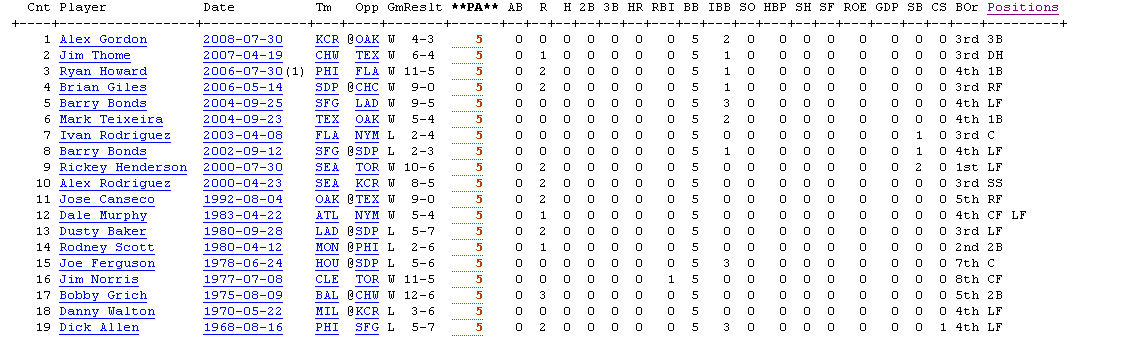
As I mentioned, this not a unique feat nor is it the record for walks in a game with 0 at-bats. The record is 5 achieved by 19 different players include Alex Gordon just last year. All told, 10 of the 19 instances have happened since 2000 and all but two have occurred since 1975. Barry Bonds, not surprisingly, is the only repeat achiever on the list. Teams for guys that have done this are 12-7. Here is a look at the list of those currently sharing the record as copied from Baseball Reference.com:
 Baseball By Paul