Archive for ‘Player Focus’

Wednesday: 05.6.2009

The Next New Closer

Bullpens across the league are in complete disarray which creating a lot of excitement in the late innings of many games, but also leading to plenty of uncertainty at the back end of bullpens league-wide. Sure, Joe Nathan and Mariano Rivera are locked and loaded as their team’s closer barring injury, and there are a handful of others, but we’ve already seen a carousel on several teams including St. Louis, Oakland, Baltimore and Washington. This could be helpful for the many fantasy baseball owners that employ the Punt Saves strategy with their pitching staff at their draft or auction. Given the immense volatility with closers, this strategy says to pass on buying closers and spend the money on offense or starting pitching. Then, actively pursue newly anointed closers as they come up throughout the season. The problem this year might be that you might get lucky and snap one up, but how long will he last?

I have a hidden gem for you that is starting to get more and more run at some fantasy outlets. I drafted him in two different NL-Only leagues thanks to his strong spring that suggested he was completely healthy after missing virtually all of 2008. He threw 10 clean innings with seven strikeouts, one walk and three hits allowed. As I’ve mentioned before, I pay heed to Spring Training numbers when someone is coming back for injury or a youngster fighting for a roster spot. At 34, this guy is an established veteran, but he was coming back from a torn right rotator cuff. The mystery man is Florida’s Kiko Calero. He has picked up right where his Spring Training left off having allowed just three runs in his 14 innings of work while striking out 19 and walking four. Meanwhile, the current closer Matt Lindstrom hasn’t been great. I would caution reading too much into Lindstrom’s 7.20 ERA as it’s borne mostly of an outing in which he allowed 7 runs in 2/3rds of an inning. I just don’t particularly trust him in general and think he will collapse enough at one point to open the door for Calero, not Leo Nunez.

The worst case scenario is that Calero appears to be one of the few middle relievers you can trust if you’re using the Middle Reliever Methodology to solidify your rotation, but regardless I think he should definitely be watched especially if Lindstrom strings a few poor outings together.

Tuesday: 03.24.2009

Matsuzaka Analysis: Off-the-Mark

There isn’t a draft guide available for 2009 whether online or in magazine form that doesn’t encourage avoiding Daisuke Matsuzaka unless he comes at a severe discount. Given the proliferation of such caution messages, he may very well be discounted in a league that you play… well not if you’re in a league with me. The Matsuzaka Meltdown presentiment is a bit misguided in my opinion. Most, if not all, baseball fans have heard the phrase “the statistics don’t always tell the whole story” and I think that has never been truer than in forecasting Matsuzaka’s 2009 season. Detractors immediately point to the obscene walk and strand rates. I’ll grant that they don’t jive with the ERA and win totals. If a pitcher with questionable talent had put together a 2008 like Matsuzaka’s, I could understand pinning the 72-point font “AVOID” flag on him in your draft spreadsheets.

Matsuzaka isn’t a marginal talent, though. He’s proven that in his first two major league seasons, in his eight seasons in Japan and in two World Baseball Classics. During his major-league debut, he had a career-worst WHIP of 1.32 thanks in large part to a career-worst hit rate of 8.4 hits per nine. He took a much more stubborn approach in 2008 as he didn’t want to give hitters anything to hit which yielded a hit rate of 6.9, on par with his Japanese League career mark of 7.1. Of course it also brought about the ugly 5.0 BB/9 and the resulting WHIP was 1.32 again! The way I see it, Matsuzaka’s ugly walk rate was more by design in that he refused to give into hitters than it was because he just flat out lost control at times a la someone like Oliver Perez. He went seven innings or more in just eight of his 29 starts yet averaged 100 pitches which isn’t a surprise with all of the walks. I think the issue here is that the analysts are approaching Matsuzaka as if he’s just like any other pitcher. There are some of the standard red flags: 5.0 BB/9, 100 pitches in just 5.7 IP per game, abnormally high strand rate of 80% and seemingly unsustainable hit rate of 27%. But Matsuzaka isn’t a standard pitcher. He is far more in control than his walk rate suggests.

Look at how he improved as the situation got more critical:
situational

Even the 1.8 K/BB with runners in scoring position falls below the 2.0 threshold that you really want a pitcher to have, but topping that figure is hard to come by when you’re walk 5.0 per nine so relative to his season, the 1.8 was a peak. For comparison sake, his opponent’s OPS w/RISP last year was .696 so that was obviously an area of focus for him heading into 2008. There is no doubt that Matsuzaka pressed his luck in 2008 and he won time and time again, but I think that those outlets that project a far worse season in 2009 don’t acknowledge the fact that Matsuzaka is a very talented arm capable of getting better and improving where he needs to in order to earn a high win total and low ERA. In 2007, he deserved better than the 4.40 ERA he had and in 2008, he deserved worse than the 2.90 ERA he had so where does that leave us for 2009? Nearly a strikeout per inning with a mid-3.00s ERA and a great shot at winning a ton of games with that team in Boston.

If you watched a lot of his starts, you saw a guy who was trying to be far too fine and while it hitters struggled to do much when he did give them something, many hitters caught on to the fact that he wasn’t giving in so they chose to take their free base. I went back on MLB.tv and watched almost 20 of his starts and that’s what I saw as opposed to some clueless kid incapable of getting anything over the dish. Already in 2009 he struck out 13 batters in 14.7 WBC innings while walking five en route to a 3-0 record for champion Japan which included an 8-inning domination of Cuba. The case of Matsuzaka is one where the numbers don’t necessarily lie, but they can lead you astray if you follow them without context and eliminate all the previous success enjoyed by a 10-year veteran. As you enter your drafts over the next two weekends, I’d encourage you not to discount Matsuzaka too sharply from the other high-level pitchers. To do so would be putting too much stock into one poor (albeit VERY poor) indicator from a guy who has pitched well for 10 seasons. Unless of course you’re in a league with me, then please discount him massively.

Wednesday: 09.24.2008

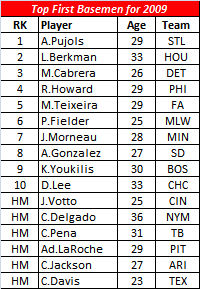
Top 10 First Basemen for 2009

Top 10 First Basemen Podcast

You can listen to the analysis in the above podcast, but for those just interested in the list then here it is:

Tuesday: 09.23.2008

Top 10 Catchers for 2009

Top 10 Catchers Podcast

You can listen to the analysis in the above podcast, but for those just interested in the list then here it is:

Friday: 08.22.2008

Updated Numbers for Unsung/Star Comparison

I had compiled the data for the All-Value team some time before posting the second half, so I decided to update both sets and show the stats & 5×5 dollar values of the players in question:

Thursday: 08.21.2008

The Unsung Heroes of 2008, Part II

For some reason, I did the entire infield except shortstops. That was not at all intentional, but they will be included with the outfielders and designated hitters in this part two. For those that may have missed the initial portion of this article, I am basically looking at the most unsung heroes of the 2008 season and comparing them against the elite talents at each position. It isn’t necessarily to slam the stars or suggest that stars are useless, instead it shows that there are gobs of value the middle-to-late rounds of drafts & auctions. I often use elite talents that are having elite years so as to further prove that I’m not just out to make the stars look bad. Without further ado, let’s dive into part two:

Shortstop
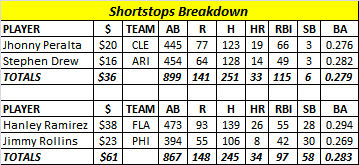
Stars: Let’s kick this off with perhaps the best fantasy player of them all in 2008: Hanley Ramirez. A light RBI total is the only thing keeping him from holding the #1 overall spot in Yahoo! Fantasy Baseball, but even still he rates 6th. He is on pace to trade some of that plus speed for more power as he looks to top 30 home runs for the first time in his career. He has also gained a ton of plate patience with 70 walks already this season after just 52 all of last year. He isn’t a great shortstop, but that isn’t a problem in fantasy baseball. For now, he is the preeminent middle infielder in the game and he’ll be just 25-years old in 2009.

The other star might be year’s biggest disappointment and he finds himself in this article because he was a no-doubt first rounder in almost every league. Jimmy Rollins might have the most disappointing season following an MVP season in the history of the game. Hmm… maybe I will research that. His brilliant 2007 was hardly an anomaly so even with a natural regression, no one could have predicted this kind of fall from grace. He remains a legitimate speed threat and should end the season nearing 40 bags, but he could feasibly end with fewer than double-digit home runs and he won’t come anywhere near his 3-year average of 127 runs scored and 77 runs batted in.

Unsungs: The pickins are slim at shortstop outside of the superstar crop, but these two gems were undoubtedly late round/waiver pick ups. Jhonny Peralta has been one of the few bright spots in an otherwise dismal season for the Cleveland Indians. He is on pace for a career year in runs, home runs and RBIs. He was showing an upward trend in taking walks, but has cut that total severely this year and it’s worked for him. It’s not a complete parallel, but perhaps he is experiencing a similar effect to Kevin Youkilis in that he’s performing better by being less patient.

The other value shortstop is a guy who showed some flashes of his ability last year, but never really put it all together for more than a few weeks at a time. Stephen Drew is on pace for career highs in four of the five standard roto categories. His three stolen bases would be six off of his 2007 total, but given the great strides everywhere else, we can overlook that for now. Though he has added 45 points to his batting average, his OBP has risen a meager 12 points because of a sharp drop off in walks much like Peralta. This saps up a decent amount of value in OBP leagues, but Drew was acquired for peanuts after his 2007 in all formats. He’ll enter next year as a 26-year old and should regain some of plate patience while hanging onto the counting stats gains as well. He should be a prime target for keeper league players with an eye on 2009.
Outfield
Stars: I didn’t necessarily align two players for each outfield position, instead I just took six outfielders for both stars and unsungs without regard for left-center-right. The time off will depress the counting stats a bit, but Matt Holliday has been every bit as good as he was during last year’s magical season. He has added speed and batting average to make up for the almost 100 fewer at-bats that will stifle the runs scored a little and the RBIs by a healthy margin. His insane tear since the All-Star Break has actually made it possible for him to maybe reach his home run total from a season ago. How weird is this? Holliday’s home-road splits in home runs and RBIs match his pre-post ASB splits: 14 HR/51 RBI home & pre-ASB; 10/22 road & post-ASB. That is one of the stranger coincidences I’ve seen in a sport filled with statistical oddities. Holliday is second to Lance Berkman only because of the time off for injury and he has been light years better down the stretch which is especially helpful for head-to-head players.

For OBP-leagues, Grady Sizemore is my top outfielder for 2008. His average sits at .267, but with 80 walks already, he has a .381 OBP. He is a home run away from 30-30 and a huge September could put him in the elite 40-40 club. If he doesn’t raise his average over the final month of the season, he could be undervalued (relative to other star players) coming into 2009, but I’d happily take him in the top five. Seven more hits would give him a .280 average and get critics off of his back, but those seven hits would barely dent a team’s overall batting average meaning even at .267 it’s not nearly the problem that some want to make it. If you’re in a league with me and you want Sizemore, you’d best bring your pocketbook or have a higher draft pick than me in the first round.

Though he is in for another power drop, Carlos Beltran is having a solid-if-unspectacular season thus far. In fact, it is only the power total that is off from last year. But being on pace for nearly 70 more at-bats from last year is what boosts the other totals by comparison to 2007 so when comparing the two seasons in-depth, it is clear that 2008 was a pretty legit downer for Beltran. Now on the wrong side of 30, the decline shouldn’t be a huge surprise. By the same token, this kind of complete season from a 31-year old is still impressive.

Alex Rios doesn’t have an excuse like Beltran for his relatively poor 2008 season considering he is 27-years old and should be entering his prime and not exiting it. Instead of building on three straight increases in home runs, Rios will need a huge September to even reach his three-year average of 17. He has held his overall value by pacing for a 124% gain in stolen bases from last year. With only modest declines in runs, batting average and runs batted in, Rios’ 2008 will likely boil down to a trade of power for speed. The reason it will almost assuredly end as a disappointment is because of the expectations of big power/moderate speed weren’t met. This perceived disappointment could depress Rios’ 2009 value and make him a strong buy-low candidate.

His team is the story of 2008 and though they couldn’t have done it without him, Carl Crawford is still not living up to the expectations of his owners. As bankable a speed commodity as they get, Crawford won’t be able to hide behind a DL-stint as an excuse for his weak output in stolen bases. The injury only adds a degree of certainty to the potential for Crawford to drop not only in steals but also batting average, runs, home runs AND runs batted in. Ouch. From a borderline 1st rounder depending on league size, the 2008 season has been a colossal failure. That said, this is by and large the anomalous season of Crawford’s career and age 27, he should NOT be written off or judged wholly off of this tough season.

Rumors of his demise during the early part of the season were greatly overstated as Vladimir Guerrero showed that he is far from done as a formidable fantasy outfielder. A .219 average/.260 on-base in May stirred up the critics, but I don’t care if he had hit .100 that month because it was 96 at-bats. Anyone who is going to write off a career .322 hitter over 6517 at-bats because of 96 crappy ones is an idiot. Plain and simple. That low month will likely snap his streak of .300+ average seasons that he has maintained throughout his entire career, but he should still 30-100 and hit around .290. Don’t rule out the potential for Vlad to repeat his June and his .375 again and reach .300 after all. He is just an amazing hitter and should be treated as such until further notice.

Unsungs: The most obvious name on this list is where I’ll start. If you know anyone that is telling you they expected this kind of season out of Carlos Quentin, punch them in the face. I drafted Quentin in two leagues, one of which was a mixed league, and I didn’t expect anything CLOSE to what he has done. In fact, I remember the conversation with my Dad where I told him I’d be thrilled with 15-80 from Quentin in what I thought would be a much-improved White Sox lineup. The last time Quentin topped 20 home runs was 2005 in AAA-Tucson. He is on pace for 45-124. While the breakthrough season is definitely a surprise, it is more because of the rapid onset of stardom as opposed to the stardom itself. Remember, Quentin was a very highly touted prospect coming through Arizona’s system. From a preseason value-to-season output ratio, can anyone even touch Quentin?

Perhaps Ryan Ludwick would be close to Quentin that ratio but he displayed his power potential with 14 home runs in 300 at-bats last year. This year he has become a full-timer and now he, too, is chasing down a 40-home run season. Ludwick as a power source has been pretty well known for some time, it was merely opportunity that prevented him from capitalizing at the major league level, but the .306 batting average has been a remarkably pleasant surprise. He turned 30 in the middle of the season so while he might not be a long-term building block, he likely won’t be a one-year wonder either.

In the digital age, secrets rarely remain so for very long. Nate McLouth was the new-age kind of sleeper that has so much sleeper status that he is no longer a legit sleeper. He is still providing TREMENDOUS value for his fantasy owners, but his strong totals in only 329 at-bats last yera combined with his being an expert favorite meant that few were surprised when his name was brought up on draft/auction day. His only downside to 2007 was a weak .258 average, but at .275 this year he erased his one negative. He will turn 27 after the season meaning he is just entering the upswing of his career. Likely under contract in keeper leagues after his 2007 breakout, he is a tremendous target for those looking to build a foundation for 2009 and beyond.

Until July, McLouth was part of very strong outfield that included Jason Bay and Xavier Nady, both of whom could feasibly be included on this list. Given Bay’s past superstar status, Nady joins his former teammate in the list of unsungs. He has matched or exceeding his counting totals from 2007, but added a robust .327 average despite 15 fewer at-bats and five more weeks left in the season. A perennial second-half fader, Nady’s success is due in large part to his bucking of that trend with a 1.043 OPS since the All-Star Break against a .902 beforehand. It looks like Nady has finally put it all together for an entire season. He will be 30 before year’s end, but with a full-time job, he’s one of those steady 25-85 contributors that you need to supplement your star power with to win championships.

One wasn’t enough. J.D. Drew gives the unsung group its full allotment of Drews. I didn’t realize that Drew was already 33-years old. I guess since he has topped 500 at-bats just once in his career, I haven’t seen him play enough to realize he has been around for 11 seasons. In OBP-leagues, Drew has been a beast. That’s not to say his .280 batting average has been trash by any stretch, but he has hit just .209 since the break while posting a .395 on-base during the same stretch. Without a strong burst to end the season, he will likely fall off the list when the final iteration comes out in October/November because of how poorly he has done after the break, but I’m rewarding him for his body of work this season which includes 19 home runs and a .408 on-base percentage.

I am a huge fan of Rick Ankiel. I have been from day 1 so even though I saw the flaws in his approach last year, I was bought into the power potential. He is on pace for an 80-30-80 season and while it hasn’t been anything to write home about, he has increased his plate discipline this season. Underdog stories just seem to find success in St. Louis and Ankiel is a shining example given his incredible journey back to the big leagues. As a power hitter, there is little concern for the fact that he will turn 30 in the middle of next year as that skill loves tenure. He will never be a #1 outfielder, nor even a #2, but he’s a strong #3 with a bankable skill set.

Designated Hitter
Star: With a horrid April and just six games played in June & July combined, it’s been a lost season for David Ortiz. Do you want to know how you can identify a superstar? Their lost seasons result in a 20 home runs and 80 runs batted in. Though off by his standards, Ortiz is still carrying a .373 on-base giving him legitimate value in OBP-leagues especially for teams that were able to weather the storm of his almost two-month absence. Given a clean bill of health, even a 33-year old Ortiz is a superstar to be sought after.

Unsung: Speaking of clean bills of health, Milton Bradley would kill for one. Of course even with the nagging injuries that sidelined him from time-to-time this year and will keep him from just his second 500 at-bat season in his nine years, it’s still a minor miracle that Bradley’s played at all after ripping his knee up in a freak incident during which his own manager tackled him to keep him from beating up an umpire. His career year isn’t surprising from a talent standpoint, that’s always been a known commodity, but that he has stayed out of trouble and remained relatively healthy is the eye-catcher from Bradley in 2008. OBP-leaguers have enjoyed Bradley’s career year even more as he’s posted a .445-mark and could top 90 walks despite the time missed.

And there it is. My take on the best values of 2008 with a look at some superstars to gain context as to how strong the breakout seasons have been. With a month+one week left in the season, there could be some changes before the final list is published, but I like how the first version came out.

Saturday: 08.16.2008

The Unsung Heroes of 2008

Though we still have a month and a half left in the season, I am fairly certain that putting together a group of the most unsung players to perform well this year is safe. I will probably post a final version of this same list in October or November, but here is how it is shaping up midway through August.

A lot of these lists that attempt to look at value or sleepers or hidden gems or whatever you want to call them end up becoming lists of the best seasons as if we didn’t know those were valuable number sets. I am trying to avoid that with this piece. What I am looking at is a comparison, by position, of players that were highly touted and those much less so. The purpose behind this isn’t to bash on some stars having an off season. In fact, several of those in the comparison are having brilliant years, rather the idea was to point out constructing a team is made more within the middle & end rounds of a draft/auction that it is with the star power. Plus this also serves as some good ol’ fashioned back-patting. These gents deserve a hand for their excellent performance and I am here to give it to them.

For this exercise, I took two underdog-types and two stars from each position (six total OFs instead of LF-CF-RF and only one DH) and compared the stat lines through August 15th. Yes, there is some cherry-picking here obviously, but as I mentioned I am not out to prove that star players aren’t necessary or anything silly like that. I picked mostly first and second rounders on the star side and I wasn’t afraid to pick Albert Pujols or Matt Holliday and throw them in here. I just wanted to see how the rag-tag group holds up against the creme de la creme.

Catcher
Stars: It would have been easy to pick Victor Martinez on the star power side, but I also think it’d have dented the credibility of this piece since he’s missed most of the season. I did pick two of the 4M-Catchers for the star power with Joe Mauer and Russell Martin. Mauer, for all of the amazing real baseball talent and value has, remains one of the most overrated fantasy baseball commodities in the league. It’s not that he doesn’t perform, in fact his value comes in arguably the most underrated category: batting average (or on-base percentage in some leagues). He has notched double-digit home runs and 80+ runs batted in once in the past four seasons and he’s pacing to miss both marks again this year. Given his usual cost, it’s tough to justify sinking that much money into modest production even if it as a painfully thin position.

If I am spending high on catcher (and 9 of 10 times, I’m not), then the money or draft pick is being invested in Martin. When speaking of 5-category production, the numbers of Hanley Ramirez come to mind which might make Martin’s 5-category offerings seem meager. They’re not. Again, the context of being a catcher is a very important factor. He is a little off of his 20-20 (actually 19-21) numbers from last year, but .290-90-15-70-15 is something we haven’t seen from a backstop other than Martin since Jason Kendall‘s 2000 season.

Unsungs: There is a field from which to pick from after you get past the 4Ms with Martin, Martinez, Mauer and Brian McCann and there were several strong candidates to fill these two slots. For the first spot, I picked Geovany Soto. He was a strong sleeper candidate in many circles and he hasn’t disappointed. He is on pace for 24-92 and a .286 average. He can also take a walk so his on-base is at a robust .365. He burst onto the scene with a 26-home run season in AAA Iowa after never reaching double-digits in six previous minro league seasons. He will be a high dollar acquisition in non-keeper leagues next year, but for now he is the most unsung catcher of the season.

Colorado’s Chris Iannetta is a classic post-hype sleeper after failing to bring his minor league success to the bigs in short stints during 2006 and 2007. Now, still just 25, he wrested the job from Yorvit Torrealba and he is now enjoying a breakout season. His raw numbers are good enough on their own, but considering he’s got 32 Runs, 14 home runs, 49 RBIs and a .270 AVG/.376 OBP, but when you see that he has done it all in just 237 at-bats, it’s hard not to be even more impressed.

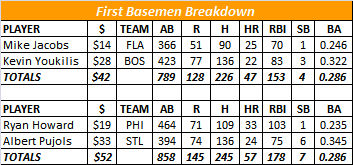
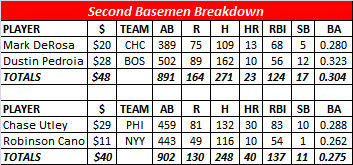
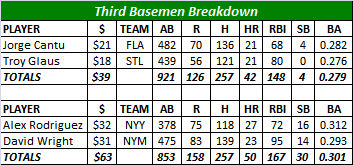
Below each discussion is a stat-box comparison that includes the standard 5×5 categories in fantasy baseball as well as a dollar-value for each player:

First Base
Stars: Let’s start off with the gold standard: Albert Pujols. There may be no more valuable player in the entire league this season depending on when your league had its draft or auction. Concerns over Pujols’ elbow and the potential for it to take several games from his season severely depressed his value (severe being relative to his usual value) on draft day and thus, since he has put up the kind of Pujolsian numbers we’ve come to expect when health is assured. He is on pace for 31 home runs, which is one fewer than last year and 18 fewer than two years ago, so it’s safe to say that the elbow is probably in some pain. It hasn’t affected his ability to hit, just hit it very far.

The other choice for the stars section doesn’t have any problems hitting it very far. Ryan Howard has rebounded from a brutal start and has 33 homers and 103 RBIs this season. His .235 batting average has cut into his overall value despite that incredible power. If he continues to struggle with batting average, he’ll fall into the Adam Dunn zone in standard leagues. He is pacing to 43 home runs, shaving another four off of 2007’s total which was 11 away from his MVP season of 2006.

Unsungs: If I want a no-average, power-hitter then I’d rather acquire Mike Jacobs, at least he’s open about being a batting average anchor with a .263 career average. He is a bit off that career pace at .246, but he also has a career-high 25 home runs and counting. Coming into the season, some pundits wrongfully characterized the Florida Marlins lineup as a one-trick pony (Hanley Ramirez), but I liked it with Jeremy Hermida, Jacobs, Cody Ross, Dan Uggla and Josh Willingham in the mix. Willingham has missed a lot of time, but Jorge Cantu has filled that void. At any rate, the depth of the lineup has opened up things for Jacobs to have a career year.

Kevin Youkilis gained notoriety well before he reached the bigs for his tremendous plate discipline. He was known as the “Greek God of Walks” after a 70-walk season in 59 games way back in A-ball during the 2001 season. He had a .512 on-base because he had a .317 batting average with those walks. He continued talking walks throughout his minor league, but never really displayed the usual power you like from a corner infielder. Since becoming a full-time in 2006, he has increased his power output yearly including his 2008 breakout that has him on pace for nearly 30 home runs. His walk totals are dwindling year-over-year since 2006, but he was quoted as saying that he was letting a lot of great pitches go by the wayside in order to garner that walk. He has now started to mash the ball in early counts: .469/.469/.876 with 10 HR and 27 RBI in 113 at-bats during 0-0, 0-1 and 1-0 counts.

Second Base
Stars: It’s been a “Tale of Two Seasons” for Chase Utley. After hitting 25 home runs before the All-Star Break, he has just five since. In fact, you could say it’s been a tale of two months considering that he had 18 home runs and 47 RBIs during April and May. Perhaps the Home Run Derby Monster got to Utley. Either way, he is going to finish with a tremendous season as the elite second baseman in all of baseball. He has definitely justified his early round/high dollar cost to fantasy owners.

Robinson Cano, however, has not. Three straight seasons of four-category production combined with the fact that he would be just 25 years old this season had expectations sky-high for Cano, but the season has been a complete bust. He hit .151 in April with just two home runs as his stock plummeted to a career-low, but he bounced back with a .295 average in May, but still just two home runs. He continued to hit the ball in June and July with .287 and .327 averages respectively, but he has yet to hit more than three home runs in any particular month.

Unsungs: It doesn’t get much more unsung than Mark DeRosa. He started the season looking over his shoulder to see if Brian Roberts would be brought in from Baltimore and even then he has still had to fight for every scrap of playing time he has received. That motivation and drive has resulted in a career year. Owners have come to expect a solid level production with a ton of position flexibility and he has once again delivered. He already has a career-high in home runs with 14 and could top 100 in both runs scored and runs batted in. I would be surprised if he was a double-digit investment in many leagues yet he’s returned $20 in value.

The reigning Rookie of the Year is now making a bid for this year’s Most Valuable Player. Dustin Pedroia does not put up the kind of flashy numbers you would expect from an MVP candidate whether considering real or fantasy baseball, but huge batting average and runs scored totals can be very underrated. Despite his hardware from 2007, he wasn’t a hugely sought after commodity this spring thus offering huge earnings against his cost. Pedroia’s big season will give him prominence on the fantasy landscape entering 2009, while DeRosa will likely continue to toil in relative obscurity.

Third Base
Stars: Fewer things say star power more than third base in New York. Alex Rodriguez and David Wright have continued their brilliance again in 2008. They have combined for 50 home runs, 167 runs batted in and 30 stolen bases while hitting .301. Known for being huge power sources, the New York duo earn their huge price tags by adding average and speed to that incredible power. Even more amazing is that A-Rod is pacing to register is lowest at-bat total (504) since 1999 after missing time to injury earlier this season. A full season of numbers might have landed A-Rod back-to-back MVPs regardless of a playoff berth for the Yankees. Wright, meanwhile, hasn’t displayed the same type of speed he did a season ago, but he’s still been a 5-category superstar worth every bit of his draft day cost.

Unsungs: The guys mentioned here had both fallen on the fantasy radar after a decline in production, though one significantly more so than the other. Jorge Cantu had a slim shot at a starting gig with the Florida Marlins at an unsettled third base thanks to the void left by Miguel Cabrera. He has taken this opportunity to channel his 2005 season that saw him hit 28 home runs and drive in 117 runs. He is currently on pace for 27-89 as well as 92 runs scored. In leagues where he was actually rostered at the draft/auction, he probably has a double-digit price tag in a scant few. You would be hard-pressed to find a better candidate for Comeback Player of the Year.

The power has never been in question for Troy Glaus, but his health from year-to-year is always a concern. He is on pace for almost 700 plate appearances during his first season with the St. Louis Cardinals and he has been able to put up a very nice season. He could reach 30-100 by season’s end, but more importantly is that his .275 average is no longer than the anchor its been the past seven years hanging around .250 more often than not.

Next up: the outfielders & designated hitters.

Wednesday: 08.13.2008

Home Run Derby Curse?

I doubt it’s anywhere near as strong as the Madden video game cover curse, but it seems that some home run derby participants in recent years have prolonged power outages immediately following the event. My study that follows wasn’t terribly in-depth or scientific. It was spurred because the Tigers are playing losing to the Toronto Blue Jays this week and I thought about Alex Rios‘ lack of home runs since participating in last year’s contest. Those memories also called to mind the first real collapse I remember and that was of Bobby Abreu. He not only participated in the 2005 event at Comerica Park, but he owned the sucker. He hasn’t been the same power threat since.

The problem with the instances is that they are too few to represent a trend yet and there is no way of figuring out who it might get next. Lance Berkman was in his 4th derby this year, but he never collapsed following the derby as he has this season. Did he collapse because of the derby this year? Unfortunately, I don’t have an answer on that front.

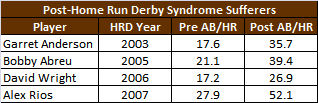
At any rate, Berkman and fellow competitor Dan Uggla are in the throes of a potential home run derby-induced power outage with a combined five home runs between them since the All-Star Break after mashing 55 prior to the Midsummer Classic. Below, I look at five other recent cases of Post-Home Run Derby Syndrome (PHRDS—pronounced “Freds”):

Garret Anderson, 2003 – While Abreu is who I remember first noticing the syndrome impacting, it looks like Anderson was his predecessor! In that 2003 season, Anderson hit 29 home runs. He hasn’t topped 20 in the five seasons since, coming no closer than within 12 to that 2003 mark. The 2003 season was the fifth season in a row with 21+ home runs including a 35-home run campaign and back-to-back 29s. Granted, Anderson has battled injuries and of course, Father Time since that Home Run Derby victory, but power is an old-person skill and he has topped 500 at-bats twice.

Bobby Abreu, 2005 – The year he won that Home Run Derby in Detroit marked his seventh straight season of 20+ home runs. He even mixed in seasons of 30 and 31. He was a bona fide superstar with his 5-category production. If you played on-base percentage in your league, he was worth even more as he routinely topped .400 bolstered by 100+ walks in each of those aforementioned seven seasons. Since that fateful night, he has 52 home runs over 3.5 seasons (about 15 per). He, like Anderson, is obviously getting older, but still power is a skill you usually carry until retirement if it’s something you displayed prominently during your prime. Plus he has continue to run, hit for high average and draw tons of walks so he isn’t battling injury and his skills haven’t just left him. PHRDS claims another!

David Wright, 2006 – Wright struggled after the break of that 2006 season and then went homer-less in April to open 2007, but after that he was pretty much back on track. As a superstar still awaiting his prime, he beat PHRDS, but it’s as rare as Magic Johnson and his AIDS. I include Wright mainly to give hope to the Rios owners out there worried about their wannabe star, who is now in his prime and could struggle to reach double-digit home runs this season.

Alex Rios, 2007 – This case of PHRDS just snuck up on me! I saw Rios fizzle after the break last year, it impacted several of my teams since I absolutely love the guy. Instead of diagnose a case of chronic PHRDS, I attributed it to Alex being Alex as he perennially fades after the break (his OPS is 112 points lower after the All-Star Break from 2005-2007). No he didn’t have a staph infection to fall back on and it briefly crossed my mind that it might be PHRDS, but as an avid Rios supporter, I was in sheer denial. Even this past winter, as I prepared my lists and forecasts, it again crossed my mind that perhaps Rios was in the clutches of PHRDS and might not be the 25+ homer breakout I wanted him to be in 2008. I shouldn’t have ignored that little voice that was screaming at me.

To you Berkman and Uggla owners that have dropped points in home runs and RBIs since the break, I feel for you. Watching a family member suffer from PHRDS as it controls their central power system is heartbreaking. You just want to go out to that mound and lob one in there for them to send 400 feet the other way, but you can’t. You just have to hope and pray that it will go into remission. Berkman is no spring chicken at 32 while Uggla is 30 raising the same age concerns that plagued the first two sufferers of chronic PHRDS. I do believe that both can pull themselves out the proverbial fire; Berkman because he is an amazing hitter that can & will make necessary adjustments when he not going right and Uggla because he corkscrews himself into the batters box about three inches on nearly every swing… but honestly, who knows. We’ll just have to visit daily and monitor their vitals. PHRDS is a cruel, cruel bitch and takes away fantasy titles and gobs of cash along with your favorite player’s power.

Monday: 08.4.2008

A Few Notes…

– He didn’t run tonight despite three hits, but Emilio Bonifacio is a burner that is now in the Washington Nationals’ lineup likely for the balance of the year. He stole 21 bases in the minors this year. Not only does he offer a known commodity in stolen bases, but he plays second base as well. He’s a great waiver option if he’s still available.

-Most attention in the AL RoY race has gone to Evan Longoria (with good reason), but a 2-for-4 effort that included a homer and two runs batted in brings David Murphy up to 15 bombs and 73 (!) runs batted in.

Huston Street has apparently fallen out of favor as the primary closer in Oakland. Why they didn’t deal him then is beyond me. Opportunities could be spread very thin between Jerry Blevins, Santiago Casilla, Joey Devine and Brad Ziegler making it very tough on fantasy owners. Casilla is my favorite, but I think Devine is the favorite in Oakland. Ziegler is interesting because he has yet to yield a run, but his peripherals aren’t that impressive.

-In other Oakland news, they sent down Dana Eveland, who was obliterated by opposing hitters in all of July and blowup start in August. He was replaced on the roster by Dan Meyer, though it doesn’t look like Meyer will jump into the rotation. He pitched four sparkling innings of mop-up on Monday night in relief of a shaky Sean Gallagher. He struck out three and allowed just four hits.

More notes Tuesday morning/afternoon and an extended piece Tuesday night…

Wednesday: 07.30.2008

Player Focus: 7/30/08

I didn’t deliver on my promise to post something last night, but I was again just too beat. Things have been a whirlwind of late, but I wanted to at least get something going tonight.

Cabrera Showing Why He’s One of the Best
Chances are you know someone (or perhaps you yourself are the one) that traded Miguel Cabrera for around 75 cents on the dollar back in the early summer. After all, his numbers were downright pedestrian when compared against the backdrop of his career lines. His torrid July marks the billionth case of the baseball season being a marathon and not a sprint, thus requiring a great deal of patience. First of all, it’s not like he was ever in the midst of a BAD season. He wasn’t putting up the otherworldly numbers that many predicted him for, but he was a still a producer. His night is now over after being pinch-ran for, but he went 3-for-5 with four runs driven in and his eighth July home run.

Lately it seems that if someone is on base, then Cabrera is going to drive him in. He has 31 runs batted in during his past 24 games! He would need to stay pretty hot with the home runs to reach 30 for the season, but there is no reason to believe he can’t do it. He needs 12 in two months, but this month’s eight is twice as many as he has had in any other month. I think there are times where we as fantasy owners get a little nuts with our expectations of superstars. Anything other than improvement on the season before for first or second round picks is unacceptable and it really shouldn’t be that way. If the low-end of Cabrera is a .300-30-100 season, that’s still pretty darn good. With his hot July, he has set himself up to top both the 30 and 100 marks handily.

Shoppach Enjoys Career Night, Year
With a brilliant 5-for-6 effort against the Tigers tonight, Shoppach continued his solid, if unspectacular, career year going. I am not much for drafting/paying for catchers in my leagues unless I see someone great going at a bargain. Instead, I opt for the $1 route and usually look to find either diamonds in the rough that could emerge or guys I know won’t play too much but can do something when they do get an opportunity. Shoppach was a big target of mine in all leagues because I liked his potential to smack 10 home runs while spelling Victor Martinez for an off-day or catching when Martinez plays first base. It turns out I struck it rich (relatively speaking) with the Martinez injury that has led to almost 200 at-bats for Shoppach already with more on the way.

A day before the trade deadline, Shoppach has topped the 10-home run mark I had hoped for so at this point everything else is bonus. He has a terrible batting eye that hasn’t really improved, but he delivers exactly what you want out of a $1 catcher: power, without killing any other categories. Playing time will be a factor when (if?) Martinez returns, but he should end the season in the upper teens for home runs.

___________________________________

The trade deadline is tomorrow and there has already been a ton of action to this point. I can’t remember the last season with this many season-changing crossovers to spend FAAB on. First it was the pair of aces in C.C. Sabathia and Rich Harden and then the consolation prize of Joe Blanton to the Phillies. Then it was Xavier Nady to the Yankees followed by Casey Blake to the Dodgers. Now Mark Teixeira heads over to Angels while Casey Kotchman comes over for the Braves. The three-way deal being discussed right now would move Manny Ramirez to Florida and Jason Bay to Boston. For some reason, I get the feeling that the Ramirez-Bay 3-way will go down tomorrow. Here’s a look at the pitching and hitting numbers that have been available via FAAB this season so far. These numbers are the totals prior to the trade:

Wow, that is some talent!! Blanton severely skews the pitching data and it is still a solid stat-line. Included Bay and Ramirez wasn’t done to make the hitting numbers look better, they standalone just fine. I just feel like that deal will get done by the end of tomorrow so I went ahead and threw the tremendous lines of those two into the mix. Without them, there was still 1406 at-bats of .297 average along 56 home runs and 247 runs batted in on the move so far this season.