Archive for ‘Starting Pitchers’

Monday: 03.22.2010

2010 Echelons of Starting Pitching: Part 7

Here is the next part, just 82 more! 🙂

Part 1
Part 2
Part 3
Part 4
Part 5
Part 6

Echelon 3, Part II – Getting There

100. Kevin Millwood, 34, Baltimore Orioles – He had no business ending up with a 3.67 ERA last year with an ugly 1.7 K/BB and 1.2 HR/9 found behind the curtain of that undeserved mark. Unfortunately that performance has driven his price up well beyond what he’s worth (15th round ADP) making him someone to leave alone completely unless that price comes way down. He will pile up the innings, but they won’t necessarily be any good and you should thank your lucky stars if he gives you anything below a 4.50 ERA in 2010.

99. Dallas Braden, 26, Oakland A’s – Braden has back-to-back seasons with good end results, but the skills backing those figures up are a little disconcerting. He came through the minors with a 10.1 K/9 and 2.4 BB/9 in 347 innings, but only brought 5.7 K/9 with him to the majors. His long term success seems to hinge on whether or not he can elevate that strikeout rate up into the 7-8 range if not all the way to the elite levels he reached in the minors. Fueling his 3.89 ERA from a year ago was also his 0.6 HR/9 which was a vast improvement over his 1.0 from 2008. Even if he only bumps the Ks to 6.5 while holding the walk rate steady around 3.0 and maintains the HR/9 gains, then he is a great endgame pick with a very favorable home ballpark. There is so much starting pitching talent in Oakland that someone is going to get squeezed and whoever that is will have their value squeezed. Braden is in line for a spot right now so he’s worth a late look and that is exactly what he is getting at a 20th round pick at MDC right now.

98. Luke Hochevar, 26, Kansas City Royals – It’s not coming along as quickly as you would expect from a #1 overall pick, but not everyone progresses the same. You would probably call me crazy if I told you his second half, during which he posted a 7.35 ERA, was a major growth period. But alas, it was. He refined a splitter and became a strikeout machine (8.4 in 86 IP) and turned the walks way down (2.7 BB/9) leading to a sparkling 3.1 K/BB. So what the hell happened that gave him such an ugly ERA and WHIP? Bad luck was a factor, but so was the major case of gopheritis (14 HR!). Zack Greinke might finally have the 2 to complete the 1-2 punch in KC in the form of Hochevar. And you can have him for pennies on the dollar as he is a 21st round pick in AL-Only leagues representing an excellent value late.

97. Jake Westbrook, 32, Cleveland Indians – Missed all of 2009, but he’s a better version of Kevin Millwood who can actually be relied upon for a 4.00-4.30 ERA in 200 innings of work. His strikeout rate will sit somewhere between 4.7 and 5.2, but that’s not why you’re going for someone like Westbrook. In his last five full seasons, he has a 0.7 HR/9 which has allowed him to have success with such middling skills. As a 22nd round pick, his price is just right, too.

96. Mat Latos, 22, San Diego Padres – I like the long term potential and love the home park, but he is going to have an innings ceiling (around 150) and might not even have a starting spot for a while how Tim Stauffer, Wade LeBlanc and Sean Gallagher shake out this spring. All four of the guys are pitching, so it won’t be easy. Stauffer and Gallagher are out of options while Latos has just 47 innings at AA and has yet to pitch in AAA, so he could end up as the odd man out. Draft the skill, but you may want to look elsewhere if your league doesn’t have a reserve or minor league roster to stash Latos.

95. Gio Gonzalez, 24, Oakland A’s – A messy when you look at the things that matter in fantasy baseball (5.75 ERA, 1.71 WHIP), but his 9.9 K/9 rate is so very enticing. He is a premier talent still developing even though it seems like he has been around forever. If he can avoid the implosion games (like his 11 ER in 2.7 IP vs. Minn in July), get some good luck to counterbalance last year’s bad luck and keep blowing batters away, then he can be an effective low-to-mid 4.00s ERA, 150+ strikeout guy. That’s just a good case scenario, if everything breaks PERFECTLY for him, then he can have an Oliver Perez circa 2004 season (2.98 ERA, 239 K in 196 IP).

94. Clayton Richard, 26, San Diego Padres – Is there anything better than finding out you are moving from home run friendly US Celluar Field to everything stifling PETCO Park? Richard turned up his strikeout rate to an appetizing 6.7 after just 5.5 in his 48 inning debut back in 2008, but his walk rate also rose from 2.5 to 4.2. If he can balance that figure somewhere close to 3.0, he is poised to be the next big time PETCO benefactor. Use Kevin Correia’s 2009 as a guide for Richard’s upside in 2010 (3.91 ERA, 1.30 WHIP, 142 K).

93. Chris Young, 31, San Diego Padres – Despite three straight solid years from 2006-2008 with an ERA below 4.00, many were a little skeptical of Young and saw him as a product of PETCO. His walk rate was ticking upward from 2005 on and things came to a head in 2008 when it topped 4.0 and took his K/BB below 2.0 for the first time ever. Things got much worse last year in an injury-shortened season as the BB rate ticked up again but the strikeout rate plummeted to 5.9, well off the 8.1 K/9 career mark he had coming into 2009. One thing that always angers me is when people would say, “Can you believe Texas gave up this guy!?” when talking about Young because he would have a career ERA approaching 6.00 if had stayed in Texas with his +50% FB rate. He is best suited for PETCO and if you can get him in a league where you can spot start him at home until he proves something on the road, then I’d invest in him. If you have to start him fulltime, expect a low-to-mid 4.00s ERA with nearly a strikeout per inning.

92. Paul Maholm, 28, Pittsburgh Pirates – Maholm is a perfect example of how middling the ceiling of an average K/9 pitcher can be no matter how sharp the control. He has three straight seasons with virtually the same skills of 5.6 K/9 and 2.7 BB/9 yet three vastly different ERAs: 5.02, 3.71 and 4.44. His highest K rate in that three year span was 6.1 in 2008. That was also the year he posted that 3.71 ERA, not surprisingly. At 28, he’s unlikely to raise his K rate significantly, so he’s basically a WYSIWYG guy who will give you 190 innings with a passable ERA and average-to-below average WHIP because of how many hits he allows.

91. Gil Meche, 31, Kansas City Royals – Meche lost his way a bit last year after back-to-back strong seasons with the Royals. His control abandoned while his strikeout rate dipped and his ERA exploded to 5.09 in 129 innings. Injuries derailed the season and were a likely cause for the struggles prior to packing it in for the year in August, so he’s coming in at a great value for 2010. Plan for a 4.10 ERA and 165 strikeouts in 200 innings, which isn’t bad for the 13th round of an AL-Only or 21st round of a Mixed League.

90. David Bush, 30, Milwaukee Brewers – There is usually a guy in your league who still has that glimmer of hope for Bush to finally put it all together for an ERA and WHIP that match his skills. If I’m in your league, it’s probably me. Since coming to Milwaukee, Bush has a 6.4 K/9 and 2.2 BB/9 yet his ERA in that time is 4.86 because he completely falls apart with runners on and can’t keep the ball in the yard at an acceptable rate (1.3 HR/9). He isn’t costing anything right now (20th round ADP in NL-Only) setting him up to be a tremendous value if he can just get back to what he did in 2008 (4.18 ERA, 1.14 WHIP).

89. John Maine, 29, New York Mets – Maine’s underlying stats are all the map, but he has remained productive throughout posting passable ERAs in each of the past four seasons even though it has risen each year. His strikeout rate has dipped in each of the past two years, but his HR/9 has fallen each of the past four years, too. His walk rate the past two years has been above 4.0 which has taken his ERA above the same mark, if he can get back to the 3.5 mark from 2007 (or better) then he could be poised for a strong comeback season. Of course, above all he needs to stay healthy as he has lost significant time the last two years. If he can go 180 innings, he can be a useful mid-rotation starter.

88. Kevin Correia, 29, San Diego Padres – Correia is not just a PETCO product, rather the Padres finally gave him a real chance and let him throw 198 innings. He posted skills similar to what he had done in his career prior to 2009 and the results were solid as he maintained an ERA below 4.00 (3.91) and a solid 1.30 WHIP. I wouldn’t pay for more than a carbon copy of 2009 this year, but if the Padres improve a bit, he could reach the mid-teens in wins and two years of a better than 7.0 K rate suggest he could reach 160 strikeouts, too.

87. Chris Volstad, 23, Florida Marlins – After being a bit overrated based on an 84 inning sample coming into 2009, I think Volstad has shifted to the other end of the spectrum and now he’s being overlooked after a 5.21 ERA in 159 innings last year. He had a rough patch late in the season and was eventually demoted and thus a bit forgotten, but he’s a groundball pitcher with above average strikeout (6.1) and walk rates (3.3). Those rate were at 6.6 and 2.7 in the first half of the season of the season showing what he is capable of when he is going well. He’s got a 187 ADP in NL-Only leagues right now so he’s a great value that I highly recommend eyeing late. His profile is a recipe for success and now he has 243 major league innings under his belt.

86. Joel Pineiro, 31, Los Angeles Angels – Pineiro had a brilliant season last year, his best since 2003, thanks to impeccable control (major-league best 1.1 BB/9) and an elite groundball rate (60%). He also had an absurdly lucky 0.5 HR/9. Pineiro has always been OK at inducing groundballs and limiting walks, but last year he was amazing at both and it fueled the 3.49 ERA. He will need to repeat both to sniff that ERA again, especially if he plans to keep striking out 4.4 batters per nine innings or even the 4.9 K/9 he had in 2008. He’s moving back to the AL and his last two full seasons in that league yielded ERAs of 6.36 and 5.62. In other words, be careful here. I think we will see at least a 0.50 ERA jump but he could pile up the wins again thanks to the offense and bullpen supporting him. He might just be a better control version of Joe Saunders, which isn’t awful, but hardly great either.

85. Ricky Romero, 25, Toronto Blue Jays – Why does an up & coming pitcher with a great groundball and very good strikeout rate have to get stuck in the AL Beast? Such is the fate of Romero which will probably cost him at least 0.30 runs of ERA each year right out of the gate. He baffled the league the first time around posting a 6-3 record with a 2.87 ERA and 1.25 WHIP in 72 innings in the first half, but they caught up in the second half tattooing for a 5.27 ERA and 1.71 WHIP in 106 innings. His groundball rate held strong across both halves, in fact it improved in the second, but he dropped a full strikeout to 6.8 and his walk rate ballooned to 4.7 from 3.0. It’s his move now and how he answers the adjustments the league made will determine how successful he can be in 2010. His is the perfect profile (high K/high GB) to bet on, so don’t be afraid to risk that extra dollar on Romero.

84. Brandon Morrow, 25, Toronto Blue Jays – Morrow has been Joba’d to date and his results have borne the brunt of the abuse, but now he gets a fresh start with Toronto and they seem set on putting in the rotation and leaving him there. He’s got a tremendous arm and can blow batters away at better than one per inning, but he has yet to show any control in the majors thus far (5.8 BB/9 in 198 IP). He is still very young so that control should develop, but until it does his wildness will limit his upside. For now, think of him as a right-handed Jonathan Sanchez capable of a boatload of strikeouts, but middling ratios.

83. Koji Uehara, 35, Baltimore Orioles – He’s essentially removed from the list because it looks like the O’s have permanently moved him to the bullpen. Just removing him and moving forward would’ve messed up all the numbers so I thought I’d mention him and let you see where I had him assuming he was going to be a starter. I definitely liked him in the rotation, but I still like him a middle relief option if you are someone who goes for that strategy.

Monday: 03.15.2010

2010 Echelons of Starting Pitching: Part 6

Sorry for the delay in posting lately, but I have been busy with some other things including auction/draft prep for the leagues I commission as well as taking over the reins at Eye of the Tigers.com, the Detroit Tigers blog in the Fanball Blog Network. Plus I have started my two weekly columns over at OwnersEdge.com for Fanball, too. Fear not, though. I am going to finish the list.

This part will take us up to the top 100 so we are in the homestretch.

Part 1
Part 2
Part 3
Part 4
Part 5

Echelon 3, Part I – Prince or Frog?

Can you believe that we have looked 144 pitchers already and we are only into the third echelon of five? I told you this year’s list was huge. Last year I covered 154 arms total and I’m only 10 away from that mark with three full echelons left. In part 1, I describe echelon 3s as “a mix of young guys on the rise still putting it all together and crafty veterans capable of eating a boatload of innings without destroying your team”. These guys either have a guaranteed spot or a clear line to a guaranteed spot that doesn’t include several injuries and a leap of faith from their management (the one exception being Jarrod Washburn who has yet to sign). Talent wise, the upside for these guys ranges from solid, useful piece (i.e. someone you wouldn’t stream based on matchup) to game-changer who could essentially make your season and take a long toward the championship you so desire. But that is upside which means perfect health, reaching their skill ceiling and a healthy dose of luck mixed in. So they aren’t without risk, but that risk lessened considerably as compared to their 4th and 5th echelon brethren. There are 119 pitchers left in the list, so with Echelon 3, I will begin to count them down.

119. Jose Contreras, 38, Philadelphia Phillies – Every time we try to bury this guy he comes back and shows a glimmer and looks rosterable. He seems to either dominate for six or seven innings or give up six or seven runs in one inning.

118. Jarrod Washburn, 35 years old, Free Agent – The aforementioned Washburn has yet to find a club, but the latest rumors have the Orioles interested if his price drops. He should learn from Johnny Damon and Orlando Hudson that digging your heels will keep you at home this season, so if he wants to play just sign a reasonable one year deal with someone. Washburn had a rebirth with the Mariners last year thanks in large part to their stellar defense, but he fell apart after being traded to Detroit mostly because he was giving up home runs at a ridiculously high rate (2.5 HR/9). He’s a flyball pitcher who looked to be fully entrenched in the twilight of career until that 133 inning outburst with Seattle, but anything short of a return there will bring him back to the mid-4.00s, low strikeout pitcher he had been the three years prior to 2009.

117. Chien-Ming Wang, 30, Washington Nationals – Reports suggest that Wang will miss at least the first and possible the second month of the season as he returns from shoulder surgery that cost him most of what was already a dismal 2009 season. When healthy, he will slot into the Nationals rotation almost instantly. Wang’s name recognition from his time with Yankees will keep him from sneaking up on anyone, but he could easily turn into a legitimate fantasy asset as he was back in 2006 and 2007. It is virtually impossible to project wins, but I don’t think it is wrong to suggest that they will be a bit tougher to come by with the Nationals than they were with the Yankees when he won 19 in consecutive years. He would be worth a buck or two in an NL-Only league where you could store on a disabled list or reserve roster and wait for him to return.

116. Ian Snell, 28, Seattle Mariners – This one time fantasy darling has burned the bridge with many fantasy owners across the world so much so that he has been banished to a Do Not Draft Under Any Circumstance list. I try not to do that with anyone because I am always trying to win so if someone can further that cause then I will roster him. Even Derek Jeter or Milton Bradley. He had a breakout skills wise in 2007 with 7.7 K/9 and 2.9 BB/9. Since then, his walk rate has skyrocketed in each of the past two years with 4.9 in 2008 and 5.2 last year. His strikeout rate has fallen, too, but the first it was just to 7.4 while last year’s was a big drop down to 5.5. He owns 7.0+ K/9 skill and that shouldn’t be entirely ignored. A skills return combined with the Seattle defense could result in a nice season.

115. Kyle Davies, 26, Kansas City Royals – Interesting note: his first name is Hiram. Obvious note: average control with a mid-6.0 K/9 rate leads to a modicum of success. And that’s exactly what Davies managed to do in 2008, but the control left him again in 2009 and so did the success. Still just 26, his success or failure in 2010 will hinge solely upon his ability to command the strike zone. Well I shouldn’t say solely. If he walks 2.5 batters nine innings, but has matching homerun and strikeout rates, then it won’t be a very good year. If he can walk 3.5 or fewer per nine while matching his career strikeout rate of 6.3, then he has a shot at being useful.

114. Aaron Laffey, 25, Cleveland Indians – On the surface, this might look like someone worth investing in: 7-9, 4.44 ERA in 122 IP last year; 4.39 career ERA in 265 IP. But he has a plummeting K/BB rate thanks to a dismal K/9 that hasn’t topped 4.5 since his debut 49 inning stint back in 2007. Sinking in concert with that K rate is his groundball rate which used be excellent at 62% when he first came up, but has moved to 51% and 49% the last years, respectively. You can get by with a lame strikeout rate if you’re topping 55% in groundball rate, but that is no longer the case for Laffey leaving him with a scary profile worth very little. Pass until groundball returns and/or strikeout rises dramatically and his minor league record (6.3 in 663 IP) says don’t bet on the latter.

113. John Lannan, 25 Washington Nationals – Lannan’s profile is very similar to Laffey’s except he is holding steady or at least not falling as quickly in the key areas making him someone worth at least keeping an eye in deeper NL-Only leagues. His K rate tumbled dramatically from 5.8 to 3.9 last year, but his groundball rate held steady from 54% in 2008 to 52% last year. And he has improved his walk rate each year in the league including a 3.0 BB/9 last year. If he can hold those control gains, maintain his 50%+ groundball rate and get back to that 5.8 K/9 then he becomes a very nice low-cost option for the back end of your rotation. If not, then his sub-4.00 ERAs will quickly become a thing of the past.

112. Ross Ohlendorf, 27, Pittsburgh Pirates – His 2009 results will likely drive his price too high considering they were a bit lucky. His 1.3 HR/9 is scary especially considering the 5.6 K/9 and 2.7 BB/9 that supported it are just OK. A severe flyball pitcher with middling skills doesn’t inspire too much confidence, but if he could drop that HR/9 below 1.0, then he could be onto something legitimate.

111. Kyle Lohse, 31, St. Louis Cardinals – A rich man’s John Lannan, Lohse has strung together four straight seasons of a better than 2.0 K/BB rate including a very sharp 2.4 in 2008 that led to his career year 15-6 record with a 3.78 ERA. Injuries kept him from getting anywhere near that in 2009 (118 IP), but his skills weren’t markedly different. He should continue with his 2.0 K/BB again in 2010 leaving his HR/9 to inevitably decide his fate as either a 3.78 ERA pitcher (0.8 HR/9 that year) or 4.74 ERA pitcher (1.2 HR/9). Lohse’s value pretty much just depends on how much you buy into the Dave Duncan Magic Machine.

110. Zach Duke, 27, Pittsburgh Pirates – Can you really have a breakout season when you lead your league in losses? Sure and it’s just another example of how misleading a W-L record is when judging a starting pitcher. Duke even made the All-Star Game last year thanks to a 3.29 ERA, 1.21 WHIP and eight wins for the lowly Pirates. Things unraveled a bit after the break, but the year ended up as his best full season (he went 8-2 with a 1.81 ERA in 85 innings his rookie year). Like so many at the bottom of this tier, he is a low strikeout, control artist type reliant upon limiting free passes and keeping the ball in the yard for his success. Last year was his first 2.0 or better K/BB since that rookie stint and not surprisingly it yielded his best results yet. I have a hard time trusting sub-6.0 K/9 guys myself, let alone sub-5.0 guys like Duke, but if he can get back up to his previous 51% groundball mark and continue to shave down his H/9 (9.8 H/9 in 2009 came after 10.7, 13.5 and 11.2 marks from 2006-2008), then he can have some value. Right now his value lies as a home/away spot starter: 4.44 ERA at PNC, 4.86 elsewhere in the last three years and a 3.85/4.28 split in 2009.

109. Doug Davis, 34, Milwaukee Brewers – Davis is to WHIP what a Jack Cust or Carlos Pena is to batting average. Allowing at least a hit per inning on average and walking more than four per nine has led four straight seasons of 1.50+ WHIP for Davis. His WHIP is like death and taxes, you can set your watch to it, but that doesn’t make him completely worthless. In that same four year stretch, he has just one completely unusable ERA (4.91 in 2006), otherwise his 4.25, 4.32 and 4.12 marks the last three years over an average of 181 innings has legitimate value. He will strike a decent number of batters out, too, with a career 6.7 mark. He returns to Milwaukee this year where he had that ugly 4.91 ERA, but also where his two best seasons took place the two years prior to that blowup. In 2004 and 2005, he threw 430 innings of 3.62 ERA with a non-Davis-like 1.30 WHIP thanks to just 3.6 BB/9. He also struck out nearly eight batters per nine innings. I’m not saying he will recapture that magic in 2010. Pay for 2009 repeat, but pray for some of the Miller Park magic where he has posted a 3.37 ERA in 372 innings.

108. Vicente Padilla, 31, Los Angeles Dodgers – No one wants to take Vicente Padilla in their league, but he has some value especially now that he is back in the National League. I don’t think he can go through a whole season posting an 8.7 K/9 and 2.7 BB/9 as he did in 39 innings with the Dodgers last year, but his AL ERA pushed 5.00 while his NL mark sits below 4.00. You can do worse than his 4.25 ERA and 6.5-7.0 K/9 in 175 innings.

107. Mike Pelfrey, 26, New York Mets – I got away from the low K/control artist types there for a second with Davis, but we’re headed back that way with Pelfrey. He’s got the low strikeout part down, but his walk rate jumped up over 3.0 last year (3.2 in 184 IP) which is a fair bit higher than the rest of the group. He excels over the group in limiting home runs though having never been above 1.0 in the majors. His groundball rate is also improving, which helps lessen the impact of the low strikeout rate. If he could just get to that 6.0 K/9 level and keep everything else the same (or better, obviously), then he could be well on his way to building upon that 3.72 ERA from 2008. He is coming absolutely dirt cheap (432 ADP) because of the 5.03 ERA last year, but he was very unlucky in the second half despite actually taking his K/9 to the aforementioned 6.0-mark. He could make a very nice endgame option, even in very deep mixed leagues.

106. Jason Marquis, 31, Washington Nationals – Another 2009 All-Star ranked in the 100s, but not without good cause. Marquis racked up the wins (11 before the break) thanks to a career-best groundball rate (56%) and a tiny HR/9 of 0.6 (also a career-best). Alas, Marquis has topped 5.0 K/9 just once in the last five years (5.1 in 2007) and his K/BB rate hasn’t topped 1.45 since 2004 and even that was a weak 1.97. Yes those round up to 1.5 and 2.0, but I’m using two decimal places to make a point: Marquis has an incredibly weak skills profile making him a scary investment unless he can maintain or increase the 56% groundball rate. Not a bad innings-eater option, but 2006 shows what can happen if the ball doesn’t stay down (6.03 ERA in 194 IP; 43% GB rate). Be careful.

105. Kenshin Kawakami, 35, Atlanta Braves – His skills suggest more a 4.40 ERA pitcher than the 3.86 he managed, especially considering the loss of K rate as the season wore on. He fits the general tenor of this grouping, he’s a solid if unspectacular option used best in single leagues that could get hot for short periods of time, but could also get rocked for 6 ER in 2+ innings in any given outing.

104. Randy Wells, 27, Chicago Cubs – A surprise breakout rookie in 2009, Wells posted a 3.05 ERA thanks to decent skills (2.3 K/BB, 0.8 HR/9) and a fair groundball rate. The general marketplace doesn’t appear to be charging a premium for his 2009 stats, which is good because it wouldn’t be worth the cost. There is room for a little skill growth, specifically in the K rate. If he got that up near 6.5, he could be a nice cheap endgame option.

103. Nick Blackburn, 28, Minnesota Twins – Is anyone keeping track of how many times I called a low strikeout control artist a “Nick Blackburn-type” so far in this list? Back-to-back seasons with 4.5 and 4.3 K/9 rates doesn’t really jump off the page at anyone, but when you can push 2.5 K/BB rate because of the sub-2.0 BB/9, he is at least given a modicum of value. Again, from a personal preference standpoint, I avoid these types but that doesn’t mean that you have to, too. I’d strongly recommend it as his margin for error is paper thin as evidenced by his second half (5.02 ERA despite better base skills), but over the course of a whole season he will have streaks of effectiveness. For his career, his ERA is more than a run better at home (3.57 to 4.64), but changing from the Metrodome to Target Field kind of makes it tough to follow that trend for spot starting purposes.

102. Derek Holland, 23, Texas Rangers – Though a direct comparison for 2009 shows me losing out, I would rather use my endgame dollars on the Derek Hollands of the world (7.0 K/9, 3.1 BB/9) than the Nick Blackburns (4.2, 1.8) because the skills of the former will win out more often than not. Holland was mauled by a 1.7 HR/9 which left him with a 6.12 ERA. The two are being valued nearly the same over at MockDraftCentral.com so far this season yet I’d take Holland 100 times out of 100 even if he cost two-three rounds more than Blackburn. Holland was blistered by bad luck in addition to that ugly home run rate, but he showed flashes of the kind of quality pitcher he can (and likely will) be in the near future. He’s worth investing in now before the results catch up with the minor league hype and raise the price.

101. James McDonald, 25, Los Angeles Dodgers – Call me crazy, but I like guys who strike out 9.9 batters per nine innings in 503 minor league innings and then come up to the majors and have pretty decent success in a role that is new to them. His totals were depressed by an awful first month he spent working the kinks out and getting used to working from the bullpen. In April he threw 14 horrible innings in which he allowed 13 runs on 13 hits, walked 14 and struck out just six. From then on he threw 49 innings with a 2.76 ERA while striking out 48 (8.8 K/9) and walking 20 (3.7 BB/9; 2.4 K/BB). He’s got a legitimate shot to enter the rotation in 2010 as the fifth starter and I think he is poised for a breakout season, especially if he earns that spot. He is costing next to nothing as he doesn’t even register on the NL-Only ADP at MockDraftCentral.com right now. He is a prime endgame target who you could feasibly steal for a dollar if your league is napping and end up not only turning a profit this year, but also in 2011. That said, if another owner or two has the same idea as you, I’d go the extra buck to land him because unless you get into an inflation-driven bidding war, he will still be undervalued.

Thursday: 03.4.2010

2010 Echelons of Starting Pitching: Part 5

Continuing the monster starting pitcher list…

Part 1
Part 2
Part 3
Part 4

Echelon 4, Part II – Wishing Well

(Note: this entire group has at least some MLB experience)

26 Year Olds

1. Fausto Carmona, Cleveland Indians – I bet you are at least a little surprised to see that he is just 26 years. He is two years removed from a brilliant Cy Young-worthy season, but since then his control has been absolutely horrible with 5.1 BB/9 in 246 innings. Though he continues to induce groundballs at a tremendous rate, he has a weak strikeout rate (just 5.0 K/9 the last two years and it was only 5.7 in his great year) and his batting average against has risen yearly (including two major jumps in LHB OBA). If he can show anything remotely resembling command, then he is worth a flier as 2007 remains a viable upside.

2. Charlie Haeger, Los Angeles Dodgers – Like any knuckleballer, he’s essentially at the mercy of the wind. Just take a look at Tim Wakefield’s year-to-year ERA for an idea of how wild the ride can be if you choose to invest in Haeger.

3. Matt Maloney, Cincinnati Reds – Maloney displayed some pretty solid skills in his 41-inning debut last year including a miniscule 1.8 BB/9 rate and usable 6.2 K/9 rate. But the 2.0 HR/9 rate sank him and led to his 4.87 ERA. In the minors, his K rate has dipped each year since 2006, but so has his walk rate culminating in a 5.0 K/BB in 150 innings last year between AA and AAA. He’s back end of the rotation NL-Only guy who won’t hurt much, but isn’t leading you to victory, either.

4. Brandon McCarthy, Texas Rangers – Another guy you may be surprised to find in the 26 year old list as he has seemingly been around forever. Once a top prospect, McCarthy cracked Baseball America’s Top 100 back in 2005, but he just hasn’t panned out at the major league level in parts of five seasons. His minor league strikeout rate (10.1 in 528 innings) has never translated to the majors (6.1 in 373 innings) nor has his walk rate for that matter (1.9 compared to 3.4) leaving him with an uninspired K/BB rate of 1.8. On top of all that, he has never been able to stay healthy with his 102 innings in 2007 standing as his career high. A clean bill of health under Mike Maddux with the minor league skills he owns would be worth a flier in AL-Only leagues. Monitor him this spring.

5. Charlie Morton, Pittsburgh Pirates – The year was a baby step for Morton so while his K/9 held tight at an OK 5.8, he cut his BB/9 from 4.9 to 3.7 and his HR/9 rate from 1.1 to 0.6. The latter was especially instrumental in his ERA drop from 6.15 to 4.55. Control has been an issue even throughout his 665 minor league innings (4.3 BB/9) so last year’s step in that area was a big one. There isn’t a ton of upside here, but for a buck you could do a lot worse to finish off your rotation.

6. Felipe Paulino, Houston Astros – He missed all of 2008 so last year was a first step back meaning he may still be another year away from legitimate production. That said, he still managed 8.6 K/9 and 3.4 BB/9 rates in 98 innings but his 1.8 HR/9 rate crushed him and led him to his 6.27 ERA. The walk rate is actually an improvement on his 4.4 BB/9 in 386 minor league innings so if he holds those gains, he could become a viable option. The key will how close he can get to his minor league 0.7 HR/9 rate. Like so many of these 4th and 5th tier guys, their success is predicated upon improving their control and/or home run rate. For Paulino, it’s the latter.

27 Year Olds

1. Alfredo Aceves, New York Yankees – I included him in the starting pitcher list just because of the slight possibility that he wins the fifth spot in the rotation. It’s a longshot without question, but it’s not completely out of the realm of possibilities and thus he gets a nod. He showed some excellent skills last year in relief striking out 7.4 batters and walking just 1.7 per nine innings. Whether he wins the fifth spot or not, he is worth a look in AL-Only leagues as a middle reliever option.

2. Brian Duensing, Minnesota Twins – Standard Twins starting pitcher profile: low strikeouts/lower walks. He didn’t bring all of his control from the minors so he stayed below the 2.0 K/BB threshold, but still managed some solid results (3.64 ERA, 1.37 WHIP). He doesn’t have a set rotation spot right now and frankly, he doesn’t deserve one over the guys they have. At the same, the Minnesota rotation isn’t the bastion of health so he will likely grab some starts.

3. Scott Feldman, Texas Rangers – One of the biggest fantasy all-stars from 2009, Feldman came out of nowhere to 190 strong innings and rack up 17 wins with a 4.08 ERA and 1.28 WHIP. However, his mediocre skills (5.4 K/9, 3.1 BB/9) suggest a repeat would be tough. One key to his success was inducing more groundballs than in 2008 allowing defensive star Elvis Andrus to vacuum them up at shortstop. If he can take another step forward in that area, then he can get by with his uninspiring 1.7 K/BB rate. I wouldn’t completely avoid him on draft day, but tread cautiously.

4. Josh Geer, San Diego Padres – Geer refuses to give up walks, but if you want a hit then he is very accommodating (10.2 H/9 in majors; 9.7 in 620 minor league IP) . He doesn’t strike nearly enough batters out either (4.7 K/9 in 103 IP) and home runs absolutely destroyed (2.4 HR/9) him which explains how someone who walks just 2.0 batters per nine can still have an ERA approaching 6.00 in PETCO Park. I love that he limits walks, but it isn’t nearly as cool if you are just trading them for hits. If he gets his act together, he could be a decent filler in NL-Only leagues thanks to his generous home park.

5. Tom Gorzelanny, Chicago Cubs – Well hello there, new Tom Gorzelanny who wants to strike everybody out. It’s nice to meet you. Never known for dominating hitters at the major league level, Gorzelanny finally brought his big strikeout rate to the majors with him (9.0 K/9) albeit in 47 inning sample. Meanwhile his command stayed sharp at 3.3 BB/9 yet he still yielded a 5.55 ERA. He has had significant success in the majors before (2007) and if he can hold some of those strikeout gains then he would be a nice endgame option as the Cubs’ fifth starter. He’s definitely worth keeping an eye on.

6. Sean Marshall, Chicago Cubs – Gorzelanny is worth keeping an eye because for some reason the Cubs hate this guy. While he has been better working out of the bullpen, the Cubs haven’t really given him a legitimate shot at starting in either of the past two seasons (seven and nine starts, respectively). He’s got nice skills across the board and he’s a lefthander so it is a bit surprising that the Cubs have given up on him so quickly in the rotation lately. He did start 43 games across 2006 and 2007 with limited success, but his entire skillset has improved since that time. Gorzelanny and 2009 rookie surprise Randy Wells are question marks at the backend of that rotation so Marshall could get a mini audition at some point this season, but the Cubs will likely throw him back in the pen at the first sign of trouble.

7. Daniel McCutchen, Pittsburgh Pirates – A solid minor league profile earned him a cup of coffee with the big league club last year and his results were OK given the lackluster skillset. He’s got some pretty good control, but a 4.7 K/9 won’t cut it if he hopes to have any long term success. I like what the Pirates are doing with their overall direction and little is set at the backend of their rotation so I wouldn’t be surprised if McCutchen got another legitimate look just so the Pirates can accurately what, if anything, they have with him.

8. Micah Owings, Cincinnati Reds – *Insert tired joke about his hitting prowess*. Owings’ 2009 was essentially a throwaway thanks to injuries including a bum shoulder and then a baseball to the head that messed up his eardrum. His pre-2009 profile was shaping up nicely with enough strikeouts and decent enough control to match. Home runs have always been a bit of an issue which has only been exacerbated by his two home parks (ARI and CIN), but I don’t think he should be completely tossed to the side just yet. Aroldis Chapman likely won’t break camp with the team meaning the fifth spot is open. If Owings is able to snatch that with solid production, then he could delay Chapman indefinitely.

9. Manny Parra, Milwaukee Brewers – One of my bigger whiffs of 2009, Parra imploded under the weight of horrible control likely due in large part to shoulder issues that seemed to nag him as he tried to fight through them. He has the kind of talent that could make him 2010’s Ervin Santana circa 2008. Santana always elite talent, but his 2007 was a disaster but he bounced back with a breakout campaign that netted him an All-Star bid and some Cy Young consideration. The strikeout is just tantalizing enough to drop a couple of bucks on him and try him out. Be prepared to jump ship mercilessly if things don’t go according to plan.

10. Glen Perkins, Minnesota Twins – See also: Duensing, Brian except Perkins couldn’t finagle any good results from his work.

11. David Purcey, Toronto Blue Jays –He was one of my deeeeep sleepers for 2009, but his control completely abandoned him (5.6 BB/9), which isn’t good when it wasn’t starting from a great place (4.0 BB/9 in 2008). Things were worse in the minors where he posted a 5.0 BB/9 after two seasons in the mid-2.0s. He still owns the skills he has shown previously, but 2009 was a big step backward for Purcey. There doesn’t appear to be an opening for him in the rotation right now and frankly, I’m not sure he could earn one if the fourth or fifth spot were up for grabs.

12. Andrew Sonnanstine, Tampa Bay Rays – A pinpoint control artist whose skills faded across the board in 2009, including that usually strong control. One issue throughout his career has been the inability to strand runners which when paired with his control gives him a real David Bush feel minus a few strikeouts. Unfortunately for Sonny, the Rays’ rotation is ridiculously deep so he won’t get a chance to prove himself as a starter. A good spring could get him shipped out a la Jason Hammel in 2009, which would be great for his chances at being a starter. His is a skillset I generally like if he’s holding at 5.8 K/9 or above, but that K rate has faded yearly since 2007. Monitor closely, but don’t rush to roster him in any format just yet.

13. Jeremy Sowers, Cleveland Indians – I don’t really have anything nice to say about Sowers and if the Indians’ rotation weren’t so wide open, I wouldn’t even have bothered listing him. I probably wouldn’t even roster him in a 12-team AL Central-Only league.

14. Tim Stauffer, San Diego Padres – The former top pick from 2003 coming back from a completely lost 2008 fared quite well across two minor league levels and in 73 major league innings. If he could get close to his minor league walk rate of 2.5 (in 569 IP), then he would be onto something. In the meantime, he will fight for a rotation spot with the likes of Clayton Richard and Jon Garland. NL-Only leagues should monitor his progress because the raw talent is there.

28 Year Olds

1. Armando Galarraga, Detroit Tigers – Took the league by storm in 2008 with some decent skills that led to a 3.73 ERA, but the 1.4 HR/9 rate portended trouble without vast improvement. The improvement didn’t come (1.5 in 2009) and the walk rate went up over 1.0 to 4.2 BB/9 and the result was an ugly 5.64 ERA in 144 innings. He’s probably the 7th or 8th option to start in Detroit, but that could change overnight when risks like Jeremy Bonderman, Nate Robertson and Dontrelle Willis stand between him and a rotation spot. I wouldn’t touch Galarraga without seeing significant improvement in the homerun rate.

2. Oliver Perez, New York Mets – He will get every opportunity in New York for no other reason than the fact that they simply don’t have any starting pitchers after Johan Santana. He allegedly looks great so far this spring, but the same thing is being said of Dontrelle Willis so take it with a pound of salt. The sexy strikeout rate teases and fantasy owners conjure up images of 2004 and 2007 when talking themselves into rostering Ollie, but you’re only hurting yourself if you bid much more than $1 on this partially scratched lottery ticket.

29 Year Olds

1. Brian Bannister, Kansas City Royals – Added a legitimate groundball rate to his limited arsenal that essentially starts and ends with his solid control. If he can hold or build on that trend, then he could be a worthwhile situational play for AL-Only leaguers. His strikeout rate is rising incrementally and another move up would put him past the coveted 6.0 rate. When combined with the already sharp control and developing groundball rate, Bannister’s skillset could be viable enough to produce a repeat of his rookie season when he went 12-9 with a 3.87 ERA. I wouldn’t rush out to invest in him, but I wouldn’t discard him out of hand, either.

2. Jeff Francis, Colorado Rockies –The forgotten former ace is returning from a torn labrum that cost him all of 2009, but he has been successful in the recent past with 414 innings of 4.19 ERA, 1.34 WHIP, 6.1 K/9 and 2.9 BB/9 across 2006 and 2007. He likely won’t come back and immediately perform like that, but it is the upside to keep in mind. Don’t go crazy based on his name as his last two years include a 5.01 ERA and a completely lost year.

30 Year Olds

1. Jon Garland, San Diego Padres – His skills remain virtually unchanged year-to-year leaving luck and run support to determine where in the 4.00s his ERA will be and how many wins his ho-hum performance will net. I wouldn’t be surprised if at least one owner in your league talked himself into Garland dipping below 4.00 ERA because of the PETCO pop and thus bumping his cost. That’s a situation I wouldn’t to be involved in. If I can get Garland for next to nothing, then I might give him a look and at least stream him at home.

2. Rich Hill, St. Louis Cardinals – Will he be Dave Duncan’s latest reclamation project? Duncan’s reputation is strong enough that it could raise Hill’s price to an unreasonable level and kill his sleeper value as a rebirth candidate. Keep in mind that Hill is just two years removed from nearly 200 innings of 3.92 ERA and 1.20 WHIP. The health and mental hurdles are holding Hill back right now, not talent. Watch closely this spring for reports on Hill’s control and WebMD report.

3. Colby Lewis, Texas Rangers – Returning to the majors for the first time since 2007, Lewis is an intriguing option after performing well in Japan and latching back on with his original team in Arlington. GM Jon Daniels has been quoted as saying that Lewis will be in the rotation and the MLB.com depth chart has him set up as the third starter behind Scott Feldman and Rich Harden. He has a live arm and as with other Texas pitchers I’ve mentioned, he gets a little boost from being under the tutelage of pitching coach Mike Maddux. He’s drawing some attention as a very deep sleeper right now so he will be worth monitoring during spring for no other reason than to make sure he holds the rotation spot Daniels said he is in line to get.

4. Carlos Silva, Chicago Cubs – No. Just no. Even moving to the National League won’t do much for Silva. In his last three full seasons (2006-2008), he has walked just 1.7 batters per nine which is literally the only redeeming quality for Silva.

31 Year Olds

1. Chris Capuano, Milwaukee Brewers – Capuano hasn’t thrown a pitch in two full years thanks to two Tommy John surgeries which instantly makes him little more than a flier regardless of how good he looks this spring. He has displayed solid career skills with 7.4 K/9 and 3.0 BB/9 in 712 innings. He is someone to keep an eye on in deep NL-Only leagues, but investing more than a dollar at this point would be an unnecessary risk.

2. Jeremy Guthrie, Baltimore Orioles – The jump in ERA from 2008 to 2009 is hardly surprising considering how tenuous his skills were when he managed back-to-back sub-3.70 ERA seasons (6.0 K/9, 2.6 BB/9, 1.2 HR/9). He managed to top 2.0 in K/BB, but the K rate was falling while the BB rate was rising and in 2009 things came to a head with a 5.0 K/9, 2.7 BB/9 and a grotesque 1.6 HR/9. This is not a profile I would buy into.

3. Todd Wellemeyer, San Francisco Giants – Another notch on Dave Duncan’s reclamation belt, Wellemeyer had a brilliant season (by his standards) in 2008, though many didn’t believe he could repeat the magic in 2009 because the skills profile wasn’t that great and home runs have always been a problem for him. The naysayers were proven right as Wellemeyer’s strikeouts fell and his walks went back up while the problematic home runs rose, too. Wellemeyer is no longer with Duncan out in San Francisco and he will have to battle uber-prospect Madison Bumgarner for a spot in the rotation. If he wins the spot, Wellemeyer might be worth spot starting here & there depending on matchup and venue.

35 Year Olds

1. Braden Looper, Free Agent – He hasn’t struck out more than five batters per nine innings since 2004 while his BB/9 rate has been below 2.5 just once in that same span. He somehow managed to go 14-7 last year, but that’s merely Exhibt 4,938,247 that a W-L record doesn’t tell you how well a pitcher has pitched in a given season. He is currently teamless because of a high asking price and even if he does find a team this spring, it is unlikely he will start the season with a rotation spot. Of course what we find valuable in fantasy baseball doesn’t always match what teams value in real life. Looper has averaged 190 the last three seasons and though he’s posted a below league average ERA+ (89), someone will find value in that reliability.

2. Jeff Suppan, Milwaukee Brewers – A poor man’s version of Looper gives you an idea of just how bad Suppan is in fantasy baseball terms. However, his inning-eating track record is lengthy dating back to 1999, but he hasn’t posted a 2.0+ K/BB since 2003 and it was just 2.2. Prior to that, he hadn’t broken the mark since 1998. In other words, Suppan is not someone you want to roster in 2010.

37 Year Olds

1. Bartolo Colon, Free Agent – He hasn’t been worth much since he stole the 2005 Cy Young award. His 21 wins “earned” him the award. His subsequent suckiness and inability to stay healthy is probably karma for the thievery.

38 Year Olds

1. Pedro Martinez, Free Agent – Came back for 45 innings last year and showed some solid skills with a 4.6 K/BB ratio, but 1.4 HR/9 limited his overall success. Still, he went 5-1 with a 3.63. Health and how many innings he can reasonably go will be the major hurdles for Pedro in 2010. He is rumored to be discussing a return to the Phillies and the 5th spot is a bit wide open with no clear option to fill the role. I wouldn’t bet on more than 100 innings from him, but if he lands with a spot where he can win a rotation role, I’d drop a few dollars on him.

39 Year Olds

1. Miguel Batista, Washington Nationals – With little set in the backend of their rotation, Batista has a legitimate shot to win a role with the Nats this year. His skills plummeted last year with a sub-1.00 K/BB ratio and barring a dramatic improvement in his 6.2 BB/9, you will want nothing to do with him in 2010.

43 Year Olds

1. Tim Wakefield, Boston Red Sox – The knuckleballer continues to get it done year in and year out despite pushing his mid-40s at this point. Injuries cut short his season last year, but he’s apparently ready and expecting to be a part of the rotation out of the gate. He will have to fend off youngster Clay Buchholz, but it’s hard to argue with nine straight seasons of at least league average ERA+, including seven above average. He’s a million years old and he’s not going to strikeout a ton of batters, but you could do worse than Wakefield for your last rotation spot in an AL-Only league.

Thursday: 02.25.2010

2010 Echelons of Starting Pitching: Part 4

Continuing the monster starting pitcher list…

Part 1
Part 2
Part 3

Echelon 4, Part I – Upside Hotel

As with the Echelon 5, I’m going to sort this subset of players by age with 26 again being the cutoff point. This group of 25 and under arms is further along than the group in Echelon 5. Almost all of them have some major league experience and/or a clear path to their team’s rotation with an impressive spring performance. The long term upside of some of them might not be as high as some 5s, but their chance to make a 2010 impact is much higher. This 26 and over crowd is significantly better than their Echelon 5 counterparts and though there is still a chance they’ll implode, it’s not the near certainty it is with the 5ers. Crafting a scenario where they are fantasy viable doesn’t involve a set of 7-10 “if” phrases, instead maybe just two or three.

20 Year Olds

1. Madison Bumgarner, San Francisco (MLB) – Much has been made over his significant drop in K/9 at AA (from 8.6 to 5.8), but I think it’s still far too early to overreact. He struck out 10.5 per nine in 141 innings in 2008 and then suffered the drop in 107 innings at AA-Connecticut last year. So he has one great and one awful similarly sized sample. He still kept the ball in the yard remarkably well (0.5 HR/9) and had sparkling results (1.93 ERA, 1.03 WHIP). Oh and he’s 20! It’d be nice to see his velocity return this year, but judgments need to be held at least until he is able to legally drink. He’s still an excellent investment for 2011.

21 Year Olds

1. Aroldis Chapman, Cincinnati Reds (WBC) – Big time prospect defected from Cuba and surprised everyone by signing with the Reds. He already possesses a plus-plus fastball both in terms of speed and movement with a strong slider to complement it. He is still very raw and hopefully the Reds handle him with care. Realistically he should have an ETA of June 2011 at the earliest unless he just OBLITERATES the high minors for significant periods of time.

2. Hector Rondon, Cleveland Indians (AAA) – He could probably use another 75-90 innings at AAA, but he’s proven himself at every level thus far with great control, above average to great strikeout rates and the ability to limit home runs. His changeup is coming along well to go with a low 90s fastball and two breaking pitches. It wouldn’t be totally out of the realm of possibilities for him to win a spot out of camp, but at least some AAA time this year is probably best for his development.

3. Chris Tillman, Baltimore Orioles (MLB) – Owns a great fastball/curveball combo that he used to dominate the minor leagues to the tune of 10 K/9 across 399 innings and posting a 3.79 ERA in the process including a 3.18 at AA and 2.70 at AAA in the past two seasons. He got a 65 inning taste of the big leagues last year and it was rocky to say the least. I think that the experience will serve him well this season and he will make his adjustment to the league and succeed more than he fails. His control was actually better in the majors (3.3 BB/9 to 3.9 in the minors) than it was coming up through the minors so if he holds onto that and the strikeouts get to 80% of his minor league level, then the league is in trouble.

22 Year Olds

1. Jhoulys Chacin, Colorado Rockies (MLB) – Made it from AA to the majors in 2009, but struggled mightily with his control in the quick stops at AAA (14 IP) and MLB (11 IP). A full season or at least three-quarters of a season at AAA will serve him well as polishes his control against better competition. He already has an above average changeup to go with his excellent groundball-inducing fastball. This is the kind of repertoire you want for a Coors Field pitcher. If he can get his cutter and curveball to catch up, then he can be a #1 guy. He is definitely someone worth investing in with an early minor league pick.

2. Kyle Drabek, Toronto Blue Jays (AA) – Hopefully the Jays don’t rush Drabek in an effort to show fans what they got back for Roy Halladay. He still has a raw arsenal including a changeup that needs plenty of work. It wouldn’t be awful to start him at AAA out of spring, but another 40-50 innings at AA first might even be the best solution followed by AAA work the rest of the year before a September call-up and then another 50 or so innings at AAA in the beginning of 2011 before getting to the show. Obviously this is dependent on how he performs this season, but there is absolutely no need to rush him.

23 Year Olds

1. Michael Bowden, Boston Red Sox (MLB) – He doesn’t jump off the page with gaudy numbers or an overwhelming set of pitches, but all three (fastball, curveball and changeup) are above average and have some room to get better. He strikes me as someone similar to Jair Jurrjens at least in terms of his peripheral numbers. Jurrjens teeters on that 2.0 K/BB line mainly because of a passable but not overwhelming 6.0-6.5 K/9 rate. That doesn’t mean Bowden will be posting a 2.60 ERA anytime soon if for no other reason than the fact that Jurrjens didn’t deserve his in 2009. Bowden profiles as a middle-to-back of the rotation guy who could raise his ceiling as he becomes more polished.

2. Brett Cecil, Toronto Blue Jays (MLB) – Simply lost his ability to strikeout batters at the elite rate he had in 2008 across three levels. Having pitched just 31 innings at AAA in 2008 and only 49 more in 2009, he was clearly rushed into his major league duty. He would be best served with another 75 or so innings at AAA to start 2010, but most depth charts have him in the big league rotation right now. There will be more growing pains, but he has middle of the rotation ability.

3. Jeremy Hellickson, Tampa Bay Rays (AAA) – His changeup was identified as the thing to work on for 2009 and he met the challenge turning it into an above average pitch en route to a brilliant season. He’s been the total package of power and control throughout the minors and he isn’t far from pushing way onto the major league roster. The Rays have an embarrassment of riches when it comes to their starting pitching and continued AAA success from Hellickson could put someone else out via trade or even Hellickson himself who could fetch a mint for the Rays.

4. Tommy Hunter, Texas Rangers (MLB) – His underlying numbers belied the resulting success he enjoyed in 2009 and he is in for some significant regression if he posts the same kind of peripherals again in 2010. He’s a back end of the rotation starter who can be useful in spurts, but he will soon be squeezed out of the Texas rotation by the influx of talent they have coming down pike. The one caveat is that Mike Maddux is a very good pitching coach and he coaxed the 4.10 ERA in 112 innings out of Hunter, so perhaps there is even more magic where that came from. That’s not a hedge, though. I’m avoiding Hunter at all costs and I’ll happily eat crow if he miraculously becomes a 7.0+ K/9 pitcher while maintaining his solid control.

5. Vincent Mazzaro, Oakland A’s (MLB) – Profiles pretty similarly to Hunter across the board including the part about eventually being squeezed from the rotation by better talent. Mazzaro has displayed 6.5-7.0 K/9 talent in the minors, but only brought 5.8 K/9 with him to the majors in his first tour. He can display the kind of K/BB ratio he enjoyed at AA-Midland and AAA-Sacramento the past two years then he might stick in the back end of that rotation, but I wouldn’t bet on him over Gio Gonzalez, Dallas Braden or even Josh Outman once he’s fully healthy late in 2010.

6. Jake McGee, Tampa Bay Rays (AA) – See what I mean about Tampa Bay’s depth? McGee spent 2009 returning from elbow surgery so he essentially started over again in hopes of regaining his arm strength. He only threw 30 innings of work, but struck out 40 batters while walking 12 across two levels in low A ball. He has always been a dominant type who overpowers hitters with a sharp fastball and deceptive curveball and changeup offerings as his secondary pitches. He’s a bit of unknown as he returns from injury and he could detour to the bullpen where his high strikeout/somewhat erratic control profile would flourish and perhaps develop into closer-worthy status should the control get better.

7. Jonathon Niese, New York Mets (MLB) – Acquitted himself well enough when forced into duty at the major league level before being shutdown like so many Mets were in 2009. He is in line to win a spot in the rotation more out of necessity than anything else, but he could be similar to teammate John Maine if all goes well. That is probably the ceiling for his profile right now with a mid-4.00s ERA and decent strikeout totals being the low end of a healthy season from Niese. You could do worse in an NL Only while filling out your rotation.

8. Aaron Poreda, San Diego Padres (MLB) – You know what is better than pitching in Petco? Nothing. And that is why Poreda will get a look in most NL Only leagues even if he doesn’t break camp in the rotation (which he shouldn’t). His spotty control needs about 100 more innings of AAA work before he is ready to make any type of impact in the majors. He has got a low-to-mid 90s fastball that he is living off of at this point while his slider and changeup require attention. He could make an impact during the dog days of summer, even if as a spot starter at home in spacious Petco Park.

24 Year Olds

1. Jake Arrieta, Baltimore Orioles (AAA) – Part of the wave that Baltimore hopes can make them the next Tampa Bay in the coming seasons. Arrieta has two money pitches with his fastball and slider while the changeup is becoming more and more effective. He dominated AA for 59 innings before getting a promotion to AAA where he remained strong, but lost three strikeouts off of his K/9 (down to a still solid 7.7). He needs more time at AAA to work on his command and continue to improve that changeup, too. He could be a midseason call up perhaps after the deadline if veterans Kevin Millwood and/or Jeremy Guthrie are moved out to contenders, but I wouldn’t expect any significant contributions until 2011.

2. Homer Bailey, Cincinnati Reds (MLB) – After four straight season on the Baseball America Top 100 from 2005 to 2008 (topping out at 5 in 2007), Bailey had been left dead at least in terms of an elite prospect as he not only failed in two small, nearly insignificant major league stints, but also struggled to master AAA (4.77 ERA in 111 IP in 2008). Of course once he was written off and the limelight went to roast some other “next big thing”, he excelled. First in AAA and then in majors. Actually his first 62 major league inning of 2009 were abysmal (6.82 ERA), but from August 28th on he went 5-1 with a 1.76 ERA, 1.34 WHIP, 8.7 K/9 and 2.5 K/BB in 51 innings. Plus he had also laid waste to AAA posting a 2.71 ERA, 1.27 WHIP, 8.2 K/9 and 3.0 K/BB in 90 innings before the big league success. Now even taking it all together, it’s still just 141 innings of success, but Bailey proved what many often forget: you can’t rush to judgment on young pitchers. Don’t rush back to the other end of the spectrum for 2010 though, either. He’s still very young. Buy in with an expectation of a 4.30 ERA over 170 innings and anything better will be a bonus.

3. Collin Balester, Washington Nationals (MLB) – Young enough to believe he can improve into a useful piece on the fantasy landscape, but even his minor league profile wasn’t terribly exciting so expectations can’t be terribly high for him. It is kind of an obvious thing to say, but Balester’s key to success is greatly improved control. He doesn’t have enough stuff to give away free passes and overcome it. Again, it’s not groundbreaking, but for some pitchers it’s much more important whereas someone with overpowering stuff can learn the control piece later on.

4. Brad Bergesen, Baltimore Orioles (MLB) – This guy is snake bitten. He took a shot off the shin cutting his season short last year and now this offseason he gets hurt filming a commercial. He’s got very good command which is probably why the O’s were confident enough to let him pitch just 11 innings in AAA before bringing him to the majors. He will need to have sub-2.0 BB/9 stuff if he plans to stick with fewer than 5.0 K/9 and be successful. I will go back to my favorite comp for this profile, he is very Nick Blackburn-ish meaning he could experience more success in 2010, but the margin for error is Mary Kate Olsen thin.

5. Luke French, Seattle Mariners (MLB) – French wishes he had the profile of Bergesen or Blackburn. He’s got the middling K-rate that they have, but nowhere near the control. The Seattle defense seems to give pitchers a boost similar to what Petco does for guys in San Diego, but that still doesn’t really make me want to roster French. He needs to recapture the seemingly anomalous 7.9 K/9 and 2.2 BB/9 skills he showed in 82 innings at AAA-Toledo last year before I will approach the bandwagon.

6. Sean Gallagher, San Diego (MLB) – He gets the Petco boost off the bat, but that’s mitigated a bit by the fact that they have 94,000 options for their rotation who could be equal to or better than Gallagher at this point. He has shown the talent to be a very good top of the rotation guy with good command and a strikeout per inning stuff, but health has been a major roadblock to this point. A clean bill of health plus Petco Park could result in one of those $1 gem seasons where you get 150 innings of 3.60 ERA. Watch closely this spring.

7. Matt Harrison, Texas Rangers (MLB) – There isn’t a ton to like here, but he did manage 3.1 K/BB ratio in 640 minor league innings, so he can’t be completely ignored, especially in Texas because of the Mike Maddux Effect. He’s waiver wire fodder in all scenarios even if he somehow broke camp in the rotation.

8. Kris Medlen, Atlanta Braves (MLB) – He got better as the season went along posting a 3.4 K/BB ratio from July on and become a very reliable reliever for the Braves. The Braves rotation seems pretty set 1 through 5 right now, but that doesn’t mean Medlen won’t ever make his way back as a starter. He’s an ideal swingman for them as he continues to develop a third offering to go with his plus slider and solid fastball.

9. Franklin Morales, Colorado Rockies (MLB) – Like Medlen, Morales looks to be locked into a bullpen spot for 2010, but that doesn’t necessarily mean he will be there permanently. His control needs plenty of work and the bullpen is a better place to figure it out than every fifth day as a starter. He may catch some spot start duty unless he becomes their left-handed 7th/8th inning guy several games a week. Provided he is used regularly, he has value as a high strikeout reliever who could vulture a handful of wins and a handful of saves.

10. Marc Rzepczynski, Toronto Blue Jays (MLB) – Fared pretty well in 61 major league innings despite essentially skipping AAA (just 11 IP) en route to the majors. He’s a groundball pitcher with excellent strikeout ability which is usually a recipe for legitimate success. His command is a bit sketchy having walked over 4.0 batters per nine, but as long as he’s approaching nearly a strikeout per inning he can get by with those walks. He’s a bit under the radar and I really like him for 2010 if he can secure a rotation out of spring.

11. Anthony Swarzak, Minnesota Twins (MLB) – Fits the low strikeout/high control profile we’ve come to expect out of Minnesota, but his command isn’t quite to the level of teammates Scott Baker, Nick Blackburn, Carl Pavano and Kevin Slowey. He has just 80 innings of AAA ball under his belt so I suspect we will see him start there and refine that control before getting another shot in the majors. His profile isn’t terribly appealing because it lacks the flashy strikeout total, but the Twins have a strong enough track record that you want to keep your eye on their prospects just so you don’t miss out on a potential gem.

12. Sean West, Florida Marlins (MLB) – Didn’t pitch much at AA (64 innings) and skipped AAA completely, but actually fared relatively well in 103 innings at the big league level. He got his feet under him in the late summer closing out with a 2.6 K/BB ratio across the final two months after failing to top 1.5 prior to that point. He’s an intriguing option for 2010 after gaining some invaluable experience last year. He has some serious strikeout potential for an endgame pick and might not cost more than a dollar.

25 Year Olds

1. David Huff, Cleveland Indians (MLB) – He wasn’t able to bring much of his 8.1 minor league K/9 rate with him to majors as he failed to reach even the 5.0 mark in 128 innings. That and a host of other factors led to a dismal 5.61 ERA and 1.56 WHIP. But he would hardly be the first pitcher to struggle mightily in his first shot in the majors only to mature and become the viable option his minor league performance suggested he could become. The Indians rotation is wide open for 2010 so he shouldn’t be short on opportunities unless he completely implodes. Someone to watch, but best case is still a mid-4.00s ERA.

2. Ian Kennedy, Arizona Diamondbacks (MLB) – Injury wiped out most of 2009, but he impressed the D’Backs enough with a 5.6 K/BB ratio (28 Ks, 5 BB) in the Arizona Fall League for them to seek him out in the blockbuster Curtis Granderson/Max Scherzer trade. He has a 9.9 K/9 rate in 249 minor league innings along with a 2.8 BB/9 so the skill is there. He’s drawing a lot of attention as a sleeper so far this year. So much so that he is headed toward the other end of the spectrum, but there will still be plenty of leagues that undervalue him. Look out for his health reports throughout the spring and be ready to pounce if he is given a clean bill of health and a spot in the rotation.

3. Andrew Miller, Florida Marlins (MLB) – It’s been a helluva rollercoaster ride for Miller already and he’s just 25 years old. He has shown flashes of brilliance, but they have been fleeting. This year is a do-or-die kind of season at least in terms of projecting Miller as a top of the rotation starter. If he fails to show improvements in his command, then it is time to reset expectations on what he can become. He does a great job limiting home runs and holds an above average strikeout rate which leaves the mental aspect of the game as his final hurdle to stardom. That mental game goes hand in hand with improving his control. I’d rather wait-&-see with him unless he came at a truly rock bottom price.

4. Bud Norris, Houston Astros (MLB) – He has been rumored as a future closer type, but the Astros went out and acquired two potential closers for their bullpen so they obviously won’t be looking to Norris for that role in 2010. He only has two worthwhile pitches, so barring vast improvement of the changeup his future is in the bullpen. The rotation is a mess after Wandy Rodriguez and Roy Oswalt so Houston will likely shoehorn him into the rotation regardless of the progress of that third pitch which could mean trouble. He offers strikeouts, but they could come with an ERA approaching 5.00.

5. Yusmeiro Petit, Seattle Mariners (MLB) – It seems like he has been around forever since he first started in pro ball at 18 back in 2003, but he still hasn’t hit his prime. He has a very live arm having struck out over a batter per inning in 612 minor league innings, but he has only brought 73% of that effort to majors with a 6.9 K/9 in 229 innings across the last four seasons. That’s a passable rate as is his 2.9 BB/9 in the same span. The problem has been his atrocious 2.0 HR/9 rate. That is simply unacceptable and is the sole reason for his 5.57 major league ERA. As an extreme flyball pitcher, the Seattle defense will help him, but they can’t help save balls that are knocked 400 feet to right or left field. He bears watching and could definitely be worth a flier if he finagles that fifth spot this spring, but be prepared to cut your losses if the home runs remain an issue.

Wednesday: 02.24.2010

2010 Echelons of Starting Pitching: Part 3

Continuing the monster starting pitcher list…

Part 1
Part 2

Echelon 5, Part II – A Mixed Bag

This group, at 26 and above, has used up their prospect status on the low end while the older guys are retreads looking to recapture magic or make good on promise they once had. There are 30 guys in this group and only a few will have legitimate fantasy value this year. If your rotation is populated with too many guys from this list, you are likely in the throes of a difficult season.

26 Year Olds

1. Mitchell Boggs, St. Louis Cardinals (MLB) – Displayed awful control in 58 innings last season (5.1 BB/9), but still managed a 4.19 ERA somehow. He’s a 6.5-7.0 K/9 pitcher and with Dave Duncan on his side, he could become a useful arm for deeper NL-Only leagues. He bears watching.

2. Billy Buckner, Arizona Diamondbacks (MLB) – His skills should’ve netted him the 4.19 ERA Boggs had, but he was unlucky and suffered a 6.40 ERA/1.59 WHIP. Like many youngsters, he needs to refine his control in order to be consistent start to start.

3. Thomas Diamond, Chicago Cubs (AAA) – Has a live arm, but absolutely not control whatsoever. He has a 10.1 K/9 in 435 minor league innings, but has also walked 5.0 batters per nine which just won’t cut it. Twice a top 75 prospect back in 2005 and 2006, but hasn’t fulfilled that promise to date.

4. Dana Eveland, Toronto Blue Jays (MLB) – Been around forever having spent parts of the last five seasons in the majors, but his only real success was 2008. Control has been an issue from the jump, but a fluctuating strikeout rate is sapping any discernible value now, too. And he’s fat.

5. Doug Fister, Seattle Mariners (MLB) – A poor man’s Nick Blackburn right now who still allows too many home runs. Considering that a Blackburn owner is poor, owning Fister seems like a terrible idea.

6. Scott Olsen, Washington Nationals (MLB) – Remember when he was worth a look? He’s still young enough to be viable if he gets back to his 2006 days of 8.3 K/9 which he had over 181 innings.

7. Mitch Talbot, Cleveland Indians (MLB) – Doesn’t have the pedigree of his former teammates in Tampa Bay, but now has a legitimate opportunity to get into the rotation. His 2.8 K/BB ratio in 905 minor league innings suggests he can be an asset. Monitor him this spring.

27 Year Olds

1. Jeremy Bonderman, Detroit Tigers (MLB) – His strikeout rate has been in a free fall since 2006, but he’s also pitched just 82 innings in the last two years. He was once a fantasy favorite, but injuries have derailed his ascension. Worth tracking through the spring and April.

2. Jeff Karstens, Pittsburgh Pirates (MLB) – He doesn’t have nearly enough control (3.8 BB/9 in 2009) to strikeout so few batters (4.3 K/9). A mid 4.00s ERA is probably his ceiling at this point.

3. J.D. Martin, Washington Nationals (MLB) – Another low strikeout control artist who has a small margin for error making his a profile I’m not terribly fond of. He was excellent at limiting home runs in the minors with 0.7 HR/9 in 744 minor league innings.

4. Joe Martinez, San Francisco Giants (MLB) – Displayed almost a 4.0 K/BB rate in 592 minor league innings, but his debut last year was cut short by a ball to the head. Would be an injury replacement at best.

5. Fernando Nieve, New York Mets (MLB) – Had absolutely no business posting a 2.95 ERA with 5.6 K/9 and 4.7 BB/9 in 37 innings. The rotation is so wide open in New York that he could get a chance, but that doesn’t mean he deserves one on your roster.

6. Carlos Torres, Chicago White Sox (MLB) – He’s got some pretty good stuff, but no one pitch is overwhelming despite the lofty strikeout numbers in the minors. Could nab the fifth spot.

7. Jason Vargas, Seattle Mariners (MLB) – Low strikeouts, solid control, too many homeruns… it’s become a mantra for the 26+ group so far.

28 Year Olds

1. Daniel Cabrera, Chicago White Sox (MLB) – Even when he failed back in the day, he at least provided strikeouts. The past two seasons has seen his K/9 rate drop below five rendering him entirely useless. Draft him if you hate winning.

2. Dustin Nippert, Texas Rangers (MLB) – Displayed some solid skills in 70 innings of work last year shaving nearly a full walk off of his BB/9 from 2008. Likely a bullpen option at least in the short term.

3. Dontrelle Willis, Detroit Tigers (MLB) – Once an elite level pitcher who has spiraled into the abyss of suckiness. A mental block has impeded him as much as anything physically at this point. His name will keep him on the radar for at least one more year.

29 Year Olds

1. Sergio Mitre, New York Yankees (MLB) – Mostly awful in 2009 as little more than a 5-inning starter. Injury would be his only avenue back into the rotation.

30 Year Olds

1. Lenny DiNardo, Oakland A’s (MLB) – Kick yourself in the DiNardo if you draft him.

2. Eric Stults, Los Angeles Dodgers (MLB) – Has shown glimpses at the major league level, but overall he’s far too erratic to be trusted on any level. He was good for 39 innings in 2008 and that may end up as his career year.

32 Year Olds

1. Tim Redding, Colorado Rockies (MLB) – He was awful in favorable parks, what do you expect the carnage to be like in Coors?

2. Brian Tallet, Toronto Blue Jays (MLB) – Had three straight solid seasons leading up to ’09, but all were tiny samples between 54 and 62 innings. He was exposed in 161 innings last year. Tread very lightly.

3. Josh Towers, Los Angeles Dodgers (MLB) – Has pitched all of five major league innings the past two years. A control artist wannabe at his best, he could be a spot start option if he gets hot a la 2005.

34 Year Olds

1. Rodrigo Lopez, Arizona Diamondbacks (MLB) – He really wasn’t that bad in July last year, but that’s a one month sample. His best seasons are six and eight years ago, respectively.

35 Year Olds

1. Freddy Garcia, Chicago White Sox (MLB) – Showed some decent stuff in 56 innings with the White Sox last year and enters 2010 with a chance at the last spot in the rotation. You could do worse for a $1 at the very end of an AL Only.

2. Livan Hernandez, Free Agent (MLB) – No. Just, no. He will probably get a chance somewhere, though so I listed him.

3. Russ Ortiz, Los Angeles Dodgers (MLB) – If he gets a real shot at the fifth spot, it’ll be embarrassing for LA.

36 Year Olds

1. Ramon Ortiz, Los Angeles Dodgers (MLB) – If he gets a real shot at the fifth spot, it’ll be embarrassing for LA.

Wednesday: 02.24.2010

2010 Echelons of Starting Pitching: Part 2

Continuing my mega-list of starting pitchers for 2010…

Echelon 5 – Lottery Tickets

For this grouping, players will be broken up by age instead of ranked. After all, what does it really mean if I rate Junichi Tazawa over Tanner Scheppers or vice versa? It doesn’t. Both are deep AL-Only options in dynasty leagues or leagues with a “keepable” minor league roster and hopefully my 1-2 sentence insight will help your decision one way or another. This echelon is more of an informational session than anything else bringing names to light who you may need to know about later in the season. There are 66 guys in this echelon and I see them in two separate sets: 25 and under and 26 and over. Anyone in the latter has probably had a shot in the majors, but has enough warts on him to merit this low of ranking. At the same time, they have talent that could be refined and parlayed into a modicum of success in the right scenario. The former is a group that likely hasn’t reached the bigs for any significant time as of yet and they need a lot more polish before becoming viable options for your starting roster. As I mentioned earlier, they are for the hardest of hardcore players with very deep rosters.

I’ll break it into two parts starting with the 25 and under set.

19 Year Olds

1. Tyler Matzek, Colorado Rockies (no pro ball) – Excellent high school lefty with a plus fastball and two solid breaking pitches. An unpolished changeup will be what he needs to work on to get himself to the majors. He projects as a #1 right now, but there’s no legitimate data to suggest otherwise. A late pick even in minor league drafts unless you are interested in waiting.

2. Martin Perez, Texas Rangers (AA) – Drawing comparisons to Pedro because of his slight stature and excellent stuff. Enjoyed a breakout in the Sally League, but came back down to earth a bit in a tiny AA sample. He cracked Baseball America’s Top 100 last year before the breakout so he’s likely no fluke, but he’s still at least a full year away, perhaps even a year and a half.

20 Year Olds

1. Jenrry Mejia, New York Mets (AA) – Hopefully the Mets don’t let their major league pitching deficiencies dictate how quickly they move Mejia. He’s got an amazing fastball, but little else right now which could relegate him to the bullpen as he moves forward. Control and a bankable second pitch should be his areas of focus in 2010.

2. Mike Montgomery, Kansas City Royals (A+) – Reinforcements for Zack Greinke are on the way and Montgomery is part of the cavalry. He has had three stops over the past two seasons and managed an ERA of 2.25 or better each time. His changeup is already very strong which could fast-track his route to the majors if his fastball improves across AA and AAA.

21 Year Olds

1. Tim Alderson, Pittsburgh Pirates (AA) – His K/9 dropped by nearly two to below 6.0 in concert with a significant dip in velocity. The results, a 3.89 ERA and 1.28 WHIP, were still passable, but there is cause for concern. The 2010 season is a huge one for Alderson and will give insight into whether he’s a top half of the rotation starter or back-end innings eater type.

2. Phillippe Aumont, Philadelphia Phillies (AA) – A solid two-pitch guy with a huge arm capable of consistent high 90s fastballs, but also lacks the control that usually comes with this profile. This could mean a future in the bullpen, but likely as a closer if he maintains the kind of dominance he’s shown thus far. The progression of his changeup (which is virtually unusable at this point) will determine his future path.

3. Casey Crosby, Detroit Tigers (A-) – An excellent return from TJ surgery put him on the prospect map in 2009. Sparkling K/9 (10.1) overshadowed a high 4.1 BB/9. Fastball-changeup combo already effective, but needs to refine his breaking stuff to reach his full top of the rotation potential.

4. Deolis Guerra, Minnesota Twins (AA) – Results (4.89 ERA, 1.34 WHIP) overshadowed a decent seasons skills-wise, especially with his control (2.5 BB/9). He will likely be given every opportunity to succeed with the Twins just so they don’t come away completely empty-handed from the Johan Santana trade. He’s fantasy’s version of a draft-&-follow because it could take awhile.

5. Matt Moore, Tampa Bay Rays (A-) – Yes, the Rays have even MORE excellent pitching on the way. Moore destroyed the SALLY league to the tune of 12.9 K/9 in 123 innings which helped cover up an ugly 5.1 BB/9. Already owns a 4-pitch arsenal, but needs to become a smarter pitcher as he moves through the system or he will burnout.

6. Jarrod Parker, Arizona Diamondbacks (AA) – Out for 2010 with TJ surgery, but still worth keeping on the radar if you can stash him at a next-to-nothing cost. He’s obviously a long-term investment, but should be worth the wait.

7. Trevor Reckling, Los Angeles Angels (AA) – May be at least part of the reason the Angels were OK with letting John Lackey move on as he projects to be a future top of the rotation starter. Already possesses an above average changeup and slider, command of his decent fastball is the missing ingredient.

22 Year Olds

1. Zach Britton, Baltimore Orioles (A+) – Yes, they have even more pitching on the horizon in addition to the group of excellent arms on the cusp for 2010. Britton’s stuff isn’t that great, but he induces throngs of groundballs and has enough to maintain a passable 6.0-6.5 K/9 rate as he advances through the system.

2. Brandon Erbe, Baltimore Orioles (AA) – Better pure stuff than Britton, but lacks a third pitch right now which combined with the influx of starting pitching talent in Baltimore could lead him down a path towards future closer. Even moving his changeup from well below average to average could make him a mid-level starter.

3. Christian Friedrich, Colorado Rockies (A+) – He’s got three explosive pitches already, but the missing piece is a more consistent changeup. He has at least added it to his repertoire, but refinement of it will determine how quickly he can get to Denver. Of course even without it being a reliable pitch, it will be hard to keep him down too long if he continues to strike out 12.0 batters per nine as he has in his first 168 innings of pro ball.

4. Jeremy Jeffress, Milwaukee Brewers (AA) – Possesses a top speed fastball, but often fails to command it resulting in some ugly BB/9 numbers. He’s going to be serving his second suspension, this time a 100-gamer, essentially costing him the 2010 season. He’s very raw and at least a full year away, tread lightly.

5. Kasey Kiker, Texas Rangers (AA) – His changeup is the most effective pitch in his arsenal which includes a low 90s fastball, too. His K/9 held strong in the jump to AA, but control nearly doubled to 4.7. How that control develops at AAA will determine Kiker’s progression towards Arlington.

6. Mike Leake, Cincinnati Reds (AFL) – I saw a lot of polish for a 22-year old in his first pro ball experience in Arizona this past fall. I really like him, but instead of trying to express that in 2-3 sentences, I’ll recommend the Base Heads scouting report of Leake done by Paul Bourdett.

7. Sean O’Sullivan, Los Angeles Angels (MLB) – Performed about as well as you’d expect for a low strikeout/low walk guy. Home runs killed him (2.1 HR/9), or else he might have been able to keep his ERA closer to 5.00 than 6.00. Profiles as a Nick Blackburn type as a ceiling.

8. Jordan Walden, Los Angeles Angels (AA) – Basically your standard big fastball pitcher who needs work just about everywhere else. Has a decent secondary pitch with the slider, but the changeup needs quite a bit more polish and control is too erratic even for someone striking out a batter per inning. A worthy long-term investment.

23 Year Olds

1. Carlos Carrasco, Cleveland Indians (MLB) – Excellent fastball/changeup combo projects as top of the rotation stuff, but struggles to consistently display his best work. Peripherals portend at least a #3 starter if not a #2 or ace, but the mental game stands in front of him and that level right now.

2. Andrew Cashner, Chicago Cubs (AA) – Elite fastball and decent breaking pitch haven’t produced the kind of strikeout results you’d expect just yet. Relieved in college so the adjustment could be messing with him a la Joba Chamberlain. Might end up back in the ‘pen in the long run.

3. Aaron Crow, Kansas City Royals (AFL) – Has a beautiful fastball to build his arsenal around which should all but guarantee him at least a future in the bullpen if his changeup doesn’t continue to develop throughout the minors. Tough to project with no pro work under his belt besides the AFL, but he seems to be legitimate.

4. Daniel Gutierrez, Texas Rangers (AA) – Like many others on this list, the development (or lack thereof) of his changeup will determine his future in the majors between the rotation and the bullpen. You have to like that he’s being developed in the Texas system which has established itself as one of the league’s best.

5. Dan Hudson, Chicago White Sox (MLB) – Zoomed through five levels in 2009 including a 19 inning stint in the majors. May seem rushed, but he acquitted himself well at every stop before the majors never falling below 9.0 K/9 or topping 3.4 BB/9. After a half season of polish at AAA, Hudson’s 4-pitch repertoire could be ready to stick in bigs permanently.

6. Shairon Martis, Washington Nationals (MLB) – He wasn’t terribly special in the minor leagues so his lackluster major league performance shouldn’t really surprise anyone, either. If you’re relying on him for anything, you’ve already lost your league.

7. Tanner Scheppers, Texas Rangers (AFL) – His brilliant fastball was on display in Arizona this fall, but there is uncertainty around his future as a starter since he lacks a legitimate changeup at this point. Worthy of investment while role is sorted out, though.

24 Year Olds

1. Eric Hurley, Texas Rangers (AAA) – Torn rotator cuff cost him the 2009 season and he’d had a rough 2008 before that, however he’s got enough velocity and control to not give up on just yet. Definitely a wait-&-see guy given the injury, though.

2. Chuck Lofgren, Milwaukee Brewers (AAA) – Twice a top 75 prospect, Lofgren has been dismal the past two seasons leading to his departure from Cleveland via the Rule 5 draft. He has dropped a strikeout per nine in each of his last three stops bottoming out at 5.7 last year. Has enough control to fill back end spot in the rotation.

3. Brad Mills, Toronto Blue Jays (MLB) – Nothing overpowering within his arsenal, but that hasn’t kept him from keeping a decent K/9 throughout each stop along the way to the majors. The control has gotten a tick worse along the way, too which would be a recipe for disaster in the majors.

4. Esmil Rogers, Colorado Rockies (MLB) – Everything about him right now suggests a future in the bullpen: no discernible third pitch, significant fatigue as game wears on and shaky control. Improvements to a very weak changeup could make him fourth starter material.

5. Junichi Tazawa, Boston Red Sox (MLB) – Moved from AA to the majors last year, but his peripherals were awful at AAA and MLB levels albeit in tiny samples. Lacks a dominating out pitch, but he is crafty enough to stick in the rotation if he holds 85% of his 8.1 K/9 from AA.

25 Year Olds

1. Sam LeCure, Cincinnati Reds (AAA) – Solid fastball, but not a lot else. He is becoming a pitcher and using what he does have to the best of his ability. That ability might cap out as a back of the rotation starter, though.

2. Brad Lincoln, Pittsburgh Pirates (AAA) – A good fastball/curveball combo afforded him a solid if unspectacular 2009 season, but the development of his changeup will determine his future at the next level. It’s a popular refrain, but it’s accurate, too.

3. Adam Miller, Cleveland Indians (AAA) – He just can’t stay healthy. He’s spent his last three years at AAA, totaling 99 innings and he missed all of 2009. Too big of a risk to invest in right now.

4. Kevin Mulvey, Arizona Diamondbacks (MLB) – A pitch-to-contact type who will likely struggle to strikeout 6.0+ batters per nine at the big league level, but could still be effective by utilizing his defense. A back end starter at best.

5. Craig Stammen, Washington Nationals (MLB) – Doesn’t walk anybody, but doesn’t strike anybody out, either. He’s the kind of guy who could have 4-5 good starts before giving up 8 ER in 2.1 IP. Very thin margin for error with this skillset.

6. Donnie Veal, Pittsburgh Pirates (MLB) – Big power arm, but lacks any control whatsoever. It doesn’t hurt the Pirates to try the Veal, but he’s still pretty raw (pun-intended).

Tuesday: 02.23.2010

2010 Echelons of Starting Pitching: Part 1

I haven’t posted for three weeks, but it hasn’t been without good reason. I have been working on my favorite piece of the winter, the Starting Pitcher Echelons. It’s my third year doing this and this year’s is the biggest yet. Last year, I went 154 deep and in 2008 there were 112. This year, I have 263 names. I’d be surprised if I was missing anybody of consequence but I will rely on you the reader to let me know if there are glaring omissions.

There are five distinct echelons this year and it is meant to emulate a starting rotation. The 1s are your aces that will be taken early and cost the most money in most leagues. They have reliable track records and excel across the board. Meanwhile the 2s are guys I really like and their best-case-scenario season would be ace-level. There is usually just one small thing missing from their equation that keeps them out of the top echelon, but you can reasonably anchor your staff with these guys if you choose to wait on pitching. The 3s are a mix of young guys on the rise still putting it all together and crafty veterans capable of eating a boatload of innings without destroying your team. All of them have enough discernible skill to put up a very good season, but it would definitely standout either because they are returning from injury, have yet to do at the big leagues or haven’t done in several seasons. The 4s are essentially 3s with bigger, more glaring questions surrounding them. They are likely further away from the majors if they are youngsters. The veterans found within the 4s have some skill, but lack any clear path into the rotation or simply have a bigger chance at hurting your team should they get several starts. And the last echelon is the 5s which contains severely unpolished young arms who are likely a year or two away in most cases, but merit some consideration in dynasty leagues or leagues with minor league rosters and veterans who should be spot-started at best and should only be considered as stopgaps in disaster scenarios.

The 4s and 5s won’t have a whole lot written about them since their projected impact for 2010 is much lower by comparison to the 1s, 2s and 3s. For the 5s especially, I’ll probably stick to one sentence about them and move on. Some of the 4s who could be a factor later will get a little bit more detail included, but the meat of the analysis will be on the 2s and 3s. Even the 1s don’t need a ton of breakdown as we already know why they are there. Also this year I’ve included a special 6th echelon which is a 10-pack of 4s and 5s who will miss a significant amount of time in 2010 due to injury or who are returning from a major injury in 2009 and should be approached with the utmost amount of caution in terms of expectations. Let’s start with that group.

Supplemental Echelon “Six” – The Infirmary

1. Jesse Litsch (right elbow; July return), 24 years old, Toronto Blue Jays (echelon 4) – He enjoyed some success in 2007 and 2008 (combined 3.67 ERA in 287 IP) despite striking out just 4.7 batters per nine.

2. Edinson Volquez (Tommy John; late ’10 if at all), 26 years old, Cincinnati Reds (echelon 4) – If you have a reserve roster where you could get Volquez on the cheap and hold him over for 2011, he’s worth a look late just for the long-term investment. Could pitch 30-40 innings down the stretch, but who knows how valuable those would be?

3. Erik Bedard (left shoulder; August return), 30 years old, Seattle Mariners (echelon 4) – Same old story with Bedard. I heard a rumor that Rich Harden was quoted as saying Bedard is a candyass. Bedard could be a stretch run asset if he returns for the final two months, but I wouldn’t bend over backwards to land him, even in a league with a reserve roster.

4. Justin Duchscherer (back, right elbow, depression; Spring Training return), 32 years old, Oakland A’s (echelon 4) – Didn’t throw a single pitch in 2009 after a tremendous 2008 breakout. Like Bedard, Harden and the next guy on this list, he will ALWAYS carry significant risk no matter how well he pitches.

5. Kelvim Escobar (shoulder; Spring Training return), 34 years old, New York Mets (echelon 4) – I’m a huge fan of this guy but the simple fact is that he can’t be trusted. Word out of the Mets camp is that he could be used as a reliever, but I’m including him on the starting pitcher list because there’s a good enough chance he will get starts for that lame rotation sooner or later.

6. Ross Detwiler (hip; June return), 23 years old, Washington Nationals (echelon 5) – He has struck out nearly a batter per inning in 234 minor league innings, but managed just five per nine in 76 innings last year in 14 starts. Need to see some consistent performance upon return to even recommend a spot start duty.

7. Jordan Zimmerman (elbow; late ’10 if at all), 23 years old, Washington Nationals (echelon 5) – Like Volquez, Zimmerman is worth snapping up late if he can be reserved and kept inexpensively for 2011. I love his potential and would have had him possibly as high as echelon 2 if he were pitching this year. He and Stephen Strasburg will be a viable 1-2 for the Nationals for the coming years.

8. Josh Outman (Tommy John; late ’10), 25 years old, Oakland A’s (echelon 5) – The only reason Outman is echelon 5 is because I’m uncertain how much he can really offer upon his return in 2010. Plus by the time he returns, the Oakland rotation might be locked up so he might be relegated to relief work.

9. Dustin McGowan (shoulder; mid ’10), 27 years old, Toronto Blue Jays (echelon 5) – He didn’t throw a pitch last year and likely won’t throw one until midseason this year. Plus he’s really only had one above average season thus far. He’s displayed solid skills in his 354 major league innings (7.3 K/9, 3.6 BB/9), but he’s complete wildcard with this much time off.

10. Shawn Hill (Tommy John; mid ’10), 28 years old, Toronto Blue Jays (echelon 5) – He’s another guy who always seems to be injured with one thing or another. He doesn’t have overwhelming stuff, but holds enough control to manage a 2.0 K/BB rate. I liked him better in Washington and even better in San Diego. Even a healthy Hill could have some tough sledding in the AL Beast.

Thursday: 03.6.2008

2008 Version of Echelon-Divided Starting Pitchers

(Originally posted at Rotojunkie.com)

I put in a great deal of care and research, but I know these rankings aren’t perfect by any stretch. As such, I invite any and all constructive feedback and discussion regarding the rankings. I’m not yet certain if I will post updates as the Spring progresses. I know I’ll be updating them on my spreadsheets, but I don’t know if there’s much value in me continually shifting players a spot or three here and there throughout March.

In closing, I hope the ‘Pen can glean some value from this and for those that take the 11,000-word journey from start to finish, I thank you in advance.

1. Johan Santana, New York Mets (29) – Here is what I wrote pre-trade: “Don’t get it twisted; Santana is still the best, most reliable pitcher available. He suffered some gopheritis in 2007 and still posted incredible numbers. A trade would only raise his value higher… if that’s possible.” And now post-trade: “Yep, it’s possible, his value has definitely increased. That said, I still won’t take him in the first round myself, but that’s a personal philosophy more than anything else. It could be a magical ‘rebound’ year for Johan.”

2. Jake Peavy, San Diego Padres (26) – Three straight 200+ inning seasons assuages injury fears even the down year in ’06 had plenty to love. Mike Cameron’s departure hurts the outfield defense, but Peavy’s skills can easily overcome the loss. Oh, and he just got company at the NL Cy Young Award party, but his attitude leads me to believe that he’s game for the challenge. You might see two studs go toe-to-toe and race to a pair of sub-2.00 ERAs!

—–

3. Erik Bedard, Seattle Mariners (29) – Here is what I wrote pre-trade: “Like Santana, a trade only boosts his already sky-high value. A late-season oblique strain derailed the career year that would’ve garnered serious Cy Young consideration. He could even take another step in 2008 as the mileage is relatively low on that golden left arm. He is capable of putting up baseball’s first 250+ strikeout season since 2004. (R.Johnson, 290)” And now post-trade: “He actually didn’t move up to three, I already had him here, but the trade isn’t enough to move him past the two Senior Circuit studs. I’m betting on a full season, which means Cy Young consideration.”

4. Justin Verlander, Detroit Tigers (25) – Sophomore slump this! Verlander followed up a brilliant rookie campaign with an even better second season. He shows absolutely no signs of slowing down and with that lineup up behind him, a 20+ win season wouldn’t surprise. Pay for the skills, though, as wins are almost completely unpredictable. He is my pick for American League Cy Young in 2008.

5. Brandon Webb, Arizona Diamondbacks (29) – He has only had one “bad” year since joining the majors and that was his sophomore slump when he walked 119 men. Even then, he posted a 3.59 earned run average despite a 7-16 record and 1.50 WHIP. Anytime someone puts up four straight 200-inning seasons in this era, people will worry, but Webb hasn’t shown any ill effects.

6. Josh Beckett, Boston Red Sox (27) – Left for dead after the disastrous 5.02 ERA of ’06, but peripherals said he wasn’t nearly that bad. He has shown several flashes that indicated a potential 20-win season and last year everything came together to deliver said season. If health remains, so will remarkable numbers.

7. C.C. Sabathia, Cleveland Indians (27)
– He posted a career-high for innings (241), but that doesn’t mean he will breakdown, but it’s something to be aware of since it’s such a spike (up from 192 in ’06). Enough negativity though, Sabathia has four straight seasons of declining walk totals and with that kind of control, it won’t matter how many batters he has to face!

8. John Lackey, Los Angeles Angels (29) – He has lowered his WHIP for five straight seasons, coincidentally his star has risen in unison with the drop. Perceived as a power pitcher, three straight declines in K/9 say not so much. That said, he still dials it up for 7+ punch outs per nine. Oh yeah, he’s only 29.

9. Dan Haren, Arizona Diamondbacks (27) – The fourth Oakland ace to head to the National League in the Billy Beane era, but the first to be dealt at his peak. The second half might scare some off, but let that be your gain and enjoy an ace entering his prime. Any benefit you give him for moving into the National League should be neutralized by moving from a very friendly home park to a much less friendly one in Arizona. He should see a rise in strikeouts, though as he is now facing the pitcher in each lineup and nine pitcher-like hitters in San Francisco.

10. Scott Kazmir, Tampa Bay Rays (24) – It bears mentioning yearly: He was traded for Victor Zambrano! The control (1.38 WHIP) remains the weakness, but that is skewed by a rough 1st half (1.55). His brilliant 2nd half (2.93 ERA in 111 IP) and the fact that he is 24 years old make him a true ace now and a legitimate cornerstone pitcher for his owners moving forward. Whoever thought we would see a Tampa Bay Ray in the top 10 of a pitcher list?

11. Felix Hernandez, Seattle Mariners (22)
– Ok, THIS is the season! I’ve successfully passed on the Hernandez Hype Train the past two seasons as I felt he’d be remarkably overvalued… and he was. Peripherals say ’07 was much better than 3.93. Pay for the breakout his proponents have been promising for two years. Post-Bedard addition, “This only takes more pressure off of him and allows him to be slotted as the #2-starter.

12. Cole Hamels, Philadelphia Phillies (24)
– Why do I feel like Hamels’ brilliant season was “quietly” achieved last year? Maybe it’s because he started just six times from August on, or perhaps I’m an idiot. His worst months were still top-flight making him a bona fide ace provided a clean bill of health.

13. Aaron Harang, Cincinnati Reds (30) – Chalk another up for Billy Beane, who stole him from Texas and now watches him join the laundry list of arms that have been groomed by Oakland under his reign. Harang’s a true workhorse with four straight years of ERA decline and three straight years of K/9 incline. Death, taxes and Harang.

—–

14. James Shields, Tampa Bay Rays (26) – A tale of two halves likely due to the nearly 90-inning spike in workload from ’06 to ’07. His skills are legit, make no mistake, but don’t pay ace money. Not because he’s not worth it, but because you just shouldn’t have to at this point.

15. Roy Oswalt, Houston Astros (30) – A very reliable, upper-echelon pitcher, but his peripherals are telling a story of rising ERA while the strikeouts per nine have dropped four straight seasons. That said, few would quibble with him as their anchor. That lineup may be underrated and could lead to another big win total for Roy-O in 2008.

16. Chris Young, San Diego Padres (28) – He is raising his strikeouts per nine while lowering his ERA each year in the majors as he solidifies himself as a top-flight starter. As I don’t with Colorado hitters, I’m not going to punish Young for the fact that he uses his home field to his advantage… a lot! If he can pull his home stats from last year (1.69 ERA in 85.1 IP) and his road stats from two years ago (2.41 in 93.1 IP), he can be a top 5 pitcher.

17. Carlos Zambrano, Chicago Cubs (26) – In the six months of last season, Zamrbano was remarkable for three and plain awful in the other three. Five straight 200+ inning seasons is a red flag to be cognizant of when bidding, but given how brilliantly he pitched in those three good months, I’ll give him the benefit of the doubt. In 442 drafts run at MockDraftCentral.com through 1/25/08, his average draft position was ninth amongst pitchers, I’m not giving him that much benefit of the doubt.

18. John Smoltz, Atlanta Braves (41) – Another freak of nature that has become more and more frequent in today’s sports landscape, as Smoltz actually IMPROVED on his already solid 2006 by posting a 3.11 ERA and 1.18 WHIP while increasing his K/9 for a third straight year in 2007. Perhaps the four years of closing helped stretch out the back end of his career and with numbers like these, it’s tough to bet against him.

19. Daisuke Matsuzaka, Boston Red Sox (27) – The highly touted Asian phenom impressed during his first half of major league baseball, but then fell apart after the break including a dismal September (7.62 ERA in 28.1 IP), but there was plenty to like about the much-hyped debut (specifically, nearly a strikeout per inning). A lack of control was the issue that continually ruined starts in the second half, but even while he was struggling, he managed to strike out 8.4 batters per nine innings, which wasn’t too far off of his 9.3 from the first half. He might be something of a post-hype sleeper in 2008, which could trim a few bucks off of his auction price.

20. Javier Vazquez, Chicago White Sox (31)
– It was his best season since the 2003 campaign that was good enough to get him traded from the Montreal Expos to the New York Yankees. After three years of 1.25 or higher WHIP, he came back down to 1.14 and voila, the ERA dipped below 4.00 once again. If he avoids bad luck with his strand rate and holds or improves upon the four-year uptrend in strikeouts per nine innings, Vazquez is a good bet for a repeat. With a much improved offense supporting him, his win total might not have to rebound like it did in 2007, either (3 wins pre-break, 12 after).

21. Fausto Carmona, Cleveland Indians (24) – I know this means jack to anyone reading and there is no way to even know if I’m being truthful, but I’ve guessed on the last four ages before looking them up and I’m 4-for-4! Just thought I’d share, sorry. Anyway, Carmona’s 2007 season is the kind of season that makes a fantasy championship. He likely cost his owners next to nothing and delivered Cy Young-worthy statistics. Of course, this now sets him up to be a detriment to his 2008 owners in re-draft leagues because he will likely be overvalued. I think he’ll be a fine option, but you have to temper the expectations. In one “expert” mock I saw, he was the 10th starter taken, that’s just absurd. A bucket full of wins, a high 3.00s ERA and an average WHIP (1.30+) will cost too much this year.

—–

22. Roy Halladay, Toronto Blue Jays (31) – I didn’t guess Halladay’s age, streak over. He is definitely a workhorse, the seven complete games (a major league-best) says so, but his ERA and WHIP are trending up the last three years while his strikeouts per nine are trending down in the same period. Is he becoming a Greg Maddux type of pitcher? Well, he’d need to walk fewer batters for that to be the case, but my point was a low strikeout, decent ratios guy that can still get you a good number of wins. I think he might have one more sub-4.00 ERA year in him, but beyond that, I’m worried.

23. Brad Penny, Los Angeles Dodgers (29) – Did you know he was third in the NL Cy Young voting last year? That doesn’t mean he necessarily deserved it, but he was nonetheless. Penny outperformed his peripherals numbers by a healthy margin, but his fantasy owners for 2007 only care about how his numbers looked when the season ended in October, not what his numbers said he should’ve done. However, his 2008 owners should be more focused on the “should’ve” aspect. Folks, we’re dealing with a 4.00 ERA pitcher, who isn’t striking batters out as much anymore. There’s nothing wrong with that and if he can hold the gains in groundball rate, he might stay below 4.00 again in 2008, but be careful betting that it will be too much below 4.00.

24. Rich Hill, Chicago Cubs (28) – He was very strong in his first full season in the majors. He offered a solid ERA at 3.92, but also threw in a bunch of Ks (8+ per nine) and baseball’s ninth-best WHIP at 1.19. If pressed to complain about something, I’d say that he could definitely stand to get the ball on the ground a bit more and avoid allowing it to get caught up in that Wrigley wind, which could wreak havoc on many an afternoon. But the kid is strong and I like improvements in ERA, wins (though highly unpredictable) and strikeouts while the WHIP holds or experiences a slight bump into the low 1.20s.

25. Yovani Gallardo, Milwaukee Brewers (22) – I have some reservations about slotting the youngster this high, but he is damn good. He was excellent in his 17-start stint with the Brewers in 2007 and nothing in his skill set suggest he won’t get even better. He has dominated the minor leagues since 2005 and the highest level of competition didn’t seem to get to him during a healthy sample of ’07 (110.1 IP), so despite the concerns of placing a 22-year old this high, I’m confident that the numbers back the ranking. Many people are ranking him even higher, but I see that turning into a Felix Hernandez situation where they are setting themselves up for disappointment with unrealistic expectations. In keeper leagues where he has a low salary, do pretty much anything you can to acquire him, but be smart with your dollars in re-draft leagues. If you’re paying a lot above a player’s age and he isn’t a top-flight hitter, it is likely a mistake.

26. Ian Snell, Pittsburgh Pirates (26) – His pitching wasn’t terribly different from half to half when looking at the expected ERA (around 3.90 in both), but the actual results were remarkably different. His breakout first half (2.91 ERA) had many clamoring for his services, but he followed it up with a 4.58 ERA and 1.46 WHIP after the break. Even still, he ended the season by lowering his ERA nearly a full run from 2006 and the breakout looks legit. Draft his skills and don’t worry about the fact that his wins could be scarce on the Pirates.

27. Tim Lincecum, San Francisco Giants (23) – It’s tough not to buy into a power-pitching (9.2 K/9) 23-year old after a strong debut, but I suggest caution. I have seen him in the top 20 in some circles, but I am just not ready to go that high yet. His delivery is conducive to injury and his control was shaky during stretches last year. He will learn from his 146 innings from 2007, but there are still some growing pains ahead for him. Of course as negative as that profile sounds, I still rated him 27th, so I still like the kid plenty!

28. Jeff Francis, Colorado Rockies (27) – I know, a Rockies pitcher in the top 30, am I nuts? No and this isn’t just me buying into the magical run by the Rockies at the end of last season either. Francis really put it all together in his third season as a pro and a little more second half luck would’ve allowed us to see a sub-4.00 ERA on the Rockies’ staff! He is getting a handle on the walks, but could stand to allow fewer hits to enjoy the gains of lowered walks in his WHIP. As I’ve maintained throughout, wins are too tough to predict, but he seems a good bet for at least 15 (if not a repeat of the 17) with a low-4.00s ERA and a mid-to-low 1.30s WHIP.

29. Matt Cain, San Francisco Giants (23) – I didn’t realize that Cain was this young until looking up his age a second ago. Wow, the Giants have a killer 1-2 punch for years to come. Too bad they have very little else. A case study of the “can’t predict wins” issue I’ve been harping on as he posted a 3.65 ERA and 1.26 WHIP yet was 7-16. He cut over a strikeout of his per nine rate from 2006, but that was mostly due to the 6.6 rate in the first half. He finished strong, striking out 8.2 per nine after the break. He’s a 200-inning workhorse that you can count on every five days.

30. Dustin McGowan, Toronto Blue Jays (26) – He was finally a full-time starter last year after splitting time between the rotation and bullpen during his stints with the Jays in 2005 and 2006 and it seems that consistency in role really helped McGowan. He was especially impressive after the break going 7-6 with a 3.67 ERA and 1.14 WHIP in 98 innings. The 191.7 innings pitched was the most of his career and an 80-inning spike from 2006. That said, he has displayed a pretty consistent peripheral skill sets despite varying ERAs over the past five years suggesting that he is the real deal.

31. Brett Myers, Philadelphia Phillies (27) – He suffered an up-and-down season that saw him start in the rotation and end as the closer. He also spent some time on the disabled list with an elbow issue, which is never good. His poor first half was due in large part to bad luck. He came back in late July after the injury and things balanced out so his numbers got much better. Frankly, he is a very good option regardless of where the Phillies put him, but I think you can confidently draft or buy him as a starter for 2008.

32. Adam Wainwright, St. Louis Cardinals (26) – It was most definitely a tale of two halves for starter turned closer turned starter. In the first half, he was 7-7 with a 4.66 ERA and 1.53 WHIP, but in the second half he was 7-5 with a 2.71 ERA and 1.25 WHIP. An even further look shows that only his April and May were problematic while he was did very well from June until the end of the year. Offensive supporting cast be damned, I’m very high on Wainwright. I hated watching him shut the door on my Tigers in the ’06 World Series, but watching him in those playoffs you could see he was nasty. That nastiness has converted nicely back into the rotation. He doesn’t quite have the K/9 displayed in his two AAA seasons, but if he can sustain the 7 per from the 2nd half, then it’s merely an expected regression from making the jump to the bigs (7.7 in the two AAA seasons). Even in AAA, his control was a bit suspect at 1.40 and 1.51 WHIP for the two AAA seasons, so his 1.40 WHIP from last year isn’t out of the ordinary, but at the same time, it’s not very good. He’ll need to hang onto the 2nd half improvement to entrench himself in that solid second tier of starters. As mentioned earlier, I’m very high on him so I like him to build off of the second half by keeping the K’s near 7p9 and balancing out that WHIP in the high 1.20s to low 1.30s. (taken from my write-up for him on the message board Rotojunkie.com)

33. Jeremy Bonderman, Detroit Tigers (25) – After a disastrous second half last year (6.19 ERA), Bonderman is the perfect post-hype sleeper. I think he foolishly pressed through pain last year before being shutdown on September 10th, but he has been given a clean bill of health for the 2008 season and I’m predicting a nice bounce back. Nothing went right for him in that second half, yet the skills were still there. He is on baseball’s best team and I think he will be integral to the Tigers holding onto that distinction. The last five years he has alternated strikeout rates every year with odd numbers being the off years, so he could return to the 8+ level in ’08 if he holds the trend.

34. Francisco Liriano, Minnesota Twins (24) – He lost the 2007 season to Tommy John Surgery, but appears ready for a full recovery as the anchor of their now Johan Santana-less rotation. He drew plenty of comparisons to the aforementioned Santana in his rookie year of 2006, and with good reason. It would be foolish to pay for the excellence displayed in ’06 as there may very well be some bumps in the road as he gets back into the groove. That doesn’t mean he can’t deliver the kind of numbers he did two years ago, it just means that if he does, you should receive them at a bargain if you’re considering getting him.

35. Chad Billingsley, Los Angeles Dodgers (23) – Impressed as both a starter and reliever last year, closing out the year in the former. The ERA lowered in three consecutive months starting in July and ending with September’s 2.59 in 31.1 innings. The only real issue with Billingsley is the control. He walked nearly four per nine last year and that could lead to disastrous games from time to time. Adding it all up, he’s a growing star at age 23 that strikes out almost one per inning and needs to iron out his control. I’ll buy that for a dollar… or even close to $20.

36. A.J. Burnett, Toronto Blue Jays (31) – Is anyone else surprised that he only made 25 starts? Yeah, that’s what I thought. At this point, if you’re paying for more than 25 starts, you’re an idiot. He has pitched over 173 innings twice in his career, so aim for 22-25 starts and take the rest as gravy. All that said, he enjoyed a healthy spike in his strikeouts per nine last year jumping up to 9.6 and had a good second half (3.45 ERA, 1.11 WHIP), which does help raise his stock a bit coming into the 2008 season. Skills say top 25, health says top 40.

37. Tim Hudson, Atlanta Braves (32) – He returned to Oakland-like excellence last year after two “off” years. On the periphery, both of those two seasons carried an expected ERA right in line with his career norms, but a sharp rise in walks doomed the WHIP in each season and bumped the ERA in 2006. After two straight seasons in the 3.0s, he was back down to 2.1 last year and all of sudden he was a $20+ pitcher again. I like more of the same in 2008 for Hudson, so bid accordingly.

38. Ben Sheets, Milwaukee Brewers (29) – It’s a damn shame. It really is. Ben Sheets simply can’t make it through an entire season anymore. After a brilliant 2004 campaign, Sheets has been hurt in each of the last three seasons, topping out at 156 innings. Unlike the first two injury-riddled seasons, last year Sheets showed some flaws in the arsenal. First, his strikeout rate nosedived down to 6.8 from 9.8 in 2006. Worse yet, his walks per nine skyrocketed up to 2.4 from 0.9 in 2006. The closest he was to 2.0 in the past four years was 1.8 in 2003, so the 2.4, while not bad on its own merit, is alarming for someone like Sheets. In the spirit of the 36th ranked pitcher, “Skills say top 25, health says top 40.”

39. Pedro Martinez, New York Mets (36) – He looked strong in his September return, but there is still plenty to prove for aged and frail former ace. The sample size is too small to worry about an inflated ERA spurred by the 41% hit rate. He mowed batters down with more than one strikeout per inning and gave up just eight runs in 28 innings of work. He and teammate Oliver Perez have enough potential to earn full price from someone, don’t let it be you. If either is available at value (or below), then enjoy their services and pray for that full rebound, otherwise pass.

40. Ted Lilly, Chicago Cubs (32) – Lilly enjoyed a career year upon his return to the National League (pitched with Montreal in 1999), but don’t pay for a carbon copy in 2008. After three straight years of 4.0 walks per nine, he was down to 2.4 last year, so the smart money is on a jump at least back into the 3.0s. Even with that regression likely, he will still be a strong option on the mound and he should be able to amass another big win total with that great lineup backing him up.

—–

41. Oliver Perez, New York Mets (26) – After two absolutely brutal seasons in a row, Perez found a bit of that 2004 magic last year. Many will fall too far in love with him and overpay for a 2008 season that likely won’t be as good. His walks shot back up in the 2nd half (4.6) and the ERA joined (4.06 after 3.13 in the 1st half). Ok, I got that negative stuff out of the way, now I return you to your regularly scheduled man-crush. Perez is still only 26 years old, has a strong 8+ strikeouts per nine trend over the past three years, plays for a great team and in a home park that stifles home runs, a key weakness of his. A return to 2004 excellence isn’t out of the question, paying for it is.

42. Philip Hughes, New York Yankees (21) – He gave everyone a taste of what is forthcoming with an incredible September to the tune of 3-0, 2.73 ERA, 1.18 WHIP and 18 strikeouts in 29.7 innings. He is slotted to be the fourth starter and while it will be part of a great team, I will be practicing caution when deciding whether or not to acquire the youngster’s services, especially in redraft leagues. I’m reminded of Felix Hernandez’ 2005 audition when I’m seeing hysteria surrounding Hughes. Hughes’ debut wasn’t as impressive, yet the fanfare is nearly equal. If you’re playing to win this year (and if you aren’t, why play?), be careful when investing your money in a 21-year old arm unless he is going to be your 3rd or 4th starter. Some of them work out at this age, but most do not.

43. Joe Blanton, Oakland Athletics (27) – He is an Oakland Athletic for now, but they are actively shopping him. It seems their asking price is remarkably high, so he might break camp with the team as well. He has been a workhorse for each of his three seasons in the majors averaging 208 innings per, but the other numbers have bounced up and down during his time. He had pinpoint control last year that continued a three-year downtrend. The sharp drop from 2.7 to 1.6 isn’t likely to stay that low, but if he can keep some of the gains he is likely headed towards another solid, yet unspectacular season. Any trade would likely improve win potential since he’d be leaving Oakland and that awful lineup support, but he’d also be leaving a very friendly home park.

44. John Maine, New York Mets (27) – Wowed everyone with a remarkable first half (2.87 ERA), but it did contain a fair bit of luck. His second half luck-o-meter shifted all the way into a bit “unlucky” and he was exposed in the second half with an ERA more than two runs higher. If he can hold the strikeout gains from the second half (up two full to 9.5) and balance out the luck, he is a very viable option on the mound.

45. Chien-Ming Wang, New York Yankees (28) – Back-to-back 19-win seasons, a great lineup supporting him and a repeatable, useful skill (60% groundball rate), yet Wang can’t seem to get much love in fantasy circles. It is probably because he doesn’t rack up the strikeouts, though he did add nearly two strikeouts per nine to his total in 2007 (4.7). Ok, so he won’t be a four-category starter, but two seasons of good numbers in the other three should be enough to merit a higher ranking than he has seen in some projections.

46. Derek Lowe, Los Angeles Dodgers (34) – He is often overlooked, but Lowe has been remarkably consistent the past three seasons. You can count on him for about 200 innings with a high 3.00s ERA and 1.27 WHIP. His ERA faded badly in the second half (5.08) last year, but there was a good bit of misfortune involved there as his peripherals stayed intact. He may not be the flashiest name and at 34, he is unlikely to all of sudden pull a sub-3.00, 20-win season out of his bag, but if you want a reliable #2 for your fantasy roster then Lowe is your guy.

47. Tom Gorzelanny, Pittsburgh Pirates (25) – He had a breakout first half, but fell apart in the second half. He doesn’t strikeout enough batters to mask his walk rate. At 25, there is plenty of room for growth and I expect Gorzelanny to enjoy some in 2008. The key will be maintaining the strikeout gains while bringing his walks back down to the first half level. A low-4.00s ERA is likely, but if everything goes right, he could wind up below that mark as he did in 2007.

48. Jered Weaver, Los Angeles Angels (25) – He missed some time out of the gate, but posted solid numbers once his season got started. If you are paying for his magical 2006, you are wasting your money. He is much closer to mediocre pitcher his brother has been than he is the 11-2, 2.56 ERA stud we saw in 123 innings during that rookie campaign. With Kelvim Escobar starting the season on the shelf, they will be asking more out of Weaver as the #2 starter, the effect of which can really go either way.

49. Zach Greinke, Kansas City Royals (24) – With his life in order, Greinke is back to fulfilling the promise he showed as a highly touted prospect and solid-performing rookie way back in 2004. Back-to-back bombings in early May were the only thing that kept Greinke from an excellent season. His ERA was a solid 3.69 at the end of the season, but would have been 3.02 had those disasters not happened. That said, you can’t pick and choose which stats count and which ones do not. A young, power pitcher coming off of an impressive second half with some decent offense behind him? Sign me up.

50. Kelvim Escobar, Los Angeles Angels (32) – He has long been one of my favorite players who isn’t a Detroit Tiger, which is probably why I get burned by him so often. It’s not that he isn’t good, in fact, he has some top tier stuff, but the man just cannot stay healthy! Even last year, one of his best ever, he was brilliant in the first half but then nagging injuries caused a precipitous second half decline. If you pay the big picks or spend the top draft pick and don’t set up a contingency plan, you have no one to blame but yourself.

51. Joba Chamberlain, New York Yankees (22) – It is reported that the Yankees will go the Johan Santana route with their young phenom in 2008. Chamberlain will be eased into the rotation via the bullpen much like baseball’s best pitcher was in 2002 with the Minnesota Twins. The number being bandied about right now is 140 innings for Chamberlain, but injuries or poor performance (Mike Mussina, Kei Igawa anyone?) could force New York’s hand and increase that total. Honestly, even if he were slotted in the rotation from the get-go, I wouldn’t have rated Chamberlain too much higher anyway. His age, heavy increase in workload and the fact that he hasn’t actually ever started a game in the majors are reasons to tread cautiously when looking to acquire him.

—–

52. Gil Meche, Kansas City Royals (29) – Everyone scoffed at the lucrative deal he received from the Royals, myself included, but Meche came out and delivered a career year. His ERA, WHIP and walks per nine are all on a positive three-year trend. He is entering his prime so he could push each of those to a fourth year. He does play in one of baseball’s toughest divisions, but he is almost certain to be undervalued in most leagues and will be a nice fit in the middle of your rotation.

53. Rich Harden, Oakland A’s (26) – Fool me once, shame on you; fool me 647 times, shame on me!!! For computer drafts where I have the iTunes on during the draft, I will listening to The Who when Harden comes up for bid because I won’t get fooled again. He has inning totals of 189, 128, 46 and 26 over the past four seasons. In each of those abbreviated seasons, he has flashed signs of his previously displayed brilliance from 2004. He is said to be feeling great (who-Kelvim Esocbar, you don’t answer-isn’t right before and during spring?), but I cannot envision paying the price you are likely going to have to in order to get him. If you can get him for single-digits or late in a draft, then it’s a nice risk-reward proposition. With his potential, that scenario is unlikely, so let someone else ride the rollercoaster.

54. Mark Buehrle, Chicago White Sox (29) – Bounced back from a rough 2006 for a strong year that included a no-hitter. That said, Buehrle is WYSIWYG kind of guy. His numbers scream a 4.00-something ERA, a decent WHIP and low strikeout totals. The wins have a chance at moving up with a much improved offense working for him this year. He has pitched 200+ innings for seven straight seasons, so be aware of the miles on that left arm.

55. Shaun Marcum, Toronto Blue Jays (26) – Marcum joined Dustin McGowan and Jesse Litsch to give the Blue Jays some legitimacy to their rotation last year behind workhorse Roy Halladay and oft-injured A.J. Burnett. Marcum was figured out a bit more the second time around (4.97 ERA post-break), but the experience of pitching a full season in the majors should eliminate the breakdown factor in 2008. Plan for mid-4.00s, a decent strikeout rate and league average WHIP then plant him into the middle of your rotation.

56. Clay Buchholz, Boston Red Sox (23) – Capped off the no-hit parade of 2007 with a gem in Boston against the Baltimore Orioles on September 1st which promptly earned him just seven and two-thirds more innings during the season. The World Series Champions had no reason to over-extend their young ace leaving him primed and ready to be an integral part of their defense of that title in 2008. The injury concerns surrounding Curt Schilling may open the door widest for the youngster, but remember that the signing of Bartolo Colon means time in AAA is also a possibility. Still, dominant strikeout rates, sparkling minor league totals and a brilliant September call-up portend future excellence.

57. Greg Maddux, San Diego Padres (42) – Four straight years of declining strikeout rates would generally be a red flag, but not when it’s paired with three years of ERA improvement as is the case with Maddux. You couldn’t have scripted a better setting for the twilight of a truly remarkable career than Petco Park. Looking to off-set a high WHIP and get ridiculously reliable numbers at a bargain? Acquire Maddux and enjoy.

58. Randy Johnson, Arizona Diamondbacks (44) – Though his twilight hasn’t, on the whole, been bad, it has been decidedly less reliable than Maddux’s. Johnson was in rare form to start the season before his back gave out and led to another surgery. His 2008 (and career at this point) remains in doubt, so tread very carefully. I can’t envision wanting to be the one with my money on red 51 for anything above the $10-mark.

59. Andy Pettitte, New York Yankees (35) – HGH shmHGH, sayeth Pettitte. He doesn’t seem to have let this Roger Clemens/Mitchell Report scandal get him down. His past two seasons seems to suggest he misses his human growth homie, but if you pair him with somebody like Maddux to alleviate the WHIP damage, he is a pretty solid option for your 4th or 5th starting pitcher. Unfortunately for New York, he will likely be their 1st or 2nd.

60. Dontrelle Willis, Detroit Tigers (26)
– If last season’s performance from Willis caught you completely off guard then you’re just dumb. The writing was on the wall… in Sharpie. It was a tad extreme with the plus 5.00 ERA and 1.60 WHIP, but he has been begging for a mid-4.00s ERA for some time now. Perhaps a change of scenery to a winning team will allow him to recapture that Rookie of the Year, Cy Young-contending form. The Tigers, and your fantasy team for that matter, really just need a sub-4.50 ERA with a heap of wins to get a decent return on investment.

61. Scott Baker, Minnesota Twins (26) – It is in this realm of the starting pitchers where I always choose a guy like Baker over someone like Randy Johnson or Andy Pettitte. I’m a sucker for potential. Upside is almost always used somewhere in the sentence immediately following the acquisition of someone like Baker. Beware the downside, though. As a pitch-to-contact sort (10.2 hits/9), he could see some innings snowball on him and watch his ERA balloon in the dangerous American League Central.

62. Wandy Rodriguez, Houston Astros (29) – Rodriguez doesn’t even have to completely fix his road woes (6.37 ERA in 82.7 IP) to be a very solid option provided he remains nearly unhittable at home (2.94 ERA in 95 IP). If he could just come down below 5.00 on the road, he would be a tremendous bargain ready to breakout. Strong improvements across the board including a proven portion of success make Rodriguez a strong buy candidate heading into 2008.

63. Ervin Santana, Los Angeles Angels (25) – Santana doesn’t even to have to completely fix his road woes… OK, maybe he does. I considered just copy-n-pasting the previous entry while changing the names and numbers. It really wouldn’t have been too far off the mark except that Santana was a complete abomination on the road while not shining as bright as Rodriguez at home. Pegged as a breakout candidate, Santana disappointed so heavily in 2007 that he was a jettisoned to the minors for a period of time. That said, he is still very young and his peripherals didn’t abandon him last year. In fact, he improved his strikeout rate over one full from 2006 (up to 7.5 per nine). His poor campaign last year will leave him undervalued and you should be ready to pounce on the positive margin that waits.

64. Shawn Hill, Washington Nationals (27) – In parts of seven minor league seasons, he has a 3.08 ERA in 508.7 innings; a total fit for a reliever yet Hill has started 95 of the 96 games he has appeared in during that stretch of time. He hasn’t pitched over 100 innings in any season since 2003, so he has been unable to cash in his seemingly strong potential. Despite being around since 2000, he is still just 27 making well worth the risk if the price is right. Pitchers notorious for incomplete seasons rarely ever just start completing them (A.J. Burnett anyone?), so temper expectations.

65. Bronson Arroyo, Cincinnati Reds (31)
– When viewing his career statistics on the whole, his 2006 season is clearly the outlier. The 3.29 ERA and 1.19 WHIP on the heels of a 4.51 and 1.30 the previous season no doubt offered tremendous to profit to the owners that were fortunate enough to have him. It also bred a set of lofty, unrealistic expectations that he couldn’t meet in 2007. Owners that were scratching their heads at his 4.23/1.40 season have only themselves to blame when expecting something different from a career 4.22/1.33 pitcher. The 9-win total was out of sorts, but it simply lends more evidence to the unpredictability of that category as a whole.

—–

66. Kevin Slowey, Minnesota Twins (24) – Put together a brilliant AAA campaign before coming up and posting some mixed results in 66.7 innings with the Twins. Unlike a lot of the entries you will find past the 60-mark, Slowey does not give away bases via the walk. Over 200 innings between AAA and the majors last year, he posted an eye-popping 5.3 strikeout-to-walk ratio. Over parts of three minor league seasons, he has 7.1 strikeout-to-walk ratio in 354.3 innings. This is the kind of skillset you want! If he can use that control to create more groundballs for himself, you could see big improvements in 2008.

67. Andy Sonnanstine, Tampa Bay Rays (25) – Your eyes don’t deceive you, I did rank someone with a 5.85 ERA in the rookie season as the 67th best fantasy baseball pitcher for 2008. Look closer for the primary reason for the ranking: Sonnanstine had a 3.7 strikeout-to-walk ratio! Another problem was that if he left the game with runners on base, they were damn near guaranteed to score because of that putrid bullpen at manager Joe Maddon’s disposal. To wit, when he was out of harm’s way (in this example, the Rays’ bullpen is “harm”), he enjoyed a 2.66 ERA, 1.03 WHIP, 5.1 K:BB ratio and 6-4 record in 71 innings of AAA work. As with Slowey, grab this skillset immediately. Whodathunk that the Rays would be a bastion for fantasy pitching in 2008, yet they will feature their fourth starting pitcher on the list in about three capsules from now.

68. Brian Bannister, Kansas City Royals (27) – As arguably the statistically best rookie pitcher in the American League last year, perhaps you would expect a better rating for Bannister. The problem is that his tools for success last year weren’t strikeouts and groundballs, rather smoke and mirrors. He had a great summer with strong efforts in June, July and August, but the other three months and September in particular, left plenty to be desired. He doesn’t strikeout many nor benefit from a high groundball rate to counter the lack of dominance making him a risky play moving forward. On the plus side, he does have a 107-inning sample of good production to build upon.

69. Homer Bailey, Cincinnati Reds (22)
– While he might have been the highest touted prospect pitcher coming into the season, he was the one that got hit the hardest while his peers like Tim Lincecum and Yovani Gallardo enjoyed plenty of success. Most damaging during the 45-inning stint? How about 28 walks against 28 strikeouts. Yikes. He looked great in 67 and 1/3 innings of AAA work, so don’t let a small sample of major league work scare you off too far. His control issues will continue to serve up heartburn for his owners until he matures.

70. Matt Garza, Tampa Bay Rays (24)
– Speaking of control issues… You will find Garza ahead of teammate Sonnanstine in many rankings and it’s likely due to some appetizing stat sets. For example, he pitched 47 innings of 2.49 ERA on the road and 26 and 1/3 innings of 1.37 ERA in July. Of course, no matter home or away he carried a WHIP over the 1.50-mark. As a much more heralded prospect than Sonnanstine and others, he is likely to be overrated. If he can be had at the appropriate value, I advocate acquiring him.

71. Boof Bonser, Minnesota Twins (26) – Bonser had a remarkable May after a garbage April and quickly showed that it was the outlier, by a longshot. After the 4-0, 2.45 ERA month of May, he never got below 4.70 again or won more than two games in one month. Nevertheless, he has decent strikeout and groundball rates for a 26-year old, so the potential for upside remains.

72. Jon Garland, Los Angeles Angels (28) – From 2005 to 2006, he increased his ERA by a full run yet smoothed it over by booking his second straight 18-win season. From 2006 to 2007, he gave back about 0.30 on the ERA, but at the cost of eight wins. He possesses virtually none of the dominance you would expect from a 6’6” pitcher with fewer than five strikeouts per nine innings each of the past four seasons resulting in a tepid outlook. His 2007 was a tale of two halves and that bad one was the second which you never like to invest in when filling out your rotation. Tread carefully here.

73. Hiroki Kuroda, Los Angeles Dodgers (33) – He is coming to America on the heels of his worst season in the past three and as a 33-year old to boot. Owners dreaming of a Hideo Nomo-like debut will have to remember that Nomo was 26 years old upon his arrival and had that unorthodox delivery as a key part of his arsenal. Kuroda will likely just have to settle for being a back of the rotation, very old rookie.

74. Chuck James, Atlanta Braves (26) – Similar to what I mentioned earlier, when faced with these decisions later on in the draft, I tend to side towards the youth provided there is legitimate upside found within the skillset. This power lefty is by no means brimming with it, but you can certainly envision him enjoying extended periods of success. If he can’t reverse a declining strikeout rate and lower an enormous flyball rate (49%), upside becomes upchuck in a hurry.

75. Dave Bush, Milwaukee Brewers (28) – Both he and James burned me rather badly in 2007, but I haven’t given up on either. By the way, Bush was 12-10 last year with a 5.12 ERA and 1.40 ERA and 12-11 the year before with a 4.41 ERA and 1.14 WHIP lending overkill evidence to the fact that pitching performance will have little correlation with W-L record. Even in a poor season, Bush had his glimpses (specifically a 3.51 ERA in June), but immediately pulled the rug out from under owners as soon as they got excited about a good start or two. He also suffered from Bondermanitis, allowing hitters a .350/.388/.540 line in the first inning last year. Pay for 12 wins and a mid-4.00 ERA while hoping that he can improve the strong peripherals of 2006.

76. Chris Capuano, Milwaukee Brewers (29) – After his May 7th start, he was 5-0 with a 2.31 ERA in 39 innings of work. He didn’t win another game the rest of the season, finishing the season at 5-12 with a 5.10 ERA. His skills didn’t disappear all of a sudden meaning he will be remarkably undervalued coming into the 2008 season. He had a strong September (2.81 ERA in 16 innings) and he has over 440 innings of quality work (spanning 2005 and 2006) to show that he is in fact a quality starting pitcher worthy of a roster spot. There is depth in the Milwaukee rotation and as a lefty, Capuano will be coveted by those needing an arm. For the same reason, the Brewers will likely want to hang onto him.

77. Micah Owings, Arizona Diamondbacks (25) – In leagues that count pitcher batting numbers, Owings is a beast! I don’t actually know of any such leagues, but the guy can rake. He put together a .333/.349/.683 line with four home runs and 15 runs batted in over 60 at-bats. On the mound, where his numbers actually count, he is decidedly less spectacular. He should be good for eating some innings with a fair ERA and WHIP, but he isn’t a top-flight prospect that the D-Backs are waiting to see blossom.

78. Jon Lester, Boston Red Sox (24) – Battled back from lymphoma very impressively going 4-0 in 63 innings with a 4.57 ERA. Hopefully he is able to focus solely on pitching with the health in order. If that is the case, he will have to work on his command. He is a young, power pitcher on a great team that can lose the plate at times. This will cause headaches as well as an inflated WHIP, but fixing the problem should come with experience. You have to like his win potential on such a strong offensive team, but don’t assume they will pile up regardless of how he pitches.

79. Doug Davis, Arizona Diamondbacks (32) – There aren’t any surprises when it comes to Doug Davis. What you see is pretty much what you get, and that is a .500 pitcher with a grotesque WHIP and passable ERA. He will likely strikeout around seven batters per nine innings, as well. His WHIP is driven by his love for walking batters; you might call him Anti Sonnanstine. It took a solid second half rebound to land at a 1.59 WHIP. He posted a 1.72 in the first half, but then came back to his career levels with a 1.46 in the second half (career: 1.49). His value lies in the consistency to eat innings and not destroy a staff that he has offered the past four seasons.

80. Ian Kennedy, New York Yankees (23) – Kennedy is being groomed as part of a youthful triumvirate in the Big Apple along with #42 Phil Hughes and #51 Joba Chamberlain. Though better than Hughes with the big league club last year (albeit in a far more limited sample), Kennedy is ranked third on the hierarchy of pinstripers. The other two are thought to have better raw stuff, while many rave that Kennedy better uses what he does have. His 8.8 strikeouts per nine ratio in 34.7 AAA innings a season ago was the lowest rate he had thrown in any minor league stop or during his two seasons with the USC Trojans. The power carried over well in his 19 inning cup of coffee as he struck out 15 batters (7.1/9). Since he is less heralded, he has a chance to provide the best value amongst the trio, at least for 2008.

81. Jeremy Guthrie, Baltimore Orioles (29) – The 4.95 ERA of the second half was much closer to what you should expect from Guthrie than was the 2.45 of the first half. He enjoyed a spike in strikeouts up to 6.3 per nine, but nothing else remained consistent from half to half. I think he can approach 200 innings with a mid-4.00s ERA and a WHIP that won’t hurt your staff. The O’s are going to win 60-something games and 15 of those might be during Guthrie starts, but as I’ve been saying throughout this piece, there’s really no way to tell. Pay for the ratios and take whatever wins you can get.

—–

82. Aaron Cook, Colorado Rockies (29) – When you strikeout fewer than four batters per nine innings as Cook has throughout his career, it’s a lot easier to throw 75-pitch complete games as Cook did on July 25th of last season. An oblique strain shutdown a career year in the making, but he returned in the World Series to throw six innings against the Boston Red Sox. He does his best to alleviate his miniscule strikeout rate with a huge groundball ratio that nears 60%. Troy Tulowitzki and his defensive crew is Cook’s best weapon. Look for another year similar to last, but be careful with your innings expectation as his totals fluctuate from year-to-year with 2006 as his only season topping 200.

83. Barry Zito, San Francisco Giants (30) – So how much does a 4.53 ERA cost these days? Oh, about $119 million dollars. I can’t recall encountering anyone that thought the deal the Giants gave him last offseason was anything close to worthwhile. My question is how did GM Brian Sabean and his cohorts look at Zito’s trends and think that he was worth anything close to $119 million dollars??? It is simply mind-boggling. That said, no fantasy owners will have to pay such a fee to acquire his services and he will no doubt be a clearance bin pickup. At 30, he is young enough to fix what was broken last year, especially if his devastating curve is working consistently. His ADP has fallen over six rounds from last year to round 17 with his low point being round 20. I can see myself rostering him during the latter or later, but in any round prior to the 20th, I have to leave him to someone else.

84. Nate Robertson, Detroit Tigers (30) – His 2006 season was too good to expect a repeat, but the 2007 follow-up was too poor to expect a repeat, either. He is somewhere in between the two meaning you should look for a near-200 inning season with low-4.00 ERA and 1.30-something WHIP and a pile wins with that amazing offense behind him. The key to heading back towards the 2006 season will be getting lefties out again. He allowed a .181 average against them during his career year, but watched that average balloon to .296 a season ago.

85. Daniel Cabrera, Baltimore Orioles (27) – No matter how good your stuff is, if you walk nearly five per nine, you’re going to struggle. Sadly, the 4.8 walk rate was an improvement from the vomit-inducing 6.3 of 2006. If you believe he will eventually put it together, then he remains an intriguing option. At this point, I think the best you can hope for is 4.50+ ERA with a healthy number Ks and poor WHIP. Maybe you can find an appetizing split and spot start him in daily-move leagues.

86. Mike Mussina, New York Yankees (39) – He showed his advanced age a season ago, but it was surprising given how well he had performed the year prior. He is probably somewhere in between those two seasons, meaning he will be around 4.50 and 1.35 (+/- .10 for both rates). He offers a strong potential for wins as part of the Yankees if he can stay on the right side of 5.00 with the ERA. His best month was September adding some shine to his prospects as late round, semi-reliable option for the back end of your rotation.

87. Kevin Millwood, Texas Rangers (33) – Similar to the Barry Zito situation, it was hard to look at Texas’ acquisition of Millwood and see it as a good move. Of course, they didn’t throw away barrels of money like the Giants did with Zito, but it was still pretty obvious that they weren’t going to get the 2.86 ERA they paid for when buying him from Cleveland. He is better than the 5.16 ERA from a season ago, but not by leaps and bounds because his home park always hurt him. He should come at bargain basement prices in just about all league formats.

88. Andrew Miller, Florida Marlins (22) – Miller zoomed through the minors and ended up pitching 64 innings with the Tigers enjoying little success. He was obviously rushed a bit, but I don’t think it will stunt his growth. Now, he moves to a friendlier park and gets to be part of a rotation that can sustain any growing pains he may incur again this year. As a power pitcher than can induce the groundball, Miller has the tools for success, but may just require more seasoning before being consistently effective. I can envision him going through stretches of greatness multiple times during the season, but he will also suffer his share of starts where he fails to get through the fifth inning (he had four such starts out of 13 last year including his final three) as his control can abandon him at times.

89. Orlando Hernandez, New York Mets (38) – His three year positive trends in ERA and WHIP might overvalue him, but don’t be fooled. His peripherals scream a 4.25+ ERA pitcher, especially with the extreme flyball tendencies. He is getting up there in age as well and it’s tough to predict just how many innings you can reasonably expect from him on a year-to-year basis. Given how much uncertainty is in his portfolio, I’d hesitate to make him anything more than a reserve player or very last pitcher in the starting lineup for your fantasy team.

90. Jason Bergmann, Washington Nationals (26) – There is some goodness within this skillset, but you might have to deal with some growing pains as he develops into a worthy fantasy option. A boatload of second half bad luck inflated the final numbers on Bergmann, but he’s worth a late-round flier.

91. Kyle Kendrick, Philadelphia Phillies (23) – Kendrick was the butt of a hilarious practical joke in which the team informed him he had been traded for a hot dog eating champion. That is probably what he is most known for at this point, but he offers some value as a control-based youngster. A diminutive K-rate (4.0) doesn’t always portend a pitcher that will struggle, especially if it is paired with pinpoint control, as Kendrick does.

92. Jeff Suppan, Milwaukee Brewers (33) – Another pitch-to-contact type that carry much upside. He is your typical innings eater that doesn’t strikeout very many batters. He is trending negatively in ERA and WHIP the past three seasons, which doesn’t do the already non-existent upside any favors. If you pay for a 4.40 ERA and 200 innings without expectations of anything more and the ability to handle slightly less, then you will do alright with Suppan. To truly maximize his value, hold off on acquiring him until after the break. He has a 3.09 ERA in 271.3 post All-Star Game innings since 2005.

93. Paul Byrd, Cleveland Indians (37) – Yet another supreme control pitcher that thrives on being stingy with the free passes and virtually unwilling to strike anyone out. Even if his ERA hovers around the 4.50 range, he is likely to help or stabilize your WHIP while notching a hanful of wins on a good team.

94. Joe Saunders, Los Angeles Angels (26) – If he can get a few more of these batted balls to find his defense’s gloves then he would see a pretty strong uptick in his value. He saw a 0.34 point jump in batting average against last year which led to a 0.10 WHIP jump, as well. As it is, he is a southpaw that the Angels have brought along nicely. After two partial seasons, Saunders looks to nail down a rotation spot for his first full season in the majors as a fifth starter. His strikeout rate from the minors (6.7 in 587 innings) has held pretty well at 6.0 in 187 major league innings. If he could add 0.5 to that total while keeping his walks where they are (2.7), he should be a solid back of the rotation option.

95. Franklin Morales, Colorado Rockies (22) – He pitched extraordinarily well down the stretch for the white-hot Rockies as they streaked into the playoffs and that may artificially inflate his value, so don’t get caught in the trap. He only brought 6 of the 9.7 strikeouts per nine he had in 428 minor league innings, so there is room for growth in that area. Of course, if he starts heading back towards the 9.7 mark, he may also head towards his 4.9 walks per nine ratio from the minors as well. He only had 3.2p9 during his stretch run that spanned 39.3 innings. There is plenty to like about this fireballer, especially his extreme groundball tendencies, but pay heed to the fact that he will suffer growing pains and regardless of all the humidor talk, Coors Field was still a severe hitter’s park.

96. Ubaldo Jimenez, Colorado Rockies (24) – I obviously paired these two together on purpose given their similarities (youth, power, suspect control and team). Jimenez brought more of his peripheral stats with him last year as he struck out 7.5 and walked 4.1 per nine innings (his rates in the minors were 8.8 and 4.5, respectively). As such, we got a clearer picture of what he has to offer and the potential shortcomings awaiting him this year. He is a groundball pitcher like Morales, though less pronounced. Either way, both allow that strong defense to take care of a lion’s share of the dirty work. In order to be consistently valuable for a fantasy team over the course of an entire season, Jimenez needs to be closer to three walks per nine than he is six walks per nine.

97. Randy Wolf, San Diego Padres (31) – He is now part of the “Pitching Excellency Test Center Operative”, commonly referred to as PETCO Park. That alone will spike his value and will likely price me out of the running for his services. He is vying for that 5th starter role on the Padres, but he will have stiff competition (namely Mark Prior and Clay Hensley). Of course, if he continues to fail to complete the first inning of his Spring Training starts (as he has done twice in row through March 5th), he will quickly remove himself from that competition.

98. Jair Jurrjens, Atlanta Braves (22) – On the surface, he fared pretty well during his 30.7 inning call up with the Detroit Tigers last year posting a 4.70 ERA and 1.14 WHIP. Looking closer, you see a 1.0 K:BB and just about lose your lunch. At 22 years old, it is easier to excuse that kind of performance, especially when he has over 500 minor league innings of a 3.3 K:BB ratio. He is probably best served with some time in AAA to start the season, but the Braves’ fifth spot is wide open and he is quickly emerging as the favorite. Something he has done well in the minor leagues is keep the ball in the park with a 0.50 HR/9 rate and moving from Detroit to Atlanta only helps the cause of keeping it that low. Turner Field was slightly in favor of pitchers in terms of home runs allowed last year, rating a 99. Meanwhile, Comerica Park checked in at 114.

99. Justin Duchscherer, Oakland A’s (30) – After posting 188 innings out of the bullpen for the A’s over the past five seasons, Duchscherer is headed back to the rotation for the first time since 2003. He is no stranger to the rotation, with 152 out of 170 of his minor league appearances coming as starts. And by all accounts during the spring, he is extremely happy to be heading back out for first inning action. The question won’t be if he has the skills to succeed as a starter, but rather his surgically repair hip will hold up or not. If it does, he could be a big time sleeper in just about every format. Since he is making a big move and coming off of a major injury, he finds himself on the back end of this Top 100.

100. Tom Glavine, Atlanta Braves (42) – My child will be left-handed, that way he can pitch in the majors forever! Glavine fell off the table in the second half of last year leaving many wondering if age finally caught up to him (prior to last year, he had three straight sub-4.00 ERA seasons) or if he just had a bad stretch. Well there were plenty of negative indicators in his 4.11 ERA first half that suggested he was headed towards the 5.00 mark, so the season at large paints a picture of decline. That said, he is heading back to Atlanta where he might just have one last hurrah left in him and stay on the right side of 4.50 ERA and 1.40 WHIP. His name alone will likely get him drafted/bought in most leagues, but don’t overdo it and reach for him.

Twelve under 30:

Gio Gonzalez, Oakland A’s (22) – This guy gets dealt more than the aces of clubs in the Bellagio, but he might have found his best landing spot yet in the Bay Area. He is still very young and pitched brilliantly in AA last year with 11.1 K/9 and a 3.3 K:BB ratio.

Luke Hochevar, Kansas City Royals (24) – With just 12.1 innings pitched, it was more of a sip of coffee as opposed to a cup, but he did look good in that very limited sample. He didn’t have any clear trends carry over between AA and AAA and he lost over 2 strikeouts per nine innings in the jump. He’ll need more seasoning, but definitely someone to watch.

J.P. Howell, Tampa Bay Rays (25) – A good season in AAA was marred by a disastrous spin around the majors. He lost control as his hits per nine went from 7.7 to 12.2 and walks from 2.4 to 3.7. If he can rid himself of the gopheritis and continue to fan plenty of batters, there could be a strong bargain available here.

Adam Loewen, Baltimore Orioles (24) – You have to wonder if Loewen is best friends with Daniel Cabrera after watching him walk 26 batters in his 30.3 innings last year. Given the sample size and how obscenely horrific that rate is, we can chalk it up as an aberration for now. But even in 2006, he was nearing five walks per nine, so his control as well as how he rebounds from the elbow injury will determine how far he goes.

Paul Maholm, Pittsburgh Pirates (25) – It is always tough to get excited about young guys that don’t blow batters away. Maholm’s 5.3 strikeouts per nine is not going to impress many, but when it is paired with only 2.5 walks per nine it is easier to digest. Though his actual ERA was 5.01, his work suggested something much nearer to 4.00. The potential is there.

Adam Miller, Cleveland Indians (23) – He has topped 70 innings in a season just twice since 2003 and only made it through 65.3 last year. Elbow problems are eating away at his potential, but lucky for him there is more than enough to eat. In his 461 minor league innings, he has struck out 8.9 per nine and walked just 2.7. Health is the key, as it is for throngs of young pitchers.

Scott Olsen, Florida Marlins (24) – This piece of garbage ruined several fantasy teams in 2007 (thankfully none of mine), but he had 180 solid innings under his belt coming into the season, so it might just be a sophomore slump. Off the field issues become a concern now, but a late round/low dollar flier could pay off.

Manny Parra, Milwaukee Brewers (24) – He actually increased his K/9 moving from AAA to the big show, but along with it came a sharp rise in walks and hits allowed which led to a fair, but unspectacular cup of coffee.

John Patterson, Washington Nationals (30)
– He can be a really valuable arm when healthy. How many pitcher profiles start out like that? Tons, I know, but Patterson is Prior-esque in his inability to stay healthy. Honestly, if you pay more than $2 for him or draft him before the reserve rounds, you’re not very interested in winning. Don’t chase, but recognize that he is still just 30 and still has the talent to be a season-changer if he can go 198 innings like he did in 2005.

Mike Pelfrey, New York Mets (24) – A disastrous debut may have taken him off of most radars, but he has a strong groundball rate (48%), but too many were counting for hits and he was walking four batters per nine innings leaving him with a ridiculously high WHIP. As a post-hype sleeper on an excellent team, he could be a strong reserve pick and end-game $1 arm.

Mark Prior, San Diego Padres (27) – Hey, he’s still Mark Prior and only at 27, someone in your league is going to fall in love with the fact that he’s moved to Petco (or “Pitching Excellency Test Center Operative”), the place where pitchers go to succeed. It’s still uncertain when he will be able to get back on the mound (perhaps late May, perhaps mid-summer), but there is intrigue.

Edinson Volquez, Cincinnati Reds (23) – The Texas Rangers just hate having viable pitchers, so they moved Volquez for Josh Hamilton. Volquez owned both AA and AA to the tune of 10.5 K/9 and a 3.2 K:BB ratio before a solid showing in 34 innings with the Rangers. He is a candidate for a rotation spot in Cincy for 2008, but as a flyball pitcher moving from one launching pad to another it is a buyer beware situation.
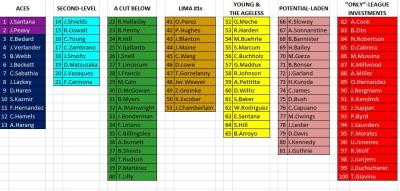
Color Coded
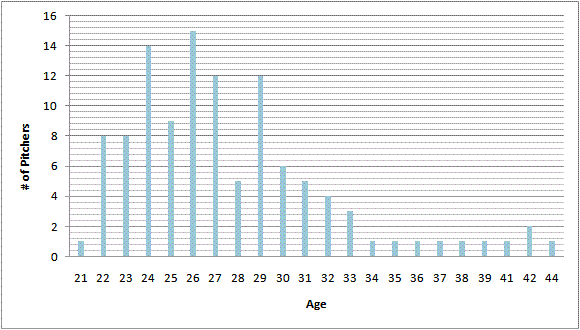
Color Coded

age_gif
teams_gif