Archive for ‘Strategy’

Monday: 08.24.2009

2010: Top 12 Catchers

Today I’ll start to make my way around the diamond with a look at the top 12 for 2010 at catcher:

CATCHER
1. Joe Mauer
2. Victor Martinez
3. Brian McCann
4. Mike Napoli
5. Russell Martin
6. Jorge Posada
7. Matt Wieters
8. Geovany Soto
9. Chris Iannetta
10. Kurt Suzuki
11. Bengie Molina
12. A.J. Pierzynski

–This is a position still dominated by players with M-last names. I’ve been touting Mauer as a first-round pick in various outlets, as I believe the power is here to stay. The pace of power will likely slow, but he also doesn’t have a built in month off like he did coming into this season.

–Martinez is a perfect example of why you shouldn’t make too much out of a washed out season killed by injuries. He had four excellent seasons of work backing him up, but that didn’t keep him from dropping significantly in a lot of leagues. He’s now on pace for a career high in home runs (27).

–McCann had to suffer through an atrocious April (.195 average) before figuring out what was wrong. It turns out he couldn’t see. Once he got outfitted with a new pair of glasses, his season took off. He’s on pace for his 4th straight excellent season and he will be just 26 in 2010.

–Napoli’s ability has never been in question during his previous three seasons in the bigs. He had massive power and a batting average that was on the rise, but he just couldn’t stay on the field. His career high prior to 2009 was 268 at-bats. Now he’s at 306 and on pace for 450+, which should yield career highs in home runs and RBI. He’s continued his batting average spike sitting at .294 this season and will remain in his prime when he turns 28 on Halloween this year.

–Martin has had a busted season, but has still carried plenty of value at catcher. He will be just 27 at the beginning of next season, so it’d be foolish to write him off after a down season.

–Like Martinez, Posada had an injury-riddled 2008, but he has bounced back as good as ever, especially for a 38-year-old. In that stadium, Posada remains viable even if only in 120-130 games.

Based on the expectations and absurd draft round in many leagues, Wieters has been a bust this season. He’s on pace to top 350 at-bats, yet he’s hitting just .264 and he’s on pace for a meager seven home runs and 33 RBI. Hell hath no fury like a fantasy player scorned. Wieters will drop to a more reasonable round in many leagues and below value in many others, but it’d be dumb to give up on him for not meeting the unrealistic expectations set upon him this season. He could be a classic post-hype sleeper depending on his 2009 finish.

–The reigning National League Rookie of the Year has flopped this year to say the least. Geovany Soto has hit .217 and has just nine home runs this season. He’s been ravaged by injuries and managed to play just 81 games, which sets up a great potential value in 2010.

–I expected more out of Chris Iannetta in 2009, but the .221 batting average makes his season look a lot worse than it has been. He is on pace for a useful 21 home runs and 72 RBI, but he once again failed to play anything approaching a full season – even for a catcher (on pace for 118 games). He has a sharp eye, big power and turns just 27 next year.

–Suzuki has made big strides again in 2009, adding some solid power to his game and becoming a viable catcher option across all league formats. He is on pace to top 70 runs scored and runs driven in, which isn’t too bad in Oakland’s putrid offense.

–The emergence of Buster Posey puts Molina’s 2010 home in doubt. Regardless of where he plays, he is going to be a late-round option that is worth more than his draft position with legitimate power and an average that won’t kill you. He can be a disaster in OBP league (.280), but plays well in standard 5x5s.

–Pierzynski is like Molina in that neither are particularly exciting picks, yet both have value and are capable of being much better than their draft position.

Saturday: 08.15.2009

2010: The First Round

This article appeared on Fanball.com’s Owner’s Edge on August 8th:

Today I am headed to the 2010 crystal ball and I am going to piece together how I feel the first round in next March’s fantasy drafts should go. This is, of course, subject to change from now until hours before said drafts, but it’s always fun to start this exercise early and watch it evolve.

JUST MISSED

Let’s first start with a group of players that didn’t make the dozen (by the way, I realize some places advocate a 10-team as a standard league, but I honestly can’t stand them; I think 12 teamers are far superior and even 14-16 teams is ideal).

— All Pitchers – It is a well documented fact that pitchers carry higher risk than hitters and while you will invariably roster some risk, doing so in the first round is just foolish. Tim Lincecum is fantastic as are Johan Santana and Roy Halladay, but there isn’t a snowball’s chance of any of them landing on my roster in a draft league if the asking price is going to be that high. There are countless examples that I would cite as to why I won’t take a starting pitcher that high and most of them are names of guys that cost next to nothing and excelled, but others are guys that were “can’t miss” fantasy aces and they missed. I’ll spare you time and just mention the most recent: Brandon Webb. Anyone that tells you they could’ve seen this coming is a bold face liar. Webb was the definition of a workhorse with five straights seasons of 208+ innings and an ERA below 3.60 in all of them. He raised his wins yearly and his strikeouts in the first four before dipping down from 194 to 183 in 2008. No one, and again I mean no one, would’ve predicted that he’d throw one poor four inning outing and then spend the remainder of the season on the shelf. So feel free to take your ace pitcher in the first (or second) round and absorb the massive risk. I’m comfortable scouting for next guy left for dead after one down season (Justin Verlander), or the next injury comeback that slips because of the lack of recent production (Josh Johnson, Webb in 2010), or the next prospect who has been up so long without amazing results that he’s labeled a bust when in actuality he’s just hitting his prime (Edwin Jackson) or lastly the massively skilled guy that didn’t have the performance to match who is now in a much friendlier situation and ready to explode or re-explode in this particular case (Javier Vazquez).

–Grady Sizemore, OF, Cleveland Indians – Make no mistake, I love me a 2010 Grady Sizemore. He’s going to be underrated because of this wretched season (as compared to expectations) and provide some big time value a la Carl Crawford this year (of whom, if I may toot my horn a smidge, I said this about in a top 100 outfielders list this preseason, “Nothing in his foundational skills suggest that he won’t come back as good as ever in 2009 so invest the standard 50-stolen base speed with double digit power, a ton of runs, around 75 driven in and a .300 average.” He’s pacing for – 107 R, 18 HR, 78 RBI, 77 SB, .314 AVG). It’s not like Crawford was going in the 5th or 6th round and Sizemore won’t either, but you could see him drop into the 3rd for sure. Since the batting average was already an issue in his 30-30 season of 2008, it’s impossible to recommend him with your #1 pick even on the expectation that he’s at least a 25-25 guy. He should probably be moved from the leadoff spot on a permanent basis starting in 2010. Then we will finally start to see the 100-RBI seasons start rolling in.

–Mark Teixeira, 1B, New York Yankees – I was very excited for Teix to head to the Big Apple. As an aside, I’d have been more excited about 2009 had he stayed in Los Angeles with the Angels. Anyway, I still expected plenty of excellence from Teixeira once he signed with the Yanks. He sputtered out of the gate as he’s wont to do with a .200/.367/.371 line and three home runs. I wasn’t deterred. Not only did I hold Teixeira in the four leagues I had him in, I actually sought to acquire him in two others. As we know, he blew up in May with 13 home runs, 34 RBIs and a blistering 1.139 OPS. He’s re-entered the atmosphere again and maintained solid if unspectacular production ever since. Stats are stats and they all go towards the bottom line in a rotisserie league, but to see someone hit 48% of their home run total to date in one month is a bit disconcerting. It’s an odd enough sample to be considered a fluke. So while Teix’s move to New York has him on pace to finally reach the 40-HR plateau again, I’m not sold enough on him as a Yankee to believe that he is a first rounder.

–Mark Reynolds, 3B, Arizona Diamondbacks – If I had to guess, I would say that Reynolds has been the catalyst for a lot first place teams in fantasy leagues across the country. His MVP-caliber numbers at his clearance bin cost represent perhaps the best value of the season. He is on pace for an absurd 48 HR/30 SB season. But even more shocking than either of those figures is the .283 average. Reynolds is a human air conditioner with a 37% strikeout rate in 1297 major league at-bats. And that lack of contact puts a batting average at risk as evidenced by his .239 last year. The power is absolutely legitimate so at worst he’s a 30 HR threat for the foreseeable future. The speed, like the batting average, is a question. He did manage 11 stolen bases in 2008, but he’s nearly doubled that this year with two months to go. Simply put, his 2009 emergence cannot be trusted as an expectations guideline going forward. Some leagues will see him go very high, but there is a lot of risk here.

–Matt Holliday, OF, St. Louis Cardinals – I know what you’re thinking: “Well duh, of course he’s not a first round. Why is he even in the honorable mention list?” Well for one, he’s an excellent player. After he was traded to Oakland, throngs of people thought he would suck and once he had a terrible April, they felt validated and acted as if the season was over right then & there. He righted the ship in the Bay Area and while the numbers were definitely depressed a bit because of the harder league and much less friendly home park he still ended his brief Oakland stay with an .832 OPS. Since his trade back to the National League, he’s been perhaps the best hitter in the league with a .488 average and 1.386 OPS in his small 43 at-bat sample. Despite all of the nonsense posted about how Holliday would all of a sudden become Jacque Jones or something, he is on pace for a sold 21 HR/19 SB season with totals nearing 100 in runs scored and driven in. Thanks to his St. Louis boost, he’s now up over .300, too. I think he will stay with the Cardinals and be a very appetizing pick for those with a late first round draft slot. In the end, I don’t think he makes the cut, but he is very much an elite player.

–Jose Reyes, SS, New York Mets – I wouldn’t have moved him out of the first round based on one injury-riddled season if the injury wasn’t in the legs. Despite three straight double-digit home run seasons, Reyes’ value is without question in his speed. He has averaged 65 stolen bases in the past four seasons which is such an advantage in a heavily valued category. I was actually advocating him as the #1 overall pick (Albert who?) this offseason because he overwhelms in two categories (stolen bases and runs scored) while contributing significantly in the three others (average, home runs, RBIs). He’s still just 26 yet he has four full season and parts of two others before this year under his belt. If he has a clean bill of health and there is no expectation that he will be slowed by the injury that has limited his 2009 to 147 at-bats, then I will assuredly slot him back into the first round. But until then, he’s on the outside looking in because of the risk.

THE FIRST ROUND

12. Justin Morneau, 1B, Minnesota Twins – Morneau already has a few brilliant seasons under his belt including an MVP campaign, but his 2009 is shaping up to be the best yet. All he did in Joe Mauer‘s absence this April was hit .318 and post a .922 OPS. And when Mauer came back and just unleashed himself on the league, Morneau was there in lockstep with him accumulating a .361/.459/.713 line with nine home runs to Mauer’s 11. I think the perception is that first base is deeper than it actually is, but really it’s star-laden at the top and then it drops. Kendry Morales‘ emergence, Derrek Lee‘s resurgence and Mark Reynolds‘ qualification there certainly helps (though he’s likely still more valuable at third). I think Morneau himself is also a bit underrated in that you don’t always hear his name when talks of the elite first basemen begin, but most certainly belongs there thanks to a fourth straight powerhouse performance.

11. Prince Fielder, 1B, Milwaukee Brewers – See? I told you first base had star power. Fielder has 95 RBIs so far this season in 108 games, which is just seven fewer than he had all year in 2008 with 51 more games on his record. His 50-HR campaign is looking a little like Mark Teixeira‘s 40-HR season in that people thought that would become the norm when in actuality it became the high watermark that he may touch again in his career, but he is unlikely to approach perennially. This year Fielder has added a strong batting average to his arsenal as he is currently hitting .302, but don’t focus on that. The immense power and run production is why you invest in Fielder. He hit .288 in 2007 and followed it up with a .276 in 2008. The perception of a 12-point drop and the reality of it are very different and the same goes for the .276 as compared to this year’s .302. Overall, we’re really talking about a 7-8 +/- hit variance year over year given Fielder’s usual 575-580 at-bat sample. He is on pace for 39 home runs meaning he could easily reach 40 with a little luck. That means he’d have 50 and 40 home run seasons under his belt before turning 26. He is an amazing talent and the best is still on the way.

10. Miguel Cabrera, 1B, Detroit Tigers – You didn’t believe me about that first base star power did you? There might even be one more coming in this top 10. Cabrera is a bona fide stud, plain and simple. He will need an RBI surge to notch his sixth straight 30-100 season (and as a Tigers fan, I’d LOVE to see a surge like he had last year in the 2nd half, but I digress). It took him a season in the new, more difficult league, but Cabrera has found his stroke once again and is headed for his second best batting average ever at .333. It’s odd to pretend as if last year’s .292 was some sort of slump or down year, but when you set the bar that high, these things happen. Cabrera still has at least one, if not a few .340-40-140 campaigns in his future. He will turn 27 early into the 2010 season, an age which is often regarded as the beginning of a hitter’s “prime years”. It is truly frightening to think that Cabrera can and almost assuredly will get better.

9. David Wright, 3B, New York Mets – To hear it from a Mets fan, Wright’s massive power outage can be blamed on Citi Field’s cavernous ways. Of course those very same people are aghast to find out that Citi Field is at the very least hitter-neutral and on some park factor lists, actually hitter-friendly when it comes to home runs. And that doesn’t even begin to address why Wright isn’t hitting home runs on the road if it’s only his home park causing the problem. Even with the power outage, Wright has been a top 15 fantasy producer this year thanks to a strong batting average (.323) and 23 stolen bases already. Even if he hadn’t boosted those two categories to offset his power shortcomings, I wasn’t going to banish a 26 (will be 27 at the start of 2010) year old superstar from the first round. He posted four straight seasons over 25 home runs before this year including a 30-30 campaign in 2007. If I didn’t have him in a key NL-Only money league, I’d almost be wishing for him to hit 10 or fewer home runs so the knee-jerk reactors would swear off of his for 2010 and pump up his value for those of us that know enough not to place too much emphasis on this one season when he has 2650 at-bats of excellence under his belt.

8. Joe Mauer, C, Minnesota Twins
– I debated about whether or not to slot him higher, but my recent comments about overemphasizing one year with respect to a down year are in play for a good year, too. Perhaps Mauer stole Wright’s power. Either way, it’s a skill never before displayed by Mauer at such a high level making it suspect moving forward. The upshot is that he didn’t sacrifice a single bit of his batting average once the power arrived, in fact he’s on pace for a career high .359. His 2009 at the deepest position on the diamond would be jaw dropping so to see them come from a catcher is just mind blowing. And because he is such a tremendous hitter I think his new found skill is here to stay, at least most of it. Think about how much value you’re getting with a first baseman’s line at catcher. I think Mauer hits .320-25-90-90 in his sleep for the next several seasons (provided health) with the capability of so much more as his 2009 injury-shortened season has shown. The talk about moving him from behind the dish has been in play for almost his whole career, but he’s apparently said he wants to stay there. I would just suggest you enjoy it while you can.

7. Alex Rodriguez, 3B, New York Yankees – I almost feel wrong slotting A-Rod this far down the list, but I think it’s an accurate position for him. Similar to Mauer, A-Rod is having a very strong season despite missing over a month to injury. I think if you had told A-Rod owners that they would have to absorb his weak batting average (.261) in order to get 80 runs, 33 home runs, 103 RBIs and 12 stolen bases-all of which he’s on pace for this season-they would’ve been thrilled. He was tumbling down into the 6th and 7th rounds in some leagues because fantasy owners were so paralyzed with fear. The reason I didn’t end up putting A-Rod higher is that the simple fact is because he is 34 years old and he’s not invincible. He is a world-class player that dominated his sport for years and still has several great years left in him, but as he ages the speed will continue to deteriorate and the batting average will suffer, too.S

6. Carl Crawford, OF, Tampa Bay Rays – Welcome back, C2! After the seasons Crawford had been putting up (five straight seasons over 45 SBs, four of those w/50+), it was so completely obvious that health was what held him back in 2008. In fact it killed his season. It essentially made him waiver wire fodder. But that is all in the past now and he has decided to make up for lost time by running wild this year. If he keeps at his current pace, he will smash his career high of 59 and end up with 77! The 12 home runs he has already would have been enough to satiate most owners, but he’s got two months to match or exceed his career high of 18. Simply put: Crawford is in the midst of his prime and he is a legitimate five-category contributor when healthy.

5. Ryan Braun, OF, Milwaukee Brewers – He just hasn’t slowed down since his amazing rookie campaign back in 2007. He is a four-category stud and maintains mid-teens speed giving him across-the-board viability. The crazy thing is that he will be just 26 years old next year meaning he likely hasn’t even come close to peaking. He definitely has 40 home run power in his bat and he could feasibly string together three or four such seasons. The speed may trickle down as he goes through his late 20s, but that’s all just gravy anyway since you’re buying the massive power production, runs scored and .300+ batting average. It’s a shame he was such a butcher at third base because he would be even more valuable on the infield.

4. Matt Kemp, OF, Los Angeles Dodgers – It’s hard to find something not to like about this blossoming 24-year old (will turn 25 before 2010). He has a better than .300 career average, incredible speed (35 SBs last year and on pace for 33 more this year) and developing power. He’s set to top 20 home runs for the first time in his career this year and he’s on pace for an incredible 104 RBIs. Why would a 104-RBI season be incredible? Because Kemp has spent the bulk of his season hitting 6th, 7th or 8th in the lineup. He’s even batted 9th 11 times! It is tough to argue with the production down there, but that doesn’t mean he wouldn’t excel as the 5th hitter if he were left there for a significant sample. The wart that Kemp does have is his strikeout rate. He was at 25% last year tallying 153 strikeouts. He’s on pace to cut total down by about 15 or so this season. If he keeps putting up these kinds of numbers on offense, then I can deal with his strikeout rate, but seeing how he has progressed since his first season leads me to believe he will correct that strikeout rate as he ages.

3. Chase Utley, 2B, Philadelphia Phillies
– What if I told you that I had a .300-30-100-100-15 guy available to you in the first round? In fact he’s somewhat underrated as compared to other superstars so you might get him later in the first round. Is that something that would interest you? Of course it is. Now what if I told you this guy played second base? I know, you’d do back flips. Chase Utley is just amazing. Kanye West may have made that song with him in mind actually. Though 30 (he will be 31 by 2010 opener), he has shown no signs of slowing down any time soon. I think he will stand as a viable first round candidate for at least the next two years before he starts his decline phase.

2. Hanley Ramirez, SS, Florida Marlins – I am still not entirely certain he doesn’t deserve the top spot. What can’t he do? The move down in the lineup has curbed his stolen base production, but the 28 he is on pace for is nothing to sneeze at, either. And this year he has countered that dip in speed with a career high .344 batting average and more RBIs (which were expected in the 3-hole). It blows my mind to think that he will be just 26 next year. When you stack the numbers with the guy residing in the top spot (have you figured out who it is yet?), it’s clear to see why it’s tough to pick one ahead of the other. Then you factor in Ramirez’s position and the decision gets even murkier. The reason I eventually landed on Ramirez at 2 is because while you know you can expect greatness, it is not entirely certain where it will come from within the five categories. Will his speed continue to trickle down as a middle-of-the-order producer? Will the power go back up to last year’s mid-30s heights and beyond? Is a .330-.340 hitter or more a .300-.310 hitter? There is a pretty significant difference over the course of 600+ at-bats. What I do know for sure is that if someone flips these top two, I wouldn’t really argue. They are the quintessential 1 and 1a split by millimeters at best.

1. Albert Pujols, 1B, St. Louis Cardinals – This guy is absurd. I really could end it right there and I don’t think anyone would find it weird. But I’ll elaborate a bit. The 2007 and 2008 seasons are what you get when Pujols isn’t really 100% and they were still both fantastic seasons. Now he is operating at 100% and we see the damage he is doing. He’s a four category superstar and he’s brought back the speed he flashed back in 2005. He’s already reached double-digit steals and he’s on pace for 15. He’s also on pace to be the first player to top 50 home runs since 2008 (Ryan Howard, 58). I think the part of Pujols’s flawless game that gets overlooked, at least to a degree, is the batting average. Getting 550-600 at-bats of .330+ batting average is incredible. As I mentioned earlier, I think Matt Holliday will stay in St. Louis to keep that lineup clicking around Pujols. He’s my #1 for 2010.

Monday: 06.8.2009

Roy Halladay: The Complete Picture

It wasn’t always bubblegum and lollipops for the American League’s best pitcher. Roy Halladay notched his major league-leading 10th win of the season on Sunday with a complete game shutout of the Kansas City Royals. The complete game was his third of the season and second of the week as he continues to prove beyond a shadow of a doubt that he is the junior circuit’s best pitcher. In fact he is right on the heels of Johan Santana for baseball’s best overall. It was an up-&-down path to stardom for Halladay, though.

He came to the majors for a cup of coffee in 1998 getting just two starts totaling 14 innings. He made the club the following season as a 22 year old and went 8-7 in 149 innings with an incredibly lucky 3.92 ERA. He had essentially a 1.0 K:BB rate with 82 strikeouts against 79 walks and allowed better than a hit per inning for a 1.57 WHIP. You can understand why I declared his ERA so fortunate. Things came to a head the following season as he maintained his 1.0 K:BB ratio and was decimated to the tune of a 10.64 ERA and 2.20 WHIP in 68 innings of work. He stayed down for the rest of the year save three relief appearances in September.

Then he had to work his way up from High-A at the beginning of the 2001 season. Toronto’s 1999 #1 prospect according to Baseball America was essentially in remedial classes as a 24-year old working his way back to the bigs from High-A, where he was a reliever. He made seven starts between AA and AAA before coming back up in July. In his first appearance (a 1st inning bailout of Esteban Loaiza, who had given up 5 runs in just 1/3 of an inning), he was destroyed, allowing six runs in 2+ innings of work and it looked like all of his hard work was for naught. But the Blue Jays stuck with him. He had come a long way having displayed the best control of his career during the minor league stints of 2000 and 2001. And though just 71 innings of work, his strikeouts were way up, too.

The rest, as they say, is history. He started 16 times the rest of 2001 and put together a 5-3 record with a 2.71 ERA, 1.10 WHIP, 8.3 K/9 and 1.9 BB/9 in 103 very strong innings. The next season he made the All-Star team and he followed that up with a Cy Young Award winning performance. His only hiccups in the run up to becoming one of baseball’s elite were a bum right shoulder in 2004 that limited him to 133 innings and a freak accident broken leg the year after that again held him under 150 innings (141.7). Since 2002, he has been the gold standard for complete games with his 40 (including Sunday’s) standing as a major league best in that timeframe (Livan Hernandez and CC Sabathia, 28).

Outside of just being fascinating on its own accord, I wanted to write about Halladay on the heels on my piece of patience that I wrote yesterday. I’m not suggesting you should’ve held over Halladay yearly since 1999 if you owned him, but rather that you can’t just write off young players at the first sign of distress. Halladay was a highly thought of prospect, but it took 336 innings spanning parts of four years for him to really break through. Today’s fantasy owner would’ve discarded him after the 2000 meltdown and then been baffled by his emergence two years later. In fact, it’s unfair to limit it to just fantasy owners. The baseball watching public and media would’ve behaved similarly on both fronts. This is speaking generally of course, as there are pockets of people and certain outlets that don’t hastily judge prospects on minuscule samples.

Brandon Phillips is another example. He was a highly touted prospect for several years ranking 9th, 2nd, 1st and 1st in his organization from 2000-2003. He was in the top 20 for all baseball in 2002 (20th) and 2003 (7th). After a 31 AB stint in 2002, he came up for over 100 games in 2003, but struggled mightily in 370 at-bats. In fact, he put up a .206/.246/.310 line in his first 432 at-bats spanning parts of four seasons, but 86% of those at-bats came in one season as a 22 year old. Alas, the Indians gave up on him and let him go in a trade at the beginning of the 2006 season. He finally got a full season’s worth of work at the age of 25 and performed quite well with 17 HR, 25 SB and a .276/.324/.427 line. He got even better in his age 26 season, going 30-30 and garnering a shred of MVP consideration. He had paid dividends on the prospects from the early 2000s and it’s not like he was a late bloomer at 25, just that the Indians were wildly impatient.

The latest iteration could be happening before our eyes in the form of Edwin Jackson. Drafted by the Los Angeles Dodgers at age 17 back in 2001, it feels like Jackson has been around forever. The Dodgers afforded him a whopping 75 innings in the big leagues before discarding him at the age of 22 to the Rays for Danyz Baez and Lance Carter. The Rays gave him a sample even larger than Halladay’s 336 innings as they saw him through 381 innings spanning three seasons with varying degrees of success. The only thing is, they didn’t stick around for the payoff. Instead they dealt him to Detroit for Matt Joyce. Jackson is enjoying a career year at age 25 (just like Halladay) thanks in large part to massively improved control (just like Halladay). In fact, Jackson has improved his walk rate four straight seasons going from 6.2 BB/9 in 2006 to 2.1 BB/9 through 83 innings in 2009. I’m not saying Jackson is going to be the next Roy Halladay based on 83 excellent innings of work, but there are some nice similarities.

In fact, when I started this piece, it was for the sole purpose of showing Halladay’s path and how it had bumps in the road to stardom. As many of you may know, I’m a diehard Detroit Tigers fan so I don’t want this coming off as a spin job to say my favorite team’s new shiny toy is headed towards the top 3 starting pitchers in all of baseball in the coming years. Jackson is just one of many examples that shows that major league teams are sometimes hasty in their judgment of youngsters and expect too much of kids that haven’t fully matured. That effect trickles down to the fantasy baseball community and creates these seasons deemed as “out of nowhere” that shock everyone even if the player was highly thought of coming up through the minors and is still very young. They are actually just breakouts due to the maturation of mid-20s players. Not everyone will come up and be Ryan Braun, Tim Lincecum or Evan Longoria.

Ervin Santana went through this last year. His breakout was seen as a “rising from the dead” because he had been solid if unspectacular in his first two seasons and then hit a major road bump in season three with a 5.76 ERA in 2007. That season included a trip back to AAA to try and “fix” him. The thing is, his skills hadn’t just fallen off of a cliff that year. He was actually striking out more than ever (7.6 K/9) leading to his career-best K:BB ratio of 2.2. The walks were up a tick at 3.5 BB/9, but he wasn’t nearly as broken as was perceived. Then last year, his control improved dramatically and he had a breakout season at age 25. So far this year he has stumbled out of the gate after starting the season on the disabled list. Two flameout starts have inflated his numbers, but he took a huge step forward on Friday with 8 and 2/3rds of 1-run ball against the Detroit Tigers. It was the first start I had seen of his all year and he looked so 2008 as he brought the boom, boom pow on the Tigers. (I really won’t blame if you stop reading and never come here again after that…)

Who will be the next player written off at far too young an age only to meet or exceed his prospect promise?

Sunday: 06.7.2009

Patience is a Virtue

We’ve all heard that adage a million times in our lives, but fantasy baseball players would be well served to take it to heart. I grant that it is easier said than done, but that doesn’t make it any less important or given anyone an excuse for not adhering to the notion. In this day and age where you can get up to the second standings, it’s easy to see hpow fantasy owners could be prone to impatience. They add a player to their roster and watch him go 0-for-4 for three straight days and they think he’s a bum.

When I first got introduced to this game, it was a league with my parents and my dad’s co-workers. The league was 10 teams, AL-Only and they updated the statistics weekly via the USA Today stats dump every Tuesday. The anticipation for the standings each week accompanied by an expansive team-by-team statistical readout was intense. I couldn’t WAIT for my dad to get home from work. And heaven forbid their actual jobs get in the way and prevent the update until Wednesday. This was before I even got a team, once I actually joined the league, I was off the walls eager on summer Tuesday afternoons. I would ride my bike to the convenience store and grab the USA Today and begin to compile my team’s stats and then try to guess how I was doing in the standings (a futile exercise to be sure).

Anyway, transactions were weekly within your team and bi-weekly free agent buys were the means for replacing players outside of trades. So you were looking at giving players at least 7-14 days to perform and you generally wouldn’t make a hasty decision based on one scoring period so fantasy owners were by and large much more patient pre-Internet age, mostly because they had to be unless they had some insane commissioner interested in updating the numbers daily, but I’m sure it prevented a lot of the horror stories we hear yearly about people releasing players in April or May who end up having brilliant seasons. If you’ve read this site in 2009 or any of my work for Owner’s Edge at fanball.com, you’ve seen me talk about the impatience of fantasy owners on many levels: discarding top prospects when they don’t perform instantly, giving up on starters with good skills after a bad start or two and judging hitters on tiny at-bat samples.

This doesn’t mean you have to sit on the team you drafted until a certain date in the season and let a sinking ship sink. But make sure your decisions come from the right place. Knee-jerk reactions to an established player struggling will never serve you well. Dumping a hot prospect you drafted three years ago because his first go at the league as failed to launch is dumb. And trying to fix your pitching by streaming 15 pitchers in and out every single day is unlikely to payoff and lower that Wang’d ERA. Staying the course with your core and preying on the owners that do the above is the way you should go about fixing a rough start or even enhancing a well-performing squad. In the aforementioned AL-Only league (that is in the midst of its 20th season by the way), I am the reigning champion and I desperately want to defend my title. We also had two new owners come in this year and they happen to be two very good friends of mine so I don’t to want fizzle out in front of them either.

Alas, that’s precisely what I did out of the gate. By week 3, I was 9.5 and 22.5 points behind my two friends and buried in last. I had 6.5 points in front of me just to make a move out of the cellar. I didn’t panic. Even though Scott Baker and Andy Sonnanstine LOVED to ruin every nice outing by Dallas Braden and Felix Hernandez making it feel impossible to fix my 5.49 ERA. Keep in mind, we use just six pitching slots: 4 SP/2 RP and I was using 5/1 mix because Braden had relieved in 2008 and I only had one closer (Joakim Soria). I stayed patient and didn’t make panic moves. And like I mentioned earlier, I wanted to take advantage of people that would fall victim to impatience.

At the beginning of week 7 (May 18th) I made my first trade of the season dealing away of hot hitting Shin-Soo Choo for a struggling Kevin Slowey. He had an ugly 4.50 ERA, but he had a 35 to 4 K/BB ratio so he still had the impeccable control he displayed in 2008. I was very confident in a rebound for Slowey. Mind you, I didn’t necessarily prey on this other owner by giving him Choo for Slowey. Choo is no slouch and has hit .319 with 3 HR, 10 RBI and 3 SB since the trade. Meanwhile, Slowey is 3-0 with a 2.70 ERA and 1.15 WHIP for me in 20 innings. He has struck out 14, too, but this is a 4×4 league.

I wanted to use the free agent buys as another means to plug holes and see if I could on a roll. I really liked my team coming out of the draft and I wasn’t willing to blow it up because of a horrible April/early May. We have a five-man reserve roster that is integral to the strategy of using the bi-weekly buys to my advantage. I could put some of my early flameouts on the bench and try some other hands. I technically had a four-man reserve because I had The Chosen One taking a spot until his recent call up to the Orioles. That is of course Matt Wieters.

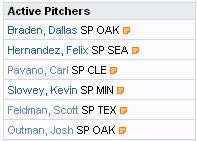
When Soria got hurt, I decided to go with a 6-man rotation after acquiring more starter/reliever combos in the form of Scott Feldman and Josh Outman. I hate Texas pitchers so I was mighty skeptical of Feldman, but I love Oakland pitchers so I was pleased to see Outman throwing well. I still had a few of their outings ruined by Sonnanstine, but I was definitely trending the right way. From week 6 to 7, I moved the ERA from 4.98 to 4.60 and moved up 2 spots to 8th in the category. The WHIP was moving rapidly in tandem. I added Carl Pavano to the mix in favor of Sonnanstine and eventually woke up to one of the best sights a CBS owner can see:

hot SPs

Those little orange squares are better than porn in the middle of summer as fantasy baseball owner. From week 3 to 9, I gained 12.5 points and moved from 10th to 5th. A lot of the winning formula was patience as my first move didn’t even come until mid-May which is the time I usually suggest you wait until before moving major pieces from your draft. My ERA is now at 4.34, the WHIP is 1.33 and I lead the league with 23 wins. Soria is now back, which is great since I’m dead-last in saves. To accommodate, I traded Feldman and Aaron Hill for Joe Nathan and Placido Polanco.

Back to the original point, this isn’t the first time that patience has helped me get through a tough early season. And I only learned that patience was the key by making mistakes in the past. Outside of a team decimated by injuries, I can’t imagine any reason for giving up on a season even at this point. I could have easily quit on my team early on when the staff was failing as described above Mark Teixeira, Jose Lopez, Jhonny Peralta and B.J. Upton couldn’t hit their way out of wet paper bags.

The “everything now”, Internet society we live in has made it harder for fantasy baseball owners. Well wait, it hasn’t actually made it hard, but it is perceived to be harder. When the team you brought into the season doesn’t lead the league instantly and stay on fire all year, the natural inclination for most is to throw up their hands and say, “this year is sunk!”, but in actuality very few of those teams should be abandoned as early as they are because the deficit isn’t nearly as large as the owner erroneously perceives.

If you’re the guy with all of the “I traded/cut Player X in early May and he ended with a great season” stories, then you’re not practicing enough patience. And those “Buy-Low Candidate” lists published by the 100s every season? Those are guides of how to take advantage of you. Wise up and trust you initial draft day and give a guy a legitimate chance to sink or swim with your team.

Thursday: 06.4.2009

Trade Targets – Pitching

This was the final part of what ended up being a 3-part series that appeared on Owner’s Edge at fanball.com –

Infield
Outfield
Pitching

Finishing up my series of trade targets leaves me with just the mound men to cover. As a refresher or for anyone that didn’t read either of the first two installments that covered the infield and outfield: this isn’t just a group of buy low targets; there are some buy at-cost and even some buy high, too. This group just brings value in some form or fashion to your team, so let’s get to them.

Scott Baker, Minnesota Twins – Since about late April, I have been furiously beating the drum to buy low on Baker and his teammate Kevin Slowey. The window has closed on Slowey, as he is 4-0 with a 2.40 ERA and 1.19 WHIP in five starts since May 12th. His season ERA is now below 4.00 at 3.97. But Baker hasn’t quite gotten on track like Mr. Slowey. He appeared to be turning the corner with a May 8th outing that included seven shutout innings but followed that up with nine earned runs allowed in his next two starts spanning 11 innings of work. Then he threw 8.1 strong against Milwaukee, but followed it up by allowing four in 5.2. That has been his “thing” thus far for 2009. Four runs in 5.2 equates to a 6.32 ERA, which is his season ERA. But alas, he finds himself on this list. I’m a sucker for anyone with ridiculous control. Baker walked six in 38 innings during May; Daniel Cabrera walks six during the National Anthem. Baker is also striking out 6.7 batters per nine, which is a very reasonable rate. His numbers are in line, but he is being punished by a ridiculous home run rate that WILL come down. He’s at 2.4 HR/9 so far this season, but his career number through 2008 is 1.1 HR/9.

A.J. Burnett, New York Yankees – The haters and naysayers are out in full force screaming, “I TOLD YOU SO!!!” regarding the Burnett signing. But the Yankees may (and probably will) have the last laugh. Burnett hates the first half of the season for some reason. From 2006-2008, Burnett has a 4.64 ERA before the All-Star Break, yet a 3.28 after. He is coming off of back-to-back nice starts and three strong out of his last four, so his cost probably isn’t as low as it was after his May 22nd start when his ERA reached a sky-high 5.28, but his overall numbers are still unappealing at 4.69 for the ERA and 1.39 for the WHIP. In leagues counting strikeouts, he has at least been delivering some value during his struggles. If you get him now, you’re looking at 130 strikeouts and an ERA around 3.20 with a chance at a boatload of wins in 140 or so innings. One key factor is health, as he has never had back-to-back 200-inning seasons, but health aside, I think he will improve his numbers without question.

John Danks, Chicago White Sox – It would appear as though Danks’ 2008 bubble has burst when you look at his 4.80 ERA/1.47 WHIP combo, but the skills are in line for a strong rebound. His strikeouts are up (8.3), as are the groundballs (0.99 G/F ratio), both of which are great indicators. The walks are up too much at 3.6, but that is inflated by two terrible outings in which he yielded six and four runs, respectively, in separate six-inning outings. Though I’m not a huge fan of this practice, if you take those out, his BB/9 is back at the 2.6 it was at last year. With the outings, it’s at 3.6. Simply put, everything points to a journey back into the 2008 realm for Danks, and soon. Acquire confidently.

Jorge De la Rosa, Colorado Rockies – de la Rosa was one of “my guys” coming into the season. Ya know, the guys that you love that aren’t getting much pub so you can usually get them cheaply; in other words – a sleeper, but a legitimate one unlike a Nelson Cruz that touched every radar out there by the time draft season hit. Through his May 15th start, I was looking like a genius. I hadn’t counted my chickens before they hatched given how early into the season we were, but I was enjoying his success on several of my fantasy teams. Then the wheels came off. De la Rosa has been thrashed in his three starts since May 15th, allowing 18 runs in 12 innings while walking 10 and allowing 18 base hits. He has struck out 12, but even that can’t cover the damage he has done in a short time. His season ERA is now up to 5.43 and the WHIP is at 1.43. He is still striking out better than a batter per inning at 9.5 K/9, which keeps him above the 2.0 threshold aimed for in K:BB ratio despite a 4.3 BB/9 rate. I would probably hold off in mixed leagues without reserve lists, but he is probably dirt cheap in NL-only leagues and makes for a nice addition to the strikeout totals even while he works out the kinks elsewhere in the arsenal.

Jon Lester, Boston Red Sox – This is one of the more higher profile buy low candidates due to name, past success and the team he plays for, but he is still coming at a discount thanks to a 5.65 ERA and 1.55 WHIP. His peripherals suggest neither of those numbers should be anywhere near that high. He is striking out batters at an amazing 10.2 per nine clip while walking just 3.3, good for a 3.1 strikeout-to-walk ratio. Home runs have eaten him alive so far, as he is just three away from his 2008 total. His HR/9 (1.5) rate is 2.5x his 2008 mark of 0.6. A correction in that figure combined with these peripherals would yield a sharp drop in his ugly ERA and WHIP totals. Take him at any discount you can get right now, because he is not long for this level of ineptitude. In fact, he has two strong outings sandwiching a dud over his past three, so the wheels of the turnaround may already be in motion. He does have a worthy opponent Saturday in his next start when the Texas Rangers head to Fenway.

Roy Oswalt, Houston Astros – They say that history has a way of repeating itself and Oswalt’s beginning to 2009 when compared to 2008 seems to play that adage out. Oswalt posted a 4.68 ERA and 1.38 WHIP during the first half last year spanning 115 innings. He has been similarly shaky again in 2009 with a 4.28 ERA and 1.34 WHIP through 69-plus innings of work. Yet his indicators are very strong and almost identical to 2008’s first half indicators. He is striking out 7.2 batters per nine (7.3 in ’08) and walking 2.5 (2.1 in ’08). Like several others covered already, the home run ball has been the bane of existence so far in 2009 and it was in 2008, too. Only once had Oswalt posted a HR/9 rate at or above 1.0 and that was an injury-shortened season in 2003 in which he pitched just 127 innings. He posted a 1.4 HR/9 rate in the first half but cut it back down 0.5 during his incredible second half run. With his skills in order, that once again appears to be the sticking point to success for Oswalt and once he gets that in order he will return to the elite class of bankable starting pitchers. His value may never be lower, so now is the time to buy, especially since his price probably jumped a tick after his latest outing in which he threw seven innings of one-run ball with eight strikeouts.

Carl Pavano, Cleveland Indians – How hard is it to erase a one-inning, nine-run shellacking? Pavano threw 45 innings of 3.60 ERA work in the month of May and his ERA is still sitting at 5.29. That opening week abomination is likely still overshadowing the progress Pavano has made into a viable fantasy starter. He has a sparkling 3.9 K:BB ratio thanks to a career-high 7.1 K/9 rate. His ability to hold those strikeout gains will determine how far he goes in 2009 since the control has never been in question. He is in a no-pressure situation in Cleveland and it almost seems as if he relishes sticking it to the Yankees with every passing successful start. He gave up more than three runs just once in May and has walked more than two only once since the ugly debut. Pavano might still be on the wire in many leagues, which, of course, would obviously eliminate the need to trade for him, but it shouldn’t be hard to spin a discount from any owner looking at his gaudy ERA and factoring his injury history and lack of a legitimate track record outside of that magical 2003. Of course, that means there is also an inherent risk involved for you if you acquire him, but his skills support an ERA comeback.

CC Sabathia, New York Yankees
– Most of the names included on this list have qualified as buy-low candidates in some form or fashion, which wasn’t always the case on the two hitter lists. Those lists had guys performing well that I still recommended chasing down and CC is probably the first to fit that bill for the pitchers. That said, there is still a legitimate upside in that strikeout rate that you’re buying low on. He is at 6.5 K/9 right now, a figure he hasn’t touched since 2004. The best has yet to come for him in 2009 despite his 3.46 ERA and 1.14 WHIP. He is a top dollar ace that will command a premier hitter or a package of 2-3 quality talents, but he can begin to repair a broken down pitching staff. If he gets on the kind of run he had with Milwaukee last year, he can single-handedly lead you up your league’s standings.

Also Look Into:


— Aaron Harang, Cincinnati Reds
– He appears to be all the way back from 2008’s washout, yet the ERA isn’t as pretty as it should be with a 4.1 strikeout-to-walk ratio. I’d pay full price, but you might be able to get a bargain thanks to a 4.19 ERA.

— Rich Harden, Chicago Cubs – Unsurprisingly on the DL right now, Harden has a surprisingly mammoth (for him) ERA of 4.74. Yes, he has walked 4.4 per nine, but that’s tolerable when you’re striking out 11 per nine innings. He’s ALWAYS going to be an injury risk, but the reward can be huge as fantasy owners learned last year in his 25 brilliant starts.

— Koji Uehara, Baltimore Orioles – Slated to be back in a week, Uehara has displayed pinpoint control (1.9 BB/9) and solid ability to miss bats (6.7 K/9). Though much lesser heralded than Kenshin Kawakami in terms of imports, he has definitely outshone him to date.

— Jordan Zimmermann, Washington Nationals – He won’t be too discounted in keeper leagues despite a 6.07 ERA, but he’s worth targeting either way. He just can’t keep an ERA that high while striking out more than a batter per inning (9.2 K/9) and walking fewer than 3.0 batters per nine (2.7 BB/9).

Wednesday: 06.3.2009

Trade Targets – Offense

This appeared as a two-part piece on Owner’s Edge at fanball.com –

Infield
Outfield

CATCHER

Bengie Molina, San Francisco Giants – Molina started the 2009 season on fire with a .329 average, four home runs and 18 RBI, but he has since fallen on hard times with a .194 average in May with another four home runs and still three days left in the month. Molina has been a viable hitter at the catcher position since 2003, averaging 16 home runs, 71 RBI and a .284 batting average. In virtually all six of those seasons, he has had at least one flameout month. Last year he had an awful July. Two years ago, it was also July. He just so happened to have his bad month early on this year, but that creates a potential buying opportunity with his average down to .253. Now with the eight home runs and 30 RBI, which pace out to 29 and 107, respectively, he won’t be free, but it is definitely worth looking into his cost from your league’s Molina owner. Just don’t accidentally email the owner that has Jose Molina.

Also look into: Joe Mauer – I realize he’s the world’s hottest hitter right now, but he’s not a fluke. I know he won’t continue to hit .425, but he can hit .350 as he did in 2006 and that alone is worth investing in even if you don’t think the power is legit. Assuming he gets about 360 more at-bats, hitting .350 for the season would leave him hitting .333 the rest of the year. Hitting .324 for the year, so a 100-point drop from where he is, would still leave him as a .300 hitter from here on out. If the price isn’t obscene, get him.

FIRST BASE

Ryan Howard, Philadelphia Phillies – With his batting average at .263, there is little risk at him hurting you there. He’s likely to stay steady there and in a dream scenario, he could improve. Regardless, you’re getting Howard for the power. His 12 home runs is a fine number, but at a pace of 43, it’s well off of his three-year average of 51. That number is inflated by the 58 from his MVP season, but he has averaged 48 the last two years, so any way you slice it he is a bit off of his usual home run pace. There are 32-35 home runs coming from Howard over the remainder of the season and there are few players offering that kind of production two months into the season. Howard is the Carl Crawford or Jacoby Ellsbury of home runs. Generally one guy can’t carry you through the home run leaderboard, but Howard is capable of it.

Also look into: Lance Berkman – His run production paces are strong at 37 home runs and 104 RBI, but the .229 batting average should offer a discount.

SECOND BASE

Placido Polanco, Detroit Tigers – He has been a batting average machine throughout his career, but especially so in Detroit. He came over from Philadelphia in the middle of 2005 and hit .338 in 86 games. From there he hit .295, .341 and .307 in his three full seasons with the Tigers. He is currently at just .269, but he’s been 22 points better from April to May and he improved his average 10 points in the three-game set with Kansas City. He reminds me of Freddy Sanchez last year. It just didn’t make sense for Sanchez to be struggling so much, so I targeted him in the 2nd half and he went on to .346 after the All-Star break.

Also look into: Jose Lopez – He’s like a penny stock at this point. He can’t get much worse, so if you have a reserve roster, you might as well scoop him up for a song and stash until to see if he gets right over the next 5-7 weeks. I recommend him primarily for AL-only leagues and mixed leagues with more than 12 teams.

SHORTSTOP

Alexei Ramirez, Chicago White Sox – The 4-for-7 showing in Chicago’s thrashing of the Angels on Monday might’ve caught his owner’s attention and given him hope of a turnaround, but he is still definitely not going for full price. Remember folks, he did this last year, as he was hitting .244 through May. From June on he hit .303 with 19 home runs and 70 RBI. He hit .355, .341 and .308 during the summer months before again falling on hard times in September with a .211 average, but he still hit six home runs and stole three bases that month. He is a streaky player. We have seen this type of player before and we will see it again, yet for some reason the fantasy baseball community still falls for it and counts the player out when they are down and then puts them in the Hall of Fame when they’re at their peak. These guys are nauseating in head-to-head leagues, but roto owners just need to display patience and they will be rewarded. Take advantage of the fact that so many fantasy owners can’t practice that
patience.

Also look into: Troy Tulowitzki – He is also very streaky and it is hard to believe he could suck this bad all year long. The only way to go is up for him.

THIRD BASE

David Wright, New York Mets – There is so little star power at the hot corner that I considered just putting “The Stars” despite the fact that they are all performing remarkably well. Wright is hitting .345 with 11 stolen bases, so he is offering big value despite just three home runs and he won’t come cheaply, but given the dearth of bankable talent at third right now, it’s worth looking into his price tag. With Aramis Ramirez on the shelf and Alex Rodriguez fresh off of it, Wright is in slim company with Evan Longoria, Ryan Zimmerman, Michael Young and Chipper Jones standing as the stars of the position. Other contributors have stepped up, but it’s uncertain how they will hold up: Casey Blake (nine homers), Pedro Feliz (.307 average), Brandon Inge (12 homers) and Mark Reynolds (13 homers/10 steals). I’d prefer the star power at position where it is thin.

Also look into: Alex Gordon – He is still out until late June/early July and it’s always risky acquiring players that are on the disabled list, but his price could be rock bottom and he could deliver a nice boost in the second half of the season.

———–

OUTFIELD

Carlos Lee, Houston Astros – Lee is the model of consistency, an undervalued skill in the fantasy landscape. He is a bankable .300-30-100 line the only deviations being a .265 average in 2005 and 28 home runs last year, but that came in just 115 games, so he’d have easily smashed the 30-homer mark had he met his five-year average games played figure of 159. As it is, he has averaged 151 games over the past six seasons with a line of .295, 32 HR, 110 RBI, 90 runs and 12 steals. He’s just a tick off the power numbers at a pace of 29-99 and the speed is way down with just one stolen base, but his remarkably steady history suggests he will get back on track. There is no discount to be had, but if you’re looking to implant a star into your lineup, go for Lee.

B.J. Upton, Tampa Bay Rays – A cursory look at Upton suggests he has been awful this season with a .212 average, two home runs and a worthless nine RBI. It’s been awful, there is no denying that, but the speed has kept him fantasy-relevant. His 16 steals put him on pace for 54 this season and there is nothing to suggest he won’t continue to run. If he gets everything else back on track, the OBP will shoot up and increase his stolen base opportunities, giving him a legitimate shot to top 60 bags. He has also scored 32 runs putting him on pace to net 107. Runs are often overlooked and a 100+ pace for someone doing this horribly is pretty good. Like the stolen bases, imagine the potential for runs scored as he improves and begins to get on pace more often. The ugly .212-2-9 line leads to a discount on the appetizing 32 runs and 16 steals.

Ryan Braun, Milwaukee Brewers – Like Lee, Braun isn’t struggling and definitely doesn’t qualify as a buy-low candidate, but his career to date would suggest that a huge four months is on the horizon. He has “just” nine home runs so far with months of five and four to start the season, respectively. It isn’t unreasonable to believe he has 24+ home runs in the bank, as seven of his 10 months prior to 2009 saw Braun hit six or more home runs. That baseline alone would be good 24, but within those 10 months are four with 9+ homers, meaning he could have as many as 30 on deck without it being a huge stretch. Like Lee, Braun also runs a good bit and he’s on pace for 10 right now after seasons of 15 and 14 in 2007 and 2008, respectively. Essentially, Braun shapes up as a younger Lee, meaning the ceiling could even be a tick or two higher. Buy!

Also Look Into:

Matt Holliday, Oakland A’s – The naysayers couldn’t WAIT to pump their chest about Holliday after a horrid April that saw him hit .240 with just one home run, but that shortsighted foolishness was obliterated in May as he put up a .291/.416/.456 line with five homers. He’s NOT going to put up Colorado numbers, but he’s not just going to become Endy Chavez, either. He might still carry a discount.

Magglio Ordonez, Detroit Tigers – Still in the throes of a power outage, Maggs hit .315 in May after a .241 April. He has averaged 24 homers per year for the past three seasons and there doesn’t appear to be any discernible injuries that would lead me to believe he won’t display 20-homer power this season. He should also end the season at or above .300, leaving some nice growth there, too. Play up the seven-homer, 66-RBI pace to depress his cost.

Andre Ethier, Los Angeles Dodgers – By now most realize the impact that Manny Ramirez has on Ethier and the proof is in the pudding, as Ethier dropped from a .976 OPS in April to .601 in May. You could probably parlay Ethier’s struggles into a discount and ride it out for the next month until Ramirez comes back in early July.

Wednesday: 05.27.2009

Around the Diamond – 5.26.09

Transcript from Tuesday’s show:

Podcast can be found here: http://sporer.podbean.com/
or in iTunes under Baseball by Paul*

* – there are two Baseball by Paul listings because I used to have the podcast at MyPodcast.com, but they blew up so I had to move it and start anew.

Note – I said “best well run” re: the Red Sox organization… sounds weird to hear it now. Not sure it’s proper grammar.

FIRST BASE
First base is well known as a power position in the lineup. Many teams have one of their best hitters manning first base and it isn’t necessarily important that they man it well on the field so long as they swing a sweet stick in the middle of the lineup. The Major League average SLG at 1B is .490 so far this season (it was .463, .464 and .488 the past three seasons), yet 14 teams are below that mark. Worse yet is that 9 teams are below .450 including four below .410. San Francisco is getting a .290 SLG from their 1B—nice work there by Travis Ishikawa and Rich Aurilia. Even Emilio Bonifacio has a .304 SLG.

SECOND BASE
Jayson Nix
banged his 3rd and 4th home runs of the night, but even more notable is that his brother also hit his 4th of the year. Cincinnati’s Laynce upped his average to .287 with a 2-for-4 effort that included that 4th home run. I’m sure the DiMaggios-Joe, Dom and Vince-pulled off the feat a few times in their career. As I’m sure Cal and Billy Ripken did SEVERAL times! OK maybe not. Billy had 20 home runs in 3015 ABs spanning 12 seasons.

SHORTSTOP
Jason Bartlett
is headed to the disabled list along with his double play partner Akinori Iwamura, who will actually miss the rest of the season with a torn ACL. The Rays are M*A*S*H unit right now with a quarter of their 25-man roster disabled. Bartlett is probably the most damaging loss at this point. He has been amazing at the dish including a 1.127 OPS in May, which is best among all shortstops and 9th in the majors.

THIRD BASE
Garrett Atkins
was rumored in potential trade talks this offseason, but now it will be next to impossible to get much in return thanks to his awful start to the 2009 season. His disgustingly bad May in which he has a .399 OPS have sunk his season totals to .190/.273/.293. How does such a potent run producer just fall off at age 29, especially playing half of his games in such a favorable home park? His 2B, HR, RBI, BB, AVG, OBP and SLG totals are all in a three-year decline. He’s relatively young so he might not be toast, but a slide like this in this era can only lead to one question: did he have “help” during the 2006-2007 heydays? Who knows, but something is seriously wrong with Garrett Atkins.

CATCHER
Joe Mauer
has the May Triple Crown right now with a .444 batting average, 11 HR and 31 RBIs. He has done so with fewer AB than any of the other HR leaders in the top 10 except ARod (7 in 58 AB). In fact, he’s actually got a Quadruple Crown when you factor in his 25 runs scored. He has been just brilliant. And he’s not the only one. According to Noah Coslov of MLB.com’s Twitter, the Twins have homered in 9 straight games. The last time they accomplished such a feat was a 12-game streak all the way back in July of 2002. During yesterday’s broadcast, Detroit Tigers announcer Dan Dickerson said “The Royals are Detroit’s closest competition in terms of games back, but any Tigers fan knows it’s the Twins you always worry about.”

OUTFIELD

I won’t complain too much because the Detroit Tigers are off to a great start, but remind me again why THEY are paying Gary Sheffield to hit .291 with a .430 OBP and .535 SLG for the Mets? He hit his 5th home run tonight and he appears to be in quite a groove. I realize he was bringing very little to the table in Detroit except for a logjam for ABs and I don’t really object to getting rid of him, just wondering if there wasn’t a better way available to where Detroit doesn’t eat the ENTIRE $14 million while he plays and plays well for another team.

According to Ken Rosenthal, the Kansas City Royals might be the top suitor for Jeff Francoeur if the Braves shop him. Question 1: why WOULDN’T the Braves shop him? Question 2: why would the Royals be their top suitor? I know the answer is because Dayton Moore, their GM, is a former Braves guy, but c’mon—Francouer just isn’t that good. And I actually like Frenchie, I’m just being honest. Question 3: Rosenthal mentions that the Red Sox are known to have an eye on Francoeur. The question once again is WHY? I thought the Red Sox liked to acquire good players. They are one of the better run teams so this one perplexes me unless Theo & Co. are seeing something beyond his awful numbers.

PITCHER
Jason Berken
made his major league debut for the Baltimore Orioles tonight and fared alright. He went five allowing two runs on seven hits and three walks while striking out three. He picked up the win as his offense supported him well with 3 HR off of Ricky Romero en route to a 7-2 thrashing. Berken is one eight starting pitchers to rate in the top 15 for the Orioles organization according to the Minor League Analyst put out by the guys over at BaseballHQ.com and the second one up to the majors this year. Brad Bergesen was the first and he has been beat up in seven starts so far with a 5.49 ERA and 1.60 WHIP. The three best are still in the minors and they are all off to very strong starts. Chris Tillman is the closest at AAA-Norfolk and he is 5-0 in eight starts with a 2.13 ERA, 1.21 WHIP and 10.4 K/9. Jake Arrieta is at AA-Bowie and he has a 4-2 record in eight starts with a 2.97 ERA, 1.23 WHIP and 11.8 K/9. And Brian Matusz (I think it’s pronounced: Muh-twos, feel free to correct me if I’m wrong) is 3-2 in nine starts with a 2.68 ERA, 0.78 WHIP and 10.8 K/9.

If these arms pan out for the O’s, the future will be very bright with three of their lineup centerpieces already established in veteran Brian Roberts and youngsters Adam Jones and Nick Markakis. Prospect Nolan Reimold has impressed early on with three home runs, the latest of which came tonight. And their top prospect overall, Matt Wieters, is set to debut Friday. That said, they have no legitimate pitching on their major league roster outside of maybe Jeremy Guthrie, so while it would be unreasonable to expect ALL eight prospects to pan out entirely, they definitely need half of them to be prime contributors to their future especially because they are stuck with the unfortunate curse of playing a division that seems like it will never have a down period.

Monday: 05.25.2009

It’s Still Early

I realize we’ve reached Memorial Day and that is often a signpost for people to start reacting to numbers, whether by individuals or what your team as a whole has put up. While I am not against using today as a day to start aggressively looking at your team and trying to pinpoint weaknesses, I would caution that it is still early. If you follow me on Twitter, you have probably seen me lament (whine?) about my terrible pitching staff in my 10-team 4×4 AL Only league. We use just six pitching spots with 4 SP and 2 RP. Comprised initially of Scott Baker, Dallas Braden (qualified RP) Felix Hernandez, David Purcey, Andrew Sonnanstine and Joakim Soria, I watched as my ERA started poorly (4.93 after week 1) and just rose meteorically into the stratosphere (5.49 by week 3 and above 5.00 until week 6). I eventually shuffled Purcey out for Kyle Davies, but he was back to being Kyle Davies by the time I got him. Once Soria hit the DL, I scooped Scott Feldman and Josh Outman, but nothing worked.

Every time I got a nice outing, Sonnanstine was there to completely erase it and then some. Feldman gave me two strong starts, but Sonnanstine wasn’t having any of it. Then Outman comes along and starts throwing brilliantly, but Baker was there in a flash to cut out that nonsense. I was starting to get frustrated as my ERA hovered at, around or above 5.00 deep into May. Finally, I made a real move. I traded some of my offensive depth for another arm. I don’t think there’s a single media outlet that I participate in where I haven’t suggested buying low on Baker and his teammated Kevin Slowey. So I practiced what I was preaching and grabbed Slowey for Shin-Soo Choo. But alas, Baker and Hernandez both crapped the bed in their first starts of the week and I figured here we go again. However, that proved NOT to be a precursor of things to come for the Kramerica Industries. The first starts of Baker and Hernandez would stand as the only non-quality starts out of nine for my team. Feldman and Sonnanstine threw very strong games, each notching a win. Newcomer Slowey enjoyed an excellent debut on my team with his third straight gem going 7+ and grabbing a W.

But the All-Star was Outman (great name for a starting pitcher, btw… much better than Balfour). Coming off of a struggle against Toronto, I picked him up in a free agent buy on May 10th for just a $1 (real $, not FAAB). I targeted him mainly because of his nice K-rate (despite not counting Ks in this league), quality home park and upcoming schedule. He had the lowly Royals, the Rays (who can’t seem to beat lefties according to my good friend Jason Collette… more on that in a second) and the D’Backs. I was set to give him a 3-start audition with the last coming on the day of our next buy. He certainly couldn’t be any worse than what I was getting. Just as I drew it up he beat KC handily, STEAMROLLED the Rays and played with fire (5 BB/0 K) & escaped against the D’Backs. The latter two came in week 7 giving him 13+ IP of 0.66 ERA and 0.95 WHIP. Back to the Rays vs. southpaws for a minute. Though I went with Collette on that one as he’s a diehard Rays fan, I was blown away when I saw that the Rays actually have the most runs scored against lefties by a wide margin. That said, Outman got the best of them, lefty Brett Anderson wasn’t terribly sharp by still got his first major-league win and Dallas Braden was strong through seven but the Rays beat up righties Andrew Bailey and Brad Ziegler to salvage a win in the 3-game set.

I’d be remiss if I didn’t mention that Hernandez and Baker redeemed themselves on Sunday going a combined 16+ innings allowing just four runs and 15 base runners good for a 2.21 ERA, 0.92 WHIP and 2 wins. All told, my six starters went 60+ innings of 3.12 ERA and 1.17 WHIP while going 6-2. I lowered my ERA from 4.98 to 4.60 and my WHIP from 1.42 to 1.37 which brings me back to my original point: it is still early enough that a strong week can drastically move the needle on your numbers. This was a very good week for my starters, but it wasn’t some otherworldly performance that can’t be duplicated a couple more times in the next month or so. Yes at-bat and inning totals are piling up as we get ready to flip the calendar to June, but don’t give up on a category and just say, “Oh it’s too late, I’m buried in that… might as well forget about it.” If you’re going to do that, you might as well forget about your season.

Another tip, and this works especially well for offensive categories, is to sort through your league history and see what the winning total was a year ago. See how the top team in your standings is currently pacing. Chances are they are set to blow last year’s winning mark out of the water meaning they are likely to regress. Check your pace as well. We’re about 30% through the season which means there is still a TON of time left and outside of a team just LITTERED with catastrophic injuries, no one should be throwing in the towel yet.

Friday: 05.15.2009

K/BB as an ERA Indicator Addendum

Over at Owner’s Edge by Fanball.com, I wrote a piece about strikeout-to-walk ratios and how they relate to a pitcher’s ERA. I looked at the past two seasons to see how strong a correlation there was between K/BB ratio and ERA. If a strong enough relation existed, I wanted to use that information to see which pitchers stood out as buy-low or sell-high targets based on their K/BB and ERA thus far.

I was happy with the results in terms of the players identified, but some of my statistical conclusions left me a little uneasy, so I went back to the drawing board a bit. This time around, I went five years back and grabbed every qualifying ERA. This data set presented 393 samples with ERAs ranging from 2.27 to 6.47 and K/BB ratios from 8.3 to 1.1. I was comfortable with the depth of this set. In the original piece I used a 2.0 K/BB threshold, but given that 2.0 is the baseline that we generally look for in the fantasy baseball world, I thought it was a bit low for the purposes of what I’m looking to get out of the data.

I bumped it up to 2.5. At 2.0, it’s essentially a coinflip which isn’t surprising considering that it is hardly an elite mark. In fact there were 248 data points of 2.0 or better and it was a 60%/40% split of ERAs +/- 4.00. The worst ERA in the entire study, Eric Milton‘s disgusting 6.47 offering from 2005, actually topped the 2.0 threshold thanks to his sparkling 2.5 BB/9 rate. Moving to 2.5 cuts out the bottom 31 ERAs in the study and 46 of the bottom 50.

Here are the results with the deeper data pool and higher K/BB threshold:
k-bb ratio

4.00+ ERA

The above charts show that a 2.5+ K/BB ratio is three times more likely to yield a sub-4.00 ERA than not. Within a given season, there will be a group of pitchers whose skills should have netted them a better ERA, but poor defense or simply bad luck plagued them and left their skills unrewarded. The average was eight such starters per season. Given that recent trends have between 80 and 90 ERA qualifiers, it is about 9-10% of starting pitchers that get the short of the stick regardless of skills.

Here are some of the best buy-low opportunities who are also at risk of being part of this year’s batch of unlucky pitchers:

buy low

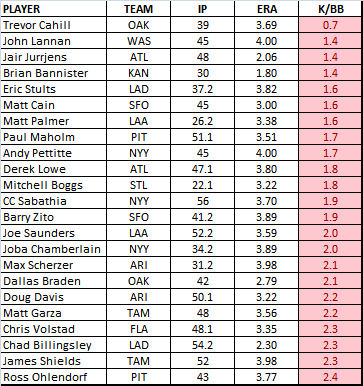
I don’t think you can really buy low on Justin Verlander given how unbelievably hot he has been lately striking out 9, 11, 11 and 13 in his past four starts. However all four of his AL Central counterparts on the list should come at legitimate discounts. I’d target Minnesota’s Kevin Slowey above all. His 0.9 BB/9 is amazing and while it might not hold 100%, he maintained a 1.3 in 160 IP last year so it’s unlikely to jump up too much. Rich Harden, Jon Lester and Jake Peavy won’t be bargain bin pick ups because of their gaudy strikeout totals (and because Harden and Peavy don’t have outrageous ERAs), but if you can get them at any discount, I’d recommend doing so immediately.

The at-risk group has it’s fair share of star power on it, too:

sell high

Three-fifths of the New York Yankees rotation is overachieving so far while the remaining two are getting obliterated (A.J. Burnett-5.36, Phil Hughes-7.56). And that over achievement has earned a record just one game above .500. Any regression could be very damaging and quickly push the Yankees to fourth in their division. But I actually expect Sabathia and Chamberlain to get better as we close out May and head into June. Sabathia will up his K-rate while Chamberlain will trim his BB-rate and continue to strikeout a batter per innings.

Jair Jurrjens and Brian Bannister are major red flags. We know what the bottom looks like for Bannister (1.9 K/BB in 183 IP last year led to 5.76 ERA), but Jurrjens flirted with the 2.0 threshold last year and ended up having a pretty successful year. Of course he did go for a sub-3.00 ERA in the first half and then regress heavily with a 4.49 in the second half. At least in 2008 he was straddling the limit with a 1.9 first half and 2.1 second half. I’d sell him instantly. And I’d have never bought Bannister so if you do have him, cash in that lottery ticket as soon as you can because it has an expiration date.

The names on this list that I’m least worried about are: Chad Billingsley, Max Scherzer and Matt Garza because of their strong K-rates of 9.3, 8.4 and 7.9, respectively. Yes Mitchell Boggs is toting an 8.1 K/9, but the last time he reached a mark that high was his final year at the University of Georgia in 2005 so I’m not buying it in the least with just 22 innings of work. As I mentioned earlier, I do think Chamberlain will turn it around, but there is still some risk because he has a nearly 10.0 H/9 rate to go with the gaudy BB-rate. There are concerns that he is trying to save himself to go six or seven innings and it’s causing him to be very hittable in the rare instances that he is actually in zone.

Wednesday: 05.6.2009

The Next New Closer

Bullpens across the league are in complete disarray which creating a lot of excitement in the late innings of many games, but also leading to plenty of uncertainty at the back end of bullpens league-wide. Sure, Joe Nathan and Mariano Rivera are locked and loaded as their team’s closer barring injury, and there are a handful of others, but we’ve already seen a carousel on several teams including St. Louis, Oakland, Baltimore and Washington. This could be helpful for the many fantasy baseball owners that employ the Punt Saves strategy with their pitching staff at their draft or auction. Given the immense volatility with closers, this strategy says to pass on buying closers and spend the money on offense or starting pitching. Then, actively pursue newly anointed closers as they come up throughout the season. The problem this year might be that you might get lucky and snap one up, but how long will he last?

I have a hidden gem for you that is starting to get more and more run at some fantasy outlets. I drafted him in two different NL-Only leagues thanks to his strong spring that suggested he was completely healthy after missing virtually all of 2008. He threw 10 clean innings with seven strikeouts, one walk and three hits allowed. As I’ve mentioned before, I pay heed to Spring Training numbers when someone is coming back for injury or a youngster fighting for a roster spot. At 34, this guy is an established veteran, but he was coming back from a torn right rotator cuff. The mystery man is Florida’s Kiko Calero. He has picked up right where his Spring Training left off having allowed just three runs in his 14 innings of work while striking out 19 and walking four. Meanwhile, the current closer Matt Lindstrom hasn’t been great. I would caution reading too much into Lindstrom’s 7.20 ERA as it’s borne mostly of an outing in which he allowed 7 runs in 2/3rds of an inning. I just don’t particularly trust him in general and think he will collapse enough at one point to open the door for Calero, not Leo Nunez.

The worst case scenario is that Calero appears to be one of the few middle relievers you can trust if you’re using the Middle Reliever Methodology to solidify your rotation, but regardless I think he should definitely be watched especially if Lindstrom strings a few poor outings together.