Archive for ‘2009 Fantasy Guide’

Monday: 01.12.2009

More Outfielder Comparisons Coming…

For those emailing and asking about the Top 100 Starting Pitchers, I appreciate your continued patience as I am diligently working on that piece. In the meantime, I’m putting together another comparison of outfielder lists. Today I picked up the Fanball.com magazine due in large part to the fact that it prominently features a very good friend of mine, Jason Collette. The presentation of the magazine is absolutely wonderful, second to none. I’ve only just begun to read the magazine so I don’t have any specific thoughts on the feature articles or rankings just yet. I’ll post the comparison on Tuesday and should be able to include a triple comparison of my list and the two magazine plus how outfielders are being taken in mock drafts being held at MockDraftCentral.com. All the thoughts and theories of the lists are nice enough, but how is it all playing out when teams are being assembled?

I hope to finish a couple of other things for the fantasy guide this week, so please stay tuned for those updates as well.

Friday: 01.9.2009

Batting Average Anchors: Myth?

We have all seen this exchange. You’re in a draft or auction and Adam Dunn has just landed on his team for the season. After the draft pick or once the bidding is done, one guy (and sometimes even a couple) invariably tells the owner that while he may like Dunn’s power, that owner will regret carrying Dunn’s often putrid batting average. With five straight years of 40+ home runs, it is easy to see why rostering him is a desirable proposition. So how much do these batting average anchors hurt the team?

A standard league has 14 hitting spots on a roster thus Dunn or the batting average dead weight of your choice is accountable for essentially 1/14th of team’s batting average. This can and does vary based on the number of at-bats a player has in a season, but for the most part you can expect about 515 to 575 at-bats from someone like Dunn. What I did was look at a few different scenarios and then looked at how adding a batting average stud like Joe Mauer to the mix differed from adding Dunn or Mark Reynolds to that same team.

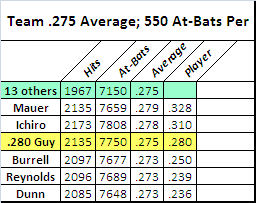
The first scenario has the other 13 players at a .275 average with 550 at-bats per spot. How did that team fare when adding the stud, the mid-level and the dud?

avg-anchor1

Adding Mauer to the team as is nets a healthy four points to the batting average and adding him in lieu of any of our three anchors yields a six point boost. Those results aren’t particularly surprising. The fact that each of anchors only costs the team as a whole two points is promising. Surely that minor bump down is more than offset by their contributions in the power categories (and the decent offering of speed by Reynolds).

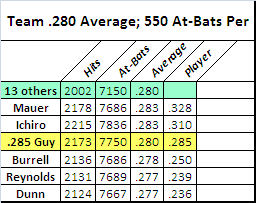
How about when a team is hitting .280 on an average of 550 at-bats per player? The results aren’t much different:

avg-anchor21

The impact of Mauer and Ichiro is equal now while Pat Burrell gets a one point edge over his average-deficient peers. For all intents and purposes, there is little difference between these first two examples. Though I doubt it’s a newsflash to many, notice that the player with a slightly higher average than the team he’s joining does nothing to impact the team’s overall batting average? If you’re deciding between a two players with close lines, but one guy hits .272 with a eight more runs, two more home runs, seven more RBIs and an extra steal than the guy hitting .285, take the .272 guy because both have a virtually nil impact on the overall batting average so you might as well grab the extra counting stats.

Next I looked at a team that averages 450 at-bats per player. Obviously the more at-bats on a team, the less one guy’s batting average impacts the bottom line. Since the .275 and .280 studies were virtually the same under 550 at-bats, I only looked at the .280 average team with 450 at-bats:

avg-anchor3

Here we see that the run-of-the-mill .285 average guy in 450 at-bats does positively impact the team’s batting average. There is now an eight point difference between Mauer and Dunn. Clearly that’s significant. In this scenario there is a legitimate decision as to whether or not Dunn’s power advantage will make up for his lack of batting average. The answer to this is variable dependent on the team you’ve assembled to that point and what your plan is continuing on through the rest of the draft or auction.

Finally, I looked at a scenario of rostering TWO of these batting average black holes. You will obviously be getting some insane power production if you put Dunn and Burrell on your team, but what kind of hole will you find yourself in from a batting average standpoint?

avg-anchor4

Frankly, I expected worse here. Sure there is a 10-point gap between Mauer/random .280 dude and Burrell/Dunn, but 70+ home runs and 180+ RBIs is a nice consolation prize. In the end, I think the fantasy baseball community as a whole overrates the negative impact of a poor batting average from someone like Dunn. It’s not like discussing the downside of Dwight Howard‘s awful free throw percentage on your basketball team. Basketball players take a very disparate number of free throws and Howard is among the leaders. The number of at-bats for players on a fantasy baseball team doesn’t vary all that much. And if they’re hitting horribly, they’ll lose at-bats to someone else. When Howard is especially awful at free throws, teams are more inclined to send him to the line a few extra times that week or month.

I have never shied away from a bad batting average power hitter and I probably never will given that a 550 at-bat season is about 6-8% of a team’s at-bat total while 40 home runs is about 18% of the average team’s home run total and 100 RBIs is about 11% of the average team’s RBI total. Even the 11 steals by Reynolds is around 10% of the stolen base total for a mid-pack team further proving that the potential impact of a player’s counting stats is higher than even the best hitter’s impact on batting average.

Wednesday: 01.7.2009

A Different Look at Outfielders for ’09

I made a trip to the local Barnes & Noble today in search of fantasy baseball magazines. Specifically I was looking for the FanBall offering as a good friend of mine, Jason Collette, is a big part of their coverage. Unfortunately, it was not in but I did pick up the annual Sporting News fantasy baseball magazine. Say what you will about fantasy baseball magazines and their value, but I usually end up with three or four every year and I make no apologies for it.

Having just finished my outfielder rankings, I immediately turned to SN’s rankings of outfielders to see how the two lists compared. What follows is a comparison of the two lists. There were 96 of my outfielders in their top 105 so that’s what I’ll be looking at here. It was interesting to see who I really liked compared to them and who they really liked compared to me. There were 14 players that SN & I were within one rank +/- of each other.

Outfielders I Love…

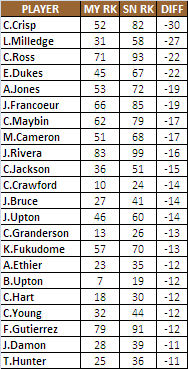
Here are the guys I rated much higher than the Sporting News. The cutoff was a double-digit difference between the lists:

sn-comp1

Coco Crisp was the biggest split between the two sets of rankings. Initially, I thought that might just be because they went to press before Crisp was in Kansas City. One of the biggest knocks on magazines is timeliness. At any rate, they DID have Crisp in KC… they just didn’t see him as being all that valuable. We differed on a lot of young guys: Milledge, Dukes, Jones, Maybin, Upton, Bruce and Young all got much lower marks from Sporting News. I don’t necessarily consider myself the type of fantasy player that buys into youth and potential all that much. I like proven, established players much more, but it would appear that Sporting News has me beat on downgrading youth movements.

Outfielders They Love…

Here are guys that Sporting News rated much higher than I did in my list. Again, the cutoff was a double-digit discrepancy:

sn-comp2

Check out that Aaron Rowand love!! For me, I just don’t see it. It’s not like they projected him for 20-90, but they did predict a healthy boost in his run production numbers and I see no clear reason to expect such. At best, he stays status quo from last year, which would give him a stat line behind plenty of his peers. The aforementioned Jason Collette will no doubt side with Sporting News on Nelson Cruz as he simply loves the guy! I was really by the following: Winn, Ludwick, Ibanez, Quentin and Holliday. All of those, for one reason or another, really stuck out to me as inexplicably favorable rankings. And for the record, Holliday was already on Oakland when he received the #1 ranking for their book. I found their Holliday capsule & prediction interesting:

His minor league performance was not indicative of the player Holliday became with Colorado, but he is moving to one of the best pitchers’ parks in the American League. It would be foolish to expect 30 home runs or .319 average in Oakland, but the Athletics value stolen-base efficiency, and Holliday was decent on the basepaths last season.

Projection – 111 r/35 hr/122 rbi/27 sb/.324 average

I love Holliday and I really hope he gets those kind of numbers, but the two entities seemed to contradict one another. At any rate, I am by no means trying to start crap with Sporting News and say I’m right and they’re wrong. I think the comparison between rankings is half the fun of coming up with a rankings set.

I leave you today with the entire list of 96 that were compared:

sn-comp4

I want to again thank everyone for their very kind words about the piece. I put a lot of effort into doing the work and I really hope you all find some value in it for your fantasy prep this winter/spring. Please continue to stay tuned to the blog for more rankings, articles and discussion.

Tuesday: 01.6.2009

2009 Top 100 Outfielders Part 3: 10-1

The final part of my series of the top 100 outfielders for 2009 counts down the top 10. If you’ll notice, the longest capsules came in the middle of the rankings because those are your game breakers that will can boost your season over the top. Spending 250 words explaining why Carl Crawford or Matt Kemp is a stud (duh??) isn’t as useful as explaining why Shin-Soo Choo or Elijah Dukes is a worthy addition to your fantasy roster and is likely worth that extra dollar or slight reach to secure their services.

Part 1: 100-51
Part 2: 50-11

Enjoy the final countdown:

10. Carl Crawford, 27, Tampa Bay Rays – Wouldn’t you know it, the Rays have their best season ever and Crawford has his worst?! Injuries contributed largely to the digression from his usually amazing offerings. Nothing in his foundational skills suggest that he won’t come back as good as ever in 2009 so invest the standard 50-stolen base speed with double digit power, a ton of runs, around 75 driven in and a .300 average. Outside of a league filled with inexperienced members, it is doubtful that Crawford’s injury-shortened season will depress his value much at all. For the top 10 outfielders, I will add where the guy went in two mocks I’m following. One is mlb.com’s Fantasy 411 podcast expert’s draft and another is one I’m participating in with a group of guys from the fantasy baseball message board Rotojunkie.com. 411: 2nd round – 20th pick overall/7th outfielder taken, RJ: 2nd round – 24th pick overall/7th outfielder taken.

9. Jason Bay, 30, Boston Red Sox – That’s the Bay we were used to prior to 2007! He still hasn’t completely come back to 2005/2006 levels against left-handers, but everything else is back on track and a full season in the Red Sox lineup will be trouble for opposing pitchers. A 2006 redux with more runs scored and driven in thanks to the Red Sox lineup seems very likely for Bay in 2009. Despite a great rebound back to previously established levels, Bay might still drop a bit as a result of the collapse in 2007. He has a legitimate shot to jump back into the $30 dollar levels as a part of that Red Sox lineup. 411: 4th round – 37th pick overall/15th outfielder taken, RJ: 4th round – 40th pick overall/14th outfielder taken (I got him).

8. Matt Kemp, 24, Los Angeles Dodgers – He whet the appetites of fantasy owners with a great 292 at-bat sample in 2007, but the glut of outfielders coming into last season helped give Kemp a little more value. Sure, he was the odds-on favorite for the third spot with Andruw Jones and Juan Pierre, but there were no guarantees for him getting 500 at-bats. Well he got 606 and didn’t disappoint in the least. He used out and out destruction of lefties (.369) to fuel a .290 average along with 18 home runs and 35 stolen bases. He boosted his power in the second half portending 20+ HR potential to match that elite speed making a better than $30 season a very real possibility if everything breaks in his favor. 411: 4th round – 44th pick overall/17th outfielder taken, RJ: 3rd round – 33rd pick overall/12th outfielder taken (I got him, too).

7. B.J. Upton, 24, Tampa Bay Rays – Fears that his power was gone as opposed to merely absorbed by a sore shoulder were erased with a monstrous playoff (7 home runs). For the trouble of dropping 13 home runs off of his 2007 total, he did add 22 stolen bases giving him nearly equal value year over year. The big gains in walk rate and contact rate are very promising, too. Come off of surgery on that shoulder might prevent him from maxing out his potential in 2009, but look out in 2010. For now, I expect a move back into double digits for power and continued elite speed en route to a high $20s season in value. 411: 2nd round – 18th overall/6th outfielder taken, RJ: 2nd round – 15th overall/4th outfielder taken.

6. Josh Hamilton, 27, Texas Rangers – Was there a better story than Hamilton in 2008? He is showing why he was the #1 overall pick all the way back in 1999. It is hard to peg a “prime” for a guy like this because of the time he missed so perhaps he is still improving like a 24-25 year old as opposed to establishing a prime level like most 27-year olds. How good is a player when he hits 13 home runs, drives in 50, steals six bases and hits .298 and it’s is labeled a 2nd half fade? It isn’t unreasonable to expect another boost in performance from this guy, but an even a repeat of his $30 dollar season would be a great success. 411: 2nd round – 16th overall/4th outfielder taken, RJ: 1st round – 10th overall/3rd outfielder taken.

5. Carlos Lee, 32, Houston Astros – His fourth straight 30-100 season was a lock before a broken finger derailed his season. He still only missed the mark by two home runs despite just 436 at-bats. He has a remarkably strong skillset that is as consistent as it gets. There are at least three more 30-100 seasons coming from Lee including another monster season for 2009. He was pacing near the 40 home run mark before last year’s injury and while I don’t know he can do that again, a 2007 repeat brings in almost $30 dollars of value. I feel like he is slipping a bit despite nothing in his skills that should give owners pause. 411: 3rd round – 26th overall/10th outfielder taken, RJ: 3rd round – 26th overall/9th outfielder taken.

4. Carlos Beltran, 32, New York Mets – His home run totals are in a three year decline while his batting average and stolen base totals are in a three year incline. The power drop is no doubt tied to a huge uptick in groundball rate from 2007 to 2008, but the slight gains in speed and batting average plus 23 extra runs offset the six home run loss. He is no longer a flashy pick that makes you think of 40/40 potential like back in 2004, but it is hard to argue with how much production he offers across the board. 411: 2nd round – 15th overall/3rd outfielder taken, RJ: 2nd round – 22nd overall/5th outfielder taken.

3. Alfonso Soriano, 33, Chicago Cubs – I feel like people are forgetting that Soriano missed a bunch of time due to injuries and managed just 453 at-bats. That is the only way I can explain why he’s not being given credit for nearly going 30-20 in those 453 at-bats. Even at 33, he is still one of the best players in the entire game when it comes to fantasy baseball. He is still one of the preeminent power-speed combos with 30-30 a real possibility if he can stay on the field all year. In these two mocks and a few others I’ve seen, Soriano is representing a value pick when you consider he his potential in 550-600 at-bats. 411: 2nd round – 22nd overall/9th outfielder taken, RJ: 2nd round – 23rd overall/6th outfielder taken.

2. Ryan Braun, 25, Milwaukee Brewers – Is this guy really 25?!?! The two seasons that he has put up are amazing on their own, but then you consider is age and it’s unthinkable. His numbers are legit, his skills are legit and there is growth in this profile. His difference-making power turns heads, but it’s his mid-to-high teens speed and quality batting average that make him an elite first round pick. He could be on the verge of one of those special seasons that will just carry an entire fantasy team. 411: 1st round – 12th overall/2nd outfielder taken, RJ: 1st round – 9th overall/ 2nd outfielder taken (I got him… yep, I took three from the list’s top nine).

1. Grady Sizemore, 26, Cleveland Indians – My #1 ranked guy didn’t drive in 100 runs and he hit .268, so I know what you’re thinking… are you crazy? The reason I like him so much is that he didn’t have to do anything extraordinary to get near 35 HR/40 SB. He finished at 33/38 and it wasn’t due to two out of this world months, instead he just put up quality month after quality month. A better September (2 HR/3 SB) could’ve taken him to the famed 40-40 heights. He is cutting K’s while maintaining a solid walk rate. The Indians lineup should be consistently viable throughout the entire season which will only help Sizemore’s runs scored and runs driven in. We might get that 40-40 season in 2009. 411: 1st round – 11th overall/1st outfielder taken, RJ: 1st round – 5th overall/1st outfielder taken.

top-100-outfielders

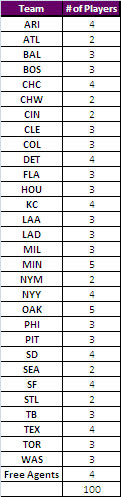
top-100-of-by-age top-100-of-by-team

Monday: 01.5.2009

2009 Top 100 Outfielders Part 2: 50-11

I decided to make this into a three part series with the final countdown of 10-1 coming out as it’s own piece along with the visual breakdown of the list.

Part 1: 100-51

Here are outfielders 50 through 11:

50. Mark DeRosa, 34, Cleveland Indians – A trade to Cleveland virtually guarantees he will get another 500 at-bat season, though after last year’s performance I don’t think that was in doubt in Chicago, either. At his advanced age, you would love a repeat of 2008, but it’s unrealistic to expect it. Like Carlos Guillen back at #61, DeRosa has multiple position eligibility and his owners will almost assuredly find him more valuable at second or third base as opposed to the outfield. He grabbed 87 RBIs from predominantly the sixth and seventh spots in that Cubs lineup last year. Even occupying the same spot in the Indians’ lineup should bring similar opportunities to drive in runners. The Indians were on fire in the second half of last year and that was without anything from Travis Hafner & Victor Martinez. I wouldn’t bet on another 20 home run season this year, but repeats in the remaining categories plus 15 home runs should thrill fantasy owners.

49. Denard Span, 25, Minnesota Twins – Span had his best start in the high minors that helped earn him a chance with the big club. It helped that Michael Cuddyer was banged up and Carlos Gomez was playing horribly, too. He displayed some excellent plate discipline in his 347 at-bat stint, but that was a new skill so it could regress this season. He has 30 steal-100 run potential, but I’m not buying into double-digit power just yet. There is plenty to love here and the fact that he is downright brilliant with the glove bodes well for his chances to remain on the field even if Cuddyer is healthy.

48. Raul Ibanez, 36, Philadelphia Phillies – How consistently strong is this guy? He continues to get older (as we all do, of course) and it seems each year, fantasy owners expect the bottom to fall out and it continues to remain intact and firm. Now he moves to a contender in a friendlier ballpark so surely he will get some respect coming into 2009, right? Citizen’s Bank ballpark wasn’t has homer-happy in 2008 as in previous year coming down to a neutral 100 rating, but it’s still better than Safeco in Seattle. The downside is that Ibanez won’t be hitting 3rd or 4th as he was in Seattle. He will likely be the 5th or maybe even the 6th hitter for that lineup meaning the RBI chances will drop significantly and likely cost him his streak of 100-RBI seasons. Temper the expectations of a power boost, but he should add 3-5 to last year’s 23 with 90 runs scored and 80 RBIs in the easier league.

47. Shin-Soo Choo, 26, Cleveland Indians – He was a key cog in that second half explosion of the Indians’ lineup last year (.1038 OPS in 210 at-bats after break). It was his second big league stint and another glowing success. He has a decent eye, legit power and capable speed. Over the course of a full season, he’s got strong double-double potential. The skills displayed in both the 2006 and 2008 stints were also prevalent throughout his minor league career so there is little to be skeptical about in terms of betting on a big season. At each level (rookie through AAA), he had at least 204 at-bats and never hit lower than .288, never had lower than a .363 on-base percentage (same as the .288 season) and never dipped below an .817 OPS (in AAA over 1054 at-bats). The only potential hitch is the 9-for-16 (56%) stolen base rate in the majors. Choo has minor league stolen base totals of 14, 37, 18, 40, 20 and 26 from 2001-2007.

46. Justin Upton, 21, Arizona Diamondbacks – It was an inconsistent season for the heralded youngster as he opened up white hot (five HR, .963 OPS in April) only to cool considerably (four HR, .177 AVG in May/June) and then suffer an injury that relegated him to just nine games across July and August. On the bright side, he finished strong with a .919 OPS in September that included four home runs as well. Strikeouts were a huge problem, but he also displayed a very strong eye even when he was at his lowest point of the season (35 walks in 50 games spanning May/June). As a whole, the 2008 season wasn’t too bad for Upton when you consider his quick ascent to the majors and the highly useful skills he displayed prominently (power and batting eye). The lacking component that may’ve been falsely attributed to Upton in the first place was the speed. He managed just one stolen base while being caught four times. The 15 and 19 stolen bases during his two minor league season of 2006 & 2007 likely earned him the perceived ability but he was stealing at rates of 68% and 63%, respectively. This guy is a bona fide, but it remains to be seen if he is the power-speed combo that his brother, B.J. Upton, is for Tampa Bay. Buy into a couple more steps forward in 2009.

45. Elijah Dukes, 24, Washington Nationals – Likely known more for his off-the-field indiscretions than his on-field exploits at this point, Dukes quietly knocked the ball around solidly last year in limited playing time. He faltered out of the gate after missing all of April with a .520 OPS in 48 May at-bats. From there he hit nearly .290 with a better than .400 on-base percentage and 13 home runs and 10 stolen bases in 226 at-bats. Sample size caveats apply, but his skills aren’t entirely unknown after a .280/.363/.448 line in 1555 minor league at-bats. The biggest concern expressed coming out of his solid offering is the groundball rate at 47%. Projections of 25-30 home runs over the course of 600 at-bats seem unrealistic with the ball on the ground that often. He is plenty of capable of adjustments that would yield a big home run total, but betting on it is risky. His 13 steals in 17 attempts (77%) are nice, but I don’t see base stealing as a part of his game that he’s interested in showing off. That is to say, I don’t expect proportionate increases just because he might play an entire season. He had a 73% success rate in the minors, but that was buoyed by 47-for-59 showing in 160 games in A-ball back in 2003-2004. He didn’t top 68% at any other level. Putting it all together, Dukes is a very good hitter in a lineup that I think is progressing meaning he should be able to post significant gains in runs scored and runs driven in if he makes it the entire season. Mark him down for a 24 HR-15 SB offering and hope for the adjustments and focus that could yield a 30-20 season.

44. Xavier Nady, 30, New York Yankees – The X Man has perennially fared better in the first half of seasons with a career .812 OPS before the break compared to a .765 OPS afterwards. Last year upheld the trend, but his first half was so strong (.901 OPS) that the dip only took him to .825. For the trouble, he rewarded owners with more robust power knocking 13 home runs in 250 at-bats after hitting 12 in 305 prior to the break. The question now is where will Nady find playing time in 2009? The signing of Mark Teixeira by the Yankees moves Nick Swisher back into the outfield where a logjam exists at the corners. Perhaps a deal is imminent to clear it up, but even in the jumbled mess I think Nady’s skills will win out for his second ever 500+ at-bat season. From that, a carbon copy of 2008’s cumulative stats with an average near his career mark of .280 is what you can expect.

43. J.D. Drew, 33, Boston Red Sox – It’s the same old song & dance with Drew: he just can’t healthy. After nearly reaching 500 at-bats in Los Angeles back in 2006, he has shaved 28 and then 98 at-bats off of the previous year’s total. He was absolutely destroying the ball in the first half last year when injuries (predictably) befell him. This is a 25-100 talent, even at 33, if he could suit up for 145 games. Betting that this or the next or the next will be that dream season is foolish at best. The wear of getting older will begin causing problems here sooner than later as well and when it’s all said and done; Drew is 400 at-bat player with incredible ability. The best bet is to hope you’re in a league that has soured on him so severely that his price tag offer value instead of great risk. Anything over $15 represents the latter while the $11 I was fortunate to pay in one league was a no-brainer; he earns that in 300 at-bats.

42. Pat Burrell, 32, Free Agent – If you want .250-30-90, Burrell is your guy. He has posted three straight $18 dollar seasons with little change from one to the next. As a rotisserie player, there are few more bankable mid-level options than Burrell. Head-to-head leaguers seeking the week-to-week consistency ought to search elsewhere, however. The only thing consistent about Burrell is his in-season streakiness. I can only imagine how many times a fantasy owner has dealt a struggling Burrell only to watch him catch fire that very same week and reel off a .300/.400/.500 month. His destination is yet to be determined, but once the Phillies signed Raul Ibanez, it was clear that they were done with Burrell. I can’t envision a move that would severely damage his value, but the right situation could definitely boost it. Perceived as hitter-friendly, Citizen’s Bank played neutral for home runs in 2008 so don’t be worried that a new home park will eat up his power. In fact, he hit 21 of his 33 home runs on the road in an almost even amount of at-bats. Having a batting average anchor is always worrisome, but generally overrated amongst fantasy gamers unless paired with multiple others.

41. Delmon Young, 23, Minnesota Twins – Pegged for a huge 2008 breakout in some circles, Young displayed a flat line from his 2007 rookie season. In terms of value for fantasy baseball, he offered $18 in both 2007 and 2008. There are a few decent improvements within last year’s skillset: fewer strikeouts/more walks, more steals & runs scored in 70 fewer at-bats and another strong season for batting average (.290 in 575 at-bats) giving him a career-mark of .292. The power dipped thanks to a huge groundball rate for Young. If he remains as severe a groundball hitter in 2009 then another $18-20 season is on tap. A power spike could yield an 85-20-75-15 season with a .280 average. As a #1 overall pick, he has huge expectations that some feel he isn’t meeting, but he’s been really good in his 1346 major league at-bats and he is still just 23.

40. Rick Ankiel, 29, St. Louis Cardinals – You are probably numb to it by now, but sit back and think about the depths that Ankiel has come back from to be a massively productive outfielder for the Cards. The power here is legit after banging out 25 home runs in his first full season. You want to be careful about getting caught up in his age because of the gaps in his career due to everything that has happened. That said, just because it will be his second full season as an outfielder, it doesn’t mean he gets treated like a blossoming 23 year old. The reaction to his being 29 should be that he is in the midst of the power prime and improvements in his game plus a full season of health could easily take him to and past the 30 home run mark in 2009. Think of him as a potential Pat Burrell-plus: same counting stats with 15-20 batting average points.

39. Ryan Ludwick, 30, St. Louis Cardinals – Did the Cards strike it rich with breakouts last year or what? The batting average was a huge surprise, but opportunity seemed to be all he lacked to put that power on display in the majors. He has a .500 slugging percentage in 2780 minor league at-bats on his resume that has to count for something. I’m buying 35-100 here, but if the price starts to creep up into a territory that seems to include an average over .280, I have to drop out because I’m not sold on him sustaining that into 2009. He was mashing line drives at a torrid clip last year that is sure to regress and bring that average down into the .270s. If Rick Ankiel is a Pat Burrell-plus, then Ryan Ludwick is a Rick Ankiel-plus; the base is a run producing power hitter with slight additions from one model to the next. By season’s end, the values of the three aren’t likely to differ markedly, either. Heck, perhaps the Cardinals make a run at Burrell and then the three can begin benefitting from one another.

38. Adam Dunn, 29, Free Agent – Are you catching the general theme of these last few players? If you’re looking for a set of numbers you can legitimately put in the bank and just forget about until October, Dunn & his 40 home runs fulfill that desire. He has exactly 40 in each of the past four seasons and a fifth 40+ home run tally from 2004 when he hit 46. Four of the five seasons have seen him meet or exceed the 100-RBI barrier while the lone anomaly was a 92-RBI campaign in 2006. As I have alluded to earlier in these rankings, Dunn’s issue is batting average. He posted a career best in that 2004 season when he hit .266. In the remaining four seasons of the run, he has topped .247 once (.264 in 2007). I have also mentioned that this problem isn’t likely to destroy your team unless there are a few others carrying the same kind of dead weight for 400+ at-bats. If two teams are going after Dunn or Burrell, the losing team ought to just turn around and sign the remaining player. The same is true to a greater extent for fantasy baseball owners. The draft/auction pool has several of these big power/low average run producers so don’t get stuck overbidding for one when there are plenty of capable fill-ins still available. You don’t have to roster Ichiro AND Joe Mauer to go after Dunn, but pairing him with Mike Jacobs, Rickie Weeks and Michael Bourn is essentially punting the batting average category. Find the middle ground and enjoy a 40-home run season.

37. Brad Hawpe, 29, Colorado Rockies – Hawpe put together a blazing second half performance to ensure another fine season and remain a quality option valued in the low $20s. Coors Field gets a lot of credit for his success, but the splits weren’t so divergent in 2008. Even still, it is OK to acquire players from favorable ball parks. It is often said with a bite that gives it almost a stigma quality, “Well he plays in Coors.” I don’t care if he uses his home field to his advantage, that won’t become a relevant tidbit until leaves said park (see: Holliday, Matt). Back to Hawpe… for his career he has a .283/.374/.504 line at home in 954 at-bats and .282/.376/.482 line on the road in 959 at-bats. He’s a quality hitter who seems to be settling into a nice 25-85 groove with solid batting average on a yearly basis. Speaking of batting average, he had some nice gains against lefties moving up to .282 (in 124 at-bats) after a .214 showing (in 126 at-bats) last year. These gains didn’t show up in his overall batting average because he gave them back to righties with a .283 performance (in 364 at-bats) after last year’s blistering .315 (in 390 at-bats). The difference between a .285 and .300 average over the course of 500 at-bats is five hits so don’t view the move from .291 to .283 as much more than minor variance.

36. Conor Jackson, 26, Arizona Diamondbacks – A personal favorite of mine, Jackson seemed to be headed for a career year after a huge April that saw him hit five home runs and knock in 24 base runners while hitting .348. He came back to earth in May with a 1-10-.247 offering before getting back on track for June and July and finally sputtering into the finish line with zero home runs in 182 at-bats spanning August and September. The biggest jump in value came with his move to the outfield. As a first baseman, he simply does not have enough power to feel comfortable investing in him unless you’re stacked with outfield power. I think there is a 20-home run hitter here as he enters his prime, but even as a .300 hitter with low-to-mid teens home runs and 80+ runs & RBIs, he’s got plenty of worth. Conversely, if he chooses not to expand his power and focuses solely on piling up base hits, a batting title could be in his future. The bottom line is that he has yet to show the best he has to offer and whichever path he takes will be very profitable for his fantasy owners.

35. Vernon Wells, 30, Toronto Blue Jays – Did you know Wells was 30 years old?? Yeah, me neither. Last year helped eliminate doubt that 2007 was clearly an outlier as opposed to the beginning of the end for Wells. He might have reached another 30-100 season had injuries not robbed him of May and July. One of Pat Burrell or Adam Dunn seems like an ideal fit for this punchless lineup, but it’d have to be Burrell in light of the verbal spat between Jay’s GM JP Ricciardi and Dunn last year. A move like that would only add to Wells’ value, but for now let’s just hope for a full season of the 2006/2008 versions of Wells sans that ‘06 speed. Ask any of your league mates and other friends who play how many double-digit stolen base seasons Wells has and most if not all will say a figure higher than the two he actually owns.

34. Milton Bradley, 31, Free Agent – Another 400 at-bats in Arlington Ballpark would’ve been nice, but the Rangers have a glut of OF/DH options so Bradley is likely to suit up elsewhere in 2009. He has been rumored to the Cubs for a little while now, but nothing is official. At this point, he is a younger version of J.D. Drew will a little bit of speed. It is just impossible to bet on him for a 400 at-bat season given his history being shelved by nagging injuries, thus he gets a ranking much lower than his skills merit. A move back to the National League would seem to go against Bradley as he’d be forced to play the field day in and day out. With Texas, he got 329 at-bats out of the designated hitter’s spot which no doubt contributed to him topping 400 at-bats for the first time since 2004. It’s really hard to say what he would be capable of over the course of a full season since there is virtually no precedent for it. As good as Bradley can be, you are likely still better off letting him go to another team than absorbing the headache yourself. You have to figure after last year’s explosion, it will be hard to score him at a next-to-nothing bargain price.

33. Magglio Ordonez, 35, Detroit Tigers – There isn’t a ton of mystery and as a fantasy baseball player you should love that about a guy. Averting unnecessary risks is one of the keys to being successful. With Ordonez, you have a .300-20-100 guy. After back-to-back seasons approaching nearly 600 at-bats, he had some bumps and bruises that cost him some time, but still managed an excellent 561 at-bat campaign in 2008. Health has been the only thing to keep Ordonez down throughout his career so while the power ceiling has dipped from the 30s of his early career to the 20s of now, you should feel comfortable with this reliable skillset occupying an outfield spot on your team. The Tigers ought to be a more stable unit in 2009 meaning the run producing opportunities should be plentiful start to finish and could result in another huge (think 120+) RBI season for Ordonez.

32. Chris Young, 25, Arizona Diamondbacks – The drop in almost all of the counting stats despite the extra at-bats made Young a disappointment in 2008, but the skills were largely unchanged. He did improve against lefties which helped him boost his batting average up 11 points, but that boost still only got him to .248. He will need to make major adjustments against right-handers to eliminate his AVG woes, but even coming up through the minors he was little more than a .260s hitter so the ceiling is low regardless. What fantasy players were really hoping to see was the 30-30 season he narrowly missed in ’07, but he didn’t come close with 22 & 14. It is hard to see anything in skills displayed to this point that suggest better than a .245-80-25-80-25 line, but that holds a better than $20 value and thoughts of a potential 30-30 season with a respectable .260 average stay fresh in the minds of fantasy owners everywhere and drive his value a few dollars on speculation alone.

31. Lastings Milledge, 24, Washington Nationals – The 2008 season was a solid step forward for Milledge as he posted nearly identical halves resulting in a .268-65-14-61-24 line. He found his stroke a bit more in the latter half resulting in a .299 average and counting stats virtually the same as before the break despite 81 fewer at-bats. A very highly touted prospect coming up, he is a heart of the order power-speed combo who is getting better each day. He will have to improve upon his second half power display to chase the HR total up to 20+ to match the stolen bases. That lineup is starting to gain some stability, including the addition of Josh Willingham, and Milledge will benefit from the gains as much as he will contribute to them. This is a player to roster in 2009.

30. Jayson Werth, 29, Philadelphia Phillies – He became a fantasy beast with a season of 400+ at-bats. He has a brilliant eye with plus power and plus speed. The lefty-righty splits are the lone raincloud above his head, but he had a .360 OBP (despite a .255 AVG) against righties in 263 at-bats last year and he is .251/.347 in 961 career at-bats against righties. So while he certainly doesn’t hit them as well as he does left-handers, he does still manage to get on base at a legitimate enough clip to warrant continued playing time. Thus a 500 at-bat season starts to call up thoughts of 25+ homers & steals from Werth, even at 29. Geoff Jenkins was a bust as Werth’s pseudo platoon partner which should help facilitate that 500 at-bat season for Werth. Even a repeat of the 24 HR/20 SB with more runs scored & driven in thanks to more playing time would be a great result in 2009.

29. Johnny Damon, 35, New York Yankees – Those waiting for the shoe to drop on the aging Damon are missing out on several post-30 quality seasons. He’s registered a $26 value in the three of the past four seasons with the other year still at $20. Top flight speed combined with a perennially potent lineup leave me confident that another $20+ season is on the horizon. There may be a logjam at outfield, designated hitter and first baseman for New York, but Damon certainly won’t draw the short straw in any situation. He has a near worthless arm, but that shouldn’t outright cost him playing time when he produces at such a high level offensively. Let your league mates hesitate because of his age and enjoy the continued excellence that Damon delivers.

28. Hunter Pence, 26, Houston Astros – When the rollercoaster ride finally ended, many passengers weren’t as sick as they suspected they’d be at the start. There are no doubts that Pence failed to meet expectations in average and speed, but extrapolating his 2007 power numbers into a full season (as many did after he blistered the league for 108 games) show he wasn’t much different in those categories despite the up and down season. He will need to be more selective on the basepaths in 2009 (11-for-21) if he wants to continue to get a green light and the batting average should hit an uptick when his groundball and line drive rates head back to where they belong.

27. Jay Bruce, 22, Cincinnati Reds – How refreshing is it to see guys like Bruce and Evan Longoria pay huge dividends at the major league level after being highly doubted minor leaguers. Bruce has his warts, as any 21 year old will, but to put up 21 home runs in your first 413 at-bats is special. His two offseason focuses are no doubt hitting against lefties (.190 in 137 at-bats) and developing some patience at the dish (110 K in 108 games). They won’t be fixed overnight, but Bruce was a .308 hitter with a 2.7 K:BB ratio in 1341 minor league at-bats so he’s likely to improve on his .254/3.3 offerings sooner than later. There is generally a contingent of two or three owners in every league that goes nuts for wunderkinds like Bruce so if the bidding starts heading north of $20 with no end in sight, promptly check out for this season. Keeper league players, hold onto this guy… he’s of the rare breed that is already producing plentiful numbers but still holds gobs of potential.

26. Jermaine Dye, 35, Chicago White Sox – Remember that group of guys I was talking about that is infatuated with young potential? A byproduct of their love is an undervaluing of older talent still getting it done at a high level like Dye and a few others in this particular grouping (Damon, Ordonez). I doubt there is another MVP-caliber season in that bat of Dye’s, but a couple more 30 home run campaigns are on tap. Power producing teammates like Paul Konerko, Carlos Quentin, Alexei Ramirez and Jim Thome help keep the runs scored & RBI totals in the low 80s to high 90s, too. Only a freak accidental broken leg has interrupted Dye’s sparkling health resume so you can count on him to suit up for 500+ at-bats over the course of the six month season, a bonus in head-to-head leagues especially.

25. Torii Hunter, 33, Los Angeles Angels – Yet another of the aging producers that scare off buyers with an age on the wrong side of 30. I think because you kinda know what you’re going to get out of them and there isn’t much excitement, it drives down their value because everyone wants the flashy 24-year old breakout candidate. Again, avoiding risk is never a bad thing (in fact, I encourage it more often than not) and when you invest in these heavily established track records of quality skills, you’re mitigating your overall risk. Having a who’s who of the best 23-26 year olds looks great, but they all have to meet or exceed the high expectations to win because they’ve likely never performed at their highest level in the majors. Now that doesn’t mean you load a team with nine of your 14 hitting spots checking in at 30+ years old… that’s a risky proposition in its own right. Mixing young and old within the foundation of your team is the right way to go about and 20-20 talent like Hunter is a great piece for that puzzle. Los Angeles’ struggle to put up runs consistently is shown in Hunter’s 78 runs batted in, but the base skills remained firmly intact and that’s what you’re buying here.

24. Jacoby Ellsbury, 25, Boston Red Sox – Ellsbury’s huge callup performance in 2007 set a series of misguided expectations for his first full season last year and it’s just another example of why you can’t place too much stock into 116 at-bats no matter how good or how bad they may be for a player. Ellsbury looks to be a perennial 45-50 stolen bases player, but the mid-teens power will either need to be developed or it doesn’t exist. He lost a lot of plate discipline in the second half (from 10% walk rate to 4%), but with it saw a nice boost in batting average (from .268 to .291). Stolen base totals look unbalanced in favor of the first half thanks to anomalous months of May (18) and August (1). He looks to be a solid 8-9 steals per month player and those two months were blips on the radar. For now, invest in huge speed, big runs scored totals thanks Boston’s lineup and a solid (if unspectacular) batting average. If the power comes, enjoy it; but don’t pay a premium expecting it.

23. Andre Ethier, 27, Los Angeles Dodgers – If you have been playing this game for a little while now, you have probably heard the phrase “pay for skills, not roles” either verbatim or in some derivation thereof. I chanted it in my head as the bidding for Ethier started in my NL-Only league. Sure, he was the odd man out on the Dodgers behind Matt Kemp, Andruw Jones and Juan Pierre, but there was no way he was the 4th-best outfielder on that team heading into 2008. When the bidding stopped at $13, I felt I had committed some sort of crime. I finished my chant, penciled his name onto the roster page and moved on. Now all of this may sound like a 20/15 hindsight revision of how my auction played out (you’ll have to believe that I’m telling the truth), but the main point is that a skilled player like Ethier will have ample opportunity to get into the lineup over the course of six months and you can’t use latest depth chart from your favorite website the morning of your draft/auction as the end all-be all of playing time decisions. I didn’t plan on Ethier being as good as he was, but I knew that 450 at-bats of his skills were worth $13 dollars. Now firmly entrenched in right field, Ethier has the chance and ability to approach a 30-100 season.

22. Vladimir Guerrero, 33, Los Angeles Angels – I have covered ad nauseum the value of aging studs, so I won’t take that angle again here, but rest assured that Guerrero meets the criteria to a degree. Is it the dwindling at-bat totals yearly since 2006 that prevented 30 home runs in 2007 and 2008 or is it really just a mark he is unlikely to reach again? Trick question as the two options are related. Start betting on a ceiling of 550 at-bats as Guerrero eases into the homestretch of his brilliant career. With the power he is displaying (still very good, by the way), a 25-30 HR total is what can be expected in 500-550 at-bats. Despite their penchant for stealing, the Angels know it’d be foolish to risk getting Guerrero hurt for a few extra stolen bases. As with Hunter, Guerrero suffered in RBIs because the team wasn’t proficient offensively. Now they have lost Mark Teixeira and the re-signing of Juan Rivera suggests that Pat Burrell, Adam Dunn or Manny Ramirez aren’t options to bolster the lineup (at least according to their GM) so it could be a similar story in 2009 without the emergence of a Kendry Morales or Brandon Wood. I am happy investing in a .315 AVG with 25 HR from Guerrero even if the RBI totals linger in the 90s again… that said, I think the Angels will bring in one of those boppers since they could easily slot whomever they picked at DH while Rivera plays left.

21. Carlos Quentin, 26, Chicago White Sox – Clearly plenty of fantasy players forgot that Quentin was once a highly touted prospect for the Arizona Diamondbacks, but even those that knew full well couldn’t have predicted the onset of the breakout this quickly. It was a perfect storm of high quality skills, opportunity and home ballpark that led to Quentin’s excellent 2008 campaign. A self-inflicted wrist injury cut the season short and may have cost him an MVP award in the process. Wrist injuries are always tricky for power hitters so he might not be right back to pushing 40-45 HR even if he plays the entire season. In fact, lingering wrist problems or not, he just might have the same mix of skills and luck to reciprocate 40 HR potential. Even with 30 HR power, it’s tough not to like Quentin’s prospects in the middle of that White Sox lineup. A 100-30-100 would be a welcomed follow-up to a dream season. Don’t get caught up in the hysteria of extrapolating the 36 HRs over 550-600 at-bats, pay for 30 at most.

20. Bobby Abreu, 35, Free Agent– The fourth of five free agents within the top 50 meaning there is still plenty of action to be done in this season’s hot stove league. Without knowing his new home, it is hard to say how much, if at all, Abreu’s value will be dented by leaving the Yankees and that very potent lineup. Last year marked his 10th straight season with 20+ stolen bases, but he was just 22-for-33 so we will have to see if that’s an outlier or an age-related decline. Again too, will his new team be prone to stealing as a team and are they interested in letting him take off 33 times at his age? The sooner he signs somewhere, the sooner his value can be best assessed for the year ahead. For now, I’m content to bet on a double-double with at least 80 runs scored and driven in and a .290+ batting average. That factors in the potential (and likely) move to a weaker lineup as well as some age-induced decline, but it’s still a very valuable season to put on your fantasy roster.

19. Ichiro Suzuki, 35, Seattle Mariners – Ichiro is amazing. He has at least two more .300+/100+ runs/30+ steals seasons in him even at age 35. Imagine if he hadn’t been slowed by a hamstring in the second half of last year, he might’ve reached 55 stolen bases. His skills are incredibly consistent and they’ve resulted in eight straight 200+ hits/100+ runs/30+ steals seasons. He seems to be falling a little bit in some of the early mocks out there, but that could be more because of a deeper pool of options than something against Ichiro. With someone as bankable and skillful as Ichiro, there isn’t a ton to write about because it has been the same old story for so long.

18. Corey Hart, 27, Milwaukee Brewers – Many believed, including yours truly, that a 600 at-bat season would allow Hart to approach or exceed a 30-30 season. Instead, he used those 100+ extra at-bats to score 10 fewer runs, hit four fewer home runs, drive in just 10 extra runs and tie his stolen base total of 23. I can understand his fantasy owners feeling ripped off, but that’s still a very quality line to run out there. He could be an early round sleeper now (a guy that goes a few picks or maybe a round later than he probably should) as he still has the potential for a 30-30 season, or at least 30-25. The point is that it would be foolish to give up on a 27-year old coming off of back-to-back $20+ dollar seasons without any discernible loss of skills or injury-related reason. Hart’s high quality skills are intact by and large and he’s operating with a clean bill of health at the time of this writing. Buy him up!

17. Shane Victorino, 28, Philadelphia Phillies – Victorino starting hitting radars with full force in 2007, but might have slipped off a bit because he had just 47 at-bats over the final two month of the season. He still managed 12 home runs and 37 stolen in 456 at-bats. Like Hart, Victorino got quite a few more at-bats in 2008 and didn’t necessarily deliver how you might have thought. Despite the extra 114 at-bats, he had just two more home runs and one fewer stolen base. He did tack on 24 runs scored and 12 extra knocked in, though. He has pretty well established the power-speed combo that he can be called upon for now: mid-teens pop/mid-thirties speed is a heckuva combo especially when it comes with 100 runs scored. His 50-something RBIs won’t be a game-changer, but at least he is adding to the bottom line.

16. Alex Rios, 28, Toronto Blue Jays – Maybe there was something in the Toronto water that took away the power hitting abilities of the Blue Jays. Rios continues to put up a monster half with an OK one year in and year out, leaving fantasy owners drooling over the prospects of him putting up a full season of him at his best. What he failed to deliver in what was a growing power profile he made up for with a doubling of his usual speed output. He hit the ball on the ground nearly 50% of the time in the first half of the season which naturally sapped his power, but a reversal in that trend down to just about a third of time helped him pop 11 second half home runs. Talks of 30-30 potential have been tied to Rios for a few seasons now, but staph infections, home run derby curses and a “who knows what went wrong” 2008 have kept him from maxing out his potential thus far. Even if he settles in as a low-to-mid 20s producer in homers and steals with a .290 average, 90 runs and 90 driven in, he is still one of the more valuable outfielders available.

16. Nate McLouth, 27, Pittsburgh Pirates – After a huge showing in just 329 at-bats in 2007, McLouth was all over sleeper & breakout lists for 2008 and he didn’t disappoint. He hit everything in sight in April and didn’t really cool down until June. August was another chilly month, but he ended with a very strong September and has now positioned himself into the conversation of 30-30 potential. He is part of a nice group of late 20-something outfielders that all offer a similar dollar value with put go about it in different ways. For McLouth, the Pirates seem ready to make him a middle-of-the-lineup force, but his power seemed to evaporate during the audition in the 3-hole (just three HR and a .394 SLG in 208 at-bats.) Pay attention to where the Pirates plan to bat him this season as he may not be comfortable anywhere but at the top. However, if the Pirates tell him he’s hitting third, I’m confident he will adjust and put together another fine season of mid-twenties power and speed.

14. Nick Markakis, 25, Baltimore Orioles –Markakis enjoyed some legitimate growth in key skills last year and almost reached the exalted .300/.400/.500 line. He was 13 points shy in slugging percentage. Most fantasy owners will notice the drop in speed (from 18 to 10) and slightly fewer home runs (from 23 to 20) and overlook the sharp gains in plate discipline (38 more walks in 42 fewer at-bats) and equal amount of extra-base hits (69) again, despite 42 fewer at-bats. He didn’t display a ton of speed in the minors, so his stolen base totals will likely be closer to 2008’s total than 2007’s. If he reaches the .300-100-30-100 he’s capable of, nobody will care if he steals “only” 10-12 bags. Focus more on Markakis as a bona fide run producer as opposed to your prototypical power speed combo similar to the likes of Rios, Hart, Curtis Granderson, etc…

13. Curtis Granderson, 28, Detroit Tigers – Speaking of Granderson… it’s tough to be disappointed with his output from 2008, but it’s even tougher when you consider that he missed the first month of the season. Fearful of running out of innings as the team spiraled out of control, Jim Leyland kept Granderson from running at will leaving him with just 12 stolen bases by season’s end. But the 22 home runs in just five months and sharp gains against his kryptonite (.259 vs. lefties after .160 & .218 in two previous seasons) point to another very bright season for one of the game’s best and coolest players. The power displayed in just a five month season now has rumblings of 30-30 circling Granderson. A full season in that lineup makes Granderson a prime contender for the runs scored title in the American League. Make no mistake; this is a still-growing skillset sure to bolster your team’s number across the board. In the interest of full disclosure, I’m a diehard Tigers fan and an even bigger Granderson fan so while I value these last six players almost the exact same, Granderson won out in the rankings perhaps due to some bias. Put ‘em in a bag and pull one out and you can’t be disappointed with whomever you get.

12. Manny Ramirez, 36, Free Agent – Maybe Ramirez remaining unsigned is why the other quality free agents in this list can’t get work yet. I have completely tired of the media-driven saga surrounding Ramirez’s free agency and I am eager for it to end regardless of where he goes. If I had to bet, I’d place money on one of the Los Angeles teams as his landing spot. Even if it is with the Dodgers, there is virtually no chance we will see the same sort of unconscious destruction of pitchers that he displayed post-trade last year, but a big year is in store. The key isn’t (and wasn’t in 2006 & 2007) skills, rather health. The idea that he doesn’t give it his all is pure garbage. This is easily one of the best hitters the game has seen and as long as he gets 500 at-bats, a .300-30-100 season is coming. The more at-bats beyond 500, the higher the counting stats go, naturally. The unfounded dislike for Ramirez, especially from delusional Red Sox fans, shouldn’t play any sort of role in constructing your team. I love him most if he lands in LA, the NL is obviously easier, but Jake Peavy is still with the Padres, Brandon Webb and Danny Haren still in Arizona and San Francisco’s staff is very deep. Either western division has its launching pad complete with horrible pitching so the end of it all is that Ramirez is a great player and should be targeted regardless of final destination.

11. Matt Holliday, 29, Oakland A’s – How surprising was this off-season move? The first and most obvious difference is the home ballpark as he moves from one extreme to the other. This predictably set off the calls that Holliday is “nothing” outside of Coors. Apparently, he is still paying for Dante Bichette’s sins. Holliday has posted OPS figures of .892 and .860 outside of Coors the past two seasons, both figures that would have easily led the A’s in 2008. The fact of the matter is, Holliday is a great baseball player and he won’t just forget how to hit now that he doesn’t get to play in Coors Field for 81 games. For the record, Oakland’s Jack Cust hit 20 of his 33 home runs in McAfee Coliseum last year. The panic caused by the move from Coors to McAfee is setting up to make Holliday one of the best values amongst superstars in 2009. It’s almost similar to drop in value for Albert Pujols after all the speculation that he wouldn’t make it through the season because of a balky elbow. Proceed with confidence.

The top 10 and a nice breakdown of this list is next on the docket. I encourage any and all comments on the list. As I have mentioned before, I will be posting updated versions as the hot stove league shakes out and spring training gets underway.

Friday: 01.2.2009

2009 Top 100 Outfielders Part 1: 100-51

A four part series covering the two most vast positions in fantasy baseball will begin today with part 1 of the outfielders. There will be an accompanying piece finishing up the outfielders over the weekend and then a two-part series on starting pitchers later in the month. Both iterations will have updates in the rankings throughout the rest of the off-season done in a “rankings-only” format, that is just the pasting of an excel shot like Top 10 & Honorable Mention lists had that I did back in October. I strongly encourage feedback on the rankings and look forward to hearing what you think about them, so please utilize the comments section below. And now, the bottom half of the top 100 outfielders:

100. Rajai Davis, 28 years old, Oakland A’s – He managed 30 stolen bases in 218 at-bats despite just a .248 average and awful .278 on-base percentage. Imagine what 20-25 points of on-base percentage could do for that speed!? Betting on over 300 at-bats is risky, but the fragility of Oakland outfielders (Travis Buck & Ryan Sweeney specifically) add to that potential and you have to love him as a single-digit option or reserve round material for your ballclub.

99. Brandon Moss, 25, Pittsburgh Pirates – It seems like Moss will be the everyday guy in right field for the Pirates and with a full season’s worth of at-bats, he could be one of those unsung guys that gives you a decent line when you check back in October. It’s doubtful he will excel at any one thing, but he could deliver upwards of 15 home runs with handfuls of runs scored, driven in and stolen bases.

98. Carlos Gonzalez, 23, Colorado Rockies – Obviously Coors Field is significantly more beneficial to hitting than McAfee Coliseum, but there is a lot to work on for Gonzalez. After the Matt Holliday trade, there were rumblings that Gonzalez might be flipped again soon but those rumors have tempered and now it looks like he will vie for a spot with the Rockies. There is talent for a 12 and 12 type of season, but any investment in Gonzalez is likely one for the future.

97. Travis Buck, 25, Oakland A’s – As mentioned earlier, Buck has had trouble staying on the field. He doesn’t have an overwhelming skillset even when fully healthy, but he is another guy that doesn’t hurt you anywhere. The Oakland offense stands to improve with the addition of Matt Holliday and health elsewhere so Buck’s runs scored & driven in could see a boost, too. The downside is another year riddled with nagging injuries that prevent him from taking a step forward.

96. Nate Schierholtz, 25, San Francisco Giants – I can’t think of any reason for the Giants to not play Schierholtz for 350-400 at-bats, but by the same token I wouldn’t be the least bit surprised if he ends the season on the wrong side of 300. He should join Fred Lewis and Aaron Rowand in the San Francisco outfield, but it’s likely that he will have to battle Randy Winn and Dave Roberts for his chances. He is a free swinger with a solid power-speed combo, but uncertainty around opportunity should limit how high you go on draft day.

95. Josh Anderson, 26, Atlanta Braves – The outfield is wide open in Atlanta giving Anderson a great shot at locking up 400+ at-bats. It remains to be seen how much else is there with Anderson, but a bankable category like speed will earn a roster spot in just about any format that finds him in the player pool. His price will be determined by certainty around playing time. Earlier drafts/auctions will see Anderson go at a bargain price.

94. Steven Pearce, 26, Pittsburgh Pirates – Again, the Pirates outfield appears wide open meaning guys like Pearce and Moss should be given ample opportunity to establish themselves as viable major leaguers. With a full season of at-bats, Pearce is someone that could easily find himself notching double digits in home runs and stolen bases. Pay for 300 at-bats because the Pirates are the type of team that would needlessly sign Garret Anderson and run him out there for 400+ at-bats.

93. Rocco Baldelli, 27, Free Agent – How can you not root for this guy? After everything he has been through, he continues to come back time and time again. Now just 27, he’s available on the free market with the Pirates, Rays and Red Sox all in the mix at press time. He will not be able to go everyday with his medical condition, but he can be a cheap source of power with regular playing time. For now, wait and see where he goes and what kind of role he will have for 2009… even then, he might be best left as someone else’s headache.

92. Chase Headley, 24, San Diego Padres – I think we all expected a full season of at-bats last year, but Scott Hairston and Jody Gerut emerged as viable options which left Headley with only 331 at-bats by season’s end. Headley is penciled in as the left fielder with 31-year old Gerut as the odd man out right now, but don’t be surprised if the three split two spots regularly. Headley projects as a bona fide run producer suited for the middle of the order, but Petco saps power like no other and could relegate him to the teens in home runs.

91. Ryan Spilborghs, 29, Colorado Rockies – He was great in 233 at-bats last year delivering across the board production, but I was surprised to see that he was 29 years old. With Matt Holliday and Willy Taveras both gone, only Brad Hawpe holds a secure spot in the outfield coming into the season meaning Spilborghs has a shot at 500 at-bats. A double-double (10+ home runs and steals) is a pretty safe bet with that kind of playing time.

90. Mark Teahen, 27, Kansas City Royals – Traded the 2007 speed and average for power, a trade that would be vetoed in most leagues. His walk rate has slid year-over-year since 2006 and in turn sunk his on-base percentage all the way to .311 last year. At his age, he’s not toast, but temper your expectations for this classic “what you see is what you get” guy.

89. Marcus Thames, 32, Detroit Tigers – He simply doesn’t play enough to warrant a higher ranking, but he is a reliable power source that is good for 20-25 home runs even if he doesn’t top 350 at-bats. Another negative tied to the lack of playing time is low totals in runs scored and runs driven in. Mix in a weak batting average and you have 4th/5th outfielder fodder.

88. Michael Cuddyer, 30, Minnesota Twins – Injuries stole 2008, but it opened the door for the likes of Denard Span who showed he’s worthy of several hundred at-bats even if at the expense of Cuddyer. The 2006 season is the clear outlier now and a return seems highly unlikely. If he’s not squeezed out by the youthful trio of Span, Carlos Gomez and Delmon Young, then he will offer a 2007 redux.

87. Aaron Rowand, 31, San Francisco Giants – More valuable in “real” baseball terms than he is for fantasy because of how well he handles the glove. Anybody that expected 2007 numbers last year was only fooling themselves and status quo in 2009 would be a good outcome here. He has lowered his stolen base totals yearly since 2004 making that category a non-factor at this point. A sprinkle of everything here, but nothing more.

86. Marlon Byrd, 31, Texas Rangers – Many were skeptical of a 30-year old breakout from 2007 and Byrd’s first half of 2008 justified those skeptics, but he rebounded with a blistering second half that included a .327 average and seven home runs in 280 at-bats. Invest in 450 at-bats approaching a double-double with plenty of runs scored & driven in thanks to a stout Texas lineup.

85. Ben Francisco, 27, Cleveland Indians – Teams that picked him up off of the scrap heap had to be happy with the returns from Francisco as he emerged into a full-time player. He’s been a double-digit thief throughout his minor league career, but went just 4-for-7 last year. Like the others in this tier, he’s got strong double-double potential with decent offerings in runs scored & driven in without killing your batting average. Don’t assume the speed in your bid, but power approaching 20 home runs should make up for it.

84. Jody Gerut, 31, San Diego Padres – Wow, where’d that come from? Don’t discount Gerut’s rebirth. After two years off, he’s a young 31 and still has plenty left in the tank for a fourth outfielder-type. He does most of his power damage away from home, but he still managed a healthy .295 average with 17 extra-base hits in the cave that is Petco Park. As it stands right now, Gerut is the odd man out in San Diego, but he will get a fair number of at-bats to work with this season.

83. Juan Rivera, 30, Los Angeles Angels – There was so much promise after he made good on a full complement of at-bats in 2006, but 2007 was lost to injury and 2008 was just bad. He re-signed with the Angels and Garret Anderson is now out of the picture so Rivera can log 450-500 at-bats of cheap power in the middle of the lineup.

82. Brian Giles, 38, San Diego Padres – A pending legal case hangs over the head of Giles and it could feasibly alter his status with the Padres depending upon how it plays out, but for now I’ll operate under the assumption that he will be available to and in the lineup for the Padres come April. Two down years in batting average seem linked to his performance against left-handers as he went from .217 and .241 in 2006 and 2007 to .301 last year boosting him 35 points in overall average from ‘07. OBP leaguers love the guy, but otherwise he doesn’t do a ton. He has shaved a home run a year since 2005 when he had 15 and has just 51 and 63 runs batted in the past two seasons.

81. Ryan Sweeney, 24, Oakland A’s – A prototypical Athletic with a very appealing skillset that can’t seem to stay on the field all season. He struggles mightily against lefties, but at worst he would be the good side of a platoon so if he’s healthy, he’ll play. His nine stolen bases last year were his highest yet and being part of Oakland doesn’t lend itself to many opportunities so temper your expectations there. A full season of at-bats could yield a .300-70-15-70-8 line.

80. Scott Hairston, 28, San Diego Padres – He came up as one of Arizona’s brightest prospects, but was shipped to intra-division rival San Diego for a song and he has shown flashes of what made him such a hot commodity years ago. He spent most of his time leading off which helps explain the low RBI totals despite 17 home runs (12 solo shots). In fact, he posted a .958 OPS and .294 AVG with 12 HR as a leadoff hitter; he hit just .199 otherwise.

79. Franklin Gutierrez, 26, Seattle Mariners – I got this one wrong big time last year. I scooped up Gutierrez wherever I could last year in hopes of a season approaching 20-20. Upon further review, I was overly optimistic in the first place. I won’t be making the same mistake again despite a clear opportunity for playing time in Seattle. At 26, hope isn’t completely lost but it’s hard to see development in Gutierrez right now. I’ll pay for a low end double-double with a middling batting average and accept anything more as bonus.

78. Josh Willingham, 30, Washington Nationals – A back injury derailed the beginnings of a career season for Willingham and he never really got going again. He was hitting .345 with five home runs in 108 at-bats when he was shelved for all of May and most of June. I think the Nationals’ lineup is starting to come together a bit which should allow Willingham to add some substance to his bankable power in the form of RBIs and runs scored. At worst, you’ve got 25 home runs.

77. David Murphy, 27, Texas Rangers – One of a bumper crop of rookies who was well on his way towards a 20 homer-100 RBI season until a knee ended his season prematurely. He wasn’t a grade A prospect, but the results weren’t overly surprising given his home environs. He joins Byrd, Brandon Boggs, Nelson Cruz and Josh Hamilton for the three outfield spots, but there is nothing to suggest that his rookie season was smoke & mirrors meaning he’ll get a fair shot at repeating.

76. Jose Guillen, 32, Kansas City Royals – It’s hard to find takers for sub-.300 on base percentages these days, just ask Dayton Moore. The Royals have dangled Guillen on the market but nobody appears interested and it’s tough to blame them. His 20 HR/97 RBI season looks usable on the surface, but the lack of any patience whatsoever and a horrible second half creates a dim outlook. If the second half carries over into the spring and/or early part of 2009, he could be pushed to the bench by Mark Teahen. Proceed with caution.

75. Adam Lind, 25, Toronto Blue Jays – Had virtually the same amount of playing time in both 2007 and 2008 and the skills displayed didn’t vary much: 11 in 290 AB for 2007, 9 in 326 last year, a 4.1 K:BB ratio in 2007, 3.6 last year and 36% XBH (extra base hit) rate in 2007 against 32% last year. With some more selectivity, he can be a .280-20-80 player in 2009, but pay for .270-15-80 and accept anything better as a bonus.

74. Nelson Cruz, 28, Texas Rangers – He finally translated his minor league success into the majors albeit in just 115 at-bats. However, he is now in a group of five vying for three spots… one of which is guaranteed to Josh Hamilton without question. Then it’s he, Byrd, Murphy and Brandon Boggs for the other two spots. The power stroke is legit and it is of course enhanced by playing in Texas. Meanwhile, he has stolen double digit bags in three of the past four seasons meaning a full-time gig would likely yield a robust power-speed combo in the neighborhood of 25-15. Playing time is the key here and I’m not certain he has it locked in.

73. Michael Bourn, 26, Houston Astros – The second player in our bottom quartile that managed a ton of stolen bases (41) despite an outright disgusting on-base percentage (.286). In his 594 major-league at-bats, Bourn is hitting .182 against lefties. If only the problems stopped there. Teammate Kaz Matsui scored one more run than Bourn in 92 fewer at-bats; Bourn needs an on-base percentage at or above .320 or he may start losing playing time. His lack of contributions elsewhere makes him a cheap speed option and right now there isn’t anything to suggest he will be anything but…

72. Jack Cust, 30, Oakland Athletics – Another category specialist, but Cust combines his massive power with an excellent eye that adds to his run scoring opportunities despite a .233 batting average. A friendlier home park could see him hit 40 home runs and become the American League’s Adam Dunn (though Dunn could move to the AL and be the AL’s Dunn himself!). For now, he’s a bargain bin home run hitter and he’s unlikely to veer from that distinction. His value skyrockets in OBP leagues, but standard leaguers are paying for 80-30-80 and you should be able to absorb the batting average hit as long as you don’t add Dunn, Jason Giambi or Mark Reynolds to your roster, too.

71. Cody Ross, 28, Florida Marlins – It was an up & down year for Ross. He posted a .415 OPS in April while failing to hit a home run and drove in just two. Then he blasted 10 home runs with 18 RBIs en route to a 1.259 OPS in May. He had another down month in June before evening out for the rest of the summer. The sum of it is that Ross is a legitimate double-digit home run hitter, but struggles mightily against righties (.249 in 317 AB) and could be robbed of playing time because of it. Playing as a 28-year old on a team in a perpetual youth movement doesn’t help either. Buying into a season with more than 400 at-bats is risky.

70. Jeremy Hermida, 25, Florida Marlins – After a disappointing season for a once-promising prospect, Hermida isn’t yet behind the eight ball because he is still just 25. That said, paying for 2007’s numbers is a mistake at this point even though it can be achieved. Until further notice, he is a dime-a-dozen outfielder that gives you mid-teens power and underwhelming numbers the rest of the way.

69. Ryan Church, 30, New York Mets – This one hurt on a personal level. I’ve always been a fan of Church and I pegged him for a big season last year. Things started off swimmingly, but then collapsed under the weight of two severe concussions. Completely healthy and ready to go, Church should be a 20 home run hitter with nice returns in runs scored and driven in thanks to that star-laden lineup for the Mets.

68. Eric Byrnes, 33, Arizona Diamondbacks – An amazing 2007 had Byrnes’ stock at its peak, an injury-riddled disaster last year has now bottomed out that same stock. Even 100% health on those hamstrings won’t facilitate a return to the 50-stolen base mark, but a double-double in the high teens with 75 runs scored and driven in is a fair expectation. The signing of Felipe Lopez hasn’t squelched all rumors of Byrnes being dealt to Boston. A move there would dent his value significantly as he’d move from starter to 4th outfielder.

67. Randy Winn, 34, San Francisco Giants – How is his speed improving at this advanced age?! Don’t bet on another 20+ stolen base season, but a double-double season with .285+ average is what you are buying here. He’s logged 600 plate appearances since 2002 so you know you can count on him. This team has made some great moves this off-season and they could hang around in the west deep into the summer with Winn playing the role of veteran leader with Randy Johnson for an otherwise very youthful team.

66. Jeff Francoeur, 25, Atlanta Braves – When it was all said & done, Francoeur was probably my biggest mistake of the 2008 season. I loved him for a big season. Everything went wrong for him. It started with him falling apart against lefties. They had never proven difficult for him since his arrival into the majors and then all of a sudden he hit .210 against southpaws in 2008. At the break, it was clear that 2008 was a washout, but I thought Francoeur might make some adjustments and have a reasonable second half to build upon for 2009. He didn’t. At 25, there is hope, but the leash could be short given the stable of young outfielders in the Braves’ system. An 80-20-80 would be a success as he re-figures it out.

65. David DeJesus, 29, Kansas City Royals – He doesn’t wow you with his fantasy contributions, but the sum of a .290-85-10-85-10 line is quite nice. It’s not going to overwhelm opposing pitchers, but that Kansas City lineup will be improved from 2008 and DeJesus will be the leader there even if he relinquishes the leadoff spot to newly acquired Coco Crisp in favor of the 2-hole. If you play in a league that uses individual outfield slots, enjoy DeJesus’ triple eligibility.

64. Hideki Matsui, 34, New York Yankees – The Yankees might not be done making moves this winter and Matsui could be on his way out if they can find a taker. A move could be really good or really bad for Matsui. Right now, he’s penciled in as the designated hitter, but that leaves Nick Swisher on the bench. Thus, if he stays in New York he might not garner a full season’s worth of at-bats and a move out to a team that would play him daily would be welcomed.

63. Juan Pierre, 31, Los Angeles Dodgers – He could be on the outside looking in for playing time right now, but I can’t envision the Dodgers going with Andruw Jones for any regular amount of time given how bad he has been over his past 781 at-bats. That doesn’t mean that they won’t look into the trade or free agent market for a better option, though. Pierre has always been reliable for runs, speed and batting average, but last year with just 375 at-bats he was unable to reach the usual 90+ runs scored. With regular playing time, look for a return near previously established norms: 80 runs, 50 steals and a .290 average. Otherwise, a 2008 redux.

62. Cameron Maybin, 22, Florida Marlins – Nice sip of coffee for the youngster with 16 hits in 32 at-bats over the course of eight games, but it’s insignificant in determining his 2009 value. He had an .831 OPS in 108 games in AA with 21 stolen bases and 13 home runs. He’s a five-category threat without a doubt, but at such a young age there will likely be several peaks and valleys throughout the season. The lack of options in the outfield for Florida suggests that Maybin will be the guy in center all year long. A year similar to Delmon Young’s 2008 with more stolen bases and less batting average is what I’m expecting.

61. Carlos Guillen, 33, Detroit Tigers – To see Guillen walk, let alone run, you’d never believe that he’d be a stolen base threat. Hobbled by nagging injuries nearly all year in 2008, he still managed nine after seasons of 20 and 13. Double-digit SB days are behind him, but the power and run production abilities remain. He will still qualify at 3B for 2009 where holds more value, but if you take care of your corner infield and need a solid 3rd/4th outfield option good for 15-18 home runs with a boatload of runs scored & driven in, then Guillen’s a good choice.

60. Luke Scott, 30, Baltimore Orioles – A tale of two halves for Scott, but the power was prevalent throughout. There is 30-home run power in that bat. Combining that with a budding lineup should yield a solid 85-30-85 season or thereabouts. Likely older than most realize at 30, but his primary skill, power, ages well so hitting the pivotal age isn’t worrisome.

59. Carlos Gomez, 23, Minnesota Twins – Given his age, it’s hard to pile on despite how he was in 2008. He was a key return for Johan Santana so the expectations to perform well and quickly were astronomical and thus he may’ve been rushed into duty. He has a long way to go before being anything more than a stolen base specialist with a bad average and little else residing in your 3rd or 4th outfielder slot.

58. Fred Lewis, 28, San Francisco Giants – This relatively unknown speedster burst onto the scene with a very impressive first full season. Whiffed way more than you want a leadoff hitter to do (91 times hitting 1st), but still managed a .350 on-base percentage from the top spot. Horrible supporting cast suppressed RBI total, even for a leadoff hitter. Lineup should improve with Lewis as the table-setter, but temper your expectations of growth. A repeat could be the ceiling here.

57. Kosuke Fukudome, 32, Chicago Cubs – Though he didn’t live up to the hype (who can these days?), Fukudome wasn’t all bad in his major league debut. He had a bit of power and speed with a great eye that made him a gem in OBP leagues. The biggest concern is that his batting average and OPS virtually dropped month-over-month all season (the OPS raised slightly from August to September but was still at .577). With such a sharp eye and really good raw skills, I foresee legitimate improvements for 2009. A line in the neighborhood of 85-15-70-15 is more befitting of someone with his skills.

56. Nick Swisher, 28, New York Yankees – The raw power remained, but not nearly to the degree expected with his move out of McAfee Coliseum into U.S. Cellular Field in Chicago. He has been a batting average anchor for years, but last year’s .219 was just downright awful. After back-to-back seasons of .291 average against left-handers, he hit just .197 off of them last year. A correction will bring his average back into the .250s where he normally resides. He moves over to New York where he should fall into 90 runs and 80 RBIs as long as they play him. My favorite thing about Swisher in 2009 is that he will no doubt be very cheap to roster.

55. Willy Taveras, 27, Cincinnati Reds – Those justifying his signing with the Reds are saying, “At least he’s better than Corey Patterson.” Sure, but is there a player about whom you can’t say that exact phrase? Anytime someone swipes 68 bases, they are going to be a fantasy baseball asset even if it’s paired with NOTHING else of legitimate value as was the case in Taveras’ 2008 season. The only time he has topped a .321 on-base percentage was when he hit everything in sight and went off with a .320 AVG/.356 OBP. It’s pay-n-pray with Taveras, pay for 35 stolen bases and pray for 80 runs and a batting average above .280.

54. Jason Kubel, 26, Minnesota Twins – His march towards fulfilling his promise continues in the right direction with his best season yet. At 26, there is more to come from this slugger though lefties continue to be a problem for him. This could be the season that sees him hit 30 home runs, but 2010 is more likely for that. With four options in the Minnesota outfield, he could be relegated to DH for majority of the season, but that won’t impact his 2009 eligibility.

53. Adam Jones, 23, Baltimore Orioles – A further along version of Cameron Maybin, Jones is the kind of guy that will have a month that makes your entire league start requesting him in a trade followed by a month that will make you regret not pulling the trigger on one of those trades. By season’s end you should be happy with the net results of this budding star. He should bring a double-double with high 70s in runs scored and runs driven in.

52. Coco Crisp, 29, Kansas City Royals – His 2007 and 2008 totals were virtually the same despite the fact that he had 165 fewer at-bats last year. A trade to the Royals gives him a full-time role again, but simply extrapolating last year’s numbers into 550-600 at-bats would be dangerous. I’d be more willing to bet on 30+ stolen bases than 10+ home runs. For now, a 2007 repeat feels right.

51. Mike Cameron, 36, Milwaukee Brewers – He enjoyed a power spike despite missing a month due to suspension. Three years of declining stolen base and RBI totals may scare some, but the suspension played a large role in continuing that trend for 2008. This skill set is one of the more reliable ones in the league so you can expect an 85-25-75-15 line with a poor batting average. Trade rumors have put him in center for the Yankees which would only help his value, but for now he is part of a solid lineup in a neutral park.

There it is. I’ll have the second part ready this weekend and then a visual breakdown of the list including an echelon-divided list, a by team list and a by age list. Again, feedback is strongly encouraged.