Archive for ‘Analysis’

Monday: 05.9.2011

Prospect Spotlight: Jose Iglesias & Yamaico Navarro

The prospect parade continued on Sunday as the Boston Red Sox announced they were calling up slick fielding shortstop Jose Iglesias to take the spot of Marco Scutaro, who is headed to the disabled list.

JOSE IGLESIAS

This call up has exponentially less fanfare than that of Eric Hosmer for many reasons, chief among them being that he isn’t near the talent from a fantasy aspect and the fact that he’s essentially going to be a defensive replacement.

The 52nd-ranked prospect by Baseball America is unquestionably excellent with the glove which has allowed him to climb the minor league ranks and reach AAA at the age of 21, but his bat lags way behind.  It’s always going to, too.  His ceiling is going to be a Rey Ordonez-plus.  He likely won’t be quite as inept at the plate, but .700 OPS will be a challenge (Ordonez had a career .600 OPS).

His lack of skill with the bat combined with his role as a defensive replacement make him a complete nonfactor in all fantasy formats.  I have seen him drafted to minor league rosters in some AL-Only leagues and I’m not entirely sure why (and I’m talking long-term, not just ’11).  Perhaps it is because he is the top rated or at least one of the top rated prospects on a high profile team, but those lists are all-encompassing meaning his remarkable defense matters.

Unless you play a Strat-O-Matic or Scoresheet league, his defense means nothing for fantasy players.

YAMAICO NAVARRO

I was hoping that Yamaico Navarro would get a call soon even over Iglesias as he brings a lot more potential with the bat, but he suffered an oblique strain and on May 7th he hit the 7-day DL in the minors.  That may be more why Boston went with Iglesias.

Navarro had a strong season last year (hitting .275/.356/.437 in AA and AAA) crossing three levels including a 20-game stint with the Red Sox from late August through the end of the year.  He was clearly overmatched in the small sample (.143/.174/.143), but that’s not too surprising for a 22-year old who had just 16 games of AAA experience prior to reaching the big leagues.

He is back in Pawtucket and off to a great start this season hitting .329/.436/.612 in 101 plate appearances.  He has 14 extra base hits including eight doubles, two triples and four home runs.  He has driven in 12, scored 19 and two stolen bases.

Perhaps as impressive as anything in his start is the 1:1 K/BB split (13 apiece).  His plate patience has been something he seems to be working on constantly as he was sitting 2.4-2.5 in 2007 and 2008 before dropping to 2.0 in 2009 and then a really nice improvement to 1.3 last year.

Primarily a shortstop in his minor league career, Navarro has also seen time at second base, third base and all three outfield spots this season.  With that flexibility plus a great start at the dish, I wouldn’t be surprised if the Red Sox soon selected him to be their super-utility man especially in light of the fact that their backup outfielders, Mike Cameron and Darnell McDonald, are hitting a robust .158 combined (9-for-57).  It will depend on how those two play in the coming weeks and how quickly Navarro heals from the oblique.

But again even adding his 2011 start, he still has just 39 games above AA and he is still just 23 years old.  I think Navarro is someone to strongly consider depending on league format.  He may still be available in dynasty/ultra leagues, so check your wire.  Meanwhile, AL-Only leaguers using a more limited minor league roster (3-7 slots) might want to make room to invest as he will almost certainly get the call before September, especially if he keeps raking the ball when he returns from injury.  Don’t start releasing guys who are top 5-7 in their organization for him, but he is as good as any other lower rated org. guy… unless the org. is Kansas City.

Sunday: 05.8.2011

Trolling the Wire: Week 6 Monday-Friday

Coming into the season, Scott Baker would have never been someone I would have imagined putting on my Trolling the Wire recommendation list because he is someone who was drafted or purchased at auction regardless of league format.

There was a tick of uncertainty with his rotation spot during Spring Training as the Twins did their best to show they didn’t care that much about winning (Nick Blackburn?  Really?), but in the end he landed a spot and Kevin Slowey was the odd man out.  Baker stumbled out of the gate allowing four runs in each of his first two starts across 11 innings which inexplicably led to the fantasy community at large distancing itself from Baker.

As a long-time fan of Baker despite his being a Twin (and my being a Tigers fan), this struck me as odd.  His ERA has left a bit to be desired in shallow mixed leagues three of the last four years, but his skills always said he was a  sub-4.00 ERA kind of pitcher.  Meanwhile his strikeout and walk rates were rock solid the last three years as the former ranged from 7.4 to 7.8 and the latter held firm from 2.2 to 2.3.

His chronic issue has been home runs allowed.  Longballs have been a problem of Baker’s throughout his entire career and they are the main reason that his pedestrian ERA rarely matches up with his near-elite skills profile.  A lot of good work can be erased in one swing when you are prone to gopheritis.

In those first two starts back in April, he allowed two home runs in each.  In the first start the homers accounted for all four runs of damage while he yielded two solo shots in the second start.  I have recommended Baker twice this season since those first two starts and those who picked him up have enjoyed two of his four excellent outings since those first two.

After the April 10th start, he had a 6.55 ERA in 11 innings.  Since then he has dropped his ERA below 3.00 to 2.97 allowing just five runs in his last 28.3 innings of work.  In that time he has allowed just two home runs (a pair of solo shots to Boston in his last outing) while striking out 25 and walking a mere four (6.3 K/BB).  In other words, he has joined the Hold List.

He is owned in just two thirds of CBS leagues, 32% of Yahoo! leagues and a meager 18% of ESPN leagues.  He is someone you can confidently start regardless of opponent and venue at this time.  At the very least, he will bring you a well-above average strikeout rate (7.8 against AL average of 6.6) and excellent WHIP (1.14 compared to AL average of 1.29) thanks to elite control.  The upside is that he could match his 2008 ERA of 3.45 or at least just reach the sub-4.00 levels that his skills have suggested in the past.

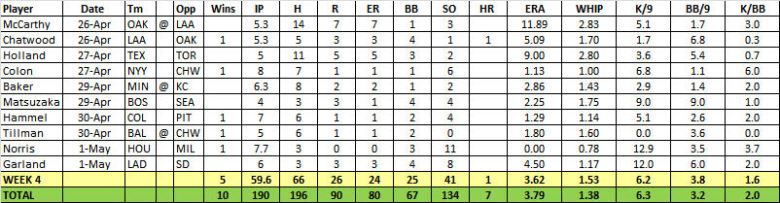
Baker’s excellent start from Friday wasn’t a part of this week’s spot starter recommendations, but that didn’t keep the group from having the best week yet.  The 14 recommendations started 13 times (Sam LeCure did not pitch) with just one allowing more than three runs (R.A. Dickey, 6 ER v. SF).  Nine of the 13 pitchers allowed fewer than three runs allowing the group to post the first sub-3.00 ERA week of the season.

The frustrating part is that despite the excellent starts night after night, the group only managed four wins.  Compare that to five of the 10 recommendations from last week getting wins despite the group faring much worse and you have exhibit 9,271,584,336 of why projecting and chasing wins is stupid and not worth your time.  Worry about skills, let the wins come to you.

Let’s see what week 6 brings us.

MONDAY:

Travis Wood (CIN @ HOU) – I had some trepidation about Wood coming into this season as I worried that he might not be able to repeat his 3.51 ERA without legitimate skills improvement.  But I didn’t have him down for a 6.21.  His skills have been way too good to merit such an ugly ERA and a trip to Houston is a nice elixir to get things going back in the right direction.  His last start was against the Stros at home and he allowed two runs and struck out seven over six innings, a repeat performance would be welcomed.

Edwin Jackson (CHW @ LAA) – Jackson got off to a nice start this season before two implosion starts tanked his ERA taking it from 3.51 to 5.86 in just 9.7 innings.  I am not willing to give up on him at this point as the talent is still there in spades.  I’ll take a shot here that he builds off of his big start against Minnesota that was overshadowed by Francisco Liriano’s no-hitter.

TUESDAY:

Joel Pineiro (LAA v. CHW) – His late start to the season has kept him under the radar as he is massively under-owned despite two strong starts to begin his season.  His highest ownership rate among the three major outlets is a 32% mark in Yahoo! leagues which still leaves him plenty available for to jump on before your league wises up.  He isn’t a huge strikeout guy and never will be, so innings cap leaguers in major need of strikeouts might want to look elsewhere on this one.

Jason Hammel (COL v. NYM) – Hammel been excellent following a shaky season debut where he allowed four runs in five innings against the Dodgers.  He has posted a sub-2.00 ERA in the subsequent five starts allowing more than two just once.  He gets to face a mediocre Mets offense that he fared pretty well against back in early April in his second start of the season.  He held the Mets to just two earned in six innings allowing seven baserunners.

Jake Arrieta (BAL v. SEA) – Our first trio of the season on a given day.  Arrieta is the pick for the more strikeout-starved teams thanks to outings of eight and nine strikeouts in two of his last three.  The anemic Mariners offense strikeouts 4th-most in the AL so Arrieta should have another fan-friendly outing.

WEDNESDAY:

Scott Baker (MIN v. DET) – His last appearance on Trolling before officially joining the Hold List.

Jake Peavy (CHW @ LAA) – It is his first start off of the disabled list and some owners are vehemently against starting a guy in that situation, but Peavy, a strikeout pitcher, gets to face the Angels who strikeout the most in the American League.  It’s a gamble with an injury risk like Peavy, but if he goes out and dominates, you might not get another chance to pick him up so better to be early.

THURSDAY:

Jon Garland (LAD @ PIT) – Congratulations to the Pirates for being .500 this late into the season, but it isn’t because of their 25th-ranked offense.  This team strikes out more than any in baseball and this is the kind of spot that guys like Garland excel despite not possessing overwhelming stuff.

Charlie Morton (PIT v. LAD) – He has done some great things this season, but he has an uneven skills profile looking at it in full.  The strikeout total for the season is worrisome at 4.7, but he’s up to a very useful 6.8 in his last four starts.  His season total is held down by the fact that he managed just six in his first three starts totaling 22 innings.  He was someone I really liked to take a step forward this year and become useful in any NL-Only format and possibly ramp up enough for mixed league viability.  He could become a Trolling regular in the coming weeks.

FRIDAY:

Dillon Gee (NYM @ HOU) – Splitting time between starting and relieving, the samples are small but he has been much better in the former thus far.  He has a 2.65 ERA with 6.4 K/9 and a 2.0 K/BB in 17 innings as a starter.  A four run implosion in a 1.7 inning relief outing has inflated his season numbers.  I think the skills are good enough that we could eventually see Gee hit the Hold List over the summer.  For now, he’s a good spot starter.

Ryan Dempster (CHC v. SF) – Check your league’s wire, he could be available.  He really shouldn’t be so if he is, make him a permanent hold.  He just got off to an ugly start, plain and simple.  Home runs were positively killing him, but they have never been a major problem in the past so that will regress in his favor.  We are already seeing it in his last two starts.

He has gone 14 innings allowing just three runs (1.92 ERA) striking out nine, walking two and allowing one home run (a solo shot on Sunday to Drew Stubbs).  Sometimes guys have terrible stretches that can’t be explained away by injury or significant skills change.  It could just be something within his delivery that he is working to correct then all of a sudden he will be back to his 200 inning/near-8 Kper9/mid-to-high 3.00s ERA self.

As always, look for the weekend picks later in the week.

Friday: 05.6.2011

Eric Hosmer & Julio Teheran Called Up

Yesterday and today have brought great news for two of the brightest minor league prospects in all of baseball as Kansas City Royals first baseman Eric Hosmer and Atlanta Braves starting pitcher Julio Teheran both learned that they are getting the call up to the show.

Both were top 10 prospects on just about any list that you looked at this preseason and I had Teheran atop my list of National League pitching prospects back in March.  The call ups are very different in terms of what they mean for fantasy owners both in the immediate future and going forward.

HOSMER

Hosmer is chief among the coming wave of blue-chip talent for the Royals so him being the first to reach the majors amongst the hitters isn’t terribly surprising.  He probably could’ve broken camp with the team, but they wanted to see what Kila Ka’aihue could do with a legitimate shot at every day at-bats.

The Kila Monster raked his way through the minors including smashing 24 home runs in 94 games a season ago.  And at 27, the organization owed it Ka’aihue and themselves to see if he was going to be a major contributor for what they hope is a winning ballclub in the near future.  Or at the very least he could prove his worth at the major league level and then allow them to either flip him or Billy Butler for even more parts as those two plus Hosmer had the potential for a major logjam.

Well Ka’aihue couldn’t even hit his weight (240 lbs.) which might have been enough to stave off Hosmer a bit longer even though it would’ve been a far cry from the .319 he hit a year ago and the .292 he has posted in the last three years in the minors.  By the way, for those concerned with the financial implications of calling up Hosmer, check out this tweet from Royals aficionado Rany Jazayerli:

Absurd is right.  I understand gaming the system and keeping a guy down until late May or early June of a given year, especially if you don’t really have a shot to contend in a given year like KC this year, but keeping Hosmer down that long was just never going to happen.

So Hosmer gets the call due not only to Ka’aihue’s failures but also his own excellence.  He has punished AAA in his first tour of the league hitting .439 in 26 games along with 19 walks in 118 plate appearances giving him a .525 on-base percentage.  He actually had more walks than strikeouts (16), something he also did in an 87-game sample in High-A at the start of last year.

The power hasn’t been as prevalent as expected with just three home runs and five doubles in his 43 hits, but after posting a .233 ISO in his breakout season across two levels last year as a 20-year old, many believe it is simply a matter of when, not if in terms of his power production.  ESPN’s Eric Karabell made a strong comp to that end likening him to Logan Morrison.  Morrison showed power early on his career, but it tapered as he climbed the minor leagues though the batting average and on-base percentage remained elite.

Morrison hit just two home runs in his 62-game debut last year and was pigeonholed at some outlets as a no-power, high-average asset despite being just 23 years old coming into this season.  In his first 15 games he ripped four home runs while improving both his average and on-base percentage.  Of course that is a tiny sample, but you can see where Karabell was headed.

One aspect of Hosmer’s game many might not be aware of is the speed dynamic.  He stole 14 bases a season ago and amassed nine triples.  So while he may not deliver the punch right out of the gate (remember, he is all of 21 this year), he could offer some sneaky speed at the 1B or CI slot on your roster.

And let’s not completely rule out the power, either.  We are dealing with a whopping 26 games and if just two more balls had found their way over the wall, he’d be on a 31 home run pace over 162 games instead of the 18 we see now.

He is undoubtedly already on a roster in any keeper league that has minor league rosters, but of course check just in case.  He is probably rostered in most AL-Only leagues even if they are re-draft leagues as long as they have some kind of bench, but again, check.  In leagues where he is available, he is an asset worth going heavily for just about regardless of format.

The trickiest league for determining his value is the 10-team mixed league.  With legitimately talent consistently on the wire throughout the season, you don’t want to get sucked in by the potential of the shiny new toy.  Just remember what happened to Brandon Belt earlier this year (.569 OPS and demotion back to AAA in 17 G) and how underwhelming Freddie Freeman has been thus far (.700 OPS in 32 G).  Hosmer rates higher than both on virtually all prospect lists, but that doesn’t mean he couldn’t end up performing quite similarly.

Rostering him in a 10-team mixer depends entirely on who you would be cutting to get him.  If you want to run your scenario by me, feel free to do so in the comments below or on Twitter (@sporer).  If it’s a luxury spot for you and you want to see if the lottery ticket hits, go for it.  If you’re cutting a contributing member of your team to take a shot on him, consider the potential downside, too, instead of just dreaming of what might happen.

Also, I would raise my bid substantially in OBP leagues.

TEHERAN

The Braves calling up their top pitching prospect was a bit more unexpected than Hosmer, but once the confetti settled and everyone read the fine print, the excitement was tempered after learning Teheran would only be up for a start on Saturday against Philadelphia because of a doubleheader before heading back to the minors.

As such, he should be treated as any other spot starter that you would use from the Trolling the Wire pieces I post here.  If you have been streaming starters this year, then I would consider him just ahead of Tom Gorzelanny, who is one of my recommendations for Saturday.  He isn’t without risk, but the Philly lineup is hardly daunting.

Teheran, younger than Hosmer at just 20 years old, has a 1.80 ERA and 1.10 WHIP in 30 innings at AAA-Gwinnett going 3-0 in his five starts.  His 3.1 K/BB ratio is strong, but down significantly from his previous marks thanks to a 7.5 K/9 which is 2.5 off of last year’s pace.  In sort of an odd pattern, he has done this before, though I’m not sure how much stock I would put into it.

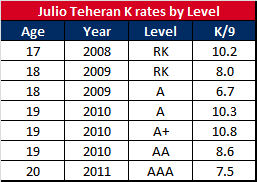
In his 15-inning debut back in 2008, he struck out 10.2 per game.  He followed that up with 7.4 per game in 81 innings as an 18-year old in 2009.  Then he ramped it back up to an even 10 last year in his best season yet which totaled 143 innings.  It could just be him getting used to the tougher competition, too.

Looking deeper we see the following:

Every promotion except the one from A-ball to High-A sees a drop in K/9, but when he repeated A-ball from 2009 to 2010, the strikeout rate climbed back up to an elite level.  In other words, as he gets used to a competition set, he adds the strikeout back into his arsenal as the premier way of getting outs.  These are all tiny samples, but the biggest simple sample is the High-A one which is nearly twice as long as most any other one and we see that he also put up his best strikeout rate there.

It would be more helpful to see splits from that stint to see if there is anything to this notion, but my general inclination is to not worry about the lower strikeout rate at the outset of his AAA career as I believe it will rise over the summer.

I wouldn’t read anything into why he is being brought up instead of, say, Mike Minor, either.  Minor pitched yesterday (May 5th) and pitched quite brilliantly mind you as he has all year so far, while Teheran hasn’t pitched since April 30th.  This allows them to build in a longer break for their 20-year old elite prospect as they find ways to limit his workload as well as give him a taste of the majors and perhaps learn something about just how close he is to sticking at the big league level.

Do not cut anyone of value to pick up Teheran in your league.  He should be a daily-league only play for those who are spot starting.  He will be back down to the minors after the start regardless of how well it goes.  The Braves have their five starters and if they need one on a long-term basis, it’s going to be Minor.

Just enjoy Teheran’s sip of coffee and hope that we get to see some of the excellence that is expected from this youngster in the years to come.  But if he’s pounded and lasts just four innings, don’t panic.  It means nothing.

Thursday: 05.5.2011

Trolling the Wire: Week 5 The Weekend

OK, I am going to stop recommending Sam LeCure because he never pitches when I put him on the Trolling the Wire list.  Those who have pitched are doing pretty well as a whole so far this week so hopefully I can keep the momentum rolling with some strong weekend picks.

By the way, I am adding Bud Norris to “Hold” list with Brandon McCarthy.  I think both are worth keeping on your roster permanently pretty much regardless of league format.  He is piling up strikeouts (10.9 K/9) and walking 1.5 fewer batters than last year (3.0 BB/9 in 36 innings).  He will make his final appearance on TtW this weekend*.

(*unless he falls off the Hold List at some point in the season.  That would require a series of poor starts, but we’ll cover falling off the Hold List at a later time if McCarthy, Norris or any other participants fall off.)

SATURDAY:

Norris (HOU @ PIT) – He’s cutting up much better talent so of course I like him against the Pirates and their 25th-ranked offense according to runs scored.  Maybe the removal of Brandon Lyon as closer will increase Norris’s chance at a win, too.  In the interest of full disclosure, I have not checked to see if Lyon has blown any Norris starts.

Tom Gorzelanny (WAS @ FLO) – Off to a strong start this year, Gorzelanny seems to have refined his approach a bit resulting in some strong numbers.  In his first start he allowed five earned runs in five and a third while striking out eight.  He hasn’t approached that strikeout mark again topping out at four, but hasn’t allowed more than two in any of the four starts.  He has been great in his two starts against Florida for his career, too, setting up a nice matchup for him to continue his strong start.

SUNDAY:

James McDonald (PIT v. HOU) – This was a guy I loved coming into the season and he got off to a pretty slow start last just 4.7 innings in his first start then allowing 5, 6 and 8 earned runs in his next three.  He has put together a pair of strong six inning starts during his last two outings allowing just two runs, striking out eight and winning both decisions.  Despite their overall ineptitude, Houston is 10th in runs, but that offense doesn’t really strike fear in anyone.  Brett Wallace is the only one with a better than .900 OPS while Hunter Pence is the only other one above .800 among full-time players (Jason Bourgeois has a .929 in 46 AB).

Erik Bedard (SEA v. CHW) – Let’s pick on the White Sox while they are down.  I think by season’s end they will be performing way better, but right now they are horrible with a .670 OPS that ranks 23rd in baseball.  Plus it’s at home which only helps pitchers.  Bedard is still getting on his feet after not pitching for all of 2010.  I think that is an underrated factor that many don’t account for when analyzing him.  It was a bit unreasonable to expect an automatic return to what we are used to out of him, but now we can see him rounding into form with a pair of strong starts against Detroit and Texas.

Results for Week 5 and the weekday picks for Week 6 coming on Sunday.

Wednesday: 05.4.2011

Minor Leaguers in Fantasy Baseball, Part 3

Picking up where we last left off, part 3 of the series looks at the rest of the top 20 from 2006 to see how successful that class ended up being from a fantasy perspective.  Remember, they are being graded on their fantasy impact with a heavy lean toward their first three years (when most fantasy owners who own them as minor leaguers can keep them for an initial low price, usually $5).

11. Prince Fielder (MIL) – Hands down the best of the bunch thus far.  He has five straight seasons with 157+ games played with tremendous results (110 OPS+ in ’06, never lower than 130 since).  For a rebuilding team back in 2005-2006, they are thrilled with the returns of Fielder whether they had him as a minor league pick or traded a bundle for him to a contending team.  This is what people are hoping to get with someone like Bryce Harper or Mike Trout (not necessarily the same package of results, but the superstar performance).  Rating: 6 – Yes, he exceeds the scale.  You just can’t get better results out of a prospect whether in fantasy baseball or in the real world game.

12. Howie Kendrick (LAA) – Conversely, this isn’t exactly what you want out a prospect.  He is just now entering his prime (and off to a fantastic start), but the lead up has been disappointing as last year was his first season topping 105 games when he played 158 but only put up the same stat line as that 105 game season (and not even as good in some areas).  He has been a ho-hum fantasy asset.  Though he could still be a success at 27 years old, he has definitely been a bust for fantasy leaguers as a once blue-chip prospect.  Rating: 1.5 – Simply hasn’t played enough and the results, outside of some decent batting averages early on, have been unimpressive.

13. Alex Gordon (KC) – He actually peaked at #2 on the BA list (2007), but he’s been an unmitigated disaster since then.  He checked in at #13 on the 2006 list before ever seeing a pitch as a professional and proceeded to have an excellent season at AA-Wichita with 29 home runs, 101 RBIs and 22 stolen bases all while hitting .325 in 130 games.  Considering that he started his pro career in AA and tore it up, he was one of the most prized young commodities in the game and his fantasy owners no doubt mulled over some truly amazing offers before inevitably deciding to enjoy the next George Brett instead.  Whoops.  Rating: 0.5 – He is off to a nice start and has done a bit more in the majors than Wood or else he’d have earned a 0, too.

14. Andy Marte (CLE) – Biggest bust this side of Christina HendricksRating: 0 – Yeah, that’s all I’m going to write about him.  He has 20 home runs in 301 career games after three 20-home run seasons in the minors before 2006.

15. Ryan Zimmerman (WAS) – The 2005 #4 overall pick needed just 67 minor leagues games to reach the majors and that happened the year he was draft.  That’s pretty impressive.  He came up for great 20-game cup of coffee and he has been an excellent major leaguer since.  Of course he is stuck on the disabled list this year and he will be out at least six weeks thanks to abdominal surgery.  But judging him on the whole, the only logical conclusion is that he has been an overwhelming success as the star player of the Washington Nationals.  Coming up the year he was drafted as a 20-year old and not only sticking ever since but performing at a well above average clip (career 121 OPS+) makes Zimm one of the best overall prospects of the last five years.  Rating: 5 – I don’t instantly recall how much fanfare he received back in 2006 as a minor leaguer, but as a top five draft pick he was no doubt firmly entrenched on the radar.  He has done quite well for his owners whether they drafted him or traded for his services.

16. Ian Stewart (COL) – The blurb on the Baseball America list says that Stewart drew comparisons to former Rockie Larry Walker.  Wow, I see why the scout wanted to remain anonymous on that comment.  A 38-year old decrepit Walker did more in 100 games than anything Stewart has done in his career.  He showed elite power in the minor leagues (.234 ISO) and for second it appeared as though it was starting to show at the majors with a 25-home run season in 2009, but he regressed back in 2010 and then stumbled so badly out of the gate in 2011 that he was sent back to the minors (though he was recently recalled).  He may be a late bloomer (26 this year), but he is very unlikely to ever meet the lofty expectations placed upon him in the minors.  His #16 rank in 2006 was a drop from #4 the year before while his mediocre season in the minors led to a 30-spot drop for the 2007 list.  He has definitely been a bust for his original fantasy owners and now he is polluting the rosters of a new set of owners.  Rating: 2 – Slight credit for 25 and 18 home run seasons in 2009 and 2010.

17. Conor Jackson (ARI) – The various maladies that derailed what looked like a promising career aren’t necessarily Jackson’s fault, but they have limited him to just 90 games played across the last two seasons.  However his initial owners, which is our focus in this piece, have to be pretty pleased with what he delivered in the three year stretch from 2006-2008.  If they turned away offers to keep their prized prospect, they can’t be too angry with the .292/.371/.451 line with an average of 14 home runs, 71 runs driven in, 73 runs scored and four stolen bases (powered mostly by a season of 10 in 2008).  Rating: 4 – Not quite star level, but when you consider the failure rate of prospects, his three year run was quite valuable.

18. Jarrod Saltalamacchia (ATL) – A slightly better version of Andy Marte considering his stats are a bit better in fewer games and he wasn’t a three time top 14 prospect like Marte.  That said, he is still a huge bust.  At 26, I guess it’s feasible for him to still be something of value, but he gave nothing to his original fantasy owners who had him as a prospect.  Rating: 1 – Assuming they remember any of them, they have to be kicking themselves for passing on the sweetheart deals that game their way for this highly sought after backstop.

19. Andy LaRoche (LAD) – Often the younger brothers of professional athletes are expected to be better than the older sibling, but that is far from the case in the LaRoche household.  Adam LaRoche has carved out a very solid career as mid-20s power first basemen while his brother is in his third organization in four years.  He was never the super-hyped “must-have” prospect meaning there likely isn’t a lot of regret tied to offers passed up to keep LaRoche.  Though given how poorly he has performed, I’m his original fantasy owners wish they’d have taken any deal that involved getting a productive major leaguer in exchange for LaRoche.  Rating: 1 – It took until his third year just to register 225+ at-bats in a season.

20. Carlos Quentin (ARI) – He has had an up and down career tied mostly to a host of injuries both in the minors and in the majors.  Those who had him in NL-Only leagues were really burnt as he flopped in his first two major league stints posting a combined .230/.316/.425 line in 57 and 81 game samples in 2006 and 2007.  Then he was traded to the White Sox and exploded for an MVP-caliber season that was cut short by injury.  He has remained a power threat, but hasn’t quite captured the magic from his 2008.  Rating: 2.5 – It is hard to account for all the potential factors here.  As I said, NL-Only owners were burnt to a crisp here though mixed leaguers did get an amazing season his third year in the big leagues      .  I settled at 2.5 giving credit for the awesome season, but not too much since he has been underwhelming otherwise.

Totaling up the ratings, we get an average of 2.4 across the 20 players (because I included halves and broke the scale on each end with a 6 and two 0s).  That’s not very good.  Breaking it down shows us just how sketchy even the best prospects can be:

There are 14 players with a 2.5 rating or worse, which is the threshold I would consider to be a failur.  Now this is of course a subjective scale, but based on the criteria, I’m not sure you could find much disagreement regardless of who was doing the rating.  The biggest consideration goes to initial performance because we are comparing it against the perceived value back when they were prospects prior to reaching the bigs.

APPLYING THE 2006 LESSON

How do we apply what we learned here to the current prospect landscape in 2011?  There isn’t a surefire rule for prospects thus there isn’t one specific takeaway from this exercise.  If I were to come away with one notion it would be not to put so much stock into minor leaguers and when faced with a favorable deal loaded with proven talent (and this isn’t a far-fetched scenario, prospect hounds often are willing to overpay) to trade a blue chip prospect, even if it is the one that EVERYONE thinks CAN’T MISS, pulling the trigger is the way to go.

Sure you might be trading away the next Prince Fielder or Zimmerman, but the odds are much higher that you’re trading away a Gordon or Marte or LaRoche or Salty or Stewart or you get the point.  And even if you are trading away the former, it isn’t like you are getting ripped off for him (which is probably the main point here), you just won’t be able to tout having rostered the next big thing from day 1.  As silly as it sounds, that very thing means a lot to people as they aim to prove how smart they are when it comes to projecting talent.

If it isn’t really your fault if your prospect fizzles out (and it really isn’t), then you aren’t a master scout ready to get your Stalker and stopwatch and post up behind home plate when one of your guys hits, either.

A major part of the must-have-youth epidemic in fantasy baseball is that everyone is trying to set themselves up for the future while still contending.  They want to be the New England Patriots who continue to trade for more picks in the future instead of just picking some damn players for once.

Don’t be that guy.  If you are lucky enough to nab a Mike Trout who skyrockets up prospect lists leaving with this massively sought after commodity, but you also have a core of legitimate talent on expiring contracts, don’t be afraid to deal Trout for the missing pieces to championship puzzle.

One thing we have learned in the early part of 2011 is that with these insane injuries, you’re never really “set”.  If you are looking at your roster at any point in the season that isn’t the final day of a championship season and thinking you can’t use any help, then you are only fooling yourself.

That doesn’t mean you should turnover your roster everyday with trades and waiver pickups, but unless you can predict the future, you roster is always in need of care and if it means trading a top prospect and you’re getting a great offer, I don’t see any reason to pass it up.

2011 PROSPECTS

I picked the 2006 list because it is five years old and thus can be reasonably judged as all of the players have had ample time to prove themselves one way or another.  Of course it is just one data point in the grand scheme and only 20 prospects on that data point meaning the 70% failure rate I ended up with isn’t necessarily the norm.

Perhaps 2006 was an anomaly, however I am pretty certain that it isn’t too far off, especially when the measure for success in fantasy baseball is a much higher bar than in on the field baseball.  If we were going solely on real life baseball success, about 65% of those players would be successes.

So getting back to the 70% failure rate, let’s bump it down a bit since the sample was limited and say that 12 of any given top 20 will be fantasy failures.  That means that 12 of these guys, who currently hold significant value in their fantasy leagues, won’t pan out:

Bryce Harper

Mike Trout

Jesus Montero

Dominic Brown

Julio Teheran

Jeremy Hellickson

Aroldis Chapman

Eric Hosmer

Mike Moustakas

Wil Myers

Jameson Taillon

Dustin Ackley

Shelby Miller

Manny Machado

Matt Moore

Michael Pineda

Freddie Freeman

John Lamb

Mike Montgomery

Chris Sale

Though it is very early, Hellickson, Chapman and Pineda are all already enjoying some big league success and giving back to their owners in a positive way.  Sale was great in his stint last year, but he’s been terrible so far this year.  Freeman is impossible to judge after just 133 plate appearances, but it hasn’t been great so far.

So that leave 15 players, realistically the jury is still very much out on all five already in the majors so let’s just say they stay as is with the three pitchers continuing to succeed and Sale & Freeman never quite paying off.  Of the remaining 15, 10 more are likely to massively underwhelm their fantasy owners in their first three years at the big league level.  Do you have any of those 15 remaining players?  How confident are you that yours are part of the five who will make it?  Trust me, everyone is saying to themselves that their guy or guys are in the five, but the problem is that we all have different players on the list meaning we really have no idea.

While the trend toward collecting young, unproven talent is in vogue for major league teams, it should be the opposite for fantasy league teams.  Any time you can turn over completely unproven talent for viable, bankable players, you should do it.  It is a bit of a gray area if you are out of contention, but even then I think you should be going after young talent that is logging major league reps whenever you can (think Brian Matusz types from last year).

Please don’t read that to mean that you should never keep minor league players and trade them for 20 cents on the dollar, I’m certainly not saying that.  To be clear what I am saying is that when you get great offers for the best prospects around, you are going to have more success taking the offer than you are by sitting on your minor leaguer and hoping he becomes a star, especially if you are in a position to win the title that season.

Tuesday: 05.3.2011

Trading for Superstars: What’s Left?

As we turn the calendar on the first full month of the baseball season, the trade wires will begin firing up in earnest as teams maneuver to plug holes left by the spate of injuries and slow starts around the majors.  On the other end of those struggling are the superlatives who are off to record-setting starts.

Slotting one of those players into your lineup is a cure many would love to administer to their team.  Of course it is those who are doing the best that can be toughest to trade for in terms of trade value.  Will they continue?  If not, how much will they fall off?  How much should one month boost their trade value as compared to where they were drafted or what their salary was in the auction?

These questions and more are what lie ahead for owners as they contemplate offers and discuss a myriad of trade possibilities.  I am going to look at 10 of the best performers thus far (five hitters, five pitchers) and work through an exercise whereby we try to figure what exactly is “left” for them.  In other words, what are they going to offer you if you trade for them?

An owner who traded for Ubaldo Jimenez after his sick April in which he threw 24.3 innings of 0.79 ball with 31 strikeouts winning all five of his starts got back 187.3 innings of 3.27 ERA with 14 wins in 28 starts.  A far cry from his April work, but still very useful especially to a team in need of pitching.  But at what cost?  If his trade mate charged him a Roy Halladay price then he may not have been so happy as he didn’t get the sub-3.00 excellence linked to baseball’s best pitcher.

We will look at the five pitchers today.  First we will see what they would have left if they merely managed to end the 2011 season with their three year average of statistics.  Then we will take a look at they still have in the tank as compared against a favorable projection based on their first month, their previous high watermark season and some personal projection from yours truly.

PITCHERS
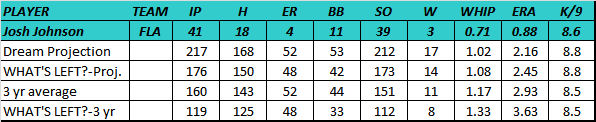

Johnson’s three year has injury time missed built into it since he made just 14 starts in 2008 and 28 a year ago.  It skews things a bit, but it shouldn’t be glossed over since he is a legitimate injury risk (what pitcher isn’t?).  Coming into the season there were some injury grumblings about him similar to those of Adam Wainwright.

So far he has not only avoided them entirely, but put together a six start stretch that has just been downright absurd in terms of quality.  If he were to have a second straight career year, there would essentially be a 2010 Clay Buchholz with more strikeouts left in the tank.  Buchholz threw 174 innings with a 2.33 ERA and 1.20 WHIP last year.  So call it a Buchholz-plus.

However if he were to succumb to any injury and just meet his three year average, which is a hell of an average for the rate stats mind you, he would be pretty “meh” from here on out.  Think 2010 Hisanori Takahashi.  The Mets swingman threw 122 innings with a 3.60 ERA and 1.30 WHIP along with 114 strikeouts.

That’s obviously a pessimistic look as you never really want to project injury for someone, but you need to build that into your cost when trading for Johnson.  If your trade partner is unwilling to build in some sort of discount for very real injury risk associated with Johnson then you might be better off looking elsewhere.

Weaver has been a workhorse the last three years getting better year over year increasing his starts and innings while also improving most of his other numbers in the process, too.  As such, many may see this surge as a continuation of what he has been doing the last several years.

Of course it doesn’t always work that way.  In fact, it is much smarter to predict a regression to the mean than it is continued excellence.  If he put up a line equal to his three year average, it would still be one of the best seasons of his career, yet owners getting him now would be saddled with some pretty pedestrian numbers.  Imagine something similar to 2010 Kevin Slowey.

I love Slowey, but the price you would have to pay to get a Slowey clone from here on out what would be pretty outrageous.  I actually don’t see Weaver dropping that much over the remainder of the season, but given how often we see players regress to their average, it certainly isn’t out of the realm of possibilities.

I actually see something of a Ubaldian season for Weaver which is essentially what the dream projection give him.  He “struggled” in his start on Monday (notching the baseline of a quality start, 6 IP/3 ER), but when that is your worst start of the year so far, you’re doing just fine.

Keep in mind that if Weaver “only” matches his line from last year (except for wins… if he only managed 13 after getting six in the first month, that’d be really unfortunate), you are due for 173 innings of 3.50 ERA and 1.15 WHIP with 178 strikeouts.  A very strong line to be sure, but perhaps not as impactful as you might be hoping given the price paid.  I am not saying don’t trade for him, I actually think he is pretty safe as pitchers go, but don’t let your trade partner gouge you, either.

In an AL-Only league I play in, I saw him get traded for Nelson Cruz which I thought was quite fair on both sides.  In fact, looking at his CBS page, I see he was part of another trade in some other league with Cruz who was paired with Brian Roberts while Yadier Molina was sent back with Weaver.

Haren is known for slow second halves waiting until after the All-Star Break to regress to his mean.  After several years of this trend, he reversed it last year.  Saddled with gobs of bad luck in Arizona throughout the first half, he was traded to the Angels just before the trade deadline and pitched masterfully down the stretch posting a 2.87 ERA in 94 innings.

He has maintained that high level of pitching into this year, but still some are reticent because of his history of slowing down as the season wears on.  Personally, I would leverage that in my favor to drive the price down a bit.

Though his ERA has regressed in the second half many times throughout his career, he isn’t a completely useless shlub.  His strong strikeout rates hold up well regardless of time period and his WHIP often stays well above average, too.  Plus, there are still two months before the second half of the season.  If you trade for Haren now, you could still get plenty of goodness and then flip him yourself if you truly are afraid of the second half.

Haren is an especially great target for teams struggling in WHIP.  While it is still technically early, we are getting close to the point where massive ERA and WHIP deficits can’t be easily fixed with a move or two.  Innings are piling up and if you’re too far away from the rest of the pack, you will need two or three star arms to fix it and trading for that would likely decimate you elsewhere rendering the moves useless.
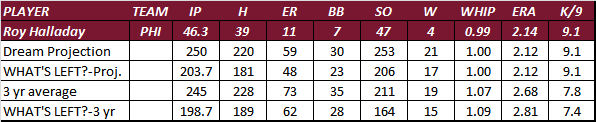

How do you make a dream projection for this guy?  Use 1968 Bob Gibson as a reference point?  Without getting too ridiculous, I just decided to stick with what he has done so far this year and project it for the entire season.  That would still qualify as a career year, but barely after his amazing 2010.

Even his three year average is absurd and if that’s “all” did in 2011, he would still almost certainly be the best pitcher in baseball from here on out.  The simple fact is you’re going to have to pay to get him and if you can somehow avoid paying the price of your first round pick or top dollar offensive asset, then do the trade.

Of course, I doubt that will happen.  Perusing the CBS trades shows us that he has been dealt for Joey Votto, Ryan Braun and Hanley Ramirez most recently.  If your pitching needs help and he is who you seek, you better hope your offense can sustain respectability without its best player or else there is no point doing the trade.  That is to say if you’re going to lose as many points taking player X out of your offense as you’d get by adding Halladay to your pitching, then look elsewhere to fix your pitching woes.

By the way, if he ended this season with his three year average, he would essentially be 2010 David Price with 10 fewer innings from here on out.  We are a month into the season and what he has left is the equivalent of one of the best pitchers in baseball from last year.
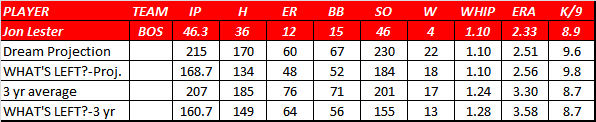

Last but not at all the least is Lester.  A popular pick for the American League Cy Young, including mine, he is showing why so many thought he could bring home the hardware this year.  Outside of Halladay, he has the least downside in his profile should he “only” reach his three year average by season’s end.  Part of that is because his ERA and WHIP aren’t as good as the others right now, but the other part is because his three year average is very strong.

He has become one of the most consistent aces in the game and as a 27-year old entering his physical prime, many believed he would take a significant step forward to make a bid for American League’s best pitcher.  If he were to reach that lofty goal, he would probably be near or better than the dream projection.

That would make him, in my estimation, the best of this group to trade for considering he likely won’t cost as much as Halladay does and his upside as compared to what he has already done is the best of the bunch, too.

He has been involved in some insane trades at CBS in that if you were able to get similar value, you should jump at the chance.  Twice today he was dealt straight up for Tim Hudson.  Other straight up deals include ones for: Alex Gordon (!!!), Jose Reyes, Ryan Howard and Justin Verlander.

I won’t share every single one, but just looking at the first page of these trades, they all seem to favor the team getting Lester except for the one where Lester and Howard Kendrick cost the owner Miguel Cabrera and Jake Arrieta.  That is pretty even, though I generally prefer to get the superstar hitter in trades.  Of course if you need pitching, that isn’t always possible.

I hope this exercise helps you in your trade endeavors as you try to assess exactly what you are getting back in your mega-deal.  Next, I will look at some hitters who are on fire and perform the same exercise.

You may also be interested in reading the piece by Daniel Moroz over at Beyond the Boxscore that looks at how April’s top pitchers from previous years finish the season.

Monday: 05.2.2011

Assessing the New Pitching Landscape

I was perusing some league rosters last night preparing for the upcoming week when it struck me how strong a particular team’s pitching staff was after a month of play.  I then flipped back to my own team and noticed it was similarly strong.  Neither of our teams is being fueled by Jered Weaver or Dan Haren (it’s an AL-Only league).

My team is middle of the pack in total pitching points while the other team is out in front, but not because it is loaded with front-line starters.  In fact the other’s team highest pitching pick was Justin Verlander and his 3.64 ERA is actually a team-worst.

My point here is that the depth that everyone projected in pitching is coming to fruition, but as such, it takes even more quality pitchers to succeed.  You have to change the reference point since it is so plentiful.  Starting pitcher ERA from last April has dropped 0.08 league-wide including a drop of nearly 0.30 in the American League:

Last year there were nearly twice as many sub-2.00 ERA starters (*20+ innings thrown) as there have been this year (14 to 8), but the 2.00-3.00 ERA pool has fattened up a bit so far this year growing from 23 to 29 leaving both pools with 37 sub-3.00 pitchers all told.

Looking further, it is the middle tier of usable starters (sub-4.00 ERA) that has seen the improvement early on as 14 more sub-4.00 ERA pitchers have emerged as compared to last year.  What that means, assuming the pitching surge continues, is that staffs built around an ace and a pair of mid-level guys while piecing the rest together between relievers and another starter or two now needs to add another legitimate starter to the equation in order to compete.

That’s just one example.  There are many ways to build a staff, but if you didn’t build yours while accounting for the influx of good starting pitching, then you’re likely lagging behind, especially without one of the superlatives thus far like a Josh Johnson, Roy Halladay or one of the aforementioned Angels.

I have always believed you can wait on pitching and I remain firmly in that camp, but the emergence (again assuming it continues on this way) we saw in 2010 and continue to see so far in 2011 doesn’t mean you can wait longer.  That’s the common misconception.   You still need to build from the same theoretical tier you’ve built from in the past.  The names may change, but the rounds and dollars values need to remain the same.

You can’t wait longer just because you see more guys with sub-4.00 ERAs and passable WHIPs available later; the improved pitching league-wide just means that replacement level is now a higher bar.

What does this mean now that the season in a month in?  It means don’t be fooled by free agents with shiny ERAs and WHIPs thinking they are automatic keepers because of how enticing someone with a 3.50 ERA on the wire (or whatever would be a good ERA for a starter in your league format… I’m assuming standard 12-team mixed) would’ve been three-four years ago.  You have to re-adjust your thresholds of what is good and what merits someone being picked up and kept long-term.

You also have to honestly assess the staff you built back in March to determine if it’s good enough to compete.  If you were one of those who waited longer than usual assuming there would be enough to pitching to feed off of, then you may find that you’re placing as well as you’d hoped and perhaps a trade is in order.  A month in, we can’t fully know what is going to happen with our team, but taking a detailed look at how you assembled your staff should give you some insight into how it will hold up in this brave new pitching world we seem to be living in since last year.

Sunday: 05.1.2011

Trolling the Wire: Week 5 Monday-Friday

This week was a process for the Spot Starter picks.  It started off poorly as posterboy Brandon McCarthy, who I recommended keeper permanently last week, was torched by the Angels allowing seven runs on 14 (!) hits in just five and a third innings.  Meanwhile, my second pick on Tuesday (skipped Monday due to a lack of viable options) was his opponent, Tyler Chatwood, who I went with over Marco Estrada and Gavin Floyd in order to get the most favorable matchup.

He was passable and earned a win, but the Floyd was excellent against the Yankees (W, 8 IP, 2 ER, 10 K, 5 BR) and Estrada looked sharp against the Reds (7 IP, 2 ER, 5 K, 5 BR).  But I stand behind choosing Chatwood as those two were playing two of the best offenses in baseball and they happened to escape with some gems.  The favorable play was passing on those two, especially for this strategy.

Then on Wednesday Derek Holland was ripped for five earned runs in the third straight start and all of a sudden I had three recommendations who totaled 15.7 innings allowing 15 runs with just six strikeouts. Of course there was plenty of time left in the week and the remaining seven selections all allowed three or fewer runs while five of them logged six or more innings.

The rally helped lower the season-long ERA while the five wins logged double the season total to 10.

Let’s keep the weekend momentum (1.75 ERA in 25.7 innings with the Saturday & Sunday starters) going into week 5:

MONDAY:

Bartolo Colon (NYY @ DET) – His ownership rates will likely bump up again after free agent pickups are run on Sunday, but as of now he remains available in a lot of leagues across all of the major outlets.  He is striking batters out, he is inducing groundballs and he is going deep into his starts.  There is just nothing within this profile so far to caution against buying into it.  His resurgence is the epitome of Ron Shandler’s axiom: “Once a player displays a skill, he owns it.”

Derek Holland (TEX @ OAK) – The string of 5 ER starts has to stop here, right?  Holland is too talented to keep getting pounded for a nickel each game and the A’s in their spacious stadium is a great place to get right.  I will be watching this start to get a better handle on Holland, too.  I haven’t seen him throw since the start in NY where Ron Washington was an idiot.

TUESDAY:

Sam LeCure (CIN v. HOU) – LeCure is a perfect matchup play as he feasts on the weak, but isn’t quite as strong against the stiffer competition.  To wit, he has allowed 2 ER and 1 ER in starts against Houston and at San Diego, respectively, striking out 14 in 11 innings across the two starts.  In his other two starts he allowed five to Arizona (including four HR) and three at Milwaukee in just 4.3 innings.

R.A. Dickey (NYM v. SF) – He hasn’t quite been as strong as he was in 2010, but nobody really expected him to be, either.  He has been useful especially getting through some control issues early in the season.  He is generally strong at home (1.99 ERA at Citi; 3.58 away in ’10) and the Giants aren’t scaring anyone with their lineup as Buster Posey slumps (5 for his last 26) and Pablo Sandoval, their best hitter so far this year, just went on the disabled list for 4-6 weeks with a hand injury.

WEDNESDAY:

Kevin Correia (PIT @ SD) – The Giants look like the ’27 Yankees compared to their divisional foes in San Diego as the Padres needed a 7-run surge today to finally top 80 runs for the season (84-last in the majors).  Meanwhile, Correia has just one implosion this season while allowing two or fewer runs in four of his six starts.  He likely won’t maintain his 2.90 ERA all year, but I doubt the regression begins against his old teammates.

Jake Arrieta (BAL @ KC) – The Royals offense is doing some nice work this year, but so is Arrieta having looked great in five of his six starts (an 8 ER in 3.3 IP shellacking against Texas as the lone blemish) which is masked by a 5.01 ERA.  I like him to tame the Royals a bit and keep his streak going.  He may even sneak a win, too, as his offense gets to face Kyle Davies.

THURSDAY:

Joel Pineiro (LA @ BOS) – After starting the season on the disabled list, many owners cut bait on Pineiro as he just made his season debut this past weekend.  The Red Sox are still trying to find their footing so I like Pineiro to take advantage and induce plenty of weak contact en route to a solid showing.

Brandon Beachy (ATL v. MIL) – He is this week’s pick to keep as his ownership starting to increase with each passing great start.  I’m not sure what took so long.  Of course, he is still available in quite a few leagues so he makes the list at least once more.  He has a sub-1.00 WHIP and a strikeout per inning pitched, I can’t imagine a format where that isn’t useful.

FRIDAY:

Jonathon Niese (NYM v. LAD) – He just keeps performing so he keeps getting recommended.  His ERA looks available after being inflated in back-to-back starts in early April when he gave up 11 in 10 innings to Philly and Colorado.  Since then he has reeled off three straight 2 ER starts allowing just the six runs in 19.3 innings.  The Dodgers are essentially a two-man lineup right now so Niese should be able to continue rolling.

Phil Humber (CHW @ SEA) – Pitcher on a roll + garbage opponent + pitching in garbage opponent’s excellent ballpark = auto-start.  Humber is another guy with only one real significant negative mark on his record (4 ER in 5.3 against Tampa Bay), but he has been sharp otherwise including a gem under the spotlight in Yankee Stadium.  The MAAAriners shouldn’t prove too challenging.

Weekend picks later in the week…

Saturday: 04.30.2011

Trolling the Wire: Week 4 The Weekend

It’s been an interesting week.  A few of the picks were knocked around while others excelled and perhaps excelled enough to keep the weekly totals strong.  We’ll see after the week.  Some things got bumped around this week including Scott Baker getting pushed to start against Kansas City instead of Tampa Bay which was beneficial since he got to avoid the white-hot Ben ZobristJason Hammel didn’t start yesterday and is instead starting today.  I guess he will count for a Saturday pick.

I’ll give another Saturday pick, but it is academic at this point since games have already started.  I meant to post them yesterday, but I passed out early last night after a week of not getting much sleep.  The last thing I saw for the night was Carlos Santana’s walkoff home run against my Tigers… what an awful way to fall asleep.

Chris Tillman (BAL @ CHW) – The White Sox just aren’t playing up to their ability.  Tillman has had two good and two bad starts so far.  He can feast on lesser teams so I’ll give him a shot against Chicago.

SUNDAY:

Jon Garland (LA v. SD) – Some like him, some don’t, but he performs.  He has been especially reliable in the National League despite an unimpressive strikeout rate almost every year (just once above 4.8 since 2004).  The Padres offense is downright abysmal making him an easy start.  In fact, several lesser starters would be a start against this offense.  It’s just sooo bad.

Bud Norris (HOU v. MIL) – What does this guy need to do to get his ownership rates up?  All he has done is strikeout six or more in each of his five starts and allow just three runs in his last three starts totaling 18 innings.  He has really cut down his walks from 4.5 BB/9 last year down below to 3.0 at 2.9.  He isn’t just picking on trash, either.  His last start came against the St. Louis Cardinals when he allowed 0 ER in six innings.

Look for the week’s results and the week 5 picks on Sunday.

Thursday: 04.28.2011

Minor Leaguers in Fantasy Baseball, Part 2

Yesterday I took a look at the impact of the 2010 rookie class and posited that could have a negative effect on how the fantasy community as a whole values prospects going forward.  Of course they are already overvalued as a whole so it may not move the needle a bit.

The fact remains that many owners are so eager to roster the next star that they often hamper their chances at winning just for the opportunity to be the guy who has Buster Posey on a cheap contract.  Posey was excellent last year and is off to another pretty strong start again in 2011, but he is the exception, not the rule.

In the next two parts of this series, I will look back at the top 20 prospects from 2006 to see how things have panned out for them.  What is the success rate of top prospects?  What is it that even defines success?  After looking back, I will have more thoughts on what this class from five years ago can teach us about the 2011 class and we should view minor leaguers now and going forward.

LOOKING BACK

So while the elite prospects acquitted themselves quite well, there were several players off the radar contributing legit numbers.  With just a year elapsed, it is impossible to truly judge the 2010 class completely, but the early returns are strong.  Let’s go back five years and see how things have gone for the top 20* prospects from 2006.

(*top 20 is a bit of an arbitrary cutoff, but seems like the right cutoff of the prospects who are coveted most by fantasy owners  who don’t have them and held tightest by owner who do)

1. Delmon Young (TB) – He was rated by BA four times: three times at #3 and #1 in 2006.  He was as can’t miss as can’t miss gets ripping through the minors in three years debuting at 20 years old and becoming a permanent big leaguer at 21.  Alas, he has kind of missed in terms of expectations-to-output ratio.  I have remained firmly entrenched on the Delmon Bandwagon as he is just 25 now, but last year was his first big time fantasy season since his rookie year when he hit .288 with 13 home runs, 93 RBIs and 10 stolen bases.  I would lean toward giving him an incomplete as I would like to see how his follow up season goes, but I think many would label him a bust.  Rating (1-5 scale, 5 being the best): 2 – Tough one to grade as we are still looking at a .291 career hitter who has played 150+ games in three of his four seasons, but the expectations were so astronomical that being just average is a disappointment both in fantasy baseball and on the field.

2. Justin Upton (ARI) – Another tough one to analyze as he is just 23 headed into his fourth full big league season.  That said, the results have been underwhelming with just the one truly star turn in 2009 sandwiched by two slightly above average seasons.  Through it all, he has failed to play 140 games in any single season.  Keep in mind that a major component of the grading here is how an owner of his back in 2006 feels now about turning away so many Godfather offers that may have brought him short-term glory and may have possibly unearthed a gem 2nd or 3rd tier prospect who would still be contributing today.  Rating: 2.5 – Earns a slightly higher mark than Delmon for delivering his big year while likely still a part of the original owner’s team, but otherwise his name is much bigger than the production.  His fantasy cost-to-talent ratio isn’t a favorable one for his owners let alone the regret he has saddled original owners with while looking back on offers.

3. Brandon Wood (LAA) – He is legitimately one of the worst major league baseball players ever.  He has put up more than a full season’s worth of 22 OPS+ (175 G, 501 PA).  That is unreal.  To have the alleged talent to earn that many at-bats combined with the constant failure takes a special kind of awful.  Rating: 0 – He likely changed how his original owners view prospects from now on.  You can bet that if they get have someone like Jesus Montero and get an equivalent offer to what they received for Wood back in 2006, they are taking it without blinking.

4. Jeremy Hermida (FLO) – Injuries just obliterated his career though it’s not like we shouldn’t have seen it coming as they started back in his minor league days.  Believed to be a dynamic five tool power-speed combo, Hermida never really ran at the big league level likely because there was no sense risking injury in the rare time he was actually on the field.  The power materialized in spurts, but all in all he was a colossal bust.  Rating: 1 – Teased with a strong 2007 campaign (125 OPS+, 18 HR), but played just 123 games that year and has posted an 85 OPS+ in 350 games since.

5. Stephen Drew (ARI) – Breezed through the minors in short order with some eye-popping numbers that just haven’t translated into fantasy stardom.  Drew is likely regarded as a hit from a real world standpoint as a slightly above average shortstop with only one truly bad year (2007), but he was supposed to be Hanley Ramirez/Troy Tulowitzki-good for fantasy owners and it just hasn’t happened.  Rating: 2 – Credit for showing up every day (three 150+ GP seasons out of four; fourth still had 135), but not enough fantasy goodness.

6. Francisco Liriano (MIN) – Burst onto the scene in ’06 with a truly brilliant season before succumbing to an arm injury that cost him all of 2007 and has rendered him inconsistent since.  He has the best single season of anyone on the list so far, but because his stock plummeted so quickly after ascent he too is something of a failure.  Rating: 2.5 – As an amateur free agent, he has far exceeded expectations on the field even if he never throws another pitcher again, but in the fantasy realm even the debut can’t keep him earning a weak grade.

7. Chad Billingsley (LAD) – The first one on the list to actually pay legitimate year-over-year dividends for his fantasy owner commensurate with expectations.  Original owners of his can proudly look back at the offers they declined in favor of hanging onto Billingsley as he has developed into a very reliable fantasy starter.  Rating: 5 – Even if you only held him for his first three years (league rules vary on minor leaguers), he rewarded you handsomely with 438 innings of 3.33 ERA, 35 wins and 401 strikeouts.  Given the inexact science of prospecting and incredible volatility of pitching, nobody would turn down that kind of production from a minor league pick.  And if you would, then you have wildly unrealistic expectations from those minor league draft slots.

8. Justin Verlander (DET) – A star who paid off for his owners regardless of your league’s rules when it comes to minor leaguers.  He won the Rookie of the Year out of the gate and followed it up very nicely with an even better year in 2007.  His 2008 year was a disappointment, but the composite of his first three years still yields 589 innings of 4.05 ERA with 46 wins and 470 strikeouts.  Rating: 5 – He had an extra-long shelf life for you to trade him for a big haul with two brilliant seasons to start off his career.

9. Lastings Milledge (NYM) – It’s a surprise he has lasted as long as he has given how poorly he has performed in a significant 1500 at-bat sample at the big league level.  He has been well below average with a career OPS+ of 91 and the only stint he was above average came in his 59 game sample of 2007 with the Mets.  At 26, he will likely get at least one more shot if not two or three, but he has been an unequivocal bust.  Rating: 1 – A two-time top 11 prospect on the BA plus the New York hype machine likely had his original owners fending off sweetheart offers on the reg.

10. Matt Cain (SF) – The crazy thing about the list so far as the amount of failed hitters and the fact that the biggest hits have far and away been starting pitchers.  It just goes to show that with prospecting there is really no safe route.  You just have to do your homework and put yourself in the best position to hit and then pray that you get a little lucky.  Rating: 4 – Dinging him a bit for the W-L records early on even though they aren’t indicative of his skill.  And the ERAs weren’t that great for mixed leagues early on.  That said, minor league rosters are usually found in single leagues (at least that’s been my experience) and he was a no-doubt gem in NL-only leagues even with the low win counts.

To be continued…