Archive for ‘Analysis’

Thursday: 07.3.2008

Player Focus 7.3.08

Daniel Cabrera pulled the first Player Focus reverse jinx by going out and throwing a complete game against the Kansas City Royals last night. I guess he reads the blog! 🙂 I’m still not buying.

June Swoon Continues Downward Spiral for Gutierrez
After smacking 13 home runs in just 271 at-bats and showing the proclivity to obliterate lefties (.919 OPS), many believed Franklin Gutierrez was ready to make the leap in 2008. Instead he has gone from bad to worse to each month bottoming out last month with a .430 OPS! Worse yet is that he can’t even hit lefties (.607 OPS) anymore either. The 25-year old looked ready to offer a solid power-speed mix similar to that of teammate Grady Sizemore, albeit on a lower level. With a disgusting .222/.274/.328 line, he isn’t even getting regular at-bats right now.

Outside of the absolute deepest AL-Only leagues, it is virtually impossible to justify rostering Gutierrez. There are 10s of better outfield options on the wire in mixed leagues and almost as many in 10 to 12-team AL-Only leagues as well. I was a proponent of his coming into the season, but until he learns some discipline at the dish, he will continue to flounder. The minor leagues could also be in his future.

Another Gem Moves Billingsley Over .500
I was also a strong proponent of Billingsley entering the season and that relationship has proven to be much more fruitful. Eight innings of shutout ball against the Astros on Thursday brought his record up to 8-7 and his ERA down to 3.12. Allowing just seven base runners in the outing brought his WHIP to serviceable 1.31. Walks have been a sore spot all season (4.0 BB/9), but he allowed just one this evening. In fact, control has been the hurdle keeping Billingsley from stardom for his entire career (4.4 BB/9), but remember that he is just 23 years old.

He remains destined for superstardom given his career trajectory thus far and he is a primary target of mine if I’m building for the future. Frankly, he’s a target of mine regardless of my team’s chances this year, but he especially becomes someone to seek if he has a desirable price for next year and perhaps even 2010.

Huff Surpasses 2007 HR Total w/2 on Thursday
Earlier this week, CBS Sportsline had an article about Aubrey Huff as their lead on fantasy baseball sites. I didn’t click through and read the piece, but it was no doubt flattering the 31-year old veteran for his excellent 1st half. He made the most of his national attention with a two home run performance on Thursday against the Kansas City Royals. They were home runs 16 and 17, which gives him two more than he had in all of 2007 despite 235 more at-bats than he’s had so far this season. His vintage 1st half could make him prime trade bait for rebuilding O’s.

The surprising first half of the Baltimore Orioles (43-41) has been key to Huff’s success with respect to his runs scored and runs driven in figures. They aren’t the Texas Rangers or Chicago Cubs, but few would’ve guessed that the O’s would have the league’s 13th-best OPS (.746) at the halfway mark. Three other team members (Nick Markakis, Brian Roberts and Luke Scott) have OPS totals above .800 while Ramon Hernandez, Adam Jones and Kevin Millar have had their moments as well. If you’re in an AL-Only league that punishes players traded out of the league, Huff should be considered high risk because even with their pleasantly surprising first half, the O’s are in 4th place in their division. Too bad they don’t play in the NL West. Even 90 cents on the dollar for Huff might be worth it if you’re in the thick of a pennant race where his departure would cause a significant void in your lineup.

Wednesday: 07.2.2008

Player Focus 7.2.08

I’m at work, so the charts won’t be available. But here is a look at a few players:

The D-Cab Stops Here
Get out and walk! Baltimore Orioles pitcher Daniel Cabrera teased, as he often does, that he was finally putting it all together and cashing in on the gobs of talent he so obviously possesses. Then the calendar turned to June. It was a month during which Cabrera went from 3.60 ERA/1.28 WHIP to 4.53 ERA/1.41 WHIP. How did he do it? The same way he always does: a complete and utter lack of control. A 4.6 BB/9 rate is going to make life tough on anybody as evidenced by a truly horrible 7.06 ERA from Cabrera. He started five games in June and went 0-3 walking three or more in all but one start. During that start, he yielded eight hits in six innings so he was still tattooed for six earned runs. If you bought him in May, shame on me—I should’ve been here to warn you that it was a mirage. If you still own him, shame on you—he’s just not very good.

Longoria As Good As Advertised
Fantasy baseball league owners are always looking for the next big thing: the Ryan Braun of 2007 or Francisco Liriano of 2006 lightning in a bottle surge that propels a team up the standings ladder. There are dozens of “can’t miss” prospects that miss… and miss badly. Tampa Bay’s Evan Longoria was a can’t miss prospect that found himself first or second on just about all of the top prospect lists heading into the season and he has handsomely rewarded the pundits and forecasters. In a world of can’t misses that continually disappoint, Longoria’s rookie campaign has been a refreshing smash hit.

His line of .268/.343/.521 with 15 home runs, 47 runs batted in, 42 runs scored and five stolen bases would be a nice end of season performance, but he’s got three more months left to produce!!! I’d be remiss if I didn’t thank Jacoby Ellsbury, Geovany Soto and Joey Votto for their delivering on expectations as well. They all showed a taste of what to expect with their cups of coffee last year which alleviated at least some of the risk.

More on Chasing Wins…
One more point I left out of the piece on chasing wins that I absolutely meant to include on Monday: Tim Lincecum is something of a poster boy for the volatility & unpredictability of wins. Just about every magazine, website and projection sheet around was high on Lincecum’s skills but all cautioned that he’d be short on wins because of his participation on the San Francisco Giants, perceived to be one of the league’s worst heading into the season.

Well folks, he’s 9-1. He had seven wins all of last season, so I understand where the pundits were coming from, but it’s a fallacious argument from the start. If you drafted a slightly lesser pitcher on a better team because you were afraid of not garnering enough wins with Lincecum, then you did yourself a disservice. Always acquire the top skills first and foremost. Teammate Jonathan Sanchez has eight wins as well.

Monday: 06.30.2008

Chasing Wins is Stupid

It gets said time and time again during every single fantasy baseball season, but it’s just foolish to chase wins. Making trades or pick-ups based solely on the idea of acquiring wins is a losing proposition almost every single time. Think about it, you’re acquiring one piece (albeit a substantial piece) of an amazingly large puzzle that determines whether or not a team wins. Too often, fantasy owners are expectant of wins from their pitchers with strong ratios (ERA & WHIP) without giving enough consideration to the other factors, specifically how well the starter pitcher’s team performs for him while they are batting. The adage that you can’t win a game 0-0 has often been used when talking about excellent starting pitchers that have terrible offense behind them. This is primarily why it is stupid to chase wins. But if you are going to do it, at least do it right.

Shaun Marcum has a 2.65 ERA and 1.00 WHIP this season, yet he’s just 5-4 in 15 starts. Kyle Kendrick has a 4.59 and 1.44 WHIP yet he is 7-3 in 16 starts. The point of that exercise isn’t to suggest that you should want Kendrick over Marcum; rather it exemplifies the “unfairness” of win distribution at times. Marcum should probably have 10+ wins given how well he has pitched and Kendrick should be the one with four or five victories. Livan Hernandez and his 5.22 ERA has yielded eight wins, but Scott Olsen and his 3.47 ERA has netted a meager four wins.

So what is the “right” way to chase a category not worth chasing? It comes down to information, specifically information that goes beyond earned run averages and WHIP ratios. I do not encourage ignoring either of those because regardless of how many wins you need, you can’t blow up those ratios just to maybe grab a handful of elusive wins. The key information necessary is Run Support. Run Support is the amount of runs a pitcher’s offense is scoring for him while he is the pitcher of record. It is calculated like an ERA, that is to say, it’s also based off of a nine inning average.

For the piece, I took starters with 80 or more innings this season and sorted them by their Run Support. I broke the 105 qualifying pitchers into two groups. The ones with good Run Support are those getting 5.00+ runs and the rest are those getting “bad” Run Support. Using that measure splits the group very evenly with 54 pitchers falling under the good column and the remaining 51 being part of the bad group.

Here are the findings of the study:
• The good group is averaging 7.3 wins apiece on an average of 16.3 starts, 12 of which are resulting in decisions (74%)
• The bad group is averaging 5.1 wins apiece on an average of 16.2 starts, 11.3 of which are resulting in decisions (70%)
• The good group has a composite ERA of 4.16 and composite WHIP of 1.36 in 5280 innings
• The bad group has a composite ERA of 4.07 and composite WHIP of 1.33 in 5077.3 innings
• Of those in the good group, eight have fewer than six wins (15%)
• Of those in the bad group, 32 have fewer than six wins (63%)

So what does this all mean? It means, obviously, that Run Support is a key factor in determining wins and losses regardless of a pitcher’s performance (that is, ERA & WHIP). Now that doesn’t mean I advocate grabbing a group of shlocks with good run support and try to pile up a ton of wins. To wit, those with good Run Support but an ERA of 4.40 or worse are averaging five wins while those below are enjoying an average of eight wins. The pitcher’s performance still matters so don’t just roll the dice on lesser pitchers playing for supposedly high-octane offenses and assume that will be enough. Take the time to see who is getting the support and make your decisions accordingly.

Chasing wins isn’t for me. I will still take the better peripheral performance 100 out of 100 times. Give me Shaun Marcum (five wins), John Danks (five) and Greg Maddux (three) before Ted Lilly (eight wins), Kyle Kendrick (seven) and Oliver Perez (six). That said, you can listen to any fantasy baseball radio show or peruse any fantasy baseball message board and find plenty of threads that say, “I needed wins, so I grabbed Mike Pelfrey since he’s on the Mets and they have a great offense.” A great offense isn’t equal to all pitchers. Kyle Kendrick tops the list at 8.13 runs, but teammates Adam Eaton, Cole Hamels and Brett Myers are all on the list of pitchers getting poor run support despite Philadelphia being the league’s 4th-best team in terms of runs scored.

The only area with more volatility than wins is saves and both can make you gray or worse yet, bald if you try to acquire them directly instead of trusting skills to be rewarded in the long run. Consider that of the 24 pitchers to win 15 or more games last year, only two had an ERA above 4.40 by season’s end (8%). That was a five-year low that followed 2006’s high watermark of 26% during the timeframe. Looking at the eight-win pitchers here at the halfway point shows that 12% of them have an ERA over 4.40.

Conclusion: Chasing wins is stupid.

Wednesday: 06.18.2008

Did You Know?

As I was pouring over stats for an article I’ll publish tomorrow, I found some very interesting tidbits that I thought I’d share with everyone:

-The Philadelphia Phillies are the only team to have had the same five pitchers start every game this season. Cole Hamels, Brett Myers, Jamie Moyer, Adam Eaton and Kyle Kendrick make up the team’s 74 starts.

-Of those qualified for the ERA title, there are 42 pitchers with an ERA below 4.00. All of 2007 saw 40 such pitchers.

-Coming into April 14th, Jason Kendall was hitting .405 across his first 37 at-bats. He is hitting .254 after compiling another 176 at-bats.

-Carlos Quentin is on pace for 38 home runs, 127 runs batted in and nine stolen bases. Eric Byrnes is on pace for 13 home runs, 51 runs batted in and nine stolen bases.

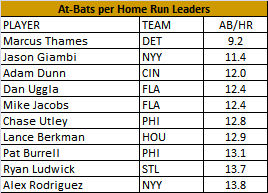
-With an 0-for-3 effort on today, Marcus Thames’ home runs in a streak is still alive. The torrid pace (last eight hits have been home runs) helped give him a nine at-bats per home run rate! Obviously, that’ll even out as he garners more and more playing time, but it is pretty impressive. Here are the top in AB/HR from a pool of the top 40 home run hitters so far this season:

-We all knew it at the time, but as the season wears on the Miguel Tejada trade just looks better and better for Baltimore. Tejada has been his regular declining self on pace for 20 home runs, which is fine enough. Baltimore got centerpiece Luke Scott, who is on pace for 28 home runs and looks to be finally putting it all together. In addition, they got Matt Albers and Dennis Sarfate who have contributed 75 strong innings out of the bullpen. Troy Patton was also a part of the deal, but has yet to pitch for the O’s. Albers, Sarfate and Scott have been three key players in Baltimore’s very surprising success that has them two games over .500.

-Three players have over 30 stolen bases so far this season (Jacoby Ellsbury, Willy Taveras and Ichiro Suzuki with 34, 31 and 30, respectively). This time last year, Reyes was blowing away the field with 38 and the next closest total was a trio with 22 stolen bases.

-In their best year ever, Carl Crawford has actually been one of the worst performers on the Tampa Bay Rays. After three straight seasons of .800+ OPS, he is at .681 through Wednesday.

-Adrian Gonzalez is on pace for 44 home runs. He hit a total of 54 in 2006 and 2007 combined.

-On May 11th, Emil Brown had 33 RBIs… he has 4 since.

-Freddy Sanchez has the worst OPS amongst players qualified for the batting title with a .564. He posted an .851 in 2006 when he won a batting title and then a solid, if unspectacular follow-up of .785 last year. Off-season shoulder surgery is the likely culprit for a busted 2008.

-Of those qualified for the batting title, nobody is below .200. Last year, Richie Sexson ( .198 ) and Elijah Dukes ( .191 ) were below the Mendoza Line at this point in the season. They are doing their best to get there against as Dukes is hitting .226 and Sexson is at .219.

Look for a study on starting pitchers to come out tomorrow in this space…

Thursday: 06.5.2008

Great Read

Ever take those internet journeys where you start off looking for one thing and wind up somewhere totally different, but you’re glad you ended up there? That is exactly how I found this debate between two stat guys & two scout guys conducted by Alan Schwarz at Baseball America over three years ago. In fact, I don’t even remember what I was first looking for… something baseball related I’d bet. I never caught this conversation the first time around during the whole “Moneyball” dustup. It’d be really interesting to get the four guys back for a follow-up and see how they’ve progressed with their stances on everything. At any rate, I thought it’d be topical given today’s amateur draft at 1 PM on ESPN.

Sunday: 06.1.2008

Baseball’s Power Outage

(Editor’s Note: Click on charts for a better view when necessary)

At this time last year, Troy Glaus, Victor Martinez and B.J. Upton each had eight home runs for the year. This year the trio has combined for just five! This fact, among others, has led a bevy of analysts, bloggers and radio hosts to spend ample time hypothesizing about what has brought about the current “power outage” in baseball. Oftentimes the conclusion is that the game has been cleaned up and thus gotten weaker. Is that just the convenient answer that we want to be true or is there some sort of legitimacy to it? Since we can’t really prove whether or not it’s true given the lack of evidence around who was and who wasn’t on PEDs the past several years, this answer will always be largely conjecture. What we can do, however, is take a look at the numbers and see just how much the power has dropped off around the league.

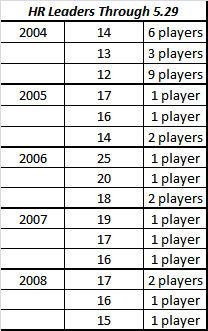
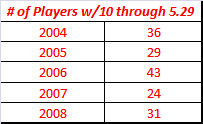
To get an idea of how much, if any, power has dissipated from the game, I looked at several things: Slugging Percentage, Home Runs and Doubles. I also looked at weather just to see if anything interesting struck me, but I don’t think that would come into play until late in the year. I went back to 2004 giving me a complete four-year sampling to compare the first two months of 2008 against. First, I’ll show some of the simpler data I compiled that probably doesn’t have huge correlations year-over-year but can be “fun” to look at when discussing these kinds of things. The following charts focus on the concentration of home runs meaning they fail in giving us the scope we need to judge how far up or down the league’s power is or isn’t right now. What they do offer is an interesting look into how the premier hitters performed during the period studied.
10 or more HR
Judging by those two charts, 2006 was a huge power year all around. Two players had 20 or more home runs and a whopping 43 had 10 or more, both are easily the best of all years studied. Sidenote: 2006 was the second hottest year in the United States on record. The above charts might lead you to believe that 2008 has been a more fruitful power year than 2007 and all the talk is just bluster. And this is why we must dig deeper.

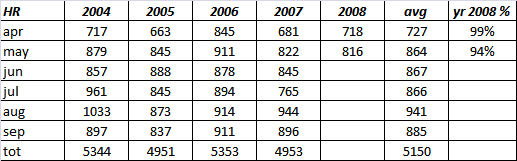
Let’s examine the home run totals a bit more to get more perspective. I took home runs totals by month from 2004 through May of 2008 and then looked at the average of each month. From there, I compared the 2008 April and May totals against the average to see how they stood up. Though the grumblings of a power outage started in earnest during April, the 718 home runs hit reached 99% to the April average (727) and totaled 37 more than April 2007 (681). In fact, outside of the home run happy 2006 season (845 April HRs), the 718 home runs hit this past April was the biggest total of the years studied.

May, however, was a different story. Though just six off of the mark of 2007’s May, the 816 home runs reached just 94% of the average and qualified as the lowest total of the years studied. From 2004-2007, home runs saw a 20% increase from April to May. This year, there was only a 14% increase month-over-month bringing the five year average down to +18%. If the season follows pace and assumes the same percentage gains and losses established from 2004-2007, then there would be about 4900 home runs in 2008, the lowest of the years studied by over 50 home runs.
Month-Over-Month HR Changes
So the data centered around home run output leaves us with an uneven answer. April home run output was strong by comparison despite that month usually being excused due to inclement weather while the uptick generally enjoyed by the league in May was decidedly absent in 2008 despite the concentration of power being stronger or at least as strong as previous seasons.

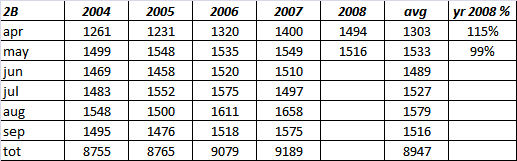
Let’s move onto doubles because contrary to popular belief, power isn’t only about home runs. Legitimate power can and will result in a boatload of double as well. April 2008 gave us the highest double output of all the years studied by far meaning that heading into May it seemed that the assumed power outage had little behind it. The double output in May was only 99% of the average from the sample size once again lending credence those in favor of a power outage.

At this point in my study, I still felt rather uncertain about the results. Some of you probably see where I’m going with this, but I chose present these numbers first because it is primarily what the so-called experts and pundits choose to focus on when decrying the drop of power in the media. These raw totals told me that April was on pace with history and any drops experienced in May appeared negligible. The preceding charts were contrary to everything that the very first chart I put together showed me:
Slugging Percentage by month
Even though the doubles and home runs totals from April and May suggested that things weren’t all that bad, both months had a depressed slugging percentage when compared against the previous four seasons. Mind you, I’m well aware of the fact that doubles and home runs aren’t the only variables included in slugging percentage, but they are the most common components with the biggest impact. The impact of singles is small as is the frequency of triples. Now we’re nearly 900 words into the piece and we only really needed one chart to show us that power is in fact down in baseball for 2008.

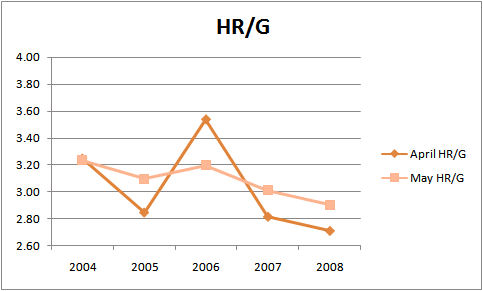
The key was obviously to look at things on a per game basis. Given the random weather patterns in both April and May that cause both rain outs and snow outs leading to various scheduling changes, the raw totals won’t always deliver the full story. Let’s take a look at both home runs and doubles on a per game across the past five seasons in April & May to see how prominent a decline in power has struck the league this year:

The talking heads got one right, folks. They may not have taken the best path (total numbers), but the two charts found above clearly show that there is a legitimate power decline in the game of baseball right now. Is it because of the crackdown on PEDs? As I mentioned at the very beginning, that is an impossible question to completely answer with the data we have in front of us. The game’s biggest fans that took the constant black eyes bestowed upon the game to heart absolutely want it a crackdown on PEDs to be the answer for the decline. Perhaps the powers in charge have altered the ball back into the favor of pitchers?

After all, 31 starting pitchers have earned run averages below 3.50. And 19 starting pitchers have FIP measures below 3.50. Four of the pitchers with a FIP below 3.50 have an ERA above 3.50 essentially meaning they have been bitten by some bad luck. Unfortunately, I was unable to find an easy way to put together the data to see how many players had similar figures in previous seasons. For all of 2007, only 17 pitchers were on the right side of 3.50 in the ERA category and only nine of them held a <3.50 FIP.

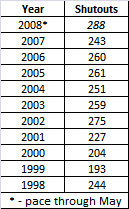
Lastly with regards to pitching, consider that there have already been 96 shutouts this season including nine from the pitiful Detroit Tigers thought in the off-season to be capable of chasing down 1000+ runs scored. Last year, there were 243 shutouts total (40.5 per month). Through May 31st, we’ve already seen 96 shutouts this year. If the 2008 pace holds (48 per month), then we would see 288 shutouts, easily the highest total in the 30-team era:

With four months of play left, the bulk of which will be played in the hottest weather of the year, it is difficult to make any sweeping conclusions. One thing is certain right now, power is down and the margin is statistically valid. For all the heat that Bud Selig takes, it does seem that his concerted effort to crackdown on PEDs in baseball is paying some dividends. Warning track power is the story of the season as are the many wall-scraping home runs that have been a point of consternation through the first two months. So frequent are these close calls that the talk of instant replay on some level in baseball is being heavily discussed nearly as much as the Power Outage of 2008.

Sunday: 06.1.2008

Player Focus 6.1.08

I spent the past two evening researching for an article I’ll post on Monday which is why I didn’t have any updates for Friday or Saturday. All of the data needed has been collected so I’ll finish writing the piece of post late tonight so it’s available on Monday morning. For now, some player looks:

Chipper Jones Rebounds from 0-fer with 2 hits
There has never been a question of Chipper Jones’ talent. And until 2004, he was on track to be a surefire first-ballot Hall of Famer, but then the injury bit him, and bit hard. From 1995 to 2003, Jones played less than 153 games just once and it was 140 of Atlanta’s 144 games during the strike shortened 1995. Since then he hasn’t played 137 in any season. The first year that he lost to injuries was also his worst ever despite 30 home runs and 96 RBIs as he hit just .248. The .847 OPS he had that season just goes to show how amazing of a player Jones is even in a down season.

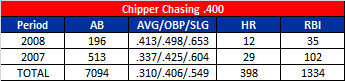
Last year saw Jones net 500 at-bats for the first time since 2003 and he responded with a brilliant season that included 29 home runs and a .337 batting average. He has carried over that excellence in the early part of 2008, hitting over .400 at the June 1st post. With a 2-for-3 (and 3 walks) effort on Saturday, Jones rebounded from an 0-for-5 to ensure he would enter June above the famed .400 mark. Ted Williams’ .406 from 1941 stands as the last time the feat was accomplished and I’m not going out on a limb when I say that it will still be the last time when the 2009 season opens up.
Chipper Jones\' Quest for .400
I’m comfortable trotting out the same reasons against a .400 season that we see anytime anyone is flirting with the mark into late May/early June. The primary of those being that the media pressure as the calendar flipped to September would be too much for ANY man to handle. In this day and age of over-analysis for even the most minor of stories, can you imagine the amount of coverage that would be given to a feat that hasn’t been accomplished in 67 years?! If you thought ESPN was obnoxious now…

It bears mentioning again that hitting a baseball is so difficult that the elite are permitted to fail 7-of-10 times to achieve their status. Despite how hard it is to accumulate hits, we’re now asking for more than one in most games because a simple 1-for-4 or even 1-for-3 effort will lower his batting average! Consider that Williams “only” hit .406 in 456 at-bats and he’s widely regarded as the best hitter the game has seen. Jones’ feat would probably require at least 50 more at-bats and even if he approached the 450 at-bat mark with a .406 average, that’s a pretty small margin of error for that homestretch. Finally, Jones has a great batting eye, but it’s not good enough to propel a run at .400. He has a 14% walk percentage for his career which shouldn’t be scoffed at, it’s tremendous. The 15% rate through May 31st is a big reason why he has been on base at a nearly 50% clip so far this season. Again, it falls short when you start talking about a .400 season… by a lot! Williams posted a remarkable 24% walk percentage during his magical run at .400 and a 21% rate for his illustrious career. Sorry Braves fan, it just isn’t happening.

Ricky Nolasco on Fire of Late
In 2006, the Florida Marlins had to have been impressed by their 23-year old rookie who had put together a solid 11-11 season with a 4.82 ERA in 140 innings. There was plenty of room for improvement, no doubt, but it was definitely a nice foundation to build upon. An elbow injury limited him to 21.3 innings in 2007 making this year his second season for all intents and purposes. He came out of the bullpen for his first two appearances and tossed 5.7 scoreless innings. He joined the rotation on April 11th and promptly allowed five earned runs in five innings, but managed a win nonetheless. His second start was even worse with six earned runs in 4.7 innings and eventually the loss. In the eight starts since then, he has allowed more than three runs just once lowering his ERA nearly two runs in the span from 6.46 to 4.48.

His peripherals over the past three starts are in line with his 2006 totals. In the end, Nolasco likely isn’t a pitcher that should be relied upon to do much more than what he did in 2006. He could shave up to half a run off of the ERA and settle in around 4.30, but that likely stands as the upside at this point. I would tread VERY cautiously in standard mixed league formats (i.e. 10-12 teams), while those over 12 teams with reserve rosters might want to consider stashing him. I doubt he’s available in NL-Only leagues, but he should obviously be picked up if he is on the wire during your transaction period.

Thursday: 05.29.2008

Caught Empty-Handed?

During the preparation season (October to March if you’re like me), there are tons of debates that get looked at from every possible angle. One that comes up annually is position scarcity. Is it better to have the best at a scarce position or just fill the gap with something moderately adequate and hope that maybe you capture a breakout season in a bottle? This year it was quite clear that catcher was the thinnest position. (Note: I also believed outfield to be far more scarce than many believed, but it’s a different beast in that some of the game’s top producers are outfielders and stocking up on them early doesn’t carry the potential disadvantages of getting a top catcher early on.)

It was viewed as the 4 M’s and then the rest. Russell Martin, Victor Martinez, Joe Mauer and Brian McCann were the elite while almost anything else was table scraps by comparison. Geovany Soto and J.R. Towles were appealing rookies that got a lot of attention based mostly on potential. So back to our question, would you be paying the premium for an M or waiting on the flotsam? I’ve always been firmly entrenched in the flotsam camp. I’m not saying I get the absolute worst of the worst, but I’m definitely hoping to get two $1 lottery tickets in the auction. That is, two $1 catchers that have some level of silver lining that could lead to a quality season. At most, I’ll budget $10 to fill the two catcher spots. In my draft leagues, I usually designate a set of value guys and take them once only a couple of teams need catchers.

To me, spending the extra resources (draft pick or auction dollars) to maybe get top quality production at catcher just isn’t worth it. The 4 M’s are some quality baseball players, but it’s not like I get them AND the same outfield or the same trio of corner infielders that I would’ve gotten by not investing those extra resources. My point is, your team will take the hit somewhere. Is it better to take the hit in catcher or any other position? The answer, plain and simple, is any other position. And there are several reasons for this answer.

First is that the position is a defensive one; hitting is secondary for almost every catcher. Regardless of how well they hit, a catcher’s first job is to run the pitching staff and quarterback the defense… or at least it will be if the manager has his way. That doesn’t mean that they care less about hitting, but their management is likely to ignore some struggles at the dish if they are calling their games remarkably well and engineering a crisp defensive unit. It’s a very cerebral position that puts a lot on a guy’s plate and sometimes the hitting gets pushed to the side. Ever notice how many former catchers are currently managing teams?

Second is that the position takes a toll on the body! One of the reason it is hard to get quality numbers out of catchers is because they just don’t play as much as other players so they can’t pile up counting stats. Usually it’s simply the nature of being a catcher is conducive to planned off days, but oftentimes injuries occur and they miss extended periods of time. There is a reason that players move from behind the dish after a few seasons. Craig Biggio started out as a catcher and so did Carlos Delgado & B.J. Surhoff. Neither would’ve lasted as long as they did (or are in Delgado’s case) without moving to a new position. Victor Martinez played 30 games at 1st base a season ago and 22 the season before that—he is slowly making the transition. Already this year he has four games logged as a first baseman.

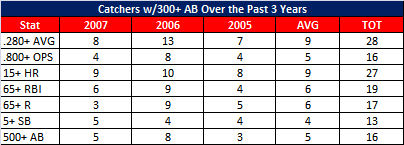
Reasons 1 and 2 lead to volatility in the already depressed production of players at that position. To put it simply: too much can go wrong when investing heavily in catchers at the expense of another position. Consider the following table:

2005-2007 Catchers Production

Ouch, that’s pretty awful, isn’t it? So what’s my point? Looking at the three year averages of production across the key statistics in fantasy baseball, there isn’t even enough at any statistic for one per team in a 10-team league. And 12+ team leagues are far more common meaning things are even thinner in your average league. That coupled with the fact that there are no sure things at catcher (isn’t that right, Mr. Martinez?) means you should avoid investing heavily at the position. The best way to optimize your chances for winning is to mitigate the risk. You can’t play it safe across the board, but when taking risks you assess the level of risk against the potential reward.

When analyzing catcher, the risk-reward says you’re better off with Dioner Navarro and Chris Snyder at a dollar apiece or a late round pick than Russell Martin or Victor Martinez for several dollars (varies greatly by league) or in the first 2-3 rounds. Navarro was brutal last year with a .641 OPS, but digging deeper reveals an .815 OPS after the break. Most owners would only see his overall numbers and probably laugh when you roster him for a $1 or in the reserve rounds of your draft. Now he has an .862 OPS in 118 at-bats. Snyder’s 13 home runs from 2007 likely had him on more radars than Navarro, but the .252 average and 47 RBIs likely kept his draft position and auction price low. His .889 post-break OPS, powered by a .386 on-base, screamed buy to me and now I’m enjoying his .842 OPS and 26 RBIs in several leagues.

Both of these players may look like hindsight 20-20 picks and I can’t necessarily prove that they aren’t so you’ll have to trust me. I’m simply making a point that a little extra homework can save resources from being wasted and enhance your chances for winning your league. Even if that same homework results in a Carlos Ruiz (.595 OPS) or Kurt Suzuki (.614 OPS), it freed up resources (in the form of auction dollars or your higher level draft picks) that ensured you weren’t stuck relying on an Andruw Jones or Eric Byrnes as a #1 or #2 outfielder. Acquiring a top catcher means you will have to cut corners elsewhere and it’s wiser to cut corners at catcher than it is at any other position. By the way, the mention of Martin may draw the ire of some who look at his line and say he’s doing just fine. He hasn’t been abysmal, but he’s on pace for 9 HR and 12 SB when many projected a near 20-20 season again after last year’s 19 HR-21 SB. Factor in the price paid to get him (leagues in which he was a keeper notwithstanding) and he is whatever the level is just before “abysmal”.

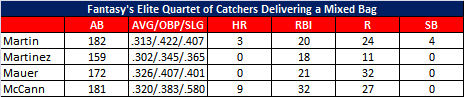
As the calendar flips to June, the preseason catcher quartet shows the one ranked 4th producing the best by a landslide:

I’ve already covered Martin. Mauer has been a bust in the power department since day 1 for the most part so his homerless streak isn’t terribly surprising, but the owners that have 0 HR-11 R-18 RBI out of Martinez thus far probably get sick every morning when they sift through the boxscores. The only one on par with McCann thus far? The rookie of course. Geovany Soto has McCann matched in home runs with 9 to go with his 36 RBIs, 21 runs scored and .301/.396/.563 line. Three of the four catchers widely regarded as the only sure things available are vastly under performing against expectations and the fourth was often rated the lowest only further showing how uncertain the position can be for fantasy owners.

This subject will be revisited throughout the season and at length again in the off-season.

Friday: 04.25.2008

May’s Best Performers from 2005-2007

As we head down the backstretch of month one in our marathon towards the finish line, even the most adamant of us that preach patience with our teams need to dust off the desk once again and start taking a look things. The season is easing into a canter and players are fast approaching the 100 at-bat mark meaning it’s easier for to analyze how our players are performing from the still smallish samples we have at our disposal. As the at-bat totals climb the rate statistics won’t be subject to such wild fluctuations with each 1-for-10 slump or 5-for-10 surge.

The following article is less about making moves based on the past and more about shedding some light on what we might be seeing from a group of players in the coming month of May. I analyzed the past three years of data to determine who the top May hitters are during that stretch. I took everyone that posted an .850 or better OPS in May of 2005, 2006 and 2007. From there, I looked how frequently the players appeared. If a player appeared only once, they were done as I was looking for players that consistently smack the ball around in May. Performing in one of the past three Mays can be written off as a fluke.

There were 45 players that hit the .850 or above OPS mark in two of the three seasons and you will learn about them very shortly. Eight of those 45 (18%) turned the hat-trick. The positional breakdown delivers 21 outfielders, 14 corner infielders, six middle infielders and four catchers/designated hitters. The point of this exercise is to shed some light on the players you can reasonably expect a surge from as the calendar turns over to May. It is by no means a guarantee that these players will perform in this May as they have in past Mays, but the data set is large enough to make it worthwhile (read: fun) to look at for fantasy owners. Also, some of the players on the list might be currently struggling and thus increase their candidacy for a buy-low trade.

,

The bulk of this 45-player list is superstars and established players, so don’t expect a list of players you can troll the waiver wire for in hopes of riding a hot May up through your standings. If anything, this list was constructed to offer peace of mind to those worry easily in this game we play. A hot month can jump-start a season and erase a slow start. Heck, Ryan Braun didn’t even need an April to put together an MVP-caliber season last year. There are definitely some players in this list that are currently slumping enough to raise concern for their owners. There are sometimes various degrees of validity to slumps of superstars, but those are usually injury-related. So if your stud isn’t in the news for various maladies that could be affecting his performance, then he is likely just in a slump that he will assuredly come out of during the season.

It could be May, it might be June, but as the adage goes: hitters hit. OK, enough preaching, let’s get back into some specifics about the list. A team breakdown suggests that opponents of Boston, Detroit and the New York Yankees had better watch out. Of course, I’d have suggested they watch out even without this list. Only seven teams don’t have a player within the list of 45 and the most surprising tidbit to come out of that fact is that one of the seven is NOT the San Francisco Giants (their representative will surprise you even more!) The light-hitting Kansas City Royals, Oakland Athletics and San Diego Padres are all on the list of seven to the surprise of no one. The lack of representation from the Tampa Bay Rays is actually a bit of surprise despite their ineptitude as a team in recent years. Though thinking through it now, their budding stars have not really been around long enough to have strung together a few Mays in a row. The Los Angeles Dodgers, Seattle Mariners and Texas Rangers round out the list of seven. For those keeping track, that is three-quarters of the American League West to make the no-show list.

>

I have now exhausted the content of this article that focuses on everything but the players involved, so let’s get to the meat of it all. Since the entire chart of 45 players with 13 columns of data apiece isn’t viewer friendly to the format of this article, I’ll break it up in three groups of 15 and countdown from 45 to 1, sorted by OPS:

• Note that I included the extra base hit percentage so you can get an idea of how many doubles and triples each batter had to go with the home runs that you can see listed. I found this to be more useful than keep the double & triple columns.

• Though .850 was the cutoff to qualify for the study, you will see that three of those ended up on the list actually have OPS below the .850 mark. Each of these three players had two seasons that qualified for the study, but clear their third year of May statistics took them below the threshold I was looking to achieve.

• Mike Cameron’s presence could bode well for his owners as he doesn’t even begin play until April 29th after serving a 25-game suspension for amphetamine use.

• Though he made the list, Adam Dunn doesn’t necessarily heat up in May. He hits for a ton power and takes the walks that we expect him to take. Both of these outcomes inflate his OPS to give him a spot on the list, but factoring in the .222 average almost eliminates the goodness of the home runs and runs batted in. As always, in an OBP league Dunn is a monster!

• Pat Burrell is not getting much press because of superstar teammate Chase Utley’s play, but Burrell has been white-hot to start the season. He often starts off the season well, but not this well. Many are attributing his hot start to the off-season marriage and the fact that he is a contract year.

• Several of the players in the bottom third of the list would benefit from continuing this historical trend including Casey Blake (.233 avg), Troy Glaus (0 hr) and Brad Hawpe (1 hr).

31-45

Next, we’ll look at the middle third which contains a fair bit more star power than players 31-45. However, this grouping also contains the list’s biggest surprise:

• As mentioned earlier, Chase Utley is steamrolling towards a Player of the Month Award at April wraps up. He has 10 home runs and an absurd 1.280 OPS. If he puts up another strong May, the league is in deep trouble!

• With a recent seven-game hitting streak from David Ortiz that has included three of his four home runs, he is heating up just in time to keep his hot May trend alive.

• Jose Castillo is no misprint; he did qualify for the list. In leagues where you might already be feeling desperate and willing to try anything, he might be a worth a flier to test the trend and see if it sticks. (Note: his 2007 May did see his hit .313, but that was it as he totaled just a .718 OPS. His 2006 May was spectacular with seven home runs, though. Buyer beware!)

• Utley isn’t the only one on fire that cracks the top 30: Conor Jackson, Chipper Jones, Alex Rios and David Wright are all paying large dividends for their owners thus far.

• Lyle Overbay welcomes May with open arms. He has yet to hit a home run this year and he has six in each of the past two Mays. He is one of the eight players that posted an .850 or better in each of the three seasons analyzed.

• Nick Johnson is finally healthy, but uncharacteristically struggling in April. He is still piling up walks, but not much else.

16-30

Finally, let’s look at the top 15. It’s star-laden with the likes of Alex Rodriguez, Albert Pujols, Matt Holliday and Miguel Cabrera, all of whom are 1st round picks/top-dollar players.
• Aging stars Magglio Ordonez, Gary Sheffield and Manny Ramirez do some of their best work in May. Ordonez & Ramirez are both on fire already, while Sheffield is banged up and struggling when he does play.

• A pair of second basemen cracked the top 15, but only relies on the long ball to power his fantasy value. Brian Roberts and Dan Uggla are overshadowed by Chase Utley (and rightfully so), but both join him and actually supersede him when it comes to May performance over the past three seasons.

• Jason Bay was a waste of draft picks and auction money for his owners a season ago, but when you look at the breakdown, May was his best month. He hit four home runs per month from April to August, but only twice did he top .695 in OPS.

• In the off-season, Albert Pujols’ elbow caused Y2K-like fear on the fantasy landscape. A month into the season, it has proven to be as innocuous as Y2K was some eight years ago. That said, his owners aren’t out of the wood yet. In fact, they won’t be until at least the All-Star Break. A primary source of the fear was centered around the fact that while he’d play and play hard while he could, he would shut things down at the first sign of pain. Provided health, he should continue his tear in May.

• Mark Teixeira, my pick for the National League MVP, is poised to breakout. He has raised his batting average by 40 points in the past week, but his home run pace is a little light at 30. Look for a strong May to propel to securing the Senior Circuit’s top player honors at season’s end.

Top 15

There are the Top 45 performers in the month of May over the past three seasons. Even though most of the players in the study topped 250 at-bats, it is still difficult to say whether or not performing well in a particular month year-in and year-out is anything more than coincidence. If you buy into study, you can use the data to acquire some buy-low candidates and wait for their breakout next month. If you’re skeptical about the validity of what you just read, you can still use the data to your advantage by flipping some of these players for more than they’re worth by citing their impending breakout in May. Wherever you fall on the spectrum, this kind of study is what makes baseball such a great game. We gather piles and piles of data and analyze to see if we have anything. If not, it’s back to the drawing board.

Wednesday: 03.12.2008

2008 Guide to Middle Reliever Methodology

This was originally posted on Rotojunkie.com, but the board over there has been taken down and moved with the archives disappearing.  I’m posting this years after the fact…

First, let’s get a refresher on the MRM.

The idea is that you acquire three middle relievers amongst your nine pitchers whose stats will combine to give you those of a top flight starting pitcher at 1/5th to maybe ½ of the price. The price you will pay for your “Cheap Cy” as Bod [Bodhizefa, a poster from the board] termed them (and I like it, so I’ll keep it) depends on what echelon of reliever you aim to acquire.

The method is becoming much more prevalent these days (just as Bod predicted back in ’05 when he made brought this to light at RJ), so much so that the Rotoworld.com Fantasy Baseball Draft Guide put a section in their magazine dedicated to specifically to middle relievers. The way for this method to have the most success is to find the next Rafael Betancourt, Jonathan Broxton or Carlos Marmol as opposed to paying the premium for one (or more) of that trio. That said, you don’t avoid these three by any stretch. You will still encounter leagues where middle relievers, even the best, are undervalued. It is rare, but not completely unheard of…

Exclusions for the MRM:
This methodology is not viable in 4×4 leagues unless one of the four categories is strikeouts, though I’ve rarely seen that. It is best employed in standard 5×5 leagues. As the number of categories increases, the methodology will likely decrease in viability because Holds will likely enter the landscape, which automatically shines the spotlight on the landscape of middle relievers.

Tenets for the MRM:
• 3 relievers, 2 is too few unless you get something like Betancourt-Broxton, but then the point of it being a cheap way to improve the pitching is likely eliminated since they’re such high profile. 4 are too many since you’re taking up too many roster spots.

• 1 of your relievers should be a big innings guy. Last year, there were:

o 31 relievers who pitched 70+ IP
o 13 relievers who pitched 80+ IP
o 3 relievers who pitched 90+ IP

• Acquire relievers with high strikeout rates. The bar should be set no lower than 7.0 K/9. Last year, there were:

o 80 relievers who had a 7.0+ K/9
o 51 relievers who had a 8.0+ K/9
o 34 relievers who had a 9.0+ K/9
o 12 relievers who had a 10.0+ K/9
o Those 80 relievers averaged 57 IP
o Those 51 relievers averaged 57 IP
o Those 34 relievers averaged 57 IP
o Those 12 relievers averaged 52 IP

• All three needn’t be above that rate, but the best and most useful will end up there. Don’t eliminate the sub-7.0 K/9 relievers just because of the K-rate.

• That said the 7.0+ K/9 guys are going to be your best bets. With the measure I created to assess relievers, the top 50 middle relievers had an average of 9.1 K/9 and only six of them dropped below the 7.0 mark.

• All of the top 28 were at 7.9 K/9 or above with an average of 9.8 K/9.

• The seven pitchers in the Top 50 that were below 7.0 K/9 had an average of 6.6 K/9.

The List:
• To rank the middle relievers, I ranked the top 126 relievers by ERA, K:BB and K/9. Then I took the rankings of all three categories and weighted the strikeout rates by 1 and the ERA by 2 and divided the total by 3 to come up with a “score”. I don’t know if this is the best system, but I found the results to be viable enough to be useful. Frankly, you could probably just use K/9 and go by that.

• Joba Chamberlain’s remarkable 24-inning cup of coffee last year was far and away the best score at 4.7. He ranked 25.3 points above the 2nd place Jonathan Broxton.

• We’re going to look at things from a few different angles. First let’s look at how the Top 50 ranked using the scoring method I devised:

HTML Code:
RK	PLAYER		        TEAM	LG	IP	W	L	HLD	SV	ERA	RK	K:BB	RK	K/9	RK	TOTAL
1	Joba Chamberlain	NYY	AL	24	2	0	8	1	0.38	1	5.67	2	12.75	2	4.7
2	Jonathan Broxton	LAD	NL	82	4	4	32	2	2.85	27	3.96	4	10.87	8	30.0
3	Jensen Lewis		CLE	AL	29.1	1	1	5	0	2.15	13	3.40	13	10.52	9	30.7
4	Rafael Perez		CLE	AL	60.2	1	2	12	1	1.78	4	4.13	3	9.27	28	33.7
5	Rafael Betancourt	CLE	AL	79.1	5	1	31	3	1.47	3	8.89	1	9.10	31	34.0
6	George Sherrill		BAL	AL	45.2	2	0	22	3	2.36	20	3.29	18	11.15	5	36.3
7	Carlos Marmol		CHC	NL	69.1	5	1	16	1	1.43	2	2.74	32	12.50	3	36.3
8	Heath Bell		SDG	NL	93.2	6	4	34	2	2.02	10	3.40	14	9.85	16	36.7
9	Russ Springer		STL	NL	66	8	1	11	0	2.18	15	3.47	9	9.00	32	51.0
10	Damaso Marte		PIT	NL	45.1	2	0	15	0	2.38	21	2.83	30	10.18	12	56.0
11	Joaquin Benoit		TEX	AL	82	7	4	19	6	2.85	28	3.11	24	9.55	19	61.7
12	Juan Cruz		ARI	NL	61	6	1	4	0	3.10	43	2.72	34	12.84	1	63.7
13	Justin Speier		LAA	AL	50	2	3	24	0	2.88	29	3.92	5	8.46	43	67.3
14	Hideki Okajima		BOS	AL	69	3	2	27	5	2.22	16	3.71	7	8.22	51	68.7
15	Octavio Dotel		CHW	AL	30.2	2	1	1	11	4.11	83	3.42	12	12.22	4	71.3
16	Troy Percival		TAM	AL	39	3	0	3	0	1.85	7	3.40	15	7.85	53	72.7
17	Pat Neshek		MIN	AL	70.1	7	2	15	0	2.94	31	2.74	33	9.50	20	73.7
18	Justin Miller		FLA	NL	61.2	5	0	17	0	3.65	64	3.08	25	10.88	7	74.7
19	Chad Qualls		ARI	NL	82.2	6	5	21	5	3.05	37	3.12	23	8.54	42	89.7
20	Bob Howry		CHC	NL	81.1	6	7	22	8	3.32	52	3.79	6	7.99	52	92.7
21	Scott Downs		TOR	AL	58	4	2	24	1	2.17	14	2.38	49	8.84	36	94.3
22	Ryan Rowland-Smith	SEA	AL	38.2	1	0	3	0	3.96	78	2.80	31	9.90	14	97.0
23	Dan Wheeler		TAM	AL	74.2	1	9	18	11	5.30	116	3.57	8	9.95	13	98.3
24	Manny Delcarmen		BOS	AL	44	0	0	11	1	2.05	11	2.41	47	8.39	45	99.3
25	Al Reyes		TAM	AL	60.2	2	4	0	26	4.90	110	3.33	17	10.47	10	100.3
26	Chris Schroder		WAS	NL	45.1	2	3	1	0	3.18	47	2.87	29	8.58	40	100.3
27	Matt Lindstrom		FLA	NL	67	3	4	19	0	3.09	42	2.95	26	8.33	47	101.0
28	Michael Wuertz		CHC	NL	72.1	2	3	8	0	3.48	58	2.26	58	9.86	15	111.7
29	Matt Guerrier		MIN	AL	88	2	4	14	1	2.35	18	3.24	19	6.95	83	114.0
30	Fernando Rodney		DET	AL	50.2	2	6	12	1	4.26	89	2.57	39	9.68	18	116.3
31	Jeremy Accardo		TOR	NL	67.1	4	4	2	30	2.14	12	2.38	50	7.65	59	117.0
32	Bobby Seay		DET	AL	46.1	3	0	10	1	2.33	17	2.53	41	7.42	66	118.3
33	John Bale		KAN	AL	40	1	1	5	0	4.05	82	2.47	44	9.45	21	119.7
34	Rudy Seanez		LAD	NL	76	6	3	4	1	3.79	70	2.70	35	8.64	39	120.7
35	Brian Fuentes		COL	NL	61.1	3	5	8	20	3.08	40	2.43	46	8.25	49	121.7
36	Jon Rauch		WAS	NL	87.1	8	4	33	4	3.61	63	3.38	16	7.34	68	126.0
37	Jimmy Gobble		KAN	AL	53.2	4	1	16	1	3.02	33	2.17	63	8.46	44	129.0
38	Joe Smith		NYM	NL	44.1	3	2	10	0	3.45	56	2.14	64	9.18	29	130.3
39	Andrew Brown		OAK	AL	41.2	3	3	3	0	4.54	97	2.53	42	9.39	24	130.7
40	Tim Byrdak		DET	AL	45	3	0	8	1	3.20	49	1.88	82	9.80	17	131.7
41	Jason Frasor		TOR	AL	57	1	5	4	3	4.58	100	2.57	40	9.32	27	133.7
42	Scot Shields		LAA	AL	77	4	5	31	2	3.86	75	2.33	52	9.00	33	135.0
43	Lee Gardner		FLA	AL	74.1	3	4	9	2	1.94	9	2.89	28	6.32	101	135.0
44	Lenny DiNardo		OAK	AL	34.2	1	2	0	0	1.82	6	3.14	21	5.79	113	138.0
45	Randy Flores		STL	NL	55	3	0	14	1	4.25	88	3.13	22	7.69	58	138.7
46	Aaron Heilman		NYM	NL	86	7	7	22	1	3.03	36	3.15	20	6.59	97	141.0
47	Pedro Feliciano		NYM	NL	64	2	2	18	2	3.09	41	1.97	73	8.58	41	141.3
48	Cla Meredith		SDG	NL	79.2	5	6	10	0	3.50	59	3.47	11	6.70	94	144.3
49	Santiago Casilla	OAK	AL	50.2	3	1	12	2	4.44	95	2.26	57	9.32	26	146.3
50	Joel Peralta		KAN	AL	87.2	1	3	7	1	3.80	71	3.47	10	6.81	89	146.3

• This list gives you the track record guys. Of course, that segues perfectly for me to mention something about this methodology as a whole: relievers are remarkably volatile. From year-to-year, things will change. On the positive, this allows you to find hidden gems. On the negative, you could invest in “sure things” and watch them blow up in your face. This caveat is why it’s smarter to invest less in your trio so that if things aren’t working out by June, then you can cut bait and try another.

• The next list is those 81 relievers that topped 7.0+ K/9 ranked by strikeouts per nine innings:

HTML Code:
RK	PLAYER		       TEAM	LG	IP	W	L	HLD	SV	ERA	RK	K:BB	RK	K/9	RK	TOTAL
12	Juan Cruz		ARI	NL	61	6	1	4	0	3.10	43	2.72	34	12.84	1	63.7
1	Joba Chamberlain	NYY	AL	24	2	0	8	1	0.38	1	5.67	2	12.75	2	4.7
7	Carlos Marmol		CHC	NL	69.1	5	1	16	1	1.43	2	2.74	32	12.50	3	36.3
15	Octavio Dotel		CHW	AL	30.2	2	1	1	11	4.11	83	3.42	12	12.22	4	71.3
6	George Sherrill		BAL	AL	45.2	2	0	22	3	2.36	20	3.29	18	11.15	5	36.3
53	Derrick Turnbow		MIL	NL	68	4	5	33	1	4.63	101	1.83	84	11.12	6	157.3
18	Justin Miller		FLA	NL	61.2	5	0	17	0	3.65	64	3.08	25	10.88	7	74.7
2	Jonathan Broxton	LAD	NL	82	4	4	32	2	2.85	27	3.96	4	10.87	8	30.0
3	Jensen Lewis		CLE	AL	29.1	1	1	5	0	2.15	13	3.40	13	10.52	9	30.7
25	Al Reyes		TAM	AL	60.2	2	4	0	26	4.90	110	3.33	17	10.47	10	100.3
56	Armando Benitez		FLA	NL	50.1	2	8	11	9	5.36	117	1.97	74	10.24	11	163.0
10	Damaso Marte		PIT	NL	45.1	2	0	15	0	2.38	21	2.83	30	10.18	12	56.0
23	Dan Wheeler		TAM	AL	74.2	1	9	18	11	5.30	116	3.57	8	9.95	13	98.3
22	Ryan Rowland-Smith	SEA	AL	38.2	1	0	3	0	3.96	78	2.80	31	9.90	14	97.0
28	Michael Wuertz		CHC	NL	72.1	2	3	8	0	3.48	58	2.26	58	9.86	15	111.7
8	Heath Bell		SDG	NL	93.2	6	4	34	2	2.02	10	3.40	14	9.85	16	36.7
40	Tim Byrdak		DET	AL	45	3	0	8	1	3.20	49	1.88	82	9.80	17	131.7
30	Fernando Rodney		DET	AL	50.2	2	6	12	1	4.26	89	2.57	39	9.68	18	116.3
11	Joaquin Benoit		TEX	AL	82	7	4	19	6	2.85	28	3.11	24	9.55	19	61.7
17	Pat Neshek		MIN	AL	70.1	7	2	15	0	2.94	31	2.74	33	9.50	20	73.7
33	John Bale		KAN	AL	40	1	1	5	0	4.05	82	2.47	44	9.45	21	119.7
80	Brandon Morrow		SEA	AL	63.1	3	4	18	0	4.12	84	1.32	120	9.41	22	198.0
54	Tyler Yates		ATL	AL	66	2	3	13	2	5.18	115	2.23	59	9.41	23	158.7
39	Andrew Brown		OAK	AL	41.2	3	3	3	0	4.54	97	2.53	42	9.39	24	130.7
64	Taylor Tankersley	FLA	NL	47.1	6	1	16	1	3.99	80	1.69	97	9.36	25	175.3
49	Santiago Casilla	OAK	AL	50.2	3	1	12	2	4.44	95	2.26	57	9.32	26	146.3
41	Jason Frasor		TOR	AL	57	1	5	4	3	4.58	100	2.57	40	9.32	27	133.7
4	Rafael Perez		CLE	AL	60.2	1	2	12	1	1.78	4	4.13	3	9.27	28	33.7
38	Joe Smith		NYM	NL	44.1	3	2	10	0	3.45	56	2.14	64	9.18	29	130.3
83	Jack Taschner		SFO	NL	50	3	1	13	0	5.40	119	1.76	92	9.18	30	201.3
5	Rafael Betancourt	CLE	AL	79.1	5	1	31	3	1.47	3	8.89	1	9.10	31	34.0
9	Russ Springer		STL	NL	66	8	1	11	0	2.18	15	3.47	9	9.00	32	51.0
42	Scot Shields		LAA	AL	77	4	5	31	2	3.86	75	2.33	52	9.00	33	135.0
55	Mark McLemore		HOU	NL	35	3	0	1	0	3.86	76	1.94	76	9.00	34	160.7
65	Trever Miller		TB	AL	46.1	0	0	12	1	4.86	108	2.00	69	8.98	35	176.0
21	Scott Downs		TOR	AL	58	4	2	24	1	2.17	14	2.38	49	8.84	36	94.3
61	Matt Thornton		CHW	AL	56.1	4	4	17	2	4.79	106	2.12	65	8.82	37	172.7
63	Renyel Pinto		FLA	NL	58.2	2	4	16	1	3.68	66	1.75	93	8.66	38	175.0
34	Rudy Seanez		LAD	NL	76	6	3	4	1	3.79	70	2.70	35	8.64	39	120.7
26	Chris Schroder		WAS	NL	45.1	2	3	1	0	3.18	47	2.87	29	8.58	40	100.3
47	Pedro Feliciano		NYM	NL	64	2	2	18	2	3.09	41	1.97	73	8.58	41	141.3
19	Chad Qualls		ARI	NL	82.2	6	5	21	5	3.05	37	3.12	23	8.54	42	89.7
13	Justin Speier		LAA	AL	50	2	3	24	0	2.88	29	3.92	5	8.46	43	67.3
37	Jimmy Gobble		KAN	AL	53.2	4	1	16	1	3.02	33	2.17	63	8.46	44	129.0
24	Manny Delcarmen		BOS	AL	44	0	0	11	1	2.05	11	2.41	47	8.39	45	99.3
92	Jon Coutlangus		CIN	NL	41	4	2	9	0	4.39	93	1.41	117	8.34	46	225.0
27	Matt Lindstrom		FLA	NL	67	3	4	19	0	3.09	42	2.95	26	8.33	47	101.0
52	C.J. Wilson		TEX	AL	68.1	2	1	15	12	3.03	35	1.91	80	8.33	48	151.3
35	Brian Fuentes		COL	NL	61.1	3	5	8	20	3.08	40	2.43	46	8.25	49	121.7
73	Will Ohman		ATL	NL	36.1	2	4	12	1	4.95	111	2.06	66	8.23	50	190.0
14	Hideki Okajima		BOS	AL	69	3	2	27	5	2.22	16	3.71	7	8.22	51	68.7
20	Bob Howry		CHC	NL	81.1	6	7	22	8	3.32	52	3.79	6	7.99	52	92.7
16	Troy Percival		TAM	AL	39	3	0	3	0	1.85	7	3.40	15	7.85	53	72.7
58	Brian Tallet		TOR	AL	62.1	2	4	1	0	3.47	57	1.93	78	7.83	54	170.0
97	Scott Eyre		CHC	NL	52.1	2	1	5	0	4.13	85	1.29	122	7.77	55	233.7
62	Salomon Torres		MIL	NL	52.2	2	4	5	12	5.47	120	2.65	37	7.76	56	173.0
77	Kevin Cameron		SDG	NL	58	2	0	1	0	2.79	26	1.39	119	7.76	57	193.3
45	Randy Flores		STL	NL	55	3	0	14	1	4.25	88	3.13	22	7.69	58	138.7
31	Jeremy Accardo		TOR	NL	67.1	4	4	2	30	2.14	12	2.38	50	7.65	59	117.0
82	Todd Coffey		CIN	NL	51	2	1	7	0	5.82	124	2.26	56	7.59	60	198.7
74	Dustin Nippert		ARI	NL	45.1	1	1	2	0	5.56	121	2.38	51	7.58	61	192.7
66	Jared Burton		CIN	NL	43	4	2	11	0	2.51	23	1.64	100	7.53	62	177.3
107	Frank Francisco		TEX	AL	59.1	1	1	21	0	4.55	98	1.29	121	7.46	63	249.3
98	Juan Rincon		MIN	AL	59.2	3	3	14	0	5.13	114	1.75	94	7.45	64	234.0
102	Luis Vizcaino		COL	NL	75.1	8	2	14	0	4.30	91	1.44	115	7.43	65	240.7
32	Bobby Seay		DET	AL	46.1	3	0	10	1	2.33	17	2.53	41	7.42	66	118.3
75	John Grabow		PIT	NL	51.2	3	2	8	1	4.53	96	2.21	62	7.38	67	193.0
36	Jon Rauch		WAS	NL	87.1	8	4	33	4	3.61	63	3.38	16	7.34	68	126.0
95	Joel Zumaya		DET	AL	33.2	2	3	8	1	4.28	90	1.59	104	7.32	69	233.0
59	Matt Wise		NYM	NL	53.2	3	2	13	1	4.19	86	2.53	43	7.27	70	170.3
71	Tom Gordon		PHI	NL	40	3	2	14	6	4.73	103	2.46	45	7.20	71	184.7
96	Kyle Farnsworth		NYY	AL	60	2	1	15	0	4.80	107	1.78	90	7.20	72	233.3
67	Darren Oliver		LAA	AL	64.1	3	1	8	0	3.78	69	2.22	61	7.16	73	180.0
78	Guillermo Mota		MIL	NL	59.1	2	2	6	0	5.76	123	2.61	38	7.16	74	194.0
110	Brandon Medders		ARI	NL	29.1	1	2	1	0	4.30	92	1.44	116	7.11	75	252.3
90	Jason Grilli		DET	AL	79.2	5	3	11	0	4.74	104	1.94	77	7.05	76	222.3
118	Brian Bruney		NYY	AL	50	3	2	6	0	4.68	102	1.05	125	7.02	77	270.0
101	Jeremy Affeldt		CIN	NL	59	4	3	9	0	3.51	60	1.39	118	7.02	78	236.0
117	Jonah Bayliss		PIT	NL	37.2	4	3	4	0	8.36	126	1.61	102	7.02	79	265.0
99	Sean Green		SEA	AL	68	5	2	13	0	3.84	74	1.56	105	7.01	80	234.3

FYI: The rank on the far left of the above list is their overall rank using my devised scoring method.

The usefulness of the above is list that it is where you are likely to find the diamonds in the rough.

Here is a breakdown of those Top 81 in strikeout rates by League:
o National League: 42
o American League: 39

Diamonds in the Rough (these are the guys most likely to be the next Betancourts and Broxtons):
o 1 Rafael Perez, CLE
o 2 Justin Miller, FLA
o 3 Matt Guerrier, MIN
o 4 Jensen Lewis, CLE
o 5 Santiago Casilla, OAK
o 6 Michael Wuertz, CHC
o 7 Juan Cruz, ARI
o 8 Matt Lindstrom, FLA
o 9 Brandon Morrow, SEA
o 10 Taylor Tankersley, FLA
o 11 Tony Pena, ARI
o 12 Joel Peralta, KC
o 13 Chris Schroder, WAS
o 14 Jimmy Gobble, KC
o 15 Bobby Seay, DET
o 16 Joe Smith, NYM
o 17 Andrew Brown, OAK
o 18 Manny Delcarmen, BOS
o 19 Pedro Feliciano, NYM
o 20 Mark McLemore, HOU
o 21 Justin Speier, LAA
o 22 Tim Byrdak, DET
o 23 Kevin Cameron, SD
o 24 John Bale, KC
o 25 Peter Moylan, ATL

Grandpas (these guys had solid seasons last year, but they are ridiculously old, so it’s tough to bet on a repeat):
o 1 Russ Springer, 39 y/o
o 2 Al Reyes, 37 y/o
o 3 Rudy Seanez, 39 y/o
o 4 Trever Miller, 34 y/o

The Known Commodities (these guys are the premier middle relief aces as well as the steady, unheralded relievers :
o 1 Jonathan Broxton
o 2 Rafael Betancourt
o 3 Carlos Marmol
o 4 Joba Chamberlain
o 5 Heath Bell
o 6 Scot Shields
o 7 Aaron Heilman
o 8 Pat Neshek
o 9 Dan Wheeler
o 10 Hideki Okajima
o 11 Chad Qualls
o 12 Joaquin Benoit
o 13 Scott Proctor
o 14 Bob Howry
o 15 Fernando Rodney
o 16 Derrick Turnbow
o 17 Octavio Dotel
o 18 Damaso Marte
o 19 Jeremy Accardo
o 20 Al Reyes

Examples: (I’ll close with a series of combos from last year to show how the method works)
o Heath Bell, Peter Moylan and Scott Proctor:
o 276.7 IP
o 15-13 W-L
o 2.51 ERA
o 1.14 WHIP
o 229 K

o Matt Guerrier, Justin Miller and Joel Peralta:
o 237.3 IP
o 8-7 W-L
o 3.22 ERA
o 1.18 WHIP
o 208 K

o Rafael Betancourt, Joaquin Benoit and Aaron Heilman:
o 247.3 IP
o 19-12 W-L
o 2.48 ERA
o 1.00 WHIP
o 230 K

o Jonathan Broxton, Pedro Feliciano and Jon Rauch:
o 233.3 IP
o 14-10 W-L
o 3.20 ERA
o 1.15 WHIP
o 231 K

o Cla Meredith, Pat Neshek and Matt Thornton:
o 205.3 IP
o 16-12 W-L
o 3.68 ERA
o 1.30 WHIP
o 188 K

o Scott Downs, Rafael Perez and Justin Speier:
o 168.7 IP
o 7-7 W-L
o 2.25 ERA
o 1.04 WHIP
o 166 K

A few final thoughts:

• Patience can be rewarded, but it’s a method that allows you a choice between patience and knee-jerk reactions. Personally, I give my guys that I target a fair shot to perform. Remember, relievers have small samples so one outing can balloon an ERA, but if they are still blowing batters away, then they are going to hold their bullpen spot and get a fair chance bring that ERA down. If you loved someone in the offseason and acquired them and then they suffer a rough April in six innings of work, but still hold a 9 K/9 or something like that, then I’d stand pat with them.

• Even if you plan to be patient with your initial picks, this method (like scouring for saves) takes in-season leg work. Always be alert of the next big thing. Carlos Marmol didn’t pitch until May 19th last year!

• If you start paying mid-teens in auctions for the upper-echelon of middle relievers, you’re not employing the strategy properly. The point is to get top 15-20 starter numbers for next-to-nothing cost.

• I’ll close with a few DEEEEEP sleepers:
o Kerry Wood, CHC
o Edwar Ramirez, NYY
o Renyel Pinto, FLA
o Vinnie Chulk, SF
o Wil Ledezma, SD
o Jack Taschner, SF
o Jon Coutlangus, CIN
o Guillermo Mota, MIL
o Lenny DiNardo, OAK
o Zach Miner, DET
o Tyler Yates, ATL
o David Aardsma, CHW
o Royce Ring, ATL

There it is, folks. I hope this helps you if you choose to employ what I believe is a very viable strategy. Please feel free to ask any questions or offer any players you think will be useful pieces in this strategy. Enjoy!