Archive for ‘Fantasy Baseball’

Tuesday: 06.15.2010

Baseball by Paul 6/15/10 Show Notes

Here are the show notes from the Tuesday, June 15th episode:

Listen to the Show
Subscribe via iTunes

Trolling the Wire Pickup

Lyle Overbay, 1B, Toronto Blue Jays

If I told you that Aaron Hill had a .641 OPS, Adam Lind just .634 and Lyle Overbay an uninspiring .710 and then had you guess the Toronto Blue Jays record, what would you say? Probably something like 22-43. No, they’re 34-30 despite three of their more prominent hitters giving them next to nothing at the plate. Today’s trolling the wire focuses on the latter of those three, Lyle Overbay. Overbay isn’t a top level first base option by any stretch of the imagination. He has a career .806 OPS and averages 17 HR and 75 RBI while hitting .276. That makes him an AL-Only 1B and a mixed league corner/DH type. This year he has been waiver wire fodder, but that is slowly changing.

After an 0-for-4 on May 11th, Overbay’s average was down to .169 and he had hit just one homer. Since then, he is hitting .309 (34-for-110) with five home runs and 16 RBIs raising his average a whopping 66 points and his OPS an eye-popping 165 points in little over a month. Of course the composite numbers are still a little weak so he remains on many waiver wires. Even with his struggles, he is still outperforming Derrek Lee, Lance Berkman, Todd Helton and rookie favorite Justin Smoak on the player rater. His home run pace is back in line with his career norms at 18 and the 68 RBI pace is just off the career mark. If you are looking to fortify your corner infield in light of the position-wide underachievement, then Overbay is a nice option who is almost assuredly available for free in your league.

Articles of the Day

Featured Piece: F-Bomb 2.0: How close is Francisco Liriano to 2006? – by Aaron Gleeman

Others:
Assessing the Trade Market for Cliff Lee & Roy Oswalt – by Jon Heyman

Buzz from Around the Horn – by Ken Rosenthal

Cliff Lee Possibly Moving AGAIN – by Jeff Passan

Jason Hammel Returns After DL Stint – by Jason Grey (Insider required, but well worth it.)

The Anatomy of Galarraga’s Strong Start – by Joe Pawlikowski

Bet of the Day

Today was an easy pick for me. Any time I see Philadelphia as an underdog with Roy Halladay pitching, I’m automatically taking them. I realize their offense has been awful of late, but I can’t pass up the opportunity to get positive odds on a Halladay start. The Phils go to New York to face CC Sabathia and Yankees, but I’m going with the road team.

Pick: Phillies +110
Record: 1-1

Wednesday Spot Starts

Anibal Sanchez v. Texas Rangers – he’s become a must start across all formats at this point, yet he is still on plenty of waiver wires.

Zach Duke v. Chicago White Sox – this one is much more risky, but the Sox are awful against lefties so this could be a chance to pick up a solid start in DEEEEP leagues.

Follow me on Twitter
E-mail the Show
Past Shows
Eye of the Tigers Blog

Monday: 06.14.2010

Baseball by Paul 6/14/10 Show Notes

Here are the show notes from the Monday, June 14th episode:

Listen to the Show

Trolling the Wire Pickup

Edwin Jackson, SP, Arizona Diamondbacks – Jackson threw eight shutout innings with 12 strikeouts on May 17th which was far and away his best start of the season. His ERA had been 7.43 to that point, but since that start he’s gone 2-1 in five starts with a 2.84 ERA and 1.16 WHIP in 44.1 innings. He also has 43 strikeouts in that span. He looked pretty sharp against the Cardinals yesterday going 6.2 innings and allowing just two runs.

Since his season ERA is still a gaudy 5.18, he is likely on plenty of waiver wires, but I think it’s time to grab if you need some strikeouts and some quality innings. Don’t count on many wins with that atrocious bullpen supporting him, but wins are unpredictable anyway so that shouldn’t be your reason for picking someone up.

Article of the Day

What Should the Nationals Do? by R.J. Anderson

Bet of the Day

I’m going back to the well with the Cardinals even though they cost me yesterday. Instead of taking the moneyline, I’ll go with the runline as Adam Wainwright faces Luke French.

Baseball Book of the Week

The Machine by Joe Posnanski

Follow me on Twitter
E-mail the Show
Past Shows
Eye of the Tigers Blog

Sunday: 06.13.2010

Baseball by Paul 6/13/10 Show Notes

Here are the show notes from the Sunday, June 13th episode:

Listen to the Show

Trolling the Wire Pickup

Drew Stubbs, OF, Cincinnati Reds – He had a solid 42-game cup of coffee with the Cincinnati Reds last year elevating his status as a power-speed combo capable of 20-20 over a full season. After a .186/.301/.271 April, the only 20-20 he was assured was 20 runs and 20 RBIs. He was dropped across many formats despite some decent plate discipline and seven stolen bases. He rewarded those who stuck with him by delivering a .273/.339/.525 May including 5 HR, 18 RBI and four more steals. He has tailed off a bit midway thru June, but he is still on pace for 19 HR, 83 RBI, 32 SB and 94 R. The price to pay for that is his .242 average, but it’s worth it if you can afford the BA dent.

Stubbs is owned in just 40% of ESPN leagues right now despite being the 34th-rated outfielder on their Player Rater. That puts him ahead of guys like Bobby Abreu, Justin Upton, Jayson Werth, Matt Holliday and Hunter Pence. In other words, he needs to be owned even with the light batting average.

Article of the Day

What Makes a Fantasy Baseball Keeper? by Ron Henry

Bet of the Day

Since I’m taping this later that I wanted thanks to an impromptu visit from my sister this morning, I will avoid the early games for the Bet of the Day since that information would entirely useless.

I like the St. Louis Cardinals coming in at -134 with Chris Carpenter taking on Edwin Jackson. That’s a pretty good price for an elite ace so I would try that out.

Cardinals -134

Follow me on Twitter
E-mail the Show
Past Shows
Eye of the Tigers Blog

Saturday: 06.12.2010

Baseball by Paul 6/12/10 Show Notes

Here are the show notes from the Saturday, June 12th episode:

Trolling the Wire Pickup

Jason Hammel, SP, Colorado Rockies – He has been EXCELLENT in his last four starts and in five of six since returning from the disabled list. Now might be the last chance to get him as he owned the Toronto Blue Jays tonight going eight shutout innings allowing just three hits and walking three others while striking out six. Taking out his May 21st start at Kansas City, Hammel is 4-0 with a 1.57 ERA and 1.08 WHIP in his 34 innings with 7.6 K/9 and a 3.6 K/BB ratio. Even leaving the start in only takes his ERA to 2.41 and actually lowers his WHIP a tick to 1.07 while the K/BB ratio also moves up slightly to 3.9.

He was solid in 2009, though mostly an NL only play with a 4.33 ERA and 1.39 WHIP in 176.2 innings. He had a huge home/road split going 3-3 with a 5.73 ERA and 1.62 WHIP in 81.2 innings at Coors Field while putting together a 7-5 record with a 3.13 ERA and 1.19 WHIP on the road.

The oddest thing about the severe split was that his strikeout-to-walk rate was significantly better at home. This year, he has reversed the split statistically with the better record, ERA and WHIP at home, but the better strikeout-to-walk ratio on the road. That said, he is pitching well enough that I would start him anywhere right now. Last year, avoiding Coors was the right play, but there isn’t enough data to buy into a home/road split with Hammel right now. He’s proven he can pitch on the road and this year he appears to have corrected the home woes making him a full-time option in deeper mixed league formats as well as all NL-Only leagues.

The Minor Leaguer Strategy

Some of the strategies I will discuss on this show include one I learned from Mike Siano of MLB Network’s Fantasy 411 show. He brought it up last year and what he does is picks up a hot minor leaguer on Thursday when fewer teams are playing and just holds the guy through the weekend in hopes of him getting called up. If he’s not called up by the new week’s deadline, he cuts ties and tries it again next week. This landed him Tommy Hanson in one of his league’s last year and Mike Stanton this year. Employing the strategy would’ve also gotten you Carlos Santana and Buster Posey, too.

In both cases, the young catchers received what essentially boils down to votes of non-confidence. Their front offices said they were still working on important aspects of their game and would not be called up all that soon. And in both cases, they were called up shortly thereafter. Posey came on a Saturday in late May and Santana was called up just yesterday on a Friday. Now in any only league with a reserve or keeper list, neither of these guys would be found on the wire, but they were available in a lot of mixed leagues because the roster spot was too precious to hold open for them.

The next players I would recommend trying this strategy with are Pittsburgh’s Pedro Alvarez and Philly’s Dominic Brown. Pittsburgh knows the future is now and their lineup is already chocked full of youngsters especially after they recently called up Jose Tabata and Brad Lincoln. Alvarez can’t be far off. He’s has a .291/.378/.551 triple slash line with 12 home runs and 51 RBIs. Andy LaRoche just doesn’t appear to be as good as his minor league numbers suggested. He’s hitting .240 with three home runs and 12 RBIs in 167 ABs so there is no reason for him to block Alvarez much longer.

Brown is a bigger gamble because he is only in AA right now, but so was Stanton. Brown is hitting .311/.381/.568 with 10 home runs, 36 RBIs and 9 stolen bases in 190 at-bats so far. When you add that to his 37 games at AA last year, he’s hitting .297/.376/.472 with 13 bombs, 56 RBIs and 17 stolen bases in 337 at-bats. At the very least, he seems ready for a promotion to AAA. But with the Phillies struggling to get any consistency at the dish and Raul Ibanez a major part of those problems, it wouldn’t be farfetched to see the Phils promote Brown to the majors. After all, there is very little chance that Jayson Werth will be resigned next year and Brown is the heir apparent. Perhaps they could play together for three and a half months before the baton is passed entirely.

Jason Castro is another name that leapt to mind. Houston is awful. Their catching situation is awful and it’s about time they infuse some young talent into their team.

Article of the Day

Cole Hamels: Still the Same Pitcher? by Eno Sarris

Friday: 04.30.2010

April Showers

(This is an abridged look at an article appearing at OwnersEdge.com)

We close the book on the first month of the season tonight and there is one pervasive feeling among many fantasy owners right now: panic. There is nothing worse than seeing your hitters on the highway (hitting something in the .100s) or worse yet with a bingo number (something beginning with an “0”), though no full time hitters are in the bingo range. In the internet age of fantasy baseball where you are able to track your team realtime, it’s easy to get caught up in every at-bat and overreact to someone’s rough start.

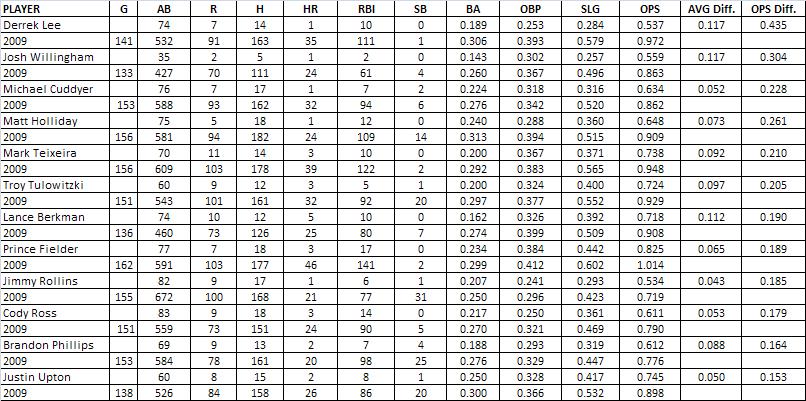
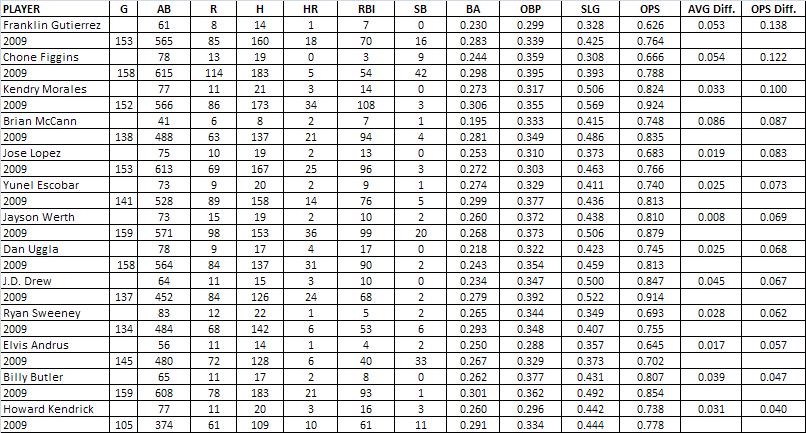
I’d like to present a list of players ranging from bona fide stars to late round sleeper-types from 2009 who had an awful April only to turn it around and deliver the kind season we all expected, or even better, exceed expectations. If a look at this list doesn’t make you realize you need to give early round picks Grady Sizemore (.192, 0 HR) and Carlos Lee (.177, 0 HR) as well as young sleeper types Julio Borbon (.194, 4 SB) and Nolan Reimold (.193, 1 HR) more time to perform how you expected back in March, then nothing will.

Players with .150+ OPS Difference from April until End of Season

Click for full view

Players with <.150 OPS Difference from April until End of Season

Click for full view

Monday: 04.19.2010

Kyra Sedgwick is Your Friend

The common refrain you hear from those owners who choose to punt saves is “saves will come into the league”. This is in reference to the volatility of the closer position causing new, previously unheralded guys to be thrust into the role and availing the league of another save source. Of course these owners generally assume they will somehow automatically collect these saves and as such they feel justified in their strategy. Regardless of your league’s pickup process (waivers, FAAB, fastest-finger), no one can guarantee that they will the benefactor of the new saves that invariably enter the league. I am not saying you absolutely can’t win with the strategy, but I don’t think it’s a good one at all.

The amount of turnover we have already seen among closers this year (Texas, Baltimore, Toronto, Cleveland, Minnesota, Los Angeles Angels, Colorado and Philadelphia) have the punters out in full force collectively sticking out their tongue as if to say, “This is why I don’t pay for saves!!!” I actually believe this volatility hurts their case and gives merit to paying for saves. Of those eight teams who have had a closer change due to ineffectiveness or injury, only two (Minnesota & Colorado) had top tier closers and both of them went down to injury. Injury doesn’t prove a theory like punting saves. Grady Sizemore’s injury last year doesn’t create a rash of outfield punting. In season management is hard enough without purposely adding the ridiculously stressful task of chasing saves to your agenda.

And I’m not sure why paying for saves has such a negative connotation as if the top closers are costing you a 2nd round pick or something. The top three, Jonathan Papelbon, Jonathan Broxton and Mariano Rivera, had an average draft position of 63-64-65 (note: I’d actually rank them Broxton, Rivera then Papelbon), which lands you in the 6th round. Of course, they aren’t the only quality closers, either. Some of my favorites coming into 2010 included Heath Bell (9th rd), Joakim Soria (9th), Jose Valverde (11th) and Andrew Bailey (12th). I also liked Billy Wagner a lot (12th), but he definitely had and I guess still has injury risk. Another thing often overlooked with the best closers is that they aren’t just one-trick ponies. My group of six averaged 34 saves, a 2.19 ERA, 1.03 WHIP, and 80 K in 67 innings of work. That takes your back of the rotation starter with a 4.50 ERA/1.35 WHIP down to a 3.77/1.25 guy. And that’s just the peripheral benefit. Obviously the gaudy save total and job security is why you select one of them in the first place instead of punting or selecting a Matt Capps-type bottom tier guy.

Depending on which podcasts or publications you listen to/read, you will hear different opinions on closers. Some experts swear by locking down top guys while others allegedly refuse to pay for saves. I don’t think you can really build a solid case for the latter as I’ve outlined. But if I had to give one reason why I believe that investing in the closers is valuable is because this game is about mitigating risk and I can’t think of anything more risky than putting your production in an entire category (as well as an impact in three others) on the fate of a FAAB bid or waiver order or whether or not you are the first one at the computer when news breaks of the latest closer going down. Wouldn’t you rather have just drafted Jonathan Broxton and supplemented him with guys like Jon Rauch or Chris Perez who could be had for next to nothing despite being first in line for a job/closing for sure for six weeks? Obviously those two wildcards worked out, but there were a host of others you could’ve rolled the dice on once you secured an elite guy. And even if you wanted to just go with your ace closer and then a highly skilled middle reliever or two while playing the wire for new saves, that’d be fine. At least you’re not purposely taking a zero in 1/5th of the pitching categories. That’s just silly.

Wednesday: 03.31.2010

2010 Echelons of Starting Pitching: Part 11

It’s finally done! After 27,776 words, the 11 part epic on starting pitchers is complete. Below is final piece that covers the upper echelon, the cream of the crop, the aces. Here are the other 10 parts and I hope you’ve enjoyed the series.

Part 1
Part 2
Part 3
Part 4
Part 5
Part 6
Part 7
Part 8
Part 9
Part 10

Echelon 1 – Aces

15. Josh Johnson, 26, Florida Marlins – Johnson finally got a full season of play under his belt and he did not disappoint. He improved significantly upon the skills he had shown in his previous 272 innings spread across four years since 2005. The results were a 15-5 record with a 3.23 ERA, 1.16 WHIP, 8.2 K/9 and 3.3 K/BB. Don’t think that his presence on a small market team will leave him under the radar. He is toting a 71 ADP, good for 13th among starting pitchers. At 26, there’s reason to believe there is actually another level of improvement left in Johnson’s game, but even a carbon copy of 2009 would easily be enough to lead your staff in 2010. One potential concern is the 122 inning spike from ’08 to ’09, but I wouldn’t dismiss based on that as there is no solid evidence that a spike automatically yields a dip in performance. If you have an equally excellent starter in mind with Johnson and that pitcher doesn’t have the spike, then maybe you let it be the deciding factor.

14. Tommy Hanson, 23, Atlanta Braves – His rookie season couldn’t have possibly went better if you scripted it. Well maybe in the script he wouldn’t have been completely jipped out of the Rookie of the Year Award that he most certainly deserved ahead of Chris Coghlan. And yet he finished behind Coghlan AND J.A. Happ. Sweet brains, voters. At any rate, Hanson met the lofty expectations set upon him and dominated the league to the tune of a 2.89 ERA with a 2.5 K/BB rate in 128 innings. There is no doubt more to come from the former Top 5 prospect, too. His ERA was a bit fortunate last year, but his strikeout and walk rates could very improve with a year under his belt and offset any correction forthcoming and lead to another sub-3.00 ERA. I wouldn’t bet on the sub-3.00 ERA, rather I’d look for something around 3.30-3.50, but don’t be surprised if he tops a 3.0 K/BB and throws up another absurd season across the board.

13. Adam Wainwright, 28, St. Louis Cardinals – I have been a huge fan of Wainwright’s since for three years now. I really liked him coming into the 2007 season after watching his nasty stuff shut down my Tigers at the end of games in the 2006 World Series. I have continued to drive the Wainwright Bandwagon and last year was the biggest payoff yet with a Cy Young-worthy season that yielded 19 wins, a 2.63 ERA and a career-best 8.2 K/9 rate. He flat out ridiculous in the second half with a 1.97 ERA and 1.11 WHIP in 119 innings as every facet of his game improved down the stretch. He built up to this point with small steps each year since 2007 and now 2010 will be a “do it again” season where he will be asked to show that his elite status is for real. There is nothing within his profile to suggest he won’t be able to meet that challenge. He is also a great example of how sometimes it takes even the highly touted prospects a while to develop. He was a 4-time Top 100 Baseball America prospect from 2001 to 2004, but he didn’t even get going in the majors as a starter until 2007. Now, he’s an ace-level frontline starter for one of the best teams in baseball.

12. Jon Lester, 26, Boston Red Sox – There was really only one improvement from 2008 to 2009 for Lester. Of course, it was massive as he raised his K/9 from 6.5 to an eye-popping 10.0. Oddly enough, it didn’t yield any improvement in his ERA (3.21 in ‘08, 3.41 last year), but adding 73 strikeouts absolutely raised his fantasy value. A guy with this kind of incredible stuff on a team like the Red Sox is pure gold. They have a tremendous defense as well as a very supportive offense which should put him in line to win more often than not. There’s no reason to believe a spike in K rate would be fluky and as such Lester moved into the bona fide ace list for 2010. Bid with confidence.

11. Cole Hamels, 26, Philadelphia Phillies – Hamels had identical skills from 2008 to 2009 yet his ERA rose from 3.09 to 4.32 thanks to an overcorrection on his fortunate hit rate from 2008. Everyone seems content to blame the ERA jump on the high workload from 2008 that included a World Series run, but I really don’t think that was it. His skills didn’t depreciate at all; in fact he actually trimmed his walk rate slightly leading a jump in K/BB. The beauty of his 2009 “struggles” is that he is now a tremendous value for 2010. His 98 ADP has him sitting as the 20th SP off the board. He has Top 5 skills and I would have put him higher if it weren’t for the amazing depth at the top. There are just so many quality arms this year that there are really clusters of like pitchers more than ever, especially in these final two echelons. Hamels is a huge value in 2010, but don’t let him sit too long or else someone will snap him up before you can.

10. Wandy Rodriguez, 31, Houston Astros – What exactly does Wandy have to do to get some legitimate credit for his work? He has improved his K/BB rate every year since 2005 and his ERA every year since 2006 and his HR/9 has improved or stayed flat each year since 2005 yet he is still the 28th SP off the board with a 126 ADP. I realize he plays for a garbage team so it’s hard to see much win potential, but if that’s how you pick your starting pitchers then you should find a different game because that’s a fool errand to be sure. He may not have the name recognition or the high profile team, but Rodriguez is most certainly among the elite starting pitchers in baseball with a skillset that continues to improve and could see yet another uptick in 2010. Enjoy the huge profit he turns as he gets passed over by your entire league several times over.

9. Johan Santana, 31, New York Mets – He hasn’t posted the elite K/9 rate for two years settling in at 7.9 after six years between 9.2 and 11.4, but you’d think he was at 4.2 K/9 the way some talk about him. Last year was a tough year for him including missed time to injury, but he is said to be 100% healthy for 2010 and that means another Johan-esque season. He posted a league-best 2.53 ERA with the 7.9 K/9 two years ago so even though your bottom line isn’t getting 235+ strikeouts, he can still log 200 with a sub-3.00 ERA and double-digit wins. His WHIP trend hasn’t been promising having gone up yearly since 2004, but even with that he has only topped out at 1.21 which is still Top 15 among starting pitchers. Another reason I still really like Santana is that he has at least one more insane season in his arm and the downside of investing in him in hopes of being the benefactor of that season is very slight. I wouldn’t be happy if he only pitched 167 innings like he did last year, but if that’s a bad season then I’m investing in him every chance I get.

8. Justin Verlander, 27, Detroit Tigers – I wonder how many times a pitcher has gone from leading the league in losses one year to leading the league in wins the very next. But that is exactly what Verlander did as his 2009 picked up where 2007 left off. The biggest improvement in Verlander’s game was mental, at least as far as I could tell. He labored through April (6.75), but was pitching pretty well below the surface (10.9 K/9, 3.8 K/BB) so instead of letting the ERA get to him and imploding his whole season, he handled the adversity with maturity and he was virtually unhittable for the remainder of the season. There is some concern about his high pitch count games and his batters faced total, but I think it could be a bit overblown. Yes there were several pitch counts into 100s, but he wasn’t struggling through those starts or pitching tired, his arm wasn’t being slagged. He was still throwing fluidly and bringing it at 97-100 MPH. Pitch counts and innings totals on their own mean little, it’s the state of the pitcher as they get higher that matters. I’m not just being a homer, either. I watched every one of his games during the season and watched them again on MLB.tv this offseason so I stand behind the analysis. Overall, he only threw 39 more innings than in 2008 and he’s no longer in the age range that is most at risk for high inning counts year after year.

7. Josh Beckett, 30, Boston Red Sox – Is Beckett actually so good that he has become a boring pick at age 30!? It’s really hard to believe he has a 5.01 ERA season on his resume when you consider that his K/BB has never been below 2.1 and sits at 3.1 for his career. This is as consistent a profile as you can find for a starting pitcher and I am actually surprised that he is the 15th SP off the board, especially on such a high profile team like the Red Sox. He’s got a sub-3.00 ERA season lurking in there somewhere, it could be 2010.

6. Dan Haren, 29, Arizona Diamondbacks – Everyone knows that Haren’s seasons are often a tale of two halves where his ERA seems to rise year after year once the All-Star Break hits. But let’s not confuse that fade with some kind of skills implosion where you should instantly deal him in June. His ERA split was 2.19/4.09 from the first half to the second, but he had equal 7-5 records, still notched 110 strikeouts in 114 innings and his WHIP was still a very solid 1.20. Trying to trade Haren around the All-Star Break is probably a stupid idea when it comes right down to it because anyone with a brain knows about his second half “swoons” and you probably won’t get enough value to merit trading an ace starter. So instead of trying to outsmart yourself, just hang onto Haren and get ready for a fourth straight brilliant season of mid-teens wins, sub-3.50 ERA, 200+ Ks and 1.20 or better WHIP.

5. Zack Greinke, 26, Kansas City Royals – It was really nice to see the Cy Young voters actually get it right for once and make sure the American League’s best pitcher got the award even though he only had 16 wins. Greinke absolutely deserved the award with an amazing season that included a mind-numbing 9.5 K/9 rate. In fact, his K/9 has risen yearly since 2005 and while it might have peaked in 2009, no one is complaining with a better than one per inning rate. Greinke’s ERA can and probably will move up a full run in 2010 and he will still be an unquestioned ace, that’s just how good he was in 2009. Don’t worry about trying to guess how many wins he will get with the Royals and just draft him for his dazzling skillset.

4. C.C. Sabathia, 29, New York Yankees – There isn’t a lot left to be said about Sabathia. He is as consistent as they come having logged fewer than 193 innings just twice in his career and those were seasons of 188 and 180 innings, respectively. His 3.37 ERA last year was the highest mark in four years and he hasn’t had a WHIP higher than 1.17 in the same span. He’s a perennial Cy Young candidate with plenty left in the tank and he deserves every bit of his Top 5 ranking. The ridiculous offense behind him does set him up to potentially garner more wins than the average starter, but his ability to go deep into games has always put him in position for the decision so adding the league’s best offense only makes things better.

3. Tim Lincecum, 26, San Francisco Giants – This is pretty blasphemous to some I presume, huh? I’m not down on Lincecum just because I put him here; I just think there is a pair of guys who could top him in 2010. I think he will be truly remarkably yet again, but the other two will be their league’s Cy Young winners. With a pair of seasons like the two Lincecum has had, I can see why some are tempted to take him in the first round of their draft. It’s not something I would ever do, with him or the other two guys yet to be listed, but I can understand it. The fact that he got better from 2008 to 2009 is just sickening. Some skeptics are still predicting a breakdown in the near future, but I don’t see him as any more susceptible than every other pitcher. His ERA might tick above 3.00 this year, but he is still a mortal lock for at least 240 strikeouts.

2. Felix Hernandez, 24, Seattle Mariners – How is he only 24 years old?? Last year he finally put it all together for the world class season everyone had been expecting for a few years now. As young as he is, there is no reason to believe he won’t continue to improve, too. He’s got the best profile for continued growth, too: power/groundballer. A 2009 carbon copy would not surprise me, nor would improvement upon last year’s elite season. He’s going 5th among starting pitchers in the latest ADP, but I would only take one guy ahead of him…

1. Roy Halladay, 33, Philadelphia Phillies – Matthew Berry of ESPN put in his bold predictions column that Halladay could win 25 games this year and I couldn’t agree more. He doesn’t strikeout as many as Tim Lincecum or even Felix Hernandez, but he had back-to- back ERAs of 2.78 and 2.79 in the American League East. Re-read that last part again. His walk rate has been above 1.9 once in the last seven years and his WHIP has been above 1.19 just twice in the last nine years (1.24, 1.35). In other words, he is the game’s best pitcher and now he moves into an easier division in the much easier league. He may begin challenging Lincecum and Hernandez in strikeouts with the cozier environment. And he can definitely challenge the 25-win mark that Berry floated out there for him. If you want to venture out and grab a starting pitcher early, make it Halladay.

Tuesday: 03.30.2010

2010 Echelons of Starting Pitching: Part 10

This part finishes off Echelon 2 and then Part 11 will be Echelon 1 all by itself.

Part 1
Part 2
Part 3
Part 4
Part 5
Part 6
Part 7
Part 8
Part 9

Echelon 2, Part II – Kings

25. Chad Billingsley, 25, Los Angeles Dodgers – A brilliant 2008 season left many wondering the heights Billingsley would reach in 2009 as he had lowered his ERA and BB/9 while raising K/9 each year in the league to that point. Well the strikeout and walk rates ticked a bit in the wrong direction, but the ERA unnecessarily shot up (4.03) nearly a full run thanks to a very unlucky second half. Despite the uptick in ERA, he isn’t being overlooked by the fantasy community as his ADP (123rd) puts him 27th among starting pitchers. Clayton Kershaw gets most of the attention, and with good reason, but the Dodgers have dual aces with him and Billingsley. If you miss out on Kershaw, grab Billingsley 2 ½ rounds later.

24. Kevin Slowey, 26, Minnesota Twins – I really hate that Slowey pitches for the Minnesota Twins. I am a huge fan of him as a player, but his success is a detriment to my team, the Detroit Tigers. I just pray for him to be on the losing end of 2-1 battles against the Tigers that way my team wins and my fantasy team gets some value out of it. I was very high on Slowey last year (21st) and I remain so this year as you can see with the top 25 ranking. He is coming back from an injury riddled 2009 where a 4.86 ERA has driven down his value. He’s the 53rd SP off the board on the latest ADP list which is absolutely crazy. He posted his second season in a row with a 5.0 K/BB and took his strikeout rate up over seven to 7.4 which over the course of a 200 inning season would be about 165 strikeouts. He has yet to post an ERA below 3.99 because the longball still plagues him. That is the hurdle between Slowey and a sub-3.50 ERA season. He was excellent at limiting home runs in the minors so getting that skill to translate to the majors seems to be within the scope of his talent. His skillset is too good to be posting 4.00 ERAs and I think at age 26 with 318 innings under his belt, Slowey finally puts together a complete breakout season.

23. Scott Baker, 28, Minnesota Twins – He and Kevin Slowey are thought to be synonymous with one another so why not bundle them together here on the list? I’m not just doing it for the sake of ease or anything, either. I believe they belong together and Baker is just a bit further along so he gets the nod over Slowey. His K/BB is 3.4 for his career and has only once been below that mark (2.3 in 54 innings back in 2005). His K/9 rate has been above 7.0 for two straight seasons and he has managed to pound the strike zone without being overly hittable. After posting back-to-back hit rates above 10.0 in 2006 and 2007, Baker now pushed back below 9.0 for two straight seasons while sacrificing only somewhat on the walk rate (1.8 BB/9 06-07; 2.2 08-09). Baker isn’t coming at quite the discount of Slowey, but he is still a nice value as the 33rd starting pitcher off the board.

22. Jake Peavy, 29, Chicago White Sox – Moving from PETCO and the National League to US Cellular and the American League is about as drastic a move as you can make for a starting pitcher, but Peavy isn’t former teammate Chris Young who needed PETCO to have any real success at all. I am not foolish enough to think we will see sub-3.00 ERAs like we saw four out of the last six years from Peavy, but I don’t think he becomes Daniel Cabrera, either. Yes he did benefit from PETCO, everyone does, but for his career he has managed a 3.79 ERA, 1.29 WHIP, 8.3 K/9 and 2.6 K/BB in 622 road innings. Peavy has the talent of a top 10 pitcher, but moving to the AL will make it tougher to post those overwhelming top 10 numbers in 2010. Luckily he’s coming as the 23rd SP off the board.

21. Cliff Lee, 31, Seattle Mariners – I moved him down a bit because of the strained ab that will likely put him on the DL to start the season. It is problematic enough that the M’s have been rumored to be searching for another pitcher perhaps even bringing back Jarrod Washburn. Obviously I don’t think it will be catastrophic because I still rated him 21st, but injuries are scary for a pitcher, especially an elite one. Lee’s ADP is still very high at 57, making him the 10th SP off the board. There is absolutely no way I would go that high for him with the insane depth at SP this year. Fanball.com’s Ray Flowers said he saw Lee go in the 11th round of an NFBC draft this past weekend which I think it veers toward the other end of the spectrum as I’d take him in the 8th-9th without worrying. Nothing within his skillset scares me even the move back to the American League, so if he does get a clean bill of health with a defined timetable for how long the strain will shelve him between now and your draft day, bump him back up into the top 15 without question.

20. Clayton Kershaw, 22, Los Angeles Dodgers – Tough to resist the urge to place him much higher than 20th, but he’s not a finished product just yet. That is scary for the rest of baseball because of how great he is already. He has a tendency to labor at times and rack up his pitch count which limited him to just 5.7 IP per start. His control would abandon him and lead to those blown up pitch counts and he ended up walking 4.8 batters per nine. When you strikeout nearly 10 batters per nine (9.7 K/9), you can sustain that kind of walk rate but you’re only going to post a sub-3.00 ERA with that walk rate if you have a very fortunate hit rate. In fact, Kershaw led all of baseball with a miniscule 6.3 H/9. He was aided by a 27% hit rate, but that isn’t overwhelmingly lucky so the correction won’t do much damage to him, especially if he does see some gain in his control. Overall, this is a very strong profile that will only get better as he continues to learn at the major league level. There may be hiccups here & there, but nothing devastating. Look for his first 200+ inning season in 2010.

19. Javier Vazquez, 34, New York Yankees – I was so upset when the Yankees reacquired Vazquez this past offseason. Not because it’s the Yankees getting better or anything silly like that (though they did give back virtually nothing… get real with Melky Cabrera), but because Vazquez is a Cy Young candidate in the National League just as he was last year. There was tough competition so he didn’t quite nab the award, but he was one of my best predictions from 2009 as I rated him 18th. Headed back to the Bronx has scared many because of his results the last time he was a Yankee (4.91 ERA), but he’s a different pitcher five years later and even though his ERA was bad the first time around, he still had a 2.5 K/BB rate. The move back to the AL hasn’t put him at any type of discount because he joined the highest profile team and that’s fine. I don’t think he will be the 12th SP as his ADP projects, but I do think he will be much better than he was the first time around for the Yankees back in 2004.

18. Ricky Nolasco, 27, Florida Marlins – You are reacting one of two ways to seeing Nolasco this high: a) “WHAT?!?! This guy had a 5.06 ERA last year and you are ranking him 18th overall!?!???!” Or b) “Dangit, even Paul is onto Nolasco’s awesomeness, there’s no way I am going to sneak him despite that 5.06 ERA last year.” Nolasco is Exhibit A of why ERA isn’t at all representative of a pitcher’s effectiveness. It can tell you if a pitcher has been good or bad at times, but looking at it alone will get you in trouble. Nolasco posted a career best 9.5 K/9 offsetting the minor bump in BB/9 to 2.1 giving him his second straight season of 4.4 K/BB rate. Nolasco was sent down at the end of May when his ERA was 9.07 and he had given up eight runs in back-to-back starts of fewer than four innings. He worked out some kinks, came back and for the final four months of the seasons he went 141 innings with a 3.83 ERA, 1.08 WHIP, 10.1 K/9 and 5.1 BB/9. He posted those fantastic numbers even with three starts in which he gave up 7, 7 and 10 runs. Nolasco has the skills of a sub-3.50 ERA pitcher with 200 strikeouts. Don’t let him sit out there too long in your draft.

17. Ubaldo Jimenez, 26, Colorado Rockies – If I had told you a few years ago that soon there would be a pitcher from the Colorado Rockies who would crack the top 20 of a starting pitchers list, you would have laughed in my face. Yet here we are. Jimenez has tamed Coors Field for 506 innings so if you’re still skeptical, you’re obviously never going to be convinced. Last year was a big step forward as he pushed his K/9 up over eight (8.2) and posted his first sub-4.0 BB/9 (3.5). Not only is he a high strikeout power pitcher, but he also has a fantastic groundball rate (54% and 53% the last two years) that allows him to rack up outs in spades. Simply put, he’s got the best kind of profile to invest regardless of his home stadium. Go the extra dollar.

16. Chris Carpenter, 35, St. Louis Cardinals – Carpenter probably single-handedly won some fantasy leagues with the overwhelming value he delivered last year. He was definitely a late round, low dollar pick up having essentially missed two full seasons (21 IP across 2007 and 2008) and he went out and threw 193 brilliant innings and nearly won the Cy Young Award. The only reason I have him this low is because the injury risk is always present with him, especially at his age. Plus, as I’ve mentioned a thousand times already, the pool of starting pitching is so deep that you can place someone with Carpenter’s talent at 16th and it’s not out of place. Another reason he’s a tick lower than the next 15 is that he doesn’t strikeout a ton of batters. He’s no slouch with a 6.7 K/9 last year and better than 7.5 in each of his last three full seasons prior to last year, but as you will soon see those ahead of him are posting strikeout rates better than 7.5 ranging as high as 10.0.

Tuesday: 03.30.2010

2010 Echelons of Starting Pitching: Part 9

We are now entering the big guns you can build your staff around. Most of echelon two can lead a staff depending on your strategy. If you decide the let the truly elite arms pass by with their gaudy price tags, then a foundation around a couple of these guys will get the job done. In an AL or NL Only league, a lot of these guys are more than adequate #1s if you choose to stockpile hitting early on. Either way, this group shows just how deep starting pitching is for 2010.

Part 1
Part 2
Part 3
Part 4
Part 5
Part 6
Part 7
Part 8

Echelon 2 – Anchormen

52. Jair Jurrjens, 24, Atlanta Braves – No one, myself included, thinks he can sustain a 2.60 ERA with the peripherals he displayed last year. He limits home runs very well (0.5, 0.6 last two years) and sits right at the acceptable 2.0 K/BB rate so it’s not like I expect his ERA to jump to 5.00 or something crazy. He is much more of a 3.68 ERA pitcher (his 2008 mark) than 2.60 (his 2009 mark) so don’t pay for the cost of the latter. Unfortunately, that’s his market value right now as he’s going 32nd among starting pitchers (ahead of Scott Baker, Brett Anderson) and 142nd overall. At that price, I’m passing without question.

51. Carlos Zambrano, 29, Chicago Cubs – Though Zambrano has never posted an ERA north of 4.00, he is still a very scary investment on draft day. His K/BB has been below 2.0 each of the last four years, but it is on the rise since 2007 so perhaps he’s headed back over 2.0 in 2010. After five straight years easily surpassing 200 innings from 2003 to 2007, Zambrano has pitched 189 and 169 the last two years, respectively. He is a risky proposition, but he is still immensely talented capable of piling up strikeouts with a good ERA. He could pay huge dividends at the right price, but right now he is at cost or too expensive as the 163rd player off the board (39th SP).

50. Johnny Cueto, 24, Cincinnati Reds – A tale of two halves for Cueto as he posted a 2.70 ERA/1.12 WHIP in the first half but labored to a 7.00/1.72 second half including a DL stint. Overall this is still a good skills profile worth investing in with the home run rate being the final piece of the puzzle to a sub-4.00 ERA season. At 24, it may not come in 2010, but there are still plenty of strikeouts and a 4.20 ERA available here.

49. Brandon Webb, 31, Arizona Diamondbacks – He is supposed to return by the end of April, but how good will he be right out of the gate? Webb proves exactly how volatile and unpredictable starting pitchers are because coming into 2009, there were few if any pitchers thought to be more reliable than him. Then he got hurt after a poor four inning start and hasn’t pitched since. I’m reticent to completely write him off even if he misses the entire first month, but not at his current price: 146 ADP, 33rd among SPs. Aces who return 100% from injury at a discount are what make a championship season so keep track of Webb’s value in your league and be ready to pounce if he falls too far.

48. John Danks, 25, Chicago White Sox
– His skillset dropped off a bit from his breakout 2008, but he was still very valuable. His HR/9 seems to be the key to his success right now with the 0.7 of 2008 really aiding him en route to a 3.32 ERA. Last year it ballooned to 1.3 but his ERA didn’t rise in concert. His second half K/9 (5.5) is alarming, but it was 8.2 in the first half so unless injury is the answer, it’s kind of silly to overreact to an arbitrary period because of its recency. I’ve heard some down reports on Danks this year, but his market price isn’t reflecting that as he’s going off the board as the 37th starting pitcher. I don’t mind Danks for 2010, but only at the right price.

47. Ted Lilly, 34, Chicago Cubs – Lilly has had three straight excellent seasons posting K/BB rates of 3.2, 2.9 and 4.2. He enters 2010 banged up with mid-April as his expected return time, but that hasn’t discounted him at all as he’s going 44th among starting pitchers with a 173 ADP. It’s always risky to latch onto someone who is already injured, but this isn’t expected to linger so I would proceed as scheduled.

46. Gavin Floyd, 27, Chicago White Sox – No one believed his 2008 breakout season because the skills were a bit shaky with a 2.0 K/BB and 1.3 HR/9, but then he went out and did even better in 2009 (2.8, 1.0) despite not getting the ERA to show for it (4.06). He got better as the season wore on including an 8.1 K/9 and 3.9 K/BB in the second half showing the is still another level of growth for Floyd. Home runs have always been an issue as they destroyed him in his early years (2.0+ twice, 1.7 another year), but he has reigned that in quite a bit despite still teetering on the acceptable 1.0 rate. I think his strikeout and walk rates will step up again in 2010 allowing him to overcome a 1.3 HR/9.

45. Roy Oswalt, 32, Houston Astros – Oswalt suffered his worst season ERA-wise (4.12), but he still posted a 3.3 K/BB rate so the skills are intact. He’s laboring through a minor hamstring tweak, but it doesn’t appear serious so I wouldn’t downgrade him based on that. As the 36th SP off the board, I’m a little concerned with his price, but I still see a bounceback season so you could reasonably invest around that ADP if you didn’t like the other names on the board at that point.

44. Daisuke Matsuzaka, 29, Boston Red Sox – I still believe. Not everyone does, but his ADP is 47th among starting pitchers so I am right in line with the marketplace here. The walks remain the biggest hurdle to believable stardom for Matsuzaka, but even in lieu of him getting a handle on that he offers a load of strikeouts with super-high win potential as part of the Red Sox. I’d never encourage chasing wins, but he showed in 2008 that imperfect skills could still net 18 wins. Last year was an injury throwaway, so focus more on 2007 and 2008 when assessing his value. Also check the injury report, of course. It doesn’t look like he will start the season in the rotation so perhaps the few weeks on the DL will bring a discount at the draft table.

43. Jeff Niemann, 27, Tampa Bay Rays – He managed a 3.98 ERA in the first half despite weak skills (5.1 K/9, 4.0 BB/9), but then the skills caught up big time (7.1 K/9, 2.1 BB/9) in the second half and the ERA lagged (3.90). He is a bit under the radar in a rotation of studs, but he looks poised for a huge season based on his 102-inning second half. I would take any of the five starters from Tampa Bay as part of my rotation this year, but Niemann’s price (55th SP, 216 ADP) is especially appealing.

42. Edwin Jackson, 26, Arizona Diamondbacks – It took a while, but Jackson delivered on the promise of a 3-time Top 100 prospect from 2003 to 2005. After a brilliant first half, Jackson came back to the pack a bit, but now he moves to the National League where his K rate could reach 8.0 per nine. His success will be determined by his HR/9 rate. In the first half when it was at 0.7, his ERA was at 2.50, but then it skyrocketed to 1.7 and his ERA approached 5.00 at 4.76. It is hard to believe he’s just 26 years old as it seems like he’s been around forever. His 2009 season was just the beginning for E-Jax.

41. A.J. Burnett, 33, New York Yankees – Prior to 2008, the knock on Burnett was his inability to stay healthy. Sure he had a great strikeout rate and at times looked like one of the two-three best starters in the game, but he averaged just 158 IP from 2004-2007. But 2008 was a contract year so perhaps Burnett would make it through to impress potential suitors. In fact, he did just that throwing a career-high 221 innings while racking up 18 wins (also a career-high) and eventually coaxing the Yankees to open their wallets for a fat contract. In his first season with them, he managed his second straight 200+ IP season, a career first. Finally this immensely talented arm is taking his turn every fifth day, everything is great, right? Wrong. Burnett has had an ERA over 4.00 in each of the past two years and last year saw a dip in K/9 and jumps in BB/9 and HR/9. The former resulted in a league-high 97 walks and 17 wild pitches. Of course, 200 IP of 4.00 ERA with mid-to-high teens wins and 190+ strikeouts is hardly chopped liver, but don’t just draft based on his name. He has become a liability in WHIP at this point and needs to be downgraded for it.

40. David Price, 24, Tampa Bay Rays – He gets crushed because he failed to meet an unrealistic set of expectations, but 128 league average innings isn’t awful for a rookie. His adjustments from the first half to the second showed his maturity and ability make adjustments. He had terrible control yet a great strikeout rate in the first half, but that yielded a 4.70 ERA and 1.64 WHIP. In the second half, his strikeout rate dropped from 9.6 to 5.9, but his walk rate plummeted from an absurd 6.3 to 2.4 resulting in a 2.4 K/BB rate despite the average K rate. This guy is as good as advertised, you just can’t expect every phenom prospect to post a sub-3.00 ERA with 190 strikeouts as soon as they reach the majors. I like Price to take a huge step forward into 2010.

39. Max Scherzer, 25, Detroit Tigers – What is not to like about a guy who strikes out a batter per inning while walking fewer than 3.5 per nine? Apparently something if you ask the Arizona brass because they seemingly couldn’t wait to unload him. Of course, it’s not like they got nothing in return (Edwin Jackson, specifically), but this is an ace in the making. That’s not just biased Tigers fan talking, either. Scherzer might lose some strikeouts coming over to the American League, but he is still going to be force at missing bats. Look for him to reach 190 strikeouts and post an ERA between 3.75 and 4.00 in his best season yet.

38. Francisco Liriano, 26, Minnesota Twins – The Twins apparently flirted with moving Liriano to the bullpen to take over for injured star closer Joe Nathan. Thankfully they have come to their senses and decided to leave him in the rotation where he should once again flourish. He won’t be posting the 2.16 ERA he had in 2006, but a sub-4.00 ERA with 160 strikeouts in 175 innings will fit quite nicely into any rotation, especially as the 56th SP off the board at a 218 ADP. Liriano is inexplicably going after Joba Chamberlain and Andy Pettitte, who are vastly overvalued right now.

37. Jorge de la Rosa, 29, Colorado Rockies – His breakout season wasn’t fully rewarded as his first half ERA (5.66) was much worse than he deserved thanks to unfortunate hit and strand rates. A correction in the second half led to an excellent 12-2 record with 106 Ks, 3.38 ERA and 1.29 WHIP in 104 innings. A blistering K rate plus a 45%+ groundball rate make up the best kind of profile to invest in. I think some people are still afraid to invest in Rockies pitchers, but I’m more than happy to take de la Rosa before his 188 ADP. I can’t help but wonder why the Kansas City Royals ever got rid of de la Rosa, but then again it’s the Royals.

36. Rich Harden, 28, Texas Rangers – He wasn’t quite as good as his 2008 ERA of 2.07 suggested nor was he as bad as his 2009 ERA of 4.09 suggested. Both years his skills were that of a mid-3.00s guy with an insane strikeout rate (11.0!!!). You know injuries are a concern for a guy when back-to-back 140 inning years are considered progress. He just can’t be relied on for a full season and as such, a top 10 talent is pushed down to a top 40 ranking.

35. Ryan Dempster, 32, Chicago Cubs – Skeptics were out in full force after a breakout 2008 season and while I expected some regression from his sub-3.00 ERA season, I didn’t hate him. I rated him 56th and said: “The workload spike theorists are probably having a field day with Dempster’s 140 IP jump though the impact may be lessened due to age and the fact that he has topped 200 IP in the past. A lot of strikeouts with a 3.90 ERA and 1.35 WHIP is still a very good line so bid with that in mind.” He went 3.65, 1.31 with 172 Ks. I see no reason not to bet on more of the same in 2010.

34. Matt Cain, 25, San Francisco Giants – Cain is going to get his owners in trouble sooner or later. His ERA consistently outpaces his underlying stats and yet the projected regression never hits. In fact, last year he shaved nearly a full run off of his ERA down below 3.00 despite another drop in K/9 (third straight year) and a second straight jump in HR/9. His control improved down to a healthy 3.0 BB/9 and he will need to hold or improve on that metric to enjoy upper level success again in 2010, especially if he plans on once again cutting into his strikeout rate. Rest assured that despite the negative tilt to this capsule, I recognize that Cain is a very good pitcher. He is a workhorse with three straight 200+ inning seasons so you can rely on him every fifth day, just don’t be surprised if his ERA starts pushing toward 4.00.

33. John Lackey, 31, Boston Red Sox – Lackey has been a personal favorite for years, but I don’t let my personal biases affect my fantasy strategies. Lackey has missed significant time to injury for two straight seasons and the move from Los Angeles to Boston bumps him down several spots before a pitch is even thrown. He’s never been an overpowering force with strikeouts having been above 7.9 just once in his career and right around 7.2 each of the last three years. I love the 3.0+ K/BB for the past three years and he will definitely need it in Boston to avoid an ERA north of 4.00.

32. Jered Weaver, 27, Los Angeles Angels – I think Weaver is constantly viewed as a disappointment because he hasn’t been able to replicate his 2.56 ERA and 1.03 WHIP from his rookie season in the three years since. Of course those figures were luck driven to be that low because his peripheral skills have been virtually the same every single year of his career, including that sparkling 123 inning debut. Weaver is prone to the longball as an extreme flyball pitcher and that is what keeps his ERA up above 3.75 instead of down closer to 3.25 where a groundballer with his other skills might reside. He has settled in at this level, but that doesn’t mean he isn’t worth every nickel he costs on draft day. View his reliability as a skill.

31. Scott Kazmir, 26, Los Angeles Angels – It was a tiny sample (36 IP), but it was nice to see Kazmir rebound after being traded to LA. He’s a rich man’s Rich Harden (pun somewhat intended) right now having topped 200 IP just once and below 155 in three of his five seasons. His health is my only concern when it comes to wondering if he can be an elite starter or not. I don’t really about 5.92 ERA in 111 IP with Tampa Bay last year from a skills perspective as it was tied to injury. He’s coming at a discount as the 42nd SP off the board behind the likes of Carlos Zambrano, Edwin Jackson, Jair Jurrjens and Brandon Webb. Pass on that whole group and take a calculated risk on Kazmir.

30. Aaron Harang, 32, Cincinnati Reds – After establishing himself as one of the most reliable starters in the game from 2005 to 2007, Harang labored through his toughest years as a pro in 2008 as his ERA rose over a run to 4.78 and he had a league-leading 17 losses. Things weren’t much better in 2009 and when it was all over, Harang had been saddled with back-to-back six win seasons despite some really sharp skills that included 3.0 and 3.3 K/BB rates in 2008 and 2009, respectively. He had some bad luck mixed in with an increasing HR/9 rate, but overall this wasn’t a 4.20+ ERA, six win pitcher. He is said to be at 100% health and poised to return to his 05-07 form once again. Best yet is he’s dirt cheap right now as the 65th SP drafted with a 240 ADP.

29. Yovani Gallardo, 24, Milwaukee Brewers – It’s hard not to get excited about a K/9 near 10.0 (9.9 in 186 IP) from a 24-year old starter. The control was a bit off last year up over 1.5 walks per game from his 3.0 mark in 2007 (he was also at 3.0 in 2008, but that was an injury shortened season of 24 IP). And it was especially high in the second half at 5.3 BB/9 in 82 innings, which led to a near-5.00 ERA. That said, he was returning from a lost season and there was enough of his top shelf skill on display to feel confident about him moving forward. Even wonder what it would be like if Rich Harden could go 185+ IP? Gallardo’s 2010 could emulate what that would look like.

28. James Shields, 28, Tampa Bay Rays – When is two straight years of increased BB/9 not really a bad thing? When you are going from 1.5 to 1.7 to 2.1. Despite the increases, Shields still has elite level control. That said, it’s never a good thing when a skill is eroding, however slight the erosion may be. Shields was also a bit more hittable in 2009 and it led to his first 4.00+ ERA in three seasons. But as with Jered Weaver, Shields’ reliability (215, 215, 220 IP since 2007) is a skill that shouldn’t go unnoticed. He possesses an excellent K/BB rate having topped 6.7 K/9 in each of his four seasons so that despite being a control artist, he’s not a drag on your strikeout totals. He’s not a flashy pick by any stretch of the imagination, but that doesn’t make him a bad buy for your rotation.

27. Matt Garza, 26, Tampa Bay Rays – Having seen him in person and many, many times on TV, I can confidently say that Garza has some of the best stuff in all of baseball and his stats are about to catch up to that stuff as he continues to mature and learn more about how to pitch. We saw the first step last year as he began to strike more batters out throughout the year, but as especially as the year wore on. His K/9 jumped more than two strikeouts to 8.4 and he was at 9.2 in the second half. A 15 win-200 strikeout-3.50 ERA season is well within reach for Garza in 2010 and the fantasy community knows it as he has a 115 ADP as the 24th SP off the board.

26. Brett Anderson, 22, Oakland A’s – He was a very integral piece of the package sent from Arizona to Oakland for Dan Haren and his rookie season showed why the A’s were so interested. Of course, they also got Chris Carter, Carlos Gonzalez, Aaron Cunningham, Dana Eveland and Greg Smith out of the deal, but Anderson, Carter & Gonzalez were the big ticket items. Anderson was a groundball pitcher (51%) with excellent strikeout ability (7.7 K/9) that actually improved as the season wore on (8.7 in 2nd half) whereas most rookies usually hit a wall and fade in that first 162-game grind. After such an impressive debut, Anderson caught the eye of many and has become the sleeper du jour of the fantasy baseball industry, which in turn has made him anything but a sleeper. I am not at all dissuaded by the press he is receiving, though as I’m still targeting him because despite the raised profile he is still coming in as the 35th SP off the board at 153 ADP.

Ten more from this echelon and then the aces…

Saturday: 03.27.2010

2010 Echelons of Starting Pitching: Part 8

Down the stretch we come!!! Finishing off Echelon 3 and just two more to go…

Part 1
Part 2
Part 3
Part 4
Part 5
Part 6
Part 7

Echelon 3, Part III – Ready to Shine?
82. Joba Chamberlain, 24, New York Yankees – Yes he’s currently a reliever, but he’s an injury away from being in the rotation. That or Phil Hughes ineffectiveness which isn’t completely out of the realm of possibilities. This is one of the biggest wastes of talent in the game right now because they Yankees have jerked him around and ruined him mentally. He has tremendous value even in the bullpen, but I think he will net at least double-digit starts, too. A hybrid season between the rotation and pen is probably best for him at this stage. If the cost is down as it should be, he’s worth investing in.

81. Anibal Sanchez, 26, Florida Marlins – More injury issues for Sanchez limited him to his third straight season of less than 90 innings and he’s never pitched more than 114 at the major league level, but he is just 26 years old he has posted two nice K rates in a row (8.7 in 2008, 7.4 last year). I still believe so draft the skills and hope for health.

80. Joe Saunders, 29, Los Angeles Angels – With back-to-back sub-5.0 K/9 rates, he’s not a sexy pick at all. In fact, I’m 99% certain that most owners vomit while or immediately drafting him. But the simple fact is he logs innings and wins. In 2008, he managed a lucky ERA (3.41) with skills that portended an ERA nearly a full run higher (4.32). In 2009, he displayed nearly equal skills and was justly saddled with a 4.60 ERA. There is something to be said for the reliability of a 190-inning starter, but don’t expect better than a 4.30 ERA.

79. Brad Penny, 32, St. Louis CardinalsDave Duncan Fever, Catch It!! Penny is just two years removed from a 208 inning, 3.03 ERA and 16 win season. His ERA (5.61) was ugly in the AL with Boston, but his skills were solid while his ERA in San Francisco (2.59) was excellent but his K-rate dipped to 4.9. He still managed a 2.2 K/BB thanks to a miniscule 1.9 walk rate so overall he was pitching well regardless of the end result. Now he goes to St. Louis where pitching coach Duncan has built aces out of much, much less. The ceiling for Penny for 2010 is becoming the third ace in St. Louis; bid with confidence.

78. Jason Hammel, 27, Colorado Rockies – Just needed an opportunity with the stacked rotation in Tampa Bay squeezing him out so he was traded and had a very nice season. His strikeouts went up and walks went down leading to an excellent 3.2 K/BB ratio. Though the NL helped him as a whole, Coors Field didn’t work out as well as he posted a 5.73 ERA at home. Yet his K/9 (7.4) and K/BB (3.7) were both better at home so I’d bet on him to improve that home ERA and push for a sub-4.00 ERA in 2010.

77. Trevor Cahill, 22, Oakland A’s – I don’t think the 21-year old Cahill got enough credit for getting through a 179-inning rookie year with a reasonable 4.63 ERA and 10 wins. That is mainly because his season is juxtaposed against Brett Anderson’s which isn’t really fair for many starting pitchers let alone a rookie who has never pitched above AA. He didn’t bring his 10.0 K/9 from the minor leagues with him to the majors, but that doesn’t mean he is destined to be a 4.5 K/9 pitcher the rest of his career. He’s 22 and still learning a lot about how to pitch in the majors. He’s coming very cheap so I really like him keeper leagues because he will contribute a solid in 2010, but also give you a low-cost, high-upside keeper for 2011.

76. Barry Zito, 32, San Francisco Giants – Zito’s really solid season is being overlooked and no one trusts he can do it again. Yes the strikeout rate was his highest since 2001, but at 7.2 it was essentially in line with his 6.4 K/9 the last five years. He’s going to walk batters, it’s that simple but as long as he’s striking out 6.4+ batters and logging 190+ innings, he has value. Just because San Francisco will never get their return on investment from him doesn’t mean you will suffer the same fate. And he’s only 32, that’s hardly old.

75. Brian Matusz, 23, Baltimore Orioles – It was only 45 innings, but Matusz skipped AAA and made it to the majors in his first professional season after stops at A+ and AA. He acquitted himself quite well with a 7.7 K/9 and 2.8 BB/9. Forget the 4.63 ERA because those rates are worthy of a much better figure over the course of a season. This polished college pitcher is ready for the big time and holds legitimate AL-Only value and could feasibly become a mixed league value if he can maintain those rates or better throughout 2010.

74. Phil Hughes, 24, New York Yankees – I mentioned earlier that his ineffectiveness could land Joba Chamberlain back in the rotation, but don’t confuse that with me predicting ineffectiveness for him. He struggled in seven starts with an ERA over 5.00, but he still struck out 8.0 per nine and managed a 2.1 K/BB while starting so he was hardly awful. But he was truly brilliant in relief with an 11.0 K/9 and 5.0 K/BB in 51 innings. He earned the fifth spot in the rotation and on pure talent alone he deserves a much higher ranking. But we’ve seen this before with a Yankee stud so I’ll lean conservative with Hughes until I see him make the transition back into the rotation.

73. Justin Masterson, 25, Cleveland Indians – Like Hughes, Masterson fared much better coming out of the pen but he showed glimpses as a starter. He’s now a full-time starter and he will need to cut down that 4.2 BB/9 while holding most of that 8.3 K/9 rate to be successful. One underrated tidbit about Hughes and Masterson is their dual SP/RP eligibility in leagues that differentiate the pitching spots. I like this former top prospect to take another step forward and justify the praise he garnered as an elite trade chip in Boston before finally being shipped away for star catcher Victor Martinez.

72. J.A. Happ, 27, Philadelphia Phillies – A 12-4 record and a shiny sub-3.00 ERA for the National League’s best team will get Happ overdrafted in many leagues, but don’t fall prey. He was fairly lucky in his peripherals (high LOB%, low hits against %) and his high flyball rate (43%) won’t help much, either. Also forgotten is the fact that he was an old rookie so there isn’t necessarily any growth coming at 27 years old. He’s a 4.30 ERA pitcher with 135-140 Ks in 200 innings who could pile up wins if things break right thanks to an excellent offense supporting him.

71. Aaron Cook, 31, Colorado Rockies – A rich man’s Joe Saunders, Cook doesn’t strike batters out at a very impressive clip (4.0 K/9 last 3 years) and that instantly gets him overlooked by the bulk of the fantasy baseball community. Yet he possesses a tremendous groundball rate (58% career mark in 1088 IP) and sharp control with a BB/9 at or below 2.7 every year since 2005. He comes cheaper than Saunders, yet he’s far more reliable.

70. Bronson Arroyo, 33, Cincinnati Reds – Consistency is inexplicably an undesirable trait for fantasy baseball owners when they scout pitchers. How else can you explain Arroyo’s 322 ADP? At a position rife with injuries, Arroyo has notched 200+ innings for five straight seasons averaging 215 with 13 wins, 146 Ks, 4.09 ERA and 1.31 WHIP. What exactly is wrong with that in the middle-to-back end of your rotation? Nothing. Set it and forget it.

69. Rick VandenHurk, 25, Florida Marlins – Plenty of attention is paid to Florida’s dynamic 1-2 punch of Josh Johnson and Ricky Nolasco with good reason, but the remaining 3/5ths have been a bit overlooked as a whole. Anibal Sanchez and Chris Volstad have already been given their due on this list, but VandenHurk is a darkhorse I really like for 2010. The Marlins appear to foolishly be putting a lot of stock in VandenHurk’s spring ERA so he might not start the season in the rotation, but Clay Hensley is still Clay Hensley so RVH will get his chance. In the meantime, he will be a valuable bullpen asset.

68. Mark Buehrle, 31, Chicago White Sox – A rich man’s Bronson Arroyo, Buehrle is the model of consistency with nine straight 200-inning seasons and seven ERAs of 3.89 or better and just one above 4.14. He doesn’t strikeout many, but that is only very detrimental in leagues with innings caps. Two no hitters including a perfect game last year keep Buehrle’s profile somewhat high, but he still doesn’t get as much credit as he deserves.

67. Brett Myers, 29, Houston Astros – A change of scenery should serve Myers well and he brings a solid skills profile with him that deserves consideration. His strikeout rate tumbled from 2007 to 2008 and then dipped again last year, but he’s still above 6.0 and has still held above 2.0 K/BB rate. I think the strikeout rate moves back up over 7.0-7.5 in a very sharp comeback season reminiscent of 2006. He doesn’t cost anything (334 ADP), so why not give him a shot?

66. Neftali Feliz, 22, Texas Rangers – I know it’s sacrilegious to put Feliz this low, but I am interested in helping you win, not just latching onto the flavor of the month. I believe Feliz is a truly special talent who will be great, but seasons like Tommy Hanson’s are the exception while ones like David Price’s or worse are the rule for untested young phenoms. Feliz had an excellent 31 relief innings last year, but it was THIRTY ONE innings and it came in relief. He will have his ups and downs in 2010 and it’s laughable to see him drafted ahead of Scott Kazmir, David Price, Gavin Floyd, Jorge de la Rosa and Kevin Slowey among MANY others. This is a Matt Wieters situation for 2010. Avoid unless his price comes down to a realistic level.

65. Carl Pavano, 34, Minnesota Twins – Resides on the “do not draft under any circumstance” for many owners, but those owners are only hurting their teams. His ERA wasn’t great (5.10 combined between Cleveland & Minnesota), but the 3.8 K/BB was elite. If he can maintain that kind of excellent rate and hold the improved K rate he showed in Minnesota (7.2, up from 6.3 in CLE), then he’s going to be a hidden gem at 365 ADP. His time in New York was a complete and utter disaster, but don’t let that foolishly keep you from making a smart decision about rostering him in 2010 especially at his depressed cost.

64. Rick Porcello, 21, Detroit Tigers – Like Trevor Cahill, don’t assume that Porcello is locked into his 4.7 K/9 just because that’s what he showed in his first big league season at age 20. He is a developing ace who more than held his own despite never pitching above A+ ball in the minors. His velocity improved as the season wore on and he had two 8 K starts in the last month and a half, both in just 5.7 innings. He might not be ready for an elite K rate in 2010, but I’d expect to see improvement to the acceptable 6.0-mark. This is a superstar in the making.

63. Wade Davis, 24, Tampa Bay Rays – Very well seasoned in the minor leagues, Davis grabbed a major league cup of coffee in 36 late-season innings last year and impressed. He struck out 8.9 batters per nine while walking only 3.2 (2.8 K/BB) en route to a 3.72 in six starts. He is the next in what has become a factory of arms in Tampa Bay and he just recently nailed down the 5th spot in the rotation. To give you an idea of how strong the Tampa rotation is, note that Davis is the first of their five in the list and there are only 63 spots left. Invest heavily in Rays despite their residence in the AL Beast.

62. Derek Lowe, 37, Atlanta Braves – He wasn’t as good as his 3.24 ERA in 2008, but he’s not as bad as his 4.67 ERA in 2009, either. Even at 37 years old, he’s somewhere in between thanks in large part to an excellent groundball rate. Now, that rate has fallen yearly since 2006, but even at 56% it’s elite. Lowe is a workhorse who has averaged 206 innings per year since 2002 never throwing fewer than 183 in that span and notching an average of 15 wins, too. He’s a 4.00 ERA pitcher at this juncture, but as I mentioned before, consistency is a skill and it shouldn’t be overlooked.

61. Ervin Santana, 27, Los Angeles Angels – Dealing with a sore elbow that he reportedly banged on a piece of furniture, Santana says it is no cause for alarm. For now, I’ll believe him. As such, I like him for a bounceback in 2010. He is very inconsistent with a wide variety of ERAs in his five seasons, but he’s never had a sub-2.0 K/BB and his lowest K/9 is 6.2 in that span. His two best seasons came in the two he stayed healthy (not terribly surprising) and topped 200 innings of work. If the elbow does prove to be nothing more than a little bump, then Big Erv is ready for a big year.

60. Clay Buchholz, 25, Boston Red Sox – Buchholz can look so amazing at times and so awful at others. Those times can come in the same game if you catch him on the right (or wrong?) night. The no-hitter has kept his expectations sky high and that’s OK when you consider how dominant he has been in the minors (2.42 ERA in 443 IP), but he needs to harness his control (4.1 BB/9 191 IP) to begin paying dividends on #4 prospect in the MLB rating from 2008. I’m not sure how he is being drafted ahead of Kevin Slowey, Jeff Niemann, Francisco Liriano and Rich Harden among others. Like Feliz, avoid unless the price tag gets reasonable. Of course, Joba Chamberlain is being drafted ahead of Buchholz, so who knows what the hell these mock drafters are thinking?!

59. Shaun Marcum, 28, Toronto Blue Jays – After back-to-back big seasons, Marcum was on his way to becoming a very solid #2 starter thanks to a 2.5 K/BB in 310 innings across 2007 and 2008. His strikeout and groundball rates had improved from ’07 to ’08 before falling victim to Tommy John Surgery in late 2008. He got a minor league cup of coffee (16 IP) to close out 2009 and he fared quite well (2.30 ERA, 13 K, 3 BB). Absence makes the brain grow forgetful as Marcum is falling to a 329 ADP (87th SP overall) behind the likes of Chris Young and Randy Wells. He could be one of the biggest profits on the mound in 2010. Buy, buy, buy!!!

58. Stephen Strasburg, 21, Washington Nationals – Here he is! The toast of the town has met expectations early on with an excellent spring striking out 12 in nine innings allowing just two earned runs. But the Nats wisely sent him to minor league camp and will give him a tour of AA and AAA before bringing up to the show sometime in May or June. As I mentioned before, it’s important to realize that seasons like Tommy Hanson’s (11-4, 2.89 ERA, 1.18 WHIP in 128 IP) are the exception, not the rule. Since 2000, there have been three rookie starting pitchers to post a sub-3.00 ERA, sub-1.20 WHIP and 8.0+ K/9 in 128+ innings. Hanson, Roy Oswalt and Brandon Webb make up the list. Strasburg looks like he will become an elite talent, but that doesn’t mean instant success. Unless you are in a keeper league, temper your expectations and don’t be afraid to not get Strasburg in lieu of overpaying.

57. Jonathan Sanchez, 27, San Francisco Giants – It’s hard not to salivate over a 9.8 K/9 rate in 163 innings. It comes with a huge walk rate (4.8), too, but Sanchez is definitely moving forward. Despite 4.3-4.8 BB/9 rates in each of the past three seasons, Sanchez has sustained a 2.0+ K/BB across 373 innings. Lefties tend to develop a little bit slower than righties; expect another step forward for Sanchez in 2010.

56. Joe Blanton, 29, Philadelphia Phillies – Blanton flourished in his first full National League season with a career high 7.5 K/9 en route to workman-like 4.05 ERA in 195 innings of work. There is nothing particularly flashy about Blanton, but as we have seen with many of the guys in this group, he’s a horse. His ERA has bounced around, but in the NL I think it will stabilize around the 4.00-level. There is no reason to believe the 7.5 K/9 won’t stick around, too.

55. Ben Sheets, 31, Oakland A’sBilly Beane’s A’s were about as unexpected to land star free agent Sheets as the Reds were to land Aroldis Chapman. He had enjoyed his second best season ever in 2008 before losing the entire 2009 season to an arm injury. Much has been made of his disastrous spring start in which he didn’t log an out and allowed nine earned runs, but honestly, who cares? Many very good starting pitchers absolutely suck in spring only to pitch just fine in the regular season. The only reason Sheets is getting the attention is because he’s returning from injury. For the record, he threw four innings allowing one run and striking out four just five days after that outing, so he’s fine. As someone who hasn’t topped 200 innings since 2004 and returning from injury, reliability will be an issue but 150 innings of Sheets is better than 200 from many others.

54. Hiroki Kuroda, 35, Los Angeles Dodgers – I love this guy’s skill set as he ramped up his strikeout rate by one to 6.7 K/9 while trimmed his walk rate a tad to 1.8 BB/9 resulting in a brilliant 3.6 K/BB. I expect more of the same in 2010 with more volume as he should approach 185-200 innings of work. That kind of skill profile for 185 innings is an absolute steal at a 236 ADP. Go the extra dollar.

53. Randy Wolf, 33, Milwaukee Brewers – The Dodgers should have hung onto Wolf as they now search to fill their 5th starter spot with Vicente Padilla already in place at the four hole. Wolf battled injuries from 2004-2007, but has posted 190 and 214 inning the last two seasons with very strong results to show for it. Now he moves to Milwaukee where he will become the two to Yovani Gallardo giving the Brew Crew a legit 1-2 punch they sorely lacked last year after CC Sabathia’s departure.