Archive for ‘Outfield’

Friday: 01.11.2013

Top 10 Centerfielders Right Now

Tonight MLB Network will fire up the 2013 iteration of their “Top 10 Right Now” series at each position capped off with a “Top 100 Overall”. They will start with the both the centerfield and second basemen shows. I always enjoy this series and generally look forward to it after the New Year since I eat up just about any fresh baseball content I can as we wait for pitchers & catchers to report. Instead of putting up my lists after they air their selections, I’ll post mine ahead of time and then compare notes after the shows air. Again, this is not a fantasy list.

CENTERFIELDERS

This was a bit tough because there is some legitimate transition at this position. Because it is a premier defensive position, we have some guys who are excellent with the leather, but lagging with the bat so deciding their fate was difficult. As such, I did some honorable mentions to cover these cases:

Chris Young (OAK) – He grades out extremely well with the defensive metrics even if your metric of choice happens to be your eyes, but his offense has never been great and has been on the decline since 2010’s peak. He’s now in a playing time crunch in Oakland.

Josh Hamilton (LAA) – He has been in center for exactly 52 percent of the time the last two years (130-of-250) with modest results. He is unlikely to see a single game there in 2013 or perhaps ever again as two of the best centerfielders will be playing in the same outfield with him.

Peter Bourjos (LAA) – A near-shoo-in for the 2014 iteration of this list, Bourjos is arguably the best defensive centerfielder in the game, but he was limited to just 195 plate appearances last year because his production at the dish imploded after a strong 2011. I feel like my list reflects how seriously I consider defense, it’s not just a list sorted by OPS, but Bourjos just didn’t do enough in the follow up to his breakout 2011 to warrant a spot.

Cameron Maybin (SD) – Similar to Bourjos in that almost all of his value is coming from his defense and base running right now with a lagging bat, except Maybin is logging 560-ish plate appearances of modest to poor bat work. Don’t even worry about bringing Petco Park, either. He was far worse on the road last year with a disgusting 572 OPS in 269 plate appearances

Ben Revere (PHI) – Revere is a ridiculously good defensive outfielder, but his time has been split between right and center with the best work being done in the former. The Phillies paid a handsome fee to the Twins for Revere’s services in order to make him a full-time centerfielder. He may well wind up on the 2014 list like Bourjos, but for now he’s merely an honorable mention.

10. Curtis Granderson (NYY) – Grandy was so exceptional with the bat in 2011 that most overlooked any defensive foibles, but when the bat regressed in 2012 his issues in center were exacerbated. He has really struggled with what the Fielding Bible labels as “Deep” plays the last two years which has result in some poor grades across all the defensive metrics. The bat and base running make a net-positive as a centerfielder, but the diminishing defense holds him back.

9. Bryce Harper (WAS) – He spent 92 of his 138 games kicking butt in centerfield during his rookie year, but the Nats set the precedent for the Phillies by also paying the Twins a handsome fee for a big time centerfielder when they acquired Denard Span at the end of November. Span has a deep enough track record in the field and with the bat so if he is healthy, he’s their guy in center and that’s why Harper is buried on the list. I’ll be interested to see how MLBN handles these cases since they won’t technically enter 2013 as centerfielders, but we know without question that they are very capable centerfielders.

8. Denard Span (WAS) – And here he is. I love Span’s defense, he is definitely one of the best out there with the glove and hopefully his concussion issues are behind him so he can stay on the field. He rebounded last year from a two year lull with the bat, but not quite to his exceptional level from 2008-2009. He still owns those bat skills and when combined with his defense, he is a near-elite centerfield.

7. Adam Jones (BAL) – His defensive reputation is definitely substantial as evidenced by a pair of Gold Gloves, but I don’t see an elite glove when watching him. I see some great player, but otherwise he’s a good-not-great defender. The defensive metrics aren’t particularly fond of him, especially for a two-time hardware winner, but reality and perception are often far apart when it comes to the Gold Gloves. Elsewhere, his bat continues to advance so even modest defense makes him a tremendous asset for Baltimore.

6. B.J. Upton (ATL) – This is one where my eyes and the metrics just don’t marry well. I see a silky smooth defender who uses his speed well and makes a lot of amazing plays. I think Upton has to fend off a lot of heat being labeled a disappointment because he isn’t a superstar and it looked like he would become one after 2007. He has been a remarkably consistent player value-wise save a 2009 blip in which he still delivered 2.4 fWAR. He was paid like a star for a reason, he is one.

5. Matt Kemp (LAD) – This is like an amped up Granderson case. Kemp’s bat is phenomenal, one of the absolute best in baseball the last two years even with him playing just 106 games last year. But his defense, while improved, still leaves something to be desired. I feel like he has been improving a lot since that debacle across-the-board in 2010, but the metrics are still down on him. If this were a fantasy list, he likely wouldn’t fall past two or three, but since we’re focusing on the complete package, he is down here.

4. Austin Jackson (DET) – I went back and forth on A-Jax and almost slotted him as high as second because I think his defense is truly elite and the bat took a major, sustainable step forward last year. Of course, he has just the one elite year with the bat so his outstanding glove earns him the four-spot. While the hitting improvements are definitely viable, he still has to go out and prove it with a strong follow-up.

3. Michael Bourn (FA) – Bourn hasn’t reached 105 wRC+ once in the last four years yet he has finished 4.9, 4.7, 4.1, and 6.4 fWAR. That is some serious defensive and base running value being delivered by Bourn. He is still lingering on the market, but someone is going to get themselves a fantastic centerfielder.

2. Andrew McCutchen (PIT) – I’m not a huge fan of his defense, but he has excellent and sustained bat to earn such a high spot. He is improving yearly with the bat and seems to be getting better in the field. He isn’t atrocious by any means, but I didn’t see a Gold Glove winner out there in 2012. When you’re crushing the hell out of the baseball like Cutch does, you don’t need to be Peter Bourjos-esque with the leather.

1. Mike Trout (LAA) – Of course, it doesn’t hurt if you are! It’s only the one season, but Trout was Cutch-plus with the bat all while playing Bourjosian D, predominantly in center (110-of-139 games). I know he isn’t going to start 2013 in centerfield, but he is still the best centerfielder in the game right now. Unlike with Span/Harper, Bourjos could lose his starting role if he performs poorly with the bat again and Trout would assume the role. Harper only moves back to center with a Span injury so he is more of a theoretical CF than Trout. I will be very interested to see how MLBN handles this tonight.

Friday: 12.14.2012

Josh Hamilton in Offensively-Challenged Los Angeles

Josh Hamilton signed a surprise five year deal with the Los Angeles Angels worth $125 million dollars as they hope to out-hit their opponents on the heels of losing two important cogs from their rotation in Dan Haren and Zack Greinke. Forecasting a player’s career is one of the toughest things to do even when you have a guy who appears to be growing linearly at each level in the minors and then as a major leaguer. When you take one of the most unique cases ever like Hamilton, it gets a helluva lot harder, so I’m going to punt to a degree.

To guess how his body will age after what he put it through contains so much guesswork that it’s not even really worth it. Virtually every player has some sort of comparable within history to rely on or at least seek guidance from, but not Hamilton. Instead, let’s focus on the biggest change for Hamilton: his home ballpark. I think that will have a major effect on his production as he leaves one of the best ballparks in the game and enters a sneaky-tough one.

HamiltonTexRoad

To the surprise of nobody, I hope, Hamilton does significantly better at the Ballpark in Arlington. Part of that is because virtually every player does better at home (unless you play in cavernous confines like Petco Park) and more importantly because TBIA is a very favorable park for hitters. It rated in favor of hitters across all major categories including 4th in runs according to ESPN Park Factors. Baseball-Reference does composite park factors, one for batters and one for pitchers, where over 100 favors batters. Texas hasn’t been under 100 on either side of the ledger since 1994. In other words, it’s a hitter’s paradise.

And still a third outlet gets to the heart of how much Hamilton enjoyed his home park. Stat Corner shows park factors by batter handedness and they show Texas with a 117 home run factor for lefties. The same goes for doubles and triples while singles are still favorable at 103. Again, 100 is even so lefty batters get a 17 percent advantage on home runs in Texas. Just for a point of reference, we all know Yankee Stadium offers a very generous home run edge to lefties because we see it with our eyes every night, but the numbers back it up as well with a 146 factor. Keep in mind that these numbers from Stat Corner are three-year rolling averages.

So that is what he is leaving behind.

We saw in the figure above that he is still a mighty capable hitter elsewhere. If you average the home run and RBI totals over his average plate appearance count the last three years (582), he’s a 27-89 guy. So .294 average, 870 OPS, 27 home runs and 89 RBIs? That’s basically Andrew McCutchen the last three years. McCutchen’s 863 OPS is the closest match to Hamilton’s road numbers over the last three years. I used three years to approximate the plate appearances. Cutch had 2004 in that span.

Next closest was Evan Longoria, but I had to drop the plate appearance threshold to 1500. Longo has an 872 OPS in 1547 plate appearances as his 2011 and 2012 were injury-shortened. I’m not using these two as comps, rather using them to show what an 870 OPS guy looks like. The problem with using these two is their trajectories are a lot different than Hamilton. We can’t just expect Hamilton to put up a reasonable facsimile of his road work with the Angels because that doesn’t factor in his career trajectory or aging. Nor does it take into account the fact that he will be playing 81 games in Angels Stadium. That might actually be more important than anything his body does, at least in the short-term.

Going through our resources again, we see that ESPN had Angels Stadium as the 4th-worst for runs scored and they didn’t register a favorable mark for hitters in any of the major categories, except for triples which isn’t exactly a major part of Hamilton’s game. In fact, they were 4th-worst for hits in general, 6th-worst for home runs, 8th-worst for doubles, and 17th-worst for triples. Baseball-Reference shows that they’ve gone from neutral/slightly pitcher’s park to heavy pitcher’s park just recently posting 92 batter and pitcher park factors each of the past two seasons.

Digging deeper with our third resource shows the real trouble. Or at least, potential trouble. Stat Corner given Angels Stadium a home run park factor of just 82 for left-handed batters! In other words, that park is suppressing lefty longballs 18 percent more than a “normal” park. Remember he was getting a 17 percent advantage in Arlington so this move constitutes a potential 35 percent dip in home run production for 81 of his games. His new ballpark also stifles double/triples to the tune of a 92 park factor while it is essentially neutral on singles with a 99 factor. Adding to chorus, Brian Cartwright, creator of Oliver, confirmed what we saw from Stat Corner.

How has Hamilton done in these confines through his career thus far? Glad you asked. Obviously with Rangers he has had plenty of exposure (his 166 PA there are his second-most in any park) to the ballpark, though it hasn’t exactly gone well on the whole. He has a .260/.325/.440 line with five home runs, 19 RBIs, 8 percent walk rate, and 17 percent strikeout rate in Anaheim. The story is bit different when you look at the five slices of the pie that make up these numbers, but does it tell us anything?

HamiltonLAbyYrThere is a small sample size alert in effect for the entire 166 plate appearances, so of course any one of the five slices receives the same alert, even louder to be honest. It is at least somewhat interesting that the composite is really brought down by a rough go in LA this past year. The Angels completely shut him down. To that point, he’d put together a .287/.367/.500 line in 128 plate appearances. Of course his big problem from 2012 at large rears its head here, too. His strikeout rate was enormous in Los Angeles last year just as it was with a career-worst 26 percent rate for the year. If that trend continues, his work in LA prior to 2012 won’t matter because the overwhelming swing-and-miss will continue to eat into his production.
I don’t necessarily expect him to crumble into a league average player because of his home park, but the impact should be significant even though he won’t be facing the Angels pitching anymore. He hasn’t really enjoyed success in any of the renowned pitcher’s parks in the American League where he has something of a sample (70+ plate appearances) except Cleveland.

HamiltonPitchParks

I’ll reiterate again that these are all small samples. I’m not disclosing that so they can be ignored, just to point that I’m not putting an egregious amount of weight into them and you shouldn’t either as I’m sure many great players struggle in these parks. Conversely, they aren’t entirely meaningless either. In other words: the mean a lil’ somethin’. And let’s keep in mind that he has 18 games in the top two venues. So that’s 99 games in three venues where he hasn’t posted better than a 765 OPS for his career.

It should be noted that he will get a benefit of 18 games in the state of Texas to pad the road numbers we saw at the very beginning. He’s removing the LA ones and replacing them with nine in Arlington and nine in the home of the new AL West foe, Houston. He has been remarkably successful in Houston no doubt due to both the park and the fact that they haven’t exactly been awesome of late. Nor will they be in 2013, so that should continue. He has a .344/.400/.525 line with seven extra-base hits including a pair of home runs and nine RBIs in 70 plate appearances.

Where does all of this leave us?

Barring some serious changes from what we’ve seen to date, Hamilton’s production is a virtual lock to decrease and not just marginally.  As far as the contract goes, the baseball community has wins valued at about $5 million dollars per meaning Hamilton would have to be a five win player on average over the life of the contract to “earn” it. Of course there is other value to bringing in someone like Hamilton (listed lowest to highest, IMO) in terms of attendance, apparel sales, potential playoff earnings, etc… I honestly don’t believe I have the capability to calculate the exact impact for all of them, but I think you could reasonably slice a win per year ($5 million) off of “expectation” and it wouldn’t be completely out of bounds. In other words, I don’t think owner Arte Moreno and GM Jerry DiPoto signed this deal saying, “we absolutely, unequivocally think Hamilton will deliver 25+ wins during these five years, so we’ll go ahead and do this deal!” They are hoping for star-level production for the first two-three years resulting in no worse than some playoff appearances and ideally a title. If that occurs, they’ll consider the deal a success.

Slicing off the win from his expectation would then mean he has to be a 4.0 win player for five years, or net 20 wins however he wants to disperse them. Considering that his most favorable of the three win metrics (fWAR, rWAR, & WARP) was at Fangraphs and he was still “only” a 4.4 win player with an amazing year at the dish, I think he will be hard-pressed to fully “earn” the contract from a wins standpoint, at least in terms of how we calculate wins in the sabermetrics community. A lot of that seemingly low (when you consider his offensive output) win total from last year (btw, his rWAR was 3.4 & WARP was 3.9) is because he was a net negative in the field. Will he get better moving back to a corner outfield spot? Even if he does, will his bat stay on par with 2012 so that he’s then a 4-5 win player?

In a word: no. I just can’t see it happening. Hamilton is one of the most talented players in all of baseball so no one would lose their minds if he chased down a 1000 OPS again, but that would be an upset and fantasy folks should probably forget about the days of Hamilton’s MVP season (1044 OPS) and last year (930 OPS), instead focusing on his 2011 as a potential peak (882 OPS). The power output could be stunted to sub-30 levels, too. He hit 58 percent of his home runs in Arlington from the last years (that also happened to be 58 home runs as he hit exactly 100). He will struggle to keep that record going in Angels Stadium.

And again, all of this doesn’t even begin to try to factor his aging curve and his past troubles with drug addiction will play in his mid-30s. Hamilton is still a star-caliber player, but not necessarily superstar-caliber in his new digs so if your league doesn’t allow a discount for his switch in home ballparks, then bow out immediately. Tread cautiously.

Monday: 12.10.2012

Allen Craig in 2013

The 2012 season is officially over.  Whether your line of demarcation is the World Series or the awards season, the bow is now on another excellent season of baseball.  With my beloved Detroit Tigers taking the crushing loss in the World Series, I was ready to put an eye toward 2013 immediately.  So naturally I have already started three drafts, two mocks and one actual league.

The first came in Arizona when I attended the BaseballHQ.com First Pitch Forums (a must event for baseball nut, so much fun).  I actually participated in simultaneous drafts out there, but one was a Scoresheet league (my first!) so I’ll focus on the trio of 15-team mixed leagues for the purposes of this piece.  The other two are mock drafts I set up with podcast group members.  I’ll discuss those in more detail later.  For now, I want to discuss a staple across all of my teams: Allen Craig.

The Wrench landed on all three of my teams due in large part to my aggressive approach to acquiring him.  The league in Phoenix was a standard 15-team NFBC-style draft.  We do 23 rounds live and finish the rest online.  I drew the 10th pick which wasn’t my ideal spot, but I have no real complaints with it, either.  Once Matt Kemp and Carlos Gonzalez went sixth and seventh, I began to think I could get insanely lucky and end up with Joey Votto.  Instead, he went eighth.

I passed on the likes of Albert Pujols, Buster Posey, or Prince Fielder and went with Giancarlo Stanton.  He put up a full season of power in 501 plate appearances with a career-high 37 home runs.  Frankly, I was kind of surprised he was there.  It was round two where I made my move.  Knowing I would have to wait another 18 picks for my third round pick and feeling plenty comfortable with him here, I took Craig with the 21st pick in the draft.  Many believed it was a bit crazy.

The thing with drafts is that it only takes one of your other 14 competitors to sink your plan to roster someone.  With nine of those competitors getting two picks apiece, it was a risk I was unwilling to take even though he may well have made it back to me.  In the two mock drafts, I got the third and sixth picks respectively and ended up waiting a tick longer for Craig nabbing him with the 33rd and 36th overall picks in the third round of both leagues.  The CouchManagers  engine allows drafters to vote picks as “good” or “bad” giving users some instant feedback on how leaguemates view their selections.  Across the two leagues, Craig received three good and nine bad votes.

I get it.  It is unconventional and because many people seem to disagree with the pick both as outsiders looking in and even within the leagues where I selected him, I probably could’ve gotten him later.  Probably doesn’t work for me, though.  I took him where I valued him as I see him as a quality upside pick.  He finished top ten among first basemen in home runs (ninth* with 22), runs scored (tied for seventh with 76), and runs batted in (seventh with 92) despite logging just 514 plate appearances.  He was also second among qualified first basemen with a .307 batting average and fifth with a .354 on-base percentage.

The upside with Craig is simply playing time.  Injuries have limited him to 733 plate appearances the last two seasons with four stints on the disabled list.  It started with a strained left groin in April of 2011 that cost him 13 games.  A bruised right knee from 2011 cost him essentially two months (54 games).  While he did return and closed out the season with a bang (.290 average, .901 OPS and seven home runs in 97 plate appearances), the injury bled into 2012 as the resultant surgery cost him all of April.  I would rather bet on a player who has displayed the skills and needs to stay healthy as opposed to someone with potential who are we are waiting on to see if they can “put it all together” and deliver on minor league promise.  Mind you, health is a skill so while I say the upside is “simply” playing time, there are some who never bring that facet to their game and we are left with a bunch of “could’ve been” seasons.

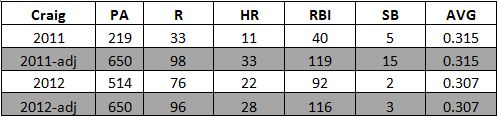
In fact, look what Craig’s last two seasons could’ve been with a full allotment of plate appearances:

Allen Craig 2013

The only real difference between those two adjusted seasons is the stolen base total.  That is about the furthest thing from the mind of someone drafting him so even if he does manage a full season of playing time and only steals a couple bags, it doesn’t dent his value.

Take the average of the other four numbers (97, 30, 118, .309) and over the past two seasons only two players have hit all four benchmarks: Kemp in 2011 and Miguel Cabrera this year.  Of course, these are just theoretical thresholds for Craig as he hasn’t yet proven the health piece, but the production in four of the five standard categories is excellent and definitely worthy a high pick especially as first base thins out a bit at the top.

Known as a position of depth, there were far few elite level options in 2012 compared to 2011.  Using ESPN’s Player Rater, it took 6.9 rating to make the top 50, which I think we could all agree is the upper echelon of offensive players.  Of that 50, only nine were first basemen.  Of those nine, four were no doubt not utilized primarily at first with Cabrera and Edwin Encarnacion qualifying at third base while Posey and Joe Mauer are best deployed at catcher.  Adrian Gonzalez is on the fence as a first base/outfield qualifier, but we can leave him at first.

In 2011, the top 50 threshold was at 6.7 on the Player Rater and 12 of those were first basemen.  Of those 12, only Michael Young (third base) and Mike Napoli (catcher) were best deployed at another qualifying position.  Lance Berkman and Michael Morse were like Gonzalez with their outfield qualification.  I definitely didn’t tab Craig with an early selection with the thought of position scarcity front of mind, but it shouldn’t be ignored, either.  Craig also carries the dual eligibility in the outfield adding flexibility to the pick, too.

Craig has been one of the best hitters in baseball the past two seasons ranking 17th in OPS+ among batters with 700 or more plate appearances.  That is my primary reason for selecting him where I have been; he’s a great hitter.  Additionally, in order to put up an elite season, he isn’t waiting on talent develop, rather he needs his body to cooperate.  While that certainly isn’t a given, it is a much sounder investment than betting on someone’s talents to shine through or for them to “get it”.

*Craig logged the ninth-highest total at 22, but there were players tied at 30 and 23 leaving 11 players with more homeruns than him. 

Tuesday: 10.2.2012

Down Ballot MVPs: Yoenis Cespedes

Let’s talk AL MVP.

No, not that MVP battle.  I am talking about the next tier, the down ballot candidates.  I realize that most people probably don’t care about the also-rans in an MVP race, but I actually do care because I like seeing guys recognized for their big seasons even if they weren’t quite the best.  There is no financial benefit (that I’m aware of) and no one but the encyclopedic fans with incredible memories will remember the 7th-place finisher in a given year, but I’m sure it is special for the player to be given consideration for such a prestigious award.

Top 5 or top 10 finishes in the MVP do get thrown around when it comes to Hall of Fame discussion, too, so it is important that the “right” guys get their due.  I put right in quotes obviously because there is no single right answer.  For one, fans really only care that the writers get the winner right.  After that, most couldn’t care less.  There were 22 players who got votes in the American League last year and 23 for the National League so the ballot runs deep.  For this series, I am pointing out guys I want to see in that upper range, say top 5-7.

Over the next few weeks, I’ll profile some of my favorite down ballot candidates in each league.  In the American League, these guys are fighting for third place and beyond.  I can’t envision any scenario where Mike Trout and Miguel Cabrera aren’t first and second in some order.

Let’s start out west:

Yoenis Cespedes (OAK, OF) – How great has he been this year?  In just about any other year he is a walkaway Rookie of the Year, but he picked the Year of Trout for his debut.  Not only did he deliver the power and speed that was expected from him based on his elite athleticism (23 HR; 16 SB), but he also hit .291 with a .353 on-base percentage, both higher than anticipated by a significant margin.  He was expected to be among the freest swingers, but his 19% strikeout rate was 31st in the AL among those with 500+ plate appearances.  Adam Dunn paced the league at 34%, easily taking the MLB title, too.  Cespedes was nowhere near the 25%-30% range that made up the rest of the top 10.

When you talk about value, there is a desire to get the heart of how a singular player impacted his team.  Now that is difficult to quantify, but the methods in place look kindly upon Cespedes.  First off, the A’s were 80-47 when he was in the lineup (an incredible .630 win percentage) and just 12-21 (.364) when he was sidelined.  Obviously crediting one of 25 as the sole reason for those splits in record is a bit outlandish on par with pitchers and quarterbacks getting far too much credit for wins and taking too large a hit for losses.  It does at least begin to show how important he is to that team, though.

If you lean more into the sabermetric sect, you might be interested to know that he has a 3.81 Win Probability Added (defined here) in his 127 games.  That is good for 7th in the American League (for the record, Trout had a massive lead at 5.61 and he has played just 10 more games than Cespedes).  These two have squished a lot of WPA into smaller sample sets than the others in the top 10.  On that definition page, it defines a 3.0 or better as great which coincidentally covers the entire top 10 in the AL as Adam Jones rounds it out at 3.04, just ahead of 11th place Billy Butler’s 2.85 mark.

Fangraphs also has a Clutch statistic (defined here) in which Cespedes also grades out nicely with a 0.75 mark (where 0.5 is above average and 1.0 is great).  He actually kills Trout here who is at -0.53 which is below average by their scale.  Of those top seven in WPA, Cespedes is the 3rd-most clutch by that statistic.  Looking at his statistics in various states of leverage (defined by Baseball-Reference here), his quality clutch rating isn’t a huge surprise as he does his best work in High Leverage situations with a .349/.432/.651 line including six home runs, 28 RBIs, and six stolen bases in 74 plate appearances.  He also has eight walks against 11 strikeouts.  The strikeout tick upward to 49, but he also fares quite well in Medium Leverage situations with a .327/.388/.567 line with 10 homers, 34 RBIs, and seven stolen bases in 240 plate appearances.  He has a meager .682 OPS and .230 batting average in Low Leverage situations across 216 plate appearances.

He wasn’t the top WAR guys on the A’s thanks in large part to Josh Reddick’s incredible defense (though he was hardly a slouch with the bat), but I do think Cespedes was easily their best offensive player overall (combinations of Chris Carter, Brandon Moss and Johnny Gomes were better in various stats like OPS, OPS+, wRC+, and wOBA, but none of them played close to as much as Cespedes) while being a capable defender in centerfield (a premium position) and leftfield.  He essentially split his time down the middle between the two positions when looking at the innings.  He is older than most rookies (26), but he still exceeded expectations in his first year as a major leaguer and he is a major reason why the A’s are now playoff bound.

Thursday: 07.12.2012

The Second Half Hail Mary Team

Your team sucks.  Way to go, idiot.  You are wallowing near or at the bottom of the standings with seemingly no hope.  It’s a redraft league so you don’t even have the option of trading for the 2013 which can be a fun exercise once you realize a season is lost.  So what do you do with the second half?  Hint: ignore your team and start looking for sleepers who will definitely fail in fantasy football is not the answer.  No, the answer is you throw conservatism out the window and chuck some Hail Marys to see if you can make a run.  Cross-sport reference!!!!

As dire as the situation may look now, there is time.  It’s not exactly the halfway point, four teams have played 87 games and all but two have (Washington & Kansas City at 83 & 84, respectively) played 85 or more, but a lot of baseball is still going to be played.  There will be plenty of Cinderella stories in October about a team that was buried at the All-Star Break only to surge through the standings in the dog days of summer en route to an improbable victory.  Let’s make that your story.

Presenting the Hail Mary Team for 2012.  This group of strugglers contain a ton of upside if they can reach previously established heights in the coming months.  Honestly, if you are one of the teams looking up at most of the league in your standings, you probably have a couple of these guys on your team.  They came into the season with elevated expectations and have failed to meet them for a bevy of reasons.  Their price tags have lowered (and if they haven’t, just pass, because there’s no sense paying full price) and with nothing to lose, they could be your ticket to a much better slot in your standings.

CATCHER Carlos Santana

He’s been wretched this year after a great 2011 season.  And it’s not just the concussion that sidelined him near the end of May as he was horrible in that whole month leading up to the injury (.233/.314/.344).  The concussion may be exacerbating the situation, but it’s just been a rough go since a solid .262/.417/.446 line April suggesting that maybe something other than the concussion is in play.  Nevertheless, this is a power force at a scarce position who can be a big time run producer if he gets back to the guy we saw in his first 201 games spanning part of 2010 and all of 2011: .244/.362/.459 with 33 HR and 101 RBI.  Brian McCann got some consideration, but his surge before the break (.421, 4 game HR streak w/11 RBI) likely allayed the fears of many and ate into any discount you could’ve gotten previously.

FIRST BASE – Ike Davis, Eric Hosmer

Both guys have been hot of late, but such wretched starts have their overall lines still in shambles resulting in their appearance on waiver wires in shallower leagues and making them available for little more than a song in leagues where they are on a roster.  Davis has a very healthy .294/.351/.635 line with 7 HR and 28 RBI in the last month so his price might be one of the higher ones on this list comparatively speaking, but I’d be willing to pay it as long as it still represented a discount against preseason expectations.  He’s been a bit Dan Uggla-esque circa 2011 where the batting average was just awful, but the power was still present.  I’m not sure he’s going to run off a 33-game hit streak like Uggla did, but who cares?

Hosmer ripped off a 3-hit game in Yankee Stadium in late May, his first of the year, and that seemed to be something of a turning point for his season.  From that game on: .289/.352/.430 with 4 HR, 19 RBI and 7 SB in 165 plate appearances.  He is still toting a .231/.299/.371 season line, though, which is why he still qualifies for this team.  Like Davis, he will be on the higher end of the cost spectrum among this list of players, but he should still be available at a sharp discount compared to the preseason which is what makes him a worthy Hail Mary target.

SECOND BASE – The Weekeseseseses, Rickie & Jemile

The Brothers Weeks have been awful this year lending to the decimation of the second base this year which could’ve been a plentiful position had players met or at least been near expectations.  Surges from Aaron Hill, Neil Walker, Jason Kipinis and Jose Altuve are only masking failures of the brothers, Dustin Pedroia, Ian Kinsler and Dustin Ackley instead of adding depth.  Back to these two, though, with Rickie first.

Injuries have always been a problem as he has just one season with more than 129 games played, otherwise he has usually performed quite well as long as he is on the field.  Until this year.  Even a depressed offensive environment can’t mask his woes as he checks in just under the Mendoza Line at .199 with just 8 HR and 6 SB in 81 games.  He hit 20 HR in 118 games last year, so even doubling his current output would be short of expectations.  He’s running at the same clip as last year, but he’s not really a speed asset these days anyway, that’s his brother’s area of expertise.

Speaking of Jemile, he has been an abomination thus far.  Imagine he were even average, the A’s might be above .500.  As it is, they are right at the mark and his return could help them stay there or exceed the level going forward.  The real bummer is that his poor half has overshadowed the huge gains in walk rate (up from 5% last year to 11% this year) paired with a small improvement in strikeout (down 1% to 13%).  If Dee Gordon can lead baseball in stolen bases (30) with a .280 on-base percentage, Weeks should have more than 12 with a more palatable .312 OBP.  He is an easy target if steals is a category where you’re severely lagging.

SHORTSTOP – Alexei Ramirez

When Ramirez ended up April with a paltry .498 OPS, some may have seen that as a prime buying opportunity as he routinely takes a while to get going.  Over his career, April is easily his worth month checking in with a .561 OPS compared to .721 or better in every other month peaking with .822 in July.  He sputtered to a .581 mark this May.  He improved to .678 in June so he is progressing, but not nearly as rapidly as usual.  In a scant 7-game sample for July, he is at 1.057 so maybe he finally ready to let loose.

The power has been noticeably absent throughout with just two home runs.  He has run a bit more to help alleviate a bit of the damage checking in with 10 SB, three more than all of last year in a full season.  He has long been one of those guys who is much better as a fantasy asset than as a real life one with only one season over 99 OPS+ (104 as a rookie).  He had become a bankable 15-70-10-80 with an average around .270.  It will take a helluva rally to get there this year, but if he just performs to the levels we have seen in the past, he will be a positive asset at shortstop at a nothing cost.

THIRD BASE – Ryan Zimmerman

I was surprised the other day when I heard some fantasy analysts dismissing him as a non-entity.  The basic premise was essentially that he’s never been any good so why are folks still hung up on him?  That’s just crazy talk.  He was excellent in 2009-2010 and was tracking toward another great season last year when injuries cut it short.  He hasn’t been good this year and I think injuries are a big reason again as he had a DL stint back in late April through early May and then he took a while to get going once he was back.

I’ll grant that he isn’t the sturdiest guy around.  That seems to come with territory when dealing with defensive stalwarts like Zimmerman, but he is definitely a damn fine hitter capable of big numbers.  In fact, he has been hot of late starting with a Coors Field trip (always a nice remedy for a hitter) totaling 14 games in all during which he has hit .333/.394/.683 with 5 HR and 18 RBI.  He has a 1.003 OPS with 3 HR in the non-Coors part, so don’t worry that he is Brandon Mossing us.  His bottom line is still gruesome (.694 OPS) enough that the price won’t be too steep.

OUTFIELD – Cameron Maybin

Proponents of Maybin’s are pointing toward last year’s second half dash to the finish that saw him swipe 28 bases after the break with an improved .268 average (up from .259) and hoping he has another such run (pun fully intended) in him.  The talent is there in glimpses, but those are all too brief because even when he’s hitting the longest home run in Chase Field, he’s still only carrying a .212 average.

Ichiro Suzuki

This is probably just the decline of a 38-year old former star, but it’s hard not to look at his 39 SBs from just a year ago and dream of him stealing 20+ in the second half.

Shane Victorino

He has been a far cry from what we expect in the slugging department thanks to a precipitous drop in triples as he has just two after leading baseball two of the last three years and notching 10 in the third of those seasons.  Aside from that, he hasn’t been awful save a little batting average misfortune.  I think the perception of his struggling is stronger than the truth of it as he already has as many steals (19) as he did in all of last year and his eight homers are just off of last year’s pace.  Try to prey on the trade rumors swirling about and his benching the other day for not liking his slot in the order as well as the general Phillie malaise that has seemingly stunk up every non-Hamels entity.

Bes Jond Unnings and D.J. Jupton

Paired together for obvious reason, Desmond Jennings and B.J. Upton have been colossal disappointments this year, though like others in the list they have run enough to stem the tide a bit on their being fantasy sinkholes.  Both have 15 SBs, impressive more so for Jennings coming in eight fewer games, but both are still on the wrong side of .680 OPS to date.  It looks even worse if you extend back into September for Jennings as he jumped off a cliff after a blazing hot run from late July through August.

Meanwhile, no one is expecting anything batting average-wise from Upton, but what is with the power outage?  He’s been around a 20 HR hitter the last two years which combined with his speed and 80ish runs driven in and scored made the batting average plenty palatable.  He’s now on pace for 13, down 10 from last year, but he can string together some 4-5 HR months and rally to or above 20 if he’s right.  Both of these Rays have plenty of upside that make gambling on them easy, especially at a discount.

Nelson Cruz

He has been lying in wait just ready for a Cruzian streak.  It may be bubbling up near the surface, too, as he entered the break with three multi-hit games including four doubles, but no homers.  When he gets hot he can carry a fantasy team so he is an easy inclusion even though he hasn’t been as rotten as the others with a 99 OPS+.  You may have to package one of your few worthwhile assets to get him and someone else on this list.  It could pay major dividends with a monster like Cruz.

PITCHING

Tim Lincecum

Duh.  Just look at the track record, I don’t really need to tell you why he’s a Hail Mary candidate.

Dan Haren

Currently injured making it a nice time to strike.  For the purposes of this exercise it also helps that he was terrible for five starts (8.67 ERA) before finally hitting the DL with a balky back.  His brilliant track record and the glimpses of greatness this year when healthy make it clear that he is still someone worth targeting.  The rest will hopefully get him back to 100% and he will return to his previously established level of excellence.

Rickey Romero

Let’s be honest, he didn’t really earn a 2.92 ERA last year from a skills standpoint. He still got the 2.92 ERA and I’m sure it helped many a fantasy team, but expecting that this year would’ve been silly.  Similarly, he isn’t a 5.22 ERA pitcher, either.  The skills have deteriorated this year without question, but not 5.22 deterioration.  His control is all out whack with a career-worst 4.7 BB/9.  That points to a potential mechanical issue which hopefully can be identified and corrected.

Unfortunately, the bubonic plague is sweeping across the Toronto rotation so injury could be an issue, too, but he doesn’t seem to be laboring or hurting when I view his starts with my amateur scouting eye.  A 3.50 ERA from a workhorse who will put himself in position for decisions (and ideally wins given their stout offense) can go a long way toward fixing your flailing staff.

Derek Holland

We saw last year, specifically in the second half and playoffs, what he can do when he is click.  His skills are in line with last year’s save a bit of home run trouble which has no doubt led to his inflated 5.05 ERA.  He quietly came off the DL just before the break and had a quality start, strike quickly before he strings a few together and saps up any discount via trade or starts getting scooped up off the waiver wires.

Doug Fister

The infield defense has struggled as planned and Fister has been a prime casualty, but that isn’t the only factor as a 17% HR/FB rate has led to a 1.2 HR/9 rate.  That factor should regress, especially for a groundball artist (2.2 GB/FB ratio), and that will cut into his 4.75 ERA.  Completing the Hail Mary pass would be a tightening up of the defense allowing him to pitch to a level on par with his skills which would be around 3.45 or better.

Francisco Liriano

Personally, I don’t think he should be trusted, but we are talking Hail Marys here.  He has a 3.12 ERA and a strikeout per inning in his seven starts since returning to the rotation.  We know the upside he has when everything is going perfectly.

Ubaldo Jimenez

Is he the next Liriano after his fall from grace last year?  Probably so, but like Liriano he is streaking in his last seven with a 2.93 ERA and 44 Ks in 46 innings.  In fact, they both started their streaks on June 5th so they are even more similar this year.  They both have ace upside.  Doesn’t mean they’ll will reach it, but the chance is there.

Ervin Santana

He likes to throw a stinker season in every once in a while to keep everyone honest I guess, but his capability is a commodity as proven in three of the previous four years from 2008-2011.  Unsurprisingly home runs were his issue in 2009, too, so figuring that out will be the key to his potential success going forward.  He doesn’t quite have ace potential because he peaks around 6.8-7.0 K/9, but with the Angels clicking, he can run off a bunch of wins with quality ratios if he gets himself figured out.

Clay Buchholz

Another guy I don’t really buy into, but people I respect do and besides, I’m trying to fix your crappy team not mine.  Even including the thrashing he suffered right before hitting the DL, he had 3.35 ERA and 5-1 record (including 4 straight Ws) in eight starts whittling his ERA from 9.09 to 5.53 in the process.  He is currently sitting on the DL with terrible bottom line numbers making now the best time to strike if you are interested.

Tuesday: 06.19.2012

Trout and Harper in 2013: The Industry Weighs In

Though we are in the midst of our third straight “year of the pitcher” (maybe it should be an “era of the pitcher”?), two hitters are capturing the attention of the baseball world.  Rookie hitters at that.  Mike Trout and Bryce Harper, the consensus top prospects in baseball this preseason, have lived up to their hype thus far leaving the baseball community drooling in anticipation of what will come next.  The fantasy baseball community might be drooling most of all, especially those with the wunderkinds on their teams.  Those playing in keeper leaguers are giddiest of the bunch.

Trout is on pace to produce one of the five best age 20 seasons since the expansion era (1961), in fact the 2nd-best if he maintains his current pace of production.  Only A-Rod’s insane age 20 season tops Trout’s current pace from an OPS and OPS+  standpoint.  Harper is on pace to be just the 2nd 19-year old to qualify for the batting title and post an OPS+ over 100.  Not 2nd-best, 2nd at all in the expansion era (and subsequently the best at his current pace).

(data courtesy of Baseball-Reference.com)

We got a 40-game taste of Trout at age 19 a season and it was less than impressive.  He hit .220 with a  .672 OPS including five home runs and four stolen bases.  In exactly 60 more at-bats than he had last year, he has a .328 average, .907 OPS, six home runs and 19 (!) stolen bases.

Harper, meanwhile, spent his first pro season between A and AA last year.  He crushed the former, posting a .977 OPS with 14 home runs and 19 stolen bases in 258 at-bats before getting a promotion.  He faltered upon arrival posting a .628 OPS in his first 80 at-bats, but closed the year with an .878 OPS in his final 49.

It looked like he was going to need a similar adjustment to AAA as he had a .708 OPS in 72 at-bats before getting the call to the majors as the decimated Nationals needed his potentially impactful bat.  Using arbitrary endpoints again, he seemed to need an adjustment period again posting a meager .650 OPS in his first 13 games.  However, since May 13th he has hit .325 with 15 extra-base hits include seven home runs leading to a .988 OPS in 123 at-bats.

The two are on pace for some pretty impressive seasons even if you don’t factor in their ages:

Harper’s RBI total is pacing a bit low, but it won’t take much to boost that up.  In fact, if you just added five to his current mark, he would move from 59 to 75 in a snap.  By the way, a quick note about the pacing.  I built in five off days for both of them just to be a bit conservative.  I also included an 85% pace which builds in some regression should they fall off their current production pace yet maintain the same amount of at-bats.  It’s kind of a wet blanket/reality check as they are likely at or very near the peak production of their seasons right now.

With the hysteria surrounding the two, I wondered about the future.  Specifically next spring.  I have my own ideas about their 2013 value, but I wanted to know where some of the top fantasy minds in the industry saw them going so I reached out to them with that very question.  Here are the results:

Derek Carty (Twitter) – I imagine both Harper and Trout will be drafted higher than they should — fantasy players love drafting on hype, so much so that they’ll draft a guy who has to make good on his ceiling just in order to break even on the pick (see: Brett Lawrie, 2012) — although both should be quite good.  Harper will offer more in terms of power while Trout will offer more in terms of speed.

A true 80 runner, Trout could swipe 40 bags next year (although some scouts feel he’ll slow quickly as he ages, given his body type).  Harper could challenge 30 HR. and both could provide solid averages, although Trout’s power/speed combo will likely be superior to Harper’s, giving him the edge (especially leading off for the Angels).  I’ll take Trout in the seventh and Harper in the 10th (subject to change, of course, based upon rest-of-2012 performance).

Eno Sarris (Twitter) We asked this of analysts in the online scouting community going into the year for FanGraphs+ ($) and they were all split.  Like right down the middle split.  Dave Cameron writes a piece about how impressive Bryce Harper has been in the early going, and then Wendy Thurm writes that we shouldn’t forget about how good Mike Trout has been.

It seems clear that both will be great, and quickly, and so we’re left with the quintessential question: do you prefer to have power first, or speed?  I’ll take the speedy guy, even if it’s a year older, and here’s why: 1) This speedy guy with power is more likely to add value in all five offensive roto categories. 2) This speedy guy comes with a great contact rate.

There’s nothing worse than a contact problem, and though Harper has a nice strikeout rate, his swinging strike rate (12.5%) is way above average and the sample is almost robust enough to worry about it (Ed. note: this was turned in before Harper’s 5 K performance, which Sarris subsequently wrote about).

Along with Trout’s speed, his better contact rate (9.6% better) should mean that his batting average will be better than Harper’s most years.  It’s as simple as that, but there’s a little more.  If stolen bases by themselves are rare, the true five-cat performer is even rarer, and if you can get your speed from guys with power, you avoid ever having to Juan Pierre it up. I know Harper has the ability to steal some bags now, but I see it more like athleticism and taking advantage of situations — a la Brandon Belt — than Trout-like wheels.

Both of these guys have upside — in one corner, you have a guy who could hit .280 with 25+ homers and 10+ steals as soon as next year, and in the other you have a guy that could hit .300 with 15+ homers and 40+ steals next year. The thing is, there’s an outside shot that Trout’s current batted ball mix (1.22 gb/fb, 12.2% HR/FB) and ISO (.192) are sustainable, in which case he might hit closer to 20 home runs and push the needle further in his favor.

I chose Trout over Harper when they came up and I’ll do it again. Oh, and round? I’ll take him as early as the third or fourth, depending on how the hype works out going into the season next year.  If Harper gets more of the attention, I might gamble on taking Trout in the fifth or sixth in order to really pump him for value.

Joel Henard (Twitter) – Looking at Trout and Harper next season, it’s going to be a tough call.  I definitely see them going way too early in drafts with owners drafting them in the 2nd round.  I see both guys as later 3rd and early 4th round guys.  I am a Harper fanatic and will probably draft him way too early, with that being said I would rank them in 3rd and 4th round.

Riley Breckenridge (Personal Twitter; PO Twitter) Mike Trout: late 2nd round, early 3rd – Updated ZiPS projections have Trout pegged for a 90/15/60/33/.290 output in 2012. I think we’ll see an uptick in all five categories in 2013, (~95/18/70/38/.295), which brought to mind the 2011 model of Andrew McCutchen with more speed, a better batting average, and slightly fewer home runs. McCutchen’s ADP this year sat in the mid-20s, so I’d project Trout as a late 2nd rounder in most leagues.

Bryce Harper: late 3rd round, early 4th – Harper is a tougher call than Trout.  His real value will come when he can give a fantasy owner 30+ bombs and ~20 steals. While I’m fairly certain that day will come, I’m not sure it’ll be in 2013.

Jason Collette (Twitter) – Along where Desmond Jennings and Brett Lawrie were this year both round and dollar wise to be honest.

Nando Di Fino (Twitter) – I actually ran numbers with Harper, Griffey, Yount, Mantle, and A-Rod — their 19-year old season vs. their 20-year old seasons.  All but Yount put up insane numbers. Trout is essentially a year ahead of them right now, so it’s a sneak preview, to a degree. I look at them like this:

Harper: $32 roto player, with lots of power, great average, and some speed.

Trout: $34 roto player, with some power, great average, and a little more speed, which will get his value a tick above Harper’s.

In points leagues, I bet Harper is a little more valuable in 2013 when it’s all said and done, and I would wager that Harper would go in the first round in most drafts, while Trout falls to 2/3. In reality, they should probably both be late first-rounders in both formats next season, and will likely finish with late first-round value.

Al Melchior (Twitter) – Trout probably won’t maintain a .300-plus batting average going into next season, but he should have some Shane Victorino-type value with his speed/power combo. With the added hype of having been a top prospect boosting his value, I see him going as a 4th or 5th rounder.

Harper will hit for more power than Trout, and that will offset his relative shortcomings in batting average and steals. Think of him as Hunter Pence, but with more stolen bases and walks. Also likely to be drafted in the 4th or 5th rounds on average.

Cory Schwartz (Twitter) – Assuming both of these phenoms continue to produce at their current pace and rates, they’ll both be highly coveted in re-draft leagues next year.  Personally I’d go after Trout first, because his edge in the stolen base category will likely outweigh the value of Harper’s superior power.  He’s not likely to hit in the .320’s next year as he is right now, but I think his other production is realistic and projects to high teens in homers and 35-40 steals with an average in the .280’s and nearly 100 runs.

In a 12-team re-draft league, that type of player would probably go in the third round and possibly even sooner… think about Andrew McCutchen this year in terms of value; he’ll certainly go ahead of where Desmond Jennings did this year.  Harper projects for a slightly higher average and could challenge 30 homers next year, while stealing 12-15 bases.

He’ll probably go a half-dozen or so picks after Trout, comparable to or before someone like Hunter Pence. Either way, both have clearly established themselves as potential impact players next year and, based on their production so far this year and expected growth going forward, neither will last very long on draft day.

Derek VanRiper (Twitter) – Valuing Trout and Harper for 2013 requires an unscientific calculation of their expected adjustment period as big league pitchers find ways to get them out. As we’ve learned through the first two-plus months of Brett Lawrie‘s 2012 season, elite tools don’t immediately lead to elite results over the first 500-600 plate appearances.

Trout should run enough to steal at least 25 bases while providing double-digit power, while Harper seems to be a better bet for 15-20 homers and double-digit steals, albeit with a lower batting average because of his ongoing development against left-handed pitching.  In Trout, I think we’re looking at a player who will be valued as a third or fourth-round pick in many drafts next season (similar to Desmond Jennings in 2012), while with Harper it seems as though a Round 4-5 ADP seems more likely.

Chris Liss (Twitter) – Off the top of my head – mixed league, Trout will be a 2nd round pick, Harper 3rd. That is if we drafted for 2013 today. But obviously that could change a lot.

Scott Pianowski (Twitter) – I can’t see Trout lasting longer than two rounds, perhaps getting into the Top 12 or 15. He’s capable of being a dominant speed player right away and he has good (not elite) power, so we might have a five-category player here. It will be interesting to see how the league changes its pitching approach to him, and how the kid reacts.

Harper I don’t like as much as everyone else seems to for the immediate future. Down the road, of course, we can all see the superstar potential. I doubt I’d get him where I’m likely to slot him, maybe fourth or fifth-round value. And before anyone drafts either of these guys in 2013, remember all the sophomores that have broken our hearts.

Ray Flowers (Twitter) – If I was drafting today for the 2013 season I’d roster Trout for the reason many others are saying Trout would be their choice – it’s the speed component. I don’t doubt that Harper could make a run at 20 steals, but if Trout is swiping 40 bags as is obviously possible, Harper is going to have to hit a who lot more dingers to make up that difference in the fantasy game. Plus, I’m not sure that Harper is going to be a .300 hitter right off the hop, which will make his need for a major home run driven effort exceedingly important if he is going to outpace Trout next season.

Speaking of sophomore slumps, notice the 4th-place hitter on that age 20 list from above.  Jason Heyward.  Just two years ago he took the league by storm with a five-tool game worthy of the #1 prospect ranking he earned that preseason.  Since then things haven’t necessarily gone as planned.  He labored through injuries dropping 50 points on his batting average and 141 points on his OPS a season ago.  He has been better on the whole so far this year, but his walk rate has dipped again while his strikeout rate is at a career-high 23%.

He serves as the most ready-made example of what Pianowski is talking about as does Brett Lawrie, a name elicited often by our panelists.  I know what you’re thinking, “Harper and Trout aren’t Heyward and Lawrie!”  And that may be true, but they were both elite, blue-chip prospects who took the league by storm in their debuts and have since struggled by comparison.

Trout didn’t take the league by storm initially (87 OPS+ in that 40-game sample last year) which is maybe why he feels different meanwhile Harper seems to be a generational, once-in-a-lifetime-type talent to whom rules of history don’t apply, unless we’re talking about the rules of Ken Griffey Jr.’s early career.  While Trout matches up somewhat with A-Rod (who struggled in 17 and 48-game samples as an 18 and 19-year old before storming the league at 20).

Nevertheless, if they maintain these incredible paces, no one is going to care about cautionary tales from history and the pair will be very highly drafted in 2013 (like top 10 if they keep their current paces up).  For me, I have Trout higher than Harper.  His speed changes the fantasy game and when paired with his run production ability and batting average potential makes him my favorite type of player.  I would value him as a 2nd rounder in 12-team mixed leagues and I can legitimately see him creeping into the 1st round.

Harper, meanwhile, is of course no slouch.  He oozes with ability and his power could be transcendent in a hurry.  In the lowered offensive era, that is huge.  The Hunter Pence comparison given by a few of the analysts makes sense, but I would give him more pop (30+ HRs) while taking away some of the batting average (closer to .265-.270, compared Pence’s .280-.290 range with a couple of .300s mixed in), at least initially.  Harper has .300/35 capability, I’m just not sure it shows up in year two.  I would value him as a 3rd rounder.

Loosely averaging everyone’s thoughts and opinions yields Trout as a late second/early third round pick and Harper as a mid-to-late third round pick.  They will continue to garner a ton of attention the rest of this season and their draft position will be written about a ton during the upcoming winter and early next spring at the various internet outlets and in every magazine that hits newsstands.

Tuesday: 07.19.2011

Keeper Building Blocks: Outfield, Part 1

Outfield has a lot of great centerpiece players that would be worth giving up any un-keepable entities you have to in order to land them.  In fact, a number of them are “arm & a leg guys” meaning, of course, that they will cost you an arm and a leg.

You have to give something to get something and as long as you aren’t blowing up your team completely (e.g. trading a few expiring contracts/high-priced un-keepables AND some guys you were planning on keeping), then they are worth it.  Situations will vary depending on league format & keeper rules, but don’t overdo it just to get one guy or you may be worse off than you were before you got him.

Based on talent, age and the likelihood of studs on a cheap contract, outfield is the best position in this Keeper Building Block series to find your truly elite cornerstone.  The first 7 or 8 guys fall into that category and while all won’t be cheap in your league, several should be giving you options.  And it is likely that at least one of them is on a contender and hopefully you the missing puzzle pieces for them to seal a title and be willing to give their star.

There are several more OF building blocks than at any other position, so I broke it up into two pieces.

Catchers

First Base

Second Base, Addendum

Shortstop

Third Base, Addendum

Jose Bautista (TOR, 30) – See the third basemen piece for info on Bautista.  He is almost certainly on a cheap contract and it’d take just about any viable piece you to get him, but it might be worth it if you still have a few keepers around him.  His value is much, much higher at third base, but since he qualifies at outfield, I made sure to list him here.

Carlos Gonzalez (COL, 25) – When a season of .287 with 22 HR, 27 SB, 88 RBI & 100 R is your come down season from a career year, you are an elite player.  Plus he is getting better month-over-month so he just might improve those paces.  Either way, he still ranks 26th overall on ESPN’s Player Rater and 8th amongst outfielders.  His 2010 breakout came on the heels of an 89 game debut in Colorado that went well (.284/.353/.525, 13 HR & 16 SB), but still left him with a reasonable average draft position (ADP) of 120.  So he is either on a minor league contract or a regular one that is no doubt affordable.

Andrew McCutchen (PIT, 24) – I am pleased to have this burgeoning star locked up for two more years in my NL-Only league for just $15.  He is a dynamic, five-category (his .279 isn’t elite, but the league-high is .272 and my team average is .262 so he is definitely a positive contributor in that category) stud who appears to be just scratching the surface of his potential.  Next year will likely be his first full season in a run production lineup spot (third or fourth) and that should allow to knock in 100+ runs for the first time in his career.  That is if he doesn’t increase his pace of 98 this year and make 2012 his second stab at the century mark.  He is the face of the budding Pirates franchise and he can be the same for your fantasy team.

Mike Stanton (FLO, 21) – This kid is incredible.  He hit 22 home runs in 100 games (hitting one every 16.3 AB) and while the lofty strikeout rate (31%) made it clear that batting average would be a challenge, the power was undeniable.  He has made incremental gains on his power (HR every 15.8 AB and .267 ISO up from .248), his strikeout rate (down to 28%) and walk rate (up from 8.6% to 9.2%, OK so that is essentially the same) putting him on pace for 34 home runs and 96 RBIs… at 21 years old!

If there is one concern, it’s slight and it’s his age combined with the strikeout rate.  His inexperience and lack of contact could lead to prolonged slumps as he continues to grow.  It doesn’t dissuade me from targeting him, but keep it in mind.  In most keeper leagues, he will be on a minor league contract which is no doubt much cheaper than his actual value and with power on the decline league-wide; he should be a premier target.

Jay Bruce (CIN, 24) – He is essentially a look into Stanton’s future on some level, a pure power hitter with batting average liability.  Bruce doesn’t have the strikeout woes that Stanton does, but they profile similarly.  As a 21 and 22 year old Bruce hit 21 and 22 home runs in 413 and 345 at-bats, respectively.  His walk rate has steadied at 10% the last three seasons and while his BABIP-influenced.281 batting average (.334 BABIP) from 2010 hasn’t held (.265 w/.293 BABIP), the .265 he has posted doesn’t hurt too much in this low-offense environment of 2011.  I have him and Stanton pretty close, but I gave Stanton the edge because he likely cheaper and he is three years younger.

Jason Heyward (ATL, 21) – The ideal situation would be finding Heyward on a contender because his 2011 has been a disappointment (have I mentioned that young talents, no matter how good, don’t improve linearly?) due at least in part to injury.  There is a bit of concern around his massive groundball rates (55% and 58% in his two pro seasons) and how that affects his power potential, but the kid is 21 and even when he is underperforming it is easy to see while watching him that he is a special player.

Colby Rasmus (STL, 24) – Generally when a guy needing a “change of scenery” is thrown around, it is an excuse for his struggles when the truth is that he probably just isn’t as talented as originally believed.  However with Rasmus, I think it is one of the few cases where the change is necessary.  Rasmus has a permanent front row seat in manager Tony LaRussa’s dog house and it seems to have finally crept on the field full time and affected his play.  Instead of aiding his first place Cardinals with a season that builds on his strong 2010, Rasmus looks out of place and appears to pressing with increasingly worse numbers month-to-month:

April: .301/.392/.476

May: .253/.370/.407

June: .213/.268/.416

Generally teams don’t discuss trading mid-20s talents like Rasmus alas his name has come up in some preliminary rumors as we near the trade deadline.  I have no doubts that he can flourish out from under LaRussa’s thumb and his modest 2011 output might allow you to get a discount via trade.  Or he could be a primary reason why you’re building for 2012 already.  If it is the latter, sit tight with Rasmus.

Monday: 07.4.2011

Hail Mary Team, Part 3

Yikes, let’s get the rest of this Hail Mary Team out so you can go trade for the guys.  The first parts have unleashed a Midas touch on some of these guys and may have taken them out of contention for a discount.  Mark Reynolds and Hanley Ramirez both had multi-home run games after being mentioned (not implying causation… merely a coincidence) and Reynolds actually hit three over the weekend.

One of the outfielders I had slated for the team has also gone off as Nelson Cruz blasted home runs on Friday and Sunday.  His Friday performance also included six RBIs.  Perhaps his team manager will focus less on that mini-hot streak and more on the .245 batting average and sub-.300 on-base percentage and not charge you the full price for his services.

Catchers, First Basemen & Second Basemen

Shortstops & Third Basemen

Let’s see what else the outfield offers the Hail Mary Team.

OUTFIELD:

Cruz (TEX) – He is on pace for 38 home runs now so he isn’t exactly tanking his manager’s team, nor was he before his recent little outburst, but the 95 RBI pace and aforementioned weak batting average & on-base percentage totals might allow you to squeeze him out in a trade for less than full value.  As I have mentioned in earlier parts of this series, with guys like this it isn’t necessarily that I think you can get them dirt cheap rather you can trade your prime asset for him AND someone else which results in a net gain for your team.  So please don’t see Cruz or Martin Prado included on these lists and think that I value them the same as Adam Dunn and Dan Uggla. 

Carl Crawford (BOS) – He was just getting going when he hit the disabled list.  I cannot imagine how frustrating that must be for him after signing the massive contract and joining the Red Sox this offseason.  He went on the DL on June 17th, the previous month he was hitting .298 with five home runs and 21 RBIs.  The speed was still noticeably absent (just 2 SBs in that hot stretch), but the four category production made it easier to forget the lack of speed.

There is almost always at least some type of discount when trading for guys on the DL so strike as soon as possible with Crawford.  When he was hitting like trash in April and May, no one was selling low on him because he was still playing daily and everyone believed he would come out of it (and he was starting to), but when a guy is no longer putting up daily numbers (even if they are below expectations) prices tend to drop.

Jayson Werth (WAS) – Many people believed that Washington would regret the seven year deal to Werth at some point, no one thought that point would be year 1.  The fact that they have been poking around .500 despite their $100-million-dollar-man carrying a .709 OPS is quite impressive.  In the last three years when he emerged as a big time player that allowed him to get such a contract, he was always good throughout the year essentially putting up balanced halves.  In other words, he doesn’t wear down so hopefully the Nats start to see some dividends returned on that hefty contract with a big second half out of Werth.

He is on pace for his third 20 HR-20 SB season in his last four (27 HR, but only 13 SB last year) so he hasn’t been a complete shlub despite what the batting average might tell you.  A complete reversal in groundball-flyball distribution and a 10% rise of infield flyballs have been the culprits in his .223 average & .265 BABIP.  Add in that he has hit .155 with just 6 RBIs in the last month and there is no way a fantasy manager can realistically ask for anything near full price halfway through the season.  At least not with a straight face.

Jason Heyward (ATL) – Skip this one in keeper leagues, he could be hitting .051 and I don’t think a keeper league manager would bail on him.  He gets a small pass for some time missed, but a .228 batting average and just 20 RBIs & 30 runs scored in the 62 games he has played has to be leaving his managers wanting more.  His scant track record isn’t enough to blindly believe he will have a big second half, perhaps it is simply a sophomore slump for the 21 year old, but if you can get a talent like him at a significant discount, it is worth taking a shot on especially in what is an otherwise lost season for your ballclub.

Corey Hart (MIL) – Hart can catch fire and stay hot for a while as he has posted halves of 21 and 15 home runs within the last three years.  The big reason he has been kind of “blah” so far this year is that his groundball-flyball profiles have flipped much like Werth’s.  He is a career 41% flyball hitter down at 35% this year meanwhile he’s a career 40% groundball hitter who was at 38% last year, but has rocketed up to 47% this year.  If he can get that figured out, he can have a huge second half with a mid-teens home run total if not something pushing 20.

Alex Rios (CWS) – He was quite overrated coming into this year when consider that his 2010 season was essentially a blistering hot May and five mediocre months during which he topped .760 OPS just once (April) and slid from month-over-month from that .760 “perch” in June down to .645 by September after the hot May.  Essentially to buy in on Rios is to bet that one of his summer months will match or at least approach his eight home run, 1.106 OPS May from last year.  Of course the way he is going this year, he would kill for a .700-something OPS month as his high for 2011 is .685 in June.

Magglio Ordonez (DET) – He finally looks healthy again after the nasty ankle injury last July and what that means is a .300+ batting average with plenty of runs driven in.  He won’t be a huge power source, but at 37 you aren’t expecting him to at this point.  I have been really impressed watching him the last few days and I feel confident that he is ready to contribute to the middle of that strong Detroit lineup.  He should be on the waiver wire of more than a few leagues and I would consider rostering him and getting in now before he is mid-hot streak.
