Archive for ‘Statistical Analysis’

Wednesday: 01.4.2012

Oakland Cashes in with Gonzalez Trade

As division foes Texas and Los Angeles grow stronger, the Oakland A’s are entirely committed to focusing on their future as they have dealt another key cog in their once strong rotation.  Gio Gonzalez is headed to the Washington Nationals for a package of prospects that includes their 3rd (Brad Peacock), 4th (A.J. Cole) and 9th (Derek Norris) best farmhands according to Baseball America.  The fourth piece was lefty Tom Milone, who BA listed as having the best control and changeup in the organization.

This group of youngsters (Milone is the elder statesman of the bunch at 25) joins the trio of prospects the A’s got for Trevor Cahill.  That group was highlighted by Jarrod Parker and included outfielder Collin Cowgill and reliever Ryan Cook.  Parker was listed 4th on the Arizona Diamondbacks top 10 prospects and projects to have some incredible upside that could make him better than Cahill if he pans out completely.  However, Cahill is the more finished product, obviously, and still under team control for several years while Parker returned from Tommy John Surgery in 2011.

Looking at the returns from Washington shows some strong upside starting as early as 2012:

Brad Peacock (RHP) – Peacock emerged a bit in 2010 pitching in High-A for the second time (48 IP there to end 2009) when he doubled his strikeout rate to 10.3 K/9 while seeing his walk rate rise just slightly from 1.9 to 2.2 BB/9 in 103 innings.  He was promoted to AA where he came off the rails a bit, specifically a 5.1 BB/9 and 1.2 HR/9 in 39 innings (meanwhile, his strikeout rate dipped to 7.0).

In similar fashion, he repeated the level to start 2011 and looked more like the Peacock from the start of 2010 with an 11.8 K/9 and 2.1 BB/9 in 99 innings before reaching AAA.  While he saw some degradation in his numbers with the promotion, he still struck out a batter per inning, but the walk rate jumped to 4.5 per game.  The real difference in his 2011 season was a severe lack of hits against him.  He allowed just six hits per nine in 147 innings across both levels.  The big season earned him a cup of coffee with the Nats (0.75 ERA in 12 IP).

Peacock has a mid-90s fastball (sits 93) that can touch 96-97 with a wicked curveball and progressing change up that sits 82-84 and looked sharp during his quick 12-inning stint with the big league club.  There was talk of him possibly being a future reliever, but after his breakout season in the high minors last year, he looks like a full-fledged starter capable of becoming a #2 or #3 at his peak, especially in that pitching-friendly home ballpark where Oakland plays (for now).

A.J. Cole (RHP) – At 20 years old and about to enter just his second season a professional, Cole is still pretty far away from contributing to the A’s, but an impressive debut combined with a projectable frame (6’4/180) have many seeing future ace potential for him.  He did nothing to dissuade such thoughts in 2011 striking out 10.9 batters per game in his 89 innings and walking just 2.4 (for a 4.5 K/BB).

Like Peacock, his fastball sits 91-93, but flashes 96-97 and his curveball is further along than his changeup.  He has a Ubaldo Jimenez-esque delivery whereby he shoots his hand out behind his back just before he throws the pitch.  His leg kick is a little Verlanderian in that he gets it really high and loose and leads into his easy delivery.  His mechanics aren’t quite as effortless as Justin Verlander’s, but then again outside of maybe Matt Moore, nobody’s are right now.

If his body fills out a bit as projected and that gives him the tick or two on his fastball, he will be in really good shape in terms of hitting that ace-level projection, especially if that boost in velocity is paired with the expected improvement of his changeup.  There are some ifs and maybes with Cole right now, as with any 20-year old, but the future is bright and he may well end up being the gem of this entire haul in five or six years.

Derek Norris (C) – For those who mislabel “Moneyball” as simply “guys who take walks”, Norris is the quintessential Moneyball player.  For those who are more enlightened, Norris is the kind of player who would’ve been wildly undervalued in the era when Moneyball first came to be because he totes a wholly unimpressive .249 career batting average in 1815 minor league plate appearances, but offsets it with an eye-popping .403 on-base percentage thanks in large part (OK, thanks exclusively) to a 19% walk rate, including two seasons over 20% (2008 & 2010).

His .235 and .210 batting averages the last two years are alarming especially in light of his plate discipline.  Some scouts believe that his contact rate will improve in the coming seasons, but it is hard not to be at least somewhat concerned at this juncture.  Of course, he isn’t just a fancy walk rate.  When he does make contact, it is often solid contact as evidenced by his 20 home runs (his second 20+ HR season in the minors) and a career-high .237 Isolated Average (slugging minus batting average).

A catcher who can get on base, hit for pop and even run a bit (13 SB per 500 AB) is a valuable commodity for sure, but playing half of his games in Oakland Coliseum means Norris will have to improve his contact rate or he could easily be looking at a sub-.200 batting average.  The Major League Equivalency of his 2011 line when placed in Oakland yields a .155/.268/.312 line.  Ouch.  No need to panic just yet, though, as he will be just 23 years old in 2012 so he still has time to develop.

Tom Milone (LHP) – The term “crafty lefty” is often reserved for a veteran southpaw who may have once had an overpowering arsenal that has diminished with age leaving him to outsmart hitters with command and guile.  At 25, Milone is already a crafty lefty despite what you might infer from his minor league numbers.  He is a prime example of why just looking at the numbers isn’t ever enough.

Though he boasts an improving strikeout rate that went from 6.3 K/9 in 2009 to 9.4 this past season, Milone doesn’t overpower hitters.  Deception and pinpoint accuracy make his high-80s fastball play better that it truly is while a strong changeup and passable curveball round out his arsenal.  He has chipped away at his walk rate since 2009, as well, starting at an already-strong 2.1 BB/9 and getting down to a remarkably impressive 0.97 mark in 148 innings at AAA this year (giving him a 9.7 K/BB).

Milone’s big season in the high minors earned him a big league cup of coffee and he was pretty much as expected in his 26 innings.  He maintained his sharp command walking just 1.4 batters per game, but the strikeout rate dipped to 5.2 K/9, unsurprisingly.

He showed a heavy flyball lean in his small sample (49%), so Oakland’s home park will suit him quite well in that regard should that prove to be a trait he retains once he becomes a full-time big leaguer.  His groundball rate had been diminishing a bit as he climbed the minor league ladder, but his 31% mark in the majors was in sharp contrast to his 41% at AAA.  Of the ballparks within his new division, only Texas will punish him severely for a flyball lean, but fantasy managers are always leery of their non-aces going into Texas so that isn’t a major adjustment in strategy.

If you are looking for a solid comp for Milone, look no further than his new team as Dallas Braden seems to fit the bill quite well.  Braden pitched just 18 innings in 2011 because of injury, but his 2010 season was a bit of a breakout as he notched 30 starts for the first time posting a 3.50 ERA and 1.16 WHIP in 193 innings.  His 5.3 K/9 wasn’t terribly impressive, but 2.0 BB/9 was quite nice and helped him achieve a strong 2.6 K/BB.

Milone, like Braden, will likely be an undervalued asset come draft day and though I often prefer guys who miss bats, I also like bargains and this particular skill set is still underappreciated on the fantasy landscape.  If you have some flamethrowers atop your rotation and some high strikeout relievers, you can afford a Braden/Milone or two to round out your staff.

Thursday: 12.22.2011

Trolling the Wire: Final Season Rundown

If you came to this site with any regularity during the baseball season, you likely saw plenty written about my weekly spot starter choices.  Every week throughout the season, I scanned the free agent pool of standard mixed leagues for the best starting pitcher matchups available.  Not every starter was going to be available in every league so I tried to provide as many quality options as possible.

Every Sunday I reviewed the previous week’s selections to see how they turned out.  Some crashed and burned horribly, but many others soared and offered above average performances that would have no doubted aided your team.  Week 18 was especially disastrous as my 16 picks posted an abysmal 6.27 ERA  and 1.50 WHIP in 93 innings notching just four wins.  That is pretty awful.

First off, the 16 picks were easily a single week high as I averaged 11 over the season and for that many picks to result in such poor numbers means more than one imploded.  In fact, just one of the 16 had an ERA below 4.03 (Cory Luebke in his second start of the week) while four starters had an ERA of 10.29 or worse with the biggest offenders being Gavin Floyd (10 ER in 2.7 IP) and Derek Holland (4 ER in 1.7 IP).  Oddly enough, the group still produced 6.4 K/9 and a 2.8 strikeout-to-walk ratio, but the 1.7 HR/9 probably did them in.

Thankfully the picks closed out the season with great strength.  Three of the last four weeks saw the pick set post an ERA of 2.86 or lower and in the “off” week, the picks still yielded a plenty usable 3.93 ERA and 1.27 WHIP.  So let’s take a deeper look at how everything shook out in the season of spot starters.

I made a total of 264 picks over 23 weeks with 254 of them actually pitching.  The other 10 were either skipped, rained out or injured.  The entire group managed a 3.65 ERA and 1.26 WHIP in 1561 innings of work while striking out 1182 (6.8 K/9) and walking 463 (2.7 BB/9) yielding a 2.6 strikeout-to-walk ratio.  With 85 wins, the group won 33% of their starts.  I didn’t keep an exact win-loss record and I’m sure a large percentage of the remaining 169 starts were no decisions.  They also allowed 0.8 home runs per nine innings.

With their body of work, the group essentially splits up into eight 195-inning pitchers from which you would have gotten the same 3.65 ERA and 1.26 WHIP, but also 11 wins and 148 strikeouts.  In other words, they were a group of Jhoulys Chacins.  Chacin was 11-14 in 194 innings with a 3.62 ERA, 1.31 WHIP and 150 strikeouts.  Other strong comps include Jaime Garcia (195 IP, 13 W, 3.56 ERA, 1.32 WHIP, 156 K) and Ted Lilly (193 IP, 12 W, 3.97 ERA, 1.16 WHIP, 158 K).

So the average sampling of the 254 spot start selections yielded you a Chacin, Garcia or Lilly.  A random sampling of the 33 starts (1561 IP ÷ 254 starts x 33 = 195 IP) could obviously return a performance better or worse than those comps, but as an average that is pretty solid.

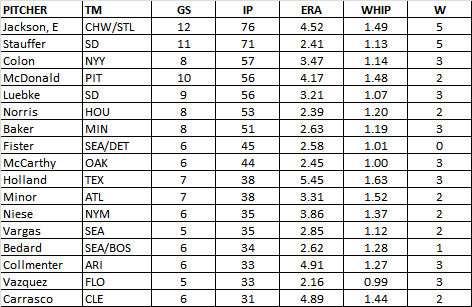
Let’s look now at the pitchers most frequently picked and how they did when selected.  Edwin Jackson was the Spot Starter of the Year having been picked 12 times.  I have long been a fan of his and after watching him for an entire year in Detroit, I liked him even more.  I was happy to see him breakout with the Tigers not only because that is my team, but also because I knew he had it in him.

His skills have improved in the years since, but the results haven’t always been there to match.  The same went for me when I picked him as a spot starter.  Despite finishing the year with a 3.79 ERA and 1.44 WHIP, I picked him for 76 innings during which he posted a 4.52 ERA and 1.49 WHIP with five wins.  His 6.8 K/9 and 2.6 K/BB during the 76 innings are right in line with his season-long 6.7 and 2.4 rates.

Two other pitchers surpassed double digits in terms of times picked: Tim Stauffer (11) and James McDonald (10).  Stauffer offered 71 strong innings with a 2.41 ERA and 1.13 WHIP while McDonald was similar to Jackson in his 56 innings with a 4.17 ERA and 1.48 WHIP.  Stauffer matched Jackson’s five wins, but McDonald netted just a pair.  It was another Padre who stood alone with nine starts.  Cory Luebke needed one fewer start to match McDonald’s 56 innings while his 3.21 ERA and 1.07 WHIP were among the best numbers for any pitcher.  Despite the strong numbers, he won just three of his nine starts.

Of the 86 pitchers who were picked in all, 17 were picked five or more times including the four covered above.  Those 17 pitchers threw 786 innings (50% of the total) pitching to a 3.37 ERA and 1.25 WHIP with 44 of the 85 wins.  The king of that bunch was Javier Vazquez, who posted a 2.16 ERA and 0.99 WHIP in five starts.  He would have made more appearances in the recommendations, but his availability surged at points during the season and he just wasn’t on the wire in enough leagues.

The worst of the five-plus start bunch was Derek Holland.  Despite his breakout season, I had horrible luck when picking him as he was totally boom or bust.  I mentioned his four earned runs in less than two innings (21.18 ERA) earlier, but he also had outings of 7 ER in 5.3 IP and 5 ER in 5 IP which contributed to his 5.45 ERA and 1.63 WHIP in 38 innings across seven starts.  He did give us three gems, though, including two 7 IP/1 ER starts down the stretch (September 14th and 20th).  I would be surprised if he found on the waiver wire of too many leagues from the start of 2012.

Here is the five-plus start bunch sorted by innings:

Poor Doug Fister.  He throws 45 excellent innings with a 2.58 ERA and 1.01 WHIP yet didn’t have a single win to show for it.  Despite how horrid the Seattle Mariners were for the year, they had three starters on this list and all three delivered fantastic numbers despite netting just three wins in 17 combined starts.

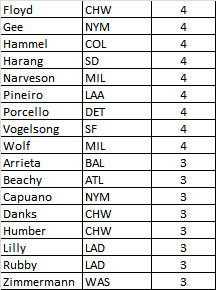
There were 17 other starters who were selected at least three times this year.  Here they are with just their times selected:

The rest of the breakdown saw 16 pitchers picked twice and 36 picked just once.

Obviously this strategy requires a specific set of league rules to pull off, but assuming your league doesn’t have stringent transaction or innings limits and allows daily moves, then this is a strategy that can be of significant value.  The upshot is that instead of spending early picks of the stud aces like Justin Verlander, Tim Lincecum or Cole Hamels, you continue to build your offense into a juggernaut.  There will still be plenty of pitching in the middle rounds to start your rotation, but then you leave your last pick or two to fill out the rotation and those will be your stream slots for spot starters.

I will run this again in 2012, so for those of who you enjoyed it this year, it will be back.  For those of you who want to try it out, you will have a shot to use my picks if you’d like.

Thursday: 12.15.2011

Trevor Cahill’s 2012 Outlook in Arizona

For a few days it seemed certain that Oakland A’s lefty starting pitcher Gio Gonzalez would be dealt in a blockbuster deal this winter.  The rumors were running rampant and frequent and had names attached to them like Jesus Montero and Dellin Betances from the Yankees, Mike Stanton or Logan Morrison as a centerpiece from the Marlins and Jacob Turner and Nick Castellanos from the Tigers.

Unfortunately for Oakland, none of those came to pass (the packages from New York and Detroit or even just Stanton from Florida would’ve been an excellent return for Gonzalez), but then out of nowhere it was their other budding star pitcher, Trevor Cahill who was dealt.  He was sent to the Arizona Diamondbacks with Craig Breslow for prospects Jarrod Parker, Collin Cowgill and Ryan Cook on December 10th.

The deal gives the reigning NL West champs a front three of Ian Kennedy, Daniel Hudson and Cahill without sacrificing any of the pieces they used to win 94 games and push Milwaukee to the brink in the first round of the playoffs back in October.  What will the move from the American League’s version of the west to the National League’s mean for Cahill?

He enters his age 24 season having pitched three full campaigns (at least 30 starts in each) that have yielded a mixed bag of results.  He was an All-Star and down ballot Cy Young candidate in 2010, but has sandwiched that breakout with two seasons of essentially league average work (96 and 97 ERA+ totals in 2009 and 2011).  Pitchers are generally expected to see an improvement when shifting to the National League just by virtue of the fact that they get to face their mound counterparts, but might Cahill have some natural growth within his talent profile, too?

His Pedigree

Cahill came up through the minors as a highly touted prospect for Oakland after being taken in the 2nd round of the 2006 draft.  He squeezed in nine professional innings after signing as an 18-year old and then proceeded to show why he was such a high pick in 2007 and 2008.  He made three stops in the two years (A, High-A and AA) throwing 230 innings with a 2.66 ERA, 1.09 WHIP, 9.9 K/9 and 2.8 K/BB.

His major league debut saw less than half of that strikeout rate show up as he fanned just 4.5 batters per game in 179 innings.  That said, the strikeout rate has crept up yearly since he reached the majors and last year’s 6.4 K/9 in his high watermark for now.  Perhaps given where he established that minor league strikeout rate, his progression in the majors should be less surprising.  More on that later.

His primary asset has been the ability to induce groundballs at an elite rate (56% the last two years) which the usually sure-handed defense of the A’s* translates into plenty of outs.  Combine that with a scant flyball rate in a spacious park and you can see why Cahill has enjoyed league average or better success in each of his first three seasons despite not yet topping 2.0 in his strikeout-to-walk ratio.

*The A’s defense had far and away its worst year since Cahill joined the team and not surprisingly his numbers suffered in concert.  His BABIP during the 2010 season was at .236 yielding a 2.97 ERA against a 4.19 FIP while his BABIP soared to .302 in 2011 pushing his ERA to 4.16 against a 4.10 FIP.  In other words, he was essentially the same guy each of the last two years, but he counts an exemplary defense for improved results.  Later we will see how Arizona’s defense might suit him in 2012.

The National League

When discussing strategy with mixed league fantasy baseball managers, you will often hear someone say they lean heavily toward starting pitchers in the National League as a general principle, especially if their other choice is a pitcher in the American League East.  Even if the NL pitcher is slightly less talented, a lot of times the deciding factor will be the league in which he pitches.  Is it worth it?  In general does leaning toward NL starting pitchers pay off?

Looking at the last three years, the answer is yes, but only marginally so.  Not enough to where I would knowingly take a less talented pitcher just because he is in the assumed safe haven of the National League.

As you can see, the difference in starting pitcher strikeout rates from league to league is about 0.2-0.3 in favor of the National League while walk rates are dead even.  The difference over 200 innings is a whopping three strikeouts (147 to 150).  So there isn’t a major difference in strikeout rate from one league to the other even with pitchers batting and striking out 33% of the time.  We saw this come to fruition in 2011 as the big pitchers who switched leagues saw inconsistent changes in their strikeout rates.
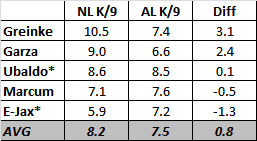
*Ubaldo Jimenez and Edwin Jackson both switched during the 2011 season resulting in smaller innings samples for each column while the others are all comparing their 2010 and 2011 full seasons.

Both Jackson and Shaun Marcum actually lost something on their strikeout rate when joining the National League while Marcum’s teammate Zack Greinke and their central division foe Matt Garza saw significant gains in their first season’s as National Leaguers.  Jimenez held firm moving from Colorado to Cleveland midseason.  It is a limited sample of pitchers for sure, but the point is simply that the National League doesn’t automatically yield a better strikeout rate.

What about the actual results?  Do we see a discernible difference in starting pitcher ERAs from league to league?
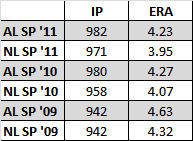
Overall, the league ERA in the National League has been 0.20 to 0.31 better during the last three years including 0.28 better in 2011.  So again there is a slight enhancement for National League-based  starting pitchers over their equal American League counterparts, but keep in mind that over 200 innings, it is a seven earned run difference and just five earned runs in a 150-inning sample.

There is still no compelling case to be made for taking a lesser talented NL pitcher over even a slightly more talent AL one.  If you use league home as a tiebreaker between two comparable players, then it makes sense to lean toward the National League as you should expect incremental gains in strikeout rate and ERA results.

Using Cahill’s 2011 results, he would stand to gain five strikeouts up to 152 and his ERA would shave seven runs off and move down to 3.86.  Those are simple quick and dirty estimates using his 2011 results against 2011 league standards.  This removes all of his context-based factors and assumes no growth.

His Home Park

Cahill leaves a park in Oakland well known for favoring pitchers and heads to Arizona to play in a park equally well known for its opposite effect on pitchers.  Neither is the best at what it is known for, but Cahill will now play in the division with the most renowned stadiums for each end of the spectrum: San Diego’s PetCo Park for pitchers and Colorado’s Coors Field for hitters.

Here is comprehensive look at the park factors for the divisions Cahill is leaving and joining using Baseball-Reference’s Park Factors for just 2011 as well as the last three years combined:

(-b refers to park factor for batters; -p for pitchers)

Overall the change is minimal with the biggest difference being his less favorable home park, but his severe groundball tendency combined with the boost from the National League should mitigate most of it, especially since that doesn’t even take into account his potential to improve as a pitcher.  Meanwhile, he essentially trades Texas for Colorado.  Of course, Texas never really bothered him as he posted a 2.23 ERA and 2.1 K/BB rate in 40 innings (his highest count outside of Oakland) there.

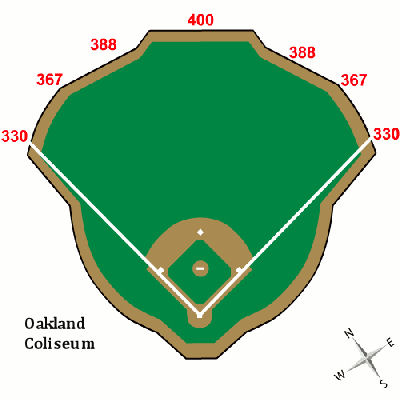
The outfield dimensions of Chase Field as compared Oakland Coliseum are unlikely to impact Cahill negatively.  In fact, Chase Field is deeper in almost every respect.  Where Oakland Coliseum derives a great deal of its love from pitchers is in the foul territory.  The expansive room available to make plays on balls that would otherwise be souvenirs in most other stadiums has saved many an Oakland pitcher.  It is hard to derive how much of an impact, if any, that will have on Cahill in 2012.  While I can find how many of his pitches turn into foul balls, I can’t find how many of those foul balls result in outs.

His Defense

As I mentioned earlier, Cahill relies heavily on his defense.  With a 56% groundball rate, a sharp infield offense is key to his success.  In 2010, the top four fielders in UZR on the A’s were Cahill’s infielders: Kevin Kouzmanoff 16.1 at 3B, Daric Barton 12.1 at 1B, Mark Ellis and Cliff Pennington at 9.9 apiece at 2B and SS, respectively.  Of the four, only Ellis played fewer than 1231 innings (986) and the most important cog, Pennington, played 1304.

On the 2011 A’s, Ellis and Kouzmanoff were the top two rated infielders in UZR with 2.1 and 2.0 marks in 501 and 365 innings, respectively.  Ellis was traded to Colorado to make way for youngster Jemile Weeks while Kouzmanoff was only in the lineup throughout 2010 because of his glove (.296 wOBA) and yet somehow got worse with the bat in 2011 (.271 wOBA) before eventually being traded to Colorado as well, though in a separate deal from Ellis.  Meanwhile Pennington regressed to previous defensive levels with a -5.2 UZR in 1272 innings, which is more in line with his -4.7 and -4.5 marks from 2008 and 2009.

The aforementioned Weeks had a -4.1 UZR as the primary second baseman and Scott Sizemore was a team worst -6.0 UZR at third base.  Both added a Bondsian level of offense compared to their predecessors, though, so the offensively-starved A’s had to overlook their defensive shortcomings.  This no doubt affected Cahill en route to a career-worst .302 BABIP.  While that isn’t too far off of the average (.299 in the AL), Cahill needs to be above average there until his base skills (missing bats and limiting free passes) improve.

The Diamondbacks were first in baseball in UZR at 55.8 in 2011.  Good news for Cahill, right?  Yes, but not as good as that one piece of information suggests.  The bulk of Arizona’s UZR goodness is built off of their strong outfield defense: Chris Young 14.1 in CF, Gerardo Parra 9.8 in LF and Justin Upton 7.7 in RF.

But right behind those three is shortstop Stephen Drew at 4.5.  His season was cut short by injury, but backup shortstop John McDonald turned in a 4.0 UZR, too.  Drew has been above average each of the last three years including an 8.7 UZR in 2010.  Keeping him healthy will be essential because he not only picks it, but he is a far better with the bat than McDonald.

Aaron Hill has a very strong defensive track record with a 21.7 UZR in six seasons of work and just one season below average (-4.9 in 2009).  Ryan Roberts broke out in his first full season of play both at the dish and in the field.  He spent the bulk of his time (902 of 1132 innings) at third base and acquitted himself well enough with a 1.7 UZR.

Defensive numbers can fluctuate year-to-year so while the Diamondbacks might not finish first in the league again in 2012, it is nice to know that all of Cahill’s new infielders have track records to back up their 2011 performance.  This is a net gain for Cahill, especially with the A’s placing a premium on bat production in lieu of quality fielding (and who can blame them?).  Lucky for Cahill and Arizona, their slick fielders can handle the bat, too.

His Bullpen & Offense

These two factors only really contribute to his potential win count, the predicting of which is generally foolish because of how inconsistently they correlate to quality pitching.  More to the point, wins aren’t really something that starting pitchers can control because even if they pitch well for their allotment of innings, they need the bullpen to hang on.  And even if the bullpen keeps their masterpiece intact, the offense needs to have earned enough runs off of the opposition’s starter and bullpen, too.

For the sake of full disclosure, let’s quickly look at both aspects.  The bullpens were equal for intents and purposes in 2011 and both have the talent to do the same again in 2012.  Any major differences between the two would come from fluctuating luck or a change in personnel.  As it stands right now, Cahill will see no discernible gain or loss in bullpen support with the trade.  Projecting forward he was more likely to lose out by staying in Oakland as they continue to discuss potential trades involving Andrew Bailey.

There seems to be a real improvement in his team offense with the move to Arizona as evidenced by the 2011 numbers of the two units:

Of course, that still doesn’t mean he will have an increase in wins.  Consider his 2010 season.  He went 18-8 and while the Oakland offense was better than the dreadful 2011 iteration, they still only scored 4.1 runs per game.  Logic and wins don’t mingle well.  Yes, you can probably afford to pitch a bit worse and register an above average win total with an offensive stalwart like the Yankees supporting you, but then you see Aaron Harang win 14 games with the Padres who scored a whopping 3.7 runs per game in 2011.

Cahill’s bullpen support remains strong and his offensive support is improved, but don’t let either have a significant impact in your 2012 analysis for him.

His Improvement

We have taken a look at all of the outside factors that could contribute to Cahill’s success or failure in 2012, so what about the factors he can handle?  He showed during his minor league career that he can be a dominant strikeout pitcher, but you have to consider that the bulk of that work was done in the lower minors.

He skipped AAA before making his debut (subsequently logged 9 AAA IP in 2010) and posted a career-low 8.0 K/9 in a quick 37-inning stint in AA at the end of 2008.  So while the gaudy 9.9 K/9 in 247 minor league innings is nice, you have to adjust more than you would normally take off for a pitcher who had a strikeout rate like that with some significant work in AA and AAA.  Going from 9.9 to the 4.5 of his rookie year would have been hard to project, but he deserves credit for not crumbling under the pressure as a 21-year old who essentially came from High-A.

His improved strikeout rate seems to correlate well with the effectiveness of his curveball.  I took a look at him early this season after just two starts because I noticed that his curve was generating a lot of swinging strikes.  In fact, he continued to use his curveball effectively throughout the season.  He used it 4% more than in 2010 (24%) and it generated a swing 5% more often (52%) resulting in strikes 5% more often (67%), 1% of which were swing-through strikes or whiffs (14%).  His 2011 data; 2010 data.

This piece by David Golebiewski at Baseball Analysts looks at Cahill’s year on the whole and examines both his curveball and slider together leading to a similar conclusion that they are the key to an elevated strikeout rate for him. More to point, keeping them down so that hitters swing over the top of them will allow Cahill to generate more strikeouts as he continues to mature.  Plus, the worst case scenario on a well-placed breaking pitch low in the zone is weak contact in the infield which shouldn’t be too problematic for the Diamondbacks fielders to handle.

He has posted a 3.6 BB/9 in two of his first three seasons which is in line with his 3.7 BB/9 mark as a minor leaguer, but the 2.9 BB/9 shows that there is room for improvement.  He is unlikely to become Cliff Lee with his control whether now or in the future, but even incremental improvement toward that 2010 mark would be help his gaudy 1.43 WHIP.

His 2012

I really like Cahill’s outlook for 2012.  I would have liked it in Oakland, too, but the move to Arizona only helps matters.  Despite the bouncing ERA from 2.97 to 4.16, he was virtually the same exact pitcher in 2010 and 2011.  In fact, his secondary numbers say just that:
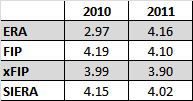
It is hard not to be impressed with what he has accomplished as a 21 to 23 year old in his 583 career innings.  He only has the one standout season from a fantasy aspect, but there is a burgeoning skill set worth buying into just as the Diamondbacks did with the trade.

I see him with a ceiling of around seven and a half strikeouts per game, though we may only see another incremental gain in 2012.  We have probably already seen his best walk rate at 2.9 in 2010, but he can get there again and it could be as soon as 2012.    Add in the improved defense closer to what he enjoyed in 2010 and I think we see something like in the following ranges for Cahill in 2012:

ERA: 3.60 – 3.92 (a spread of 7 ER in 200 IP)

WHIP: 1.24 – 1.30 (a spread of 13 base runners in 200 IP)

K/9: 6.7 – 7.5 (149-167 Ks in 200 IP)

BB/9: 2.9 – 3.4 (65-76 BBs in 200 IP)

W: these projections are enough to net 15+, but always remember that wins are unpredictable

I chose to do ranges because the accuracy of firm numbers is so low and the difference in actual performance between those ranges is pretty reasonable across a 26-week season as you can see from the information in parentheses next to each category.  Cahill is currently the 44th starting pitcher off the board in early mock drafts at MockDraftCentral.com which puts him in the 13th round at 164 overall.

Right now I don’t hate him at that 164th spot, but I think that is full price and I would opt to wait for some of the names behind him Doug Fister (180), Jaime Garcia (193), Derek Holland (197), Matt Moore (203), Javier Vazquez-assuming he doesn’t retire (246) and Ricky Nolasco (258) to name a few.  I see some, if not all, of those names eventually passing Cahill in ADP along with Yu Darvish (206) depending where he ends up.

In a mock draft (14-team mixed league) I’m currently involved in, I got him in the 21st round with pick 286 which I thought was a steal.  I suspect as more players get signed and we get closer to draft season his ADP will dip lower than 164 making him something of a bargain.

Wednesday: 11.23.2011

Is Playoff Hangover Real for Starting Pitchers?

Analyzing and subsequently choosing starting pitchers for a fantasy baseball is more art than science these days.  There are tons of different theories, hypotheses, principles, concepts, philosophies, ideas, notions and axioms that fantasy managers will subscribe to and often the landscape becomes so jumbled that some of these will overlap or outright contradict another.  One such adage is that starting pitchers on teams that make a deep run into the playoffs are susceptible to a level fatigue that non-playoff pitchers avoid.

It is kind of a tributary of the Verducci Effect.  The Verducci Effect warns that pitchers under 25 years old who see their inning workload increase by 30 or more innings are subject to regression in performance often because the season is cut short by injury, but also the innings they do pitch aren’t on par with the previously set watermark.  The Playoff Hangover, which doesn’t have nearly the traction of the Verducci Effect, doesn’t have age limits or even any hard and fast inning requirements.  The loose concept is that the extra month of pitching and late start to the offseason could make a pitcher subject to performance degradation the following year.

The logic behind this supposition is sound enough on its face, more pitching + less rest = worse followup… OK, not outrageous .  It isn’t hard to envision how a longer season with a 20-35 extra innings (depending on the caliber of pitcher and how far their team goes) could have a negative impact on a starting pitcher, especially in this day and age when pitch counts and inning workloads are at the fore and the focus on protecting pitchers is at an all-time high.

But how does the theory play out in practice?  Nominally the best teams in the league make the playoffs and then the best of that bunch advances on into the League Championship Series and eventually the World Series.  Of course it takes a strong rotation to do this so it would stand to reason that often the pitchers on these teams advancing round-to-round are among some of the league’s best.

The relevance here is that the sample of pitchers isn’t likely to be riddled with injury washouts and subpar hurlers fit for the backend of second division teams.  Should an extra 25 innings from a Texas Ranger or St. Louis Cardinal starting pitcher impact their 2012 projection and ranking this offseason?  Does a lengthy playoff run portend performance degradation the following year?

To observe the potential effects of deep playoff runs, I looked at the inning output year-to-year of the starting pitchers for teams making it to the LCS in each league.  If this potential hangover had any substance, it would likely show itself in the form of injury resulting in decreased workloads for the parties involved.  I looked at the starting pitchers from the 12 LCS teams since 2008 which yielded a sample of 29 starters who all threw at least 12 playoff innings and averaged 23 as a group.

Of that group:

  • 16 of 29 (55%) saw their innings decrease the following year
  • 8 of the 16 (50%) saw what I would term a “marginal” decrease in workload (fewer than 20 innings) and averaged 204 innings as a group
  • 1 of those 8 (13%) threw fewer than 195 innings (Scott Kazmir with 147, after 152 during the playoff year)
  • 3 of the 16 (19%) saw what I would term a “marked” drop in workload, 20-35 innings, but that group still averaged 198 innings
  • 10 of the 16 (63%) threw what I would term “full seasons” of work averaging 208 innings
  • 5 of the 16 (31%) saw what I would term a “major” drop in workload, 50+ innings, due in large part to injury
  • 1 of those 5 (20%) threw a career high in innings during their playoff year
  • 0 of those 5 (0%) were within the generally accepted injury risk age range of 25 years or younger
  • The group of 5 averaged 32 years old while no one was younger than 28
  • 13 of 29 (45%) saw their innings increase the following year
  • 8 of the 13 (62%) saw a marginal increase in workload (fewer than 20 innings) and averaged 219 innings as a group
  • 2 of the 13 (15%) saw a marked increase in workload (20-35 innings) and averaged 219 innings
  • 2 of the 13 (15%) saw what I would term a “legitimate” increase in workload (36-49 innings) and averaged 214 innings
  • 1 of the 13 (8%) saw a major increase in workload (50+ innings) as Madison Bumgarner threw 94 more major league innings the following year.  That is admittedly skewed because he truly threw 193 innings in 2010 if you count his minor league total.  In that case, his workload increase would be 12 innings from 2010 to 2011.
  • 3 of the 29 appear in both ends of the pool including Cole Hamels (who actually appears twice increase pool and once in the decrease pool), CC Sabathia and Cliff Lee.

Are there any great lessons to be learned within these results?  It would seem not as far as I can tell.  We saw a total of 17% injury attrition from the group (5 of 29) and while that isn’t a meaningless figure, is there any indication that it had anything to do with the extra work in the playoff year?  They were all established veterans and only Jonathan Sanchez had reached previously untouched heights in terms of total workload.

Starting pitchers are inherently risky which is why you don’t see them populate the early rounds of drafts despite how often several of them finish among the top 25 in fantasy value in a given year.  We are always looking for advancements in analyzing and projecting pitchers year to year and attempts to show how workload impacts performance is currently the primary focus.  So while it might make some logical sense to concoct a theorem whereby deep playoff runs under the most intense spotlight the game offers will eventually hamper a pitcher in the subsequent year, it doesn’t seem to hold up as a bankable red flag.

Further damning the notion is the fact that it is only brought up in the context of the playoffs whereby fall and winter leagues, probably because of their scant coverage, aren’t thought of as future hindrances. While the pitchers in the Arizona Fall League or Venezuelan Winter League aren’t up to the caliber of the MLB Playoffs on the whole, each league will funnel impact players into the league for the 2012 season.

Any proof that an extended playoff run contributed to an injury-shortened season the following year would like be offered retrospectively and thus downgrading a Chris Carpenter or CJ Wilson (who pitched the most playoff innings in 2011 at 36 and 28, respectively) because of their team’s run through the World Series would be foolhardy and most of all, arbitrary.

Carpenter is37 years old with a checkered injury history on the heels of back-to-back 235+ inning seasons, something he has never done, so there is reason for caution with him, but if he does succumb to injury at any point in 2012 it isn’t likely to be related to the extra playoff innings.  Wilson, who only recently transitioned to starting, will soon be rewarded for excelling in that transition and who knows how a new environment, fame, heaps of money and lofty expectations will impact him in 2012?  But if he is felled by injury next season, I don’t see his 28 playoff innings anywhere near the top of the suspect list.  Happenstance and bad luck should be brought in for questioning first.  Especially in light of the fact that Wilson went from 74 relief innings in 2009 to 204 innings as a starter in 2010 (plus 24 playoff innings) to 223 (and 28) in 2011 without incident.

The Playoff Hangover Panic is a tool of revisionists retrofit onto a poor performance when no obvious explanation exists.  Thus you won’t see any concerns in the 2012 Starting Pitcher Guide around the elongated seasons of Carpenter, Wilson, Jaime Garcia, Derek Holland, Colby Lewis, Justin Verlander, Yovani Gallardo, Edwin Jackson, Matt Harrison, Zack Greinke, Doug Fister, Max Scherzer, Rick Porcello, Kyle Lohse, Shaun Marcum or Randy Wolf, all of whom threw 10+ playoff innings as their teams reached the LCS.

Tuesday: 09.20.2011

Trolling the Wire: The Finish Line

(Ed. note: – That’s embarrassing… this was supposed to go up at 11:30 AM yet it was scheduled for 11:30 PM by accident… sorry for those of you who needed guys today.  However I’ve used Holland and E-Jax so often that you probably could’ve guessed they would be the picks. )

Just about a week left (season ends Wednesday, September 28th) and while there might not be a lot of undecided races in Major League Baseball, there are still plenty of undecided winners in fantasy leagues everywhere.  Just within my own leagues there is one where five teams are split by just 6.0 points and another where three teams split by 6.5 points.  And of course any head-to-head league comes right down to the wire.

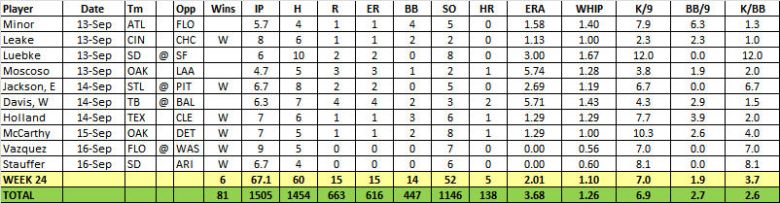
Last week’s spot starter picks did quite well if I may shed any modesty for a moment as they posted a 2.01 ERA and 1.10 WHIP in 67 innings.  Just one of the 10 pitchers gave up more than three runs (Wade Davis, 4) and six gave up one or none so in a week when getting the best out your last remaining starts is especially crucial, these guys came through.

The Hail Mary picks

In theory every game counts the same, but in April or even August you have time overcome nightmarish starts, but with nine days left in the season it’s do or die.  One implosion can end your chances depending on the league standings.

With precious little time left, I’m focusing only on prime picks.  If you’re in Hail Mary mode just about anyone with a pulse will qualify so I don’t think I need to highlight those guys.  I’m going for the best and best (or best of the rest as it were since these are guys on many waiver wires).

TUESDAY:

Derek Holland (TEX @ OAK) – Holland has been mostly good to us and a start in Oakland is pretty close to a no-brainer with someone of his talent.

Edwin Jackson (STL v. NYM) – He’s been a stalwart for those who stream pitchers because no matter how well he pitched, he couldn’t seem to get any real respect this year.

WEDNESDAY:

No one of noteJavier Vazquez finally had his ownership rate move up significantly and it is now 73% so he is no longer available to us spot start players.  Some marginal guys I considered that would be upper tier Hail Marys include Brad Peacock, Brandon McCarthy and Wade Miley

THURSDAY:

Still no onePhilip Humber and Jeff Niemann are among the few longshot options, but Humber has been very inconsistent since the All-Star break and Niemann has the Yankees. 

FRIDAY:

Josh Collmenter (ARI v. SF) – A favorable matchup against a weak lineup (in a huge game for both teams, of course) and he has walked just three in his last five starts (all in one start against San Diego).

Matt Harrison (TEX v. SEA) – An even better matchup than Collmenter and while his control isn’t as sharp, his propensity for strikeouts is a bit higher.

SATURDAY:

Aaron Harang (SD v. LAD) – I have covered Harang at home on more than one occasion, he’s money at home.

Joe Saunders (ARI v. SF) – I know what you’re thinking, you thought I wasn’t going with risky plays here down the stretch, but Saunders has been money for a nice stretch and I like him against a weak lineup even if the game means a ton for both teams.

SUNDAY:

Mike Minor (ATL @ WAS), Edwin Jackson (STL v. CHC), Bud Norris (HOU v. COL), Derek Holland (TEX v. SEA) – All four have been staples on the Trolling so I don’t feel I really need to sell you on them with commentary.  If you have been streaming for any period of time, chances are you have used one or more of these guys on multiples occasions.

Monday-Wednesday later this week when the spots become official.

Monday: 09.12.2011

Trolling the Wire: Week 24 Tuesday-Friday

I didn’t love anyone for tonight’s games so this week’s Trolling will focus on Tuesday through Friday.  As with Sunday’s picks, I will mention some Hail Mary picks throughout that you can consider if you’re desperately trying to make a move.  I’m not counting these in my actual tally because while they are calculated picks that have enough upside to deliver, they are only being mentioned for the most dire of situations.

I will show you the weekly results with and without them just for fun, but note that the official numbers at year’s end will not include the longshot picks from Sunday and the rest of the season.


TUESDAY

Standard:

Mike Minor (ATL v. FLO) – He has gotten some dirty wins and his 3.58 ERA the last month (28 IP) isn’t off-the-charts great, but I love the strikeout potential with 30 in those 28 IP & 8.2 K/9 for the year.

Mike Leake (CIN v. CHC) – He just threw a complete game giving up two runs on three hits against these Cubs and he has a 2.74 ERA and 3.5 K/BB in 23 innings (3 starts) against them this year.

Cory Luebke (SD @ SF) – Up and down lately as the rookie seems to be hitting a bit of a wall (no more than 6 IP in last 6 starts).  Alas he remains a strong strikeout asset.  Despite three straight losses, he is still a worthy option, especially against the Giants.

Guillermo Moscoso  (OAK v. LAA) – Home: 6-2, 2.26 ERA, 0.92 WHIP and 2.5 K/BB; road: 2-6, 4.82, 1.43 and 1.2.  Let’s play the numbers here.

Hail Mary:

Dillon Gee (NYM v. WAS) – He has been too inconsistent lately as he too may be suffering from the proverbial rookie wall, but he has three straight outings with six strikeouts and he is markedly better at home with a 3.18 ERA against 5.59 on the road.


WEDNESDAY

Standard:

Edwin Jackson (STL @ PIT) – I don’t understand how someone can be as good as he has been this season yet still have ownership rates below 50% at multiple outlets.

Wade Davis (TB @ BAL) – On the heels of a complete game effort with two earned runs against the Red Sox, Davis earns a look against an inferior opponent by comparison.

Derek Holland (TEX v. CLE) – The human rollercoaster.  Someone this inconsistent might be best suited for a Hail Mary, but I believe in his immense talent.  He laid an egg last time out against the Indians, but I think he gets them back.

Hail Mary:

Randall Delgado (ATL v. FLO) – Ultra-talented rookie against a lame Marlins team could end well.  He has been limited innings-wise in his first couple of starts since the recall, but he has also looked strong.

Bud Norris (HOU v. PHI) – Normally a standard pick, but against Roy Halladay his chances at a win are severely limited while the Phillies offense has become more imposing as the season has developed.

Rich Harden (OAK v. LAA) – He has crazy strikeout potential, but I think everyone has had him on their team at one point or another and knows just how maddening it can be.  Tread cautiously.


THURSDAY

Anibal Sanchez is still only on 72% of teams at ESPN.  I won’t count him as a pick because he isn’t widely available, but check your league just in case.  He should be back at 100% the way he has been throwing the last month.

Standard:

Brandon McCarthy (OAK v. DET) – Hate to go against my Tigers not only because they are my favorite team, but also because they have been rolling lately.  However, McCarthy has also been rolling and he could stop the locomotive known as the Tigers, especially at home.

Hail Mary:

Homer Bailey (CIN v. CHC) – Strong skills, but gopheritis continues to bite Bailey year after year.  A career-best 3.2 K/BB is worth buying into and it’s been even better the last month with a 5.8 K/BB powered by his 8.2 K/9 in 38 innings.


FRIDAY

Standard:

Javier Vazquez (FLO @ WAS) – I have been rolling him out weekly and it continues this week, though his ownership rate has finally crept above 60%.  Still too low.

Tim Stauffer (SD v. ARI) – Another hometown hero with a 2.76 in PETCO against a 4.95 mark on the road.  The skills are significantly better, too, with 6.5 K/9 and 3.4 K/BB marks at home against 5.7 and 1.7 on the road.  I thought he could be an any venue kind of guy, but it hasn’t played out that way in 2011.

Hail Mary:

Felipe Paulino (KC v. CHW) – A microcosm of his inconsistency can be seen in his last two starts: shuts down the Mariners in Seattle and gets crushed by the A’s in Oakland.  Strikeout potential is significant.

Sunday: 09.11.2011

Sunday Spot Starters

For many teams, Sunday could mark the end of their 2011 season.  Head-to-head leagues are in the playoffs and teams facing elimination will need their team’s best effort to advance on.  Hopefully enough categories are close enough to make winning a possibility as opposed to an unthinkable long-shot.

Since there will be different situations across leagues on Sunday, I will break the picks up between all-in picks and standard picks.  All-in picks are for those who need a miracle and just need to pile up strikeouts, win chances and hope for the best with the rates.  They will want to scoop as many standard picks as they can, but they may also need to dip into the all-in ones depending on availability.

Standard Picks: recommended for anyone employing spot-starting this season.

Javier Vazquez (FLO @ PIT) – He has allowed more than three just once since June 12th, I have no idea how he isn’t on more teams.  He is easily the #1 spot start for Sunday especially with a favorable opponent.

Josh Collmenter (ARI v. SD) – I remain stunned at how little love he has gotten this year even as his sample of quality of work expands.  He is still too available in my opinion.  He has been really sharp since a flameout start to begin August allowing no more than two runs in any of his six subsequent starts.  Throw in a very favorable opponent and he is an easy auto-start.

James McDonald (PIT v. FLO) – Obviously recommending opponents against each other limits the amount of wins you could possibly get, but Vazquez also might be on a team in your league whereas McDonald isn’t as likely to be on one.  He hasn’t quite been as sharp as Vazquez of late, but he hasn’t given up more than three runs since August 5th.


All-In Picks: recommending only for team managers desperate to make an impact whether in their final day of their H2H battle or in the waning days of their roto league.

Jake Westbrook (STL v. ATL) – The Braves are reeling having lost 7 of 10 while Westbrook was really sharp his last time out including nine strikeouts.  It was the first time he struck out more than four since July 15th.

Zach Stewart (CHW v. CLE) – After two shellackings, he went & threw a one-hit shutout with nine strikeouts against Minnesota in his last outing.  The odd thing is that one of the shellackings was doled out by the Twins.  He has shown both his upside & downside.  Like the Braves, the Indians are 3-8 in their last 10.

Edinson Volquez (CIN @ COL) – First off he is starting in Coors Field which is enough to make this a Hail Mary pick, but also consider that he is returning from the minors where he was sent for poor performance.  However anyone with any knowledge of Volquez knows just how good he can be so it might worth taking the chance that he returns to the majors with a bang.

Thursday: 09.8.2011

Fight for 15

I mentioned in part one of my top 15 starting pitchers for 2012 that deciding on the 15th guy was a bit of a task.  I had several guys who I felt could have reasonably been slotted there and eventually landed on Johnny Cueto.  There is no denying the fact that he hasn’t really earned his 2.05 ERA this year, as evidenced by his 3.87 xFIP and 3.78 SIERA.

That said, he is far from a shlub at the same time.  He has seen an 11% increase in his groundball rate to 53% with only some deterioration to his strikeout rate (down from 6.7 to 6.2 K/9).  In fact his strikeout rate has been up and down all season, but it was at a very impressive 8.1 per game over the last month.  The great part is that the uptick came without any damage to his groundball (held at 53%).

The 40-inning sample over the last month is small in the grand scheme, but I do believe Cueto can hold the groundball gains while also working his way into a consistent strikeout rate between 6.7 and 7.2.  I wasn’t merely blinded by the shiny ERA when I ranked him 15th, rather I believe in his talent and have been impressed in the starts of his I have seen this year.  That said, I stand by the fact that there were many candidates for the spot and I wanted to address them for those who were wondering.

Here they are in reverse order:

Jaime Garcia (STL) – It was more of a cursory thought to put him in at the 15-spot.  The quickness of the thought has nothing to do with the fact that he had a poor stretch in August.  If I was going to put him there, a bad month wouldn’t have dissuaded me, just as a great month wouldn’t elevate someone undeserving like Mark Buehrle into the discussion.

In the end, Garcia just didn’t stack up against a host of his peers.  He did have some modest gains on his breakout rookie season toting a near-3.0 K/BB while sustaining most of the 56% groundball rate we saw last year.  The WHIP is still problematic at 1.36, but the climb in hit rate might be linked to a worse infield defense for the Cards which they will hopefully address this offseason given their rotation.

Josh Beckett (BOS) – Beckett was easily identifiable as a regression candidate who in turn could be a fantasy star because of how much last year’s 5.78 ERA depressed his value.  He has exceeded even my wildest expectations with a 2.49 ERA and 0.98 WHIP in 174 innings, but a lot of it has been his BABIP, LOB% and HR/FB rates swinging all the way back to the opposite end of the spectrum this year.  For as unlucky as he was last year, he has been equally as lucky this year.

That said, the skills remain strong (8+ K/9 yearly saved 2006’s 7.0; K/BB below 2.6 just once in career) and as a part of the Boston Red Sox he should always have a shot at a nice win total as long as he stays healthy and makes 30+ starts.  But he is also a perpetual risk for at least a spell on the disabled list or a skipped start or two and his wildly inconsistent BABIP, LOB% and HR/FB rates in the face of the solid skills make it hard to put him in the top 15.

C.J. Wilson (TEX) – Who had this one pegged?  Just as he appeared to be coming into his owner as an ace late inning reliever, it was announced that Wilson would shift to the rotation and become a full-time starter.  Few, if any, had high expectations for this experiment yet he put together an impressive 204-inning debut as a starter last year with lone wart being his league-leading 93 walks.  Alas many remained skeptical, myself included calling for a 4.00ish ERA, for various reasons.  Wilson made significant improvements across the board and he is now a strong option atop a fantasy staff, but at 30 he lacks both the skill and upside of top 15ers.  However, that is a more of a commentary on how strong the pitching pool is these days as opposed to a knock on Wilson.

Yovani Gallardo (MIL) – Often when you see a young flamethrower fanning one or more batters per inning, his walk rate is around four or five a game.  While he may have electric stuff that can fool even the best big leaguers, he rarely knows exactly where it is going himself resulting in plenty of free passes, too.  If this type of pitcher is to become a reliable frontline starter and reach his true potential, you will see that strikeout rate tick down yet remain strong, while the walk rate sees major improvement.

This profile explains Gallardo who saw his strikeout rate dip to 8.2 after marks of 9.9 and 9.7 in his first two seasons.  His walk rate has improved drastically year to year, too, starting at 4.6 in 2009 before dropping to 3.7 last year and a much more palatable 2.7 this year.  At 25, Gallardo hasn’t yet reached his ceiling and we could still see him jump another level or two.  He’s getting better, but the best is yet to come.

Shaun Marcum (MIL) – I have nicknamed him “The Anti-Booster” as he has seen his strikeout and walk rates both erode despite leaving the hardest division on the planet for the much cushier NL Central.  The losses have been marginal (0.3 K & 0.5 BB), but it still interesting to someone with his skill get away from the AL Beast and not experience a spike in performance.  Sure, his ERA improved over a half of a run, but that’s clearly artificial when you look at the complete picture.  He strikes me as someone who will chronically be underrated and while he may never have that transcendent season that would bring deserved respect, he will continue to be a strong #2 fantasy asset coming at the price of a #3 or at least at the very end of the #2s.

Ian Kennedy (ARI) – After showing last year why he was so hyped as a Yankee farmhand, Kennedy has shown incremental improvement in his skills, but monumental improvement in his results.  Flyballs and specifically the home runs that result from them were his big issue last year, but he sliced 5% off of his flyball rate this year and with that his HR/9 dropped by 25% to 0.9 per game.  He has no doubt advanced a bit in 2011, but he can’t quite be relied upon for a sub-3.00 ERA going forward just yet.  He might not even be the top choice on his team for 2012.

Daniel Hudson (ARI) – His season is all the more impressive when you consider that he had a 5.30 ERA on May 1st after he allowed three runs in seven innings against the Cubs.  Since then he has gone 157 strong innings with a 3.10 ERA still hitting some bumps in the road which is what you would expect from a 24-year old in his first full season in the majors.  Some fantasy managers might be upset with the loss of a full strikeout down to 6.9, but the savvier manager is happier about the sub-2.0 walk rate.  An 8% dip in flyball, 7% of which went directly to his groundball, is arguably the most impressive development for Hudson this year.  For now he simply doesn’t have the track record to merit a top 15 position just yet, but this is a growth stock that is definitely worth buying into for the immediate future.

Ricky Romero (TOR) – Despite the huge dip in ERA from 3.73 to 3.01, Romero has essentially been the same pitcher in 2010 and 2011.  The main differences in his season have been a 40-point drop in BABIP and a massive 11% jump in LOB%.  That LOB% jump more than covered his 3% in HR/FB resulting in the improved ERA.  I am still a huge fan of the 26-year old lefty and feel that he has plenty of growth potential going forward.

Whether he deserved it or not, the improved results have paid huge dividends especially since he was underrated coming into the season.  I mentioned in my SP Guide that he was being listed behind the likes of Trevor Cahill, Jhoulys Chacin and Jeremy Hellickson at ESPN and he has thoroughly outclassed all three with Hellickson being the only one anywhere near him in results thanks to a wholly undeserved 2.90 ERA (4.24 FIP, 4.51 xFIP & 4.42 SIERA).

Matt Garza (CHC) – I may have reacted like a jilted lover when it came to forecasting Garza for 2011.  After diving headfirst into the front seat of his bandwagon for 2010 and projecting an elite season, I was left cold and unimpressed by essentially a repeat season (0.04 ERA & 0.01 WHIP improvements) replete with a nearly two strikeout dip and a third straight year of declining groundball rate.

I was worried about the new flyball-heavy Garza heading into Wrigley Field, even in light of the inherent National League strikeout boost.  Two straight years of 1.1 or worse HR/9 and a rising flyball rate would spell trouble in the Windy City especially when combined with Garza’s fiery attitude.  But he changed.  He has seen a major uptick in strikeouts with a career high 9.3 mark, but most importantly his groundball rate skyrocketed up 11% to 46%, a career high for a full season, yielding career-best 3.52 ERA that isn’t even as low as it should be given how well he has pitched.

Career worst BABIP and LOB% rates have teamed up to keep his ERA nearly a half run higher than his components suggest (3.16 xFIP & SIERA).  He had displayed little variance in his year-to-year BABIP and LOB% during his first three full seasons which is why this year screams aberration.  If his strikeout and groundball rates aren’t also aberrations, he might finally be in line for that huge season I saw coning in 2010.

Zack Greinke (MIL) – His was the name I heard most when it came to that 15 spot or being included somewhere within the top 15.  I definitely understand it and he was on the list during various iterations.  I made the move to Cueto late leaving Greinke on the outside, but the more I look at it the more I think a change may be in the offing.  I didn’t just look at his ERA and slot him 16th, I am well aware of the fact that he has been much better than his 3.93 ERA.

All of his component skills scream a sub-3.00 ERA, but he has struggled with runners on for a second straight season and his four years of HR/FB fortune seems to have bit back hard all at once this season with a 14% mark.  In the end, 10.4 K/9 and 5.1 K/BB rates are downright nasty and they carry the day as he should definitely improve going forward just as did as the 2011 season wore on.

Wednesday: 09.7.2011

Trolling the Wire: Week 23

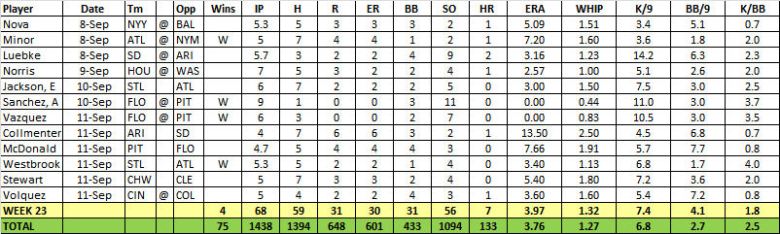
The selective approach to last week’s Trolling picks paid off for us as the 10 starters logged a healthy 2.52 ERA, 1.02 WHIP and 3.5 K/BB rate.  That isn’t to say I wasn’t aiming for precision with my in-season picks, but the risk threshold has definitely been tightened as we wind the season down because there is less time to come back from implosions.

Monday was the holiday and then I couldn’t get it done before Tuesday & Wednesday day games because of the day job so here are picks for Thursday-Saturday.  Apologies for those of you who needed M-T-W picks.  I’m already working on Week 24 so I have it ready to go right away this weekend along with some Sunday picks on Friday or Saturday of this week.

THURSDAY:

Ivan Nova (NYY @ BAL) – Three straight 7 inning starts in which he allowed just five runs (2.14 ERA) and netted three wins.  In fact, he has won eight straight starts only one of which was anything close to bad (7 ER in 5.3 IP at KC).

Mike Minor (ATL @ NYM) – He carries some risk as he has been a bit inconsistent mixing in a few 4-5 ER starts in with really good ones.  The one constant has been his strikeout rate (8.6 K/9) so if that is a need for your team, he is an auto-start.

Cory Luebke (SD @ ARI) – I have been a fan of his all year, but there may be more risk than you want to take on if you’re protecting ratios.  Two things working against him are that his two starts against Arizona haven’t been very good (7 ER in 11 IP) and his last two starts (one of which was an Arizona start) haven’t been great (8 ER in 10 IP) and some speculate he may be hitting a wall.  I’ll stand firm as the strikeouts remain strong and I think it is more of a bump in the road than something due to fatigue.


FRIDAY:

Bud Norris (HOU @ WAS) – He is a perfect spot starter with an ERA nearly a full lower against the bottom feeders (3.44 against sub-.500 teams; 4.37 against better than .500 teams).  His strikeout rate of nearly one per inning remains enticing, too.


SATURDAY:

Edwin Jackson (STL v. ATL) – He has a 3.44 ERA with the Cardinals despite the 8 ER beatdown in Milwaukee in his second start with the ballclub.

Anibal Sanchez (FLO @ PIT) – Appears to be improving over his last four and opponent like the Pirates is a great opportunity to stay hot.


Wednesday: 08.31.2011

Top 15 Starting Pitchers for 2012: 10-1

Continuing the top 15 for 2012, let’s go 10 to 1:

10. Jered Weaver, Los Angeles Angels – While I was higher on his teammate Haren, I wasn’t down on Weaver by any stretch still ranking him 14th and believing almost entirely in his newfound strikeout ability.  Alas the strikeouts were a bit fraudulent (back down 7.5 K/9), but he has improved tremendously on his 2010 rate stats.  His league-best 2.28 ERA continues a three year trend of improvement while his 1.00 WHIP marks a fourth straight year of improvement.

Last year’s 3.01 ERA was greeted with a 3.32 xFIP and 3.15 SIERA suggesting he great, but not quite that great, but this year’s mark is met with great skepticism as shown by his 3.73 xFIP and 3.52 SIERA.  A 6% rise in LOB%, a 2% dip in BABIP and a 3% improvement in HR/FB rate have all combined to deliver the gaudy ERA figure.  He is on pace to finish top three among starting pitchers this year, but I don’t think it is sustainable so while I will remain high on him as a top 10 guy, I’m not sold as top 5.

9. David Price, Tampa Bay Rays – In each of his three full seasons, Price has improved his strikeout and walk rates reaching 8.7 K/9 and 2.2 BB/9 in his 191 inning so far this year. The 2007 #1 overall pick is panning out about as well as you could hope for a top pick.  In his first full season you saw the skills, but the results were so-so.  He bounced back with improved skills and great results, though they were a bit undeserved.  And finally this year his skills have ticked up yet again and the results are good, but looking at his xFIP & SIERA, they could be even better.

I have Price 9th, but I understand taking him a bit higher based on his potential for more because while the upcoming guys have unimpeachable track records, but they have plateaued a bit.  He has two and 2/3rds (threw 128 IP in 2009) seasons under his belt and his talent is unquestioned, but his age and lean track record land him below these upcoming veterans.

8. Dan Haren, Los Angeles Angels – Haren is kind of the forgotten ace these days.  Maybe it because he is boring as a 30-year old with absurdly strong skills and consistency.  He has gone 216 innings or more yearly since 2005 and he’s easily on pace to do the same again this year.  Outside of his debacle of a first half last year, he has posted a 3.33 ERA or better in four of the last five years.  Even if you include last year’s 3.91, he has still been an above average pitcher.  He is on pace to win his league’s K/BB title for the third time in four years (the “off” year was last year’s 4.0) by topping 5.0 with ease and hitting 5.9 in 2009 and 2010.

I love his reliability and lengthy track record.  Add in that he usually goes a cut below these guys he is included with and it is easy to be sold on Haren as your #1 pitcher.  The only downside is that despite logging no fewer than 33 starts in each of the last six years and on pace for a seventh, he has yet to top 16 wins despite how good he has been yearly.  Since this is a ranking of fantasy viability, wins matter and it is why I have him ninth, down two spots from his preseason rank.

7. Tim Lincecum, San Francisco Giants – Remember when there was mass hysteria over Lincecum earlier this season?  Let me refresh your memory.  In a four start stretch from May 27th to June 11th, Lincecum pushed his ERA from 2.06 to 3.41 walking seven across the final two starts of that stretch and five during the outing just after the run.  Since then he has been one of baseball’s best with a 1.75 ERA, 1.13 WHIP and 99 strikeouts in 93 innings.

He is backed by an anemic offense that caps his otherwise substantial fantasy value.  He won 18 during his first full season, but he hasn’t topped 16 since so they gaudy strikeout rate is merely putting him back on par with someone who can be relied on for wins yet with a slightly lesser strikeout rate.  However, he does have a 2.78 ERA and 10.1 K/9 in 850 innings over the last four seasons so I can deal with getting wins elsewhere.

6. C.C. Sabathia, New York Yankees – The definition of “workhorse”, Sabathia is about as bankable as a pitcher gets.  After a couple seasons of skills erosion, he has roared back with a huge 2011 including a full strikeout more than last year up to 8.6 K/9 and his best walk rate since 2008.  Sabathia’s penchant for going deep into games combined with the backing of a perennially prolific offense have led to win totals of 19, 21 and 18 (and counting) during his three seasons with the Yankees.  While he will likely opt out of his current contract to improve his financial standing, it will almost assuredly come from the Yankees leaving that win potential high.

5. Cliff Lee, Philadelphia Phillies – If you don’t like the Phillies for some reason, you might want to quit reading now because as you may or may not have noticed this is our first Phillie in the list, but hardly our last.  Like Lincecum, there was some panic surrounding Lee earlier this season.  After all, he ended April with an ERA of 4.18 and a month later it was only down to 3.94 after he closed the month allowing 6 ER in 5.3 innings.  That said, his skills were nearly flawless and I couldn’t recommend buying him enough.  Most fantasy managers weren’t selling, but those who were regretted it.

Since May 31st, he has gone 10-2 in 14 starts spanning 106 innings with a 1.78 ERA, 0.92 ERA, 8.6 K/9 and 5.1 K/BB.  Without the benefit of a “Since 5/31” leaderboard, I am willing to bet he is no worse than the second-best pitcher in baseball with only a certain Detroit Tiger possibly outclassing him in that timeframe.

4. Clayton Kershaw, Los Angeles Dodgers – When it comes to this top 5, there is virtually no separation between the group because it so hard to decide who is more great.  At this point it becomes personal preference.  I went back and forth between Kershaw and Lee for these two spots.  Do you prefer a proven track record or someone on the come up who could legitimately improve or possibly regress due to age and a lack of experience (by comparison)?

Kershaw has been one of just a few bright spots in LA this year with his excellent season on the mound.  His stuff is so filthy that it is hard to believe we have already seen the best of the 23-year old.  He is pacing toward his third straight season of 7.0 hits per game or less allowed including a 6.3 in 2009 that was MLB’s best.  He is also on track for his third straight season of more than a strikeout per inning, but this year he took a major step forward in control resulting in a 4.2 K/BB.

Unlike with hitters, I’m often willing to lean toward the older player when it comes to pitching, but you can’t deny how great Kershaw is at the ripe age of 23 and given that this is him merely meeting and exceeding the hype he got in the minors and early on in his major league career, I expect more greatness from the young southpaw in 2012.

3. Cole Hamels, Philadelphia Phillies – The Phorgotten Phillie.  A lot of the attention this year has gone to Lee and teammate Roy Halladay leaving Hamels somewhat neglected given how well he has done.  He is every bit an ace yet he is viewed as a cut below the other two.  I don’t quite see it that way and didn’t before the season, either.  I had Hamels fourth overall this March ahead of Lee and Jon Lester among others and he has backed that up with an excellent season.

In the second half of last year he displayed a never-before-seen groundball skill that I thought, if legit, could transfer him into a bona fide fantasy ace made better by the fact that he wouldn’t have fantasy ace cost as somewhere between the 13th and 17th arm off of the board.  His secondary numbers show that his 2.58 ERA is almost entirely deserved with a 2.90 xFIP and 2.80 SIERA backing up his entrance into fantasy acedom.

2. Justin Verlander, Detroit Tigers – There is no denying how great Verlander’s season has been and he has finally emerged as a true fantasy #1, but this is still just his first season with an ERA under 3.37 and WHIP under 1.16.  The strikeouts, the sheer volume of quality innings and the no-hit stuff literally every fifth day are incredible assets he does possess, but one fantastic year isn’t enough to remove the king from his perch atop the starting pitcher list.

His ability to go deep into just about every game he is in has allowed him to pile up 17+ wins in five of six seasons, but I want to see another season of consistently excellent outings before I give him the top spot.  As a diehard Tigers fan, I have long been aware of Verlander’s potential for a season like this, but I remained puzzled by how it continually eluded him.  He is finally having it and I wouldn’t be surprised if it is the start of a series of them.

1. Roy Halladay, Philadelphia Phillies – I don’t care if he is going to be 35 years old next year.  He was 34 this year and he is on track to put up his fourth straight sub-2.80 ERA season.  He has topped 1.4 BB/9 once since 2004 and hasn’t been above 1.3 in the last three years.  The strikeout boost everyone was expecting to come last year never really panned out, instead arriving this year as he upped his mark for the third straight year to 8.7 K/9 (the gains were incremental in 2009 and 2010).

He is getting older, there is no denying that fact, but you also can’t deny the fact that is somehow getting better at the same time.  He is already on pace to improve his strikeout, walk, home run and hit rates (as well as his WHIP) and there is an outside shot that he could actually improve on his 2.44 ERA from last year, too.

I can’t see any legitimate reason to remove him from the top spot when he continues to perform like the best pitcher in baseball.  Sure, he is 4th on ESPN’s Player Rater for SPs this year, but you don’t put a guy #1 expecting him to finish there yearly, rather you put a guy #1 because there is a damn good chance he will be the top guy and his floor is also significantly better than everybody else’s.