Archive for ‘Strategy’

Sunday: 05.1.2011

Trolling the Wire: Week 5 Monday-Friday

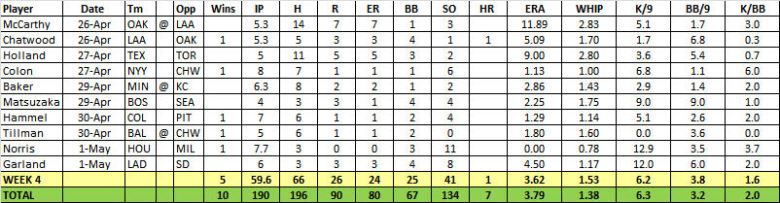
This week was a process for the Spot Starter picks.  It started off poorly as posterboy Brandon McCarthy, who I recommended keeper permanently last week, was torched by the Angels allowing seven runs on 14 (!) hits in just five and a third innings.  Meanwhile, my second pick on Tuesday (skipped Monday due to a lack of viable options) was his opponent, Tyler Chatwood, who I went with over Marco Estrada and Gavin Floyd in order to get the most favorable matchup.

He was passable and earned a win, but the Floyd was excellent against the Yankees (W, 8 IP, 2 ER, 10 K, 5 BR) and Estrada looked sharp against the Reds (7 IP, 2 ER, 5 K, 5 BR).  But I stand behind choosing Chatwood as those two were playing two of the best offenses in baseball and they happened to escape with some gems.  The favorable play was passing on those two, especially for this strategy.

Then on Wednesday Derek Holland was ripped for five earned runs in the third straight start and all of a sudden I had three recommendations who totaled 15.7 innings allowing 15 runs with just six strikeouts. Of course there was plenty of time left in the week and the remaining seven selections all allowed three or fewer runs while five of them logged six or more innings.

The rally helped lower the season-long ERA while the five wins logged double the season total to 10.

Let’s keep the weekend momentum (1.75 ERA in 25.7 innings with the Saturday & Sunday starters) going into week 5:

MONDAY:

Bartolo Colon (NYY @ DET) – His ownership rates will likely bump up again after free agent pickups are run on Sunday, but as of now he remains available in a lot of leagues across all of the major outlets.  He is striking batters out, he is inducing groundballs and he is going deep into his starts.  There is just nothing within this profile so far to caution against buying into it.  His resurgence is the epitome of Ron Shandler’s axiom: “Once a player displays a skill, he owns it.”

Derek Holland (TEX @ OAK) – The string of 5 ER starts has to stop here, right?  Holland is too talented to keep getting pounded for a nickel each game and the A’s in their spacious stadium is a great place to get right.  I will be watching this start to get a better handle on Holland, too.  I haven’t seen him throw since the start in NY where Ron Washington was an idiot.

TUESDAY:

Sam LeCure (CIN v. HOU) – LeCure is a perfect matchup play as he feasts on the weak, but isn’t quite as strong against the stiffer competition.  To wit, he has allowed 2 ER and 1 ER in starts against Houston and at San Diego, respectively, striking out 14 in 11 innings across the two starts.  In his other two starts he allowed five to Arizona (including four HR) and three at Milwaukee in just 4.3 innings.

R.A. Dickey (NYM v. SF) – He hasn’t quite been as strong as he was in 2010, but nobody really expected him to be, either.  He has been useful especially getting through some control issues early in the season.  He is generally strong at home (1.99 ERA at Citi; 3.58 away in ’10) and the Giants aren’t scaring anyone with their lineup as Buster Posey slumps (5 for his last 26) and Pablo Sandoval, their best hitter so far this year, just went on the disabled list for 4-6 weeks with a hand injury.

WEDNESDAY:

Kevin Correia (PIT @ SD) – The Giants look like the ’27 Yankees compared to their divisional foes in San Diego as the Padres needed a 7-run surge today to finally top 80 runs for the season (84-last in the majors).  Meanwhile, Correia has just one implosion this season while allowing two or fewer runs in four of his six starts.  He likely won’t maintain his 2.90 ERA all year, but I doubt the regression begins against his old teammates.

Jake Arrieta (BAL @ KC) – The Royals offense is doing some nice work this year, but so is Arrieta having looked great in five of his six starts (an 8 ER in 3.3 IP shellacking against Texas as the lone blemish) which is masked by a 5.01 ERA.  I like him to tame the Royals a bit and keep his streak going.  He may even sneak a win, too, as his offense gets to face Kyle Davies.

THURSDAY:

Joel Pineiro (LA @ BOS) – After starting the season on the disabled list, many owners cut bait on Pineiro as he just made his season debut this past weekend.  The Red Sox are still trying to find their footing so I like Pineiro to take advantage and induce plenty of weak contact en route to a solid showing.

Brandon Beachy (ATL v. MIL) – He is this week’s pick to keep as his ownership starting to increase with each passing great start.  I’m not sure what took so long.  Of course, he is still available in quite a few leagues so he makes the list at least once more.  He has a sub-1.00 WHIP and a strikeout per inning pitched, I can’t imagine a format where that isn’t useful.

FRIDAY:

Jonathon Niese (NYM v. LAD) – He just keeps performing so he keeps getting recommended.  His ERA looks available after being inflated in back-to-back starts in early April when he gave up 11 in 10 innings to Philly and Colorado.  Since then he has reeled off three straight 2 ER starts allowing just the six runs in 19.3 innings.  The Dodgers are essentially a two-man lineup right now so Niese should be able to continue rolling.

Phil Humber (CHW @ SEA) – Pitcher on a roll + garbage opponent + pitching in garbage opponent’s excellent ballpark = auto-start.  Humber is another guy with only one real significant negative mark on his record (4 ER in 5.3 against Tampa Bay), but he has been sharp otherwise including a gem under the spotlight in Yankee Stadium.  The MAAAriners shouldn’t prove too challenging.

Weekend picks later in the week…

Saturday: 04.30.2011

Trolling the Wire: Week 4 The Weekend

It’s been an interesting week.  A few of the picks were knocked around while others excelled and perhaps excelled enough to keep the weekly totals strong.  We’ll see after the week.  Some things got bumped around this week including Scott Baker getting pushed to start against Kansas City instead of Tampa Bay which was beneficial since he got to avoid the white-hot Ben ZobristJason Hammel didn’t start yesterday and is instead starting today.  I guess he will count for a Saturday pick.

I’ll give another Saturday pick, but it is academic at this point since games have already started.  I meant to post them yesterday, but I passed out early last night after a week of not getting much sleep.  The last thing I saw for the night was Carlos Santana’s walkoff home run against my Tigers… what an awful way to fall asleep.

Chris Tillman (BAL @ CHW) – The White Sox just aren’t playing up to their ability.  Tillman has had two good and two bad starts so far.  He can feast on lesser teams so I’ll give him a shot against Chicago.

SUNDAY:

Jon Garland (LA v. SD) – Some like him, some don’t, but he performs.  He has been especially reliable in the National League despite an unimpressive strikeout rate almost every year (just once above 4.8 since 2004).  The Padres offense is downright abysmal making him an easy start.  In fact, several lesser starters would be a start against this offense.  It’s just sooo bad.

Bud Norris (HOU v. MIL) – What does this guy need to do to get his ownership rates up?  All he has done is strikeout six or more in each of his five starts and allow just three runs in his last three starts totaling 18 innings.  He has really cut down his walks from 4.5 BB/9 last year down below to 3.0 at 2.9.  He isn’t just picking on trash, either.  His last start came against the St. Louis Cardinals when he allowed 0 ER in six innings.

Look for the week’s results and the week 5 picks on Sunday.

Thursday: 04.28.2011

Minor Leaguers in Fantasy Baseball, Part 2

Yesterday I took a look at the impact of the 2010 rookie class and posited that could have a negative effect on how the fantasy community as a whole values prospects going forward.  Of course they are already overvalued as a whole so it may not move the needle a bit.

The fact remains that many owners are so eager to roster the next star that they often hamper their chances at winning just for the opportunity to be the guy who has Buster Posey on a cheap contract.  Posey was excellent last year and is off to another pretty strong start again in 2011, but he is the exception, not the rule.

In the next two parts of this series, I will look back at the top 20 prospects from 2006 to see how things have panned out for them.  What is the success rate of top prospects?  What is it that even defines success?  After looking back, I will have more thoughts on what this class from five years ago can teach us about the 2011 class and we should view minor leaguers now and going forward.

LOOKING BACK

So while the elite prospects acquitted themselves quite well, there were several players off the radar contributing legit numbers.  With just a year elapsed, it is impossible to truly judge the 2010 class completely, but the early returns are strong.  Let’s go back five years and see how things have gone for the top 20* prospects from 2006.

(*top 20 is a bit of an arbitrary cutoff, but seems like the right cutoff of the prospects who are coveted most by fantasy owners  who don’t have them and held tightest by owner who do)

1. Delmon Young (TB) – He was rated by BA four times: three times at #3 and #1 in 2006.  He was as can’t miss as can’t miss gets ripping through the minors in three years debuting at 20 years old and becoming a permanent big leaguer at 21.  Alas, he has kind of missed in terms of expectations-to-output ratio.  I have remained firmly entrenched on the Delmon Bandwagon as he is just 25 now, but last year was his first big time fantasy season since his rookie year when he hit .288 with 13 home runs, 93 RBIs and 10 stolen bases.  I would lean toward giving him an incomplete as I would like to see how his follow up season goes, but I think many would label him a bust.  Rating (1-5 scale, 5 being the best): 2 – Tough one to grade as we are still looking at a .291 career hitter who has played 150+ games in three of his four seasons, but the expectations were so astronomical that being just average is a disappointment both in fantasy baseball and on the field.

2. Justin Upton (ARI) – Another tough one to analyze as he is just 23 headed into his fourth full big league season.  That said, the results have been underwhelming with just the one truly star turn in 2009 sandwiched by two slightly above average seasons.  Through it all, he has failed to play 140 games in any single season.  Keep in mind that a major component of the grading here is how an owner of his back in 2006 feels now about turning away so many Godfather offers that may have brought him short-term glory and may have possibly unearthed a gem 2nd or 3rd tier prospect who would still be contributing today.  Rating: 2.5 – Earns a slightly higher mark than Delmon for delivering his big year while likely still a part of the original owner’s team, but otherwise his name is much bigger than the production.  His fantasy cost-to-talent ratio isn’t a favorable one for his owners let alone the regret he has saddled original owners with while looking back on offers.

3. Brandon Wood (LAA) – He is legitimately one of the worst major league baseball players ever.  He has put up more than a full season’s worth of 22 OPS+ (175 G, 501 PA).  That is unreal.  To have the alleged talent to earn that many at-bats combined with the constant failure takes a special kind of awful.  Rating: 0 – He likely changed how his original owners view prospects from now on.  You can bet that if they get have someone like Jesus Montero and get an equivalent offer to what they received for Wood back in 2006, they are taking it without blinking.

4. Jeremy Hermida (FLO) – Injuries just obliterated his career though it’s not like we shouldn’t have seen it coming as they started back in his minor league days.  Believed to be a dynamic five tool power-speed combo, Hermida never really ran at the big league level likely because there was no sense risking injury in the rare time he was actually on the field.  The power materialized in spurts, but all in all he was a colossal bust.  Rating: 1 – Teased with a strong 2007 campaign (125 OPS+, 18 HR), but played just 123 games that year and has posted an 85 OPS+ in 350 games since.

5. Stephen Drew (ARI) – Breezed through the minors in short order with some eye-popping numbers that just haven’t translated into fantasy stardom.  Drew is likely regarded as a hit from a real world standpoint as a slightly above average shortstop with only one truly bad year (2007), but he was supposed to be Hanley Ramirez/Troy Tulowitzki-good for fantasy owners and it just hasn’t happened.  Rating: 2 – Credit for showing up every day (three 150+ GP seasons out of four; fourth still had 135), but not enough fantasy goodness.

6. Francisco Liriano (MIN) – Burst onto the scene in ’06 with a truly brilliant season before succumbing to an arm injury that cost him all of 2007 and has rendered him inconsistent since.  He has the best single season of anyone on the list so far, but because his stock plummeted so quickly after ascent he too is something of a failure.  Rating: 2.5 – As an amateur free agent, he has far exceeded expectations on the field even if he never throws another pitcher again, but in the fantasy realm even the debut can’t keep him earning a weak grade.

7. Chad Billingsley (LAD) – The first one on the list to actually pay legitimate year-over-year dividends for his fantasy owner commensurate with expectations.  Original owners of his can proudly look back at the offers they declined in favor of hanging onto Billingsley as he has developed into a very reliable fantasy starter.  Rating: 5 – Even if you only held him for his first three years (league rules vary on minor leaguers), he rewarded you handsomely with 438 innings of 3.33 ERA, 35 wins and 401 strikeouts.  Given the inexact science of prospecting and incredible volatility of pitching, nobody would turn down that kind of production from a minor league pick.  And if you would, then you have wildly unrealistic expectations from those minor league draft slots.

8. Justin Verlander (DET) – A star who paid off for his owners regardless of your league’s rules when it comes to minor leaguers.  He won the Rookie of the Year out of the gate and followed it up very nicely with an even better year in 2007.  His 2008 year was a disappointment, but the composite of his first three years still yields 589 innings of 4.05 ERA with 46 wins and 470 strikeouts.  Rating: 5 – He had an extra-long shelf life for you to trade him for a big haul with two brilliant seasons to start off his career.

9. Lastings Milledge (NYM) – It’s a surprise he has lasted as long as he has given how poorly he has performed in a significant 1500 at-bat sample at the big league level.  He has been well below average with a career OPS+ of 91 and the only stint he was above average came in his 59 game sample of 2007 with the Mets.  At 26, he will likely get at least one more shot if not two or three, but he has been an unequivocal bust.  Rating: 1 – A two-time top 11 prospect on the BA plus the New York hype machine likely had his original owners fending off sweetheart offers on the reg.

10. Matt Cain (SF) – The crazy thing about the list so far as the amount of failed hitters and the fact that the biggest hits have far and away been starting pitchers.  It just goes to show that with prospecting there is really no safe route.  You just have to do your homework and put yourself in the best position to hit and then pray that you get a little lucky.  Rating: 4 – Dinging him a bit for the W-L records early on even though they aren’t indicative of his skill.  And the ERAs weren’t that great for mixed leagues early on.  That said, minor league rosters are usually found in single leagues (at least that’s been my experience) and he was a no-doubt gem in NL-only leagues even with the low win counts.

To be continued…

Friday: 04.22.2011

Trading Tips

As we approach May 1st, trading will start to become a bigger part of league activity.  A month isn’t necessarily enough time to assess your team’s strengths and flaws, but injuries and more than anything else, impatience often fuel trade talks.  With that in mind, I wanted to offer up some tips to hopefully improve your trading experience whether you start firing up talks in a week or in mid-June.

  • Don’t tell the league to make you offers for your guys – If you are serious about improving your team via the trade, then sending a mass email with guys you’re willing to part with followed by a call to action for other owners to engage you for those players isn’t the way to go.  It is the rare occasion when those emails announce a team’s best players being available and as such they barely register on the radar let alone making such an impact that other owners will be compelled to do the legwork to acquire those guys.

    • There is one exception – If you are engaged in talks to trade either your blue chip prospect (as you are contending and playing for now) or moving your stud(s) to build for the following year, it behooves you and the rest of the league to announce your intentions in a leaguewide email so that you give everyone a fair shot at the guy(s) in question and also get yourself the best deal possible.  Now, you don’t have to do this, but there’s zero downside for you.  You can let the initial trade partner know at the outset, “hey, I’m going to give everyone a crack here, but I like the deal we’re discussing” and he/she should be totally cool with that.  Meanwhile you let the league know, “hey, there is a leader in the clubhouse for the services of player x, if you’re interested please let me know, otherwise I’ll be moving forward.  I just wanted to give everyone an equal shot at this high quality asset.”  Again, there is just no downside for you to do this.

  • Don’t downplay the guys you’re getting in an attempt to advance the negotiation – The minute you start sending me emails telling me how bad my players that you want are or will be in the future is the minute I know you’re a) lying to get the deal you want or b) stupid because you’re purposely taking on bad assets.  I highly doubt it’s ever b, so can the negativity and just play it straight up.

  • Do try to make sure the deal is even for both sides – The definition of “even” is ambiguous without question, but the goal is to make sure that both owners come out of a deal feeling they made their team better.  Win-win trades are absolutely the way to go.  If you purposely try to rip someone off in a trade, you’re burning a bridge and possibly losing a trade partner for rest of his/her time in that league if not several.  Remember the old adage, a satisfied customer might tell 2-3 other friends, but a dissatisfied customer will definitely tell 10 or more.  If you become known as the ripoff artist in the league, you will have a hard time consistently winning unless you draft perfectly and then ace the waiver wire all season long.  Now, obviously some deals will work out much more in one team’s favor by the time you analyze it at season’s end, but that doesn’t mean it was a ripjob when it was consummated.  What I’m focusing on here is trading hurt assets, taking advantage of breaking news that everyone might not be privy to and things of that ilk.  I understand it is everyone owner’s responsibility to do their diligence before making a deal and they’d have no one to blame but themselves if they got hosed, but that doesn’t mean it won’t still hit your credibility.  If you make people afraid to trade with you, you may benefit in the short-term with that first ripoff trade, but you’ll do way more harm to your chances in the long-term.

  • Do put thought into your offers – When sending an offer, focus more on the guy you’re trading with than yourself.  You know how no one wants to hear about your fantasy team when you’re telling them about it at a party?  The same thing applies when you start off a proposal discussing the guys you want your trade partner to give up.  Begin by letting them know what they can get out of dealing with you.  “It looks like you need some stolen bases, which I can definitely supply.  I think you might be interested in Ichiro Suzuki.  Meanwhile, I was thinking a trade of Ichiro for _____ would work well for both of us.  You’re 12 steals away from four points and then another handful away from another group of points” or something to that affect.  In that scenario, you’ve made just a cursory mention of who you want while focusing the attention on how much they can benefit from talking trade with you.

  • Do respond to ALL offers – There’s nothing like sending out an offer and getting crickets.  Just respond, it doesn’t take long.  I’ll go so far as to say that even if the offer is utter garbage in your eyes, simply reply saying, “no thanks, that doesn’t improve my team and the offer would need A TON of work to get talks going.”  That’s direct without being entirely rude and it gets home the point that he’s nowhere near a trade with track he is on.

  • Don’t veto trades – OK, maybe I shouldn’t make a 100% blanket statement as there are some outlandish situations where it may be called for, but by & large vetoes are utter bullcrap.  Don’t impress your player values on the rest of the league.  What if at the end of April last year, someone was buying into Jose Bautista’s swing change from September of 2009 and seeing it lead to four more homers to start the season and decided to move Prince Fielder for him?  You may not like it and you may not have accepted the deal if you were the Fielder owner, but there isn’t something overly objectionable about that deal even before hindsight because we don’t know the reasoning behind the Fielder owner making the move.  Maybe he’s a better scout than you are and wants to roll the dice.  Who are you to say he can’t?  Maybe he thinks Fielder just isn’t going to put it together as the season goes forward (and 83 RBIs & .261 AVG would suggest that he kinda didn’t).  The point is, he paid his money and unless you can prove collusion (and good luck doing that), it’s a deal that has to pass.  That’s an extreme example, but few things about this game piss me off more than trade vetoing, especially in a cash league where adults have paid to manage their team however they damn desire.  Just because you might not make a move doesn’t mean it’s unequivocally wrong.  Unless you’ve got a collusion charge that will stick, stop vetoing trades.  It’s pathetic.  You don’t know the future any more than any other owner so stop pretending you do.

  • Don’t tell the league to make you offers on your guys – Yes, I’m repeating this one, but it’s important.  “Hey guys, I need power and I have Mediocre Guy A, Shlub B and Washout C available for trade.  Send me offers!  Thanks.”  Yeah, no.  And it’s not much better if it’s Star A, Stolen Base King B and Ace Arm C, either.  It’s just that it’s usually less than inspiring guys being made available AND the other owner now wants me to do the work for him.
Tags:
Thursday: 04.21.2011

Trolling the Wire: Week 3 The Weekend

The picks recommended are doing pretty well so far this week off the top of my head, especially tonight as Brandon McCarthy and Chris Capuano did some great work.  Here are the weekend picks:

SATURDAY:

Brandon Morrow (TOR  v. TB) – This isn’t one of the official picks because it will be the rare league that he is available on the wire, but just in case he is, I strongly recommend picking him up regardless of format.  Well, except NL-Only, I guess.

Dillon Gee (NYM v. ARI) – He looked pretty good against Atlanta in his season debut and he draws the D’Backs at home this weekend.  I don’t think he will overwhelm, but another good start is definitely a strong possibility.  His peripherals were pretty good in 161 innings at AAA-Buffalo last year, but gopheritis (1.3 HR/9) kept his ERA near 5.00.  He registered more than a strikeout per inning with fewer than 2.5 walks per game.  Very intriguing profile.

Carlos Carrasco (CLE @ MIN) – His Opening Day thrashing is what has his ERA still pushing near 5.00 (7 ER in 6.7 IP), but since then he has three straight quality starts totaling 19.3 innings of 3.26 ERA work with 15 strikeouts.  He’s a guy I liked a lot before the season started and nothing has dissuaded me through four starts.

SUNDAY:

Randy Wolf (MIL v. HOU) – I understand that the standard league at most of the big outlets is pretty shallow, but what does a guy have to do to get some love?  OK, I get it if you weren’t diving in headfirst after a 10-strikeout performance against the Pirates, but he followed it up with six shutout innings and five more strikeouts against Philadelphia.  He’s gone 6+ in three of his four starts and registered five Ks in his three starts apart from the huge 10-strikeout game.  I’m definitely betting on him to stay hot against Houston.

Sam LeCure (CIN @ STL) – I think his start to the season has gone relatively unnoticed as he’s available in a ton of leagues.  He started with back-to-back good starts against Houston and in San Diego so competition has fueled him a bit and Arizona definitely roughed him up at home with four bombs (5 ER in 5.3 IP), but I like the 4.3 K/BB rate powered by nearly a strikeout per inning (17 in 17.1 IP).  The Cardinals will be a tough test, but he’s in St. Louis as opposed to his homer-friendly home ballpark so I like the gamble.

Look for the week’s results and the week 4 picks on Sunday.

Tuesday: 04.19.2011

The Ultimate Backfire

Talk about getting burned.  In an AL-Only league I play, I kept a $23 Joe Mauer.  I originally planned to get Drew Butera for a buck and just lock up all of the Minnesota catchers at-bats.  Yeah, Butera is pretty much worthless, but I was going to invest the money elsewhere.  Then the bidding for Victor Martinez slowed abruptly after $20 and I was still in it locking him up for what I believed to be a bargain $24.  Ya… now I have $47 of catchers on the DL.  Imagine the worst replacements possible and multiply it by 5000 for the kind of drek I’m going to have in my lineup.  Matt Treanor was my pickup for Mauer.  I shutter to think of the possibilities out there for Martinez.

*sigh*

More later…

Sunday: 04.17.2011

Trolling the Wire: Week 3 Monday-Friday

Spotty internet access as I awaited my setup to be transferred from my old apartment made for a spotty and abbreviated version of what I intend to become a weekly staple with the spot starter recommendations.  In a moment, I will unveil the list of week three recommendations as well as how the week two pickups performed, but first a bit more about the goal behind these recommendations.

The idea is that there is enough useful pitching on the waiver wire of a large swath of leagues (generally, 10-14 team mixers) that you can play the matchups with one or two spots in the backend of your rotation and get some very quality work out the spots instead of sticking it out with a run of the mill third or fourth starter.

Cory Schwartz and Mike Siano over MLB.com’s Fantasy 411 popularized the phrase “pitch or ditch” for this strategy.  You will also hear it called streaming or spot starting.  I am not for a second pretending like I created this strategy, I am merely offering my solutions on the best way to maximize it.  Let’s see how last week’s picks worked out:

Not too bad on the whole as only one of the nine gave up more than three runs (Brandon Beachy) and he softened the blow by striking out eight.  Of course he had to make up for Jeff Francis’ lame one strikeout in six and a third innings of work.  If there is one thing that sticks out as less than desirable, it’s the two wins in nine starts, but you can’t chase wins and a lot of these are available because they aren’t on the high profile teams that would generally be more conducive to wins.

Who’s on tap for week 3?

MONDAY:

Chris Tillman (BAL v. MIN) – He has had an uneven start to the season with a dominating six inning no-hit effort against Tampa Bay followed by two poundings at the hands of the Tigers and Yankees.  The best medicine is a shot against the league’s worst offense in the midst of getting used to being without their best player.  They weren’t very good with Joe Mauer and it would be quite a shock if they were without him.

Travis Wood (CIN v. PIT)Wood’s skills have remained intact from last year which is to say they are pretty good and facing the anemic Pirates should only accentuate them.  The fly in his ointment remains a severe flyball rate in a terrible park for such an affliction.  He was extremely lucky when it came to home runs last year (6.3 HR/FB) and he’s been even luckier this year (4.5%) so while I like him in this favorable matchup, I wouldn’t stick with him beyond that.

TUESDAY:

Jonathon Niese (NYM v. HOU) – A 3.0 strikeout-to-walk ratio powered by nearly eight strikeouts per game coupled with a 51% groundball rate is enough for me to remain optimistic in Niese despite a 6.88 ERA.  He is getting tagged by a 56% LOB% and 14% HR/FB rate so a date with the lowly Astros is welcomed by Niese and owners of his services.  Depending on who you cut for him, this may be someone to hang onto going forward.

Phil Coke (DET @ SEA) – Through two starts totaling 13.7 innings, Coke has allowed just two runs.  The six hits allowed are definitely a plus while the six walks are neither good nor bad.  In his debut start against Kansas City, he struck out seven, but followed that up with just two in seven innings against Oakland.  So we are left wondering what kind of strikeout capability he will offer as a starter.  The Mariners strikeout 2nd-most in the American League, but they are also tied for the most walks in baseball.  It’s a terrible lineup in a favorable park, so Coke should be a nice play here (and in his next start when he draws the Mariners at home).

WEDNESDAY:

Bud Norris (HOU @ NYM) – He worked out well last week so let’s hit the well again.  He has improved start to start and posted strikeout totals of 7-6-7 in the process.  This is a very talented young arm who could become a permanent asset for fantasy owners sooner than later.

Philip Humber (CHW @ TB) – Picking on the Rays again who Humber already thwarted back on April 9th allowing a run in six innings with four strikeouts en route to a win.  This is purely a hot streak/matchup play as I don’t like Humber much going forward.

THURSDAY:

Brandon McCarthy (OAK @ SEA) – To drive home the point about not chasing wins, the A’s will face Felix Hernandez during this start, but I still really like McCarthy.  Like Norris, he has improved start to start (all of which came against teams much better than Seattle) yet his ownership rate remains very low.  He could definitely become a long-term hold going forward so you might want to his secure his services sooner than later if you have the spot available.

Chris Capuano (NYM v. HOU) – He just can’t stay this unlucky, especially against a bad team like the Astros.  He’s getting groundballs and strikeouts while limiting walks, but his BABIP is nearly .400 (.385) and over 20% of his flyballs have left the yard leaving him with an ugly 61% LOB%.  Those numbers begin their correction with this start.

FRIDAY:

Fausto Carmona (CLE @ MIN) – Many of you may know that I’m not a fan of Carmona at all, but he’s done some impressive work in his last two starts (v. BAL, @LA) against better teams than the Twins including 11 strikeouts over 14.7 innings which is high for him.  He’s still inducing a crapton of groundballs, too.  He gets hot in stretches and after a horrific Opening Day starts (10 ER in 3 IP) he’s allowed four runs in 21.7 innings (the other start was against BOS), so ride the wave.

Jo-Jo Reyes (TOR v. TB)Even with a small sample size, his .438 BABIP is kind of unbelievable.  It has definitely fueled his 6.75 ERA, but I like that he’s still striking out nearly a batter per inning (12 in 13.3 IP) and maintaining a 1:1 groundball/flyball ratio.  I hate to keep picking on Tampa Bay, but until they get Evan Longoria back and/or sort out their lineup woes, it will continue to happen.

I will give out the Saturday and Sunday picks midweek as those are going to be the repeat starters and I’d like to see the first starts of those guys before making another decision on them.   Plus it guards against injury that may occur in those initial starts.

Friday: 04.15.2011

Trolling the Wire: The Weekend

Wrapping up the week on Spot Starters, here is who I like today and through the weekend:

FRIDAY:

Chris Narveson (MIL v. Washington)Narveson has been brilliant this year striking out more than a batter per inning and toting a 0.00 ERA through his first two starts.  He can’t really be any better, but I see no reason he can’t continue to excel matching legitimate skills with a favorable matchup in Washington.  With his first two starts, his ownership rate is definitely on the rise, but some leagues still aren’t hot to this hidden gem.

Kyle Lohse (STL v. Los Angeles) – Lohse is well on his way to recapturing the magic of 2008 when he went 15-6 with a 3.78 ERA in 200 innings having netted a 3.00 ERA over 15 innings in his first two starts amassing 10 strikeouts with just a single walk.  Even more importantly, he has a ridiculously strong 58% groundball rate which could be the driving force to a resurgent season.  Today he draws the lowly Dodgers who you may think are doing well enough because of Matt Kemp’s excellent start and their passable 6-7 record, but even with Kemp they have a paltry .679 team OPS.

SATURDAY:

Scott Baker (MIN v. Tampa Bay) – He has some interesting numbers in his stat line so far this year.  He has an uncharacteristically high 4.9 BB/9 (well away from his 2.1 career mark), an 82% LOB% which is about 10% above league average and generally helps a guy’s ERA, but not when you have a 3.3 HR/9 rate!!!  That is just absurd, even for Baker who struggles with the long ball.  Exactly 1/3rd of his flyballs are leaving the yard at this point.  I’m willing to bet all three of those numbers will come down and while the LOB% dropping isn’t necessarily helpful, the evening out of the other two will hack several runs off of his 6.55 ERA.  The best remedy for a rough start is drawing the Longoria-less Rays.

Jeff Niemann (TB v. Minnesota) – Like his opponent, Niemann has some odd figures through two starts with a similar 3.1 HR/9 rate matched with an ugly BABIP (.344) and LOB% (55%).  His strikeout-to-walk rate of 1.7 is less than impressive as his strikeout rate of 5.2 sits well below his 6.5 career mark.  An even better remedy than Niemann facing his own team is facing the now Mauer-less Twins.  They weren’t any good with him and without him they can’t possibly be better.  It’s odd to favor both guys in a matchup since at best you can only get one win, but I don’t chase wins.  Plus not everyone plays BOTH guys I recommend, so pick your favorite between (I’d lean Baker) the two and enjoy.

SUNDAY:

Jeff Francis (KC v. Seattle)With a groundball rate even better than Lohse’s (57%), Francis is off to a great start through three starts in his first tour of the American League.  He doesn’t offer overwhelming strikeout totals as his 5.7 K/9 is about what you should expect across a full season, but he could receive a boost facing the Mariners, who strikeout 3rd-most in the American League.

That’s it for Sunday.  I don’t want to recommend someone I don’t really believe in just to have 2 guys.

I should have the full week 3 spot starters out this weekend.

Friday: 04.8.2011

Trevor Cahill’s Early Strikeout Surge

Coming into the 2011 season, I had some reservations about Trevor Cahill.  Specifically I was worried that his excellent 2010, namely the 2.97 ERA, would inflate his value higher than I was willing to pay in light of the fact that his skill set didn’t necessarily portend such a gaudy ERA.  He was below the recommended 2.0 K/BB rate at 1.9 thanks to a below average 5.4 K/9 rate.

Instead of missing bats, he utilized his spacious home park (2.18 ERA in 103 home innings) and strong defense (56% groundball rate and .236 BABIP) en route to his surprise season.  Alas Cahill was once the 11th-best prospect in baseball according Baseball America (2009) after an impressive minor league career filled with strikeouts (9.9 K/9 in 247 innings).  I mentioned in my AL West Preview that though Cahill was my regression pitcher, don’t be surprised if he shows some growth and starts missing more bats commensurate with his minor league track record.

Through two starts we are seeing a lot of strikeouts from Cahill with mixed results.  In his first game, he struck out eight but lasted just 4.7 innings (because of pitch count) walking four and leaving with a no decision.  Then yesterday, he continued the strikeout parade fanning seven in eight very impressive innings in Toronto.  Is there a change in Cahill’s approach or are we just seeing two of his better strikeout games early in the year?

Remember that even last year he had a handful of strong strikeout games, including a back-to-back pair in June where he struck out seven St. Louis Cardinals and followed it up by fanning 10 Pittsburgh Pirates.  The importance of that is to suggest that we could just be seeing his best strikeout work at the front end of the season as opposed to the beginning of a trend.

Having watched both of his starts, one thing that has stuck out to me that says we might be seeing legitimate growth is the emergence of his curveball, especially yesterday in his duel with Ricky Romero.  Four of his seven strikeouts came on swings & misses of the curveball.  Only two of his eight in the season opener came on swinging curves, but across the two starts it has been a significantly improved pitch.

Coming into the big leagues, the curveball was supposed to be his strikeout pitch according to his scouting reports, but it didn’t play out that way during his first two seasons.  In 2009 he threw it just 102 times (3%), 28% of which were swung at and just 7% of those missed altogether.  Last year he threw the curve 414 times (14%) generating a swing 30% of the time, the lowest of any of his five offerings.  Batters missed 11% of the curve swings; improved results, but hardly in line with what was expected of him as he progressed through the minors.

Early on, it seems he is set on improving his success with the pitch and looking to use it a lot more.  In the first outing he threw it 23% of the time inducing swings 54% of the time, 13% of which were missed.  As I mentioned, only two of his strikeouts came with the curve, but the increased usage was noteworthy.  Yesterday, he took another step forward with it throwing it 31% of the time, 52% of which were swung at and 18% of those missed and another 18% fouled off.

Going back to that pair of strikeout-heavy games from 2010, we see that Cahill was not reliant upon the curveball to amass those 17 punch outs across two starts.  In the first against St. Louis, just two of the seven came on swinging curves.  The same was true in the 10-strikeout effort against Pittsburgh giving him four in 17 (24%) as opposed to his six in 15 (40%) for the first two starts of this year.  In fact in the two interleague games he only threw 30 curveballs (nearly half the total of what he’s thrown so far this year) out of 203 pitches (15%) only 1/3rd of which were swung at and eight of those were missed entirely.

So where does all of this leave us?  With just two games of data, it would be foolish to make definitive statements about Cahill’s strikeout ability, but in the small sample we are seeing a change in approach that marries well with past history from the minor leagues.  He is just 23 this year so it isn’t at all out of the question to expect some growth, especially with his pedigree as a prospect.  From a fantasy perspective, I would be heartened by the change if I owed him, but if I was in need of strikeouts I wouldn’t rush out to trade for him just yet.

I will continue to watch Cahill closely and see if the curveball usage and its ability to induce swings & misses is an early season aberration or true change in skill making him more of a strikeout pitcher and thus a much greater fantasy baseball asset.  I will post an update on Cahill in about a month.

Resources:

Baseball-Reference.com

TexasLeaguers.com

BrooksBaseball.net

Thursday: 03.24.2011

2011 Guide to Middle Reliever Methodology

Previous versions:

2009

2008

I didn’t do a 2010 version of the MR guide.  I think it was because my main Thursday column over at Fanball was called “Middle Men” so I was writing about middle relievers every week.  A quick refresher on the idea of MRM for the uninitiated—the goal is to acquire three dirt-cheap middle relievers who in turn will net you the stats of an elite starting pitcher. From my experiences, it is best employed in single league auctions. That doesn’t mean that it can’t be done in mixed league drafts and auctions, especially deep ones, just that I find it most effective in SLAs.

This strategy seems to gain traction yearly with more and more fantasy magazines and online draft kits dedicating a portion to middle relievers.  Of course they often identify the elite middle relievers.  I won’t gloss over the elite of middle relievers in my list, but I hope to highlight the up & comers so that you have a deep list in case other owners choose to utilize the MRM for their teams as well.  Not only that, but some of us will invariably end up in leagues where the bulk of middle relievers are ignored or severely undervalued.

I’d hate to assume that every league was going to bid up the top ones and leave you empty-handed when they finally do come available on the cheap.  The idea is to find the next elite reliever since the whole goal is to save money in the budget for more hitting*.

(*I’m saving it for hitting, you may choose to invest it in a higher priced ace starter or closer.)

VOLUME

When you’re constructing your three-pack of relievers, you need to keep an eye on their innings totals from the past couple of seasons. Some guys have very appetizing strikeout and walk rates, but are used in a very limited capacity (30-40 IP) and thus should be counted only as your third guy, if at all, unless you are predicting an increased role for 2011.

We are seeing greater balance in workload among the relief corps.  In 2009, eight non-closing relievers managed 80+ innings of relief work.  In 2010, there were only five such non-closing relievers.  Compare that with five years ago when there were 14 and 10 years ago when there were 19.  Only two relievers topped 90 innings last year so you’re looking for 70+ innings at the high end.

WHO’S NEXT?

Here are five young small-sample strikeout studs that you should keep on your radar:

1. Jordan Walden, 23 years old, Los Angeles Angels – He displayed blistering heat (avg. 99 MPH w/his fastball) in his 15-inning sample at the big league level last year striking out 23 batters.  He’s a failed starter as a 2-pitch pitcher whose third just never developed, but he looks like he could be a dominant setup guy behind Fernando Rodney and might even get a shot at saves at some point this year.

2. Kenley Jansen, 23, Los Angeles Dodgers – He had a star turn in 27 innings similar to Walden’s where he struck out 41 batters.  He’s actually a failed catcher that the Dodgers shifted to the pen with great success in limited samples thus far.  Unlike Walden, there is legitimate competition for saves on the Dodgers with Jonathan Broxton and Hong-Chih Kuo so he’s almost certainly going to spend the year in the 6th through 8th innings.

3. Zach Braddock, 23, Milwaukee Brewers – Likely to be just a LOOGY as a southpaw who crushed lefties in his 34 innings of work.  Even still, he has massive strikeout potential and could develop a larger role if veteran arms LaTroy Hawkins and Takashi Saito succumb to injury.

4. Collin Balester, 25, Washington Nationals – Another failed starter, Balester shifted to the pen last year with great success in 21 innings striking out 28 batters.  If the team places importance on Spring Training numbers, Balester should grab a spot in the bullpen as he’s excelled in his nine innings striking out 10 and walking just two.  As a former starter, he could be stretched out for 2-inning stints and end up pushing the 100-inning mark which could make him especially valuable if he continues to strikeout a batter per inning or better.

5. Ernesto Frieri, 25, San Diego Padres – With Edward Mujica and Ryan Webb shipped out for Cameron Maybin, spots are open in the SD bullpen and Frieri had a great 32 inning audition during which he struck out 41 batters.  This could be the next great unheralded middle reliever for the Padres.  He’s no better than fifth on list for saves, so don’t speculate here if you want saves.

NON-STARTING STARTERS

Here are three guys that have come up as starting pitchers, but may be forced to the bullpen due to filled rotations:

1. Kevin Slowey, Minnesota Twins – He’s carried a solid 6.9 K/9 in 473 innings as a starter and I could see that ticking up above eight as a reliever.  How he will be utilized out of the bullpen is a bit of a mystery at this point, but I can’t imagine he would be much more than a 6th-7th inning guy and then a long relief guy for the 2nd through 5th innings every fifth day when Nick Blackburn pitches.

2. Hisanori Takahashi, Los Angeles Angels – The swingman pitched 122 innings for the Mets last year and was much better out of the bullpen.  He struck out 9.4 batters per game in 57 relief innings posting a 2.04 ERA and 1.13 WHIP.  Meanwhile he struck out 7.5 with a 5.01 ERA and 1.45 WHIP in 12 starts totaling 65 innings.  He could have some sneaky value, especially if they use him more than an inning at a time.

3. Manny Parra, Milwaukee Brewers – Like Takahashi, Parra struggled when starting and excelled out of the ‘pen.  His strikeouts were strong regardless of role (9.4 as SP, 9.8 as RP), but in 16 starts he posted a 6.19 ERA and 1.74 WHIP in 84 innings.  Meanwhile his ERA was 2.39 with a 1.35 WHIP in 38 relief innings.  The WHIP was still high, but I’m really not concerned with a reliever’s WHIP in terms of impact on a team’s bottom line by the end of the season.  As I mentioned in the Closer Tier’s piece, Carlos Marmol’s crazy awful WHIP from 2009 (1.46) would impact a standard 12-team staff by 0.01-0.02 depending on the final innings count.  There’s an impact, but not nearly to the degree many analysts suggest.

THE ELITE

This is the cream of the middle reliever crop as I see it.  These are the guys that will likely cost you the most to acquire as just about everyone recognizes their value.  In the cases where your league fails to pump their costs, jump at the chance to get them at a discount.  Also, I’m not saying you can’t pay more than a dollar on them, but some of them might creep as high as $8-10 which is a price I’m not willing to pay.  In fact, anything above $5 would likely push me out.  Here are the favorites:

1. Luke Gregerson, San Diego Padres – Back-to-back 75+ inning seasons averaging 10.7 K/9 combined with the ever-looming threat of a Heath Bell trade make him the most sought after middle man these days.  He doesn’t give an elite ERA (3.24 and 3.22), but it doesn’t hurt, either.  You are drafting him for the major strikeouts and potential emergence into the closer’s role.

2. Aroldis Chapman, Cincinnati Reds – He’s one of the hottest prospects in the game so his value is likely to be through the roof relative to middle relievers.  He could be a 100-inning, 100+ strikeout guy if Dusty Baker doesn’t lean veteran heavy and realizes the gem he has with Chapman.  Eventually he should be tried as a starter, so he should get some 2-inning stints to keep him at least somewhat stretched out.

3. Daniel Bard, Boston Red Sox – The arrival of Bobby Jenks likely puts Bard third on the list for saves, but that doesn’t curb his value for me.  He’s their best reliever for sure and they need him pitching the most important outs to get to the ninth with a lead.  He was excellent in 2010 and I could see him getting even better and taking that strikeout rate back up over 11 as he did in 2009.

4. Mike Adams, San Diego Padres – The skill is not in question at all.  It’s a matter of staying healthy for Adams.  He has yet to put together back-to-back healthy seasons so 2011 would complete his first pair.  He’s been the complete package at relief with gaudy strikeout totals and minuscule ERA and WHIP rates.

5. Joaquin Benoit, Detroit Tigers – Missed all of 2009, but came back with a career year that earned him a hefty contract.  Like Adams, the skill is not in doubt at all, it’s all about staying healthy.  He will be a major asset setting up Jose Valverde and could get some sneaky saves when Valverde needs a break.

6. Hong-Chih Kuo, Los Angeles Dodgers – Another guy similar to Adams whose skill is elite, but staying on the field has been problematic.  A complete season in 2011 would be his first pair of back-to-back full seasons, too.  He absolutely obliterates lefties (.095 last year), but crushes righties too, avoiding LOOGY status.

7. Sergio Romo, San Francisco Giants – His value is ticking upward as Brian Wilson’s status for Opening Day remains in doubt.  Romo isn’t guaranteed to get the saves if Wilson is absent, but he is the one most are speculating on thanks to back-to-back seasons with 10+ K/9 rates matched with a sub-3.0 BB/9.

8. Grant Balfour, Oakland Athletics – Balfour is a good example of how a reliever’s ERA can vary wildly year-to-year even if the skills stay relatively steady.  The samples are so small that it a bit of randomness can make a huge difference.  He has maintained strong skills with strikeout per inning stuff for his entire career and the control is improving as he ages.  In Oakland’s spacious park, he’ll be even better.

9. Rafael Betancourt, Colorado Rockies – The home runs are always going to keep his ERA high for an elite reliever (3.50 or higher), but the ridiculous control (3 seasons below 2.0 BB/9 including 1.2 last year) and equally ridiculous strikeout rates make him a useful asset.

10. Rafael Soriano, New York Yankees – Speaking of home runs, I’m worried about how Soriano’s massive flyball rate (52% last year, 50% career) will play in Yankee Stadium.  The skills are strong otherwise, but the ERA will likely be higher than the sub-3.00* totals he has posted since 2006.  (*it was right at 3.00 in 2007)

THE NEXT LEVEL

Here is where you can find value.  A few of these guys likely won’t be at the forefront of many radars in your league.  Some are known, but still just don’t command a price tag commensurate with their value (which is of course great for us).  And others have the name, but found themselves in this tier because I value them as next-level despite their elite tier price tag—you may want to pass on those that fit those criteria:

1. Matt Belisle, Colorado Rockies – Came out of a nowhere with a brilliant season last year, but the lack of a legitimate track record is what keeps him out of the elite column.  Can he maintain the strikeout per inning stuff and more importantly will Colorado allow him to throw 92 innings again or close to it at least?  If so, he’s great and likely quite underrated.

2. Tyler Clippard, Washington Nationals – This is an example of what we’re trying to find the next example of in 2011.  Clippard was taxed by the Nats throwing 91 innings in 78 appearances, but he delivered with 11.1 K/9, a 3.07 ERA and 11 wins.  In fact, he had 17 decisions.  I wouldn’t bet on anything close to that again as reliever wins are even flukier than starting pitcher ones.  He will likely be overrated in 2011.

3. Bobby Jenks, Boston Red Sox – Don’t underestimate Jenks this year.  He could be closing at some point if Papelbon is moved, but if not we could see his workload increase back into the high 60s for the first time since 2007 as he won’t be used solely according to save availability.

4. Takashi Saito, Milwaukee Brewers – Even at 41, he shows no signs of slowing down.  He’s more a 55-inning pitcher these days as opposed to 65-70 he gave when came to the majors in 2006, but he can still offer 65+ strikeouts in that time.

5. David Robertson, New York Yankees – He’s been a favorite of mine since back in 2009 when he was an unknown.  Now part of a deep bullpen, he’s still pumping out massive strikeout totals, but the lack of control leaves his ERA & WHIP elevated.  The latter doesn’t bother me in the least.

6. Chris Sale, Chicago White Sox – I love this kid, but there’s no way he deserved the closer’s role over Matt Thornton based on a 23 innings at the end of the season.  Drafted as a starter, he could be the swingman for Chicago this year which could boost his innings total and add to his value.

7. Sergio Santos, Chicago White Sox – The converted infielder came out of nowhere to have a very good season out of the bullpen last year striking out nearly 10 batters per nine innings.  His control was a bit erratic and he seemed to wear down late in the season.  He should improve in 2011.

8. Jason Motte, St. Louis Cardinals – I know he’s done it for two and a half years, but I still don’t buy Ryan Franklin as a closer.  Motte will get a chance sooner or later.  In the meantime, he’s good for a strikeout an inning and improving control and rate stats.

9. Kevin Jepsen, Los Angeles Angels – Another guy I’ve liked for a while, he’s been up and down, but with Scott Downs on the DL to start the season, he could be first in line for saves behind an ever-shaky Fernando Rodney.

10. David Hernandez, Arizona Diamondbacks – After struggling as a starter despite some quality stuff, he transitioned nicely to the bullpen raising his strikeout rate from 5.7 K/9 in eight starts (42 IP) to 10.9 in 37 innings of relief.  In fact, he improved across the board.  I love JJ Putz this year, but back spasms are putting his Opening Day in doubt and Hernandez should be heir apparent.

11. Joba Chamberlain, New York Yankees – We all know what he can do.  The Yankees aren’t afraid to allow him to pitch more than an inning at a time (did so 15 times last year) so he could feasibly push the 80-inning mark, though the depth of the NY bullpen might eliminate the need.

12. Alexi Ogando, Texas Rangers – With Neftali Feliz officially taking back the closer’s role, Ogando is firmly entrenched as his setup man.  He looked strong in his 41-inning debut and has looked even stronger in the minors with a 12.6 K/9 and 1.9 BB/9 in 112 innings (all but 31 came in Dominican Summer League, but he dominated AA and AAA for those 31, too).

13. Ryan Madson, Philadelphia Phillies Another high dollar guy (again, relative to middle relievers) because Brad Lidge is so shaky in front of him and he has a long track record of quality middle relief.  His strikeout rate has increased yearly since 2006 nearly touching 11 last year.  A chair kicking incident cost him a lot of time last year as it resulted in a broken toe.  Otherwise, he’s a high workload reliever when healthy.

14. Joel Peralta, Tampa Bay Rays – He enjoyed a breakout season at age 34 last year and color me a bit skeptical.  He is in the mix for some saves as they vow to go closer by committee, but I want to see if the strikeouts are for real before investing.

15. Edward Mujica, Florida Marlins – He finally paired his elite control (0.8 in ’10, 1.4 career) with a big time strikeout rate (9.3) resulting in a sick 12.0 K/BB rate.  His home run rate has been a problem for his entire career and leaving PETCO will be problematic even though Sun Life Stadium is still solid for pitchers.

GOLD MINING

If the last tier is where you find value, then this is where you get rich. Some of your leaguemates won’t even know who a handful of these guys are, but they have the skills and they just might become the next best thing. Even if they don’t become sometimes-closers or vulture five-plus wins, they could just rack up 65+innings of quality work anonymously for your team:

1. Clay Hensley, Florida Marlins – He might be a bit more known as he is supposed to be the next in line behind Leo Nunez, but Nunez was much better than many are giving him credit for so I think he holds the job.  Hensley had his best season yet last year after spending all of ’09 in the minors.  I wouldn’t pay more than $2 to find out if he can repeat.

2. Santiago Casilla, San Francisco Giants – His career profile is a great example of how volatile a middle reliever’s skills can be as he has bounced from useful to scrub before finally notching his best season last year at age 30.  Don’t go crazy for him.

3. Chris Resop, Pittsburgh Pirates – He has remade himself as a strikeout-heavy reliever and should finally get a chance to do it for a full season, especially since he’s out of options.

4. Sean Marshall, Chicago Cubs – In his first season as a full-time reliever, he took a nice step forward in the strikeout rate and pitched in a lot of high leverage situations allowing him to accumulate seven wins.  Don’t bet on the wins, but this lefty can get right and left handers out.

5. Bobby Parnell, New York Mets – Looked sharp in 76 relief innings between AAA and the majors and I think he is a primed for 80+ inning season with quality stats.  A great dollar value very late.

6. Jesse Crain, Chicago White Sox – If the spike in strikeout rate (8.2 last year, 5.8 career to date prior to ’10) is for real, he’s usually good for at least 65 innings making him plenty useful as a dollar guy in that deep bullpen.

7. Sean Burnett, Washington Nationals – Emerged with an outburst of strikeouts last year raising his rate more than two to 8.9 K/9 in 63 innings.  The backend of Washington’s bullpen is uncertain so he could grab some saves, too.

8. Kerry Wood, Chicago Cubs – He’ll pump tons of strikeouts, but also tons of walks and he’s good for at least a DL stint or two so if you league counts injuries he is a first round pick.

9. Tim Collins, Kansas City Royals – The diminutive Collins (5’7) carries a strikeout rate that belies his stature (13.3 K/9 in 223 minor league IP).  He should make the team out of camp and I see no reason he won’t continue to pile up the strikeouts.

10. Anthony Slama, Minnesota Twins – Nicked a little bit with an elbow issue this spring, but he should be back at some point this season and he can be a huge strikeout asset out of the Minnesota bullpen.  Monitor his return and be ready to jump in.

11. Michael Wuertz, Oakland Athletics – He’s only had the one great season, 2009, so I’m a little skeptical, but he did maintain a strikeout per inning in an injury-riddled season last year.  The home ballpark always helps, but don’t bet on 2009 numbers.

12. Bill Bray, Cincinnati Reds – Looked as good as ever after missing all of 2009, but he is a LOOGY so he doesn’t pile up many innings which limits his potential.

13. Dan Runzler, San Francisco Giants – He’s got an explosive strikeout rate in his 41 innings as a big leaguer, but a 5.5 BB/9 suggests caution.  He could be a great sleeper if he tames the control and increases the workload.

14. Jeremy Jeffress, Kansas City Royals – Triple digit heat and a devastating breaking pitch scream future closer for this top prospect.  He may not break camp with the team, but when he comes up, he will be a target.  Don’t overpay, though.

15. Louis Coleman, Kansas City Royals – A big 2010 in the minors coupled with a big spring have earned him some sleeper buzz.  Reliever spring stats might be the most worthless of all as they samples are insanely small.  His 92 innings from last year are enough to know he can be a big strikeout guy out of KC’s pen.