Archive for ‘Strategy’

Tuesday: 03.24.2009

Matsuzaka Analysis: Off-the-Mark

There isn’t a draft guide available for 2009 whether online or in magazine form that doesn’t encourage avoiding Daisuke Matsuzaka unless he comes at a severe discount. Given the proliferation of such caution messages, he may very well be discounted in a league that you play… well not if you’re in a league with me. The Matsuzaka Meltdown presentiment is a bit misguided in my opinion. Most, if not all, baseball fans have heard the phrase “the statistics don’t always tell the whole story” and I think that has never been truer than in forecasting Matsuzaka’s 2009 season. Detractors immediately point to the obscene walk and strand rates. I’ll grant that they don’t jive with the ERA and win totals. If a pitcher with questionable talent had put together a 2008 like Matsuzaka’s, I could understand pinning the 72-point font “AVOID” flag on him in your draft spreadsheets.

Matsuzaka isn’t a marginal talent, though. He’s proven that in his first two major league seasons, in his eight seasons in Japan and in two World Baseball Classics. During his major-league debut, he had a career-worst WHIP of 1.32 thanks in large part to a career-worst hit rate of 8.4 hits per nine. He took a much more stubborn approach in 2008 as he didn’t want to give hitters anything to hit which yielded a hit rate of 6.9, on par with his Japanese League career mark of 7.1. Of course it also brought about the ugly 5.0 BB/9 and the resulting WHIP was 1.32 again! The way I see it, Matsuzaka’s ugly walk rate was more by design in that he refused to give into hitters than it was because he just flat out lost control at times a la someone like Oliver Perez. He went seven innings or more in just eight of his 29 starts yet averaged 100 pitches which isn’t a surprise with all of the walks. I think the issue here is that the analysts are approaching Matsuzaka as if he’s just like any other pitcher. There are some of the standard red flags: 5.0 BB/9, 100 pitches in just 5.7 IP per game, abnormally high strand rate of 80% and seemingly unsustainable hit rate of 27%. But Matsuzaka isn’t a standard pitcher. He is far more in control than his walk rate suggests.

Look at how he improved as the situation got more critical:
situational

Even the 1.8 K/BB with runners in scoring position falls below the 2.0 threshold that you really want a pitcher to have, but topping that figure is hard to come by when you’re walk 5.0 per nine so relative to his season, the 1.8 was a peak. For comparison sake, his opponent’s OPS w/RISP last year was .696 so that was obviously an area of focus for him heading into 2008. There is no doubt that Matsuzaka pressed his luck in 2008 and he won time and time again, but I think that those outlets that project a far worse season in 2009 don’t acknowledge the fact that Matsuzaka is a very talented arm capable of getting better and improving where he needs to in order to earn a high win total and low ERA. In 2007, he deserved better than the 4.40 ERA he had and in 2008, he deserved worse than the 2.90 ERA he had so where does that leave us for 2009? Nearly a strikeout per inning with a mid-3.00s ERA and a great shot at winning a ton of games with that team in Boston.

If you watched a lot of his starts, you saw a guy who was trying to be far too fine and while it hitters struggled to do much when he did give them something, many hitters caught on to the fact that he wasn’t giving in so they chose to take their free base. I went back on MLB.tv and watched almost 20 of his starts and that’s what I saw as opposed to some clueless kid incapable of getting anything over the dish. Already in 2009 he struck out 13 batters in 14.7 WBC innings while walking five en route to a 3-0 record for champion Japan which included an 8-inning domination of Cuba. The case of Matsuzaka is one where the numbers don’t necessarily lie, but they can lead you astray if you follow them without context and eliminate all the previous success enjoyed by a 10-year veteran. As you enter your drafts over the next two weekends, I’d encourage you not to discount Matsuzaka too sharply from the other high-level pitchers. To do so would be putting too much stock into one poor (albeit VERY poor) indicator from a guy who has pitched well for 10 seasons. Unless of course you’re in a league with me, then please discount him massively.

Wednesday: 02.18.2009

The 2008 MRM in Review

On the heels of the 2009 list of Middle Relievers, I wanted to show how last year’s list fared. Before that, let me address a few things that came across via comments, email and over at the message board I frequent (Rotojunkie.com):

Rafael Soriano was a miss on the list. He’s a huge injury risk, but undoubtedly talented and belongs near the top of the GOLD MINING list. He can strikeout over a batter per inning and has the ability to close if he stays on the field and Mike Gonzalez doesn’t work out.

J.A. Happ and Scott Downs were both brought up separately and the reason they didn’t make the list is because I was under the impression that both would be vying for rotation spots. If they fail to lock down rotation spots, they are viable candidates for MRM, especially Downs with his back-to-back successful seasons out of the ‘pen.

To Dan Lowe, thanks for your great comments. I did include Bob Howry in the FLIERS category as his skills far classed the numbers he yielded. He is still worth a look, even at 35. David Riske has logged a K rate better than 6.0 just once since 2004 and a 2.0 K:BB rate once since 2005. He showed the ability to be an elite MR back in Cleveland, but it’s been awhile. Finally, excellent find on the Burton tidbit in that Baseball Analysts article. I didn’t think my mancrush for him could get any higher, but it just did!!

To the several emailers, I know the Joey Devine is penciled in as the closer on several depth charts, but there is no guarantee that Brad Ziegler doesn’t earn that job come Opening Day. Speaking of Ziegs, the reason he didn’t make any of the lists is because of his 4.5 K/9 and 3.3 BB/9. Not too appetizing, though the 60 IP sample is hardly massive. He hasn’t really blown batters away in the minors either.

Now, the 2008 list in review and some examples of how the method works from those that made the list:

• Diamonds in the Rough (these are the guys most likely to be the next Betancourts and Broxtons):
o 1 Rafael Perez, CLE – AWESOME
o 2 Justin Miller, FLA – FLAMED OUT THANKS TO INJURY
o 3 Matt Guerrier, MIN – 2ND HALF MELTDOWN
o 4 Jensen Lewis, CLE – CLOSED FOR AWHILE–13 SV
o 5 Santiago Casilla, OAK – 2ND HALF MELTDOWN THANKS TO INJURY
o 6 Michael Wuertz, CHC – OK, BUT INNINGS CUT DRASTICALLY
o 7 Juan Cruz, ARI – SUSTAINED 12 K/9; OVERCAME 5.4 BB/9 FOR 2.61 ERA
o 8 Matt Lindstrom, FLA – K/9 DROP, BUT STRONG 2ND HALF EARNED CL JOB
o 9 Brandon Morrow, SEA – AWESOME
o 10 Taylor Tankersley, FLA – DONE AFTER 18 IP
o 11 Tony Pena, ARI – STRONG BB GAINS FROM ’07, MIDDLING K RATE
o 12 Joel Peralta, KC – AWFUL
o 13 Chris Schroder, WAS – SENT DOWN EARLY FOR GOOD
o 14 Jimmy Gobble, KC – OBLITERATED
o 15 Bobby Seay, DET – DECENT IN EXPANDED ROLE THANKS TO 9.3 K/9
o 16 Joe Smith, NYM – MASSIVE GB & STRONG K HELD ALL YEAR
o 17 Andrew Brown, OAK – WEAK SKILLS, WEAKER BODY
o 18 Manny Delcarmen, BOS – AWESOME
o 19 Pedro Feliciano, NYM – SPURRED NYM COLLAPSE; AWFUL V. RIGHTIES
o 20 Mark McLemore, HOU – DNP IN MAJORS
o 21 Justin Speier, LAA – SHARP LOSSES IN K & BB RATES BROUGHT 5 ERA
o 22 Tim Byrdak, DET – BB RATE TOO HIGH; RIGHTIES MASHED HIM
o 23 Kevin Cameron, SD – JUST 10 IP; FLIER POTENTIAL IN OAK?
o 24 John Bale, KC – JUST 27 IP
o 25 Peter Moylan, ATL – INJURED EARLY, COULD BE READY OPENING DAY

• The Known Commodities (these guys are the premier middle relief aces as well as the steady, unheralded relievers :
o 1 Jonathan Broxton – BRILLIANT-FULL TIME CLOSER NOW
o 2 Rafael Betancourt – BUST EARLY, STABLE IN 2ND HALF
o 3 Carlos Marmol – BRILLIANT-MADE 2K9 LIST JUST IN CASE
o 4 Joba Chamberlain – BRILLIANT-FULL TIME STARTER NOW
o 5 Heath Bell – STRONG AGAIN THOUGH 2ND HALF FADE; HOFFMAN HEIR
o 6 Scot Shields – VERY GOOD, MADE 2K9 LIST
o 7 Aaron Heilman – BIG K SPIKE BROUGHT BIGGER BB SPIKE, TROUBLE ENSUED
o 8 Pat Neshek – LOST ’08 AFTER 13 IP; GONE TIL ’10
o 9 Dan Wheeler – VERY GOOD-MADE 2K9 LIST
o 10 Hideki Okajima – VERY GOOD-MADE 2K9 LIST
o 11 Chad Qualls – BRILLIANT-FULL TIME CLOSER NOW
o 12 Joaquin Benoit – NOT 100% IN ’08-MISSING AT LEAST HALF OF ’09
o 13 Scott Proctor – WORKLOAD CAUGHT UP; NOW IN FLORIDA-AVOID
o 14 Bob Howry – ERA & WHIP DECEIVE-PERIPHS SAY BUY IN ’09 DESPITE AGE
o 15 Fernando Rodney – PRETTY BAD; 13 SV ALLEVIATES PAIN OF 6.7 BB/9
o 16 Derrick Turnbow – LOST ’08 AFTER 6 IP; MOVE TO TEX FRIGHTENS
o 17 Octavio Dotel – STILL DOMINANT; WORTH ELEVATED ERA
o 18 Damaso Marte – TALE OF 2 HALVES; STILL VIABLE AT 34
o 19 Jeremy Accardo – LOST ’08 AFTER 12 IP; ’07 AN OUTLIER FOR NOW
o 20 Al Reyes – SQUEEZED OUT OF ELITE TB PEN; TURNS 102 IN ’09

• I’ll close with a few DEEEEEP sleepers:
o Kerry Wood, CHC – HUGE PAYOFF AS DOMINANT CLOSER
o Edwar Ramirez, NYY – SOLID ’08-A FAVORITE FOR ’09
o Renyel Pinto, FLA – NOTHING TERRIBLY SPECIAL
o Vinnie Chulk, SF – A 4.5 K/9 RENDERED HIM USELESS IN ’08
o Wil Ledezma, SD – LEFT SD, NOT MUCH ELSE TO SAY
o Jack Taschner, SF – DROPPED NEARLY 2 K/9-DIMINISHING ROLE IN SF
o Jon Coutlangus, CIN – DIDN’T GET TO ’08 MAJORS
o Guillermo Mota, MIL – SOMEWHAT USABLE IN ’08, BUT 35 IN ’09
o Lenny DiNardo, OAK – 23 WORTHLESS IP IN ’08
o Zach Miner, DET – BECAME OK STARTER, BUT K RATE WAS AWFUL
o Tyler Yates, ATL – K AND BB RATES TANKED YET ERA DROPPED
o David Aardsma, CHW – MADE 2K9 LIST AS A SLEEPER
o Royce Ring, ATL – WORTHLESS IN 22 IP

Here are some examples of the method in practice from 2008’s list:

o Hong-Chih Kuo, Juan Cruz and Manny Delcarmen:
o 205 IP
o 10 W
o 3 SV
o 2.67 ERA
o 1.12 WHIP
o 239 K

o Kerry Wood, Edwar Ramirez and Reynel Pinto:
o 186 IP
o 12 W
o 35 SV
o 2.67 ERA
o 1.12 WHIP
o 239 K

o Rafael Perez, Justin Miller and Matt Guerrier:
o 199 IP
o 14 W
o 3 SV
o 4.35 ERA
o 1.40 WHIP
o 188 K

Tuesday: 02.17.2009

2009 Guide to Middle Reliever Methodology

It’s time for 2009 Guide to the Middle Reliever Methodology. A quick refresher on the idea of MRM for the uninitiated—the goal is to acquire three dirt-cheap middle relievers who in turn will net you the stats of an elite starting pitcher. From my experiences, it is best employed in single league auctions. That doesn’t mean that it can’t be done in mixed league drafts and auctions, especially deep ones, just that I find it most effective in SLAs. This strategy seems to gain traction yearly with more and more fantasy magazines and online draft kits dedicating a portion to middle relievers. Of course they often identify the elite middle relievers. The idea is to find the next elite reliever since the whole goal is to save money in the budget for more hitting*.

(*I’m saving it for hitting, you may choose to invest it in a higher priced ace starter or closer.)

I won’t gloss over the elite of middle relievers in my list, but I hope to highlight the up & comers so that you have a deep list in case other owners choose to utilize the MRM for their teams as well. Not only that, but some of us will invariably end up in leagues where the bulk of middle relievers are ignored or severely undervalued. I’d hate to assume that every league was going to bid up the top ones and leave you empty-handed when they finally do come available on the cheap.

VOLUME

When you’re constructing your three-pack of relievers, you need to keep an eye on their innings totals from the past couple of seasons. Some guys have very appetizing strikeout and walk rates, but are used in a very limited capacity (30-40 IP) and thus should be counted only as your third guy, if at all, unless you are predicting an increased role for 2009. This year has greater balance in workload among the relief corps. In 2007, three non-closing relievers that managed 90+ innings of relief work while nobody reached that threshold in 2008. There were, however, nine that topped 80 and 31 more that topped 70.

THE LIST

I took the top 200 relievers based on innings pitched and began paring it down through a series of filters. First, obviously, was eliminating closers. From there, I applied a strikeouts-per-nine filter of 6.5. Last year the figure was 7.0, but I let a couple of special cases in at the 6.5 because I believe they will be valuable in 2009. Finally, a strikeout-to-walk ratio filter was applied to determine who made the next level before final cuts. I took the generally accepted 2.0 mark because the only ones treading that fine line had big K rates. The two 6.5 K rates both topped 3.0 in their K:BB rate. I settled upon the final list after a cutting a handful of players that met the filters due to injury, age, role and fluke factor. When dealing with such small samples, flukey seasons will come about rather regularly in the reliever ranks. That volatility is another reason why you don’t want to have too much money locked up into these guys so you can cut bait if things aren’t working out as the season progresses. And so here it is, the 2009 Middle Reliever Methodology List:

WHO’S NEXT?

Here are three small-sample strikeout studs that you should keep on your radar:
1. Mitch Stetter, 27 years old, Milwaukee Brewers – He made the most of his 25 innings last year as he struck out 31 batters, good for an 11.0 K/9. Unfortunately, he also walked 19 (6.8 BB/9). In his 312 minor league innings, he has a 9.1 K/9 and 2.5 BB/9. He could easily earn a big league spot in camp.

2. Garrett Mock, 25, Washington Nationals – Their depth charts lists like 817 pitchers, which calls to mind the old adage, “If you have 817 pitchers, you don’t have any…” I may’ve paraphrased a bit, but the point stands that the bullpen is wide open in D.C. Mock struck out 26 in 29 relief innings and 46 total batters in 41 innings that includes his three starts. On the surface, his 2.0 K:BB meets the baseline we’re looking for, but when it comes on a 10.1 K/9 rate, it’s a bit less impressive. His walk rate was half that over 569 minor league innings though his K rate was decidedly less at 7.7, too. Either way, he’s got a live arm and real shot at coming north in April.

3. David Robertson, 23, New York Yankees – The Yankees might have settled their pen enough with some emerging talent from the minors and the use of extra starting pitchers leaving no spot for Robertson out of the gate in 2009. However, there is no doubt that his 36 strikeouts in 30 innings (10.7 K/9) caught the eye of the Yankee brass. Though still quite green, he hasn’t posted a K rate below 10 at any stop in the minors posting a very impressive 12.4 K/9 over 138 innings spanning 2007 and 2008. Despite the impressive K total in his cup of coffee, he was knocked around to the tune of a 1.45 WHIP which yielded a 5.34 ERA. He made need more seasoning in AAA, but a midseason call up when reinforcements are needed in the pen should be in his future.

NON-STARTING STARTERS

Here are three guys that have come up as starting pitchers, but may be forced to the bullpen due to filled rotations:
1. Justin Masterson, 23 years old, Boston Red Sox – Though he managed a sub-4.00 ERA in nine starts, it wasn’t until he moved to the pen that he began posting a respectable K:BB ratio. He gained an extra strikeout per nine up 7.6 while shaving over a full walk down to 3.1. Mixing that newfound success with a killer groundball rate netted him a 2.36 ERA in 34 innings of relief. By my count, Masterson needs at least four failures before entering the rotation.

2. Scott Elbert, 23, Los Angeles Dodgers
– Making the jump from AA, Elbert brings a live arm to the majors. Unfortunately, it has yet to show any sustained control and thus if he expects to stick with the club in April, it’ll have to be out of the bullpen where his 5.0 BB/9 will do less damage. If the Dodgers do decide to hold him for their bullpen, a good comparison would be Seattle’s Brandon Morrow. He posted 9.9 K/9 and 5.1 BB/9 rates in the minors before joining the M’s and posting nearly the exact same figures (he actually raised the BB/9 to 5.9). Morrow has flourished though with a 3.73 ERA in his 128 innings.

3. James McDonald, 24, Los Angeles Dodgers – I’d be willing to bet that the Dodgers are only interested in keeping one of their youngsters up and in the bullpen. If that’s the case, I’d have to give the nod to the more polished McDonald. He has experience at AAA and he hasn’t displayed any of the same huge control woes that plague Elbert. Another potential scenario is that McDonald wins the 5th spot and Elbert stays on in the bullpen. After all, how tough could it be to oust Jason Schmidt, Shawn Estes and Eric Stults?

THE ELITE

This is the cream of the middle reliever crop as I see it. These are the guys that will likely cost you the most to acquire as just about everyone recognizes their value. In the cases where your league fails to, jump at the chance to get them at a discount:
1. Carlos Marmol, 26 years old, Chicago Cubs – We already have some controversy as Marmol could very well end up as the Cubs’ fulltime closer with Kevin Gregg setting him up, but a better than 4.0 walk rate and massive flyball ratio fuel doubt about 9th inning potential.

2. J.J. Putz, 32, New York Mets – A former ace closer, his ugly 5.5 BB/9 is skewed by an odd, injury-riddled first half. He now joins the Mets to set up Francisco Rodriguez and will likely draw the attention of many K-Rod owners in a handcuff situation. If he’s left alone, pounce.

3. Jon Rauch, 30, Arizona Diamondbacks – Chad Qualls seems to have a lock on the closer spot leaving Rauch to slink back into his role as stud middle reliever. He has excelled there now for three years and there is little to indicate that 2009 can’t become his fourth. The second half meltdown didn’t result in an overwhelming shift of skills. He walked 3.1, but that was merely a correction on his first half 1.3 rate; he was bit by dastardly hit and strand rates.

4. Rafael Perez, 27, Cleveland Indians – He ranked fourth on my list last year that used a formula based on ERA, K:BB and K/9. He also ranked first on my Diamonds in the Rough and he didn’t disappoint. He traded half of a walk (up to 2.7) for almost a full strikeout per nine (up to 10.1) on his way to a 3.54 ERA and 1.18 WHIP. This elite groundballer isn’t pigeonholed into a lefty specialist because righties struggle against him, too. If Wood falters, Perez should become the closer.

5. J.P. Howell, 26, Tampa Bay Rays
– Enjoyed his first of what could be many Shieldsian seasons as he logged a boatload of innings (89) with great rates (2.22 ERA/1.13 WHIP), a ton of strikeouts (92) and a handful of both wins (6) and saves (3). A walk rate approaching 4.0 could yield a boost in ERA, but even a low-3.00s ERA keeps Howell in studsville. No closer in TB leaves a 15+ save upside.

6. Hong-Chih Kuo, 27, Los Angeles Dodgers
– In 80 innings of work, 69 of which were from the bullpen, Kuo toyed with the competition to the tune of a 10.8 K/9 and 2.4 BB/9—both of which were better when you look at just the relief work. Concerns around health and the fact that 2008 was an “out of nowhere” season for his control create some risk when predicting a repeat.

7. Joey Devine, 25, Oakland A’s – Speaking of health concerns, Devine’s biggest inning total as a pro is a whopping 57 back in 2007! As a reliever, that’s not the worst thing ever, but it goes along with seasons of 26 and 29 innings in 2005 and 2006. Though he impressed in his 46 innings in 2008, he missed all of June and July. Simply put, it’s very tough to rely on him. That unreliability factor might make the A’s think twice about penciling him in as the closer. It should also give you pause when penciling him in as one of your three MRs in 2009. He’s certainly got the elite talent for either job, but can he last?

8. Scot Shields, 33, Los Angeles Angels – I put him here because he might be the most famous middle reliever in the last five or so years, however be careful getting caught up in a bidding war. Though the strikeout rate has moved incrementally year over year since 2006, the walk rate has too, at a faster clip. The once rubber arm has dropped his inning count yearly since 2004 as well. That said, a better than one-per-inning strikeout rate and amazing groundball rate should keep him valuable for at least a few more years.

9. Juan Cruz, 30, Unsigned – A lot of warts can be covered up by a 12.4 K/9 rate, even Cruz’s ugly 5.4 BB/9 rate. He gained a modicum of control in the second half (3.3) and ended up dominating with a 1.64 ERA and 1.09 WHIP in 22 innings. He would already be signed if he didn’t cost a 1st round pick, but I can’t imagine him sitting out there much longer. A team could call on him to be their closer so consider that potential if you draft before he’s signed.

THE NEXT LEVEL

Here is where you can find value. A few of these guys likely won’t be at the forefront of many radars in your league. Some are known, but still just don’t command a price tag commensurate with their value (which is of course great for us). And others have the name, but found themselves in this tier because I value them as next-level despite their elite tier price tag—you may want to pass on those that fit those criteria:
1. Carlos Villanueva, 25, Milwaukee Brewers – He actually got nine starts last year so his total body of work topped the 100-inning mark, but he shined as a reliever. In 59 innings, he posted a 9.4 K/9, 2.1 BB/9 and 2.12 ERA against his 7.7 K/9, 2.5 BB/9 and 4.07 ERA composite line. He may very well be tapped for spot starts again this season, but there is nothing wrong with that if he’s going to post these kinds of numbers. And the upside is 100+ innings of the numbers he had as a reliever. I love him for 2009.

2. Edwar Ramirez, 28, New York Yankees – Could he be the heir apparent to Mariano Rivera? If the Yankees decide that Joba Chamberlain will be a full-time starter, then he very well could fill that closer-in-waiting role. He is your prototypical high K/high BB reliever. His 10.2 K/9 last season in New York was his first stop of 10+ innings below 13.3 since 2003. He has a 2.8 BB/9 over 277 minor league innings so the potential for greatness is there. Buy, buy, buy!!!

3. Dan Wheeler, 31, Tampa Bay Rays – An odd season for Wheeler as weak supporting stats yielded a 1.88 ERA/0.91 WHIP in the 1st half thanks to a microscopic hit rate and inflated strand rate while brilliant supporting stats in the 2nd half brought a 4.82 ERA despite a 1.11 WHIP thanks to a massive correction in strand rate and significant correction in hit rate. Massive flyball rate increase seems like an outlier at this point. Like Howell, the save upside exists, but could also inflate price.

4. Ryan Madson, 28, Philadelphia Phillies – Veterans of the MRM may be all too familiar with Madson as I am. I was enticed by his 3.1 K:BB ratio and 8.0 K/9 from 2005, so I made him part of my trio in 2006. They started him in the rotation so I figured, this could be even better. It wasn’t better. He got destroyed for 90 innings in the rotation and then for 44 more less-awful innings in the bullpen.

5. Manny Delcarmen, 27, Boston Red Sox – A successful 2008 marks back-to-back great seasons for Delcarmen yet he still plays second fiddle to Hideki Okajima in terms of profile. That’s perfect for MRM’ers as you can pass on the higher priced Okajima for a much cheaper yet equally awesome Delcarmen.

6. Jose Arredondo, 25, Los Angeles Angels – The heir apparent to K-Rod until the Angels signed Brian Fuentes; Arredondo remains the younger Shields for at least another season. His miniscule 1.62 ERA was spurred by a lights-out strand rate and unsustainable hit rate. That said, his skills are very promising for the now and beyond. His numbers could from last year could overvalue him, but a correction is coming so don’t get sucked in when better, cheaper options exist.

7. Hideki Okajima, 33, Boston Red Sox – By no means was I downing him in the Delcarmen note, rather pointing out the discrepancy in price does not correlate with a discrepancy in performance. A 2nd half jump in walk rate was offset by a non-existent hit rate or his season ERA would’ve been well into the 3.00s. K rate remains strong, but be aware of age, huge drop in groundball rate and an escalating walk rate.

8. Grant Balfour, 31, Tampa Bay Rays
– What didn’t go his way during Tampa Bay’s dream season? There is always a group of outliers when a team has an unexpectedly awesome season like that and Balfour is Exhibit A for Tampa Bay. The strikeout ability is absolutely legit but his hit and strand rates are entirely unsustainable meaning a correction in ERA is on the way. Control has, not surprisingly for some name Balfour, always been an issue, too. Tread cautiously.

9. Octavio Dotel, 35, Chicago White Sox
– He might be old, but he can still blow it by guys. He only needed 67 innings to log 92 strikeouts—that’s amazing! His ERA hasn’t been elite for some time, but it’s also not bad enough to shy away. And if he’s healthy enough for 60+ innings, he’s worth rostering.

GOLD MINING

If the last tier is where you find value, then this is where you get rich. Some of your leaguemates won’t even know who a handful of these guys are, but they have the skills and they just might become the next best thing. Even if they don’t become sometimes-closers or vulture five-plus wins, they could just rack up 65+innings of quality work anonymously for your team:
1. Jerry Blevins, 25, Oakland A’s – A darkhorse candidate for the Oakland job thanks to strong skills (8.4 K/9 in OAK, 10.8 K/9 in 259 minors IP) and experience closing in the minors (41 saves).

2. Jeremy Affeldt, 29, San Francisco Giants
– Since 2006 he has a 7.81 ERA & 3.8 K/9 in 43 IP as a starter and 3.84 ERA & 7.3 K/9 in 192 IP as a reliever. Even splits keeps southpaw from LOOGY status.

3. Jared Burton, 27, Cincinnati Reds – Injuries stunted a very nice breakout that ate up almost all of July and August; he likely wasn’t 100% during a poor September either. Owns a better than 8.0 K/9 throughout his career including 8.9 last year. One of my favorites for ’09.

4. Tony Pena, 27, Arizona Diamondbacks – Third in line for saves or worse if Cruz is re-signed, this should curb his price amongst speculators. He hasn’t displayed the strikeout ability you look for when using the MRM.

5. Jose Veras, 28, New York Yankees
– A slightly wilder clone of teammate Edwar Ramirez.

6. Matt Thornton, 32, Chicago White Sox
– Skepticism sets in because he posted a never-before-seen K rate (10.3), BB rate (2.5) and groundball rate (53%). I’m quite bearish on a repeat, plus Dotel and Scott Linebrink would get a shot a closing if Bobby Jenks faltered.

7. Joe Nelson, 34, Tampa Bay Rays
– As with the other TB penners, saves potential exists, but it’d take a lot of failures to get to him. The K & BB rates jive with his career numbers, but the correction due in strand rate will boost ERA into mid-3.00s.

8. Jesse Crain, 27, Minnesota Twins – Not bad in his return from surgery and 2006 suggest some room to grow during second full season back. Holds leaguers should see a big number here in 2009.

9. Justin Miller, 31, San Francisco Giants – Though treading the fine line near the 2.0 K:BB rate, he’s still above and with an 8.3 K/9 rate, too. As a REM-deep sleeper saves option, 2007 points to how good things can get with Miller.

10. Santiago Casilla, 28, Oakland A’s – Another hot start tanked by a terrible finish, though injury may’ve been the culprit in 2008. Skilled enough to thwart teammates for closer’s role, but can he maintain over a full season?

11. Boof Bonser, 27, Minnesota Twins – Excellent skills went wholly unrewarded thanks to a terrible strand rate. He managed 9.8 K/9 and 2.8 BB/9 in his 52 relief innings which could signal a permanent new role for him.

12. Cory Wade, 25, Los Angeles Dodgers – The other sub-7.0 K/9 to make the list thanks to a 3.8 K:BB rate. His 387 minor league innings back up the miniscule walk rate and point to potential in the K rate. One to watch.

13. Rafael Betancourt, 34, Cleveland Indians – A big fat bust last year thanks to some gopheritis mixed with extreme hit and strand rate corrections from 2007’s excellence. 50%+ flyball tendency keeps HR-allowed potential in play.

14. Bill Bray, 25, Cincinnati Reds – Nice potential with K rate gains since 2006, but consistent control and a clean bill of health have eluded him during that time period as well. Left-handedness buries saves opportunity.

FLIERS

A lot to prove to show value for 2009.
1. Boone Logan, 24, Chicago White Sox
2. Will Ohman, 31, Unsigned
3. David Aardsma, 27, Seattle Mariners
4. Jesse Carlson, 28, Toronto Blue Jays
5. Ramon Troncoso, 26, Los Angeles Dodgers
6. Scott Linebrink, 32, Chicago White Sox
7. Taylor Buchholz, 27, Colorado Rockies
8. Bob Howry, 35, Chicago Cubs
9. Mike Lincoln, 34, Cincinnati Reds
10. Neal Cotts, 29, Chicago Cubs
11. Kyle Farnsworthless, 33, Kansas City Royals
12. Damaso Marte, 34, New York Yankees
13. Blaine Boyer, 27, Atlanta Braves
14. Ramon Ramirez, 27, Boston Red Sox
15. Kyle McClellan, 24, St. Louis Cardinals
16. Alex Hinshaw, 26, San Francisco Giants
17. Tyler Walker, 33, Seattle Mariners
18. Buddy Carlyle, 31, Atlanta Braves
19. Robinson Tejada, 27, Kansas City Royals
20. Scott Proctor, 32, Florida Marlins

Friday: 02.13.2009

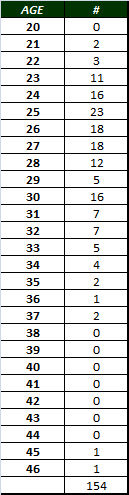
Top 154 SPs in List Form

Here is a look at the top 154 starting pitchers broken down by list:

Broken down by age, look at that cluster between 23 and 28 years old.

Broken down by age, look at that cluster between 23 and 28 years old.

A team breakdown from most to least

A team breakdown from most to least

And finally, the echelons with some details about each grouping

And finally, the echelons with some details about each grouping

I’d like to thank everyone for the tremendous feedback on the list thus far. I’m glad it’s been so well-received. I’ll be polishing it up this weekend (i.e. removing Hurley, downing Sheets and slotting Blanton back in—among other goodies to come). I also hope to complete at least 2 podcasts over the weekend, so stay tuned for that as well.

Wednesday: 02.11.2009

The Podcast Returns!

On the heels of the starting pitcher list being released, I’ve brought back the podcast with an episode covering some of the ins & outs of the list. It can be found here: http://pauls.mypodcast.com/index.html or view iTunes by searching for Baseball by Paul.

Wednesday: 01.28.2009

Measuring Impact of Projected Stats

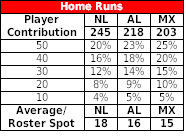
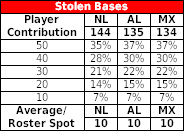
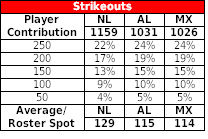
Chances are if you’ve been playing fantasy baseball for a few years, you have said or heard someone say that he/she is just aiming to finish in every category and that should take them to the promised land. In standard 12 team leagues, that would give them 10 points in 10 categories and it’s a rare instance where 100 points wouldn’t win the league. How do you put that benchmark in use while preparing for your drafts and auctions? Are you overvaluing or undervaluing someone’s contribution to the detriment of your team? I wanted to look at what something like 30 home runs or 20 stolen bases meant to the “Finish Third Theory” and which one was more valuable so I did a little math. I took the third place value over the past few years from the many leagues I’ve played in an came up with an average for 12-team NL, AL and Mixed (MX) leagues. Then I looked at how impactful a series of benchmark numbers were on that 3rd place total. Finally, I included the average you ideally want per roster spot to hit that total so you can have an idea how far above or under average your team is tracking towards that sweet spot.

I only looked at home runs, stolen bases and strikeouts because those are the most skill-based statistics and they best lend themselves to being projected year-in and year-out. Runs, runs batted in and wins are very team-based and situational. Of course the rate categories (OBP or AVG, ERA and WHIP) would be too difficult to study in this format.

Home Runs
home-runs

What we see on the home run chart is that you have to build a foundation with this category. Just because you land Ryan Howard early doesn’t mean you can shuffle your attention elsewhere because you’ve got your power stud. The best part about home run studs is that they are contributing to three categories with their one skill. Only one of the top 10 home run hitters from 2008 failed to score at least 85 runs (Adam Dunn, 79) and all 10 had at least 100 RBIs. Pat Burrell and Jack Cust joined Dunn as the only players within the top 20 to score fewer than 85 while Cust was the lone top 20 entry to have fewer than 85 RBIs. Remember that you can never have too much power. Even in mid-season trade negotiations, you can pitch the fact that you’re offering help in three categories when offering a big slugger.

Stolen Bases
stolen-bases

This is why I love power-speed combo players. Not only is my power base being built, but I’m getting HUGE contributions to my speed base at the same time. I understand that Wily Taveras is a huge contributor to the speed needed for third place, but he’s a virtual zero everywhere else. Jayson Werth, used here because he is in Taveras’ ADP range, brings 15% of the speed to the table AND 12% of the power. It’s not that Taveras is useless and would never wind up on a roster of mine, but his speed is often analyzed on its own with no regard for the detrimental impact of Taveras elsewhere. Give me Delmon Young 100 out of 100 times over Juan Pierre though the two are just one spot from one another in ADP. The lesson here is not look at speed in a vacuum and over draft the “all-speed” types. Meanwhile, seeing how impactful a top base stealer can be to the bottom line makes a case for Hanley Ramirez, Jose Reyes and Grady Sizemore as the top three fantasy values because of their plentiful across-the-board contributions. They are all bona fide first rounders, but all three deliver at least a quarter of the stolen base total needed for 3rd place while posting elite figures in at least TWO more categories.

Strikeouts
strikeouts

For me, the biggest surprise here was how much a 150-strikeout pitcher can move the needle. With 10 or fewer available in most seasons, the 200-K guys are obviously highly sought after with good reason but missing out on them while snagging three of the 30 other 150+ strikeout guys is a very reasonable alternative. You don’t need me or anyone else to tell you that someone topping 200 strikeouts will be very valuable to your team because only one had fewer 16 wins and two posted an ERA higher than 3.49, but the catch is the risk associated with pitchers—also not a newsflash. The bankable 200-K guys (Johan Santana, Jake Peavy, CC Sabathia, Tim Lincecum) likely won’t find their way onto my roster because I’d rather add another 20 HR/20 SB guy in those early rounds. Don’t be afraid of that solid starter that gets just 6.0 K/9 because you falsely believe he doesn’t strike out enough batters to significantly improve the bottom line.

Wednesday: 01.21.2009

Scheduling Advantages Down the Stretch

Sometimes a fantasy league’s trade deadline tops that of the major league action as the contenders aim to get that missing piece for a stretch run. What follows is a look at the August and September home/road breakdown of some of the parks most known for favoring its hitters and some of the parks most known for favoring its pitchers. Why pay the extra prospect or draft pick that your trade partner requests for Garrett Atkins if he’s going to spend most of September on the road where he struggles to be much more than replacement level? Maybe Tom Gorzelanny is worth it as a throw-in piece of deal if the Pirates will be at home for most of the final two months.

Hitter-Friendly Parks

hitter

The takeaways from the above list are:

– Give Colorado Rockies hitters a boost in deadline dealings as they get 10 more games at home than on the road including a very nice 18/9 split in the final month of the season.

– Temper the expectations of Texas Rangers hitters with lopsided home/road splits already on your roster and being considered in prospective trades.

– Baltimore Orioles hitters get fewer games at home down the stretch, but the four game difference isn’t overwhelming. I’d rate them as is in deadline deals with no biases about where they will play the final two months.

– Conversely (or similarly), Chicago White Sox hitters get more games at home down the stretch, but the four game difference isn’t overwhelming. Again, there should be no home-field price hike factored in during your late July trade talks for White Sox hitters.

– Finally for our hitter-friendly parks, the Cincinnati Reds hitters are nearly even in home and away tilts over the course of August and September. There is a five game difference in September in favor of road games, but they have four in Colorado and another three game set at the Juice Box in Houston. If anything, their schedule leans in their favor much like Chicago’s.

Pitcher-Friendly Parks

pitcher

The takeaways from the above list are:

– San Diego, every pitcher’s dream, are about neutral on the whole but do have a 10/16 home/road split in the season’s final month including six of the final eight in Colorado and Arizona. Owners in leagues with August trade deadlines might consider moving their San Diego arms for the final month.

– Pittsburgh Pirates pitchers have a very favorable final two months with just 20 games on the road. The unfortunate part is that outside of Paul Maholm, they just don’t have very many desirable pitchers as we head into 2009. Gorzelanny and Ian Snell may bounce back, but after that it’s Zach Duke, Phil Dumatrait and Ross Ohlendorf.

– The arms of the Bay Area have nearly identical splits over the final two months with no overwhelming advantage showing up for either ballclub. I can’t imagine a scenario where you wouldn’t want to hang onto the rosterable arms of San Francisco anyway, but it’s still somewhat comforting to know that they won’t be touring the NL’s most hitter-friendly parks down the stretch. Oakland grows pitchers seemingly like no other and they have a history of turning it on during the 2nd half (last year notwithstanding) so they too are good holds for deadline dealings.

– Even though Minnesota’s schedule is tilted slightly towards road games, their pitchers are of a high enough caliber that you will want them in just about any situation.

The above knowledge likely won’t win a league on its own, but you have to try and take advantage of any potential help that may be available. I could see this knowledge being quite helpful in head-to-head leagues, too.

Friday: 01.9.2009

Batting Average Anchors: Myth?

We have all seen this exchange. You’re in a draft or auction and Adam Dunn has just landed on his team for the season. After the draft pick or once the bidding is done, one guy (and sometimes even a couple) invariably tells the owner that while he may like Dunn’s power, that owner will regret carrying Dunn’s often putrid batting average. With five straight years of 40+ home runs, it is easy to see why rostering him is a desirable proposition. So how much do these batting average anchors hurt the team?

A standard league has 14 hitting spots on a roster thus Dunn or the batting average dead weight of your choice is accountable for essentially 1/14th of team’s batting average. This can and does vary based on the number of at-bats a player has in a season, but for the most part you can expect about 515 to 575 at-bats from someone like Dunn. What I did was look at a few different scenarios and then looked at how adding a batting average stud like Joe Mauer to the mix differed from adding Dunn or Mark Reynolds to that same team.

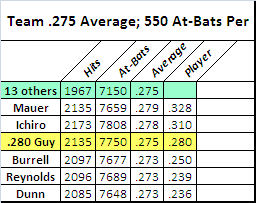
The first scenario has the other 13 players at a .275 average with 550 at-bats per spot. How did that team fare when adding the stud, the mid-level and the dud?

avg-anchor1

Adding Mauer to the team as is nets a healthy four points to the batting average and adding him in lieu of any of our three anchors yields a six point boost. Those results aren’t particularly surprising. The fact that each of anchors only costs the team as a whole two points is promising. Surely that minor bump down is more than offset by their contributions in the power categories (and the decent offering of speed by Reynolds).

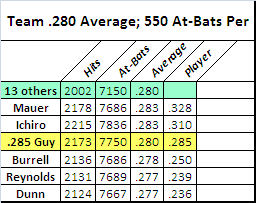
How about when a team is hitting .280 on an average of 550 at-bats per player? The results aren’t much different:

avg-anchor21

The impact of Mauer and Ichiro is equal now while Pat Burrell gets a one point edge over his average-deficient peers. For all intents and purposes, there is little difference between these first two examples. Though I doubt it’s a newsflash to many, notice that the player with a slightly higher average than the team he’s joining does nothing to impact the team’s overall batting average? If you’re deciding between a two players with close lines, but one guy hits .272 with a eight more runs, two more home runs, seven more RBIs and an extra steal than the guy hitting .285, take the .272 guy because both have a virtually nil impact on the overall batting average so you might as well grab the extra counting stats.

Next I looked at a team that averages 450 at-bats per player. Obviously the more at-bats on a team, the less one guy’s batting average impacts the bottom line. Since the .275 and .280 studies were virtually the same under 550 at-bats, I only looked at the .280 average team with 450 at-bats:

avg-anchor3

Here we see that the run-of-the-mill .285 average guy in 450 at-bats does positively impact the team’s batting average. There is now an eight point difference between Mauer and Dunn. Clearly that’s significant. In this scenario there is a legitimate decision as to whether or not Dunn’s power advantage will make up for his lack of batting average. The answer to this is variable dependent on the team you’ve assembled to that point and what your plan is continuing on through the rest of the draft or auction.

Finally, I looked at a scenario of rostering TWO of these batting average black holes. You will obviously be getting some insane power production if you put Dunn and Burrell on your team, but what kind of hole will you find yourself in from a batting average standpoint?

avg-anchor4

Frankly, I expected worse here. Sure there is a 10-point gap between Mauer/random .280 dude and Burrell/Dunn, but 70+ home runs and 180+ RBIs is a nice consolation prize. In the end, I think the fantasy baseball community as a whole overrates the negative impact of a poor batting average from someone like Dunn. It’s not like discussing the downside of Dwight Howard‘s awful free throw percentage on your basketball team. Basketball players take a very disparate number of free throws and Howard is among the leaders. The number of at-bats for players on a fantasy baseball team doesn’t vary all that much. And if they’re hitting horribly, they’ll lose at-bats to someone else. When Howard is especially awful at free throws, teams are more inclined to send him to the line a few extra times that week or month.

I have never shied away from a bad batting average power hitter and I probably never will given that a 550 at-bat season is about 6-8% of a team’s at-bat total while 40 home runs is about 18% of the average team’s home run total and 100 RBIs is about 11% of the average team’s RBI total. Even the 11 steals by Reynolds is around 10% of the stolen base total for a mid-pack team further proving that the potential impact of a player’s counting stats is higher than even the best hitter’s impact on batting average.

Sunday: 06.1.2008

Baseball’s Power Outage

(Editor’s Note: Click on charts for a better view when necessary)

At this time last year, Troy Glaus, Victor Martinez and B.J. Upton each had eight home runs for the year. This year the trio has combined for just five! This fact, among others, has led a bevy of analysts, bloggers and radio hosts to spend ample time hypothesizing about what has brought about the current “power outage” in baseball. Oftentimes the conclusion is that the game has been cleaned up and thus gotten weaker. Is that just the convenient answer that we want to be true or is there some sort of legitimacy to it? Since we can’t really prove whether or not it’s true given the lack of evidence around who was and who wasn’t on PEDs the past several years, this answer will always be largely conjecture. What we can do, however, is take a look at the numbers and see just how much the power has dropped off around the league.

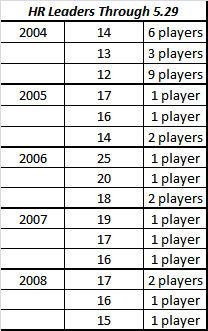
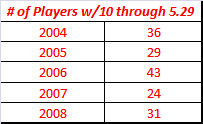
To get an idea of how much, if any, power has dissipated from the game, I looked at several things: Slugging Percentage, Home Runs and Doubles. I also looked at weather just to see if anything interesting struck me, but I don’t think that would come into play until late in the year. I went back to 2004 giving me a complete four-year sampling to compare the first two months of 2008 against. First, I’ll show some of the simpler data I compiled that probably doesn’t have huge correlations year-over-year but can be “fun” to look at when discussing these kinds of things. The following charts focus on the concentration of home runs meaning they fail in giving us the scope we need to judge how far up or down the league’s power is or isn’t right now. What they do offer is an interesting look into how the premier hitters performed during the period studied.
10 or more HR
Judging by those two charts, 2006 was a huge power year all around. Two players had 20 or more home runs and a whopping 43 had 10 or more, both are easily the best of all years studied. Sidenote: 2006 was the second hottest year in the United States on record. The above charts might lead you to believe that 2008 has been a more fruitful power year than 2007 and all the talk is just bluster. And this is why we must dig deeper.

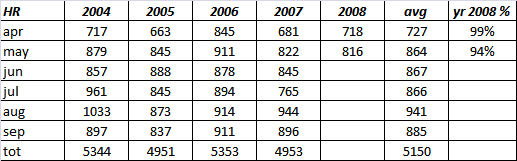
Let’s examine the home run totals a bit more to get more perspective. I took home runs totals by month from 2004 through May of 2008 and then looked at the average of each month. From there, I compared the 2008 April and May totals against the average to see how they stood up. Though the grumblings of a power outage started in earnest during April, the 718 home runs hit reached 99% to the April average (727) and totaled 37 more than April 2007 (681). In fact, outside of the home run happy 2006 season (845 April HRs), the 718 home runs hit this past April was the biggest total of the years studied.

May, however, was a different story. Though just six off of the mark of 2007’s May, the 816 home runs reached just 94% of the average and qualified as the lowest total of the years studied. From 2004-2007, home runs saw a 20% increase from April to May. This year, there was only a 14% increase month-over-month bringing the five year average down to +18%. If the season follows pace and assumes the same percentage gains and losses established from 2004-2007, then there would be about 4900 home runs in 2008, the lowest of the years studied by over 50 home runs.
Month-Over-Month HR Changes
So the data centered around home run output leaves us with an uneven answer. April home run output was strong by comparison despite that month usually being excused due to inclement weather while the uptick generally enjoyed by the league in May was decidedly absent in 2008 despite the concentration of power being stronger or at least as strong as previous seasons.

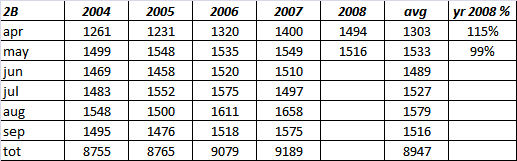
Let’s move onto doubles because contrary to popular belief, power isn’t only about home runs. Legitimate power can and will result in a boatload of double as well. April 2008 gave us the highest double output of all the years studied by far meaning that heading into May it seemed that the assumed power outage had little behind it. The double output in May was only 99% of the average from the sample size once again lending credence those in favor of a power outage.

At this point in my study, I still felt rather uncertain about the results. Some of you probably see where I’m going with this, but I chose present these numbers first because it is primarily what the so-called experts and pundits choose to focus on when decrying the drop of power in the media. These raw totals told me that April was on pace with history and any drops experienced in May appeared negligible. The preceding charts were contrary to everything that the very first chart I put together showed me:
Slugging Percentage by month
Even though the doubles and home runs totals from April and May suggested that things weren’t all that bad, both months had a depressed slugging percentage when compared against the previous four seasons. Mind you, I’m well aware of the fact that doubles and home runs aren’t the only variables included in slugging percentage, but they are the most common components with the biggest impact. The impact of singles is small as is the frequency of triples. Now we’re nearly 900 words into the piece and we only really needed one chart to show us that power is in fact down in baseball for 2008.

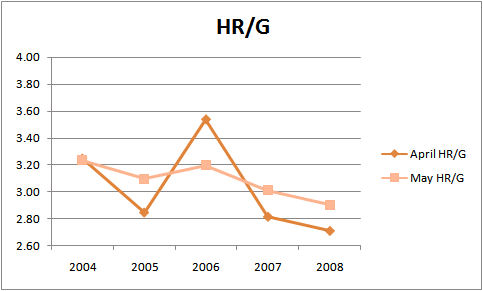
The key was obviously to look at things on a per game basis. Given the random weather patterns in both April and May that cause both rain outs and snow outs leading to various scheduling changes, the raw totals won’t always deliver the full story. Let’s take a look at both home runs and doubles on a per game across the past five seasons in April & May to see how prominent a decline in power has struck the league this year:

The talking heads got one right, folks. They may not have taken the best path (total numbers), but the two charts found above clearly show that there is a legitimate power decline in the game of baseball right now. Is it because of the crackdown on PEDs? As I mentioned at the very beginning, that is an impossible question to completely answer with the data we have in front of us. The game’s biggest fans that took the constant black eyes bestowed upon the game to heart absolutely want it a crackdown on PEDs to be the answer for the decline. Perhaps the powers in charge have altered the ball back into the favor of pitchers?

After all, 31 starting pitchers have earned run averages below 3.50. And 19 starting pitchers have FIP measures below 3.50. Four of the pitchers with a FIP below 3.50 have an ERA above 3.50 essentially meaning they have been bitten by some bad luck. Unfortunately, I was unable to find an easy way to put together the data to see how many players had similar figures in previous seasons. For all of 2007, only 17 pitchers were on the right side of 3.50 in the ERA category and only nine of them held a <3.50 FIP.

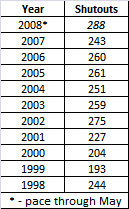
Lastly with regards to pitching, consider that there have already been 96 shutouts this season including nine from the pitiful Detroit Tigers thought in the off-season to be capable of chasing down 1000+ runs scored. Last year, there were 243 shutouts total (40.5 per month). Through May 31st, we’ve already seen 96 shutouts this year. If the 2008 pace holds (48 per month), then we would see 288 shutouts, easily the highest total in the 30-team era:

With four months of play left, the bulk of which will be played in the hottest weather of the year, it is difficult to make any sweeping conclusions. One thing is certain right now, power is down and the margin is statistically valid. For all the heat that Bud Selig takes, it does seem that his concerted effort to crackdown on PEDs in baseball is paying some dividends. Warning track power is the story of the season as are the many wall-scraping home runs that have been a point of consternation through the first two months. So frequent are these close calls that the talk of instant replay on some level in baseball is being heavily discussed nearly as much as the Power Outage of 2008.

Wednesday: 03.12.2008

2008 Guide to Middle Reliever Methodology

This was originally posted on Rotojunkie.com, but the board over there has been taken down and moved with the archives disappearing.  I’m posting this years after the fact…

First, let’s get a refresher on the MRM.

The idea is that you acquire three middle relievers amongst your nine pitchers whose stats will combine to give you those of a top flight starting pitcher at 1/5th to maybe ½ of the price. The price you will pay for your “Cheap Cy” as Bod [Bodhizefa, a poster from the board] termed them (and I like it, so I’ll keep it) depends on what echelon of reliever you aim to acquire.

The method is becoming much more prevalent these days (just as Bod predicted back in ’05 when he made brought this to light at RJ), so much so that the Rotoworld.com Fantasy Baseball Draft Guide put a section in their magazine dedicated to specifically to middle relievers. The way for this method to have the most success is to find the next Rafael Betancourt, Jonathan Broxton or Carlos Marmol as opposed to paying the premium for one (or more) of that trio. That said, you don’t avoid these three by any stretch. You will still encounter leagues where middle relievers, even the best, are undervalued. It is rare, but not completely unheard of…

Exclusions for the MRM:
This methodology is not viable in 4×4 leagues unless one of the four categories is strikeouts, though I’ve rarely seen that. It is best employed in standard 5×5 leagues. As the number of categories increases, the methodology will likely decrease in viability because Holds will likely enter the landscape, which automatically shines the spotlight on the landscape of middle relievers.

Tenets for the MRM:
• 3 relievers, 2 is too few unless you get something like Betancourt-Broxton, but then the point of it being a cheap way to improve the pitching is likely eliminated since they’re such high profile. 4 are too many since you’re taking up too many roster spots.

• 1 of your relievers should be a big innings guy. Last year, there were:

o 31 relievers who pitched 70+ IP
o 13 relievers who pitched 80+ IP
o 3 relievers who pitched 90+ IP

• Acquire relievers with high strikeout rates. The bar should be set no lower than 7.0 K/9. Last year, there were:

o 80 relievers who had a 7.0+ K/9
o 51 relievers who had a 8.0+ K/9
o 34 relievers who had a 9.0+ K/9
o 12 relievers who had a 10.0+ K/9
o Those 80 relievers averaged 57 IP
o Those 51 relievers averaged 57 IP
o Those 34 relievers averaged 57 IP
o Those 12 relievers averaged 52 IP

• All three needn’t be above that rate, but the best and most useful will end up there. Don’t eliminate the sub-7.0 K/9 relievers just because of the K-rate.

• That said the 7.0+ K/9 guys are going to be your best bets. With the measure I created to assess relievers, the top 50 middle relievers had an average of 9.1 K/9 and only six of them dropped below the 7.0 mark.

• All of the top 28 were at 7.9 K/9 or above with an average of 9.8 K/9.

• The seven pitchers in the Top 50 that were below 7.0 K/9 had an average of 6.6 K/9.

The List:
• To rank the middle relievers, I ranked the top 126 relievers by ERA, K:BB and K/9. Then I took the rankings of all three categories and weighted the strikeout rates by 1 and the ERA by 2 and divided the total by 3 to come up with a “score”. I don’t know if this is the best system, but I found the results to be viable enough to be useful. Frankly, you could probably just use K/9 and go by that.

Joba Chamberlain’s remarkable 24-inning cup of coffee last year was far and away the best score at 4.7. He ranked 25.3 points above the 2nd place Jonathan Broxton.

• We’re going to look at things from a few different angles. First let’s look at how the Top 50 ranked using the scoring method I devised:

HTML Code:
RK	PLAYER		        TEAM	LG	IP	W	L	HLD	SV	ERA	RK	K:BB	RK	K/9	RK	TOTAL
1	Joba Chamberlain	NYY	AL	24	2	0	8	1	0.38	1	5.67	2	12.75	2	4.7
2	Jonathan Broxton	LAD	NL	82	4	4	32	2	2.85	27	3.96	4	10.87	8	30.0
3	Jensen Lewis		CLE	AL	29.1	1	1	5	0	2.15	13	3.40	13	10.52	9	30.7
4	Rafael Perez		CLE	AL	60.2	1	2	12	1	1.78	4	4.13	3	9.27	28	33.7
5	Rafael Betancourt	CLE	AL	79.1	5	1	31	3	1.47	3	8.89	1	9.10	31	34.0
6	George Sherrill		BAL	AL	45.2	2	0	22	3	2.36	20	3.29	18	11.15	5	36.3
7	Carlos Marmol		CHC	NL	69.1	5	1	16	1	1.43	2	2.74	32	12.50	3	36.3
8	Heath Bell		SDG	NL	93.2	6	4	34	2	2.02	10	3.40	14	9.85	16	36.7
9	Russ Springer		STL	NL	66	8	1	11	0	2.18	15	3.47	9	9.00	32	51.0
10	Damaso Marte		PIT	NL	45.1	2	0	15	0	2.38	21	2.83	30	10.18	12	56.0
11	Joaquin Benoit		TEX	AL	82	7	4	19	6	2.85	28	3.11	24	9.55	19	61.7
12	Juan Cruz		ARI	NL	61	6	1	4	0	3.10	43	2.72	34	12.84	1	63.7
13	Justin Speier		LAA	AL	50	2	3	24	0	2.88	29	3.92	5	8.46	43	67.3
14	Hideki Okajima		BOS	AL	69	3	2	27	5	2.22	16	3.71	7	8.22	51	68.7
15	Octavio Dotel		CHW	AL	30.2	2	1	1	11	4.11	83	3.42	12	12.22	4	71.3
16	Troy Percival		TAM	AL	39	3	0	3	0	1.85	7	3.40	15	7.85	53	72.7
17	Pat Neshek		MIN	AL	70.1	7	2	15	0	2.94	31	2.74	33	9.50	20	73.7
18	Justin Miller		FLA	NL	61.2	5	0	17	0	3.65	64	3.08	25	10.88	7	74.7
19	Chad Qualls		ARI	NL	82.2	6	5	21	5	3.05	37	3.12	23	8.54	42	89.7
20	Bob Howry		CHC	NL	81.1	6	7	22	8	3.32	52	3.79	6	7.99	52	92.7
21	Scott Downs		TOR	AL	58	4	2	24	1	2.17	14	2.38	49	8.84	36	94.3
22	Ryan Rowland-Smith	SEA	AL	38.2	1	0	3	0	3.96	78	2.80	31	9.90	14	97.0
23	Dan Wheeler		TAM	AL	74.2	1	9	18	11	5.30	116	3.57	8	9.95	13	98.3
24	Manny Delcarmen		BOS	AL	44	0	0	11	1	2.05	11	2.41	47	8.39	45	99.3
25	Al Reyes		TAM	AL	60.2	2	4	0	26	4.90	110	3.33	17	10.47	10	100.3
26	Chris Schroder		WAS	NL	45.1	2	3	1	0	3.18	47	2.87	29	8.58	40	100.3
27	Matt Lindstrom		FLA	NL	67	3	4	19	0	3.09	42	2.95	26	8.33	47	101.0
28	Michael Wuertz		CHC	NL	72.1	2	3	8	0	3.48	58	2.26	58	9.86	15	111.7
29	Matt Guerrier		MIN	AL	88	2	4	14	1	2.35	18	3.24	19	6.95	83	114.0
30	Fernando Rodney		DET	AL	50.2	2	6	12	1	4.26	89	2.57	39	9.68	18	116.3
31	Jeremy Accardo		TOR	NL	67.1	4	4	2	30	2.14	12	2.38	50	7.65	59	117.0
32	Bobby Seay		DET	AL	46.1	3	0	10	1	2.33	17	2.53	41	7.42	66	118.3
33	John Bale		KAN	AL	40	1	1	5	0	4.05	82	2.47	44	9.45	21	119.7
34	Rudy Seanez		LAD	NL	76	6	3	4	1	3.79	70	2.70	35	8.64	39	120.7
35	Brian Fuentes		COL	NL	61.1	3	5	8	20	3.08	40	2.43	46	8.25	49	121.7
36	Jon Rauch		WAS	NL	87.1	8	4	33	4	3.61	63	3.38	16	7.34	68	126.0
37	Jimmy Gobble		KAN	AL	53.2	4	1	16	1	3.02	33	2.17	63	8.46	44	129.0
38	Joe Smith		NYM	NL	44.1	3	2	10	0	3.45	56	2.14	64	9.18	29	130.3
39	Andrew Brown		OAK	AL	41.2	3	3	3	0	4.54	97	2.53	42	9.39	24	130.7
40	Tim Byrdak		DET	AL	45	3	0	8	1	3.20	49	1.88	82	9.80	17	131.7
41	Jason Frasor		TOR	AL	57	1	5	4	3	4.58	100	2.57	40	9.32	27	133.7
42	Scot Shields		LAA	AL	77	4	5	31	2	3.86	75	2.33	52	9.00	33	135.0
43	Lee Gardner		FLA	AL	74.1	3	4	9	2	1.94	9	2.89	28	6.32	101	135.0
44	Lenny DiNardo		OAK	AL	34.2	1	2	0	0	1.82	6	3.14	21	5.79	113	138.0
45	Randy Flores		STL	NL	55	3	0	14	1	4.25	88	3.13	22	7.69	58	138.7
46	Aaron Heilman		NYM	NL	86	7	7	22	1	3.03	36	3.15	20	6.59	97	141.0
47	Pedro Feliciano		NYM	NL	64	2	2	18	2	3.09	41	1.97	73	8.58	41	141.3
48	Cla Meredith		SDG	NL	79.2	5	6	10	0	3.50	59	3.47	11	6.70	94	144.3
49	Santiago Casilla	OAK	AL	50.2	3	1	12	2	4.44	95	2.26	57	9.32	26	146.3
50	Joel Peralta		KAN	AL	87.2	1	3	7	1	3.80	71	3.47	10	6.81	89	146.3

• This list gives you the track record guys. Of course, that segues perfectly for me to mention something about this methodology as a whole: relievers are remarkably volatile. From year-to-year, things will change. On the positive, this allows you to find hidden gems. On the negative, you could invest in “sure things” and watch them blow up in your face. This caveat is why it’s smarter to invest less in your trio so that if things aren’t working out by June, then you can cut bait and try another.

• The next list is those 81 relievers that topped 7.0+ K/9 ranked by strikeouts per nine innings:

HTML Code:
RK	PLAYER		       TEAM	LG	IP	W	L	HLD	SV	ERA	RK	K:BB	RK	K/9	RK	TOTAL
12	Juan Cruz		ARI	NL	61	6	1	4	0	3.10	43	2.72	34	12.84	1	63.7
1	Joba Chamberlain	NYY	AL	24	2	0	8	1	0.38	1	5.67	2	12.75	2	4.7
7	Carlos Marmol		CHC	NL	69.1	5	1	16	1	1.43	2	2.74	32	12.50	3	36.3
15	Octavio Dotel		CHW	AL	30.2	2	1	1	11	4.11	83	3.42	12	12.22	4	71.3
6	George Sherrill		BAL	AL	45.2	2	0	22	3	2.36	20	3.29	18	11.15	5	36.3
53	Derrick Turnbow		MIL	NL	68	4	5	33	1	4.63	101	1.83	84	11.12	6	157.3
18	Justin Miller		FLA	NL	61.2	5	0	17	0	3.65	64	3.08	25	10.88	7	74.7
2	Jonathan Broxton	LAD	NL	82	4	4	32	2	2.85	27	3.96	4	10.87	8	30.0
3	Jensen Lewis		CLE	AL	29.1	1	1	5	0	2.15	13	3.40	13	10.52	9	30.7
25	Al Reyes		TAM	AL	60.2	2	4	0	26	4.90	110	3.33	17	10.47	10	100.3
56	Armando Benitez		FLA	NL	50.1	2	8	11	9	5.36	117	1.97	74	10.24	11	163.0
10	Damaso Marte		PIT	NL	45.1	2	0	15	0	2.38	21	2.83	30	10.18	12	56.0
23	Dan Wheeler		TAM	AL	74.2	1	9	18	11	5.30	116	3.57	8	9.95	13	98.3
22	Ryan Rowland-Smith	SEA	AL	38.2	1	0	3	0	3.96	78	2.80	31	9.90	14	97.0
28	Michael Wuertz		CHC	NL	72.1	2	3	8	0	3.48	58	2.26	58	9.86	15	111.7
8	Heath Bell		SDG	NL	93.2	6	4	34	2	2.02	10	3.40	14	9.85	16	36.7
40	Tim Byrdak		DET	AL	45	3	0	8	1	3.20	49	1.88	82	9.80	17	131.7
30	Fernando Rodney		DET	AL	50.2	2	6	12	1	4.26	89	2.57	39	9.68	18	116.3
11	Joaquin Benoit		TEX	AL	82	7	4	19	6	2.85	28	3.11	24	9.55	19	61.7
17	Pat Neshek		MIN	AL	70.1	7	2	15	0	2.94	31	2.74	33	9.50	20	73.7
33	John Bale		KAN	AL	40	1	1	5	0	4.05	82	2.47	44	9.45	21	119.7
80	Brandon Morrow		SEA	AL	63.1	3	4	18	0	4.12	84	1.32	120	9.41	22	198.0
54	Tyler Yates		ATL	AL	66	2	3	13	2	5.18	115	2.23	59	9.41	23	158.7
39	Andrew Brown		OAK	AL	41.2	3	3	3	0	4.54	97	2.53	42	9.39	24	130.7
64	Taylor Tankersley	FLA	NL	47.1	6	1	16	1	3.99	80	1.69	97	9.36	25	175.3
49	Santiago Casilla	OAK	AL	50.2	3	1	12	2	4.44	95	2.26	57	9.32	26	146.3
41	Jason Frasor		TOR	AL	57	1	5	4	3	4.58	100	2.57	40	9.32	27	133.7
4	Rafael Perez		CLE	AL	60.2	1	2	12	1	1.78	4	4.13	3	9.27	28	33.7
38	Joe Smith		NYM	NL	44.1	3	2	10	0	3.45	56	2.14	64	9.18	29	130.3
83	Jack Taschner		SFO	NL	50	3	1	13	0	5.40	119	1.76	92	9.18	30	201.3
5	Rafael Betancourt	CLE	AL	79.1	5	1	31	3	1.47	3	8.89	1	9.10	31	34.0
9	Russ Springer		STL	NL	66	8	1	11	0	2.18	15	3.47	9	9.00	32	51.0
42	Scot Shields		LAA	AL	77	4	5	31	2	3.86	75	2.33	52	9.00	33	135.0
55	Mark McLemore		HOU	NL	35	3	0	1	0	3.86	76	1.94	76	9.00	34	160.7
65	Trever Miller		TB	AL	46.1	0	0	12	1	4.86	108	2.00	69	8.98	35	176.0
21	Scott Downs		TOR	AL	58	4	2	24	1	2.17	14	2.38	49	8.84	36	94.3
61	Matt Thornton		CHW	AL	56.1	4	4	17	2	4.79	106	2.12	65	8.82	37	172.7
63	Renyel Pinto		FLA	NL	58.2	2	4	16	1	3.68	66	1.75	93	8.66	38	175.0
34	Rudy Seanez		LAD	NL	76	6	3	4	1	3.79	70	2.70	35	8.64	39	120.7
26	Chris Schroder		WAS	NL	45.1	2	3	1	0	3.18	47	2.87	29	8.58	40	100.3
47	Pedro Feliciano		NYM	NL	64	2	2	18	2	3.09	41	1.97	73	8.58	41	141.3
19	Chad Qualls		ARI	NL	82.2	6	5	21	5	3.05	37	3.12	23	8.54	42	89.7
13	Justin Speier		LAA	AL	50	2	3	24	0	2.88	29	3.92	5	8.46	43	67.3
37	Jimmy Gobble		KAN	AL	53.2	4	1	16	1	3.02	33	2.17	63	8.46	44	129.0
24	Manny Delcarmen		BOS	AL	44	0	0	11	1	2.05	11	2.41	47	8.39	45	99.3
92	Jon Coutlangus		CIN	NL	41	4	2	9	0	4.39	93	1.41	117	8.34	46	225.0
27	Matt Lindstrom		FLA	NL	67	3	4	19	0	3.09	42	2.95	26	8.33	47	101.0
52	C.J. Wilson		TEX	AL	68.1	2	1	15	12	3.03	35	1.91	80	8.33	48	151.3
35	Brian Fuentes		COL	NL	61.1	3	5	8	20	3.08	40	2.43	46	8.25	49	121.7
73	Will Ohman		ATL	NL	36.1	2	4	12	1	4.95	111	2.06	66	8.23	50	190.0
14	Hideki Okajima		BOS	AL	69	3	2	27	5	2.22	16	3.71	7	8.22	51	68.7
20	Bob Howry		CHC	NL	81.1	6	7	22	8	3.32	52	3.79	6	7.99	52	92.7
16	Troy Percival		TAM	AL	39	3	0	3	0	1.85	7	3.40	15	7.85	53	72.7
58	Brian Tallet		TOR	AL	62.1	2	4	1	0	3.47	57	1.93	78	7.83	54	170.0
97	Scott Eyre		CHC	NL	52.1	2	1	5	0	4.13	85	1.29	122	7.77	55	233.7
62	Salomon Torres		MIL	NL	52.2	2	4	5	12	5.47	120	2.65	37	7.76	56	173.0
77	Kevin Cameron		SDG	NL	58	2	0	1	0	2.79	26	1.39	119	7.76	57	193.3
45	Randy Flores		STL	NL	55	3	0	14	1	4.25	88	3.13	22	7.69	58	138.7
31	Jeremy Accardo		TOR	NL	67.1	4	4	2	30	2.14	12	2.38	50	7.65	59	117.0
82	Todd Coffey		CIN	NL	51	2	1	7	0	5.82	124	2.26	56	7.59	60	198.7
74	Dustin Nippert		ARI	NL	45.1	1	1	2	0	5.56	121	2.38	51	7.58	61	192.7
66	Jared Burton		CIN	NL	43	4	2	11	0	2.51	23	1.64	100	7.53	62	177.3
107	Frank Francisco		TEX	AL	59.1	1	1	21	0	4.55	98	1.29	121	7.46	63	249.3
98	Juan Rincon		MIN	AL	59.2	3	3	14	0	5.13	114	1.75	94	7.45	64	234.0
102	Luis Vizcaino		COL	NL	75.1	8	2	14	0	4.30	91	1.44	115	7.43	65	240.7
32	Bobby Seay		DET	AL	46.1	3	0	10	1	2.33	17	2.53	41	7.42	66	118.3
75	John Grabow		PIT	NL	51.2	3	2	8	1	4.53	96	2.21	62	7.38	67	193.0
36	Jon Rauch		WAS	NL	87.1	8	4	33	4	3.61	63	3.38	16	7.34	68	126.0
95	Joel Zumaya		DET	AL	33.2	2	3	8	1	4.28	90	1.59	104	7.32	69	233.0
59	Matt Wise		NYM	NL	53.2	3	2	13	1	4.19	86	2.53	43	7.27	70	170.3
71	Tom Gordon		PHI	NL	40	3	2	14	6	4.73	103	2.46	45	7.20	71	184.7
96	Kyle Farnsworth		NYY	AL	60	2	1	15	0	4.80	107	1.78	90	7.20	72	233.3
67	Darren Oliver		LAA	AL	64.1	3	1	8	0	3.78	69	2.22	61	7.16	73	180.0
78	Guillermo Mota		MIL	NL	59.1	2	2	6	0	5.76	123	2.61	38	7.16	74	194.0
110	Brandon Medders		ARI	NL	29.1	1	2	1	0	4.30	92	1.44	116	7.11	75	252.3
90	Jason Grilli		DET	AL	79.2	5	3	11	0	4.74	104	1.94	77	7.05	76	222.3
118	Brian Bruney		NYY	AL	50	3	2	6	0	4.68	102	1.05	125	7.02	77	270.0
101	Jeremy Affeldt		CIN	NL	59	4	3	9	0	3.51	60	1.39	118	7.02	78	236.0
117	Jonah Bayliss		PIT	NL	37.2	4	3	4	0	8.36	126	1.61	102	7.02	79	265.0
99	Sean Green		SEA	AL	68	5	2	13	0	3.84	74	1.56	105	7.01	80	234.3

FYI: The rank on the far left of the above list is their overall rank using my devised scoring method.

The usefulness of the above is list that it is where you are likely to find the diamonds in the rough.

Here is a breakdown of those Top 81 in strikeout rates by League:
o National League: 42
o American League: 39

Diamonds in the Rough (these are the guys most likely to be the next Betancourts and Broxtons):
o 1 Rafael Perez, CLE
o 2 Justin Miller, FLA
o 3 Matt Guerrier, MIN
o 4 Jensen Lewis, CLE
o 5 Santiago Casilla, OAK
o 6 Michael Wuertz, CHC
o 7 Juan Cruz, ARI
o 8 Matt Lindstrom, FLA
o 9 Brandon Morrow, SEA
o 10 Taylor Tankersley, FLA
o 11 Tony Pena, ARI
o 12 Joel Peralta, KC
o 13 Chris Schroder, WAS
o 14 Jimmy Gobble, KC
o 15 Bobby Seay, DET
o 16 Joe Smith, NYM
o 17 Andrew Brown, OAK
o 18 Manny Delcarmen, BOS
o 19 Pedro Feliciano, NYM
o 20 Mark McLemore, HOU
o 21 Justin Speier, LAA
o 22 Tim Byrdak, DET
o 23 Kevin Cameron, SD
o 24 John Bale, KC
o 25 Peter Moylan, ATL

Grandpas (these guys had solid seasons last year, but they are ridiculously old, so it’s tough to bet on a repeat):
o 1 Russ Springer, 39 y/o
o 2 Al Reyes, 37 y/o
o 3 Rudy Seanez, 39 y/o
o 4 Trever Miller, 34 y/o

The Known Commodities (these guys are the premier middle relief aces as well as the steady, unheralded relievers :
o 1 Jonathan Broxton
o 2 Rafael Betancourt
o 3 Carlos Marmol
o 4 Joba Chamberlain
o 5 Heath Bell
o 6 Scot Shields
o 7 Aaron Heilman
o 8 Pat Neshek
o 9 Dan Wheeler
o 10 Hideki Okajima
o 11 Chad Qualls
o 12 Joaquin Benoit
o 13 Scott Proctor
o 14 Bob Howry
o 15 Fernando Rodney
o 16 Derrick Turnbow
o 17 Octavio Dotel
o 18 Damaso Marte
o 19 Jeremy Accardo
o 20 Al Reyes

Examples: (I’ll close with a series of combos from last year to show how the method works)
o Heath Bell, Peter Moylan and Scott Proctor:
o 276.7 IP
o 15-13 W-L
o 2.51 ERA
o 1.14 WHIP
o 229 K

o Matt Guerrier, Justin Miller and Joel Peralta:
o 237.3 IP
o 8-7 W-L
o 3.22 ERA
o 1.18 WHIP
o 208 K

o Rafael Betancourt, Joaquin Benoit and Aaron Heilman:
o 247.3 IP
o 19-12 W-L
o 2.48 ERA
o 1.00 WHIP
o 230 K

o Jonathan Broxton, Pedro Feliciano and Jon Rauch:
o 233.3 IP
o 14-10 W-L
o 3.20 ERA
o 1.15 WHIP
o 231 K

o Cla Meredith, Pat Neshek and Matt Thornton:
o 205.3 IP
o 16-12 W-L
o 3.68 ERA
o 1.30 WHIP
o 188 K

o Scott Downs, Rafael Perez and Justin Speier:
o 168.7 IP
o 7-7 W-L
o 2.25 ERA
o 1.04 WHIP
o 166 K

A few final thoughts:

• Patience can be rewarded, but it’s a method that allows you a choice between patience and knee-jerk reactions. Personally, I give my guys that I target a fair shot to perform. Remember, relievers have small samples so one outing can balloon an ERA, but if they are still blowing batters away, then they are going to hold their bullpen spot and get a fair chance bring that ERA down. If you loved someone in the offseason and acquired them and then they suffer a rough April in six innings of work, but still hold a 9 K/9 or something like that, then I’d stand pat with them.

• Even if you plan to be patient with your initial picks, this method (like scouring for saves) takes in-season leg work. Always be alert of the next big thing. Carlos Marmol didn’t pitch until May 19th last year!

• If you start paying mid-teens in auctions for the upper-echelon of middle relievers, you’re not employing the strategy properly. The point is to get top 15-20 starter numbers for next-to-nothing cost.

• I’ll close with a few DEEEEEP sleepers:
o Kerry Wood, CHC
o Edwar Ramirez, NYY
o Renyel Pinto, FLA
o Vinnie Chulk, SF
o Wil Ledezma, SD
o Jack Taschner, SF
o Jon Coutlangus, CIN
o Guillermo Mota, MIL
o Lenny DiNardo, OAK
o Zach Miner, DET
o Tyler Yates, ATL
o David Aardsma, CHW
o Royce Ring, ATL

There it is, folks. I hope this helps you if you choose to employ what I believe is a very viable strategy. Please feel free to ask any questions or offer any players you think will be useful pieces in this strategy. Enjoy!