Archive for ‘Team Specific’

Thursday: 01.27.2011

Three Questions – San Francisco Giants

With the 2011 Starting Pitcher Guide slated for next month, I have a jam packed volume covering all the ins and outs of starting pitching in the 2011 season for your viewing pleasure.  Of course that doesn’t do much to address the offensive side of things so I decided to start this “Three Questions” where I will cover some key offensive issues for each of the 30 teams.  There will be more content here dealing with offense, but this is the beginning.

I paid a lot for Pablo Sandoval last spring, WTF?

Yeah that was a tough one to swallow.  He certainly didn’t come close to expectations, but at the same time he wasn’t the season killer he is made out to be, either.  Season killers are multiple month injuries on April 12th.  You can overcome guys who underperform expectations, but still play 152 games.  Plus it isn’t like his season was a complete & utter disaster, he had streaks of excellence mixed in, namely his April and August where he posted 1.008 and .907 OPS marks, respectively.

In many leagues, Sandoval’s down season (.268/.323/.409 w/13 HRs) will actually create a buying opportunity as owners overreact to what essentially amounts to a sophomore slump at age 23.  Most guys aren’t even in the big leagues at 23 and Sandoval has 1400+ plate appearances under his belt.   We have seen the best of Sandoval and we have seen the worst of Sandoval and with his price being driven by the latter, now is the time to invest.  In the SiriusXM/FSTA Draft during their conference out in Las Vegas on Monday, he was taken in the 8th round (101st overall) of a 13-team mixed league.  Last year he was a 3rd-4th round pick.

Third base is still pretty thin so his value won’t completely plummet, but I would consider that 8th round value to be the high end of where he will go in drafts so you might be able to get him a few rounds later depending on your league.  Once you get past the top 10 of Evan Longoria, Ryan Zimmerman, David Wright, Alex Rodriguez, Adrian Beltre, Aramis Ramirez, Pedro Alvarez, Martin Prado, Michael Young and Casey McGehee then I think Sandoval is just as good of a pick as the other guy.

He won’t offer nearly as much power as Mark Reynolds, but his overall profile is much more stable.  He doesn’t carry the age/injury risk of Scott Rolen & Chipper Jones and factoring in reasonable improvement regression, he should be better than them even if they manage to stay healthy.  Bottom line is you should pay for a guy hitting .300 with 18 home runs and 75+ runs scored and driven in, but be willing to go the extra buck or two for the potential he has as a 24-year old still coming into his own.

Andres Torres was a prototypical fantasy All-Star last year, what about 2011?

At 33, we’re not dealing with a growth profile here.  Torres’s 570 plate appearances last year eclipsed his career total by 115 spread across parts of five seasons.  That said, he gave us a taste of 2010 in 170 plate appearances in 2009 when he had six home runs and six stolen bases along with eight(!) triples.  After an amazing July, he sputtered down the stretch no doubt suffering some fatigue from his first whole season.  For 2011, it is going to be all about cost.

I’m confident he can put together another solid power/speed season as a “glue guy” for any fantasy team, but is the price tag going to be that of a glue guy or second tier fantasy star?  Early returns are mixed.  His ADP (average draft position) at one popular mock draft sites is off the charts ridiculous.  He is checking in as the 35th outfielder off the board (116th overall) ahead of guys like Curtis Granderson, Adam Jones, Carlos Lee, Vernon Wells and Nick Markakis.  While I said I don’t doubt he can repeat 2010, drafting him ahead of those guys means he has to repeat for me to get proper returns on my investment.

In the industry draft I mentioned earlier, he went in the 20th round (250th overall) which actually hits the other end of the spectrum as a great value.  I doubt he will go that late in most drafts, but anything before 15th-16th round is really ramping up the risk on your end.  He is a great story who has overcome his ADHD to have success in the big leagues, but you still have to remember he is a 33-year old strikeout machine with solid speed in a lineup that is still only decent at best.

Look for a .260-76-12-55-22 line which has value, but let your team construction dictate if he is a fit or not.  If you have a lot of high risk/high reward youth on the team, then Torres is a great stabilizing vet who’s downside isn’t  going to kill you.  But if you have a veteran-laden team on offense, then bet on the upside of a Travis Snider or Logan Morrison before taking a low ceiling Torres.

Is there anyone off the radar who could make an impact for the reigning Champions?

Yes there is and it is someone who has already been covered in depth here, first baseman/left fielder Brandon Belt, who was my favorite player to watch that Arizona Fall League back in November.  As presently constructed, the Giants lineup is essentially Posey, Sandy and Six Old Dudes.  Now those old dudes came through huge last year, especially in the playoffs and helped bring home a title, but older players aren’t bastions of health.  Injuries create opportunities which is where someone who is just about ready for the big leagues, like Belt, comes into play.

The reason Belt now has left fielder attached to his defensive description is because first base, his normal position, is pretty well sealed up for the time being.  Aubrey Huff parlayed his excellent 2010 season into a deserved contract and though he is 34, he has averaged 152 games per season since his age 26 season.  In that time, he has played fewer than 150 just once.  That said, age is fickle.  But the real opportunity could come in left field where Pat Burrell was something of a savior for that lineup in 96 games last year but is neither young (34), agile (-39.7 career UZR) or super healthy of late (122 & 120 GP the last 2 years).

Belt was a breakout prospect last year crossing three levels before heading to Arizona where he continued to stay hot.  Only 13 of his 136 games came at AAA-Fresno so he will start the 2011 season down there to get some more seasoning so he isn’t someone who should be drafted as anything other than a minor leaguer right now, but don’t be surprised if he earns an early summer call-up to spark that offense.

Make no mistake that the Giants won the World Series because of their pitching and that remains their overwhelming strength for 2011.  The offense is far from perfect and the veterans will have to produce with Posey if the team expects to contend out west and if not, GM Brian Sabean will have to find guys who can with Belt being the best minor league option for the Giants.

Tuesday: 01.25.2011

Three Questions – Seattle Mariners

With the 2011 Starting Pitcher Guide slated for next month, I have a jam packed volume covering all the ins and outs of starting pitching in the 2011 season for your viewing pleasure.  Of course that doesn’t do much to address the offensive side of things so I decided to start this “Three Questions” where I will cover some key offensive issues for each of the 30 teams.  There will be more content here dealing with offense, but this is the beginning.

Will Justin Smoak start to look like the guy who was the centerpiece in a deal for an ace?

Smoak, a blue chip prospect coming up through the Rangers’ organization, drew rave reviews in three minor league seasons ranking 13th (2010) and 23rd (2009) on Baseball America’s Top 100 Prospect list the last two years.  He was being compared to former Ranger Mark Teixeira, likely due to the easy surface comparison of switch-handedness, a deft eye at the plate, first round draft status and first base positioning on the diamond.  It will be tough to find out how apt those comparisons were as Smoak is now a Seattle Mariner.

His career started off with a whimper in 275 plate appearances with the Rangers, but he still showed the ability to draw walks with a 105-point split between his batting average and on-base percentage, although both lagged with the latter topping out at .316.  His 8-home run total wasn’t horrible either.  Across a full season, that projects to the low-20 power Smoak was projected for in his young career.  Results on the whole were slightly better in Seattle (93 OPS+ v. 79 in Texas) though they came at the expense of his batting eye as the difference in average and OBP dwindled to 48 points.

As the centerpiece return for the M’s in the trade that sent Cliff Lee to the Texas Rangers the expectation for Smoak to hit Teixeira likely won’t go away, however the capacity to do so will be seriously diminished in his home park of Safeco Field.  According to StatCorner.com, Safeco Field has a park factor of 91 on home runs for left-handed batters and just 84 for righties.  For the uninitiated, anything below 100 favors pitchers.  So for 81 of his games, Smoak is going to be playing in an environment that eats away at his ability to do the thing fantasy owners need most out of a first base/corner infield option, hit for power.

Factor in the historically bad lineup which has no chance but to improve but will still struggle and you’ve got a player bringing very little to the table in terms of production.  If the low-20s was Smoak’s ceiling for the early part of his career in Texas, then 15-17 is the new ceiling playing in Seattle.  Combine that with below average runs scored and driven in totals and you have waiver wire fodder in most league formats.  He will get drafted because of his name and because of his hot September (.340/.421/.580, 3 HR, 9 RBI), both of which are factors that will price me out for sure.  I don’t need a hit before I pass this Smoak.

Where do I draft Ichiro now that he’s 37 & stuck in that lineup?

I am less concerned about the age than I am his awful supporting cast who last year cashed in Ichiro’s .359 on-base percentage for a whopping 74 runs.  SEVENTY-FOUR!!!  He hit .315 with 214 hits and scored 74 runs.  We have already seen within his early-to-mid 30s that Ichiro isn’t aging normally.  He continues to be an age-defying star and there is no reason to bet that he drops off the table suddenly in 2011.  As I have mentioned many times before, I would be careful subscribing to these trends, but he has an on-off trend with his batting average that is schedule for an on year.  His last four years in order have been .351, .310, .352 and .315 meaning if the trend held he would be in for another transcendent batting average year that can carry a fantasy team.

On-off trends are hardly the statistical work of Baseball Prospectus and company, but maybe he dedicates himself in a different way during the offseason of those “down” seasons to come back and have another huge year.  Flimsy at best, so don’t use it as the reason to draft him.  Draft him because he hits .300+ in a ton of at-bats with 35+ stolen bases.  Unfortunately he cannot be counted on for runs until further notice, but he is a stud in two categories.

In a recent “Experts” Draft held over at CBS, he went at the top of the 5th round.  I might be more prone to take him in the back of the 4th round when all of those picks were being wasted on starting pitchers, but it’s inconsequential to say he is late 4th instead of an early 5th round pick.  Anywhere in that pick 40-60 range suits me just fine.  The age is scary to many so you may even be able to hold off until the 6th round or get a few dollars shaved off of his auction price.  When you are dealing with superstar once-in-a-lifetime players, things like natural age progression and mistrusting the stats is how you get burned.  He is as solid as they get in this game on unpredictability.

Is there anyone besides Ichiro worth caring about in this lineup?

Yes, there is some hidden value.  Off the top, I would be willing to bet on a Chone Figgins rebound.  The price is likely to be ripe for a profit as his .259 average left a sour taste in the over-reactionary populace of fantasy baseball while you are smart enough to wade through the belly-aching and see a guy who still stole 42 bases and hit much better from June on (.280) after entering the month with a .211 average.

But for the purposes of this question, I would like to shift your attention to the former AL West foe who was brought to the Mariners to provide some punch to their lineup, Jack Cust.  You may recall about 500 or so words ago I lamented Safeco Field and what it does to a hitter’s power.  However the “hitter” in that example is a mere mortal when it comes to power hitting, he is no Jack Cust.  Cust’s power isn’t to be stifled by cavernous stadiums whether in the Bay Area or the great Northwest.

Cust popped a .501 slugging percentage in McAfee Coliseum, his former home in Oakland, which has a home run park factor just a point higher at 92 for lefties than his new home.  This means his power won’t be stifled, just as the power of the guy whose shoes he is filling, Russell Branyan, wasn’t during his two stints with Seattle.  Cust has a legitimate shot to replicate Branyan’s 31 home run season from 2009 and he certainly doesn’t cost what 31 home runs should (went 29th round in the aforementioned “Experts” League) so put a star next to him on your draft list.

Saturday: 01.22.2011

Three Questions – Texas Rangers

With the 2011 Starting Pitcher Guide slated for next month, I have a jam packed volume covering all the ins and outs of starting pitching in the 2011 season for your viewing pleasure.  Of course that doesn’t do much to address the offensive side of things so I decided to start this “Three Questions” where I will cover some key offensive issues for each of the 30 teams.  There will be more content here dealing with offense, but this is the beginning.

Michael Young. Go.

OK, that’s not really a question, but his offseason has been one of uncertainty with the signing of Adrian Beltre and Baseball-Reference.com referring to him as Mike Young for some reason, so what does 2011 have in store for him?  For fantasy purposes the movement on the diamond whether over to first base or off the field to designated hitter has no real impact on his fantasy value because he will still qualify at third base based on last year.  That is where his value is highest without question.  I can’t really see the position move impacting his offense too much, either, though sometimes guys just don’t respond well to DH’ing.

Young has been a legitimate fantasy asset now for eight straight seasons and even at 34 years old there is nothing in his profile to suggest that will change.  The batting average dipped below .300 for only the second time in the eight year stretch since 2003, but with his flyball rate climbing yearly since 2007, that is hardly shocking.  The tradeoff is the likelihood of his power staying in the upper teens, lower 20s area.  His team dependent numbers should remains strong as the lineup actually gets better than its 2010 iteration with addition of Beltre.  With third base still one of the thinner positions on the infield (shortstop is the thinnest), Young remains a quality asset whether at third or filling your corner infielder spot.

Can Mitch Moreland hold the first base spot all year or does Chris Davis take that job and run with it?

Moreland joined the Rangers late in July and enjoyed a solid 47-game stint, but the results aren’t indicative of what you should expect over a full season.  He showed uncharacteristic power (9 HR in 145 AB; 12 in 353 minor lg. AB) thanks to a 21.2% HR/FB which would be tough to sustain over an entire season and would certainly qualify as an upset if he did it.  With a 29 AB/HR rate in 1398 minor league at-bats, no one is betting he is going to sustain his 16 HR/AB over a full season in the majors.

Conversely, he showed a much better knack for getting base hits in the minors than he did in his short time at the big leagues.  A career .313 hitter in the minors, Moreland hit just .255 in his time with the Rangers.  In essence, I would bet on the two trends reversing where he a low double-digit home run total for the season would be paired with a .285+ batting average and above average plate discipline.

But will it be enough?  For your fantasy team, not in mixed leagues as he profiles as a slightly better Daric Barton.  For the Rangers, that is to be determined.  Davis is a prototypical AAAA guy who has mashed his way through the minor leagues on multiple occasions, but failed to carry it into the big leagues in his last two years after a strong rookie debut in 2008.  Of course despite being written off as a complete bust by most, he is still just 25 years old.  Plenty of guys don’t even start their major league career until age 25 and he already has 872 major plate appearances under his belt so it’s far from over for him.

On the whole, Davis has more upside than Moreland related specifically to his prodigious power so inking Moreland in at first base on your Texas Rangers lineup projection is dangerous.  A lot can change between now and Opening Day.  It is a situation to monitor closely throughout the spring, but in the end it is one to avoid in anything but the deepest leagues where I would be more willing to gamble on Davis with a late pick if he has a solid spring than invest in Moreland’s higher floor, but much lower ceiling.

Is this the year that Ian Kinsler finally puts it *all* together?

Kinsler, a fantasy favorite for a few years now, has a 30-30 season (2009), a 20-20 season (2007), a .319 season (2008), a .517 slugging season (2008), two 100 runs scored seasons and two All-Star appearances (2008, 2010) yet his career still feels like something of a disappointment when you realize it could be so much better.  In the 30-30 and 20-20 seasons, he hit .253 and .263 respectively.  In the All-Star seasons he only played 121 and 101 games.  In fact he’s only played more than 130 games once in his five year career.  He is either putting up an incredible minus one key factor and/or having injuries cut dream seasons short.

So is 2011 the season of 150 games, 100-30-90-30? … No, of course not.  Sorry, but there is just no way you can realistically project that at 29 he is all of a sudden going to make it through an entire season.  Health is a skill and it’s one he lacks.  That said, he is still generally putting up a season’s worth of numbers in the 100-odd games he does play so he is still worth drafting relatively given the risk, but I think it would be foolish to reach for him at a position that has a lot more depth than many seem to realize.

Maybe shortstop’s stink drifts over to second base or fantasy owners just associate middle infield positions with scarcity, but second base has plenty of viable option.  Those automatically ahead of Kinsler for include Robinson Cano, Chase Utley, Dustin Pedroia, Dan Uggla and Brandon Phillips.  After that group, Kinsler’s power-speed combo is just too rich to pass up for guys like Rickie Weeks and Martin Prado, who are very good, but just don’t offer Kinsler’s robust fantasy excellence.  Plus you can always dream that everything goes his (and your) way and he finally plays a full set of games.  Just don’t bet on it.

Friday: 01.21.2011

Three Questions – Oakland A’s

With the 2011 Starting Pitcher Guide slated for next month, I have a jam packed volume covering all the ins and outs of starting pitching in the 2011 season for your viewing pleasure.  Of course that doesn’t do much to address the offensive side of things so I decided to start this “Three Questions” where I will cover some key offensive issues for each of the 30 teams.  There will be more content here dealing with offense, but this is the beginning.

How will the playing time be split between the 947 outfielders on the roster?

After their offseason acquisitions, the Oakland A’s have the following outfielders on the roster: Chris Carter, Coco Crisp, David DeJesus, Conor Jackson, Hideki Matsui, Ryan Sweeney, Michael Taylor and Josh Willingham.  With Jack Cust no longer on the team, you pretty much pencil Matsui into the DH spot for most of the season.  That leaves seven players for three spots.  So the ideal setup would be DeJesus in left, Crisp in center and Willingham in right.

Ideal is the operative word here because though the A’s would love to get 150 apiece games out of that trio, they are far from the modicum of health.  DeJesus played just 91 games last year and has only once topped 144 in his career (157 in ’07).  Crisp has never reached the 150-game plateau.  In the past three seasons he has played 118, 49 and 75 games, so he is far from a sure thing.  Add in that he is now on the wrong side of 30 years old (31), too.  Like Crisp, Willingham has never reached the 150-game plateau, either.  He has only topped 500 at-bats twice in his career and they were in his first two full seasons as a major leaguer (2006 & 2007).  In the subsequent three years, he has 351, 427 and 370 at-bats.

So like I said, in a dream world the A’s would give the bulk of time to those three players but history says that you really shouldn’t bet on that with any level of certainty.  Since he can play all three positions, Sweeney is natural fit for the fourth outfielder as he can be plugged in for any of the three starters.  Jackson primarily plays left, but could play right in a pinch.  He can also play first base so he could end up rotating around the diamond to get his playing time.

Carter and Taylor might both start the season in AAA.  The former can’t really play anywhere so he projects as the backup DH right now while the former is on the cusp of being a busted prospect.  He was rated 29th by Baseball America before the 2010 season and went out and laid an egg with a .740 OPS and just six home runs after seasons of 19 and 20 and OPS marks of .968 and .944 in 2008 and 2009.  He can play all three outfield spots so he can back anyone up or take over a starting job if he establishes himself at the plate in AAA.

The A’s have great depth in the outfield which suits them quite well, but does little inspire fantasy owners.  All of their outfielders are likely to be discounted both because of health concerns and the lack of clarity around playing time so if one or more of them manages to play a full season, they will be very profitable for their team.  I would pick one you think is most worth gambling on, but avoid rostering multiple A’s outfielders.  Ranking them, I’d go: Crisp, Matsui, Willingham, DeJesus, Sweeney, Jackson, Carter and Taylor.

What’s up with Kurt Suzuki?

That is kind of a vague question, but looking at his 2010 season against 2009 season shows significant decline in total player value, but more so to the A’s than to fantasy owners.  His runs and RBIs sunk, but a lot of that is tied to the 75 fewer at-bats as opposed to a production drop.  His power output was essentially the same as he hit two fewer home runs in the 75 fewer ABs.  The big drop came in 32-point batting average decline which shades his season as much worse than it actually was, again from a fantasy aspect specifically.

Calling it a 32-point drop sounds a lot worse than calling it what it really is, a 3.2% dip over the course of 131 games.  Playing 131 games is essentially 21 weeks of a 26 week season and in that span the difference between a .274 batting average and a .242 batting average is 16 hits, or less than one a week.  When you think about it like that, he needed less than one extra bloop a week to fall in and all the talk about “what was wrong with Suzuki?” would be non-existent.

This is why I don’t flip out over batting average fluctuations from one year to the next within a certain range.  Some raise an eyebrow and there is something within their skills that points to a long-term problem, but mostly it’s statistical noise.  For Suzuki, he suffered a very weird anomaly where he had a 20% infield flyball rate, more than double his previous career high.  It contributed to an ugly .245 BABIP which obviously held his batting average down.

Use Suzuki’s 2009 as a baseline projection for his 2011 season and draft accordingly.  Catcher is deeper than usual thanks to the recent influx of young talent (namely Carlos Santana and Buster Posey) and Suzuki projects as a borderline top 10 candidate at the position.

Does Daric Barton have any value in standard 5×5 leagues?

In a word?  No.  Because standard leagues don’t use on-base percentage which eliminates his most value asset: the ability to draw walks (AL high 110 last year).  And that leaves you with a first baseman or corner infielder hitting a blasé .265-.275, barely scraping double digit power with fewer than 60 RBIs (due at least in some part to his team setting) and not turning his high on-base percentage into a high number of runs scored (again, due at least in part to his team setting).  That’s trash.

There were 15 first basemen that hit 20+ home runs, which is double Barton’s output and there were 27 in all who hit more than his pitiful 10 home runs.  There were 22 first basemen with more RBIs than his 57 including Kevin Youkilis who topped him by five in nearly 200 fewer at-bats.  Slotting him at corner only makes things look worse as there were another 11 third basemen with 20+ home runs, 21 topping 10 as well as 19 guys who topped his RBI output.

Unless you play in a specialty league that counts walks and/or on-base percentage, Barton is waiver wire fodder until further notice.  And I’m only leaving the door open slightly because he is 25 years old and it wouldn’t be out of the realm of possibilities for him to develop some power and for the Oakland lineup to stay healthy and generate plenty of run scoring and driving in opportunities, but the opening is very minimal and I certainly wouldn’t advise you to bet on it.

Thursday: 01.20.2011

Three Questions – Los Angeles Angels

With the 2011 Starting Pitcher Guide slated for next month, I have a jam packed volume covering all the ins and outs of starting pitching in the 2011 season for your viewing pleasure.  Of course that doesn’t do much to address the offensive side of things so I decided to start this “Three Questions” where I will cover some key offensive issues for each of the 30 teams.  There will be more content here dealing with offense, but this is the beginning.

Will Howie Kendrick finally be the batting title contender he was thought to be as a prospect?

If there was one thing Kendrick could do in the minor leagues, it was get base hits.  He hit .363 or better in four minor league seasons from 2003-2006 leading many to believe he would be a perennial batting title contender once he hit the major leagues.  It hasn’t quote turned out that way in his first five seasons as a big leaguer.

First off, last year was the first in which he topped 105 games played, but it was also the first one he hit below .285 (.279 in 616 at-bats).  Then there is the fact that his batting average dropped year since a 2nd-season peak of .322 back in 2007.  From there he hit .301 then .291 and then last year’s .279.  So is a .350+ batting average in store for Kendrick?

No, probably not.  Coinciding with his batting average decline is a BABIP decline (not surprisingly), but while pitchers generally tend to cluster around .300 for BABIP, a hitter sets his own over time.  Kendrick’s is declining rapidly (.313 last year, career high of .381 in 2007) as both his groundball and line drive rates erode while his flyball rate ticks up in the last three years.

The case for him (however thin) would be that he is just entering his prime and despite having logged five years of major league time, it’s really just parts of four seasons and one full one.  He has shown the mix of skills needed for a batting title worthy average (high contact rate, high BABIP, significantly more groundballs & line drives than flyballs and decent speed needed to beat out a handful of hits over the course of the season) and 2011 could be the year that all of those skills combine for the breakout we have been waiting on for a while.

I am fine endorsing Kendrick as an asset to buy, just make sure your expectations are in the right of frame of mind.  You can dream of the scenario where he has the unexpected breakthrough season, but don’t pay for more than a double-double (10+ HR/SB) with a batting average floor that won’t ever hurt and a ceiling for much more.

What does Kendry Morales’ late-May broken leg do to his 2011 value?

In a word?  Nothing.  Not for me at least.  He will be nearly nine months removed from perhaps the most embarrassing walkoff grand slam celebration ever when Spring Training fires up next month and all reports indicate he will be 100% ready to go.  As such it is reasonable to expect that he will start 2011 where his breakout 2009 season and excellent start to the 2010 season left off: mashing.  In the 203 games spanning that time, he had a .302/.353/.548 triple slash with 45 home runs, 147 RBIs and 115 runs scored.

Even with the incredible depth at first base, I have Morales just making the cut of the top 10: Albert Pujols, Miguel Cabrera, Joey Votto, Mark Teixeira, Kevin Youkilis, Adrian Gonzalez, Prince Fielder, Adam Dunn, Ryan Howard and Morales.  Though if we knew Justin Morneau was going to be 100% and ready to go by Opening Day, he would crack that list and push Morales just outside.  Look for Morales to settle into a cozy .290-80-30-100 prime for the next few years.

Is Brandon Wood… nevermind, who cares?  What does a full season of Peter Bourjos look like?

Bourjos is a bright 24-year old prospect for the Angels who few had penciled into the 2011 lineup when the offseason began back in November.  The Angels were heavy favorites in the Carl Crawford Sweepstakes which would have left them with a Crawford-Torii HunterBobby Abreu outfield.  Abreu would take some days off at DH sliding Hunter to right and getting Bourjos some burn, so it’s not like he was expected to head back to AAA-Salt Lake, but after the spectacular failure that was their offseason, the Angels will now look to him for 500+ at-bats in centerfield.

Known primarily for his blazing speed (and exemplary defense), Bourjos will have fantasy value even if he isn’t ripping the cover off of the ball.  Obviously he will have to hit enough to merit everyday at-bats, and extrapolating a 51-game sample is dangerous so you can’t just look at Bourjos’ six home runs and 10 stolen bases and expect 17/27 over 500 ABs.  However, his minor league record suggests he can be a .270 hitter with 10-12 home runs and 30+ stolen bases.  His .204 batting average from last season was driven mostly by a .228 BABIP so the bulk of the 66-point increase I am projecting is tied to regression improvement of his abnormal BABIP.

Monday: 05.25.2009

Team Bomb Pop

Per @DailyFungo on Twitter: “The Royals’ uniforms today — with the red caps — make them look like a team of Bomb Pops.”

Hilarious!! I couldn’t agree more, see below:

team bomb pop

Sunday: 05.24.2009

Best Promotional Giveaway Ever?

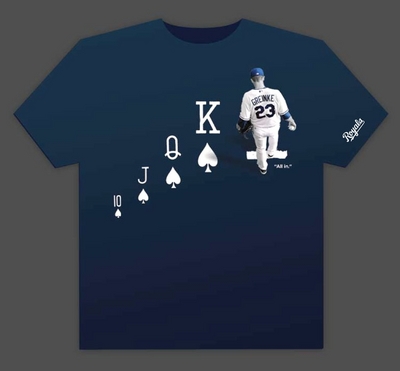
I want to be in Kansas City on June 16th, specifically at Kauffman Stadium where the Royals will host the Arizona Diamondbacks. On its own merits, that may not be anything special. It could be Zack Greinke vs. Danny Haren, which would be amazing or it could be Luke Hochevar vs. Yusmeiro Petit. Frankly, I wouldn’t care if it were the latter so long as I get there early enough to scoop this brilliant t-shirt:

Courtesy of Aroudn the Horn in KC (http://royals.mlblogs.com/)

Courtesy of Aroudn the Horn in KC (http://royals.mlblogs.com/)

I’d love to see a line of these come out for all of the game’s premier aces. Either way, I must get my hands on one of these KC ones. A very well thought out t-shirt and I’m surprised we haven’t seen it before now.

Friday: 05.8.2009

A National Power?

In my 2009 predictions, I slotted the Washington Nationals last in their division, but I suggested that they would have some legit offense thanks to offseason additions and growth from pieces they already had, “Washington finally doesn’t have an offense hinged on whether or not Nick Johnson stays healthy. They are pretty strong 1-8 as well as deep on the bench with Elijah Dukes, Josh Willingham and Willie Harris.”

Though it is still only May, it looks as though the Nationals won’t be dead last in the NL in OPS. Last year, they posted an embarrassing sub-.700 (.696) that was “topped” by only the Oakland Athletics (.686) in all of baseball. This year has been markedly different with the Nationals improving nearly 100 points in OPS to .794 that is good for 4th in the NL and 8th overall. Adam Dunn has been a huge addition with nine home runs already, but also an impressive .297 average. He has never hit anywhere near that level so it is safe to bet that the average will come down at least a bit. He has seasons of .264 (2007) and .266 (2004) that stand as his two highest. With one of the game’s best batting eyes and a commitment to not being a batting average anchor, Dunn is capable of .275-.280, but even if he only manages to match his career high of .266, he will still post a .400+ OBP with 40+ home runs.

Cristian Guzman has spent some time on the DL already this season, but he has remained the hitting force he was last year carrying a .386 average with 12 multi-hit games and just two 0-fers in his 17 games played. Nick Johnson‘s ability has never been in question, but his inability to stay healthy has stunted his career. He’s healthy right now and back to being the high average-high on base perfect #2 hitter for this lineup. Typically you want big time power from your first baseman, but Dunn fills that role and takes the heat off of Johnson when it comes to home run hitting.

The most impressive thing about the Nationals’ hot hitting thus far is the fact that it has come with NOTHING from Lastings Milledge (.397 OPS-now in AAA) and Josh Willingham (.693 OPS propped up by 10 walks; hitting just .174). Their worthlessness has been erased by the guys already mentioned as well as one of my favorites to rebound in 2009: Ryan Zimmerman. His only 0-fer of the season was in the 2nd game of the year which has resulted in an on-going 27-game hitting streak. He is hitting a robust .336 with six home runs and 21 RBIs. His 71 total bases are 2nd-best in the National League.

The downside to Washington’s offensive uproar? It hasn’t translated to much in the win column as they are dead last in not only the NL East, but the entire National League with a 10-18 record. That futility rests on the shoulders of the pitching, or severe lack thereof. Only Joe Beimel (1.74 ERA in 10 IP) has an ERA below 3.60 on the entire staff. Only three others are below 4.66. After two strong starts in late April, ace-of-the-future Jordan Zimmerman has been rocked for 11 runs in 11 and 2/3rds innings over his two latest starts. Allowing him to learn on the job and take his inevitable lumps wouldn’t be a problem on team that had two or three other starters capable of stopping a losing streak, but on a team like this it just adds to the mess. It’s reminiscent of Jeremy Bonderman‘s 2003 rookie campaign on that God-awful 43-119 team that saw Mike Maroth lose 21 and would’ve featured two 20-game losers had the Tigers not purposely moved Bonderman to the bullpen to save him that hit on his psyche.

If Zimmerman (20 years old) and their other youngster that surprisingly broke camp with the team, Shairon Martis (22) can develop into reliable rotation pieces through their experiences this year, they will go with ace John Lannan (24) to give the Nats a fair 1-3. Then there is the X-factor… or should I say the S-factor as in Stephen Strasburg. There hasn’t been a pitching prospect with this much promise in quite some time and recent reports suggest that the Nats will wisely take the San Diego State righty with the #1 overall pick in this June’s amateur draft despite the potentially absurd $50 million dollar asking price from idiot loser Scott Boras. Unfortunately for the Nats, you simply can’t pass on a talent like this:

2007 – 37 IP, 2.43 ERA, 0.89 WHIP, 11.4 K/9 and 3.6 BB/9
2008 – 97 IP, 1.57 ERA, 0.79 WHIP, 12.3 K/9 and 1.5 BB/9
2009 – 87 IP, 1.24 ERA, 0.74 WHIP, 17.0 K/9 and 1.7 BB/9

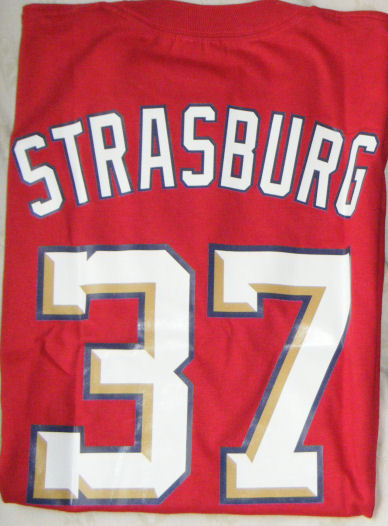
So confident was I that the Nationals just COULDN’T pass on the youngster that I had this made:

Stephen Strasburg Custom Nationals t-shirt

Stephen Strasburg Custom Nationals t-shirt

I will be in D.C. for a game later this year and I’m hoping I’m the only one with that shirt, but since it’ll be a week after the draft, I’m sure there will be a few others floating around. And that’s also assuming that locals haven’t gotten the same exact idea I had and already own one.

With the offense they have displayed in the early going and the potential rotation they’re developing, the Nationals may be making noise much sooner than most would have expected. I haven’t even covered some of their up and coming minor league arms like Ross Detwiler, Tyler Clippard and J.D. Martin, all of whom are off to good starts as well as Colin Balester, whom the organization likes a lot. The biggest hurdle for the Nationals is their four opponents in the NL East. It will be interesting to see what Strasburg does for the team and how they choose to play the free agent and trade markets in an effort to thwart their worthy competition within the division.