Archive for February, 2013

Monday: 02.4.2013

Countdown to Spring Training: 18 Days – Allen Craig

Only 18 days until live game action…

With 30 days to go, I started profiling a hitter per day highlighting one from each team. I selected my player of note from each team and then randomized them (which was pretty interesting consider who the final two were after the randomization) so that’s the order I’ll be following.

ALLEN CRAIG

You had to know this was coming.

I mean seriously, who else would I choose for St. Louis? I basically already wrote his Countdown piece back in December, I just didn’t know it yet. So I’m going to rely heavily on that for today’s entry as I don’t need to simply regurgitate what I said there or what I’ve said on Twitter (and elsewhere) since November. Allen Craig is my player in 2013. That much is clear. The wagon is hitched. Next stop: promised land.

I’ve taken him just about everywhere in mocks (missed getting him in just one) so far this winter though it appears I’m driving a relatively full bandwagon. Looking at this ADP data from NFBC provided by Baseball HQ we see that Craig is slotted 53rd overall and while I’ve been taking him higher–I’m actually the 21 that qualifies as Craig’s earliest pick which I did here (Team 10) in a November draft during the Arizona Fall League event by Baseball HQ–usually in the 30s, others have are seeing the upside within The Wrench.

Since I did this write up about two months ago and some of you have likely already read it, I made something for you to still get your daily baseball fix on the day we* officially turn the page from football to baseball.

*I never closed the book personally, I just had both open.

Enjoy:

Sunday: 02.3.2013

Countdown to Spring Training: 19 Days – Adam Jones

Only 19 days until live game action… and many folks officially turn their attention back to baseball tonight after the Super Bowl (Go Niners!)

With 30 days to go, I started profiling a hitter per day highlighting one from each team. I selected my player of note from each team and then randomized them (which was pretty interesting consider who the final two were after the randomization) so that’s the order I’ll be following.

ADAM JONES

I talk often about how we can’t expect linear growth (and I’m hardly the only one) from young players. As exciting as it is to see a big age-22 season as a 380 PA/100 game call-up, we can’t just assume that they’ll take the experience and expound on it the following year as a full-time player. Hell, even if they log 500+ playing 140-something games as a full-time player in that age-22 season, there are still no guarantees that, even with good base skills, they’ll improve the following year.

It just doesn’t happen that way. Sometimes it does and it’s magical, but often we see players experience a series of ups and downs in the early 20s as they amble about like a baby goat trying to establish themselves on firm ground. Regardless of their pedigree coming up, they may bounce around statistically for multiple seasons before finally becoming what we saw in the minors. And of course, they might not ever reach those minor league expectations. Adam Jones fits the former description.

Jones, a supplemental first round pick of the Mariners back in 2003, was a well-regarded prospect landing in the Baseball America Top 100 in both 2006 (64) and 2007 (28). He had a few cups of coffee with the Mariners, but was eventually traded to Baltimore in that huge Erik Bedard trade. His 2008 Oriole debut wasn’t particularly special as he showed just a bit of the power and speed that we’ve now come to expect from him yearly. He’s now headed into what he hopes will be his sixth straight *full* season (500+ PA) and fifth straight of better than league average performance.

ajones1

He surged forward in his second full season adding 10 home runs and improving his strikeout and walk rates, all in virtually the same amount of playing time. Despite adding 102 plate appearances the following year his production was essentially static in the counting number while his walk rate plummeted while the strikeout rate ticked back up. He rebounded at age 25 and then took another step forward last year for his best year yet. And depending on how you delineate it, he either just entered his prime or has yet to do so, either way the future is bright.

Is 2012’s power jump for real? The 18.8 percent HR/FB rate isn’t outlandish given his 2009 and 2011 rates. He did a lot of his home run damage in May hitting 10 with a 31.3 percent HR/FB rate, but at the other end of the outlier spectrum he had just a 9.1 HR/FB rate in August when he hit just two home runs so they cancel each other out a bit, though it’s reasonable to say May’s outburst contributed a good bit to his surplus over 2011. Nothing within his profile loudly screams that the 32 home runs were a fluke, though I’d probably land in 25-28 range for a projection. He didn’t hit a ton of flyballs (32.6 percent), but his 21.5 line drive rate offset that a bit.

Jones now has three straight seasons of established performance averaging a .284 batting average, 25 HRs, and 12 SBs, with the latter two categories on the rise year over year. The 2012 season may be the best of his career, but there is legitimate room for improvement given his skills and age especially since we’ve seen him do better with the walk rate in the past. I happen to think he can take another step forward with his batting average and put together a handful of .300+ seasons. It’s not much of a jump from the .280s anyway so I’m not exactly going out on a limb, just outlining something that is a reasonable expectation in the near future. Taking it a step further, a .320 or better season where he contends for a batting title in the near future wouldn’t surprise me at all.

Bet on a big batting average jump before another 32 HR season.

Saturday: 02.2.2013

Countdown to Spring Training: 20 Days – Anthony Rizzo

Only 20 days until live game action…

With 30 days to go, I started profiling a hitter per day highlighting one from each team. I selected my player of note from each team and then randomized them (which was pretty interesting consider who the final two were after the randomization) so that’s the order I’ll be following.

ANTHONY RIZZO

One of the winter’s rising sleepers (which of course cuts into his sleeper value) is Chicago Cubs first baseman Anthony Rizzo. He had a brief, but ugly debut in 2011 that saw him hit just .141 with a 523 OPS in 153 plate appearances with the San Diego Padres. Jed Hoyer, formerly of the Padres, joined forces with Theo Epstein to run the Cubs that offseason so they wanted to get their prized prospect, whom they’d discovered as part of the Boston Red Sox organization when they drafted him in 2007. He was traded for that offseason and instantly became part of their future foundation with Starlin Castro.

Rizzo ripped through the PCL in 2011 with 26 home runs, 101 RBIS, and a 1056 OPS in 413 plate appearances and yet he somehow topped that in his follow-up as a Cub farmhand hitting 23 home runs, driving in 62, and posting an 1101 OPS in just 284 plate appearances. He’d have been called up earlier, but Bryan LaHair was having an unexpected great start to the season. Once he reached the majors again on June 26th, he showed that his 2011 flop was merely a blip. He hit .285 with 15 home runs, 48 RBIs, and an 805 OPS in 368 plate appearances. His seven percent walk rate was below average, but the 17 percent strikeout rate was very good (3% better than league average for the position).

A lot of outlets are looking for a big breakout in 2013 now that he will have a full season of playing time. The Bill James projection at Fangraphs has him down for a .283-33-109 season. Yes, really. The “Fans”, which consists of 41 Fangraph reader projections, weren’t far from James at .285-28-103. Those are definitely… optimistic… to say the least. I can’t help but wonder if we, the baseball community, learned nothing from last year. Doesn’t Rizzo fit the mold of some heavily favored sleepers from 2012? Namely guys like Eric Hosmer, Brett Lawrie, and Desmond Jennings?

They were the shiny new toys of 2011 with various levels of kick-assery and they became the object of many fantasy managers’ affection leading into the March draft season for 2012. Hosmer had more or less a full season logging 128 games and 563 plate appearances while Lawrie and Jennings merely gave a taste at 43 and 63 games played, respectively. And how did that all work out?

rizzo1

Hosmer is least like Rizzo from an experience standpoint, but most like him in every other avenue as the pair are both 23-year old left-handed first basemen. Hosmer had the relatively full season of success in 2011, but that second time around the league was brutal as the struggles against lefties continued and he couldn’t stay great against righties. His 886 OPS against righties dropped to 700 in 2012 while his performance against lefties improved just six points to a still-meager 591 OPS.

Rizzo posted an 892 OPS against righties in 2012 compared to just 599 against lefties. As lefties with groundballs tendencies, they are going to be more susceptible to the infield shift. I don’t know how much either Hosmer or Rizzo faced the shift in 2012, but I do know they hit .091 and .161, respectively, on grounders to the pull field against lefties. It’s a thin slice of data as they had just 44 and 31 such plate appearances, but still worth noting especially if either or both weren’t facing the shift often.

League average for lefties in those situations was .174 so Rizzo wasn’t too far off, but his margin for error is scant if he is to have the breakout season projected at Fangraphs as he can’t give anything back against righties (and probably needs to jump up some) and needs massively improve against lefties. He was great in a half of 2012, but it is a lot different going through the grind of all six months in the big leagues. Even hitting the extrapolation of his 2012 numbers would be a major achievement.

Taking his 2012 rates over 630 plate appearances yields a 26 homer/82 RBI season which would be fantastic for the 23-year old and I still think that should be on the outer end of his projection. After all, look what another sweet-swinging first baseman did in 2012 compared to his 2011 extrapolation. Paul Goldschmidt skipped Triple-A in 2011 coming up to the bigs for a 177-plate appearance carafe of coffee during which he crushed eight bombs with 26 RBIs and a .250/.333/.474 line. Extrapolating that out would’ve been a 28/93 season yet he was far from a disappointment when he “only” went 20/82 last year. (Sidenote: I’ve got more on him coming up soon. Big fan. Big, big fan.)

The extrapolation game with youngsters is dangerous, and frankly kind of stupid. We already know that they aren’t guaranteed to progress in a linear fashion thus expecting someone like Rizzo to essentially just double his 2012 production in his first full season at such a young age is foolhardy. In order to hit any of these home run projections, he’s either going to have to maintain his 18 percent HR/FB rate or add some flyballs to the 30 percent he hit last year. He wasn’t struggling to hit the ball hard with an awesome 24.4 percent line drive rate, but sustaining that over a full season won’t be easy, either.

Just 10 percent (14-of-143) of qualified hitters were at or above his 24.4 LD rate meanwhile only four of those players were at or below his 30 percent flyball rate. So it’s basically one or the other. Two of them were Buster Posey and Robinson Cano, so there is precedent for Rizzo… as long as he’s an all-world player. And only six players maintained an 18.1 HR/FB rate or better with a flyball rate south of 30 percent. Posey and Cano were two of them along with David Freese, Kendrys Morales, Billy Butler, and Carlos Gonzalez. Note that none of those players were both 23 years old and entering their first full year in the majors.

Despite the negative slant to this piece, I’m not down on Rizzo’s long-term prospects at all. I’m simply preaching caution with him for 2013. Last year wasn’t the first year that prospects failed to live up to their billing, but rather the most recent examples thus they’re still fresh in our memories. We should learn from last year’s mistakes, not make them again. Sure there is going to be some under-25 stud who tears the league apart, but betting a significant amount of your auction budget or a high round draft pick that you found the needle is a good way to finish sixth.

One final note is that obviously all bets are off in keeper and dynasty leagues as you’re going to have to pay a little more on the front-end to enjoy the future. In current keeper & dynasty leagues, he is already cheap and likely not for sale, but in new leagues he will have a bit of an elevated price based on his hot 2013, age, and overall prospects. If you are the type who likes to build the future juggernaut in those leagues, he’s definitely one to target.


Saturday: 02.2.2013

Countdown to Spring Training: 21 Days – Jason Heyward

Only 21* days until live game action…

With 30 days to go, I started profiling a hitter per day highlighting one from each team. I selected my player of note from each team and then randomized them (which was pretty interesting consider who the final two were after the randomization) so that’s the order I’ll be following.

*Sorry for missing Friday’s entry, but I’m doubling up today so technically there are 20 days until live game action, but we’ll get to that later today!

JASON HEYWARD

On the heels of a brilliant 2009 campaign at age 19, Atlanta outfielder Jason Heyward entered the 2010 season as the #1 prospect in all of baseball. You’d have thought it was a full season when you saw his numbers with a .323/.408/.555 line including 17 HRs, 63 RBIs, 10 SBs, and 25 2Bs, but injuries limited him to just 99 games which he split pretty evenly between High-A (49) and Double-A (47) tacking on three more at Triple-A to close the season out. Despite the hype there was no guarantee he’d start the 2010 season with the Braves, but then a big Spring Training during which he hit .305 with five extra-base hits, four stolen bases, and a near1:1 K:BB ratio (11 K/10 BB) sealed his fate as the starting rightfielder for good in Atlanta.

Well, for good so far.

You know what happened next. He hit a three-run home in his first major league at-bat and went on to have an excellent, near-Rookie of the Year campaign falling short to Buster Posey by just 22 points.  Unfortunately that was followed by the fabled sophomore slump in which he dropped 50 points from his batting average, saw his walk rate & OBP tumble in concert, and he missed 34 games due to injury including right shoulder injury that sent him to the disabled list in late May. He first missed time with the shoulder on May 11, but looking at the numbers suggests it was plaguing him throughout the month before finally hitting the DL on May 22nd:

heywardmay2011

Ouch. And that doesn’t even show the fact that he managed one line drive all month. He had 12 groundballs, nine flyballs, four popups, and the one line drive. So while it is speculation on my part that the shoulder was ailing him all month, I think the evidence is strong. He rebounded a bit when he returned on June 15th finishing out the month relatively, but then fell back into a deep slump that last all of July and August. In the two months he hit just .212/.281/.394 with 6 HRs, 20 RBIs, and 2 SBs. Perhaps most alarming was that his usually solid walk plummeted to seven percent.

He was lost.

A major problem facing Heyward in his dismal 2011 season was an inability to hit anything with a wrinkle. This is not a new problem facing youngsters and he didn’t exactly crush off-speed in 2010, but his 2011 work against the pitches especially awful and the 2012 rebound no doubt aided his resurgence:

heywardoffspeed

He didn’t exactly pound the ball against off-speed stuff last year, either, but the bar was so low that just returning to 2010 levels was enough to really help his overall numbers. Isolating his work against curveballs specifically shows that to have been his problem pitch above all in that 2011 season. Though his .143 batting average against the changeup in 54 plate appearances wasn’t carrying him to any batting titles, either.

heywardcurveball

He still has to get better to become the superstar that many see him becoming (myself included). His 35 percent strikeout rate against off-speed stuff in 2012 was the 13th-highest in baseball. That put him in the company of new teammate B.J. Upton (36.4%) and Colby Rasmus (36%), a pair of supremely talented, highly touted prospects (Upton peaked as the #2 overall prospect in ’04; Rasmus at #3 in ’09) who have never quite lived up to their expectations. Look at their numbers against off-speed since 2009 (as far as back as the data goes):

prospectOFvoffspeed

Heyward is the “best” of the three, but the lead is marginal and entirely tied to his extra plate discipline with a walk rate that is nearly two times that of the other two guys. It might worth noting that within the 2012 season, Heyward did show some improvement against non-fastballs from half to half posting a 689 OPS against the pitches through the All-Star break and followed it up with a 761 OPS from mid-July to the end of the season. The splits were small samples of about 115 plate appearances apiece, but maybe he adjusted something in-season to improve.

One thing that stuck out was that he killed changeups in the first half hitting .346 with a 991 OPS against them albeit in just 30 plate appearances before falling back to a .174 average and 513 OPS against them in the second half, again in a scant 24 plate appearances. Perhaps his luck was just evening out and the split in halves has no real significance.

The bottom line is that pitchers are beating him with off-speed pitches on a consistent basis and he will need to adjust if he is to become a superstar, face of the franchise-type who will take the torch from the now-retired Chipper Jones. For those wondering how he fares against fastballs, he has an 867 career OPS against them with single season marks of 903 in 2010, 827 in 2011, and 860 last year. He does have one particular trend that has been going in his favor year-over-year: his groundball rate is shrinking while his flyball rate climbs. He started with 55 percent groundball and 27 flyball rates in 2010, moving to 55 and 33 percent in 2011, and finally 44 and 37 percent a year ago. He was very close to the league average batted ball profile of 45 groundball, 34 flyball, and 21 percent line drive.

I hope y’all realize how much restraint I showed by not once referencing that Heyward has Trouble with the Curve.

You’re welcome.

Friday: 02.1.2013

Countdown Continues Tomorrow

With just an hour in the day left, I’m not going to be able to finish today’s entry for the Countdown to Spring Training. I’m going to have to push it to tomorrow, but I’ll do a day-night doubleheader to get caught up. In the meantime, get caught up on any of the entries you’ve yet to read:

Friday: 02.1.2013

Top 10 Catchers Right Now

Tonight MLB Network will continue the 2013 iteration of their “Top 10 Right Now” series at each position capped off with a “Top 100 Overall*”. They will air both the catcher and first base shows on Friday evening. I always enjoy this series and generally look forward to it after the New Year since I eat up just about any fresh baseball content I can as we wait for pitchers & catchers to report. Instead of putting up my lists after they air their selections, I’ll post mine ahead of time and then compare notes after the shows air.

*I will not be doing a top 100

This is not a fantasy list!!

I didn’t really have anyone that I fretted over leaving off. Wilin Rosario doesn’t actually play catcher so his hitting exploits would have to be about 2x what they are currently. OK, he puts on the equipment and positions himself behind home plate, but to say he plays catcher is an insult to even the worst of defenders behind the dish, let alone the best.

Jonathan LuCroy was probably closest, but he was beat out by another guy who played under 100 games last year as I expect this guy to top LuCroy in 2013.

THE LIST

10. Salvador Perez (KC) – There is a lot of speculation on this one as Perez has just 115 games played in his major league career, but part of these lists is projected 2013 performance and I’m expecting a nice year from him which should be his first full season. Despite the small sample of work, he has shown a lot. He has shown legitimate power (.471 slugging percentage & 14 HR), a strong hit tool (.311 batting average), and an ability to make adjustments as he dropped his strikeout rate from 12.7 percent in 2011 to 8.9 last year. The Royals no doubt see the potential signing him to a 5-year, $7 million dollar deal before last year which includes options for 2018 and 2019 which will be remarkably affordable (at $5 and $6 MM, respectively) if he continues at the trajectory we’ve seen early one.

9. Carlos Ruiz (PHI) – He is on the shelf for the first month of the season serving a 25-game suspension for banned substances which is unfortunate as he looks to follow-up his breakout 2012. Of course, he put together his .325/.394/.540 line in 114 games last year so missing 25 doesn’t necessarily preclude him from repeating. Suspension or not, the big question is whether or not his spike in HR/FB rate (from 4.4 in ’11 to 15.1 last year) is legitimate and thus will sustain his 16-homer output. That’s huge spike especially in light of his flyball percentage shrinking five percent.

8. Brian McCann (ATL) – The latest news has McCann’s shoulder feeling better and gives him a shot to be ready by Opening Day. Last year was an unmitigated disaster given his standard of excellence as he played a career-low 121 games with a paltry 87 OPS+ output. He kept his 20+ HR streak intact, but that was probably the only positive point in his season. This ranking takes the injury concerns into consideration as he’d be much higher without them.

7. Alex Avila (DET) – Avila labored through a tough season after a huge 2011 breakout as nagging injuries hampered him from day one. Most catchers are usually dealing with an ailment or three by the time Spring Training hits the one-week mark, but Avila seemed to suffer more than his fair share and lower body ones to his hamstring and knee held his power numbers down quite a bit. Despite the injuries, he was still above average offensively and an offseason rest should help him chase down those 2011 numbers again in 2013.

6. Carlos Santana (CLE) – A rough start to 2012 didn’t stop Santana from putting together an excellent season and the only thing keeping him this low is that he’s not a particularly great catcher defensively. I wrote about him in detail in my Countdown to Spring Training series if you’re interested in more.

5. Joe Mauer (MIN) – He still played the majority of his games at catcher and after an ugly half-season in 2011, his numbers returned to what we expect from Mauer (unless you’re still expecting 2009, in which case just stop). He’s still an excellent player even if he spends most of his time at first base or DH, but he’s not a good defensive catcher so he can only be ranked so high as we move into the elite who combine offense and defense.

4. Matt Wieters (BAL) – He’s yet to become the offensive juggernaut we expected when he was coming up through the minors, but that hasn’t stopped him from rounding into one of the best catchers in all of baseball. The defensive piece is in place and I wouldn’t be surprised to see his offensive game take off in these final three years of his 20s.

3. Miguel Montero (ARI) – Like Santana, Montero didn’t sprint out of the gate in 2012, but that couldn’t deter him from a great season at the dish and he pairs that bat with great work behind the dish. In fact, he has improved a ton when it comes to shutting down the running game the last few years. After posting a 26 percent caught stealing rate in his first full season back in 2009, he has since posted rates of 31, 40, and 42 percent. The 42 percent a year ago was the third-best in baseball. He is really one of the best overall catchers in the game and yet doesn’t get nearly enough credit as such. I will be especially interested to see where he rates on the lists tonight.

2. Buster Posey (SF) – How much can really be said about this reigning NL MVP that hasn’t been said yet? His 2010 was a precursor to his excellence which was delayed a year by his injury in 2011. Those who were worried that the injury might take some time coming back from were shown the door immediately as Posey ripped the league apart for a 1016 OPS in April. But it was his second half of the year that really earned him the MVP as he posted a 1023 or better OPS in each month with 21 RBIs per month and his .364 average in September was his worst from July on as he hit a combined .371 in the three months.

1. Yadier Molina (StL) – This shouldn’t be too much of a shock. Sure, Posey won the MVP, but he also played 29 games at first base and Molina was a legitimate candidate finishing 4th in the voting. Long regarded as the unquestioned best defender in baseball, Molina’s offensive outburst the last two years puts him in the discussion as the single best player in the game if you were talking about building a team from scratch.

Friday: 02.1.2013

Top 10 First Basemen Right Now

Tonight MLB Network will continue the 2013 iteration of their “Top 10 Right Now” series at each position capped off with a “Top 100 Overall*”. They will air both the catcher and first base shows on Friday evening. I always enjoy this series and generally look forward to it after the New Year since I eat up just about any fresh baseball content I can as we wait for pitchers & catchers to report. Instead of putting up my lists after they air their selections, I’ll post mine ahead of time and then compare notes after the shows air.

*I will not be doing a top 100

This is not a fantasy list!!

Youngsters Eric Hosmer and Anthony Rizzo were close, but #10 on the list beat em out because of his two full years of big time production.

Dear Lord, please don’t let the MLBN guys list Ryan Howard.

THE LIST

10. Freddie Freeman (ATL) – I think so forget that the sweet-swinging lefty is just 23 years old. He has back-to-back 20-homer seasons and showed improvement in both his walk and strikeout rates from year one to year two improving both by about two percent. His continued ascent makes the loss of Chipper Jones easier to swallow for that offense (not to mention the addition of the Upton Bros) and the best may well be on the way as early as 2013.

9. Allen Craig (StL) – The purpose of these lists is to explore the position right now and project forward for the 2013 season. As such, Craig makes my list. His skills are plentiful and already in place, but he needs to stay healthy which I think he will do in 2013 and show subsequently show everyone what a beast he is with the bat. Those paying attention have already seen the 141 OPS+ the last two years, but that’s only been in 733 plate appearances, a full season of dominating will earn him the attention he deserves.

8. Mark Teixeira (NYY) – He is likely to rate higher on everyone’s list on the show tonight, but that’s based solely on name value. The shift (not be confused with MLBN’s The Shredder) has eaten his batting average and it isn’t coming back. He’s been under .260 the last three years and barring a change in approach, I just don’t see him coming back to the levels we were used to in his 20s when he hit a combined .290, topping .300 three times. His OPS has declined yearly since 2007. He’s still good, but no longer great.

7. Paul Konerko (CHW) – He sputtered to the finish line in 2012, but he’s far from done, even at 37 years old. Despite the down second half, he still finished with the 6th-best OPS+ among first basemen qualified for the batting title. Konerko has at least another big year in his bat, if not maybe even 2-3 seasons.

6. Edwin Encarnacion (TOR) – He may not repeat his 2012 breakout that saw him pop 42 bombs, but he’s far from a power fluke. He had a 162-game average of 27 homers for the three years leading up to last year so we had definitely seen glimpses of greatness within his game. Of course Cory Schwartz, Jason Collette, and Matthew Berry have seen the greatness since E40 was in teeball.

5. Paul Goldschmidt (ARI) – I’m extremely high on Goldschmidt as evidenced by this ranking, but I think he’s slated for a big 2013. He’s got a great all-around game bringing big power (43 doubles, 20 homers), a good batting eye (10% walk rate), and speed which is rarely seen from the position (18-for-21 SB success rate). He has 30-35 home run upside, too, which could start to shine through as early as 2013 in his age-25 season.

4. Adrian Gonzalez (LAD) – When your down season is a .299-18-108 season, you’re a damn good ballplayer. That was Gonzalez’s 2012 and while it isn’t what we’re used to (he averaged .306-33-106 from 2009-2011), it was hardly bad. Throw in the trade to LA and I think he’s being slept on a bit. My only major concern is the plummeting walk rate that has gone from 18 percent in 2009 to 13, 10, and then just six percent last year. Thankfully his strikeout rate has held firm between 16 and 16.6 percent in that span. He is still a star.

3. Prince Fielder (DET) – First base is always a position with offensive stalwarts, but I wonder if Prince ever looks things over and shakes his head that even with his numbers he isn’t the unquestioned best at his position. He has missed one game in the last four seasons. Though he peaked at 50 home runs in his second year, he has hardly struggled in the meantime. He is still averaging 36 per season since that 2007 breakout along with a .290 average and 111 RBIs. Plain and simple, he is one of the best the game has seen and he has plenty more in store.

2. Albert Pujols (LAA) – Remember when his career was over in April? And how he probably wasn’t going to make the Hall of Fame in early May? It was an uncharacteristically slow start for The Machine, but the panic button was smashed to bits by far too many people especially since he’d just done something similar in 2011. He is still unquestionably one of the game’s best players and I wouldn’t even quibble with someone giving him the top spot, but for me it was easily…

1. Joey Votto (CIN) – The torch is passed. Yes, he only played 111 games last year thanks to an injury, but he still led first basemen in fWAR at 5.9 among those with 450+ plate appearances. He won his third straight OBP title in the National League and second MLB-wide title in three years. Despite playing just 111 games, he still clubbed a career-best 44 doubles. If he had gotten the 625 plate appearances he normally gets in a season, he was on pace for 58 doubles which would’ve been one shy of Todd Helton’s 59 in 2000, the most in the integration era (since 1947).

I really should do these during the week so I don’t smash four posts (two reviews, two new lists) onto the site in a matter of hours. I’ve just been so deep in the SP guide stuff that by the time Friday hits, I’m like “Oh man, I gotta get my top 10 stuff done”.

Friday: 02.1.2013

Top 10 RF – Review

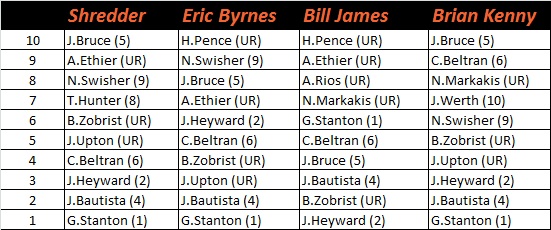
Last Friday night, MLB Network unleashed their Top 10 Rightfielders Right Now along with input from host Brian Kenny, co-host Eric Byrnes, and special guest to the series Bill James. In the LF review I mentioned my issue with MLB Network lists including guys who weren’t slated to play the particular position next year and we have a few of those on in rightfield with Josh Hamilton, Justin Upton and Ben Zobrist.

I included Upton in left and Hamilton in right because that’s where they are going to play and the change for Upton was known when they presented the show because they discussed Upton’s trade to Atlanta. And I listed Zobrist at second base because that’s where he was slated to play this year before the Rays brought Kelly Johnson aboard. For those unaware, Johnson wasn’t a Ray when the 2B lists were unveiled.

Here are all four lists from MLB Network-related folks and then I’ll address them separately:

top10RFlists

I told ya Andre Ethier was going to be on all most of these lists.

The Shredder

Apart from our three known differences that occur on every list as outlined above, Ethier is the split between lists. It was tough leaving him off. In the end, I went with Jayson Werth because of his all-around game and how good he looked upon returning from injury. Jay Bruce was a bit underrated at 10, though had I included Upton and Zobrist, he’d have been at least seventh for me so the difference between The Shredder and me looks bigger than it would’ve been with Bruce.

My inclusions they didn’t list: Werth, Josh Reddick, and Josh Hamilton

Eric Byrnes

If given the option, I’d have bet all of my money on Byrnes listing Hunter Pence. Pretty easy bet, though, right? It’s not a terrible listing, especially at 10. Overall, I really like his list to be honest as I did with his leftfield list. He gets a lot of crap from the baseball community, especially on Twitter, but I don’t think he’s so bad. My friends over at Productive Outs cannot stand him. Perhaps it’s the Spiccoli-esque way he speaks and that dialect is often viewed as just generally stupid, especially in California where both live. That’s just speculation on my part. I just think that Byrnes is actually one of the better player-analysts on the network, even if you think the bar is really low.

My inclusions he didn’t list: Werth, Hunter, Reddick, and Hamilton

Bill James

Bill, Bill, Bill. Jeez. I mentioned in the LF review that James’ lists have really puzzled me and this one was no different. Stanton at 6???? Sheesh. I was so focused on that ranking that I barely paid attention to the Alex Rios and Nick Markakis inclusions, neither of which I like that much. My fanboydom aside, how is Stanton sixth?

My inclusions he didn’t list: Werth, Swisher, Hunter, Reddick, and Hamilton

Brian Kenny

In fairness, I chastised Kenny in the LF review for including Carlos Quentin, who played just 86 games a year ago, only to then include Werth on my list in his 81-game season. The difference as I see it is that Werth played half a season after three straight 150+ game seasons where Quentin has rarely even been within 20 games of 150. We both had Werth on our lists, a move I obviously support. I don’t have any major quibbles with Kenny’s list this time around outside of Markakis and that’s not even a major quibble. He had consideration, but the position was just too deep to find room for him. In fact, he’d be third behind Ethier and Norichika Aoki on the honorable mentions.

My inclusions he didn’t list: Hunter, Reddick, and Hamilton

Coming up this evening: my first base and catcher lists!

Friday: 02.1.2013

Top 10 LF – Review

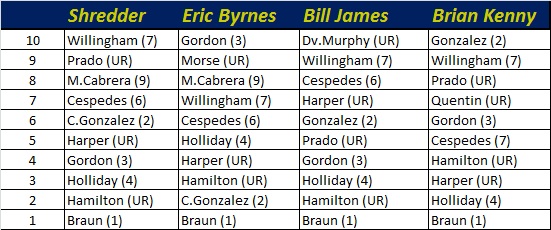
Last Friday night, MLB Network unleashed their Top 10 Leftfielders Right Now along with input from host Brian Kenny, co-host Eric Byrnes, and special guest to the series Bill James. There is no real consistency with these lists and that part has been a bit annoying. I’m specifically referring to deciding where to list guys. Why are they listing Martin Prado and Josh Hamilton as leftfielders and Justin Upton as a rightfielder when they will not be playing those positions in 2013?

By their own admission, these lists are also supposed to be projecting the 2013 season so it makes zero sense to do this, especially since they set that precedent with their first episode and listed Shin-Soo Choo in center. I know these lists are for s’s & g’s and despite how it may read, I’m not getting that worked up over it, I’m just trying to have some fun as we move closer toward real baseball.

Here are all four lists from MLB Network-related folks and then I’ll address them separately:

top10LFlists

The Shredder

Technically, I only had one difference with The Shredder because had I know they were counting Hamilton and Bryce Harper as leftfielders I’d have done the same. I talked about them in the centerfielder list with Harper actually making the top 10. Since I hadn’t ranked Hamilton in the CF list and realized that the lists were supposed to be a ranking of where they were slated to play, I included him with the rightfielders. With that out of the way, I don’t really have any major problems with The Shredder’s list. I obviously like Carlos Gonzalez quite a bit more, but it seems The Shredder dings him hard for his road stats, as does Brian Kenny which is pretty silly because he still plays in Colorado. If the list is supposed to be about who they are right now and how they’ll do in 2013, how does his poor road work matter when he more than makes up for it at home?

My inclusions they didn’t list: Alfonso Soriano, Brett Gardner, and Justin Upton

Eric Byrnes

Similarly to The Shredder, if you remove the Harper/Hamilton issue then I’m almost in lock-step with Byrnes. In fact, apart from a major difference on Alex Gordon, we about matched on every pick. He seriously underrated Gordon’s defense, but also made a big point out of the fact that Gordon isn’t a 30-home run guy. Neither was Byrnesie in his best year, 2007, during which played left predominantly. Another point he stressed repeatedly was that he felt Cargo was definitely the best defensive leftfielder in the game. It’s Gordon for me, but his claim isn’t outlandish. Oh, and Byrnes seemed to have played WITH EVERYBODY ON EVERY LIST IN THE SHOW.

My inclusions he didn’t list: Soriano, Gardner, and Upton

Bill James

More of the same as we only have one disagreement beyond his ranking guys who aren’t actually leftfielders anymore and Harper. I was really surprised with his ranking of Harper and Hamilton, but I guess he was leaning heavily on the track record differential between the pair. Some of James’ lists during this series have really surprised whether it was a shocking inclusion or questionable positioning of a player. David Murphy had his first 500 PA season last year in what was easily his best season and now he’s a top 10 LF? I don’t see it, Bill.

My inclusions he didn’t list: Soriano, Gardner, Upton, and Melky Cabrera

Brian Kenny

Kenny’s lists have really shocked me, too. I watch Clubhouse Confidential daily so I think I’m pretty well versed in Kenny’s mindset about the game, but then he goes and drops Carlos Quentin seventh on his list after an 86-game season. In fact, Quentin has never topped 131 games and he’s now four years removed from his best season.

My inclusions he didn’t list: Soriano, Gardner, Upton, and Cabrera