Archive for ‘Analysis’

Sunday: 08.3.2008

Post All-Star Break Bums

It has taken me awhile, but I had some other writing commitments to fulfill before I could sit down and hammer this out. A few weeks ago, I covered the best hitters for the 2nd half over the past three seasons. That group of players has shown a penchant for performing very well after the All-Star Break. Whether or not some sort of switch comes on for them or if it’s anything more than a mere coincidence is up for debate. I feel that using a three-year sample does show that at least something is going on that should be noticed. Some players can’t stand the cold and need the blistering heat of July and August to get their bat going.

Conversely, there is a group of players that don’t fare nearly as well after the break. Fatigue could be a big reason for this ineptitude. Given the way I gathered the data here, it could just be that they aren’t very good players in the first place. I pulled the sub-.750 OPS players with 200+ at-bats after the break from 2005-2007 and then isolated the players that appeared more than once. The first set of players are the ones that appeared all three times.

There isn’t much Earth-moving information contained in the above table. You have a catcher, several middle infielders and Pedro Feliz as the three-time offenders. All of them fare worse after the break than they do prior to it, but not a single one is a prime fantasy contributor to begin with, so while they might be in your lineup depending on league settings they aren’t part of a foundation.

The group of 25 players that follows appeared twice in the three-year span studied and within this list you will find some star power. The bulk of the list is still marginal mixed league talent and role playing single league players, but it isn’t completely useless to have a beat on who typically fades down the stretch.

Notice immediately two of this year’s best players in Justin Morneau and Kevin Youkilis. Thus far, both are bucking their trend handily. Morneau has a .255 average since the break, but a power surge has led to a .979 OPS with four home runs and 19 RBIs. Youkilis has had a similar power output with five home runs and a .961 OPS since the break. It’s too early to say they have eliminated that trend from their profile as there are still two months of play left in the season.

There are a lot of speedsters in this list and that is more a product of the fact that they don’t post very high OPS figures in general because they aren’t very powerful. That’s why I included the numbers before the break as a backdrop. I wouldn’t want someone to just see the names and think that the player is a guaranteed sell. Jose Reyes for example doesn’t experience a precipitous fall in production from one half to the next. Since they only appeared in two of the three seasons studied, that third season could have been a huge year that has their composite OPS over the .750-mark.

I would like to look at the biggest drop-offs for the second half on a percentage basis as opposed to just the players that are below a particular figure. I think a project like that will take much longer and might something suited for the off-season with the 2006-2008 data. We shall see.

Friday: 08.1.2008

My Trade Deadline Experience

The All-Star Break Fizzlers will be ready to post today, but in the meantime, here’s a look at my journey through yesterday’s trade deadline in one fantasy league:

After a ridiculously hot start, my team in an NL-Only 11-team 5×5 league has fluctuated between 4th and 6th for a few months. We took the cheap route with pitching as the Corderos were our highest priced arms at $13 (Francisco-kept) & $18 (Chad). Manny Parra & Wandy Rodriguez have been the aces at $7 apiece while Jonathan Sanchez has been a great $1 value even with his current struggles. We bought Mike Gonzalez for $26 when he came back (you can’t draft DL’d guys at the auction and they go up for bid when they come back) since we were short a closer after the other Cordero fizzled. $10 FA pickup Hong-Chi Kuo has really been an All-Star for us so despite this rag-tag group, we are 4th in ERA.

Offensively, we kept Upton ($5), Victorino ($6-extended from $1) CJackson ($10-extended from $5), Tulowitzki ($10-extended from $5), CYoung ($15-extended from $5 2yrs) and AGonzalez ($25). Holliday was our top get at $49 during the auction. We targeted and got several bit players that we thought would be instrumental to a great offense: Snyder $5, Keppinger $8, Sanchez $13, Ethier $13, Fukudome $18 and Encarnacion $24 were all guys that we happily acquired during the auction. Though some haven’t worked out (Sanchez & Keppinger have been underwhelming) and we’ve dealt with a rash of injuries (Bard, Tulow, Kepp, Holliday, Upton and replacement Spilborghs were all out at one point together)—we’ve still managed to rack up the league’s 2nd highest offensive point total.

Sorry for the long backstory, but I thought it worthwhile to the story of my deadline strategy. At any rate, we couldn’t give away Encarnacion & Tulowitzki to clear cap in order to get into the Harden or CC biddings despite how little we were asking (relative to their value). We still wanted to cut cap in order to get involved in any other players that might come back.

Since we owned Blake DeWitt, we wanted to get involved in the Casey Blake bidding. I didn’t know what was going on with the Manny business when this was going down, so we made an aggressive push to cut some cap and get Blake, too. We found a taker for Encarnacion. He wanted Parra and EE for Hermida $5 and Tankersley $1 (a Heilman $10 was tied to him). Since we were actually hurting our main need, pitching, I wanted more assurance on our end in case we didn’t achieve our end goal of finishing in the money and pushing for 1st. Hermida is a free agent at the end of the year, so I asked for Jay Bruce $5 instead. He agreed and the deal was consummated. We put in a $26 bid for Blake and won him (by $11… EEK!!!). Or did we? Trades of multiple players in this league are subject to a comparison of Sagarin ratings and the disparity needs to be within $20. Tankersley does NOT rate well for ol’ Jeff’s rankings and thus the deal was cancelled and thus, so was the Blake bid.

I lobbied the commissioner to let us make a small adjustment to the deal to let it fit Sagarin ratings and there’d be no harm, no foul. Adding Saito, who’s almost certainly out for the year, would balance the disparity and then we’d get Blake. He wouldn’t budge. We spoke on the phone, but he was firm. He made a compelling case, but I appreciated that he at least hashed it out with me. Talk about a blessing in disguise.

We re-did the trade to leave Tank out and insert Saito so now it fits. So Parra/EE for Bruce/Heilman/Saito opens up $16 in cap for us. At this point, we have set our sights on another Casey in lieu of losing Blake. Mr. Kotchman’s arrival has piqued our interest, but we’re still hoping for something to go down on the day of the deadline that’ll really appeal to us. Meanwhile, dealing Parra was slightly counterproductive given how badly we need pitching, but I thought it was a good value deal especially since we got a keepable Bruce over an expiring Hermida.

We looked at the strong pitching teams to try and find a match almost weekly yet nothing materialized. As the Blake thing was going on, we finally found a partner, or so we thought. It looked like this team had the ace we desired along with cap flexibility that would free us up for FAAB bids as well. It turns out that this owner travels a TON for his job and a working dialogue to hammer out a detail stretches the span of a few days.

Initially we offered a deal where the principals were Matt Holliday and Jake Peavy. We’d gain $15 with this move on its own and we hoped to free up even more cap with the supplemental pieces involved so we targeted a $1 Pelfrey among others. After not hearing back for awhile, he finally wrote back saying that while he didn’t mind Peavy-Holliday, the rest wasn’t going to work either because he didn’t want to give the players (Doumit $9) or they were frozen on his roster in accordance with different rules of the league (Church $7). In his email, he also mentioned something about wanting another piece of offense that viable. I suspect this was because he was going to include Pelfrey as well.

I studied and finally came up with the following:

Holliday $49-Fukudome $18-Waechter $10-Petit $10
for
Peavy $35-Broxton $13-Kapler $10-Edmonds $1

I was so excited about the potential of this deal. It gave us a third closer so we could make a dent in the saves category, a bona fide ace so we could maybe start to move up in Ks instead of just running in place. Despite being good in ERA, the WHIP was lacking, but there were 3 or so points sitting right there. And while he can’t touch Holliday in production, this would also give us cap to comfortably acquire Kotchman to supplement the offense loss. It also met the Sagarin ratings with a disparity of just 68 cents. I sent the email with the offer prior to the Manny Ramirez deal.

About three hours later, Manny was a Dodger. Now I was REALLY excited about the prospects of this deal. I really, really wanted to get it done because we could get Manny to replace Holliday PLUS get the pitching help we wanted!!! I sent a follow up email just to ensure that he understood the urgency of the matter for us. Then it hit me, OH CRAP… we have a 12 AM deadline because our free trading deadline is the same as baseball’s. We have a 2 up-2 down deadline until August 31st where you can trade with teams two away from you in either direction in the standings. I didn’t want to mess with that, I wanted to get it done today (Thursday).

I grew impatient and decided to give him a call letting him know my availability to hash out any reservations he may be having. It turns out he was in the air and landed around 8 pm at which point he phoned me and said it looked solid, but he’d confirm in about an hour and a half after he got into his hotel. I was ecstatic. I know I’m totally geeking out over a fantasy baseball trade, but this is why I play the game. Making moves and fighting hard to win is why this game is so damn fun.

The email came in around 10 that he confirmed the deal sending us Peavy, Broxton and spares for Holliday, Fukudome and spares. In the process, we freed up $28 more bucks for the Manny Ramirez sweepstakes that will take place on Tuesday. All told, we have $47 of open cap plus the $10 for Blake DeWitt, who we’ll cut to get him. Our 2-month push roster looks like the following:

C: Bard, Snyder
CI: AGonzalez, CJackson, Ojeda
MI: Sanchez, Tulowitzki, Keppinger
OF: Manny, Victorino, Young, Ethier, Bruce
DH: Edmonds, Kapler

Px10: MGonzalez, FCordero, Broxton, Kuo, JMiller, Lincoln, Heilman (for now), Peavy, JSanchez, Wandy

Standings at a glance with closest on both sides:
1st: 91
2nd: 74.5
3rd: 70
t4th: 64
t4th: 64
6th: 62

AVG (5th): .278 – .277 – .276 – .2692 – .2688 – .267
HR (3rd): 166 – 160 – 157 – 151
R (1st): 724 – 692
RBI (2nd): 679 – 651 – 636 – 632
SB (8th): 87 – 85 – 79 – 64

ERA (4th): 3.78 – 3.83 – 4.06 – 4.15 – 4.18
K (9th): 747 – 723 – 712 – 704 – 687
Sv (9th): 41 – 39 – 34 – 29 – 24
W (8th): 60 – 60 – 59 – 56 – 55 – 52 – 50
WHIP (7th): 1.31 – 1.31 – 1.33 – 1.37 – 1.38 – 1.39

I realize that Manny isn’t the season changer that Harden or CC would’ve been, but my excitement for Manny is because we essentially get Peavy and Broxton without decimating the offense because Manny covers Holliday very nicely. I’m not done making 2 up-2 down moves because we need at least one more starter in order to log enough IP to dent the ERA & WHIP. The Peavy move was our all-in, which is decidedly better than our FAAB acquisitions of Mark Mulder and Steve Trachsel last year that constituted as our last ditch all-in move to get into the money.

Thanks for reading.

Thursday: 07.24.2008

The Last 365

Fantasy owners (and baseball fans in general for that matter) make a lot decisions and engage in a host of arguments based on different sized samples of data. The first thing that someone disagreeing with an assertion will generally look at is the sample size. If you tout an unknown commodity after a hot week, you’re likely to get hammered for putting far too much stock into a 7-day period. Sometimes when we’re on the side that wants to be right, we’ll ignore obvious sample size issues in hopes of not being called out.

What is a big enough sample size? Honestly, that depends on what you’re asserting or trying to prove. If you look back at a .417/.489/.590 week of a player you chose over the .231/.300/.378 player for your head-to-head league match, then you can pound your chest a little bit because you clearly made the right decision. But if the latter player is clearly the better player and you let that week make you chose player A again then you start getting yourself into trouble.

Does a month offer enough data to start making judgments on players? Again, it’s going to depend at what you’re hoping to accomplish. At the beginning of the seasons, fantasy team owners across the world are hypersensitive to the highs and lows that their players (and even those not on their team) are going through. Entering May 1st, Emil Brown had 25 RBIs. He has 49 through Wednesday. Josh Willingham was hitting .341, but he has .167 since (missed all of May) to leave him at .260 on the season.

Most are familiar with the awful start of C.C. Sabathia, but it bears mentioning that he was 1-4 with a 7.88 ERA. After a complete game shutout of the Cardinals tonight, he is 10-8 with a 3.30 ERA. How many watched as the owner of Sabathia in their league dealt him for a quarter of his true value because it wasn’t just a bad start or two, but rather a month? Furthermore, how many watch Mark Hendrickson get picked up because of a 4-1 start with a 3.68 ERA for the Marlins? You start looking for reasons, however flimsy, to believe these things to be true. For someone like Hendrickson, it was the previous track record of Florida arms and the home stadium that all of sudden made him worthwhile. Sabathia was out of shape and his workload had caught up to him.

If a player has an established track record (of success or failure), then you shouldn’t begin to take numbers seriously until June 1st rolls around if they are going against that previously established record. Even at that point, you should be cautious of making hasty moves that could end up hurting you in the long run. Remember that on June 1st, there are still FOUR months in a fantasy baseball season. I’m not suggesting you have to stand pat until two months or more into the season, rather that it can be foolish that make moves because of numbers posted in the first 2-2 1/2 months into the season if they are inexplicably against years of unlike data. I grant that there are variables to this line of thinking that can come into play. Injuries, age, team situation (lineup/ballpark/playing time) are primary amongst these factors.

I have spent the last 500+ words telling you which time periods aren’t long enough to make, so what time period of statistics do I find suitable enough to make judgments off of for players who performing against career norms? I think a year’s worth of data is pretty solid. Meaning if a guy has a great 1st half, how is he looking against his peers when it is combined with his previous season’s second half? Believe it or not, a half season of data—no matter how good or bad—can be a fluke especially when it’s complete contrary to a player’s history that spans much more than a half season.

I’m going to post some of the 365-day Leaderboards so we can get a better idea of who has been performing the best over the past “season” worth of games. Plenty of this year’s top performers will be found within these lists, but others not currently atop the league leaders for 2008 will be scattered across these lists as well. This exercise isn’t meant to be a predictive measure so much as it is a better look who has been performing the best for a more sustained period of time than just the nearly four months of the 2008 season.

This set of lists covers the Top 25 across the main roto categories of home runs, runs batted in, stolen bases and runs scored. I took OPS instead of batting average because I (as many do) find it a better measure of a player’s value. I realize average or even on-base percentage are used in fantasy scoring, but went with the OPS anyway.

Again, I’m not looking at these to be predictive of the final two months of the season, instead just another set of data to chew on when judging talent. Most of the names found within the above listings have been getting it done for a full season’s worth of plate appearances and it wouldn’t be a horrible idea to rely on them to get it done for you during the final two months of the season.

I leave for Philadelphia tomorrow and I’ll be gone until Sunday evening. While I hope to have some stuff up during that time period, I’m unsure if I’ll have time for much of anything. When I get back, I’ll most assuredly report on my trip to Citizen’s Bank Ballpark as the Phillies play host to the Atlanta Braves. I think we’re down for at least Saturday’s matchup which features Cole Hamels against Jo-Jo Reyes. We might go to the Kyle Kendrick-Jair Jurrjens showdown on Friday evening as well, but that is TBD at this point.

Monday: 07.21.2008

Need an Arm for the Stretch?

I got an email shortly after posting the Second Half hitter pieces asking if I had plans for anything on pitchers. I compiled the data to do a study on pitchers after the break, but the results were very light. I took the same three year data set of 2005-2007 and looked at the pitchers with 80+ innings and an ERA of 3.50 and below. The results were very underwhelming as only 63 results came back for all three seasons combined.

I could’ve loosened the ERA threshold, but even 80 innings of a 3.50 from a starter isn’t going to move the needle of a fantasy team’s ERA very much at all. I also could’ve lowered the innings threshold to 60+ or 40+, but 60 only brought in few more samples and 40 started to bring in relievers (and again, a 40-inning sample won’t dent an ERA).

There were 14 pitchers that showed up twice (well, John Smoltz qualified all three seasons, but he’s done for 2008 anyway), but these names aren’t going to surprise and Smoltz is one of three that isn’t even available via trade or waiver wire rendering this entire process just about useless. Thankfully it didn’t take terribly long, so I’ll share the results with you all and move on to the next project:

Pitchers w/80+ IP of <3.50 ERA for the 2nd-half twice from 2005-07:
1. Andy Pettitte
2. Brandon Webb
3. CC Sabathia
4. Chris Carpenter
5. Derek Lowe
6. Jake Peavy
7. Jeff Suppan
8. Johan Santana
9. John Lackey
10. John Smoltz
11. Josh Beckett
12. Roger Clemens
13. Scott Kazmir
14. Tim Hudson

Don’t get me wrong, you should probably still target these guys as your hired gun for the duration of the season, but the point of the exercise was to highlight a group of players to target that might turn up some unknown jewels given the narrowed data set. This list would be targeted regardless of the split analyzed.

Friday: 07.18.2008

Another Handful of Predictions

Yesterday I offered some predictions for every team in the American League and today I’ll look at the National League:

National League East
Atlanta Braves – Slugger Mark Teixeira will mash another 13-15 home runs from now until season’s end giving him a fourth straight 30-HR season. This is filed under Atlanta because that’s obviously where he is right now. Though despite the prevailing thought that Atlanta is going to get rid him, there are also reports to the contrary… Maligned outfielder Jeff Francoeur will catch fire for a good month and a half at some point in the 2nd half and still end up with >20 HRs.

Florida MarlinsCody Ross continues to hit well with eight home runs and a .280+ batting average in the 2nd half. Don’t forget that he hit 12 home runs and had a 1.064 OPS in 173 at-bats last year… Outfielder Jeremy Hermida turns it up in the 2nd half, as he did in 2007, and posts .800+ OPS… Scott Olsen will frustrate owners with his inconsistency, but post a second half ERA right around the 3.84 he put together prior to the break. Spot-starting or cutting your losses on Olsen after a string of shaky starts is a bad move. Ride him until October…

New York Mets – To hear some talk about his season, you’d think that Johan Santana was 4-11 with a 4.50 ERA instead of 8-7 with a 3.10 ERA. He was blown up a bit by the Reds in his first post-break start and I think it opens up a prime buy-low opportunity (low relative to Johan). I like him for a sub-3.00 ERA with 10 wins… John Maine should rack up some wins, but at a >4.00 ERA cost to your team… Carlos Beltran quietly put up a solid first half, but things will get even better in the second half with a .900+ OPS and a 25 HR-25 SB tally.

Philadelphia Phillies – With that high-octane offense, Pedro Feliz is left to do his thing in obscurity and he’ll match his first half output with another 12 home runs from here on out… The surprise in that Phillies’ offense has been the fact that Jimmy Rollins is having a pedestrian season by his standards. He won’t reach his 2007 heights of excellence, but an .850+ OPS in the second half is in store… Brett Myers will return from his stint in the minors and give the Phillies a sub-4.25 ERA in their rotation.

Washington Nationals – The season has been a pretty huge bust from an offensive standpoint as it seems anytime someone starts producing for the Nats, he gets hurt shortly thereafter. Austin Kearns finally appears to be healthy and should enjoy a solid, if unspectacular second half with eight home runs and a .750+ OPS… Who would have thought that the Nationals would have four rosterable starting pitchers? Jason Bergmann, John Lannan, Odalis Perez and Tim Redding have been legit middle/back of the rotation starters. Lannan and Bergmann will be the best bets out of that group going forward.

National League Central
Chicago Cubs – Two of the biggest surprises for the Cubs this season have been Ryan Dempster and Geovany Soto. Dempster moved back to the rotation after serving as a closer for several years and has produced great results with a 3.25 ERA and 1.18 WHIP. That said, I suspect he’ll get bumped around the rest of the way to the tune of a 4.00+ ERA… Soto has also been amazing with 16 home runs and a .876 OPS in his debut campaign. His second half won’t be as fruitful as he will post <.800 OPS.

Cincinnati Reds – This was supposed to be a breakout season for Edwin Encarnacion and a strong second half will allow him to deliver on that preseason promise. He will set a career high in home runs with his next one and he has .293 or better in every month but May, so he is going to get the average above that career .272 mark. An .800+ OPS and 10+ HRs are in store for EE the rest of the way… With a completely dominant first half, Edinson Volquez all but assured himself a great season, but non-keeper leaguers should sell high as Volquez is going to start getting punished for that colossal walk rate (4.3p9). He will have an ERA north of 4.00 in his remaining starts.

Houston Astros – Starting pitcher Wandy Rodriguez hasn’t COMPLETELY fixed his home/road splits issues, but he has greatly improved them and it’s benefited him very nicely with a 3.31 ERA/1.29 WHIP in 81.7 innings. Expect more of the same the rest of the way with a <3.50 ERA as the new ace of the Astros. Hunter Pence has been maddeningly inconsistent this year, but his end of season numbers will look alright come October. Look for a second half .800+ OPS and 10 home runs.

Milwaukee BrewersPrince Fielder set the bar pretty high for himself with 50 home runs last year which is why his 16 HR and .845 OPS from the first half is “disappointing”, but he will make amends with a .950+ OPS and 20 home runs from here on out… Dave Bush is putting it all together lately with his very strong recent stretch. His first half numbers of 4.39 ERA/1.15 WHIP resemble the 4.41 ERA/1.14 WHIP season totals from 2006. He could be amazing if he strand some runners (just 66% LOB% this season) and that’s why owners looking at his WHIP expect great things. The LOB problem has always been an issue and given his lengthy record with it, he will be turning back into a pumpkin before too long. Sell high.

Pittsburgh PiratesXavier Nady is a classic fade player with an OPS 98 points lower after the break in the past three seasons (.831 to .733), but I have a feeling he’s poised to stay strong during this second half with an .875+ OPS. An .875 mark would still be a 30-point drop, but definitely within reason and good enough to avoid that perennial fade… One thing you can usually count on is a good batting average from Freddy Sanchez which makes his .230 from this season all the more disappointing. He will get right in the second half with a .300+ AVG from here on out… This next one is a gut feeling with absolutely no statistical backing behind it, but I think Ian Snell will have a sub-4.50 ERA the rest of the way. I know 4.50 is hardly Cy Young material, but considering that he is currently at 5.83, it’s a marked improvement.

St. Louis Cardinals – Though not expected back until August, Adam Wainwright is going to give his fantasy owners a strong homestretch push with a <3.25 ERA and six wins… Several people seem to be waiting for the other shoe to drop with respect to Ryan Ludwick‘s Cinderella season, but I don’t think he’s going to fade. He’s got another 15 home runs and a .900+ OPS in the tank.

National League West
Arizona DiamondbacksChris Young‘s follow up to a great 2007 season has been a pretty big bust despite 13 home runs thus far. He will make some necessary adjustments to enjoy a .900+ OPS and 15+ HRs the rest of the way… Chris Snyder, recovering from a testicular fracture (OUCH!!), is expected back next week and I think he will double his home run total to 14 by season’s end.

Colorado Rockies – It’s been a decidedly different season for the Rockies after their surprise appearance in the World Series last year, but they are still just seven games out. Ubaldo Jimenez has developed into a good starter with declining ERAs in every month of the season. He will be a sub-4.00 ERA pitcher and pair with Aaron Cook for a legit 1-2 punch in Denver… Brad Hawpe has been great since coming back from the disabled list with 12 home runs in 129 at-bats. I expect him to grab 15 more home runs the rest of the year.

Los Angeles Dodgers – Despite seemingly loaded with talent, the Dodgers have been completely anemic on offense this season. Look for the offense to heat up during the dog days of summer with Matt Kemp clubbing 10+ HRs, Jeff Kent slugging 12 of his own and Andre Ethier with another 10 while all three post a better than .800 OPS.

San Diego Padres – Speaking of anemic offenses, the Padres fit that classification as well despite how great Adrian Gonzalez has been this season. Scott Hairston and Kevin Kouzmanoff have displayed some power of their own, but I like Khalil Greene, usually a reliable power threat if nothing else, to muscle up for 12+ home runs and rookie phenom Chase Headley to smack eight or more as well. They could put together a little run if they bats heat up. No one has done anything to establish themselves out West, so perhaps the Padres turn around their 2008 season and challenge a little bit.

San Francisco Giants – Some are labeling this team a surprise team, but they are 40-57 so despite how great their top three of Tim Lincecum, Matt Cain and Jonathan Sanchez have been on the mound, this is still a pretty weak team. Ray Durham has already been dealt to Milwaukee and Randy Winn may be out very soon as well since this team has no need for the veterans. I think they’ll get some youthful exuberance and play some near .500 ball with their trio of starters notching eight wins apiece. Eugenio Velez is back up and I think this time he’ll deliver and steal 15+ bags.

Tuesday: 07.15.2008

Middle Reliever Hotsheet: Volume IV

For those of you that know it from the message board, you’ve seen previous volumes of the Middle Reliever Hotsheet, but for many others this may be your first look. It has been two months since I last did an update and I don’t have any particular reason behind why I waited so long to do another one, but it’s basically a comprehensive look at the best middle relievers in baseball for the current season. Before the season, I covered the Middle Reliever Methodology, which is really just the utilization of middle relievers in various quantities to counter stockpiling mediocre or below average starting pitchers just because they are in the rotation.

Determining who the best will be from year to year has proven difficult and nearly as volatile as their parent subset of closers. You needn’t look any further than Rafael Betancourt‘s disastrous 2008 season for proof of this volatility. However, some of the success stories from last year, specifically Heath Bell, have proven to be solid bets once again this season. Anyway, I digress. I put together the MRH to update the middle reliever landscape so that those using the method will know where to look for their next diamond in the rough. Oftentimes players are held onto because of name recognition when better options exist (see: Broxton, Jonathan & Marmol, Carlos). But even when those established middle reliever names are performing, there still may be equal or better options available at a hugely discounted rate and that’s really the benefit of this strategy: top-flight production at a replacement-level cost. Bell & Hideki Okajima have paid dividends for their owners this season, but they were two of the hottest targets with Betancourt, whereas a Kyle McClellan or Matt Thornton was (or still could be) had for nothing as a waiver-wire pickup.

Volume IV turns in the lowest count of “Top Non-Closers” since I started doing this back in April with nine. I’ll show those nine in the charts that follow this writing, but for now I am going to look at some relievers that don’t meet some of the requirements for middle reliever stardom, but have skills that point to potential excellence going forward from now until the end of the season:

(numbered, but in no particular order)

1. Joel Peralta, Kansas City Royals – Peralta has seven strikeouts per nine and just 1.3 walks per nine in his 28 and 2/3 innings pitched for a Royals bullpen with some solid parts in it. OK, what’s the catch? A 5.65 ERA is enough to get Peralta overlooked in the search for a reliable middle reliever. His penchant for the blowup has done in the 32-year old. He has given up two runs in seven of his 23 appearances and that’s just not going to cut it. The quality peripherals point to talent, but perhaps he lacks that mental edge necessary in relieving.

2. Manny Delcarmen, Boston Red Sox – On May 27th, his ERA was 5.14. A month later, his June 27th clean inning had lowered the ERA to 3.27, but then he allowed six runs in his next three appearances spanning an inning and a third bringing the ERA back up to 4.72. That’s the long of saying that he is like Peralta in his gas can-like tendencies that balloon an ERA in a moment’s notice. His strikeout rate is at a healthy one per inning, but the walk rate is a tad high at 3.4.

3. Sean Green, Seattle Mariners – Usually the attention goes to J.J. Putz when you’re talking about the Mariners’ bullpen, but he’s been rendered ineffective due to injuries this season which left the door open. Unfortunately for Green, Brandon Morrow and 12.5 strikeouts per nine innings walked in and snapped up the available attention. That doesn’t mean that Green hasn’t been awesome. In fact, he has a 2.72 ERA despite the fact that he was dumped for nine runs in 13 innings during May (6.23 ERA). Green’s 53 innings are tied for 6th among relievers making his tiny ERA, solid 1.21 WHIP and quality 8.2 K/9 rate that much better.

4. Chad Durbin, Philadelphia Phillies – Until Brett Myers was recently sent down to the minors, the Phillies had the same starting rotation all season long. This gave their bullpen a steadiness in roles that has no doubt contributed to their success. Durbin has been the link from those starters to the sweet back-end of the bullpen headlined by Brad Lidge, Ryan Madson and J.C. Romero. He has the most innings of any non-starter on the Phillies, but given his previous time as a starter the Phillies know they can stretch him out a little bit. He hasn’t disappointed with a 1.89 ERA and 7.4 K/9 in his 52.1 innings.

5. J.P. Howell, Tampa Bay Rays – Though prone to a walk (4.3 BB/9), it is due more to stinginess than a lack of control (6.0 H/9). This stinginess has suited Howell quite well as he’s become a true middle relieving ace for one of baseball’s best teams in 2008. He strikes out nearly a batter per inning (8.7 K/9) and has yielded a meager 2.68 ERA in his 57 innings (3rd-most amongst relievers). He is the least likely of these five to be available in your league, but he is the perfect anchor for a team using the MR Method.

To the charts we go:

You should aim to land one of the “Nifty Nine” found on the right if you’re employing the MR Methodology on your team. They represent the middle relievers with best, most complete skills to date. And given that we’re at the midpoint of July, sample size issues are eliminated from the equation meaning these are rather sturdy bets for at least the balance of the ’08 season.

The following two lists present the top skills in power and control regardless of anything else. These are just your premier flamethrowers and pinpoint control artists absent filters of innings pitched except that they reside in the top 200 relievers in terms of workload.

Finally, we filter down the top strikeout and walk rates based on workload. Using the top 200 innings-loggers, we get an average of 36 and a 1/3 innings which is what I used as the requirement to make either of these lists.

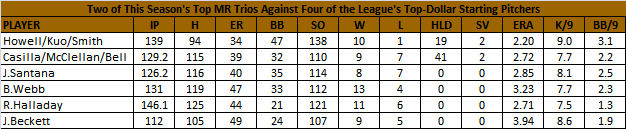
And finally, a look at how some combos of middle relievers have performed against some of the best starting pitchers in baseball:

Sunday: 07.13.2008

Post-All Star Break Producers, Part II

Yesterday I posted Part I of a two-part piece on some historically strong performers in the 2nd half. For the study, I looked at post All-Star Break numbers from the years 2005 to 2007 and picked out the instances of players posting an .850 OPS or better. From there, I took the players that did it more than once and isolated them. The group that pulled the hat-trick were in yesterday’s list, while today will cover the remaining bunch that did it two out of three times. In the upcoming chart, you will see the three-year totals and averages for the 43 players that had an .850 or better OPS in two out of three seasons, meaning the season that they didn’t make it is factored in, too.

The email response to the first portion was great and I really appreciated it, thought some readers point blank asked what they are supposed to do with the information. You don’t have to do anything with it if you don’t want to, but it can be used for reference when entertaining trades for a stretch. It is by no means wholly predictive so don’t blindly follow it to the point of taking a bad trade because you think Player X is going to have a bust out second half. But if you are deciding between a few players, this information might lead towards the right guy to help your team from here until October. The Elite 16 list was filled with stars, but there were plenty of stars not listed meaning maybe you trade some stars you currently own for these ones that have shown a penchant for stepping it up during the dog days of summer.

The second list is decidedly less star-laden meaning you could find some real value by acquiring some of these players at a severely discounted price. Some of the players on the list are already having great seasons (Jason Bay, Milton Bradley, Adrian Gonzalez), but some others have seen their stock tumble based on a horrific first half (Robinson Cano, Matt Diaz, Todd Helton). Baltimore’s Luke Scott is having a breakout season of sorts due in large part to his job security, but if he holds to his usual pattern, he’s in for an even bigger 2nd half which would truly make 2008 a breakout season for him. He has the biggest pre to post All-Star Break delta in OPS at 261 points! Speaking of opportunity as a breeding ground for breakout potential, second to Scott in OPS improvement is recently traded Matt Murton. He should get a chance in Oakland to repeat his 194-point OPS improvements after the break especially given the fragility of Ryan Sweeney and suckiness of Emil Brown & Travis Buck. He’s batted second in back-to-back evenings since being recalled on July 11th.

Some other potential gems exist in the form of Carlos Delgado, Travis Hafner, Paul Konerko and Adam LaRoche. Althought Delgado and LaRoche have both been strong in July, so the window to acquire them cheaply might be closed.

Feel free to share your tales of trading for some of these guys as Steve from Iowa did via email. Steve sold high on BbP favorite, Justin Ducscherer in a deal that landed him Matt Holliday. Steve dealt Duchscherer and Bill Hall for Holliday. Like I said, Duchscherer is a huge favorite of Baseball by Paul, but this is an amazing deal for Steve.

Saturday: 07.12.2008

Post-All Star Break Producers, Part I

I’ve never done crack, but I imagine that the withdrawals from quitting the stuff are similar to what I suffer through during the All Star Break. While likely not nearly as dramatic, I suspect many others search for ways to keep themselves engaged, but occupied. This naturally leads back to your league’s homepage in search of ways to shore up the weaknesses for the stretch run. The dust has settled on the “first half” (technically the 81-game mark hit weeks ago) and every fantasy owner should know full well what they need to get to their desired result.

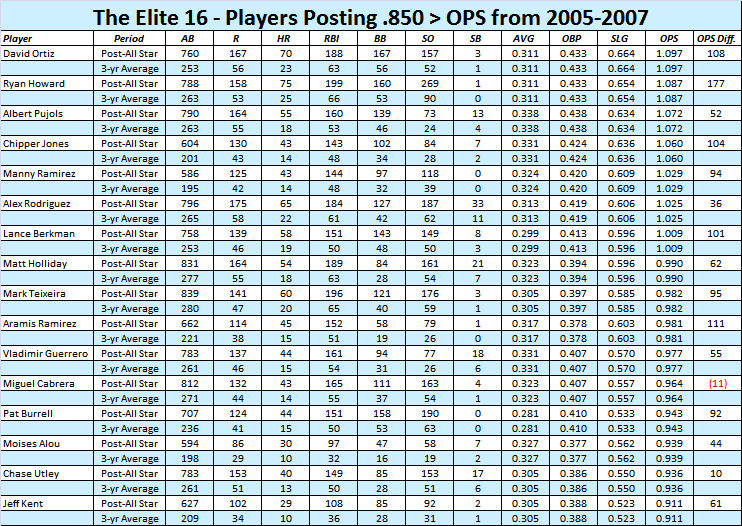
Is your team in need of offense? I have compiled a group of players that have shown a propensity for second half excellence in the past three seasons by registering an .850 or better OPS in at least two of the three seasons. Of the 59 players that qualified, 16 of them completed the hat-trick and the names within that list are unlikely to surprise many. In fact, the entire list is rather star-laden but that doesn’t render it useless. We know that stars are supposed to perform, but if you’re acquiring the high-dollar players from a team dumping and looking at 2009, this list will guide you towards the players you are likely to get the most gains from during the last 2 1/2 months of the season.

I will start with the upper echelon of players. As I mentioned, this group gave .850 or better in each of the three seasons studied (2005-2007). In fact, the lowest three-year average in OPS is Jeff Kent‘s .911. By and large, this group of players will represent the guys you ought to be targeting for the second-half surge. Some of them are in the midst of otherworldly seasons already so a continuation of their post-All Star Break mashing could lead to some record-breaking totals.

Here is a detailed look at the group sorted by OPS. The far right column is their difference in OPS from before to after the All Star Break. The 3-year average column directly below each player is their total line divided by three… pretty self-explanatory stuff there!

Seeing David Ortiz & Ryan Howard top the list should please owners of these guys quite a bit. For Ortiz, it was a painfully slow start followed by an injury currently shelving him that his derailed his season while Howard had delivered little more than raw power until the beginning of July. Even at his worst (like a .234 batting average), Howard’s power production makes him rosterable in just about any format. He is already turning things around in July with both the power (seven home runs in 10 games) AND the batting average (.375, 15-for-40). The time to buy low has probably vanished by now, but he should still be a superstar target, especially if he can be had at ANY amount of discount.

The usual suspects round this list though Kent has been rather “blah” so far this season. The Dodgers could really, really use a hot summer from him considering their lineup’s immense struggles. If he achieves his average output from the past three seasons, he will be very close to last year’s final numbers and that’s pretty darn good for a 40-year old second baseman.

Moises Alou might be done forever with his latest injury likely sidelining him for all of 2008. He is (was?) a truly amazing hitter that would get the job done whenever he was the lineup. Unfortunately, at age 42, his body is just not holding up anymore. I decided to leave him on the list essentially to pay homage to his greatness because I knew he wasn’t going to be a viable target for fantasy owners in the 2nd half of 2008.

Tomorrow I’ll post the remaining 43 players on the list. It is the group of players that reached the .850 OPS or better mark two out of the three seasons I looked at for this study. That list contains top-flight superstars, mid-level semistars, average players and somewhat scrubby players that you might be able to pick up off the heap and speculate on to see if they continue their post-All Star Break hitting trend.

Wednesday: 07.9.2008

A’s Trade Harden; Beane Gets Ripped!

Speculation around Rich Harden being dealt from the Oakland A’s is nothing new for 2008, but it finally happened on Tuesday with the Chicago Cubs stepping up and giving the A’s a four-pack of players including a few major-league ready players. The A’s got Sean Gallagher, Matt Murton, Eric Patterson and Josh Donaldson for Harden and swingman, Chad Gaudin. Fans and pundits alike are criticizing the haul despite the strong track record of GM Billy Beane. I think the criticism is severely misguided and that Beane did just fine in trading the team’s ace.

Harden, when healthy, is an amazing talent with top-10 ability. Heck, it might even be top-5. The problem is that “when healthy” piece. His 77 innings this year are more than he logged in the past two seasons combined (72.3) and he has topped 128 innings a season just once despite being with the A’s since 2003. That massive concern is why the A’s weren’t able to acquire the kind of package that a talent like Harden would normally net. This is real life and not a video game, so Beane can’t trade based on Harden’s potential should he remain healthy. After all, the Cubs know all about top-flight talents that can’t stay on the hill. They had a pair of arms that were anointed future Hall of Famers in Mark Prior and Kerry Wood, yet they spent more time in the hospital than on the mound. Prior is again going to miss the entire season while Wood has reinvented himself as a closer with the Cubs.

Harden’s value has never been higher in the past two-plus seasons and Beane, known for trading arms that many others would deem “untouchable”, cashed in his chips before things had a chance to go south again. Maybe he noticed that Harden hasn’t really been the same since his eight-inning outing on June 26th, going just five in two starts thereafter with a 1.8 K/BB ratio. It was his longest outing of the season and perhaps he was stretched too far. Maybe Harden is a 6-inning pitcher at this point in his career until he builds up some durability.

Maybe I’m reading too deep into a small sample and Beane realized that Harden’s value may never be this high again so he decided to get three of Chicago’s top-10 prospects and an underrated outfielder in Matt Murton, who has never been given a full opportunity. Regardless of his motive for the deal, hasn’t his extensive track record of success earned him the benefit of the doubt? His most recent trade of a top quality arm has already paid dividends. Over the winter, he dealt Dan Haren to Arizona for Dana Eveland, Carlos Gonzalez, Aaron Cunningham, Greg Smith, Brett Anderson and Chris Carter. Eveland & Smith are 12-12 in 212.3 innings with a 3.56 ERA, 1.33 WHIP, 6.0 K/9 and 4.1 BB/9. Gonzalez came up a little while ago and has a .272/.295/.432 line in 125 at-bats with 16 extra-base hits of his 34 total hits. Cunningham and Carter are both raking in the minors while Anderson is striking out over a batter per inning and earned a promotion to AA earlier this season. And that’s just one trade!

Beane can evaluate talent and that fact shouldn’t be lost on anyone at this point. Not everything he does is a slam dunk, that’s not the case for anyone in the game of baseball, but he’s got some 360-windmills under his belt. Let’s look at some of his more recent moves for the A’s:

Traded Nick Swisher for Gio Gonzalez, Fautino De Los Santos and Ryan Sweeney
Both Gonzalez and De Los Santos are striking out over a batter per inning in AAA and AA, respectively, though both are struggling mightily with their control. Sweeney has been really good for the A’s with a .300/.354/.405 line in 200 at-bats. Swisher has recently turned it up, but overall he’s been a disappointment this season. At 28, he didn’t fit into the rebuilding plan of the A’s.

Traded a PTBNL for Jack Cust
His batting average may never be pretty (currently .221), but he still leads the team in on-base percentage (.361), home runs (15) and slugging percentage (.413) for qualified batters. He has 41 home runs and 125 RBIs since becoming an Athletic in May of last year. That alone is worth a player to be named later.

Signed Frank Thomas twice, once for $500K (2006) and this year for $390K
This most recent time was after Toronto discarded him to the scrap heap due to a slow start. He put up a .933 OPS in 91-at bats before hitting the disabled list with tendinitis in right quad. The first time around was amazingly successful. After two down years eaten up by injury, Beane took a chance on Thomas and watched him put up a .270/.381/.545 line in 466 at-bats with 39 home runs and 114 runs batted in.

Those are just four recent moves that worked out very well for Beane and the A’s so why is everyone so fearful that this Harden trade will be a remarkable disaster for the A’s? One of the reasons being bandied about is the inclusion of Chad Gaudin. Hats off to Gaudin who has performed well in his role between the rotation and bullpen, but he isn’t much to write home about and will likely be exposed badly in Wrigley Field. Last year, he was masterful in the first half with a 2.88 ERA and 8-3 record in 18 starts. His 4.0 walks per nine screamed “trouble” for the second half. Lo and behold, he was 3-10 with a 6.30 ERA in 90 second-half innings. The control actually got worse with 5.2 walks per nine after the break. He had a 3.99 home ERA against a 4.84 on the road in 199.7 innings last year. This year, it was an even more glaring exploitation of his home field with a 2.25/4.99 split in favor of McAfee Coliseum.

It’s not all bad for Gaudin, though, as he has quelled the control issue for now with 2.4 walks per nine. Even still, his inclusion to the trade does not doom the A’s or the give the Cubs an automatic ticket to the postseason. Given their propensity to develop arms, I’m almost certain that Oakland has several Chad Gaudins floating around their minor league system.

This is the kind of trade that can be a win for both. It doesn’t eliminate the A’s from contention and if Harden continues at pace or something near pace, it most definitely helps counteract the Brewers’ acquisition of C.C. Sabathia thus improving their chances to win the Central. For the A’s, Gallagher will enter the rotation without issue, but more importantly is that Murton may be able to offer their anemic offense a boost. Patterson gives them some depth on the infield that they desperately need given the fragility of Eric Chavez, Bobby Crosby (both of whom are currently DL’d) and Mark Ellis.

Given the limitations Beane deals with as Oakland’s GM, it is imperative that he avoids risk whenever possible. A Carl Pavano situation would decimate the A’s and while Harden is significantly more talented than Pavano, his inability to consistently take the mound was too much for a risk for the A’s. Though still just 26, Harden’s free agency is right around the corner (post ’09, I believe) and he will command a large sum despite that lingering health concern. Beane has decided to let someone else roll the dice with that money and get something in return.

Maybe Harden pitches well the rest of 2008 and does really well through mid-July in 2009 as well giving him highest value yet entering next season’s trade deadline, but a more likely scenario is that he’s frequently in and out of the rotation during that time alternately looking like Pedro Martinez on the mound and Mark Prior on the DL. Regardless of how it eventually plays out (remember, hindsight is 20/15), Beane wisely assessed the situation and made a strong trade for his ballclub.

Monday: 07.7.2008

Midseason Pacing

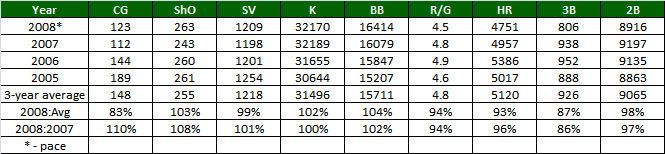
We’re a good bit over the “true” halfway point of 81 games, but still a week away from the observed middle point of the season, the All-Star Game, so I thought I’d take a look at how the league was pacing in a few statistics through Sunday:

The first half delves into pitching performance while the back-end takes a peek at some pacing in the hitting department, most specifically power. The primary reason I put together the chart was because I had suspected that Complete Games were up this year. Honestly this was probably because last year’s league leader, Roy Halladay, already had six after racking up seven during the entire 2007 campaign. Therefore I thought, perhaps foolishly, that since Halladay was doing it at a more frequent pace, the league must be as well. It is, but hardly at anything close to a record-breaking pace. Furthermore, the 2008 pace is well off the three-year average from 2005-2007 that was undoubtedly much “dirtier” than the game is today.

The league pace is up 8% on Shutouts from a year ago, though I could’ve easily guessed that as a diehard Detroit Tigers fan. Despite having what many believed was one of the best lineups ever constructed, the Tigers have been blanked a vomit-inducing 10 times this season! Their futility alone serves for half of the growth over 2007 and covers all of the difference between the 2008 pace and the three-year average (and then some)!

It was anecdotal evidence that also led me to thinking that pace of Saves was up significantly led by Francisco Rodriguez‘ record-breaking pace as well as George Sherrill‘s bid for 50. I remember seeing Sherrill relieve Felix Hernandez in a Tacoma Rainier’s game against the Round Rock Express a couple years ago. I thought he was pretty good and would eventually be a formidable reliever, but I didn’t think he had 50-save stuff. Of course a look at his peripherals beget that he doesn’t have 50-save stuff (5.1 BB/9). Nevertheless, saves have remained rather static over the past three seasons and this year’s pace is no different.

Naturally I was expecting that with Shutouts up, Runs per Game would be down. Or perhaps I thought they were down because of the article from a few weeks ago I did on power being down. Either way, my beliefs were confirmed as the RpG is down 0.3 from last year (and from the three-year average incidentally). This is likely due in large part to Home Runs still being down 7% over the three-year average and 3% from a season ago. Doubles are down a tick as well quelling the idea that the would-be Home Runs are turned into Doubles. Triples, a seemingly very unpredictable occurrence, are way down from both last and the three-year average. I haven’t the slightest clue as to what that might mean.