Archive for ‘Baseball’

Tuesday: 03.27.2012

BS Report and Betting Dork!

My primary goal for the 2012 Starting Pitcher Guide was to make it better than last year’s offering which I considered a resounding success.  I am feeling confident that the goal will be met as the 2012 version has already had more downloads than last year’s and that number is likely to go up after today.  Today’s BS Report during which Bill Simmons discussed baseball with his buddy Jack-O and Grantland head baseball writer Jonah Keri included a plug of the SP guide.   You can and should listen to the entire podcast at the BS Report link in the previous sentence, but I’ve also included my name check here because why not?!

Simmons Plug

Additionally, I recorded my second stint on the Betting Dork podcast with Gill Alexander from Pregame.com.  Last week we covered pitchers (naturally) and this week we dove into position players discussing a handful of over and under valued guys.  Gill is an excellent baseball handicapper and while we’d both love to add the other’s primary hobby (mine being fantasy baseball, of course), the time needed to succeed at both is just too much.  At least too much to enjoy it and maintain any semblance of a life during the summer.

Part 1 talking pitchers (I come in at the 30-minute mark, but listen to it all if you love baseball)

Part 2 talking hitters (I come in at the 43:30 mark, but again I recommend the entire show)

Monday: 03.19.2012

The 2012 Starting Pitcher Tiers & Projections – Now Available

When I released the 2012 Starting Pitcher Guide last week, I made mention into the introductory piece that there the tiered rankings you are likely used to seeing in the guide would be part of a supplement to come out later.  Later is now as I have completed the file.  It is a lot different from previous years in that this year’s version includes projections for 124 starters across the AL & NL.  I’ve never tackled projections before, but decided that it would be a healthy addition to the tiered rankings and give you a better handle on how well (or poorly in some cases) I think these guys will do in 2012.  For the aforementioned 124 arms, there will also be an additional comment within the spreadsheet so if the 73,000 words of the guide weren’t enough, I’ve got more reading for you!

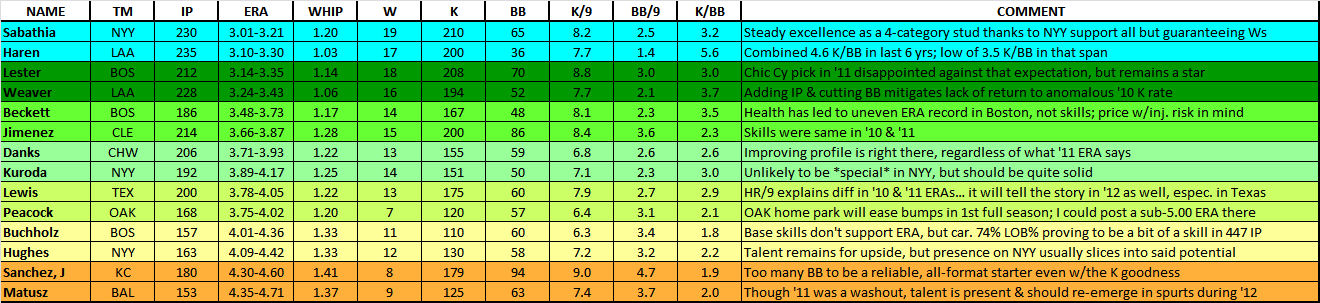
Here is a sample of the AL rankings (click for full-size)

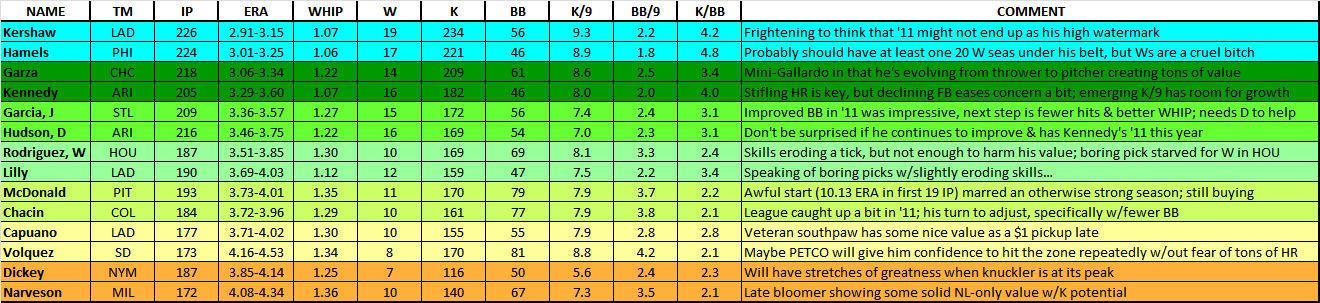
As you can see, they are split into colored tiers with the projections and comments included.  That sample shows a couple from each grouping in the AL.  There are 64 names in AL who got a projection.  I cut it off there because I’m not sure how useful projections are for the lower grade guys like Nick Blackburn, the uncertain playing time guys like Jacob Turner and the who-really-cares-if-they-pitch-200 IP-anyway-guys like Bruce Chen.  Of the 21 names in that bottom grouping that you will see on the spreadsheet, I’m sure some of them will emerge into useful arms whether in AL-only formats or all formats, but things aren’t adding up that way right now so I focused on the most useful names (in my estimation).

Here is a sample of the NL rankings (click for full-size)

Right now, the Tiers & Projections will be available to donors only. 

I’m insanely appreciative of those who donate for the work I do and I wanted to reward that generosity so once you donate through the PayPal link (also found in the upper right of the page), you will be sent the Excel file containing the information.  If you’ve already donated, it should already be in your inbox.  If it’s not and you believe you should have it, please let me know via email or on Twitter.  If your PayPal email address isn’t where you want it sent, just let me know and I’ll make sure you get it at the proper address.

Wednesday: 03.14.2012

The 2012 Starting Pitcher Guide

It’s finally here!

-400 Pitchers

-76,300 Words

-190 Words Per Pitcher (on average)

-151 Pages

Please enjoy the 2012 Guide and feel free to direct any questions and comments either here in the comments section, on Twitter @sporer or via email through sporer at g mail.  As was the case last year, you can donate to show your appreciation in the upper right corner of this page.  I sincerely appreciate any and all donations and I’m beyond flattered at the fact that I’ve already received a handful of donations AHEAD of the release.

2012 SP Guide with 400 Player Capsules

Wednesday: 01.4.2012

Oakland Cashes in with Gonzalez Trade

As division foes Texas and Los Angeles grow stronger, the Oakland A’s are entirely committed to focusing on their future as they have dealt another key cog in their once strong rotation.  Gio Gonzalez is headed to the Washington Nationals for a package of prospects that includes their 3rd (Brad Peacock), 4th (A.J. Cole) and 9th (Derek Norris) best farmhands according to Baseball America.  The fourth piece was lefty Tom Milone, who BA listed as having the best control and changeup in the organization.

This group of youngsters (Milone is the elder statesman of the bunch at 25) joins the trio of prospects the A’s got for Trevor Cahill.  That group was highlighted by Jarrod Parker and included outfielder Collin Cowgill and reliever Ryan Cook.  Parker was listed 4th on the Arizona Diamondbacks top 10 prospects and projects to have some incredible upside that could make him better than Cahill if he pans out completely.  However, Cahill is the more finished product, obviously, and still under team control for several years while Parker returned from Tommy John Surgery in 2011.

Looking at the returns from Washington shows some strong upside starting as early as 2012:

Brad Peacock (RHP) – Peacock emerged a bit in 2010 pitching in High-A for the second time (48 IP there to end 2009) when he doubled his strikeout rate to 10.3 K/9 while seeing his walk rate rise just slightly from 1.9 to 2.2 BB/9 in 103 innings.  He was promoted to AA where he came off the rails a bit, specifically a 5.1 BB/9 and 1.2 HR/9 in 39 innings (meanwhile, his strikeout rate dipped to 7.0).

In similar fashion, he repeated the level to start 2011 and looked more like the Peacock from the start of 2010 with an 11.8 K/9 and 2.1 BB/9 in 99 innings before reaching AAA.  While he saw some degradation in his numbers with the promotion, he still struck out a batter per inning, but the walk rate jumped to 4.5 per game.  The real difference in his 2011 season was a severe lack of hits against him.  He allowed just six hits per nine in 147 innings across both levels.  The big season earned him a cup of coffee with the Nats (0.75 ERA in 12 IP).

Peacock has a mid-90s fastball (sits 93) that can touch 96-97 with a wicked curveball and progressing change up that sits 82-84 and looked sharp during his quick 12-inning stint with the big league club.  There was talk of him possibly being a future reliever, but after his breakout season in the high minors last year, he looks like a full-fledged starter capable of becoming a #2 or #3 at his peak, especially in that pitching-friendly home ballpark where Oakland plays (for now).

A.J. Cole (RHP) – At 20 years old and about to enter just his second season a professional, Cole is still pretty far away from contributing to the A’s, but an impressive debut combined with a projectable frame (6’4/180) have many seeing future ace potential for him.  He did nothing to dissuade such thoughts in 2011 striking out 10.9 batters per game in his 89 innings and walking just 2.4 (for a 4.5 K/BB).

Like Peacock, his fastball sits 91-93, but flashes 96-97 and his curveball is further along than his changeup.  He has a Ubaldo Jimenez-esque delivery whereby he shoots his hand out behind his back just before he throws the pitch.  His leg kick is a little Verlanderian in that he gets it really high and loose and leads into his easy delivery.  His mechanics aren’t quite as effortless as Justin Verlander’s, but then again outside of maybe Matt Moore, nobody’s are right now.

If his body fills out a bit as projected and that gives him the tick or two on his fastball, he will be in really good shape in terms of hitting that ace-level projection, especially if that boost in velocity is paired with the expected improvement of his changeup.  There are some ifs and maybes with Cole right now, as with any 20-year old, but the future is bright and he may well end up being the gem of this entire haul in five or six years.

Derek Norris (C) – For those who mislabel “Moneyball” as simply “guys who take walks”, Norris is the quintessential Moneyball player.  For those who are more enlightened, Norris is the kind of player who would’ve been wildly undervalued in the era when Moneyball first came to be because he totes a wholly unimpressive .249 career batting average in 1815 minor league plate appearances, but offsets it with an eye-popping .403 on-base percentage thanks in large part (OK, thanks exclusively) to a 19% walk rate, including two seasons over 20% (2008 & 2010).

His .235 and .210 batting averages the last two years are alarming especially in light of his plate discipline.  Some scouts believe that his contact rate will improve in the coming seasons, but it is hard not to be at least somewhat concerned at this juncture.  Of course, he isn’t just a fancy walk rate.  When he does make contact, it is often solid contact as evidenced by his 20 home runs (his second 20+ HR season in the minors) and a career-high .237 Isolated Average (slugging minus batting average).

A catcher who can get on base, hit for pop and even run a bit (13 SB per 500 AB) is a valuable commodity for sure, but playing half of his games in Oakland Coliseum means Norris will have to improve his contact rate or he could easily be looking at a sub-.200 batting average.  The Major League Equivalency of his 2011 line when placed in Oakland yields a .155/.268/.312 line.  Ouch.  No need to panic just yet, though, as he will be just 23 years old in 2012 so he still has time to develop.

Tom Milone (LHP) – The term “crafty lefty” is often reserved for a veteran southpaw who may have once had an overpowering arsenal that has diminished with age leaving him to outsmart hitters with command and guile.  At 25, Milone is already a crafty lefty despite what you might infer from his minor league numbers.  He is a prime example of why just looking at the numbers isn’t ever enough.

Though he boasts an improving strikeout rate that went from 6.3 K/9 in 2009 to 9.4 this past season, Milone doesn’t overpower hitters.  Deception and pinpoint accuracy make his high-80s fastball play better that it truly is while a strong changeup and passable curveball round out his arsenal.  He has chipped away at his walk rate since 2009, as well, starting at an already-strong 2.1 BB/9 and getting down to a remarkably impressive 0.97 mark in 148 innings at AAA this year (giving him a 9.7 K/BB).

Milone’s big season in the high minors earned him a big league cup of coffee and he was pretty much as expected in his 26 innings.  He maintained his sharp command walking just 1.4 batters per game, but the strikeout rate dipped to 5.2 K/9, unsurprisingly.

He showed a heavy flyball lean in his small sample (49%), so Oakland’s home park will suit him quite well in that regard should that prove to be a trait he retains once he becomes a full-time big leaguer.  His groundball rate had been diminishing a bit as he climbed the minor league ladder, but his 31% mark in the majors was in sharp contrast to his 41% at AAA.  Of the ballparks within his new division, only Texas will punish him severely for a flyball lean, but fantasy managers are always leery of their non-aces going into Texas so that isn’t a major adjustment in strategy.

If you are looking for a solid comp for Milone, look no further than his new team as Dallas Braden seems to fit the bill quite well.  Braden pitched just 18 innings in 2011 because of injury, but his 2010 season was a bit of a breakout as he notched 30 starts for the first time posting a 3.50 ERA and 1.16 WHIP in 193 innings.  His 5.3 K/9 wasn’t terribly impressive, but 2.0 BB/9 was quite nice and helped him achieve a strong 2.6 K/BB.

Milone, like Braden, will likely be an undervalued asset come draft day and though I often prefer guys who miss bats, I also like bargains and this particular skill set is still underappreciated on the fantasy landscape.  If you have some flamethrowers atop your rotation and some high strikeout relievers, you can afford a Braden/Milone or two to round out your staff.

Thursday: 12.15.2011

Trevor Cahill’s 2012 Outlook in Arizona

For a few days it seemed certain that Oakland A’s lefty starting pitcher Gio Gonzalez would be dealt in a blockbuster deal this winter.  The rumors were running rampant and frequent and had names attached to them like Jesus Montero and Dellin Betances from the Yankees, Mike Stanton or Logan Morrison as a centerpiece from the Marlins and Jacob Turner and Nick Castellanos from the Tigers.

Unfortunately for Oakland, none of those came to pass (the packages from New York and Detroit or even just Stanton from Florida would’ve been an excellent return for Gonzalez), but then out of nowhere it was their other budding star pitcher, Trevor Cahill who was dealt.  He was sent to the Arizona Diamondbacks with Craig Breslow for prospects Jarrod Parker, Collin Cowgill and Ryan Cook on December 10th.

The deal gives the reigning NL West champs a front three of Ian Kennedy, Daniel Hudson and Cahill without sacrificing any of the pieces they used to win 94 games and push Milwaukee to the brink in the first round of the playoffs back in October.  What will the move from the American League’s version of the west to the National League’s mean for Cahill?

He enters his age 24 season having pitched three full campaigns (at least 30 starts in each) that have yielded a mixed bag of results.  He was an All-Star and down ballot Cy Young candidate in 2010, but has sandwiched that breakout with two seasons of essentially league average work (96 and 97 ERA+ totals in 2009 and 2011).  Pitchers are generally expected to see an improvement when shifting to the National League just by virtue of the fact that they get to face their mound counterparts, but might Cahill have some natural growth within his talent profile, too?

His Pedigree

Cahill came up through the minors as a highly touted prospect for Oakland after being taken in the 2nd round of the 2006 draft.  He squeezed in nine professional innings after signing as an 18-year old and then proceeded to show why he was such a high pick in 2007 and 2008.  He made three stops in the two years (A, High-A and AA) throwing 230 innings with a 2.66 ERA, 1.09 WHIP, 9.9 K/9 and 2.8 K/BB.

His major league debut saw less than half of that strikeout rate show up as he fanned just 4.5 batters per game in 179 innings.  That said, the strikeout rate has crept up yearly since he reached the majors and last year’s 6.4 K/9 in his high watermark for now.  Perhaps given where he established that minor league strikeout rate, his progression in the majors should be less surprising.  More on that later.

His primary asset has been the ability to induce groundballs at an elite rate (56% the last two years) which the usually sure-handed defense of the A’s* translates into plenty of outs.  Combine that with a scant flyball rate in a spacious park and you can see why Cahill has enjoyed league average or better success in each of his first three seasons despite not yet topping 2.0 in his strikeout-to-walk ratio.

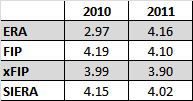
*The A’s defense had far and away its worst year since Cahill joined the team and not surprisingly his numbers suffered in concert.  His BABIP during the 2010 season was at .236 yielding a 2.97 ERA against a 4.19 FIP while his BABIP soared to .302 in 2011 pushing his ERA to 4.16 against a 4.10 FIP.  In other words, he was essentially the same guy each of the last two years, but he counts an exemplary defense for improved results.  Later we will see how Arizona’s defense might suit him in 2012.

The National League

When discussing strategy with mixed league fantasy baseball managers, you will often hear someone say they lean heavily toward starting pitchers in the National League as a general principle, especially if their other choice is a pitcher in the American League East.  Even if the NL pitcher is slightly less talented, a lot of times the deciding factor will be the league in which he pitches.  Is it worth it?  In general does leaning toward NL starting pitchers pay off?

Looking at the last three years, the answer is yes, but only marginally so.  Not enough to where I would knowingly take a less talented pitcher just because he is in the assumed safe haven of the National League.

As you can see, the difference in starting pitcher strikeout rates from league to league is about 0.2-0.3 in favor of the National League while walk rates are dead even.  The difference over 200 innings is a whopping three strikeouts (147 to 150).  So there isn’t a major difference in strikeout rate from one league to the other even with pitchers batting and striking out 33% of the time.  We saw this come to fruition in 2011 as the big pitchers who switched leagues saw inconsistent changes in their strikeout rates.
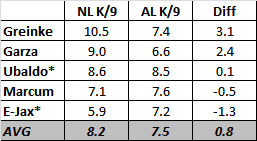
*Ubaldo Jimenez and Edwin Jackson both switched during the 2011 season resulting in smaller innings samples for each column while the others are all comparing their 2010 and 2011 full seasons.

Both Jackson and Shaun Marcum actually lost something on their strikeout rate when joining the National League while Marcum’s teammate Zack Greinke and their central division foe Matt Garza saw significant gains in their first season’s as National Leaguers.  Jimenez held firm moving from Colorado to Cleveland midseason.  It is a limited sample of pitchers for sure, but the point is simply that the National League doesn’t automatically yield a better strikeout rate.

What about the actual results?  Do we see a discernible difference in starting pitcher ERAs from league to league?
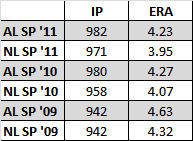
Overall, the league ERA in the National League has been 0.20 to 0.31 better during the last three years including 0.28 better in 2011.  So again there is a slight enhancement for National League-based  starting pitchers over their equal American League counterparts, but keep in mind that over 200 innings, it is a seven earned run difference and just five earned runs in a 150-inning sample.

There is still no compelling case to be made for taking a lesser talented NL pitcher over even a slightly more talent AL one.  If you use league home as a tiebreaker between two comparable players, then it makes sense to lean toward the National League as you should expect incremental gains in strikeout rate and ERA results.

Using Cahill’s 2011 results, he would stand to gain five strikeouts up to 152 and his ERA would shave seven runs off and move down to 3.86.  Those are simple quick and dirty estimates using his 2011 results against 2011 league standards.  This removes all of his context-based factors and assumes no growth.

His Home Park

Cahill leaves a park in Oakland well known for favoring pitchers and heads to Arizona to play in a park equally well known for its opposite effect on pitchers.  Neither is the best at what it is known for, but Cahill will now play in the division with the most renowned stadiums for each end of the spectrum: San Diego’s PetCo Park for pitchers and Colorado’s Coors Field for hitters.

Here is comprehensive look at the park factors for the divisions Cahill is leaving and joining using Baseball-Reference’s Park Factors for just 2011 as well as the last three years combined:

(-b refers to park factor for batters; -p for pitchers)

Overall the change is minimal with the biggest difference being his less favorable home park, but his severe groundball tendency combined with the boost from the National League should mitigate most of it, especially since that doesn’t even take into account his potential to improve as a pitcher.  Meanwhile, he essentially trades Texas for Colorado.  Of course, Texas never really bothered him as he posted a 2.23 ERA and 2.1 K/BB rate in 40 innings (his highest count outside of Oakland) there.

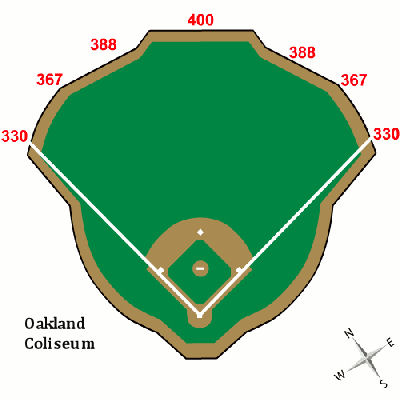
The outfield dimensions of Chase Field as compared Oakland Coliseum are unlikely to impact Cahill negatively.  In fact, Chase Field is deeper in almost every respect.  Where Oakland Coliseum derives a great deal of its love from pitchers is in the foul territory.  The expansive room available to make plays on balls that would otherwise be souvenirs in most other stadiums has saved many an Oakland pitcher.  It is hard to derive how much of an impact, if any, that will have on Cahill in 2012.  While I can find how many of his pitches turn into foul balls, I can’t find how many of those foul balls result in outs.

His Defense

As I mentioned earlier, Cahill relies heavily on his defense.  With a 56% groundball rate, a sharp infield offense is key to his success.  In 2010, the top four fielders in UZR on the A’s were Cahill’s infielders: Kevin Kouzmanoff 16.1 at 3B, Daric Barton 12.1 at 1B, Mark Ellis and Cliff Pennington at 9.9 apiece at 2B and SS, respectively.  Of the four, only Ellis played fewer than 1231 innings (986) and the most important cog, Pennington, played 1304.

On the 2011 A’s, Ellis and Kouzmanoff were the top two rated infielders in UZR with 2.1 and 2.0 marks in 501 and 365 innings, respectively.  Ellis was traded to Colorado to make way for youngster Jemile Weeks while Kouzmanoff was only in the lineup throughout 2010 because of his glove (.296 wOBA) and yet somehow got worse with the bat in 2011 (.271 wOBA) before eventually being traded to Colorado as well, though in a separate deal from Ellis.  Meanwhile Pennington regressed to previous defensive levels with a -5.2 UZR in 1272 innings, which is more in line with his -4.7 and -4.5 marks from 2008 and 2009.

The aforementioned Weeks had a -4.1 UZR as the primary second baseman and Scott Sizemore was a team worst -6.0 UZR at third base.  Both added a Bondsian level of offense compared to their predecessors, though, so the offensively-starved A’s had to overlook their defensive shortcomings.  This no doubt affected Cahill en route to a career-worst .302 BABIP.  While that isn’t too far off of the average (.299 in the AL), Cahill needs to be above average there until his base skills (missing bats and limiting free passes) improve.

The Diamondbacks were first in baseball in UZR at 55.8 in 2011.  Good news for Cahill, right?  Yes, but not as good as that one piece of information suggests.  The bulk of Arizona’s UZR goodness is built off of their strong outfield defense: Chris Young 14.1 in CF, Gerardo Parra 9.8 in LF and Justin Upton 7.7 in RF.

But right behind those three is shortstop Stephen Drew at 4.5.  His season was cut short by injury, but backup shortstop John McDonald turned in a 4.0 UZR, too.  Drew has been above average each of the last three years including an 8.7 UZR in 2010.  Keeping him healthy will be essential because he not only picks it, but he is a far better with the bat than McDonald.

Aaron Hill has a very strong defensive track record with a 21.7 UZR in six seasons of work and just one season below average (-4.9 in 2009).  Ryan Roberts broke out in his first full season of play both at the dish and in the field.  He spent the bulk of his time (902 of 1132 innings) at third base and acquitted himself well enough with a 1.7 UZR.

Defensive numbers can fluctuate year-to-year so while the Diamondbacks might not finish first in the league again in 2012, it is nice to know that all of Cahill’s new infielders have track records to back up their 2011 performance.  This is a net gain for Cahill, especially with the A’s placing a premium on bat production in lieu of quality fielding (and who can blame them?).  Lucky for Cahill and Arizona, their slick fielders can handle the bat, too.

His Bullpen & Offense

These two factors only really contribute to his potential win count, the predicting of which is generally foolish because of how inconsistently they correlate to quality pitching.  More to the point, wins aren’t really something that starting pitchers can control because even if they pitch well for their allotment of innings, they need the bullpen to hang on.  And even if the bullpen keeps their masterpiece intact, the offense needs to have earned enough runs off of the opposition’s starter and bullpen, too.

For the sake of full disclosure, let’s quickly look at both aspects.  The bullpens were equal for intents and purposes in 2011 and both have the talent to do the same again in 2012.  Any major differences between the two would come from fluctuating luck or a change in personnel.  As it stands right now, Cahill will see no discernible gain or loss in bullpen support with the trade.  Projecting forward he was more likely to lose out by staying in Oakland as they continue to discuss potential trades involving Andrew Bailey.

There seems to be a real improvement in his team offense with the move to Arizona as evidenced by the 2011 numbers of the two units:

Of course, that still doesn’t mean he will have an increase in wins.  Consider his 2010 season.  He went 18-8 and while the Oakland offense was better than the dreadful 2011 iteration, they still only scored 4.1 runs per game.  Logic and wins don’t mingle well.  Yes, you can probably afford to pitch a bit worse and register an above average win total with an offensive stalwart like the Yankees supporting you, but then you see Aaron Harang win 14 games with the Padres who scored a whopping 3.7 runs per game in 2011.

Cahill’s bullpen support remains strong and his offensive support is improved, but don’t let either have a significant impact in your 2012 analysis for him.

His Improvement

We have taken a look at all of the outside factors that could contribute to Cahill’s success or failure in 2012, so what about the factors he can handle?  He showed during his minor league career that he can be a dominant strikeout pitcher, but you have to consider that the bulk of that work was done in the lower minors.

He skipped AAA before making his debut (subsequently logged 9 AAA IP in 2010) and posted a career-low 8.0 K/9 in a quick 37-inning stint in AA at the end of 2008.  So while the gaudy 9.9 K/9 in 247 minor league innings is nice, you have to adjust more than you would normally take off for a pitcher who had a strikeout rate like that with some significant work in AA and AAA.  Going from 9.9 to the 4.5 of his rookie year would have been hard to project, but he deserves credit for not crumbling under the pressure as a 21-year old who essentially came from High-A.

His improved strikeout rate seems to correlate well with the effectiveness of his curveball.  I took a look at him early this season after just two starts because I noticed that his curve was generating a lot of swinging strikes.  In fact, he continued to use his curveball effectively throughout the season.  He used it 4% more than in 2010 (24%) and it generated a swing 5% more often (52%) resulting in strikes 5% more often (67%), 1% of which were swing-through strikes or whiffs (14%).  His 2011 data; 2010 data.

This piece by David Golebiewski at Baseball Analysts looks at Cahill’s year on the whole and examines both his curveball and slider together leading to a similar conclusion that they are the key to an elevated strikeout rate for him. More to point, keeping them down so that hitters swing over the top of them will allow Cahill to generate more strikeouts as he continues to mature.  Plus, the worst case scenario on a well-placed breaking pitch low in the zone is weak contact in the infield which shouldn’t be too problematic for the Diamondbacks fielders to handle.

He has posted a 3.6 BB/9 in two of his first three seasons which is in line with his 3.7 BB/9 mark as a minor leaguer, but the 2.9 BB/9 shows that there is room for improvement.  He is unlikely to become Cliff Lee with his control whether now or in the future, but even incremental improvement toward that 2010 mark would be help his gaudy 1.43 WHIP.

His 2012

I really like Cahill’s outlook for 2012.  I would have liked it in Oakland, too, but the move to Arizona only helps matters.  Despite the bouncing ERA from 2.97 to 4.16, he was virtually the same exact pitcher in 2010 and 2011.  In fact, his secondary numbers say just that:
It is hard not to be impressed with what he has accomplished as a 21 to 23 year old in his 583 career innings.  He only has the one standout season from a fantasy aspect, but there is a burgeoning skill set worth buying into just as the Diamondbacks did with the trade.

I see him with a ceiling of around seven and a half strikeouts per game, though we may only see another incremental gain in 2012.  We have probably already seen his best walk rate at 2.9 in 2010, but he can get there again and it could be as soon as 2012.    Add in the improved defense closer to what he enjoyed in 2010 and I think we see something like in the following ranges for Cahill in 2012:

ERA: 3.60 – 3.92 (a spread of 7 ER in 200 IP)

WHIP: 1.24 – 1.30 (a spread of 13 base runners in 200 IP)

K/9: 6.7 – 7.5 (149-167 Ks in 200 IP)

BB/9: 2.9 – 3.4 (65-76 BBs in 200 IP)

W: these projections are enough to net 15+, but always remember that wins are unpredictable

I chose to do ranges because the accuracy of firm numbers is so low and the difference in actual performance between those ranges is pretty reasonable across a 26-week season as you can see from the information in parentheses next to each category.  Cahill is currently the 44th starting pitcher off the board in early mock drafts at MockDraftCentral.com which puts him in the 13th round at 164 overall.

Right now I don’t hate him at that 164th spot, but I think that is full price and I would opt to wait for some of the names behind him Doug Fister (180), Jaime Garcia (193), Derek Holland (197), Matt Moore (203), Javier Vazquez-assuming he doesn’t retire (246) and Ricky Nolasco (258) to name a few.  I see some, if not all, of those names eventually passing Cahill in ADP along with Yu Darvish (206) depending where he ends up.

In a mock draft (14-team mixed league) I’m currently involved in, I got him in the 21st round with pick 286 which I thought was a steal.  I suspect as more players get signed and we get closer to draft season his ADP will dip lower than 164 making him something of a bargain.

Monday: 10.31.2011

The Offseason

People ask me what I do in winter when there’s no baseball.  I’ll tell you what I do.  I stare out the window and wait for spring. — Rogers Hornsby

You have no doubt seen this quote before and likely quite recently in light of the 2011 season coming to an end.  I think I have seen it pop up in my Twitter feed at least 5-6 times in the last week.  I use it here because it is so fitting.  Sure, I like football a good bit and my Detroit Lions are actually giving me something to care about, too, but even still I am already looking forward to everything baseball-related that we get in the fall and winter months: Bill James Handbook being released, Hot Stove league of free agency and offseason trading, the Winter Meetings in December, the BaseballHQ.com Forecaster being sent out, MLB Network’s 30 Clubs in 30 Days and even the first appearance of fantasy baseball magazines on the bookshelves at Barnes & Nobles (RIP Borders *single tear*).  Perhaps my favorite offseason event of them all is coming up this week as I head out to Phoenix for the BaseballHQ.com First Pitch Forums and Arizona Fall League conference.

My month-plus hiatus between the regular ending and the World Series was fruitful and enjoyable.  I did log some research work for the offseason content here at Baseball by Paul, but mostly I tried to enjoy the time off and give my fingers a rest.  I followed my Tigers through a pair of thrilling playoff series which included a trip to Dallas to watch games 1 and 2 of ALCS with a couple of great friends.  Even though we lost both games, I don’t regret a single second of the trip.  The Dallas fans were a bit more hostile & rude than I anticipated (please don’t ever judge Texas/southern hospitality on a trip to Dallas), but all in all, it was a great time.  Speaking of the playoffs, that was perhaps one of the best sets of playoffs ever played with 38 of a possible 41 games being played, many of them nailbiters until the end.  Obviously I’d have preferred to see my Tigers in a rematch with the Cardinals for the World Series, but the Rangers/Cardinals matchup didn’t disappoint in the least.

The Hot Stove has already kicked off with some major moves of the front office variety taking place with the Red Sox, Cubs and Padres all getting new general managers while the Red Sox, Marlins and White Sox have already or will soon tab new field managers.  On the player movement front, we are seeing options being picked and declined including the CC Sabathia opt-out saga has already run its course from start to finish with he and Yankees agreeing on a new deal.  The biggest player news thus far has taken place in the AL Central with the trading of Derek Lowe to Cleveland for a minor leaguer and Minnesota acquiring Matt Maloney through waivers.  Lowe joins Ubaldo Jimenez and Justin Masterson atop the Indians rotation as they continue to play for the here and now after moving a significant chunk of their top level farm pieces for Jimenez during the summer.

Lowe may end up adding more off the field than on it, though, as he is a groundball-heavy, control artist who may find life difficult in Cleveland with Asdrubal Cabrera and Jason Kipnis defending up the middle for him.  Lonnie Chisenhall, who plays third base, checked out a bit more favorably with his glove although both he and Kipnis have limited samples which can cause issues with the defensive metrics so we might not have a true idea of their talents until seeing them for at least a full season in the majors.  With Lowe, they will get plenty of chances to prove their worth.

Maloney, with a career walk rate of 1.9 in his 80 innings, seems tailor-made for Minnesota and their “walk-nobody ever or else…” pitching philosophy.  His 6.1 strikeout rate isn’t overly intimidating, but it is better than some of the control-only pitchers they have given large inning totals to in the past (I’m looking at you and your 4.8 K/9, Nick Blackburn).  He will have to battle for a role on the team, but it is an interesting pickup that could bear some fruit.

So that is a quick rundown of what we have seen in the very early stages of the offseason, but there is just so much more to come.  Look for regular posting to return starting next week when I am back from Phoenix including a preliminary Top X starting pitcher list.  I haven’t decided if I want to go 50 or 100 yet, thus it’s top X for now.  Also, I now have a set schedule over at RotoHardball.com that includes an afternoon post on Mondays geared toward AL-Only league topics and a morning piece on Thursdays focused on NL-Only league topics.  In other words, I am not focusing so much on the star levels of the player pool, rather often digging deeper as single leagues generally utilize more of each team’s 25-man roster than a standard mixed league.  Today, I wrote about Bartolo Colon and his outlook for 2012.

Thursday: 09.8.2011

Fight for 15

I mentioned in part one of my top 15 starting pitchers for 2012 that deciding on the 15th guy was a bit of a task.  I had several guys who I felt could have reasonably been slotted there and eventually landed on Johnny Cueto.  There is no denying the fact that he hasn’t really earned his 2.05 ERA this year, as evidenced by his 3.87 xFIP and 3.78 SIERA.

That said, he is far from a shlub at the same time.  He has seen an 11% increase in his groundball rate to 53% with only some deterioration to his strikeout rate (down from 6.7 to 6.2 K/9).  In fact his strikeout rate has been up and down all season, but it was at a very impressive 8.1 per game over the last month.  The great part is that the uptick came without any damage to his groundball (held at 53%).

The 40-inning sample over the last month is small in the grand scheme, but I do believe Cueto can hold the groundball gains while also working his way into a consistent strikeout rate between 6.7 and 7.2.  I wasn’t merely blinded by the shiny ERA when I ranked him 15th, rather I believe in his talent and have been impressed in the starts of his I have seen this year.  That said, I stand by the fact that there were many candidates for the spot and I wanted to address them for those who were wondering.

Here they are in reverse order:

Jaime Garcia (STL) – It was more of a cursory thought to put him in at the 15-spot.  The quickness of the thought has nothing to do with the fact that he had a poor stretch in August.  If I was going to put him there, a bad month wouldn’t have dissuaded me, just as a great month wouldn’t elevate someone undeserving like Mark Buehrle into the discussion.

In the end, Garcia just didn’t stack up against a host of his peers.  He did have some modest gains on his breakout rookie season toting a near-3.0 K/BB while sustaining most of the 56% groundball rate we saw last year.  The WHIP is still problematic at 1.36, but the climb in hit rate might be linked to a worse infield defense for the Cards which they will hopefully address this offseason given their rotation.

Josh Beckett (BOS) – Beckett was easily identifiable as a regression candidate who in turn could be a fantasy star because of how much last year’s 5.78 ERA depressed his value.  He has exceeded even my wildest expectations with a 2.49 ERA and 0.98 WHIP in 174 innings, but a lot of it has been his BABIP, LOB% and HR/FB rates swinging all the way back to the opposite end of the spectrum this year.  For as unlucky as he was last year, he has been equally as lucky this year.

That said, the skills remain strong (8+ K/9 yearly saved 2006’s 7.0; K/BB below 2.6 just once in career) and as a part of the Boston Red Sox he should always have a shot at a nice win total as long as he stays healthy and makes 30+ starts.  But he is also a perpetual risk for at least a spell on the disabled list or a skipped start or two and his wildly inconsistent BABIP, LOB% and HR/FB rates in the face of the solid skills make it hard to put him in the top 15.

C.J. Wilson (TEX) – Who had this one pegged?  Just as he appeared to be coming into his owner as an ace late inning reliever, it was announced that Wilson would shift to the rotation and become a full-time starter.  Few, if any, had high expectations for this experiment yet he put together an impressive 204-inning debut as a starter last year with lone wart being his league-leading 93 walks.  Alas many remained skeptical, myself included calling for a 4.00ish ERA, for various reasons.  Wilson made significant improvements across the board and he is now a strong option atop a fantasy staff, but at 30 he lacks both the skill and upside of top 15ers.  However, that is a more of a commentary on how strong the pitching pool is these days as opposed to a knock on Wilson.

Yovani Gallardo (MIL) – Often when you see a young flamethrower fanning one or more batters per inning, his walk rate is around four or five a game.  While he may have electric stuff that can fool even the best big leaguers, he rarely knows exactly where it is going himself resulting in plenty of free passes, too.  If this type of pitcher is to become a reliable frontline starter and reach his true potential, you will see that strikeout rate tick down yet remain strong, while the walk rate sees major improvement.

This profile explains Gallardo who saw his strikeout rate dip to 8.2 after marks of 9.9 and 9.7 in his first two seasons.  His walk rate has improved drastically year to year, too, starting at 4.6 in 2009 before dropping to 3.7 last year and a much more palatable 2.7 this year.  At 25, Gallardo hasn’t yet reached his ceiling and we could still see him jump another level or two.  He’s getting better, but the best is yet to come.

Shaun Marcum (MIL) – I have nicknamed him “The Anti-Booster” as he has seen his strikeout and walk rates both erode despite leaving the hardest division on the planet for the much cushier NL Central.  The losses have been marginal (0.3 K & 0.5 BB), but it still interesting to someone with his skill get away from the AL Beast and not experience a spike in performance.  Sure, his ERA improved over a half of a run, but that’s clearly artificial when you look at the complete picture.  He strikes me as someone who will chronically be underrated and while he may never have that transcendent season that would bring deserved respect, he will continue to be a strong #2 fantasy asset coming at the price of a #3 or at least at the very end of the #2s.

Ian Kennedy (ARI) – After showing last year why he was so hyped as a Yankee farmhand, Kennedy has shown incremental improvement in his skills, but monumental improvement in his results.  Flyballs and specifically the home runs that result from them were his big issue last year, but he sliced 5% off of his flyball rate this year and with that his HR/9 dropped by 25% to 0.9 per game.  He has no doubt advanced a bit in 2011, but he can’t quite be relied upon for a sub-3.00 ERA going forward just yet.  He might not even be the top choice on his team for 2012.

Daniel Hudson (ARI) – His season is all the more impressive when you consider that he had a 5.30 ERA on May 1st after he allowed three runs in seven innings against the Cubs.  Since then he has gone 157 strong innings with a 3.10 ERA still hitting some bumps in the road which is what you would expect from a 24-year old in his first full season in the majors.  Some fantasy managers might be upset with the loss of a full strikeout down to 6.9, but the savvier manager is happier about the sub-2.0 walk rate.  An 8% dip in flyball, 7% of which went directly to his groundball, is arguably the most impressive development for Hudson this year.  For now he simply doesn’t have the track record to merit a top 15 position just yet, but this is a growth stock that is definitely worth buying into for the immediate future.

Ricky Romero (TOR) – Despite the huge dip in ERA from 3.73 to 3.01, Romero has essentially been the same pitcher in 2010 and 2011.  The main differences in his season have been a 40-point drop in BABIP and a massive 11% jump in LOB%.  That LOB% jump more than covered his 3% in HR/FB resulting in the improved ERA.  I am still a huge fan of the 26-year old lefty and feel that he has plenty of growth potential going forward.

Whether he deserved it or not, the improved results have paid huge dividends especially since he was underrated coming into the season.  I mentioned in my SP Guide that he was being listed behind the likes of Trevor Cahill, Jhoulys Chacin and Jeremy Hellickson at ESPN and he has thoroughly outclassed all three with Hellickson being the only one anywhere near him in results thanks to a wholly undeserved 2.90 ERA (4.24 FIP, 4.51 xFIP & 4.42 SIERA).

Matt Garza (CHC) – I may have reacted like a jilted lover when it came to forecasting Garza for 2011.  After diving headfirst into the front seat of his bandwagon for 2010 and projecting an elite season, I was left cold and unimpressed by essentially a repeat season (0.04 ERA & 0.01 WHIP improvements) replete with a nearly two strikeout dip and a third straight year of declining groundball rate.

I was worried about the new flyball-heavy Garza heading into Wrigley Field, even in light of the inherent National League strikeout boost.  Two straight years of 1.1 or worse HR/9 and a rising flyball rate would spell trouble in the Windy City especially when combined with Garza’s fiery attitude.  But he changed.  He has seen a major uptick in strikeouts with a career high 9.3 mark, but most importantly his groundball rate skyrocketed up 11% to 46%, a career high for a full season, yielding career-best 3.52 ERA that isn’t even as low as it should be given how well he has pitched.

Career worst BABIP and LOB% rates have teamed up to keep his ERA nearly a half run higher than his components suggest (3.16 xFIP & SIERA).  He had displayed little variance in his year-to-year BABIP and LOB% during his first three full seasons which is why this year screams aberration.  If his strikeout and groundball rates aren’t also aberrations, he might finally be in line for that huge season I saw coning in 2010.

Zack Greinke (MIL) – His was the name I heard most when it came to that 15 spot or being included somewhere within the top 15.  I definitely understand it and he was on the list during various iterations.  I made the move to Cueto late leaving Greinke on the outside, but the more I look at it the more I think a change may be in the offing.  I didn’t just look at his ERA and slot him 16th, I am well aware of the fact that he has been much better than his 3.93 ERA.

All of his component skills scream a sub-3.00 ERA, but he has struggled with runners on for a second straight season and his four years of HR/FB fortune seems to have bit back hard all at once this season with a 14% mark.  In the end, 10.4 K/9 and 5.1 K/BB rates are downright nasty and they carry the day as he should definitely improve going forward just as did as the 2011 season wore on.

Saturday: 08.27.2011

Top 15 Starting Pitchers for 2012: 15-11

Back in late June, I presented my first run at a top 15 for 2012 and as I looked back on the list two months later, I don’t hate it.  There will be changes in the next iteration, but I don’t think it was reactionary to the 2011 season through three months while at the same time accounting for some of the emerging stars from this season.  I will post a second run through of that list soon, but today I wanted to perform the same exercise with starting pitchers.

As we head into September, there is a lot of talk around a pitcher who might be an MVP candidate, not to mention ridiculously deep candidate pools for each league’s Cy Young.  The Year of the Pitcher, Part II has continued in earnest after a hot start to the season with each league lowering its as compared to last year.  As it stands right now, both leagues are toting sub-4.00 marks for the first time since 1992.

The American League’s tenuous grasp there at 3.98 makes it unlikely that the leagues will set 20-year lows, but at 3.98 and 3.85, respectively, there is a good chance the leagues will improve on last year’s 4.14 and 4.02 marks.  Better overall pitching mitigates the impression that some of the year’s surprising performances has made, but the environment can’t change the fact that the top level performances are incredibly stunning.

With a commitment to the fast start that has consistently eluded him (career 4.75 ERA in April), Justin Verlander has taken center stage as the league’s breakout superstar at starting pitcher.  His stuff has never been questioned, but it has been as sharp as ever and seemingly getting better as the season wears on.  Talk of him as an AL MVP candidate has started to pop up, though the list of worthy candidates might be too long for him to pull off the feat for the first time since 1992 when Dennis Eckersley inexplicably won both by a landslide despite deserving neither.  At least if Verlander did it, his case would be airtight for both.

In the National League, Roy Halladay has hardly ceded his perch atop the league checking in behind only Clayton Kershaw in most rankings, but the bar has been set so high for him that a 2.56 ERA/1.05 WHIP season with an improved strikeout rate (8.6, up from 7.9) and no change in his league-leading walk rate (1.1) has been more expected than impressive.  Make no mistake, he is still jaw-dropping and amazing, but Kershaw is right there matching him in innings (190 apiece) then besting him in ERA (2.51), WHIP (1.02), strikeouts (9.8) and wins* (16 to 15).

*Since we’re talking about fantasy value, wins matter.  I’m not using them to say Kershaw is, has been or will be a better pitcher, but the miniscule edge does add to his lead in overall fantasy value. 

As with my top 15 overall players for 2012, I don’t plan on overreacting to anything we have seen in 2011 counter to a player’s history.  They will be credited for it, of course, just not overly so.  An example of this would be Ian Kennedy.  He ranks 12th on ESPN’s Player Rater among starting pitchers and while I was high on him this year (ranking him 41st and in tier 2), I still undershot the mark.  His significant flyball tendencies combined with a park conducive to home runs had me feeling he’d be good, but not great.

He’s been great.  In part due to the fact that he cut his HR/FB rate from 10.8% last year to 9.0% this year.  His xFIP of 3.62 and SIERA of 3.48 are more in line with what I had him down for and as such, he will be ranked accordingly and not in this top 15 for 2012.  So who actually made the first cut?

15. Johnny Cueto, Cincinnati Reds – His 2.03 ERA has been remarkably impressive, but he hasn’t backed it with skills conducive to such a mark.  However, I firmly believe he has the talent to do consistently post a mid-3.00 or lower ERA.  This year he has had a significant spike in groundball rate (53%) combined with a barrage of good fortune (5.6% HR/FB rate & .226 BABIP) leading to the shiny ERA that is nearly two runs lower than his xFIP and SIERA.

His hefty groundball rate earns some of the HR/FB and BABIP goodness, but not that much.  Beyond that, his strikeout rate has dipped from 6.7 to 5.8 while his walk rate ticked up to 2.9 per game.  He still has strikeout stuff (as evidenced by his 7.2 K/9 in the last month) but he is learning how to combine it with his newfound groundball abilities.  If he can combine the two, he could legitimately acquire an ERA around this year’s 2.03.

I will admit right away that there were several candidates for the 15-spot so I wouldn’t be surprised if Cueto is bumped out in subsequent iterations.  That said, he has definitely improved his stock.  I will know more after I watch more games of Cueto and the other contenders this offseason, for now he gets the nod.

14. Matt Cain, San Francisco – He continues to significantly out-produce his xFIP totals, but it’s not like his peripherals are a complete mess, either.  His dwindling home run rate is something to behold bottoming out at a barely-visible 3.9% this year (down from 7.4% last year and having never topped 8.4%).

His strikeout rate has been remarkably steady since 2007 fluctuating between 7.1 and 7.7 in the five year period while his walk rate is on a three year decline since 2008.  His groundball rate has climbed to a career-best 41% this year, an interesting development if it sticks.  He has already notched six strong years under his belt yet he will be just 27 years old in 2012.

13. Jon Lester, Boston Red Sox – If his 2011 feels like a disappointment, it is only because it seems like everyone had him as their preseason favorite for American League Cy Young and he has “only” been the 11th best pitcher in his league according to the ESPN Player Rater.

When compared against more realistic expectations, he has remained an excellent fantasy option.  His ERA peaked after a June 7th start when he gave up three in six innings and bumped it up to 3.98, but since then he has posted a 2.23 ERA, 1.01 WHIP and 8.3 K/9 in 73 innings of work.

12. James Shields, Tampa Bay Rays – This was my guy for 2011, I loved his prospects to pay huge dividends coming off of an abysmal seasons results-wise yet toting a rock solid skill set ripe for a major comeback.  As someone who never jumps on the superstar pitchers in snake drafts because of their cost, I rely on Shields types to make up ground and he did not disappoint.

In fact, he impressed beyond even my lofty expectations.  It’s no fluke, either.  His skills remain elite and he might finally put together a few consecutive seasons commensurate with those skills.  The only thing that might change for 2012 is his zip code.  I wouldn’t be surprised to see the Rays deal him.  I’m not sure any destination would remove him from the top 15 while a favorable move might bump him up a spot or two.

11. Felix Hernandez, Seattle Mariners – For anyone wondering what’s “wrong” with Hernandez, and there has been talk of it on podcasts, radio shows and in articles at various sites, I’d answer with a resounding “nothing!”.  His ERA has risen more than a run from 2.27 last year to 3.37 this year, but his base skills have been nearly identical.  His strikeout rate has actually bumped up from 8.4 to 8.8 while his walk rate has moved up a mere 0.3 to 2.8 this year.

His xFIP totals the last two years are almost exactly the same.  Last year he was at 3.14 and this year he is at 3.16, so looking only at his ERA and WHIP as compared to last year and trying to squeeze a narrative about how much the Mariners’ lack of success is wearing him down is foolish.  They were god-awful last year, too, and he had an amazing season.  He has been the same, only a little less fortunate.  The only reason he is down here is because that team is so pathetic.  Predicting wins is very difficult, but it has become quite clear that they are far less plentiful for pitchers in Seattle.

I’ll have 10-1 up next.

Saturday: 08.20.2011

Roster Management Down the Stretch

As we close out the final week-plus of the August, roster management is the key to success, especially for roto managers.  Obviously roster management is key throughout a season, but I wouldn’t make such a blatant statement without expounded on it, either.  As you peruse your standings daily, you have to make realistic judgments on the points you can still gain and where they can be gained.  With the limited amount of time left in the season, every at-bat or inning pitched is even more crucial than it was back in April or May.

That, of course, is because there is less time to come back and gather the points you need for success.  I stress these points because of what I am about to say: the points you can gain and categories in which you can gain them might mean that it is smarter to play a lineup that doesn’t include the best overall players.

For some this may sound like common sense and for others this may sound like a contradiction over something I have said before.  I often say, “Never bench your studs”, but that is in regards to benching an ace pitcher in a hostile environment or against a tough team or sitting a big bat because of back-to-back series against San Francisco and Philadelphia or any pair of pitching-laden teams.

So my NBYS mantra is entirely independent of these late season scenarios when you are trying to win your league or at least move up in the standings for a higher cash spot if first place isn’t in reach.  With your overall studs like Matt Kemp and Curtis Granderson to name a pair, they are playing all the time no matter what because regardless of what category you need help in, they can deliver.  However when you start to get into the more specialized players, you may have a better bench option even if their overall talent doesn’t quite match.

A lot of these examples will come on the offensive side of things.  If your standings have stratified to where 10 stolen bases can get your six points while you are locked in position in home runs and RBIs in that you can’t catch anyone nor are you close to being caught, then it makes sense to sit Nelson Cruz for Ben Revere even though you would normally never make such a move.  It won’t always be a Cruz-type that you have to sit down, but if your other outfielders are Granderon, B.J. Upton, Michael Brantley and Desmond Jennings, then Cruz is the obvious because he contributes least to the stolen base cause.

The decision won’t always be so cut-&-dried which is why you have to do the work and figure out the optimal lineup to maximize your points.  That starts with being honest about where you can realistically gain points and where you might be susceptible to losing them.  Be conservative with your estimations, there is no value to inflating them because you will just end up disappointed when they don’t come through.

The hardest stats to project and to move are the rate stats: batting average, ERA and WHIP so unless things are really tight in your league, it is unlikely that there will be a ton of movement even with more than a month left in the season.

If trades are still in play, you should make moves the same way you would with roster moves in that you don’t always have to get the most talent back in a trade if that talent doesn’t help you win.  Keeper leagues are an extra wrinkle to consider and there are too many different scenarios to give any specific advice there, but in redraft leagues you could trade a guy like Cruz from our earlier example for a nice haul that would help your stolen bases cause and then some since he is such an impact player.

As always, it is still remarkably difficult to chase wins because of how fickle they can be and while I would still focus on pitcher skills, I can understand paying more heed to a team’s offense, defense and bullpen (three elements that contribute significantly to whether or not a pitcher wins) as we come down the stretch.  I still wouldn’t value Ivan Nova over Felix Hernandez even though Nova has one more win in seven fewer starts with an ERA nearly a run higher, but I could definitely see valuing a C.J. Wilson much closer to Hernandez now than you would’ve back during draft season in March.

This final stretch is when a lot of fantasy leagues are won because fantasy managers get lazy with their teams, even if they are in contentions.  They start to focus on football, especially those who play fantasy football and have their draft in late August/early September.  Take advantage of the diverted focus and continue to put max effort into your title hopes or quest to finish in or higher in the money spots.

The extended vacation and lack of posting was unplanned and I appreciate those who reached out.  I should’ve mentioned it on the site and let everyone know I wasn’t quitting the site or anything.  At any rate, content will continue through to the end of the season.  As we wind down the 2011 season, the posting schedule won’t be daily, but still three to four posts a week (down from the six during first four months of the season.

Tuesday: 08.2.2011

Fantasy Impact of NL Players Moving to AL

Fantasy Impact of NL to AL Guys

I’m going to take a look at the guys moved all around during the deadline, but only from the fantasy angle.  So it is less about judging the team’s front office on the returns whether short or long term, but rather about how these players can have fantasy impact for you in the next two months and beyond (for prospects).

Ubaldo Jimenez (COL to CLE) – There is a lot of talk about much Jimenez has struggled this year which is expected because comparing his 2.88 ERA and 1.15 WHIP from 2010 to his 4.46 and 1.37 marks this year tells us he has been significantly worse.  But has he really?  The one significant cause for concern is the drop in fastball velocity from 96 MPH to 93 MPH.  Velocity drops are often an indicator of trouble, but beyond that there isn’t a great deal of difference in Jimenez’s profile.

He has a 2.3 K/BB rate for the third straight with virtually identical components to last year’s: 8.69 K/9 & 3.74 BB/9 in 2010; 8.63 K/9 & 3.73 BB/9 in 2011.  I don’t usually go two places after the decimal point, but I wanted to show just how close it has been.  His xFIP and SIERA are remarkable steady over the last three years with xFIPs of 3.59, 3.60, and 3.56 this year while his SIERAs are 3.77, 3.68 and 3.56 this year.

I realize most leagues don’t use xFIP or SIERA but the point is that he is pitching better than his ERA suggests.  The big differences are a career-high .312 BABIP (.280 and .271 the last two years) and severe struggles with men on base leading to a career-worst LOB% of 67% (74% and 77% the last two years; league-average is around 72%).

Another concern for many is his moving from the NL to AL as it is a league generally tougher on pitchers due in large part to replacing the pitcher batting with a designated hitter.  I would theorize that the change in park factors from Coors Field to Jacobs Field (shut up, Flo from the insurance company) would mitigate the league difference.  Coors Field significantly plays up 1B, 2B, 3B and HR while Jacobs Field plays essentially neutral or pitcher-heavy to all eight (each category for righties and lefties) except left-hander home runs (107 park factor, which is still an improvement from Coors’ 113).

This is the prize of the trade deadline for AL-only leaguers and if you need an arm then you need to take your chances on Jimenez.  He leaves a massively under-performing and disappointing team in Colorado for a pennant race in Cleveland which can only help.  At the very least, I think it would be a neutral factor.  His K/9 when slotted into the AL leaderboard is 6th-best so he is even better in 5×5 leagues.  The velocity drop may in fact be problematic, but his profile says there isn’t a reason for grave concern.  He could be a game-changer down the stretch for any team capable of real traction in strikeouts, ERA and WHIP.  Wins are always a crapshoot, but there is no denying that the Indians have been sticking around for four months and this kind of big time trade could spark the whole team.  Or not.  Don’t chase wins.

Colby Rasmus (StL to TOR) – The Blue Jays earned raved reviews for plucking Rasmus from the Cardinals for what amounts to a pile of parts since Edwin Jackson wasn’t really a Jay except in passing.  I do think it was a nice pickup for the long term especially in light of what they gave up, but for the rest of 2011 it might not make that much of a fantasy impact.  Since the potential is there, I understand putting a significant portion of FAAB on him and even encourage it, but you have to be prepared for it to not work out.

The simple fact is he is regressing by the month.  After an .867 OPS in April, he has fallen to .777 then .684 and then most recently .544 in August.  A player of his caliber is unlikely to show up on the wire throughout the remainder of the season so take a chance on the upside if an offensive spark is what you’re missing.  Last year he ended the season on a very high note with a .318/.403/.514 line and four home runs, 12 RBIs, 19 runs scored and two stolen bases in 107 at-bats in September.  Let’s hope this fresh start rejuvenates him and gets back to the Rasmus we saw in 2010 and the first month of 2011.

Mike Adams (SD to TEX) – His move in home ballpark is just about the opposite of Jimenez’s, but as a short reliever there is less chance that it will greatly impact his rock solid skills profile.  He strikes out more than a batter per inning (9.2 K/9), doesn’t walk anybody (1.7 BB/9) and induces a decent amount of groundballs (46%) so I wouldn’t be surprised if he continued to excel despite the move to a hitter’s park in the more hitter-friendly league.

As a reliever, it’s not like he was facing pitchers in the 7th and 8th innings anyway.  He is worth a few bucks as the last man on your pitching staff and might be worth even a few extra bucks if you’re in dire need of saves and don’t mind speculating.  Rangers manager Ron Washington has publicly soured on Neftali Feliz a bit and while that might just be his way of motivating him, he might also be looking for a reason to make a change (even though it’s his fault Feliz is there in the first place when he should be in the rotation).

Kosuke Fukudome (CHC to CLE) – Those in OBP leagues take note, Fukudome has gotten on base at a 36% or better clip all four years in the majors and 37% or better in each of the last three years.  That’s really ALL he does, though.  He has three home runs and two stolen bases on the season.  I understand that leadoff is hardly a run-producing spot in the lineup, but despite more than 300 plate appearances there, Fukudome has 12 RBIs.  The next worst is Austin Jackson with 24.  Of course a lot of that goes on the Cubs and their anemic offense, but he has never had more than 60 RBIs in a season.  He should be looked at as a 4th or 5th outfielder at best.

Brandon Allen (ARI to OAK) – This feels like a pretty typical Oakland pickup, doesn’t it?  Allen has thwarted AAA quite handily alas he is headed back there for now, but many suspect the A’s will give him a legitimate shot to see if they finally have a first basemen who is fantasy relevant (sorry, Daric Barton).  Allen has only gotten 65 games spread out across the last three years and while his line is a meager .213/.325/.404, he does have eight home runs and 27 RBIs, numbers that pace out to 27 and 91 in 600 at-bats.  A dollar reserve player in leagues where reserves are applicable, otherwise keep an eye out for his return to the majors which should happen at some point this year.