Archive for ‘Data & News’

Thursday: 05.29.2008

Caught Empty-Handed?

During the preparation season (October to March if you’re like me), there are tons of debates that get looked at from every possible angle. One that comes up annually is position scarcity. Is it better to have the best at a scarce position or just fill the gap with something moderately adequate and hope that maybe you capture a breakout season in a bottle? This year it was quite clear that catcher was the thinnest position. (Note: I also believed outfield to be far more scarce than many believed, but it’s a different beast in that some of the game’s top producers are outfielders and stocking up on them early doesn’t carry the potential disadvantages of getting a top catcher early on.)

It was viewed as the 4 M’s and then the rest. Russell Martin, Victor Martinez, Joe Mauer and Brian McCann were the elite while almost anything else was table scraps by comparison. Geovany Soto and J.R. Towles were appealing rookies that got a lot of attention based mostly on potential. So back to our question, would you be paying the premium for an M or waiting on the flotsam? I’ve always been firmly entrenched in the flotsam camp. I’m not saying I get the absolute worst of the worst, but I’m definitely hoping to get two $1 lottery tickets in the auction. That is, two $1 catchers that have some level of silver lining that could lead to a quality season. At most, I’ll budget $10 to fill the two catcher spots. In my draft leagues, I usually designate a set of value guys and take them once only a couple of teams need catchers.

To me, spending the extra resources (draft pick or auction dollars) to maybe get top quality production at catcher just isn’t worth it. The 4 M’s are some quality baseball players, but it’s not like I get them AND the same outfield or the same trio of corner infielders that I would’ve gotten by not investing those extra resources. My point is, your team will take the hit somewhere. Is it better to take the hit in catcher or any other position? The answer, plain and simple, is any other position. And there are several reasons for this answer.

First is that the position is a defensive one; hitting is secondary for almost every catcher. Regardless of how well they hit, a catcher’s first job is to run the pitching staff and quarterback the defense… or at least it will be if the manager has his way. That doesn’t mean that they care less about hitting, but their management is likely to ignore some struggles at the dish if they are calling their games remarkably well and engineering a crisp defensive unit. It’s a very cerebral position that puts a lot on a guy’s plate and sometimes the hitting gets pushed to the side. Ever notice how many former catchers are currently managing teams?

Second is that the position takes a toll on the body! One of the reason it is hard to get quality numbers out of catchers is because they just don’t play as much as other players so they can’t pile up counting stats. Usually it’s simply the nature of being a catcher is conducive to planned off days, but oftentimes injuries occur and they miss extended periods of time. There is a reason that players move from behind the dish after a few seasons. Craig Biggio started out as a catcher and so did Carlos Delgado & B.J. Surhoff. Neither would’ve lasted as long as they did (or are in Delgado’s case) without moving to a new position. Victor Martinez played 30 games at 1st base a season ago and 22 the season before that—he is slowly making the transition. Already this year he has four games logged as a first baseman.

Reasons 1 and 2 lead to volatility in the already depressed production of players at that position. To put it simply: too much can go wrong when investing heavily in catchers at the expense of another position. Consider the following table:
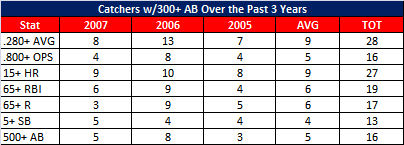
2005-2007 Catchers Production

Ouch, that’s pretty awful, isn’t it? So what’s my point? Looking at the three year averages of production across the key statistics in fantasy baseball, there isn’t even enough at any statistic for one per team in a 10-team league. And 12+ team leagues are far more common meaning things are even thinner in your average league. That coupled with the fact that there are no sure things at catcher (isn’t that right, Mr. Martinez?) means you should avoid investing heavily at the position. The best way to optimize your chances for winning is to mitigate the risk. You can’t play it safe across the board, but when taking risks you assess the level of risk against the potential reward.

When analyzing catcher, the risk-reward says you’re better off with Dioner Navarro and Chris Snyder at a dollar apiece or a late round pick than Russell Martin or Victor Martinez for several dollars (varies greatly by league) or in the first 2-3 rounds. Navarro was brutal last year with a .641 OPS, but digging deeper reveals an .815 OPS after the break. Most owners would only see his overall numbers and probably laugh when you roster him for a $1 or in the reserve rounds of your draft. Now he has an .862 OPS in 118 at-bats. Snyder’s 13 home runs from 2007 likely had him on more radars than Navarro, but the .252 average and 47 RBIs likely kept his draft position and auction price low. His .889 post-break OPS, powered by a .386 on-base, screamed buy to me and now I’m enjoying his .842 OPS and 26 RBIs in several leagues.

Both of these players may look like hindsight 20-20 picks and I can’t necessarily prove that they aren’t so you’ll have to trust me. I’m simply making a point that a little extra homework can save resources from being wasted and enhance your chances for winning your league. Even if that same homework results in a Carlos Ruiz (.595 OPS) or Kurt Suzuki (.614 OPS), it freed up resources (in the form of auction dollars or your higher level draft picks) that ensured you weren’t stuck relying on an Andruw Jones or Eric Byrnes as a #1 or #2 outfielder. Acquiring a top catcher means you will have to cut corners elsewhere and it’s wiser to cut corners at catcher than it is at any other position. By the way, the mention of Martin may draw the ire of some who look at his line and say he’s doing just fine. He hasn’t been abysmal, but he’s on pace for 9 HR and 12 SB when many projected a near 20-20 season again after last year’s 19 HR-21 SB. Factor in the price paid to get him (leagues in which he was a keeper notwithstanding) and he is whatever the level is just before “abysmal”.

As the calendar flips to June, the preseason catcher quartet shows the one ranked 4th producing the best by a landslide:
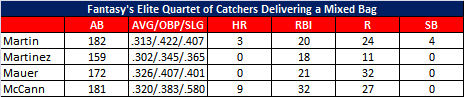
I’ve already covered Martin. Mauer has been a bust in the power department since day 1 for the most part so his homerless streak isn’t terribly surprising, but the owners that have 0 HR-11 R-18 RBI out of Martinez thus far probably get sick every morning when they sift through the boxscores. The only one on par with McCann thus far? The rookie of course. Geovany Soto has McCann matched in home runs with 9 to go with his 36 RBIs, 21 runs scored and .301/.396/.563 line. Three of the four catchers widely regarded as the only sure things available are vastly under performing against expectations and the fourth was often rated the lowest only further showing how uncertain the position can be for fantasy owners.

This subject will be revisited throughout the season and at length again in the off-season.
Tuesday: 05.27.2008

You’ve GOT to be Kidding Me!

I was ready to sit down type out three or four segments of a Player Focus, but after the Tigers blew YET ANOTHER GEM from their oft-struggling pitching, I’m just too damn angry to put together anything worthwhile. This team sucks. I mean it, they are absolutely awful. I thought this offense was supposed to be worthwhile? You can still make the “it’s early” claims on individuals (and that excuse is fading fast as the calendar gets ready to turn into June), but it’s not at all viable for a team.

The only thing working in this piece of crap team’s favor is the fact that no other team is interested in (i.e. none of them can hit worth a lick) taking control of the division so the Tigers are mathematically still in it. At this point, it’s a pipedream. Maybe if Dontrelle channels his 2005-06 performance, Zumaya & Rodney come back and pitch to the best of their abilities, Robertson, Rogers and Verlander all bring their ERAs below 5.00 and the overrated piece of trash offense decides to score a consistent amount of runs each game instead of spurts of double-digit run production then the Tigers can DREAM about the postseason. Until then, I’m strongly considering a 3-game boycott. I’m so pissed.

Tuesday: 05.27.2008

Picking On the Royals

What follows is NOT a newsflash: The Kansas City Royals suck. See? Nothing new there, huh? The reason it bears mentioning is because prior the recent 8-game losing streak, they were just one game below .500 and you might have started think they weren’t too bad. They are building a nice foundation, I won’t deny that, but they remain a doormat for at least this season. Zach Greinke is paying the dividends expected of him prior to his mental health breakdown that put his career in doubt a couple years ago. However, the next best ERA by a qualifying starter is over two runs higher. The only time that isn’t a problem is if Greinke is holding a sub-2.00 ERA. He’s not. Greinke’s 2.82 looks great, but Brian Bannister’s 4.94 does not. That said, the pitching hasn’t really been the primary issue for the Royals this season due in large part to the fact that they have a solid bullpen anchored by the electric Joakim Soria.

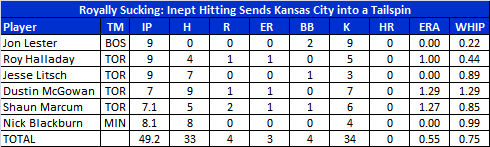
Rather the problem has been their complete inability to place bat to ball. Alex Gordon, the team’s franchise player, is starting to back up some of those ridiculously lofty expectations bestowed upon him last year, but he doesn’t even have an .800 OPS. In fact, none of the Royals regulars do at this point (Gordon’s .799 is the closest… obviously). Scarier still is that Miguel Olivo has been their best offensive player per at-bat this season. He only has 96 at-bats, but has posted a strong .911 OPS. The team’s .671 OPS is an American League worst and tied for second-worst with the San Diego Padres among the entire league (Washington, .664). In the nine games since Jon Lester’s no-hitter last Monday, six of the starting pitchers facing them have gone seven or more innings with an incredible amount of success:

That is pretty pathetic. And it’s not like we’re talking about a group of front-line starters here. Halladay is the only one that fits that bill. The rest aren’t exactly Steve Trachsel and Jeff Weaver, but the Royals are doing a great job making them look like Johan Santana and Jake Peavy. I have even more bad news, Royals fans. It doesn’t get easier anytime soon.

As I’m writing this, they have tied it up against Joe Nathan in the bottom of the ninth as the Twins and Royals play extras in KC, so they might pull this one out. If they do, tomorrow is their best chance at a two game winning streak as they throw Greinke against Livan Hernandez. It’s far from a given as Hernandez hasn’t been too shabby. From there they get control specialist Kevin Slowey to close out the Minnesota series and then the staff with the league’s 5th-best ERA strolls into town in the form of the Cleveland Indians. The opener features the resurgent Cliff Lee, then C.C. Sabathia and finally Paul Byrd. *cue TV infomercial* But wait! There’s more!! Then they pack up and head to Chicago to face the Sox, owners of the league’s SECOND-best ERA!

The Royals enjoyed a fairly nice start and they are beginning to put down some legitimate pieces in the future’s foundation, but the 2008 season will likely be another cellar-dwelling one that might not result in many more wins than their 69 from a season ago. Finally, I realize it goes without saying, but I will just to cover my bases: start any and all starting pitchers against them for your fantasy team. I don’t care if you have Jarrod Washburn and Boof Bonser on your roster and you’re thinking about cutting them for some middle relievers. If they play KC the week you’re thinking of making the move, WAIT!

Tuesday: 05.27.2008

Player Focus 5.27.08

Jay Bruce to Debut for the Reds on Tuesday
When perusing the top prospect rankings of many publications this off-season, you likely found Cincinnati’s Jay Bruce no lower than 3rd and oftentimes he occupied the top spot. The writing has been on the walls for a few days now with rumors of Adam Dunn and Ken Griffey Jr. being shopped and/or Corey Patterson being released. Bruce will make his debut with the Reds tonight against the Pittsburgh Pirates in what is likely to be an audition of sorts. Bruce’s success could be the impetus needed by Walt Jocketty to move one of the two stars outfielders.

From a fantasy baseball purpose, I look at it like this: Bruce could “Ryan Braun” the league this year, but chasing down that kind of lottery ticket is foolhardy. Don’t give up (or give up on) established major league ballplayers just to acquire Bruce. Keeper league situations are different, of course. If manages to stay up for the entire season, I could see Bruce putting up the following line:

.265/.338/.482 in 400 ABs with 15 HR-65 RBI-51 R-11 SB

Of course Dusty Baker is a flaming idiot, so he’ll probably mess Bruce up somehow.

More player updates tonight/tomorrow morning.

Sunday: 05.25.2008

Player Focus 5.26.08

Verlander Strong in No-Decision Against Twins
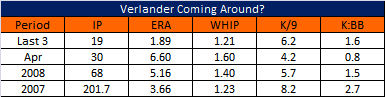
The Detroit Tigers bullpen failed Justin Verlander on Sunday afternoon when Francisco Cruceta gave up a grand slam to Jason Kubel in a 6-1 Twins victory. The silver lining for Detroit was that their ace went seven strong innings and did everything he could to set them up for a win, something he hasn’t done much of this year. His pitch count was getting high, but JV was still bringing the goods as his fastball was reaching mid-to-upper 90s regularly in the 6th & 7th innings. This was third in a trio of quality starts from Verlander dating back to May 14th. Control was a bit of an issue at times today with 4 walks, but the Tigers are happy to have their anchor back on track.

Verlander was absolutely brutal in April and continued to struggle with his first two outings in May. Both the team and Verlander himself insisted that there was no underlying injuries that were causing the poor performance. Many pundits claimed that his velocity was down, but that just seems to be something trotted out anytime a pitcher with past success falls on hard times for an extended period. I watch every single Tigers game on MLB.tv or MLB Extra Innings and I didn’t see a noticeable decline in his velocity. Instead, he was often getting behind hitters and they were making him pay. That and he just seemed to hit a wall in the 5th or 6th inning of every start. In fact, his OPS allowed chart tells that story: 1st-3rd innings is .696, 4th through 6th innings is .730 and the 7th-9th innings is 1.248. If you bought low or stayed the course with Verlander, you’re now reaping the benefits of that savvy and there is plenty to more to come as the season wears on.

Holliday & Hawpe Injuries Leave Rockies Punchless
The injury bug has bitten the 2008 Colorado Rockies. Again and again and again! When outfielder Brad Hawpe hit the disabled list, it wasn’t a crushing blow because of how poorly he’s been performing this year and perhaps the time off would do him some good. But when they had to place Matt Holliday on the DL to join both Hawpe and Troy Tulowitzki, Rockies fans were left asking, “Could anything else go wrong?!?!” Unfortunately the answer is yes as Garret Atkins sat out the entire weekend with a stiff neck and might join his superstar friends on the DL. And don’t forget that their leader in slugging percentage, Clint Barmes, hit the DL on Saturday. The Rockies will now feature a Minnesota Twins-esque lineup with Scott Podsednik, Seth Smith, Ryan Spilborghs and Willy Taveras manning the outfield. If Atkins does miss extended time, Chris Iannetta and Todd Helton become their premier hitters. In Minnesota, the Twins look to a catcher and first baseman when they need a key RBI, too.

That’s a lot of bonafide talent to lose at one time. But showing the 2007 production isn’t a complete picture because it leaves out Barmes’ strong performance thus far in 2008 and Tulowitzki’s horrid work before giving way to Barmes once he hit the DL several weeks ago. For those curious, the quintet has put together a .289/.353/.470 line 25 HRs-104 RBI-101 R in 764 combined ABs through Sunday. And just to make things more exciting, ace starter Jeff Francis holds a 6.18 ERA through his first 10 starts of the season. It wasn’t a stretch to say the Rockies wouldn’t make the playoffs with a complete team in 2008, now it’s more unlikely than a Marlins-Rays World Series.

One final note: Dusty Baker is an idiot. Oh wait, I said that yesterday. Chances I say it again tomorrow? Vegas has it opening at 1:3 despite the Cincinnati off-day.

Saturday: 05.24.2008

Player Focus 5.25.06

Phenom Upton Struggling at the Plate
The Arizona Diamondbacks came out of the gates absolutely on fire this season and it was due in large part to the play of Justin Upton. Upton was destroying the ball leading to five home runs and 15 runs batted in. The struggles from his 2007 cup of coffee was seen merely as growing pains, Upton had arrived. Whoops. I think that’s why they say it’s a marathon not a sprint. Upton has been a disaster in May hitting just .224. He has struck out in 45% of his at-bats and has just one home run.

The silver lining to an awful May is that Upton has garnered 17 walks good enough for a .388 on-base percentage. From the available data, it looks like he is simply waiting too long in hopes of getting his pitch. On 3-2 counts, he has 14 walks and 12 strike outs. He is hitting just .042 in that situation as well. When he is first pitch swinging, he is hitting .500 and a strong .474 on 1-0 & 1-1 counts combined. It stands to reason that he needs to once again be aggressive in order to get out of his slump.

Duchscherer Chucks Eight Scoreless, Nets 4th Win
The 2007 season was a lost one for Oakland A’s pitcher Justin Duchscherer. Injuries shut him down after just 16.3 innings work. Prior to that, he was a bullpen ace for the A’s in three straight seasons. From 2004-2006, Duchscherer worked 237.7 innings with a 2.80 ERA and 1.11 WHIP. He struck out 7.4 batters per nine with a 3.3 strikeout-to-walk ratio. During this past offseason, the A’s decided that Duchscherer would be a bigger asset to them in their rotation.

After all, they had jettisoned their ace (yet again) to Arizona for a cornucopia of pieces and there was a ton of uncertainty after Joe Blanton and oft-injured Rich Harden. Duchscherer threw a 5-inning pearl on April 4th against the Cleveland Indians but then missed the next three weeks before throwing another strong 5 innings against the Seattle Mariners on April 26th.

Duchscherer improved to 4-3 and dropped his WHIP below 1.00 with eight shutout, one-hit innings against the Boston Red Sox tonight. It’s incredible to think that a pitcher with a 2.16 ERA and 0.98 WHIP would be a 4th starter. Of course, that’s merely his position in the rotation—The Duke has clearly been one of the best A’s pitchers. As the season wears on, it’ll be interesting to see how many quality innings the A’s can get out of an arm used to going about 80 innings per season. With six quality starters (Blanton, Harden, Duke, Dana Eveland, Greg Smith and Chad Gaudin), the A’s will have the flexibility to ensure they maximize their rotation. If you assumed that Duchscherer was good for 160 innings this season, he’d have 119 left in the tank. Giving him an average of 6 per would leave him with 19 more starts. Now that is hardly scientific. Fact is, that no matter how much I love The Duke (I own him in every league I can), I know that he isn’t likely to reach the 100s in innings due simply to fatigue as opposed to performance. For now, I’ll enjoy the ride.

Votto Blasts 10th; Drives in 4 More
We all know that Cincinnati Reds manager Dusty Baker isn’t particularly bright. He runs arms ragged (usually for no reason) and makes awful personnel decisions. Take for example the fact that rookie phenom Joey Votto started just 20-of-29 games for the Reds in April. After all, you have to get Scott Hatteberg in the lineup. I don’t mean to hate on Hatteberg. He has a tremendous eye with a career .362 on-base percentage and 59 more walks than strikeouts (562 to 503), but 12-home run power out of first base is unacceptable. Votto a hit a quarter of that total in one game earlier this month and with his 10th home run of the season tonight in San Diego, he is establishing himself as a full-time major league ballplayer.

Not only does Votto the typical run-production skills needed at corner infield, but with 40 stolen bases in his past two seasons down in the minors he has shown that he can run a bit if needed. That speed is more likely to show up in 1st-to-3rd movement and hustling out an infield single here and there than it is in the stolen base column. He could threaten double-digit totals, but I’d be surprised to see him match that 20 stolen base average from 2006-2007. Generally, a rookie with a line like Votto’s would be setting himself up for Rookie of the Year contention, but the National League has some stiff competition for that hardware this season and it comes from the same team. Chicago Cubs catcher Geovany Soto and Japanese import Kosuke Fukudome are both bonafide contenders for the award, with Soto the early leader. Award winner or not, Votto has been great thus far and could possibly set a career-high in home runs this season (22 in both 2006 and 2007 with Chattanooga & Louisville, respectively).

Saturday: 05.24.2008

Player Focus 5.24.08

Sheffield Tops Mendoza Line; Hits 3rd HR
Gary Sheffield has been pretty awful this season as he topped .200 for the first time since May 13th. He hit his third home in a 1-for-5 effort on Friday night. Despite his colossal struggles (his average has been over .222 one time this season: .286 on 4.8.08), he is still seeing the ball very well as evidenced by his .336 OBP.
Usually that wouldn’t be an OBP to get excited about, but a 134-point difference between batting average and on-base percentage is strong. I am a huge believer in sample sizes so I fully realize how little three games means, but it isn’t completely useless when judging a potential forthcoming surge. Sheffield represents a decent buy-low candidate at this point. He is likely to come very close to last year’s totals though probably fewer than the 22 steals he had in 2007. If he does match 2007 in the run production categories, he is set to accumulate 22 home runs, 66 RBIs and 91 runs scored while hitting for a .286 batting average. He is currently on pace for 10 stolen bases and I think he hits that or maybe 2-3 more.

Uggla on Pace for 51 HRs
Florida Marlins second baseman Dan Uggla is absolutely dialed in. With a 2-for-4 effort on Friday that included his 15th home run, he is now hitting a white-hot .414 with 11 HRs and 22 RBIs in May. Uggla’s sophomore season delivered more power than his great debut, but a 37-point drop in batting average cut deeply into his value.

This pace will slow considerably and right now might be the prime time to try and sell Uggla for maximum value. His strikeout rate is up yet again, currently creeping on 30% and players simply can’t perform at the highest levels in the game when they’re missing the ball this much. See also: Reynolds, Mark.

In the 19 games that Reynolds reeled off his 7 home runs, he struck out 32% of the time. Starry-eyed owners started discussing his 40-HR potential and dreaming about him as a low-priced keeper for years to come. Since the 7th HR, Reynolds is hitting .182 (14-for-77) and striking out 40% of the time. Uggla is unlikely to have such a precipitous drop because he has proven he can succeed with a high strikeout rate, but it’s going to be much closer to the .270-30-90 projections (give or take) than his 51-HR pace. If a legitimate selling opportunity exists in your league, you owe it to your team’s success to entertain it.

Cano’s Buy-Low Opportunity Slipping Away
Speaking of streaking second basemen, Robinson Cano is rebounding nicely from a terrible April. He is hitting .313 and has matched or exceeded his April totals in HR, RBI, SB and R in 39 fewer at-bats. A look at the peripheral numbers identified Cano as a remarkably buy-low opportunity during April and even for the opening days of May. A 7-game hitting streak from May 4th to 12th brought him to the cusp of the Mendoza Line. A 4-for-4 effort on May 14th brought the average to .205 and with another 4-for-4 game today, he is up .232 and likely off the block in most leagues.

If for some reason the owner of Cano will trade him at a discounted rate, you should still pounce. Cano is a bona fide .300 hitter and should end the season with 18-20 home runs, as well. At 25 years old, he has yet to his “prime”, but he already has three very productive season under his belt. If you have a hole 2B, don’t be afraid to pay regular price for his services, but definitely lean on his .232 average and sub-.300 on-base percentage to get his owner to drop the price.

Saturday: 05.24.2008

The Last Hurrah…

This is it, folks. This is my last and hopefully best effort at blogging consistently. Let me step back first.

I love writing. I love baseball. And I really love writing about baseball, specifically fantasy baseball. I wrote 11,000 words about starting pitchers before the season started. I wrote several thousand more about effectively using middle relievers on your team. I have nearly 17,000 posts on a fantasy baseball message board.

This isn’t a horn-tooting bragfest, rather I am merely displaying that my desire to write about baseball isn’t in question. Without researching, I think I had started or re-started blogging approximately 4,938 times. Again, that’s merely a guess. Well you know what? I’m tired of failing. So here we go.

What you can expect is baseball, baseball and more baseball. I may veer off into other topics from time-to-time, but I’m not betting on much else but baseball being found in this space. And the writing will have a decidedly fantasy slant to it as well. I’ll have player analysis, subject-specific articles like the pitching ones I referenced earlier and other hodgepodge fantasy baseball items. (I have always wanted to use hodgepodge legitimately and it looks like I just did.)

I am not getting back into blogging for any other reason than the fact that I truly enjoy researching and writing about the game of baseball. I will continue to post at Rotojunkie, but most of the article-length posts will appear here instead of over there. By the way, if you’re uninitiated with Rotojunkie‘s message board, I strongly suggest taking a look.

I’m not going to lay out a whole series of expectations that I would likely fail to meet. Instead, I’ll let you know that some days you might find 4-5 posts and then there will be days I don’t post. In order to deliver some regularity, I am hoping for a minimum of 5 posts per week.

Already, let’s get this (re)started…

Friday: 04.25.2008

May’s Best Performers from 2005-2007

As we head down the backstretch of month one in our marathon towards the finish line, even the most adamant of us that preach patience with our teams need to dust off the desk once again and start taking a look things. The season is easing into a canter and players are fast approaching the 100 at-bat mark meaning it’s easier for to analyze how our players are performing from the still smallish samples we have at our disposal. As the at-bat totals climb the rate statistics won’t be subject to such wild fluctuations with each 1-for-10 slump or 5-for-10 surge.

The following article is less about making moves based on the past and more about shedding some light on what we might be seeing from a group of players in the coming month of May. I analyzed the past three years of data to determine who the top May hitters are during that stretch. I took everyone that posted an .850 or better OPS in May of 2005, 2006 and 2007. From there, I looked how frequently the players appeared. If a player appeared only once, they were done as I was looking for players that consistently smack the ball around in May. Performing in one of the past three Mays can be written off as a fluke.

There were 45 players that hit the .850 or above OPS mark in two of the three seasons and you will learn about them very shortly. Eight of those 45 (18%) turned the hat-trick. The positional breakdown delivers 21 outfielders, 14 corner infielders, six middle infielders and four catchers/designated hitters. The point of this exercise is to shed some light on the players you can reasonably expect a surge from as the calendar turns over to May. It is by no means a guarantee that these players will perform in this May as they have in past Mays, but the data set is large enough to make it worthwhile (read: fun) to look at for fantasy owners. Also, some of the players on the list might be currently struggling and thus increase their candidacy for a buy-low trade.

,

The bulk of this 45-player list is superstars and established players, so don’t expect a list of players you can troll the waiver wire for in hopes of riding a hot May up through your standings. If anything, this list was constructed to offer peace of mind to those worry easily in this game we play. A hot month can jump-start a season and erase a slow start. Heck, Ryan Braun didn’t even need an April to put together an MVP-caliber season last year. There are definitely some players in this list that are currently slumping enough to raise concern for their owners. There are sometimes various degrees of validity to slumps of superstars, but those are usually injury-related. So if your stud isn’t in the news for various maladies that could be affecting his performance, then he is likely just in a slump that he will assuredly come out of during the season.

It could be May, it might be June, but as the adage goes: hitters hit. OK, enough preaching, let’s get back into some specifics about the list. A team breakdown suggests that opponents of Boston, Detroit and the New York Yankees had better watch out. Of course, I’d have suggested they watch out even without this list. Only seven teams don’t have a player within the list of 45 and the most surprising tidbit to come out of that fact is that one of the seven is NOT the San Francisco Giants (their representative will surprise you even more!) The light-hitting Kansas City Royals, Oakland Athletics and San Diego Padres are all on the list of seven to the surprise of no one. The lack of representation from the Tampa Bay Rays is actually a bit of surprise despite their ineptitude as a team in recent years. Though thinking through it now, their budding stars have not really been around long enough to have strung together a few Mays in a row. The Los Angeles Dodgers, Seattle Mariners and Texas Rangers round out the list of seven. For those keeping track, that is three-quarters of the American League West to make the no-show list.

>

I have now exhausted the content of this article that focuses on everything but the players involved, so let’s get to the meat of it all. Since the entire chart of 45 players with 13 columns of data apiece isn’t viewer friendly to the format of this article, I’ll break it up in three groups of 15 and countdown from 45 to 1, sorted by OPS:

• Note that I included the extra base hit percentage so you can get an idea of how many doubles and triples each batter had to go with the home runs that you can see listed. I found this to be more useful than keep the double & triple columns.

• Though .850 was the cutoff to qualify for the study, you will see that three of those ended up on the list actually have OPS below the .850 mark. Each of these three players had two seasons that qualified for the study, but clear their third year of May statistics took them below the threshold I was looking to achieve.

• Mike Cameron’s presence could bode well for his owners as he doesn’t even begin play until April 29th after serving a 25-game suspension for amphetamine use.

• Though he made the list, Adam Dunn doesn’t necessarily heat up in May. He hits for a ton power and takes the walks that we expect him to take. Both of these outcomes inflate his OPS to give him a spot on the list, but factoring in the .222 average almost eliminates the goodness of the home runs and runs batted in. As always, in an OBP league Dunn is a monster!

• Pat Burrell is not getting much press because of superstar teammate Chase Utley’s play, but Burrell has been white-hot to start the season. He often starts off the season well, but not this well. Many are attributing his hot start to the off-season marriage and the fact that he is a contract year.

• Several of the players in the bottom third of the list would benefit from continuing this historical trend including Casey Blake (.233 avg), Troy Glaus (0 hr) and Brad Hawpe (1 hr).

31-45

Next, we’ll look at the middle third which contains a fair bit more star power than players 31-45. However, this grouping also contains the list’s biggest surprise:

• As mentioned earlier, Chase Utley is steamrolling towards a Player of the Month Award at April wraps up. He has 10 home runs and an absurd 1.280 OPS. If he puts up another strong May, the league is in deep trouble!

• With a recent seven-game hitting streak from David Ortiz that has included three of his four home runs, he is heating up just in time to keep his hot May trend alive.

• Jose Castillo is no misprint; he did qualify for the list. In leagues where you might already be feeling desperate and willing to try anything, he might be a worth a flier to test the trend and see if it sticks. (Note: his 2007 May did see his hit .313, but that was it as he totaled just a .718 OPS. His 2006 May was spectacular with seven home runs, though. Buyer beware!)

• Utley isn’t the only one on fire that cracks the top 30: Conor Jackson, Chipper Jones, Alex Rios and David Wright are all paying large dividends for their owners thus far.

• Lyle Overbay welcomes May with open arms. He has yet to hit a home run this year and he has six in each of the past two Mays. He is one of the eight players that posted an .850 or better in each of the three seasons analyzed.

• Nick Johnson is finally healthy, but uncharacteristically struggling in April. He is still piling up walks, but not much else.

16-30

Finally, let’s look at the top 15. It’s star-laden with the likes of Alex Rodriguez, Albert Pujols, Matt Holliday and Miguel Cabrera, all of whom are 1st round picks/top-dollar players.
• Aging stars Magglio Ordonez, Gary Sheffield and Manny Ramirez do some of their best work in May. Ordonez & Ramirez are both on fire already, while Sheffield is banged up and struggling when he does play.

• A pair of second basemen cracked the top 15, but only relies on the long ball to power his fantasy value. Brian Roberts and Dan Uggla are overshadowed by Chase Utley (and rightfully so), but both join him and actually supersede him when it comes to May performance over the past three seasons.

• Jason Bay was a waste of draft picks and auction money for his owners a season ago, but when you look at the breakdown, May was his best month. He hit four home runs per month from April to August, but only twice did he top .695 in OPS.

• In the off-season, Albert Pujols’ elbow caused Y2K-like fear on the fantasy landscape. A month into the season, it has proven to be as innocuous as Y2K was some eight years ago. That said, his owners aren’t out of the wood yet. In fact, they won’t be until at least the All-Star Break. A primary source of the fear was centered around the fact that while he’d play and play hard while he could, he would shut things down at the first sign of pain. Provided health, he should continue his tear in May.

• Mark Teixeira, my pick for the National League MVP, is poised to breakout. He has raised his batting average by 40 points in the past week, but his home run pace is a little light at 30. Look for a strong May to propel to securing the Senior Circuit’s top player honors at season’s end.

Top 15

There are the Top 45 performers in the month of May over the past three seasons. Even though most of the players in the study topped 250 at-bats, it is still difficult to say whether or not performing well in a particular month year-in and year-out is anything more than coincidence. If you buy into study, you can use the data to acquire some buy-low candidates and wait for their breakout next month. If you’re skeptical about the validity of what you just read, you can still use the data to your advantage by flipping some of these players for more than they’re worth by citing their impending breakout in May. Wherever you fall on the spectrum, this kind of study is what makes baseball such a great game. We gather piles and piles of data and analyze to see if we have anything. If not, it’s back to the drawing board.

Thursday: 04.3.2008

Stock Up: Todd Wellemeyer

(Originally posted on Rotojunkie.com)

Wellemeyer went 5 innings allowing one run on four hits with six strikeouts. The downside? Three walks! I’m not basing his potential value off of just this starter. Here are his numbers as a starter last year, plus last night’s game:

4-1 W-L
54.3 IP
3.49 ERA
1.37 WHIP
7.0 K/9
1.6 K/BB

Final thought: The sample size isn’t huge at 54 innings, but the performance suggests he merits a spot in deep NL-Only Leagues where you need a starter. If he gets the walks under control (pardon the pun) he could become worthwhile in shallower leagues.