Archive for ‘Fantasy Baseball’

Monday: 01.21.2013

2013 Starting Pitcher Guide Now Available

title1

Full details on the 2013 Starting Pitcher Guide

With the continued enhancements to a product you’ve hopefully already come to enjoy, we are moving to a very affordable pay model. You can order for $12! The guide, which comes via email in PDF form, is now available.

We now have a sample entry available for you to peruse so you have an idea of what you’re getting in the 2013 Guide. Click below to see both mine and Doug’s thoughts on Oakland A’s youngster, Jarrod ParkerDownload the Sample Here.

Available Now

btn_buynowCC_LG

Questions & comments can be directed to thespguide@gmail.com

Friday: 01.11.2013

FakeTeams Guest Post on Homer Bailey

The fantasy site over at SBNation, FakeTeams, is wrapping up Starting Pitcher Week and Bret Sayre asked if I could contribute a guest post on a starting pitcher-related topic of my choice. With the release of their 51-100 rankings, I decided to choose a favorite of mine from that segment. The result was a breakdown on Homer Bailey that turned out pretty well if I may say so myself.

Here’s an excerpt:

In 2012, [Bailey] had just five implosion starts, or 15 percent of his 33 outings. He also cut down the damage from his worst outing of the year. Last year he had a nine earned run shellacking that did a number on his ERA (accounted for 14 percent of his total earned runs), but this year his worst outing was six earned runs. Everyone is going to have a bad outing (Justin Verlander had an eight run disaster last year), but mitigating the overall damage helps stem the tide on a poor composite ERA. Bailey isn’t Verlander so he will have trouble recovering from an eight earned run outing. Whereas Verlander put up a 1.93 ERA in his next six starts.

Some highlights from week of Starting Pitchers:

Plus so much more including other profiles similar to the Bailey on guys like Jarrod ParkerJordan Zimmermann, and C.J. Wilson

Thursday: 01.10.2013

2012 Starting Pitcher Guide Review

Here is a (by no means comprehensive) report card for the 2012 Starting Pitcher Guide. I did the same last winter reviewing the 2011 guide and folks seemed to enjoy that so I figured let’s do it again. Who doesn’t like a little accountability? I’m always going to have hits and misses. Obviously the goal is to have many more of the former, but above all I want my process to be sound so that it is driving the analysis into the right place and then you can apply it to what you’re seeing on your TV/MLB AtBat app and in the stats then perhaps you can uncover your own hits. I hope I helped you assemble a viable staff in your fantasy league. And if you happened to get saddled with any of my big misses, hopefully they were cancelled out by two or three (or eight) hits.

**ANNOUNCEMENT ON THE 2013 GUIDE COMING SOON!**

Last year’s guide

Jump to National League
Jump to The Misses

AMERICAN LEAGUE

…nailed a second straight Cy Young call (Kershaw in 2011) highlighting David Price’s immense potential in the guide, “There is still another level to Price as he has a Verlanderian season in his future; his 2010 was a taste” and pegging him for some hardware in the projections spreadsheet comments, “Follow the skills, not ERA, to see that he’s getting better yearly; future Cy Young”. Tabbing Kershaw and Price as superstuds is hardly walking the thin branches, but their modest W-L records the year before may have deflated their value in some leagues which should have never happened.

…loved Jake Peavy as a low investment/high upside play for those willing to stomach the obvious injury risk, “Injury risk looms, but 4.0 K/BB shows the upside & full health could yield a star return”.

…also loved Peavy’s teammate Chris Sale, who was transitioning from the bullpen. From the guide, “Sale is a worthy asset to be sought after both immediately and for the future. He may only pitch 150 innings, but he could strike out 135 batters with a 3.65 ERA which would be incredible value at his current price.” He turned out even better as there was no real cap on his innings.

…saw Max Scherzer as someone to invest in, “I was bullish on Scherzer last year and remain so headed into 2012 especially because the 2011 surface disappointment should lower his price at least a tick. Now is the time to buy.” If you follow me on Twitter or listen to my podcast, you know I was never dissuaded from Scherzer even with a 7.77 April ERA or 5.55 through May.

…bought into Doug Fister’s improvements in the second half with Detroit and he actually ended exceeding strikeout estimates, “I do think Fister has a legitimate shot to be a low 6s strikeout pitcher with great control and a groundball lean giving him a real chance at 200+ innings with a mid-3.00s ERA and enough Ks to make it worthwhile. His post-trade work shows there is potential for even more, too. There is real talent here.” Injuries are the only thing that kept the 200 IP/mid-3.00s from happening.

…eagerly backed Felipe Paulino, “[who] was a growth stock to monitor in last year’s guide, but now he is a full on buy especially since his price is likely to stay low thanks to his composite numbers (4-10, 4.46 ERA, 1.44 WHIP)”, and only injuries could derail that train. He was brilliant through seven starts and no doubt paid back the dollar you spent on his services.

…liked an aged Bartolo Colon, “All that to say that a healthy Colon (and at 39, I’m considering healthy something around the 164 innings he reached in 2011, let’s say anything 145 or better) is a worthy buy. Outings in Texas could be dangerous, but there is more good than bad here with Colon”. He had a 3.43 ERA in 152.3 innings, and it was at 3.05 in 141.7 if you had him in a league where you could bench him for his Coors Field and US Cellular Field starts.

…all but aced Jarrod Parker’s projection giving him between a 3.58 and 3.87 ERA with a 1.24 WHIP and 8.3 K/9 in 151 innings. He bested the innings and ERA at 181.3 and 3.47, respectively, making up for the 6.9 K/9 and 1.26 WHIP. The comment was strong as well, “Uber-prospect ready to step onto the stage for big rookie season in OAK.”

…saw Tommy Milone for the value he does have, “I often prefer guys who miss bats, [but] I also like bargains and this particular skill set is still underappreciated on the fantasy landscape.”

…suggested that fantasy players only use Jason Vargas in his friendly home ballpark, “The best deployment of Vargas is as a home-only spot starter. His flyball/pitch-to-contact profile is very dangerous outside of Safeco Field.”

…wished that the Mariners would’ve used Hisashi Iwakuma in their rotation from the jump comparing him to Hiroki Kuroda, “Kuroda has been one of my favorite values the last few years thus if Iwakuma continues to mirror Kuroda as a major leaguer, he could end up as a nice 2012 bargain. Signing with the low profile Mariners should help curb his debut price tag this spring.” Iwakuma went 8-4 with a 2.65 ERA, 1.23 WHIP, 7.4 K/9, and 2.8 K/BB in 95 innings after a modest 4.75 ERA in 30.3 relief innings.

…believed in Matt Harrison’s 2011 season, “his breakout was due almost entirely to growth and improved skill meaning we should see more of the same in 2012.”

…had a good feel for Yu Darvish, “I lean toward the conservative on things like this so I would pay for something like a 3.70-4.00 ERA in 170 innings (that looks like a big range, but it’s five earned runs in 170 IP). The likelihood of him completely falling on his face is low in my estimation as he seems to have the stuff and makeup to avoid such a fate, but I think the upgrade in difficulty of Major League Baseball compared to the Japanese League he is coming from is such that the likelihood of a sub-3.00 ERA season of dominance is equally low. Bid cautiously on this promising, but uncertain profile.”

…has never really liked Clay Buchholz especially given his price tag, “Injuries have been a yearly concern and the skills aren’t that appealing to overlook that risk, but his presence on the Red Sox is likely to keep his value relatively high making it easy to stay away as the price surges.”

…didn’t buy Daniel Bard’s move to starter, “Necessity seems to have prompted move to SP, but I’m not sure it works right away.”

…was worried that Henderson Alvarez’s strong 2011 debut would inflate expectations, “This a growth stock, though the progression is probably more of a long-term one thus we will likely see some regression in his numbers in his first full season around the league”.

…refused to bite on Justin Masterson’s 2011, “I wouldn’t pay the premium for his 2011 season with the hopes that he figures out southpaws, rather I would let someone else take the plunge and monitor him from afar. Better to reassess this winter and decide for 2013.”

…wasn’t surprised by Rick Porcello’s career-high hits-allowed rate, “For now, he remains an AL-only play primarily both because he is still growing and because of the potential pitfalls with the infield defense, but don’t write him off as a bust so quickly.”

…saw flaws in Bruce Chen’s 3.77 ERA from 2011, “There is a good chance that Chen will suffer a severe regression before it is all said and done and you don’t want to be around for it.”

…fought off the temptress that is Francisco Liriano noting that “his next 200-inning season will be his first. The potential remains evident, but the headache that comes with it remains equally evident and can’t be quelled by any amount of ibuprofen thus he is better off on anyone else’s roster but your own.”

…has never had faith in Nick Blackburn, “I love groundball pitchers, but you have to strike out somebody and Blackburn simply doesn’t with a career strikeout rate 4.3 and a career-best of 4.6 set last year (not counting his 6.2 K/9 in 12 IP in 2007). Avoid.”

NATIONAL LEAGUE

…didn’t exactly call Kris Medlen becoming the best pitcher ever, but you NL-only players should’ve had him on your roster once he did, “[F]or now he is a $1 NL-only guy who could pay dividends as your last pitcher logging 70-something strong innings with 70-something strikeouts and having an outside shot to emerge as a starter should injuries ravage the Braves rotation and the more advanced prospects prove unready.”

…continued to like Jon Niese, “With a little help from his defense, he can have the breakout season that his skills have been begging for the last two years. Go an extra buck or two on what will likely still be a low price tag.”

…loved Jordan Zimmermann, “This profile is brimming with potential, a fact not lost on mock drafters as his he holds an average draft position as the 34th pitcher off the board and 117th overall. I could see him even a bit higher as he is poised for a true breakout turn in 2012. Go the extra dollar… or three.”

…liked Ryan Dempster to rebound from a rough 2011, “Hopefully the jump in ERA is seen as a decline in skill by your leaguemates and pushes Dempster’s cost down at the draft table. If so, be ready to pounce. Heck, even if it doesn’t, his price tag is rarely as high as the value he delivers.”

…was pretty darn close on Mat Latos’ projection giving him a 3.26-3.56 ERA, 1.15 WHIP, and 8.9 K/9 in 214 innings only to see him post a 3.48 ERA, 1.16 WHIP, and 8.0 K/9 in 209.3 innings. Not too bad when you consider the error bars in projections. As with Scherzer, I was never worried even when Latos ended April with a 5.97 ERA.

…saw the upside in Homer Bailey’s peripherals, “Despite a pair of mid-4.00 ERAs the last two years, xFIP has Bailey at 3.75 and 3.77 based on his pure skills. There is upside to invest in here.”

…was really bummed when A.J. Burnett bunted a ball into his own face, but stayed the course which paid off even more when he beat estimates on how much time he’d miss. He still ended up with 202.3 innings. “[He is] shifting to the pitcher-friendly PNC Park and NL Central fresh on the heels of Albert Pujols and Prince Fielder leaving. I’d be willing to take a shot in a league with a reserve roster or disabled list spots because Burnett could be very useful in the 4 or so months he does pitch this year.”

…liked Trevor Cahill so much that he got a full breakdown even before the guide came out seen here and his projection was dead on. The guide put him down for a 3.60-3.92 ERA, 1.27 WHIP, and 6.9 K/9 in exactly 200 innings. He threw exactly 200 innings and managed a 3.78 ERA, 1.29 WHIP, and 7.0 K/9.

…was hoping for a full season out of Chad Billingsley, but fantasy managers no doubt netted a profit in his 149.7 innings given his average draft position in the spring, “I think the 2011 season creates a great buying opportunity for Billingsley especially as his ADP is currently tracking eight spots below teammate Ted Lilly’s as the 74th starter off the board and 29 spots overall at 271.”

…suggested Chris Capuano would be a worthy late pickup, “He is a nice low-dollar gamble who can really pay off if there are more solo shots than anything else.”

…found the obvious value in Clayton Richard, but made sure everyone else saw it too, “he is at best a home-only spot starter so if you don’t play in a league with a reserve roster that would allow you to stream him in and out, don’t even bother.” So he managed some value despite leading the NL in home runs allowed and all of MLB in hits allowed thanks to his 3.02 ERA and 1.10 WHIP in 95.3 home innings.

…bought fully into Madison Bumgarner’s star potential, “This is a star in the making, but don’t expect any sort of discount as he is tracking just five spots below Cain on starting pitcher ADP at 20th and just over a round later as a 7th rounder (75th overall). Buy.”, and only a shaky September (5.47 ERA in 26.3 IP) kept it from fully coming to fruition. That September kept the ERA projection of 2.99-3.28 from coming through (he ended at 3.37), but everything else was on target.

…saw enough from Ryan Vogelsong’s excellent 2011 to stay invested, “Even if his LOB% regresses back toward the 72% league average, he can still be a valuable asset if everything else remains steady. His xFIP had him at 3.85 so you should plan for that as a ceiling and bid accordingly from there.” He even bested that 2011 xFIP with a 3.37 ERA in 189.7 innings.

…urged everyone to run away from Jair Jurrjens, “I almost refuse to roster Jurrjens for any price at this point, especially if his 5.3 K/9 from 2011 is a new level he plans to work at going forward. Sure, there is a price at which point it becomes crazy not to take a shot, but he is unlikely to fall to my threshold for that scenario.”

…and Carlos Zambrano, “I just don’t see the upside. Zambrano can miss some bats and while does generate more groundballs than flyballs, his rate is on a three-year decline down to 1.1 GB/FB last year. No thanks.”

It wasn’t all peaches & cream. There are bound to be some misses when you’re doing several hundred profiles.

THE MISSES

I was too high on Matt Moore despite pointing out the reasons why I shouldn’t be within his profile. I fell for the new shiny toy, which is exactly what I repeatedly tell y’all not to do.

I gave up on Jason Hammel after supporting him for years!

I watched in horror as one of my favorites, Ricky Romero, crumbled and took our teams down with him.

I watched in horror as another one of my favorites, Dan Haren, fought a losing battle against injuries and he saw his performance diminish in concert.

I expected a much bigger rebound for Gavin Floyd.

I thought Ubaldo Jimenez’s 2011 struggles were merely a blip. More like a blimp… because are blimps are large… and his struggles were large… :crickets: No? OK, no.

I didn’t think Ervin Santana would lead baseball in homers allowed thus tanking his numbers.

I was a bit too aggressive on Derek Holland… for approximately the 19th straight year.

I didn’t think Mark Buehrle would see such stark improvements in WHIP and K rate in the NL.

I thought Kyle Kendrick was useless as a fantasy asset.

I figured Joe Blanton’s shiny peripherals would yield something way better than a 4.71 ERA.

I suggested avoiding Paul Maholm despite his amazing first name.

I remain baffled by home run king* Bronson Arroyo. (*that’s not a flattering title for a pitcher)

I was way down on Kyle Lohse.

I loved Tim Lincecum (like just about everyone else I’m sure, but it’s still a miss in my guide so I’ll own it).

As I mentioned up top, I’ll have information on the 2013 guide very soon. I’m already working on it which is the earliest ever. It will be the best iteration yet!

Monday: 01.7.2013

Yu Darvish’s 221 Strikeouts

Jason Cole over at Lone Star Dugout shared a fantastic YouTube video today on Facebook that shows the third strike of all of Yu Darvish’s 221 strikeouts (embedded at bottom, too, if you want to wait). It’s the perfect antidote to the winter malaise that baseball fans suffer, especially at this point when the Hot Stove has chilled as most of the biggest names have signed and trade rumors are in a lull. As an addendum to this brilliant video, here are some Yu-related strikeout stats:

  • Yu’s 10.4 K/9 was 2nd in MLB (Max Scherzer 11.1) among qualified starters.

  • Yu’s 10.4 K/9 was 4th in MLB history for qualified rookies (Kerry Wood 12.6, Doc Gooden 11.4, Hideo Nomo 11.1).

  • Yu’s 27 percent strikeout rate was 2nd in MLB behind Scherzer’s 29 percent mark.

  • Yu’s 27 percent strikeout rate is 4th best among qualified (162+ IP) rookies behind the same three from the second entry. All three of those guys fanned 30 percent or more including Wood’s filthy 33.3 percent mark.

  • Yu’s 221 strikeouts were 7th in MLB despite the fact that both he and Scherzer didn’t even eclipse 200 innings, let alone the 227 that the other five (Justin Verlander, R.A. Dickey, Clayton Kershaw, Felix Hernandez, and James Shields) all reached or exceeded.

  • Yu’s 221 strikeouts rank 6th among rookies behind Gooden (276), Herb Score (245), Nomo (236), Wood (233 in 167 IP!), and Pete Alexander (227). Alexander needed exactly 200 more innings to finish six strikeouts behind Wood.

  • Yu’s 221 strikeouts mark just 9th time a pitcher has achieved more than 220 strikeouts in fewer than 200 innings. Both he and Scherzer achieved the feat this year (231 in 187.7 IP) and they join Oliver Perez (239 in 196), Nomo (236 in 191.3), Wood (233 in 166.7), Sam McDowell (225 in 194.3), David Cone (222 in 195), Erik Bedard (221 in 182), and Nomo again (220 in 198). All but McDowell occurred in the last 18 years. McDowell pulled it off in 1966 when he and Dave Boswell blew the field away at 10.4 and 9.2 K/9, respectively, while Mickey Lolich finished a very distant third at 7.6 K/9.

  • Yu’s 192 strikeouts on a swinging strike were 1st in MLB just ahead of Scherzer at 189. Dickey (187) and Verlander (181) joined them as the only four to top 175. It is the 6th best mark in the last four years (as far as the data goes) behind Clayton Kershaw’s 200 in 2011 and four guys in 2009: Tim Lincecum (205), Verlander (202), Javier Vazquez (202), and Zack Grienke (194).

  • Yu’s 59 three-pitch strikeouts were 1st in the American League and 3rd overall behind Cliff Lee’s 70 and Dickey’s 62.

  • Yu’s 50 percent strikeout rate in two-strike plate appearances was 1st in the American League and tied for 2nd in MLB behind teammates Stephen Strasburg (52%) and Gio Gonzalez (50%).

  • Yu’s 29 percent whiff rate is the 2nd best in baseball behind Rich Harden’s 30 percent mark since 2007 according to this Brooks Baseball/BP chart. Harden’s figure is made more impressive when you realize that it is a composite mark for 2007-2011.

  • Yu’s 28 percent whiff rate on fourseam fastballs is the best during that span with a minimum of 500 heaters thrown. The chart can be viewed in detail here.

  • Yu wiggled out of 36 three-ball counts for strikeouts which was good for 2nd best in the American League behind Verlander (43) and 9th overall behind Yovani Gallardo (49), Greinke (44), Cole Hamels (43), Gonzalez (42), Matt Cain (38), Madison Bumgarner (38), and Kershaw (37).

  • Yu’s 21 percent wiggle-out rate (strikeouts in three-ball PAs) was tied for the 7th-highest in MLB with Hamels dominating the field at 31 percent. There are 14 pitchers Yu and Hamels with several ties include two at 25 percent, three at 24, and seven at 22 along with solo entries at 28 and 23.

  • Yu’s 122 strikeouts out of the strike zone were 5th best in baseball behind Hernandez (142), Greinke (136), Shields (132), and CC Sabathia (124).

  • Yu got 116 of those 122 strikeouts on swing-and-misses, good for 2nd best in baseball behind Hernandez at 128.

  • Yu is awesome.

It figures that my first post of 2013 would be about a badass strikeout pitcher. For those curious, I have finished my work on the Baseball Prospectus 2013 Annual so I’ve turned my full attention to the 2013 Starting Pitcher Guide. I’ll have news on that soon. In the meantime, my fall/winter slumber here is officially done with this post so expect regular content to return even as I work on the guide.

Here is the Yu video if you don’t want to click the link at the beginning of the post:

Friday: 12.14.2012

Josh Hamilton in Offensively-Challenged Los Angeles

Josh Hamilton signed a surprise five year deal with the Los Angeles Angels worth $125 million dollars as they hope to out-hit their opponents on the heels of losing two important cogs from their rotation in Dan Haren and Zack Greinke. Forecasting a player’s career is one of the toughest things to do even when you have a guy who appears to be growing linearly at each level in the minors and then as a major leaguer. When you take one of the most unique cases ever like Hamilton, it gets a helluva lot harder, so I’m going to punt to a degree.

To guess how his body will age after what he put it through contains so much guesswork that it’s not even really worth it. Virtually every player has some sort of comparable within history to rely on or at least seek guidance from, but not Hamilton. Instead, let’s focus on the biggest change for Hamilton: his home ballpark. I think that will have a major effect on his production as he leaves one of the best ballparks in the game and enters a sneaky-tough one.

HamiltonTexRoad

To the surprise of nobody, I hope, Hamilton does significantly better at the Ballpark in Arlington. Part of that is because virtually every player does better at home (unless you play in cavernous confines like Petco Park) and more importantly because TBIA is a very favorable park for hitters. It rated in favor of hitters across all major categories including 4th in runs according to ESPN Park Factors. Baseball-Reference does composite park factors, one for batters and one for pitchers, where over 100 favors batters. Texas hasn’t been under 100 on either side of the ledger since 1994. In other words, it’s a hitter’s paradise.

And still a third outlet gets to the heart of how much Hamilton enjoyed his home park. Stat Corner shows park factors by batter handedness and they show Texas with a 117 home run factor for lefties. The same goes for doubles and triples while singles are still favorable at 103. Again, 100 is even so lefty batters get a 17 percent advantage on home runs in Texas. Just for a point of reference, we all know Yankee Stadium offers a very generous home run edge to lefties because we see it with our eyes every night, but the numbers back it up as well with a 146 factor. Keep in mind that these numbers from Stat Corner are three-year rolling averages.

So that is what he is leaving behind.

We saw in the figure above that he is still a mighty capable hitter elsewhere. If you average the home run and RBI totals over his average plate appearance count the last three years (582), he’s a 27-89 guy. So .294 average, 870 OPS, 27 home runs and 89 RBIs? That’s basically Andrew McCutchen the last three years. McCutchen’s 863 OPS is the closest match to Hamilton’s road numbers over the last three years. I used three years to approximate the plate appearances. Cutch had 2004 in that span.

Next closest was Evan Longoria, but I had to drop the plate appearance threshold to 1500. Longo has an 872 OPS in 1547 plate appearances as his 2011 and 2012 were injury-shortened. I’m not using these two as comps, rather using them to show what an 870 OPS guy looks like. The problem with using these two is their trajectories are a lot different than Hamilton. We can’t just expect Hamilton to put up a reasonable facsimile of his road work with the Angels because that doesn’t factor in his career trajectory or aging. Nor does it take into account the fact that he will be playing 81 games in Angels Stadium. That might actually be more important than anything his body does, at least in the short-term.

Going through our resources again, we see that ESPN had Angels Stadium as the 4th-worst for runs scored and they didn’t register a favorable mark for hitters in any of the major categories, except for triples which isn’t exactly a major part of Hamilton’s game. In fact, they were 4th-worst for hits in general, 6th-worst for home runs, 8th-worst for doubles, and 17th-worst for triples. Baseball-Reference shows that they’ve gone from neutral/slightly pitcher’s park to heavy pitcher’s park just recently posting 92 batter and pitcher park factors each of the past two seasons.

Digging deeper with our third resource shows the real trouble. Or at least, potential trouble. Stat Corner given Angels Stadium a home run park factor of just 82 for left-handed batters! In other words, that park is suppressing lefty longballs 18 percent more than a “normal” park. Remember he was getting a 17 percent advantage in Arlington so this move constitutes a potential 35 percent dip in home run production for 81 of his games. His new ballpark also stifles double/triples to the tune of a 92 park factor while it is essentially neutral on singles with a 99 factor. Adding to chorus, Brian Cartwright, creator of Oliver, confirmed what we saw from Stat Corner.

How has Hamilton done in these confines through his career thus far? Glad you asked. Obviously with Rangers he has had plenty of exposure (his 166 PA there are his second-most in any park) to the ballpark, though it hasn’t exactly gone well on the whole. He has a .260/.325/.440 line with five home runs, 19 RBIs, 8 percent walk rate, and 17 percent strikeout rate in Anaheim. The story is bit different when you look at the five slices of the pie that make up these numbers, but does it tell us anything?

HamiltonLAbyYrThere is a small sample size alert in effect for the entire 166 plate appearances, so of course any one of the five slices receives the same alert, even louder to be honest. It is at least somewhat interesting that the composite is really brought down by a rough go in LA this past year. The Angels completely shut him down. To that point, he’d put together a .287/.367/.500 line in 128 plate appearances. Of course his big problem from 2012 at large rears its head here, too. His strikeout rate was enormous in Los Angeles last year just as it was with a career-worst 26 percent rate for the year. If that trend continues, his work in LA prior to 2012 won’t matter because the overwhelming swing-and-miss will continue to eat into his production.
I don’t necessarily expect him to crumble into a league average player because of his home park, but the impact should be significant even though he won’t be facing the Angels pitching anymore. He hasn’t really enjoyed success in any of the renowned pitcher’s parks in the American League where he has something of a sample (70+ plate appearances) except Cleveland.

HamiltonPitchParks

I’ll reiterate again that these are all small samples. I’m not disclosing that so they can be ignored, just to point that I’m not putting an egregious amount of weight into them and you shouldn’t either as I’m sure many great players struggle in these parks. Conversely, they aren’t entirely meaningless either. In other words: the mean a lil’ somethin’. And let’s keep in mind that he has 18 games in the top two venues. So that’s 99 games in three venues where he hasn’t posted better than a 765 OPS for his career.

It should be noted that he will get a benefit of 18 games in the state of Texas to pad the road numbers we saw at the very beginning. He’s removing the LA ones and replacing them with nine in Arlington and nine in the home of the new AL West foe, Houston. He has been remarkably successful in Houston no doubt due to both the park and the fact that they haven’t exactly been awesome of late. Nor will they be in 2013, so that should continue. He has a .344/.400/.525 line with seven extra-base hits including a pair of home runs and nine RBIs in 70 plate appearances.

Where does all of this leave us?

Barring some serious changes from what we’ve seen to date, Hamilton’s production is a virtual lock to decrease and not just marginally.  As far as the contract goes, the baseball community has wins valued at about $5 million dollars per meaning Hamilton would have to be a five win player on average over the life of the contract to “earn” it. Of course there is other value to bringing in someone like Hamilton (listed lowest to highest, IMO) in terms of attendance, apparel sales, potential playoff earnings, etc… I honestly don’t believe I have the capability to calculate the exact impact for all of them, but I think you could reasonably slice a win per year ($5 million) off of “expectation” and it wouldn’t be completely out of bounds. In other words, I don’t think owner Arte Moreno and GM Jerry DiPoto signed this deal saying, “we absolutely, unequivocally think Hamilton will deliver 25+ wins during these five years, so we’ll go ahead and do this deal!” They are hoping for star-level production for the first two-three years resulting in no worse than some playoff appearances and ideally a title. If that occurs, they’ll consider the deal a success.

Slicing off the win from his expectation would then mean he has to be a 4.0 win player for five years, or net 20 wins however he wants to disperse them. Considering that his most favorable of the three win metrics (fWAR, rWAR, & WARP) was at Fangraphs and he was still “only” a 4.4 win player with an amazing year at the dish, I think he will be hard-pressed to fully “earn” the contract from a wins standpoint, at least in terms of how we calculate wins in the sabermetrics community. A lot of that seemingly low (when you consider his offensive output) win total from last year (btw, his rWAR was 3.4 & WARP was 3.9) is because he was a net negative in the field. Will he get better moving back to a corner outfield spot? Even if he does, will his bat stay on par with 2012 so that he’s then a 4-5 win player?

In a word: no. I just can’t see it happening. Hamilton is one of the most talented players in all of baseball so no one would lose their minds if he chased down a 1000 OPS again, but that would be an upset and fantasy folks should probably forget about the days of Hamilton’s MVP season (1044 OPS) and last year (930 OPS), instead focusing on his 2011 as a potential peak (882 OPS). The power output could be stunted to sub-30 levels, too. He hit 58 percent of his home runs in Arlington from the last years (that also happened to be 58 home runs as he hit exactly 100). He will struggle to keep that record going in Angels Stadium.

And again, all of this doesn’t even begin to try to factor his aging curve and his past troubles with drug addiction will play in his mid-30s. Hamilton is still a star-caliber player, but not necessarily superstar-caliber in his new digs so if your league doesn’t allow a discount for his switch in home ballparks, then bow out immediately. Tread cautiously.

Monday: 12.10.2012

Allen Craig in 2013

The 2012 season is officially over.  Whether your line of demarcation is the World Series or the awards season, the bow is now on another excellent season of baseball.  With my beloved Detroit Tigers taking the crushing loss in the World Series, I was ready to put an eye toward 2013 immediately.  So naturally I have already started three drafts, two mocks and one actual league.

The first came in Arizona when I attended the BaseballHQ.com First Pitch Forums (a must event for baseball nut, so much fun).  I actually participated in simultaneous drafts out there, but one was a Scoresheet league (my first!) so I’ll focus on the trio of 15-team mixed leagues for the purposes of this piece.  The other two are mock drafts I set up with podcast group members.  I’ll discuss those in more detail later.  For now, I want to discuss a staple across all of my teams: Allen Craig.

The Wrench landed on all three of my teams due in large part to my aggressive approach to acquiring him.  The league in Phoenix was a standard 15-team NFBC-style draft.  We do 23 rounds live and finish the rest online.  I drew the 10th pick which wasn’t my ideal spot, but I have no real complaints with it, either.  Once Matt Kemp and Carlos Gonzalez went sixth and seventh, I began to think I could get insanely lucky and end up with Joey Votto.  Instead, he went eighth.

I passed on the likes of Albert Pujols, Buster Posey, or Prince Fielder and went with Giancarlo Stanton.  He put up a full season of power in 501 plate appearances with a career-high 37 home runs.  Frankly, I was kind of surprised he was there.  It was round two where I made my move.  Knowing I would have to wait another 18 picks for my third round pick and feeling plenty comfortable with him here, I took Craig with the 21st pick in the draft.  Many believed it was a bit crazy.

The thing with drafts is that it only takes one of your other 14 competitors to sink your plan to roster someone.  With nine of those competitors getting two picks apiece, it was a risk I was unwilling to take even though he may well have made it back to me.  In the two mock drafts, I got the third and sixth picks respectively and ended up waiting a tick longer for Craig nabbing him with the 33rd and 36th overall picks in the third round of both leagues.  The CouchManagers  engine allows drafters to vote picks as “good” or “bad” giving users some instant feedback on how leaguemates view their selections.  Across the two leagues, Craig received three good and nine bad votes.

I get it.  It is unconventional and because many people seem to disagree with the pick both as outsiders looking in and even within the leagues where I selected him, I probably could’ve gotten him later.  Probably doesn’t work for me, though.  I took him where I valued him as I see him as a quality upside pick.  He finished top ten among first basemen in home runs (ninth* with 22), runs scored (tied for seventh with 76), and runs batted in (seventh with 92) despite logging just 514 plate appearances.  He was also second among qualified first basemen with a .307 batting average and fifth with a .354 on-base percentage.

The upside with Craig is simply playing time.  Injuries have limited him to 733 plate appearances the last two seasons with four stints on the disabled list.  It started with a strained left groin in April of 2011 that cost him 13 games.  A bruised right knee from 2011 cost him essentially two months (54 games).  While he did return and closed out the season with a bang (.290 average, .901 OPS and seven home runs in 97 plate appearances), the injury bled into 2012 as the resultant surgery cost him all of April.  I would rather bet on a player who has displayed the skills and needs to stay healthy as opposed to someone with potential who are we are waiting on to see if they can “put it all together” and deliver on minor league promise.  Mind you, health is a skill so while I say the upside is “simply” playing time, there are some who never bring that facet to their game and we are left with a bunch of “could’ve been” seasons.

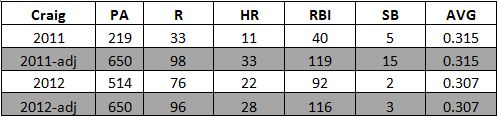
In fact, look what Craig’s last two seasons could’ve been with a full allotment of plate appearances:

Allen Craig 2013

The only real difference between those two adjusted seasons is the stolen base total.  That is about the furthest thing from the mind of someone drafting him so even if he does manage a full season of playing time and only steals a couple bags, it doesn’t dent his value.

Take the average of the other four numbers (97, 30, 118, .309) and over the past two seasons only two players have hit all four benchmarks: Kemp in 2011 and Miguel Cabrera this year.  Of course, these are just theoretical thresholds for Craig as he hasn’t yet proven the health piece, but the production in four of the five standard categories is excellent and definitely worthy a high pick especially as first base thins out a bit at the top.

Known as a position of depth, there were far few elite level options in 2012 compared to 2011.  Using ESPN’s Player Rater, it took 6.9 rating to make the top 50, which I think we could all agree is the upper echelon of offensive players.  Of that 50, only nine were first basemen.  Of those nine, four were no doubt not utilized primarily at first with Cabrera and Edwin Encarnacion qualifying at third base while Posey and Joe Mauer are best deployed at catcher.  Adrian Gonzalez is on the fence as a first base/outfield qualifier, but we can leave him at first.

In 2011, the top 50 threshold was at 6.7 on the Player Rater and 12 of those were first basemen.  Of those 12, only Michael Young (third base) and Mike Napoli (catcher) were best deployed at another qualifying position.  Lance Berkman and Michael Morse were like Gonzalez with their outfield qualification.  I definitely didn’t tab Craig with an early selection with the thought of position scarcity front of mind, but it shouldn’t be ignored, either.  Craig also carries the dual eligibility in the outfield adding flexibility to the pick, too.

Craig has been one of the best hitters in baseball the past two seasons ranking 17th in OPS+ among batters with 700 or more plate appearances.  That is my primary reason for selecting him where I have been; he’s a great hitter.  Additionally, in order to put up an elite season, he isn’t waiting on talent develop, rather he needs his body to cooperate.  While that certainly isn’t a given, it is a much sounder investment than betting on someone’s talents to shine through or for them to “get it”.

*Craig logged the ninth-highest total at 22, but there were players tied at 30 and 23 leaving 11 players with more homeruns than him. 

Friday: 12.7.2012

Joe Blanton in Los Angeles… er… Anaheim

After declining Dan Haren’s $15.5 million dollar team option and letting Washington pay him $13 million for one year, the Los Angeles Angels signed Joe Blanton for $15 million dollars over the next two years. Blanton, heading into his age 32 season, is essentially a Haren-lite in that he has strong K/BB rates and struggles with home runs. Home runs have been especially problematic for Blanton of late as he has posted a 1.4 HR/9 rate in each of his last three full seasons spanning 2009-2012 (he had a 1.1 in just 41 IP in 2011).

In that same time, he has a 3.4 K/BB that his risen yearly topping out at 4.9 last year. His sharply declining walk rate is primary factor as it has dipped yearly since 2008 when he tied a career-high 3.0 BB/9 all the way down to last year’s excellent 1.6 mark. His newly discovered strikeout success has been a bit overlooked. He carried a 5.1 K/9 in 761 innings with Oakland, but then moved over to the National League and saw a rise of more than two strikeouts per game up to 7.3 K/9 in 674 innings. There is a benefit in moving over to the NL, but it’s about 0.3 strikeouts per game so it wasn’t just that for Blanton.

His whiff rate (swinging strikes) rose dramatically in that time suggesting his stuff got better. The data only goes back to 2007 which only covers about a year and a half of his Oakland work, but you can see the sharp rise in that time:

   Year IP Whiff Rate
2007 230 6.8%
2008 198 6.6%
2009 195 8.4%
2010 176 9.8%
2011 41 10.4%
2012 191 10.4%

The dramatic rise has been driven mostly by improvements in his breaking stuff. For the data set we have, his slider whiff rate jumped from 13% in the two years with Oakland to 17% in the four in the National League (mostly with Philly before last year’s trade to LA). His curveball jumped from 12% to 20% and it has been at 22% the last three years. It will be interesting to see if he can maintain the strikeout gains upon returning to the American League.

Unlike Haren, who he is ostensibly replacing, Blanton gets a nice boost in home ballpark when it comes to his biggest problem: home runs. Citizen’s Bank Ballpark in Philly actually suppressed righty home runs a bit last year with a 94 rating (where 100 is average), but lefties had a field day at 126. Dodger Stadium is often thought of as a pitcher’s park (and it has been on the whole rating 100 or lower since 1962), but you can hit some home runs there and last year it had a 108 rating for righties and a 117 mark for southpaws.

Blanton gave up 14 home runs in Citizen’s Bank a year ago, seven to each side. He actually only gave up three bombs in 38 innings in Dodger Stadium last year (2-1 favoring righties for those wondering). His new home, Angels Stadium, hasn’t yielded a favorable home run park factor to either side of the dish since 2009 including last year’s extremely stingy 80 to righties and 82 to lefties. Though the entire sample dates back to his Oakland days, Blanton has allowed just one home run in 48 innings of work there en route to a 2.61 ERA in six starts and two relief appearances.

Blanton doesn’t have the upside of Haren at all. The comparison is meant only between the similarities in strong K/BB rates and trouble with home runs. Blanton hasn’t been on the ride side of a 4.00 ERA since 2007, but his last three full season xFIP totals are encouraging at 4.01 in 2009, 3.87 in 2010, and 3.39 last year (his 3.15 in 2011 came in just 41 innings).

The xFIP totals are so favorable because they balanced out his gaudy home run problems with a league average HR/FB rate whereas Blanton has been above 12% the last four years (including the partial 2011) topping out with last year’s 15.3%. If you aren’t confident that he can utilize the park to make major strides in the home run department, then FIP would be a better indicator for you. It still tells a positive story about how he has pitched the last three full season declining from 4.45 in 2009 to 3.91 last year.

Though going back to the AL isn’t a positive indicator for ERA in general (NL starters have a 0.28 advantage the last four years), this specific case represents an opportunity for a pitcher to buck the trend and slice some fat off of his ERA going the other way. I like Blanton as a late dollar days target to round an AL-only or deep mixed league staff. His unimpressive numbers from last year (4.71 ERA, 10-13 record) combined with the general assumption that moving to the AL is a net negative for a pitcher will leave his price tag lower than it should be for this talent profile.

Thursday: 12.6.2012

Dan Haren in Washington

If Dan Haren had somehow been a free agent last year, he would’ve commanded a mint. It would’ve certainly topped C.J. Wilson’s five year deal for $77.5 million which was the highest among pitchers changing teams (C.C. Sabathia signed five year extension for $122 million with the Yankees). Alas, Haren was in the fourth and final guaranteed year of a $44.75 million dollar deal that included a club option for $15.5 million in 2013. Given his track record as one of the most reliable, quality arms in the game, it was easy to envision that getting picked up and Haren becoming a free agent for the 2014 season.

Things didn’t go according to plan for Haren. While he has suffered back and hip soreness for quite some time, neither had interfered with him establishing himself as one of the game’s true workhorses with 33 or more starts in seven straight seasons never throwing fewer than 216 innings and rising yearly since 2008 to a 2011 peak of 238. So of course with the worst timing possible, he is struck down by the back for his first ever DL stint in early July. Worse yet, the time missed is less of an issue than the damage to his performance as he labored to a 4.33 ERA and 1.29 WHIP (both full season career highs) in 177 innings.

The Angels declined the option instead paying him $3.5 million to test the market where he found out yesterday he was worth $13 million dollars for a year to the Washington Nationals.  When you add in the buyout, he is actually going to make a million more than he would’ve had he been kept on in LA, but now with just a one year deal, he has to prove himself to the league before he will command another multi-year contract.

As Sam Miller pointed out yesterday on Baseball Prospectus, the declining velocity is a growing concern in addition to the back and hip especially since they may well be related. And given the uncertainty around his health, it is difficult to project how Haren will perform in 2013, but let’s try to get some clarity anyway.

LEAGUE/BALLPARK

Shifting from the American League to the National League often benefits a starting pitcher and we’ve seen that in Haren’s career already. Excluding the 119 innings as a Cardinal split over two years from ages 22 to 23, we see that Haren pitched to a 3.59 ERA with a 7.2 K/9 and 1.9 BB/9 in 1172 innings between Oakland and Los Angeles compared to a 3.56 ERA, 8.7 K/9, and 1.6 BB/9 in 586 innings with Arizona.

In the last five years, the difference in ERA between starters in each league is 0.24 favoring the National League. That figure is on the rise recently after a 0.20 split in 2010 rose to 0.28 in 2011 and then 0.32 last year. Strikeout rates favor the NL by 0.3 and those have held pretty steady in recent years as well while walk rates are essentially dead even.

Any potential gains from the league switch may well be washed out by the trade in home parks. Angels Stadium remains overlooked as one of the most pitcher friendly parks in the game. He is leaving the park that ranked third-friendliest for pitchers (according to Baseball-Reference) last year and fourth-friendliest over the last three years to enter the 16th-friendliest from last year and over the last three years. Nationals Park has essentially been a dead even park for its entire existence. On the scale, 100 is even and the park has never rated higher than 101 for pitchers or lower than 98 for batters in a given year.

Digging deeper shows even more potential pitfalls for Haren. Over at Statcorner, they give a lefty-righty breakdown of each park factor in several categories. They show the home run park factor in Anaheim to be at 82 for lefties (again with 100 being average) and 80 for righties while it jumps to 96 and 106, respectively in D.C.

Let’s not forget that Haren spent a good bit of time in a hitter’s park when he was with the Diamondbacks from 2008 through half of 2010 before being traded to LA. During that time the park rated at 107, 106, and 105 for pitchers. He didn’t really have trouble with the park until 2010. In 2008, he had a 3.35 ERA in 113 innings at home with a 0.8 HR/9 then in 2009 he was even better with a 2.81 ERA in 115 innings and a 0.9 HR/9. He had a 4.36 ERA in 74 home innings in 2010 including a ghastly 1.6 HR/9 before the trade.

What we don’t know is whether or not his back and/or hip were bothering him at all during that 2010 run. In fact, it would make sense if either was an issue during the early part of the season because the poor home numbers are confined to a four start block in late April through May when he had four starts and posted a 6.67 ERA over 27 innings allowing nine home runs (3.0 HR/9) with four or more earned runs in each outing.

He also had a 35/5 K/BB in that span so the struggles were a bit baffling. He closed out his Arizona tenure with a 3.34 ERA in 40 innings spanning six starts in June and most of July. He only allowed four home runs (0.9 HR/9) during that time. It would be pure speculation to suggest he was banged up during that rocky run, but it also wouldn’t be surprising.

CONCLUSION

The focus on league switch and ballparks is important because of Haren’s home run tendencies, dwindling velocity, and injury concerns, but the fact is that if the latter of those three is in check, he will be good (and possibly even great). He showed as much last year for various spells. He had a 3.34 ERA in April, saw it balloon to 4.41 in mid-May before chiseling it back down to 3.53 in June. Then the back issue wreaked its havoc for a four start spell that saw him yield a 9.14 ERA in 22 innings before finally succumbing to the injury and hitting the DL.

He looked sharp instantly upon his return on July 22nd, but strained it again leading to some mid-August struggles. Then he closed the season strongly with an eight start run of 2.81 ERA in 48 innings with 41 strikeouts and just five walks. Looking at his gamelog seems to show the obvious points where the back and hip were causing the most pain for Haren. Haren still had an excellent walk rate, solid strikeout rate, and finished 17th in baseball in strikeout-to-walk ratio.

An offseason to get right will obviously serve Haren well and clearly the Nationals saw enough in his medical records to give him $13 million dollars so I would still trust him as a fantasy asset. The beauty of his shaky 2012 and the continued talk about his back troubles is that it will lower his 2013 price at the draft table. He bounced back from his rough 2010 and he can bounce back from this. The drop in velocity is never great, but if he had put up his same peripherals with a normal home run rate (~1.0 HR/9 for him) and a 3.50 ERA, then we wouldn’t be ringing the alarms as loudly about it. The caution for injury will be built into the price of Haren; he has a deep enough track record to be trusted again in 2013. Given health, bet on 200+ innings of 3.50-3.75 ERA (a difference of five earned runs over 200 innings) with at least 7.5 strikeouts per game and a strong WHIP on the right side of 1.20.

Wednesday: 08.8.2012

Starting Pitching Rankings for Remainder of ’12

I apologize for the tumbleweeds blowing around here the last week-plus.  I’ve been adjusting to my new sleep schedule as a gainfully employed citizen and it has limited my time to post.  That said, I have definitely been working on baseball projects in the limited spare time I’ve had and the primary project has been my rest of season SP rankings.  I did a top 80 for each league as well as an overall top 100 which includes commentary.  I did it in Excel and you can find the file below for the latest version of Excel as well as a 1997-2003 compatible version.  To whet your appetite a bit, here are the top 24 sans commentary:

And here are the files for your perusal.  I encourage comments if you have questions about guys or anything of that nature.

Top 100 from Aug to EOS

Top 100 from Aug to EOS-Old Excel

The commentary is listed on the first sheet and then you have the league-by-league ranks on the second sheet.

Monday: 07.30.2012

10 Injured Pitchers on the Way Back

It seems like somebody or somebodies of consequence succumb to injury daily during the dog days and wind up on the disabled list. Subsequently that puts a strain on waiver wire availability as we see fewer and fewer attractive options.  Some leagues will always have someone worthwhile, but others are riddled with retreads and those who are actually getting hurt because roster space becomes too precious to hang onto the disabled.  As Roy Oswalt has proven once again tonight (8 ER on 11 H in 5.3 IP), pitching at anything less than 100% is difficult, even for a former star.

With that in mind, understand that these arms may deliver nothing of value once they return (if they return) to the hill.  However, as we end the final third of the season, taking chances on upside can be the difference between winning a title and not, securing a money spot or waiting for a check in October that isn’t coming.  Here are 10 pitchers in various states of disrepair and of various talent levels who could be had for free in a good number of leagues (or at a discount via trade) and end up delivering some high quality innings for you.  Keep in mind that some of these guys are still quite some time away, so plan accordingly to that end.

Brandon McCarthy

Out Since: June 19th w/shoulder injury

Status: Literally just started his rehab start as I’m typing this

Availability: On 44% of rosters in Yahoo!; 46% in ESPN

He was hoping to avoid a rehab start altogether, but it wasn’t to be so he’s starting for Sacramento tonight (Monday evening) and if all goes well then he should take his turn with Oakland later this week.  If you think the injuries for McCarthy have been frustrating for you as a fantasy manager of him, try actually being him.  I imagine it is especially trying to get in a groove only seemingly every time off the DL only to keep going back on a few weeks later.

When on the field, he has been straight-killin’ it this year with a 2.54 ERA and 1.21 WHIP in 78 innings.  He was white-hot before hitting the DL the most recent time with a 1.35 ERA and 0.80 WHIP in 20 innings across three starts.  Strikeouts aren’t really his thing (usually ranging 6-6.5, which is average to slightly below depending on year), but thankfully neither are walks (2.2 BB/9 this year after an amazing 1.3 last year).  Love that park, plus the sweet-swingin’ A’s might line him up for a few more Ws, too.

Brandon Morrow

Out Since: June 11th w/oblique injury

Status: On rehab assignment touching 95 MPH

Availability: On 78% of rosters in Yahoo!; 55% in ESPN

Two things have plagued Morrow as a starter: walks and injuries.  He has been improving yearly with the former including a huge step forward in 2012 (2.8 BB/9; 8% BB rate) and appeared to be ready for a full-fledged breakout season before the oblique sidelined him back in June.  After fanning just 12 in his first four starts (27 innings in all), he fanned a much more Morrow-esque 55 in 51 innings spanning eight starts.  Check your wire if you have roster space as he is out there in some league, but most likely you’ll have to see about netting him at a discount* via trade.

*admittedly that discount is probably shrinking now that he is on rehab

Jaime Garcia

Out Since: June 5th w/shoulder injury

Status: Started his rehab on Monday w/2.3 scoreless

Availability: On 38% of rosters in Yahoo!; 29% in ESPN

Before finally hitting the DL in early June, Garcia labored through a pair of ugly starts, the latter of which he probably never should have made as he had already been skipped in the rotation after the shaky outing against the Phillies on May 26th.  In fairness, it’s pretty easy for me to say that now and the Cardinals were working with a helluva lot more information than I have now or did at the time.

I don’t think Mike Matheny would’ve let his guy go out there if he thought it would eventually put Garcia down for two months.  If you discount the Houston implosion right before the DL, Garcia was essentially having his 2011 season again.   Now is the perfect time to scoop Garcia up on the sly, especially if you have a free DL spot dying to be utilized.

Shaun Marcum

Out Since: June 14th w/elbow injury

Status: Looking to start a rehab this weekend; could be dealt during waivers deadline in Aug.

Availability: On 68% of rosters in Yahoo!; 64% in ESPN

Don’t ask me how/why he is on so many more teams than these other three.  I guess it could be his strong strikeout totals (8.4 K/9, 23% rate) that standout above the other three (especially since Morrow got a late start on his) while his ERA, WHIP and walk rate are in the neighborhood or better than them as well.  But still, I’m surprised so many have held on as there wasn’t much good news throughout July.

Things are looking up now and Jon Paul Morosi of FOXSports speculates that he could be a waive trade candidate.  That would surprise me.  There might be around $2.5 mil owed to him depending when he hit waivers, but that’s it as he is set to be a free agent this winter so surely some wildcard contender would claim him to block a trade to their opposition if he came available.  For our purposes, his venue doesn’t much matter, as long as he is back on the field there is bound to be some worthwhile production.

Ted Lilly

Out Since: May 23rd w/shoulder injury

Status: Started his rehab Sunday and will probably need a couple outings (results)

Availability: On 42% of rosters in Yahoo!; 37% in ESPN

Lilly had developed one of the most stable skillsets in the games the last several years, but unfortunately those skills have tumbled significantly in 2012.  Of course, it’s also been a tiny eight game sample and his numbers are heavily influenced by outings of six and five walks in Houston and in Arizona so it’d be a bit premature to bury him.  Meanwhile, he has enjoyed success (3.14 ERA, 1.13 WHIP) in spite of the 5.7 K/9 and 1.6 K/BB in 49 innings. I would still take a shot on a healthy Lilly in 12 team leagues or higher.  I think he is still a spot starter at best in 10-teamers so no need to rush out and get him before he gets back to the Dodgers.

Brett Anderson

Out Since: June 5th, 2011 w/Tommy John Surgery

Status: Has made 2 rehab starts has a few more slated in AAA before heading to Oak.

Availability: On 4% of rosters in Yahoo!; 0% in ESPN

One of the brighter young pitchers in the game, Anderson fell victim to the Slider Monster who ate his elbow up after he threw the pitch a career-high 40% of the time in his 83 innings last year.  He is working his way back from Tommy John and could be this year’s Tim Hudson, who put together seven strong starts down the stretch in 2009 in his return from TJS.  Jordan Zimmermann was OK in his seven starts in 2010, but better in a real-life aspect than a fantasy one.  Stephen Strasburg was unreal in five outings a year ago, but he’s on a different level than those other guys.

The issue for Anderson is where he fits into the rotation, especially with McCarthy on the way back.  Of course neither McCarthy nor Bartolo Colon are models of health so I’m sure the situation will work itself out by the time Anderson is officially back.

This next group of guys are a good further away, so I’m just putting them on your radar to either make a note about or stash in deep leagues if they’re available and you desperately need pitching.

Jeff Niemann

Out Since: May 14th w/broken leg

Status: Threw a bullpen, simulated gm on tap followed by rehab; looking at late-Aug. return

Availability: On 3% of rosters in Yahoo!; 0% in ESPN

Coming back from a non-arm injury gives Niemann a leg up on the others listed, but he is still looking at a late-August return so there won’t be much time for him to contribute once he is back.  He was in the midst of following up his strong second half from 2011, too, before the freak accident with the broken leg derailed his 2012.

Tim Stauffer

Out Since: May 14th w/elbow injury

Status: Threw a bullpen last week, rehab forthcoming & return slated for late-Aug.

Availability: On 8% of rosters in Yahoo!; 19% in ESPN

Stauffer appeared to be getting his career, one plagued with injuries, back on track after a breakout season at age 29 in 2011 that saw him throw 186 strong innings with a 3.73 ERA and 1.26 WHIP.  Injuries limited him to just 14 innings from 2006-2008, including a completely missed season in 2008, so even working his way back into effective relief was a win for Stauffer.  Hopefully he gets back in time to make 6 or 7 starts to close out the season especially since 15 of their 26 September games are in Petco Park.

Jhoulys Chacin

Out Since: May 1st w/pectoral muscle injury

Status: Made it through his first rehab pain-free; slate back mid-Aug.

Availability: On 16% of rosters in Yahoo!; 5% in ESPN

Even when he makes it back, how much can he be trusted in that park the way it’s playing this year?  With the margin for error virtually non-existent in Coors Field these days, his elevated walk rate is especially treacherous (4.3 BB/8 career; 5.5 this year).  When he’s on, he can be a big strikeout guy, but at 24 he is still very much a work in progress.  This is more for keeper leaguers who are playing with an eye on 2013 as I wouldn’t trust my contending ratios to Chacin in Denver coming off of injury.

Rubby de la Rosa

Out Since: July 31st, 2011 w/Tommy John Surgery

Status: Slated for rehab in return from Tommy John

Availability: On 0% of rosters in Yahoo!; 0% in ESPN

It remains to be seen whether or not he will pitch in the majors at all in 2012 and then if he does, his role is undecided.  He could just get his feet wet as a reliever, though his long-term outlook remains in the rotation so this would be another one for keeper leaguers with an available spot for a highly talented youngster.  I am a huge fan of this 23-year old going forward, but he might not pay major dividends until 2014.