Archive for ‘Off-Season’

Tuesday: 01.19.2010

Baseball by Paul Podcast: Episode 1

The podcast is back! I’ve started up the Baseball by Paul podcast over at BlogTalkRadio.com with the debut episode airing earlier this evening with Fanball.com’s Jason Collette. Jason is a colleague of mine from Owner’s Edge at Fanball and he also runs the blog Dock of the Rays about his Tampa Bay Rays.

He and I spoke for an hour about the mock draft season covering strategies, average draft positions (ADP) specifically focusing on a group of players we found overvalued and undervalued, a group of players that have landed on his teams often and finally we went rapid fire on a group of players I find interesting for the 2010 season. Jason was excellent and the show went really well as far as I’m concerned.

I’m looking to do episodes on Tuesdays, Thursdays and Saturdays. Tuesdays and Thursdays will be at 5 PM central while the Saturday will be an afternoon show without a set time just yet. On Thursday I will have injury guru, Will Carroll from Baseball Prospectus. We are going to hit on a bunch of players coming off of injuries, still laboring through injuries and possible red flagged to be injured in 2010.

Show Homepage
Episode 1 with Jason Collette

Monday: 01.4.2010

Schedule This Week

I’ll have content up Tuesday and Wednesday of this week. Thursday is the National Title Game with my Longhorns involved and then Friday I’m off to Vegas for the weekend. After Wednesday (when I will try to post 2-3 things), I won’t post until at least Monday of next week.

Tuesday: 12.15.2009

2010 Third Basemen: 18-34 & Others

The long promised tour around the diamond is finally beginning! I severely underestimated how busy work would be as the holidays approached. I’m in a different role than I was this time last year so I didn’t really know what to expect. Then a stint on the DL this weekend backed up this piece and the shortstops one. Don’t worry though, there will be plenty of content throughout December, January, February and March. Without further ado, let’s start the 2010 rankings:

I arduously debated how I was going to do this list before finally settling on what you’re about to read. I’m not sure the rest of the infield will be like this or not, but this is how I’m going to run with the hot corner. The goal, for me, is to write about enough players at a position without going overboard. The problem is that I’m not great at writing just a little bit about guys, but at the same time there are a group of players that simply don’t need 1,000 words written about them for the upcoming season. So I’ve put together a list of 47 players eligible for third base. The first group of 13 is what I’ll call the Clearance Bin. They won’t be drafted in a lot of leagues, and they will last deep into the draft of the leagues they will be selected in, but they have some value. The remaining 34 will be split into two groups of 17 with the first group (18-34) holding a level of upside that will merit drafting in most leagues depending on the various structures.

Clearance Bin (listed alphabetically)

Pedro Alvarez, Pittsburgh Pirates – His value in keeper leagues is much different than it is in one-year leagues. He hasn’t hit AAA yet so even if he does come up in 2010, it likely won’t be until after the All-Star Break.

Geoff Blum, Houston Astros – He’s 37 years old with a little pop in his bat, but not much else. The Astros are seeking a better option at third base which will only crush Blum’s miniscule value into complete oblivion.

Emilio Bonifacio, Florida Marlins – Looking at his batting average from Opening Day throughout May looks like the Dow as it steadily dwindles from .800 to .269 by month’s end. He set the fantasy world afire those first few weeks, but many saw him for the fraud he was pretty quickly. He’s cheap speed who will likely be picked up repeatedly throughout the season for those looking to pick up a quick base or two.

Pedro Feliz, Free Agent – He just watched the Phillies sign his replacement in Placido Polanco, but he won’t go unemployed given his strong defense and capable bat. As of right now, the Astros, Orioles and Twins have all been rumored to be interested. (The Astros have since signed Feliz.)

Josh Fields, Kansas City Royals – After a 23 HR debut back in 2007, Fields has disappointed in the two seasons since and now he finds himself with a change of scenery. He’s blocked by Alex Gordon, but Gordon hasn’t exactly been the model of health nor played up to expectations so Fields could get some time. He is still just 27 (on December 14th), but it remains to be seen if he can recapture the power stroke he displayed in 2007.

Mike Fontenot, Chicago Cubs – After a strong 243 at-bat sample in 2008, Fontenot was projected to build on that success in 2009, but instead fell flat on his face barely matching his counting stats in 130 more at-bats while dropping his average from .305 to .236. Now he enters 2010 as a 29-year old utility man, whose playing time is uncertain as the Cubs will no doubt be among the movers & shakers during the offseason.

Jake Fox, Oakland A’s – Fox hit the radar last year by hitting .409 and 17 home runs in 194 minor league at-bats prior to reaching the majors. He didn’t quite bring that kind of average and power to majors hitting .259 with 11 home runs. The playing time will be available in Oakland, but we all know how offense gets sapped in that park, too. As a guy with 20 home run potential, he just missed the cut into the Clearance Bin, but for now here is where he resides.

Mat Gamel, Milwaukee Brewers – Gamel is a big time power prospect who got his first taste in the majors last year, but didn’t do a whole lot. The emergence of Casey McGeehee and return of Rickie Weeks could relegate Gamel to bench duty, especially since he is atrocious in the field.

Troy Glaus, Free Agent – He’s 33, coming off of a lost season, injury prone and jobless. I don’t think he will remain jobless, but betting on a 2008 repeat (.270 AVG, 27 HR, 99 RBI) is a very risky proposition. He could easily make the top 34 once his 2010 destination is known, for now he’s a non-factor in most formats.

Jerry Hairston Jr., New York Yankees – A veritable fantasy baseball Swiss Army Knife, Hairston can play several positions, but that’s about the extent of his value. He’s never going to be an everyday player, but he can be a stopgap capable of running a bit.

Bill Hall, Seattle Mariners – With Chone Figgins aboard, Hall is really going to struggle for at-bats. It doesn’t help that he was completely awful in 2009 hitting just .201 in 334 at-bats with eight home runs. His 35 home run season back in 2006 seems eons away at this point.

Adam Kennedy, Free Agent – A career resurgence at age 33 should get Kennedy signed this offseason, but there is absolutely no reason to bet on a 2009 repeat. Seriously, no reason.

Ty Wigginton, Baltimore Orioles – He snapped his streak of 20 home run seasons in 2009, but it wasn’t because a lack of playing time. He actually had more at-bats than he had in 2008 when he hit 23 home runs. At 32, he’s not old by any stretch and he should get work in Baltimore as they wait for Josh Bell.

Third Basemen 18-34
34. Garrett Atkins, Free Agent – Atkins was, not surprisingly, cut loose by the Rockies after an abysmal 2009 season. He barely made the cut into the rankings because despite how awful he was last year (.226/.308/.342 in 354 AB), he was one RBI short of three straight 20+/100+ seasons from 2006-2008. Of course even that performance is looked at skeptically because of how disparate his home/road splits were for the latter two years of the stretch (OPS in 2007 H-.936/R-.773; 2008 H-.904/R-.661). I think Baltimore would be a nice destination for him where he could be a usable part in AL-Only leagues with a mid-teen home run total and low 60s RBI total. Think Stephen Drew of 2009, but that’s a ceiling at this point so Atkins still has plenty to prove.

33. Brandon Wood, Los Angeles Angels – The Angels hate Brandon Wood. Don’t ask me why, but it is quite clear that they do. Even with Figgins in Seattle, the depth chart shows Maicer Izturis as the starting third baseman. Despite three straight big seasons in AAA, he can’t get a legitimate shot at the big league level. He has posted a .287/.353/.548 line in 313 AAA games with 76 home runs and 233 RBIs while playing strong defense at shortstop and third base, yet the Angels seem entirely disinterested in using him. His best bet would be to get moved to a team that would actually use him, but in the interim he’s potential-laden 25 year old waiting for a break.

32. Edwin Encarnacion, Toronto Blue Jays – An injury-riddled 2009 saw EE shift from the Reds to the Blue Jays at the trading deadline where he was a little better, but still below average. He has shown the skills of a middle (5-6-7) of the lineup run producer at different times from 2006 to 2008. He looks to be capable of hitting for power, taking walks and managing a strong batting average, but can he put it all together for 600 plate appearances, a mark he has yet to reach in his career. He is in the midst of his prime and he will get every opportunity to succeed with the Jays. He sets up as a decent sleeper whether in a mixed league or AL-Only.

31. Juan Uribe, Free Agent –There is a market for third basemen this year so on the heels of a very strong 2009, Uribe will be picked up by some team despite three sub-.300 OBP seasons in row prior to last year. He has got pop in his bat and plays solid defense, which is essentially the prototype for a third baseman once you get past the game-changers.

30. Brett Wallace, Oakland A’s – Wallace earned this ranking because he has the best shot at a full-time job. A strong 32-game stint (.281/.403/.438) at AA Springfield in the Cardinals organization earned him a promotion to AAA Memphis where he was solid, if unspectacular (.293/.346/.423) in 62 games before being the centerpiece return for Oakland in the Matt Holliday deal. His 44 games in Sacramento (.302/.365/.505) proved to be his most complete stop of the season. Combining it all, he notched 600 plate appearances and posted a .293/.367/.455 line with 20 home runs and 63 RBIs in 138 games. Eric Chavez just isn’t a legitimate roadblock keeping Wallace in AAA so as long as GM Billy Beane thinks his 443 plate appearances proved enough, he should start the season at third. I wouldn’t expect anything higher than .293-20-63 across a full season of work as he will have rookie struggles while playing in an atrocious park for hitters.

29. Placido Polanco, Philadelphia Phillies – Technically he won’t qualify here until he plays 20 games at the hot corner to open the season. Regardless of that fact, he will be drafted as a second baseman and likely stay there for his owner’s team for the duration of the season. With 10 home runs last year and a career high of 17 (set back in 2004 with the Phillies), he just doesn’t have enough power to stick at third base in fantasy baseball. However, since the position is so Mary-Kate Olsen thin, I’m still listing him because there will probably be some owners who get in a situation where they need Polanco there or even perhaps at corner infield. You should draft him as a second baseman and then enjoy his flexibility throughout the season as you deal with injuries or engage various trades. If you enter the 2010 season with him as your #1 third base option, you’d better be excellent everywhere else or you did something wrong.

28. Scott Rolen, Cincinnati Reds – You can ask me why the Reds traded a 27-year old injury-prone third baseman for a 35-year old injury-prone third baseman, but that doesn’t mean I have an answer. After a career year in 2004 in which he still only played 142 games and snapped a stretch of three straight seasons over 150 games, he played just 56 in 2005. He bounced back with 142 in 2006 giving him five out of six seasons with 142+ games and 593+ plate appearances. That said, he was past 30 and injuries once again became a big part of who he was. An injury-marred 2007 saw his lowest slugging percentage ever at .398 as he managed just 112 games. Things didn’t get much better in 2008 when he played 115 and posted another uncharacteristically low SLG (.431). He missed 34 games last year, but hit .305 with solid runs scored and driven totals despite another meager power output (11 home runs). He will be 35 right around Opening Day and the injury history is too blatant to ignore despite the potential to be a valuable fantasy asset. He’s nothing more than an NL-Only option on draft day.

27. Andy LaRoche, Pittsburgh Pirates – LaRoche went through an up-and-down 2009 season mixing in two great months with four awful ones leaving him with a .258/.330/.401 line to show for it. With Pedro Alvarez breathing down his neck, the pressure is on to start producing at the level of his minor league tenure: .295/.382/.517 with 95 home runs, 333 RBI and 346 R in 1800 at-bats from 2003-2008. The biggest thing in LaRoche’s favor is that Alvarez has yet to take a swing in AAA, so he will be in Indianapolis for at least two months. But if he tears that league up like he did AA (.333/.419/.590 with 13 HR in 258 PA) and LaRoche struggles, then LaRoche could be in trouble. With Akinori Iwamura brought in to man second base and Garrett Jones and Steven Pearce holding down first base, there aren’t any alternatives for LaRoche right now.

26. Mark Teahen, Chicago White Sox – Teahen is essentially at the ceiling I gave Atkins with additional speed positional flexibility. He is never going to make or break your season unless you play in a 15-team AL Central Only league, then and only then could he become an elite force. Use 2008 and 2009 as a guide and hope he can recapture his 2006-2007 batting average.

25. Brandon Inge, Detroit Tigers – This was virtually a carbon copy of his 2006 breakout except he had a sparkling first half, good enough for an All-Star nod, followed by a putrid second half and 2006 was the reverse. And he played through injuries throughout the second half which really took their toll on his performance at the dish. There was many instances when I was watching him gut it out that I respected the effort, but saw him as a detriment to my Tigers because he just had nothing left in his legs. Assuming full health in 2010, he has high teens power with low 70s RBI capability, but he will always be a drain on the batting average or on-base percentage, depending on league parameters. Don’t bid with 25+ HR power in mind, it takes too much going abnormally right for it to happen consistently for him.

24. Casey McGehee, Milwaukee Brewers – Journeyman minor league castoff latches on with division rival and enjoys a breakout season reaching new heights in many statistical categories. It’s a great story, but it’s incomplete and I have a feeling that Brewers fans might not like the dénouement. At 27, it’s unreasonable to project more growth from McGehee. In fact, projecting anything but regression seems foolish. I think he would be lucky to match his 2009 counting stat totals even with 200 additional PA (from 394 to a round 600). At this point, it remains unclear if he will even be an everyday player with Rickie Weeks back and Mat Gamel looming. Let someone else have this Cinderella story play out on their team because midnight is right around the corner and could hit before Memorial Day of 2010.

23. Mark DeRosa, Free Agent – Though teamless right now, it isn’t because a lack of interest in the veteran utility man. After smashing a career-high 21 home runs in 2008 (previous high was 13 in 2006), DeRosa’s approach went out the window as he seemed set on being a power hitter. Sure, he set a new career high with 23 home runs, but his average plummeted from the 2006-2008 mark of .291 down to .250. I would bet on more of the same in 2010 , but you can do much worse than 75-20-75 with an average around .260-.265 at third base.

22. Martin Prado, Atlanta Braves – Prado is another guy who is eligible at third base, but offers the most value at second base. He will also enter 2010 with first base eligibility making him a daily transaction owner’s dream. He showed signs of his breakout in limited work during 2008 when he posted a .320/.377/.461 line in 254 PA which is nearly identical to his 2009 work of .307/.358/.464 in 503 PA. He’s a great #2 hitter, which is where he saw most of work, but he was a Swiss Army Knife in the lineup too batting everywhere but first throughout the season. The power, though still modest, is a new wrinkle to his game so I wouldn’t bet on a spike even going into his age 26 season, but he can be a very useful player somewhere in the neighborhood of .300-80-10-60 with three position eligibility and a chance to add outfield during the season.

21. Alex Gordon, Kansas City Royals – Fool me once, shame on me. Fool me twice, shame on you. Fool me until you retire because I refuse to give up on you, that is love, not shame. Though he hasn’t progressed as rapidly as many expected or hoped, he is still just 26 years old (or will be in February of 2010) and played just 130 games at AA as his only minor league experience before reaching the majors. He should have been tearing up Omaha for at least a season and a half when he was racking up 1171 big league plate appearances. And he showed marked improvements from years one to two. Last year was a throwaway lost to injury, but it was good that he got two months worth of action to close out the season so that Opening Day 2010 wasn’t his foray back into the mix after hip surgery. This year is definitely put up or shut up, but I think he puts together a fine .275-80-20-80-10 season at a great bargain price as a post-hype sleeper.

20. Mike Lowell, Boston Red Sox (for now) – The word about town is that Lowell is headed to Texas, but he will have to pass a physical first. Anyone who knows anything about Lowell knows that that won’t be easy. I’m willing to be he is in the Opening Day lineup for a team in April (barring a Spring Training injury) and he’s bound to put up season similar to the one he’s up two years in a row: 55 runs, 17 home runs, 75 RBIs, solid to good batting average in fewer than 450 at-bats. Set that as your ceiling and take any at-bats above that mark as pure profit.

19. Chase Headley, San Diego Padres – Headley wasn’t too bad in his first full season of work, but there was a sharp home/road split, just as you might expect from a San Diego Padre. At home, he was a vomit-inducing .208/.300/.351 while sharply improving to .305/.377/.426 on the road. The upshot was that he managed seven home runs at home. If he can match that mark while improving the five from the road, then the high-teens are well within reach.

18. Jhonny Peralta, Cleveland Indians – Poised for his biggest season yet, Peralta fell flat on his face with his worst season yet in terms of runs, home runs and all three triple slash stats (average, on-base and slugging). He became a groundball machine (50%) which led to the power outage, which made his 83 RBIs all the more impressive. His 83 RBI/.691 OPS combo was just the second time since 2000 that a player managed that many RBIs or more while posting a .691 OPS or worse. I loved Peralta coming into 2009, but I’m cautiously optimistic for 2010. The groundball percentage spike seems to be only the big change from 2008 to 2009 so a correction there should bring back the .275-80-20-75 lines we saw in three of four seasons from 2005 to 2008. Don’t be surprised Peralta corrects that GB% malfunction and actually builds on his 2008. From the good people of Hedge City, USA – I’m not saying bet on it, just understand that the possibility is real and wouldn’t take a series of events to occur.

Next: 17-1

Thursday: 11.5.2009

MLB: Top 60 Fantasy Starting Pitchers for 2010

With the World Series concluding with the New York Yankees defeating the Philadelphia Phillies for their 27th championship, it’s time for the third season (if the regular season and postseason are #1 and #2): the Hot Stove season. This includes not only the offseason movement for all of the teams, but also the in-depth analysis for the upcoming fantasy baseball season. So as I sit in the internet cafe at the Doubletree Suites in Phoenix, AZ, getting ready for the opening reception of the BaseballHQ.com First Pitch Forums, I’m going to kickoff my Hot Stove season here at Baseball by Paul with my top two tiers of starting pitchers. (Yes, I unofficially kicked off with a few player previews and my top 12s from late in the 2009 season, but this is the OFFICIAL kickoff)…

Since there is still so much to be sorted out, this will just be a 1-60 list with the profile capsules coming later in the winter along with the third through fifth tiers. I’ll have a few comments on why some guys landed where they did later, but for now it will just be the list. Without further ado:

TOP TIER
1. Tim Lincecum, SF Giants
2. Johan Santana, NY Mets
3. Felix Hernandez, SEA Mariners
4. Roy Halladay, TOR Blue Jays
5. Dan Haren, ARI Diamondbacks
6. CC Sabathia, NY Yankees
7. Zack Greinke, KC Royals
8. Josh Beckett, BOS Red Sox
9. Javier Vazquez, ATL Braves
10. Jake Peavy, CHI White Sox
11. Justin Verlander, DET Tigers
12. Cliff Lee, PHI Phillies
13. Adam Wainwright, STL Cardinals
14. Brandon Webb, ARI Diamondbacks
15. Josh Johnson, FLO Marlins

SECOND TIER
16. Chris Carpenter, STL Cardinals
17. John Lackey, LA Angels
18. Jon Lester, BOS Red Sox
19. Yovani Gallardo, MIL Brewers
20. Clayton Kershaw, LA Dodgers
21. Matt Cain, SF Giants
22. Wandy Rodriguez, HOU Astros
23. Matt Garza, TB Rays
24. Jered Weaver, LA Angels
25. James Shields, TB Rays
26. Ubaldo Jimenez, COL Rockies
27. AJ Burnett, NY Yankees
28. Chad Billingsley, LA Dodgers
29. Cole Hamels, PHI Phillies
30. Tommy Hanson, ATL Braves
31. David Price, TB Rays
32. Rick Porcello, DET Tigers
33. Max Scherzer, ARI Diamondbacks
34. Jair Jurrjens, ATL Braves
35. Edwin Jackson, DET Tigers
36. Ted Lilly, CHI Cubs
37. Gavin Floyd, CHI White Sox
38. Randy Wolf, LA Dodgers
39. John Danks, CHI White Sox
40. Ricky Nolasco, FLO Marlins
41. Scott Baker, MIN Twins
42. Kevin Slowey, MIN Twins
43. Rich Harden, CHI Cubs
44. Jorge de la Rosa, COL Rockies
45. Stephen Strasburg, WAS Nationals
46. Roy Oswalt, HOU Astros
47. Erik Bedard, SEA Mariners
48. Carlos Zambrano, CHI Cubs
49. Ryan Dempster, CHI Cubs
50. Brett Anderson, OAK A’s
51. Johnny Cueto, CIN Reds
52. Clay Buchholz, BOS Red Sox
53. Jeff Niemann, TB Rays
54. Jordan Zimmerman, WAS Nationals
55. Derek Lowe, ATL Braves
56. Daisuke Matsuzaka, BOS Red Sox
57. Gil Meche, KC Royals
58. Neftali Feliz, TEX Rangers
59. Joba Chamberlain, NY Yankees
60. Aaron Harang, CIN Reds

Tuesday: 11.3.2009

2010 Focus: Buster Posey

On the heels of the Matt Wieters profile from Saturday, I wanted to briefly discuss another hot catching prospect for 2010: San Francisco’s Buster Posey. Posey played some great baseball throughout his career at Florida State University, but it was his senior year that really put him on the map and led to his being picked 5th overall by the Giants in 2008. He had a video-game-on-beginner-level-esque line hitting .463/.566/.879 in 68 games with 26 home runs, 93 RBIs, 89 runs scored, 57 walks and just 29 strikeouts. Only once in his three years with the Seminoles did he strikeout more than he walked (as freshman in 2006: 45 K, 38 BB).

He had an insignificant 37 at-bat sample across two levels after being drafted in ’08, but it didn’t keep him from earning a spot among baseball’s top prospects coming into 2009 (14th). He didn’t disappoint putting together a .326/.428/.540 line with 13 home runs, 56 RBIs, 36 extra bases hits in all and a 1:1 K:BB ratio (45 apiece) in 291 at-bats at High A-San Jose. He skipped AA and went directly to AAA-Fresno and picked up right where he left off with a .321/.391/.511 with five home runs and 22 RBIs in 131 at-bats. All told, he has hit .327/.421/.538 with 19 home runs, 86 RBIs and a 1.02 K:BB rate (72:70) in his minor league career spanning 459 at-bats.

I can’t see how he has anything else to prove in the minors. Of course, Wieters had a .355/.454/.600 line with 27 home runs, 91 RBIs and a 0.93 K:BB rate (76:82) in 530 minor league at-bats in 2008 and still started 2009 in AAA-Norfolk. Bengie Molina’s contract is up, Pablo Sandoval is just fine at first or third base and Posey served his obligatory stint in AAA, so why wouldn’t he break camp with the big league team? So let’s operate under the assumption that Posey is a 2010 major leaguer, now what? Now is the time when we think back a few months (actually, eight) and remember the outlandish projections for Wieters, some of which even built in a quick AAA stint and then we recall what happened over the six months from April through September as Wieters failed to come close to the figures even if you pro-rate out the first two months since he wasn’t called up until May 29th.

The simple fact is that Posey would be an exception to the historical trend if he had an exemplary rookie season. As I covered in the Wieters profile, catchers rarely put together top tier debuts. And the ones that have had legitimate success in recent history had much more seasoning than either Wieters or Posey before reaching the big leagues. Geovany Soto labored through 2255 minor league at-bats and was a 25-year old rookie. Mike Piazza had more than three times as many minor league at-bats as Posey and almost two and a half times that of Wieters. Same with the other rookies of the year who played catcher since 1987:

  Min Lg. Abs vs. Posey vs. Wieters
Santiago 1654 3.6 2.9
Alomar 1933 4.2 3.3
Piazza 1390 3.0 2.4
Soto 1959 4.3 3.4

With such strong evidence in front of my face, I refuse to foolishly ignore it and predict magical things for Posey in 2010. I will, however, start Posey’s projection by giving him the full-time job. The incumbent, Molina, hit .265 with 20 home runs and 80 RBIs which looks alright on the surface, but then you see the .285 on-base percentage and start vomiting as if you’d just downed a gallon of ipecac before you can even get to the 87 OPS+. If that wasn’t bad enough, he has just one season above 100 OPS+ (108 in 2005 when he was an on-base “machine” at .336). There isn’t a single viable reason for San Francisco to bring the 35-year old back. It wouldn’t hurt for them to bring in a savvy vet to help Posey along, but I don’t think someone like Molina wants to be a second fiddle playing maybe two times a week. Perhaps his brother, Jose, would be interested in such a role. Regardless of who’s backing him up, I can guarantee one thing: Buster Posey will be overvalued for 2010.

Posey in 2009: .118-1-0-0-0*
Posey in 2010: .296-56-11-64-9

(* – Posey had a whopping 17 at-bats late last season)

Saturday: 10.31.2009

2010 Focus: Matt Wieters

If someone asks you how you thought Matt Wieters performed in 2009, your answer will likely give the questioner a lot of insight into how you rated Wieters coming into the season. If you say something like, “Oh that stupid bum ruined my team. He was a total bust!”, then it is clear that you were part of the (HUGE) group that massively overrated the rookie backstop. If your answer is more along the lines of, “Well he wasn’t anything terribly special, but his September/October gave us a taste of why he was the consensus #1 prospect coming into the season.”

You didn’t have to search very far to find a favorable outlook for Wieters in 2009. Joe Mauer with power was the tagline as projections ranged as high as 30+ home runs while many fell in the mid-20s. Even Bill James initially put Wieters down for 24 with 85 RBIs and a .311 batting average. This piece over at FanGraphs.com openly encouraged reaching for him in drafts. And there were countless others using different ways to say the same thing: Wieters will be an instant hit in the major leagues.

I can honestly say I’m not using 20/15 hindsight to chastise those that were over the top in their predictions of Wieters. I was in the vocal minority that believed it was a foolish risk to jump headfirst into a marriage with Wieters with expectations of an All-Star caliber season. I expressed this belief on Twitter and on a pair of message boards I used to frequent. I also marveled at Wieters’ draft position being above Chris Iannetta’s in this review of a mock draft I was in. While I was decidedly wrong on Iannetta, it does show that I’m not blowing smoke re: Wieters.

Razzball was on target, too. Any outlet that suggested caution with Wieters wasn’t downing his merits as a top prospect in the grand scheme, just tempering expectations for his debut season. It is one thing to move from the minors to majors as a position player in the infield or outfield and it is quite another to do so behind the plate. Geovany Sotos surprise 2008 season was fresh in the minds of those highest on Wieters with the rationale that if Soto can do what he did, the better, more heralded Wieters can TOP those numbers.

What you may not realize is that Wieters’ debut wasn’t abnormal of what we should expect from a rookie catcher. And while he wasn’t exemplary, he wasn’t a bust either. Over the past 20 years, there have been just seven catchers to log 300+ at-bats in their first season (note: the Play Index doesn’t differentiate between rookie qualified and 1st seasons, so while Mike Piazza and Geovany Soto [and others I’m sure] had excellent rookie seasons, they weren’t factored in because of the PI limitations). Of those seven, Kenji Johjima posted the best Adjusted OPS (OPS+) with a 103 and he was 95 years old (actually, 30). Wieters’ 95 OPS+ was 4th. Rarely is a catcher even given a legitimate chance out of the chute and in the instances where they are, there isn’t instance success at the dish. Furthering the point, in the last 30 years, there have been four Rookie of Year winners (Soto, Piazza, Sandy Alomar and Benito Santiago) that played catcher.

So that’s all the long way of saying that my relatively high opinion of Wieters hasn’t changed based on his first 354 at-bats. In 2010, he will take a big step toward the lofty projections heaped upon him last year. He still might not do the .300-30-100 dream season many foresee now and for years to come, but he should build off of the positives he showed throughout the season and specifically in final month of the season while learning from struggles he experienced upon being called up. His value will vary from league to league with some downing him after last year while others boost him as a perfect post-hype sleeper candidate. I don’t think he will have much sleeper value because he certainly hasn’t fallen off the radar. Sure, there is a contingent that over drafted him and might swear off of him, but the phrase is “hell hath no fury like a woman scorned,” not “like a fantasy baseball owner scorned” so that group should just get over their own stupid move and realize that Wieters is a much wiser pick this year than he was in 2009.

Wieters in 2009: .288-35-9-43-0
Wieters in 2010*: .292-86-25-82-0

(*–this assumes Wieters is moved up in the order batting 4th or 5th with some combination of Nick Markakis, Adam Jones and Nolan Reimold flanking or ahead of him. )

Wednesday: 10.28.2009

The Offseason

Now that the regular season has wrapped and the offseason is upon us, it’s time for another season to start for me: Blog Season. I do the bulk of my writing here during the offseason dispensing the bulk of my fantasy information over the winter and early spring in preparation for upcoming season. I was fortunate enough to work with Fanball at OwnersEdge.com this year which made it virtually impossible to write here regularly since I was committed to 2 columns a week, 2 live advice sessions, watching the Detroit Tigers every night, working my 40+ hour/week job and still finding enough time to spend with puppy!! Fanball didn’t restrain my topic choices at all, so it was essentially like I was blogging in long-form two times a week, it was just in a different location. And if you came here during the season at all, you saw that I shared a few of the articles in this space.

I’ve already begun looking closely at 2010 and you can expect a lot of content in the coming months, including something brand new. Despite the name of this site being “Baseball by Paul”, there will be a football piece every Sunday night/Monday morning reviewing the week’s action. I started this last week in a different space and it was received pretty well. I didn’t do one this past Sunday because I was in Las Vegas and I didn’t take my computer with me. Even though it’s a little dated on Wednesday, I’m still going to post one today. In addition to that, I’ll be posting –

– Report from First Pitch Forums: Arizona (including reviews, pictures and analysis from AFL games)
– Top 12s for the infield and at closer
– Top 100 outfielders
– Top 200 starting pitchers
– Sleepers
– Various strategy pieces
– A breathing top 24 (updated weekly starting in February)
– Podcasting (which should include interviews with some awesome guests)
– Book reviews (not limited to baseball, but there will be plenty on the great game)

As well as plenty of other stuff, too! Anyway, it should be similar to last year, but hopefully even more content. I’m starting earlier this year (in fact, I started in August for cryin’ out loud!) which only means more, better content.

Monday: 03.9.2009

Movin’ On Up!

I know I’ve been gone for quite a while, but I’ve been putting together my last round of spring articles. In the meantime, I was offered a position with Fanball.com’s Owner’s Edge site and I’ve accepted. My first article over there covers my hitting sleepers can be found here. What does this move mean for the blog? Honestly, I don’t know as of yet. I’ll be posting two articles a week at OE along with stints in the Live Advice chat section (I’m really looking forward to that!) for my duties over there. I’ll let you all know ASAP how I’ll proceed with http://www.paulsporer.com

Tuesday: 02.17.2009

2009 Guide to Middle Reliever Methodology

It’s time for 2009 Guide to the Middle Reliever Methodology. A quick refresher on the idea of MRM for the uninitiated—the goal is to acquire three dirt-cheap middle relievers who in turn will net you the stats of an elite starting pitcher. From my experiences, it is best employed in single league auctions. That doesn’t mean that it can’t be done in mixed league drafts and auctions, especially deep ones, just that I find it most effective in SLAs. This strategy seems to gain traction yearly with more and more fantasy magazines and online draft kits dedicating a portion to middle relievers. Of course they often identify the elite middle relievers. The idea is to find the next elite reliever since the whole goal is to save money in the budget for more hitting*.

(*I’m saving it for hitting, you may choose to invest it in a higher priced ace starter or closer.)

I won’t gloss over the elite of middle relievers in my list, but I hope to highlight the up & comers so that you have a deep list in case other owners choose to utilize the MRM for their teams as well. Not only that, but some of us will invariably end up in leagues where the bulk of middle relievers are ignored or severely undervalued. I’d hate to assume that every league was going to bid up the top ones and leave you empty-handed when they finally do come available on the cheap.

VOLUME

When you’re constructing your three-pack of relievers, you need to keep an eye on their innings totals from the past couple of seasons. Some guys have very appetizing strikeout and walk rates, but are used in a very limited capacity (30-40 IP) and thus should be counted only as your third guy, if at all, unless you are predicting an increased role for 2009. This year has greater balance in workload among the relief corps. In 2007, three non-closing relievers that managed 90+ innings of relief work while nobody reached that threshold in 2008. There were, however, nine that topped 80 and 31 more that topped 70.

THE LIST

I took the top 200 relievers based on innings pitched and began paring it down through a series of filters. First, obviously, was eliminating closers. From there, I applied a strikeouts-per-nine filter of 6.5. Last year the figure was 7.0, but I let a couple of special cases in at the 6.5 because I believe they will be valuable in 2009. Finally, a strikeout-to-walk ratio filter was applied to determine who made the next level before final cuts. I took the generally accepted 2.0 mark because the only ones treading that fine line had big K rates. The two 6.5 K rates both topped 3.0 in their K:BB rate. I settled upon the final list after a cutting a handful of players that met the filters due to injury, age, role and fluke factor. When dealing with such small samples, flukey seasons will come about rather regularly in the reliever ranks. That volatility is another reason why you don’t want to have too much money locked up into these guys so you can cut bait if things aren’t working out as the season progresses. And so here it is, the 2009 Middle Reliever Methodology List:

WHO’S NEXT?

Here are three small-sample strikeout studs that you should keep on your radar:
1. Mitch Stetter, 27 years old, Milwaukee Brewers – He made the most of his 25 innings last year as he struck out 31 batters, good for an 11.0 K/9. Unfortunately, he also walked 19 (6.8 BB/9). In his 312 minor league innings, he has a 9.1 K/9 and 2.5 BB/9. He could easily earn a big league spot in camp.

2. Garrett Mock, 25, Washington Nationals – Their depth charts lists like 817 pitchers, which calls to mind the old adage, “If you have 817 pitchers, you don’t have any…” I may’ve paraphrased a bit, but the point stands that the bullpen is wide open in D.C. Mock struck out 26 in 29 relief innings and 46 total batters in 41 innings that includes his three starts. On the surface, his 2.0 K:BB meets the baseline we’re looking for, but when it comes on a 10.1 K/9 rate, it’s a bit less impressive. His walk rate was half that over 569 minor league innings though his K rate was decidedly less at 7.7, too. Either way, he’s got a live arm and real shot at coming north in April.

3. David Robertson, 23, New York Yankees – The Yankees might have settled their pen enough with some emerging talent from the minors and the use of extra starting pitchers leaving no spot for Robertson out of the gate in 2009. However, there is no doubt that his 36 strikeouts in 30 innings (10.7 K/9) caught the eye of the Yankee brass. Though still quite green, he hasn’t posted a K rate below 10 at any stop in the minors posting a very impressive 12.4 K/9 over 138 innings spanning 2007 and 2008. Despite the impressive K total in his cup of coffee, he was knocked around to the tune of a 1.45 WHIP which yielded a 5.34 ERA. He made need more seasoning in AAA, but a midseason call up when reinforcements are needed in the pen should be in his future.

NON-STARTING STARTERS

Here are three guys that have come up as starting pitchers, but may be forced to the bullpen due to filled rotations:
1. Justin Masterson, 23 years old, Boston Red Sox – Though he managed a sub-4.00 ERA in nine starts, it wasn’t until he moved to the pen that he began posting a respectable K:BB ratio. He gained an extra strikeout per nine up 7.6 while shaving over a full walk down to 3.1. Mixing that newfound success with a killer groundball rate netted him a 2.36 ERA in 34 innings of relief. By my count, Masterson needs at least four failures before entering the rotation.

2. Scott Elbert, 23, Los Angeles Dodgers
– Making the jump from AA, Elbert brings a live arm to the majors. Unfortunately, it has yet to show any sustained control and thus if he expects to stick with the club in April, it’ll have to be out of the bullpen where his 5.0 BB/9 will do less damage. If the Dodgers do decide to hold him for their bullpen, a good comparison would be Seattle’s Brandon Morrow. He posted 9.9 K/9 and 5.1 BB/9 rates in the minors before joining the M’s and posting nearly the exact same figures (he actually raised the BB/9 to 5.9). Morrow has flourished though with a 3.73 ERA in his 128 innings.

3. James McDonald, 24, Los Angeles Dodgers – I’d be willing to bet that the Dodgers are only interested in keeping one of their youngsters up and in the bullpen. If that’s the case, I’d have to give the nod to the more polished McDonald. He has experience at AAA and he hasn’t displayed any of the same huge control woes that plague Elbert. Another potential scenario is that McDonald wins the 5th spot and Elbert stays on in the bullpen. After all, how tough could it be to oust Jason Schmidt, Shawn Estes and Eric Stults?

THE ELITE

This is the cream of the middle reliever crop as I see it. These are the guys that will likely cost you the most to acquire as just about everyone recognizes their value. In the cases where your league fails to, jump at the chance to get them at a discount:
1. Carlos Marmol, 26 years old, Chicago Cubs – We already have some controversy as Marmol could very well end up as the Cubs’ fulltime closer with Kevin Gregg setting him up, but a better than 4.0 walk rate and massive flyball ratio fuel doubt about 9th inning potential.

2. J.J. Putz, 32, New York Mets – A former ace closer, his ugly 5.5 BB/9 is skewed by an odd, injury-riddled first half. He now joins the Mets to set up Francisco Rodriguez and will likely draw the attention of many K-Rod owners in a handcuff situation. If he’s left alone, pounce.

3. Jon Rauch, 30, Arizona Diamondbacks – Chad Qualls seems to have a lock on the closer spot leaving Rauch to slink back into his role as stud middle reliever. He has excelled there now for three years and there is little to indicate that 2009 can’t become his fourth. The second half meltdown didn’t result in an overwhelming shift of skills. He walked 3.1, but that was merely a correction on his first half 1.3 rate; he was bit by dastardly hit and strand rates.

4. Rafael Perez, 27, Cleveland Indians – He ranked fourth on my list last year that used a formula based on ERA, K:BB and K/9. He also ranked first on my Diamonds in the Rough and he didn’t disappoint. He traded half of a walk (up to 2.7) for almost a full strikeout per nine (up to 10.1) on his way to a 3.54 ERA and 1.18 WHIP. This elite groundballer isn’t pigeonholed into a lefty specialist because righties struggle against him, too. If Wood falters, Perez should become the closer.

5. J.P. Howell, 26, Tampa Bay Rays
– Enjoyed his first of what could be many Shieldsian seasons as he logged a boatload of innings (89) with great rates (2.22 ERA/1.13 WHIP), a ton of strikeouts (92) and a handful of both wins (6) and saves (3). A walk rate approaching 4.0 could yield a boost in ERA, but even a low-3.00s ERA keeps Howell in studsville. No closer in TB leaves a 15+ save upside.

6. Hong-Chih Kuo, 27, Los Angeles Dodgers
– In 80 innings of work, 69 of which were from the bullpen, Kuo toyed with the competition to the tune of a 10.8 K/9 and 2.4 BB/9—both of which were better when you look at just the relief work. Concerns around health and the fact that 2008 was an “out of nowhere” season for his control create some risk when predicting a repeat.

7. Joey Devine, 25, Oakland A’s – Speaking of health concerns, Devine’s biggest inning total as a pro is a whopping 57 back in 2007! As a reliever, that’s not the worst thing ever, but it goes along with seasons of 26 and 29 innings in 2005 and 2006. Though he impressed in his 46 innings in 2008, he missed all of June and July. Simply put, it’s very tough to rely on him. That unreliability factor might make the A’s think twice about penciling him in as the closer. It should also give you pause when penciling him in as one of your three MRs in 2009. He’s certainly got the elite talent for either job, but can he last?

8. Scot Shields, 33, Los Angeles Angels – I put him here because he might be the most famous middle reliever in the last five or so years, however be careful getting caught up in a bidding war. Though the strikeout rate has moved incrementally year over year since 2006, the walk rate has too, at a faster clip. The once rubber arm has dropped his inning count yearly since 2004 as well. That said, a better than one-per-inning strikeout rate and amazing groundball rate should keep him valuable for at least a few more years.

9. Juan Cruz, 30, Unsigned – A lot of warts can be covered up by a 12.4 K/9 rate, even Cruz’s ugly 5.4 BB/9 rate. He gained a modicum of control in the second half (3.3) and ended up dominating with a 1.64 ERA and 1.09 WHIP in 22 innings. He would already be signed if he didn’t cost a 1st round pick, but I can’t imagine him sitting out there much longer. A team could call on him to be their closer so consider that potential if you draft before he’s signed.

THE NEXT LEVEL

Here is where you can find value. A few of these guys likely won’t be at the forefront of many radars in your league. Some are known, but still just don’t command a price tag commensurate with their value (which is of course great for us). And others have the name, but found themselves in this tier because I value them as next-level despite their elite tier price tag—you may want to pass on those that fit those criteria:
1. Carlos Villanueva, 25, Milwaukee Brewers – He actually got nine starts last year so his total body of work topped the 100-inning mark, but he shined as a reliever. In 59 innings, he posted a 9.4 K/9, 2.1 BB/9 and 2.12 ERA against his 7.7 K/9, 2.5 BB/9 and 4.07 ERA composite line. He may very well be tapped for spot starts again this season, but there is nothing wrong with that if he’s going to post these kinds of numbers. And the upside is 100+ innings of the numbers he had as a reliever. I love him for 2009.

2. Edwar Ramirez, 28, New York Yankees – Could he be the heir apparent to Mariano Rivera? If the Yankees decide that Joba Chamberlain will be a full-time starter, then he very well could fill that closer-in-waiting role. He is your prototypical high K/high BB reliever. His 10.2 K/9 last season in New York was his first stop of 10+ innings below 13.3 since 2003. He has a 2.8 BB/9 over 277 minor league innings so the potential for greatness is there. Buy, buy, buy!!!

3. Dan Wheeler, 31, Tampa Bay Rays – An odd season for Wheeler as weak supporting stats yielded a 1.88 ERA/0.91 WHIP in the 1st half thanks to a microscopic hit rate and inflated strand rate while brilliant supporting stats in the 2nd half brought a 4.82 ERA despite a 1.11 WHIP thanks to a massive correction in strand rate and significant correction in hit rate. Massive flyball rate increase seems like an outlier at this point. Like Howell, the save upside exists, but could also inflate price.

4. Ryan Madson, 28, Philadelphia Phillies – Veterans of the MRM may be all too familiar with Madson as I am. I was enticed by his 3.1 K:BB ratio and 8.0 K/9 from 2005, so I made him part of my trio in 2006. They started him in the rotation so I figured, this could be even better. It wasn’t better. He got destroyed for 90 innings in the rotation and then for 44 more less-awful innings in the bullpen.

5. Manny Delcarmen, 27, Boston Red Sox – A successful 2008 marks back-to-back great seasons for Delcarmen yet he still plays second fiddle to Hideki Okajima in terms of profile. That’s perfect for MRM’ers as you can pass on the higher priced Okajima for a much cheaper yet equally awesome Delcarmen.

6. Jose Arredondo, 25, Los Angeles Angels – The heir apparent to K-Rod until the Angels signed Brian Fuentes; Arredondo remains the younger Shields for at least another season. His miniscule 1.62 ERA was spurred by a lights-out strand rate and unsustainable hit rate. That said, his skills are very promising for the now and beyond. His numbers could from last year could overvalue him, but a correction is coming so don’t get sucked in when better, cheaper options exist.

7. Hideki Okajima, 33, Boston Red Sox – By no means was I downing him in the Delcarmen note, rather pointing out the discrepancy in price does not correlate with a discrepancy in performance. A 2nd half jump in walk rate was offset by a non-existent hit rate or his season ERA would’ve been well into the 3.00s. K rate remains strong, but be aware of age, huge drop in groundball rate and an escalating walk rate.

8. Grant Balfour, 31, Tampa Bay Rays
– What didn’t go his way during Tampa Bay’s dream season? There is always a group of outliers when a team has an unexpectedly awesome season like that and Balfour is Exhibit A for Tampa Bay. The strikeout ability is absolutely legit but his hit and strand rates are entirely unsustainable meaning a correction in ERA is on the way. Control has, not surprisingly for some name Balfour, always been an issue, too. Tread cautiously.

9. Octavio Dotel, 35, Chicago White Sox
– He might be old, but he can still blow it by guys. He only needed 67 innings to log 92 strikeouts—that’s amazing! His ERA hasn’t been elite for some time, but it’s also not bad enough to shy away. And if he’s healthy enough for 60+ innings, he’s worth rostering.

GOLD MINING

If the last tier is where you find value, then this is where you get rich. Some of your leaguemates won’t even know who a handful of these guys are, but they have the skills and they just might become the next best thing. Even if they don’t become sometimes-closers or vulture five-plus wins, they could just rack up 65+innings of quality work anonymously for your team:
1. Jerry Blevins, 25, Oakland A’s – A darkhorse candidate for the Oakland job thanks to strong skills (8.4 K/9 in OAK, 10.8 K/9 in 259 minors IP) and experience closing in the minors (41 saves).

2. Jeremy Affeldt, 29, San Francisco Giants
– Since 2006 he has a 7.81 ERA & 3.8 K/9 in 43 IP as a starter and 3.84 ERA & 7.3 K/9 in 192 IP as a reliever. Even splits keeps southpaw from LOOGY status.

3. Jared Burton, 27, Cincinnati Reds – Injuries stunted a very nice breakout that ate up almost all of July and August; he likely wasn’t 100% during a poor September either. Owns a better than 8.0 K/9 throughout his career including 8.9 last year. One of my favorites for ’09.

4. Tony Pena, 27, Arizona Diamondbacks – Third in line for saves or worse if Cruz is re-signed, this should curb his price amongst speculators. He hasn’t displayed the strikeout ability you look for when using the MRM.

5. Jose Veras, 28, New York Yankees
– A slightly wilder clone of teammate Edwar Ramirez.

6. Matt Thornton, 32, Chicago White Sox
– Skepticism sets in because he posted a never-before-seen K rate (10.3), BB rate (2.5) and groundball rate (53%). I’m quite bearish on a repeat, plus Dotel and Scott Linebrink would get a shot a closing if Bobby Jenks faltered.

7. Joe Nelson, 34, Tampa Bay Rays
– As with the other TB penners, saves potential exists, but it’d take a lot of failures to get to him. The K & BB rates jive with his career numbers, but the correction due in strand rate will boost ERA into mid-3.00s.

8. Jesse Crain, 27, Minnesota Twins – Not bad in his return from surgery and 2006 suggest some room to grow during second full season back. Holds leaguers should see a big number here in 2009.

9. Justin Miller, 31, San Francisco Giants – Though treading the fine line near the 2.0 K:BB rate, he’s still above and with an 8.3 K/9 rate, too. As a REM-deep sleeper saves option, 2007 points to how good things can get with Miller.

10. Santiago Casilla, 28, Oakland A’s – Another hot start tanked by a terrible finish, though injury may’ve been the culprit in 2008. Skilled enough to thwart teammates for closer’s role, but can he maintain over a full season?

11. Boof Bonser, 27, Minnesota Twins – Excellent skills went wholly unrewarded thanks to a terrible strand rate. He managed 9.8 K/9 and 2.8 BB/9 in his 52 relief innings which could signal a permanent new role for him.

12. Cory Wade, 25, Los Angeles Dodgers – The other sub-7.0 K/9 to make the list thanks to a 3.8 K:BB rate. His 387 minor league innings back up the miniscule walk rate and point to potential in the K rate. One to watch.

13. Rafael Betancourt, 34, Cleveland Indians – A big fat bust last year thanks to some gopheritis mixed with extreme hit and strand rate corrections from 2007’s excellence. 50%+ flyball tendency keeps HR-allowed potential in play.

14. Bill Bray, 25, Cincinnati Reds – Nice potential with K rate gains since 2006, but consistent control and a clean bill of health have eluded him during that time period as well. Left-handedness buries saves opportunity.

FLIERS

A lot to prove to show value for 2009.
1. Boone Logan, 24, Chicago White Sox
2. Will Ohman, 31, Unsigned
3. David Aardsma, 27, Seattle Mariners
4. Jesse Carlson, 28, Toronto Blue Jays
5. Ramon Troncoso, 26, Los Angeles Dodgers
6. Scott Linebrink, 32, Chicago White Sox
7. Taylor Buchholz, 27, Colorado Rockies
8. Bob Howry, 35, Chicago Cubs
9. Mike Lincoln, 34, Cincinnati Reds
10. Neal Cotts, 29, Chicago Cubs
11. Kyle Farnsworthless, 33, Kansas City Royals
12. Damaso Marte, 34, New York Yankees
13. Blaine Boyer, 27, Atlanta Braves
14. Ramon Ramirez, 27, Boston Red Sox
15. Kyle McClellan, 24, St. Louis Cardinals
16. Alex Hinshaw, 26, San Francisco Giants
17. Tyler Walker, 33, Seattle Mariners
18. Buddy Carlyle, 31, Atlanta Braves
19. Robinson Tejada, 27, Kansas City Royals
20. Scott Proctor, 32, Florida Marlins

Friday: 02.13.2009

Top 154 SPs in List Form

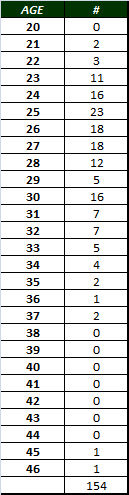
Here is a look at the top 154 starting pitchers broken down by list:

Broken down by age, look at that cluster between 23 and 28 years old.

Broken down by age, look at that cluster between 23 and 28 years old.

A team breakdown from most to least

A team breakdown from most to least

And finally, the echelons with some details about each grouping

And finally, the echelons with some details about each grouping

I’d like to thank everyone for the tremendous feedback on the list thus far. I’m glad it’s been so well-received. I’ll be polishing it up this weekend (i.e. removing Hurley, downing Sheets and slotting Blanton back in—among other goodies to come). I also hope to complete at least 2 podcasts over the weekend, so stay tuned for that as well.