Archive for ‘Player Focus’

Monday: 03.21.2011

18 of My Favorite Pitchers for 2011, Part 1

Any fantasy baseball magazine, book or website is bound to have a sleepers section somewhere.  They are a fantasy staple loved by all and for good reason as everyone is looking to get the next big thing at a great price that will propel them to a title and help them for years to come if they play in a keeper league.

Of course in the Information Age we live in these days, it is really hard to get anything by your leaguemates in terms of a legitimate sleeper.  The more obvious sleepers turn up in seemingly every one of these articles all of sudden making them overvalued or at least just fairly priced sapping the value.  I am not here to bash sleeper articles as I have done them for the last five or six years whether here or at the various outlets I have worked for in the past.  I wanted to try a different approach this year.

Instead of worrying about sleeper label and pretending like we are pulling a fast one on our leaguemates, let’s just look at some guys I like for 2011.  These aren’t necessarily sleepers as many will be firmly entrenched on the radar of your opponents.  Nor are they necessarily breakout candidates, either.  After all, who really knows what defines a breakout?  It can mean 10 different things to 10 different people.

If you read the Starting Pitching Guide then you won’t be surprised by some of these guys as I made it clear how much I liked them there by suggesting you aggressively buy in or go the extra dollar or a host of other ways I used to convey my excitement for them.  Essentially if they are on this list, I like them more than their current projection meaning there is profit to gained.  There isn’t a uniform theme to this piece so let’s just get started with the names and you’ll see what I mean.

1. Cole Hamels – Seeing Hamels on a list like this might come as a surprise after all he doesn’t fall too far out of the top 10 starting pitchers in most drafts.  His inclusion is due to the fact that I have him as a top 5 guy for 2011.  He has Cy Young-quality stuff.  It was a travesty that his pitching led to just 12 wins, but that’s why judging pitchers on wins is foolish.  He is a bit overshadowed by teammates Roy Halladay and Roy Oswalt, but I think he’s the best bet from a production-to-cost ratio.

2. Tommy Hanson – Like Hamels, this is a superstar in the making, but an overreaction to a 10-11 record from 2010 is depressing his value a bit.  Guys like Hamels and Hanson are the ones who will be my aces in 12-team mixed leagues because I refuse to pay the premium attached to the Lincecums and Felixes of the world.  If you’re looking for guys to take Ubaldian leaps from good to great, target Hanson and this next guy…

3. Chad Billingsley – Noticing a trend with these first three guys?  Billingsley also had a record that belied his true value going 12-11 for the second straight season masking his return to 2008’s 2.5 K/BB and a career best 0.4 HR/9.  Are you surprised to learn that he is just 26 years old?  In a standard 12-team mixer, I’m building my hitting base filling in some scarcity fields like shortstop (if I can get Hanley or Tulow), third base and outfield (remember, we need five) while taking advantage of the first base depth with those first 6-8 picks then pairing Hanson and Billingsley as my 1-2 punch.  My offense is going to be better than the guy who took Halladay in round 1 or 2 and my pitching is going to nearly on par and potentially better even if he paired a Sabathia or Weaver with him using yet another early round pick.

4. Brandon Morrow – I think he is getting a little trendy raising his value, but that doesn’t dissuade me.  Last year, I loved Gio Gonzalez and Jonathan Sanchez to make big leaps forward and they didn’t let me down.  Morrow is my guy of that class this year.  If he can shave a full walk off of his rate like Gonzalez did, he would be near 3.0 and if it didn’t cost him over two strikeouts in the process (as it did Gonzalez), he can be truly elite.

5. Ricky Romero – I love me some Blue Jays this year.  I will lift a quote from myself from the Guide re: Romero, “Romero meets the three criteria of Sporer Trifecta of Excellence (patent pending) with a strong strikeout rate (7.5 K/9), a truly elite groundball rate (55% career) and an above average changeup (though it was valued higher in ’09)”.  He has the stuff to take a step forward, but even a 2010 repeat has value at the cost I’m seeing for him in the two drafts I have already done and the expert leagues that have already taken place.

6. Hiroki Kuroda – A victim in the W-L column going just 11-13 last year despite a very strong skill set.  He has managed three straight sub-3.80 ERA seasons in the majors despite failing to reach even 70% LOB% let alone the league average 72% mark.  His age (36) undoubtedly scares some off, but nothing in his profile warrants fear (50%+ GB rate, 2.2 or better BB/9 and improving K/9 reached 7.3 last year).  He comes cheaper or at the same cost as the likes Matt Garza and Tim Hudson despite a more stable set of skills and even a tick of upside if that LOB% bumps up to average.

7. Edwin Jackson – Not much love out there for Jackson for some reason.  Maybe because it took him so long to begin paying any sort of dividends on his elite prospect status (4th in baseball in 2004) or because he teased and tantalized with so many false starts prior to that breakout year in Detroit back in 2009.  In Don Cooper I trust.  In 75 innings he righted Jackson’s season from the disaster it was in Arizona assisting Jackson to eight quality starts out of 11 including a run of three in which he struck out 11, 10 and 11.  I think Cooper and the Sox will finally extract the best out of Jackson for a full season returning a sharp profit on his current value.

8. James McDonald – This is the third year of me driving the McDonald Bandwagon.  He’s just getting going after a trade to the Pirates finally got him into a rotation so I’m not going anywhere now.  He went for $4 in NL Tout Wars over the weekend.  He is the kind of endgame play that can yield $10+ dollars of profit and be integral to a championship run.  Frankly I’m surprised he was so cheap as he has popped up on a lot of sleeper lists this offseason, much to my chagrin.

9. Jordan Zimmermann He got a nice little 71-inning (31 in the majors) tune up last year coming back from Tommy John Surgery displaying 99% of his velocity from 2009 (92 of 93 MPH) and posted some decent stats albeit in smallish sample.  I am quite intrigued by what he can do in a full season (though a full season this year may mean  approx. 170 innings) having displayed strikeout an inning stuff throughout his minor league career as well as the 91 innings from his rookie year.  Injury returns are often a great source of profit and Zimmermann will be a prime candidate in this field for 2011.

Tomorrow’s portion of the list will feature nine names geared more towards single leagues and deeper mixed leagues.  That doesn’t mean they are entirely out of play for 10 and 12 mixed leaguers, especially if you have a reserve roster or taxi squad, but a lot of those leagues will have several of these guys on the waiver wire after the draft.

Ed. Note – if you’re wondering where Dan Haren is on this list, I figured he was too obvious to include.  If you’ve been reading my work at all this offseason, participated in the chat I hosted a few weeks back or talked with me via Twitter, you know how much I love this guy for 2011 (and beyond for that matter).  He is an unheralded ace with one of the best and most stable skills profiles in all of baseball.  He was tied with Max Scherzer as the 6th most expensive starter in AL Tout Wars ($20), a bargain in my book.  I have him 3rd-best in the AL behind Felix Hernandez and Jon Lester, just ahead of Justin Verlander.

Tuesday: 03.15.2011

Why Joe Mauer Isn’t the Top Catcher in 2011

This will serve as the 3/15 Daily Dose (Ed. note – I’ve got time for one post a day right now, so it’s either a feature like this or the DD).

Catcher is always a tricky spot in fantasy baseball.  It’s usually pretty thin putting a premium on the studs, but that is counterbalanced by the fact that even the studs are guaranteed to miss time by not catching at least a day and sometimes two each week.  There is a firm ceiling on a catcher’s output because of those built-in days off plus the significant risk of more missed time due to injury.

Despite all of that, Joe Mauer remains the consensus top catcher and usually goes very early.  Whether people are still salivating over that MVP season from 2009 and hoping it will return (only for a full season this time instead of five months) or they just want to get the perceived best player at a perceived scarce position who will at the very least give you a major boost in an oft-forgotten or at least generally mishandled category (batting average).

First things first, catcher isn’t as scarce as conventional wisdom suggests.  It’s not superstar-laden, but the upper crust (8 or 9 guys spread across two, maybe three tiers) is thicker and the mid-to-late round options contain about 10 or so guys who don’t vary much in their overall value.

The point of this article is less about scarcity and more about that perceived top option.  I have nothing against Mauer.  Despite being a Tigers fan with the Twins as one of our chief rivals, I really like the guy.  I actually want him to become the guy he was in 2009 and I was convinced he would be for most of the 2010 offseason until March hit and I came to my senses and backed off in the nick of time (a lot of it had to due with reading some convincing pieces, namely by Ron Shandler).  I still think he’s capable of being truly elite when it comes to power and pure hitting, but until he shows it that 2009 season is a major outlier.

When I posted my catcher rankings back on February 9th, I had Mauer first.  In fact every single one of the seven offseason magazines I sheepishly admit to having bought (Borders giftcard + addiction to fantasy baseball = win!) did, too.  I have thought long and hard about it and I’m making a change.  This is not home team bias driven, but I think Victor Martinez should be the top catcher for 2011.

Before I get into why, I want to clarify that this doesn’t mean you have to draft him first.  I think he will have the most value, but you will still see at least Mauer go before if not Brian McCann, Buster Posey and maybe even Carlos Santana, too.  Be careful, though, catcher is a position that tends to go in runs so if you see Mauer go, it is probably time to pounce on Martinez if you’re on board with my thoughts.

The reason I like him as the top catcher is the obvious one: he’s not going to be catching much at all.  The problem with catchers is the position.  It’s a grueling position that inherently wears guys down and cuts into their offensive value in a myriad of ways, most of which I already covered.  The general degradation of their bodies as the season progresses just eats into their value.

The Tigers are planning to play Martinez at DH most days, catcher every once in a while to spell Alex Avila and some first base when Miguel Cabrera needs a partial day off and moves to DH.  Speaking of Cabrera, if a worst-case scenario came to fruition for the Tigers whereby they missed Cabrera for any amount of time due to his off-the-field issues, then that would just mean more time for Martinez not catching as he is the primary backup at first.

So what does not catching do to his value?  We have a glimpse of it in the form of his 2009 season.  He caught 85 games and played first for another 70 logging a career high 155 games and essentially matched the production in line with his best seasons.  Coming at age 30 for a catcher, that’s impressive.  His OPS+ was 126, 3rd-highest of his career (130 as a 26 year old, 129 at 28).  He hit .303 with 23 homers and 108 RBIs (2nd-best HR, RBI totals and 3rd-best AVG of his career).

In the 2011, his split between games catching and not catching will be much greater which should result in another 150+ games played and could even yield career-high production.  I think we could see as much as a 7-10% increase of his production from 2009 season with the bulk of his catching duties removed from his plate combined with the fact that he is still in his prime (although 32 years old is generally regarded as that final year of the prime).

Just using the low end of that increase yields a .324 average, 25 home runs, 116 RBIs and 94 runs scored, which would no doubt lap the field in terms of catchers.  In fact, unless Mauer repeats his 2009, Martinez with “just” a .300-20-100- season is better than Mauer at .330-10-80.  Mauer’s batting average advantage offers .002 more to the bottom line over Martinez, but Martinez more than makes up that difference with 10 more HRs and 20 more RBI.  Martinez has three 20-100 seasons; two included a .300+ average.  He also had .302-20-79 last year in just 127 games.

Consider also that power is drying up recently making his 20+ ability all the more valuable, especially since it doesn’t come with the deficiencies found in a Mike Napoli 20-homer season (granted, V-Mart costs more than Nap, too).  Mauer’s batting average boost is nice, there is no denying that, especially since he is capable of .350 in any given season, but Martinez is hardly a liability there and he often logs more at-bats than Mauer.  Mauer has yet to reach 540 at-bats in a season while Martinez has four such seasons, three of which topped 560.

For as great a hitter as Mauer is, he has yet to rack up 100 RBIs in any given season, either.  Martinez has three such seasons.  I’m struggling to see why Mauer is an unchallenged #1 at the position.  The batting average impact is undeniable.  His “worst” season in the last three was last year’s .327, but compared to Martinez the advantage isn’t as glaring.  Apart from 2009’s explosion of 28 homers, he has reached double digits just once (13, 2006).  Same with topping 85 RBIs, only 2009’s 96 fit the bill.

Instead of betting on what Mauer can be, why not invest in what Martinez already is?  There is too much risk tied up in catchers already before you even get into the personal situations of each, but then you look at Mauer with his injury history combined with the underwhelming production save the one star category.

Looking at Martinez, you’re alleviating a great deal of the risk associated with catching by getting a catcher-eligible DH/1B, combining that with a proven track record of power production at a position lacking it (just four 20+ HR hitters in 2010; more than four just once since 2003 [2009]) with a guy still in his prime.  Adding it all up, you have a new #1 atop the catcher rankings.  Martinez is your guy if you want to go with catching early.

Thursday: 02.3.2011

Three Questions – San Diego Padres

With the 2011 Starting Pitcher Guide set to come out in a few weeks, I have a jam packed volume covering all the ins and outs of starting pitching in the 2011 season for your viewing pleasure.  Of course that doesn’t do much to address the offensive side of things so I decided to start this “Three Questions” where I will cover some key offensive issues for each of the 30 teams.  There will be more content here dealing with offense, but this is the beginning.

What happens to this offense without Adrian Gonzalez?

Oh don’t worry, new first baseman Brad Hawpe will fill in so well that you will barely notice Gonzalez left.  A .298/.393/.511 line with 31 bombs and 101 RBIs shouldn’t be a problem for Hawpe.  OK that’s obviously an egregious lie that I don’t believe in the least.  Do you want to know how important Gonzalez was to an offense that still only finished 22nd with him?  Look at this:

Gonzalez led them in five key offensive categories and no one was really close.  Chase Headley was the 2nd-highest qualifying batting average at .264, Will Venable’s 13 home runs were 2nd to Gonzalez, Headley had a whopping 58 RBIs to finish 2nd on the team, Yorvit Torrealba was 50 points behind Gonzalez with a .343 OBP, but that came in just 325 at-bats.  The 2nd-highest qualifying on-base percentage was again Headley with a paltry .327 mark.  And in the most hotly contest of the five categories, Headley finished 14 hits behind Gonzalez with 161 on the season.

Counting stats for Padres hitters are likely to be even worse than they were last year cutting into the already stunted value of the group.  Headley managed those 58 RBIs despite hitting behind Gonzalez, who was getting on base 40% of the time for him.  The team added some pieces in addition Hawpe including a brand new double play duo with Orlando Hudson at second base and Jason Bartlett at shortstop as well as former super-prospect Cameron Maybin, but the loss of Gonzalez is still a major blow to an offense that was already pretty poor.

The power-sapping ways of PETCO park are nothing new and Padres hitters have long been evaluated with that impact built in, but without their superstar cog in the middle the entire group takes another hit to their value.  The chances of the six year streak of a non-Gonzalez entity topping 100 R or 100 RBI being broken seem slim.  The last two players to do it were in 2004 when Mark Loretta scored 108 runs and Phil Nevin drove in 105.

Following up a career year with one of his worst, what’s in store for Jason Bartlett in 2011?

The 2010 season was a rough one for Bartlett especially in light of his breakout 2009 in which he hit 14 home runs, drove in 66 runs, scored 90 runs, stolen 30 bases and hit .320, all career highs.  Lucky for him, he plays shortstop which is a barren wasteland after the top tier so he will have some value no matter what.  How much exactly is going to be tied to how many stolen bases he rack up.  He had a string of 23, 20 and 30 before last year’s 11, so the ability is there and San Diego was the 6th-runningest (so surprised that didn’t get a red squiggly line under it in Word) team last year with 124 stolen bases.

Additionally, he can offer some batting average value or at least not be a drag for a team.  Last year his .254 was a drag as regression bit back hard from 2009 and instead of falling back to career norms, he was actually a bit unlucky.  He is .281 hitter for his career and there is no reason to think he shouldn’t bounce back to that in 2011 and if luck breaks his way again, it wouldn’t be tough for him to top .300 again.  So as a late round speed/average shortstop, he has some value.  As I mentioned already, counting numbers will be tough to come by on this team.  Especially for Bartlett who isn’t particularly adept at getting on base.  Though he has a career .345 OBP, it is propped up by the standout 2009 and a .367 mark in 372 plate appearances back in 2006.

One last thing to consider with him is that he has only averaged 135 games played in the last four years with a high watermark of 140 and a low of 128.  That means you’re going to need a replacement for around 27 games, or 16% of the season.  Given the dearth of talent at shortstop, this can be a problematic proposition.  His backup is likely to be Kevin Frandsen or Everth Cabrera.  You could fill one of Bartlett’s strengths depending on who fills in, Frandsen for average and Cabrera for speed.  If you’re left hitting the wire, you may find that the remains are somehow even less appealing than Frandsen and Cabrera.

Is Cameron Maybin ready to pay dividends on his blue chip prospect status?

The problem is we might not even notice if he does improve because of his home ballpark.  He has certainly proven everything he can in the minor leagues so it is time for the three-time top 8 Baseball America prospect to start showing the talent at the big league level.  At 24 with just a season’s worth of big league plate appearances (610) under his belt, even a poor 2011 wouldn’t be enough to write him off completely but it would put closer to Brandon Wood territory.

The biggest issue right now is the striking out.  He has struck out in 31% of his major league at-bats despite the significant gains in K% in the minors.  After striking out in 32% of his AA at-bats in 2008, he cut down to 20% in his first run through AAA in 2009 followed by 19% in 130 AAA at-bats last year.  Any contact would be better than striking out for Maybin at this point.  At the very least, he could maybe use his excellent speed to turn some of his groundballs into base hits.

Better pitch recognition can increase his value another way as more walks would again allow him to add value by way of his speed.  As noted in the Bartlett section above, the Padres aren’t afraid to run, but it is hard to do much running with a .302 on-base percentage.

I don’t think Maybin will magically fix the strikeout and walk issues all at once in 2011, but I think we will see incremental gains in his first full season which should yield a 20+ stolen base season and low-teens power.  You can do much worse than that for a low dollar late outfield option in NL-Only leagues.  I don’t think he is quite a dollar days guy just yet, especially if your league has any guys who love grabbing the next big thing, but his price tag shouldn’t be pushing double digits.  As a single digit buy, I would highlight him as a quality end-game play perfect for rounding out a team.

Thursday: 01.27.2011

Three Questions – San Francisco Giants

With the 2011 Starting Pitcher Guide slated for next month, I have a jam packed volume covering all the ins and outs of starting pitching in the 2011 season for your viewing pleasure.  Of course that doesn’t do much to address the offensive side of things so I decided to start this “Three Questions” where I will cover some key offensive issues for each of the 30 teams.  There will be more content here dealing with offense, but this is the beginning.

I paid a lot for Pablo Sandoval last spring, WTF?

Yeah that was a tough one to swallow.  He certainly didn’t come close to expectations, but at the same time he wasn’t the season killer he is made out to be, either.  Season killers are multiple month injuries on April 12th.  You can overcome guys who underperform expectations, but still play 152 games.  Plus it isn’t like his season was a complete & utter disaster, he had streaks of excellence mixed in, namely his April and August where he posted 1.008 and .907 OPS marks, respectively.

In many leagues, Sandoval’s down season (.268/.323/.409 w/13 HRs) will actually create a buying opportunity as owners overreact to what essentially amounts to a sophomore slump at age 23.  Most guys aren’t even in the big leagues at 23 and Sandoval has 1400+ plate appearances under his belt.   We have seen the best of Sandoval and we have seen the worst of Sandoval and with his price being driven by the latter, now is the time to invest.  In the SiriusXM/FSTA Draft during their conference out in Las Vegas on Monday, he was taken in the 8th round (101st overall) of a 13-team mixed league.  Last year he was a 3rd-4th round pick.

Third base is still pretty thin so his value won’t completely plummet, but I would consider that 8th round value to be the high end of where he will go in drafts so you might be able to get him a few rounds later depending on your league.  Once you get past the top 10 of Evan Longoria, Ryan Zimmerman, David Wright, Alex Rodriguez, Adrian Beltre, Aramis Ramirez, Pedro Alvarez, Martin Prado, Michael Young and Casey McGehee then I think Sandoval is just as good of a pick as the other guy.

He won’t offer nearly as much power as Mark Reynolds, but his overall profile is much more stable.  He doesn’t carry the age/injury risk of Scott Rolen & Chipper Jones and factoring in reasonable improvement regression, he should be better than them even if they manage to stay healthy.  Bottom line is you should pay for a guy hitting .300 with 18 home runs and 75+ runs scored and driven in, but be willing to go the extra buck or two for the potential he has as a 24-year old still coming into his own.

Andres Torres was a prototypical fantasy All-Star last year, what about 2011?

At 33, we’re not dealing with a growth profile here.  Torres’s 570 plate appearances last year eclipsed his career total by 115 spread across parts of five seasons.  That said, he gave us a taste of 2010 in 170 plate appearances in 2009 when he had six home runs and six stolen bases along with eight(!) triples.  After an amazing July, he sputtered down the stretch no doubt suffering some fatigue from his first whole season.  For 2011, it is going to be all about cost.

I’m confident he can put together another solid power/speed season as a “glue guy” for any fantasy team, but is the price tag going to be that of a glue guy or second tier fantasy star?  Early returns are mixed.  His ADP (average draft position) at one popular mock draft sites is off the charts ridiculous.  He is checking in as the 35th outfielder off the board (116th overall) ahead of guys like Curtis Granderson, Adam Jones, Carlos Lee, Vernon Wells and Nick Markakis.  While I said I don’t doubt he can repeat 2010, drafting him ahead of those guys means he has to repeat for me to get proper returns on my investment.

In the industry draft I mentioned earlier, he went in the 20th round (250th overall) which actually hits the other end of the spectrum as a great value.  I doubt he will go that late in most drafts, but anything before 15th-16th round is really ramping up the risk on your end.  He is a great story who has overcome his ADHD to have success in the big leagues, but you still have to remember he is a 33-year old strikeout machine with solid speed in a lineup that is still only decent at best.

Look for a .260-76-12-55-22 line which has value, but let your team construction dictate if he is a fit or not.  If you have a lot of high risk/high reward youth on the team, then Torres is a great stabilizing vet who’s downside isn’t  going to kill you.  But if you have a veteran-laden team on offense, then bet on the upside of a Travis Snider or Logan Morrison before taking a low ceiling Torres.

Is there anyone off the radar who could make an impact for the reigning Champions?

Yes there is and it is someone who has already been covered in depth here, first baseman/left fielder Brandon Belt, who was my favorite player to watch that Arizona Fall League back in November.  As presently constructed, the Giants lineup is essentially Posey, Sandy and Six Old Dudes.  Now those old dudes came through huge last year, especially in the playoffs and helped bring home a title, but older players aren’t bastions of health.  Injuries create opportunities which is where someone who is just about ready for the big leagues, like Belt, comes into play.

The reason Belt now has left fielder attached to his defensive description is because first base, his normal position, is pretty well sealed up for the time being.  Aubrey Huff parlayed his excellent 2010 season into a deserved contract and though he is 34, he has averaged 152 games per season since his age 26 season.  In that time, he has played fewer than 150 just once.  That said, age is fickle.  But the real opportunity could come in left field where Pat Burrell was something of a savior for that lineup in 96 games last year but is neither young (34), agile (-39.7 career UZR) or super healthy of late (122 & 120 GP the last 2 years).

Belt was a breakout prospect last year crossing three levels before heading to Arizona where he continued to stay hot.  Only 13 of his 136 games came at AAA-Fresno so he will start the 2011 season down there to get some more seasoning so he isn’t someone who should be drafted as anything other than a minor leaguer right now, but don’t be surprised if he earns an early summer call-up to spark that offense.

Make no mistake that the Giants won the World Series because of their pitching and that remains their overwhelming strength for 2011.  The offense is far from perfect and the veterans will have to produce with Posey if the team expects to contend out west and if not, GM Brian Sabean will have to find guys who can with Belt being the best minor league option for the Giants.

Tuesday: 01.25.2011

Three Questions – Seattle Mariners

With the 2011 Starting Pitcher Guide slated for next month, I have a jam packed volume covering all the ins and outs of starting pitching in the 2011 season for your viewing pleasure.  Of course that doesn’t do much to address the offensive side of things so I decided to start this “Three Questions” where I will cover some key offensive issues for each of the 30 teams.  There will be more content here dealing with offense, but this is the beginning.

Will Justin Smoak start to look like the guy who was the centerpiece in a deal for an ace?

Smoak, a blue chip prospect coming up through the Rangers’ organization, drew rave reviews in three minor league seasons ranking 13th (2010) and 23rd (2009) on Baseball America’s Top 100 Prospect list the last two years.  He was being compared to former Ranger Mark Teixeira, likely due to the easy surface comparison of switch-handedness, a deft eye at the plate, first round draft status and first base positioning on the diamond.  It will be tough to find out how apt those comparisons were as Smoak is now a Seattle Mariner.

His career started off with a whimper in 275 plate appearances with the Rangers, but he still showed the ability to draw walks with a 105-point split between his batting average and on-base percentage, although both lagged with the latter topping out at .316.  His 8-home run total wasn’t horrible either.  Across a full season, that projects to the low-20 power Smoak was projected for in his young career.  Results on the whole were slightly better in Seattle (93 OPS+ v. 79 in Texas) though they came at the expense of his batting eye as the difference in average and OBP dwindled to 48 points.

As the centerpiece return for the M’s in the trade that sent Cliff Lee to the Texas Rangers the expectation for Smoak to hit Teixeira likely won’t go away, however the capacity to do so will be seriously diminished in his home park of Safeco Field.  According to StatCorner.com, Safeco Field has a park factor of 91 on home runs for left-handed batters and just 84 for righties.  For the uninitiated, anything below 100 favors pitchers.  So for 81 of his games, Smoak is going to be playing in an environment that eats away at his ability to do the thing fantasy owners need most out of a first base/corner infield option, hit for power.

Factor in the historically bad lineup which has no chance but to improve but will still struggle and you’ve got a player bringing very little to the table in terms of production.  If the low-20s was Smoak’s ceiling for the early part of his career in Texas, then 15-17 is the new ceiling playing in Seattle.  Combine that with below average runs scored and driven in totals and you have waiver wire fodder in most league formats.  He will get drafted because of his name and because of his hot September (.340/.421/.580, 3 HR, 9 RBI), both of which are factors that will price me out for sure.  I don’t need a hit before I pass this Smoak.

Where do I draft Ichiro now that he’s 37 & stuck in that lineup?

I am less concerned about the age than I am his awful supporting cast who last year cashed in Ichiro’s .359 on-base percentage for a whopping 74 runs.  SEVENTY-FOUR!!!  He hit .315 with 214 hits and scored 74 runs.  We have already seen within his early-to-mid 30s that Ichiro isn’t aging normally.  He continues to be an age-defying star and there is no reason to bet that he drops off the table suddenly in 2011.  As I have mentioned many times before, I would be careful subscribing to these trends, but he has an on-off trend with his batting average that is schedule for an on year.  His last four years in order have been .351, .310, .352 and .315 meaning if the trend held he would be in for another transcendent batting average year that can carry a fantasy team.

On-off trends are hardly the statistical work of Baseball Prospectus and company, but maybe he dedicates himself in a different way during the offseason of those “down” seasons to come back and have another huge year.  Flimsy at best, so don’t use it as the reason to draft him.  Draft him because he hits .300+ in a ton of at-bats with 35+ stolen bases.  Unfortunately he cannot be counted on for runs until further notice, but he is a stud in two categories.

In a recent “Experts” Draft held over at CBS, he went at the top of the 5th round.  I might be more prone to take him in the back of the 4th round when all of those picks were being wasted on starting pitchers, but it’s inconsequential to say he is late 4th instead of an early 5th round pick.  Anywhere in that pick 40-60 range suits me just fine.  The age is scary to many so you may even be able to hold off until the 6th round or get a few dollars shaved off of his auction price.  When you are dealing with superstar once-in-a-lifetime players, things like natural age progression and mistrusting the stats is how you get burned.  He is as solid as they get in this game on unpredictability.

Is there anyone besides Ichiro worth caring about in this lineup?

Yes, there is some hidden value.  Off the top, I would be willing to bet on a Chone Figgins rebound.  The price is likely to be ripe for a profit as his .259 average left a sour taste in the over-reactionary populace of fantasy baseball while you are smart enough to wade through the belly-aching and see a guy who still stole 42 bases and hit much better from June on (.280) after entering the month with a .211 average.

But for the purposes of this question, I would like to shift your attention to the former AL West foe who was brought to the Mariners to provide some punch to their lineup, Jack Cust.  You may recall about 500 or so words ago I lamented Safeco Field and what it does to a hitter’s power.  However the “hitter” in that example is a mere mortal when it comes to power hitting, he is no Jack Cust.  Cust’s power isn’t to be stifled by cavernous stadiums whether in the Bay Area or the great Northwest.

Cust popped a .501 slugging percentage in McAfee Coliseum, his former home in Oakland, which has a home run park factor just a point higher at 92 for lefties than his new home.  This means his power won’t be stifled, just as the power of the guy whose shoes he is filling, Russell Branyan, wasn’t during his two stints with Seattle.  Cust has a legitimate shot to replicate Branyan’s 31 home run season from 2009 and he certainly doesn’t cost what 31 home runs should (went 29th round in the aforementioned “Experts” League) so put a star next to him on your draft list.

Saturday: 01.22.2011

Three Questions – Texas Rangers

With the 2011 Starting Pitcher Guide slated for next month, I have a jam packed volume covering all the ins and outs of starting pitching in the 2011 season for your viewing pleasure.  Of course that doesn’t do much to address the offensive side of things so I decided to start this “Three Questions” where I will cover some key offensive issues for each of the 30 teams.  There will be more content here dealing with offense, but this is the beginning.

Michael Young. Go.

OK, that’s not really a question, but his offseason has been one of uncertainty with the signing of Adrian Beltre and Baseball-Reference.com referring to him as Mike Young for some reason, so what does 2011 have in store for him?  For fantasy purposes the movement on the diamond whether over to first base or off the field to designated hitter has no real impact on his fantasy value because he will still qualify at third base based on last year.  That is where his value is highest without question.  I can’t really see the position move impacting his offense too much, either, though sometimes guys just don’t respond well to DH’ing.

Young has been a legitimate fantasy asset now for eight straight seasons and even at 34 years old there is nothing in his profile to suggest that will change.  The batting average dipped below .300 for only the second time in the eight year stretch since 2003, but with his flyball rate climbing yearly since 2007, that is hardly shocking.  The tradeoff is the likelihood of his power staying in the upper teens, lower 20s area.  His team dependent numbers should remains strong as the lineup actually gets better than its 2010 iteration with addition of Beltre.  With third base still one of the thinner positions on the infield (shortstop is the thinnest), Young remains a quality asset whether at third or filling your corner infielder spot.

Can Mitch Moreland hold the first base spot all year or does Chris Davis take that job and run with it?

Moreland joined the Rangers late in July and enjoyed a solid 47-game stint, but the results aren’t indicative of what you should expect over a full season.  He showed uncharacteristic power (9 HR in 145 AB; 12 in 353 minor lg. AB) thanks to a 21.2% HR/FB which would be tough to sustain over an entire season and would certainly qualify as an upset if he did it.  With a 29 AB/HR rate in 1398 minor league at-bats, no one is betting he is going to sustain his 16 HR/AB over a full season in the majors.

Conversely, he showed a much better knack for getting base hits in the minors than he did in his short time at the big leagues.  A career .313 hitter in the minors, Moreland hit just .255 in his time with the Rangers.  In essence, I would bet on the two trends reversing where he a low double-digit home run total for the season would be paired with a .285+ batting average and above average plate discipline.

But will it be enough?  For your fantasy team, not in mixed leagues as he profiles as a slightly better Daric Barton.  For the Rangers, that is to be determined.  Davis is a prototypical AAAA guy who has mashed his way through the minor leagues on multiple occasions, but failed to carry it into the big leagues in his last two years after a strong rookie debut in 2008.  Of course despite being written off as a complete bust by most, he is still just 25 years old.  Plenty of guys don’t even start their major league career until age 25 and he already has 872 major plate appearances under his belt so it’s far from over for him.

On the whole, Davis has more upside than Moreland related specifically to his prodigious power so inking Moreland in at first base on your Texas Rangers lineup projection is dangerous.  A lot can change between now and Opening Day.  It is a situation to monitor closely throughout the spring, but in the end it is one to avoid in anything but the deepest leagues where I would be more willing to gamble on Davis with a late pick if he has a solid spring than invest in Moreland’s higher floor, but much lower ceiling.

Is this the year that Ian Kinsler finally puts it *all* together?

Kinsler, a fantasy favorite for a few years now, has a 30-30 season (2009), a 20-20 season (2007), a .319 season (2008), a .517 slugging season (2008), two 100 runs scored seasons and two All-Star appearances (2008, 2010) yet his career still feels like something of a disappointment when you realize it could be so much better.  In the 30-30 and 20-20 seasons, he hit .253 and .263 respectively.  In the All-Star seasons he only played 121 and 101 games.  In fact he’s only played more than 130 games once in his five year career.  He is either putting up an incredible minus one key factor and/or having injuries cut dream seasons short.

So is 2011 the season of 150 games, 100-30-90-30? … No, of course not.  Sorry, but there is just no way you can realistically project that at 29 he is all of a sudden going to make it through an entire season.  Health is a skill and it’s one he lacks.  That said, he is still generally putting up a season’s worth of numbers in the 100-odd games he does play so he is still worth drafting relatively given the risk, but I think it would be foolish to reach for him at a position that has a lot more depth than many seem to realize.

Maybe shortstop’s stink drifts over to second base or fantasy owners just associate middle infield positions with scarcity, but second base has plenty of viable option.  Those automatically ahead of Kinsler for include Robinson Cano, Chase Utley, Dustin Pedroia, Dan Uggla and Brandon Phillips.  After that group, Kinsler’s power-speed combo is just too rich to pass up for guys like Rickie Weeks and Martin Prado, who are very good, but just don’t offer Kinsler’s robust fantasy excellence.  Plus you can always dream that everything goes his (and your) way and he finally plays a full set of games.  Just don’t bet on it.

Friday: 01.21.2011

Three Questions – Oakland A’s

With the 2011 Starting Pitcher Guide slated for next month, I have a jam packed volume covering all the ins and outs of starting pitching in the 2011 season for your viewing pleasure.  Of course that doesn’t do much to address the offensive side of things so I decided to start this “Three Questions” where I will cover some key offensive issues for each of the 30 teams.  There will be more content here dealing with offense, but this is the beginning.

How will the playing time be split between the 947 outfielders on the roster?

After their offseason acquisitions, the Oakland A’s have the following outfielders on the roster: Chris Carter, Coco Crisp, David DeJesus, Conor Jackson, Hideki Matsui, Ryan Sweeney, Michael Taylor and Josh Willingham.  With Jack Cust no longer on the team, you pretty much pencil Matsui into the DH spot for most of the season.  That leaves seven players for three spots.  So the ideal setup would be DeJesus in left, Crisp in center and Willingham in right.

Ideal is the operative word here because though the A’s would love to get 150 apiece games out of that trio, they are far from the modicum of health.  DeJesus played just 91 games last year and has only once topped 144 in his career (157 in ’07).  Crisp has never reached the 150-game plateau.  In the past three seasons he has played 118, 49 and 75 games, so he is far from a sure thing.  Add in that he is now on the wrong side of 30 years old (31), too.  Like Crisp, Willingham has never reached the 150-game plateau, either.  He has only topped 500 at-bats twice in his career and they were in his first two full seasons as a major leaguer (2006 & 2007).  In the subsequent three years, he has 351, 427 and 370 at-bats.

So like I said, in a dream world the A’s would give the bulk of time to those three players but history says that you really shouldn’t bet on that with any level of certainty.  Since he can play all three positions, Sweeney is natural fit for the fourth outfielder as he can be plugged in for any of the three starters.  Jackson primarily plays left, but could play right in a pinch.  He can also play first base so he could end up rotating around the diamond to get his playing time.

Carter and Taylor might both start the season in AAA.  The former can’t really play anywhere so he projects as the backup DH right now while the former is on the cusp of being a busted prospect.  He was rated 29th by Baseball America before the 2010 season and went out and laid an egg with a .740 OPS and just six home runs after seasons of 19 and 20 and OPS marks of .968 and .944 in 2008 and 2009.  He can play all three outfield spots so he can back anyone up or take over a starting job if he establishes himself at the plate in AAA.

The A’s have great depth in the outfield which suits them quite well, but does little inspire fantasy owners.  All of their outfielders are likely to be discounted both because of health concerns and the lack of clarity around playing time so if one or more of them manages to play a full season, they will be very profitable for their team.  I would pick one you think is most worth gambling on, but avoid rostering multiple A’s outfielders.  Ranking them, I’d go: Crisp, Matsui, Willingham, DeJesus, Sweeney, Jackson, Carter and Taylor.

What’s up with Kurt Suzuki?

That is kind of a vague question, but looking at his 2010 season against 2009 season shows significant decline in total player value, but more so to the A’s than to fantasy owners.  His runs and RBIs sunk, but a lot of that is tied to the 75 fewer at-bats as opposed to a production drop.  His power output was essentially the same as he hit two fewer home runs in the 75 fewer ABs.  The big drop came in 32-point batting average decline which shades his season as much worse than it actually was, again from a fantasy aspect specifically.

Calling it a 32-point drop sounds a lot worse than calling it what it really is, a 3.2% dip over the course of 131 games.  Playing 131 games is essentially 21 weeks of a 26 week season and in that span the difference between a .274 batting average and a .242 batting average is 16 hits, or less than one a week.  When you think about it like that, he needed less than one extra bloop a week to fall in and all the talk about “what was wrong with Suzuki?” would be non-existent.

This is why I don’t flip out over batting average fluctuations from one year to the next within a certain range.  Some raise an eyebrow and there is something within their skills that points to a long-term problem, but mostly it’s statistical noise.  For Suzuki, he suffered a very weird anomaly where he had a 20% infield flyball rate, more than double his previous career high.  It contributed to an ugly .245 BABIP which obviously held his batting average down.

Use Suzuki’s 2009 as a baseline projection for his 2011 season and draft accordingly.  Catcher is deeper than usual thanks to the recent influx of young talent (namely Carlos Santana and Buster Posey) and Suzuki projects as a borderline top 10 candidate at the position.

Does Daric Barton have any value in standard 5×5 leagues?

In a word?  No.  Because standard leagues don’t use on-base percentage which eliminates his most value asset: the ability to draw walks (AL high 110 last year).  And that leaves you with a first baseman or corner infielder hitting a blasé .265-.275, barely scraping double digit power with fewer than 60 RBIs (due at least in some part to his team setting) and not turning his high on-base percentage into a high number of runs scored (again, due at least in part to his team setting).  That’s trash.

There were 15 first basemen that hit 20+ home runs, which is double Barton’s output and there were 27 in all who hit more than his pitiful 10 home runs.  There were 22 first basemen with more RBIs than his 57 including Kevin Youkilis who topped him by five in nearly 200 fewer at-bats.  Slotting him at corner only makes things look worse as there were another 11 third basemen with 20+ home runs, 21 topping 10 as well as 19 guys who topped his RBI output.

Unless you play in a specialty league that counts walks and/or on-base percentage, Barton is waiver wire fodder until further notice.  And I’m only leaving the door open slightly because he is 25 years old and it wouldn’t be out of the realm of possibilities for him to develop some power and for the Oakland lineup to stay healthy and generate plenty of run scoring and driving in opportunities, but the opening is very minimal and I certainly wouldn’t advise you to bet on it.

Monday: 11.29.2010

Javier Vazquez Joins the Marlins

My least favorite move of the Hot Stove season last winter was the Atlanta Braves trade of Javier Vazquez to the New York Yankees. First off, I just didn’t like the return the Braves got for Vazquez who was coming off of a brilliant season, the best of his career. Upon further review, Arodys Vizcaino is a much more heralded prospect than I originally realized so that helped the deal. He is just 19 though, so he’s far from a sure thing.

And judging the trade as a whole now after the 2010 season and into the 2011 Hot Stove really shifts the advantage to the Braves. Not only was Vazquez a total flop in New York (5.32 ERA, 1.40 WHIP, nearly -3.0 K and 2.0+ BB difference in his per 9 IP rates), but the Braves were able to flip Michael Dunn, another part of the package from New York, to the Florida Marlins for Dan Uggla.

At the time though, I mostly disliked deal from a selfish fantasy baseball angle. I bought in heavily on Vazquez in the spring of 2009 and reaped significant benefits from his Cy Young-quality season and planned to do the same in 2010 as a well-priced keeper in NL-Only leagues only to have that plan dashed with the trade. Granted, no one cares about my fantasy fortunes one way or another, but Vazquez shifting back to the American League was a loss globally as his best work had always come in National League.

Over the weekend, Vazquez and the Florida Marlins agreed on a 1-year deal worth $7 million with both a full no-trade clause and a clause stating that the Marlins can’t offer him arbitration next winter. The former isn’t terribly worrisome as I’m sure Vazquez would waive it to go to a contender (non-New York division) if the Marlins were languishing through a terrible season and looking to move him. The latter is definitely a significant concession for the Marlins, but in return they no doubt got to drop the price on the contract.

It would have been nice to have the compensation pick potential, but I don’t think it should have been a deal breaker so I applaud the Marlins for making sure they got a discount in return for the arbitration concession. Early reports had teams offering Vazquez a 2-year pact worth about $20 million, but Vazquez refused to look at anything more than a year so the Marlins landed a $3 million dollar discount for the two clauses Vazquez wanted.

It’s hard to pin a value on Vazquez for 2011 and that could result in his being severely discounted as he was heading into 2009. The struggles he had in New York last year weren’t necessarily unexpected as many predicted a substantial drop in value, but the level to which he struggled was a surprise. He has always been home run prone and that was only exacerbated in Yankee Stadium with a career-worst 1.8 HR/9. His home run rate climbed from the previous year during his first stint with New York so I’m not sure what the Yankees were expecting with an even more homer-friendly home park.

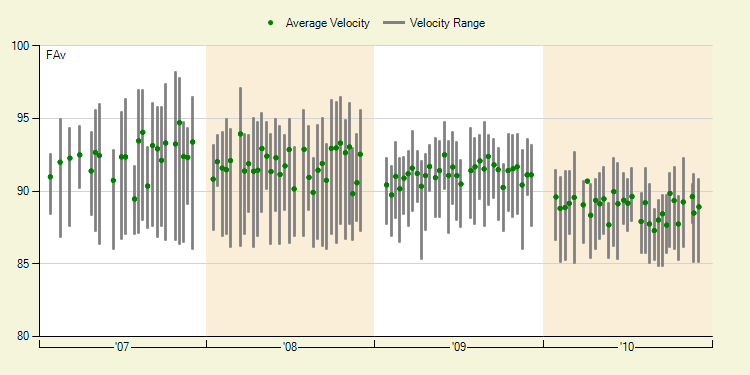
The most alarming factor from his 2010 meltdown was the drop in velocity. This has become a hot topic since rumors of his signing began swirling including a deeper look at it from FanGraphs.com writer Dave Cameron. Cameron isn’t hopeful that he can regain the lost speed and without it, he isn’t sure Vazquez can be of much value.

Given his career workload, I wouldn’t bet on Vazquez’s fastball ever coming back. And if it doesn’t, well, the Marlins just risked $7 million in the hopes that he can teach himself how to pitch without his main weapon. That’s a pretty substantial risk for a team that isn’t exactly rolling in money.

Here’s a chart from FanGraphs showing the drop in velocity:

A drop in fastball velocity is never a good thing, so I won’t try to make that case, but I’m not sure that it is a complete doomsday scenario if his velocity plateaus at the new level. He still has a plus changeup and a plus curveball to fall back on. Instead of relying more on fastball generated swings & misses, he will need to become a better “pitcher”, more crafty if you will. His flyball tendencies (41% career rate, 0.96 career GB/FB rate) won’t hurt him nearly as much in Sun Life Stadium as they did in Yankee Stadium and his strikeout and walk rates are more likely to move back toward his career rates than they are to stay where they were in 2010 just by virtue of the fact that he is back in the National League.

I wouldn’t make too many judgments based solely on his disastrous 2010 when he is also a year removed from a season that earned him Cy Young consideration. Plus he has a bit of a Bret Saberhagen thing going with every other year ERA spikes and drops and though I’d be reticent to bet on a theory like that, he has done it every year since 2000. I’m definitely willing to invest in his 13-season track record as opposed to shying away based on his worst year since his rookie year of 1998. If a sub .500 record and 4.67 ERA in 2008 held his value down going into 2009 despite strong supporting skills, then I can’t imagine having to pay much to take a chance heading into 2011 after the bottom fell out on his numbers in 2010.

Vazquez will be on my radar for 2011 and he won’t need to post a 2009 line to return a profit.

Monday: 11.15.2010

AFL Scouting Report – Brandon Belt, SF

I remember seeing Brandon Belt (1B) here at the University of Texas in a handful of games I attended across the 2008 and 2009 seasons.  My thought coming away was always, “How is he not better?”  He definitely looked like a ballplayer and he would have good plays here & there, but terribly inconsistent. He hit a pedestrian-for-college .321 in 124 games but showed exceptional plate discipline (67 BB to 74 K) and a modicum of gap power.  The only thing that really jumped off of the stat page was his 15 steals in 2009.  You just don’t expect 6’5”/195 first basemen to run much at all let alone swipe double digit bags.

To be 100% honest, I kind of forgot him once he left.  It wasn’t until early this summer that I saw he was in the San Francisco system putting together a solid beginning to the season.  Earlier this month I saw him at the Arizona Fall League in Phoenix and came away with a completely different outlook on him.  I learned from some scouts that the Giants completely reworked his swing from the ground up in hopes of better utilizing his plate discipline and extracting the power locked up in that sizable frame.

The results were amazing as he raked through three levels in his first professional season with the majority of his time with San Jose in High-A where hit posted a .383/.492/.628 line in 77 games.  That earned him a promotion to AA where stayed hot to the tune of .337/.413/.623 in 46 games.  He was again promoted, this time to AAA and though the batting average dropped he still went .229/.393/.563 in 13 games.  Be wary of the tiny sample as 3-4 extra hits would’ve taken his average up to the .290-.310 range so the .229 is very misleading.

He has stayed hot this fall (.392/.449/.658 w/14 XBH out of 31) and looked very sharp in the three games I saw him play.  He took what the pitchers gave him whether it meant blooping a ball over the shortstop’s head for a single or smashing a mistake into the gap for a double or working a walk.  His approach is very crisp.  Here is a look at the swings from his at-bats slowed down:

As for Belt moving forward, I see him with a Joey Votto-lite ceiling.  I’m not sure he can consistently hit .320 like Votto, rather closer to .290 perhaps sprinkling a .300+ season in as his luck fluctuates, but he will likely manage .400 on-base percentages with his plate patience.  For power, I have him more in the low 20s while I see Votto capable of stringing together some low 30s seasons together (his high 30s 2010 had some favorable luck behind it).  And the two meet in the road the speed as they are both adept at swiping bags despite their looks suggesting otherwise.

Barring a huge spring, Belt will likely start 2011 at AAA and get some more seasoning, but he can’t be long for the minors if he keeps raking as he did in 2010.  He is primarily a first baseman, but he played a little rightfield in his AAA stint.  If he can adequately play either position, his chances to reach the majors sooner increase as the Giants are far from locked in at first or either corner outfield spot.

Here is another video of his whole at-bats. It is a bit sped up which I didn’t do on purpose, but it happened three different times when I uploaded it so I just left it:

Thursday: 07.8.2010

Going for Broke – Catchers & Corners

I know I said podcasts were returning this week, but as I’ve mentioned before, it’s really difficult to sit at the desk for 2+ hours to record and edit the show. I need to prop my broken ankle up all the time and it’s impossible to do so comfortably at my desk. What I can do is write in the meantime, so here is part one of a series.

Did you draft Joe Mauer this year? How about Grady Sizemore or Jason Bay? Jacoby Ellsbury? Javier Vazquez? Jake Peavy? Josh Beckett? You get the point. If you drafted one or more these guys (or a host of others not included) then your season isn’t panning out how you planned. Whether injury, lack of performance or both, these guys were all top 100 picks who aren’t putting up what you expected when constructing your team.

You may have offset your duds with a handful of the diamonds in the rough that have emerged in the first half of the season, but these things seem to snowball so it is more likely that you are wallowing in the middle to bottom of your standings with two or three of these guys wondering what in the world you should do with the rest of your summer. You could give up, ignore your team and become “that owner” or you could suck it up and try your hardest to get back in it. If you have been playing this game for length of time, you have heard stories about how a team was in last place at the All-Star break, but they surged all the way back to win it.

They may have had some crafty trades or their weak links started performing, but one thing is certain: they took some chances. They went out and got some guys whether via trade or waiver wire and just said, “Hey, what’s the worst that can happen? I’m already in last! This guy will either perform up to his talent or continue to flounder, but I’m in last so it can’t hurt!” You need to invest in some gambles who have a reasonable chance to pay off big time if you’re going to surge up through the standings.

Going out and trying to acquire the Evan Longorias and Josh Johnsons of the world will cost far too much and the gain, if there is any, will be minimal. You will end up damaging yourself too much in one category or another to get what those superstars bring. With that in mind, I have put together a team of lottery ticket guys you should be targeting for this strategy. Some are next-to-nothing cost lottery tickets, while others have a cost, but it is definitely not that of a Ryan Braun or Roy Halladay. The idea is these guys will be among the hottest in the second half and start leading teams through the standings.

Catcher – Miguel Montero, Arizona Diamondbacks

Last year after the All-Star break Montero hit .316/.366/.534 with 11 home runs and 40 RBIs in 234 at-bats showing you just how hot he can get for a period of time. And it wasn’t one especially hot month that propelled him, either. His OPS totals by month were: 1.007 in July, .910 in August and .824 in September. In his tiny 81 at-bat sample so far this year, he has been excellent, but he is still returning from knee surgery and Chris Snyder has still been taking at-bats.

You should look to use the injury concern as leverage to drive the price down a little bit. He won’t be free by any stretch, especially since he was a highly touted sleeper coming into the season, but he is definitely worth targeting. Only four catchers have hit 11 home runs so far and only two of those have driven in 40 runs so if Montero can repeat or at least approach his second half numbers from 2009, then he will definitely be among the elite backstops in baseball.

First Base – Adam LaRoche, Arizona Diamondbacks

A perennial second half star, LaRoche has this odd knack for really turning it up as the thermometer jumps. In the last three years, he has a .246/.330/.440 line with 36 home runs in 925 at-bats before the break and a .309/.371/.537 line with 35 home runs in 685 at-bats after the break. Only one fewer home run in 240 fewer at-bats. He also goes from batting average anchor to batting average booster after the Midsummer Classic.

If he stays in Arizona, he could reasonably drop 20 home runs from here on out as Chase Field has been known for being a home run haven, especially for lefties like LaRoche. The honorable mention here would be Prince Fielder if your league’s Prince owner foolishly discounts him because of a ho-hum .265 batting average. It’s unlikely, but stranger things have happened. The point of this group of players is again to minimize cost while returning as much upside as possible. Generally, Fielder should still be at full price, but some people are dumb.

Third Base – Alex Gordon, 1B/3B/OF, Kansas City Royals

I seriously just put Kansas City Chiefs by accident. Whoops. I’m not even a football diehard, I prefer baseball by leaps and bounds over the NFL. I would be much higher on Gordon if he played for a competent franchise. Don’t cry about money disparity, Royals fans. You (and the Pirates and Astros, etc…) suck because of awful management. Many teams are able to overcome the financial disadvantage, but there is no defense against stupid.

Excuse the rant, it stems from the fact that Gordon is inexplicably stuck in AAA where he is annihilating pitchers with a .314/.439/.563 line including 12 home runs and even seven stolen bases in 229 at-bats. What is he proving down there? Why was he even sent down in the first place? Oh yeah, because he hit .194 in a whopping 31 at-bats. Joba Chamberlain thinks the Royals mishandled Gordon, that is how badly they have messed this up.

Anyway, he should be up soon and I think he is worth taking a chance on to see if he finally delivers #2 overall pick production. Depending on your league, he might not cost you anything more than a waiver claim. Those are probably the shallower 10 and 12 team mixed leagues in which case you probably don’t even need to consider him until he is actually called up. For those of you in those leagues, your gamble pick is Chone Figgins.

Remember in 2007 when Figgins missed the first month and then hit .160 in May? He ended the season at .330 thanks to a .376 average from June 1st on. That is the kind of crazy streak he is capable of going on if he gets himself right. And at the very least, he is on pace for 44 stolen bases.

Corner Infielder – Carlos Pena, 1B, Tampa Bay Rays

In need a power surge? Pena is your guy. In need a batting average surge? Ehhh, you might want to look elsewhere. Pena showed what kind of damage he is capable of in short order when he popped seven home runs in a six game stretch in June. He is on pace for “just” 31 home runs this year, but with the kind of streaks he can go on during a given month, he may very well approach 40 home runs as he has in two of the last three years (46 in 2007, 39 last year). A 40-home run season would mean he has 24 in the bank; for the sake of comparison Joey Votto leads all first basemen with 21 right now.

As I mentioned at the outset, he is a batting average anchor in fact he has been in every one of his 10 seasons except 2007 when he hit .282. He’s a career .244 hitter, but I think impact of one guy to a batting average is often overrated. Consider that he had 490 at-bats in 2007 when he hit .282 and 2008 when he hit .247 and the difference between those two was 17 hits. If you think he will get to his career .244 mark over say 260 at-bats in the second half, he would have to hit .292 in which case he would be a batting average boost.

Even if he hits the .227 he hit last year, he would hit .258 the rest of the way which won’t kill you. And .258 just happens to be his second-half average the last three years. He has 58 home runs before and after the breaks the last three years, but the latter 58 came in 643 at-bats while the former 58 were in 808.