Archive for ‘Player Focus’

Friday: 01.18.2013

Top 10 Starting Pitchers Right Now

Tonight MLB Network will continue the 2013 iteration of their “Top 10 Right Now” series at each position capped off with a “Top 100 Overall”. They will air both the relief and starting pitcher shows on Friday evening. I always enjoy this series and generally look forward to it after the New Year since I eat up just about any fresh baseball content I can as we wait for pitchers & catchers to report. Instead of putting up my lists after they air their selections, I’ll post mine ahead of time and then compare notes after the shows air.

This is not a fantasy list!!

(Ed. note: I swore my DVR said the reliever episode was first which is why I posted that list first. Sorry about that!)

This list was even harder than the relievers one as I just want to include so many guys. To spare you, the reader, I’m only going to include a few of honorable mentions.

Roy Halladay (PHI) – Since it is “right now”, I couldn’t justify his inclusion coming off of an injury-marred season that was easily his worst since 2004. From a fantasy angle (which isn’t entirely relevant in this NON FANTASY list) I still think he’s being criminally underrated early on in mock drafts and rankings I’ve seen, but he’s not a top 10 guy right now.

C.C. Sabathia (NYY) – This has a lot more to do with how deep the top of the starting pitcher pool is than anything Sabathia hasn’t done. There are no obviously flaws in his games, he’s absolutely amazing, but there are only 10 spots, so he’s on the outside.

Yu Darvish (TEX) – I couldn’t just play favorites and put Darvish in ahead of more deserving candidates. He took a while to get his feet under him last year and while I think he will show his top 10 worthiness this year, this list is about right now as opposed to projection. So it is with great pain that I leave Darvish out.

Also: Adam Wainwright (he was great coming off of TJ, but not great enough to include just yet.)

MLBNtopSP

THE LIST

10. Matt Cain (SF) – See what I mean? Leaving Cain off would’ve felt silly yet that’s what I would have to do to get Darvish included. Track record doesn’t weigh heavily on a “right now” list, but even just the 2012 track record favors Cain in terms of pure results. He’s awesome and he’s getting better each year. He doesn’t post the gaudy strikeout totals I drool over, but he’s proven you can be great with just a solid 20ish percent rate.

9. Gio Gonzalez (WAS) – If you think this rating is crazy, you haven’t watched him pitch enough. He keeps adding to his strikeout rate going from 20 percent in 2010 to an NL-best 25 percent last year. Meanwhile he made his first real dent in his walk rate last year dropping it a full percentage point to nine, which isn’t great, but easier to overlook when a quarter of the guys you face are walking back to the dugout after three strikes.

8. R.A. Dickey (TOR) – Absurd. Just completely absurd. His 2012 season was so freaking incredible. Seemingly out of nowhere, he ups his strikeout rate from 15.3 to 24.8 percent while actually incrementally improving his walk rate from 6.2 to 5.8 percent. Just bananas. He deservingly won the NL Cy Young and now gets to peddle his wares in the AL East with Toronto. I basically had Dickey and the next two guys neck and neck so I used track record as the tiebreaker. I’d still take these next two over him in a one-game situation.

7. Cole Hamels (PH) – When you factor out how much I’m responsible for myself, Hamels just doesn’t get enough love as an ace-level pitcher. Part of it is that he’s obscured by his rotation mates, but part of it is just that I think some fail to recognize how great he’s been the last three years. He had the 8th-best strikeout rate (24.9 percent) in the majors last year among qualified starters and only Dickey bested his 6.0 percent walk rate among those eight and it was by 0.1 percent.

6. Cliff Lee (PHI) – How did he win six games and fan 207 batters last year? I know wins and strikeouts don’t exactly go together, but the point is that he was just too good to be saddled with such a lame record (6-9). He walked a laughable 28 guys in all last year, too. His 3.3 percent walk rate was baseball’s best by nearly a full percent over Bronson Arroyo and Joe Blanton (4.2) and then of course there is the fact that he was also light years better than them in every other skill-based metric.

5. Felix Hernandez (SEA) – The top five were pretty easy for me in terms of who belonged in it. You can quibble over the order, but the group should be pretty consistent among anyone making such a list. Listing Felix fifth just doesn’t feel right, but I don’t see how I could get him any higher even as he continues to dominate. A career-best six percent walk rate accompanied fifth straight spike in strikeout rate, though just a small bit from 23 percent in 2011 to 23.8 last year. Oh, and he threw a perfect game.

4. Stephen Strasburg (WAS) – There is little doubt in my mind that he could’ve gone well past his innings limit without issue, but the Nats painted themselves into a corner. In the 159 innings he did throw, he was simply amazing. If he had qualified (requires 162 innings), his 30.2 percent strikeout rate would’ve topped Max Scherzer’s gaudy 29.4 mark for baseball’s best. He has three excellent pitches that he uses to devastate hitters. His changeup might be the best of the bunch generating a ridiculous 29 percent swing-and-miss rate. It was accountable 53 percent of his 197 strikeouts, too.

3. Clayton Kershaw (LAD) – As I mentioned earlier, I thought Dickey was a deserving Cy Young winner, but he wasn’t the only deserving candidate. Kershaw was right there and you can probably argue that wins and a great story are the only things that cost Kershaw a repeat. He led baseball in ERA for a second straight season, posted the same 6.7 H/9 mark which not only led the NL like it did in 2011, but all of baseball this time, and he led the NL in WHIP for the second straight season 1.02. His 14-9 record plus not being a knuckleball journeyman likely did him in.

2. David Price (TB) – Price showed flashes of greatness in 2010, though his 2.72 ERA was probably a bit more favorable than his numbers seemed to “deserve”. Then in 2011, he went the other way improving his underlying numbers and likely should’ve ended up with a result better than his 3.49 ERA. He finally found the right potion in 2012 repeating his 2011 base skills (24% Ks, 7% BBs) while adding a crapton of groundballs (moving 44 to 53% groundball rate) and sharpening up with runners on (moving from 73 to 81%, second to only Jeremy Hellickson at 83%) to turn in a Cy Young performance. His curveball was the driving force yielding a meager 368 OPS and generating 44 percent of his 205 strikeouts.

1. Justin Verlander (DET) – Verlander had an amazing follow up campaign to his Cy Young/MVP season in 2011 and like Kershaw, he had a very strong case for a repeat at Cy Young, but it wasn’t to be for him. He lost out by four points (whereas Dickey inexplicably crushed Kershaw, whose repeat case was probably stronger than JV’s). He again paced the entire league in innings and total strikeouts, but dropped seven wins off that flashy 24 count from last year dropping below the famed 20-mark.

By the way, Verlander is an instructive case for why I’m referencing strikeout percentage a lot more these days. He had an 8.96 K/9 in 2011 and 9.03 K/9 last year so there’ll be plenty of analysis stating that “he even raised his strikeouts!!!”, but he didn’t actually do that. He fanned 25.8 percent of batters in his dream season of 2011, compared to a flat 25 percent last year. Small difference, but important nonetheless.

Despite not winning any end of season awards, I doubt you will get much argument on Verlander as the best pitcher in the game, though the latest chic thing to do is to project a 2013 injury for him based on these recent workloads. It’s the most risk-less “bold” prediction you can make, so don’t fall into the trap of doing so to appear ballsy. Predicting any pitcher to get hurt is like guessing that Lindsay Lohan will be arrested soon. Both are ticking time bombs. Always.

Friday: 01.18.2013

Top 10 Relief Pitchers Right Now

Tonight MLB Network will continue the 2013 iteration of their “Top 10 Right Now” series at each position capped off with a “Top 100 Overall”. They will air both the relief and starting pitcher shows on Friday evening. I always enjoy this series and generally look forward to it after the New Year since I eat up just about any fresh baseball content I can as we wait for pitchers & catchers to report. Instead of putting up my lists after they air their selections, I’ll post mine ahead of time and then compare notes after the shows air.

This is not a fantasy list!!

My guess is that MLBN will rely a bit too heavily on saves here and lean toward closers, but I’m going for the best relievers regardless of role. This was pretty tough because I could’ve made a legitimate case for quite a few guys who didn’t wind up on my 10. In fact, my honorable mention list could’ve run 10-15 deep. Instead, here are just a few.

Sean Marshall (CIN) – Since these lists stress the “Right Now” aspect, considering Marshall’s track record too heavily would go against the conceit of the lists. And since he is coming off of his worst year against righties (750 OPS), he lost out on a spot. He obliterates lefties (410 OPS) and has plenty of previous success against righties to avoid the LOOGY status, but his rough start likely cost him a spot here. He had a 4.15 ERA in 17.3 innings through May, but then just a 1.85 ERA the rest of the way in 43.7 innings.

Jonathan Papelbon (PHI) – He was hardly bad in 2012, but some chinks in the armor did pop up (namely the home runs and the margins are so thin here that any small ding could cost you a spot on the list. I will state clearly that this has nothing to do with my disdain for Papelbon. I want to make the best list possible and I ended choosing my #10 over Papelbon after a couple flips back-and-forth between the two.

Jake McGee (TB) – A lefty who throws 96? How the hell is that fair? To say he dominated right-handers last year is a gross understatement. They managed a .098/.157/.134 line–that’s a 291 OPS for those keeping score–all while striking out 36 percent of the time. With these honorable mentions, there really aren’t reasons why they didn’t make the list. The top 10 was just so rich that the runoff seems entirely snubbed given how deserving they are on their own merits.

Tyler Clippard (WAS) – Remember when he stranded 96 percent of runners in 2011? So sick. He’s still awesome, just not quite top 10 awesome. Hell, neither are his bullpen mates, Drew Storen and Rafael Soriano.

Darren O’Day (BAL) – If we were doing A-Rod’s list, he might be number one. O’Day was 5th in win probability added for relievers last year while teammate Jim Johnson was tops by a good margin. O’Day just missed and Johnson wasn’t given much consideration ranking around 20 or so. It’s probably my whorishness for strikeouts. Sorry, Jimmy-J.

Sorry as well to: Jason Grilli (homers), Rafael Betancourt (drop in Ks), Al Alburquerque (innings), Kelvin Herrera (Ks didn’t stack up), Ernesto Frieri (walks), and Joel Peralta (homers).

MLBNtopRP

THE LIST

10. David Hernandez (ARI) – The D’Backs better not even consider giving the 8th inning to Heath Bell setting up J.J. Putz as Hernandez handled it masterfully last year and continues to get better each year. He is a flyball pitcher, but maintains a 0.5 HR/9 because 15 percent of his flyball stays in the infield. In the mortal division (non-Kimbrel & Aroldis), his 35 percent strikeout rate was good 5th while his 7.9 percent walk rate was best among those five.

9. Koji Uehara (BOS) – How does he only get $4.25 million from Boston this offseason? That is a steal, especially juxtaposed against the 2/$28 mil that Washington is paying Soriano (and I like Sori). Even missing two months, he deserved more than a $250,000 dollar raise for his work. He had a 14.3 K/BB! He hates walks. In fact, he hates walking. He moves briskly everywhere he goes often breaking into a trot or jog. He walked three batters in 36 innings last year. Carlos Marmol walked three batters in a game three times last year.

8. Joe Nathan (TEX) – Homers ate him up a bit at home (1.7 HR/9) or his sparkling numbers (2.80 ERA, 1.06 WHIP) would’ve been even better. And he was 37 years old.

7. Fernando Rodney (TB) – Who would have bet that Rodney would appear on a list like this… ever? Chalk one up for the “change of scenery” factor working and how. The Rays remade Rodney and he became one of baseball’s best relievers recapturing his strikeout-per-inning stuff while walking next to nobody (far and away a career-best 5 percent BB rate and 1.8 BB/9; previous best was 9 & 3.5). His velo even spiked a bit up to a career high 98.2 MPH on his four-seamer making his 83 MPH changeup that much more devastating.

6. David Robertson (NYY) – He experienced the worst timed injury ever going down in early May shortly after getting the closer’s role once Mariano Rivera went down. Robertson had been missing bats like crazy for four years, but it was always paired with a walk rate of 12 percent or worse. That changed last year when he cut it to just 7.7 percent with little cost to his strikeouts (dipped from an obscene 37 percent to a still-excellent 33 percent). He’s added a groundball element to his game the last two years only adding to his effectiveness.

5. Kenley Jansen (LAD) – An irregular heartbeat could barely tame Jansen, though it did cost him about half of September. He’s usually the one doling out irregular heartbeats, terrifying batters into submission with his filthy cutter which he throws almost exclusively (93 percent of the time). When a pitch is that good, why throw anything else? Sounds like another reliever we all know pretty well.

4. Jason Motte (StL) – Completely embraced the closer’s role en route his best across-the-board season yet in a career-high 72 innings. His 2.75 ERA was up from 2011’s 2.25, but the WHIP dropped from 0.96 to 0.92 while his strikeout rate spiked majorly to 31 percent without impacting his 6 percent walk rate. I think he is one of the more underrated relievers in the game, but that could just be my perception of him. I guess we’ll see tonight on the lists of those involved in the show.

3. Sergio Romo (SF) – While I’m constantly annoyed at how much the Giants baby Romo, I understand it. It’s probably not a surprise that he posted his best year in 2011 when they limited him to just 48 innings (1.50 ERA, 0.71 WHIP, 40% K rate, 14.0 K/BB). I’m just being selfish because I want to see flat-out embarrass grown men with his NSFW slider, rated second best in the majors last year per pitch values. His arm may one day accompany the ball to the plate, but until then, enjoy this diminutive badass.

2. Mariano Rivera (NYY) – This was obviously the toughest ranking. He had to be included despite throwing just eight innings last year before tearing his ACL, but how high? It wasn’t a leg injury and he hasn’t seen his dominance diminish at all yet, so I felt comfortable slotting the 43-year old right here. He doesn’t have the same gaudy numbers as a lot of these guys, but he is still fanning a quarter of the batters he faces and his walk rate was actually on the decline from 4.8 in 2010 to 3.4 in 2011, though it ticked up a bit to 6.3 (still great) last year in his tiny sample.

1. Craig Kimbrel (ATL) – He’s on a different plane. If you put up his numbers in a video game, your friends would tell you to get real and up the difficulty. He’s doing it on All-Madden (mixed sport metaphors FTW!). His 40+ percent strikeout rate dropped our jaws, but he wasn’t satisfied so he dropped a 50 burger on our faces fanning precisely 50.2 percent of the batters he faced last year. Major league batters. And for good measure, he nearly sliced his walk rate in half dropping from 10.5 to 6.1 percent.

No one stood a prayer against him evidenced obviously by everything I’ve already shared, but also his .126 batting average against. His 19.2 swinging strike rate was tops in baseball to the surprise of absolutely nobody. He got 40 percent of his strikeouts on three pitches. If he got two strikes on a batter, they hit .068/.112/.105 and struck out 68 percent of the time. I could keep going, but I think you get the point. This was an easy choice.

Tuesday: 01.15.2013

Top 10 2B – Review

My DVR is more interested in doing what it wants rather than what I program it to do so I didn’t get a chance to watch the top 10 second basemen show over the weekend as it did not record Friday night. The replay schedule by the MLBN was odd as they re-showed the CF episode four or five times on Saturday and Sunday with no 2B replays thrown in. It is water under the proverbial bridge, though, since I have now seen it and I can present their lists to you compared to mine.

Harold Reynolds was the guest analyst and on Monday’s Clubhouse Confidential, we actually got a look at Brian Kenny’s personal list, too. As I mentioned in the CF post, Bill James is contributing his lists this year, too. Let’s start with MLBN’s machineamajig, The Shredder.

Shredder (my rank):

10. Daniel Murphy (UR)

9. Jason Kipnis (UR)

8. Howard Kendrick (6)

7. Neil Walker (8)

6. Dan Uggla (UR)

5. Brandon Phillips (4)

4. Ian Kinsler (5)

3. Chase Utley (9)

2. Dustin Pedroia (2)

1. Robinson Cano (1)

Three disagreements between my list and The Shredder, just like with the CF list. Jason Kipnis isn’t surprising as I mentioned how close he was to making my list, but ended up at 11 when it was all said and done. I’ll spoil something right here and tell you that this is the only one of the four MLBN-related lists with Daniel Murphy. He was never a consideration for me. He was really good in 2011 (in 109 games), but basically average in 2012. I think The Shredder was way off here.

Even though he wasn’t mentioned with Jose Altuve and Kipnis in my just-missed blurb, Dan Uggla was close. For me, there were just too many more complete players to find room for him especially as we get further and further away from his excellent 2010 season. His 2011 was salvaged by a big second half and the fact that his power was always there (career-high 36 HR), but last year he flopped again and only hit 19 homers.

Where the hell is Ben Zobrist? We know from the CF episode that they are considering where guys are slated to play for 2013 because they included Shin-Soo Choo on their list. And Zobrist actually played second base for 37 percent of his games last year with plenty of experience before 2012, too. Terrible omission.

Harold Reynolds (my rank):

10. Chase Utley (9)

9. Danny Espinosa (7)

8. Rickie Weeks (UR)

7. Aaron Hill (10)

6. Howard Kendrick (6)

5. Marco Scutaro (UR)

4. Ian Kinsler (5)

3. Dustin Pedroia (2)

2. Brandon Phillips (4)

1. Robinson Cano (1)

Only two differences between Reynolds and myself, should I be concerned? Ours were the only lists with Espinosa, too. We were more or less in lockstep on our agreements, too. I rarely agree with Reynolds’ ideas when he’s on Clubhouse Confidential or MLB Tonight so that’s why I find it so interesting how much we agree here.

Where the hell is Zobrist?

Bill James (my rank):

10. Dan Uggla (UR)

9. Rickie Weeks (UR)

8. Jason Kipnis (UR)

7. Aaron Hill (10)

6. Chase Utley (9)

5. Marco Scutaro (UR)

4. Brandon Phillips (4)

3. Ian Kinsler (5)

2. Dustin Pedroia (2)

1. Robinson Cano (1)

OK, I admit it, I should’ve had Kipnis on my list, but the Scutaro love is horribly short-sighted. I guess his great 61 games with San Francisco (plus playoffs) eliminate his terrible 95 with Colorado. Oh, and his entirely nondescript, below average decade of performance prior to 2012. The fifth best second baseman in baseball? I’m a big-time James guy, but that’s just bad.

There were grumblings throughout the show from just about everyone who appeared on it that second base is this wasteland, but I’m just not seeing it. I didn’t even have Kipnis, Altuve, R.Weeks, Uggla, Scutaro, or Murphy on my list let alone Darwin Barney, who is arguably the best defender at the position, and other capable guys like Omar Infante, Dustin Ackley, or Kelly Johnson who all deserve a modicum of consideration if we are putting Scutaro on the list. This is simply not a thin position.

Where the hell is Zobrist?

Brian Kenny (my rank):

10. Marco Scutaro (UR)

9. Brandon Phillips (4)

8. Rickie Weeks (UR)

7. Neil Walker (8)

6. Jason Kipnis (UR)

5. Aaron Hill (10)

4. Ian Kinsler (4)

3. Chase Utley (9)

2. Dustin Pedroia (2)

1. Robinson Cano (1)

Kenny let me down. I thought for sure he’d remedy the problem. Alas, where the hell is Zobrist? For someone as stats-oriented as Kenny who has touted Zobrist’s value in the advanced metrics, I’m surprised he missed him. There’s really no excuse for it from any of them. He wasn’t even mentioned on the show.

That’s a pretty aggressive ranking for Hill, but Kenny buys his 2012. He’s shown the power on more than one occasion before 2012 and the speed emerged in 2011 so it’s just a matter of whether he hits somewhere near his .302 from 2012 or the .225 he hit from 2010-2011. Obviously I liked a few guys more, but I don’t bring this up to quibble with it, rather to highlight it as a discussion point.

These lists caused some consternation among one All-Star second sacker and he took to Twitter to voice his concerns in a most-hilarious way:

I wonder if Phillips objects to my #4 ranking of him. I had him #3 initially, but eventually landed with Zobrist a bit higher. I was bummed to see Phillips’ walk rate tumble a full two percentage points as it really sliced into his OBP. If he had walked 44 times like he has the last three years on average, his OBP would’ve jumped from .321 to .346 and his output would look quite a bit better since he essentially matched everything else from 2011.

As I mentioned in the CF review, my SP and RP top 10s are coming up later this week to prepare for Friday’s shows.

Where the hell is Zobrist?

Friday: 01.11.2013

Top 10 Second Basemen Right Now

Tonight MLB Network will fire up the 2013 iteration of their “Top 10 Right Now” series at each position capped off with a “Top 100 Overall”. They will start with the both the centerfield and second basemen shows. I always enjoy this series and generally look forward to it after the New Year since I eat up just about any fresh baseball content I can as we wait for pitchers & catchers to report. Instead of putting up my lists after they air their selections, I’ll post mine ahead of time and then compare notes after the shows air.                                           This is not a fantasy list!!

SECOND BASEMEN

This position isn’t nearly as crowded as centerfield. In fact I don’t even really see the need for detailed honorable mentions. I had Jose Altuve close and Jason Kipnis even a bit closer, but I was pretty set on this top 10.

10. Aaron Hill (ARI) – Kipnis could’ve taken this spot and for some, I’m sure he will. Kip’s first season started off nicely, but faded quickly and sputtered to the finish. Hill, meanwhile, has truly been all over the map since entering the league in 2005 sometimes looking like a superstar and other times barely deserving a starting role. Even at the times the bat has lagged, he has been pretty solid in the field throughout.

9. Chase Utley (PHI) – It’s not really about skill with Utley as he still has tons of it, but obviously the injuries have stacked up and conspired to limit him to just 301 games the last three years. That alone has him buried on this list.

8. Neil Walker (PIT) – You may not remember that Walker was a four-time top 100 prospect by Baseball America from 2005-2008, though that was a catcher then third baseman. He has settled in at second and really started to put together a nice career. He remains one of the game’s bests at the position, though somewhat overlooked as he doesn’t have that one standout skill.

7. Danny Espinosa (WAS) – The defense has always been there for Espinosa so being about a league-average bat the last two years has really heightened his overall value, though the Nats would no doubt love to see him swing-and-miss a good bit less. As is, the 26-year old remains a positive asset, but looking at his skills and seeing how good he can be when he’s on fire, it’s hard not to think there is more in there ready to be untapped.

6. Howie Kendrick (LAA) – While maybe he has failed against the lofty expectations that had him winning multiple batting titles, Kendrick is undoubtedly putting together a successful career. He finally appears to be past the injury bug and he delivers in all three facets of the game making him one of the best, but also most underrated second basemen in the league.

5. Ian Kinsler (TEX) – His struggles are clouded a bit by the fact that he was still a fantasy beast so you might not realize he was essentially league-average. His fielding and base running have been huge assets making him a complete second baseman and one of the best in the game.

4. Brandon Phillips (CIN) – The glove, oh man the glove. I love watching him play defense. His defense elevated him here, though he still has a quality bat and does tremendous work on the base paths. The biggest change in his game last year that led to a ho-hum offensive line was the drop in walk rate. He had established himself at the seven percent level for four years before dropping to 4.5 percent last year. Hopefully it’s an aberration.

3. Ben Zobrist (TB) – Baseball’s best Swiss Army Knife, Zobrist is usually pulling double or triple duty across the diamond for the Rays, but the addition of Yunel Escobar moves him to second on a more permanent basis. He may spend some time in the outfield, but with 189 of his last 313 games at second (60 percent), he is getting ranked at this position. Oh, and all that moving around the diamond has taken nothing away from his hitting as he has been one of the best players in all of baseball the last four years.

2. Dustin Pedroia (BOS) – What doesn’t this guy do well? He has it all: huge bat, amazing glove, and brilliant base running (including an 80 percent career success rate). When a 797 OPS is a “fade”, you know you’ve set the bar pretty high. He’s still better than all but one.

1. Robinson Cano (NYY) Duh-doy! Seriously, do I really need to expound on it? He’s lapping the field with the bat all while continually improving his defense to an above average level. He’s so good and he is just turning 30.

Friday: 01.11.2013

FakeTeams Guest Post on Homer Bailey

The fantasy site over at SBNation, FakeTeams, is wrapping up Starting Pitcher Week and Bret Sayre asked if I could contribute a guest post on a starting pitcher-related topic of my choice. With the release of their 51-100 rankings, I decided to choose a favorite of mine from that segment. The result was a breakdown on Homer Bailey that turned out pretty well if I may say so myself.

Here’s an excerpt:

In 2012, [Bailey] had just five implosion starts, or 15 percent of his 33 outings. He also cut down the damage from his worst outing of the year. Last year he had a nine earned run shellacking that did a number on his ERA (accounted for 14 percent of his total earned runs), but this year his worst outing was six earned runs. Everyone is going to have a bad outing (Justin Verlander had an eight run disaster last year), but mitigating the overall damage helps stem the tide on a poor composite ERA. Bailey isn’t Verlander so he will have trouble recovering from an eight earned run outing. Whereas Verlander put up a 1.93 ERA in his next six starts.

Some highlights from week of Starting Pitchers:

Plus so much more including other profiles similar to the Bailey on guys like Jarrod ParkerJordan Zimmermann, and C.J. Wilson

Monday: 01.7.2013

Yu Darvish’s 221 Strikeouts

Jason Cole over at Lone Star Dugout shared a fantastic YouTube video today on Facebook that shows the third strike of all of Yu Darvish’s 221 strikeouts (embedded at bottom, too, if you want to wait). It’s the perfect antidote to the winter malaise that baseball fans suffer, especially at this point when the Hot Stove has chilled as most of the biggest names have signed and trade rumors are in a lull. As an addendum to this brilliant video, here are some Yu-related strikeout stats:

  • Yu’s 10.4 K/9 was 2nd in MLB (Max Scherzer 11.1) among qualified starters.

  • Yu’s 10.4 K/9 was 4th in MLB history for qualified rookies (Kerry Wood 12.6, Doc Gooden 11.4, Hideo Nomo 11.1).

  • Yu’s 27 percent strikeout rate was 2nd in MLB behind Scherzer’s 29 percent mark.

  • Yu’s 27 percent strikeout rate is 4th best among qualified (162+ IP) rookies behind the same three from the second entry. All three of those guys fanned 30 percent or more including Wood’s filthy 33.3 percent mark.

  • Yu’s 221 strikeouts were 7th in MLB despite the fact that both he and Scherzer didn’t even eclipse 200 innings, let alone the 227 that the other five (Justin Verlander, R.A. Dickey, Clayton Kershaw, Felix Hernandez, and James Shields) all reached or exceeded.

  • Yu’s 221 strikeouts rank 6th among rookies behind Gooden (276), Herb Score (245), Nomo (236), Wood (233 in 167 IP!), and Pete Alexander (227). Alexander needed exactly 200 more innings to finish six strikeouts behind Wood.

  • Yu’s 221 strikeouts mark just 9th time a pitcher has achieved more than 220 strikeouts in fewer than 200 innings. Both he and Scherzer achieved the feat this year (231 in 187.7 IP) and they join Oliver Perez (239 in 196), Nomo (236 in 191.3), Wood (233 in 166.7), Sam McDowell (225 in 194.3), David Cone (222 in 195), Erik Bedard (221 in 182), and Nomo again (220 in 198). All but McDowell occurred in the last 18 years. McDowell pulled it off in 1966 when he and Dave Boswell blew the field away at 10.4 and 9.2 K/9, respectively, while Mickey Lolich finished a very distant third at 7.6 K/9.

  • Yu’s 192 strikeouts on a swinging strike were 1st in MLB just ahead of Scherzer at 189. Dickey (187) and Verlander (181) joined them as the only four to top 175. It is the 6th best mark in the last four years (as far as the data goes) behind Clayton Kershaw’s 200 in 2011 and four guys in 2009: Tim Lincecum (205), Verlander (202), Javier Vazquez (202), and Zack Grienke (194).

  • Yu’s 59 three-pitch strikeouts were 1st in the American League and 3rd overall behind Cliff Lee’s 70 and Dickey’s 62.

  • Yu’s 50 percent strikeout rate in two-strike plate appearances was 1st in the American League and tied for 2nd in MLB behind teammates Stephen Strasburg (52%) and Gio Gonzalez (50%).

  • Yu’s 29 percent whiff rate is the 2nd best in baseball behind Rich Harden’s 30 percent mark since 2007 according to this Brooks Baseball/BP chart. Harden’s figure is made more impressive when you realize that it is a composite mark for 2007-2011.

  • Yu’s 28 percent whiff rate on fourseam fastballs is the best during that span with a minimum of 500 heaters thrown. The chart can be viewed in detail here.

  • Yu wiggled out of 36 three-ball counts for strikeouts which was good for 2nd best in the American League behind Verlander (43) and 9th overall behind Yovani Gallardo (49), Greinke (44), Cole Hamels (43), Gonzalez (42), Matt Cain (38), Madison Bumgarner (38), and Kershaw (37).

  • Yu’s 21 percent wiggle-out rate (strikeouts in three-ball PAs) was tied for the 7th-highest in MLB with Hamels dominating the field at 31 percent. There are 14 pitchers Yu and Hamels with several ties include two at 25 percent, three at 24, and seven at 22 along with solo entries at 28 and 23.

  • Yu’s 122 strikeouts out of the strike zone were 5th best in baseball behind Hernandez (142), Greinke (136), Shields (132), and CC Sabathia (124).

  • Yu got 116 of those 122 strikeouts on swing-and-misses, good for 2nd best in baseball behind Hernandez at 128.

  • Yu is awesome.

It figures that my first post of 2013 would be about a badass strikeout pitcher. For those curious, I have finished my work on the Baseball Prospectus 2013 Annual so I’ve turned my full attention to the 2013 Starting Pitcher Guide. I’ll have news on that soon. In the meantime, my fall/winter slumber here is officially done with this post so expect regular content to return even as I work on the guide.

Here is the Yu video if you don’t want to click the link at the beginning of the post:

Friday: 12.14.2012

Josh Hamilton in Offensively-Challenged Los Angeles

Josh Hamilton signed a surprise five year deal with the Los Angeles Angels worth $125 million dollars as they hope to out-hit their opponents on the heels of losing two important cogs from their rotation in Dan Haren and Zack Greinke. Forecasting a player’s career is one of the toughest things to do even when you have a guy who appears to be growing linearly at each level in the minors and then as a major leaguer. When you take one of the most unique cases ever like Hamilton, it gets a helluva lot harder, so I’m going to punt to a degree.

To guess how his body will age after what he put it through contains so much guesswork that it’s not even really worth it. Virtually every player has some sort of comparable within history to rely on or at least seek guidance from, but not Hamilton. Instead, let’s focus on the biggest change for Hamilton: his home ballpark. I think that will have a major effect on his production as he leaves one of the best ballparks in the game and enters a sneaky-tough one.

HamiltonTexRoad

To the surprise of nobody, I hope, Hamilton does significantly better at the Ballpark in Arlington. Part of that is because virtually every player does better at home (unless you play in cavernous confines like Petco Park) and more importantly because TBIA is a very favorable park for hitters. It rated in favor of hitters across all major categories including 4th in runs according to ESPN Park Factors. Baseball-Reference does composite park factors, one for batters and one for pitchers, where over 100 favors batters. Texas hasn’t been under 100 on either side of the ledger since 1994. In other words, it’s a hitter’s paradise.

And still a third outlet gets to the heart of how much Hamilton enjoyed his home park. Stat Corner shows park factors by batter handedness and they show Texas with a 117 home run factor for lefties. The same goes for doubles and triples while singles are still favorable at 103. Again, 100 is even so lefty batters get a 17 percent advantage on home runs in Texas. Just for a point of reference, we all know Yankee Stadium offers a very generous home run edge to lefties because we see it with our eyes every night, but the numbers back it up as well with a 146 factor. Keep in mind that these numbers from Stat Corner are three-year rolling averages.

So that is what he is leaving behind.

We saw in the figure above that he is still a mighty capable hitter elsewhere. If you average the home run and RBI totals over his average plate appearance count the last three years (582), he’s a 27-89 guy. So .294 average, 870 OPS, 27 home runs and 89 RBIs? That’s basically Andrew McCutchen the last three years. McCutchen’s 863 OPS is the closest match to Hamilton’s road numbers over the last three years. I used three years to approximate the plate appearances. Cutch had 2004 in that span.

Next closest was Evan Longoria, but I had to drop the plate appearance threshold to 1500. Longo has an 872 OPS in 1547 plate appearances as his 2011 and 2012 were injury-shortened. I’m not using these two as comps, rather using them to show what an 870 OPS guy looks like. The problem with using these two is their trajectories are a lot different than Hamilton. We can’t just expect Hamilton to put up a reasonable facsimile of his road work with the Angels because that doesn’t factor in his career trajectory or aging. Nor does it take into account the fact that he will be playing 81 games in Angels Stadium. That might actually be more important than anything his body does, at least in the short-term.

Going through our resources again, we see that ESPN had Angels Stadium as the 4th-worst for runs scored and they didn’t register a favorable mark for hitters in any of the major categories, except for triples which isn’t exactly a major part of Hamilton’s game. In fact, they were 4th-worst for hits in general, 6th-worst for home runs, 8th-worst for doubles, and 17th-worst for triples. Baseball-Reference shows that they’ve gone from neutral/slightly pitcher’s park to heavy pitcher’s park just recently posting 92 batter and pitcher park factors each of the past two seasons.

Digging deeper with our third resource shows the real trouble. Or at least, potential trouble. Stat Corner given Angels Stadium a home run park factor of just 82 for left-handed batters! In other words, that park is suppressing lefty longballs 18 percent more than a “normal” park. Remember he was getting a 17 percent advantage in Arlington so this move constitutes a potential 35 percent dip in home run production for 81 of his games. His new ballpark also stifles double/triples to the tune of a 92 park factor while it is essentially neutral on singles with a 99 factor. Adding to chorus, Brian Cartwright, creator of Oliver, confirmed what we saw from Stat Corner.

How has Hamilton done in these confines through his career thus far? Glad you asked. Obviously with Rangers he has had plenty of exposure (his 166 PA there are his second-most in any park) to the ballpark, though it hasn’t exactly gone well on the whole. He has a .260/.325/.440 line with five home runs, 19 RBIs, 8 percent walk rate, and 17 percent strikeout rate in Anaheim. The story is bit different when you look at the five slices of the pie that make up these numbers, but does it tell us anything?

HamiltonLAbyYrThere is a small sample size alert in effect for the entire 166 plate appearances, so of course any one of the five slices receives the same alert, even louder to be honest. It is at least somewhat interesting that the composite is really brought down by a rough go in LA this past year. The Angels completely shut him down. To that point, he’d put together a .287/.367/.500 line in 128 plate appearances. Of course his big problem from 2012 at large rears its head here, too. His strikeout rate was enormous in Los Angeles last year just as it was with a career-worst 26 percent rate for the year. If that trend continues, his work in LA prior to 2012 won’t matter because the overwhelming swing-and-miss will continue to eat into his production.
I don’t necessarily expect him to crumble into a league average player because of his home park, but the impact should be significant even though he won’t be facing the Angels pitching anymore. He hasn’t really enjoyed success in any of the renowned pitcher’s parks in the American League where he has something of a sample (70+ plate appearances) except Cleveland.

HamiltonPitchParks

I’ll reiterate again that these are all small samples. I’m not disclosing that so they can be ignored, just to point that I’m not putting an egregious amount of weight into them and you shouldn’t either as I’m sure many great players struggle in these parks. Conversely, they aren’t entirely meaningless either. In other words: the mean a lil’ somethin’. And let’s keep in mind that he has 18 games in the top two venues. So that’s 99 games in three venues where he hasn’t posted better than a 765 OPS for his career.

It should be noted that he will get a benefit of 18 games in the state of Texas to pad the road numbers we saw at the very beginning. He’s removing the LA ones and replacing them with nine in Arlington and nine in the home of the new AL West foe, Houston. He has been remarkably successful in Houston no doubt due to both the park and the fact that they haven’t exactly been awesome of late. Nor will they be in 2013, so that should continue. He has a .344/.400/.525 line with seven extra-base hits including a pair of home runs and nine RBIs in 70 plate appearances.

Where does all of this leave us?

Barring some serious changes from what we’ve seen to date, Hamilton’s production is a virtual lock to decrease and not just marginally.  As far as the contract goes, the baseball community has wins valued at about $5 million dollars per meaning Hamilton would have to be a five win player on average over the life of the contract to “earn” it. Of course there is other value to bringing in someone like Hamilton (listed lowest to highest, IMO) in terms of attendance, apparel sales, potential playoff earnings, etc… I honestly don’t believe I have the capability to calculate the exact impact for all of them, but I think you could reasonably slice a win per year ($5 million) off of “expectation” and it wouldn’t be completely out of bounds. In other words, I don’t think owner Arte Moreno and GM Jerry DiPoto signed this deal saying, “we absolutely, unequivocally think Hamilton will deliver 25+ wins during these five years, so we’ll go ahead and do this deal!” They are hoping for star-level production for the first two-three years resulting in no worse than some playoff appearances and ideally a title. If that occurs, they’ll consider the deal a success.

Slicing off the win from his expectation would then mean he has to be a 4.0 win player for five years, or net 20 wins however he wants to disperse them. Considering that his most favorable of the three win metrics (fWAR, rWAR, & WARP) was at Fangraphs and he was still “only” a 4.4 win player with an amazing year at the dish, I think he will be hard-pressed to fully “earn” the contract from a wins standpoint, at least in terms of how we calculate wins in the sabermetrics community. A lot of that seemingly low (when you consider his offensive output) win total from last year (btw, his rWAR was 3.4 & WARP was 3.9) is because he was a net negative in the field. Will he get better moving back to a corner outfield spot? Even if he does, will his bat stay on par with 2012 so that he’s then a 4-5 win player?

In a word: no. I just can’t see it happening. Hamilton is one of the most talented players in all of baseball so no one would lose their minds if he chased down a 1000 OPS again, but that would be an upset and fantasy folks should probably forget about the days of Hamilton’s MVP season (1044 OPS) and last year (930 OPS), instead focusing on his 2011 as a potential peak (882 OPS). The power output could be stunted to sub-30 levels, too. He hit 58 percent of his home runs in Arlington from the last years (that also happened to be 58 home runs as he hit exactly 100). He will struggle to keep that record going in Angels Stadium.

And again, all of this doesn’t even begin to try to factor his aging curve and his past troubles with drug addiction will play in his mid-30s. Hamilton is still a star-caliber player, but not necessarily superstar-caliber in his new digs so if your league doesn’t allow a discount for his switch in home ballparks, then bow out immediately. Tread cautiously.

Monday: 12.10.2012

Allen Craig in 2013

The 2012 season is officially over.  Whether your line of demarcation is the World Series or the awards season, the bow is now on another excellent season of baseball.  With my beloved Detroit Tigers taking the crushing loss in the World Series, I was ready to put an eye toward 2013 immediately.  So naturally I have already started three drafts, two mocks and one actual league.

The first came in Arizona when I attended the BaseballHQ.com First Pitch Forums (a must event for baseball nut, so much fun).  I actually participated in simultaneous drafts out there, but one was a Scoresheet league (my first!) so I’ll focus on the trio of 15-team mixed leagues for the purposes of this piece.  The other two are mock drafts I set up with podcast group members.  I’ll discuss those in more detail later.  For now, I want to discuss a staple across all of my teams: Allen Craig.

The Wrench landed on all three of my teams due in large part to my aggressive approach to acquiring him.  The league in Phoenix was a standard 15-team NFBC-style draft.  We do 23 rounds live and finish the rest online.  I drew the 10th pick which wasn’t my ideal spot, but I have no real complaints with it, either.  Once Matt Kemp and Carlos Gonzalez went sixth and seventh, I began to think I could get insanely lucky and end up with Joey Votto.  Instead, he went eighth.

I passed on the likes of Albert Pujols, Buster Posey, or Prince Fielder and went with Giancarlo Stanton.  He put up a full season of power in 501 plate appearances with a career-high 37 home runs.  Frankly, I was kind of surprised he was there.  It was round two where I made my move.  Knowing I would have to wait another 18 picks for my third round pick and feeling plenty comfortable with him here, I took Craig with the 21st pick in the draft.  Many believed it was a bit crazy.

The thing with drafts is that it only takes one of your other 14 competitors to sink your plan to roster someone.  With nine of those competitors getting two picks apiece, it was a risk I was unwilling to take even though he may well have made it back to me.  In the two mock drafts, I got the third and sixth picks respectively and ended up waiting a tick longer for Craig nabbing him with the 33rd and 36th overall picks in the third round of both leagues.  The CouchManagers  engine allows drafters to vote picks as “good” or “bad” giving users some instant feedback on how leaguemates view their selections.  Across the two leagues, Craig received three good and nine bad votes.

I get it.  It is unconventional and because many people seem to disagree with the pick both as outsiders looking in and even within the leagues where I selected him, I probably could’ve gotten him later.  Probably doesn’t work for me, though.  I took him where I valued him as I see him as a quality upside pick.  He finished top ten among first basemen in home runs (ninth* with 22), runs scored (tied for seventh with 76), and runs batted in (seventh with 92) despite logging just 514 plate appearances.  He was also second among qualified first basemen with a .307 batting average and fifth with a .354 on-base percentage.

The upside with Craig is simply playing time.  Injuries have limited him to 733 plate appearances the last two seasons with four stints on the disabled list.  It started with a strained left groin in April of 2011 that cost him 13 games.  A bruised right knee from 2011 cost him essentially two months (54 games).  While he did return and closed out the season with a bang (.290 average, .901 OPS and seven home runs in 97 plate appearances), the injury bled into 2012 as the resultant surgery cost him all of April.  I would rather bet on a player who has displayed the skills and needs to stay healthy as opposed to someone with potential who are we are waiting on to see if they can “put it all together” and deliver on minor league promise.  Mind you, health is a skill so while I say the upside is “simply” playing time, there are some who never bring that facet to their game and we are left with a bunch of “could’ve been” seasons.

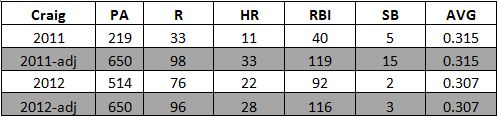
In fact, look what Craig’s last two seasons could’ve been with a full allotment of plate appearances:

Allen Craig 2013

The only real difference between those two adjusted seasons is the stolen base total.  That is about the furthest thing from the mind of someone drafting him so even if he does manage a full season of playing time and only steals a couple bags, it doesn’t dent his value.

Take the average of the other four numbers (97, 30, 118, .309) and over the past two seasons only two players have hit all four benchmarks: Kemp in 2011 and Miguel Cabrera this year.  Of course, these are just theoretical thresholds for Craig as he hasn’t yet proven the health piece, but the production in four of the five standard categories is excellent and definitely worthy a high pick especially as first base thins out a bit at the top.

Known as a position of depth, there were far few elite level options in 2012 compared to 2011.  Using ESPN’s Player Rater, it took 6.9 rating to make the top 50, which I think we could all agree is the upper echelon of offensive players.  Of that 50, only nine were first basemen.  Of those nine, four were no doubt not utilized primarily at first with Cabrera and Edwin Encarnacion qualifying at third base while Posey and Joe Mauer are best deployed at catcher.  Adrian Gonzalez is on the fence as a first base/outfield qualifier, but we can leave him at first.

In 2011, the top 50 threshold was at 6.7 on the Player Rater and 12 of those were first basemen.  Of those 12, only Michael Young (third base) and Mike Napoli (catcher) were best deployed at another qualifying position.  Lance Berkman and Michael Morse were like Gonzalez with their outfield qualification.  I definitely didn’t tab Craig with an early selection with the thought of position scarcity front of mind, but it shouldn’t be ignored, either.  Craig also carries the dual eligibility in the outfield adding flexibility to the pick, too.

Craig has been one of the best hitters in baseball the past two seasons ranking 17th in OPS+ among batters with 700 or more plate appearances.  That is my primary reason for selecting him where I have been; he’s a great hitter.  Additionally, in order to put up an elite season, he isn’t waiting on talent develop, rather he needs his body to cooperate.  While that certainly isn’t a given, it is a much sounder investment than betting on someone’s talents to shine through or for them to “get it”.

*Craig logged the ninth-highest total at 22, but there were players tied at 30 and 23 leaving 11 players with more homeruns than him. 

Tuesday: 10.2.2012

Down Ballot MVPs: Yoenis Cespedes

Let’s talk AL MVP.

No, not that MVP battle.  I am talking about the next tier, the down ballot candidates.  I realize that most people probably don’t care about the also-rans in an MVP race, but I actually do care because I like seeing guys recognized for their big seasons even if they weren’t quite the best.  There is no financial benefit (that I’m aware of) and no one but the encyclopedic fans with incredible memories will remember the 7th-place finisher in a given year, but I’m sure it is special for the player to be given consideration for such a prestigious award.

Top 5 or top 10 finishes in the MVP do get thrown around when it comes to Hall of Fame discussion, too, so it is important that the “right” guys get their due.  I put right in quotes obviously because there is no single right answer.  For one, fans really only care that the writers get the winner right.  After that, most couldn’t care less.  There were 22 players who got votes in the American League last year and 23 for the National League so the ballot runs deep.  For this series, I am pointing out guys I want to see in that upper range, say top 5-7.

Over the next few weeks, I’ll profile some of my favorite down ballot candidates in each league.  In the American League, these guys are fighting for third place and beyond.  I can’t envision any scenario where Mike Trout and Miguel Cabrera aren’t first and second in some order.

Let’s start out west:

Yoenis Cespedes (OAK, OF) – How great has he been this year?  In just about any other year he is a walkaway Rookie of the Year, but he picked the Year of Trout for his debut.  Not only did he deliver the power and speed that was expected from him based on his elite athleticism (23 HR; 16 SB), but he also hit .291 with a .353 on-base percentage, both higher than anticipated by a significant margin.  He was expected to be among the freest swingers, but his 19% strikeout rate was 31st in the AL among those with 500+ plate appearances.  Adam Dunn paced the league at 34%, easily taking the MLB title, too.  Cespedes was nowhere near the 25%-30% range that made up the rest of the top 10.

When you talk about value, there is a desire to get the heart of how a singular player impacted his team.  Now that is difficult to quantify, but the methods in place look kindly upon Cespedes.  First off, the A’s were 80-47 when he was in the lineup (an incredible .630 win percentage) and just 12-21 (.364) when he was sidelined.  Obviously crediting one of 25 as the sole reason for those splits in record is a bit outlandish on par with pitchers and quarterbacks getting far too much credit for wins and taking too large a hit for losses.  It does at least begin to show how important he is to that team, though.

If you lean more into the sabermetric sect, you might be interested to know that he has a 3.81 Win Probability Added (defined here) in his 127 games.  That is good for 7th in the American League (for the record, Trout had a massive lead at 5.61 and he has played just 10 more games than Cespedes).  These two have squished a lot of WPA into smaller sample sets than the others in the top 10.  On that definition page, it defines a 3.0 or better as great which coincidentally covers the entire top 10 in the AL as Adam Jones rounds it out at 3.04, just ahead of 11th place Billy Butler’s 2.85 mark.

Fangraphs also has a Clutch statistic (defined here) in which Cespedes also grades out nicely with a 0.75 mark (where 0.5 is above average and 1.0 is great).  He actually kills Trout here who is at -0.53 which is below average by their scale.  Of those top seven in WPA, Cespedes is the 3rd-most clutch by that statistic.  Looking at his statistics in various states of leverage (defined by Baseball-Reference here), his quality clutch rating isn’t a huge surprise as he does his best work in High Leverage situations with a .349/.432/.651 line including six home runs, 28 RBIs, and six stolen bases in 74 plate appearances.  He also has eight walks against 11 strikeouts.  The strikeout tick upward to 49, but he also fares quite well in Medium Leverage situations with a .327/.388/.567 line with 10 homers, 34 RBIs, and seven stolen bases in 240 plate appearances.  He has a meager .682 OPS and .230 batting average in Low Leverage situations across 216 plate appearances.

He wasn’t the top WAR guys on the A’s thanks in large part to Josh Reddick’s incredible defense (though he was hardly a slouch with the bat), but I do think Cespedes was easily their best offensive player overall (combinations of Chris Carter, Brandon Moss and Johnny Gomes were better in various stats like OPS, OPS+, wRC+, and wOBA, but none of them played close to as much as Cespedes) while being a capable defender in centerfield (a premium position) and leftfield.  He essentially split his time down the middle between the two positions when looking at the innings.  He is older than most rookies (26), but he still exceeded expectations in his first year as a major leaguer and he is a major reason why the A’s are now playoff bound.

Saturday: 08.18.2012

On James McDonald

James McDonald had a better season in 2011 than his 4.21 ERA might lead you to believe.  While “breakout” might be a stretch as a definition, “breakthrough” probably works.  He labored through his first four starts in April posting a 10.16 ERA in 18.2 innings.  He threw six shutout innings against the Giants on April 27th and took off from there with a 3.49 ERA in his final 152.3 innings of the season.  Even trimming those first four starts from his record, he still had his flaws in 2010, specifically walks (3.9 BB/9 in the 152.3 IP) and home runs (1.1 HR/9).

He started his 2012 season off much better with a 2.97 ERA in April.  And he only got better from there.  After seven innings of one run ball on July 7th against the Giants (with 10 Ks and 0 BBs), his season ERA was down to 2.37 and he had 100 strikeouts in 110 innings.  More importantly, his walk rate was at 2.5 BB/9 and he allowed just 0.6 HR/9.  In other words, he was having his breakout season.  Then the wheels came off.  A rough start in Milwaukee wasn’t really any reason to panic.  After all, everyone has an off day.  Even his six earned run outing in Colorado that followed wasn’t ringing alarms because Coors has destroyed pitchers all year.

But when he followed those two outings with two more awful ones against the likes of the Cubs and Astros, panic set in.  He bounced back with a baseline quality start (6 IP/3 ER) in Cincinnati to start August, but then got torched for seven earned in just four and a third at home against the lowly Padres.  For those keeping score at home, that’s three duds out of four against three of the worse offenses in all of baseball.

All told, he posted an 8.71 ERA in 31 innings across six starts pushing his ERA up nearly a run and a half (from 2.37 to 3.77).  He still has 26 strikeouts (7.6 K/9), but also had 21 walks (6.1 BB/9) and eight (!) home runs (2.3 HR/9).  His only homer-less outing in the stretch was the one in Cincinnati against the Reds.  So what happened?  Obviously his old issues came back to haunt him and wiped away a lot of the good work he had done in his breakout season.  Let’s see what the data tells us.

VELOCITY

The first place most people look when a pitcher is struggling is the radar gun.  Has his velocity changed significantly?  If so, why?  Oftentimes a major velocity dip will signify a dead arm period or perhaps even a more severe injury that the pitcher is trying to work through on his own.  With McDonald, there was no such change whatsoever with his fastball.  His breaking pitches saw a velocity change, but they both increased.

In short, velocity wasn’t the root cause of his issues.  The added speed to his breaking pitches might’ve flattened them out a bit and robbed them of some effectiveness, but his fastball velocity holding firm means he was likely plenty healthy and that there was some other reason for his ineffectiveness.

FASTBALL

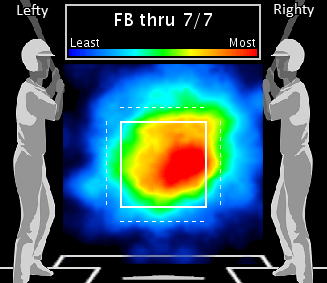
We looked at the velocity splits of his fastball from when he was on as compared to his run of bad starts.  However, we know that velocity isn’t the only thing that makes a fastball effective.  In the major leagues, even the hardest fastball has to have some wiggle or be placed perfectly otherwise it will eventually be caught up to and subsequently tattooed.  The movement on McDonald’s heater didn’t vary much in the two samples which leaves his command.  Was there is a difference in placement, specifically within the zone, of his fastball between his good and bad runs?

He was actually in the zone more during his hot stretch (56% to 52%), but look at how red it is down the middle of the zone during his poor stretch.  No wonder batters went from a .707 OPS on plate appearances that ended on a fastball up to 1.092 while striking out less (12.3% to 9.4%) and hitting more home runs (1.7% to 6.7%).  Hitting the fat part of the zone more often made hitters more aggressive and cut into his called strike percentage on the pitch, too, going from 33% down to 27%.

These fastball issues explain a lot of what went wrong for McDonald.

BREAKING PITCHES

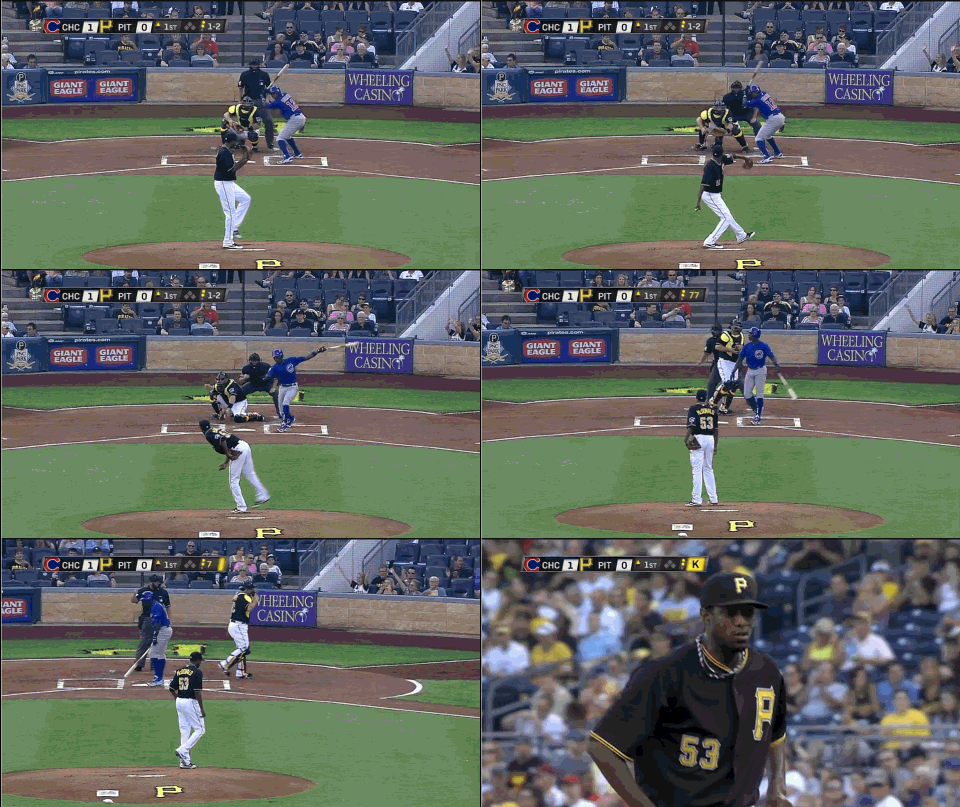
The curveball went from overwhelmingly dominant to very good and from what I saw it was because he would lose it for stretches at a time.  For three innings it would look as sharp as it did in April through early July when it yielded an absurd .291 OPS and 34 strikeouts in the 79 plate appearances that ended on the pitch and then all of a sudden it would start flattening out in the fourth without warning.

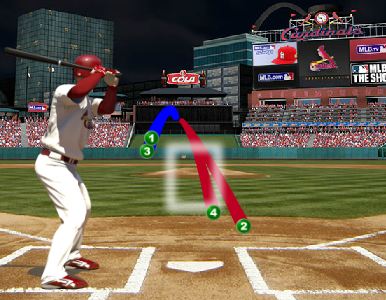
I don’t think I have the eye or general know-how to say why or explain what was going on with his mechanics when it went from good to bad.  I know a ridiculous, devastating curveball when I see one and I know a hanger that will be crushed by a historically bad hitter* against breaking balls.  Exhibits A & B:

*Soriano has a paltry .595 OPS against curve since 2009

FRIDAY NIGHT IN ST. LOUIS

Given his recent trajectory, it was difficult to be psyched about McDonald heading into St. Louis for the series opener Friday night.  They simply crush everybody even as they seemingly have three or four starters on the disabled list at any given moment.  Alas, that’s why they play the games.

McDonald was excellent against the Cards getting back to what made him so successful for the first three-plus months of the season.  His fastball command was the best it’s been in weeks while his breaking stuff was just dominant.  Four of his seven strikeouts came on breaking balls (2 apiece for the slider and curve) and 23 of his 36 breaking balls went for strikes including nine called strikes (six on the curve).  He ended up throwing six scoreless allowing just two hits and walking three.


He walked Jon Jay on five pitches to start the game and it was hard not to think, “oh boy, here we go again”, but he then induced a double play out of Allen Craig and a groundout from Matt Holliday to avoid any trouble.  His other two walks both came with two outs.  The sixth inning walk to Craig came on four straight balls with nobody on and perhaps he was pitching around him since Craig came into the game 3-for-8 with a double and a homer off of him while Holliday was just 2-for-9 with three strikeouts.  Yes, I realize there is very little difference between those two minuscule samples and I don’t even know how often pitchers work on that level especially with such short samples against both, but it’s simply a (halfhearted theory).  It could just be that he threw three lame pitches and one close one to Craig.

This was a very encouraging outing against a great opponent on the road so hopefully it spurs McDonald to be his April-early July self the rest of the way.  In fact, it is imperative to the team’s success that he is that version at least skills-wise even if the ERA is closer to 3.37 than 2.37.