Archive for ‘Statistical Analysis’

Thursday: 01.31.2013

Countdown to Spring Training: 22 Days – Adrian Beltre

Only 22 days until live game action…

With 30 days to go, I started profiling a hitter per day highlighting one from each team. I selected my player of note from each team and then randomized them (which was pretty interesting consider who the final two were after the randomization) so that’s the order I’ll be following.

ADRIAN BELTRE

For today’s countdown piece, I’m going to do things a bit different. With Adrian Beltre, I’m going to offer 22 stats about him to celebrate the 22 days left until game time. He’s been excellent and yet somewhat underrated recently both in “real” baseball and on the fantasy landscape.

  • Since getting out Seattle (where he was criminally underrated), he his 19.1 fWAR is second among third basemen to only Miguel Cabrera. Considering Cabrera has played third base just one of those three years, I think it is fair to declare Beltre the best overall third basemen by fWAR since 2010.
  • His 19.1 fWAR also lands him fifth on the overall list behind only Cabrera, Joey Votto, Robinson Cano, and Ryan Braun.
  • His fielding is no doubt aids his lofty ranking, but his 138 wRC+ is the 13th highest total in the same span (and sits 17th after factoring in ties) so it’s not like he’s been anything but spectacular with the bat, too.
  • Over at Baseball-Reference, he rates 4th overall in the 2010-2012 time period with a 19.7 bWAR topped by three of the four from the Fangraphs list. This time Cano sits atop the list followed by Cabrera and then Braun.
  • He is pacing the position in all three Triple Crown categories the last three years with 96 home runs, 309 RBIs, and a .314 batting average. He leads by four in home runs over Mark Reynolds, by 28 in RBIs over Aramis Ramirez, and by 19 points in average of David Freese.
  • For good measure he’s also leading in runs with 261 over David Wright (238)…
  • …and doubles with 115 over Ramirez again (106).
  • His last season in Seattle was really the only dismal one despite the entire tenure often being thought of as a bust because he never reached the heights of his .334-48-121 season in 2004, his last year with the Dodgers. Even factoring in the 8 HR/44 RBI swan song in Seattle, he still averaged 21 HRs and 79 RBIs per season with a 162-game average of 24/90.
  • Imagine if he hadn’t been stuck in Safeco Field for half of his games those five years. He hit a paltry .252/.304/.411 in 1595 plate appearances in his home yard.
  • That park remains hell on righties with an 84 park factor for doubles/triples and a 70 park factor for home runs. Only singles are favorable for righties at a modest 102.
  • Since transitioning out of Seattle and into a pair of favorable home ballparks the last three years, Beltre is averaging 32 HRs and 103 RBIs with a 162-game average of 36/116.
  • Not mention his average has risen from .266 to .314 the last three years.
  • He’s handled his early 30s like an all-time great. His 19.7 bWAR is the 7th-best age 31-33 WAR since 1970 and the 12th-best since 1940. He even tops Rickey Henderson and Alex Rodriguez, who tied at 19.6 apiece.
  • The greats to top his 19.7 since 1940 include: Willie Mays (31.1), Joe Morgan (25.9), Barry Bonds (25.3), Roberto Clemente (24.8), Jackie Robinson (24.5), Hank Aaron (23.5), Stan Musial (22.1), Mike Schmidt (21.3), Sammy Sosa (21.1), Craig Biggio (20.6), and Pete Rose (20.2).
  • Beltre’s 985 OPS versus righties in 2012 was 5th-best in MLB.
  • His .609 slugging percentage versus was 3rd-best as were his 30 home runs.
  • His 965 OPS in the second half of 2012 was the 8th-best in baseball and that’s with a 697 OPS in July.
  • Beltre tied Kyle Seager for the major league lead with nine home runs on 1-0 counts. Don’t get behind to these guys or they will attack.
  • Surprisingly, his 1448 OPS in those 1-0 counts was only 7th-best last year. Nick Swisher had an insane 1995 OPS including a .605 batting average.
  • But if Beltre got way ahead, he wasn’t as effective. On 2-0 counts he hit just .167 with a 333 OPS. Of course part of that is because of the meager 18 plate appearance sample. So it’s probably better stated that if he got way ahead in a 2-0 count, he wasn’t as aggressive.
  • Any plate appearance where he was ahead, he had a .405 batting average with a beastly 1274 OPS and 15 of his 36 home runs.
  • His 17 home runs with men on tied him for 4th-most with five other players including Cabrera, Braun, Chase Headley, Josh Willingham, and Alfonso Soriano.

These facts aren’t intended to inform you that Beltre is a good player. You already knew that. Instead, they should help you realize that you’re watching a generational talent. He is building a legitimate Hall of Fame case and if that fact has been lost on you to date, well, now you know and you can appreciate the greatness you’re watching at a premium defensive position.

Additionally, these gaudy statistics may help you figure out the answer to the question, “Who should I draft near the end of the first round in my draft this year?” Especially if you are in a bigger mixed league that runs 14+ teams deep, but even you 12-teamers should give him legitimate consideration. Third base isn’t the sinkhole it was a few years ago, but it is a still a premium infield position and filling it with a superstar is a great way to start your team. Hell, Evan Longoria has maintained the lofty draft status without coming close to Beltre’s numbers the last three years. I understand why people are lured in by his potential, but maybe you’d do better with Beltre’s consistency over Longoria’s promise.

Wednesday: 01.30.2013

Countdown to Spring Training: 23 Days – Todd Frazier

Only 23 days until live game action…

With 30 days to go, I started profiling a hitter per day highlighting one from each team. I selected my player of note from each team and then randomized them (which was pretty interesting consider who the final two were after the randomization) so that’s the order I’ll be following.

TODD FRAZIER

Todd Frazier, drafted 34th overall out of Rutgers in 2007, hit immediately as a pro posting a 943 OPS in a 47-game stint after the draft earning him the #5 spot on the 2008 Reds Top 11 prospect list from Kevin Goldstein. He went two levels per year in 2008 (Single-A, High-A) and 2009 (Double-A, Triple-A) holding his own at every stop earning the #2 spot in 2009 and #3 spot in 2010 on Kevin’s lists. He only had 16 games in Triple-A in 2009 so he needed more seasoning there and despite the fact that he was being used all over the diamond in the minors, the Reds were locked up at every one of his eligible positions leaving him in Triple-A for the entire season.

He wasn’t exactly dominating Triple-A on the stat sheet in 2010 or 2011, but he was clearly ready to be tested at the major league level yet he still logged another 90 games with Louisville before finally getting the call. His 41-game showing wasn’t too bad as he showed some pop (.438 slugging), but little else (.232 average, 5.8% BB rate) and thus couldn’t earn an Opening Day roster spot last year. Thankfully it took just 10 games in Triple-A before he was up with the big league club for good.

He had a strong rookie season (only 121 PA in 2011) showing even more power than we saw in 2011 (.498 slugging percentage), but also an improved average at .273 and a jump in discipline with a 7.7 percent walk rate. His season would’ve been great had he avoided the wall in September during which he hit just one homer with five RBIs and a 491 OPS. In fact, he had a 900 OPS through August.

frazierOPSmonth

He is slated to open the season at third base batting sixth and I think he can top his 2012.

First, he was an old rookie at 26-years old so while I’m often careful to point out that youngsters aren’t guaranteed to progress in a linear fashion, his case is a bit different than your average 23-year old who hits the ground running. He’s logged 1007 plate appearances in Triple-A and another 586 at the major league level in the last three years with a combined line of .262/.333/.465 and he’s actually been better as a major leaguer with an 808 OPS compared to 788 in Triple-A, so this isn’t a young pup in need of high level reps. He is pretty close to a finished product. There is still some more growth in his plate discipline as I believe he can be a 10+ percent walk rate guy at his peak, but his 7.7 from last year was right at league average for third basemen.

The power is the calling card in his bat and a near-.500 slugging percentage at the position is elite as only Miguel Cabrera (.606), Adrian Beltre (.561), and Aramis Ramirez (.540) topped the mark. He wasn’t just feasting off of that friendly home park, either. In fact he had a .526 slugging percentage on the road compared to a .469 in Cincy and his home run totals were nearly identical (10 home/9 road). There is 30-homer upside in this bat. The .273 batting average we saw last year is likely a ceiling of sorts, but that’s not why you’re getting him.

Pay for the power and enjoy the hidden speed as well. He had just six total stolen bases between Triple-A and the majors last year (including a meager 3-for-5 in MLB), but 17 the year before (in just 90 games) and 14 in 2010. He had a rough start to his pro career from a success rate standpoint (24-for-41, 59%), but since then he’s been excellent with an 86 percent success rate (38-for-44) the last two years between his Triple-A and major league work. There is a lot of value in Frazier’s profile especially compared to the investment.

Go the extra buck.

Tuesday: 01.29.2013

Countdown to Spring Training: 24 Days – Jose Bautista

Only 24 days until live game action…

With 30 days to go, I started profiling a hitter per day highlighting one from each team. I selected my player of note from each team and then randomized them (which was pretty interesting consider who the final two were after the randomization) so that’s the order I’ll be following.

JOSE BAUTISTA

It will be a quicker countdown entry today which actually works out quite well because Bautista isn’t someone in dire need of a deep-dive analysis. We know he is a power stud coming off of his two amazing full seasons of MLB-leading home run totals in 2010-2011 plus another 27 in 92 games during an injury-shortened 2012. The common analysis after 2010’s insane breakout was that his HR/FB was aberrational to his career levels so he was sure to come down. The problem with analysis isn’t projecting regression after an amazing season, it’s the certainty with which it’s done.

Granted this is easier to do in hindsight, but I’ve always had an issue with guaranteeing regression on a new level of performance. Again, it is a safe bet gravity being what it is and all, but speaking in absolutes has no real upside. He was “sure” to regress in 2011 and while he gave back 11 home runs, he added 42 points of batting average up to .302 and 68 points of on-base percentage up to .447 while actually improving his HR/FB rate from 21.7 to 22.5 percent. What changed to yield the performance is the first question you should ask before instantly declaring it will regress and moving on.

For example, his 2011 batting average stood out almost as much as his 2010 home run surge. After all, his flyball-heavy batted ball profile isn’t exactly conducive .300 batting averages. Of the 74 players to hit .300 or better since 2010, only Bautista did it with a flyball rate north of 45 percent. Only three others were at 44 percent. The average of the set was about 35 percent and 60 players were on the other side of 40 percent.

His .260 in 2010 was just above league average (.257) and his .241 last year wasn’t too far from league average (.255) so what happened in 2011? First off, he shifted the mix on his batted balls a bit taking from the flyballs and adding to both the line drive and groundballs. Secondly, he just smacked the ever-living-piss out of the ball year long, especially compared to league average.

bautista2011bbavg

His .309 BABIP compared to the league mark of .295, but given his batted ball profile compared to league average, it isn’t out of bounds to suggest he also had some good fortune. But when you barrel up the ball and smack rockets all over the place, you’re bound to create some of your good luck.

His dip back down to .241 last year wasn’t terribly surprising as he took a bit from 2011’s line drives and padded his flyball rate again back up to 49 percent. His batted ball profile as it stands over the last three years is far more conducive to .250 batting averages than .300 ones so prepare yourself for that and take anything else as an added bonus.

The worst part about last year’s left wrist injury that effectively ended his season in mid-July is that he had just ripped off nine and 14 home run months in May and June after a mere three in April. While he’d only had one in 12 July games, I was really eager to see what he had in store for us during the dog days of summer.

Over his three year explosion into superstardom, Bautista has posted a composite HR/FB of 21.6 percent, fourth in baseball behind Giancarlo Stanton (25.8), Mike Napoli (23.1), and Ryan Howard (22.3), but his 50.6 flyball percent and 15 percent infield flyball rate are the highest among anyone in the top 30 of HR/FB rate. What that tells me is that he’s selling out for power all day, every day. The 15 percent infield flies are likely a lot of “just missed” missed pitches that fall harmlessly into the shortstops glove on the back of the infield and contribute to his .256 BABIP during that time which is second-lowest among the top 10 in HR/FB (Andruw Jones .244) and third-lowest overall (Carlos Pena .251).

That is the long way of say that all the data suggests that 2011’s .302 really was an aberration and likely one of epic proportions. To repeat the feat, he will likely need to dramatically shift his hit profile or find the double rainbow for a second time. I have seen Bautista go as high as the late-first round. I’m not vehemently opposed to the idea as long as you realize you’re investing in a pure power source and not trying to rationalize the pick by saying, “well, he’s only a year removed from a .302 average so I have that upside, too.”

Sure, technically you do as one a skill is displayed it is owned (Shandlerism!), but you also have to understand the probability of said skill returning once gone and with Bautista, as his skills are currently constructed, chances are scant. There have been just 10 seasons of 40+ homers the last three years and he owns two including the best (54) and third-best (43) and he was on pace for a third which would’ve extended his 12 home run lead over Miguel Cabrera (124 to 112) for the most in the majors during that span. So if you are drafting him for that bankable power and understand his deficiency with batting average, then by all means proceed with your pick.

Monday: 01.28.2013

Countdown to Spring Training: 25 Days – Kyle Seager

Only 25 days until live game action…

With 30 days to go, I started profiling a hitter per day highlighting one from each team. I selected my player of note from each team and then randomized them (which was pretty interesting consider who the final two were after the randomization) so that’s the order I’ll be following.

KYLE SEAGER

When you look at Kyle Seager’s 2012 line of .259/.316/.423, you jaw will most certainly stay firmly in place. There is nothing particularly special about those rate stats and while they were above average (110 OPS+, 108 wRC+), they don’t lead many to identify Seager as a hot fantasy commodity. Shifting over to his counting stats changes the equation a bit as his 20 home runs, 86 RBIs, and 13 stolen bases were all top 10 at the position (note: he was tied for 10th in home runs with David Freese and Mike Moustakas). All of a sudden he is a bit more appealing.

Now imagine if he weren’t stuck in the anti-Coors? Though Seager bats left-handed and southpaws generally fare better at Safeco, he couldn’t wait to leave town. He was an All-Star on the road as his 126 wRC+ outside of Seattle was just a tick behind Adrian Beltre’s 127 and sixth-best among third basemen. He was essentially an American League Chase Headley. Headley finally found a way to do some damage in Petco Park this year en route to an amazing season, but he still led all third basemen with a 154 wRC+ on the road and he has a career 695 home OPS compared to 836 on the road.

Seagerhm-aw

Ouch, that is rough. He gets 75 percent of his home runs and 70 percent of runs batted in on the road. He does his best to bring something to the table at home by walking twice as often and steal more than three times as often, but that can hardly paper over his incredible home struggles. I’m 89 percent certain that Seager was on site, hard hat in tow, helping the construction crews bring in the fences at Safeco.

For those wondering, this isn’t a one-year thing, either. He only had 201 plate appearances in 2011, but 91 of them were in Safeco and they were terrible: .188/.256/.263 with zero home runs. Meanwhile in his 110 on the road he posted a .314/.358/.471 with three home runs. Remember how I mentioned earlier that Safeco Field doesn’t kill lefties on home runs nearly as much as righties? For those who didn’t click, it’s a 91 HR park factor for lefties compared to a 70 for righties.

That is borne out in Seager’s numbers as well. All five of his Safeco home runs (which all came in 2012) were pulled. In fact, to right and right center fields Seager is excellent at Safeco over his career with a .339 average, 901 OPS, and those five bombs. His .565 slugging percentage also includes 13 doubles. If he is doing that well to the pull field, can you imagine how bad it is when he goes opposite field? You may want a barf bag nearby.

When going to leftfield in Safeco, Seager’s line is an abysmal .195/.191/.248 in 117 plate appearances. He actually improved in 2012. After a 312 OPS–yes OPS, that would be a horrible on-base percentage–in 2011, he jumped all the way up to 482 a season ago. He is being especially obliterated when he tries to “go with the pitch” on the outer third of the zone and just outside the strike zone hitting just .152 (9-for-59) in those instances.

seageroppo

(click to enlarge)

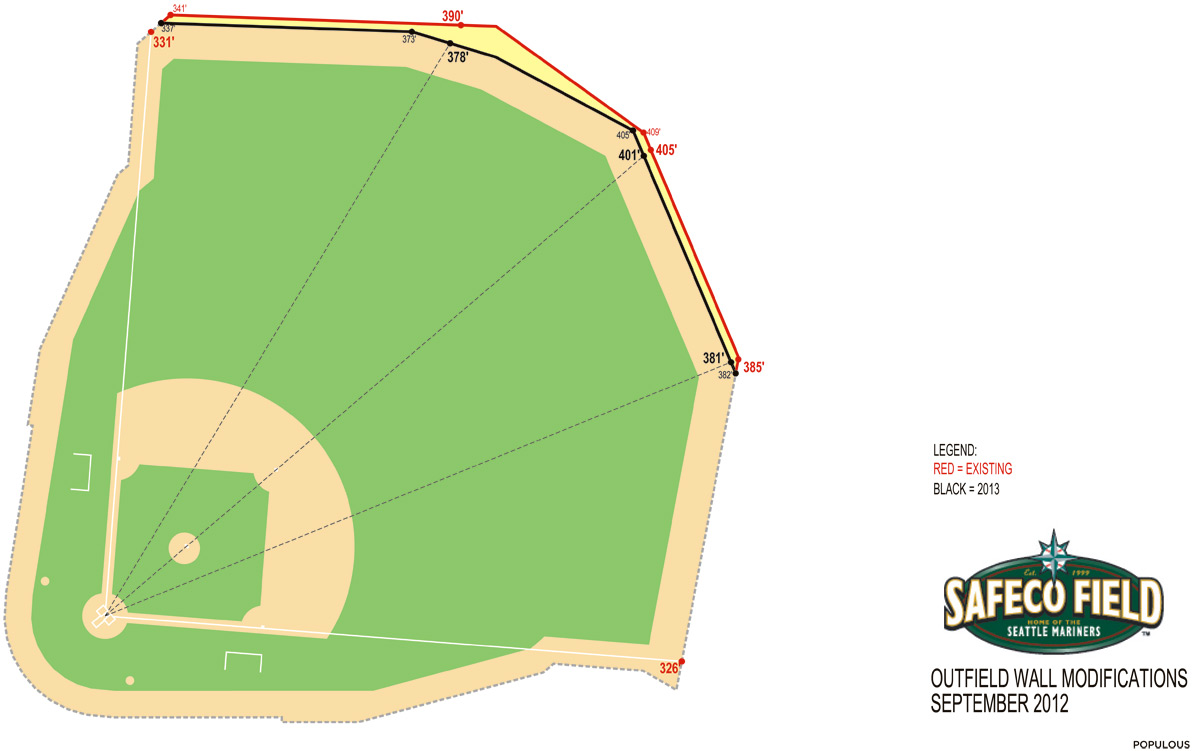
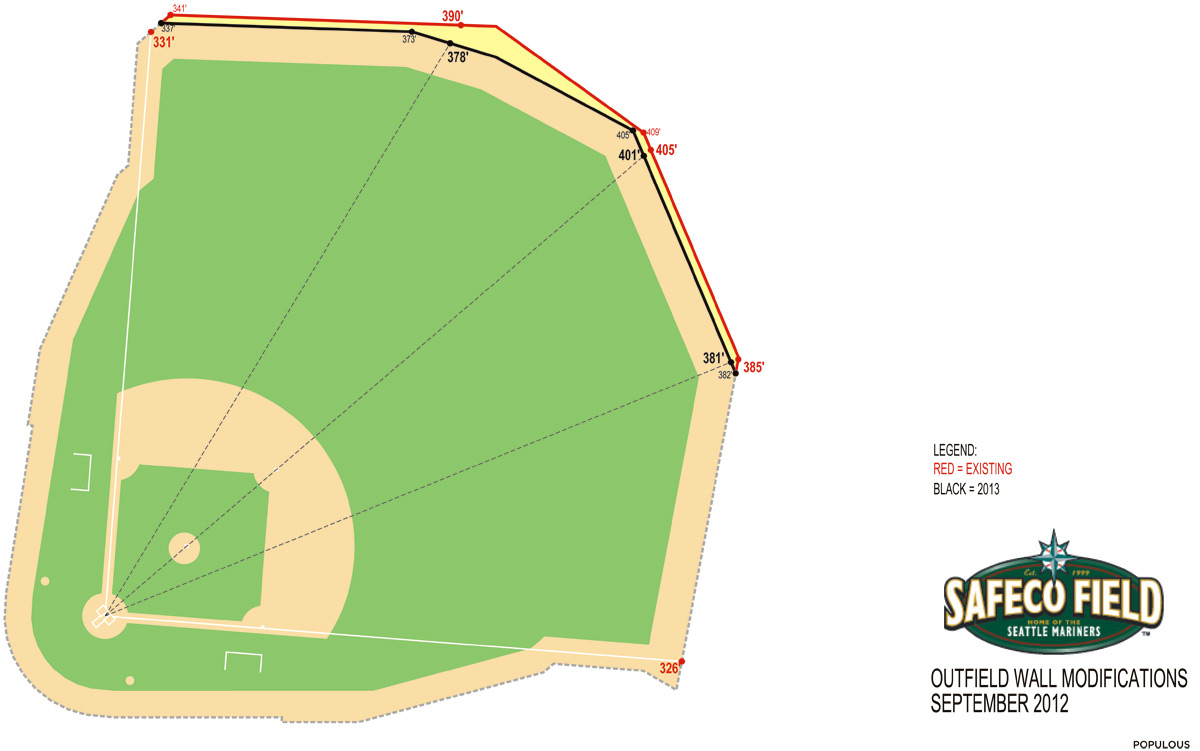
Now we ask the obvious next question as we did when discussing Yonder Alonso: how much might the moved in fences help this issue? Thanks to SportsPressNW.com, we can look at a very nice picture of the new dimensions and we see a 10-foot move in the leftfield corner, a big jump of about 12-15 feet in that leftfield power alley, and some minor moves in center and right centerfield.

safeco-dimensions

(click to enlarge)

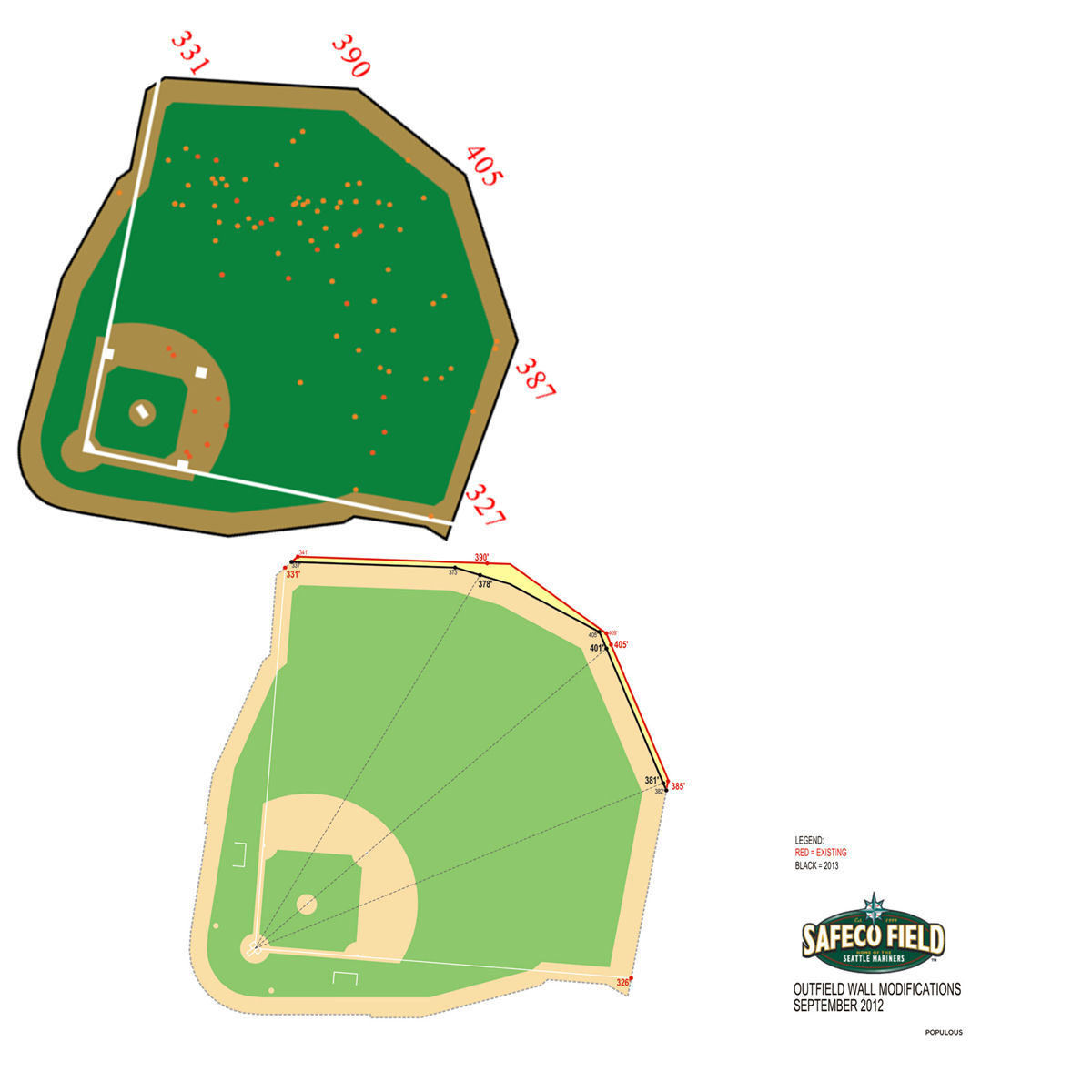
Using the Katron.org spray chart from 2012 for Seager and comparing it against the new Safeco, it doesn’t look like his current batted ball profile is set to gain massively from the move. The dots are his flyouts (lighter orange) and lineouts (darker orange). None of his doubles were anywhere near the edge of the wall so they weren’t included.

seagerspraycomp

(click to enlarge)

But as I mentioned with Alonso, this is also assumes he will have the same batted ball distribution again in 2013 and that isn’t happening. It is worth looking at though because if we saw that Seager was dotting the warning track time and time again to leftfield, we would have reason to be quite optimistic with these moved fences because even if he didn’t have the same exact distribution, he would likely hit at least a few out that way again and they’d be more likely to sail over and into the stands.

Seager, like many young left-handed batters, also struggles against lefties. Those problems, as you might guess, are you really exacerbated at home. He has a 646 OPS against lefties as a whole for his career (compared to 766 against righties), but that drops to 545 at home while sitting at a formidable 748 on the road. Another hallmark of youth is struggling with off-speed stuff and that is mostly how lefties handle him at home.

We’re slicing the data pretty thin at this point, but this is at home versus lefties by pitch:

  • Fastball: .253 AVG, .333 SLG, 14% K, 10% BB in 89 PA
  • Curveball: .176 AVG, .353 SLG, 37% K, 11% BB in 19 PA
  • Slider: .130 AVG, .130 SLG, 21% K, 0% BB in 24 PA

None of these samples are big enough to mean a ton, but it’s all we have to work with right now. These thin slices of the data won’t stabilize for some time, but there is no denying from his larger samples that Seager struggles in Safeco, with lefties, and in Safeco with lefties. The moved in fences will likely add more relief via placebo effect than in improved numbers, but Seager is just 25 years old so he still learning. If he focuses on improving against lefties regardless of venue, that will drive his biggest net positive.

As long as he continues to steal bases, his fantasy value will remain substantial aided by his 81 road games where he does his best work. Given his age, above average composite work in 2012, and the fact that the M’s just don’t have a viable backup worth sitting Seager for, he should hold the job for the duration of 2013 giving him a chance to tackle those lefty issues. He is currently slotted in the 3-hole of their lineup which is always a good thing, even in a down lineup like Seattle’s.

I love Seager as a corner infielder in a mixed league especially if you end up with a superstar 3B early on. His price could be on the rise by the time draft season hits in AL-only leagues as it thins out quickly after the superstars (Beltre, Miguel Cabrera, and Evan Longoria) and moves into the youth bracket with Seager, Moustakas, Brett Lawrie, and Will Middlebrooks.

Saturday: 01.26.2013

Countdown to Spring Days: 27 Days – Yonder Alonso

Only 27 days until live game action…

OK, so the first actual Grapefruit or Cactus League game doesn’t take place until February 22nd, but the Red Sox are splitting up their squad and playing a couple of colleges on February 21st so we’re just 30 days away from organized professional baseball. So why not a countdown of this final, grueling winter month that includes some fantasy analysis?

Obviously my primary focus at this site is on pitchers and you’ll get quite a bit of my analysis on them in late February when the SP Guide drops, thus I was thinking of something surrounding hitters. With 30 days to go, I am going to do a hitter per day highlighting one from each team. I selected my player of note from each team and then randomized them (which was pretty interesting consider who the final two were after the randomization) so that’s the order I’ll be following.

YONDER ALONSO

Coming up in the minors, Yonder Alonso had a perfect comp: Sean Casey. It was fitting for a bevy of reasons: he was a Reds farmhand (the team Casey spent eight of his 12 years with), he batted left-handed, had high batting average potential (Casey hit .300), and had a power ceiling in the low-20s (Casey reached 20+ three times, topping out at 25). Comps are should never be used as 1-to-1 gauges, but if you wanted a good idea of what to expect from Alonso as a pro, Casey was a great place to start.

Then he was traded to San Diego.

He moved from one of the best home run parks for lefties to that absolute worst. The Great American Ballpark has a 137 park factor (where 100 is average) for left-handed hitters when it comes to home runs. Only Coors Field is better in the National League checking in with a 150 park factor. Meanwhile, San Diego’s Petco Park has a frightening 61 park factor. Alonso suffered the consequences immediately. In his first full season, he hit just nine home runs in 619 plate appearances including a whopping three at home. Edwin Encarnacion hit nine home runs.

In May.

Alonso was fourth among qualified first basemen in doubles, though, hitting 39. His power manifests itself in line drives as his 24 percent mark was fifth-best among qualified first basemen, but his 31.3 percent flyball rate is easily the lowest among quintet (next lowest was Prince Fielder’s 33.3 percent). Part of that is his game and part of it is his adjusting to what Petco Park will give him. Here is his 2012 spray chart:

spraychart

This is a full spray, home and away, but Alonso clearly leans away from the pull outfield and I bet it would be even starker in a home-only chart (which wasn’t available to me). He understands what he’s dealing with in Petco. His home slugging percentage is actually higher than his road (.398 to .389) because he popped 23 of his 39 doubles at home, but looking for pull power at home is a fool’s errand as a lefty Padre. He hit .290 with a .400 slugging percentage to rightfield at home, but those numbers jumped to .342 and .544 to leftfield.

Obvious next question is: Will the moved in fences help Alonso?

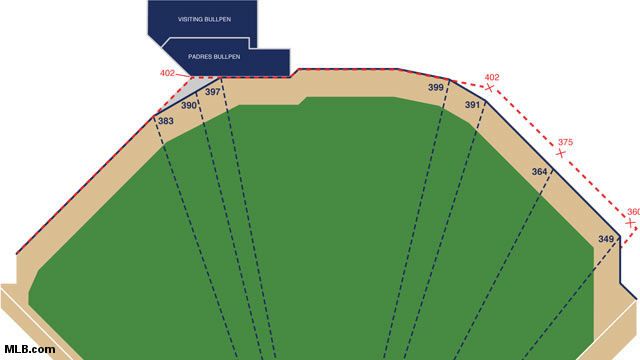
Well they should. They should ostensibly help every hitter, but I’m just being literal and anyone asking that question is actually asking how much they will help Alonso. There is no way to answer that question definitively, but let’s see if we can get some idea based on what he did in 2012. Thanks to MLB.com we know how the new fences will look once the renovations at Petco Park are finished:

petconewfence

For those of you thinking that these changes will turn Petco into Coors Jr., I hope the above picture is a wakeup call. We’re talking about a handful of 9-11 feet moves which may result in a couple extra bombs for the team’s best players. The opposition’s best players will also get a little uptick, but Petco Park is still most definitely a pitcher’s park and the best place to utilize your marginal fantasy starting pitchers. Let’s take a look at Alonso’s outfield flyball outs in Petco last year and see if those extra 10 feet would’ve turned into much.

alonsofboutsI circled a pair of outs in red that look like they might be homers in Petco2. Of course, he’d have to have the same exact hit distribution in 2013 and I highly doubt guarantee that will won’t happen. What may happen, though, is that Alonso is less fearful of pulling the ball for some power thanks to the moved in fences. At the very least, hopefully the new dimensions bring even more doubles which would then likely translate into more runs scored and driven in.

Without improved production, it is hard to justify Alonso being selected in leagues with 12 teams or fewer, even as a corner infielder or utility. He checked in as the 61st corner infielder on ESPN’s Player Rater for 2012. It was his rookie year so I’m not necessarily slamming him for finishing so poorly among corner infielders, just stating it so you’re careful not to overvalue him as he was a blue-chip prospect. And it can’t all be blamed on his home ballpark because his 723 OPS and six homers on the road were far from special.

The 26-year old Alonso is entering his physical prime and now has 746 major league plate appearances under his belt. It isn’t unreasonable to expect him to show some improvement, especially for a guy who was expected to have .300+ capability with at least high-teens power, but expecting it all at once will likely leave you disappointed. Keep him on your watch list for a standard mixed league should you need an early replacement in April or May, otherwise draft him only in NL-only leagues.

ADDENDUM

This piece was supposed to come out earlier on Saturday afternoon before I left for the movies, but I messed up the scheduling of it. So in my haste to remedy that and get it posted before it was all of a sudden Sunday, I forgot to include an instructive graphic.

yonderhmrd

Look at how his power is all to the pull field on the road (as it is with most guys, of course). This backs up the notion that he knows what he’s dealing with when it comes to Petco Park so he’s content to try and pepper doubles to leftfield instead. It will really be interesting to see if the fence move, though slight, will coax Alonso toward the pull field a bit more at home and maybe yield some extra bombs.

Friday: 01.25.2013

Countdown to Spring Training: 28 Days – Hanley Ramirez

Only 28 days until live game action…

OK, so the first actual Grapefruit or Cactus League game doesn’t take place until February 22nd, but the Red Sox are splitting up their squad and playing a couple of colleges on February 21st so we’re just 30 days away from organized professional baseball. So why not a countdown of this final, grueling winter month that includes some fantasy analysis?

Obviously my primary focus at this site is on pitchers and you’ll get quite a bit of my analysis on them in late February when the SP Guide drops, thus I was thinking of something surrounding hitters. With 30 days to go, I am going to do a hitter per day highlighting one from each team. I selected my player of note from each team and then randomized them (which was pretty interesting consider who the final two were after the randomization) so that’s the order I’ll be following.

HANLEY RAMIREZ

After the unmitigated disaster that was 2011, it wasn’t going to take much for his 2012 to be considered a rebound and it was yet he was still a disappointment. While he wasn’t going 2nd overall like 2011, he still only dipped to 20th average draft position with a high of 12 and low of 26 according to Mock Draft Central. His 20-20 season with shortstop and third base eligibility wasn’t bad, but it didn’t earn that draft position back. ESPN’s Player Rater had him 63rd overall and 42nd among batters.

The problem was that there was virtually no rebound in his paltry .243 batting average from 2011. It went up to .257, but that’s barely a dent (8 hits over a 600 AB season) and he posted the second-worst BABIP of his career at .290 (up slightly from 2011’s .275). His batted ball profile was actually somewhat conducive to a batting average increase as he added 2.5 percent to his line drives, which have the best chance to become hits. His flyball rate rose continuing a three-year trend, and those are least likely to become hits. While his flyball rate only ticked up by 1.2 percent, his infield flyball rate jumped four percent and those are all but guaranteed outs.

His BABIP based on batted ball was league average all told (he was a little low on line drives, but high on grounders & flies) so we shouldn’t be too surprised that his .257 batting average was essentially on par with the league’s .255 average as a whole. He might’ve smoked a few more at-‘em balls than normal, but nothing that would leave you saying he was quite unlucky for the performance he was delivering on the field. Batting average is really what kept his 2012 from being a “Hanley” season considering 2009 and 2010:

hanley3year

Based on my rough math estimations, a .300 average would’ve boosted Ramirez to a tie for 11th among batters in the player rater with Adam Jones and vaulted him to 18th with Jones in the overall.

“Well ya, but he was playing a lot in that cavernous monstrosity that can gives your eyes an STD if you watch too many home Marlins games!”

*Bzzz* Try again.

Ramirez raked in Marlins Stadium as did the other two superstars on that team:

homemarlins

It appears that Ramirez’s batting average issues for 2012 fit under the Occam’s razor principle: he just wasn’t good enough. No logistical pretzels about this BABIP or that venue. He simply didn’t hit the ball well enough to earn a .300+ average. I mean, we’re really only talking about a hit a week here. Another 26 hits would put right at .300 (actually .2996688, but I think MLB would go ahead and give it to him) and that feels like a lot, but there are generally around 26 weeks in the season.

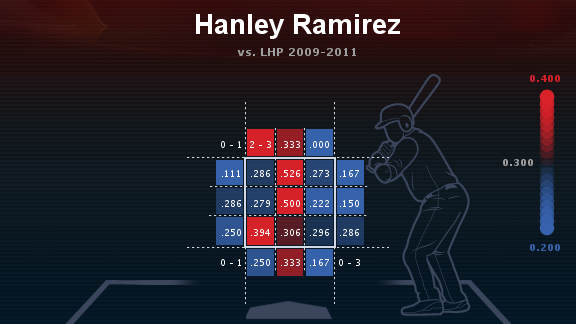
Where is going to get those hits in 2013? Ideally off of southpaws. For his two-plus seasons (92 G in ’11) from 2009-2011, he hit .305 off of lefties with a .339 BABIP. Those figures dropped to .263 and .293 in 2012. It wasn’t just one problem area either; they just handled him better than ever before. Though up and in and down and away do stand out a bit when comparing the two samples:

(click to enlarge)

(click to enlarge)

(click to enlarge)

(click to enlarge)

Ramirez remains a hot commodity for several reasons:

  • He has a track record of excellence so the potential to return to those levels is still present.
  • He is still on the right side of 30, adding to the likelihood of the first point.
  • He has dual eligibility at the hardest spot to fill (SS) and another premium infield spot (3B)
  • His “down” seasons are still 20-20 seasons with 92 RBIs. Well down seasons without injury.

Ramirez is solid “buy” target for 2013, even as a second round pick (though his ADP is a ludicrous 42 in early drafts** over at Mock Draft Central making him a huge bargain if that holds, but I doubt it will). High floors are a market inefficiency and they can sometimes be more important than a high ceiling for an early round pick. Especially if you subscribe to the notion that you can’t win your draft in the early rounds, but you can lose it.

**ADDENDUM

In the mock drafts I’ve done to date, Hanley has gone as follows:

  • 23rd overall in a 15 tm mixer w/OBP instead of AVG
  • 27th overall in a 15 tm mixer w/OBP instead of AVG
  • 21st overall in a standard 12 tm mixer
  • $31 dollars in a 14 tm auction standard 5×5

In other words: ignore that ADP because there is very little chance you’ll get him at that price.

Don’t forget the countdown continues on the weekend! 

Thursday: 01.24.2013

Countdown to Spring Training: 29 Days – Carlos Santana

Only 29 days until live game action…

30: Desmond Jennings

OK, so the first actual Grapefruit or Cactus League game doesn’t take place until February 22nd, but the Red Sox are splitting up their squad and playing a couple of colleges on February 21st so we’re just 30 days away from organized professional baseball. So why not a countdown of this final, grueling winter month that includes some fantasy analysis?

Obviously my primary focus at this site is on pitchers and you’ll get quite a bit of my analysis on them in late February when the SP Guide drops, thus I was thinking of something surrounding hitters. With 30 days to go, I am going to do a hitter per day highlighting one from each team. I selected my player of note from each team and then randomized them (which was pretty interesting consider who the final two were after the randomization) so that’s the order I’ll be following.

CARLOS SANTANA

If you just randomly poll some fantasy baseball managers asking them how Carlos Santana did in 2012, I think you’ll end up with answers suggesting it was a “down” or “poor” season. After all, he did drop nine home runs from his 2011 total, but the perception is likely built around the fact that he ended June with a .220 batting average and 673 OPS. It wasn’t so much that he got off to a poor start, either, he had an 863 OPS in April, but May and June were complete washouts as he put a 592 mark during the two months clearly playing at far less than 100 percent health and the concussion at the end of May certainly didn’t help.

In fact, from the concussion date (May 25th) to the All-Star break, he hit .172 with 527 OPS. With that in mind, how much more impressive are his final numbers of a .252 batting average and 785 OPS? The four days off served him well and he hit .281 with an 887 OPS the rest of the way. Throughout the year he continued to take his walks, but it felt like it was passivity during his May-June slump and he was missing worthwhile pitches opting for the free pass instead. That is based on probably 10-12 games of watching the Indians including some series against my Tigers so if you don’t want to lock that down in stone, I understand. Just letting you know what I saw.

Despite losing essentially two months where he was playing, but struggling majorly, Santana still had a very nice season. He sustained his OPS by raising his on-base percentage to account for the drop in slugging percentage. And he had just three fewer runs batted in despite 49 fewer plate appearances. Lost in the shuffle was the improved strikeout rate dropping from 20.2 to 16.6 percent while lightly boosting his walk rate from 14.7 to 14.9 percent.

Going into 2013, Santana is part a very deep catcher pool and analysts can’t seem to agree exactly where he belongs. There is plenty of established star power at the position with a handful of up-and-comers poised for breakouts, too. For me, he is an easy top three behind no more than Buster Posey and Yadier Molina, but the early rankings have him anywhere from two to seven:

It looks like drafters are following Steve Gardner at USAToday the most early on as his current average draft position has him as the seventh backstop off the board. In an OBP league, he’s easily behind only Posey, but most leagues still use batting average where he has a bit of a deficiency against righties. He is a switch-hitter who fares better against lefties, but he isn’t exactly crushing them, either. He had a .272 average against them last year which isn’t too far from his .278 career mark against southpaws.

An attribute to consider with Santana is his first base & DH playing time. It allows him to get those extra plate appearances that other catchers won’t accumulate and keeps some of the wear-and-tear off of him. This has allowed him to join Joe Mauer as the only two catchers with 600+ plate appearances the last two seasons. Meanwhile his 658 from 2011 is the second-highest total from a catcher since 2006 topped only by former Indian Victor Martinez who had 672 in 2009 with Cleveland and Boston.

Speaking of Martinez, he is another guy who deserves a boost because of playing time. He should still be catcher-eligible in any league worth its salt because of his 26 games there in 2011 when he last played and he won’t have to crouch at all in 2013. He should be the exclusive DH for the Tigers with maybe a couple of 1B starts mixed in to give Prince Fielder the proverbial half day off.

A healthy Santana can bring a .275-90-30-100 season to the table. And yes, I do think he can reach 100 RBIs with Michael Brantley, Jason Kipnis, Asdrubal Cabrera, and Nick Swisher ahead of him in the lineup.

Wednesday: 01.23.2013

Countdown to Spring Training: 30 Days – Desmond Jennings

OK, so the first actual Grapefruit or Cactus League game doesn’t take place until February 22nd, but the Red Sox are splitting up their squad and playing a couple of colleges on February 21st so we’re just 30 days away from organized professional baseball. So why not a countdown of this final, grueling winter month that includes some fantasy analysis?

Obviously my primary focus at this site is on pitchers and you’ll get quite a bit of my analysis on them in late February when the SP Guide drops, thus I was thinking of something surrounding hitters. With 30 days to go, I am going to do a hitter per day highlighting one from each team. I selected my player of note from each team and then randomized them (which was pretty interesting consider who the final two were after the randomization) so that’s the order I’ll be following.

DESMOND JENNINGS

Always a tantalizing prospect, the Rays slow-cooked Jennings to the tune of 1004 plate appearances in Triple-A including 397 in 2011 despite the fact that his predecessor, Carl Crawford, had left for Boston via free agency that offseason. When he finally came up that year, he hit the ground running with a 1000 OPS in his first 175 plate appearances which included eight homers, 20 RBIs, 14 SBs, 24 runs scored, and 19 walks. He was doing everything.

Regression, which was probably inevitable, hit and hit hard as he shaved nearly 200 points off of that OPS down to 805 with a .162/.259/.253 line in his final 112 plate appearances. He still scored 20 runs and maintained his 11 percent walk rate, but the hot start caught up to him a bit and since the production came in two so distinct halves of amazing and crap, it generated discussion. It would be an interesting experiment to (travel back in time and) mix up the distribution of his production to small ups and downs that eventually land on the 805 OPS and see if it generates a different discussion. I’m sure it would.

He followed it up with a 2012 that looked more like the 112 PA sample than the 175 PA sample. He was a viable power-speed combo, only one of five players to reach or top 13 home runs and 31 steals*, but the walk rate fell nearly three percent to 8.2 while the strikeout rate remain steady at 21 percent. His home total was well off the 2011 pace which would’ve seen him hit 20 had he amassed the same 563 plate appearances he got in 2012. The doubles and triples held essentially even for those curious. So what happened?

*the other four were Mike Trout, teammate B.J. Upton, Carlos Gomez, and Jason Kipnis. All but Kipnis lapped him with either a lot more home runs or steals (or more of both in the Trout & Gomez cases). 

It is a bit too simplistic to just say that his home run per flyball rate regressed and that ate up his home runs. To a degree, that is exactly what happened, but without digger deeper it isn’t a helpful bit of information. He actually hit a larger percentage flyballs in 2012 moving from 35 to 38 percent and improved his line drive rate by 2.5 percent up to 20.1 percent.  Both of those factors can be good for a power spike, but the flyball contact was far less effective in 2012 as his infield flyball rate nearly doubled from 9.4 to 18.1 percent.

In his short 2011 sample, his flyballs hit off the inner third of the strikezone yielded a 5-for-12 (.417) mark with all five hits leaving the yard. He hit .297 (11-for-37) off the inner third as a whole in 2011. In 2012, he hit just four home runs off the inner third accounting for all four of his flyballs hit in nearly twice as many tries as he went 4-for-23 (.174). He still did plenty of damage off the inner third as a whole going 26-for-76 (.342), but pitchers got better at jamming inside to limit the damage to mostly singles (15 of the 26 hits). He wasn’t turning on those inner third meatballs like this one from 2011:

djennings

It’s one thing to drop your HR/FB rate because you are crushing warning track shots on gusty days or hitting the base of the wall for doubles and triples, but Jennings saw his HR/FB rate evaporate and shift into infield flies, the least successful contact a batter can make thus aiding a 61-point drop in slugging percentage and 47-point drop in isolated power (slugging minus average).

At 26, he is just about to enter his prime and doing so with 874 plate appearances under his belt should give him enough of a base to work from to make adjustments in order to fulfill his immense promise. The potential and youth will keep his price high, but the payoff is massive and even the downside was at least somewhat palatable despite massively underperforming his cost (51st ranked OF; 23rd most expensive) thanks to the steals.

He was the 92nd player drafted last year and his 2012, though under expectations, hasn’t really deterred anyone as he is tracking at 90th overall early on this winter. The composition of my team to that point would determine whether or not I’m willing to pay that eight round price tag.

If I have a foundation of guys with three-four years of track record, maybe Robinson Cano in the first, Adrian Beltre in the second, plus a Billy Butler, Cole Hamels, you get my point, proven veteran rocks; then I’d be more inclined to take Jennings. If you have team centered around Andrew McCutchen (just the one transcendent first round year), Jason Heyward, and Chase Headley, then you should probably go with Austin Jackson or Alex Rios who are being drafted 88th and 91st, respectively.

Monday: 01.21.2013

2013 Starting Pitcher Guide Announcement

title1

It is with great excitement that today I announce details regarding the 2013 Starting Pitcher Guide. This is the sixth year of the guide and it has grown exponentially since that first iteration which actually started on a message board (the now-defunct Rotojunkie.com which has morphed into RJ Bullpen). In the 2008 debut, I ranked 100 guys (or 112 if you consider “12 Under 30” add-on) in about 11,000 words growing to last year’s 400 player/76,000 word epic that spiked download count by 2x over 2011 and was even mentioned by Bill Simmons on his podcast. We’re ready for another step forward in 2013.

The first big piece of news related to the 2013 Guide is the addition of Doug Thorburn (Twitter) as a contributor. Doug is my colleague over at Baseball Prospectus and does some of the most amazing work on the site analyzing pitcher mechanics. He has also co-authored a book with Tom House on the mechanics of pitching. He has worked at the National Pitching Association (NPA), too, adding yet another impressive notch on his pitching resume (and those are just the highlights!). Both this 2008 interview with him at BP (before he started working there) and his latest article on Gio Gonzalez are free to view.

Take a look at the Gonzalez piece especially because that will give you a feel for what he will be contributing to the guide (and because it’s amazing). In addition to an essay on pitch mechanics to help us better understand them he will also be contributing a series of Mechanics Report Cards similar to the one you saw in the article. The report card list will be hand-selected by Doug with each team being represented by at least a couple players, though some teams will have a more robust offering. There will also be insight attached to the report cards crystalizing the information found within the card. We are still fleshing out some details, but this gives you a general idea and the one thing I can promise is that it will be awesome.

The next big news is the addition of bullpen coverage! Closers, for better or worse depending on your view, are a big part of fantasy baseball and having a firm handle on how to evaluate those who have a beat on the role as well as (and perhaps more importantly in some cases) those who might end up in the role can be extremely helpful to your success. It will also create an avenue to discuss the Middle Reliever Methodology that I have long been a fan of utilizing, especially in AL/NL-Only auction leagues.

Essays are returning to the 2013 guide! In 2011, the front of the guide contained a series of essays on various pitching-related topics, but they were absent a year ago. They are coming back with a vengeance this year with the only difference from 2011 being that I will be writing all of them (except for Doug’s pitching mechanics one, obviously). Topics will include strikeouts, prospects, bold predictions (often found here yearly, but this time tied to the guide), and park factors, plus much more. I have some other ideas, but they aren’t as set in stone so I’ll go with “plus much more” instead so you can dream about what might be included (you’re welcome!).

Projections are returning for 2013! Last year was my first attempt at putting together a projection set and it went well so I’m going to do it again this year. The ERA ranges will be used again spanning four to seven earned runs. I think it gives a better idea of what I’m expecting out of the pitcher, plus it covers a bit of luck on both ends. The ranges aren’t too wide over 185-200 innings and that’s another reason I do it. When you see 3.29-3.60, it feels quite significant, but it’s a seven run difference or one every five or so starts.

Of course this is all in addition to the player capsules you’ve grown accustomed to year in and year out. There isn’t a set number of capsules and there won’t be an announced number ahead of time so I don’t paint myself into an unnecessary corner by excluding someone to stay under an arbitrary round number. Instead, I’ll just say that it will likely be a number between 400 and 600. I have over 700 names on the initial list to be pared down as some situations became clearer and some low upside far-from-the-majors minor leaguers are eliminated.

Like last year, the focus will be on plentiful profiles of those with the most impact and upside, so Jason Hammel is going to get more attention than Carlos Martinez (Cardinals prospect at Double-A), but Martinez is going to get more attention than Nick Blackburn. Hammel is impacting 2013 and Martinez is impacting 2014 & beyond for dynasty/keeper leaguers. Blackburn, by costing the Twins $5.5 million dollars this year, is only impacting their ability to buy a free agent better than Kevin Correia. Blackburn isn’t even on the 40-man roster. That’s a foolproof sign that your signing has gone awry.

sp2

With the continued enhancements to a product you’ve hopefully already come to enjoy, we are moving to a very affordable pay model. The guide will available in late-February just in time for the fantasy season and is available for $12.

The guide comes via email in PDF form.

Order now!

btn_buynowCC_LG

Questions & comments can be directed to thespguide@gmail.com

Monday: 01.21.2013

2013 Starting Pitcher Guide Now Available

title1

Full details on the 2013 Starting Pitcher Guide

With the continued enhancements to a product you’ve hopefully already come to enjoy, we are moving to a very affordable pay model. You can order for $12! The guide, which comes via email in PDF form, is now available.

We now have a sample entry available for you to peruse so you have an idea of what you’re getting in the 2013 Guide. Click below to see both mine and Doug’s thoughts on Oakland A’s youngster, Jarrod ParkerDownload the Sample Here.

Available Now

btn_buynowCC_LG

Questions & comments can be directed to thespguide@gmail.com