I’ve teased a big piece on Trout & Harper both on last week’s podcast & via Twitter. I’m finally about done and it will be out on Tuesday. Just a heads up for everyone including those who emailed asking about it.
Saturday: 06.16.2012
Welcome to Splitsville: Lefties
Welcome to Splitsville. Here is Splitsville I analyze players through a particular lens, or split, and highlight those who excel. I looked first at those excelling in each split so far this year, but then I compared it with their career performance to see if it is something that can be relied upon with any degree of certainty going forward or might just be statistical noise through two and a half months.
With the proliferation of daily games like FanGraphs The Game, Daily Joust, FanDuel, PickSix and many others, knowing which players excel in a particular split can help you decide who to pick for a single game. It is incredibly hard to pick who will excel in a one day sample and even leaning on a favorable split won’t guarantee results, but it can enhance your odds.
Our first split to examine is “vs. lefties”. Some guys just rake against southpaws. They usually aren’t southpaws themselves as the lefty-lefty matchup is one of the tougher ones for hitters which aided the rise of the LOOGYs. Here are 16 guys who are more or less LOOGY-proof:
Andrew McCutchen

McCutchen is on another level across the board this year with an .809 OPS against righties which is up a tick from his career .792 OPS mark against them. Meanwhile, he is obliterating lefties this year as his 1.285 OPS against them is baseball’s best among those with 50+ PA facing left-handers.
David Wright

Wright has been unique this year in that he has actually been better against right handers (1.063 OPS) than lefties (.986 OPS), but he is still excelling against them so he makes the list plus he has been significantly better against them for his career. As a superstar, he has excelled regardless of which hand the pitch is coming from (.855 career v. RHP), but his 1.021 OPS is akin to him being Jose Bautista (1.025 OPS in 1338 PA) circa 2010-2011 against southpaws.
Shane Victorino

Victorino has a .641 OPS against righties this year and a .742 for his career. The Flyin’ Hawaiian is a slap-hitting useful, but unspectacular outfielder against righties, but becomes Mike Napoli with more speed against lefties. Napoli has an .888 OPS in 1153 PA since 2010.
Billy Butler

Butler has always handled lefties, but this year’s power surge against them has put him on pace to push the 30-home run barrier for the first time in his career. He was popping a home run every 24 at-bats coming into this season, but has upped that mark to every 14 at-bats with 4 in 57 AB so far. Butler still hits pretty well against righties with a .288 average, but his slugging dips 100 points to .434 meanwhile he actually has more walks (99) than strikeouts (93) vs. LHP.
Derek Jeter

Unsurprisingly, this surefire first ballot Hall of Famer is doing well across the board. He has always held an edge against lefties, but this year he has been on another level and it is propping up his entire stat line. This year he has just a .696 OPS against righties. He is still hitting .280 against them, but no power (.360 SLG). He has the same amount of home runs against lefties (3) in 130 fewer plate appearances.
Kevin Youkilis

Youk has been an abomination on the whole this year, but he is still popping lefties to the tune of a solid .853 OPS (compared to his putrid .586 mark against right-handers). He has held an advantage against lefties, but it was usually accompanied with an excellent mark against righties, too (career .852 OPS). His career mark against lefties is essentially equal to 2010-2011 Troy Tulowitzki (.931 OPS in 1135 PA).
Paul Goldschmidt

Goldschmidt doesn’t exactly have a rich career history having played all of 101 games in his career, but he does seem to feast on lefties in his limited sample. His minor league record showed a similar domination of lefties suggesting we will continue to see this trend from him in the majors (1.390 OPS v. LHP; .934 vs. RHP in 131 and 326 PA, respectively).
Jose Altuve

Like Goldschmidt, Altuve has virtually a nothing sample of games compared to most of the guys on this list with just 119 played. He is but a relatively hollow batting average against same-handed pitchers, but bashes the hell out of lefties with a near-.400 average this year. This was present in his minor league career as he posted a .446 AVG and 1.165 OPS in 92 PA.
A.J. Ellis

Ellis is your prototypical late-blooming catcher as his 51 games this year are already a career-high. He has always been an on-base machine with capable batting average and no real power before this year’s surge. Though his career samples aren’t huge, he shows a pretty distinct edge when facing southpaws, especially for power.
Danny Espinosa

Espinosa has been so bad against right-handers both this year (.589 OPS) and during his career really (.676 OPS) that you could make a case that he should be a platoon player. The switch-hitter’s split has been as stark as ever this year to the point where fantasy managers should definitely be platooning him where applicable.
Scott Hairston

Speaking of platoons, Hairston is deployed that way by the Mets with great success. He has just 49 plate appearances against righties posting a paltry .600 OPS. I am surprised it took this long for him to become a platoon player with a career .225/.287/.408 line against righties in 1328 plate appearances.
Trevor Plouffe

Plouffe currently doesn’t care which hand you throw with, he is going to hit a home run regardless. But for his career, he has a distinct advantage against lefties in the form of a 230-point split in OPS. In a lot of leagues, specifically any mixed league format, he was a waiver wire pick (and might still be out there in a few leagues) so the roster should be constructed in such a way that he can be platooned once this hot streak tamps down.
Gaby Sanchez

Sanchez’s performance this year has been one steeped in relativity. A .698 OPS inspires exactly nobody, but compared to his .449 mark against righties, it is clear he fares better against lefties. And his career record, filled with much more appealing data, bears that out as well with a 177-point edge.
Jonny Gomes

Gomes notoriously feasts on lefties and the split seemed to be getting more distinct by the year before this year’s surge against righties (.752 OPS). His career mark is probably still more instructive. Same goes for teammate who would be a perfect platoon partner, though he too is enjoying an unexpected surge against same-handed opposition.
Mark Reynolds

Reynolds hits for average against no one and hits for power against anyone, but he is exceptional at getting on base and hitting for power against lefties specifically. He didn’t hit his first 2012 HR until May 4th so he only have 1 against lefties and 5 overall, but four doubles in his 12 hits vs. LHP gives him that gaudy SLG so far this year.
Cody Ross

Ross was hitting everyone before he went on the disabled list, and he has always hit like an All-Star against lefties, but this year he was at a superstar clip against them buoyed by his .625 SLG in the short sample. The Green Monster probably aided his work against righties so you might not have to worry about sitting in those situations once he returns. Either way, he has been out for nearly a month so he probably appears on more than a few waiver wires.
Friday: 06.15.2012
BP Work This Week
A quick look at my work available over at Baseball Prospectus this week.
- I was in the Lineup Card again this week, this time outlining how the Seattle Mariners could be contenders for the 2015 World Series. Pitching will lead the way if they are going to make a run. Taijuan Walker, Danny Hultzen, James Paxton and of course Felix Hernandez should they keep him around. Think 2010 San Francisco Giants for their blueprint. Jesus Montero and Dustin Ackley will be their offense anchors with Nick Franklin and 2012 1st rounder Mike Zunino on the way.
–
- Next up was the Starting Pitcher Value Picks column that looks at some of the more widely available starters who should be getting more love. I discussed A.J. Burnett yet again because I just don’t understand why he is still being overlooked and I also took a look at the recently called up Kris Medlen who was being stretched out in the minors for the Braves.
–
- The Weekly Planner will go live soon and it looks at the two-start pitchers worth trotting out in your leagues. There aren’t a ton of great choices this week who will likely be available on waiver wires, so those with the aces with a pair of starts will have an even bigger leg up over those who merely stream guys.
–
- I did my first BP Unfiltered post this week comparing the 14 K perfect games of Sandy Koufax and Matt Cain.
–
- And finally, episode 8 is out for The Towers of Power Fantasy Hour, a BP Fantasy Podcast. We discussed tons of players ranging from Matt Cain, Troy Tulowitzki and Dustin Pedroia to Tony Campana, Gregor Blanco and Nate Eovaldi. We also anoint Felix Doubront with a fantastic new nickname. The Tigers won yesterday afternoon before the pdocast, so no rant on my beloved team. By the way, I mentioned on the pod that I would be coming out with a Bryce Harper/Mike Trout-centric piece today, but I had to push it to Monday. It is coming, though.
Wednesday: 06.13.2012
Gio Gonzalez’s Breakout Season
It is hard to be overshadowed during a season when you have an 8-2 record, 2.35 ERA, 1.01 WHIP, 11.0 K/9 and 3.0 K/BB in 73 innings. And that doesn’t even mention the MLB best hit (5.3 H/9) and home run (0.1 HR/9… just 1 HR allowed) rates. Alas such is life when you are teammates with Stephen Strasburg (he of the 7-1 record, 2.41 ERA, 1.04 WHIP and MLB-best 11.7 K/9 heading into his Wednesday afternoon start) as is the case for Washington’s Gio Gonzalez.
Gonzalez is in the midst of a Cy Young-worthy season with only his teammate standing in his way at this point. I’m sorry, but Zack Greinke having a better fWAR than both of them shows a flaw in fWAR as far I am concerned. Results have to count for something. Greinke has been fantastic again in 2012 despite being saddled with a .350 BABIP that has no doubt contributed to his 1.22 WHIP, but part of that is on him. Getting obliterated by the Cubs (8 ER in 3.7 IP) and the D’Backs (7 ER in 2.3 IP) no doubt elevated that BABIP so you can’t just blame the defense, claim bad luck and move on expecting things to regress to a more palatable level.
Strasburg’s biggest implosions are a pair of 4 ER outings, both of which still saw him last longer than either of Greinke’s. Gonzalez, meanwhile, was popped by the Cubs in his opener (4 ER in 3.7 IP) and hasn’t given up more than 3 ER since including four scoreless outings of six or more innings. Apologies for the tangent, I was just perturbed to see fWAR list Greinke at 3.0, Gio at 2.7 and Strasburg at 2.6. How Strasburg is last among those three is beyond me. Both Nats fan more than Greinke, he walks fewer than either and he is in the middle for home runs. His ERA and WHIP are significantly* higher.
*significantly relative to the levels we’re discussing with these three this year, all of whom have been excellent
This is about Gonzalez, though. An incredible left-handed talent, Gonzalez has been coming into his own the last few years as he works through his mid-20s. Command and control have always been a problem for him as evidenced by the 4.4 BB/9 over his career. He has shown incremental improvement yearly since first reaching the majors in 2008, though:
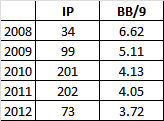
OK, improvement is a bit of a stretch for 2010 to 2011 as he simply walked one less batter in virtually the same amount of innings. In fact, his 92 walks in 2010 didn’t even lead his league thanks to C.J. Wilson’s 93, but 2011’s 91 led all of baseball as he was the only one to reach 90.
So what has changed in Gonzalez that has elevated from a quality mid-rotation arm with potential to ace-level material (with only some of the potential showing) through the first two and a half months of the 2012 season? Obviously shifting into the National League has aided some of the improvement as it is generally an easier league for pitchers to traverse due in part to the fact that they get to face their counterparts a couple of times a game and even when they aren’t, they are facing pinch hitting bench types instead of a DH.
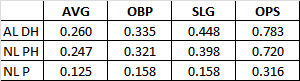
So far in 2012, starting pitchers in the National League are 0.41 ERA, 0.05 WHIP, 0.4 K/9 and 0.2 BB/9 better than their American League counterparts. Factoring those changes into Gonzalez’s current totals is a bit crude, but just for the sake ease it would push him to 2.76 ERA, 1.06 WHIP, 10.6 K/9 and 3.9 BB/9. Among the reasons it is crude include the fact that the AL numbers are influenced by Oakland being the worst hitting team in that league and he wouldn’t face them. Of course, he would also get to pitch in Oakland’s stadium which is very friendly to pitchers (Gio had a 2.63 ERA there the last two years).
FASTBALL VELOCITY/PERFORMANCE
Regardless of league, it is clear that Gonzalez is pitching as one of the best in baseball and his stuff would play anywhere. He has enjoyed a slight velocity gain that has given his four-seam fastball and sinker more punch. The four-seamer has improved from an average of 93.5 MPH to 94.1 MPH and he is throwing it more often going from 37% a year ago to 43% so far this year. The result has been more swings-and-misses and fewer balls in play (naturally).
The sinker has gone from 92.8 MPH to 93.3 MPH. He has been more selective with it throwing it 3% less than last year, but it is generating more swings-and-misses, too. There are a few more balls in play with it percentage-wise, but a sharp rise in the groundball percentage with it suggests that batters aren’t exactly squaring it up.
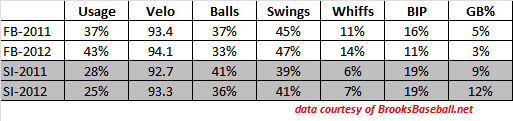
More strikes, fewer balls and poorer contact from two pitches that make up 68% of his arsenal is the foundation to the stark improvement in Gio’s numbers. The improvements in his four-seamer and sinker have spurred his surge in strikeouts, too, especially the four-seamer.
CURVEBALL PERFORMANCE
Gonzalez has a true hammer curveball. It is his best pitch, his strikeout pitch, and one of the better ones across baseball. He has taken it to another level this year. First off, he has been more selective with it throwing it 20% of the time, down from 28% a season ago. It is easily the lowest usage rate of his career, his first time below 25% in fact, and batters are having an even tougher time doing anything with it in 2012. He is throwing it for a ball nearly 3% more at 45%, but he is generating more called strikes and whiffs with it, too.
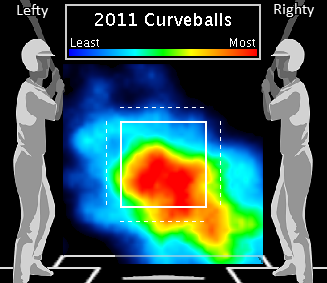

He is commanding the pitch lower in the zone which has probably led to the rise in balls thrown with it, but has also left batters powerless against it yielding a filthy .225 OPS (yes, OPS) against the pitch. There was nothing wrong with last year’s .524 OPS against the pitch, .225 is just… insane. What comes after elite? That’s what his curveball has been this year. He has had 64 plate appearances end on curveballs and just five have been hits. Nearly half, 30 to be exact, has been strikeouts while three have resulted in a walk.
CHANGEUP PERFORMANCE
A big improvement for Gonzalez has been the advancement of his changeup. He used it just 8% of the time last year and while it still isn’t much more than an occasional pitch (11%), the results have dramatically improved. He achieved all of one strikeout with the changeup a year ago in his 44 plate appearances that ended on the pitch. This year has already seen 36 plate appearances end on changeups and 11 were strikeouts. Batters are swinging 10% more often and missing 6% more often despite Gio putting it in the zone 5% less often.
He only threw it 2% of the time in 2-strike counts a year ago, whereas this year that number has risen to 9%. He is trusting the pitch more and it isn’t letting him down. Hitters can’t sit on the curveball expecting him to go to it in those counts like he did 44% of the time a season ago. He is using the curve 32% of the time in those counts and the excess has been shifted to the four-seamer and changeup.
GOING FORWARD
Gonzalez is in the midst of a special season and the obvious question is whether or not he can maintain this level of success. There is nothing he has done thus far that is ridiculously unsustainable especially for a pitcher as talented as Gonzalez. The issue remains his elevated walk rate. But it doesn’t preclude him from success. When I first looked at Gio’s stat line for this year, it reminded me of Ubaldo Jimenez’s 2010 season.
Even while he was running up that insane 15-1 first half record, he was still walking 3.3 per game. He ended the season with a 3.7 BB/9. In fact, he and the 2009 iteration of Clayton Kershaw are the only two pitchers in the last three years to post a sub-3.00 ERA with a 3.7 BB/9 or higher, which is what Gonzalez has done thus far. Gonzalez has a much better strikeout rate than either of those two had, but the common thread is that all three were eminently unhittable. Kershaw led baseball with a 6.3 H/9 rate while Jimenez was at 6.7 H/9 in 2010.
Like I said, nothing in Gonzalez’s line is crazy and unsustainable, not even his .244 BABIP. His infield defense is sound and continue to turn the weak groundball contact he generates into plenty of outs. He has been at .274 and .287 the last two years, too, so it’s not like the .244 is a major outlier for him. He will probably allow a few more home runs and not necessarily maintain a 1 per 73 inning rate (0.1 HR/9), but even regressing that out toward his career mark (0.8) won’t sink his ERA. His xFIP is a very strong 2.91.
Then just imagine if his command and control show more improvement as the season goes along and he chisels away at the walk rate. There is nothing in his line indicating that will happen, but it isn’t implausible as we watch the maturation of Gonzalez before our eyes.
I would still say he is the second best pitcher on his team, but the difference has been slight thus far. They are a great righty-lefty combo atop a rotation while Jordan Zimmermann and Edwin Jackson have been great in their own right, too. If you haven’t watched a Gonzalez start this season, I implore you to do so. Not only will you have the added benefit of watching Bryce Harper play, but Gio has some of the most entertaining stuff in the game.
Plus, the Nationals announcing duo of Bob Carpenter and F.P. Santangelo is really good. That statement was meant with some derision when I made it on Twitter, but I really think so. Carpenter is a strong play-by-play by with a good voice and Santangelo offers tons of great insight. The one downside I heard a few times was that they’re too “homery”, but I always compare that on a scale with Hawk Harrelson as the absolute worst & completely unlistenable, and they don’t even come close to that. I think they call a straight up game reacting properly to great stuff the opposing team does even though it goes against their Nats.
Monday: 06.11.2012
The 2002 Draft: 1st Round in Review
The amateur draft has come and gone and while it wasn’t as talent-laden as last year’s first round, there was still plenty of excitement surrounding a handful of guys and the teams that secured those talents are eager to see how those prospects pan out. Fans of every team of course want to know how their team did. They want analysts and pundits to give a grade and project the future of the players with perfect comparisons to current players.
That, of course, is exceedingly difficult. Check that, it is very easy to do, it is exceedingly difficult to do so with any measure of accuracy. Unlike the NFL and NBA drafts, the MLB draft takes several years to pan out (and the NFL/NBA ones can, too, but you will almost always see immediate returns the following season as well as have some projects that may pay off a few years later whereas it is insanely rare for an MLB draftee to pay dividends in year 1) as these kids, whether high schoolers or collegiate athletes, simply aren’t ready for the highest level of their profession.
With that in mind, instead of assessing the future of 17 to 22 year olds who I know very little about, let’s look back at the draft from 10 years ago and grade that with the benefit of 20/15 hindsight (20/20 hindsight is for lames). Let’s start with a review of the first round.
It was a talent rich first round in 2002, though little did we know then that it would be so for the middle to late round team as opposed to those atop the draft. Except for Tampa Bay’s B.J. Upton at #2, the remaining top five picks were colossal busts.
- Bryan Bullington, RHP, Pittsburgh
- Upton, OF, Tampa Bay
- Chris Gruler, RHP, Cincinnati
- Adam Loewen, LHP, Baltimore
- Clint Everts, RHP, Montreal
Gruler and Everts never even made it to the majors while Loewen has converted into a hitter and is now with the Mets in AAA after spending 2011 in the Blue Jays system. Bullington spent 82 innings in the majors with a 5.62 ERA, 1.58 WHIP and 1.7 K/BB. He has been in Japan for the last two years and seems to have found himself there. Last year he had a 2.42 ERA and 3.2 K/BB in 204 innings and though he is up to 3.96 this year, his skills are a bit better with a 3.5 K/BB in 64 innings.
This quintet has yielded exactly 12 WAR with Upton’s 12.1 hilariously leading the way as it is higher than the total.
Things turned up immediately (6-10… when converting this from Word into WordPress, it started every set of players back at 1):
- Zack Greinke, RHP, Royals
- Prince Fielder, 1B, Brewers
- Scott Moore, SS, Tigers
- Jeff Francis, LHP, Rockies
- Drew Meyer, SS, Rangers
Three strong picks here as Greinke and Fielder are of course stars while Francis has delivered a solid 8.6 WAR which a lot of teams would probably take if you could guarantee that out of their first round pick, although you would like more out of a top 10 pick. The pair of shortstops were the failures here and while both made the majors, they contributed a slick -1.2 WAR between the two of them.
Moore never made it to the majors with the Tigers (he made it with the Cubs & Orioles) as he was part of the Kyle Farnsworth trade with the Cubs in 2005. He was still just 21 at the time, but hadn’t done anything particularly special in the low minors for the Tigers. He is actually still plugging away in AAA having logged 1732 plate appearances there with an .839 OPS.
He is 28 years old and raking for the Astros AAA affiliate with a .330/.413/.571 line in 214 plate appearances playing all around the diamond, but primarily third base. Meyer, meanwhile, logged 1487 plate appearances in AAA through 2010, but managed a mere .636 OPS and appears to have hung ‘em up for good. He is now 30.
This quintet has yielded 51.9 WAR with Greinke’s 28.2 leading the way.
The hits picked up in the next 10 (11-20):
- Jeremy Hermida, OF, Marlins
- Joe Saunders, LHP, Angels
- Khalil Greene, SS, Padres
- Russ Adams, SS, Blue Jays
- Scott Kazmir, LHP, Mets
- Nick Swisher, OF, Athletics
- Cole Hamels, LHP, Phillies
- Royce Ring, LHP, White Sox
- James Loney, 1B, Dodgers
- Denard Span, OF, Twins
Only a pair of this 10 pack has failed to return positive value (Adams -0.4, Ring -1.0) while four of them have yielded more than 13 WAR (Hamels 25.4, Kazmir 15.2, Swisher 14.2 and Span 13.2). Yes, I am surprised that Kazmir has out-WAR’d Swish and Span, too. Apart from the two busts, the top pick of these 10 has actually yielded the least amount of value as Hermida has netted just 1.8 WAR.
All 10 players have at least reached the majors and if Ring gets one more game (he is still in Colorado’s system), then all of them will have played at least 100 games, too. The other flameout in this group, Adams, was in AAA as of 2011 with the Mets at age 30, but posted a mere .542 OPS in 72 plate appearances.
And the final 10 picks yielded a star and few other impact players as well one who switched positions and could end up as an impact guy when it is all said and done (21-30):
- Bobby Brownlie, RHP, Cubs
- Jeremy Guthrie, RHP, Indians
- Jeff Francoeur, OF, Braves
- Joe Blanton, RHP, A’s
- Matt Cain, RHP, Giants
- John McCurdy, SS, A’s
- Sergio Santos, SS, Diamondbacks
- John Mayberry, OF, Mariners
- Derick Grigsby, RHP, Astros
- Ben Fritz, RHP, A’s
I should’ve mentioned this out front, but this is the Moneyball draft. The A’s hit on Swisher and Blanton, but missed on McCurdy, Fritz and their three sandwich picks (Jeremy Brown, Steve Obenchain and Mark Teahen who yielded a combined 0.7 WAR, all from Teahen).
Cain might not feel like a superstar name, but he gets paid like one and pitches like one despite being overshadowed by teammate Tim Lincecum. He has four straight 200+ inning seasons and when combined with his league-leading 86 innings from 2012, he has a 3.19 ERA, 1.17 WHIP, 7.4 K/9 and 2.5 K/BB in 1166 innings. And that 2.5 K/BB is held down by some of the earlier work as it continues to rise going 2.1, 2.1, 2.3, 2.9, 2.8, 5.1 since 2007. This year’s 5.1 is driven by improvement in both his strikeout and walk rates.
Brownlie bounced around the minors and independent ball for seven years with four organizations, McCurdy never made it past AA, Grigsby was a terribly sad story as he never made it past A-ball lasting just two years before falling victim to crippling depression after the death of his mother and Fritz knocked around the minors and Indy ball for nine years, spending the majority of his time in the low minors with modest skills.
Mayberry is hoping to be a late-bloomer after a breakout at age 27 last year, though he has performed dismally in 55 games this year thus far. Meanwhile, Santos is rewriting his story as a big time late-inning reliever and has put together a pair of strong seasons before being traded to Toronto where he is currently working back from an injury.
So that’s the first round (sans the supplemental round) and it turned out quite well.
- 24 of 30 picks at least reached the majors (80%)
- 9 of 30 picks delivered at least 12 WAR (30%)
- 15 of 30 picks deliver at 7.4 WAR (50%)
- The 6 non-double-digit guys are in the 7.4 to 8.9 WAR range and counting (20%)
- The top 30 delivered 217.5 WAR
Compare that with the two drafts sandwiching the 2002 iteration. The 2001 draft delivered 132.2 WAR from its top 30, 103.7 of which came from four of the top five picks (Joe Mauer, Mark Prior, Gavin Floyd, Mark Teixeira) led by Mauer’s 33.8 and Teix’s 42.6. Only Dewon Brazelton, the third pick, delivered negative value in the top five (-3.5 WAR for the then-Devil Rays). The 2003 draft delivered 125.7 WAR led by Nick Markakis’ 20.4. Three of the top six never saw the majors and four of the 22 who made the majors delivered negative value “led” by Brandon Wood’s -4.0 WAR.
Both the 2001 and 2003 drafts delivered a supplemental gem as David Wright was selected 38th by the Mets as a comp. pick for Mike Hampton in 2001 and Adam Jones was selected 37th (as a shortstop) by the Mariners as a comp. pick in 2003 for their failure to sign John Mayberry Jr. the year before.
Upcoming pieces will tour each division and look at how all 30 teams did individually.
Friday: 06.8.2012
BP Work This Week
A quick look at my work available over at Baseball Prospectus this week.
- First up was the Starting Pitcher Value Picks piece in which I looked at Phil Hughes, who I may have pumped up after watching him dismantle my favorite team in a complete game of excellence. I profess my love of Edwin Jackson yet again. Weird. Completely unexpected.
–
- Next up was the Weekly Planner piece which takes a look at the all the two-start pitchers for next week and decides who you should go with and who you should probably avoid. Aces are very light this week meaning you will have to look at some lesser options if you want to load up on two start starters in H2H leagues. Edwin Jackson (yes, two mentions!!!) and Bud Norris are among my favorites in that group.
–
- I also appeared in the Lineup Card for the first time since joining Baseball Prospectus. The week’s topic was “Favorite Baseball Books” and I discussed one of my favorite books ever: The Numbers Game by Alan Schwarz. Just a fantastic journey through the history of baseball stats engineered by one of the best writers out there. He did some fascinating work on concussions in the NFL and continues to dominate life for the NY Times.
–
- And finally, episode 7 will come out for the The Towers of Power Fantasy Hour, a BP Fantasy Podcast on Saturday. We discussed a ton of players of varying import ranging from stars to lower tier “only” league options. In lieu of specific segments like most weeks, the meat of the show were these in depth breakdowns on players. Send your emails to fantasyhour@baseballprospectus.com. We record on Thursdays usually, but moved to Friday this week. We also have a Facebook Group that you should definitely join. Here is my entrant for “Best Thing I Read This Week”. I didn’t explain it particularly well on the podcast, but it cracked me the f up.
Friday: 06.8.2012
Have You Ever Noticed?
I have a useless knack for noticing random things. I notice when a cigarette grows in length during a scene on a film or show. In fact, I notice way too many continuity errors. Maybe I can get paid for it and become a Continuitist. Best job ever. I notice random patterns and of course ones that are more obvious, too. I use several different sites to cull statistical information when I am working on pieces or just doing research for my fantasy baseball teams including ESPN.
It always seems to catch my eye when the same guy leads across the board on the five categories they have as the header on team stat pages. This would fall under the more obvious patterns to catch as I am sure a lot of people would take notice of the same face five times in a row. They just wouldn’t turn it into a blog post about the teams in baseball who have this going on for their team.
There are eight teams in baseball with the same guy leading the club in batting average, home runs, runs batted in, on-base percentage and hits. Let’s just say there aren’t scrubs pulling off that feat. It’s not a massively diverse skill set needed to pull off the feat, but a good number of things have to align properly to be atop all of them.
Obviously you are kind of double-dipping with batting average and hits, though it’s no guarantee that leading one will give you the other. In fact, 12 teams have a different leader in batting average and hits. Home runs and runs batted in are an obvious double-dip as well and only seven teams saw a different leader in each of those categories.
Good batting average and on-base percentage don’t necessarily go hand-in-hand, so you have to be able to rack up hits and either do so with a good eye to draw some walks (lest an Adam Dunn-type thwart you in OBP… though Paul Konerko shan’t be outdone this year) or just be on a team where your huge batting average and handful of walks overpowers anyone else’s OBP.
First, take a moment to see how many of the eight names you can guess without looking below. Here are some hints:
- Of the eight, four are what I would call “obvious”
- Of the four non-obvious, two aren’t obscure names, just surprises to be leading these 5 cats
- Of the eight, six are from the American League & two from the National League
- Of the eight, five are outfielders
OK, those are your clues.
Good luck guessing.
.
.
.
.
This is me
…giving you some time
…and pushing some space
…between the above text
…and the pictures that I am about to post.
.
.
.
.
.
OK, time’s up.
.
.
.
.
Let’s eliminate some name that you may have guessed.
There were five guys who just missed making the list as they led in four of five categories:
- Carlos Gonzalez is just .002 OBP points behind Dexter Fowler.
- Miguel Cabrera is just .011 OBP points behind Prince Fielder.
- Hunter Pence is just .013 AVG points behind Placido Polanco.
- Chase Headley is just .008 AVG points behind Will Venable.
- Matt Joyce is just 6 RBIs behind Luke Scott.
Of those, I would assume that Cargo, Miggy and Pence were possible, if not likely, guesses.
The obvious guys were all outfielders:




Even as stacked as the Rangers are (despite their recently mortality in which they have gone 3-7 in their last 10), it is no surprise that Josh Hamilton is leading the pack their because he has just been on another level. He actually has three guys on his butt for the hits lead as Elvis Andrus, Michael Young and Ian Kinsler all have 66. The impressive thing about that is that they all have 11 or more at-bats than him.
With Fielder gone, Ryan Braun doesn’t have much competition atop the leaderboards for the Brewers. If Jonathan LuCroy hadn’t gotten hurt and could’ve registered enough at-bats for the batting title, he might have pushed Braun in OBP where he trails by .002 right now.
If these were ordered by most obvious, Andrew McCutchen would have been listed first. He is up by 11 hits, two home runs, nine RBIs, .062 average points and .068 on base points. Pedro Alvarez’s power output is the only thing keeping Cutch from running away with all five categories.
Jones is a bit surprising if only because the surprise Orioles have gotten several standout performances, but his 16 home runs and 35 runs batted in are among the American League’s best which is why he still made it into this group of relatively obvious leaders.
Oddly enough, two of the surprise names are full time DHs:




It is quite impressive that David Ortiz is leading all five of these categories on the Red Sox. The middle three aren’t terribly surprising, but to see him pacing the squad in batting average and hits is definitely a shock. Haven’t we (we being the baseball community) left him for dead two or three times?
I guess Billy Butler isn’t too surprising in light of the struggles to their other hitting standouts, but he usually displays modest power making his 32 home run, 103 RBI pace a shock this deep into the season. He might finally be having the power breakout I have projected for the last 17 years.
I am pretty sure my beagle was leading the Oakland Athletics in hits at one this season, so perhaps Josh Reddick isn’t exactly surprising given how inept their offense is, but apart from his 14 home runs, he easily has the worst numbers of this octet and he might not be leading any of these categories had Yoenis Cespedes not gotten hurt for a spell.
And in my estimation, the biggest surprise of all is Mark Trumbo. We can’t just chalk it up to Mike Trout not qualifying either as he has him beat in batting average and on-base percentage, though if you gave them an equal number of games, Trout is pacing to have more hits. On a team with Albert Pujols and coming from a guy who posted a sub-.300 OBP last year, this is a major surprise. It will be far more impressive if he is leading at the All-Star break, let alone the end of the season, but for now he gets his glory. He is definitely the favorite to lead the team in Trumbombs this year.
I realize this isn’t in the vein of most posts you find here at BbP, but I figured something fun for a Friday might be a nice change of pace. Besides, who doesn’t want 1,000+ words on the guys in baseball leading their team in five arbitrary categories picked by ESPN?
Wednesday: 06.6.2012
Brandon Beachy’s Strikeout Decline
Brandon Beachy seemingly emerged out of thin air last year to make 25 great starts for the Atlanta Braves. His rookie campaign was injury shortened as he missed most of May and June limiting him to 142 innings, but his numbers were quite impressive.
While his 3.68 ERA was fourth (of five) among rookie hurlers with 100+ innings in the National League, his 10.7 K/9 led all MLB pitchers who threw 140+ innings. His 1.21 WHIP was quite good, too. In fact, everything about his stat profile said his ERA should’ve been better, evidenced further by his 3.16 xFIP. His 1.0 HR/9 hurt with seven of 16 longshots including additional runners on base.
After all of that, many looked forward to the encore presentation of Beachy. So far it has been nothing short of amazing. He leads baseball with a 1.87 ERA and trails just a few guys for lead in WHIP with his 0.95 in 72 innings. He has cut the flyball and line drive rates channeling it into a 9% increase in groundball rate (42%) resulting in a near-halving of his home run rate to 0.6 HR/9.
He has some good fortune and sparkling defensive support yielding a miniscule and league-best .207 BABIP. Despite all that he is just 5-4 which is exhibit 5,938,291,764 of why win-loss record is virtually useless as a standalone judge for how a pitcher has fared. So tired are his defenders from flashing the leather that they’ve given him just 6.4 runs per game, 50th-best among qualified starters in baseball.
While there is so much good going on in Beachy’s season, it is hard not to notice the 3.6 strikeouts he has shaved off of his rate down to 7.1 K/9. He has actually cut his strikeout rate by more Henderson Alvarez (2.6), Derek Lowe (2.7) and Kevin Correia (3.1) have this season. By maintaining his walk rate and matching last year’s 2.9 BB/9, he still has a solid if unspectacular 2.5 K/BB (61st among qualified starters). But why the stark drop in punch outs?
He reached the majors in 2010 after spending most his season in the AA bullpen followed by seven strong starts AAA where he posted a 9.5 K/9 and 8.0 K/BB in 46 innings. In three late-season starts for the big league club he was solid, especially for a 23-year old rookie. He had a 3.00 ERA, 1.53 WHIP, 9.0 K/9 and 2.1 K/BB in his 15 innings.
His 2011 breakout was spurred by the development of a slider, a pitch he didn’t even throw in his three late-season starts in 2010. He had a strikeout per inning during those three 2010 starts though none of his three pitches (fastball, changeup, curveball) was his specific strikeout pitch. The slider became his most-used secondary pitch at 19% easily outpacing the changeup (11%) and curveball (10%). It turned the strikeout rate we saw in his 2010 season, both in the majors and minors, into something real.
Not only did batters put together a measly .182/.223/.339 line in plate appearances that ended on sliders, but they struck 40% of the time on it. He generated 52 of his 169 strikeouts (31%) on the pitch burying it low and away to righties, down and in on lefties. Righties flailed at it while lefties swung over the top of it.
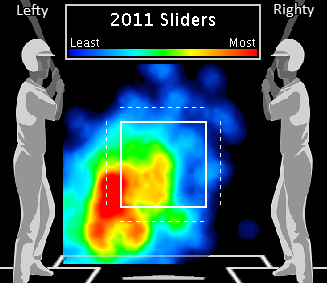
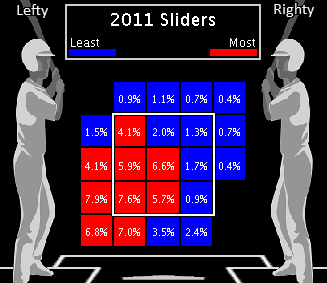
The fastball (28%), changeup (22%) and curveball (17%) contributed plenty to the bottom line which isn’t surprising as you aren’t going to carry a 10.7 K/9 with one pitch for strikeouts (unless you’re a reliever). The slider was his secondary pitch of choice when it counted, though. He threw his fastball 52% of the time in 2-strike counts and his slider 29% of the time while the change and curve were at 9% and 10%, respectively.
His pitch usage in 2-strike counts this year isn’t really any different with the slider being used a little less at 25%, the fastball up to 55% and the change (8%) and curveball (12%) almost exactly the same. So he hasn’t changed his approach for garnering strikeouts, but the pitch selection just hasn’t been as effective (obviously).

Batters are laying off the fastball and slider much more with precipitous declines in the swing-through rates on both with two strikes. Both are being put into play more often, though obviously with good results based on his great results and tiny BABIP. Only 6% of the fastballs in play last year were groundballs, this year it is up to 11% while the slider has risen from 10% to 12%. Again, that is in 2-strike counts. Perhaps the more patient approach from hitters is causing Beachy to find the zone more often with the slider.

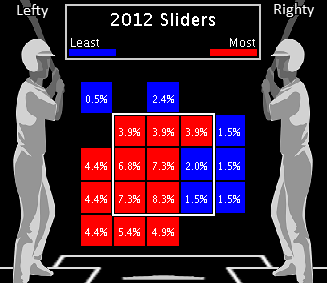
So far it hasn’t hurt him at all, but in general allowing more balls in play is obviously more dangerous than fanning a guy. The 5% increase in ball rate on 2-strike counts from the slider cannot be ignored, either. Those could just be waste pitches as he tries to get batters to chase as they did often last year, but it looks like batters are laying off of the bad ones and waiting for something more hittable.
Hittable absolutely being a relative phrase because as while they aren’t striking out on the pitch, they certainly aren’t doing anything worthwhile with the slider. Opponents have a .172/.180/.207 (yes, .387 OPS!) against the pitch overall. Beachy has clearly traded those strikeouts in for tons of weak contact which can be an effective path toward success, too. Yes it is unlikely that he can sustain a .207 BABIP over the season, but he doesn’t need to end the year with a 1.87 ERA/0.95 WHIP to be successful.
How has the lower strikeout rate impacted his ability to go deeper into games? One issue with Beachy in his rookie season was his sub-6.0 innings per start rate. He only found the seventh inning three times in his 25 starts and the eighth inning just once. He was awesome at six inning outings, though. He had 13 of them and gave up more than three runs just three times.
He has raised his average innings per start from five and two-thirds to just about six and two-thirds. Over the course of a 32-start season, that’s a 29-inning increase and he is currently pacing toward a 211 inning season. With 34% of his season banked at such an incredible ERA, he has a lot of wiggle room. While it is reasonable to expect some regression, it would be surprising if the bottom randomly fell out for Beachy.
There were 16 pitchers with a sub-3.00 ERA last year including the likes of Ryan Vogelsong and Jeremy Hellickson, both of whom didn’t have the skills that Beachy previously displayed and is currently displaying. But even if we are conservative and just give Beachy a 3.00 on the dot, he still has 138.7 innings of 3.57 ERA. You don’t have to sell high to avoid apocalypse. You can, especially if the returns significantly help your team, but Beachy has been great this year and he is still fooling hitters even with the diminished strikeout rate.
Monday: 06.4.2012
Did You Realize…? NL Edition
It’s June 4th, did you realize…
…that R.A. Dickey not only has a killer 2.69 ERA on the heels of a shutout of the St. Louis Cardinals, but he also has 70 Ks in his 74 innings putting him on pace for 210 this year?
Charlie Hough was the last knuckleballer to punch out 200+ batters when he fanned 223 in 1987 for the Texas Rangers. He did so in 285 innings (7.0 K/9), though, while Dickey is pacing 220 innings (8.5 K/9).
…that Gio Gonzalez, and not Stephen Strasburg, has been the Nationals best pitcher thus far?
It’s a matter of degree with just 0.04 points of ERA, 0.02 points of WHIP and a whopping 0.46 K/9 separating the pair. And if you look below the surface numbers, Gonzalez has had more luck on his side with miniscule BABIP and HR/FB rates while Strasburg is nearly at league average in both yielding a significant edge for Strasburg in xFIP: 2.51 to Gio’s 2.82. Fact is: both are awesome.
…that Tim Lincecum’s 5.1 BB/9 is the worst in the National League?
His struggles have been well-documented, but I was surprised to see that he has the worst walk rate in his league. His inability to work with runners on (62% LOB%) has killed him this year. Some of it might be bad luck, but watching him shows obvious struggles from the stretch that need to be fixed if he expects to come anywhere near that 3.88 xFIP that has many believing in a rebound.
…that Trevor Cahill is generating a career-high 64% groundball rate?
His strikeout and walk rates have gone the wrong way, especially with the transition to the National League, but he is still posting a strong 3.45 ERA and pairing it with a career-best 3.76 xFIP. Even his 2.97 ERA of 2010 only yielded a 3.99 xFIP. This 24-year old just keeps getting better as a pitcher and I think there is still another level for him to reach skills-wise, too. Once he can command his sinker in the bottom of the zone a bit more and cut that walk rate, batters are in big trouble.
…that Matt Cain is posting the best skills of his career with an 8.3 K/9, 1.7 BB/9 and 4.9 K/BB?
Yes, his ERA continues to out-perform his xFIP, but his xFIP also continues to come down. He has dropped it yearly dipping below 4.00 for the first time last year (3.78) and sitting at 3.57 so far this year.
…that Brandon Beachy is toting baseball’s best ERA at 1.87 despite cutting over three and a half strikeouts off of his 2011 rate?
He fanned 10.7 per game last year, but this year is down to 7.2 in his 72 innings. In turn, he has shaved 5% off of his flyball rate, added 8% to his groundball rate and cut a whopping 10% off of his BABIP from .307 down to .207 (no, 100 points isn’t 10% of .307, but his hit rate on balls in play dropped from 31% to 21%, that’s the 10% I’m talking about). There is some regression coming to that ERA, but the dip in strikeout rate doesn’t mean the success is a complete fluke, either.
…that despite his frightening 6.98 ERA, Mike Minor is actually posting skills good enough for a 4.33 xFIP?
His insane 17% HR/FB rate has led to a 2.0 HR/FB rate, but his 7.9 K/9 and 2.4 K/BB are quite good. Part of the gopheritis is bad luck, but part of it is his own doing as he fails to locate properly in the zone. He doesn’t have overpowering stuff so command and control are necessary for sustained success or else he is subject to getting batted around as evidenced by his 27% line drive rate a season ago.
…that the three NL leaders in K/BB rate are all Phillies yet Roy Halladay isn’t among them?
He’s right there at 10 with a 4.0 K/BB, but teammates Cliff Lee (5.4), Cole Hamels (5.0) and Joe Blanton (4.9) are leading the way. Blanton isn’t the only surprise as Bronson Arroyo is right there with a 4.9 himself.
…that three NL relievers have fanned at least 40% of the batters they have faced, but that Jason Grilli (40%) is one them??
The other two, unsurprisingly, are Craig Kimbrel (41%) and Aroldis Chapman (49%!!!!!!!). Grilli has actually raised his strikeout percentage yearly since 2005 starting at 8% before entering the 20s in 2008. Though 35, Grilli seems to be throwing his best baseball.
…that Tony Campana is on pace for 54 stolen bases?
This is despite also being on pace for just 309 at-bats. At this rate, if he could just get 400 at-bats, he would steal 70 bases. It can be annoying to have a one-trick pony in your lineup, but Campana can win you stolen bases. He should be rostered in any league, especially since he’s actually been a two-trick pony with a .291 average, too.
…that Dexter Fowler is on pace for 18 doubles, triples and stolen bases?
As well as 24 home runs, 99 runs scored and 84 driven in. He is also hitting .297 with a .400 on-base percentage. In other words, he has been amazing this year. It is absolutely ridiculous that he is 70% owned in Yahoo! leagues and 91% in ESPN. I can’t envision a format (save AL-only obviously) where he isn’t a viable option.
Friday: 06.1.2012
Did You Realize…? AL Edition
It’s June 1st, did you realize…
…that Felix Hernandez is toting a 3.42 ERA, good for 40th among qualified starters in the majors?
He posted a 4.45 ERA in May, but still had 33 strikeouts in his 32 innings with a 3.3 K/BB so I wouldn’t rush to the panic meter. He had a BABIP of .378 for the month including three outings in which he allowed 10 or more hits. Oddly enough one of his two good starts in May came against the Texas Rangers as he went eight strong allowing a run with seven strikeouts and a pair of walks.
…that Chris Sale leads the American League in ERA at 2.34 in 58 innings?
The month of May saw him get removed from the rotation (on May 4th) and thrust into the closer’s role where it was reported he would stay for “at least the rest of 2012”. About a week later, he was having an MRI on his elbow and there was even some concern that he could be shutdown altogether. He stayed in the closer’s role for all of 10 minutes blowing one save in his only relief appearance on May 8th before returning the rotation on May 12th. He closed the month out with 25 innings of 1.82 ERA and 0.97 WHIP with 31 strikeouts including a 15-strikeout outing on Memorial Day.
…that Sale’s White Sox are 30-22 with a +40 run differential despite Gavin Floyd (5.02), Philip Humber (5.37) and John Danks (5.70) all toting >5.00 ERAs?
It helps that Sale leads the AL and Jake Peavy isn’t far behind with a 3.05 ERA of his own. Of those three, I am still buying Floyd. He has a 3.2 K/BB built on a career-high 8.0 K/9 in 61 innings. Home runs have killed him, especially in his last three outings as the Angels, Twins and Indians trounced him for 21 runs in 15 innings with five bombs. The velocity is fine and the control only fell off in the Minnesota game (3 BB) so I don’t think there is an issue that plague him in the long term. It appears to be a rough patch with better times ahead.
…that Felix Doubront has a 9.5 K/9 and has arguably been Boston’s best start thus far?
If you’ll afford me a small back pat, I would point out that I touted Doubront in this year’s pitching guide advising that if the Red Sox gave him the shot he deserved then he should be targeting. He is even out-doing my expectations pairing the strikeouts with a 3.86 ERA and five wins in 56 innings. His 1.36 WHIP is a bit high, but at his cost you can easily accept that flaw. Furthermore, he is running hot of late with a 2.28 ERA and 1.08 WHIP over his last four with 27 Ks in 24 IP.
…that MLB’s strikeout leader, Max Scherzer (11.7 K/9), labored to a 4.04 ERA in May despite a 12.8 K/9 and 6.4 K/BB?
It was actually a marked improvement from his 7.77 ERA in April. The big issue in May was a severe case of gopheritis as he allowed at least one home run in every start (yielding a 2.0 HR/9). While some these struggles definitely fall on Scherzer’s shoulders, a good bit is bad luck, too, as his skills have been far more elite than his 5.55 ERA would suggest. He has a 3.19 xFIP as his .387 BABIP and 17% HR/FB rate have to regress some in his favor. He fanned 9 or more in four of his six May outings, I’d buy in if you can as his best outings are still ahead.
…that Henderson Alvarez and Derek Lowe both have K/9 rates lower than their ERAs?
Their ERAs are both on the right side of 4.00 which is what makes that such a weird phenomenon. In the last 10 years, only three pitchers with enough innings to qualify for the ERA title have managed to post a K/9 lower than (or equal to) their ERA while maintaining a sub-4.00 ERA:
- 2006 Chien-Ming Wang: 3.63 ERA, 3.1 K/9 in 218 IP
- 2005 Carlos Silva: 3.44 ERA, 3.4 K/9 in 188 IP
- 2009 John Lannan: 3.88 ERA, 3.88 K/9 in 206
…that Phil Hughes has allowed at least one home run in every start of the year?
His 14% HR/FB rate is high, but not as egregious as I thought it might be when I saw his 2.1 HR/FB. His generally heavy flyball rate (career 46%) is at its heaviest of 49% so while I am intrigued by his 8.4 K/9 and 3.8 K/BB, that intrigue is tempered by home run issues that are unlikely to evaporate barring a change in his approach. While it is easy to envision his 5.64 ERA coming down some, the xFIP of 4.34 says it isn’t exactly set to plummet in the vein of Scherzer.
…that Ervin Santana actually did make a change to curb his gopheritis with a 64% groundball rate in May?
After allowing 10 home runs (2.9 HR/9) in April en route to a 6.16 ERA, he figured that keeping the ball down going forward would be helpful. His 41% groundball rate in April skyrocketed to an AL-best 64% and yielding a far more palatable 1.2 HR/9 in May. That is right in line with his career mark of 1.1 HR/9 coming into this season. He was actually in the midst of a great May with a 2.17 ERA through his first four starts before stumbling a bit against Seattle and New York and settling for a still solid 3.69 ERA in 39 innings. I’m still buying where available.
…that Mike Trout is on pace for 96 Rs, 22 HR, 83 RBIs and 35 SBs?
In the last three years only two players have hit those thresholds: both Matt Kemp and Jacoby Ellsbury last year. Even if you chop 20% off of those paces to 77-17-66-28, there are only 12 such seasons in the last three years across 10 players as Kemp and Ian Kinsler each did it twice. Early on it looks like Trout is exactly the stud he was predicted to be when he was checking in as a top 3 prospect on lists all across the industry this preseason.
Here’s the kicker: take the 80% figures and tack on a .309 batting average threshold and we get just four instances in the last three years (it drops to three instances at the 100% paces). Let’s say he hits the 80% paces and hits “only” .290, where does he go in 2013 drafts? Is he a first rounder already? What if he hits 95% or better of the current pace?
…that no one is on pace top 40 stolen bases in the American League?
Both Alejandro De Aza and Jason Kipnis are pacing the league with 12 apiece pacing them for 37 and 38, respectively, based on their team’s games played. Paces can still be out of whack even two months into the season and with a category like steals, things can change rapidly. Rajai Davis has 10 in his 38 games played, but has recently fallen into more playing time. If he maintain anywhere near his current .819 OPS, he should stick in the lineup and I don’t think he would have any trouble reaching and topping 40 stolen bases. If he gets a full set of at-bats in 90 of the remaining 110 games, he paces to steal about 50 steals based on his 10 in 68 at-bats thus far. He is on a roster in just 3% of ESPN leagues. That number should be much, much higher.
 Baseball By Paul