Posts tagged ‘Countdown to Spring Training’

Sunday: 01.27.2013

Countdown to Spring Training: 26 Days – Pablo Sandoval

Only 26 days until live game action…

With 30 days to go, I am going to do a hitter per day highlighting one from each team. I selected my player of note from each team and then randomized them (which was pretty interesting consider who the final two were after the randomization) so that’s the order I’ll be following. (Ed. note: I shortened the intro from previous versions and I’ll probably eliminate after this week as I’m sure you get the point)

PABLO SANDOVAL

I am way late on today’s countdown offering. In fact, it’s Monday in some places already. I just had one of those days where my body refused to stay awake so I slept through a large chunk of the afternoon after waking up early this morning. Shortly after I woke up from my nap sleep, I had a birthday dinner for my brother. At any rate, no one cares about that, so let’s talk Sandoval. If you believe in what Razzball terms “Saberhagenmetrics”, then Sandoval is a big time target for you in 2013.

In short Saberhagenmetrics is a hilarious term named after pitcher Bret Saberhagen that describes a player who has a one-up, one-down statistical “pattern” to their career. Saberhagen himself won a Cy Young in 1985 with a 20-6 record, 2.87 ERA and 1.06 WHIP inciting the following see-saw:

saberhagenmetrics

He finally snapped the pattern in 1994 (evens were the bad years) with a 14-4 record, 2.74 ERA, and 1.03 WHIP in 177.3 innings. Putting blind faith into these types of patterns will leave you burned more often than not, but if you analyze the underlying factors that led to the underperforming seasons, you should be able to determine whether or not betting on the rebound is worth your time.

Sandoval lost his rookie status in 2008 with 154 plate appearances, but calling that a season is a stretch, since then he has four seasons on his ledger: two full and two injury-shortened but still north of 440 plate appearances. As a 22-year old in 2009, he exploded onto the scene with a .330 average, 25 HR, and 90 RBIs. His 2010 follow-up was mired by fitness and conditioning issues that ate into his production yielding a .268, 13, and 63 season. He eventually lost his job resulting in just 19 playoff plate appearances including just three against Texas in the World Series.

He came back in 2011 with a vengeance and only a broken hamate bone could slow him down. Still, he almost matched his 2009 production despite 167 fewer PAs. He managed a .315 average, 23 HRs, and 70 RBIs. He broke the other hamate bone in 2012 in addition to another DL stint caused by a strained left hamstring and this time he was slowed resulting in a .283-12-63 season in 108 games which was certainly better than 2010 by a good bit (115 wRC+ to 96), yet far from the star turns in 2009 and 2011.

With no more hamate bones to break, Sandoval is poised for another big season. In his 2011 return from hamate hell, he posted a .557 slugging percentage the rest of the way in 375 PA; in 2012 it was just .419 in 338 PA. But if the 2012 playoffs are any indication, his power is already back on track and ready for 2013. Sandoval put together a .364/.386/.712(!) line in 70 playoff PAs with six home runs including three in game one of the World Series against Justin Verlander (*Paul falls to the ground and starts convulsing in a fetal position*).

Sandoval doesn’t need to top 2009’s 25 HRs to be a fantasy stalwart. He just needs to show some consistency at or around that figure and he can become an elite asset in the game. Playing a premium infield position already enhances his value, but the combination of mid-20s power with a huge batting average is rare. Since 2009, Sandoval’s first full season, he is one of just six players with two or more seasons of .315+/23+. Miguel Cabrera leads the pack, completing the feat all four times and Ryan Braun is close behind missing just once (he “only” hit .304 in 2010) while Joey Votto and Robinson Cano join Sandoval.

Those thresholds are admittedly arbitrary, they represent Sandoval’s marks in 2011, but even if you round down to .300/20 he is still in an exclusive group of just 19 players to have completed the feat twice in the last four years. A lot of big names in this list (courtesy of B-ref):


Rk                     Yrs From   To                Age

1        Robinson Cano   4 2009 2012 26-29 Ind. Seasons

2       Miguel Cabrera   4 2009 2012 26-29 Ind. Seasons

3           Ryan Braun   4 2009 2012 25-28 Ind. Seasons

4           Joey Votto   3 2009 2011 25-27 Ind. Seasons

5       Aramis Ramirez   2 2011 2012 33-34 Ind. Seasons

6          David Ortiz   2 2011 2012 35-36 Ind. Seasons

7            Matt Kemp   2 2011 2012 26-27 Ind. Seasons

8      Troy Tulowitzki   2 2010 2011 25-26 Ind. Seasons

9         Paul Konerko   2 2010 2011 34-35 Ind. Seasons

10     Carlos Gonzalez   2 2010 2012 24-26 Ind. Seasons

11       Adrian Beltre   2 2010 2012 31-33 Ind. Seasons

12      Pablo Sandoval   2 2009 2011 22-24 Ind. Seasons

13      Hanley Ramirez   2 2009 2010 25-26 Ind. Seasons

14       Albert Pujols   2 2009 2010 29-30 Ind. Seasons

15     Victor Martinez   2 2009 2010 30-31 Ind. Seasons

16       Matt Holliday   2 2009 2010 29-30 Ind. Seasons

17       Shin-Soo Choo   2 2009 2010 26-27 Ind. Seasons

18        Billy Butler   2 2009 2012 23-26 Ind. Seasons

19        David Wright   1 2012 2012 29-29 Ind. Seasons

Let’s be clear that 70 playoff PA isn’t a big enough sample to determine if a displayed skill is something to bet on with certainty, but it did show us what Sandoval is capable of when healthy. With an offseason to heal and no more hamate bones to break, I’d favor a 2009/2011-type season 2010/2012-type especially since the price to do so isn’t egregious as Sandoval is currently the 9th third basemen off the board and 100th player selected overall according to early Mock Draft Central data.

Third base has some depth to it this year so while the superstars will still go early, you needn’t rush to lock one up for fear of being left with Kevin Youkilis’ rotting corpse.

Friday: 01.25.2013

Countdown to Spring Training: 28 Days – Hanley Ramirez

Only 28 days until live game action…

OK, so the first actual Grapefruit or Cactus League game doesn’t take place until February 22nd, but the Red Sox are splitting up their squad and playing a couple of colleges on February 21st so we’re just 30 days away from organized professional baseball. So why not a countdown of this final, grueling winter month that includes some fantasy analysis?

Obviously my primary focus at this site is on pitchers and you’ll get quite a bit of my analysis on them in late February when the SP Guide drops, thus I was thinking of something surrounding hitters. With 30 days to go, I am going to do a hitter per day highlighting one from each team. I selected my player of note from each team and then randomized them (which was pretty interesting consider who the final two were after the randomization) so that’s the order I’ll be following.

HANLEY RAMIREZ

After the unmitigated disaster that was 2011, it wasn’t going to take much for his 2012 to be considered a rebound and it was yet he was still a disappointment. While he wasn’t going 2nd overall like 2011, he still only dipped to 20th average draft position with a high of 12 and low of 26 according to Mock Draft Central. His 20-20 season with shortstop and third base eligibility wasn’t bad, but it didn’t earn that draft position back. ESPN’s Player Rater had him 63rd overall and 42nd among batters.

The problem was that there was virtually no rebound in his paltry .243 batting average from 2011. It went up to .257, but that’s barely a dent (8 hits over a 600 AB season) and he posted the second-worst BABIP of his career at .290 (up slightly from 2011’s .275). His batted ball profile was actually somewhat conducive to a batting average increase as he added 2.5 percent to his line drives, which have the best chance to become hits. His flyball rate rose continuing a three-year trend, and those are least likely to become hits. While his flyball rate only ticked up by 1.2 percent, his infield flyball rate jumped four percent and those are all but guaranteed outs.

His BABIP based on batted ball was league average all told (he was a little low on line drives, but high on grounders & flies) so we shouldn’t be too surprised that his .257 batting average was essentially on par with the league’s .255 average as a whole. He might’ve smoked a few more at-‘em balls than normal, but nothing that would leave you saying he was quite unlucky for the performance he was delivering on the field. Batting average is really what kept his 2012 from being a “Hanley” season considering 2009 and 2010:

hanley3year

Based on my rough math estimations, a .300 average would’ve boosted Ramirez to a tie for 11th among batters in the player rater with Adam Jones and vaulted him to 18th with Jones in the overall.

“Well ya, but he was playing a lot in that cavernous monstrosity that can gives your eyes an STD if you watch too many home Marlins games!”

*Bzzz* Try again.

Ramirez raked in Marlins Stadium as did the other two superstars on that team:

homemarlins

It appears that Ramirez’s batting average issues for 2012 fit under the Occam’s razor principle: he just wasn’t good enough. No logistical pretzels about this BABIP or that venue. He simply didn’t hit the ball well enough to earn a .300+ average. I mean, we’re really only talking about a hit a week here. Another 26 hits would put right at .300 (actually .2996688, but I think MLB would go ahead and give it to him) and that feels like a lot, but there are generally around 26 weeks in the season.

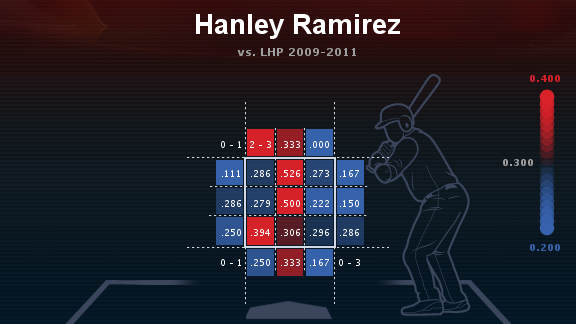
Where is going to get those hits in 2013? Ideally off of southpaws. For his two-plus seasons (92 G in ’11) from 2009-2011, he hit .305 off of lefties with a .339 BABIP. Those figures dropped to .263 and .293 in 2012. It wasn’t just one problem area either; they just handled him better than ever before. Though up and in and down and away do stand out a bit when comparing the two samples:

(click to enlarge)

(click to enlarge)

(click to enlarge)

(click to enlarge)

Ramirez remains a hot commodity for several reasons:

  • He has a track record of excellence so the potential to return to those levels is still present.
  • He is still on the right side of 30, adding to the likelihood of the first point.
  • He has dual eligibility at the hardest spot to fill (SS) and another premium infield spot (3B)
  • His “down” seasons are still 20-20 seasons with 92 RBIs. Well down seasons without injury.

Ramirez is solid “buy” target for 2013, even as a second round pick (though his ADP is a ludicrous 42 in early drafts** over at Mock Draft Central making him a huge bargain if that holds, but I doubt it will). High floors are a market inefficiency and they can sometimes be more important than a high ceiling for an early round pick. Especially if you subscribe to the notion that you can’t win your draft in the early rounds, but you can lose it.

**ADDENDUM

In the mock drafts I’ve done to date, Hanley has gone as follows:

  • 23rd overall in a 15 tm mixer w/OBP instead of AVG
  • 27th overall in a 15 tm mixer w/OBP instead of AVG
  • 21st overall in a standard 12 tm mixer
  • $31 dollars in a 14 tm auction standard 5×5

In other words: ignore that ADP because there is very little chance you’ll get him at that price.

Don’t forget the countdown continues on the weekend! 

Wednesday: 01.23.2013

Countdown to Spring Training: 30 Days – Desmond Jennings

OK, so the first actual Grapefruit or Cactus League game doesn’t take place until February 22nd, but the Red Sox are splitting up their squad and playing a couple of colleges on February 21st so we’re just 30 days away from organized professional baseball. So why not a countdown of this final, grueling winter month that includes some fantasy analysis?

Obviously my primary focus at this site is on pitchers and you’ll get quite a bit of my analysis on them in late February when the SP Guide drops, thus I was thinking of something surrounding hitters. With 30 days to go, I am going to do a hitter per day highlighting one from each team. I selected my player of note from each team and then randomized them (which was pretty interesting consider who the final two were after the randomization) so that’s the order I’ll be following.

DESMOND JENNINGS

Always a tantalizing prospect, the Rays slow-cooked Jennings to the tune of 1004 plate appearances in Triple-A including 397 in 2011 despite the fact that his predecessor, Carl Crawford, had left for Boston via free agency that offseason. When he finally came up that year, he hit the ground running with a 1000 OPS in his first 175 plate appearances which included eight homers, 20 RBIs, 14 SBs, 24 runs scored, and 19 walks. He was doing everything.

Regression, which was probably inevitable, hit and hit hard as he shaved nearly 200 points off of that OPS down to 805 with a .162/.259/.253 line in his final 112 plate appearances. He still scored 20 runs and maintained his 11 percent walk rate, but the hot start caught up to him a bit and since the production came in two so distinct halves of amazing and crap, it generated discussion. It would be an interesting experiment to (travel back in time and) mix up the distribution of his production to small ups and downs that eventually land on the 805 OPS and see if it generates a different discussion. I’m sure it would.

He followed it up with a 2012 that looked more like the 112 PA sample than the 175 PA sample. He was a viable power-speed combo, only one of five players to reach or top 13 home runs and 31 steals*, but the walk rate fell nearly three percent to 8.2 while the strikeout rate remain steady at 21 percent. His home total was well off the 2011 pace which would’ve seen him hit 20 had he amassed the same 563 plate appearances he got in 2012. The doubles and triples held essentially even for those curious. So what happened?

*the other four were Mike Trout, teammate B.J. Upton, Carlos Gomez, and Jason Kipnis. All but Kipnis lapped him with either a lot more home runs or steals (or more of both in the Trout & Gomez cases). 

It is a bit too simplistic to just say that his home run per flyball rate regressed and that ate up his home runs. To a degree, that is exactly what happened, but without digger deeper it isn’t a helpful bit of information. He actually hit a larger percentage flyballs in 2012 moving from 35 to 38 percent and improved his line drive rate by 2.5 percent up to 20.1 percent.  Both of those factors can be good for a power spike, but the flyball contact was far less effective in 2012 as his infield flyball rate nearly doubled from 9.4 to 18.1 percent.

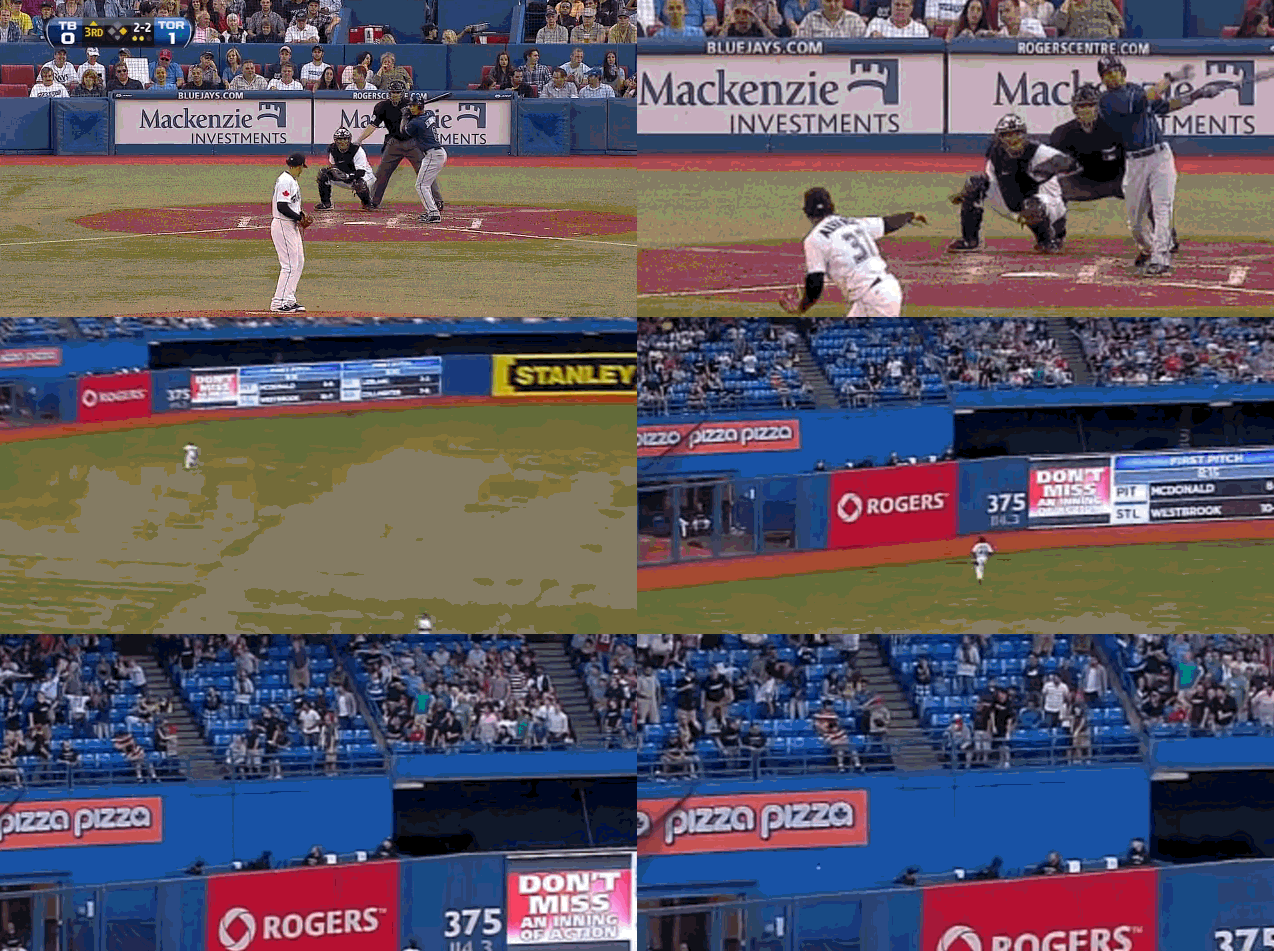
In his short 2011 sample, his flyballs hit off the inner third of the strikezone yielded a 5-for-12 (.417) mark with all five hits leaving the yard. He hit .297 (11-for-37) off the inner third as a whole in 2011. In 2012, he hit just four home runs off the inner third accounting for all four of his flyballs hit in nearly twice as many tries as he went 4-for-23 (.174). He still did plenty of damage off the inner third as a whole going 26-for-76 (.342), but pitchers got better at jamming inside to limit the damage to mostly singles (15 of the 26 hits). He wasn’t turning on those inner third meatballs like this one from 2011:

djennings

It’s one thing to drop your HR/FB rate because you are crushing warning track shots on gusty days or hitting the base of the wall for doubles and triples, but Jennings saw his HR/FB rate evaporate and shift into infield flies, the least successful contact a batter can make thus aiding a 61-point drop in slugging percentage and 47-point drop in isolated power (slugging minus average).

At 26, he is just about to enter his prime and doing so with 874 plate appearances under his belt should give him enough of a base to work from to make adjustments in order to fulfill his immense promise. The potential and youth will keep his price high, but the payoff is massive and even the downside was at least somewhat palatable despite massively underperforming his cost (51st ranked OF; 23rd most expensive) thanks to the steals.

He was the 92nd player drafted last year and his 2012, though under expectations, hasn’t really deterred anyone as he is tracking at 90th overall early on this winter. The composition of my team to that point would determine whether or not I’m willing to pay that eight round price tag.

If I have a foundation of guys with three-four years of track record, maybe Robinson Cano in the first, Adrian Beltre in the second, plus a Billy Butler, Cole Hamels, you get my point, proven veteran rocks; then I’d be more inclined to take Jennings. If you have team centered around Andrew McCutchen (just the one transcendent first round year), Jason Heyward, and Chase Headley, then you should probably go with Austin Jackson or Alex Rios who are being drafted 88th and 91st, respectively.