Posts tagged ‘Fantasy Baseball’

Sunday: 01.27.2013

Countdown to Spring Training: 26 Days – Pablo Sandoval

Only 26 days until live game action…

With 30 days to go, I am going to do a hitter per day highlighting one from each team. I selected my player of note from each team and then randomized them (which was pretty interesting consider who the final two were after the randomization) so that’s the order I’ll be following. (Ed. note: I shortened the intro from previous versions and I’ll probably eliminate after this week as I’m sure you get the point)

PABLO SANDOVAL

I am way late on today’s countdown offering. In fact, it’s Monday in some places already. I just had one of those days where my body refused to stay awake so I slept through a large chunk of the afternoon after waking up early this morning. Shortly after I woke up from my nap sleep, I had a birthday dinner for my brother. At any rate, no one cares about that, so let’s talk Sandoval. If you believe in what Razzball terms “Saberhagenmetrics”, then Sandoval is a big time target for you in 2013.

In short Saberhagenmetrics is a hilarious term named after pitcher Bret Saberhagen that describes a player who has a one-up, one-down statistical “pattern” to their career. Saberhagen himself won a Cy Young in 1985 with a 20-6 record, 2.87 ERA and 1.06 WHIP inciting the following see-saw:

saberhagenmetrics

He finally snapped the pattern in 1994 (evens were the bad years) with a 14-4 record, 2.74 ERA, and 1.03 WHIP in 177.3 innings. Putting blind faith into these types of patterns will leave you burned more often than not, but if you analyze the underlying factors that led to the underperforming seasons, you should be able to determine whether or not betting on the rebound is worth your time.

Sandoval lost his rookie status in 2008 with 154 plate appearances, but calling that a season is a stretch, since then he has four seasons on his ledger: two full and two injury-shortened but still north of 440 plate appearances. As a 22-year old in 2009, he exploded onto the scene with a .330 average, 25 HR, and 90 RBIs. His 2010 follow-up was mired by fitness and conditioning issues that ate into his production yielding a .268, 13, and 63 season. He eventually lost his job resulting in just 19 playoff plate appearances including just three against Texas in the World Series.

He came back in 2011 with a vengeance and only a broken hamate bone could slow him down. Still, he almost matched his 2009 production despite 167 fewer PAs. He managed a .315 average, 23 HRs, and 70 RBIs. He broke the other hamate bone in 2012 in addition to another DL stint caused by a strained left hamstring and this time he was slowed resulting in a .283-12-63 season in 108 games which was certainly better than 2010 by a good bit (115 wRC+ to 96), yet far from the star turns in 2009 and 2011.

With no more hamate bones to break, Sandoval is poised for another big season. In his 2011 return from hamate hell, he posted a .557 slugging percentage the rest of the way in 375 PA; in 2012 it was just .419 in 338 PA. But if the 2012 playoffs are any indication, his power is already back on track and ready for 2013. Sandoval put together a .364/.386/.712(!) line in 70 playoff PAs with six home runs including three in game one of the World Series against Justin Verlander (*Paul falls to the ground and starts convulsing in a fetal position*).

Sandoval doesn’t need to top 2009’s 25 HRs to be a fantasy stalwart. He just needs to show some consistency at or around that figure and he can become an elite asset in the game. Playing a premium infield position already enhances his value, but the combination of mid-20s power with a huge batting average is rare. Since 2009, Sandoval’s first full season, he is one of just six players with two or more seasons of .315+/23+. Miguel Cabrera leads the pack, completing the feat all four times and Ryan Braun is close behind missing just once (he “only” hit .304 in 2010) while Joey Votto and Robinson Cano join Sandoval.

Those thresholds are admittedly arbitrary, they represent Sandoval’s marks in 2011, but even if you round down to .300/20 he is still in an exclusive group of just 19 players to have completed the feat twice in the last four years. A lot of big names in this list (courtesy of B-ref):


Rk                     Yrs From   To                Age

1        Robinson Cano   4 2009 2012 26-29 Ind. Seasons

2       Miguel Cabrera   4 2009 2012 26-29 Ind. Seasons

3           Ryan Braun   4 2009 2012 25-28 Ind. Seasons

4           Joey Votto   3 2009 2011 25-27 Ind. Seasons

5       Aramis Ramirez   2 2011 2012 33-34 Ind. Seasons

6          David Ortiz   2 2011 2012 35-36 Ind. Seasons

7            Matt Kemp   2 2011 2012 26-27 Ind. Seasons

8      Troy Tulowitzki   2 2010 2011 25-26 Ind. Seasons

9         Paul Konerko   2 2010 2011 34-35 Ind. Seasons

10     Carlos Gonzalez   2 2010 2012 24-26 Ind. Seasons

11       Adrian Beltre   2 2010 2012 31-33 Ind. Seasons

12      Pablo Sandoval   2 2009 2011 22-24 Ind. Seasons

13      Hanley Ramirez   2 2009 2010 25-26 Ind. Seasons

14       Albert Pujols   2 2009 2010 29-30 Ind. Seasons

15     Victor Martinez   2 2009 2010 30-31 Ind. Seasons

16       Matt Holliday   2 2009 2010 29-30 Ind. Seasons

17       Shin-Soo Choo   2 2009 2010 26-27 Ind. Seasons

18        Billy Butler   2 2009 2012 23-26 Ind. Seasons

19        David Wright   1 2012 2012 29-29 Ind. Seasons

Let’s be clear that 70 playoff PA isn’t a big enough sample to determine if a displayed skill is something to bet on with certainty, but it did show us what Sandoval is capable of when healthy. With an offseason to heal and no more hamate bones to break, I’d favor a 2009/2011-type season 2010/2012-type especially since the price to do so isn’t egregious as Sandoval is currently the 9th third basemen off the board and 100th player selected overall according to early Mock Draft Central data.

Third base has some depth to it this year so while the superstars will still go early, you needn’t rush to lock one up for fear of being left with Kevin Youkilis’ rotting corpse.

Saturday: 01.26.2013

Countdown to Spring Days: 27 Days – Yonder Alonso

Only 27 days until live game action…

OK, so the first actual Grapefruit or Cactus League game doesn’t take place until February 22nd, but the Red Sox are splitting up their squad and playing a couple of colleges on February 21st so we’re just 30 days away from organized professional baseball. So why not a countdown of this final, grueling winter month that includes some fantasy analysis?

Obviously my primary focus at this site is on pitchers and you’ll get quite a bit of my analysis on them in late February when the SP Guide drops, thus I was thinking of something surrounding hitters. With 30 days to go, I am going to do a hitter per day highlighting one from each team. I selected my player of note from each team and then randomized them (which was pretty interesting consider who the final two were after the randomization) so that’s the order I’ll be following.

YONDER ALONSO

Coming up in the minors, Yonder Alonso had a perfect comp: Sean Casey. It was fitting for a bevy of reasons: he was a Reds farmhand (the team Casey spent eight of his 12 years with), he batted left-handed, had high batting average potential (Casey hit .300), and had a power ceiling in the low-20s (Casey reached 20+ three times, topping out at 25). Comps are should never be used as 1-to-1 gauges, but if you wanted a good idea of what to expect from Alonso as a pro, Casey was a great place to start.

Then he was traded to San Diego.

He moved from one of the best home run parks for lefties to that absolute worst. The Great American Ballpark has a 137 park factor (where 100 is average) for left-handed hitters when it comes to home runs. Only Coors Field is better in the National League checking in with a 150 park factor. Meanwhile, San Diego’s Petco Park has a frightening 61 park factor. Alonso suffered the consequences immediately. In his first full season, he hit just nine home runs in 619 plate appearances including a whopping three at home. Edwin Encarnacion hit nine home runs.

In May.

Alonso was fourth among qualified first basemen in doubles, though, hitting 39. His power manifests itself in line drives as his 24 percent mark was fifth-best among qualified first basemen, but his 31.3 percent flyball rate is easily the lowest among quintet (next lowest was Prince Fielder’s 33.3 percent). Part of that is his game and part of it is his adjusting to what Petco Park will give him. Here is his 2012 spray chart:

spraychart

This is a full spray, home and away, but Alonso clearly leans away from the pull outfield and I bet it would be even starker in a home-only chart (which wasn’t available to me). He understands what he’s dealing with in Petco. His home slugging percentage is actually higher than his road (.398 to .389) because he popped 23 of his 39 doubles at home, but looking for pull power at home is a fool’s errand as a lefty Padre. He hit .290 with a .400 slugging percentage to rightfield at home, but those numbers jumped to .342 and .544 to leftfield.

Obvious next question is: Will the moved in fences help Alonso?

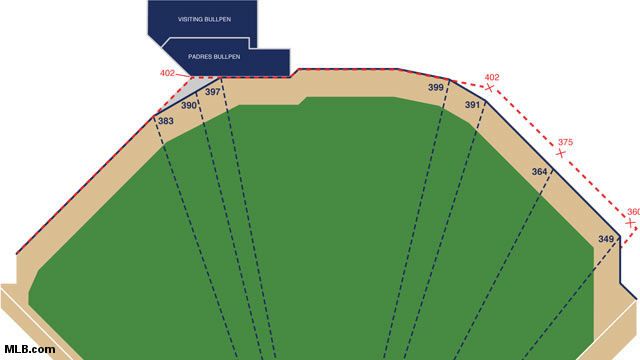
Well they should. They should ostensibly help every hitter, but I’m just being literal and anyone asking that question is actually asking how much they will help Alonso. There is no way to answer that question definitively, but let’s see if we can get some idea based on what he did in 2012. Thanks to MLB.com we know how the new fences will look once the renovations at Petco Park are finished:

petconewfence

For those of you thinking that these changes will turn Petco into Coors Jr., I hope the above picture is a wakeup call. We’re talking about a handful of 9-11 feet moves which may result in a couple extra bombs for the team’s best players. The opposition’s best players will also get a little uptick, but Petco Park is still most definitely a pitcher’s park and the best place to utilize your marginal fantasy starting pitchers. Let’s take a look at Alonso’s outfield flyball outs in Petco last year and see if those extra 10 feet would’ve turned into much.

alonsofboutsI circled a pair of outs in red that look like they might be homers in Petco2. Of course, he’d have to have the same exact hit distribution in 2013 and I highly doubt guarantee that will won’t happen. What may happen, though, is that Alonso is less fearful of pulling the ball for some power thanks to the moved in fences. At the very least, hopefully the new dimensions bring even more doubles which would then likely translate into more runs scored and driven in.

Without improved production, it is hard to justify Alonso being selected in leagues with 12 teams or fewer, even as a corner infielder or utility. He checked in as the 61st corner infielder on ESPN’s Player Rater for 2012. It was his rookie year so I’m not necessarily slamming him for finishing so poorly among corner infielders, just stating it so you’re careful not to overvalue him as he was a blue-chip prospect. And it can’t all be blamed on his home ballpark because his 723 OPS and six homers on the road were far from special.

The 26-year old Alonso is entering his physical prime and now has 746 major league plate appearances under his belt. It isn’t unreasonable to expect him to show some improvement, especially for a guy who was expected to have .300+ capability with at least high-teens power, but expecting it all at once will likely leave you disappointed. Keep him on your watch list for a standard mixed league should you need an early replacement in April or May, otherwise draft him only in NL-only leagues.

ADDENDUM

This piece was supposed to come out earlier on Saturday afternoon before I left for the movies, but I messed up the scheduling of it. So in my haste to remedy that and get it posted before it was all of a sudden Sunday, I forgot to include an instructive graphic.

yonderhmrd

Look at how his power is all to the pull field on the road (as it is with most guys, of course). This backs up the notion that he knows what he’s dealing with when it comes to Petco Park so he’s content to try and pepper doubles to leftfield instead. It will really be interesting to see if the fence move, though slight, will coax Alonso toward the pull field a bit more at home and maybe yield some extra bombs.

Friday: 01.25.2013

Countdown to Spring Training: 28 Days – Hanley Ramirez

Only 28 days until live game action…

OK, so the first actual Grapefruit or Cactus League game doesn’t take place until February 22nd, but the Red Sox are splitting up their squad and playing a couple of colleges on February 21st so we’re just 30 days away from organized professional baseball. So why not a countdown of this final, grueling winter month that includes some fantasy analysis?

Obviously my primary focus at this site is on pitchers and you’ll get quite a bit of my analysis on them in late February when the SP Guide drops, thus I was thinking of something surrounding hitters. With 30 days to go, I am going to do a hitter per day highlighting one from each team. I selected my player of note from each team and then randomized them (which was pretty interesting consider who the final two were after the randomization) so that’s the order I’ll be following.

HANLEY RAMIREZ

After the unmitigated disaster that was 2011, it wasn’t going to take much for his 2012 to be considered a rebound and it was yet he was still a disappointment. While he wasn’t going 2nd overall like 2011, he still only dipped to 20th average draft position with a high of 12 and low of 26 according to Mock Draft Central. His 20-20 season with shortstop and third base eligibility wasn’t bad, but it didn’t earn that draft position back. ESPN’s Player Rater had him 63rd overall and 42nd among batters.

The problem was that there was virtually no rebound in his paltry .243 batting average from 2011. It went up to .257, but that’s barely a dent (8 hits over a 600 AB season) and he posted the second-worst BABIP of his career at .290 (up slightly from 2011’s .275). His batted ball profile was actually somewhat conducive to a batting average increase as he added 2.5 percent to his line drives, which have the best chance to become hits. His flyball rate rose continuing a three-year trend, and those are least likely to become hits. While his flyball rate only ticked up by 1.2 percent, his infield flyball rate jumped four percent and those are all but guaranteed outs.

His BABIP based on batted ball was league average all told (he was a little low on line drives, but high on grounders & flies) so we shouldn’t be too surprised that his .257 batting average was essentially on par with the league’s .255 average as a whole. He might’ve smoked a few more at-‘em balls than normal, but nothing that would leave you saying he was quite unlucky for the performance he was delivering on the field. Batting average is really what kept his 2012 from being a “Hanley” season considering 2009 and 2010:

hanley3year

Based on my rough math estimations, a .300 average would’ve boosted Ramirez to a tie for 11th among batters in the player rater with Adam Jones and vaulted him to 18th with Jones in the overall.

“Well ya, but he was playing a lot in that cavernous monstrosity that can gives your eyes an STD if you watch too many home Marlins games!”

*Bzzz* Try again.

Ramirez raked in Marlins Stadium as did the other two superstars on that team:

homemarlins

It appears that Ramirez’s batting average issues for 2012 fit under the Occam’s razor principle: he just wasn’t good enough. No logistical pretzels about this BABIP or that venue. He simply didn’t hit the ball well enough to earn a .300+ average. I mean, we’re really only talking about a hit a week here. Another 26 hits would put right at .300 (actually .2996688, but I think MLB would go ahead and give it to him) and that feels like a lot, but there are generally around 26 weeks in the season.

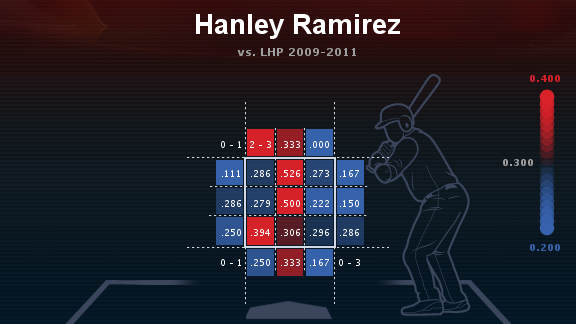
Where is going to get those hits in 2013? Ideally off of southpaws. For his two-plus seasons (92 G in ’11) from 2009-2011, he hit .305 off of lefties with a .339 BABIP. Those figures dropped to .263 and .293 in 2012. It wasn’t just one problem area either; they just handled him better than ever before. Though up and in and down and away do stand out a bit when comparing the two samples:

(click to enlarge)

(click to enlarge)

(click to enlarge)

(click to enlarge)

Ramirez remains a hot commodity for several reasons:

  • He has a track record of excellence so the potential to return to those levels is still present.
  • He is still on the right side of 30, adding to the likelihood of the first point.
  • He has dual eligibility at the hardest spot to fill (SS) and another premium infield spot (3B)
  • His “down” seasons are still 20-20 seasons with 92 RBIs. Well down seasons without injury.

Ramirez is solid “buy” target for 2013, even as a second round pick (though his ADP is a ludicrous 42 in early drafts** over at Mock Draft Central making him a huge bargain if that holds, but I doubt it will). High floors are a market inefficiency and they can sometimes be more important than a high ceiling for an early round pick. Especially if you subscribe to the notion that you can’t win your draft in the early rounds, but you can lose it.

**ADDENDUM

In the mock drafts I’ve done to date, Hanley has gone as follows:

  • 23rd overall in a 15 tm mixer w/OBP instead of AVG
  • 27th overall in a 15 tm mixer w/OBP instead of AVG
  • 21st overall in a standard 12 tm mixer
  • $31 dollars in a 14 tm auction standard 5×5

In other words: ignore that ADP because there is very little chance you’ll get him at that price.

Don’t forget the countdown continues on the weekend! 

Friday: 01.18.2013

New Podcast Out

BP-fest here of late (which is freeee today!), but Jason has posted the latest episode of our podcast. This week we spoke to Todd Zola of Mastersball.com centering our conversation on player valuation and some of the best ways to approach the process. It was a very good discussion. Additionally we discussed the three-way trade between Seattle-Oakland-Washington, Mike Napoli‘s contract finally getting done, and Matt Harrison‘s extension. We read some emails and discussed some favorite reads catching up after missing that segment for a few weeks. Stupidly, I forgot to include the Rafael Soriano signing. It’s probably because I was too focused on trying to make Manti Te’o girlfriend jokes so here are my thoughts on the signing:

I love it for Washington. It’s costly, sure, but they’re in win-now mode. Soriano now gives the Nats a ridiculous three-headed monster that they can use to shorten games to six innings on many nights. Soriano joins Tyler Clippard and Drew Storen to form the lockdown triumvirate (not to mention Craig Stammen kicking butt in his first full season as a reliever) with Soriano likely getting the first crack at the closer’s job if for no other reason than his salary. Not that he isn’t every bit as capable as the other two.

The last time Soriano was in the National League, he posted a 33 percent strikeout rate in a career-high 75.3 innings adding 27 saves as well. Craig Kimbrel (50 percent in 2012) and Aroldis Chapman (44 percent) think fanning just a third of the batters you face is cute, but for a mere mortal it is fantastic. Known as injury prone, health has eluded Soriano a bit over his entire career, but he has been a 60+ inning pitcher in three of the last four years and five of seven so he seems to have outrun the legitimacy of that tag in his late-20s and early-30s.

Sorry to those with Storen in keeper leagues. Clippard and Storen will be among the more expensive middle relievers in NL-only/deep mixed leagues and they will deliver plenty of value even if they only end up with a save or two all year. Meanwhile back on Soriano’s former team, David Robertson‘s value ticks upward again as the incumbent behind a now 43-year old Mariano Rivera returning from a torn ACL.

As for the articles referenced:

Tuesday: 08.2.2011

Fantasy Impact of NL Players Moving to AL

Fantasy Impact of NL to AL Guys

I’m going to take a look at the guys moved all around during the deadline, but only from the fantasy angle.  So it is less about judging the team’s front office on the returns whether short or long term, but rather about how these players can have fantasy impact for you in the next two months and beyond (for prospects).

Ubaldo Jimenez (COL to CLE) – There is a lot of talk about much Jimenez has struggled this year which is expected because comparing his 2.88 ERA and 1.15 WHIP from 2010 to his 4.46 and 1.37 marks this year tells us he has been significantly worse.  But has he really?  The one significant cause for concern is the drop in fastball velocity from 96 MPH to 93 MPH.  Velocity drops are often an indicator of trouble, but beyond that there isn’t a great deal of difference in Jimenez’s profile.

He has a 2.3 K/BB rate for the third straight with virtually identical components to last year’s: 8.69 K/9 & 3.74 BB/9 in 2010; 8.63 K/9 & 3.73 BB/9 in 2011.  I don’t usually go two places after the decimal point, but I wanted to show just how close it has been.  His xFIP and SIERA are remarkable steady over the last three years with xFIPs of 3.59, 3.60, and 3.56 this year while his SIERAs are 3.77, 3.68 and 3.56 this year.

I realize most leagues don’t use xFIP or SIERA but the point is that he is pitching better than his ERA suggests.  The big differences are a career-high .312 BABIP (.280 and .271 the last two years) and severe struggles with men on base leading to a career-worst LOB% of 67% (74% and 77% the last two years; league-average is around 72%).

Another concern for many is his moving from the NL to AL as it is a league generally tougher on pitchers due in large part to replacing the pitcher batting with a designated hitter.  I would theorize that the change in park factors from Coors Field to Jacobs Field (shut up, Flo from the insurance company) would mitigate the league difference.  Coors Field significantly plays up 1B, 2B, 3B and HR while Jacobs Field plays essentially neutral or pitcher-heavy to all eight (each category for righties and lefties) except left-hander home runs (107 park factor, which is still an improvement from Coors’ 113).

This is the prize of the trade deadline for AL-only leaguers and if you need an arm then you need to take your chances on Jimenez.  He leaves a massively under-performing and disappointing team in Colorado for a pennant race in Cleveland which can only help.  At the very least, I think it would be a neutral factor.  His K/9 when slotted into the AL leaderboard is 6th-best so he is even better in 5×5 leagues.  The velocity drop may in fact be problematic, but his profile says there isn’t a reason for grave concern.  He could be a game-changer down the stretch for any team capable of real traction in strikeouts, ERA and WHIP.  Wins are always a crapshoot, but there is no denying that the Indians have been sticking around for four months and this kind of big time trade could spark the whole team.  Or not.  Don’t chase wins.

Colby Rasmus (StL to TOR) – The Blue Jays earned raved reviews for plucking Rasmus from the Cardinals for what amounts to a pile of parts since Edwin Jackson wasn’t really a Jay except in passing.  I do think it was a nice pickup for the long term especially in light of what they gave up, but for the rest of 2011 it might not make that much of a fantasy impact.  Since the potential is there, I understand putting a significant portion of FAAB on him and even encourage it, but you have to be prepared for it to not work out.

The simple fact is he is regressing by the month.  After an .867 OPS in April, he has fallen to .777 then .684 and then most recently .544 in August.  A player of his caliber is unlikely to show up on the wire throughout the remainder of the season so take a chance on the upside if an offensive spark is what you’re missing.  Last year he ended the season on a very high note with a .318/.403/.514 line and four home runs, 12 RBIs, 19 runs scored and two stolen bases in 107 at-bats in September.  Let’s hope this fresh start rejuvenates him and gets back to the Rasmus we saw in 2010 and the first month of 2011.

Mike Adams (SD to TEX) – His move in home ballpark is just about the opposite of Jimenez’s, but as a short reliever there is less chance that it will greatly impact his rock solid skills profile.  He strikes out more than a batter per inning (9.2 K/9), doesn’t walk anybody (1.7 BB/9) and induces a decent amount of groundballs (46%) so I wouldn’t be surprised if he continued to excel despite the move to a hitter’s park in the more hitter-friendly league.

As a reliever, it’s not like he was facing pitchers in the 7th and 8th innings anyway.  He is worth a few bucks as the last man on your pitching staff and might be worth even a few extra bucks if you’re in dire need of saves and don’t mind speculating.  Rangers manager Ron Washington has publicly soured on Neftali Feliz a bit and while that might just be his way of motivating him, he might also be looking for a reason to make a change (even though it’s his fault Feliz is there in the first place when he should be in the rotation).

Kosuke Fukudome (CHC to CLE) – Those in OBP leagues take note, Fukudome has gotten on base at a 36% or better clip all four years in the majors and 37% or better in each of the last three years.  That’s really ALL he does, though.  He has three home runs and two stolen bases on the season.  I understand that leadoff is hardly a run-producing spot in the lineup, but despite more than 300 plate appearances there, Fukudome has 12 RBIs.  The next worst is Austin Jackson with 24.  Of course a lot of that goes on the Cubs and their anemic offense, but he has never had more than 60 RBIs in a season.  He should be looked at as a 4th or 5th outfielder at best.

Brandon Allen (ARI to OAK) – This feels like a pretty typical Oakland pickup, doesn’t it?  Allen has thwarted AAA quite handily alas he is headed back there for now, but many suspect the A’s will give him a legitimate shot to see if they finally have a first basemen who is fantasy relevant (sorry, Daric Barton).  Allen has only gotten 65 games spread out across the last three years and while his line is a meager .213/.325/.404, he does have eight home runs and 27 RBIs, numbers that pace out to 27 and 91 in 600 at-bats.  A dollar reserve player in leagues where reserves are applicable, otherwise keep an eye out for his return to the majors which should happen at some point this year.

Sunday: 07.31.2011

Fantasy Impact of AL Players Moving to NL

I’m going to take a look at the guys moved all around during the deadline, but only from the fantasy angle.  So it is less about judging the team’s front office on the returns whether short or long term, but rather about how these players can have fantasy impact for you in the next two months and beyond (for prospects).  You’ll see what I mean right away with this first guy…

Edwin Jackson, SP (CHW to TOR to StL) – Jackson is pretty easily the best player who switched from the AL to the NL and for teams in dire need of starting pitching, he will be the perfect jumpstart to their rotation and comes for “free”.  Free in that he simply costs FAAB and your worst pitcher as opposed to going out and trading for a starter which can be costly.  Judging Jackson by his 3.92 ERA at the time of trade is foolish at best and horribly misguided at worst.  Anyone paying attention sees how well he’s been pitching since a rough April (5.86 in 35 IP) having posted a 2.99 ERA in 93 innings including his first start with the Cards.

His second-level numbers are even better with a 3.21 FIP, 3.49 xFIP and 3.69 SIERA.  The WHIP is a bit hefty for the year at 1.41, but again that is inflated by April’s 1.71 mark.  His 1.31 WHIP in the subsequent three months still isn’t great, but it is quite a bit more palpable.  Keep in mind also that WHIP is especially tough to move this late into the season for better or worse.  Over the final two months, Jackson at a 1.31 WHIP might move a team up 0.01 in WHIP and that depends entirely on how the rest of the team’s staff pitches around him.  So don’t overrate that aspect of his game.

Jackson’s 7.1 K/9 rate ranks 27th among qualified starters in the National League and could stand to tick up facing non-DH lineups the rest of the way.  Combine that with his already favorable rates and a better home park and all of a sudden you have an “all-in” type of player when it comes to FAAB if pitching is your biggest need down the stretch. 

Corey Patterson, OF (TOR to StL) – It is Jon Jay who will benefit most from the trade of Colby Rasmus, but Patterson becomes the backup at all three outfield positions so he will get some at-bats on the Cardinals.  A .251/.284/.375 line in 347 plate appearances this year should tell you all you need to know about Patterson and his fantasy prospects.  He does have six home runs with 13 stolen bases so he has a tick of power-speed potential, but at what cost to your batting average?  If you have a dead spot at UTIL or your OF5 and you want to start getting some ABs that could result in something then Patterson warrants a few bucks of FAAB.  Otherwise, pass, because he isn’t an impact player even if he were somehow guaranteed regular playing time.

Derrek Lee, 1B (BAL to PIT) – My thoughts on Lee to Pittsburgh can be found here in greater detail, but from a fantasy perspective his value is similar to what it was in the AL with the Orioles which is to say minimal at best.  He is the 30th rated first baseman according to ESPN’s Player Rater.  In fairness, he has been 14th over the last month so if he stays warmish (.250/.294/.510 w/6 HR, 19 RBI) then he could be a low-level corner infield/utility option.  Then again, I say warmish because most of that 14 ranking is RBI driven which has little to do with actual skill.  He hasn’t been much of a power source in a friendly home like Camden Yards, so don’t expect a sudden uptick in PNC Park.

Marc Rzepczynski (pronounced Zep-chin-skee), RP (TOR to StL) – Dynasty NL-only leaguers might want to file The Chin away for a buck or two looking forward to the future because this 25-year old could move back to the rotation eventually.  He started 23 of his 25 appearances in 2009-2010 before shifting to the bullpen full-time this year.  After two years of a 51% groundball rate in the rotation, he has upped that mark to an eye-popping 65% in 41 relief innings.

All the while his 8+ strikeout rate has maintained (8.1 K/9 the last two years, 8.8 in 2009) suggesting some legitimate promise going forward.  His major hurdle will be figuring out righties more consistently as his strikeout to walk ratio against them is 1.7 while he posts a much healthier 3.2 mark against lefties.  Similarly his OPS allowed goes up 200 points from .578 to .778 when facing righties.

Brad Ziegler, RP (OAK to ARI) – If Jackson’s WHIP in 60+ innings the rest of the way isn’t really going to hurt you then Ziegler’s (1.35 this year and last, 1.50 in 2009) in far fewer innings (maybe 20 or so) will barely register.  Ziegler is a solid real-life reliever, but he doesn’t strikeout enough batters (career best 6.9 K/9 this year, career total of 6.0) to even have much NL-only value as your ninth pitcher on the staff.

Octavio Dotel, RP (TOR to STL) – Dotel does have the strikeouts that Ziegler doesn’t (9.2 K/9 this year, 10.9 career), but his ERA is always around the mid-3.00s and you can definitely find a high strikeout, low ERA guy who would better fit that middle reliever last spot on your staff.

Orlando Cabrera, SS (CLE to SF) – When bringing in a guy with a  .268 wOBA improves you at a position, there is trouble at that position on your team.  Cabrera, owner of the aforementioned .268 wOBA, is marginally better than Miguel Tejada (.260) and Brandon Crawford (.239), but he has been abysmal defensively at second base so why would the Giants think he could be better at shortstop?  He has zero fantasy value so don’t let the name recognition fool you into a bad move.

The only way I could see justifying so much as a dollar of your FAAB on him is if you have a dead spot at shortstop and your standings are tight in runs scored and driven in and you want to get something out of the roster spot.  And even then, you better not have a tenuous hold on your batting average spot because his .244 isn’t doing you any favors.  Perhaps he gets back to the .263 level he showed in the NL a year ago and hurts less.

There will be several pieces like this including:

  • NL players moving to AL
  • NL players changing teams in NL
  • AL players changing teams in AL
  • AL prospects moving to NL
  • NL prospects moving to AL
  • NL prospects changing orgs in NL
  • AL prospects changing orgs in AL

I think this is easier for fantasy purposes that analyzing every single trade one-by-one.  I’ll have them all out as soon as possible, but it might not be finished until Tuesday.  In the meantime, if you want my opinion on a traded player for your FAAB or waiver pickups that happen sooner, mention something in the comments below or hit me up on Twitter (@sporer) and I’ll get to you there.

Tuesday: 07.19.2011

Keeper Building Blocks: Outfield, Part 1

Outfield has a lot of great centerpiece players that would be worth giving up any un-keepable entities you have to in order to land them.  In fact, a number of them are “arm & a leg guys” meaning, of course, that they will cost you an arm and a leg.

You have to give something to get something and as long as you aren’t blowing up your team completely (e.g. trading a few expiring contracts/high-priced un-keepables AND some guys you were planning on keeping), then they are worth it.  Situations will vary depending on league format & keeper rules, but don’t overdo it just to get one guy or you may be worse off than you were before you got him.

Based on talent, age and the likelihood of studs on a cheap contract, outfield is the best position in this Keeper Building Block series to find your truly elite cornerstone.  The first 7 or 8 guys fall into that category and while all won’t be cheap in your league, several should be giving you options.  And it is likely that at least one of them is on a contender and hopefully you the missing puzzle pieces for them to seal a title and be willing to give their star.

There are several more OF building blocks than at any other position, so I broke it up into two pieces.

Catchers

First Base

Second Base, Addendum

Shortstop

Third Base, Addendum

Jose Bautista (TOR, 30) – See the third basemen piece for info on Bautista.  He is almost certainly on a cheap contract and it’d take just about any viable piece you to get him, but it might be worth it if you still have a few keepers around him.  His value is much, much higher at third base, but since he qualifies at outfield, I made sure to list him here.

Carlos Gonzalez (COL, 25) – When a season of .287 with 22 HR, 27 SB, 88 RBI & 100 R is your come down season from a career year, you are an elite player.  Plus he is getting better month-over-month so he just might improve those paces.  Either way, he still ranks 26th overall on ESPN’s Player Rater and 8th amongst outfielders.  His 2010 breakout came on the heels of an 89 game debut in Colorado that went well (.284/.353/.525, 13 HR & 16 SB), but still left him with a reasonable average draft position (ADP) of 120.  So he is either on a minor league contract or a regular one that is no doubt affordable.

Andrew McCutchen (PIT, 24) – I am pleased to have this burgeoning star locked up for two more years in my NL-Only league for just $15.  He is a dynamic, five-category (his .279 isn’t elite, but the league-high is .272 and my team average is .262 so he is definitely a positive contributor in that category) stud who appears to be just scratching the surface of his potential.  Next year will likely be his first full season in a run production lineup spot (third or fourth) and that should allow to knock in 100+ runs for the first time in his career.  That is if he doesn’t increase his pace of 98 this year and make 2012 his second stab at the century mark.  He is the face of the budding Pirates franchise and he can be the same for your fantasy team.

Mike Stanton (FLO, 21) – This kid is incredible.  He hit 22 home runs in 100 games (hitting one every 16.3 AB) and while the lofty strikeout rate (31%) made it clear that batting average would be a challenge, the power was undeniable.  He has made incremental gains on his power (HR every 15.8 AB and .267 ISO up from .248), his strikeout rate (down to 28%) and walk rate (up from 8.6% to 9.2%, OK so that is essentially the same) putting him on pace for 34 home runs and 96 RBIs… at 21 years old!

If there is one concern, it’s slight and it’s his age combined with the strikeout rate.  His inexperience and lack of contact could lead to prolonged slumps as he continues to grow.  It doesn’t dissuade me from targeting him, but keep it in mind.  In most keeper leagues, he will be on a minor league contract which is no doubt much cheaper than his actual value and with power on the decline league-wide; he should be a premier target.

Jay Bruce (CIN, 24) – He is essentially a look into Stanton’s future on some level, a pure power hitter with batting average liability.  Bruce doesn’t have the strikeout woes that Stanton does, but they profile similarly.  As a 21 and 22 year old Bruce hit 21 and 22 home runs in 413 and 345 at-bats, respectively.  His walk rate has steadied at 10% the last three seasons and while his BABIP-influenced.281 batting average (.334 BABIP) from 2010 hasn’t held (.265 w/.293 BABIP), the .265 he has posted doesn’t hurt too much in this low-offense environment of 2011.  I have him and Stanton pretty close, but I gave Stanton the edge because he likely cheaper and he is three years younger.

Jason Heyward (ATL, 21) – The ideal situation would be finding Heyward on a contender because his 2011 has been a disappointment (have I mentioned that young talents, no matter how good, don’t improve linearly?) due at least in part to injury.  There is a bit of concern around his massive groundball rates (55% and 58% in his two pro seasons) and how that affects his power potential, but the kid is 21 and even when he is underperforming it is easy to see while watching him that he is a special player.

Colby Rasmus (STL, 24) – Generally when a guy needing a “change of scenery” is thrown around, it is an excuse for his struggles when the truth is that he probably just isn’t as talented as originally believed.  However with Rasmus, I think it is one of the few cases where the change is necessary.  Rasmus has a permanent front row seat in manager Tony LaRussa’s dog house and it seems to have finally crept on the field full time and affected his play.  Instead of aiding his first place Cardinals with a season that builds on his strong 2010, Rasmus looks out of place and appears to pressing with increasingly worse numbers month-to-month:

April: .301/.392/.476

May: .253/.370/.407

June: .213/.268/.416

Generally teams don’t discuss trading mid-20s talents like Rasmus alas his name has come up in some preliminary rumors as we near the trade deadline.  I have no doubts that he can flourish out from under LaRussa’s thumb and his modest 2011 output might allow you to get a discount via trade.  Or he could be a primary reason why you’re building for 2012 already.  If it is the latter, sit tight with Rasmus.

Sunday: 07.17.2011

Trolling the Wire: Week 16 Monday-Friday

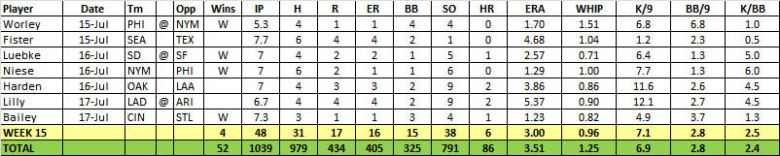
The All-Star break made for a really short week in fact most (all?) head-to-head leagues extend the “week” of play through next Sunday which is the right thing to do because assigning a win or loss on just four days of play would be really weak.  If you followed the post-break picks in your league, you are off to a great start as there was really only one bad start out of the seven and even that wasn’t a complete meltdown.  It was Doug Fister‘s four runs allowed in seven and two-thirds with just a strikeout.  Ted Lilly yielded four runs in just six and two-thirds, but he struck out nine so his start was a bit better.  Beyond that, there were several gems to start off the post-break second “half”:

MONDAY:

Chris Capuano (NYM v. FLO) – Remember the days when a 4.12 ERA on the waiver wire would be a godsend and an auto-pickup?  Ah, the mid-2000s.  Now it yields a 91 ERA+ and barely gets a second look, but Capuano has been pretty strong since his rough April during which he posted a 6.04 ERA in 25 innings.  Three blowup starts out of 13 since are what keeps him from better overall numbers, well that and the fact that he had to chisel away on a 6.04 in the first place.  He has a 3.49 ERA in 77 innings since April 29th with an 8.0 K/9 making worth a look against Florida.

TUESDAY: Let us mourn the loss of Tim Stauffer from waiver wires everywhere as his ownership rate has climbed to 83% in CBS, 74% in ESPN and 62% in Yahoo! leagues.  Honestly, that is still too low, but he is on too many teams to be considering for Trolling the Wire until further notice. 

Rubby de la Rosa (LAD @ SF) – If you have been reading the content here for a while then you know I am a big fan of this kid.  He has thrown 96 total innings this year between AA and MLB compared to 110 last year and while the Dodgers haven’t said much about a potential innings limit, there is speculation that he won’t go much beyond 130-140 especially considering he has made the jump from AA, albeit successfully.  That has little bearing on this upcoming start, but if you are in a re-draft league then you might consider flipping de la Rosa as soon as possible.  You might find someone willing to bite.  In the meantime, enjoy his strikeout per inning and incredible potential.

WEDNESDAY:

Aaron Harang (SD @ FLO) – The crafty vet has been great since returning from the disabled list (13 shutout innings) and since his ERA peaked at 5.05 after a disastrous outing in Colorado on May 14th (7 ER in 4.3 IP), Harang has been excellent toting a modest 1.35 ERA in 47 innings with 6.3 K/9 and 2.4 K/BB rates though just a 2-0 record thanks to woefully inept offense “supporting” him.  While he is better in Petco Park, he isn’t a Petco-only and thus looks like a nice start in Florida.

Ryan Dempster (CHC v. PHI) – When you enter June with a 6.00 ERA and proceed to damage it further in your first start (6 ER in 5 IP pushing it to 6.32), you can have a lot of good work go unnoticed because of the massive hole that has been dug.  That is the case with Dempster.  Since that June 3rd start, he has a 1.99 ERA and 1.10 WHIP in 45 innings spanning seven starts along with 8.8 K/9 and 3.7 K/BB rates.  Dempster is still available in over 50% of ESPN while CBS (83%) and Yahoo! (69%) leagues are more keen to his recent hot streak.

Derek Holland (TEX @ LAA) – Back-to-back shutouts earns you a look even if Holland’s came against the A’s and Mariners.  He has allowed just nine hits with 15 strikeouts and three walks against the two offensively-starved teams.  The Angels are hardly a powerhouse so let’s ride Holland’s hot streak.

THURSDAY:

Javier Vazquez (FLO v. SD) – Speaking of a hot streak, Vazquez has been white-hot the last month yet few are noticing as his season ERA is still sitting at a ghastly 5.14 in 103 innings.  Alas, he has a 1.69 ERA and 1.07 WHIP in his last 37 innings since June 16th with 7.1 K/9 and 9.7 (!) K/BB rates.  You read right, he has 29 strikeouts and just three walks during his run. This run would earn a look against most teams, but it becomes a no-brainer against the lowly Padres.

Jonathon Niese (NYM v. STL) – He has been a favorite for Trolling appearing five times with mixed results (3.72 ERA, 1.44 WHIP, 21 K, 9 BB & 2 W in 29 IP), but he has been really strong the last two months with a 2.83 ERA, 1.24 WHIP, 8.5 K/9, 3.9 K/BB and seven wins in 70 innings (11 starts).  He is on teams in 68% of CBS leagues, but just 35% and 13% in Yahoo! and ESPN, respectively.

FRIDAY:

Cory Luebke (SD @ PHI) – Still undervalued & still dominating.  He has been incredible in three July starts for Trolling readers with a 1.89 ERA and 20 Ks in 19 innings and I am going to keep him on this list until he is no longer widely available.  Essentially, he has filled the Stauffer role.


Thursday: 07.14.2011

Trolling the Wire: Week 15 Friday-Sunday

Did you read my mind & pick up Aaron Harang for a spot start today?  No?  Wow, that was dumb of you.  He was the only guy I really liked today, but didn’t have time to post my picks as I was busy with the day job.  As of this writing, he has thrown five scoreless at home against the Giants.  Of course, halfway through the season, hopefully you would be able identify an under-owned Harang against a weak offense in the best pitcher’s park in the world as a viable spot start option.

For those still wanting the assistance, I am here to help so let’s take a look at some picks for the weekend (I’m one of those who lumps Friday in with the weekend, it should be a day off anyway).  But first, we will look back on the bloodbath that was week 14.

Not even the good fortune of picking Harang & Rubby de la Rosa who had dueling no-hitters through five innings and each went on to throw six shutout innings apiece could erase the carnage of Carlos Carrasco’s two starts along with the implosions of Edinson Volquez and Bartolo Colon.  By the way, Colon pitched in Toronto tonight and was dominated for eight runs in two-thirds of an inning.  Mercifully for his fantasy team managers, only three runs were earned, but the eight runners allowed is going to sting.

FRIDAY:

Justin Verlander (*checks ownership rates*… What??? How is he on 105% of teams??  Nevermind.)

Vance Worley (PHI @ NYM) – This kid has been great in his second go-round with an 0.72 ERA in four starts since coming back up on June 18th.  You would like to see his 6.5 K/9 tick up a bit, but it is passable.  Meanwhile his 3.6 BB/9 is inflated by one outing where he walked four in six innings.  He has walked two in each of the other three outings.

Doug Fister (SEA v. TEX) – The Mariners hate him for some reason so there is virtually no chance that he logs a win, even if he goes nine and allows two runs, but the chances of a quality outing at home are very strong.

SATURDAY:

Cory Luebke (SD v. SF) – This kid’s ownership rates should be skyrocketing after each of his starts, but he might get the Tim Stauffer treatment whereby he has to prove himself for three months before he will finally be trusted.  Hopefully that is the case, that will leave us spot starting fans a gem to use every fifth day.  Luebke’s numbers aren’t just built off of his 39 relief innings.  He has a 1.06 ERA and 0.65 WHIP in 21 innings along with 11.1 K/9 and 7.0 K/BB rates.  He is an auto-start right now, especially at home.

Rich Harden (OAK v. LAA) – One good start at home, one rough start in Texas.  The latter was an easy layoff, but I am comfortable trotting him back out there for this home start against the Angels.  The Angels don’t have an overwhelming lineup and that home ballpark always helps.

Jonathon Niese (NYM v. PHI) – One of the unnoticed bright spots for the Mets has been Niese who has allowed more than three runs just once in his last 10 starts.  During that stretch he has a 2.73 ERA, 1.24 WHIP and 8.6 K/9 rate.  His 3.8 K/BB rate is quite impressive, too.  The 24-year old just continues to improve and I am surprised to see that he is on just 13% of ESPN leagues right now.

SUNDAY:

Ted Lilly (LAD @ ARI) – I think he is going to have a big second half.  His skills have produced an xFIP nearly  a full run lower (3.99) than his 4.79 ERA through 107 innings.  He doesn’t walk anyone (1.9 BB/9) and his 6.6 K/9 is pretty good, though a full strikeout under his rate from the last two years.  He has always been a huge flyball pitcher so that isn’t a major concern and I expect him to regress back toward his mean over the remainder of the season.  He could also find himself dealt by July 31st and his destination would play a role in his value of course, but for now I’m buying.

Homer Bailey (CIN @ STL) – Most head-to-head leagues aren’t just going with a four day week.  However, if yours is and you are protecting an ERA and/or WHIP lead, I would pass on Bailey, but if you have all next week to go still he is a solid gamble especially for some strikeouts.  He, too, could be instrumental down the stretch as his big second half in 2010 (3.55 ERA, 9.2 K/9 in 58 IP) earned him sleeper value coming into this season.


Thursday: 07.7.2011

Keeper Building Blocks: Third Base

If you thought things were sparse elsewhere on the infield, wait until you see what third base is offering for potential keeper building blocks.  Before the season started, I saw third base as easily the second-worst position on the diamond behind shortstop.  There has been some nice improvement in the middle tiers of shortstop to the point where you could reasonably make a case that the two have now flip-flopped.

If it weren’t for Jose Bautista qualifying at third base, the position would be in really big trouble.  It is still a troubled wasteland primarily because it started thin and has since been ravaged by injuries.  Evan Longoria, David Wright, Ryan Zimmerman, Pablo  Sandoval, Martin Prado, Scott Rolen, David Freese and Placido Polanco have all missed time due to injury this year.  All but Polanco have hit the disabled list, while Polanco is currently day-to-day with back pain that has been troubling him for a month and has no doubt impacted his modest output this year (.274 batting average, a category you draft him to excel in).

Catchers

First Base

Second Base, Addendum

Shortstop

I came up with six potential candidates, though one will take an arm and a leg (literally) to pry away from a leaguemate:

Jose Bautista (TOR, 30) – Yes, this of course is the arm & a leg guy.  He is probably no more than $10 in any league depending on how free agents are acquired and how their contracts work and when you couple that incredible price with the fact that he has been arguably the best player in the game (Matt Kemp’s speed might put him #1), you have a helluva price tag.  Unless it requires several of the keepers you were planning on for 2012, it might not be a bad idea to pay the hefty price to get Bautista.  It would take a unique set of circumstances to acquire him from a leaguemate, but given how cheap he should be in keeper leagues, you have to take a shot.

Pablo Sandoval (SF, 24) – The Kung Fu Panda is back after a rough season in 2010 and if it weren’t for his missed time on the disabled list, he probably would have made a serious run at the starting third base gig for the NL All-Star team.  He should still be cheap from any initial contract in your league, but if for some reason he was on the open market this March, he is probably still at a fair keeper price given the reaction to his modest output last year (.268/.323/.409 with 13 HR, 63 RBI).  The most games he can play this year is 121 and yet he is still on pace for 21 home runs, not bad considering he hit 25 in 153 back in 2009.

Adrian Beltre (TEX, 32) – He was coming off of a down season in 2009 which caused his value to be depressed even as he headed into Boston last year.  Thus he could be on a nice contract in your league.  This won’t apply to all leagues, but I had to include him just in case.  He will be a bit older, but he’s got great power at a scarce position.  That’s keeper-worthy.

Martin Prado (ATL, 27) – Nothing against Prado, but when he is our fourth potential keeper at third base, you know it is thin.  He has definite value, but it is tied to his batting average which can suffer in a year due to luck.  I just think we might have the next Placido Polanco on our hands, which isn’t bad, but hardly a great building block.  Remember, Polanco had back-to-back double digit home run seasons at 27 & 28 years old sandwiched by seasons of nine at 26 and 29.

Mike Moustakas (KC, 22) – In a dynasty league, he probably moves up a spot or two on this list, but even when building a keeper list during a lost season, I’m still gunning to win the very next season so I have him down here because there is no certainty he will be all that fantasy relevant in his second season.  We saw ups & downs in his minor league career and I suspect we will see the same as a big leaguer so at 23 next year, we might see more growing pains than fantasy-worthy production.  But like I said, dynasty leaguers who can keep him forever might want to invest in him over a Beltre or Prado.

Lonnie Chisenhall (CLE, 22) – Even though he will be the same age as Mous next year, I think he will be more fantasy relevant, but his ceiling isn’t as high.  He doesn’t profile to have game-changing power and of course there is still the fact that he cannot hit lefties worth a lick.  He is someone to look at for AL-Only and deep mixed league players.  I don’t think he is someone you want to invest in as a keeper for 10 & 12-team mixed leagues right now.

I don’t think I forgot any deserving candidates, but please feel free to let me know if you think I have made any egregious omissions.