Posts tagged ‘MLB’

Thursday: 01.27.2011

Three Questions – San Francisco Giants

With the 2011 Starting Pitcher Guide slated for next month, I have a jam packed volume covering all the ins and outs of starting pitching in the 2011 season for your viewing pleasure.  Of course that doesn’t do much to address the offensive side of things so I decided to start this “Three Questions” where I will cover some key offensive issues for each of the 30 teams.  There will be more content here dealing with offense, but this is the beginning.

I paid a lot for Pablo Sandoval last spring, WTF?

Yeah that was a tough one to swallow.  He certainly didn’t come close to expectations, but at the same time he wasn’t the season killer he is made out to be, either.  Season killers are multiple month injuries on April 12th.  You can overcome guys who underperform expectations, but still play 152 games.  Plus it isn’t like his season was a complete & utter disaster, he had streaks of excellence mixed in, namely his April and August where he posted 1.008 and .907 OPS marks, respectively.

In many leagues, Sandoval’s down season (.268/.323/.409 w/13 HRs) will actually create a buying opportunity as owners overreact to what essentially amounts to a sophomore slump at age 23.  Most guys aren’t even in the big leagues at 23 and Sandoval has 1400+ plate appearances under his belt.   We have seen the best of Sandoval and we have seen the worst of Sandoval and with his price being driven by the latter, now is the time to invest.  In the SiriusXM/FSTA Draft during their conference out in Las Vegas on Monday, he was taken in the 8th round (101st overall) of a 13-team mixed league.  Last year he was a 3rd-4th round pick.

Third base is still pretty thin so his value won’t completely plummet, but I would consider that 8th round value to be the high end of where he will go in drafts so you might be able to get him a few rounds later depending on your league.  Once you get past the top 10 of Evan Longoria, Ryan Zimmerman, David Wright, Alex Rodriguez, Adrian Beltre, Aramis Ramirez, Pedro Alvarez, Martin Prado, Michael Young and Casey McGehee then I think Sandoval is just as good of a pick as the other guy.

He won’t offer nearly as much power as Mark Reynolds, but his overall profile is much more stable.  He doesn’t carry the age/injury risk of Scott Rolen & Chipper Jones and factoring in reasonable improvement regression, he should be better than them even if they manage to stay healthy.  Bottom line is you should pay for a guy hitting .300 with 18 home runs and 75+ runs scored and driven in, but be willing to go the extra buck or two for the potential he has as a 24-year old still coming into his own.

Andres Torres was a prototypical fantasy All-Star last year, what about 2011?

At 33, we’re not dealing with a growth profile here.  Torres’s 570 plate appearances last year eclipsed his career total by 115 spread across parts of five seasons.  That said, he gave us a taste of 2010 in 170 plate appearances in 2009 when he had six home runs and six stolen bases along with eight(!) triples.  After an amazing July, he sputtered down the stretch no doubt suffering some fatigue from his first whole season.  For 2011, it is going to be all about cost.

I’m confident he can put together another solid power/speed season as a “glue guy” for any fantasy team, but is the price tag going to be that of a glue guy or second tier fantasy star?  Early returns are mixed.  His ADP (average draft position) at one popular mock draft sites is off the charts ridiculous.  He is checking in as the 35th outfielder off the board (116th overall) ahead of guys like Curtis Granderson, Adam Jones, Carlos Lee, Vernon Wells and Nick Markakis.  While I said I don’t doubt he can repeat 2010, drafting him ahead of those guys means he has to repeat for me to get proper returns on my investment.

In the industry draft I mentioned earlier, he went in the 20th round (250th overall) which actually hits the other end of the spectrum as a great value.  I doubt he will go that late in most drafts, but anything before 15th-16th round is really ramping up the risk on your end.  He is a great story who has overcome his ADHD to have success in the big leagues, but you still have to remember he is a 33-year old strikeout machine with solid speed in a lineup that is still only decent at best.

Look for a .260-76-12-55-22 line which has value, but let your team construction dictate if he is a fit or not.  If you have a lot of high risk/high reward youth on the team, then Torres is a great stabilizing vet who’s downside isn’t  going to kill you.  But if you have a veteran-laden team on offense, then bet on the upside of a Travis Snider or Logan Morrison before taking a low ceiling Torres.

Is there anyone off the radar who could make an impact for the reigning Champions?

Yes there is and it is someone who has already been covered in depth here, first baseman/left fielder Brandon Belt, who was my favorite player to watch that Arizona Fall League back in November.  As presently constructed, the Giants lineup is essentially Posey, Sandy and Six Old Dudes.  Now those old dudes came through huge last year, especially in the playoffs and helped bring home a title, but older players aren’t bastions of health.  Injuries create opportunities which is where someone who is just about ready for the big leagues, like Belt, comes into play.

The reason Belt now has left fielder attached to his defensive description is because first base, his normal position, is pretty well sealed up for the time being.  Aubrey Huff parlayed his excellent 2010 season into a deserved contract and though he is 34, he has averaged 152 games per season since his age 26 season.  In that time, he has played fewer than 150 just once.  That said, age is fickle.  But the real opportunity could come in left field where Pat Burrell was something of a savior for that lineup in 96 games last year but is neither young (34), agile (-39.7 career UZR) or super healthy of late (122 & 120 GP the last 2 years).

Belt was a breakout prospect last year crossing three levels before heading to Arizona where he continued to stay hot.  Only 13 of his 136 games came at AAA-Fresno so he will start the 2011 season down there to get some more seasoning so he isn’t someone who should be drafted as anything other than a minor leaguer right now, but don’t be surprised if he earns an early summer call-up to spark that offense.

Make no mistake that the Giants won the World Series because of their pitching and that remains their overwhelming strength for 2011.  The offense is far from perfect and the veterans will have to produce with Posey if the team expects to contend out west and if not, GM Brian Sabean will have to find guys who can with Belt being the best minor league option for the Giants.
Saturday: 01.22.2011

Three Questions – Texas Rangers

With the 2011 Starting Pitcher Guide slated for next month, I have a jam packed volume covering all the ins and outs of starting pitching in the 2011 season for your viewing pleasure.  Of course that doesn’t do much to address the offensive side of things so I decided to start this “Three Questions” where I will cover some key offensive issues for each of the 30 teams.  There will be more content here dealing with offense, but this is the beginning.

Michael Young. Go.

OK, that’s not really a question, but his offseason has been one of uncertainty with the signing of Adrian Beltre and Baseball-Reference.com referring to him as Mike Young for some reason, so what does 2011 have in store for him?  For fantasy purposes the movement on the diamond whether over to first base or off the field to designated hitter has no real impact on his fantasy value because he will still qualify at third base based on last year.  That is where his value is highest without question.  I can’t really see the position move impacting his offense too much, either, though sometimes guys just don’t respond well to DH’ing.

Young has been a legitimate fantasy asset now for eight straight seasons and even at 34 years old there is nothing in his profile to suggest that will change.  The batting average dipped below .300 for only the second time in the eight year stretch since 2003, but with his flyball rate climbing yearly since 2007, that is hardly shocking.  The tradeoff is the likelihood of his power staying in the upper teens, lower 20s area.  His team dependent numbers should remains strong as the lineup actually gets better than its 2010 iteration with addition of Beltre.  With third base still one of the thinner positions on the infield (shortstop is the thinnest), Young remains a quality asset whether at third or filling your corner infielder spot.

Can Mitch Moreland hold the first base spot all year or does Chris Davis take that job and run with it?

Moreland joined the Rangers late in July and enjoyed a solid 47-game stint, but the results aren’t indicative of what you should expect over a full season.  He showed uncharacteristic power (9 HR in 145 AB; 12 in 353 minor lg. AB) thanks to a 21.2% HR/FB which would be tough to sustain over an entire season and would certainly qualify as an upset if he did it.  With a 29 AB/HR rate in 1398 minor league at-bats, no one is betting he is going to sustain his 16 HR/AB over a full season in the majors.

Conversely, he showed a much better knack for getting base hits in the minors than he did in his short time at the big leagues.  A career .313 hitter in the minors, Moreland hit just .255 in his time with the Rangers.  In essence, I would bet on the two trends reversing where he a low double-digit home run total for the season would be paired with a .285+ batting average and above average plate discipline.

But will it be enough?  For your fantasy team, not in mixed leagues as he profiles as a slightly better Daric Barton.  For the Rangers, that is to be determined.  Davis is a prototypical AAAA guy who has mashed his way through the minor leagues on multiple occasions, but failed to carry it into the big leagues in his last two years after a strong rookie debut in 2008.  Of course despite being written off as a complete bust by most, he is still just 25 years old.  Plenty of guys don’t even start their major league career until age 25 and he already has 872 major plate appearances under his belt so it’s far from over for him.

On the whole, Davis has more upside than Moreland related specifically to his prodigious power so inking Moreland in at first base on your Texas Rangers lineup projection is dangerous.  A lot can change between now and Opening Day.  It is a situation to monitor closely throughout the spring, but in the end it is one to avoid in anything but the deepest leagues where I would be more willing to gamble on Davis with a late pick if he has a solid spring than invest in Moreland’s higher floor, but much lower ceiling.

Is this the year that Ian Kinsler finally puts it *all* together?

Kinsler, a fantasy favorite for a few years now, has a 30-30 season (2009), a 20-20 season (2007), a .319 season (2008), a .517 slugging season (2008), two 100 runs scored seasons and two All-Star appearances (2008, 2010) yet his career still feels like something of a disappointment when you realize it could be so much better.  In the 30-30 and 20-20 seasons, he hit .253 and .263 respectively.  In the All-Star seasons he only played 121 and 101 games.  In fact he’s only played more than 130 games once in his five year career.  He is either putting up an incredible minus one key factor and/or having injuries cut dream seasons short.

So is 2011 the season of 150 games, 100-30-90-30? … No, of course not.  Sorry, but there is just no way you can realistically project that at 29 he is all of a sudden going to make it through an entire season.  Health is a skill and it’s one he lacks.  That said, he is still generally putting up a season’s worth of numbers in the 100-odd games he does play so he is still worth drafting relatively given the risk, but I think it would be foolish to reach for him at a position that has a lot more depth than many seem to realize.

Maybe shortstop’s stink drifts over to second base or fantasy owners just associate middle infield positions with scarcity, but second base has plenty of viable option.  Those automatically ahead of Kinsler for include Robinson Cano, Chase Utley, Dustin Pedroia, Dan Uggla and Brandon Phillips.  After that group, Kinsler’s power-speed combo is just too rich to pass up for guys like Rickie Weeks and Martin Prado, who are very good, but just don’t offer Kinsler’s robust fantasy excellence.  Plus you can always dream that everything goes his (and your) way and he finally plays a full set of games.  Just don’t bet on it.

Thursday: 01.20.2011

Three Questions – Los Angeles Angels

With the 2011 Starting Pitcher Guide slated for next month, I have a jam packed volume covering all the ins and outs of starting pitching in the 2011 season for your viewing pleasure.  Of course that doesn’t do much to address the offensive side of things so I decided to start this “Three Questions” where I will cover some key offensive issues for each of the 30 teams.  There will be more content here dealing with offense, but this is the beginning.

Will Howie Kendrick finally be the batting title contender he was thought to be as a prospect?

If there was one thing Kendrick could do in the minor leagues, it was get base hits.  He hit .363 or better in four minor league seasons from 2003-2006 leading many to believe he would be a perennial batting title contender once he hit the major leagues.  It hasn’t quote turned out that way in his first five seasons as a big leaguer.

First off, last year was the first in which he topped 105 games played, but it was also the first one he hit below .285 (.279 in 616 at-bats).  Then there is the fact that his batting average dropped year since a 2nd-season peak of .322 back in 2007.  From there he hit .301 then .291 and then last year’s .279.  So is a .350+ batting average in store for Kendrick?

No, probably not.  Coinciding with his batting average decline is a BABIP decline (not surprisingly), but while pitchers generally tend to cluster around .300 for BABIP, a hitter sets his own over time.  Kendrick’s is declining rapidly (.313 last year, career high of .381 in 2007) as both his groundball and line drive rates erode while his flyball rate ticks up in the last three years.

The case for him (however thin) would be that he is just entering his prime and despite having logged five years of major league time, it’s really just parts of four seasons and one full one.  He has shown the mix of skills needed for a batting title worthy average (high contact rate, high BABIP, significantly more groundballs & line drives than flyballs and decent speed needed to beat out a handful of hits over the course of the season) and 2011 could be the year that all of those skills combine for the breakout we have been waiting on for a while.

I am fine endorsing Kendrick as an asset to buy, just make sure your expectations are in the right of frame of mind.  You can dream of the scenario where he has the unexpected breakthrough season, but don’t pay for more than a double-double (10+ HR/SB) with a batting average floor that won’t ever hurt and a ceiling for much more.

What does Kendry Morales’ late-May broken leg do to his 2011 value?

In a word?  Nothing.  Not for me at least.  He will be nearly nine months removed from perhaps the most embarrassing walkoff grand slam celebration ever when Spring Training fires up next month and all reports indicate he will be 100% ready to go.  As such it is reasonable to expect that he will start 2011 where his breakout 2009 season and excellent start to the 2010 season left off: mashing.  In the 203 games spanning that time, he had a .302/.353/.548 triple slash with 45 home runs, 147 RBIs and 115 runs scored.

Even with the incredible depth at first base, I have Morales just making the cut of the top 10: Albert Pujols, Miguel Cabrera, Joey Votto, Mark Teixeira, Kevin Youkilis, Adrian Gonzalez, Prince Fielder, Adam Dunn, Ryan Howard and Morales.  Though if we knew Justin Morneau was going to be 100% and ready to go by Opening Day, he would crack that list and push Morales just outside.  Look for Morales to settle into a cozy .290-80-30-100 prime for the next few years.

Is Brandon Wood… nevermind, who cares?  What does a full season of Peter Bourjos look like?

Bourjos is a bright 24-year old prospect for the Angels who few had penciled into the 2011 lineup when the offseason began back in November.  The Angels were heavy favorites in the Carl Crawford Sweepstakes which would have left them with a Crawford-Torii HunterBobby Abreu outfield.  Abreu would take some days off at DH sliding Hunter to right and getting Bourjos some burn, so it’s not like he was expected to head back to AAA-Salt Lake, but after the spectacular failure that was their offseason, the Angels will now look to him for 500+ at-bats in centerfield.

Known primarily for his blazing speed (and exemplary defense), Bourjos will have fantasy value even if he isn’t ripping the cover off of the ball.  Obviously he will have to hit enough to merit everyday at-bats, and extrapolating a 51-game sample is dangerous so you can’t just look at Bourjos’ six home runs and 10 stolen bases and expect 17/27 over 500 ABs.  However, his minor league record suggests he can be a .270 hitter with 10-12 home runs and 30+ stolen bases.  His .204 batting average from last season was driven mostly by a .228 BABIP so the bulk of the 66-point increase I am projecting is tied to regression improvement of his abnormal BABIP.

Saturday: 06.12.2010

Baseball by Paul 6/12/10 Show Notes

Here are the show notes from the Saturday, June 12th episode:

Trolling the Wire Pickup

Jason Hammel, SP, Colorado Rockies – He has been EXCELLENT in his last four starts and in five of six since returning from the disabled list. Now might be the last chance to get him as he owned the Toronto Blue Jays tonight going eight shutout innings allowing just three hits and walking three others while striking out six. Taking out his May 21st start at Kansas City, Hammel is 4-0 with a 1.57 ERA and 1.08 WHIP in his 34 innings with 7.6 K/9 and a 3.6 K/BB ratio. Even leaving the start in only takes his ERA to 2.41 and actually lowers his WHIP a tick to 1.07 while the K/BB ratio also moves up slightly to 3.9.

He was solid in 2009, though mostly an NL only play with a 4.33 ERA and 1.39 WHIP in 176.2 innings. He had a huge home/road split going 3-3 with a 5.73 ERA and 1.62 WHIP in 81.2 innings at Coors Field while putting together a 7-5 record with a 3.13 ERA and 1.19 WHIP on the road.

The oddest thing about the severe split was that his strikeout-to-walk rate was significantly better at home. This year, he has reversed the split statistically with the better record, ERA and WHIP at home, but the better strikeout-to-walk ratio on the road. That said, he is pitching well enough that I would start him anywhere right now. Last year, avoiding Coors was the right play, but there isn’t enough data to buy into a home/road split with Hammel right now. He’s proven he can pitch on the road and this year he appears to have corrected the home woes making him a full-time option in deeper mixed league formats as well as all NL-Only leagues.

The Minor Leaguer Strategy

Some of the strategies I will discuss on this show include one I learned from Mike Siano of MLB Network’s Fantasy 411 show. He brought it up last year and what he does is picks up a hot minor leaguer on Thursday when fewer teams are playing and just holds the guy through the weekend in hopes of him getting called up. If he’s not called up by the new week’s deadline, he cuts ties and tries it again next week. This landed him Tommy Hanson in one of his league’s last year and Mike Stanton this year. Employing the strategy would’ve also gotten you Carlos Santana and Buster Posey, too.

In both cases, the young catchers received what essentially boils down to votes of non-confidence. Their front offices said they were still working on important aspects of their game and would not be called up all that soon. And in both cases, they were called up shortly thereafter. Posey came on a Saturday in late May and Santana was called up just yesterday on a Friday. Now in any only league with a reserve or keeper list, neither of these guys would be found on the wire, but they were available in a lot of mixed leagues because the roster spot was too precious to hold open for them.

The next players I would recommend trying this strategy with are Pittsburgh’s Pedro Alvarez and Philly’s Dominic Brown. Pittsburgh knows the future is now and their lineup is already chocked full of youngsters especially after they recently called up Jose Tabata and Brad Lincoln. Alvarez can’t be far off. He’s has a .291/.378/.551 triple slash line with 12 home runs and 51 RBIs. Andy LaRoche just doesn’t appear to be as good as his minor league numbers suggested. He’s hitting .240 with three home runs and 12 RBIs in 167 ABs so there is no reason for him to block Alvarez much longer.

Brown is a bigger gamble because he is only in AA right now, but so was Stanton. Brown is hitting .311/.381/.568 with 10 home runs, 36 RBIs and 9 stolen bases in 190 at-bats so far. When you add that to his 37 games at AA last year, he’s hitting .297/.376/.472 with 13 bombs, 56 RBIs and 17 stolen bases in 337 at-bats. At the very least, he seems ready for a promotion to AAA. But with the Phillies struggling to get any consistency at the dish and Raul Ibanez a major part of those problems, it wouldn’t be farfetched to see the Phils promote Brown to the majors. After all, there is very little chance that Jayson Werth will be resigned next year and Brown is the heir apparent. Perhaps they could play together for three and a half months before the baton is passed entirely.

Jason Castro is another name that leapt to mind. Houston is awful. Their catching situation is awful and it’s about time they infuse some young talent into their team.

Article of the Day

Cole Hamels: Still the Same Pitcher? by Eno Sarris

Monday: 01.25.2010

Is Markakis Overrated? Not So Fast.

There was a piece yesterday at AOL Fanhouse by an RJ White suggesting that Nick Markakis is overrated based on his average draft position (ADP) of 49th overall and 12th amongst outfielders. He’s surrounded by Adam Lind (43rd) ahead of him and a group including Josh Hamilton (51st), Curtis Granderson (53rd), Adam Dunn (54th) and BJ Upton (58th) shortly after him. His career highs are .306, 106 R, 23 HR, 112 RBI and 18 SB. All but the runs and average came in 2007 while the other two were in 2008. Last year was his worst in the last three, but he still managed a .293-94-18-101-6 line.

I used to be driving the bandwagon that this guy was overvalued and I’d tell anyone who would listen. My biggest issue was that I didn’t see him (and still don’t) getting back to that 18-stolen base level anytime soon and yet many of his profiles on websites and in magazines kept hearkening back to that 2007 total implying it was bound to come back that season. I came around on him when I noticed something this fall. I plugged Markakis’ lows from AVG-R-HR-RBI into Baseball-Reference.com’s Play Index looking for occurrences of players reaching each of those thresholds in the last three years. The line, by the way, is .293-94-18-87. A line I don’t think many would consider AMAZING by any stretch but recognize as solid.

The results are what brought me back to Markakis’ side. In addition to Markakis, only Albert Pujols and Matt Holliday have hit those numbers or better in each of the last three seasons. Only David Wright and Alex Rodriguez have done so twice while 21 others have done it once. It’s hard to put a price on that kind of consistency, especially in this game we play let alone on the field for the Orioles. In Mr. White’s article he touts the merits of Carlos Lee (68th) and Andre Ethier (71st), two fine outfielders, as markedly better picks than Markakis. How do they stack up to Markakis? For Lee, he discusses how he is just as capable of hitting .300 as Markakis while maintaining more power (though he recognizes the 4-year decline for Lee). What he misses is that Lee is 33 and likely to continue that decline or plateau for a year or two more while Markakis is 26 years old and entering his prime. It’s not at all unreasonable to believe that Markakis will return to the low 20s or even begin to set new career highs. Another miss from Mr. White is the runs scored column. In 2008, Lee scored just 61 runs but could be given a pass having played just 115 games, but in 160 games last year he managed just 65. I’ll grant that the category is more of a team-dependent one than individual, but it still counts and a 30-run split is significant. I’d bet on the Baltimore lineup before the Houston one if for no other reason than the growth of Matt Wieters thus giving the edge to Markakis in runs scored again.

Ethier is a different matter whereby he matches up better with Markakis statistically, but he also proves my point about Markakis’ power totals likely jumping up in the coming season. To wit, Ethier hit 11, 13, 20 in his first three seasons (spanning ages 24-26) before exploding for 31 last year. His AB/HR in that period was 31.1 and then 19.2 in 2009. Markakis has hit 16, 23, 20 and 18 in his first four seasons (spanning ages 22-25) with an AB/HR of 30.7. With Ethier’s power boost came a sizeable drop in batting average. He averaged .299 for three years before hitting .272, a total of 17 hits based on his 2009 at-bat total. Markakis has hit .298 the last four seasons, but it’s not out of the realm that a power boost would also come at the cost of some batting average. The two were neck-and-neck in runs and RBIs last year, but it was Ethier’s first season topping 90 in both. This is where Markakis’ consistency comes into play again as he’s scored 90+ each of the past three seasons and been below 100 RBIs just once with 87 in 2008.

I think Ethier stands up vs. Markakis, especially 22 picks later. But that brings up one of my least favorite things about ADP comparison articles: lack of context. Twenty-two picks seems like a lot, but Markakis at 49 is the beginning of the 5th round while Ethier at 71 is the end of the 6th. If you have that 49th pick, you drafted first overall giving you 1, 24, 25, 48, 49, 72, 73. Your only chance at Markakis, Ethier and even Lee is that 49th pick based on ADP so the ADPs of Lee and Ethier are irrelevant at that point. When judging the three on their statistical merit alone, I think Lee gets removed from contention based on age-induced decline. Now you’re comparing an ultra-consistent 26 year old entering his prime with an in-his-prime 27 year old who just showed the excellence he is capable of with a career year in 2009. It’s a pick ‘em at that point. The important thing to note is that draft trends suggest that a pick in the top of the 5th is likely your only chance at one of these guys. The other may fall to you with the last pick of the 6th, but it’s a risky bet.

Markakis definitely isn’t being overrated at this juncture in the mock draft season so much as he has been the preferential pick to a host of other comparable outfielders. I’d certainly recommend against Mr. White’s recommendation of taking Lee or Manny Ramirez (62nd) for age-related reasons while Ethier is a coinflip and a reasonable case can be made for either. Among the other in proximity not mentioned by Mr. White, I’d take Markakis over Hamilton and Michael Bourn (64th) without question, I’d take Granderson before Markakis and Dunn, Upton and Nelson Cruz (67th) would depend on my team makeup at that point in the draft. Markakis doesn’t have a standout category like Dunn’s power, Upton’s speed or Cruz’s healthy mix of both, but he also doesn’t have a gaping deficiency like Dunn’s average, Upton’s average and RBIs and Cruz’s runs scored and batted in totals. I think it is that lack of a standout category that causes some to believe Markakis is overrated as evidenced by the fact that Mr. White only looks at his power as compared to Lee and Ethier.

This game is about the balance between accumulating value and mitigating risk whenever possible making a guy like Markakis a strong, but unheralded and often underrated pickup on a team. Not only does his consistent track record alleviate risk, but there is also a viable upside that could come to fruition this season and increase the value of the pick thereby covering for some of the risk that will invariably reside on your roster. Not every pick, in fact not many picks will draw the oohs and ahhs from your leaguemates and make you feel like the smartest person in the room, but that doesn’t mean they’re bad picks or reaches.

Thursday: 01.21.2010

Baseball by Paul Podcast: Episode 2

The second show is up at the BbP Podcast page and on iTunes. I talked with Will Carroll from BaseballProspectus.com about a bunch of players and how injuries will affect their draft status in 2010.

Can you count on Jose Reyes to put you in top three in SBs?
Is Reyes teammate Carlos Beltran worth gambling on?
How much of the Cy Young form will Brandon Webb regain in 2010?
In what way does Erik Bedard your psycho ex-girlfriend?
Will Daisuke Matsuzaka bounce back?

This and much more with Will…

Episode 2 w/Will Carroll

Sunday: 05.24.2009

Best Promotional Giveaway Ever?

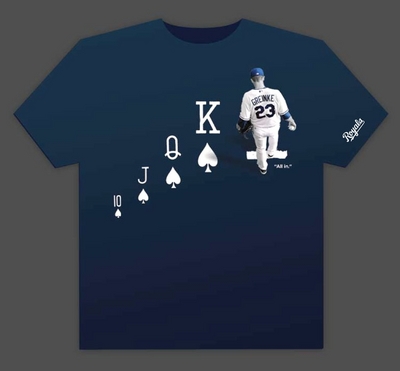
I want to be in Kansas City on June 16th, specifically at Kauffman Stadium where the Royals will host the Arizona Diamondbacks. On its own merits, that may not be anything special. It could be Zack Greinke vs. Danny Haren, which would be amazing or it could be Luke Hochevar vs. Yusmeiro Petit. Frankly, I wouldn’t care if it were the latter so long as I get there early enough to scoop this brilliant t-shirt:

Courtesy of Aroudn the Horn in KC (http://royals.mlblogs.com/)

Courtesy of Aroudn the Horn in KC (http://royals.mlblogs.com/)

I’d love to see a line of these come out for all of the game’s premier aces. Either way, I must get my hands on one of these KC ones. A very well thought out t-shirt and I’m surprised we haven’t seen it before now.