


I’ll be hosting a chat later this morning to discuss the Starting Pitcher Guide. Come by and hit me with any & all starting pitcher-related questions. And frankly, I will answer anything fantasy baseball-related, but I suspect most questions will be tied to the SP guide.
Thursday: 02.24.2011
The 2011 Starting Pitcher Guide
It’s here!!!
I’d set you up with an intro here, but there are 73,375 words in this guide, you don’t need to waste time reading me reiterate what you’re going to read in the opening of the book anyway. I truly hope you enjoy this guide. It was a max effort project and I couldn’t have done it without the help of my esteemed guest writers:
- Jason Collette from Baseball Prospectus, Rotowire and Dock of the Rays
- John Halpin from Fox Sports
- Tim Heaney from KFFL
- Zach Sanders from FanGraphs and RotoHardball
- Mike Siano from MLB
A huge thanks to them for coming onboard to make this far & away the best version of my SP guide yet. I would LOVE to hear your feedback on the guide so please feel free to comment here, hit me up on Twitter (@sporer) or email me directly sporer at gmail. I’m interested in what you thought worked, what you thought didn’t work, what you’d like to see in the future, etc… Enjoy!!!!
Also don’t forget that while the work is free, if you choose to donate using the Paypal button in the upper right corner, you will be entered to win a Tim Lincecum or Justin Verlander jersey. The drawing for that will likely take place sometime just after Opening Day.
I am very proud to present to you the 2011 Starting Pitcher Guide in all its glory and the Charts & Rankings right below:
The Guide:
 2011 SP Guide with Articles & Player Capsules.
The Charts & Rankings:
 2011 Rankings & Charts for Excel 2010.
 2011 Rankings & Charts for Excel 97-2003.
Monday: 02.21.2011
2011 SP Guide Release Date Pushed
Today was supposed to be the release date for the 2011 Starting Pitcher Guide, but alas it’s not yet completed. I had all of last week off to work on the guide and while I got a ton of it done, there was just too much to push through in a week. I didn’t want to take any shortcuts on the over 500 pitcher profiles or the nine articles I had to write or edit or the handful of useful (hopefully) charts and graphs for your viewing pleasure.
That said, I’m almost done. There is only one more team to write up and then editing. I’ve only got two more articles of my own to write and then editing the guest articles. I am aiming for a Wednesday release. I am still planning on having a chat a day or two after release where I will answer any and all pitcher-related questions (well, I’ll answer anything fantasy baseball-related to be honest).
I appreciate the patience. Even with the pushed back release, there should still be more than ample time to utilize the guide for your draft or auction prep as most leagues don’t even turn in keepers until the calendar flips over to March. I’m very excited about the final product and I think it will be worth the extra wait. Also, with the time being invested into the guide, the Daily Dose won’t be back up & running until later this week. Stay tuned for more.
Tuesday: 02.15.2011
Daily Dose – February 15th
I have been so engrossed in SP Guide work that I haven’t been reading much on the ‘net or scanning my Twitter for the best pieces, so today’s Dose will be a little light. The book has been priority #1 with my time off from work so while it has cut into my time dedicated to the Daily Dose, I think you will find that it is well worth it upon its release.
I finished the Kansas City Royals today and I must say that even accounting for the attrition they will undoubtedly suffer, their system is still overflowing with ridiculous pitching talent. It’d be a minor miracle if all four of the lefties (Mike Montgomery, John Lamb, Danny Duffy and Chris Dwyer) panned out 100% as expected, but they have at least seven other high-ceiling youngsters coming through their system ready to step in for anyone who falters. It would take an epic collapse and absurd string of bad luck for this not to pan out well for KC. There are no guarantees of pennants and World Series appearances, but a rise from the depths of the AL Central is very likely for this once proud organization.
I will be appearing on Joel Henard’s (@joelhenard) Baseball Daily Digest Fantasy February podcast Wednesday evening at 6 PM Central. There will be plenty of starting pitcher talk as we preview the book and discuss some second and third level options for you to look at as you prepare for your drafts.
I referenced a couple of tweets about Indians stars Grady Sizemore and Carlos Santana last week, but here is a piece by their MLB.com beat reporter Jordan Bastian (@MLBastian) covering things in much greater detail.
FanGraphs has purchased a fantasy game that they are rolling out for a special $9.99 price for the rest of this month. I met the creators of the game at BaseballHQ.com’s First Pitch Forums in Arizona back in November and I was definitely intrigued by it. I’m going to see if I can get a league together as I would prefer to play with friends as opposed to be part of a league of strangers. If you’re looking for a more detailed, intense fantasy baseball experience, this could be right up your alley.
ESPN unveiled their 2011 Fantasy Baseball Draft Kit recently. It’s a little light on analytical content, especially compared to what seemed to be a robust fantasy basketball guide, but I think they will be adding to it throughout Spring Training.
If you enjoy good baseball analysis on a wide variety of topics delivered straight to your inbox, I recommend Joe Sheehan’s Newsletter. He hasn’t asked me to or paid me to promote the Newsletter, but on the heels of his fantastic breakdown of the Albert Pujols contract negotiations, I figured I would let y’all know about it just in case you’re not already subscribing. It’s $29.95 for a minimum of 180 editions (more if his time permits) and after subscribing last year, I can honestly say it’s well worth the price.
CBS Sports hosted a 12-team AL-Only Auction among industry insiders and posted the results for our viewing pleasure. With the deep rosters (7 reserves), things got pretty thin with that many teams drawing from a 14-team pool. If this were a league being played out, I think I’d have a problem with the league size, but as an instructional device, I think it works just fine.
A host of different strategies employed and some very interesting player costs , too. I liked Jamey Eisenberg’s stars & scrubs approach on its face, though I think he may have incurred too much risk with his particular set of stars as Dustin Pedroia and Kevin Youkilis are both coming off of injury-shortened seasons and Alex Rodriguez may be descending into the twilight of his career. I really liked Scott Pianowski’s (@scott_pianowski) team as a whole as he mixed quality stars (Shin-Soo Choo, Jon Lester, Dan Haren, Joakim Soria and Derek Jeter) with high upside cheap guys (Derek Holland, Marc Rzepczynski, Johnny Damon and Juan Rivera to name a few).
Finally, having watched IBM’s computer Watson positively destroy two of Jeopardy’s best players ever, Eriq Gardner at Fantasy Ball Junkie wonders aloud if a computer could compete in a fantasy baseball league. It certainly wouldn’t surprise me if a computer held its own given how amazing technology is these days and getting better by the second.
Monday: 02.14.2011
No Daily Dose – February 14th
I’m neck deep in the Starting Pitcher Guide right now and I want to keep that momentum going. I have barely taken breaks to eat much less do anything else. Still plenty of work to be done, but is it really work if you enjoy doing it?! I’ll get a DD posted tomorrow, so check back.
Friday: 02.11.2011
Daily Dose – February 11th
A link-less, abbreviated Dose heading into the weekend as I drop some first base-related knowledge bombs on y’all:
Knowledge Bomb 1: A couple days ago, I released my top 25 catcher rankings to kick off my positional rankings. Let’s continue our way around the diamond and head over to the ultra-deep first base. On the offensive side of things, first base is hands down the deepest position with several superstars and plenty of talent to go around. The best way to utilize the depth is to also grab your corner infielder (in leagues that use the spot) from this pool. Some feel that the depth at first base allows you to wait on the position altogether, but I don’t think that is the right play at all.
I think you should be ready to double and perhaps triple dip (1B, CI, DH) into the plentiful bounty of first base. There are other strategies to be employed, but my feeling is that with the excess of power potential at the position compared with the dwindling power supplies in the league at large, why not maximize the position and its four-category contribution: power (HR, RBI, R and AVG as each HR contributes a hit, too)?
Even if you played up position scarcity and chose a shortstop in the first round and an outfielder in the second round (it’s thinner than you think, folks), you will still have stud potential available in the next two or three rounds. Let me show you what I mean (guys who have dual-eligibility at first base aren’t going to be included in the actual top 25 as they don’t have nearly the value at first that they do at their normal position. That means there won’t be any Victor Martinez, Buster Posey, Pablo Sandoval, etc.. Kevin Youkilis will show up because he won’t start the season with 3B eligibility after playing just 2 games there last year.):
- Albert Pujols
- Miguel Cabrera
- Joey Votto
- Mark Teixeira
- Kevin Youkilis
- Adrian Gonzalez
- Prince Fielder
- Adam Dunn
- Ryan Howard
- Kendry Morales
- Justin Morneau
- Paul Konerko
- Billy Butler
- Derrek Lee
- Gaby Sanchez
- Adam LaRoche
- Aubrey Huff
- Ike Davis
- Carlos Pena
- Lance Berkman
- Kila Ka’aihue
- Justin Smoak
- James Loney
- Daric Barton
- Matt LaPorta
Overvalued: Ryan Howard – this one is relative as I still think he is plenty valuable as a major power source, but I’m not sure he returns to his truly elite power self as some of the warning signs are to be taken seriously. He’s been going off the board as the 5th or 6th first baseman in a lot of industry mock drafts that I have seen and his ADP (average draft position) is 6th and 7th at Mock Draft Central and Couch Managers, respectively. I’ve got him 9th, so it’s not a huge dip, but I wouldn’t make him down for 40-140 automatically in 2011.
Undervalued: None – no one being seriously overlooked, at least not by more than a slot or two which isn’t enough to get up in arms. There is some value at the position because the depth pushes some guys down, but no one is being criminally passed over in lieu of lesser options.
Target: Kendry Morales – Yes, he is coming off of the big leg injury, but that isn’t something that will sap his power or hamper him at all this year. He had a breakout 2009 and was in the midst of an excellent follow-up in 2010 when the accident happened, I expect him to pick up right where he left off and continue as one of the best first basemen in the league. Even if you already locked up an elite first baseman in the first or second round, there would be nothing wrong with coming back in the fifth round and slotting Morales’ 30-home run power into your corner infield spot.
Best of the Rest: Adam Lind – he doesn’t yet qualify at first base in standard league formats, but as his assumed position for Opening Day, your league may allow you to draft him there. Even if that isn’t the case, he will earn his eligibility there quickly and he has elite power potential with the ability to hit .275+ yet he is going behind LaRoche and Pena (who he is a rich man’s version of) according to current ADP numbers. If he were first base eligible right now, I would slot him between Konerko and Butler.
Rookie to Watch: Freddie Freeman – He strikes me as James Loney-esque right now lacking enough power to be a starting first baseman. He could be a .280 hitter with mid-teens power, though, which is still worth rostering even in mixed leagues given the late round cost attached. He’s really the only rookie 1B with a chance to start in 2011.
Knowledge Bomb 2: There were 13 first basemen to hit at least 20 home runs and drive in at least 80 runs:
- 10 of the 13 scored 85+ runs
- 5 of the 13 scores 100+ runs
- 6 of the 13 hit .290+
- 10 of the 13 hit .260+ (a .260 AVG will cost a team just .002 in team AVG over a full season)
- 4 of the 13 chipped in 7+ stolen bases (Votto [16] & Pujols [14] doubled the contribution)
Knowledge Bomb 3: Check out the home run season totals at three key thresholds broken down by position:
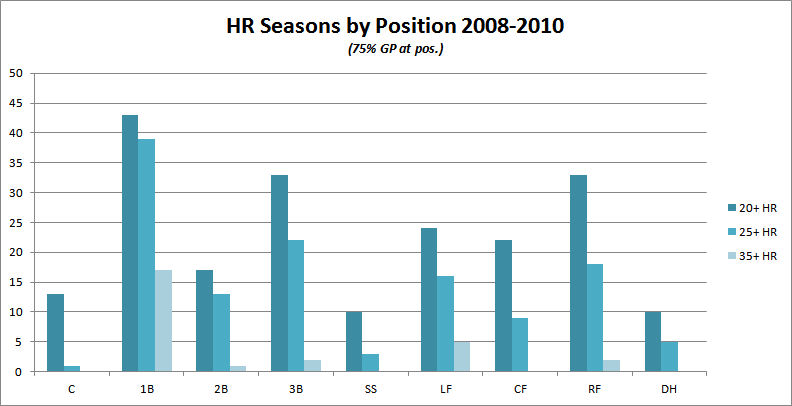
Few leagues use each outfield position individually, but even if I had lumped all three together the point of first base’s power prowess would have still held. You need three to five outfielders in all leagues whereas you need just one first baseman (but could feasibly roster up to three with corner and DH). First base is the only elite power source on the diamond. If you leave your draft or auction with Billy Butler (who I really like, so don’t get me wrong there) as your starting first baseman, you have messed up and you will likely be struggling for power all year long.
I will reiterate that you needn’t take a first baseman in the first or even the second round to cash in on the power surplus. So if you wanted to go shortstop and third baseman to attack some of the scarcity around the infield, that would be a feasible strategy and you would still have plenty of power first basemen available to you in the third and fourth rounds. However, if you’re looking at a blank 1B spot on your roster in the back end of the fifth round, chances are you are well behind your leaguemates at the position.
Thursday: 02.10.2011
Daily Dose – February 10th
You don’t have to read complaints about the weather today, let’s instead jump right into the Daily Dose:
The Los Angeles Angels beat writer for the LA Times, Bill Shaikin (@BillShaikin) quoted GM Tony Reagins on the likelihood of Mike Trout making it to Anaheim this year: “I would say it’s unlikely”, which is definitely the right thing to say right now. There’s no reason to put undue pressure on the top prospect and get him worrying about playing up to a standard that will earn him a trip to the show.
Do not take Reagins’ comments as a definitive guarantee that Trout won’t be up all year, though, because things can and will change as the season evolves. Looking at two of the best prospects to make their mark on the league last year, Jason Heyward and Buster Posey, they each elevated through minors pretty quickly. Posey was a college star at Florida State, though, so he’s a bit different than Heyward and Trout so let’s just look at Heyward.
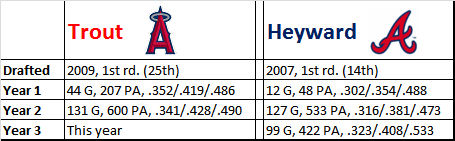
Trout and Heyward both signed early as mid-to-late first round picks, but Trout signed earlier got 32 more games in than Heyward. Both sample sizes are too small to draw much from, but a nice taste for fans to see what their team’s first pick garnered. Both exploded in their second season and became top five prospects across baseball (Heyward 5th, Trout 1st). And that brings us to this year, Trout’s third. In his third, Heyward, after crushing A-ball with a taste in High-A, went back to High-A for 49 games and acquitted himself quite well. Trout crushed A-ball last year, too, but 50 of his 131 games were at High-A unlike Heyward who only had seven in his first go-round.
Is Trout ready to make the jump to AA after 50 High-A games? Heyward needed just 56. Of course Heyward only played 99 games in his third professional hampered by injuries so he only saw another 50 games between AA (57) and AAA (3) before reaching the majors last year. Barring injury for himself, Trout could start AA and play 60-70 games there. If he continues to mash as he has thus far, he could get another 50-60 at AAA before possibly earning a late season call-up to the majors.
I’m not saying it’s going to happen, but I wouldn’t rule it out, either. That said, anyone in a re-draft league needn’t waste their time drafting Trout in March, not even if there is a reserve roster. There is no reason to tie up a roster spot on a slim chance. Besides, even if he comes up this year there is no guarantee he would be a contributor. I can’t wait to see how Trout progresses after his explosive 2010, but we will likely be waiting until Opening Day 2012 to see him suit up in Anaheim.
RotoAuthority has released their second basemen rankings for 2011 and they are veeeerrrry interesting to say the least. I’m already on record about the depth at second base, which I think is significant, and looking at this list only reinforces that belief. I don’t, however, fully agree with the ordering of the players. It starts off with a bang by not having Robinson Cano atop the list.
I like Chase Utley and Dustin Pedroia plenty, but why you’d take either ahead of Cano is beyond me. Tsuyoshi Nishioka at #7 and Sean Rodriguez at #9 ahead of Brandon Phillips at #10? I wish there were projections tied to this list because I’d love to see the fall off in production that puts Martin Prado at #15 behind Danny Espinosa (#13) and Howie Kendrick (#14). If we all drafted using the same lists and valuations then this game wouldn’t be much fun, but some of these are real head-scratchers to me.
Second base was a hot topic today as Ross Tremblay over at Fake Teams compared Utley and Cano and their projections for the 2011 season. He ended up with Utley ahead of Cano in terms of who he would want. The biggest problem I see in Tremblay’s analysis is that he vastly underrates the injury risk and age-related decline of Utley. He compares the two at full health which is already a bit of a hypothetical stretch meant to strengthen the Utley side.
Second base, as Tremblay correctly points out, is a position that shows age-related attrition more than any except catcher. Add in that Utley has three significant injuries (hand, hip, finger) in the last three years (though he didn’t miss time due to the hip surgery in the offseason) and there is legitimate risk. Utley’s biggest statistical edge for Tremblay’s projections is in the stolen base department. Again, I find this somewhat tenuous as his running could be in danger in order to mitigate some of the injury risk.
He’s a remarkably efficient base-stealer and ran plenty in September, his first full month after the injury, but Tremblay has him down for 15-20 bags which strikes me as the high end best case scenario. He has topped 15 just once in the last five years, three of which were full seasons. A year older and coming off of a season in which he played just 115 games, I would have him down for 12-15 bags.
Tremblay concedes that Cano is slightly better than Utley on the whole, but the cost of each sways him toward Utley. Cano is a bona fide first round pick while Utley is going somewhere in the second round. I’m all for value, but I’m more for mitigating risk, especially in the early rounds. That reason alone is enough for me to value Cano a good bit higher than Utley, even if he costs my first round pick. I didn’t like the hypothetical comparison Tremblay used to show Utley had higher value.
He paired each with a first baseman and determined that the Utley and Mark Teixeira/Adrian Gonzalez combo is better than a Cano and Ryan Howard/Prince Fielder pairing. I don’t necessarily agree with that statement on its own, but more to the point, who says you have to take a first basemen in the first two rounds? It’s the deepest position along with starting pitcher. It’d be great to get a stud, but I think he is once again using a hypothetical device to strengthen his Utley position. When you’re talking about a one round difference at most, you definitely want the best player, especially when he is less risky, too. That is Cano.
Knowledge Bomb: I want to share something I learned yesterday that you may already know. I absolutely love MLB.tv. I love how it works across many platforms and you can choose your broadcast and they are working to improve it yearly. One issue I always had was the fact that when you made it full-screen in your dual monitor setup, you couldn’t work on the other screen without it shrinking back down to regular size. I made this known to the @MLBtv Twitter feed yesterday and whoever runs it promptly messaged me letting me know that this feature is in place and I had just been missing it this whole time!!
If you go to this MLB.tv FAQ page, it will show you that the dual monitor feature is in the Settings able to be toggled on and off and allow you to have your game on one screen in full mode while you work on the other. This seriously (or sadly?) made my day yesterday. I knew the technology was available because Netflix Instant allows it. I’m just glad it’s now part of one of my favorite products. Sorry if you already knew this, but if you didn’t and have been clamoring for it, then it’s about as explosive as these knowledge bombs can get.
Sunday: 02.6.2011
Weekend Dosage
So I got a message today (woo, someone reads… thanks mom!!) asking if there were going to be weekend Daily Doses. Right now as I’m finishing the Starting Pitcher Guide, the answer is no. I’m dedicating my weekend time entirely to the book right now. After the Guide, it’s to be determined. For now, it’s a Monday-Friday thing.
Thursday: 02.3.2011
Three Questions – San Diego Padres
With the 2011 Starting Pitcher Guide set to come out in a few weeks, I have a jam packed volume covering all the ins and outs of starting pitching in the 2011 season for your viewing pleasure. Of course that doesn’t do much to address the offensive side of things so I decided to start this “Three Questions” where I will cover some key offensive issues for each of the 30 teams. There will be more content here dealing with offense, but this is the beginning.
What happens to this offense without Adrian Gonzalez?
Oh don’t worry, new first baseman Brad Hawpe will fill in so well that you will barely notice Gonzalez left. A .298/.393/.511 line with 31 bombs and 101 RBIs shouldn’t be a problem for Hawpe. OK that’s obviously an egregious lie that I don’t believe in the least. Do you want to know how important Gonzalez was to an offense that still only finished 22nd with him? Look at this:

Gonzalez led them in five key offensive categories and no one was really close. Chase Headley was the 2nd-highest qualifying batting average at .264, Will Venable’s 13 home runs were 2nd to Gonzalez, Headley had a whopping 58 RBIs to finish 2nd on the team, Yorvit Torrealba was 50 points behind Gonzalez with a .343 OBP, but that came in just 325 at-bats. The 2nd-highest qualifying on-base percentage was again Headley with a paltry .327 mark. And in the most hotly contest of the five categories, Headley finished 14 hits behind Gonzalez with 161 on the season.
Counting stats for Padres hitters are likely to be even worse than they were last year cutting into the already stunted value of the group. Headley managed those 58 RBIs despite hitting behind Gonzalez, who was getting on base 40% of the time for him. The team added some pieces in addition Hawpe including a brand new double play duo with Orlando Hudson at second base and Jason Bartlett at shortstop as well as former super-prospect Cameron Maybin, but the loss of Gonzalez is still a major blow to an offense that was already pretty poor.
The power-sapping ways of PETCO park are nothing new and Padres hitters have long been evaluated with that impact built in, but without their superstar cog in the middle the entire group takes another hit to their value. The chances of the six year streak of a non-Gonzalez entity topping 100 R or 100 RBI being broken seem slim. The last two players to do it were in 2004 when Mark Loretta scored 108 runs and Phil Nevin drove in 105.
Following up a career year with one of his worst, what’s in store for Jason Bartlett in 2011?
The 2010 season was a rough one for Bartlett especially in light of his breakout 2009 in which he hit 14 home runs, drove in 66 runs, scored 90 runs, stolen 30 bases and hit .320, all career highs. Lucky for him, he plays shortstop which is a barren wasteland after the top tier so he will have some value no matter what. How much exactly is going to be tied to how many stolen bases he rack up. He had a string of 23, 20 and 30 before last year’s 11, so the ability is there and San Diego was the 6th-runningest (so surprised that didn’t get a red squiggly line under it in Word) team last year with 124 stolen bases.
Additionally, he can offer some batting average value or at least not be a drag for a team. Last year his .254 was a drag as regression bit back hard from 2009 and instead of falling back to career norms, he was actually a bit unlucky. He is .281 hitter for his career and there is no reason to think he shouldn’t bounce back to that in 2011 and if luck breaks his way again, it wouldn’t be tough for him to top .300 again. So as a late round speed/average shortstop, he has some value. As I mentioned already, counting numbers will be tough to come by on this team. Especially for Bartlett who isn’t particularly adept at getting on base. Though he has a career .345 OBP, it is propped up by the standout 2009 and a .367 mark in 372 plate appearances back in 2006.
One last thing to consider with him is that he has only averaged 135 games played in the last four years with a high watermark of 140 and a low of 128. That means you’re going to need a replacement for around 27 games, or 16% of the season. Given the dearth of talent at shortstop, this can be a problematic proposition. His backup is likely to be Kevin Frandsen or Everth Cabrera. You could fill one of Bartlett’s strengths depending on who fills in, Frandsen for average and Cabrera for speed. If you’re left hitting the wire, you may find that the remains are somehow even less appealing than Frandsen and Cabrera.
Is Cameron Maybin ready to pay dividends on his blue chip prospect status?
The problem is we might not even notice if he does improve because of his home ballpark. He has certainly proven everything he can in the minor leagues so it is time for the three-time top 8 Baseball America prospect to start showing the talent at the big league level. At 24 with just a season’s worth of big league plate appearances (610) under his belt, even a poor 2011 wouldn’t be enough to write him off completely but it would put closer to Brandon Wood territory.
The biggest issue right now is the striking out. He has struck out in 31% of his major league at-bats despite the significant gains in K% in the minors. After striking out in 32% of his AA at-bats in 2008, he cut down to 20% in his first run through AAA in 2009 followed by 19% in 130 AAA at-bats last year. Any contact would be better than striking out for Maybin at this point. At the very least, he could maybe use his excellent speed to turn some of his groundballs into base hits.
Better pitch recognition can increase his value another way as more walks would again allow him to add value by way of his speed. As noted in the Bartlett section above, the Padres aren’t afraid to run, but it is hard to do much running with a .302 on-base percentage.
I don’t think Maybin will magically fix the strikeout and walk issues all at once in 2011, but I think we will see incremental gains in his first full season which should yield a 20+ stolen base season and low-teens power. You can do much worse than that for a low dollar late outfield option in NL-Only leagues. I don’t think he is quite a dollar days guy just yet, especially if your league has any guys who love grabbing the next big thing, but his price tag shouldn’t be pushing double digits. As a single digit buy, I would highlight him as a quality end-game play perfect for rounding out a team.
 Baseball By Paul