Archive for ‘Baseball’

Monday: 04.23.2012

Jordan Zimmermann and His Tiny K Rate

Coming into the 2012 season, the Washington Nationals were a chic pick to improve upon last year and even contend for a playoff spot for some (I gave them top NL wildcard with 87 wins), especially in light of the added wildcard.  On the heels of their 80-81 record a year ago, they added two big time arms in Gio Gonzalez and Edwin Jackson via trade and free agency, respectively.  Perhaps even more importantly, they have Stephen Strasburg for most of the year (likely being capped around 160 innings) and Jordan Zimmermann for the entire season after his successful 161-inning return from Tommy John Surgery.

Zimmermann, a big time prospect in his own right though definitely a cut below Strasburg in terms of hype and pedigree, is building off of a solid foundation with 284 innings under his belt coming into the year during which he has posted a 3.84 ERA, 1.23 WHIP, 7.7 K/9 and 3.5 K/BB.  With the reins off in terms of an innings limit, he is poised for a breakout in what should be his first full season of action.  He is off to great start already with a 1.29 ERA, 0.71 WHIP and 5.0 K/BB in his 21 innings spread across three starts (he has exactly three 7-inning, 1-run outings).

The gaudy 5.0 K/BB rate catches the eye, but it is spurred by his allowing just two walks (0.9 BB/9) as his 4.3 K/9 is far from special.  The first thought when strikeouts are down against expectations or track record is to check velocity, but Zimmerman’s fastball velocity is exactly the same as last year’s at 93.4 MPH so there is nothing amiss in that realm.  In lieu of the strikeouts, he is inducing plenty of weak contact with a sky-high 52% groundball rate off of which batters have a meager .121 batting average.  We saw something like this from him last April when he had a 4.3 K/9 while posting his best groundball rate of any month at 45% in 30 innings.

In fact, his two best groundball months were easily his worst strikeout months by a significant margin.  In June, he had a 41% groundball rate while striking out just 5.7 K/9.  In the other months (excluding April), his strikeout rate was 8.1 or better while the groundball rate failed to top 37%.  Can he get back to inducing groundballs and missing bats simultaneously?  In the first 23 starts of his career spanning 2009-2010, he had an 8.8 K/9 with a 46% groundball rate so he has the ability to combine the two skills.

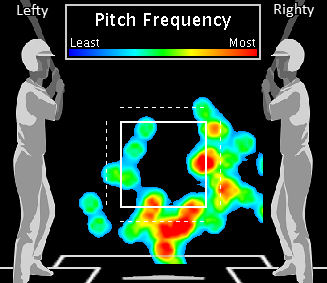
A sharp difference early on has been his curveball and Zimm’s ability to generate swings-and-misses with it.  In 2011, he was at a 15% swing-and-miss rate with it and for his career coming into 2012, he was at 21%.  The curve has definitely been his knockout finisher in the past.  This year he has just a 7% swing-and-miss rate on his bender due in large part to batters laying off of it as he tries to get them to chase out of the zone.  Just 29% of his benders have even hit the zone compared to a healthy 51% coming into this season.
Courtesy of MLB.ESPNTrueMedia.com

With hitters laying off the low, out-of-the-zone curveball, Zimmermann will need to change his approach if he wants his strikeout rate to return to previously established levels.  Of course, we are just three starts into the season, too, so while there is definitely a difference between what we have seen from Zimm in the past, it could just be him getting a feel for the curve as the season starts.

Another difference we have seen in the early (and small) sample is that he isn’t afraid of contact with two strikes.  Batters have put it in play during 21 of Zimm’s 34 two strike plate appearances (62%) with just a 29% strikeout rate while last year those rates were at 57% and 37%, respectively (meanwhile his career rates coming into ’12 are 55% and 38%).

It has served him well thus far with a .191 average and .491 OPS against in two strike situations, but in the long term he would be better served to start hitting the zone more (specifically with his curve as previously mentioned) and generating strikeouts instead of trusting his defense so often.  Based on both his talent and stuff, I think we will see Zimmermann start putting away more hitters as the season progresses.

Batters will start to get more hits off of him going forward (5.6 H/9, .200 BABIP), but hopefully he is able to counter that with an improvement in punch-outs.  You can’t argue with the outstanding results in his first three starts (though I’m sure he isn’t thrilled with the 8 runs of support from his offense across the three games) and I think we will see an even better Zimmermann going forward though the gaudy results (1.29 ERA, 0.71 WHIP) are sure to rise.

If anyone in your league is trying to “sell high” on Zimm in fear of the miniscule strikeout rate, take them up on it as long as the price isn’t egregious (Justin Verlander/Roy Halladay).  I don’t think any reasonable fantasy manager expects a leaguemate to pay for a 1.29 ERA and 0.71 WHIP knowing full well that neither is sustainable, but if they are thinking of buying low on Josh Johnson or Tim Lincecum, for example, and offering Zimmermann as a foundation, then I would entertain such a move without question.
Friday: 04.20.2012

Joining BP

No, I’m not joining the oil business with British Petroleum.  Rather, I have signed on as a contributor over at Baseball Prospectus as part of the fantasy baseball team.  I will be doing two columns a week covering starting pitchers (yes, we call that right in the wheelhouse).  I’m ridiculously excited by this opportunity.  Nothing changes here as the site will remain functional.  Speaking of that, content will be ramping up now that we are starting to get some real data to play with and examine.  Samples are still small, but pitchers are amassing three and four starts so it is worth taking a look at things now as opposed to overreacting to everyone’s debut start.  Look for another piece on Monday.

Thursday: 04.19.2012

Mat Latos and His Slow Start

Well before the Joey Votto and Brandon Phillips contracts this season, the Reds announced their intent to contend (or try to, at least) in the near term by trading a significant haul of prospect value and major league arm Edinson Volquez to the San Diego Padres for top starter Mat Latos back in mid-December.  While he benefitted from the favorable PETCO Park, Latos was hardly a product of the pitcher’s haven seeing minimal (if any in some cases) degradation in his numbers away from home.

He posted a 3.22 ERA in 190 innings at home while toting a 3.57 ERA in 249 road innings.  His WHIP was actually a tick better while his strikeout and walk rates were nearly identical regardless of venue.  Armed with a bat-missing arsenal and a groundball lean, I was definitely on the high end of the spectrum when it came to projecting Latos for 2012.  After three starts, things aren’t looking so good.  Time to readjust expectations or simply a slow start for an ultra-talented arm?  Let’s take a closer look.

Slow Starter

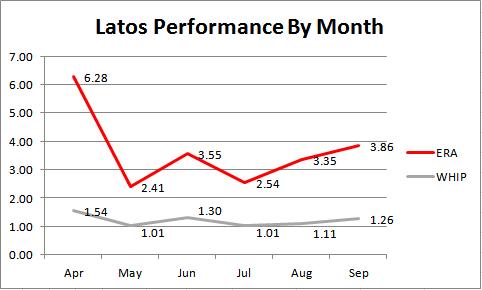
Latos is starting his third full year as a major leaguer in 2012 and in his two 31-start seasons the last two years, he has shown himself to be a perennial slow starter posting a 5.57 ERA and 1.40 WHIP in 42 April innings.  Adding in his three starts from this year, the numbers balloon to a 6.28 ERA and 1.54 WHIP in 57 April innings.  Meanwhile, May is his best month from an ERA and WHIP standpoint.

Regardless of whether or not you include his 2012 numbers, April is far and away the worst month for Latos.  History alone suggests he should improve once the calendar turns or rather, as he accumulates more work to iron out the kinks.

Velocity

With Pitch F/X data more prevalent than ever, the first data point most people check when a pitcher is struggling is fastball velocity.  It can often be an explanation for a downgrade in performance as well as be an indication of potential injury in some instances.  In the case of Latos, velocity doesn’t appear to be tied to his struggles in any way whatsoever.

In 2010, his April velocity (93.8 MPH) was actually better than his velocity the rest of the way (93.6 MPH), though just marginally.  He got a late start to 2011 accumulating just 10 Spring Training innings and then not starting until the 9th game of the year due to a strained right shoulder.  Thus it wasn’t really a surprise that his April velocity (92.0 MPH) was a tick below his 92.8 MPH mark from May on.  Through his three starts this year, his fastball velocity is right in line with 2011’s at 92.7 MPH.  In fact, he was at 93.7 MPH on Wednesday night and 76 of 112 pitches were heaters.  Velocity isn’t the problem for Latos.

Pitch Performance

While the velocity isn’t askew, the quality of his fastball early on has been in question.  Batters are tattooing the pitch to the tune of a 1.197 OPS and it hasn’t been nearly the put away pitch it was last year when he generated a 13.6% strikeout rate with it compared to just 7.5% this year (just to clear up any potential confusion, this means plate appearances that end with a fastball are yielding a strikeout 7.5% of time).  Even with the lowered velocity, his fastball was more effective last April though it was still not to the level he would enjoy from May on.  It yielded an .815 OPS last April but dipped to .752 the rest of the way.

More important than the fastball, his slider (which is easily his best pitch) hasn’t been as effective as usual thus far in terms of inducing poor contact.  The pitch earned 13.2 and 10.5 pitch values at FanGraphs in 2010 and 2011, but it’s at -1.3 through his first two starts and will likely go down once they factor in the results from Wednesday night’s start in St. Louis.  In 2010 and 2011 combined, the slider yielded a paltry .409 OPS while amassing an insane 41.8% strikeout rate.  It’s his finisher and while he has an excellent 42.9% strikeout rate with it so far this year, it is also being hit around to a .714 OPS, astronomical for that pitch when you compare it to rest of Latos’ career.

Perhaps he needs to start incorporating more sliders into his pitch mix.  He has thrown it 15.8% of the time so far this season, down a bit from the 18.6% rate in 2010 and 2011 combined.  Last April his changeup was getting blasted to a 1.214 OPS.  He was using it 12.4% and cut that by 5% from May on giving all of the excess to his slider (going from 15.2% to 20%) and it clearly spurred his success as batters had a video game-esque .338 OPS against it from May on.

He is currently throwing his changeup at an equal rate to the slider (15.8%) and while it’s not being pummeled like last year, it isn’t faring too well at .819 OPS.

Conclusion

The information available seems to suggest that Latos simply takes a while to get going.  There is nothing that jumps out in his data that points toward a prolonged degradation in performance or worse, an injury.  Some pitchers just stumble out of the block before turning it on.  While I’m not comparing the two directly, Justin Verlander had notoriously awful Aprils heading into 2011.

He made a concerted effort to work harder in Spring Training and treat those like important games instead of just tune ups so he would be ready on Opening Day.  The results were immediate as he posted 3.64 ERA, 1.02 WHIP and 9.2 K/9 in 42 April innings last year.  Even with the strong April last year and great start this year, his April line is still ugly compared to the rest of his numbers: 4.45 ERA, 1.22 WHIP and 7.7 K/9.

If you have Latos on your team, you have to stay the course and give him time otherwise you are doing yourself a disservice and wasting your draft day investment.  The peripherals are weak and the surface stats are even worse, but weathering April before breaking through is Latos’ modus operandi.  As for those of you who don’t currently have him on the roster, he makes a nice trade target who may even come at a discounted price.

I don’t like the practice of looking at struggling stars in April and labeling every single one a “buy low” as I don’t think anyone with any knowledge of how to play this game is actually putting a severe discount on Tim Lincecum or Matt Holliday to name a couple.  The price was simply too high on draft day and cutting bait for pennies on the dollar after half a month is just stupid for the current manager and a pipedream if you’re the buying manager.

Latos isn’t exactly on the level of those two (24th and 36th picks, respectively), but he’s star-ish as a top 70 pick in average draft position and so you shouldn’t go in expecting someone to completely cut their losses and take Joe Saunders or Omar Infante for him.  Maybe they will take someone in the 90-105 ADP range which would be a nice little discount, but even at draft day cost (someone in the 65-75 ADP range), Latos is worth buying in on because it is plenty reasonable to expect him to improve soon and stay good for the remainder of the season.

Wednesday: 04.18.2012

Spring Training Stats STILL Don’t Matter

Getting through the winter can be difficult for baseball diehards, especially if they don’t like football (thankfully I do and my Lions are good again, but I still crave baseball throughout).  Sure the Hot Stove League stays pretty active all winter with signings and trades and the MLB Network has continued to improve their offseason programming in each of their three years of existence.  Of course we diehards love games so even the best offseason is still only going to satiate the appetite at something less than 100%.  The crazed appetite for game action can be problematic by the time late February rolls around and Spring Training kicks into gear. 

What starts to happen is that even the smartest, most well-meaning baseball people are desperate to attribute legitimate meaning to the stats being accumulated on their sets and in their radios.  Laced with caveats and qualifiers, we still see pieces every year suggesting that this guy’s Spring Training numbers are meaningful.  I understand that you can find a guy here and there who changed something, added something or got rid of something and it started improving his performance as early as March and carried throughout the season.  Those are called outliers and for every one of those, there are 50 guys whose Spring Training numbers had no correlation to his regular season work. 

This preseason we were regaled with the exploits of Francisco Liriano and Brian Matusz and led to believe that their impressive 25-ish inning samples were indicative of bigger things for the regular season commensurate with their perceived skill level whether in the minors or previously in their MLB career.  Liriano, on the heels of a terrible season, threw 27 innings of 2.33 ERA and 1.11 WHIP along with 33 K and just 5 BB.  Time to return to 2010 levels, or better yet 2006 levels, right?  Perhaps not.  He has allowed 5 ER in each of his three starts (11.91 ERA, 2.74 WHIP) going five innings or less in all of them with just 8 K and 9 BB. 

Both samples are small, I get that.  My point is that if his Spring was indicative of anything meaningful at all, would he really just COMPLETELY LOSE IT the second the regular season light flicks on?  He is literally the direct opposite of what he was during Spring Training at this point.  Sure it is just 11 innings, but they are more in line with his 134 from 2011 than anything we saw in the 27 from March. 

They’ve yet to find a word to describe Matusz’s 2011 (10.69 ERA, 2.11 WHIP, 1.6 K/BB in 50 IP).  It was such a far cry from the minor league pitcher who earned a pair of top 25 rankings in Baseball America’s Top 100 rankings include #5 in 2010.  There was a lot of attention paid to his Spring Training performance, specifically the 22/3 K/BB in 25 innings.  The 3.65 ERA, 1.30 WHIP and 29 H were given less mention as it is believed that Spring K/BB correlates best with regular season performance. 

After two starts, that doesn’t appear to be the case with Matusz as evidenced by his 8.38 ERA, 2.17 WHIP and 0.6 K/BB in 10 innings.  Ten innings is nothing.  But again I reiterate that if his Spring Training really meant anything, ANYTHING AT ALL, would he really lose every single solitary bit of that effectiveness now that the regular season is upon us?

Stop trying to attribute meaning to Spring Training stats.  It will only hurt you. 

“But Paul, Luis Mendoza’s 417 years in the minor leagues with awful statistics aren’t important, rather his fluky-as-can-be 19 innings of 0.47 ERA against players wearing jerseys with triple digit numbers and name plates that simply say “PLAYER NAME” on them MUST mean he has turned the corner at 28 years old.  His 10.0 K/9 and 4.2 K/BB are probably not a product of competition, rather his new established level of production.  His 4.8 K/9 and 1.7 K/BB marks in 1111 minor league innings aren’t reliable!!1!!one!1!!!”

Mendoza has a 5.59 ERA, 2.28 WHIP, 2.8 K/9 and 0.4 K/BB in 10 innings across two starts thus far.  He is still terrible. 

The reason there is some measure of correlation between Spring Training K/BB rates and regular season performance is because every Spring Training there are several stars who perform well.  Guys like Justin Verlander, Dan Haren, Cole Hamels, Zack Greinke, Matt Cain, James Shields, Felix Hernandez and Cliff Lee all had good preseasons and will likely have very good regular seasons, too. There were others, too, but that isn’t surprising since they are actually highly talented pitchers. 

Stop giving value to Spring Training statistics. 

Enjoy Spring Training as the signifier that baseball is back and fantasy draft season is upon us.  Watch the games and see if someone has added a new pitch or if someone appears healthy after injury, but do not check the box scores and stat sheets and then start adjusting your rankings.  Roy Halladay had a 5.73 ERA thanks to 7 HR this Spring?  BFD! 

Thursday: 04.12.2012

The Road Soon Travelled?

20120412-185911.jpg

The Diamondbacks will take this road soon and I think there is a pot of gold at the end of it.

Thursday: 04.12.2012

How’d You Do That?

(click for more)

I love this kind of stuff.  Probably because I’m a nerd.  This is Felix Doubront and Daniel Bard discussing pitching in the Red Sox dugout during Wednesday afternoon’s game in Toronto.  I know this probably happens in every dugout from the Majors to Single-A ball so I’m not pretending it’s rare, I just like when they show us on camera.  I’m already a huge Doubront fan and while I was down on Bard coming into the season, his debut against the Jays was impressive as it included 17 swing-and-misses.  One start isn’t enough to completely change my opinion, but I’m at least slightly more intrigued than I was during Spring Training.

Thursday: 04.12.2012

Josh Johnson Thru Two Starts

Josh Johnson labored a bit through his Opening Day start last Wednesday against the St. Louis Cardinals allowing three runs on 10 hits and two walks while striking out four.  He threw mostly fastballs (74% of his 91 pitches) while his velocity continued its downward trend sitting at 92.7 MPH (95 in ’09; 94.9 in ’10; 93.8 in ’11), though he did max out at 95.4 MPH.  Was it rust as he returns from injury or is something amiss?  Johnson excited fantasy players with his Spring Training numbers that included a 2.42 ERA and 24 strikeouts against 10 walks in 22 innings of work.  At the same time, he did allow 21 hits.

I don’t put much stock into Spring Training numbers at all.  There are some instances where they matter a bit.  If a pitcher is returning from injury, I’m checking to make sure he is getting his allotted work in without incident.  I don’t even really care if he is getting knocked around, but if they say Johan Santana is supposed to go four innings or X-amount of pitches today, I want to see that fulfilled.  The other instance is in a job battle.  It doesn’t matter if marginal player X hit .904/.998/1.964 in his 20-something at-bats as that’s not at all indicative of his future performance, but it matters that he excelled if that is securing him a job for at least the near future.

Johnson was getting in his allotted work which was encouraging, but I didn’t change his ranking based on the numbers we saw.  I don’t know who the 24 Ks came against nor do I know if the 21 hits were tons of line drives or bloops and bleeders.  After seeing what can only be classified as a mediocre outing in last Wednesday’s opener, I looked forward to seeing Johnson face off against Roy Halladay Wednesday night in Philly for their second starts of the year.  Here are my observations from the outing:

  • 40 of his 80 pitches were fastballs (50%); down from his first start when he threw 74% heaters
  • His fastball averaged 92.4 MPH; down slightly from the 92.7 MPH mark in his first start
  • He threw almost only fastballs & changeups (68 of 80 pitches; 85%)
  • He only threw breaking balls 14% of the time and didn’t even throw a curveball until the 3rd
  • He threw just 6 sliders and 6 curveballs
  • He struggled to get ahead of batters going just 9-for-21 in first pitch strikes
  • That no doubt contributed to his struggles Wednesday including 11 H allowed & just 1 K
  • For his career, Johnson has a 7.4 K/BB after 0-1 counts; just 1.2 K/BB after 1-0 counts
  • For his career, Johnson allows a .220 AVG & .558 OPS after 0-1; .245 AVG & .739 OPS after 1-0
  • He failed to put away batters w/just the 1 K despite 9 batters (of 23) facing counts w/2 strikes
  • For his career, Johnson has struck out 43% of the batters who are faced w/2 strikes during a PA

This clearly wasn’t Johnson’s best outing.  The fact that it came near the beginning of the season tends to give it more weight in the eyes of some since it is 50% of his entire sample so far.  That is always dangerous for obvious reasons.  Adding it all up, he has two starts that aren’t exactly Josh Johnson-esque and given his injury history, it does raise the antennae a bit.  Right now the velocity is down and he isn’t getting the swing-throughs (just 1 on Wednesday) we’re used to seeing.  The lack of breaking pitches thrown could be an indication that he is being timid with his breaking stuff in an effort to avoid getting hurt again.  In the previous four years, he threw sliders more than a quarter of the time so he needs it to be successful.

For now, you can only stay the course with Johnson unless a full value trade comes along which is unlikely in most leagues.  I look forward to his upcoming starts to see how (if?) he progresses back toward the Johnson we are used to seeing.  I will post another update before the month is out.  He faces the Cubs at home, Nationals on the road and Diamondbacks at home in his next three starts.

Wednesday: 04.11.2012

This is Real

20120411-214404.jpg

Toronto Blue Jays left fielder Eric Thames is purposely styling his facial hair in this manner. I think it could’ve been enough to get him sent to Las Vegas in favor of Travis Snider but then I forgot about his remarkably unfortunate mustache from last year. Meanwhile, Jason Collette told me on Twitter that he believes Thames should be celebrated for the facial hair.

Wednesday: 04.11.2012

National League Predictions

I meant to get this up before leaving town for the Easter Weekend, but I didn’t so here it is now.  Since these predictions come from a contest form I turned in several weeks before the season, I don’t mind sharing them even 5-6 games into the season.  Of course, even if they weren’t something I locked in beforehand, my opinion would NOT be changed by less than a week of games.  So without further ado, here are my NL predictions.

NL East

Philadelphia Phillies 90-72

Washington Nationals 87-75*

Atlanta Braves 84-78

Miami Marlins 81-81

New York Mets 76-86


Anytime you have Roy Halladay, Cole Hamels and Cliff Lee heading up your rotation, you are going to be around to make some noise in your division.  Their neutered lineup is a bit of a concern without question especially with Juan Pierre leading off, but that rotation can mask a lot because even Vance Worley and Joe Blanton offer something at the back end.  I love what Washington did with their rotation this winter acquiring Gio Gonzalez and Edwin Jackson to pair with their aces in Stephen Strasburg and Jordan ZimmermannBryce Harper, if ready and that’s a reasonable assumption, serves as a mid-season trade acquisition as I suspect he should be ready around June 1st.

Most of what Atlanta does pitching-wise is excellent, though I can’t have much faith in any team purposely giving Livan Hernandez innings.  Their offense gives me pause outside of Brian McCann/Dan Uggla/Michael Bourn.  The key, obviously, is Jason Heyward.  Miami made some great additions to their team and while some are seeing playoff potential, I’m not sure they are in the right division for such a surge.  Even an 81-81 record represents a 9-win improvement from 2011 which is pretty significant.  It’s painfully obvious to say that Josh Johnson is the key to their season, but this 81-81 record has him staying healthy.  I’m not sold on the rest of the rotation or their bullpen holding leads that the strong offense should be able to obtain.  I don’t think the Mets are complete failure that many see them as, but again they are in a tough division to make noise in as a scrappy upstart.  They will have some nice stretches, but when push comes to shove, they don’t have enough.


NL Central

St. Louis Cardinals 90-72

Cincinnati Reds 85-77

Milwaukee Brewers 85-77

Pittsburgh Pirates 80-82

Chicago Cubs 64-98

Houston Astros 61-101


Sure the Cards lost Albert Pujols and that stings in general, but it certainly doesn’t decimate the team.  Off the bat, they “replace” him with Adam Wainwright returning and Carlos Beltran coming in via free agency.  Then you factor in Rafael Furcal at short for Ryan Theriot (Furcal had a better WAR in 50 G for the Cards than Theriot did in 132), David Freese in at third base full-time for Daniel Descalso (who had a 0.5 WAR in 148 G) and more production from Allen Craig when he returns from injury.  Yes, the loss of Chris Carpenter and potential regression of Lance Berkman takes some of those gains away, but you could also add to Matt Holliday’s production as he played just 124 G last year and still managed 5.0 WAR.  This team is loaded.  Not to mention that Shelby Miller should be ready to bolster the rotation in the summer.  Cincinnati could make more noise than this if things gel properly.  I think they have a deep lineup especially if Zack Cozart pans out as expected while the addition of Mat Latos should be huge.  I worry about the rotation outside of him as they could really go either way (well, except Arroyo, he’s only going one way).

The top of the Milwaukee rotation with Yovani Gallardo and Zack Greinke features two NL Cy Young contenders.  They didn’t quite replace Prince Fielder as thoroughly as StL did with Pujols, but switching him, Yuniesky Betancourt and Casey McGehee out for Aramis Ramirez, Alex Gonzalez and Mat Gamel could be a net gain if Gamel pans out to a level commensurate with his AAA stats.  The additions the Pirates made this offseason weren’t blockbusters, but they were all legitimate positives including Clint Barmes’s defense at short and a pair of strikeout pitchers in Erik Bedard and A.J. Burnett.  Can they score enough for it to make it matter, though?  Outside of a handful of appealing pieces, this Cubs roster is a disaster.  I sure hope Theo Epstein is planning on moving a bunch of these veteran pieces throughout the season, including ace Matt Garza.  Houston’s move of Brett Myers to closer was a poor one in my estimation as they now need to find 215 innings elsewhere, but I guess they think he’s more tradable as a closer.  I sincerely disagree, but I’m not in charge.

NL West

Los Angeles Dodgers 88-74

Arizona Diamondbacks 86-76*

San Francisco Giants 83-79

San Diego Padres 81-81

Colorado Rockies 76-86

The Dodgers winning the division isn’t based on their sale especially since I’m not sure that has a 2012 impact on the field.  In 2011, they managed 82 wins (and 79 losses, didn’t make up a game) and were underachievers for all intents and purposes.  They have two of the absolute best players in the game and they were peak performers last year, but even some regression from Clayton Kershaw and Matt Kemp should be offset by regression up to the mean for several other guys including Andre Ethier, Chad Billingsley and Mark Ellis.  The Chris Capuano and Aaron Harang signings were solid moves to shore up the rotation and the bullpen is sneaky strong, too.  Not satisfied with their breakout season from 2011, the Diamondbacks went out and got Trevor Cahill and Jason Kubel.  Cahill was a great addition, but I’m not sure Kubel is a huge positive after the development of Gerardo Parra in 2011.  They aren’t going 28-16 in 1-run games again, though.  The return of Buster Posey and additions of Angel Pagan and Melky Cabrera should help the Giants offense, but it won’t make it anything close to reliable and they also have some 1-run regression headed their way after a 33-22 record in those situations last year.

The Padres might take a while to get going, but they are better than many realize in my opinion.  The rotation is always given a boost by the home ballpark, but they have some real talent with Cory Luebke and Edinson Volquez as the 1-2 while the lineup is getting incrementally better especially after adding Yonder Alonso and getting Nick Hundley back for a full season.  They were also rated as the best farm system in all of baseball by multiple outlets meaning reinforcements are on the way, too.  I really like Robbie Erlin and Joe Wieland to come up during the season and replace the weaker parts of their rotation.  It is hard to be down on the Rockies with two superstars in Troy Tulowitzki and Carlos Gonzalez as well as other appealing bats, but the pitching is just so uninspiring.  There is some long-term promise, but I think they will struggle to compete in 2012.  This division is regarded as weak, but I think it’s quite a bit stronger than many (any?) give it credit for being from what I’ve read and heard.  At 37 years old, Rafael Betancourt isn’t someone the Rockies need to keep around for the long haul so if he excels in the closer’s role, he should be moved which would open the door for 24-year old flamethrower Rex Brothers, one of my favorite middle relievers this year.  Yes, I have favorite middle relievers.

NL Playoffs

Wildcard – Nationals defeat Diamondbacks

Division Series – Dodgers defeat Phillies 4-2; Cardinals defeat Nationals 4-1

Championship Series – Dodgers defeat Cardinals 4-3

World Series – Rangers defeat Dodgers 4-2


NL Awards

MVP – Matt Kemp, Ryan Zimmerman, Troy Tulowitzki, Joey Votto, Hanley Ramirez

Cy Young – Cole Hamels, Zack Greinke, Jordan Zimmermann

ROY – Zack Cozart, Robbie Erlin, Bryce Harper

Thursday: 04.5.2012

American League Predictions

I realize this is the third Opening Day of the season when you consider the games in Japan between Oakland and Seattle last week as well as last night’s St. Louis/Miami game, but I’m certainly not the only one who considers today the real Opening Day.  And while there aren’t nearly enough games (just seven games), we’re not here to focus on the negative.  The important thing is we have seven games sprinkled throughout the day including Justin Verlander vs. Jon Lester today at noon central!  With that, it’s time for the most important part of the season: predictions.  These mean SO much and they are very scientific.  I expect to be held accountable to these, punishable by death.

AL East

New York Yankees 92-70

Boston Red Sox 91-71*

Tampa Bay Rays 90-72

Toronto Blue Jays 85-77

Baltimore Orioles 62-100

The Yankees would obviously be in better shape if Michael Pineda had dominated throughout Spring Training and was slotted into to their #2 slot, but Hiroki Kuroda is still an upgrade there.  Even with some age regression factored into the lineup, it is still one of the best in all of baseball.  A lot of people are sleeping on Boston for some reason.  First let’s be clear that Andrew Bailey going down doesn’t matter AT ALL.  It’s a complete non-factor and easily the most replaceable piece of the team.  The guy hasn’t topped 50 innings the last two years so Bailey is especially easy to replace, but even if he were a 65-inning stalwart it wouldn’t be a problem.  Few things are more overrated than closer.  Their lineup is amazing, but I worry about the non-Lester rotation pieces given Josh Beckett’s health track record and the general uncertainty of the other three (Buchholz, Doubront and Bard).

This division is just so filthy.  It is hard to look at that Tampa Bay rotation and not have them in the playoffs, especially since the lineup is improved from 2011, too.  Honestly with a three game split from first to third, the top of this division could easily finish in any order.  My guess happens to be in this order, though I would love to see Tampa-Boston-New York.  Don’t sleep on Toronto, either.  I don’t think they quite have the rotation to stack up top to bottom.  I love Ricky Romero and Brandon Morrow, but it drops off from there especially compared to Tampa Bay.  There are some nice pieces in the Baltimore lineup, but the pitching staff remains rough.  They need to see some major improvement from their former prospects (Brian Matusz, Jake Arrieta, Zach Britton and Chris Tillman).

AL Central

Detroit Tigers 92-70

Chicago White Sox 82-80

Cleveland Indians 79-83

Kansas City Royals 73-89

Minnesota Twins 66-96

I know most of the world has my beloved Tigers going 170-0 (yes, we’re going to win 8 more games than anyone even plays) and frankly it disturbs that everyone thinks the team simply can’t lose and will run away with the AL Central.  When the general public thinks a team simply cannot lose, that’s usually when they lose.  Even with the curse of expectations, this is a really strong team with an amazing lineup, killer rotation and solid bullpen so it isn’t hard to see them among the AL’s best.  The infield defense as a liability is massively overrated.  For the few that aren’t bought in on the Tigers, this is their only real reason, but the next time that an infield defense dooms a team will be the first time.   If you’ve got “Sox” in your name, it seems you’re being slept on.  The White Sox are the opposite of the Red Sox in that their strength is the rotation while the lineup has some questions, but this is a great 1-5.  On offense, Adam Dunn and Alex Rios simply cannot be as bad as they were in 2011.

The Indians have some really nice pieces, especially on offense, but I’m not entirely sold on the rotation top to bottom.  What Ubaldo Jimenez are they going to get?  Will Justin Masterson’s continued issues with lefties doom him in ’12?  I like the lineup, but the rotation will keep them below .500.  Kansas City isn’t quite ready for the big time, either.  Love Eric Hosmer and Alex Gordon leading the lineup, but the rotation is still a mess.  The bullpen will cover up some of the mess, but they need some of their pitching prospects to make an impact this year.  Everyone is excited for Francisco Liriano’s 2012 based on his impressive Spring Training (33 K, 5 BB in 27 IP with 2.33 ERA and 1.11 WHIP).  I’m not so sure it portends regular season success, but even if he’s peak Liriano, they still don’t have nearly enough in the rotation to compete.  Add in the major injury risks littered throughout the lineup and it’s going to be another long season in the Twin Cities.

AL West

Texas Rangers 91-71

Los Angeles Angels 90-72*

Oakland Athletics 70-92

Seattle Mariners 70-92

It’s a two-horse out west with the incredibly deep Rangers powered by their disgustingly good lineup and the new look Angels led by their elite rotation and some guy named Albert.  Don’t overlook the Texas rotation, though.  They replaced CJ Wilson with Yu Darvish and they’ll enter the season with eight starters on the staff as Alexi Ogando, Scott Feldman and Robert Ross have all been starters during their career yet find themselves in the bullpen for now.  I think Ogando is better than Neftali Feliz, but the Texas can afford to see the experiment through with Feliz since they have so much depth.  LA’s lineup is hardly Albert & The Scrubs.  Howard Kendrick is going to explode for a big year while Kendrys Morales finally appears ready to contribute again.  Like Dunn in Chicago, Vernon Wells simply can’t be that bad again (.248 OBP in 529 PA) while Chris Iannetta and Peter Bourjos make up a hell of an 8-9 combo at the bottom.

Oakland and Seattle both have a handful of intriguing pieces, but neither has the team to contend especially in this division.  Brandon McCarthy’s profile has been raised this offseason with mainstream exposure through ESPN and I like him for a big year.  Yoenis Cespedes should enjoy some success, too, but a Coco Crisp/Seth Smith combo at 3-4 in the lineup is telling.  I’m a huge Dustin Ackley fan and see big things for him with the M’s, but the rotation stalls out quickly after Felix Hernandez.  Help is on the way with some great pitching prospects on the rise, but they are unlikely to make a big dent in 2012 making another down season likely in the Great Northwest.

AL Playoffs

Wildcard – Angels defeat Red Sox

Division Series – Tigers defeat Angels 4-3; Rangers defeat Yankees 4-2

Championship Series – Rangers defeat Tigers 4-3 :sadface:

AL Awards

MVP – Miguel Cabrera, Evan Longoria, Albert Pujols, Brett Lawrie, Dustin Pedroia

Cy Young – David Price, Dan Haren, Justin Verlander

ROY – Matt Moore, Joe Benson, Yu Darvish

I’ll do the National League next.