Archive for ‘Baseball’

Thursday: 02.7.2013

Countdown to Spring Training: 16 Days – Mike Napoli

Only 16 days until live game action…

Got some make-up work to do! Wednesday was really busy and all of a sudden it was 11:42 PM and clear that I wasn’t going to finish this piece. Hopefully I will be able to get some Top 10 Right Now stuff done today, too, so I don’t have the same issue I had last week.

MIKE NAPOLI

Back in 2004-2005, Mike Napoli hit a combined 60 home runs with 217 RBIs, 190 runs scored, and 21 stolen bases as a catcher in the Los Angeles Angels system. Unfortunately he wasn’t really much of a catcher behind the dish. This would prove to be a problem given his big league manager, former Dodgers catcher Mike Scioscia. Scioscia takes defense behind the plate very seriously so he wasn’t likely to be nearly as enchanted with his three true outcomes catcher as were the fans and fantasy baseball managers.

He debuted in 2006 doing what he does best: rip bombs (16), walk (51), and strikeout (90). All in 325 plate appearances over 90 games. Though he hit a meager .228, his .360 on-base percentage more than made up for it. The next year was more of the same, but in just 75 games. Then 2008 was the best of the bunch. He started a string of 20-homer seasons while also posting a career-best .586 slugging percentage and adding some batting average to a much more palatable .273 mark, but in just 78 games. The “Free Napoli” campaigns were under way by this point. He was on a 36 homer pace over 500 plate appearances.

Fast forward three years.

He played 114 and 140 games during his final two years with the Angels, but he was traded during the offseason following 2010 first to Toronto in that awesome Vernon Wells deal and then four days later to Texas. Finally. It worth noting that not all of time missed was at the hands of Scioscia. Injuries played a role as he had two DL stints in 2007 and another in 2008. In that 2010 season before leaving LA, he’d finally been given a full season (his only 500+ PA season to date) and he was solid, but not special. His walk rate plummeted to a career-worst eight percent while his 27 percent strikeout rate was the second-worst of his career. The trade was almost inevitable.

Staying in Toronto would’ve been perfectly fine, but moving to Texas whetted the appetite of every fantasy baseball manager in the world. What could he do in that park? A lot, it would turn out, but he was hardly feasting on his home venue Coors Field-style. He was actually better on the road that year with 13 homers and a 1011 OPS in Arlington and 17/1078 on the road. He didn’t stay upright as long as in 2010 missing nearly a month to a strained oblique, but he hit 30 home runs for the first time and posting career-best strikeout and walk rates. The most surprising piece of his 2011 was the .320 average. Everyone would’ve bet on 50 home runs before .320.

The follow up wasn’t quite as sweet. To hear some tell it, you’d think he hit eight home runs in 400+ PAs with a .198 batting average. It wasn’t nearly as bad as it is portrayed at some outlets. Coming from 2011’s peak, it was definitely a tumble, but how bad are we really talking about here?

napoli1

The singular difference in those two lines seems to explain everything. Elevating your strikeout rate by 10.3 percent is never a good idea and it will unquestionably cut down the production from the previous year if everything remains the same. How different were these two seasons compared to what he was averaging coming into 2011? I gave the raw averages, but then scaled them to 425 PA to better compare them with 2011-2012.

napoli2

This is more or less the same as 2012 save a sharp difference in strikeout rate. At this point, it is becoming quite clear that 2011 was the outlier. Most fantasy managers knew this deep down, but in their hearts they wanted to believe he could maintain the level now that he was playing in such a hitter-friendly environment and delivering such incredible value as a catcher. Of course the similarities in his numbers aren’t surprising when you look at his remarkably consistent batted ball profile.

napoli3

Only the HR/FB rate and that coincides with moving to Texas. So again, the only significant difference between his 2011 and 2012 seasons is how often he struck out. In 2011, he was striking out far less and it was translating into bundles of hits. In 2012, regression hit hard and actually zoomed by his career rates into a new low.

Diving deeper into his numbers, we see that off-speed pitches ate him alive in 2012, a 180-degree difference from 2011. Was this injury-related? In 2012 Napoli was day-to-day with a head injury, an illness, and twice with quadriceps injuries until the strained left quad finally DL’d him for a month in August.

napoli4

If you didn’t know any better, I could convince you that those are the numbers of two different players. The 2012 performance against off-speed stuff isn’t congruent with the 2009-2010 Napoli, either. Those 2012 numbers add up to a 582 OPS with a 43.5 percent strikeout rate, compared to 757 OPS and 30.8 percent in 2009-2010. Yet again the 2011 performance of 908 OPS and 26.7 percent is a major outlier by comparison.

Where does all of this leave us? If he didn’t have a degenerative hip issue that cost him two years and $34 million dollars from his initial deal with the Red Sox that eventually became a one year, $5 million dollar pact, it wouldn’t be too hard to project that a healthy Napoli improves significantly on his 2012 as his strikeout rate regresses toward previously established levels. The problem is determining the likelihood of a healthy Napoli. Unfortunately, it’s a pretty big unknown making it difficult to value him for 2013.

How much risk can you stomach? His current NFBC average draft position is 104, or the seventh round (NFBC uses 15-team leagues). I personally cannot stomach that much risk. Even if this were normal Napoli and not Nahipoli (please shoot me for that one), you are still talking about a guy who has one 500+ PA season and a peak of 432 otherwise. There is seemingly always something amiss with his body so adding a balky hip that we already know is a mess muddies the waters enough for me to pass altogether. It helps that he likely won’t be catching at all to exacerbate his injuries issues, but even still he won’t be on any of my 2013 teams at this current cost. I’d rather Alex Avila 126 picks later.

Monday: 02.4.2013

Chris Carter Addendum

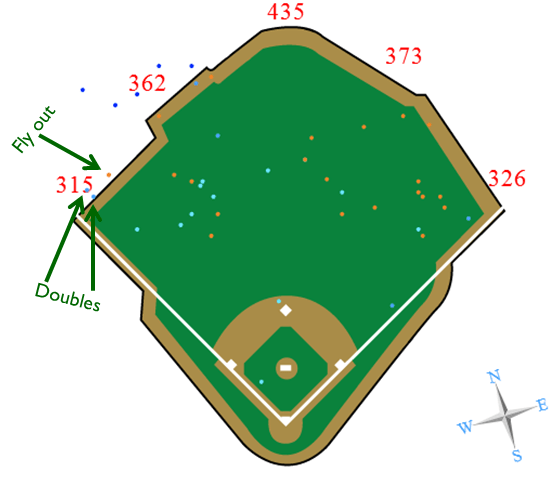
Earlier today after he was dealt to Houston, I did a piece on Chris Carter and how his power should spike with his new home ballpark. I used the Katron.org balls in play information to outline three batted balls from Carter that would’ve been home runs in Minute Maid Park. It was meant to accentuate the point regarding his likely power improvements in his much friendly environs, but it was greatly flawed. You see, the Katron dots are where the ball is fielded not where it landed. I knew this in the recesses of my mind, but I never gave full thought to the notion and what it means when analyzing this kind of data.

Here is the legend for the Katron data:

katronkey

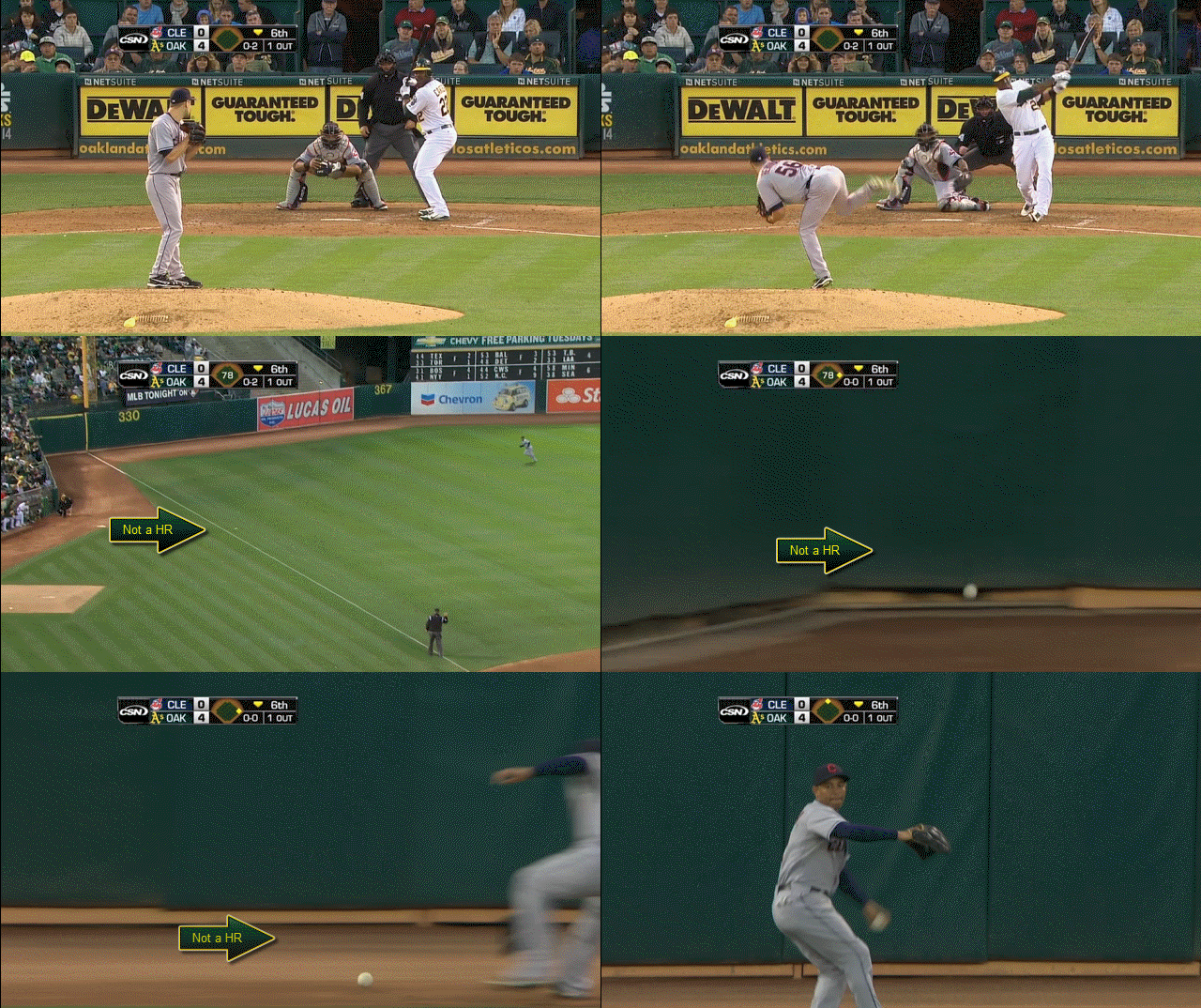
The problem comes in that we don’t know the hit type of singles, doubles, triples, and home runs. So I absent-mindedly assumed (never assume, kids) that the doubles were hit in the air either as line drives or flies. They were not. After getting some education about Katron and the potential flaws with using the data as I did, I went back to the video and found out that my particular examples show just how dangerous using the data as I did can be when the dots represent where the ball is fielded and not where it first hits the ground.

First, let’s look at the doubles:

ccarter1a

ccarter2a

See the problem now? I apologize for that, I simply didn’t put together the inherent flaws of using the data like that. It’s 100% my fault, though, so I’m not crapping on the folks over at Katron.org as it’s even there in bold below the charts:

Every location is where the ball was fielded by a player, not where it landed. You better read this Paul Sporer you stupid dummy. 

That may not be a fully accurate quote from their site.

Perhaps if I had been reading my now-BP-colleague Sam Miller a year ago when he was writing at the OC Register, this all could’ve been prevented.

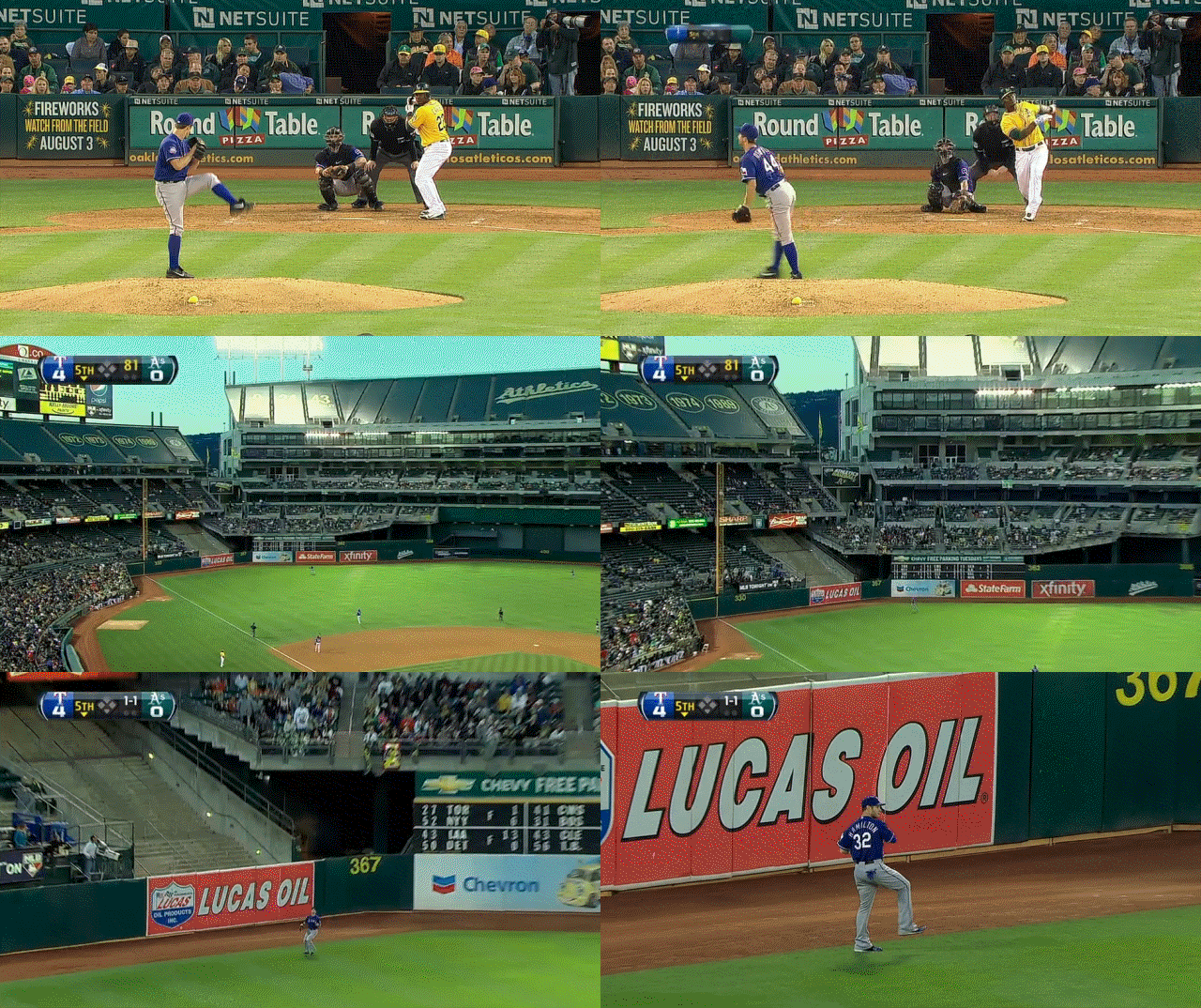
Hey, at least the flyball I highlighted doesn’t have the same issues. There is no guarantee it would’ve been out in Minute Maid, but we see the 367 sign behind Josh Hamilton when he catches it and we know that Minute Maid is 315 for a large portion of leftfield known as the Crawford Boxes.

ccarter3

click for huge picture

click for huge picture

Monday: 02.4.2013

Chris Carter Benefits from Trade to Houston

The Astros have a front office that understands how to rebuild. The best way to do it is to truly burn it to the ground and start over. In their latest such move, they traded Jed Lowrie and Fernando Rodriguez for Chris Carter, Brad Peacock, and Max Stassi. A 29-year old shortstop who is on the team until at least 2015 isn’t a bad asset for a rebuilding team like Houston, but a 26-year old slugger (who is probably a DH, but ostensibly can play first base or maybe leftfield which is where MLB Depth Charts has him as of now) and a 24-year old prospect arm who are under team control until 2019 are much better. This move is perfect for Carter.

Carter got his first real shot last year and popped 16 homers along with a .239/.350/.514 line in 260 plate appearances. He did strikeout 32 percent of the time, but also carried a strong 15 percent walk rate. He’s a classic three true outcome player and his new home is tailor-made for his game. His power plays anywhere so even in his cavernous home ballpark with Oakland he still had a .458 slugging percentage (the A’s as a team had a .392 slugging percentage at home) and five home runs despite the 89 home run park factor for right-handers. His move to Houston brings a major improvement to home venue as Minute Maid Park yields a 109 park factor to righties on home runs.

Plus, with Houston’s move to the AL West, Carter’s favorite venue from 2012 is still in play as he hit three of his 11 road homers in Texas in just six games. When you are dealing with a 260 plate appearance season, any parsing of that data is going to be subject to small sample size issues as the whole is already just a half season so keep that in mind, but it’s not like this power appeared out of nowhere for Carter. It’s always been his calling card so even with the scant samples, I’m confident in projecting that this move is a huge benefit for him. Consider also that his 182 home runs in 3647 plate appearances as a minor leaguer translate to about 30 per 600 plate appearances (29.9 to be exact). He hit 65 of those home runs in 1277 PAs in Triple-A which actually tops that overall rate checking in at 30.5 per 600 PA.

Thanks to Katron.org’s balls in play project, we can get a sense of how Carter might fare in Houston, or at least how he would’ve fared in Houston with last year’s batted ball distribution. The following is a mapping of Carter’s batted balls in Oakland on a Minute Maid Park overlay. You will see three leftfield batted ball outcomes labeled for what they were in Oakland, which would’ve likely gone for home runs in Houston. There is also a handful of warning track shots in left centerfield that might’ve gotten out in Houston depending on various circumstances. Meanwhile the five home runs were all no doubters on the Minute Maid overlay. Be mindful that this is all academic as he won’t have the exact same batted ball distribution in 2013, but it gives some sense of how his power production can improve with his new club.

CarterinMMP

By the way, Jed Lowrie was my Houston pick for the Countdown to Spring Training so don’t be surprised if this re-runs for the Houston CtST entry down the road. If I can find someone else I’m interested in, I’ll definitely go another way, but Carter is someone I really like so this fits pretty well, too. I didn’t really want to hold this analysis until Houston’s day, either. Meanwhile, Lowrie is unlikely to hold a spot in the Countdown as I had my eye on someone else for Oakland and don’t know if I want to switch it up.

Please be sure to check out the addendum to this piece.

Saturday: 02.2.2013

Countdown to Spring Training: 21 Days – Jason Heyward

Only 21* days until live game action…

With 30 days to go, I started profiling a hitter per day highlighting one from each team. I selected my player of note from each team and then randomized them (which was pretty interesting consider who the final two were after the randomization) so that’s the order I’ll be following.

*Sorry for missing Friday’s entry, but I’m doubling up today so technically there are 20 days until live game action, but we’ll get to that later today!

JASON HEYWARD

On the heels of a brilliant 2009 campaign at age 19, Atlanta outfielder Jason Heyward entered the 2010 season as the #1 prospect in all of baseball. You’d have thought it was a full season when you saw his numbers with a .323/.408/.555 line including 17 HRs, 63 RBIs, 10 SBs, and 25 2Bs, but injuries limited him to just 99 games which he split pretty evenly between High-A (49) and Double-A (47) tacking on three more at Triple-A to close the season out. Despite the hype there was no guarantee he’d start the 2010 season with the Braves, but then a big Spring Training during which he hit .305 with five extra-base hits, four stolen bases, and a near1:1 K:BB ratio (11 K/10 BB) sealed his fate as the starting rightfielder for good in Atlanta.

Well, for good so far.

You know what happened next. He hit a three-run home in his first major league at-bat and went on to have an excellent, near-Rookie of the Year campaign falling short to Buster Posey by just 22 points.  Unfortunately that was followed by the fabled sophomore slump in which he dropped 50 points from his batting average, saw his walk rate & OBP tumble in concert, and he missed 34 games due to injury including right shoulder injury that sent him to the disabled list in late May. He first missed time with the shoulder on May 11, but looking at the numbers suggests it was plaguing him throughout the month before finally hitting the DL on May 22nd:

heywardmay2011

Ouch. And that doesn’t even show the fact that he managed one line drive all month. He had 12 groundballs, nine flyballs, four popups, and the one line drive. So while it is speculation on my part that the shoulder was ailing him all month, I think the evidence is strong. He rebounded a bit when he returned on June 15th finishing out the month relatively, but then fell back into a deep slump that last all of July and August. In the two months he hit just .212/.281/.394 with 6 HRs, 20 RBIs, and 2 SBs. Perhaps most alarming was that his usually solid walk plummeted to seven percent.

He was lost.

A major problem facing Heyward in his dismal 2011 season was an inability to hit anything with a wrinkle. This is not a new problem facing youngsters and he didn’t exactly crush off-speed in 2010, but his 2011 work against the pitches especially awful and the 2012 rebound no doubt aided his resurgence:

heywardoffspeed

He didn’t exactly pound the ball against off-speed stuff last year, either, but the bar was so low that just returning to 2010 levels was enough to really help his overall numbers. Isolating his work against curveballs specifically shows that to have been his problem pitch above all in that 2011 season. Though his .143 batting average against the changeup in 54 plate appearances wasn’t carrying him to any batting titles, either.

heywardcurveball

He still has to get better to become the superstar that many see him becoming (myself included). His 35 percent strikeout rate against off-speed stuff in 2012 was the 13th-highest in baseball. That put him in the company of new teammate B.J. Upton (36.4%) and Colby Rasmus (36%), a pair of supremely talented, highly touted prospects (Upton peaked as the #2 overall prospect in ’04; Rasmus at #3 in ’09) who have never quite lived up to their expectations. Look at their numbers against off-speed since 2009 (as far as back as the data goes):

prospectOFvoffspeed

Heyward is the “best” of the three, but the lead is marginal and entirely tied to his extra plate discipline with a walk rate that is nearly two times that of the other two guys. It might worth noting that within the 2012 season, Heyward did show some improvement against non-fastballs from half to half posting a 689 OPS against the pitches through the All-Star break and followed it up with a 761 OPS from mid-July to the end of the season. The splits were small samples of about 115 plate appearances apiece, but maybe he adjusted something in-season to improve.

One thing that stuck out was that he killed changeups in the first half hitting .346 with a 991 OPS against them albeit in just 30 plate appearances before falling back to a .174 average and 513 OPS against them in the second half, again in a scant 24 plate appearances. Perhaps his luck was just evening out and the split in halves has no real significance.

The bottom line is that pitchers are beating him with off-speed pitches on a consistent basis and he will need to adjust if he is to become a superstar, face of the franchise-type who will take the torch from the now-retired Chipper Jones. For those wondering how he fares against fastballs, he has an 867 career OPS against them with single season marks of 903 in 2010, 827 in 2011, and 860 last year. He does have one particular trend that has been going in his favor year-over-year: his groundball rate is shrinking while his flyball rate climbs. He started with 55 percent groundball and 27 flyball rates in 2010, moving to 55 and 33 percent in 2011, and finally 44 and 37 percent a year ago. He was very close to the league average batted ball profile of 45 groundball, 34 flyball, and 21 percent line drive.

I hope y’all realize how much restraint I showed by not once referencing that Heyward has Trouble with the Curve.

You’re welcome.

Friday: 02.1.2013

Top 10 Catchers Right Now

Tonight MLB Network will continue the 2013 iteration of their “Top 10 Right Now” series at each position capped off with a “Top 100 Overall*”. They will air both the catcher and first base shows on Friday evening. I always enjoy this series and generally look forward to it after the New Year since I eat up just about any fresh baseball content I can as we wait for pitchers & catchers to report. Instead of putting up my lists after they air their selections, I’ll post mine ahead of time and then compare notes after the shows air.

*I will not be doing a top 100

This is not a fantasy list!!

I didn’t really have anyone that I fretted over leaving off. Wilin Rosario doesn’t actually play catcher so his hitting exploits would have to be about 2x what they are currently. OK, he puts on the equipment and positions himself behind home plate, but to say he plays catcher is an insult to even the worst of defenders behind the dish, let alone the best.

Jonathan LuCroy was probably closest, but he was beat out by another guy who played under 100 games last year as I expect this guy to top LuCroy in 2013.

THE LIST

10. Salvador Perez (KC) – There is a lot of speculation on this one as Perez has just 115 games played in his major league career, but part of these lists is projected 2013 performance and I’m expecting a nice year from him which should be his first full season. Despite the small sample of work, he has shown a lot. He has shown legitimate power (.471 slugging percentage & 14 HR), a strong hit tool (.311 batting average), and an ability to make adjustments as he dropped his strikeout rate from 12.7 percent in 2011 to 8.9 last year. The Royals no doubt see the potential signing him to a 5-year, $7 million dollar deal before last year which includes options for 2018 and 2019 which will be remarkably affordable (at $5 and $6 MM, respectively) if he continues at the trajectory we’ve seen early one.

9. Carlos Ruiz (PHI) – He is on the shelf for the first month of the season serving a 25-game suspension for banned substances which is unfortunate as he looks to follow-up his breakout 2012. Of course, he put together his .325/.394/.540 line in 114 games last year so missing 25 doesn’t necessarily preclude him from repeating. Suspension or not, the big question is whether or not his spike in HR/FB rate (from 4.4 in ’11 to 15.1 last year) is legitimate and thus will sustain his 16-homer output. That’s huge spike especially in light of his flyball percentage shrinking five percent.

8. Brian McCann (ATL) – The latest news has McCann’s shoulder feeling better and gives him a shot to be ready by Opening Day. Last year was an unmitigated disaster given his standard of excellence as he played a career-low 121 games with a paltry 87 OPS+ output. He kept his 20+ HR streak intact, but that was probably the only positive point in his season. This ranking takes the injury concerns into consideration as he’d be much higher without them.

7. Alex Avila (DET) – Avila labored through a tough season after a huge 2011 breakout as nagging injuries hampered him from day one. Most catchers are usually dealing with an ailment or three by the time Spring Training hits the one-week mark, but Avila seemed to suffer more than his fair share and lower body ones to his hamstring and knee held his power numbers down quite a bit. Despite the injuries, he was still above average offensively and an offseason rest should help him chase down those 2011 numbers again in 2013.

6. Carlos Santana (CLE) – A rough start to 2012 didn’t stop Santana from putting together an excellent season and the only thing keeping him this low is that he’s not a particularly great catcher defensively. I wrote about him in detail in my Countdown to Spring Training series if you’re interested in more.

5. Joe Mauer (MIN) – He still played the majority of his games at catcher and after an ugly half-season in 2011, his numbers returned to what we expect from Mauer (unless you’re still expecting 2009, in which case just stop). He’s still an excellent player even if he spends most of his time at first base or DH, but he’s not a good defensive catcher so he can only be ranked so high as we move into the elite who combine offense and defense.

4. Matt Wieters (BAL) – He’s yet to become the offensive juggernaut we expected when he was coming up through the minors, but that hasn’t stopped him from rounding into one of the best catchers in all of baseball. The defensive piece is in place and I wouldn’t be surprised to see his offensive game take off in these final three years of his 20s.

3. Miguel Montero (ARI) – Like Santana, Montero didn’t sprint out of the gate in 2012, but that couldn’t deter him from a great season at the dish and he pairs that bat with great work behind the dish. In fact, he has improved a ton when it comes to shutting down the running game the last few years. After posting a 26 percent caught stealing rate in his first full season back in 2009, he has since posted rates of 31, 40, and 42 percent. The 42 percent a year ago was the third-best in baseball. He is really one of the best overall catchers in the game and yet doesn’t get nearly enough credit as such. I will be especially interested to see where he rates on the lists tonight.

2. Buster Posey (SF) – How much can really be said about this reigning NL MVP that hasn’t been said yet? His 2010 was a precursor to his excellence which was delayed a year by his injury in 2011. Those who were worried that the injury might take some time coming back from were shown the door immediately as Posey ripped the league apart for a 1016 OPS in April. But it was his second half of the year that really earned him the MVP as he posted a 1023 or better OPS in each month with 21 RBIs per month and his .364 average in September was his worst from July on as he hit a combined .371 in the three months.

1. Yadier Molina (StL) – This shouldn’t be too much of a shock. Sure, Posey won the MVP, but he also played 29 games at first base and Molina was a legitimate candidate finishing 4th in the voting. Long regarded as the unquestioned best defender in baseball, Molina’s offensive outburst the last two years puts him in the discussion as the single best player in the game if you were talking about building a team from scratch.

Friday: 02.1.2013

Top 10 First Basemen Right Now

Tonight MLB Network will continue the 2013 iteration of their “Top 10 Right Now” series at each position capped off with a “Top 100 Overall*”. They will air both the catcher and first base shows on Friday evening. I always enjoy this series and generally look forward to it after the New Year since I eat up just about any fresh baseball content I can as we wait for pitchers & catchers to report. Instead of putting up my lists after they air their selections, I’ll post mine ahead of time and then compare notes after the shows air.

*I will not be doing a top 100

This is not a fantasy list!!

Youngsters Eric Hosmer and Anthony Rizzo were close, but #10 on the list beat em out because of his two full years of big time production.

Dear Lord, please don’t let the MLBN guys list Ryan Howard.

THE LIST

10. Freddie Freeman (ATL) – I think so forget that the sweet-swinging lefty is just 23 years old. He has back-to-back 20-homer seasons and showed improvement in both his walk and strikeout rates from year one to year two improving both by about two percent. His continued ascent makes the loss of Chipper Jones easier to swallow for that offense (not to mention the addition of the Upton Bros) and the best may well be on the way as early as 2013.

9. Allen Craig (StL) – The purpose of these lists is to explore the position right now and project forward for the 2013 season. As such, Craig makes my list. His skills are plentiful and already in place, but he needs to stay healthy which I think he will do in 2013 and show subsequently show everyone what a beast he is with the bat. Those paying attention have already seen the 141 OPS+ the last two years, but that’s only been in 733 plate appearances, a full season of dominating will earn him the attention he deserves.

8. Mark Teixeira (NYY) – He is likely to rate higher on everyone’s list on the show tonight, but that’s based solely on name value. The shift (not be confused with MLBN’s The Shredder) has eaten his batting average and it isn’t coming back. He’s been under .260 the last three years and barring a change in approach, I just don’t see him coming back to the levels we were used to in his 20s when he hit a combined .290, topping .300 three times. His OPS has declined yearly since 2007. He’s still good, but no longer great.

7. Paul Konerko (CHW) – He sputtered to the finish line in 2012, but he’s far from done, even at 37 years old. Despite the down second half, he still finished with the 6th-best OPS+ among first basemen qualified for the batting title. Konerko has at least another big year in his bat, if not maybe even 2-3 seasons.

6. Edwin Encarnacion (TOR) – He may not repeat his 2012 breakout that saw him pop 42 bombs, but he’s far from a power fluke. He had a 162-game average of 27 homers for the three years leading up to last year so we had definitely seen glimpses of greatness within his game. Of course Cory Schwartz, Jason Collette, and Matthew Berry have seen the greatness since E40 was in teeball.

5. Paul Goldschmidt (ARI) – I’m extremely high on Goldschmidt as evidenced by this ranking, but I think he’s slated for a big 2013. He’s got a great all-around game bringing big power (43 doubles, 20 homers), a good batting eye (10% walk rate), and speed which is rarely seen from the position (18-for-21 SB success rate). He has 30-35 home run upside, too, which could start to shine through as early as 2013 in his age-25 season.

4. Adrian Gonzalez (LAD) – When your down season is a .299-18-108 season, you’re a damn good ballplayer. That was Gonzalez’s 2012 and while it isn’t what we’re used to (he averaged .306-33-106 from 2009-2011), it was hardly bad. Throw in the trade to LA and I think he’s being slept on a bit. My only major concern is the plummeting walk rate that has gone from 18 percent in 2009 to 13, 10, and then just six percent last year. Thankfully his strikeout rate has held firm between 16 and 16.6 percent in that span. He is still a star.

3. Prince Fielder (DET) – First base is always a position with offensive stalwarts, but I wonder if Prince ever looks things over and shakes his head that even with his numbers he isn’t the unquestioned best at his position. He has missed one game in the last four seasons. Though he peaked at 50 home runs in his second year, he has hardly struggled in the meantime. He is still averaging 36 per season since that 2007 breakout along with a .290 average and 111 RBIs. Plain and simple, he is one of the best the game has seen and he has plenty more in store.

2. Albert Pujols (LAA) – Remember when his career was over in April? And how he probably wasn’t going to make the Hall of Fame in early May? It was an uncharacteristically slow start for The Machine, but the panic button was smashed to bits by far too many people especially since he’d just done something similar in 2011. He is still unquestionably one of the game’s best players and I wouldn’t even quibble with someone giving him the top spot, but for me it was easily…

1. Joey Votto (CIN) – The torch is passed. Yes, he only played 111 games last year thanks to an injury, but he still led first basemen in fWAR at 5.9 among those with 450+ plate appearances. He won his third straight OBP title in the National League and second MLB-wide title in three years. Despite playing just 111 games, he still clubbed a career-best 44 doubles. If he had gotten the 625 plate appearances he normally gets in a season, he was on pace for 58 doubles which would’ve been one shy of Todd Helton’s 59 in 2000, the most in the integration era (since 1947).

I really should do these during the week so I don’t smash four posts (two reviews, two new lists) onto the site in a matter of hours. I’ve just been so deep in the SP guide stuff that by the time Friday hits, I’m like “Oh man, I gotta get my top 10 stuff done”.

Friday: 02.1.2013

Top 10 RF – Review

Last Friday night, MLB Network unleashed their Top 10 Rightfielders Right Now along with input from host Brian Kenny, co-host Eric Byrnes, and special guest to the series Bill James. In the LF review I mentioned my issue with MLB Network lists including guys who weren’t slated to play the particular position next year and we have a few of those on in rightfield with Josh Hamilton, Justin Upton and Ben Zobrist.

I included Upton in left and Hamilton in right because that’s where they are going to play and the change for Upton was known when they presented the show because they discussed Upton’s trade to Atlanta. And I listed Zobrist at second base because that’s where he was slated to play this year before the Rays brought Kelly Johnson aboard. For those unaware, Johnson wasn’t a Ray when the 2B lists were unveiled.

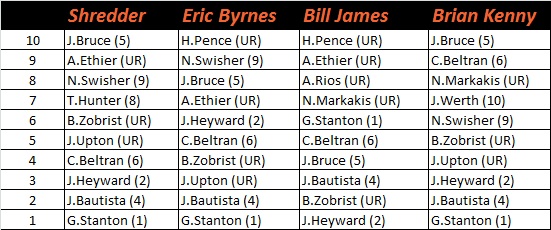
Here are all four lists from MLB Network-related folks and then I’ll address them separately:

top10RFlists

I told ya Andre Ethier was going to be on all most of these lists.

The Shredder

Apart from our three known differences that occur on every list as outlined above, Ethier is the split between lists. It was tough leaving him off. In the end, I went with Jayson Werth because of his all-around game and how good he looked upon returning from injury. Jay Bruce was a bit underrated at 10, though had I included Upton and Zobrist, he’d have been at least seventh for me so the difference between The Shredder and me looks bigger than it would’ve been with Bruce.

My inclusions they didn’t list: Werth, Josh Reddick, and Josh Hamilton

Eric Byrnes

If given the option, I’d have bet all of my money on Byrnes listing Hunter Pence. Pretty easy bet, though, right? It’s not a terrible listing, especially at 10. Overall, I really like his list to be honest as I did with his leftfield list. He gets a lot of crap from the baseball community, especially on Twitter, but I don’t think he’s so bad. My friends over at Productive Outs cannot stand him. Perhaps it’s the Spiccoli-esque way he speaks and that dialect is often viewed as just generally stupid, especially in California where both live. That’s just speculation on my part. I just think that Byrnes is actually one of the better player-analysts on the network, even if you think the bar is really low.

My inclusions he didn’t list: Werth, Hunter, Reddick, and Hamilton

Bill James

Bill, Bill, Bill. Jeez. I mentioned in the LF review that James’ lists have really puzzled me and this one was no different. Stanton at 6???? Sheesh. I was so focused on that ranking that I barely paid attention to the Alex Rios and Nick Markakis inclusions, neither of which I like that much. My fanboydom aside, how is Stanton sixth?

My inclusions he didn’t list: Werth, Swisher, Hunter, Reddick, and Hamilton

Brian Kenny

In fairness, I chastised Kenny in the LF review for including Carlos Quentin, who played just 86 games a year ago, only to then include Werth on my list in his 81-game season. The difference as I see it is that Werth played half a season after three straight 150+ game seasons where Quentin has rarely even been within 20 games of 150. We both had Werth on our lists, a move I obviously support. I don’t have any major quibbles with Kenny’s list this time around outside of Markakis and that’s not even a major quibble. He had consideration, but the position was just too deep to find room for him. In fact, he’d be third behind Ethier and Norichika Aoki on the honorable mentions.

My inclusions he didn’t list: Hunter, Reddick, and Hamilton

Coming up this evening: my first base and catcher lists!

Friday: 02.1.2013

Top 10 LF – Review

Last Friday night, MLB Network unleashed their Top 10 Leftfielders Right Now along with input from host Brian Kenny, co-host Eric Byrnes, and special guest to the series Bill James. There is no real consistency with these lists and that part has been a bit annoying. I’m specifically referring to deciding where to list guys. Why are they listing Martin Prado and Josh Hamilton as leftfielders and Justin Upton as a rightfielder when they will not be playing those positions in 2013?

By their own admission, these lists are also supposed to be projecting the 2013 season so it makes zero sense to do this, especially since they set that precedent with their first episode and listed Shin-Soo Choo in center. I know these lists are for s’s & g’s and despite how it may read, I’m not getting that worked up over it, I’m just trying to have some fun as we move closer toward real baseball.

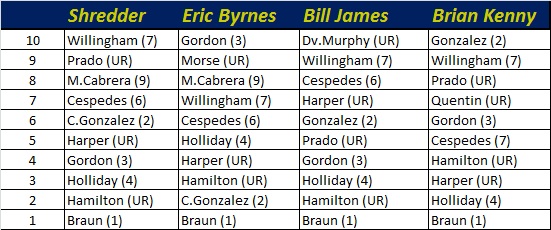
Here are all four lists from MLB Network-related folks and then I’ll address them separately:

top10LFlists

The Shredder

Technically, I only had one difference with The Shredder because had I know they were counting Hamilton and Bryce Harper as leftfielders I’d have done the same. I talked about them in the centerfielder list with Harper actually making the top 10. Since I hadn’t ranked Hamilton in the CF list and realized that the lists were supposed to be a ranking of where they were slated to play, I included him with the rightfielders. With that out of the way, I don’t really have any major problems with The Shredder’s list. I obviously like Carlos Gonzalez quite a bit more, but it seems The Shredder dings him hard for his road stats, as does Brian Kenny which is pretty silly because he still plays in Colorado. If the list is supposed to be about who they are right now and how they’ll do in 2013, how does his poor road work matter when he more than makes up for it at home?

My inclusions they didn’t list: Alfonso Soriano, Brett Gardner, and Justin Upton

Eric Byrnes

Similarly to The Shredder, if you remove the Harper/Hamilton issue then I’m almost in lock-step with Byrnes. In fact, apart from a major difference on Alex Gordon, we about matched on every pick. He seriously underrated Gordon’s defense, but also made a big point out of the fact that Gordon isn’t a 30-home run guy. Neither was Byrnesie in his best year, 2007, during which played left predominantly. Another point he stressed repeatedly was that he felt Cargo was definitely the best defensive leftfielder in the game. It’s Gordon for me, but his claim isn’t outlandish. Oh, and Byrnes seemed to have played WITH EVERYBODY ON EVERY LIST IN THE SHOW.

My inclusions he didn’t list: Soriano, Gardner, and Upton

Bill James

More of the same as we only have one disagreement beyond his ranking guys who aren’t actually leftfielders anymore and Harper. I was really surprised with his ranking of Harper and Hamilton, but I guess he was leaning heavily on the track record differential between the pair. Some of James’ lists during this series have really surprised whether it was a shocking inclusion or questionable positioning of a player. David Murphy had his first 500 PA season last year in what was easily his best season and now he’s a top 10 LF? I don’t see it, Bill.

My inclusions he didn’t list: Soriano, Gardner, Upton, and Melky Cabrera

Brian Kenny

Kenny’s lists have really shocked me, too. I watch Clubhouse Confidential daily so I think I’m pretty well versed in Kenny’s mindset about the game, but then he goes and drops Carlos Quentin seventh on his list after an 86-game season. In fact, Quentin has never topped 131 games and he’s now four years removed from his best season.

My inclusions he didn’t list: Soriano, Gardner, Upton, and Cabrera


Wednesday: 01.30.2013

Trevor Bauer Shows Us His Pitches

Found this circulating in my Facebook and Twitter feeds this morning. It’s from Trevor Bauer on January 25th when he answered a YouTube viewer’s question about his pitch grips. He proceeded to go through each one of his grips explaining how he does it with little tips and tricks and insight into the kind of movement he expects based on pressure points or arm/wrist movements. Remarkably fascinating stuff and a must-watch for baseball fans, in my opinion. I imagine this would be really cool to see as a teenager who pitches as I’m sure you could pick up a thing or two to take on the mound your next time out. Instead I’ll just have to try these out next week when warming up for softball.

“Hey idiot, stop throwing crappy-ass backup sliders in the dirt with a softball, you’re doing it wrong and I’m tired of chasing after them.”  -Paul’s throwing partner before next week’s game

Tuesday: 01.29.2013

Countdown to Spring Training: 24 Days – Jose Bautista

Only 24 days until live game action…

With 30 days to go, I started profiling a hitter per day highlighting one from each team. I selected my player of note from each team and then randomized them (which was pretty interesting consider who the final two were after the randomization) so that’s the order I’ll be following.

JOSE BAUTISTA

It will be a quicker countdown entry today which actually works out quite well because Bautista isn’t someone in dire need of a deep-dive analysis. We know he is a power stud coming off of his two amazing full seasons of MLB-leading home run totals in 2010-2011 plus another 27 in 92 games during an injury-shortened 2012. The common analysis after 2010’s insane breakout was that his HR/FB was aberrational to his career levels so he was sure to come down. The problem with analysis isn’t projecting regression after an amazing season, it’s the certainty with which it’s done.

Granted this is easier to do in hindsight, but I’ve always had an issue with guaranteeing regression on a new level of performance. Again, it is a safe bet gravity being what it is and all, but speaking in absolutes has no real upside. He was “sure” to regress in 2011 and while he gave back 11 home runs, he added 42 points of batting average up to .302 and 68 points of on-base percentage up to .447 while actually improving his HR/FB rate from 21.7 to 22.5 percent. What changed to yield the performance is the first question you should ask before instantly declaring it will regress and moving on.

For example, his 2011 batting average stood out almost as much as his 2010 home run surge. After all, his flyball-heavy batted ball profile isn’t exactly conducive .300 batting averages. Of the 74 players to hit .300 or better since 2010, only Bautista did it with a flyball rate north of 45 percent. Only three others were at 44 percent. The average of the set was about 35 percent and 60 players were on the other side of 40 percent.

His .260 in 2010 was just above league average (.257) and his .241 last year wasn’t too far from league average (.255) so what happened in 2011? First off, he shifted the mix on his batted balls a bit taking from the flyballs and adding to both the line drive and groundballs. Secondly, he just smacked the ever-living-piss out of the ball year long, especially compared to league average.

bautista2011bbavg

His .309 BABIP compared to the league mark of .295, but given his batted ball profile compared to league average, it isn’t out of bounds to suggest he also had some good fortune. But when you barrel up the ball and smack rockets all over the place, you’re bound to create some of your good luck.

His dip back down to .241 last year wasn’t terribly surprising as he took a bit from 2011’s line drives and padded his flyball rate again back up to 49 percent. His batted ball profile as it stands over the last three years is far more conducive to .250 batting averages than .300 ones so prepare yourself for that and take anything else as an added bonus.

The worst part about last year’s left wrist injury that effectively ended his season in mid-July is that he had just ripped off nine and 14 home run months in May and June after a mere three in April. While he’d only had one in 12 July games, I was really eager to see what he had in store for us during the dog days of summer.

Over his three year explosion into superstardom, Bautista has posted a composite HR/FB of 21.6 percent, fourth in baseball behind Giancarlo Stanton (25.8), Mike Napoli (23.1), and Ryan Howard (22.3), but his 50.6 flyball percent and 15 percent infield flyball rate are the highest among anyone in the top 30 of HR/FB rate. What that tells me is that he’s selling out for power all day, every day. The 15 percent infield flies are likely a lot of “just missed” missed pitches that fall harmlessly into the shortstops glove on the back of the infield and contribute to his .256 BABIP during that time which is second-lowest among the top 10 in HR/FB (Andruw Jones .244) and third-lowest overall (Carlos Pena .251).

That is the long way of say that all the data suggests that 2011’s .302 really was an aberration and likely one of epic proportions. To repeat the feat, he will likely need to dramatically shift his hit profile or find the double rainbow for a second time. I have seen Bautista go as high as the late-first round. I’m not vehemently opposed to the idea as long as you realize you’re investing in a pure power source and not trying to rationalize the pick by saying, “well, he’s only a year removed from a .302 average so I have that upside, too.”

Sure, technically you do as one a skill is displayed it is owned (Shandlerism!), but you also have to understand the probability of said skill returning once gone and with Bautista, as his skills are currently constructed, chances are scant. There have been just 10 seasons of 40+ homers the last three years and he owns two including the best (54) and third-best (43) and he was on pace for a third which would’ve extended his 12 home run lead over Miguel Cabrera (124 to 112) for the most in the majors during that span. So if you are drafting him for that bankable power and understand his deficiency with batting average, then by all means proceed with your pick.