Archive for ‘Fantasy Baseball’

Thursday: 03.10.2011

National League Pitching Prospects List

This will serve as the 3/10 Daily Dose

It’s time for my prospect rankings for each league and I want to throw out a few points before I get to today’s National League list:

o   I’m new to prospecting.  This is my first ranking of prospects as I’ve spent the last two years getting better at it before finally diving in this year.  Keith Law, Kevin Goldstein, John Sickels, Jason Collette, the BA folks (Jim Callis, Aaron Fitt, John Manuel, etc…) and Adam Foster are all much more seasoned, just to name a handful whose work I enjoy.  I stand 100% behind the work, but this isn’t yet an area of expertise for me.  I wouldn’t necessarily be eager to suggest anything is an area of “expertise” for me, but I’m much more in my element discussing major leaguers right now, but I want to get better at prospecting so it’s time to start ranking.

o   I have seen a handful of these guys live, though the bulk of my experience with them comes from reading extensively and watching video online.

o   There aren’t individual player capsules here, those are all in the Starting Pitcher Guide.

o   The ceiling is a best-case scenario as I see it.

o   The ranking combines the best-case scenario with how likely they are to reach it.  This means someone might project with a higher ceiling, but be less likely to reach it and thus rank below someone with a lower ceiling who is closer to it.

o   This doesn’t slant toward 2011.  It’s all encompassing.  In other words, don’t use it in your re-draft fantasy leagues and get upset with me if Arodys Vizcaino doesn’t throw 120 innings for you later this summer.  It’s meant more for leagues with minor league rosters of any size and dynasty leagues.

RK Player TEAM ETA Ceiling
1 Julio Teheran ATL 2012 1
2 Jameson Taillon PIT 2014 1
3 Mike Minor ATL 2010 2
4 Jarrod Parker ARI 2011 1
5 Shelby Miller STL 2012 1
6 Simon Castro SD 2011 1
7 Jordan Lyles HOU 2011 2
8 Jenrry Mejia NYM 2010 1
9 Randall Delgado ATL 2012 1
10 Tyler Matzek COL 2013 1
11 Zach Lee LAD 2013 1
12 Casey Kelly SD 2012 2
13 Trey McNutt CHC 2012 1/Closer
14 Arodys Vizcaino ATL 2013 1
15 Trevor May PHI 2013 1
16 Stetson Allie PIT 2014 1/Closer
17 Matt Harvey NYM 2013 1
18 Zack Wheeler SF 2013 1
19 Brandon Beachy ATL 2010 3
20 Jarred Cosart PHI 2014 2
21 Christian Friedrich COL 2011 2
22 Tyler Skaggs ARi 2013 2
23 Chad James FLO 2013 2
24 Cory Luebke SD 2010 3
25 Brody Colvin PHI 2014 1
26 AJ Cole WAS 2014 2
27 Chris Withrow LAD 2012 2
28 Rubby de la Rosa LAD 2013 1
29 Brad Hand FLO 2012 3
30 Mike Foltynewicz HOU 2014 2
31 Luis Heredia PIT 2014 1
32 Chad Bettis COL 2014 3
33 Jesse Biddle PHI 2014 2
34 Juan Urbina NYM 2014 2
35 Jay Jackson CHC 2011 3
36 Lance Lynn STL 2011 3
37 Juan Nicasio COL 2013 2
38 Sammy Solis WAS 2012 3
39 Aaron Miller LAD 2012 3
40 Hayden Simpson CHC 2013 2
41 Carlos Martinez STL 2014 1
42 Daryl Thompson CIN 2008 3
43 Ethan Martin LAD 2013 2
44 David Holmberg ARI 2014 3
45 JJ Hoover ATL 2012 3
46 Pat Corbin ARI 2013 3
47 Mark Rogers MIL 2010 3
48 Tyrell Jenkins STL 2015 2
49 Bryan Morris PIT 2011 3
50 Brad Boxberger CIN 2012 3

I’ll be hosting a chat soon to discuss both this and more of the Starting Pitching Guide. Plan for next Thursday, but I’ll definitely post the details ahead of time. In the meantime you can reach me on Twitter or Facebook if you have questions about this list.

Wednesday: 03.9.2011

American League Pitching Prospects List

This will serve as the 3/9 Daily Dose

It’s time for my prospect rankings for each league and I want to throw out a few points before I get to today’s American League list:

o   I’m new to prospecting.  This is my first ranking of prospects as I’ve spent the last two years getting better at it before finally diving in this year.  Keith Law, Kevin Goldstein, John Sickels, Jason Collette, the BA folks (Jim Callis, Aaron Fitt, John Manuel, etc…) and Adam Foster are all much more seasoned, just to name a handful whose work I enjoy.  I stand 100% behind the work, but this isn’t yet an area of expertise for me.  I wouldn’t necessarily be eager to suggest anything is an area of “expertise” for me, but I’m much more in my element discussing major leaguers right now, but I want to get better at prospecting so it’s time to start ranking.

o   I have seen a handful of these guys live, though the bulk of my experience with them comes from reading extensively and watching video online.

o   There aren’t individual player capsules here, those are all in the Starting Pitcher Guide.

o   The ceiling is a best-case scenario as I see it.

o   The ranking combines the best-case scenario with how likely they are to reach it.  This means someone might project with a higher ceiling, but be less likely to reach it and thus rank below someone with a lower ceiling who is closer to it.

o   This doesn’t slant toward 2011.  It’s all encompassing.  In other words, don’t use it in your re-draft fantasy leagues and get upset with me if Jacob Turner doesn’t throw 120 innings for you later this summer.  It’s meant more for leagues with minor league rosters of any size and dynasty leagues.

RK Player TEAM ETA Ceiling
1 Jeremy Hellickson TB 2011 1
2 Matt Moore TB 2012 1
3 Michael Pineda SEA 2011 1
4 Manuel Banuelos NYY 2012 1
5 Zach Britton BAL 2011 2
6 Jacob Turner DET 2013 1
7 Martin Perez TEX 2012 1
8 Kyle Drabek TOR 2010 2
9 Mike Montgomery KC 2012 1
10 Chris Sale CHW 2010 1/Closer
11 Dellin Betances NYY 2012 2/Closer
12 John Lamb KC 2012 2
13 Chris Archer TB 2012 2
14 Kyle Gibson MIN 2011 2
15 Andy Oliver DET 2010 2
16 Danny Duffy KC 2012 2
17 Drew Pomeranz CLE 2012 2
18 Casey Crosby DET 2013 2
19 Alex Wimmers MIN 2013 2
20 Chris Dwyer KC 2012 2
21 Alex White CLE 2012 2
22 Aaron Crow KC 2012 2
23 Drake Britton BOS 2013 2
24 Alex Torres TB 2012 2
25 Jason Knapp CLE 2012 2
26 Tyler Chatwood LAA 2011 2
27 Alex Colome TB 2013 2
28 Anthony Ranaudo BOS 2013 2
29 Michael Kirkman TEX 2010 3
30 Tijuan Walker SEA 2014 1
31 Tanner Scheppers TEX 2011 2/Closer
32 Robbie Erlin TEX 2013 3
33 Miguel de los Santos TEX 2013 2
34 Ivan Nova NYY 2010 3
35 Jason Thompson TB 2013 2
36 Enny Romero TB 2014 2
37 Andrew Brackman NYY 2012 2/Closer
38 Felix Doubront BOS 2010 3
39 Mauricio Robles SEA 2011 3
40 Zach Stewart TOR 2011 3/Closer
41 Drew Smyly DET 2013 2
42 Andre Rienzo CHW 2014 2
43 Jake Odorizzi KC 2013 2
44 Ian Krol OAK 2013 3
45 Brett Marshall NYY 2013 3
46 Alex Cobb TB 2012 3
47 Aaron Sanchez TOR 2014 2
48 Yordano Ventura KC 2014 2
49 Charlie Furbush DET 2011 3
50 Shawn Haviland OAK 2012 3

I’ll be hosting a chat soon to discuss both this and more of the Starting Pitching Guide.  Plan for next Thursday, but I’ll definitely post the details ahead of time.  In the meantime you can reach me on Twitter or Facebook if you have questions about this list.

Tuesday: 03.8.2011

Baseball Podcast Recommendation List

This will serve as the 3/8 Daily Dose

I grew up loving sports radio.  I used to listen to WDFN in Detroit all the time and eventually I began calling in.  The evening show in Detroit was hosted by a guy named Mega Man Ike Griffin and I loved the show.  I would write down all of my points, wait on hold for 30+ minutes and then deliver my thoughts in 1-2 minute spurts almost nightly.

One of my best sports radio memories was going to an on-site of Griffin’s show with my mom, best friend and sister.  Detroit Lions defensive end Robert Porcher was a guest and they had a Porcher-related trivia question for his tickets at the upcoming game against the Packers.  You had to name the mascot of Porcher’s alma mater, South Carolina State.  I instantly raised my hand despite the fact that I really didn’t have a clue what the answer was for this question.

I knew South Carolina was the Gamecocks, but that knowledge would be useless to me here.  Thankfully my mom was on hand.  It was her idea to just guess Bulldogs, seeing as it was a popular enough nickname that we might get it right.  And we sure did!  A few weeks later I was sitting 7th row in Porcher’s seats enjoying an excellent game that the Lions won (it was pretty rare back then, too).

We moved to Harlingen, TX when I was 14 and it took me a while to even find the lone sports talk radio station there.  For the years I lived there (3, sophomore-senior years of high school) it was purely an affiliate with no local stuff.  That made sense as there wasn’t a pro or even a viable college team anywhere in the area so there was no real need for a local flavor for the national stuff.  Might as well just stick with the pros.  We had Sporting News Radio then Fox Sports Radio followed finally by ESPN Radio.

I listened to it a lot in high school.  My dad and I would listen every day when he drove me to school and I would listen on summer nights when I stayed up late playing baseball simulators online (Jeez, I was [am?] a dork!).  Just like when I was in Detroit, I loved to call in.  Sometimes I’d wait even longer on the national shows, especially during peak hours, but I had my handy notes and an inexplicable amount of patience just so I could be heard.  I’d get most excited when I could actually respond to the host’s response instead of saying my initial piece and then having to listen to them offline.

I have taken the long way of showing how far back my love for sports talk goes with the point being that I didn’t just happen upon podcasts.  After loving sports talk radio for years, podcasts were a natural step in the process.  First off, the local stuff here in Austin isn’t very good even with two stations now.  Secondly, I cannot stand the fact that it feels like 43 minutes of every hour is commercial-laden.  So when I discovered podcasts were essentially commercial-less sports talk radio, I was immediately hooked.  Not only did they cut out my least favorite part of sports radio, but the content is often much better, too.

This all leads to my podcast recommendation list.  I listen to sports-related podcasts almost exclusively with a few general topic ones sprinkled in, but for the sake of this list, I’m going to whittle it down to baseball only.  There are different types and formats here so I’m sure there is something for everyone.  Or at least everyone who enjoys listening to baseball talk on some level.

By the way, if there is something missing on this list that you think needs to be a part of it, please don’t hesitate to leave a comment or hit me on Twitter because I’m always up to give a podcast a shot.

(UPDATED: MAY 23rd-Podcasts added and some commentary to previously listed podcasts has been added, too.  That commentary can be found in italics at the end of the original write up.)

FanGraphs Audio – Mix the usually sharp insights of FanGraphs.com analysts with the irreverent wit of host Carson Cistulli and it’s a winning combination.  Cistulli also brings in non-FanGraphs guests which only improves the show.  Check out a recent episode with player Matt Antonelli and I dare you not to become a fan of his almost instantly.  Oh and while it may not be for everybody, I for one love the intro music with Herb Alpert and the Tijuana Brass.  Yes, I even bought it on iTunes.  It’s called “The Charmer” and it’s available for a scant $0.99, iTunes giftcard FTW!

As for frequency of the show, I think it will ramp it up as the season gets nearer.  There were four in February and there were two right off the bat in March, so while they don’t keep a regular schedule I’d expect four-five per month during the season.  It checks in between 35 and 50 minutes per show.

MLB.com Fantasy 411 – This is one of the first shows I started listening to years ago.  It used to be a daily show that could be podcasted, but it has evolved into a television show on the MLB Network that will likely start soon and I believe runs 4:30-5:00 (new time!) 1:30 PM central when it’s not preempted and podcast-only.  I think they podcast most episodes, but like ESPN’s PTI, it’s better to watch since it’s a show with graphics and highlights.  Still, hosts Mike Siano and Cory Schwartz will do an episode every once in a while that is podcast only.  Great content and analysis with humor thrown is what you can expect to find on this show.  I would definitely keep it in your iTunes feed, but also set your DVR to record daily.

Baseball America PodcastAttention prospect mavens and wannabe prospect mavens, this is your podcast.  It runs often with a college rundown focusing on the Top 25 each week, draft podcasts throughout May and prospect roundup episodes all throughout the season.  Of course they do top 100 prospect stuff around this time each year (which they ran back on Feb. 23rd with the recent list), too.

They stay busy in the offseason as well with 18 podcasts since the season ended through today and if you want to only count mid-October to mid-February as kind of the dead period, 14 of the 18 came in that 4-month timeframe.  Time fluctuates based on the topic.  They are usually at least 30 minutes, but bigger topics stretch past an hour (top 100 coverage, draft report cards, signing deadline, etc…).

If you don’t have time to subscribe and digest all the fantastic writing on their site and in the bi-weekly (I believe) magazine, then this is a great substitute.  If you do subscribe to the site and/or the mag, this is the perfect supplement for your commute, dog walks or whenever you like to listen to podcasts.

The Jonah Keri Podcast – This one isn’t purely baseball, but it skews baseball enough to be included.  I’ve already recommended this in a previous Daily Dose, so I won’t just rehash everything again.  It’s a great podcast that has quickly become one of my favorites.  Keri reels in brilliant guests weekly (oftentimes more than once a week) and discusses a range of topics touching sports, pop culture, technology and the writing profession among others.  Baseball and college hoops seem to be his favorite sports with the podcast leaning toward the former thus far.  As he is Canadian, he also likes hockey a good bit and isn’t afraid to do a full episode on it either.  As a native Detroiter, I like hockey plenty but the coverage is scant here in Austin, TX.

The show is a must-listen for anyone who likes podcasts and likes sports.

Up & In: The Baseball Prospectus PodcastIf you’re not a fan of long-form podcasts, then you’re out on this one from the jump.  They routinely run two hours and sometimes push the two and a half hour mark.  Hosts Kevin Goldstein and Jason Parks are the opinionated minds behind this operation and if you’re easily offended, you may want to pass.  So now that I’ve given you two reasons not to listen, here are two reasons you would want to listen.  The long-form is awesome to me so it’s a plus in my book, but I know it can go either way toward attracting or dissuading listeners.  And the fact that Goldstein and Parks are direct with their opinions is another plus for me that can put off some.

They are prospect guys from the scouting side of the ledger when it comes to their baseball knowledge, but they understand stats and incorporate at times (they aren’t afraid to dismiss them entirely, though, either).  I think they give deep and interesting perspectives on a wide range of topics in the game and that’s what drew me in from the start (I’m a point-9’er).  They segment the show so if you only want the baseball portion or only want, as Kevin calls it, the goofy stuff, then you can pick the spots you want with his handy timed segment guide attached to each episode.

Sometimes I find their music snobbery a bit overbearing as it seems they like some of the stuff just because it’s not popular.  Honestly a lot of it is utter trash to me.  But that’s my opinion and I don’t mind that they like it.  I just think they should be the same way about mainstream music they don’t like… just move on.  No one cares that you don’t like it.  That aside, the baseball talk is plentiful and rich enough to easily overlook the slight annoyance that their condescension toward most things popular triggers (Jason does make a good point that they can’t be pegged as hating all things popular as he loves the Beatles more than anything).

If you want good baseball talk, great guests and colorful language, then you need to be listening to this show.

ESPN Fantasy Focus: Baseball – Another ESPN offering, Matthew Berry and Nate Ravitz are well-known in the industry far beyond the reaches of this podcast.  They also both play in Tout Wars leagues, too.  As for the show, it appeals to a more broad fantasy baseball player.  The standard league they discuss is a 10-team mixed which just isn’t my cup of tea.  That said, there is still some good discussion of players that range beyond standard league value and it’s worth a listen.

At times they can veer off topic a bit too much for my liking, but they are upfront that it’s a part of the show so if you don’t like it, it’s more of a “you problem” than something with them.  It’s a fun listen and a worthwhile way to pass 30-40 minutes a day.  I’ve also heard from some of my friends that both guys are really cool in person so even if you don’t love their on-air personas, they seem to be relatively well-liked guys within the industry.

I always keep them on the iTunes list.  I love when they debate and you get both sides of a player, though.  That, to me, is very useful.  Give it a shot and see how they sit with you.  Plus, the theme song is awesome.  Gets in my head every day and I don’t mind.  Update 5/23 – This is arguably their best season, in my opinion. They’ve done a great job branching out their coverage from just 10-team league-relevant information.  They’ve got some funny segments that they have added and they have just the right amount of silly stuff, again in my opinion.  It’s been a must-listen for me this season.  

Beyond the Box Score Podcast* – Another recent feature of the Podcast Recommendation of a past Daily Dose, the BTBS podcast is quickly climbing the list as one of my favorites.  It’s another long-form podcast (1.5-2 hours) filled with guests and plenty of banter between hosts Dave Gershman and Matt Klassen.  I’ve told the two before that I think sometimes Matt steamrolls Dave a bit too much and comes across too eager to get his point across, but they let me know that Matt was encouraged to speak up when he saw fit.  But they are just seven episodes in (eight should come out today sometime) so they are still getting into their groove.

Gershman is booking great guests and they usually have a couple per episode, but even a guest-less episode with just Gershman and Klassen riffing on a variety of topics would be worth listening to as well.  I’m not a fan of the bumper music between segments (The Bare Necessities), but something like that isn’t going to drive me away from a show or else I’d almost never listen to Up & In.  Update 5/23 – Dave wins, the bumper music has grown on me. 

* (Now in iTunes!)

ESPN Baseball TodayI’ve been listening to this show since it started waaaaaaay back in 2006 when Alan Schwarz was hosting.  I absolutely loved the show when Schwarz hosted it.  That’s nothing against the hosts since, but he was just fantastic.  There was a lull last season and I wasn’t listening much as I didn’t love Seth Everett partnering with Eric Karabell, but Karabell has added Keith Law and contributor turned co-host Mark Simon for the 2011 season making it a must-listen once again.

ESPN likes to keep their podcasts under an hour and most check in around 30 minutes.  Baseball Today tops 30 most days, but rarely goes much longer than 40.  I think it’s probably the wheelhouse amount of time for most.  With Law and Simon joining Karabell, I’d love if they went long-form for an hour-plus a day, but that’s not going to happen so I’ll have to take my 30-40 minutes.  Update 5/23 – I was looking a lot more forward to this earlier in the preseason, but Law’s overwhelming negativity, which comes across as shtick at this point, is just too much.  It is making it hard to listen to on some days.  You literally expect him to take the negative angle to every single topic.  I think Karabell worries about what Law thinks a little too much, too.  He also worries way too much about going into “extra innings”, which is over an allotted time set by his producer Podvader.  First off, most people don’t mind if pods run long, but more to the point, settle that off-air with your co-host and producer.  Considering that it happens more often than not, what is the point of mentioning it at this point? 

Baseball Daily Digest – My good friend Joel Henard hosts a twice-a-week show with one as a general baseball show with co-host Albert Lang and the other covering his favorite team, the Chicago White Sox, with co-host Mike Rudd.  I only listen to the general one every week, but since I like Joel’s style so much I will tune into the White Sox one every once in a while, too.  Joel also just finished his excellent Fantasy February series where he had several guests from the industry to cover a host of topics.  This is a passion of Joel’s and that comes through in the shows.  They are hosted at Blog Talk Radio so they are hour-long timeslots and I highly recommend tuning in, especially because sometimes you can hear yours truly doing a special co-hosting spot.

Betting Dork w/Gil Alexander – Another niche podcast, the topic of this one is pretty obvious in the title and I haven’t been listening to it long, but I really liked the football betting analysis and Gil’s favorite sport to bet on is baseball so I’m anticipating liking this even more as we approach the season.  To be honest, I don’t even bet much these days, but I just enjoy hearing him and his guests uncover angles and discuss trends.  Sometimes he just has guests on talk about a particular sport without the betting angle.  He does that with Marc Spears of Yahoo! to talk about basketball and I’m hoping he has baseball guests on like that during the summer.

Baseball HQ RadioIf you like the insightful numbers-based analysis of the BaseballHQ.com writing staff, then chances are you will enjoy this podcast.  It’s essentially an hour-long version of the website.  Host Patrick Davitt starts by bringing on Harold Nichols and Matt Beagle to discuss the NL and AL, respectively.  They each cover a handful of guys in their league going into the second and third level of their stats and giving you the scoop on whether they are worth owning, trading or acquiring in your league.  After that Davitt has on his guest of the week which is someone from the fantasy baseball industry (sometimes part of the HQ family) and they have a 20-30 minute chat.

The main guest spot is followed by weekly segments that include a prospect round up, Beagle on again for Market Pulse, a new segment on keeper leagues and finally Ron Shandler’s Master Notes to close out the show.  It’s different from a lot of the shows on this list, but I find it enjoyable and it is definitely ripe with worthwhile information.

Broken Bat SingleRight off the bat, this is a Kansas City Royals-themed show so if you have no interest in the goings on of that team, then you probably think that you don’t want to listen to this show.  I would encourage you to at least give it a shot if you’re a fan of baseball podcasts.  I don’t have great interest in the Royals (as y’all probably know, I’m a Tigers fan), but I do love good baseball talk and that’s what Nick Scott offers on his show.  Scott books strong guests (I really enjoyed the episode with the GM of the Northwest Arkansas Naturals, the AA team for KC) and covers the team top to bottom while also mixing in some general MLB and non-KC Central Division coverage as well.  The shows run an hour to an hour-plus, but like all of these long-form ones, it is easy to pick up where you left off if you can’t listen to it all at once.

The Detroit Tigers Podcast – While we are on the topic of team-specific podcasts, I will plug one for my favorite team.  Ian Casselberry and Mike McClary essentially do what Broken Bat Single does only for the Tigers, so of course I love it.  Again, if you’re not into team-centric shows, then you’re not going to like this, BBS or Joel’s White Sox show (it’s purely coincidental that all three are AL Central teams).

Baseball Press Podcast – Are you looking for a quicker baseball fix?  The Baseball Press Podcast is right up your alley.  The guys over at BaseballPress.com over a sub-30 minute (most of the time) covering the goings on of the game around once a week during the season.  They are in the midst of their team preview episodes right now with guests from various blogs and other outlets to talk about the team of the night.

CBS Fantasy Baseball PodcastI used to really dislike this podcast because one of the co-hosts was just insufferable.  I couldn’t listen to his trite pet theories and terrible analysis so I had to abandon ship on this one.  A few weeks ago when I was going through iTunes looking at stuff, I came across it again and decided to look through and see what new episodes they had done.  I saw they had started their positional preview episodes and this person was no longer a part of the show so I gave it a shot again.  I’m glad I did because it’s pretty enjoyable.  A three man booth with essentially a mediator and then the two analysts going back and forth, they went in depth at every single position and have followed that up with episodes dedicated to sleepers, breakouts and busts.

In season they do a few different shows each week: the weekly preview, the most added/dropped players and a recap/injury show on either Monday or Tuesday and sometimes both.  Episodes vary from 30-50 minutes long depending on what they need to cover.  They won’t cut time if the topic is meaty, but they won’t fluff it up if there isn’t anything to talk about, either (a mid-September add/drop show was 15’ long).  This is just hardcore fantasy analysis and it’s pretty enjoyable.

Bloomberg Sports’ Behind the NumbersI really enjoyed this show during the season, but there hasn’t been a new episode since October 15th so I’m not sure if it will be back for season 2.  Last year it didn’t start until March 26th, so I won’t write it off for 2011 until April.  I’d put it in your iTunes for now and just wait and see.  They get great guests and it’s a show that generally checks in under 30 minutes, if I remember correctly.  Update 5/23: A few random episodes popped up a few weeks ago, but only one would download and it was a preview episode that included a Jonah Keri interview.  I guess this isn’t coming back full-time this year. 

CBS Baseball PodcastThis podcast in its current iteration as Ear on Baseball is just five episodes old and I’ve only heard two.  One was with Kevin Goldstein, who believes C. Trent Rosencrans (the host) and others with recent baseball podcasts have lifted their format from Up & In, and the other was with some band called The Baseball Project that I just couldn’t get through.  The guys in the band sounded nice enough, but it wasn’t something I was particularly interested in and I jumped to a few spots to see if it was the entire episode or just part of it and it was the whole thing.

I realize Goldstein is kinda joking with his friend when he says he stole the format, but he’s also kinda serious.  I didn’t see anything from Goldstein’s format in Rosencrans’ show.  Nor did Goldstein make up the format for long-form podcasts.  They have a very enjoyable show that I have liked since it came out, but podcasts were out loooong before Up & In started!

At this point, I’d have to give this show an incomplete grade because I’ve only really listened to one full episode.  Update: 5/23 – They did a handful of strong episodes February-April, but then there hasn’t been an update since April 7th so I guess it’s done. 

The New Additions: (May 23rd)

The Baseball Show with Rany & JoeRany Jazayerli and Joe Sheenan are long-time friends and industry stalwarts when it comes to baseball.  As Joe tells it, they used to have extended phone calls where they would just talk about everything that was going on in baseball so given the rise in podcasts, they decided to just start recording these calls and sharing them with the world.  If you enjoyed the writing of these two back at Baseball Prospectus or currently enjoy them either at Rany on the Royals or in Sheehan’s Newsletter, then you’ll definitely like this show.

Sports Poscast with Joe Posnanski – I was absolutely thrilled to learn that Joe Posnanski was starting a podcast and 11 episodes in, it has not disappointed.  It isn’t a pure baseball podcast, but there is enough baseball content for it to crack the list especially as we inch closer to summer.  He has done three episodes (technically four as one was a two-parter) with the creator of the best show on TV, Michael Schur (Parks & Rec.), including one where they did a fantasy draft of baseball books which was amazing.  He’s also had Bob Costas, Bill James, Ian O’Connor (who recently released a book about Derek Jeter) and Giants announcer Duane Kuiper for his baseball-centric episodes.  The only no-baseball episode was with Kevin Harlan.  This is quickly becoming one of my favorites.

Hot Clicks Podcast with Jimmy Traina Another one that isn’t all baseball, but eminently listenable regardless of the guest.  I discovered the podcast this weekend and listened to all nine episodes.  The Logan Morrison and C.J. Wilson episodes are must-listens from a baseball perspective.  I also enjoyed the James Andrew Miller (co-author of Those Guys Have All the Fun: Inside the World of ESPN which releases May 24th), Erin Andrews and Chris Cooley episodes quite a bit.  If you enjoy Traina’s twice-daily link roundup at Sports Illustrated, you will probably like his podcast.

Bizball Radio – If you enjoy Maury Brown’s great work on the business of sports network (and specifically baseball) then you will no doubt enjoy this podcast where Brown speaks with some of the most intriguing guests in the sports business field.  Like some of these additions, it isn’t all baseball all the time especially with a topic like the NFL Lockout to speak about, but all except one of his guests (George Atallah from the NFLPA) was either mostly baseball talk or at least some within their episode.

Podcast To Be Named LaterJason Collette and company from DRaysBay.com have resurrected this Tampa Bay-centric podcast.  Like the other team-focused podcasts on the list, it is best if you are a fan of that team, but if you are a diehard baseball fan in need of more podcasts then you will enjoy listening to this roundtable discussion of one of the league’s best teams.

Fantasy Pros 911 PodcastRich Wilson, Tony Cincotta and Tim McLeod get together every Sunday night for an hour to talk about the week that was and the one coming up in fantasy baseball.  They cover plenty of topics in their hour-plus (the first hour is always live on BlogTalkRadio while anything additional bleeds over onto the podcast only) with information for all fantasy players regardless of league size and format.  They engage their chatroom very well, too, and also respond to emails the following week.  The sound quality leaves a little to be desired, but I believe the only way to go truly live on BTR is over the phone which precludes them from recording on Skype and then posting a cleaner recording to the site.  I might trade the live aspect for better sound, but that would take away their interactive with the chatroom which is a key aspect to the show.

Thursday: 03.3.2011

Daily Dose – March 3rd

I feel like days should extend to 26 or 27 hours in late February then into March as there is just so much going on.  I’ve got nearly 30 hours of podcasts to catch up on and the oldest one is about a week old so it’s not like I’ve let it accumulate.  My Read It Later app is bubbling over with content.  My “to do” writing list has plenty to take care of on it.  My book list is growing (and adding another next week when Jonah Keri’s Extra 2% comes out).  The release of MLB 2K11 is next week.  Plus I’ve got a 30 Clubs in 30 Days (Kansas City) on the DVR as well as some Spring Training baseball I’d like to check out.

And all that is before fantasy draft prep which will begin in earnest next week as keeper lists start to roll in.  Jeez.  So much to do and so little time.  Especially when you factor in my regular job and sleeping.  Oh well, no need to complain.  It’s better than being bored out of your mind.   February to Opening Day is one of my favorite times of the year despite the fact that I hate winter weather.  It’s not really that bad in Texas plus it’s usually done by the beginning of March.

Ian Casselberry has a very perceptive post on willful ignorance and how it is oftentimes downright annoying.  I deal with the dismissiveness of Twitter a lot when discussing sports with people.  They always say some derivation of “I don’t care who’s eating a sandwich on their couch” as if that’s all you can find on Twitter.  Yes, it started as essentially a place of Facebook statuses, but it’s become SO MUCH more.

Yet despite how often they dismiss it as useless, they come to me just as often for news on trade deadline action and various other breaking news because they know I’ll read about it on Twitter well before it’s up on ESPN.com.  For some of the dissenters, I’ve watched them morph from Twitter hater to Twitter user.  Instead of rubbing it in, I just nod to myself quietly.  As Ian says, it’s not for everybody, but anyone dismissing it as useless out of hand has no idea what they are talking about and comes across as pretty stupid.

Are you trying to curb your enthusiasm for your baseball team, but struggling to do so as you read countless glowing and optimistic reports about them from Spring Training?  Grey Papke does the dirty work for you with his “Why Your Baseball Team Sucks” piece.  It’s a perfect dose of reality to temper your expectations for the upcoming season.

After reading up more on the Zach Sanders piece I shared yesterday on Fantasy Value Above Replacement, I realized it is essentially an extension of something our friends at FB Junkie threw out earlier last month with “Why Not Fantasy VORP?”.  So if you read FB Junkie’s piece back on February 1st, use Sanders’ as a fleshing out of their notion behind fantasy value.

Justin Bopp of Beyond the Boxscore has put together an easy to use Baseball Stat Acronym Pronunciation Guide.  I disagree with the BABIP as I just say it like a work “Ba-bip”, but otherwise he’s pretty spot on.

Sticking at BtB for a moment, Chris Spurlock has offered a great article covering in detail the changes to the bats in college baseball and making it easily digestible whether you’re a math novice or hardcore mathlete.  As mentioned in the article, this should be good news for MLB, primarily from a scouting angle.  While it would suck if it really hurt the college game which is a niche sport already, I am glad it is an improvement for MLB.  Prospect scouting will still be an inexact science rife with failure even at the high end of the draft, but at least it’s a step in the right direction.  Plus I’ve always been someone who enjoys a 3-2 game, so a lowered offensive output in the college game won’t keep me away from following my Longhorns and watching them live a couple times a year.

Ray Guilfoyle of FakeTeams released his catcher rankings today and there were some surprises to be sure.  Regardless of whether or not you agree with his ranking of the top guys, one thing remains clear to me: catcher has some depth to it.  Sure there are still stars at the top, but if you miss out on the Mauers and Poseys, you’re not toast.

Mike Fast from Baseball Prospectus has a cool piece up (for free) looking at the accuracy of Baseball Info Solutions pitch locations.  If you like second, third and even fourth level baseball analysis, in other words really detailed stuff, then you’ll love Fast’s work.  This particular piece has a stunning revelation about the data and specifically it’s usage at FanGraphs.

The San Diego Padres are going to have a tough time replicating their 2010 success (success being relative here as they fell short of the NL West crown on the last day of the season despite leading for quite some time throughout the season) with the loss of their one great hitter Adrian Gonzalez, but there is reason for optimism in the future.  John Sickels breaks down their top two pitching prospects, Simon Castro and Casey Kelly (acquired in the Gonzalez trade), in his Prospect Smackdown series.

This one is nearly a month old, but it got put on the back-burner once I went into full SP guide mode there in early-to-mid February, so in case you missed Jon Weisman’s look at the upcoming “Moneyball” movie, I suggest you take a read.  I have been in the minority with him in that I have been very excited about the movie from the moment I heard it was being made.  It’s gone through a lot, but I think it can be good.  I hadn’t thought of the links to a very popular 2010 movie that Weisman mentions in the piece.  I’d love to see it emulate the success of that film, but even if it doesn’t I think it can be a success in its own right.

One of the best guys over at CBS as far as I’m concerned is Al Melchior.  He’s definitely a stats-heavy guy which is something I inherently lean toward (though he favors taking pitching relatively early so we disagree heavily there), but also the interactive graphics used in his pieces at CBS are fantastic.  The latest is one on positional scarcity and it has a really fun chart to play with at the bottom.  Al is part of the CBS podcasts, too and they just recently finished their positional previews.  They have moved onto Sleepers and Breakouts.  I’d presume that a Busts episode is next as each of the positional podcasts had a Sleepers, Breakouts and Busts portion within it.

One of my favorite things of the fantasy preseason is articles where industry members participate in a mock and then do a write up on their team with the thought process behind each pick.  I find them more helpful than just seeing a list of where everyone went.  In fact, I find the latter next to useless as the flow of a draft, while not as dynamic as that of an auction, is still dynamic nonetheless and it’s hard to get a feel for why things happened without some commentary.  Cory Schwartz participated in a mock picking from the 9-spot and breaks down his draft for us.

Come Chat Tonight: I am still planning on a hosting a chat here at paulsporer.com soon, but tonight I will be chatting at Rotojunkie at 7 PM Eastern.  It will have a pitcher tilt to it of course, but as with my first chat here at the site, I will answer anything fantasy baseball-related.

Baseball Apps: Need to get your iPhone and iPad baseball ready for the season?  Take a look at these baseball apps that should get you well equipped to enjoy the season on the go.

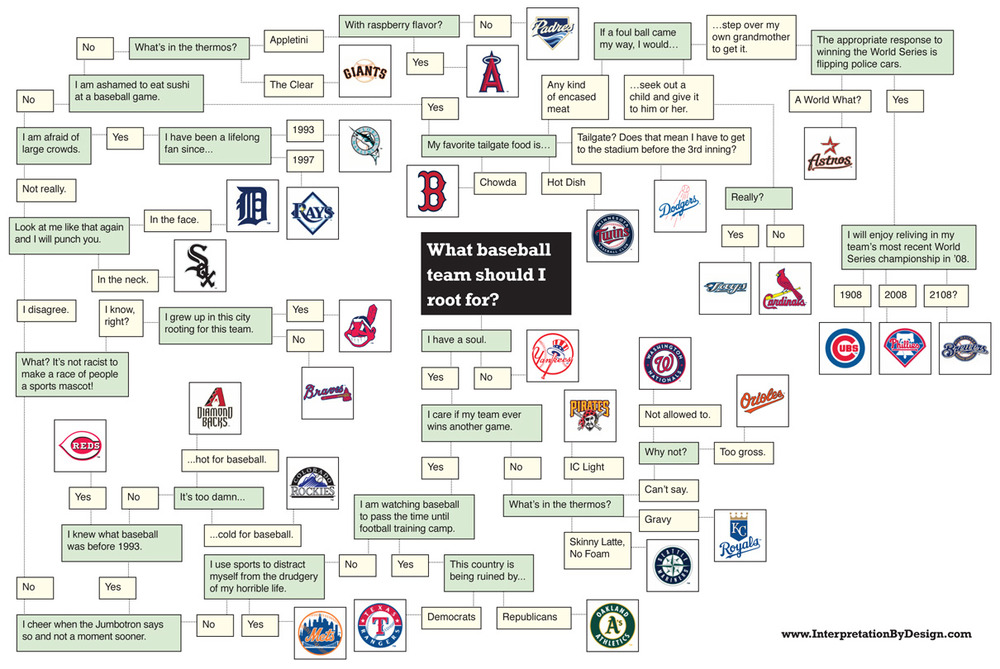
You’ve No Doubt Seen This: But just in case, the baseball fan flowchart is a funny image floating around the blogosphere and Twitterverse.

Remember When…Lance Johnson was a triples machine?  From 1991-1996, Johnson led the league in triples for five of six seasons and hit 12 in the off year (1995, when he had an absurd power surge with 10 HR after never topping 3 before).  I was upset when he left the AL before the 1996 season (10 team AL-Only league) because he had a career year including 50 stolen bases, 117 runs scored, .333 average and 69 RBIs, all career highs.  His nine homers were close to a career high.

It’s purely coincidental that the first two of these segments happen to be about Chicago White Sox, but “One Dog” was a key cog of my early fantasy teams (probably explains why I didn’t win any titles as a kid) and again because I watched a lot of WGN when the Tigers weren’t on, I was very familiar with Johnson and the Sox.

Despite playing three fewer seasons, Johnson has one more career triple than Kenny Lofton (117 to 116).  I found that pretty surprising, but Lofton only had two double-digit seasons in triples and they were 11 years apart (league-high 13 in ’95 and then 12 in ’06).  Of course Lofton has nearly twice as many stolen bases (622/327), nearly four times as many home runs (130/34) and had a significantly higher success rate on the base paths (80%/76%), though both were really good.

Knowledge Bomb: Here is an absurd statistic from Mike Axisa about Hall of Famer Greg Maddux.  Absurd might even be an understatement.  It’s just unfathomably great.  Are you ready for this?  You may have already seen it, but it resonates even on second and third viewing:


As Scott Van Pelt & Ryen Russillo say on their radio show, “let that soak in your mentals for a minute”.  That’s so amazing.  Only another 160 saw a 2-0 count.  Maddux was just not a fan of getting behind.  He only retired in 2008 so he is still a few years from getting on the Hall of Fame ballot and while it’s already a joke, the HoF voters would thoroughly embarrass themselves yet again if they made Maddux sit through another round of voting instead of putting him in on the first ballot.

Thursday: 02.3.2011

Three Questions – San Diego Padres

With the 2011 Starting Pitcher Guide set to come out in a few weeks, I have a jam packed volume covering all the ins and outs of starting pitching in the 2011 season for your viewing pleasure.  Of course that doesn’t do much to address the offensive side of things so I decided to start this “Three Questions” where I will cover some key offensive issues for each of the 30 teams.  There will be more content here dealing with offense, but this is the beginning.

What happens to this offense without Adrian Gonzalez?

Oh don’t worry, new first baseman Brad Hawpe will fill in so well that you will barely notice Gonzalez left.  A .298/.393/.511 line with 31 bombs and 101 RBIs shouldn’t be a problem for Hawpe.  OK that’s obviously an egregious lie that I don’t believe in the least.  Do you want to know how important Gonzalez was to an offense that still only finished 22nd with him?  Look at this:

Gonzalez led them in five key offensive categories and no one was really close.  Chase Headley was the 2nd-highest qualifying batting average at .264, Will Venable’s 13 home runs were 2nd to Gonzalez, Headley had a whopping 58 RBIs to finish 2nd on the team, Yorvit Torrealba was 50 points behind Gonzalez with a .343 OBP, but that came in just 325 at-bats.  The 2nd-highest qualifying on-base percentage was again Headley with a paltry .327 mark.  And in the most hotly contest of the five categories, Headley finished 14 hits behind Gonzalez with 161 on the season.

Counting stats for Padres hitters are likely to be even worse than they were last year cutting into the already stunted value of the group.  Headley managed those 58 RBIs despite hitting behind Gonzalez, who was getting on base 40% of the time for him.  The team added some pieces in addition Hawpe including a brand new double play duo with Orlando Hudson at second base and Jason Bartlett at shortstop as well as former super-prospect Cameron Maybin, but the loss of Gonzalez is still a major blow to an offense that was already pretty poor.

The power-sapping ways of PETCO park are nothing new and Padres hitters have long been evaluated with that impact built in, but without their superstar cog in the middle the entire group takes another hit to their value.  The chances of the six year streak of a non-Gonzalez entity topping 100 R or 100 RBI being broken seem slim.  The last two players to do it were in 2004 when Mark Loretta scored 108 runs and Phil Nevin drove in 105.

Following up a career year with one of his worst, what’s in store for Jason Bartlett in 2011?

The 2010 season was a rough one for Bartlett especially in light of his breakout 2009 in which he hit 14 home runs, drove in 66 runs, scored 90 runs, stolen 30 bases and hit .320, all career highs.  Lucky for him, he plays shortstop which is a barren wasteland after the top tier so he will have some value no matter what.  How much exactly is going to be tied to how many stolen bases he rack up.  He had a string of 23, 20 and 30 before last year’s 11, so the ability is there and San Diego was the 6th-runningest (so surprised that didn’t get a red squiggly line under it in Word) team last year with 124 stolen bases.

Additionally, he can offer some batting average value or at least not be a drag for a team.  Last year his .254 was a drag as regression bit back hard from 2009 and instead of falling back to career norms, he was actually a bit unlucky.  He is .281 hitter for his career and there is no reason to think he shouldn’t bounce back to that in 2011 and if luck breaks his way again, it wouldn’t be tough for him to top .300 again.  So as a late round speed/average shortstop, he has some value.  As I mentioned already, counting numbers will be tough to come by on this team.  Especially for Bartlett who isn’t particularly adept at getting on base.  Though he has a career .345 OBP, it is propped up by the standout 2009 and a .367 mark in 372 plate appearances back in 2006.

One last thing to consider with him is that he has only averaged 135 games played in the last four years with a high watermark of 140 and a low of 128.  That means you’re going to need a replacement for around 27 games, or 16% of the season.  Given the dearth of talent at shortstop, this can be a problematic proposition.  His backup is likely to be Kevin Frandsen or Everth Cabrera.  You could fill one of Bartlett’s strengths depending on who fills in, Frandsen for average and Cabrera for speed.  If you’re left hitting the wire, you may find that the remains are somehow even less appealing than Frandsen and Cabrera.

Is Cameron Maybin ready to pay dividends on his blue chip prospect status?

The problem is we might not even notice if he does improve because of his home ballpark.  He has certainly proven everything he can in the minor leagues so it is time for the three-time top 8 Baseball America prospect to start showing the talent at the big league level.  At 24 with just a season’s worth of big league plate appearances (610) under his belt, even a poor 2011 wouldn’t be enough to write him off completely but it would put closer to Brandon Wood territory.

The biggest issue right now is the striking out.  He has struck out in 31% of his major league at-bats despite the significant gains in K% in the minors.  After striking out in 32% of his AA at-bats in 2008, he cut down to 20% in his first run through AAA in 2009 followed by 19% in 130 AAA at-bats last year.  Any contact would be better than striking out for Maybin at this point.  At the very least, he could maybe use his excellent speed to turn some of his groundballs into base hits.

Better pitch recognition can increase his value another way as more walks would again allow him to add value by way of his speed.  As noted in the Bartlett section above, the Padres aren’t afraid to run, but it is hard to do much running with a .302 on-base percentage.

I don’t think Maybin will magically fix the strikeout and walk issues all at once in 2011, but I think we will see incremental gains in his first full season which should yield a 20+ stolen base season and low-teens power.  You can do much worse than that for a low dollar late outfield option in NL-Only leagues.  I don’t think he is quite a dollar days guy just yet, especially if your league has any guys who love grabbing the next big thing, but his price tag shouldn’t be pushing double digits.  As a single digit buy, I would highlight him as a quality end-game play perfect for rounding out a team.

Thursday: 01.27.2011

Three Questions – San Francisco Giants

With the 2011 Starting Pitcher Guide slated for next month, I have a jam packed volume covering all the ins and outs of starting pitching in the 2011 season for your viewing pleasure.  Of course that doesn’t do much to address the offensive side of things so I decided to start this “Three Questions” where I will cover some key offensive issues for each of the 30 teams.  There will be more content here dealing with offense, but this is the beginning.

I paid a lot for Pablo Sandoval last spring, WTF?

Yeah that was a tough one to swallow.  He certainly didn’t come close to expectations, but at the same time he wasn’t the season killer he is made out to be, either.  Season killers are multiple month injuries on April 12th.  You can overcome guys who underperform expectations, but still play 152 games.  Plus it isn’t like his season was a complete & utter disaster, he had streaks of excellence mixed in, namely his April and August where he posted 1.008 and .907 OPS marks, respectively.

In many leagues, Sandoval’s down season (.268/.323/.409 w/13 HRs) will actually create a buying opportunity as owners overreact to what essentially amounts to a sophomore slump at age 23.  Most guys aren’t even in the big leagues at 23 and Sandoval has 1400+ plate appearances under his belt.   We have seen the best of Sandoval and we have seen the worst of Sandoval and with his price being driven by the latter, now is the time to invest.  In the SiriusXM/FSTA Draft during their conference out in Las Vegas on Monday, he was taken in the 8th round (101st overall) of a 13-team mixed league.  Last year he was a 3rd-4th round pick.

Third base is still pretty thin so his value won’t completely plummet, but I would consider that 8th round value to be the high end of where he will go in drafts so you might be able to get him a few rounds later depending on your league.  Once you get past the top 10 of Evan Longoria, Ryan Zimmerman, David Wright, Alex Rodriguez, Adrian Beltre, Aramis Ramirez, Pedro Alvarez, Martin Prado, Michael Young and Casey McGehee then I think Sandoval is just as good of a pick as the other guy.

He won’t offer nearly as much power as Mark Reynolds, but his overall profile is much more stable.  He doesn’t carry the age/injury risk of Scott Rolen & Chipper Jones and factoring in reasonable improvement regression, he should be better than them even if they manage to stay healthy.  Bottom line is you should pay for a guy hitting .300 with 18 home runs and 75+ runs scored and driven in, but be willing to go the extra buck or two for the potential he has as a 24-year old still coming into his own.

Andres Torres was a prototypical fantasy All-Star last year, what about 2011?

At 33, we’re not dealing with a growth profile here.  Torres’s 570 plate appearances last year eclipsed his career total by 115 spread across parts of five seasons.  That said, he gave us a taste of 2010 in 170 plate appearances in 2009 when he had six home runs and six stolen bases along with eight(!) triples.  After an amazing July, he sputtered down the stretch no doubt suffering some fatigue from his first whole season.  For 2011, it is going to be all about cost.

I’m confident he can put together another solid power/speed season as a “glue guy” for any fantasy team, but is the price tag going to be that of a glue guy or second tier fantasy star?  Early returns are mixed.  His ADP (average draft position) at one popular mock draft sites is off the charts ridiculous.  He is checking in as the 35th outfielder off the board (116th overall) ahead of guys like Curtis Granderson, Adam Jones, Carlos Lee, Vernon Wells and Nick Markakis.  While I said I don’t doubt he can repeat 2010, drafting him ahead of those guys means he has to repeat for me to get proper returns on my investment.

In the industry draft I mentioned earlier, he went in the 20th round (250th overall) which actually hits the other end of the spectrum as a great value.  I doubt he will go that late in most drafts, but anything before 15th-16th round is really ramping up the risk on your end.  He is a great story who has overcome his ADHD to have success in the big leagues, but you still have to remember he is a 33-year old strikeout machine with solid speed in a lineup that is still only decent at best.

Look for a .260-76-12-55-22 line which has value, but let your team construction dictate if he is a fit or not.  If you have a lot of high risk/high reward youth on the team, then Torres is a great stabilizing vet who’s downside isn’t  going to kill you.  But if you have a veteran-laden team on offense, then bet on the upside of a Travis Snider or Logan Morrison before taking a low ceiling Torres.

Is there anyone off the radar who could make an impact for the reigning Champions?

Yes there is and it is someone who has already been covered in depth here, first baseman/left fielder Brandon Belt, who was my favorite player to watch that Arizona Fall League back in November.  As presently constructed, the Giants lineup is essentially Posey, Sandy and Six Old Dudes.  Now those old dudes came through huge last year, especially in the playoffs and helped bring home a title, but older players aren’t bastions of health.  Injuries create opportunities which is where someone who is just about ready for the big leagues, like Belt, comes into play.

The reason Belt now has left fielder attached to his defensive description is because first base, his normal position, is pretty well sealed up for the time being.  Aubrey Huff parlayed his excellent 2010 season into a deserved contract and though he is 34, he has averaged 152 games per season since his age 26 season.  In that time, he has played fewer than 150 just once.  That said, age is fickle.  But the real opportunity could come in left field where Pat Burrell was something of a savior for that lineup in 96 games last year but is neither young (34), agile (-39.7 career UZR) or super healthy of late (122 & 120 GP the last 2 years).

Belt was a breakout prospect last year crossing three levels before heading to Arizona where he continued to stay hot.  Only 13 of his 136 games came at AAA-Fresno so he will start the 2011 season down there to get some more seasoning so he isn’t someone who should be drafted as anything other than a minor leaguer right now, but don’t be surprised if he earns an early summer call-up to spark that offense.

Make no mistake that the Giants won the World Series because of their pitching and that remains their overwhelming strength for 2011.  The offense is far from perfect and the veterans will have to produce with Posey if the team expects to contend out west and if not, GM Brian Sabean will have to find guys who can with Belt being the best minor league option for the Giants.

Tuesday: 01.25.2011

Three Questions – Seattle Mariners

With the 2011 Starting Pitcher Guide slated for next month, I have a jam packed volume covering all the ins and outs of starting pitching in the 2011 season for your viewing pleasure.  Of course that doesn’t do much to address the offensive side of things so I decided to start this “Three Questions” where I will cover some key offensive issues for each of the 30 teams.  There will be more content here dealing with offense, but this is the beginning.

Will Justin Smoak start to look like the guy who was the centerpiece in a deal for an ace?

Smoak, a blue chip prospect coming up through the Rangers’ organization, drew rave reviews in three minor league seasons ranking 13th (2010) and 23rd (2009) on Baseball America’s Top 100 Prospect list the last two years.  He was being compared to former Ranger Mark Teixeira, likely due to the easy surface comparison of switch-handedness, a deft eye at the plate, first round draft status and first base positioning on the diamond.  It will be tough to find out how apt those comparisons were as Smoak is now a Seattle Mariner.

His career started off with a whimper in 275 plate appearances with the Rangers, but he still showed the ability to draw walks with a 105-point split between his batting average and on-base percentage, although both lagged with the latter topping out at .316.  His 8-home run total wasn’t horrible either.  Across a full season, that projects to the low-20 power Smoak was projected for in his young career.  Results on the whole were slightly better in Seattle (93 OPS+ v. 79 in Texas) though they came at the expense of his batting eye as the difference in average and OBP dwindled to 48 points.

As the centerpiece return for the M’s in the trade that sent Cliff Lee to the Texas Rangers the expectation for Smoak to hit Teixeira likely won’t go away, however the capacity to do so will be seriously diminished in his home park of Safeco Field.  According to StatCorner.com, Safeco Field has a park factor of 91 on home runs for left-handed batters and just 84 for righties.  For the uninitiated, anything below 100 favors pitchers.  So for 81 of his games, Smoak is going to be playing in an environment that eats away at his ability to do the thing fantasy owners need most out of a first base/corner infield option, hit for power.

Factor in the historically bad lineup which has no chance but to improve but will still struggle and you’ve got a player bringing very little to the table in terms of production.  If the low-20s was Smoak’s ceiling for the early part of his career in Texas, then 15-17 is the new ceiling playing in Seattle.  Combine that with below average runs scored and driven in totals and you have waiver wire fodder in most league formats.  He will get drafted because of his name and because of his hot September (.340/.421/.580, 3 HR, 9 RBI), both of which are factors that will price me out for sure.  I don’t need a hit before I pass this Smoak.

Where do I draft Ichiro now that he’s 37 & stuck in that lineup?

I am less concerned about the age than I am his awful supporting cast who last year cashed in Ichiro’s .359 on-base percentage for a whopping 74 runs.  SEVENTY-FOUR!!!  He hit .315 with 214 hits and scored 74 runs.  We have already seen within his early-to-mid 30s that Ichiro isn’t aging normally.  He continues to be an age-defying star and there is no reason to bet that he drops off the table suddenly in 2011.  As I have mentioned many times before, I would be careful subscribing to these trends, but he has an on-off trend with his batting average that is schedule for an on year.  His last four years in order have been .351, .310, .352 and .315 meaning if the trend held he would be in for another transcendent batting average year that can carry a fantasy team.

On-off trends are hardly the statistical work of Baseball Prospectus and company, but maybe he dedicates himself in a different way during the offseason of those “down” seasons to come back and have another huge year.  Flimsy at best, so don’t use it as the reason to draft him.  Draft him because he hits .300+ in a ton of at-bats with 35+ stolen bases.  Unfortunately he cannot be counted on for runs until further notice, but he is a stud in two categories.

In a recent “Experts” Draft held over at CBS, he went at the top of the 5th round.  I might be more prone to take him in the back of the 4th round when all of those picks were being wasted on starting pitchers, but it’s inconsequential to say he is late 4th instead of an early 5th round pick.  Anywhere in that pick 40-60 range suits me just fine.  The age is scary to many so you may even be able to hold off until the 6th round or get a few dollars shaved off of his auction price.  When you are dealing with superstar once-in-a-lifetime players, things like natural age progression and mistrusting the stats is how you get burned.  He is as solid as they get in this game on unpredictability.

Is there anyone besides Ichiro worth caring about in this lineup?

Yes, there is some hidden value.  Off the top, I would be willing to bet on a Chone Figgins rebound.  The price is likely to be ripe for a profit as his .259 average left a sour taste in the over-reactionary populace of fantasy baseball while you are smart enough to wade through the belly-aching and see a guy who still stole 42 bases and hit much better from June on (.280) after entering the month with a .211 average.

But for the purposes of this question, I would like to shift your attention to the former AL West foe who was brought to the Mariners to provide some punch to their lineup, Jack Cust.  You may recall about 500 or so words ago I lamented Safeco Field and what it does to a hitter’s power.  However the “hitter” in that example is a mere mortal when it comes to power hitting, he is no Jack Cust.  Cust’s power isn’t to be stifled by cavernous stadiums whether in the Bay Area or the great Northwest.

Cust popped a .501 slugging percentage in McAfee Coliseum, his former home in Oakland, which has a home run park factor just a point higher at 92 for lefties than his new home.  This means his power won’t be stifled, just as the power of the guy whose shoes he is filling, Russell Branyan, wasn’t during his two stints with Seattle.  Cust has a legitimate shot to replicate Branyan’s 31 home run season from 2009 and he certainly doesn’t cost what 31 home runs should (went 29th round in the aforementioned “Experts” League) so put a star next to him on your draft list.

Saturday: 01.22.2011

Three Questions – Texas Rangers

With the 2011 Starting Pitcher Guide slated for next month, I have a jam packed volume covering all the ins and outs of starting pitching in the 2011 season for your viewing pleasure.  Of course that doesn’t do much to address the offensive side of things so I decided to start this “Three Questions” where I will cover some key offensive issues for each of the 30 teams.  There will be more content here dealing with offense, but this is the beginning.

Michael Young. Go.

OK, that’s not really a question, but his offseason has been one of uncertainty with the signing of Adrian Beltre and Baseball-Reference.com referring to him as Mike Young for some reason, so what does 2011 have in store for him?  For fantasy purposes the movement on the diamond whether over to first base or off the field to designated hitter has no real impact on his fantasy value because he will still qualify at third base based on last year.  That is where his value is highest without question.  I can’t really see the position move impacting his offense too much, either, though sometimes guys just don’t respond well to DH’ing.

Young has been a legitimate fantasy asset now for eight straight seasons and even at 34 years old there is nothing in his profile to suggest that will change.  The batting average dipped below .300 for only the second time in the eight year stretch since 2003, but with his flyball rate climbing yearly since 2007, that is hardly shocking.  The tradeoff is the likelihood of his power staying in the upper teens, lower 20s area.  His team dependent numbers should remains strong as the lineup actually gets better than its 2010 iteration with addition of Beltre.  With third base still one of the thinner positions on the infield (shortstop is the thinnest), Young remains a quality asset whether at third or filling your corner infielder spot.

Can Mitch Moreland hold the first base spot all year or does Chris Davis take that job and run with it?

Moreland joined the Rangers late in July and enjoyed a solid 47-game stint, but the results aren’t indicative of what you should expect over a full season.  He showed uncharacteristic power (9 HR in 145 AB; 12 in 353 minor lg. AB) thanks to a 21.2% HR/FB which would be tough to sustain over an entire season and would certainly qualify as an upset if he did it.  With a 29 AB/HR rate in 1398 minor league at-bats, no one is betting he is going to sustain his 16 HR/AB over a full season in the majors.

Conversely, he showed a much better knack for getting base hits in the minors than he did in his short time at the big leagues.  A career .313 hitter in the minors, Moreland hit just .255 in his time with the Rangers.  In essence, I would bet on the two trends reversing where he a low double-digit home run total for the season would be paired with a .285+ batting average and above average plate discipline.

But will it be enough?  For your fantasy team, not in mixed leagues as he profiles as a slightly better Daric Barton.  For the Rangers, that is to be determined.  Davis is a prototypical AAAA guy who has mashed his way through the minor leagues on multiple occasions, but failed to carry it into the big leagues in his last two years after a strong rookie debut in 2008.  Of course despite being written off as a complete bust by most, he is still just 25 years old.  Plenty of guys don’t even start their major league career until age 25 and he already has 872 major plate appearances under his belt so it’s far from over for him.

On the whole, Davis has more upside than Moreland related specifically to his prodigious power so inking Moreland in at first base on your Texas Rangers lineup projection is dangerous.  A lot can change between now and Opening Day.  It is a situation to monitor closely throughout the spring, but in the end it is one to avoid in anything but the deepest leagues where I would be more willing to gamble on Davis with a late pick if he has a solid spring than invest in Moreland’s higher floor, but much lower ceiling.

Is this the year that Ian Kinsler finally puts it *all* together?

Kinsler, a fantasy favorite for a few years now, has a 30-30 season (2009), a 20-20 season (2007), a .319 season (2008), a .517 slugging season (2008), two 100 runs scored seasons and two All-Star appearances (2008, 2010) yet his career still feels like something of a disappointment when you realize it could be so much better.  In the 30-30 and 20-20 seasons, he hit .253 and .263 respectively.  In the All-Star seasons he only played 121 and 101 games.  In fact he’s only played more than 130 games once in his five year career.  He is either putting up an incredible minus one key factor and/or having injuries cut dream seasons short.

So is 2011 the season of 150 games, 100-30-90-30? … No, of course not.  Sorry, but there is just no way you can realistically project that at 29 he is all of a sudden going to make it through an entire season.  Health is a skill and it’s one he lacks.  That said, he is still generally putting up a season’s worth of numbers in the 100-odd games he does play so he is still worth drafting relatively given the risk, but I think it would be foolish to reach for him at a position that has a lot more depth than many seem to realize.

Maybe shortstop’s stink drifts over to second base or fantasy owners just associate middle infield positions with scarcity, but second base has plenty of viable option.  Those automatically ahead of Kinsler for include Robinson Cano, Chase Utley, Dustin Pedroia, Dan Uggla and Brandon Phillips.  After that group, Kinsler’s power-speed combo is just too rich to pass up for guys like Rickie Weeks and Martin Prado, who are very good, but just don’t offer Kinsler’s robust fantasy excellence.  Plus you can always dream that everything goes his (and your) way and he finally plays a full set of games.  Just don’t bet on it.

Friday: 01.21.2011

Three Questions – Oakland A’s

With the 2011 Starting Pitcher Guide slated for next month, I have a jam packed volume covering all the ins and outs of starting pitching in the 2011 season for your viewing pleasure.  Of course that doesn’t do much to address the offensive side of things so I decided to start this “Three Questions” where I will cover some key offensive issues for each of the 30 teams.  There will be more content here dealing with offense, but this is the beginning.

How will the playing time be split between the 947 outfielders on the roster?

After their offseason acquisitions, the Oakland A’s have the following outfielders on the roster: Chris Carter, Coco Crisp, David DeJesus, Conor Jackson, Hideki Matsui, Ryan Sweeney, Michael Taylor and Josh Willingham.  With Jack Cust no longer on the team, you pretty much pencil Matsui into the DH spot for most of the season.  That leaves seven players for three spots.  So the ideal setup would be DeJesus in left, Crisp in center and Willingham in right.

Ideal is the operative word here because though the A’s would love to get 150 apiece games out of that trio, they are far from the modicum of health.  DeJesus played just 91 games last year and has only once topped 144 in his career (157 in ’07).  Crisp has never reached the 150-game plateau.  In the past three seasons he has played 118, 49 and 75 games, so he is far from a sure thing.  Add in that he is now on the wrong side of 30 years old (31), too.  Like Crisp, Willingham has never reached the 150-game plateau, either.  He has only topped 500 at-bats twice in his career and they were in his first two full seasons as a major leaguer (2006 & 2007).  In the subsequent three years, he has 351, 427 and 370 at-bats.

So like I said, in a dream world the A’s would give the bulk of time to those three players but history says that you really shouldn’t bet on that with any level of certainty.  Since he can play all three positions, Sweeney is natural fit for the fourth outfielder as he can be plugged in for any of the three starters.  Jackson primarily plays left, but could play right in a pinch.  He can also play first base so he could end up rotating around the diamond to get his playing time.

Carter and Taylor might both start the season in AAA.  The former can’t really play anywhere so he projects as the backup DH right now while the former is on the cusp of being a busted prospect.  He was rated 29th by Baseball America before the 2010 season and went out and laid an egg with a .740 OPS and just six home runs after seasons of 19 and 20 and OPS marks of .968 and .944 in 2008 and 2009.  He can play all three outfield spots so he can back anyone up or take over a starting job if he establishes himself at the plate in AAA.

The A’s have great depth in the outfield which suits them quite well, but does little inspire fantasy owners.  All of their outfielders are likely to be discounted both because of health concerns and the lack of clarity around playing time so if one or more of them manages to play a full season, they will be very profitable for their team.  I would pick one you think is most worth gambling on, but avoid rostering multiple A’s outfielders.  Ranking them, I’d go: Crisp, Matsui, Willingham, DeJesus, Sweeney, Jackson, Carter and Taylor.

What’s up with Kurt Suzuki?

That is kind of a vague question, but looking at his 2010 season against 2009 season shows significant decline in total player value, but more so to the A’s than to fantasy owners.  His runs and RBIs sunk, but a lot of that is tied to the 75 fewer at-bats as opposed to a production drop.  His power output was essentially the same as he hit two fewer home runs in the 75 fewer ABs.  The big drop came in 32-point batting average decline which shades his season as much worse than it actually was, again from a fantasy aspect specifically.

Calling it a 32-point drop sounds a lot worse than calling it what it really is, a 3.2% dip over the course of 131 games.  Playing 131 games is essentially 21 weeks of a 26 week season and in that span the difference between a .274 batting average and a .242 batting average is 16 hits, or less than one a week.  When you think about it like that, he needed less than one extra bloop a week to fall in and all the talk about “what was wrong with Suzuki?” would be non-existent.

This is why I don’t flip out over batting average fluctuations from one year to the next within a certain range.  Some raise an eyebrow and there is something within their skills that points to a long-term problem, but mostly it’s statistical noise.  For Suzuki, he suffered a very weird anomaly where he had a 20% infield flyball rate, more than double his previous career high.  It contributed to an ugly .245 BABIP which obviously held his batting average down.

Use Suzuki’s 2009 as a baseline projection for his 2011 season and draft accordingly.  Catcher is deeper than usual thanks to the recent influx of young talent (namely Carlos Santana and Buster Posey) and Suzuki projects as a borderline top 10 candidate at the position.

Does Daric Barton have any value in standard 5×5 leagues?

In a word?  No.  Because standard leagues don’t use on-base percentage which eliminates his most value asset: the ability to draw walks (AL high 110 last year).  And that leaves you with a first baseman or corner infielder hitting a blasé .265-.275, barely scraping double digit power with fewer than 60 RBIs (due at least in some part to his team setting) and not turning his high on-base percentage into a high number of runs scored (again, due at least in part to his team setting).  That’s trash.

There were 15 first basemen that hit 20+ home runs, which is double Barton’s output and there were 27 in all who hit more than his pitiful 10 home runs.  There were 22 first basemen with more RBIs than his 57 including Kevin Youkilis who topped him by five in nearly 200 fewer at-bats.  Slotting him at corner only makes things look worse as there were another 11 third basemen with 20+ home runs, 21 topping 10 as well as 19 guys who topped his RBI output.

Unless you play in a specialty league that counts walks and/or on-base percentage, Barton is waiver wire fodder until further notice.  And I’m only leaving the door open slightly because he is 25 years old and it wouldn’t be out of the realm of possibilities for him to develop some power and for the Oakland lineup to stay healthy and generate plenty of run scoring and driving in opportunities, but the opening is very minimal and I certainly wouldn’t advise you to bet on it.

Thursday: 01.20.2011

Three Questions – Los Angeles Angels

With the 2011 Starting Pitcher Guide slated for next month, I have a jam packed volume covering all the ins and outs of starting pitching in the 2011 season for your viewing pleasure.  Of course that doesn’t do much to address the offensive side of things so I decided to start this “Three Questions” where I will cover some key offensive issues for each of the 30 teams.  There will be more content here dealing with offense, but this is the beginning.

Will Howie Kendrick finally be the batting title contender he was thought to be as a prospect?

If there was one thing Kendrick could do in the minor leagues, it was get base hits.  He hit .363 or better in four minor league seasons from 2003-2006 leading many to believe he would be a perennial batting title contender once he hit the major leagues.  It hasn’t quote turned out that way in his first five seasons as a big leaguer.

First off, last year was the first in which he topped 105 games played, but it was also the first one he hit below .285 (.279 in 616 at-bats).  Then there is the fact that his batting average dropped year since a 2nd-season peak of .322 back in 2007.  From there he hit .301 then .291 and then last year’s .279.  So is a .350+ batting average in store for Kendrick?

No, probably not.  Coinciding with his batting average decline is a BABIP decline (not surprisingly), but while pitchers generally tend to cluster around .300 for BABIP, a hitter sets his own over time.  Kendrick’s is declining rapidly (.313 last year, career high of .381 in 2007) as both his groundball and line drive rates erode while his flyball rate ticks up in the last three years.

The case for him (however thin) would be that he is just entering his prime and despite having logged five years of major league time, it’s really just parts of four seasons and one full one.  He has shown the mix of skills needed for a batting title worthy average (high contact rate, high BABIP, significantly more groundballs & line drives than flyballs and decent speed needed to beat out a handful of hits over the course of the season) and 2011 could be the year that all of those skills combine for the breakout we have been waiting on for a while.

I am fine endorsing Kendrick as an asset to buy, just make sure your expectations are in the right of frame of mind.  You can dream of the scenario where he has the unexpected breakthrough season, but don’t pay for more than a double-double (10+ HR/SB) with a batting average floor that won’t ever hurt and a ceiling for much more.

What does Kendry Morales’ late-May broken leg do to his 2011 value?

In a word?  Nothing.  Not for me at least.  He will be nearly nine months removed from perhaps the most embarrassing walkoff grand slam celebration ever when Spring Training fires up next month and all reports indicate he will be 100% ready to go.  As such it is reasonable to expect that he will start 2011 where his breakout 2009 season and excellent start to the 2010 season left off: mashing.  In the 203 games spanning that time, he had a .302/.353/.548 triple slash with 45 home runs, 147 RBIs and 115 runs scored.

Even with the incredible depth at first base, I have Morales just making the cut of the top 10: Albert Pujols, Miguel Cabrera, Joey Votto, Mark Teixeira, Kevin Youkilis, Adrian Gonzalez, Prince Fielder, Adam Dunn, Ryan Howard and Morales.  Though if we knew Justin Morneau was going to be 100% and ready to go by Opening Day, he would crack that list and push Morales just outside.  Look for Morales to settle into a cozy .290-80-30-100 prime for the next few years.

Is Brandon Wood… nevermind, who cares?  What does a full season of Peter Bourjos look like?

Bourjos is a bright 24-year old prospect for the Angels who few had penciled into the 2011 lineup when the offseason began back in November.  The Angels were heavy favorites in the Carl Crawford Sweepstakes which would have left them with a Crawford-Torii HunterBobby Abreu outfield.  Abreu would take some days off at DH sliding Hunter to right and getting Bourjos some burn, so it’s not like he was expected to head back to AAA-Salt Lake, but after the spectacular failure that was their offseason, the Angels will now look to him for 500+ at-bats in centerfield.

Known primarily for his blazing speed (and exemplary defense), Bourjos will have fantasy value even if he isn’t ripping the cover off of the ball.  Obviously he will have to hit enough to merit everyday at-bats, and extrapolating a 51-game sample is dangerous so you can’t just look at Bourjos’ six home runs and 10 stolen bases and expect 17/27 over 500 ABs.  However, his minor league record suggests he can be a .270 hitter with 10-12 home runs and 30+ stolen bases.  His .204 batting average from last season was driven mostly by a .228 BABIP so the bulk of the 66-point increase I am projecting is tied to regression improvement of his abnormal BABIP.