Archive for ‘Fantasy Baseball’

Tuesday: 01.20.2009

Top 24 First Basemen: 12-1

Here is the completion of my top 24 first basemen for 2009.

Part 1

12. Carlos Pena, 31, Tampa Bay Rays – There was a group of people that believed Pena would be a flop after his huge 2007 season. After his first half, they were looking spot on, but he became a catalyst for the Rays’ second half run en route to a 20 home run performance. Pena is your regular WYSIWYG kind of guy and you can just about bet on .250/30/100 for the foreseeable future. OBP leaguers give Pena a boost with his stellar walk rate increasing his value markedly. Pena is the kind of guy that is skipped over round after round because there isn’t much perceived upside with him, but 2007 proved that he can get on a roll and have a top tier season.

11. Derrek Lee, 33, Chicago Cubs – EVERY capsule about Lee this season immediately references 2005 and I’m afraid I can’t break the trend. That season is now clearly an outlier that will never be reached again. He might still have another 30-home run outburst in his bat, but realistically he’s a mid-20s home run hitter with big average and big runs & RBIs totals. He used to be a perennial double-digit basestealer, but his past two full seasons have yielded just six and eight, respectively. Still, you like the added steals from an unexpected source. Lee’s name usually combines with memories of 2005 to take him off the board well before he should so make sure you avoid that pitfall and don’t pass up better production with lesser names.

10. Joey Votto, 25, Cincinnati Reds – He had a Derrek Lee-lite season last year with depressed totals in runs scored & driven in thanks to his spot in the lineup and a lesser lineup than Lee’s Cubs. He actually bounced all around the lineup, but the 7-hole was his home most often. He will assuredly move up this season which will allow him to be the full version of Lee, but likely cheaper since he isn’t as well known… yet. What makes him better than Lee is that he is on the upswing while Lee has plateaued. With a great home stadium, he should still manage the mid-20s power despite such a high groundball rate (44%). The upside is a .300-90-30-100-10 season so don’t be afraid to go the extra dollar to get him.

9. Adrian Gonzalez, 27, San Diego Padres – Can you imagine if he was still in Texas? Instead he’s stuck in the anti-Coors which severely caps his ceiling. After hitting 21 home runs through June, he managed just 10 across July and August as the Padres played 32 of their 55 games at home. That said he is still a bankable 30-100 hitter with a nice batting average. He has dropped yearly against lefties which keeps him from a perennial .300, but his .280 is still quite useful. It appears as though the fences will be moved in at Petco which can only help Gonzalez in his quest to tame the stadium, but pay for 30-100 and if you get the 2008 bonus again, enjoy it.

8. Kevin Youkilis, 30, Boston Red Sox – Here is why I don’t think the 13 home run increase from Youk was a fluke: his walk rate fell by 3% and I believe a lot of that was him going for solid pitches that he ended up being able to do a lot with earlier in the count. Known as the Greek God of Walks, I think in past seasons he was waiting for the perfect pitch or just taking a walk. To wit, he had 15 home runs after a 1-0 count against just seven in 2007. I feel like another 25+ home run season rests on Youk’s shoulders as he decides whether or not he wants to take that approach again this season. As part of that lineup, his counting stats will be excellent as well. He’s one to chase.

7. Justin Morneau, 28, Minnesota Twins – The home runs per flyball rate dropped well off of his career norms so it cut into the home run totals, but the 97 runs, 129 RBIs and .300 batting average helped alleviate the sting. This is a guy that is getting better and becoming an elite producer at first base as seemingly no one notices. With three straight seasons of 590+ at-bats owners can have confidence that he will always be out there for them. With a correction in the hr/f rate, he could repeat the 2008 season with six or seven extra home runs.

6. Prince Fielder, 25, Milwaukee Brewers – The 50 home runs from 2007 was supported by an unsustainable hr/f rate (24%). The 46% clip at which he hit flyballs was unprecedented before and unmatched after which also aided the drop in home run output. Even still, Fielder is a legitimate power source nearly guaranteed for a mid-30s home run output with a real shot in any given year to get back to 50. To have full seasons of 28, 50 and 34 home runs entering your age 25 season is truly remarkable. It is not unrealistic to imagine sustainable growth, but set your expectations for 35-110 to prevent yourself from overpaying.

5. Lance Berkman, 33, Houston Astros – Don’t bring up Berkman’s name around head-to-head fantasy players. He had a disgusting .365-72-22-68-12 first half of the season followed by a dismal .252-45-7-38-6 second half. That enormous drop-off prevented Berkman from reversing a declining home run trend that started back in 2006. Don’t buy the 2008 speed for 2009, but this is still an excellent skillset capable of .300-30-100. He will offer 6-8 stolen bases and should score at least 100 runs with Carlos Lee and Hunter Pence behind him. The second half might have left a sour enough taste in your league to depress Berkman’s value relative to other studs, bid accordingly if you’re in such a league.

4. Mark Teixeira, 29, New York Yankees – He has plateaued at 30-100 since the monster 43-home run season back in 2005, but combined with a reliable .300 average and a ton runs makes him an elite commodity. Heading to New York should bode well for both the runs scored and runs driven in totals, while the new Yankee Stadium remains an unknown in terms of its affect on home runs. His new residence is likely to drive the price up, but don’t get caught up in the hysteria and treat like anything but the 4th-best first baseman in the league. It doesn’t get much more reliable than Teixeira so there is nothing wrong with making a part of your team’s foundation.

3. Ryan Howard, 29, Philadelphia Phillies – Howard is as elite as it gets when it comes to power production. The batting average has left something to be desired since the MVP campaign, but when you are getting those home run and RBI totals, it is hard to complain. A sharp drop in walk rate didn’t help much when he was in prolonged slumps, but that should return in 2009. He is quite streaky so H2H-leaguers beware when bidding. The fact of the matter is he has 58, 47 and 48 home runs in his past three seasons with a ton of RBIs and about 100 runs scored per as well. All of that without being a complete liability in batting average helps make Howard one of the best of the game.

2. Miguel Cabrera, 26, Detroit Tigers – If I put Cabrera ahead of Albert Pujols, it would look like little more than homersim, so I avoided the temptation. Well that and I’m not entirely sold that he belongs there so I wasn’t going to do it just for the sake of doing it. He absolutely dominated the league in the second half of 2008 and it clear that he is fully acclimated to the American League now. What is the ceiling for this guy? He has increased his home run and RBI totals yearly since 2006 and he could be headed for another jump after last year’s 37/127 effort. Make no mistake; he is a late first round talent for 2009.

1. Albert Pujols, 29, St. Louis Cardinals – Who can you say about Pujols that hasn’t been said? He is just so amazing year after year. He hasn’t put up especially gaudy home run and RBI titles the past two seasons, but the insane batting average he posts yearly separates him from the pack. He hasn’t hit below .330 since 2002 including last year’s .357. I love Hanley Ramirez as much as anyone else, but I have no qualms with making Pujols the #1 overall pick in a scratch draft. It is frightening to think that he could actually improve on last year and get back to 2006 levels. Letting him go any deeper than fourth overall is a crime and at fourth, that owner is getting a steal.

al-1b
top-24-1b nl-1b

Monday: 01.19.2009

Top 24 First Basemen: 24-13

There is a very simple directive for a first baseman in fantasy baseball: hit home runs. If you’re not drawing significant power from this position, you’re doing your team a disservice in home runs and runs batted in. There are exceptions, of course, such as pairing a power third baseman with a loaded outfield leaving you with Casey Kotchman or Lyle Overbay. But with so much bankable power at first base, it is wiser to establish your power foundation here. Below is the first of my top 24s around the infield. Everyone does top 10s or 25s or 50s (or even 100s), so I went with 24 because it’s different… and my favorite number. Let’s count ‘em down:

24. Billy Butler, 23, Kansas City Royals – Butler labored through an up-and-down season including a trip back to AAA, which is probably where he should’ve spent the bulk of the 2008 but the Royals were enticed by his .794 OPS in 329 at-bats in 2007 plus they weren’t going anywhere so I don’t blame them for giving him a legitimate opportunity. I still think he’s at least a year away from being the guy fantasy baseballers want him to be and at 23 that is expected. Every league has at least one guy who loves young potential, so Butler will be snapped up before 23 other first basemen go, but the .300-30-100 line isn’t coming just yet. Tremendous choice in keeper leagues, but a middling line for 1B in 2009.

23. Mike Jacobs, 28, Kansas City Royals – Another reason that Butler isn’t a great pick for 2009 is Jacobs. We all knew he had 30-homer pop in his bat, it was a merely a case of when it’d all come together for him. The oddity in his numbers was that he went from .290 against lefties in 2007 to just .218 last which held his batting average down. He has the ability to be batting average-neutral instead of dead weight, but even if he fails to bring it back into the .260s he is still a great source of cheap power. The park move moot as both Dolphins and Kauffman Stadiums depress home runs. If not for the declining OBP since 2006 and move to a weaker lineup, I’d have a brighter outlook for Jacobs. Pay for another 30-home run season, but temper expectations beyond that category.

22. James Loney, 24, Los Angeles Dodgers – A magical September in 2007 has clouded the judgment of Loney. His nine home runs that month were two short of best total in any minor league season (11 over 504 at-bats in 2005). He is not a power hitter and while he may develop some, it would likely be two or three years down the road as that is a skill of aged. He is a .300ish hitter capable of driving in and scoring a decent amount of runs. And based on last season and his minor league track record, he is also good for a handful of stolen bases, though he is not terribly proficient at it (58% minors, 62% majors) so manager Joe Torre may stop sending him. If someone in your league wants to pay him as a 25 (or even 20) home run hitter, then let ‘em because they are likely to be dissatisfied with the results.

21. Conor Jackson, 27, Arizona Diamondbacks – Meet James Loney v1.0. Well that’s not entirely true as Jackson is significantly more patient at the plate than Loney, but in terms of the power production they are often lumped together and with good reason. Jackson made my outfielder list (#36) and I commented there that I’d much rather place him in the outfield because he has yet to top 15 home runs. In fact, he shaved three HRs off of that 2007 total despite 125 more at-bats. I don’t know where the speed (10 SB) came from or if it’s here to stay, but that would certainly add to his value. With his ability to control the zone and do what he wants at the plate, I feel he could hit 20 home runs at the expense of his batting average, but without knowing whether he plans to do such a thing (he never responds to my texts!) I’m buying a .290-80-15-80-3 line here.

20. Jason Giambi, 38, Oakland A’s – Health is your only concern here in terms of betting on another 30-home run season. I am not even concerned that the move back to McAfee Coliseum will eat up a significant portion of his power. Giambi is as legit as they get when it comes to power hitters and the reliability of that power makes the batting average easier to swallow. With Jack Cust & Matt Holliday joining Giambi, the middle of that A’s lineup is pretty formidable. For OBP leaguers, bump Giambi up quite a bit as last year’s .373 was his lowest full season output since 1998.

19. Ryan Garko, 28, Cleveland Indians – He seemingly belongs in the Jackson-Loney zone, but I’m projecting a power boost back up over 20 and nearing 25 in 2009. Garko has seven home runs and 45 RBIs both before and after the break, but the latter came in 87 fewer at-bats and with a .319 average (again a .241 before). He has shown 20-HR power before and a correction in hr/f % will take him there again. He is capable of a .280-25-90 season, especially in that lineup. Talks of trying him in the outfield only improve his value since he will lose fewer at-bats as the Indians try to fit him, Victor Martinez and Kelly Shoppach into the lineup together.

18. Jorge Cantu, 27, Florida Marlins – Welcome back, Jorge! There are a couple reasons why he shouldn’t fade as he did after 2005’s breakout: doubled his walk rate from awful 3% to a usable 6% and the power was supported by a boost in flyballs. His at-bats shouldn’t be affected by the arrival of Gaby Sanchez as Cantu can play either corner and Sanchez is expected to battle Dallas McPherson for a starting spot. Surprisingly only 27, Cantu might actually improve as he enters his prime, however I’d be most comfortable paying something along the lines of 85-25-85-3.

17. Adam LaRoche, 29, Pittsburgh Pirates – LaRoche is absolutely unnerving to own in head-to-head leagues, but he’s the classic set it & forget it type for roto league players. Looking back, it seems 2006 saw luck on his side and resulted in a 32 home run season as opposed to signaling his arrival as a perennial 30-HR guy. The 25-85 he delivered last year is what you should expect from LaRoche. If you get him on draft and he sputters out of the gate in April and May, be ready to pounce as he will inevitably heat up. He was part of my 2nd-halfers list last year and gave owners 14 home runs and .975 OPS after the break.

16. Paul Konerko, 33, Chicago White Sox – Looking for a good value in 2009? Here it is. Konerko bounced back from an awful first half, but his final line is still unappealing and he could be mistaken as someone who is finished. That creates a buying opportunity. He still plays in a very power-friendly park and he slugged 14 home runs in 210 second half at-bats to offset a rough first half of eight in 228 AB. It is not entirely unrealistic to believe that Konerko could put up a .280+ batting average with 30 home runs and 95+ RBIs. A bounce-back season is on the horizon for a now healthy Konerko.

15. Carlos Delgado, 36, New York Mets – It will be interesting to see how Delgado is treated in fantasyland this season. Will he be remembered for a second half surge that is deemed unrepeatable or will owners see his final numbers, realize they are legit and bid him up? The latter should happen. A composite view shows that 2007 is the clear aberration and last year was nothing new in terms of skills, merely a slow start. Relying on a 36-year old can be frightening, but take comfort in the fact that Delgado has a string of four straight 500+ at-bat seasons and 11 of the last 12. He is also just 31 home runs short of 500 for his career, which could provide motivation for another solid year. Bid confidently.

14. Chris Davis, 23, Texas Rangers – When you hit 17 home runs in 80 games, it gets some attention. He hit 23 other home runs in 77 minor league games. That raw power of Davis is being coveted by many fantasy baseballers this season especially with a full season at his disposal and the potential of 81 games at the Ballpark in Arlington. With Michael Young moving to third base, Davis should be locked in at first for the bulk of the season. The Texas lineup should remain rather formidable giving Davis a great chance at 100+ RBIs with his 30+ home run capability. He didn’t quite set the league on fire like Ryan Braun, but his power is as legit and should be pursued aggressively.

13. Aubrey Huff, 32, Baltimore Orioles – He might not have another 32 home run season, but his return to prominence should not be ignored. His skills have been steady for a long time now, though an increase in flyballs likely made the big HR number possible. Still, a 25/100 season from Huff won’t cost that much and carries the potential for more. Huff’s dual eligibility at first and third only makes him a more attractive option. There seems to be a perception that Huff is older than his 32 years and if that prevails in your league, he could be discounted further; take advantage.

I was going to put all 24 up this morning, but I went to the late showing of the movie The Wrestler last night. It has been highly acclaimed and with good reason. It was a very good movie, but by the time I got home at 1:30, I was too tired to finish the last seven. I’ll complete the list tonight after work.

Thursday: 01.15.2009

Mock Draft Update: 20-Team 5×5 Mixed League

Every year at Rotojunkie.com there is a series of mock drafts of varying formats. The one that usually kicks off the bonanza is a 20-team mixer using the standard 5×5 categories. We draft a standard 23-man roster with five reserves with a firm rule that you have to complete the starting roster before getting into reserves. A 15-game qualifier is used for position eligibility. As the draft plays out over the next few weeks, I’ll be posting updates on the draft, specifically my picks and reasoning behind the selections made.

First Round – The Foundation
I pulled the 13th pick overall which didn’t affect me one way or another in terms of being happy. I had the 12th pick last year, so while it might’ve been cool to see how I do from another area of the draft, I’m fine with this spot. It started off as most mocks have so far this season with very little surprise in the picks leading up to mine. Mark Teixeira at 8th isn’t where I’d have gone, but as a huge Big Tex fan, I can’t dog the pick. After my primary target for this spot, Ryan Braun, went 10th, I began to worry that 11 or 12 would take the other guy I really wanted here. Thankfully they both passed on Ian Kinsler and I made the star second baseman my first pick. I still might’ve made him the first 2B taken even if Chase Utley was guaranteed to play Opening Day because I shudder to think what Kinsler can do in a full season. I’m an avid fan of the ultra power-speed combos like Kinsler, throw in the fact that he’s an infielder and I’m ecstatic to land him. Last year was his first 500 at-bat season, but it was barely above so the fragility is of some concern. With a full season, he has .290-120-25-100-25 potential in him.

Second Round – The Budding Star
Since I didn’t get Braun with my 1st pick, I was determined to go with an outfielder in the second round because I wasn’t going to get left without an elite one. Enter Matt Kemp. Another power-speed combo poised for another monster fantasy year. His .290 batting average was propped up by destroying lefties to the tune of .369. There may be a drop in average based on that huge performance vs. lefties, but for his career, he has hit .354 against southpaws in 316 at-bats. With 463 drafts being counted, Kemp’s average draft position is 42nd overall at MockDraftCentral.com making my picking him at 28th look like a reach. My next pick is 53rd so I know he’s not making it back to me. Heck, he probably gets snatched by the guy that eventually took Nate McLouth two picks after I grabbed Kemp. If you want a guy in a 20-team league, you have to go get him even if you feel it might be a round early. I stayed true to myself considering I rated Kemp the 8th best outfielder in my Top 100 list and he was the 10th OF off the board.

Third Round – The Risk
Generally, you don’t want your third round pick coming off of a season with 143 at-bats. There aren’t any good reasons for that kind of at-bat total. Nevertheless, I dove head first into a rebound season by Rafael Furcal in 2009. Even if the bad back prevents a mid-teens HR output, I’m still happy with 35 steals and a .300 average at short. However, that’s near the “worst case scenario” end of the spectrum. If he gives me something circa 2005-06, which is what I’m obviously expecting by making him a third rounder, then I have three $27-30 players to start off my squad.

Fourth Round – The Risk, Part 2
For someone who claims to be a very risk averse fantasy baseballer, I don’t think it’s a great idea to have two risks in the first four picks… but hear me out. I took Victor Martinez with the 68th pick in the draft. The 2008 season was a clearly a throwaway bust on all fronts for Martinez, but I don’t think it’s the beginning of the end for him by any stretch. I expect a return to his usual .300-20-100 line we had grown accustomed to see from him. That alone doesn’t make him a fourth round pick, the bonus is obviously that it comes from a catcher. We already know how sparse it is at catcher in regular 12-teamers that require you to roster two, so how bad do you think it gets when 20 teams are taking two?! It was either go for Martinez now or wait it out and end up with Mike Redmond & Nick Hundley. It’s bad enough when the second catcher is a dead spot you simply hope doesn’t hurt too much, but having TWO holes in your lineup just won’t work. With an ADP of 80, MockDraftCentral says I took Martinez 12 spots too soon. Well there were 12 more picks just before the 4th round finished so he most definitely wasn’t getting back to me in the 5th round.

Five Round – The Breakout
I struggled with this pick. I have a plan I’m trying to adhere to for this league and third base was next on the docket. I stuck to that course of action, but I had a tough time deciding who would man the hot corner for my team. I went with Alex Gordon after much debate involving he, Adrian Beltre and Ryan Zimmerman. Zimmerman had the highest ADP (97) by a landslide, but I chose the higher ceiling. Gordon showed markedly improved plate patience last year and his distribution of balls in play shifted to more flyballs and line drives, which is always a plus for power. Though he fell flat on his face after shouldering a lofty expectation load, Gordon took steps forward in his sophomore season. I would be thrilled with 25 HR and 10 SB here, but he has the ability for even more if he takes some big steps forward in year three.

1. I.Kinsler, 2B
2. M.Kemp, OF
3. R.Furcal, SS
4. V.Martinez, C
5. A.Gordon, 3B

So that’s where we are right now. You can follow our progress in real-time here:

Our Draft

Mock Draft Central’s ADP Report (member’s get list of 483)

Tuesday: 01.13.2009

The Outfielder Triple Comparison

Last Wednesday, I compared my outfielder rankings with the recently released Sporting News Fantasy Baseball ’09 magazine. I didn’t compare to show one was markedly better than the other or anything like that, I just love comparing things-especially fantasy baseball rankings. I take pride in my rankings because I put a lot of time and effort into them as I’m sure industry standard magazines like SN do, too. Thus, when I see another ranking list of the same set of players, I’m always intrigued because I like to see what aligned closely and where the huge differences were on both ends of the spectrum. As I mentioned yesterday, my friend and colleague Jason Collette and his crew released their magazine through fanball.com & ownersedge.com (For those interested, it’s been rumored to be at Borders more often than Barnes & Noble… this was true in several areas across the country).

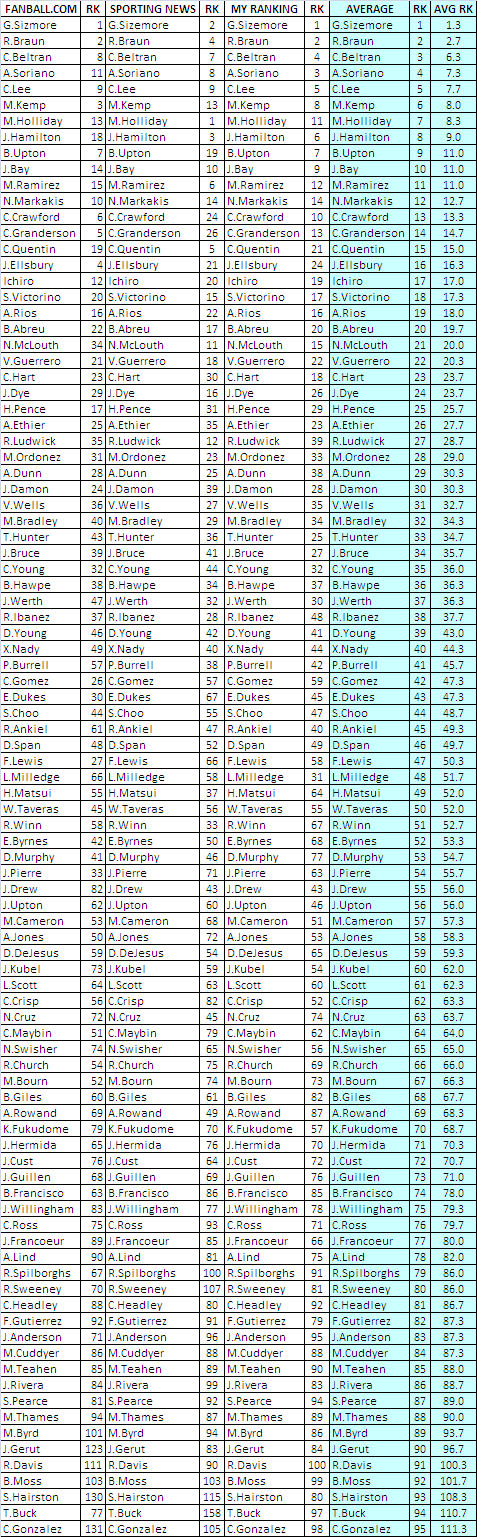
Now I have a third set of rankings to add to the mix and get an even better feel for how the outfielders are being viewed for 2009. I’ll cover the fanball list the same way I did the Sporting News whereby first I’ll look at the big differences between my list and theirs followed by the composite list in alphabetical order. Then, as an extra special treat, I’ll put up a triple comparison with an average ranking for 95 of the outfielders from my original list.

Outfielders I Love…

Here are the guys I rated much higher than the fanball crew. The cutoff was a double-digit difference between the lists:

fb-comp11

The Sporting News and I didn’t top 30 on any difference whereas I have five such differences with fanball. What does it mean? Nothing in particular. Three of the major differences in ranking came on Scott Hairston, Jody Gerut and Carlos Gonzalez, but I rated them in the latter part of my list of 100 and they rated them in the latter part of their list of 160. That doesn’t change the fact that I like them better, but the mixed league values from 80 to 160 were $0 for fanball so they find that back half rather interchangeable to some degree.

Our differences for J.D. Drew and Lastings Milledge are more significant as far as I’m concerned. I rated both in the top half while fanball had them firmly in the bottom half of their top 100. The near-guarantee that Drew will miss time due to injury has soiled his value and the fanball crew clearly doesn’t want anyone getting burned again so they slotted him behind the likes of Travis Buck, Nate Schierholtz and Steven Pearce among others. I’d be willing to admit that I was a bit generous, but his skillset is so plentiful that I couldn’t crush him despite his injury woes. I could see bumping him down a little bit in the update, but even 122 games of Drew (his average over the past five seasons) is better than the unknowns above, especially with his upside if he can make it into 140+ games.

The Milledge difference seems to be a stark difference of opinion. My love for Milledge in 2009 could start reaching Jason Collette-Nelson Cruz levels by the spring. Meanwhile, fanball is less than impressed with the budding outfielder. The accompanying capsule for Milledge said they were put off by his streakiness which isn’t a totally unfair critique. It’s easier for me to overlook the month-to-month swings since I play roto leagues almost exclusively. If he avoids the slow start he had in 2008 and doesn’t miss an entire as he did last July, I can’t see how he doesn’t show growth in 2009.

The Tattooed Titan, Josh Hamilton, fell pretty deep in their top 20. I remember thinking I might have been overrating him at six and it seems that the fanball guys would seem to say I did in fact. However, if they look at my rating of sixth among outfielders and think I was generous compared to their 18 slotting, I wonder what they thought of Yahoo!’s Brandon Funston rating him ninth OVERALL on his initial Big Board of 2009.

Outfielders They Love…

Here are the guys that fanball rated much higher than I did in my list. The cutoff was a double-digit difference between the lists:

fb-comp2

I guess I severely underrate speed. At least that’s what it seems like when you look at the list above. I’m not a huge fan of the speed specialists opting more for the power-speed combos with upside. I rarely leave a draft or auction with someone poised to steal 50+ bags with their 1 HR & 25 RBI and that is reflected in my rankings. I realize the pure dollar value of stolen bases is rather high in fantasy baseball, but there is no way I’m taking Carlos Gomez before the likes of Adam Dunn, Jermaine Dye, Magglio Ordonez, Nate McLouth and Vernon Wells though all five rate behind Gomez in the fanball list. I won’t delve into theory here in this piece, but what’s easier to fix in June or July: home runs, runs batted in and average or stolen bases? Maneuvering a deal for a stolen base guy like Gomez or Willy Taveras while holding a top 4 spot in HR, RBI and AVG makes much more sense than stocking speed and trying to peddle it later for the other categories. While I do believe they went too high on Jacoby Ellsbury, at least he’s a two category stud with potential for another (he could hit for .300+) and worthwhile offerings in HR & RBI for a leadoff guy.

Here is the fanball-Sporer full comparison in alphabetical order:

Click for full view

Click for full view

The Composite Look

Now that I’ve look at my list in comparison to two others, what does an average of all three yield? Notice how an outlier on one of the lists can boost or deflate a player’s final ranking even if the other two were well on the other side of the spectrum for said player (Ellsbury, Quentin specifically):

click for full view

click for full view

Monday: 01.12.2009

More Outfielder Comparisons Coming…

For those emailing and asking about the Top 100 Starting Pitchers, I appreciate your continued patience as I am diligently working on that piece. In the meantime, I’m putting together another comparison of outfielder lists. Today I picked up the Fanball.com magazine due in large part to the fact that it prominently features a very good friend of mine, Jason Collette. The presentation of the magazine is absolutely wonderful, second to none. I’ve only just begun to read the magazine so I don’t have any specific thoughts on the feature articles or rankings just yet. I’ll post the comparison on Tuesday and should be able to include a triple comparison of my list and the two magazine plus how outfielders are being taken in mock drafts being held at MockDraftCentral.com. All the thoughts and theories of the lists are nice enough, but how is it all playing out when teams are being assembled?

I hope to finish a couple of other things for the fantasy guide this week, so please stay tuned for those updates as well.

Friday: 01.9.2009

Batting Average Anchors: Myth?

We have all seen this exchange. You’re in a draft or auction and Adam Dunn has just landed on his team for the season. After the draft pick or once the bidding is done, one guy (and sometimes even a couple) invariably tells the owner that while he may like Dunn’s power, that owner will regret carrying Dunn’s often putrid batting average. With five straight years of 40+ home runs, it is easy to see why rostering him is a desirable proposition. So how much do these batting average anchors hurt the team?

A standard league has 14 hitting spots on a roster thus Dunn or the batting average dead weight of your choice is accountable for essentially 1/14th of team’s batting average. This can and does vary based on the number of at-bats a player has in a season, but for the most part you can expect about 515 to 575 at-bats from someone like Dunn. What I did was look at a few different scenarios and then looked at how adding a batting average stud like Joe Mauer to the mix differed from adding Dunn or Mark Reynolds to that same team.

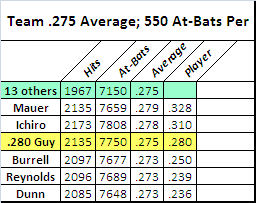
The first scenario has the other 13 players at a .275 average with 550 at-bats per spot. How did that team fare when adding the stud, the mid-level and the dud?

avg-anchor1

Adding Mauer to the team as is nets a healthy four points to the batting average and adding him in lieu of any of our three anchors yields a six point boost. Those results aren’t particularly surprising. The fact that each of anchors only costs the team as a whole two points is promising. Surely that minor bump down is more than offset by their contributions in the power categories (and the decent offering of speed by Reynolds).

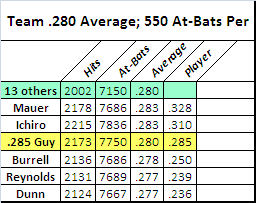
How about when a team is hitting .280 on an average of 550 at-bats per player? The results aren’t much different:

avg-anchor21

The impact of Mauer and Ichiro is equal now while Pat Burrell gets a one point edge over his average-deficient peers. For all intents and purposes, there is little difference between these first two examples. Though I doubt it’s a newsflash to many, notice that the player with a slightly higher average than the team he’s joining does nothing to impact the team’s overall batting average? If you’re deciding between a two players with close lines, but one guy hits .272 with a eight more runs, two more home runs, seven more RBIs and an extra steal than the guy hitting .285, take the .272 guy because both have a virtually nil impact on the overall batting average so you might as well grab the extra counting stats.

Next I looked at a team that averages 450 at-bats per player. Obviously the more at-bats on a team, the less one guy’s batting average impacts the bottom line. Since the .275 and .280 studies were virtually the same under 550 at-bats, I only looked at the .280 average team with 450 at-bats:

avg-anchor3

Here we see that the run-of-the-mill .285 average guy in 450 at-bats does positively impact the team’s batting average. There is now an eight point difference between Mauer and Dunn. Clearly that’s significant. In this scenario there is a legitimate decision as to whether or not Dunn’s power advantage will make up for his lack of batting average. The answer to this is variable dependent on the team you’ve assembled to that point and what your plan is continuing on through the rest of the draft or auction.

Finally, I looked at a scenario of rostering TWO of these batting average black holes. You will obviously be getting some insane power production if you put Dunn and Burrell on your team, but what kind of hole will you find yourself in from a batting average standpoint?

avg-anchor4

Frankly, I expected worse here. Sure there is a 10-point gap between Mauer/random .280 dude and Burrell/Dunn, but 70+ home runs and 180+ RBIs is a nice consolation prize. In the end, I think the fantasy baseball community as a whole overrates the negative impact of a poor batting average from someone like Dunn. It’s not like discussing the downside of Dwight Howard‘s awful free throw percentage on your basketball team. Basketball players take a very disparate number of free throws and Howard is among the leaders. The number of at-bats for players on a fantasy baseball team doesn’t vary all that much. And if they’re hitting horribly, they’ll lose at-bats to someone else. When Howard is especially awful at free throws, teams are more inclined to send him to the line a few extra times that week or month.

I have never shied away from a bad batting average power hitter and I probably never will given that a 550 at-bat season is about 6-8% of a team’s at-bat total while 40 home runs is about 18% of the average team’s home run total and 100 RBIs is about 11% of the average team’s RBI total. Even the 11 steals by Reynolds is around 10% of the stolen base total for a mid-pack team further proving that the potential impact of a player’s counting stats is higher than even the best hitter’s impact on batting average.

Wednesday: 01.7.2009

A Different Look at Outfielders for ’09

I made a trip to the local Barnes & Noble today in search of fantasy baseball magazines. Specifically I was looking for the FanBall offering as a good friend of mine, Jason Collette, is a big part of their coverage. Unfortunately, it was not in but I did pick up the annual Sporting News fantasy baseball magazine. Say what you will about fantasy baseball magazines and their value, but I usually end up with three or four every year and I make no apologies for it.

Having just finished my outfielder rankings, I immediately turned to SN’s rankings of outfielders to see how the two lists compared. What follows is a comparison of the two lists. There were 96 of my outfielders in their top 105 so that’s what I’ll be looking at here. It was interesting to see who I really liked compared to them and who they really liked compared to me. There were 14 players that SN & I were within one rank +/- of each other.

Outfielders I Love…

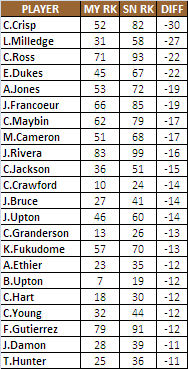
Here are the guys I rated much higher than the Sporting News. The cutoff was a double-digit difference between the lists:

sn-comp1

Coco Crisp was the biggest split between the two sets of rankings. Initially, I thought that might just be because they went to press before Crisp was in Kansas City. One of the biggest knocks on magazines is timeliness. At any rate, they DID have Crisp in KC… they just didn’t see him as being all that valuable. We differed on a lot of young guys: Milledge, Dukes, Jones, Maybin, Upton, Bruce and Young all got much lower marks from Sporting News. I don’t necessarily consider myself the type of fantasy player that buys into youth and potential all that much. I like proven, established players much more, but it would appear that Sporting News has me beat on downgrading youth movements.

Outfielders They Love…

Here are guys that Sporting News rated much higher than I did in my list. Again, the cutoff was a double-digit discrepancy:

sn-comp2

Check out that Aaron Rowand love!! For me, I just don’t see it. It’s not like they projected him for 20-90, but they did predict a healthy boost in his run production numbers and I see no clear reason to expect such. At best, he stays status quo from last year, which would give him a stat line behind plenty of his peers. The aforementioned Jason Collette will no doubt side with Sporting News on Nelson Cruz as he simply loves the guy! I was really by the following: Winn, Ludwick, Ibanez, Quentin and Holliday. All of those, for one reason or another, really stuck out to me as inexplicably favorable rankings. And for the record, Holliday was already on Oakland when he received the #1 ranking for their book. I found their Holliday capsule & prediction interesting:

His minor league performance was not indicative of the player Holliday became with Colorado, but he is moving to one of the best pitchers’ parks in the American League. It would be foolish to expect 30 home runs or .319 average in Oakland, but the Athletics value stolen-base efficiency, and Holliday was decent on the basepaths last season.

Projection – 111 r/35 hr/122 rbi/27 sb/.324 average

I love Holliday and I really hope he gets those kind of numbers, but the two entities seemed to contradict one another. At any rate, I am by no means trying to start crap with Sporting News and say I’m right and they’re wrong. I think the comparison between rankings is half the fun of coming up with a rankings set.

I leave you today with the entire list of 96 that were compared:

sn-comp4

I want to again thank everyone for their very kind words about the piece. I put a lot of effort into doing the work and I really hope you all find some value in it for your fantasy prep this winter/spring. Please continue to stay tuned to the blog for more rankings, articles and discussion.

Tuesday: 01.6.2009

2009 Top 100 Outfielders Part 3: 10-1

The final part of my series of the top 100 outfielders for 2009 counts down the top 10. If you’ll notice, the longest capsules came in the middle of the rankings because those are your game breakers that will can boost your season over the top. Spending 250 words explaining why Carl Crawford or Matt Kemp is a stud (duh??) isn’t as useful as explaining why Shin-Soo Choo or Elijah Dukes is a worthy addition to your fantasy roster and is likely worth that extra dollar or slight reach to secure their services.

Part 1: 100-51
Part 2: 50-11

Enjoy the final countdown:

10. Carl Crawford, 27, Tampa Bay Rays – Wouldn’t you know it, the Rays have their best season ever and Crawford has his worst?! Injuries contributed largely to the digression from his usually amazing offerings. Nothing in his foundational skills suggest that he won’t come back as good as ever in 2009 so invest the standard 50-stolen base speed with double digit power, a ton of runs, around 75 driven in and a .300 average. Outside of a league filled with inexperienced members, it is doubtful that Crawford’s injury-shortened season will depress his value much at all. For the top 10 outfielders, I will add where the guy went in two mocks I’m following. One is mlb.com’s Fantasy 411 podcast expert’s draft and another is one I’m participating in with a group of guys from the fantasy baseball message board Rotojunkie.com. 411: 2nd round – 20th pick overall/7th outfielder taken, RJ: 2nd round – 24th pick overall/7th outfielder taken.

9. Jason Bay, 30, Boston Red Sox – That’s the Bay we were used to prior to 2007! He still hasn’t completely come back to 2005/2006 levels against left-handers, but everything else is back on track and a full season in the Red Sox lineup will be trouble for opposing pitchers. A 2006 redux with more runs scored and driven in thanks to the Red Sox lineup seems very likely for Bay in 2009. Despite a great rebound back to previously established levels, Bay might still drop a bit as a result of the collapse in 2007. He has a legitimate shot to jump back into the $30 dollar levels as a part of that Red Sox lineup. 411: 4th round – 37th pick overall/15th outfielder taken, RJ: 4th round – 40th pick overall/14th outfielder taken (I got him).

8. Matt Kemp, 24, Los Angeles Dodgers – He whet the appetites of fantasy owners with a great 292 at-bat sample in 2007, but the glut of outfielders coming into last season helped give Kemp a little more value. Sure, he was the odds-on favorite for the third spot with Andruw Jones and Juan Pierre, but there were no guarantees for him getting 500 at-bats. Well he got 606 and didn’t disappoint in the least. He used out and out destruction of lefties (.369) to fuel a .290 average along with 18 home runs and 35 stolen bases. He boosted his power in the second half portending 20+ HR potential to match that elite speed making a better than $30 season a very real possibility if everything breaks in his favor. 411: 4th round – 44th pick overall/17th outfielder taken, RJ: 3rd round – 33rd pick overall/12th outfielder taken (I got him, too).

7. B.J. Upton, 24, Tampa Bay Rays – Fears that his power was gone as opposed to merely absorbed by a sore shoulder were erased with a monstrous playoff (7 home runs). For the trouble of dropping 13 home runs off of his 2007 total, he did add 22 stolen bases giving him nearly equal value year over year. The big gains in walk rate and contact rate are very promising, too. Come off of surgery on that shoulder might prevent him from maxing out his potential in 2009, but look out in 2010. For now, I expect a move back into double digits for power and continued elite speed en route to a high $20s season in value. 411: 2nd round – 18th overall/6th outfielder taken, RJ: 2nd round – 15th overall/4th outfielder taken.

6. Josh Hamilton, 27, Texas Rangers – Was there a better story than Hamilton in 2008? He is showing why he was the #1 overall pick all the way back in 1999. It is hard to peg a “prime” for a guy like this because of the time he missed so perhaps he is still improving like a 24-25 year old as opposed to establishing a prime level like most 27-year olds. How good is a player when he hits 13 home runs, drives in 50, steals six bases and hits .298 and it’s is labeled a 2nd half fade? It isn’t unreasonable to expect another boost in performance from this guy, but an even a repeat of his $30 dollar season would be a great success. 411: 2nd round – 16th overall/4th outfielder taken, RJ: 1st round – 10th overall/3rd outfielder taken.

5. Carlos Lee, 32, Houston Astros – His fourth straight 30-100 season was a lock before a broken finger derailed his season. He still only missed the mark by two home runs despite just 436 at-bats. He has a remarkably strong skillset that is as consistent as it gets. There are at least three more 30-100 seasons coming from Lee including another monster season for 2009. He was pacing near the 40 home run mark before last year’s injury and while I don’t know he can do that again, a 2007 repeat brings in almost $30 dollars of value. I feel like he is slipping a bit despite nothing in his skills that should give owners pause. 411: 3rd round – 26th overall/10th outfielder taken, RJ: 3rd round – 26th overall/9th outfielder taken.

4. Carlos Beltran, 32, New York Mets – His home run totals are in a three year decline while his batting average and stolen base totals are in a three year incline. The power drop is no doubt tied to a huge uptick in groundball rate from 2007 to 2008, but the slight gains in speed and batting average plus 23 extra runs offset the six home run loss. He is no longer a flashy pick that makes you think of 40/40 potential like back in 2004, but it is hard to argue with how much production he offers across the board. 411: 2nd round – 15th overall/3rd outfielder taken, RJ: 2nd round – 22nd overall/5th outfielder taken.

3. Alfonso Soriano, 33, Chicago Cubs – I feel like people are forgetting that Soriano missed a bunch of time due to injuries and managed just 453 at-bats. That is the only way I can explain why he’s not being given credit for nearly going 30-20 in those 453 at-bats. Even at 33, he is still one of the best players in the entire game when it comes to fantasy baseball. He is still one of the preeminent power-speed combos with 30-30 a real possibility if he can stay on the field all year. In these two mocks and a few others I’ve seen, Soriano is representing a value pick when you consider he his potential in 550-600 at-bats. 411: 2nd round – 22nd overall/9th outfielder taken, RJ: 2nd round – 23rd overall/6th outfielder taken.

2. Ryan Braun, 25, Milwaukee Brewers – Is this guy really 25?!?! The two seasons that he has put up are amazing on their own, but then you consider is age and it’s unthinkable. His numbers are legit, his skills are legit and there is growth in this profile. His difference-making power turns heads, but it’s his mid-to-high teens speed and quality batting average that make him an elite first round pick. He could be on the verge of one of those special seasons that will just carry an entire fantasy team. 411: 1st round – 12th overall/2nd outfielder taken, RJ: 1st round – 9th overall/ 2nd outfielder taken (I got him… yep, I took three from the list’s top nine).

1. Grady Sizemore, 26, Cleveland Indians – My #1 ranked guy didn’t drive in 100 runs and he hit .268, so I know what you’re thinking… are you crazy? The reason I like him so much is that he didn’t have to do anything extraordinary to get near 35 HR/40 SB. He finished at 33/38 and it wasn’t due to two out of this world months, instead he just put up quality month after quality month. A better September (2 HR/3 SB) could’ve taken him to the famed 40-40 heights. He is cutting K’s while maintaining a solid walk rate. The Indians lineup should be consistently viable throughout the entire season which will only help Sizemore’s runs scored and runs driven in. We might get that 40-40 season in 2009. 411: 1st round – 11th overall/1st outfielder taken, RJ: 1st round – 5th overall/1st outfielder taken.

top-100-outfielders

top-100-of-by-age top-100-of-by-team

Friday: 01.2.2009

2009 Top 100 Outfielders Part 1: 100-51

A four part series covering the two most vast positions in fantasy baseball will begin today with part 1 of the outfielders. There will be an accompanying piece finishing up the outfielders over the weekend and then a two-part series on starting pitchers later in the month. Both iterations will have updates in the rankings throughout the rest of the off-season done in a “rankings-only” format, that is just the pasting of an excel shot like Top 10 & Honorable Mention lists had that I did back in October. I strongly encourage feedback on the rankings and look forward to hearing what you think about them, so please utilize the comments section below. And now, the bottom half of the top 100 outfielders:

100. Rajai Davis, 28 years old, Oakland A’s – He managed 30 stolen bases in 218 at-bats despite just a .248 average and awful .278 on-base percentage. Imagine what 20-25 points of on-base percentage could do for that speed!? Betting on over 300 at-bats is risky, but the fragility of Oakland outfielders (Travis Buck & Ryan Sweeney specifically) add to that potential and you have to love him as a single-digit option or reserve round material for your ballclub.

99. Brandon Moss, 25, Pittsburgh Pirates – It seems like Moss will be the everyday guy in right field for the Pirates and with a full season’s worth of at-bats, he could be one of those unsung guys that gives you a decent line when you check back in October. It’s doubtful he will excel at any one thing, but he could deliver upwards of 15 home runs with handfuls of runs scored, driven in and stolen bases.

98. Carlos Gonzalez, 23, Colorado Rockies – Obviously Coors Field is significantly more beneficial to hitting than McAfee Coliseum, but there is a lot to work on for Gonzalez. After the Matt Holliday trade, there were rumblings that Gonzalez might be flipped again soon but those rumors have tempered and now it looks like he will vie for a spot with the Rockies. There is talent for a 12 and 12 type of season, but any investment in Gonzalez is likely one for the future.

97. Travis Buck, 25, Oakland A’s – As mentioned earlier, Buck has had trouble staying on the field. He doesn’t have an overwhelming skillset even when fully healthy, but he is another guy that doesn’t hurt you anywhere. The Oakland offense stands to improve with the addition of Matt Holliday and health elsewhere so Buck’s runs scored & driven in could see a boost, too. The downside is another year riddled with nagging injuries that prevent him from taking a step forward.

96. Nate Schierholtz, 25, San Francisco Giants – I can’t think of any reason for the Giants to not play Schierholtz for 350-400 at-bats, but by the same token I wouldn’t be the least bit surprised if he ends the season on the wrong side of 300. He should join Fred Lewis and Aaron Rowand in the San Francisco outfield, but it’s likely that he will have to battle Randy Winn and Dave Roberts for his chances. He is a free swinger with a solid power-speed combo, but uncertainty around opportunity should limit how high you go on draft day.

95. Josh Anderson, 26, Atlanta Braves – The outfield is wide open in Atlanta giving Anderson a great shot at locking up 400+ at-bats. It remains to be seen how much else is there with Anderson, but a bankable category like speed will earn a roster spot in just about any format that finds him in the player pool. His price will be determined by certainty around playing time. Earlier drafts/auctions will see Anderson go at a bargain price.

94. Steven Pearce, 26, Pittsburgh Pirates – Again, the Pirates outfield appears wide open meaning guys like Pearce and Moss should be given ample opportunity to establish themselves as viable major leaguers. With a full season of at-bats, Pearce is someone that could easily find himself notching double digits in home runs and stolen bases. Pay for 300 at-bats because the Pirates are the type of team that would needlessly sign Garret Anderson and run him out there for 400+ at-bats.

93. Rocco Baldelli, 27, Free Agent – How can you not root for this guy? After everything he has been through, he continues to come back time and time again. Now just 27, he’s available on the free market with the Pirates, Rays and Red Sox all in the mix at press time. He will not be able to go everyday with his medical condition, but he can be a cheap source of power with regular playing time. For now, wait and see where he goes and what kind of role he will have for 2009… even then, he might be best left as someone else’s headache.

92. Chase Headley, 24, San Diego Padres – I think we all expected a full season of at-bats last year, but Scott Hairston and Jody Gerut emerged as viable options which left Headley with only 331 at-bats by season’s end. Headley is penciled in as the left fielder with 31-year old Gerut as the odd man out right now, but don’t be surprised if the three split two spots regularly. Headley projects as a bona fide run producer suited for the middle of the order, but Petco saps power like no other and could relegate him to the teens in home runs.

91. Ryan Spilborghs, 29, Colorado Rockies – He was great in 233 at-bats last year delivering across the board production, but I was surprised to see that he was 29 years old. With Matt Holliday and Willy Taveras both gone, only Brad Hawpe holds a secure spot in the outfield coming into the season meaning Spilborghs has a shot at 500 at-bats. A double-double (10+ home runs and steals) is a pretty safe bet with that kind of playing time.

90. Mark Teahen, 27, Kansas City Royals – Traded the 2007 speed and average for power, a trade that would be vetoed in most leagues. His walk rate has slid year-over-year since 2006 and in turn sunk his on-base percentage all the way to .311 last year. At his age, he’s not toast, but temper your expectations for this classic “what you see is what you get” guy.

89. Marcus Thames, 32, Detroit Tigers – He simply doesn’t play enough to warrant a higher ranking, but he is a reliable power source that is good for 20-25 home runs even if he doesn’t top 350 at-bats. Another negative tied to the lack of playing time is low totals in runs scored and runs driven in. Mix in a weak batting average and you have 4th/5th outfielder fodder.

88. Michael Cuddyer, 30, Minnesota Twins – Injuries stole 2008, but it opened the door for the likes of Denard Span who showed he’s worthy of several hundred at-bats even if at the expense of Cuddyer. The 2006 season is the clear outlier now and a return seems highly unlikely. If he’s not squeezed out by the youthful trio of Span, Carlos Gomez and Delmon Young, then he will offer a 2007 redux.

87. Aaron Rowand, 31, San Francisco Giants – More valuable in “real” baseball terms than he is for fantasy because of how well he handles the glove. Anybody that expected 2007 numbers last year was only fooling themselves and status quo in 2009 would be a good outcome here. He has lowered his stolen base totals yearly since 2004 making that category a non-factor at this point. A sprinkle of everything here, but nothing more.

86. Marlon Byrd, 31, Texas Rangers – Many were skeptical of a 30-year old breakout from 2007 and Byrd’s first half of 2008 justified those skeptics, but he rebounded with a blistering second half that included a .327 average and seven home runs in 280 at-bats. Invest in 450 at-bats approaching a double-double with plenty of runs scored & driven in thanks to a stout Texas lineup.

85. Ben Francisco, 27, Cleveland Indians – Teams that picked him up off of the scrap heap had to be happy with the returns from Francisco as he emerged into a full-time player. He’s been a double-digit thief throughout his minor league career, but went just 4-for-7 last year. Like the others in this tier, he’s got strong double-double potential with decent offerings in runs scored & driven in without killing your batting average. Don’t assume the speed in your bid, but power approaching 20 home runs should make up for it.

84. Jody Gerut, 31, San Diego Padres – Wow, where’d that come from? Don’t discount Gerut’s rebirth. After two years off, he’s a young 31 and still has plenty left in the tank for a fourth outfielder-type. He does most of his power damage away from home, but he still managed a healthy .295 average with 17 extra-base hits in the cave that is Petco Park. As it stands right now, Gerut is the odd man out in San Diego, but he will get a fair number of at-bats to work with this season.

83. Juan Rivera, 30, Los Angeles Angels – There was so much promise after he made good on a full complement of at-bats in 2006, but 2007 was lost to injury and 2008 was just bad. He re-signed with the Angels and Garret Anderson is now out of the picture so Rivera can log 450-500 at-bats of cheap power in the middle of the lineup.

82. Brian Giles, 38, San Diego Padres – A pending legal case hangs over the head of Giles and it could feasibly alter his status with the Padres depending upon how it plays out, but for now I’ll operate under the assumption that he will be available to and in the lineup for the Padres come April. Two down years in batting average seem linked to his performance against left-handers as he went from .217 and .241 in 2006 and 2007 to .301 last year boosting him 35 points in overall average from ‘07. OBP leaguers love the guy, but otherwise he doesn’t do a ton. He has shaved a home run a year since 2005 when he had 15 and has just 51 and 63 runs batted in the past two seasons.

81. Ryan Sweeney, 24, Oakland A’s – A prototypical Athletic with a very appealing skillset that can’t seem to stay on the field all season. He struggles mightily against lefties, but at worst he would be the good side of a platoon so if he’s healthy, he’ll play. His nine stolen bases last year were his highest yet and being part of Oakland doesn’t lend itself to many opportunities so temper your expectations there. A full season of at-bats could yield a .300-70-15-70-8 line.

80. Scott Hairston, 28, San Diego Padres – He came up as one of Arizona’s brightest prospects, but was shipped to intra-division rival San Diego for a song and he has shown flashes of what made him such a hot commodity years ago. He spent most of his time leading off which helps explain the low RBI totals despite 17 home runs (12 solo shots). In fact, he posted a .958 OPS and .294 AVG with 12 HR as a leadoff hitter; he hit just .199 otherwise.

79. Franklin Gutierrez, 26, Seattle Mariners – I got this one wrong big time last year. I scooped up Gutierrez wherever I could last year in hopes of a season approaching 20-20. Upon further review, I was overly optimistic in the first place. I won’t be making the same mistake again despite a clear opportunity for playing time in Seattle. At 26, hope isn’t completely lost but it’s hard to see development in Gutierrez right now. I’ll pay for a low end double-double with a middling batting average and accept anything more as bonus.

78. Josh Willingham, 30, Washington Nationals – A back injury derailed the beginnings of a career season for Willingham and he never really got going again. He was hitting .345 with five home runs in 108 at-bats when he was shelved for all of May and most of June. I think the Nationals’ lineup is starting to come together a bit which should allow Willingham to add some substance to his bankable power in the form of RBIs and runs scored. At worst, you’ve got 25 home runs.

77. David Murphy, 27, Texas Rangers – One of a bumper crop of rookies who was well on his way towards a 20 homer-100 RBI season until a knee ended his season prematurely. He wasn’t a grade A prospect, but the results weren’t overly surprising given his home environs. He joins Byrd, Brandon Boggs, Nelson Cruz and Josh Hamilton for the three outfield spots, but there is nothing to suggest that his rookie season was smoke & mirrors meaning he’ll get a fair shot at repeating.

76. Jose Guillen, 32, Kansas City Royals – It’s hard to find takers for sub-.300 on base percentages these days, just ask Dayton Moore. The Royals have dangled Guillen on the market but nobody appears interested and it’s tough to blame them. His 20 HR/97 RBI season looks usable on the surface, but the lack of any patience whatsoever and a horrible second half creates a dim outlook. If the second half carries over into the spring and/or early part of 2009, he could be pushed to the bench by Mark Teahen. Proceed with caution.

75. Adam Lind, 25, Toronto Blue Jays – Had virtually the same amount of playing time in both 2007 and 2008 and the skills displayed didn’t vary much: 11 in 290 AB for 2007, 9 in 326 last year, a 4.1 K:BB ratio in 2007, 3.6 last year and 36% XBH (extra base hit) rate in 2007 against 32% last year. With some more selectivity, he can be a .280-20-80 player in 2009, but pay for .270-15-80 and accept anything better as a bonus.

74. Nelson Cruz, 28, Texas Rangers – He finally translated his minor league success into the majors albeit in just 115 at-bats. However, he is now in a group of five vying for three spots… one of which is guaranteed to Josh Hamilton without question. Then it’s he, Byrd, Murphy and Brandon Boggs for the other two spots. The power stroke is legit and it is of course enhanced by playing in Texas. Meanwhile, he has stolen double digit bags in three of the past four seasons meaning a full-time gig would likely yield a robust power-speed combo in the neighborhood of 25-15. Playing time is the key here and I’m not certain he has it locked in.

73. Michael Bourn, 26, Houston Astros – The second player in our bottom quartile that managed a ton of stolen bases (41) despite an outright disgusting on-base percentage (.286). In his 594 major-league at-bats, Bourn is hitting .182 against lefties. If only the problems stopped there. Teammate Kaz Matsui scored one more run than Bourn in 92 fewer at-bats; Bourn needs an on-base percentage at or above .320 or he may start losing playing time. His lack of contributions elsewhere makes him a cheap speed option and right now there isn’t anything to suggest he will be anything but…

72. Jack Cust, 30, Oakland Athletics – Another category specialist, but Cust combines his massive power with an excellent eye that adds to his run scoring opportunities despite a .233 batting average. A friendlier home park could see him hit 40 home runs and become the American League’s Adam Dunn (though Dunn could move to the AL and be the AL’s Dunn himself!). For now, he’s a bargain bin home run hitter and he’s unlikely to veer from that distinction. His value skyrockets in OBP leagues, but standard leaguers are paying for 80-30-80 and you should be able to absorb the batting average hit as long as you don’t add Dunn, Jason Giambi or Mark Reynolds to your roster, too.

71. Cody Ross, 28, Florida Marlins – It was an up & down year for Ross. He posted a .415 OPS in April while failing to hit a home run and drove in just two. Then he blasted 10 home runs with 18 RBIs en route to a 1.259 OPS in May. He had another down month in June before evening out for the rest of the summer. The sum of it is that Ross is a legitimate double-digit home run hitter, but struggles mightily against righties (.249 in 317 AB) and could be robbed of playing time because of it. Playing as a 28-year old on a team in a perpetual youth movement doesn’t help either. Buying into a season with more than 400 at-bats is risky.

70. Jeremy Hermida, 25, Florida Marlins – After a disappointing season for a once-promising prospect, Hermida isn’t yet behind the eight ball because he is still just 25. That said, paying for 2007’s numbers is a mistake at this point even though it can be achieved. Until further notice, he is a dime-a-dozen outfielder that gives you mid-teens power and underwhelming numbers the rest of the way.

69. Ryan Church, 30, New York Mets – This one hurt on a personal level. I’ve always been a fan of Church and I pegged him for a big season last year. Things started off swimmingly, but then collapsed under the weight of two severe concussions. Completely healthy and ready to go, Church should be a 20 home run hitter with nice returns in runs scored and driven in thanks to that star-laden lineup for the Mets.

68. Eric Byrnes, 33, Arizona Diamondbacks – An amazing 2007 had Byrnes’ stock at its peak, an injury-riddled disaster last year has now bottomed out that same stock. Even 100% health on those hamstrings won’t facilitate a return to the 50-stolen base mark, but a double-double in the high teens with 75 runs scored and driven in is a fair expectation. The signing of Felipe Lopez hasn’t squelched all rumors of Byrnes being dealt to Boston. A move there would dent his value significantly as he’d move from starter to 4th outfielder.

67. Randy Winn, 34, San Francisco Giants – How is his speed improving at this advanced age?! Don’t bet on another 20+ stolen base season, but a double-double season with .285+ average is what you are buying here. He’s logged 600 plate appearances since 2002 so you know you can count on him. This team has made some great moves this off-season and they could hang around in the west deep into the summer with Winn playing the role of veteran leader with Randy Johnson for an otherwise very youthful team.

66. Jeff Francoeur, 25, Atlanta Braves – When it was all said & done, Francoeur was probably my biggest mistake of the 2008 season. I loved him for a big season. Everything went wrong for him. It started with him falling apart against lefties. They had never proven difficult for him since his arrival into the majors and then all of a sudden he hit .210 against southpaws in 2008. At the break, it was clear that 2008 was a washout, but I thought Francoeur might make some adjustments and have a reasonable second half to build upon for 2009. He didn’t. At 25, there is hope, but the leash could be short given the stable of young outfielders in the Braves’ system. An 80-20-80 would be a success as he re-figures it out.

65. David DeJesus, 29, Kansas City Royals – He doesn’t wow you with his fantasy contributions, but the sum of a .290-85-10-85-10 line is quite nice. It’s not going to overwhelm opposing pitchers, but that Kansas City lineup will be improved from 2008 and DeJesus will be the leader there even if he relinquishes the leadoff spot to newly acquired Coco Crisp in favor of the 2-hole. If you play in a league that uses individual outfield slots, enjoy DeJesus’ triple eligibility.

64. Hideki Matsui, 34, New York Yankees – The Yankees might not be done making moves this winter and Matsui could be on his way out if they can find a taker. A move could be really good or really bad for Matsui. Right now, he’s penciled in as the designated hitter, but that leaves Nick Swisher on the bench. Thus, if he stays in New York he might not garner a full season’s worth of at-bats and a move out to a team that would play him daily would be welcomed.

63. Juan Pierre, 31, Los Angeles Dodgers – He could be on the outside looking in for playing time right now, but I can’t envision the Dodgers going with Andruw Jones for any regular amount of time given how bad he has been over his past 781 at-bats. That doesn’t mean that they won’t look into the trade or free agent market for a better option, though. Pierre has always been reliable for runs, speed and batting average, but last year with just 375 at-bats he was unable to reach the usual 90+ runs scored. With regular playing time, look for a return near previously established norms: 80 runs, 50 steals and a .290 average. Otherwise, a 2008 redux.

62. Cameron Maybin, 22, Florida Marlins – Nice sip of coffee for the youngster with 16 hits in 32 at-bats over the course of eight games, but it’s insignificant in determining his 2009 value. He had an .831 OPS in 108 games in AA with 21 stolen bases and 13 home runs. He’s a five-category threat without a doubt, but at such a young age there will likely be several peaks and valleys throughout the season. The lack of options in the outfield for Florida suggests that Maybin will be the guy in center all year long. A year similar to Delmon Young’s 2008 with more stolen bases and less batting average is what I’m expecting.

61. Carlos Guillen, 33, Detroit Tigers – To see Guillen walk, let alone run, you’d never believe that he’d be a stolen base threat. Hobbled by nagging injuries nearly all year in 2008, he still managed nine after seasons of 20 and 13. Double-digit SB days are behind him, but the power and run production abilities remain. He will still qualify at 3B for 2009 where holds more value, but if you take care of your corner infield and need a solid 3rd/4th outfield option good for 15-18 home runs with a boatload of runs scored & driven in, then Guillen’s a good choice.

60. Luke Scott, 30, Baltimore Orioles – A tale of two halves for Scott, but the power was prevalent throughout. There is 30-home run power in that bat. Combining that with a budding lineup should yield a solid 85-30-85 season or thereabouts. Likely older than most realize at 30, but his primary skill, power, ages well so hitting the pivotal age isn’t worrisome.

59. Carlos Gomez, 23, Minnesota Twins – Given his age, it’s hard to pile on despite how he was in 2008. He was a key return for Johan Santana so the expectations to perform well and quickly were astronomical and thus he may’ve been rushed into duty. He has a long way to go before being anything more than a stolen base specialist with a bad average and little else residing in your 3rd or 4th outfielder slot.

58. Fred Lewis, 28, San Francisco Giants – This relatively unknown speedster burst onto the scene with a very impressive first full season. Whiffed way more than you want a leadoff hitter to do (91 times hitting 1st), but still managed a .350 on-base percentage from the top spot. Horrible supporting cast suppressed RBI total, even for a leadoff hitter. Lineup should improve with Lewis as the table-setter, but temper your expectations of growth. A repeat could be the ceiling here.

57. Kosuke Fukudome, 32, Chicago Cubs – Though he didn’t live up to the hype (who can these days?), Fukudome wasn’t all bad in his major league debut. He had a bit of power and speed with a great eye that made him a gem in OBP leagues. The biggest concern is that his batting average and OPS virtually dropped month-over-month all season (the OPS raised slightly from August to September but was still at .577). With such a sharp eye and really good raw skills, I foresee legitimate improvements for 2009. A line in the neighborhood of 85-15-70-15 is more befitting of someone with his skills.

56. Nick Swisher, 28, New York Yankees – The raw power remained, but not nearly to the degree expected with his move out of McAfee Coliseum into U.S. Cellular Field in Chicago. He has been a batting average anchor for years, but last year’s .219 was just downright awful. After back-to-back seasons of .291 average against left-handers, he hit just .197 off of them last year. A correction will bring his average back into the .250s where he normally resides. He moves over to New York where he should fall into 90 runs and 80 RBIs as long as they play him. My favorite thing about Swisher in 2009 is that he will no doubt be very cheap to roster.

55. Willy Taveras, 27, Cincinnati Reds – Those justifying his signing with the Reds are saying, “At least he’s better than Corey Patterson.” Sure, but is there a player about whom you can’t say that exact phrase? Anytime someone swipes 68 bases, they are going to be a fantasy baseball asset even if it’s paired with NOTHING else of legitimate value as was the case in Taveras’ 2008 season. The only time he has topped a .321 on-base percentage was when he hit everything in sight and went off with a .320 AVG/.356 OBP. It’s pay-n-pray with Taveras, pay for 35 stolen bases and pray for 80 runs and a batting average above .280.

54. Jason Kubel, 26, Minnesota Twins – His march towards fulfilling his promise continues in the right direction with his best season yet. At 26, there is more to come from this slugger though lefties continue to be a problem for him. This could be the season that sees him hit 30 home runs, but 2010 is more likely for that. With four options in the Minnesota outfield, he could be relegated to DH for majority of the season, but that won’t impact his 2009 eligibility.

53. Adam Jones, 23, Baltimore Orioles – A further along version of Cameron Maybin, Jones is the kind of guy that will have a month that makes your entire league start requesting him in a trade followed by a month that will make you regret not pulling the trigger on one of those trades. By season’s end you should be happy with the net results of this budding star. He should bring a double-double with high 70s in runs scored and runs driven in.

52. Coco Crisp, 29, Kansas City Royals – His 2007 and 2008 totals were virtually the same despite the fact that he had 165 fewer at-bats last year. A trade to the Royals gives him a full-time role again, but simply extrapolating last year’s numbers into 550-600 at-bats would be dangerous. I’d be more willing to bet on 30+ stolen bases than 10+ home runs. For now, a 2007 repeat feels right.

51. Mike Cameron, 36, Milwaukee Brewers – He enjoyed a power spike despite missing a month due to suspension. Three years of declining stolen base and RBI totals may scare some, but the suspension played a large role in continuing that trend for 2008. This skill set is one of the more reliable ones in the league so you can expect an 85-25-75-15 line with a poor batting average. Trade rumors have put him in center for the Yankees which would only help his value, but for now he is part of a solid lineup in a neutral park.

There it is. I’ll have the second part ready this weekend and then a visual breakdown of the list including an echelon-divided list, a by team list and a by age list. Again, feedback is strongly encouraged.

Thursday: 01.1.2009

A Big Year Upcoming…

I rolled out the infield Top 15s (10 + Honorable Mentions) quickly after the season ended and then had a hiatus. I was chosen for a business trip that took me to Salt Lake City for six weeks covering all of November on into the early part of December. Since returning, I’ve been working on plenty of baseball related stuff in preparation for 2009. I’m now ready to begin unveiling some of the fruits of that labor including a breakdown of what you can expect in the coming months.

As for the podcasts, they are FAR from done. My computer needs some repairs to be fit for podcasting again, but those should be completed and good to go by the end of next week which will mark the restart of the podcast. I still have to cover the outfielders, starting pitchers and relief pitchers rankings for 2009. First on the docket of newly published materials here is part one of the Top 100 outfielders covering 100-51.

In addition to that, I expect to deliver the following:

  • Part 2 of the OF: 50-1
  • The Echelons of Starting Pitching
  • Updates on the Infielder Rankings
  • Middle-Reliever Methodology: A Primer
  • Auto-Updating Depth Charts
  • Head-to-Head Consistency Analysis
  • Using Catcher SB Rate Effectively
  • Drafting/Paying for Starting Pitchers Analysis
  • The Echelons by Position
  • Top Prospects: Who Can Contribute in 2009?
  • Paying for Closers
  • That should be enough material to keep the blog full up until Draft/Auction day. As always, I’m very interested in feedback on the work and if there is anything you’d like to see that doesn’t seem to be covered above, use the comments section to make it known and I’ll definitely entertain getting it on the docket.

    A few words about the outfielder and starting pitcher pieces… neither will focus on hard projections for the 2009 season. There will be plenty of references to numbers I could foresee, but I don’t like getting caught up in just the numbers. Instead, I’ll use the write ups to help explain why I placed a guy where I did and focus on what I liked or didn’t like in his base skills that will hopefully help you in your own projections for 2009. If I say a guy who has done mostly 10 to 13 HR and 70 to 75 RBI seasons can put up a 20 HR-90 RBI season because he’s learned to hit lefties, raised his walk & flyball rates and then he goes 17-88, I’m OK with that.

    My point in that write up would be that he has the skills for a jump in production. I’m not as worried about nailing the exact figures for that jump. You’ll see what I mean when I post the first portion of outfielders. Last year’s Starting Pitchers piece was very well received and I took a similar approach there, so I’m confident that the lack of a projected line for each outfielder and pitcher won’t be a problem.

    Without further ado, let’s get the 2009 Fantasy Guide underway… Happy New Year and thank you for reading.