Archive for ‘Fantasy Baseball’

Friday: 06.1.2012

Did You Realize…? AL Edition

It’s June 1st, did you realize…

…that Felix Hernandez is toting a 3.42 ERA, good for 40th among qualified starters in the majors?

He posted a 4.45 ERA in May, but still had 33 strikeouts in his 32 innings with a 3.3 K/BB so I wouldn’t rush to the panic meter.  He had a BABIP of .378 for the month including three outings in which he allowed 10 or more hits.  Oddly enough one of his two good starts in May came against the Texas Rangers as he went eight strong allowing a run with seven strikeouts and a pair of walks.

…that Chris Sale leads the American League in ERA at 2.34 in 58 innings?

The month of May saw him get removed from the rotation (on May 4th) and thrust into the closer’s role where it was reported he would stay for “at least the rest of 2012”.  About a week later, he was having an MRI on his elbow and there was even some concern that he could be shutdown altogether.  He stayed in the closer’s role for all of 10 minutes blowing one save in his only relief appearance on May 8th before returning the rotation on May 12th.  He closed the month out with 25 innings of 1.82 ERA and 0.97 WHIP with 31 strikeouts including a 15-strikeout outing on Memorial Day.

…that Sale’s White Sox are 30-22 with a +40 run differential despite Gavin Floyd (5.02), Philip Humber (5.37) and John Danks (5.70) all toting >5.00 ERAs?

It helps that Sale leads the AL and Jake Peavy isn’t far behind with a 3.05 ERA of his own.  Of those three, I am still buying Floyd.  He has a 3.2 K/BB built on a career-high 8.0 K/9 in 61 innings.  Home runs have killed him, especially in his last three outings as the Angels, Twins and Indians trounced him for 21 runs in 15 innings with five bombs.  The velocity is fine and the control only fell off in the Minnesota game (3 BB) so I don’t think there is an issue that plague him in the long term.  It appears to be a rough patch with better times ahead.

…that Felix Doubront has a 9.5 K/9 and has arguably been Boston’s best start thus far?

If you’ll afford me a small back pat, I would point out that I touted Doubront in this year’s pitching guide advising that if the Red Sox gave him the shot he deserved then he should be targeting.  He is even out-doing my expectations pairing the strikeouts with a 3.86 ERA and five wins in 56 innings.  His 1.36 WHIP is a bit high, but at his cost you can easily accept that flaw.  Furthermore, he is running hot of late with a 2.28 ERA and 1.08 WHIP over his last four with 27 Ks in 24 IP.

…that MLB’s strikeout leader, Max Scherzer (11.7 K/9), labored to a 4.04 ERA in May despite a 12.8 K/9 and 6.4 K/BB?

It was actually a marked improvement from his 7.77 ERA in April.  The big issue in May was a severe case of gopheritis as he allowed at least one home run in every start (yielding a 2.0 HR/9).  While some these struggles definitely fall on Scherzer’s shoulders, a good bit is bad luck, too, as his skills have been far more elite than his 5.55 ERA would suggest.  He has a 3.19 xFIP as his .387 BABIP and 17% HR/FB rate have to regress some in his favor.  He fanned 9 or more in four of his six May outings, I’d buy in if you can as his best outings are still ahead.

…that Henderson Alvarez and Derek Lowe both have K/9 rates lower than their ERAs?

Their ERAs are both on the right side of 4.00 which is what makes that such a weird phenomenon.  In the last 10 years, only three pitchers with enough innings to qualify for the ERA title have managed to post a K/9 lower than (or equal to) their ERA while maintaining a sub-4.00 ERA:

  • 2006 Chien-Ming Wang: 3.63 ERA, 3.1 K/9 in 218 IP
  • 2005 Carlos Silva: 3.44 ERA, 3.4 K/9 in 188 IP
  • 2009 John Lannan: 3.88 ERA, 3.88 K/9 in 206

…that Phil Hughes has allowed at least one home run in every start of the year?

His 14% HR/FB rate is high, but not as egregious as I thought it might be when I saw his 2.1 HR/FB.  His generally heavy flyball rate (career 46%) is at its heaviest of 49% so while I am intrigued by his 8.4 K/9 and 3.8 K/BB, that intrigue is tempered by home run issues that are unlikely to evaporate barring a change in his approach.  While it is easy to envision his 5.64 ERA coming down some, the xFIP of 4.34 says it isn’t exactly set to plummet in the vein of Scherzer.

…that Ervin Santana actually did make a change to curb his gopheritis with a 64% groundball rate in May?

After allowing 10 home runs (2.9 HR/9) in April en route to a 6.16 ERA, he figured that keeping the ball down going forward would be helpful.  His 41% groundball rate in April skyrocketed to an AL-best 64% and yielding a far more palatable 1.2 HR/9 in May.  That is right in line with his career mark of 1.1 HR/9 coming into this season.  He was actually in the midst of a great May with a 2.17 ERA through his first four starts before stumbling a bit against Seattle and New York and settling for a still solid 3.69 ERA in 39 innings.  I’m still buying where available.

…that Mike Trout is on pace for 96 Rs, 22 HR, 83 RBIs and 35 SBs?

In the last three years only two players have hit those thresholds: both Matt Kemp and Jacoby Ellsbury last year.  Even if you chop 20% off of those paces to 77-17-66-28, there are only 12 such seasons in the last three years across 10 players as Kemp and Ian Kinsler each did it twice.  Early on it looks like Trout is exactly the stud he was predicted to be when he was checking in as a top 3 prospect on lists all across the industry this preseason.

Here’s the kicker: take the 80% figures and tack on a .309 batting average threshold and we get just four instances in the last three years (it drops to three instances at the 100% paces).  Let’s say he hits the 80% paces and hits “only” .290, where does he go in 2013 drafts?  Is he a first rounder already?  What if he hits 95% or better of the current pace?

…that no one is on pace top 40 stolen bases in the American League?

Both Alejandro De Aza and Jason Kipnis are pacing the league with 12 apiece pacing them for 37 and 38, respectively, based on their team’s games played.  Paces can still be out of whack even two months into the season and with a category like steals, things can change rapidly.  Rajai Davis has 10 in his 38 games played, but has recently fallen into more playing time.  If he maintain anywhere near his current .819 OPS, he should stick in the lineup and I don’t think he would have any trouble reaching and topping 40 stolen bases.  If he gets a full set of at-bats in 90 of the remaining 110 games, he paces to steal about 50 steals based on his 10 in 68 at-bats thus far.  He is on a roster in just 3% of ESPN leagues.  That number should be much, much higher.

Wednesday: 05.30.2012

Matt Moore’s Big Memorial Day

Lost in the shuffle of celebrating Chris Sale’s incredible 15 strikeout performance from Memorial Day is the fact that heralded prospect Matt Moore had far and away his best start of the season in the same game.  Moore, a top three prospect anywhere you looked this preseason, has been consistently overshadowed by the opposing pitcher in his starts this season and while Monday was no different in that respect, it finally wasn’t because of Moore’s shortcomings.

Moore parlayed a pair of late season starts, one in the Bronx and one in Arlington during the playoffs, along with an exquisite minor league track record into a lofty preseason ranking on prospect lists everywhere.  In many instances he out-ranked either Mike Trout or Bryce Harper including topping both at Baseball Prospectus as Kevin Goldstein slotted him atop the list.  He never landed lower than third in the lists I saw.

The polished lefty had 497 minor league innings under his belt posting a 2.64 ERA, 1.11 WHIP, 12.7 K/9 and 3.3 K/BB.  That said, just 53 of the innings came in AAA and his MLB experience amounted to all of 19 innings.

I am not pointing any fingers when it comes to preseason praise as I went against my own code and heaped plenty of praise on the rookie myself.  Despite pointing out the pitfalls of teammates of David Price and Jeremy Hellickson during their rookie seasons, both uber-prospects like Moore, I still slotted him 10th in the American League projecting some Strasburgian success right out of the gate.

The control issues that plagued him early in his minor league career have been present in many of his starts this year resulting in a 4.4 BB/9 and preventing him from even seeing an eighth inning as high pitch counts have limited him to an average of 5.7 innings per start.   He was in control on Monday and while he still didn’t see the eighth inning, he finish the seventh for the first time all year.

He was pulled after 104 pitches which just so happens to be exactly how many pitches he has averaged per start topping out at 109 and falling below 100 just once (97 in his May 22nd start).  He threw a season-high 73 strikes, 18 of which were swinging, also a high watermark for the season.  Strikeouts haven’t been an issue this year as his 9.2 K/9 is 10th-best in baseball, but Monday’s 10 were due in large part to Moore being in control of the hitters as opposed to neither Moore nor batter knowing exactly where the ball is going from pitch-to-pitch.

Great stuff can generate strikeouts at an elite clip whether it is paired with command and control or not, just ask Nolan Ryan among many others.  That’s why it is important to make the distinction between Moore’s previous nine starts and the Memorial Day gem.  While everything was working for him, it was the secondary stuff that really stood out, specifically his 70-grade curveball.

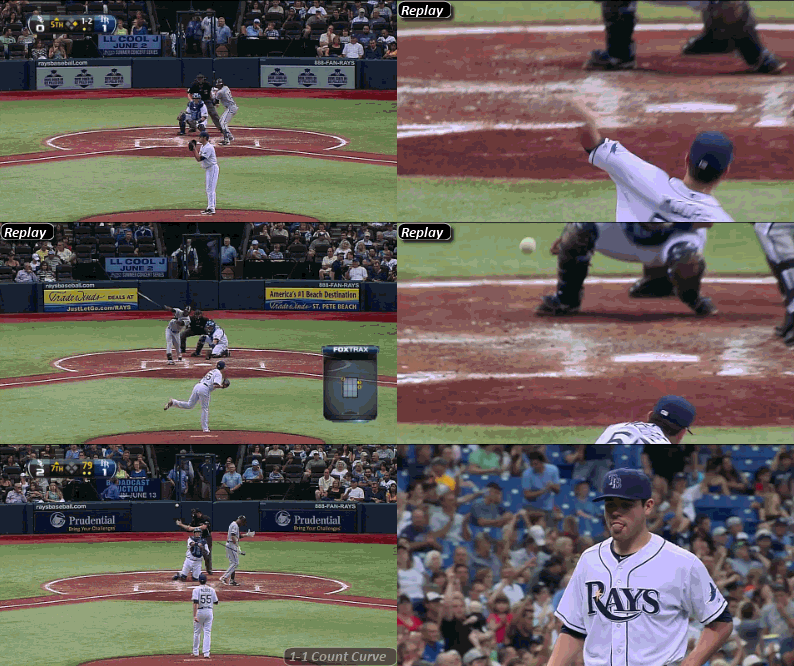
Baseball America rated the pitch as such on the 20-80 scale in their 2012 prospect guide, but he hasn’t thrown the 70-grade version too often this year.  On Monday, it might’ve been 80-grade.  He threw 15 benders, eight of which were swung (flailed?) at and four of which resulted in punch outs.  That doubled his season total for strikeouts on the curveball.  Meanwhile he got four more strikeouts out of his 21 changeups boosting his season total to 13 on the pitch.

Here are the four curveball strikeouts as well as an additional strong curveball that he threw in the seventh inning at-bat to Alexei Ramirez that resulted in one of the foursome:
How does he build on this game and enjoy more success as he continues through his rookie season?  He still needs to be more pitch efficient.  In the first inning alone he threw 15 pitches in two strike counts.  He had Alejandro De Aza and Paul Konerko 0-2 and Gordon Beckham 1-2.  He threw seven more pitches and eventually hit De Aza.  He eventually fanned Konerko and Beckham, but Konerko drew him full from 0-2 while Beckham fouled a pair of extra pitches off before going down.

It appears as though he is going to get about 105 pitches per outing so if he wants to go deep into games, he is going to have to average about 13-15 pitches per inning (that would give him seven-eight innings).  He is currently averaging 18.3 per inning.  His 4.14 pitches per plate appearance (P/PA) is the third highest amongst qualified starters just behind Felix Doubront (4.20) and Neftali Feliz (4.19).  Coincidentally enough, Sale is just behind Moore at 4.13 in his 57.7 innings.

Strikeout pitchers are naturally going to have a high P/PA than other pitchers, but consider that Moore’s 62% first strike percentage is highest by an average of 7% among those in the top 10 of P/PA meaning he isn’t taking advantage of his ability to get out ahead of hitters.  By getting ahead of hitters at that clip, he should still be able to generate strikeouts without expiring so much of allotted pitch count.

He will get it and there will be more and more glimpses of greatness on par with or better than Monday’s outing.  I certainly wouldn’t be surprised to see him get better as the season wore on.  In fact, I expect it.  While his in-game pitch count appears to be capped around the 105-mark, his innings for 2012 shouldn’t have any sort of cap that would leave him short of a full season’s allotment.

He threw 174 innings between the minors and majors (postseason included) last year so even if the Rays conservatively allotted an extra 25 this year, he could throw 199.  At his current pace of 32 starts with 5.7 innings per outing, he would throw about 182 innings.  That would still leave him plenty for a playoff run should the Rays win the division or secure one of the two wildcards.

In keeper leagues, he is no doubt coveted as one of the best in the game as he is still contributing this year and has an excellent long term outlook, but you might be able to get a discount in redraft leagues.  I would definitely explore the option and do so immediately as Monday might have cut into that discount already.  It may take still another month before we see some consistency out of him from start-to-start, but the second half of the season should yield more positive results than what we have seen thus far.

Tuesday: 05.29.2012

Roy Oswalt in 2012

It is being reported that the Texas Rangers have won the Roy Oswalt Sweepstakes, a not-too-shocking result on the heels of the Neftali Feliz injury, the ineffectiveness of Scott Feldman in his stead and the reticence of the Rangers to put Alexi Ogando back into the rotation in light of how excellent he has been as a bullpen asset.

The Rangers were always a frontrunner for Oswalt and while the Feliz injury may have expedited the process to get him signed, the Roy Halladay injury and subsequent DL’ing may have been the final push to get something done officially.  I don’t necessarily believe the Phillies would’ve made a big push for Oswalt, though.  Their staff can withstand a two month absence of Halladay as it is their abysmal hitting that leaves them tied for last in the division, four games behind the Washington Nationals.

What should the Rangers expect in an abbreviated season from the 34-year old righty making his foray into the American League?

They are getting a pitcher coming off of his worst season in a lot of respects: ERA, WHIP, fastball velocity, strikeout rate and innings pitched.  His xFIP of 3.95 was just 0.02 better than his career-worst mark set in 2007.  From 2002-2008, Oswalt was one of the most reliable starters in the game averaging 32 starts and 211 innings per season with 2003 standing as the only season that saw him throw fewer than 209 innings or make fewer than 32 starts (127 IP in 21 starts losing time to a recurring groin injury).

The 2009 season was the first time that back issues cropped up costing him some time and snapping his streak of five straight 200+ inning seasons (181 in 30 starts).  He bounced back with a vengeance in 2010 splitting time between Houston and Philly and posting his best ERA (2.76) and strikeout rate (8.2 K/9) since his rookie season (2.73 ERA & 9.1 K/9 in 142 IP).

Then last year he was limited to just 139 innings as the lower back issues returned and put him on the disabled list two separate times.  It clearly hampered his production as pointed earlier with the diminished velocity and suppressed production compared to his career marks.  He was still above average, but definitely vintage Oswalt.

A 34-year old Oswalt returning from back issues and trying his hand in the American League for the first time isn’t likely to be vintage Oswalt, either.  Having pitched in Houston for so many years, he was guaranteed interleague time against the Rangers so he has a sizeable in that ballpark.  The obvious caveat is that he had to face the Texas lineup which has seemingly always been good even when they were a third or fourth place team in their division.

A snapshot of his stats in Texas, against the AL as a whole, for his career and in the last three years shows the disparity in production in that ballpark.

Oswalt has always been a groundball pitcher with career 1.5 GB/FB and 47% groundball rates, however there has been a shift in recent years as his flyball rate has crept up a bit.  He still has a discernible groundball lean, but more flyballs than ever, too.  After ranging above 32% with his flyball rate just once from 2002-2008, Oswalt has been at 36% each of the last three years.  Meanwhile his groundball rate, which used to sit high-40s/low-50s, has been between 43-46% the last three years.

It is hard to even foster a guess what kind of peripherals we will see from Oswalt given the wide range of his recent track record and the great unknown of his back issues. Last year’s 6.0 K/9, if a new level for aged Oswalt, will likely erode some transitioning to the AL leaving him only marginally better than Feldman.  His 2.1 BB/9 from last year is significantly better than anything Feldman has ever posted, though, and the limiting of free passes has long been a calling card of Oswalt’s.

It will come down the command of his stuff.  With last year’s walk rate as good as ever, but the strikeout and hits allowed rates at their nadir, Oswalt was clearly displaying plenty of control but not much command as he pounded the zone with too many hittable pitches.  This isn’t Andy Pettitte/Roger Clemens hired gun stuff, rather it is a pitcher who likely knew he couldn’t make it through an entire season so he sat out the first two months in order to save some bullets.

Keep that in mind as your rush to place your FAAB bid or pick up Oswalt off of your waiver wire.  His name alone will draw attention and likely has him scooped off of any fastest-finger waiver wires, but I would be cautious in my expectations, especially in weekly transaction leagues.

Is he really more than a spot starter at best in 10 and 12 team mixed leagues?  How much of his struggles in Texas were the lineup and how much were the ballpark?  Getting starts in Oakland and Seattle helps mitigate the Texas starts, but I think we need to see something from him before trusting him fully.  I realize that will take you out of the running for him in most leagues as the FAAB bids will come long before he suits up, but that might not be such a bad thing if you can’t get him at a price commensurate with a 34-year old coming off of an injury-addled 2011.

In a 12 team mixed league where I could’ve scooped him on the open wire, I passed as I didn’t feel he was any better than my current staff that includes Dan Haren, James Shields, Matt Garza, Jordan Zimmermann, Jake Peavy, Max Scherzer, Derek Holland, Erik Bedard and some closers.  With names like Ervin Santana, Daniel Hudson, Tim Hudson and Brandon McCarthy on the wire, Oswalt doesn’t stand out as a “must have”.  If he doesn’t regain his velocity and thus his strikeout rate, can he really be expected to be anything other than Paul Maholm/Mike Leake circa 2011?  A solid performer likely to have some gems, but not a season saver for your fantasy team.

Monday: 05.28.2012

Trolling the Wire Notes: Week 10

Early games made it difficult to get any Monday picks in with the holiday, but the rest are updated in the sidebar.  Some of the picks are thinning out, but the TTW All-Stars include Felipe PaulinoAJ BurnettErik Bedard and of course, Edwin Jackson.  Jackson’s becoming less available, but he is still on enough wires to fit into the threshold.  I still like Anthony Bass despite a hiccup last week.  Meanwhile, JA Happ looks like he might be emerging as a solid option to rely on going forward for those who stream starters.  I was surprised to see Trevor Cahill down at 15% at ESPN, but I guess his peripherals have been pretty weak thanks in large part to his elevated walk rate after walking 3 in each of his last three starts.

Last week saw 12 of the 23 recommendations pick up a win.  That has to be an all-time high for TTW.  The ERA was nice at 3.53, but the WHIP was high at 1.40 thanks in large part to the aforementioned Bass as well as Ross Detwiler and Juan Nicasio getting smoked.  Detwiler lost his rotation spot to Chien-Ming Wang.  Not sure how I missed RA Dickey‘s second start against San Diego on Sunday.  I feel like that wasn’t listed when I checked the list last week because I had him for his May 22nd start in Pittsburgh.  Maybe it was an oversight on my part or a schedule change later on.  He was amazing in both, but now he’s on too many rosters too qualify.  And finally, Mike Minor has a lot to prove before reappearing on a TTW slate.

Last Wk: 12 W in 23 starts, 3.53 ERA, 1.40 WHIP, 7.2 K/9 in 133 IP

Tuesday: 05.22.2012

Take Notice: Anthony Bass

Anthony Bass made his major league debut in June of 2011 as a second-tier organizational prospect (#22 for the Padres according to Baseball America before the season) making the jump from AA in order to make a spot start.  He went five solid innings allowing five hits and just one run though he walked four and struck out just one en route to a win.  Considering that the start came in Colorado and he allowed 12 flyballs to just seven groundballs, things could have gone much worse especially with the four free passes.

He was sent to AAA where he spent the rest of June before re-joining the big league club.  He spent July, August and most of September as a reliever who Bud Black wasn’t afraid to use for more than an inning.  In 12 of his 24 outings, he went at least an inning and a third.  He went two-plus innings in eight of them.  I don’t think it is out of bounds to say he was run-of-the-mill during the stretch other than the fact that he could go multiple innings, an eroding trait of relievers or perhaps it is an eroding desire of managers to use relievers for one-plus.

He had a 1.89 ERA, 1.29 WHIP, 5.4 K/9 and 1.4 K/BB in his 33.3 innings with 4 holds.  The work earned him a pair of starts to close out the season.  The first: in Colorado.  He was even better this time around once again going five but allowing just two hits and one walk with a strikeout while holding the Rockies scoreless and earning his second win.  He ended his season with another five inning start, this time at home, during which he allowed a run on five hits with two walks and two strikeouts taking a no-decision for the effort.

The composite numbers yielded a solid 48.3 innings by ERA (1.68), but the other numbers told a different story as his 1.28 WHIP, 4.5 K/9 and 1.1 K/BB pointed toward a 4.62 xFIP.  He left 92% of his runners on base which is an excellent way to depress your ERA.  Less because of his performance and more because the Padres strengthened their system, Bass fell to #28 coming into 2012 according to Baseball America.  They worried his lack of consistent command would relegate him to the pen for the foreseeable future.

During Spring Training he threw 15 innings, but only got two starts.  Though it was a tiny sample, he walked just one batter while striking out nine.  I tend to put virtually zero stock into Spring Training numbers, but I don’t make decisions for the Padres and they obviously saw something they liked as he made the Opening Day roster and soon became the front-runner to take the injured Tim Stauffer’s rotation spot and be the fifth starter in the rotation.

He won the job outright and after a pair of two-inning outings to start the season, he made his first start on April 12th.  We have seen a new Bass so far.  He has six or more strikeouts in six of his eight starts and one of the other two was his debut during which he was limited to just 4.3 innings but still fanned five.  All told he has 51 strikeouts in 49 innings as a starter (he didn’t strike out or walk anyone in his four relief innings).

He has gone away from relying so much on his fastball shifting the mix over to his changeup and still seldom used sinker.  He has kept the majority of his 2011 fastball velocity and his mid-90s max isn’t much different, either, which is impressive considering the majority of his 2011 work came out of the bullpen where virtually everyone throws with more velocity knowing the workload will be shorter.

His command, the facet of his game that Baseball America thought might leave him a reliever permanently without massive development, have seen a sharp improvement leading to many more strikeouts.  He has seen a 6% rise in called strikes with his fastball and 8% with his changeup.  He is throwing the slider, his strikeout pitch, in the zone 4% more often and generating 3% more whiffs so while he has thrown 50 fewer sliders at this point than he did all of last year, he has just four fewer whiffs.

With two strikes last year, he was getting a lot of swings, but not many misses.  Fastballs were put into play 33% of the time, changeups were at 50% and the slider was at 17%.  All three are down significantly in 2012 with the fastball at 26%, the changeup at 32% and the slider at 15%.  Last year in two strike counts, he got a called third with the fastball just 8% of the time and the changeup just 5% of the time.

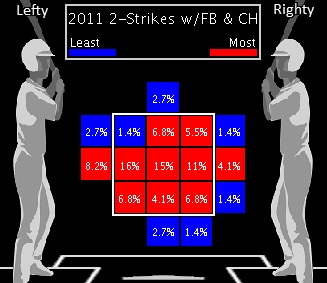
Control is putting the ball in the zone, command is putting the ball where you want it in the zone.  In 2012, his called strike percentage in two strike counts is up to 11% with the fastball and 18% with the changeup.  I didn’t include the slider because he doesn’t get called strikes with it (1 in ’11; 0 this year) and doesn’t really need to since it is his swing-and-miss pitch.  Look at the heat maps of his two strike pitches to get an even better idea of the difference between command and control.

Courtesy of ESPNTruMedia.com

Those pictures are all of his pitches skewing things a bit with this point about command since we’re focusing on the fastball and changeup.  Furthering the point another way, last year he populated the middle of the zone with his fastball and changeup in those two strike counts hitting it 42% of the time.  This year he is down to 28% in those middle three squares if you think of the strikezone as a nine square box.  Meanwhile he is pounding the bottom of the zone with those two pitches 36% of the time, up from just 17% last year.

We are seeing the emergence of Bass right before our eyes.  He has a three pitch mix (with a few sinkers sprinkled in) built on a solid low-to-mid 90s fastball and a swing-and-miss slider.  The changeup has a nice 9-11 MPH split from his fastball and continues to improve.  It is his least used pitch by a significant margin, but it is also more than a show me pitch already, too.  The 24-year old righty isn’t a PETCO product either, as his ERA at home is 3.09 compared to 2.57 on the road.  His skills improve away from PETCO Park as well suggesting he knows he can’t rely on a spacious field to cover his mistakes.

The 53-inning sample is a short one, I’ll grant that, but there are some real changes in Bass’s approach that suggest he is plenty real.  The fantasy community hasn’t exactly bought in en masse just yet, though.  He is on just 18% of rosters at ESPN, 29% at Yahoo! and 54% at CBS.  He has a real shot at becoming this year’s Cory Luebke which is an easy comp as they are teammates, though Luebke is lost for the season with an injury.

They both had similar pedigrees in the minors statistically, though Luebke found himself much higher on the prospect ranking at Baseball America checking in at #6 before last year’s breakout.  They both transitioned through the bullpen.  They are both displaying strikeout stuff that wasn’t present in the minors thanks in large part to wipeout sliders.  Luebke’s arsenal is a bit deeper, but I am making a general comparison, not a dead on 1:1.

Check your wire, there is a good chance that Bass is available.

Monday: 05.21.2012

Trolling the Wire Notes: Week 9

Lost some guys this past week as their availability rates shrunk taking them out of consideration for Trolling.  The causalities include:

Max Scherzer – knew that wouldn’t last long and 15 Ks will accelerate the process.

Ervin Santana – another one I knew wouldn’t last and a strong 2-start week sopped up his remaining availability.

Jeff Samardzija – he has really transformed himself this season as he has K’d just fewer than 6 twice in his 8 starts.

Chris Capuano – took his first loss in San Diego last week, but that hasn’t stopped him from being on 100% of ESPN league rosters.

Bud Norris – surprised and bummed about this one as he usually floats under the radar because of the Astros, but impossible to ignore his three win stretch during which he has a 0.47 ERA in 19 innings.

Check the sidebar for this week’s picks.

Last Wk: 8 W in 29 starts, 4.23 ERA, 1.39 WHIP, 9.5 K/9 in 164 IP

Wednesday: 05.16.2012

On Ross Detwiler

I am chronically a year early on players.  As the 2012 seasons unfolds, we get a chance to see who I was early on last year.  One such case has been Washington Nationals starter Ross Detwiler: see here and here.  I’m not exactly sure why I’m so often early, but Detwiler is hardly the first example (I was all over Matt Kemp for 2010 to name another, and thankfully I stayed the course for 2011).  OK, enough semi-humblebragging.  Better to be early than late, right?

The 26-year old southpaw was 6th overall pick in the 2007 out of Missouri State University.  He actually made his major league debut that September throwing a clean inning against the Atlanta Braves.  He spent all of 2008 in the minors, but then spent the next two years split between the minors and majors, though his 2010 season was cut short due to a busted hip.  He struggled to bring his minor league success (2.78 ERA, 1.43 WHIP, 8.2 K/9 and 2.8 K/BB in 120 IP) to majors putting together a modest 105 innings with a 4.78 ERA, 1.56 WHIP, 5.1 K/9 and 1.3 K/BB primarily as a starter with some bullpen work sprinkled in, too.

Part of the issue was that his 2.78 ERA in the minors during those two years likely skewed expectations toward the high side since his FIP outputs were significantly higher at each stop.  Even the peripherals likely raised expectations for Detwiler since the composite was pretty strong, but his work in AAA was a good bit below the total with a 7.3 K/9 and 2.1 K/BB.  Lefties as a whole can often take a bit longer to develop than their right-handed counterparts, though, so I kept faith in Detwiler heading into last year.  He showed some signs in 2011 finally cutting into his hit rate at 8.6 H/9, a career-best for any season whether in the minors or majors.

He has accumulated another 105 innings since the start of 2011 posting a 2.91 ERA, 1.20 WHIP, 5.9 K/9 and 2.3 K/BB with this year’s strikeout and walk rates improving again to 6.4 K/9 and 2.3 BB/9 (2.8 K/BB).  What has spurred the emergence of the promising 26-year old and more importantly, can he sustain it?

PITCH MIX

Detwiler is a four-pitch pitcher relying predominantly on his sinker and four-seamer and balancing them out with a curveball and changeup.  For his career, he has used the sinker 42% of the time, the four-seamer 29%, the curveball 15% and the changeup 14%.

That general split has held relatively firm every year save 2010 when he was throwing the four-seamer at 38% and the sinker just 26% while both secondary pitches were up at 18%.  This year he has shifted a bit taking 5% from the changeup and dispensing it to the four-seamer (now 32%) and curveball (17%), which is his best secondary pitch.  This shift has played a role in his success and based on what we have seen, even more curveball usage going forward would likely be a good thing for Detwiler.

VELOCITY

From 2009-2010, Detwiler was an 89-92 MPH guy with his fastballs with the ability to touch 93-94 MPH every now and then.  His sinker was 88-91 MPH while the four-seamer was 91-92 MPH.  In 2010 when he was using the four-seamer more than ever, it was actually at its slowest, registering a 90.7 MPH average.  His changeup sat 83-84 MPH for those two seasons while his curveball was a slow curve sitting 76-77 MPH.

Since 2011 he has seen a rise in velocity with all of his pitches.  The four-seamer now operates 93-95 MPH with 96+ in his back pocket when he needs it.  The sinker is up to 91-93 MPH now, too.  Meanwhile the slow curve has become more of a power curve elevating from 76-77 MPH in 2009-2010 to 79-81 MPH the last two years.

His changeup sat 83-84 MPH previously, but now resides 84-86 MPH.  He has always had about an 8.5 MPH split between the fastball and changeup except for 2010 when his four-seamer velocity dipped.  That year showed just a 7.7 MPH split.

STRIKEOUTS

The uptick in velocity since 2011 has no doubt been a contributing factor to his improved performance across the board including this year’s career-high 6.4 K/9 through 39 innings.  No one is going to confuse someone with a 6.4 K/9 for Nolan Ryan, but it’s nearly a strikeout higher than last year’s 5.6 K/9 and it is his first season over 6.0 after spending most of his minor league career at 8.0 K/9 or better.

He had a 6.8 K/9 in 142 innings at AAA so this newfound level might be his peak or close to it, but he would hardly be the first pitcher to add strikeouts as a major leaguer.  Minor league numbers can help give you an idea of how someone will perform, but they aren’t locked in stone indicators.  Madison Bumgarner spent two years on the wrong side of 6.5 K/9 before reaching the majors where he has a 7.6 K/9 career mark including an 8.4 K/9 in 205 innings last year.

The curveball has long been his strikeout pitch and the faster version of 2011-2012 is generating even more strikeouts.  In 2009-2010, he got a strikeout on 27% of the plate appearances that ended with a curve, but the last two years he is up at 40%.  When looking at why he has enjoyed a rise in Ks this year specifically, it is actually his fastball and changeup that are accounting for the jump.  The pair of pitches yielded a strikeout on just 10% of plate appearances that ended on one of them last year, but this year that mark is up to 13% spurred mostly by the changeup going up 5% to 14% in 2012.

GROUNDBALLS

The sharpest improvement for Detwiler in the early part of 2012 is the amount of groundballs he is inducing.  His sinker is the most effective it has ever been, inducing groundballs left and right en route to a career-best 54% rate (career 43% mark coming into 2012).

He has always been a groundball guy with a better than 1.0 groundball-to-flyball ratio, but this year’s contact against him has been overwhelmingly weak as the rise in groundball rate has come right out of his line drive rate which is down to 10%.  From 2009-2011, he carried an astronomically high line drive rate between 20% and 25%.

His line drive rate is going to see an uptick as the season progresses as 10% just isn’t sustainable.  The lowest line drive rate for an ERA qualifier going back to when that kind of data is available (2002) is 13.3% for Derek Lowe in 2002.  There have only been 12 seasons (spread among 11 pitchers as fake Fausto Carmona has two of them) under 15%.

The fact that it will rise and likely cut into his BABIP and subsequently his ERA isn’t a problem, though. I don’t think anyone expects him to finish the year with a 2.75 ERA and 1.09 WHIP anyway so some regression doesn’t make him a fraud.  How much regression is obviously the real question.

RUNNERS ON

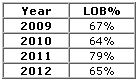
Even if he adds 5-6% to the line drive rate (most of which will go for hits as I believe the league BABIP on LDs is something like .700), his BABIP should remain on the right side of .300 as BABIP has never really been an issue with him as you saw from the chart above.  The problem is that not enough men who get on are left there.  Last year he enjoyed a 79% LOB rate, easily his highest rate ever and the first time in his career that he topped 67%.

Though off to his best start ever, he is still allowing 35% of his base runners to reach home.  League average is around 72% left on base.  He can cancel out most, if not all of his line drive rate regression by leaving more runners on base.  He doesn’t even need to push as high as league average to do so, either.  Of course, just because league average is 72% doesn’t mean pitchers are magically entitled to the mark.

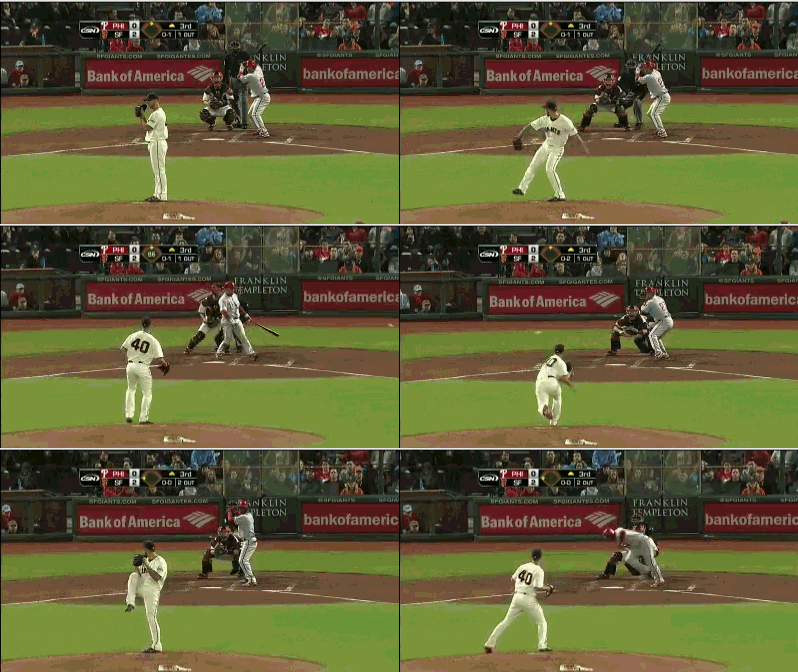
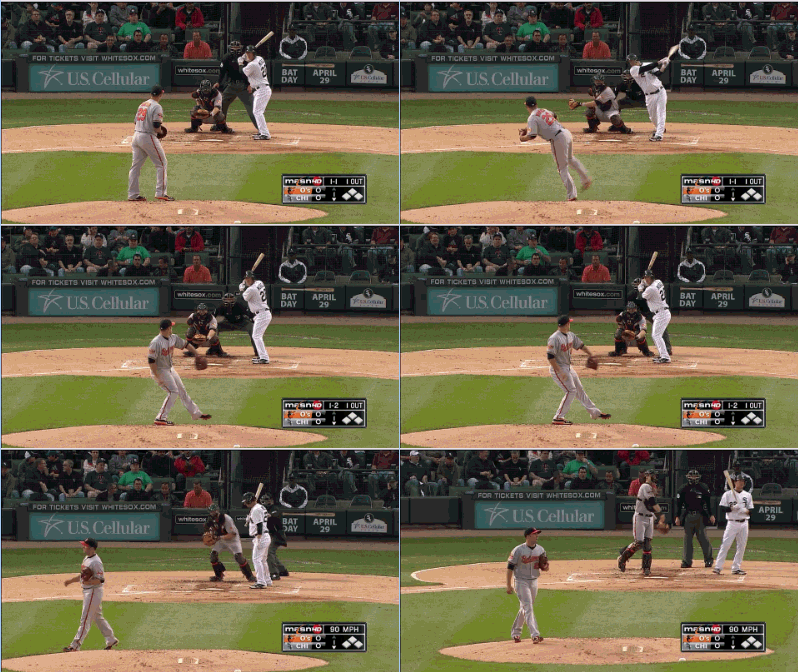
Sometimes it is a matter of focus with runners on that ends up as the missing link for pitchers, while others have markedly different wind ups and stretch positions.  For Detwiler, there isn’t a whole lot of difference between his wind up with the bases empty and his stretch with runners on so perhaps it is mental for him.

This GIF isn’t great, but my computer was being wonky as hell and this was like my 12th attempt so we’re going with it.  (I definitely need a new computer now that I’m a full-fledged GIFer… or is it GIFist… jeez, could anyone possibly care less about this last sentence?).

Detwiler has allowed a career .693 OPS with the bases empty as opposed to a .751 OPS with runners on.  Last year his split was .691 to .721, but this year he’s at an impressive .480 with the bases cleared compared to .730 with men on.  He showed last year that he can leave men on at an above average clip.  If he can even get to average this year, he will mitigate the pending regression in that line drive rate.

OUTLOOK

Though we are just 39 innings into the season, there are reasons to be excited about what Detwiler has shown especially if you extend it back to last year which is really when he started to show signs of being worth the 6th overall pick.

Any pitcher who can miss some bats and keep the ball down is likely to be successful on some level.  He doesn’t miss a ton of bats, but he misses enough at this current rate and I think there is the potential for a few more (perhaps pushing as high as 7.0 per game) if he continues to rely more on that curveball as a finisher.  Meanwhile his groundball rate is elite at 54% and allows him to carry a mid-6.0s strikeout rate yet remain very successful.

There haven’t been any wholesale changes to his approach this year (velocity, pitch mix, stance on mound, new pitch, etc…) that you would point to and say “this is why he is excelling”.  Rather it has been a maturation process that started back in 2011 when he began displaying more control as well as improved command.  The command has taken another step forward this year as continues to pound the zone, but leaves far fewer pitches “fat” where hitters can destroy them which is evidenced by the lowered line drive and elevated groundball rates.

He is becoming a better pitcher with more room to improve, too.  He just crossed the 200-inning threshold as a major leaguer this year, though, so temper expectations as he is still learning on the job.  From a fantasy perspective, trading Detwiler isn’t a bad idea if you get a nice offer, but don’t think that just because his numbers are excellent you can “sell high”.

Or at least sell high in the traditional sense.  A lot of fantasy managers probably didn’t even know who he was coming into the season so I doubt they are going to be ready to trade off a mint to acquire him after 39 big innings.  That doesn’t mean you can’t move him and get value in return.  Just don’t expect something commensurate with a 2.75 ERA and 1.09 WHIP if it were coming from someone like Zack Greinke or Cliff Lee.

Keep in mind that Detwiler was a last round pick or waiver pickup which play into his valuation.  That means if you can get some 16th-18th round guy, that is a pretty hefty return.  You might just want to hang on to your gem who is actually paying off, though, as so few ever do.  Even if he ends the season with a 3.75 ERA in 175 innings, it’s not like he will be getting slaughtered from here on out to get to that level.  He would post a 4.05 in 135 innings the rest of the way.

Monday: 05.14.2012

Trolling the Wire Notes

I just wanted to post a quick message letting you know that you can now find the Trolling the Wire picks in the sidebar before an accompanying post is put out.  In fact, there won’t always be an accompanying article outlining the reasoning behind the picks (like these two last week), but  I will at the very least post the picks in list form similar to how it appears in the sidebar since the sidebar isn’t always easily accessible in mobile formats.

If you have questions about someone I would urge you to comment on that post, tweet me @sporer or email me.  The reason that there won’t usually be an article anymore is because I want to dedicate more time to the other content like the pitcher breakdowns or “best pitches of the month” stuff you have seen this year.  By no means did I want to sacrifice Trolling as it is very popular and I think very useful, too, so this is the best way to still distribute it in my opinion.  Not to mention, I utilize a lot of the same guys and it gets a bit repetitive finding ways to tell you that Edwin Jackson should be on your team.

The picks are listed in order of confidence so if you have a choice between the 1st and 4th listed on your waiver wire, I like the 1st listed more.  I’ll include a guy if he’s 30% or more available at a primary outlet (ESPN, Y!, CBS) when I post.  For example, Max Scherzer might seem crazy, but he’s only 70% owned at ESPN and 65% at Yahoo! so he makes the cut.  I don’t suspect we’ll see him available too much longer, but for now he should be plucked.

Friday: 05.11.2012

Trolling the Wire – Weekend Edition

Here are the weekend selections:

SATURDAY

none

SUNDAY

Jeff Samardzija (CHC) – He’s been excellent this year without question.  I was skeptical when he debuted with a gem, felt justified for that skepticism when he followed it up with a pair of 5 ER outings, but now can’t help but be impressed by his last three outings during which he has yielded just 2 ER in 21 innings.  He also has 23 strikeouts in those three starts with a pair of wins.  (@ MIL)

A.J. Burnett (PIT) – He followed up his disastrous outing against the Cardinals with eight strong (2 ER) striking out 10 and walking just one.  He was left out to dry in that meltdown, but I don’t think it completely ruins his season.  Not only can be useful for your fantasy team the rest of the way, but it isn’t a stretch to suggest he finishes the season with a sub-4.00 ERA.  Let’s say he’ll go about 175 innings this season after missing a pair starts at the outset.  He’d only need to be a 3.64 ERA pitcher in his remaining 151 innings to finish with a 3.96 ERA for the season.  He’ll be fine.  (vs. HOU)

Edwin Jackson (WAS) – If you participated in Trolling last year, then you aren’t surprised to see Jackson here.  He was the most often recommended spot starter here last year.  To read/hear some write/speak about him, I can’t help but find him underrated.  You would think he has had a 4.50 ERA in the last three years as opposed to two sub-3.80 seasons along with a 4.47 one.  And in that latter one, he surged late posting a 3.24 ERA in 11 starts with the White Sox.  This year he has his best peripherals ever with a 7.9 K/9 and a 2.1 BB/9 which is a major improvement over anything he has ever done.  (@ CIN)

Jonathon Niese (NYM) – A pair of 4 BB starts bookend his 6 outings thus far raising his walk rate, but otherwise his peripherals are still sharp while his xFIP continues to suggest his ERA should be lower.  A trip into the cavernous Marlins Stadium seems like a nice remedy to get back on track after an OK start in Philly.


Tuesday: 05.8.2012

Trolling the Wire: Week 7

I spent of the first month of the season debating a different distribution method for the Trolling the Wire column that appeared weekly last year.  After deliberation, I’m just going to continue distributing as I did last year, through this site.  Some leagues allow same-day pickups so I’ll cover some guys for tonight along with the rest of the week.

(pitchers are ranked in order of confidence on a given day)

TUESDAY

Joe Blanton (PHI) – Those dismissing his complete game shutout against the Braves because it came after the marathon barn-burner the night before are missing out with Blanton.  He looked great before that start.  His strikeout rate is down to 5.4 which I don’t love, but his walk rate is on a five-year decline down to 0.8 BB/9.  (vs. NYM)

Edwin Jackson (WAS) – Last year’s TTW most used arm, Jackson is least available of the four listed (41% available at ESPN), but he is still underutilized.  Both his strikeouts and groundballs are at career-best marks (8.2 and 52%, respectively) while his walk rate is down to a career-low 2.3 BB/9.  Some people refuse to believe in E-Jax, but I remain steadfastly loyal.  (@ PIT)

Danny Duffy (KC) – I expected to see Duffy’s profile raise after a five-plus strong innings against the Yankees, but he remains widely available.  He needs to exhibit more control (4.8 BB/9), but he has built himself a solid margin for error with a 10.3 K/9 in his 23 innings.  (vs. BOS)

AJ Burnett (PIT) – Yes, St. Louis absolutely obliterated him and your fantasy team’s ERA, but you already sustained the worst of him so why jump off the train now?  He was excellent in his two starts prior to that massacre (btw, why the hell did Clint Hurdle leave him out there for that long?) and he has the stuff to get back on track again.  (vs. WAS)

Jarrod Parker (OAK) – The heralded rookie who was acquired in the Trevor Cahill deal has looked sharp in his first two outings in the American League including great work last week in Fenway.  He has a passable 6.2 K/9 rate in his first two starts, but I think we can expect to see that number rise as the season progresses.  Pitching in Oakland always helps, especially with mega-talented arms like Parker.  (vs. TOR)  — Parker was originally scheduled for Tuesday, then flipped with McCarthy for Wednesday and then flipped BACK again to Tuesday.  Thanks for the heads up from commenter Brad.

WEDNESDAY

Erik Bedard (PIT) – I’m going right back to the Pitt-Wash series well for Wednesday.  I guess the history of these two teams makes it difficult for fantasy managers to buy in on their starters and the early season success they are enjoying.  As I’ve said repeatedly, it’s never been about talent with Bedard, just health, so get everything you can out of him while he is whole.  He’s been great this year, though I’d like to see some more pitch efficiency.  Even in his last two starts where he only walked a pair in each, he has been able to go just five innings both times.  (vs. WAS)

Drew Smyly (DET) – What more does Smyly need to do for fantasy folks to buy in?  He has deftly handled Tamp Bay, Texas and the Yankees in New York yet his ownership rate is 45% at ESPN and somehow 32% at Yahoo!.  The added bonus is that he has shown some great strikeout potential, too, with 7 Ks in each of his last three outings (TEX, @ NYY, CHW).  He will have some ups and downs, but I’m buying in on the big picture.  (@ SEA)

Anthony Bass (SD) – Bass is an even more unheralded version of Smyly.  He started 2012 in the bullpen and after a pair of appearances in relief, he has moved into the rotation and looked fantastic.  Of course pitching in San Diego always enhances a pitcher’s value, but his two starts out of PETCO Park have been just fine, too.  He is missing bats (10.6 K/9 in his 5 starts) and getting tons of groundballs (55%).  His BABIP is a bit low (.247), but his 3.19 xFIP says he should be even better than his 3.51 ERA.  (vs. COL)

Ross Detwiler (WAS) – I have been a fan of Detwiler for a while and I’m glad that he is starting to display his talents at the major league level.  In limited time the last three years, he showed incremental improvements, but this year at age 26 he has taken a major step forward.  His secondary pitches are yielding both more strikeouts (career-high 6.7 K/9) and groundballs (career-high 58%) which has driven his success.  His .215 BABIP will certainly regress at some point, but there is enough to believe in with Detwiler and he shouldn’t be available in 52% of ESPN leagues.  (@ PIT)

THURSDAY

Henderson Alvarez (TOR) – Limited options with six games on Thursday and a handful of aces going, but Alvarez is coming off of a complete game shutout yet remains on the wire in many, many leagues.  The problem is that he couldn’t strike me out.  His 2.6 K/9 is frighteningly bad.  His game is to induce weak contact and let his fielders do the work (57% groundball rate), but you have to strikeout SOME batters.  He is going to have a game where several balls find the holes and he gets BABIP’d to death, but I think he will best Minnesota here.  (@ MIN)

FRIDAY

James McDonald (PIT) – Yes, another Pirates starter.  Unlike last year when their starters were drastically outperforming their peripherals, this year’s rotation actually has some strikeout arms doing pretty well yet not getting the love for it.  McDonald wasn’t missing bats early on (6 Ks through his first 3 starts) and I was concerned, but he has 25 Ks in 21 IP across three starts since without giving back the walk rate gains we saw at the start of the season.  A longtime favorite of mine, don’t be surprised if McDonald appears repeatedly on TTW as long as he remains available in many leagues.

Felipe Paulino (KC) – He’s back!  Unfortunately, Paulino started the season on the DL, but he returned last week with six shutout innings against the Yankees as he picked up where 2011 left off.  I really liked Paulino last year and I like him even more this year.  As with the Pirates starter, he is unlikely to get much love even with sustained success so jump in now.  (@ CHW)

Chris Capuano (LAD) – Fantasy managers are catching on with each passing start, but Capuano is still out there in 30% of ESPN leagues and 44% of Y! leagues so I thought he was worth mentioning.  That 2.21 ERA is going to regress a bit as home run issues have always been there with Capuano, but the strikeouts and mid-3.00s ERA by season’s end are well worth it.

Weekend picks on Friday