That quote is from Rod Allen in this afternoon’s game after he saw this from the Tigers superstar slugger:
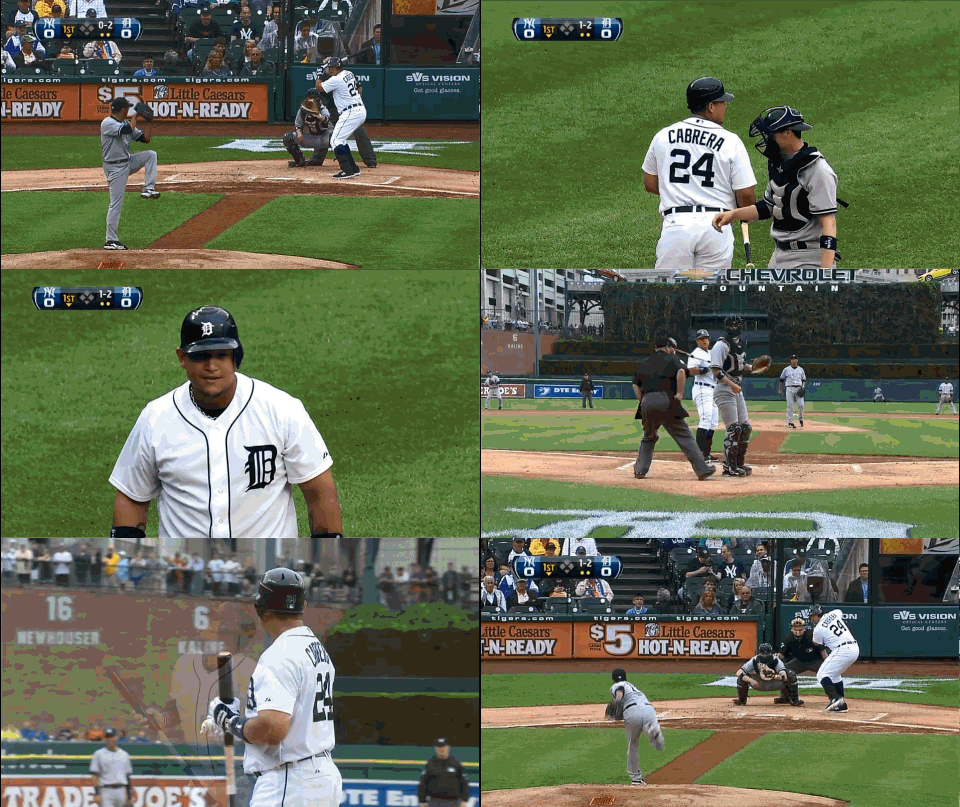
Easily the greatest sport ever…


That quote is from Rod Allen in this afternoon’s game after he saw this from the Tigers superstar slugger:
Lost in the shuffle of celebrating Chris Sale’s incredible 15 strikeout performance from Memorial Day is the fact that heralded prospect Matt Moore had far and away his best start of the season in the same game. Moore, a top three prospect anywhere you looked this preseason, has been consistently overshadowed by the opposing pitcher in his starts this season and while Monday was no different in that respect, it finally wasn’t because of Moore’s shortcomings.
Moore parlayed a pair of late season starts, one in the Bronx and one in Arlington during the playoffs, along with an exquisite minor league track record into a lofty preseason ranking on prospect lists everywhere. In many instances he out-ranked either Mike Trout or Bryce Harper including topping both at Baseball Prospectus as Kevin Goldstein slotted him atop the list. He never landed lower than third in the lists I saw.
The polished lefty had 497 minor league innings under his belt posting a 2.64 ERA, 1.11 WHIP, 12.7 K/9 and 3.3 K/BB. That said, just 53 of the innings came in AAA and his MLB experience amounted to all of 19 innings.
I am not pointing any fingers when it comes to preseason praise as I went against my own code and heaped plenty of praise on the rookie myself. Despite pointing out the pitfalls of teammates of David Price and Jeremy Hellickson during their rookie seasons, both uber-prospects like Moore, I still slotted him 10th in the American League projecting some Strasburgian success right out of the gate.
The control issues that plagued him early in his minor league career have been present in many of his starts this year resulting in a 4.4 BB/9 and preventing him from even seeing an eighth inning as high pitch counts have limited him to an average of 5.7 innings per start. He was in control on Monday and while he still didn’t see the eighth inning, he finish the seventh for the first time all year.
He was pulled after 104 pitches which just so happens to be exactly how many pitches he has averaged per start topping out at 109 and falling below 100 just once (97 in his May 22nd start). He threw a season-high 73 strikes, 18 of which were swinging, also a high watermark for the season. Strikeouts haven’t been an issue this year as his 9.2 K/9 is 10th-best in baseball, but Monday’s 10 were due in large part to Moore being in control of the hitters as opposed to neither Moore nor batter knowing exactly where the ball is going from pitch-to-pitch.
Great stuff can generate strikeouts at an elite clip whether it is paired with command and control or not, just ask Nolan Ryan among many others. That’s why it is important to make the distinction between Moore’s previous nine starts and the Memorial Day gem. While everything was working for him, it was the secondary stuff that really stood out, specifically his 70-grade curveball.
Baseball America rated the pitch as such on the 20-80 scale in their 2012 prospect guide, but he hasn’t thrown the 70-grade version too often this year. On Monday, it might’ve been 80-grade. He threw 15 benders, eight of which were swung (flailed?) at and four of which resulted in punch outs. That doubled his season total for strikeouts on the curveball. Meanwhile he got four more strikeouts out of his 21 changeups boosting his season total to 13 on the pitch.
Here are the four curveball strikeouts as well as an additional strong curveball that he threw in the seventh inning at-bat to Alexei Ramirez that resulted in one of the foursome:
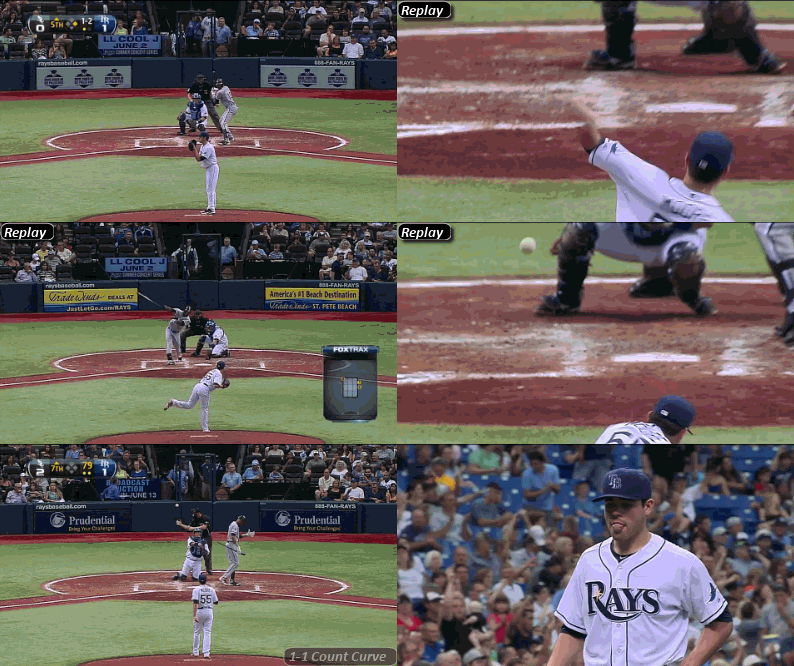
How does he build on this game and enjoy more success as he continues through his rookie season? He still needs to be more pitch efficient. In the first inning alone he threw 15 pitches in two strike counts. He had Alejandro De Aza and Paul Konerko 0-2 and Gordon Beckham 1-2. He threw seven more pitches and eventually hit De Aza. He eventually fanned Konerko and Beckham, but Konerko drew him full from 0-2 while Beckham fouled a pair of extra pitches off before going down.
It appears as though he is going to get about 105 pitches per outing so if he wants to go deep into games, he is going to have to average about 13-15 pitches per inning (that would give him seven-eight innings). He is currently averaging 18.3 per inning. His 4.14 pitches per plate appearance (P/PA) is the third highest amongst qualified starters just behind Felix Doubront (4.20) and Neftali Feliz (4.19). Coincidentally enough, Sale is just behind Moore at 4.13 in his 57.7 innings.
Strikeout pitchers are naturally going to have a high P/PA than other pitchers, but consider that Moore’s 62% first strike percentage is highest by an average of 7% among those in the top 10 of P/PA meaning he isn’t taking advantage of his ability to get out ahead of hitters. By getting ahead of hitters at that clip, he should still be able to generate strikeouts without expiring so much of allotted pitch count.
He will get it and there will be more and more glimpses of greatness on par with or better than Monday’s outing. I certainly wouldn’t be surprised to see him get better as the season wore on. In fact, I expect it. While his in-game pitch count appears to be capped around the 105-mark, his innings for 2012 shouldn’t have any sort of cap that would leave him short of a full season’s allotment.
He threw 174 innings between the minors and majors (postseason included) last year so even if the Rays conservatively allotted an extra 25 this year, he could throw 199. At his current pace of 32 starts with 5.7 innings per outing, he would throw about 182 innings. That would still leave him plenty for a playoff run should the Rays win the division or secure one of the two wildcards.
In keeper leagues, he is no doubt coveted as one of the best in the game as he is still contributing this year and has an excellent long term outlook, but you might be able to get a discount in redraft leagues. I would definitely explore the option and do so immediately as Monday might have cut into that discount already. It may take still another month before we see some consistency out of him from start-to-start, but the second half of the season should yield more positive results than what we have seen thus far.
I am chronically a year early on players. As the 2012 seasons unfolds, we get a chance to see who I was early on last year. One such case has been Washington Nationals starter Ross Detwiler: see here and here. I’m not exactly sure why I’m so often early, but Detwiler is hardly the first example (I was all over Matt Kemp for 2010 to name another, and thankfully I stayed the course for 2011). OK, enough semi-humblebragging. Better to be early than late, right?
The 26-year old southpaw was 6th overall pick in the 2007 out of Missouri State University. He actually made his major league debut that September throwing a clean inning against the Atlanta Braves. He spent all of 2008 in the minors, but then spent the next two years split between the minors and majors, though his 2010 season was cut short due to a busted hip. He struggled to bring his minor league success (2.78 ERA, 1.43 WHIP, 8.2 K/9 and 2.8 K/BB in 120 IP) to majors putting together a modest 105 innings with a 4.78 ERA, 1.56 WHIP, 5.1 K/9 and 1.3 K/BB primarily as a starter with some bullpen work sprinkled in, too.
Part of the issue was that his 2.78 ERA in the minors during those two years likely skewed expectations toward the high side since his FIP outputs were significantly higher at each stop. Even the peripherals likely raised expectations for Detwiler since the composite was pretty strong, but his work in AAA was a good bit below the total with a 7.3 K/9 and 2.1 K/BB. Lefties as a whole can often take a bit longer to develop than their right-handed counterparts, though, so I kept faith in Detwiler heading into last year. He showed some signs in 2011 finally cutting into his hit rate at 8.6 H/9, a career-best for any season whether in the minors or majors.
He has accumulated another 105 innings since the start of 2011 posting a 2.91 ERA, 1.20 WHIP, 5.9 K/9 and 2.3 K/BB with this year’s strikeout and walk rates improving again to 6.4 K/9 and 2.3 BB/9 (2.8 K/BB). What has spurred the emergence of the promising 26-year old and more importantly, can he sustain it?
PITCH MIX
Detwiler is a four-pitch pitcher relying predominantly on his sinker and four-seamer and balancing them out with a curveball and changeup. For his career, he has used the sinker 42% of the time, the four-seamer 29%, the curveball 15% and the changeup 14%.
That general split has held relatively firm every year save 2010 when he was throwing the four-seamer at 38% and the sinker just 26% while both secondary pitches were up at 18%. This year he has shifted a bit taking 5% from the changeup and dispensing it to the four-seamer (now 32%) and curveball (17%), which is his best secondary pitch. This shift has played a role in his success and based on what we have seen, even more curveball usage going forward would likely be a good thing for Detwiler.
VELOCITY
From 2009-2010, Detwiler was an 89-92 MPH guy with his fastballs with the ability to touch 93-94 MPH every now and then. His sinker was 88-91 MPH while the four-seamer was 91-92 MPH. In 2010 when he was using the four-seamer more than ever, it was actually at its slowest, registering a 90.7 MPH average. His changeup sat 83-84 MPH for those two seasons while his curveball was a slow curve sitting 76-77 MPH.
Since 2011 he has seen a rise in velocity with all of his pitches. The four-seamer now operates 93-95 MPH with 96+ in his back pocket when he needs it. The sinker is up to 91-93 MPH now, too. Meanwhile the slow curve has become more of a power curve elevating from 76-77 MPH in 2009-2010 to 79-81 MPH the last two years.
His changeup sat 83-84 MPH previously, but now resides 84-86 MPH. He has always had about an 8.5 MPH split between the fastball and changeup except for 2010 when his four-seamer velocity dipped. That year showed just a 7.7 MPH split.
STRIKEOUTS
The uptick in velocity since 2011 has no doubt been a contributing factor to his improved performance across the board including this year’s career-high 6.4 K/9 through 39 innings. No one is going to confuse someone with a 6.4 K/9 for Nolan Ryan, but it’s nearly a strikeout higher than last year’s 5.6 K/9 and it is his first season over 6.0 after spending most of his minor league career at 8.0 K/9 or better.
He had a 6.8 K/9 in 142 innings at AAA so this newfound level might be his peak or close to it, but he would hardly be the first pitcher to add strikeouts as a major leaguer. Minor league numbers can help give you an idea of how someone will perform, but they aren’t locked in stone indicators. Madison Bumgarner spent two years on the wrong side of 6.5 K/9 before reaching the majors where he has a 7.6 K/9 career mark including an 8.4 K/9 in 205 innings last year.
The curveball has long been his strikeout pitch and the faster version of 2011-2012 is generating even more strikeouts. In 2009-2010, he got a strikeout on 27% of the plate appearances that ended with a curve, but the last two years he is up at 40%. When looking at why he has enjoyed a rise in Ks this year specifically, it is actually his fastball and changeup that are accounting for the jump. The pair of pitches yielded a strikeout on just 10% of plate appearances that ended on one of them last year, but this year that mark is up to 13% spurred mostly by the changeup going up 5% to 14% in 2012.
GROUNDBALLS
The sharpest improvement for Detwiler in the early part of 2012 is the amount of groundballs he is inducing. His sinker is the most effective it has ever been, inducing groundballs left and right en route to a career-best 54% rate (career 43% mark coming into 2012).
He has always been a groundball guy with a better than 1.0 groundball-to-flyball ratio, but this year’s contact against him has been overwhelmingly weak as the rise in groundball rate has come right out of his line drive rate which is down to 10%. From 2009-2011, he carried an astronomically high line drive rate between 20% and 25%.

His line drive rate is going to see an uptick as the season progresses as 10% just isn’t sustainable. The lowest line drive rate for an ERA qualifier going back to when that kind of data is available (2002) is 13.3% for Derek Lowe in 2002. There have only been 12 seasons (spread among 11 pitchers as fake Fausto Carmona has two of them) under 15%.
The fact that it will rise and likely cut into his BABIP and subsequently his ERA isn’t a problem, though. I don’t think anyone expects him to finish the year with a 2.75 ERA and 1.09 WHIP anyway so some regression doesn’t make him a fraud. How much regression is obviously the real question.
RUNNERS ON
Even if he adds 5-6% to the line drive rate (most of which will go for hits as I believe the league BABIP on LDs is something like .700), his BABIP should remain on the right side of .300 as BABIP has never really been an issue with him as you saw from the chart above. The problem is that not enough men who get on are left there. Last year he enjoyed a 79% LOB rate, easily his highest rate ever and the first time in his career that he topped 67%.
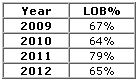
Though off to his best start ever, he is still allowing 35% of his base runners to reach home. League average is around 72% left on base. He can cancel out most, if not all of his line drive rate regression by leaving more runners on base. He doesn’t even need to push as high as league average to do so, either. Of course, just because league average is 72% doesn’t mean pitchers are magically entitled to the mark.
Sometimes it is a matter of focus with runners on that ends up as the missing link for pitchers, while others have markedly different wind ups and stretch positions. For Detwiler, there isn’t a whole lot of difference between his wind up with the bases empty and his stretch with runners on so perhaps it is mental for him.
This GIF isn’t great, but my computer was being wonky as hell and this was like my 12th attempt so we’re going with it. (I definitely need a new computer now that I’m a full-fledged GIFer… or is it GIFist… jeez, could anyone possibly care less about this last sentence?).

Detwiler has allowed a career .693 OPS with the bases empty as opposed to a .751 OPS with runners on. Last year his split was .691 to .721, but this year he’s at an impressive .480 with the bases cleared compared to .730 with men on. He showed last year that he can leave men on at an above average clip. If he can even get to average this year, he will mitigate the pending regression in that line drive rate.
OUTLOOK
Though we are just 39 innings into the season, there are reasons to be excited about what Detwiler has shown especially if you extend it back to last year which is really when he started to show signs of being worth the 6th overall pick.
Any pitcher who can miss some bats and keep the ball down is likely to be successful on some level. He doesn’t miss a ton of bats, but he misses enough at this current rate and I think there is the potential for a few more (perhaps pushing as high as 7.0 per game) if he continues to rely more on that curveball as a finisher. Meanwhile his groundball rate is elite at 54% and allows him to carry a mid-6.0s strikeout rate yet remain very successful.
There haven’t been any wholesale changes to his approach this year (velocity, pitch mix, stance on mound, new pitch, etc…) that you would point to and say “this is why he is excelling”. Rather it has been a maturation process that started back in 2011 when he began displaying more control as well as improved command. The command has taken another step forward this year as continues to pound the zone, but leaves far fewer pitches “fat” where hitters can destroy them which is evidenced by the lowered line drive and elevated groundball rates.
He is becoming a better pitcher with more room to improve, too. He just crossed the 200-inning threshold as a major leaguer this year, though, so temper expectations as he is still learning on the job. From a fantasy perspective, trading Detwiler isn’t a bad idea if you get a nice offer, but don’t think that just because his numbers are excellent you can “sell high”.
Or at least sell high in the traditional sense. A lot of fantasy managers probably didn’t even know who he was coming into the season so I doubt they are going to be ready to trade off a mint to acquire him after 39 big innings. That doesn’t mean you can’t move him and get value in return. Just don’t expect something commensurate with a 2.75 ERA and 1.09 WHIP if it were coming from someone like Zack Greinke or Cliff Lee.
Keep in mind that Detwiler was a last round pick or waiver pickup which play into his valuation. That means if you can get some 16th-18th round guy, that is a pretty hefty return. You might just want to hang on to your gem who is actually paying off, though, as so few ever do. Even if he ends the season with a 3.75 ERA in 175 innings, it’s not like he will be getting slaughtered from here on out to get to that level. He would post a 4.05 in 135 innings the rest of the way.
Earlier this month, I brought you the Best Pitches of April for starting pitchers. That was back on May 2nd. I wanted to share the same for relievers. Ideally going forward, I will present both the starters and relievers early in month as opposed to one iteration in the middle of the month.
To determine the “best” pitches of the month, I will be using FanGraphs Pitch Values and then supplying GIF-based examples of those of pitches. FanGraphs offers pitch values on fastball, slider, cutter, curveball, changeup, split-finger and knuckleball pitches, but for this exercise, we will be looking at the first six as no reliever throws a knuckleball.
I’ll list the top overall value for each pitch, the top value in the other league (so if 1st place is from an NL guy, I’ll list the top AL guy even if he’s further down the list) and also the top surprise listing which is of course arbitrary to my own tastes. GIFs will be included for the Top Overall in each pitch only.
FASTBALL
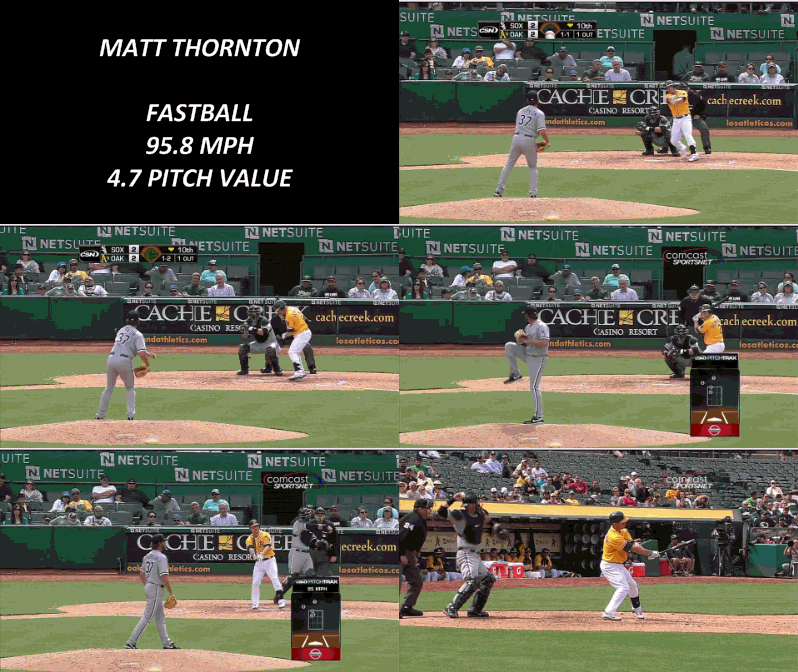
Thornton has long had a great fastball registering pitch values of 17 and 19 in 2008 and 2010, respectively. In fact it was the emergence of his fastball in 2008 that took him from a solid reliever to an elite one resulting in a 2010 All-Star bid. His fastball helped him to a 0.82 ERA in 11 innings in April with 10 strikeouts.
Here is a series of fastballs from Thornton to Oakland’s Cliff Pennington on April 25th in the bottom of the 10th inning.
SLIDER
Ogando would be a mid-rotation starter on most teams and no worse than a closer on many others. On the insanely deep Texas Rangers, he is a bridge reliever pitching crucial innings to get to Mike Adams and Joe Nathan. There is a ton of value in his role as managers often save their closer, ostensibly their best reliever, for save situations only.
With Ogando, manager Ron Washington gets to use his best reliever when it actually matters most: those especially sticky 6th, 7th and 8th inning situations. Perhaps the best part is that Ogando can give you more than three outs without incident, in fact the best deployment of him should include more than an inning of work.
Here are some sliders from Ogando to both Brent Morel of the White Sox on April 6th and Miguel Cabrera of the Tigers on April 22nd. The White Sox game is in the bottom of the 7th and the Tigers game is in the bottom of the 8th.

CUTTER
Of course Texas relievers had two of the best pitches in April. This team is just so ridiculously stocked top to bottom. I remember when the Rangers were talking trade with the Padres and everyone assumed they would go for Heath Bell. When it turned out they “only” got Adams, some thought they settled. Even before this year’s implosion with Bell, it was obvious they got the much better reliever. That said, they paid a premium in Robbie Erlin and Joe Wieland so they deserved to get the better reliever.
Here is some of Adams’ work with the cutter against Ben Zobrist of Tampa Bay in the top of the 8th inning of an April 28th meeting.

CURVEBALL
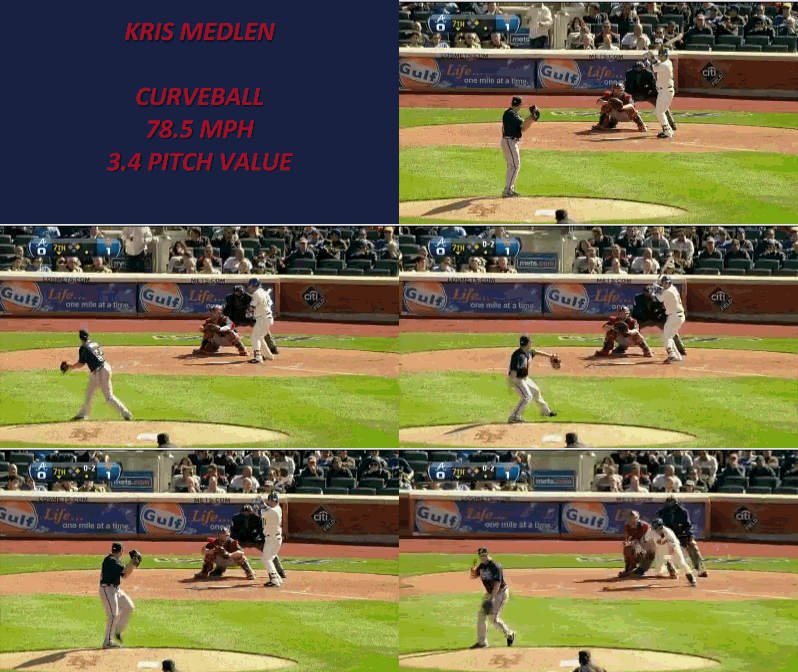
Medlen doesn’t quite reach Ogandian levels, but he is another favorite of mine who shows the embarrassment of riches that the Braves have on their staff. He would definitely be starting on a lot of teams, but the Braves have the luxury of using him as a multi-inning middle reliever.
Hopefully manager Freddie Gonzalez lets Medlen absorb a substantial workload so he doesn’t run Craig Kimbrel and Jonny Venters into the ground again this year. Medlen had outings of 2.0, 2.7 and 3.0 IP in April giving up just two runs in 13 innings of work.
Here is his curveball working against Justin Turner in an Opening Day (April 5th) meeting with the New York Mets in the bottom of the 7th inning.
CHANGEUP
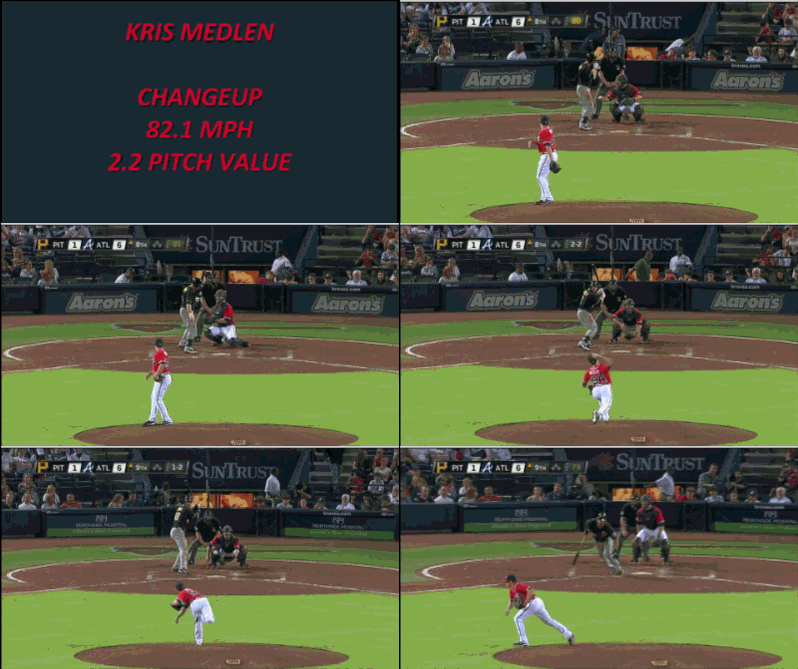
See why I think this guy could be starting? He had two of the best pitches among relievers in the month of April. He hasn’t been getting strikeouts at the level we are used to seeing from him (career 7.5 K/9, just 2.8 K/9 in April), but he has the capability and I think they will come as the season progresses. He notched 4 Ks in his 2.7 inning outing against the Mets on April 17th.
Here is his changeup against a pair of Pirates, Alex Presley and Garrett Jones, from an April 27th meeting in Turner Field during the top of the 8th and 9th innings.
SPLIT-FINGER
Remember when Arredondo was awesome? OK, awesome might be a stretch, but his rookie year saw him throw 61 innings with a 1.62 ERA, 1.05 WHIP and a 10-2 record. That is all awesome, but the 8.1 K/9 and 2.5 K/BB don’t necessarily marry up with the performance which is why that season probably falls just short of awesome. He followed it up with a 6.00 ERA in 45 innings. He missed all of 2010 to injury before resurfacing with Cincinnati last year.
He has become a useful entity in the bullpen again notching a 10.1 K/9 in April, the highest of his career (which he has continued through May thus far). He only allowed runs in one of his 10 April outings, too, yielding a 2.53 ERA in 10.7 innings.
Here is his splitter

We are a month into another great season of baseball and we have seen plenty of great pitching already both unexpected and expected starting most notably with Phil Humber’s perfect game continuing on with Jeff Samardzija and Jason Hammel’s out-of-nowhere emergence and Joe Saunders’ MLB-best 0.90 ERA on the unexpected side ranging over to the expected of Roy Halladay, Justin Verlander and Stephen Strasburg mowing through their opponents with little to no resistance.
With all of that great pitching in mind, I wanted to look at the best pitches of the month. This idea was at least partially influenced by BP colleague Sam Miller’s ridiculously excellent series highlighting the best pitches of the week. I was wanting to do something like this last year, but lacked the means to acquire GIFs such as those you’ll see below and reading Sam’s work on the week’s best pitches jogged my memory and ended up as the impetus to make my computer GIF-ready and introduce the series.
To determine the “best” pitches of the month, I will be using FanGraphs Pitch Values and then supplying GIF-based examples of those of pitches. FanGraphs offers pitch values on fastball, slider, cutter, curveball, changeup, split-finger and knuckleball pitches, but for this exercise, we will be looking at the first five as so few actually throw a split-finger and only R.A. Dickey throws a knuckleball among qualified starting pitchers.
I’ll list the top overall value for each pitch, the top value in the other league (so if 1st place is from an NL guy, I’ll list the top AL guy even if he’s further down the list) and also the top surprise listing which is of course arbitrary to my own tastes. GIFs will be included for the Top Overall in each pitch only.
FASTBALL
Lynn is using his fastball almost 10% less than he did last year when he was coming out of the bullpen shifting that pitch mix over to his slider and changeup as he has made a seamless transition and almost made Cardinals fans forget Chris Carpenter, who is shelved with an injury.
Perhaps most impressive of all is that Lynn’s heater lost just 0.9 MPH in the shift. Oftentimes since relievers are max effort hurlers used an inning at a time, their velocity will be higher than it would as a starter, but Lynn has maintained his heat almost entirely. Lynn is 4-0 with a 1.33 ERA, 0.81 WHIP, 8.0 K/9 and 4.0 K/BB in 27 IP.
Here is a look at some Lynn fastballs from his April 14th home start against the Chicago Cubs. He is facing off against Marlon Byrd in the top of the 5th inning. Byrd is befuddled. (Please excuse the very amateur GIF’ing as these are literally my first GIFs ever on a program that is brand new to me. Hopefully you see improvement as the list progresses as I started to get the hang of it by the time I was working on the changeup leader.)

SLIDER
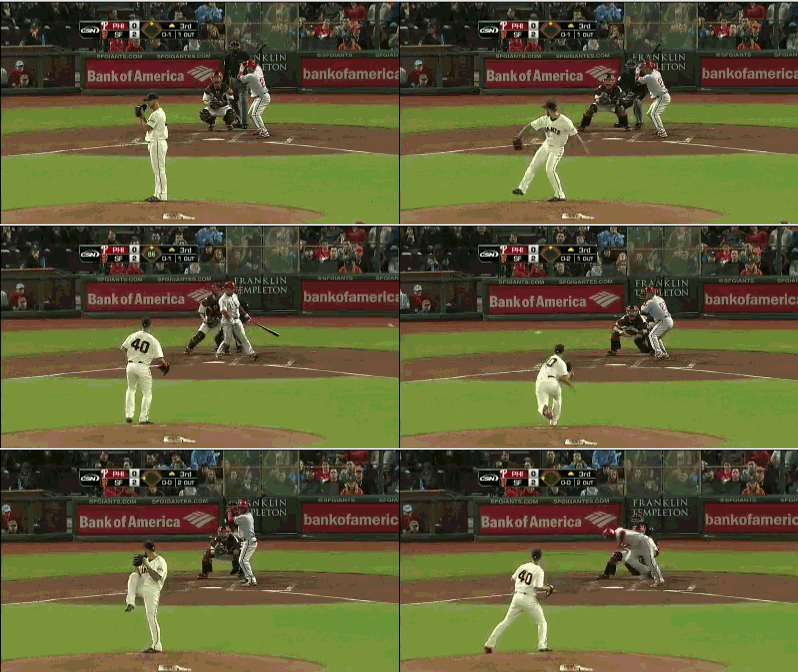
If sliders do eat up a starter’s arm then Bumgarner could be in trouble in the future. He is throwing his fastball 14% less than last year (down to 39%) and 8% of that workload has gone to his devastating slider which is serving him quite well to start the season as he has a 2.53 ERA and 1.09 WHIP in his 32 IP of work. His groundball rate is up to a career-best 55% (not counting the 58% in 10 IP from 2009), but his strikeout rate is way down thanks to just 7 K in his first three starts spanning 17.3 IP.
Since, he has 10 K in 14.7 IP across two starts for a much more palatable 6.1 K/9 compared to his season mark of 4.8 K/9. The surface results are there, but the peripherals are lagging behind a bit save the groundball rate and I’m at least a tick concerned about the escalating slider workload (from 20% in 2010 to this year’s 40%). Of course, then I watch him throw it and understand why he wants to rely on it so much.
Here he is throwing the beautiful breaker in his April 17th start against the Philadelphia Phillies in the top of the 3rd inning against both Placido Polanco and Jimmy Rollins.
CUTTER
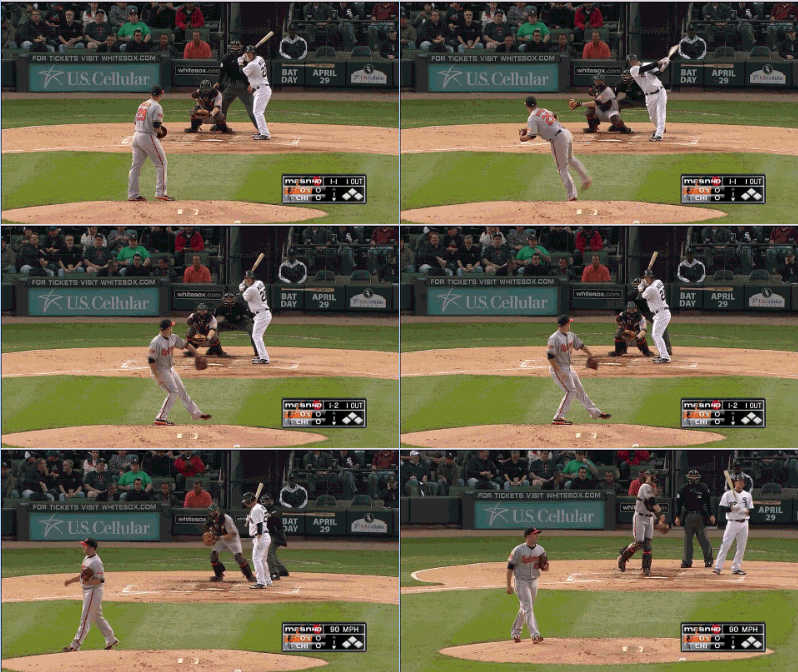
Hunter atop any of these lists might be a bit of a surprise to some as he is a league average pitcher at best who hasn’t reached 130 IP in any of his three major league seasons, but last year his cutter netted a 6.6 value which was good for 8th in all of baseball among pitchers with 80+ IP.
Hunter hasn’t parlayed his big cutter into any real success thus far toting a 4.26 ERA and 1.33 WHIP in 32 innings across five starts. His control is at a career-worst 3.1 BB/9 pairing with his 5.1 K/9 to yield a meager 1.6 K/BB.
Here is Hunter taking care of Brent Morel in the bottom of the 1st inning of his April 18th start against the Chicago White Sox.
CURVEBALL
Niese continues his quest to get his ERA below 4.00 and down to the level of his xFIP (ranging from 3.28 to 3.80 since 2010) and currently sits on the precipice with a 4.08 ERA. He is dogged by a 15% HR/FB thus far as his 3.45 xFIP is much more palatable. Meanwhile his curveball has heavily aided his 7.5 K/9 thus far with 47% of plate appearances that end on curveballs resulting in a strikeout.
It has never been about talent with Bedard, rather health as he hasn’t reached 130 IP since 2007 so it isn’t too surprising that his first five starts with the Pirates have gone pretty well. He has a 2.48 ERA, but a 1.41 WHIP thanks to his .337 BABIP. He has an 8.1 K/9 and 2.2 K/BB in 29 IP. His curveball has been his calling card throughout his injury-addled career along with a strong fastball, but this year’s fastball value is being eaten up by a .396 BABIP resulting in a -1.6 value thus far.
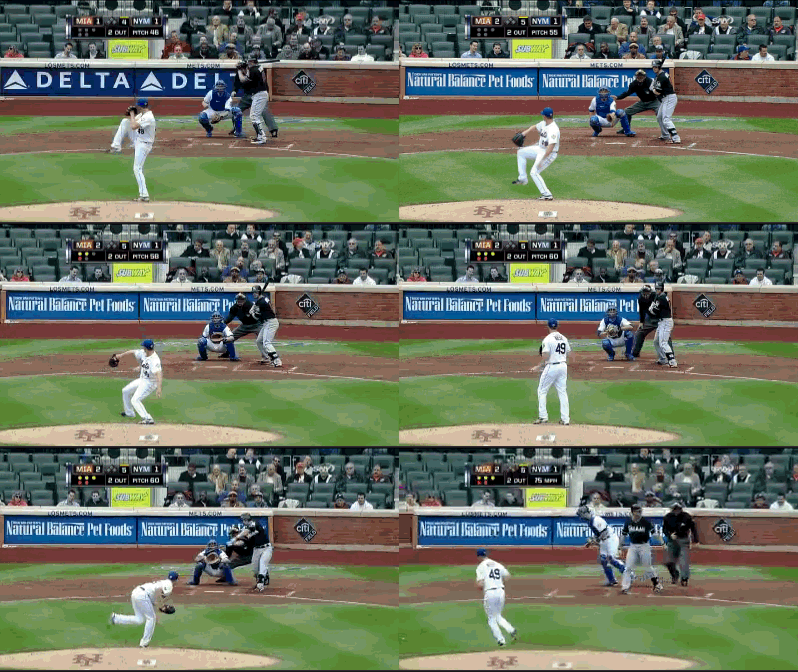
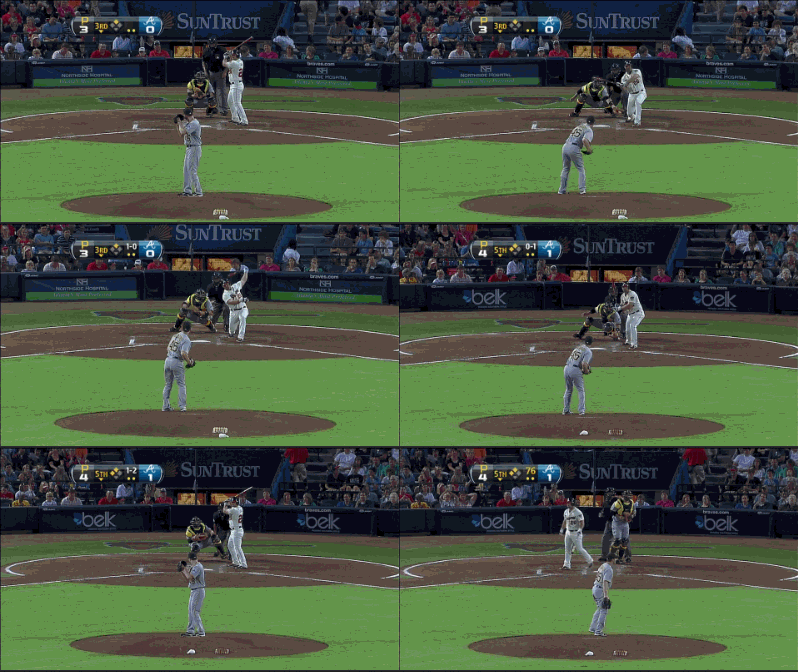
Here is Niese’s curve from his April 26th start against the Miami Marlins with a splicing of pitches from a faceoff with Austin Kearns in the top of the 4th and Brett Hayes in the top of the 6th. Also you will see Bedard’s curveball from a pair of at-bats against Dan Uggla on April 28th in the bottom of the 3rd and 5th innings.
CHANGEUP
Milone entered his Monday night start against the Boston Red Sox with a 2.00 ERA and 0.87 WHIP impressing along the way despite a modest opponent list of Kansas City, Seattle, Los Angeles and Chicago (the bookends both at home). The Red Sox would be his first real challenge, especially in Fenway.
They greeted him and his 87 MPH fastball rather rudely as he allowed 7 ER in 4.7 IP pushing his ERA to 3.69 in the process. Milone is a command and control lefty who doesn’t generate many strikeouts due to a lack of overpowering stuff and needs to effectively change speeds to have success so it isn’t entirely surprising to see him atop the changeup list.
Here he is during his April 24th start, a much more successful outing against the Chicago White Sox during which he threw eight scoreless innings of ball. Take a look at four changeups across two at-bats, first against Paul Konerko in the top of the 1st and then against Tyler Flowers in the top of the 2nd.

 Baseball By Paul