Archive for ‘Off-Season’

Thursday: 12.6.2012

Dan Haren in Washington

If Dan Haren had somehow been a free agent last year, he would’ve commanded a mint. It would’ve certainly topped C.J. Wilson’s five year deal for $77.5 million which was the highest among pitchers changing teams (C.C. Sabathia signed five year extension for $122 million with the Yankees). Alas, Haren was in the fourth and final guaranteed year of a $44.75 million dollar deal that included a club option for $15.5 million in 2013. Given his track record as one of the most reliable, quality arms in the game, it was easy to envision that getting picked up and Haren becoming a free agent for the 2014 season.

Things didn’t go according to plan for Haren. While he has suffered back and hip soreness for quite some time, neither had interfered with him establishing himself as one of the game’s true workhorses with 33 or more starts in seven straight seasons never throwing fewer than 216 innings and rising yearly since 2008 to a 2011 peak of 238. So of course with the worst timing possible, he is struck down by the back for his first ever DL stint in early July. Worse yet, the time missed is less of an issue than the damage to his performance as he labored to a 4.33 ERA and 1.29 WHIP (both full season career highs) in 177 innings.

The Angels declined the option instead paying him $3.5 million to test the market where he found out yesterday he was worth $13 million dollars for a year to the Washington Nationals.  When you add in the buyout, he is actually going to make a million more than he would’ve had he been kept on in LA, but now with just a one year deal, he has to prove himself to the league before he will command another multi-year contract.

As Sam Miller pointed out yesterday on Baseball Prospectus, the declining velocity is a growing concern in addition to the back and hip especially since they may well be related. And given the uncertainty around his health, it is difficult to project how Haren will perform in 2013, but let’s try to get some clarity anyway.

LEAGUE/BALLPARK

Shifting from the American League to the National League often benefits a starting pitcher and we’ve seen that in Haren’s career already. Excluding the 119 innings as a Cardinal split over two years from ages 22 to 23, we see that Haren pitched to a 3.59 ERA with a 7.2 K/9 and 1.9 BB/9 in 1172 innings between Oakland and Los Angeles compared to a 3.56 ERA, 8.7 K/9, and 1.6 BB/9 in 586 innings with Arizona.

In the last five years, the difference in ERA between starters in each league is 0.24 favoring the National League. That figure is on the rise recently after a 0.20 split in 2010 rose to 0.28 in 2011 and then 0.32 last year. Strikeout rates favor the NL by 0.3 and those have held pretty steady in recent years as well while walk rates are essentially dead even.

Any potential gains from the league switch may well be washed out by the trade in home parks. Angels Stadium remains overlooked as one of the most pitcher friendly parks in the game. He is leaving the park that ranked third-friendliest for pitchers (according to Baseball-Reference) last year and fourth-friendliest over the last three years to enter the 16th-friendliest from last year and over the last three years. Nationals Park has essentially been a dead even park for its entire existence. On the scale, 100 is even and the park has never rated higher than 101 for pitchers or lower than 98 for batters in a given year.

Digging deeper shows even more potential pitfalls for Haren. Over at Statcorner, they give a lefty-righty breakdown of each park factor in several categories. They show the home run park factor in Anaheim to be at 82 for lefties (again with 100 being average) and 80 for righties while it jumps to 96 and 106, respectively in D.C.

Let’s not forget that Haren spent a good bit of time in a hitter’s park when he was with the Diamondbacks from 2008 through half of 2010 before being traded to LA. During that time the park rated at 107, 106, and 105 for pitchers. He didn’t really have trouble with the park until 2010. In 2008, he had a 3.35 ERA in 113 innings at home with a 0.8 HR/9 then in 2009 he was even better with a 2.81 ERA in 115 innings and a 0.9 HR/9. He had a 4.36 ERA in 74 home innings in 2010 including a ghastly 1.6 HR/9 before the trade.

What we don’t know is whether or not his back and/or hip were bothering him at all during that 2010 run. In fact, it would make sense if either was an issue during the early part of the season because the poor home numbers are confined to a four start block in late April through May when he had four starts and posted a 6.67 ERA over 27 innings allowing nine home runs (3.0 HR/9) with four or more earned runs in each outing.

He also had a 35/5 K/BB in that span so the struggles were a bit baffling. He closed out his Arizona tenure with a 3.34 ERA in 40 innings spanning six starts in June and most of July. He only allowed four home runs (0.9 HR/9) during that time. It would be pure speculation to suggest he was banged up during that rocky run, but it also wouldn’t be surprising.

CONCLUSION

The focus on league switch and ballparks is important because of Haren’s home run tendencies, dwindling velocity, and injury concerns, but the fact is that if the latter of those three is in check, he will be good (and possibly even great). He showed as much last year for various spells. He had a 3.34 ERA in April, saw it balloon to 4.41 in mid-May before chiseling it back down to 3.53 in June. Then the back issue wreaked its havoc for a four start spell that saw him yield a 9.14 ERA in 22 innings before finally succumbing to the injury and hitting the DL.

He looked sharp instantly upon his return on July 22nd, but strained it again leading to some mid-August struggles. Then he closed the season strongly with an eight start run of 2.81 ERA in 48 innings with 41 strikeouts and just five walks. Looking at his gamelog seems to show the obvious points where the back and hip were causing the most pain for Haren. Haren still had an excellent walk rate, solid strikeout rate, and finished 17th in baseball in strikeout-to-walk ratio.

An offseason to get right will obviously serve Haren well and clearly the Nationals saw enough in his medical records to give him $13 million dollars so I would still trust him as a fantasy asset. The beauty of his shaky 2012 and the continued talk about his back troubles is that it will lower his 2013 price at the draft table. He bounced back from his rough 2010 and he can bounce back from this. The drop in velocity is never great, but if he had put up his same peripherals with a normal home run rate (~1.0 HR/9 for him) and a 3.50 ERA, then we wouldn’t be ringing the alarms as loudly about it. The caution for injury will be built into the price of Haren; he has a deep enough track record to be trusted again in 2013. Given health, bet on 200+ innings of 3.50-3.75 ERA (a difference of five earned runs over 200 innings) with at least 7.5 strikeouts per game and a strong WHIP on the right side of 1.20.

Wednesday: 01.4.2012

Oakland Cashes in with Gonzalez Trade

As division foes Texas and Los Angeles grow stronger, the Oakland A’s are entirely committed to focusing on their future as they have dealt another key cog in their once strong rotation.  Gio Gonzalez is headed to the Washington Nationals for a package of prospects that includes their 3rd (Brad Peacock), 4th (A.J. Cole) and 9th (Derek Norris) best farmhands according to Baseball America.  The fourth piece was lefty Tom Milone, who BA listed as having the best control and changeup in the organization.

This group of youngsters (Milone is the elder statesman of the bunch at 25) joins the trio of prospects the A’s got for Trevor Cahill.  That group was highlighted by Jarrod Parker and included outfielder Collin Cowgill and reliever Ryan Cook.  Parker was listed 4th on the Arizona Diamondbacks top 10 prospects and projects to have some incredible upside that could make him better than Cahill if he pans out completely.  However, Cahill is the more finished product, obviously, and still under team control for several years while Parker returned from Tommy John Surgery in 2011.

Looking at the returns from Washington shows some strong upside starting as early as 2012:

Brad Peacock (RHP) – Peacock emerged a bit in 2010 pitching in High-A for the second time (48 IP there to end 2009) when he doubled his strikeout rate to 10.3 K/9 while seeing his walk rate rise just slightly from 1.9 to 2.2 BB/9 in 103 innings.  He was promoted to AA where he came off the rails a bit, specifically a 5.1 BB/9 and 1.2 HR/9 in 39 innings (meanwhile, his strikeout rate dipped to 7.0).

In similar fashion, he repeated the level to start 2011 and looked more like the Peacock from the start of 2010 with an 11.8 K/9 and 2.1 BB/9 in 99 innings before reaching AAA.  While he saw some degradation in his numbers with the promotion, he still struck out a batter per inning, but the walk rate jumped to 4.5 per game.  The real difference in his 2011 season was a severe lack of hits against him.  He allowed just six hits per nine in 147 innings across both levels.  The big season earned him a cup of coffee with the Nats (0.75 ERA in 12 IP).

Peacock has a mid-90s fastball (sits 93) that can touch 96-97 with a wicked curveball and progressing change up that sits 82-84 and looked sharp during his quick 12-inning stint with the big league club.  There was talk of him possibly being a future reliever, but after his breakout season in the high minors last year, he looks like a full-fledged starter capable of becoming a #2 or #3 at his peak, especially in that pitching-friendly home ballpark where Oakland plays (for now).

A.J. Cole (RHP) – At 20 years old and about to enter just his second season a professional, Cole is still pretty far away from contributing to the A’s, but an impressive debut combined with a projectable frame (6’4/180) have many seeing future ace potential for him.  He did nothing to dissuade such thoughts in 2011 striking out 10.9 batters per game in his 89 innings and walking just 2.4 (for a 4.5 K/BB).

Like Peacock, his fastball sits 91-93, but flashes 96-97 and his curveball is further along than his changeup.  He has a Ubaldo Jimenez-esque delivery whereby he shoots his hand out behind his back just before he throws the pitch.  His leg kick is a little Verlanderian in that he gets it really high and loose and leads into his easy delivery.  His mechanics aren’t quite as effortless as Justin Verlander’s, but then again outside of maybe Matt Moore, nobody’s are right now.

If his body fills out a bit as projected and that gives him the tick or two on his fastball, he will be in really good shape in terms of hitting that ace-level projection, especially if that boost in velocity is paired with the expected improvement of his changeup.  There are some ifs and maybes with Cole right now, as with any 20-year old, but the future is bright and he may well end up being the gem of this entire haul in five or six years.

Derek Norris (C) – For those who mislabel “Moneyball” as simply “guys who take walks”, Norris is the quintessential Moneyball player.  For those who are more enlightened, Norris is the kind of player who would’ve been wildly undervalued in the era when Moneyball first came to be because he totes a wholly unimpressive .249 career batting average in 1815 minor league plate appearances, but offsets it with an eye-popping .403 on-base percentage thanks in large part (OK, thanks exclusively) to a 19% walk rate, including two seasons over 20% (2008 & 2010).

His .235 and .210 batting averages the last two years are alarming especially in light of his plate discipline.  Some scouts believe that his contact rate will improve in the coming seasons, but it is hard not to be at least somewhat concerned at this juncture.  Of course, he isn’t just a fancy walk rate.  When he does make contact, it is often solid contact as evidenced by his 20 home runs (his second 20+ HR season in the minors) and a career-high .237 Isolated Average (slugging minus batting average).

A catcher who can get on base, hit for pop and even run a bit (13 SB per 500 AB) is a valuable commodity for sure, but playing half of his games in Oakland Coliseum means Norris will have to improve his contact rate or he could easily be looking at a sub-.200 batting average.  The Major League Equivalency of his 2011 line when placed in Oakland yields a .155/.268/.312 line.  Ouch.  No need to panic just yet, though, as he will be just 23 years old in 2012 so he still has time to develop.

Tom Milone (LHP) – The term “crafty lefty” is often reserved for a veteran southpaw who may have once had an overpowering arsenal that has diminished with age leaving him to outsmart hitters with command and guile.  At 25, Milone is already a crafty lefty despite what you might infer from his minor league numbers.  He is a prime example of why just looking at the numbers isn’t ever enough.

Though he boasts an improving strikeout rate that went from 6.3 K/9 in 2009 to 9.4 this past season, Milone doesn’t overpower hitters.  Deception and pinpoint accuracy make his high-80s fastball play better that it truly is while a strong changeup and passable curveball round out his arsenal.  He has chipped away at his walk rate since 2009, as well, starting at an already-strong 2.1 BB/9 and getting down to a remarkably impressive 0.97 mark in 148 innings at AAA this year (giving him a 9.7 K/BB).

Milone’s big season in the high minors earned him a big league cup of coffee and he was pretty much as expected in his 26 innings.  He maintained his sharp command walking just 1.4 batters per game, but the strikeout rate dipped to 5.2 K/9, unsurprisingly.

He showed a heavy flyball lean in his small sample (49%), so Oakland’s home park will suit him quite well in that regard should that prove to be a trait he retains once he becomes a full-time big leaguer.  His groundball rate had been diminishing a bit as he climbed the minor league ladder, but his 31% mark in the majors was in sharp contrast to his 41% at AAA.  Of the ballparks within his new division, only Texas will punish him severely for a flyball lean, but fantasy managers are always leery of their non-aces going into Texas so that isn’t a major adjustment in strategy.

If you are looking for a solid comp for Milone, look no further than his new team as Dallas Braden seems to fit the bill quite well.  Braden pitched just 18 innings in 2011 because of injury, but his 2010 season was a bit of a breakout as he notched 30 starts for the first time posting a 3.50 ERA and 1.16 WHIP in 193 innings.  His 5.3 K/9 wasn’t terribly impressive, but 2.0 BB/9 was quite nice and helped him achieve a strong 2.6 K/BB.

Milone, like Braden, will likely be an undervalued asset come draft day and though I often prefer guys who miss bats, I also like bargains and this particular skill set is still underappreciated on the fantasy landscape.  If you have some flamethrowers atop your rotation and some high strikeout relievers, you can afford a Braden/Milone or two to round out your staff.

Thursday: 12.15.2011

Trevor Cahill’s 2012 Outlook in Arizona

For a few days it seemed certain that Oakland A’s lefty starting pitcher Gio Gonzalez would be dealt in a blockbuster deal this winter.  The rumors were running rampant and frequent and had names attached to them like Jesus Montero and Dellin Betances from the Yankees, Mike Stanton or Logan Morrison as a centerpiece from the Marlins and Jacob Turner and Nick Castellanos from the Tigers.

Unfortunately for Oakland, none of those came to pass (the packages from New York and Detroit or even just Stanton from Florida would’ve been an excellent return for Gonzalez), but then out of nowhere it was their other budding star pitcher, Trevor Cahill who was dealt.  He was sent to the Arizona Diamondbacks with Craig Breslow for prospects Jarrod Parker, Collin Cowgill and Ryan Cook on December 10th.

The deal gives the reigning NL West champs a front three of Ian Kennedy, Daniel Hudson and Cahill without sacrificing any of the pieces they used to win 94 games and push Milwaukee to the brink in the first round of the playoffs back in October.  What will the move from the American League’s version of the west to the National League’s mean for Cahill?

He enters his age 24 season having pitched three full campaigns (at least 30 starts in each) that have yielded a mixed bag of results.  He was an All-Star and down ballot Cy Young candidate in 2010, but has sandwiched that breakout with two seasons of essentially league average work (96 and 97 ERA+ totals in 2009 and 2011).  Pitchers are generally expected to see an improvement when shifting to the National League just by virtue of the fact that they get to face their mound counterparts, but might Cahill have some natural growth within his talent profile, too?

His Pedigree

Cahill came up through the minors as a highly touted prospect for Oakland after being taken in the 2nd round of the 2006 draft.  He squeezed in nine professional innings after signing as an 18-year old and then proceeded to show why he was such a high pick in 2007 and 2008.  He made three stops in the two years (A, High-A and AA) throwing 230 innings with a 2.66 ERA, 1.09 WHIP, 9.9 K/9 and 2.8 K/BB.

His major league debut saw less than half of that strikeout rate show up as he fanned just 4.5 batters per game in 179 innings.  That said, the strikeout rate has crept up yearly since he reached the majors and last year’s 6.4 K/9 in his high watermark for now.  Perhaps given where he established that minor league strikeout rate, his progression in the majors should be less surprising.  More on that later.

His primary asset has been the ability to induce groundballs at an elite rate (56% the last two years) which the usually sure-handed defense of the A’s* translates into plenty of outs.  Combine that with a scant flyball rate in a spacious park and you can see why Cahill has enjoyed league average or better success in each of his first three seasons despite not yet topping 2.0 in his strikeout-to-walk ratio.

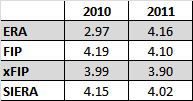
*The A’s defense had far and away its worst year since Cahill joined the team and not surprisingly his numbers suffered in concert.  His BABIP during the 2010 season was at .236 yielding a 2.97 ERA against a 4.19 FIP while his BABIP soared to .302 in 2011 pushing his ERA to 4.16 against a 4.10 FIP.  In other words, he was essentially the same guy each of the last two years, but he counts an exemplary defense for improved results.  Later we will see how Arizona’s defense might suit him in 2012.

The National League

When discussing strategy with mixed league fantasy baseball managers, you will often hear someone say they lean heavily toward starting pitchers in the National League as a general principle, especially if their other choice is a pitcher in the American League East.  Even if the NL pitcher is slightly less talented, a lot of times the deciding factor will be the league in which he pitches.  Is it worth it?  In general does leaning toward NL starting pitchers pay off?

Looking at the last three years, the answer is yes, but only marginally so.  Not enough to where I would knowingly take a less talented pitcher just because he is in the assumed safe haven of the National League.

As you can see, the difference in starting pitcher strikeout rates from league to league is about 0.2-0.3 in favor of the National League while walk rates are dead even.  The difference over 200 innings is a whopping three strikeouts (147 to 150).  So there isn’t a major difference in strikeout rate from one league to the other even with pitchers batting and striking out 33% of the time.  We saw this come to fruition in 2011 as the big pitchers who switched leagues saw inconsistent changes in their strikeout rates.
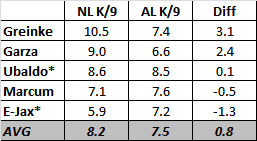
*Ubaldo Jimenez and Edwin Jackson both switched during the 2011 season resulting in smaller innings samples for each column while the others are all comparing their 2010 and 2011 full seasons.

Both Jackson and Shaun Marcum actually lost something on their strikeout rate when joining the National League while Marcum’s teammate Zack Greinke and their central division foe Matt Garza saw significant gains in their first season’s as National Leaguers.  Jimenez held firm moving from Colorado to Cleveland midseason.  It is a limited sample of pitchers for sure, but the point is simply that the National League doesn’t automatically yield a better strikeout rate.

What about the actual results?  Do we see a discernible difference in starting pitcher ERAs from league to league?
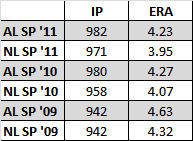
Overall, the league ERA in the National League has been 0.20 to 0.31 better during the last three years including 0.28 better in 2011.  So again there is a slight enhancement for National League-based  starting pitchers over their equal American League counterparts, but keep in mind that over 200 innings, it is a seven earned run difference and just five earned runs in a 150-inning sample.

There is still no compelling case to be made for taking a lesser talented NL pitcher over even a slightly more talent AL one.  If you use league home as a tiebreaker between two comparable players, then it makes sense to lean toward the National League as you should expect incremental gains in strikeout rate and ERA results.

Using Cahill’s 2011 results, he would stand to gain five strikeouts up to 152 and his ERA would shave seven runs off and move down to 3.86.  Those are simple quick and dirty estimates using his 2011 results against 2011 league standards.  This removes all of his context-based factors and assumes no growth.

His Home Park

Cahill leaves a park in Oakland well known for favoring pitchers and heads to Arizona to play in a park equally well known for its opposite effect on pitchers.  Neither is the best at what it is known for, but Cahill will now play in the division with the most renowned stadiums for each end of the spectrum: San Diego’s PetCo Park for pitchers and Colorado’s Coors Field for hitters.

Here is comprehensive look at the park factors for the divisions Cahill is leaving and joining using Baseball-Reference’s Park Factors for just 2011 as well as the last three years combined:

(-b refers to park factor for batters; -p for pitchers)

Overall the change is minimal with the biggest difference being his less favorable home park, but his severe groundball tendency combined with the boost from the National League should mitigate most of it, especially since that doesn’t even take into account his potential to improve as a pitcher.  Meanwhile, he essentially trades Texas for Colorado.  Of course, Texas never really bothered him as he posted a 2.23 ERA and 2.1 K/BB rate in 40 innings (his highest count outside of Oakland) there.

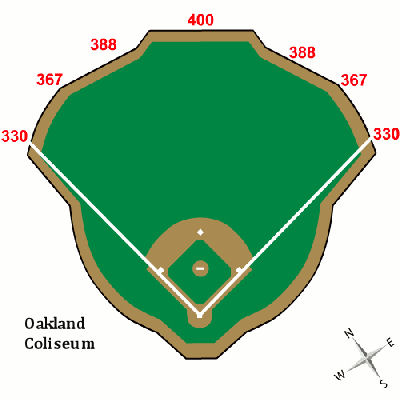
The outfield dimensions of Chase Field as compared Oakland Coliseum are unlikely to impact Cahill negatively.  In fact, Chase Field is deeper in almost every respect.  Where Oakland Coliseum derives a great deal of its love from pitchers is in the foul territory.  The expansive room available to make plays on balls that would otherwise be souvenirs in most other stadiums has saved many an Oakland pitcher.  It is hard to derive how much of an impact, if any, that will have on Cahill in 2012.  While I can find how many of his pitches turn into foul balls, I can’t find how many of those foul balls result in outs.

His Defense

As I mentioned earlier, Cahill relies heavily on his defense.  With a 56% groundball rate, a sharp infield offense is key to his success.  In 2010, the top four fielders in UZR on the A’s were Cahill’s infielders: Kevin Kouzmanoff 16.1 at 3B, Daric Barton 12.1 at 1B, Mark Ellis and Cliff Pennington at 9.9 apiece at 2B and SS, respectively.  Of the four, only Ellis played fewer than 1231 innings (986) and the most important cog, Pennington, played 1304.

On the 2011 A’s, Ellis and Kouzmanoff were the top two rated infielders in UZR with 2.1 and 2.0 marks in 501 and 365 innings, respectively.  Ellis was traded to Colorado to make way for youngster Jemile Weeks while Kouzmanoff was only in the lineup throughout 2010 because of his glove (.296 wOBA) and yet somehow got worse with the bat in 2011 (.271 wOBA) before eventually being traded to Colorado as well, though in a separate deal from Ellis.  Meanwhile Pennington regressed to previous defensive levels with a -5.2 UZR in 1272 innings, which is more in line with his -4.7 and -4.5 marks from 2008 and 2009.

The aforementioned Weeks had a -4.1 UZR as the primary second baseman and Scott Sizemore was a team worst -6.0 UZR at third base.  Both added a Bondsian level of offense compared to their predecessors, though, so the offensively-starved A’s had to overlook their defensive shortcomings.  This no doubt affected Cahill en route to a career-worst .302 BABIP.  While that isn’t too far off of the average (.299 in the AL), Cahill needs to be above average there until his base skills (missing bats and limiting free passes) improve.

The Diamondbacks were first in baseball in UZR at 55.8 in 2011.  Good news for Cahill, right?  Yes, but not as good as that one piece of information suggests.  The bulk of Arizona’s UZR goodness is built off of their strong outfield defense: Chris Young 14.1 in CF, Gerardo Parra 9.8 in LF and Justin Upton 7.7 in RF.

But right behind those three is shortstop Stephen Drew at 4.5.  His season was cut short by injury, but backup shortstop John McDonald turned in a 4.0 UZR, too.  Drew has been above average each of the last three years including an 8.7 UZR in 2010.  Keeping him healthy will be essential because he not only picks it, but he is a far better with the bat than McDonald.

Aaron Hill has a very strong defensive track record with a 21.7 UZR in six seasons of work and just one season below average (-4.9 in 2009).  Ryan Roberts broke out in his first full season of play both at the dish and in the field.  He spent the bulk of his time (902 of 1132 innings) at third base and acquitted himself well enough with a 1.7 UZR.

Defensive numbers can fluctuate year-to-year so while the Diamondbacks might not finish first in the league again in 2012, it is nice to know that all of Cahill’s new infielders have track records to back up their 2011 performance.  This is a net gain for Cahill, especially with the A’s placing a premium on bat production in lieu of quality fielding (and who can blame them?).  Lucky for Cahill and Arizona, their slick fielders can handle the bat, too.

His Bullpen & Offense

These two factors only really contribute to his potential win count, the predicting of which is generally foolish because of how inconsistently they correlate to quality pitching.  More to the point, wins aren’t really something that starting pitchers can control because even if they pitch well for their allotment of innings, they need the bullpen to hang on.  And even if the bullpen keeps their masterpiece intact, the offense needs to have earned enough runs off of the opposition’s starter and bullpen, too.

For the sake of full disclosure, let’s quickly look at both aspects.  The bullpens were equal for intents and purposes in 2011 and both have the talent to do the same again in 2012.  Any major differences between the two would come from fluctuating luck or a change in personnel.  As it stands right now, Cahill will see no discernible gain or loss in bullpen support with the trade.  Projecting forward he was more likely to lose out by staying in Oakland as they continue to discuss potential trades involving Andrew Bailey.

There seems to be a real improvement in his team offense with the move to Arizona as evidenced by the 2011 numbers of the two units:

Of course, that still doesn’t mean he will have an increase in wins.  Consider his 2010 season.  He went 18-8 and while the Oakland offense was better than the dreadful 2011 iteration, they still only scored 4.1 runs per game.  Logic and wins don’t mingle well.  Yes, you can probably afford to pitch a bit worse and register an above average win total with an offensive stalwart like the Yankees supporting you, but then you see Aaron Harang win 14 games with the Padres who scored a whopping 3.7 runs per game in 2011.

Cahill’s bullpen support remains strong and his offensive support is improved, but don’t let either have a significant impact in your 2012 analysis for him.

His Improvement

We have taken a look at all of the outside factors that could contribute to Cahill’s success or failure in 2012, so what about the factors he can handle?  He showed during his minor league career that he can be a dominant strikeout pitcher, but you have to consider that the bulk of that work was done in the lower minors.

He skipped AAA before making his debut (subsequently logged 9 AAA IP in 2010) and posted a career-low 8.0 K/9 in a quick 37-inning stint in AA at the end of 2008.  So while the gaudy 9.9 K/9 in 247 minor league innings is nice, you have to adjust more than you would normally take off for a pitcher who had a strikeout rate like that with some significant work in AA and AAA.  Going from 9.9 to the 4.5 of his rookie year would have been hard to project, but he deserves credit for not crumbling under the pressure as a 21-year old who essentially came from High-A.

His improved strikeout rate seems to correlate well with the effectiveness of his curveball.  I took a look at him early this season after just two starts because I noticed that his curve was generating a lot of swinging strikes.  In fact, he continued to use his curveball effectively throughout the season.  He used it 4% more than in 2010 (24%) and it generated a swing 5% more often (52%) resulting in strikes 5% more often (67%), 1% of which were swing-through strikes or whiffs (14%).  His 2011 data; 2010 data.

This piece by David Golebiewski at Baseball Analysts looks at Cahill’s year on the whole and examines both his curveball and slider together leading to a similar conclusion that they are the key to an elevated strikeout rate for him. More to point, keeping them down so that hitters swing over the top of them will allow Cahill to generate more strikeouts as he continues to mature.  Plus, the worst case scenario on a well-placed breaking pitch low in the zone is weak contact in the infield which shouldn’t be too problematic for the Diamondbacks fielders to handle.

He has posted a 3.6 BB/9 in two of his first three seasons which is in line with his 3.7 BB/9 mark as a minor leaguer, but the 2.9 BB/9 shows that there is room for improvement.  He is unlikely to become Cliff Lee with his control whether now or in the future, but even incremental improvement toward that 2010 mark would be help his gaudy 1.43 WHIP.

His 2012

I really like Cahill’s outlook for 2012.  I would have liked it in Oakland, too, but the move to Arizona only helps matters.  Despite the bouncing ERA from 2.97 to 4.16, he was virtually the same exact pitcher in 2010 and 2011.  In fact, his secondary numbers say just that:
It is hard not to be impressed with what he has accomplished as a 21 to 23 year old in his 583 career innings.  He only has the one standout season from a fantasy aspect, but there is a burgeoning skill set worth buying into just as the Diamondbacks did with the trade.

I see him with a ceiling of around seven and a half strikeouts per game, though we may only see another incremental gain in 2012.  We have probably already seen his best walk rate at 2.9 in 2010, but he can get there again and it could be as soon as 2012.    Add in the improved defense closer to what he enjoyed in 2010 and I think we see something like in the following ranges for Cahill in 2012:

ERA: 3.60 – 3.92 (a spread of 7 ER in 200 IP)

WHIP: 1.24 – 1.30 (a spread of 13 base runners in 200 IP)

K/9: 6.7 – 7.5 (149-167 Ks in 200 IP)

BB/9: 2.9 – 3.4 (65-76 BBs in 200 IP)

W: these projections are enough to net 15+, but always remember that wins are unpredictable

I chose to do ranges because the accuracy of firm numbers is so low and the difference in actual performance between those ranges is pretty reasonable across a 26-week season as you can see from the information in parentheses next to each category.  Cahill is currently the 44th starting pitcher off the board in early mock drafts at MockDraftCentral.com which puts him in the 13th round at 164 overall.

Right now I don’t hate him at that 164th spot, but I think that is full price and I would opt to wait for some of the names behind him Doug Fister (180), Jaime Garcia (193), Derek Holland (197), Matt Moore (203), Javier Vazquez-assuming he doesn’t retire (246) and Ricky Nolasco (258) to name a few.  I see some, if not all, of those names eventually passing Cahill in ADP along with Yu Darvish (206) depending where he ends up.

In a mock draft (14-team mixed league) I’m currently involved in, I got him in the 21st round with pick 286 which I thought was a steal.  I suspect as more players get signed and we get closer to draft season his ADP will dip lower than 164 making him something of a bargain.

Monday: 10.31.2011

The Offseason

People ask me what I do in winter when there’s no baseball.  I’ll tell you what I do.  I stare out the window and wait for spring. — Rogers Hornsby

You have no doubt seen this quote before and likely quite recently in light of the 2011 season coming to an end.  I think I have seen it pop up in my Twitter feed at least 5-6 times in the last week.  I use it here because it is so fitting.  Sure, I like football a good bit and my Detroit Lions are actually giving me something to care about, too, but even still I am already looking forward to everything baseball-related that we get in the fall and winter months: Bill James Handbook being released, Hot Stove league of free agency and offseason trading, the Winter Meetings in December, the BaseballHQ.com Forecaster being sent out, MLB Network’s 30 Clubs in 30 Days and even the first appearance of fantasy baseball magazines on the bookshelves at Barnes & Nobles (RIP Borders *single tear*).  Perhaps my favorite offseason event of them all is coming up this week as I head out to Phoenix for the BaseballHQ.com First Pitch Forums and Arizona Fall League conference.

My month-plus hiatus between the regular ending and the World Series was fruitful and enjoyable.  I did log some research work for the offseason content here at Baseball by Paul, but mostly I tried to enjoy the time off and give my fingers a rest.  I followed my Tigers through a pair of thrilling playoff series which included a trip to Dallas to watch games 1 and 2 of ALCS with a couple of great friends.  Even though we lost both games, I don’t regret a single second of the trip.  The Dallas fans were a bit more hostile & rude than I anticipated (please don’t ever judge Texas/southern hospitality on a trip to Dallas), but all in all, it was a great time.  Speaking of the playoffs, that was perhaps one of the best sets of playoffs ever played with 38 of a possible 41 games being played, many of them nailbiters until the end.  Obviously I’d have preferred to see my Tigers in a rematch with the Cardinals for the World Series, but the Rangers/Cardinals matchup didn’t disappoint in the least.

The Hot Stove has already kicked off with some major moves of the front office variety taking place with the Red Sox, Cubs and Padres all getting new general managers while the Red Sox, Marlins and White Sox have already or will soon tab new field managers.  On the player movement front, we are seeing options being picked and declined including the CC Sabathia opt-out saga has already run its course from start to finish with he and Yankees agreeing on a new deal.  The biggest player news thus far has taken place in the AL Central with the trading of Derek Lowe to Cleveland for a minor leaguer and Minnesota acquiring Matt Maloney through waivers.  Lowe joins Ubaldo Jimenez and Justin Masterson atop the Indians rotation as they continue to play for the here and now after moving a significant chunk of their top level farm pieces for Jimenez during the summer.

Lowe may end up adding more off the field than on it, though, as he is a groundball-heavy, control artist who may find life difficult in Cleveland with Asdrubal Cabrera and Jason Kipnis defending up the middle for him.  Lonnie Chisenhall, who plays third base, checked out a bit more favorably with his glove although both he and Kipnis have limited samples which can cause issues with the defensive metrics so we might not have a true idea of their talents until seeing them for at least a full season in the majors.  With Lowe, they will get plenty of chances to prove their worth.

Maloney, with a career walk rate of 1.9 in his 80 innings, seems tailor-made for Minnesota and their “walk-nobody ever or else…” pitching philosophy.  His 6.1 strikeout rate isn’t overly intimidating, but it is better than some of the control-only pitchers they have given large inning totals to in the past (I’m looking at you and your 4.8 K/9, Nick Blackburn).  He will have to battle for a role on the team, but it is an interesting pickup that could bear some fruit.

So that is a quick rundown of what we have seen in the very early stages of the offseason, but there is just so much more to come.  Look for regular posting to return starting next week when I am back from Phoenix including a preliminary Top X starting pitcher list.  I haven’t decided if I want to go 50 or 100 yet, thus it’s top X for now.  Also, I now have a set schedule over at RotoHardball.com that includes an afternoon post on Mondays geared toward AL-Only league topics and a morning piece on Thursdays focused on NL-Only league topics.  In other words, I am not focusing so much on the star levels of the player pool, rather often digging deeper as single leagues generally utilize more of each team’s 25-man roster than a standard mixed league.  Today, I wrote about Bartolo Colon and his outlook for 2012.

Tuesday: 03.15.2011

Why Joe Mauer Isn’t the Top Catcher in 2011

This will serve as the 3/15 Daily Dose (Ed. note – I’ve got time for one post a day right now, so it’s either a feature like this or the DD).

Catcher is always a tricky spot in fantasy baseball.  It’s usually pretty thin putting a premium on the studs, but that is counterbalanced by the fact that even the studs are guaranteed to miss time by not catching at least a day and sometimes two each week.  There is a firm ceiling on a catcher’s output because of those built-in days off plus the significant risk of more missed time due to injury.

Despite all of that, Joe Mauer remains the consensus top catcher and usually goes very early.  Whether people are still salivating over that MVP season from 2009 and hoping it will return (only for a full season this time instead of five months) or they just want to get the perceived best player at a perceived scarce position who will at the very least give you a major boost in an oft-forgotten or at least generally mishandled category (batting average).

First things first, catcher isn’t as scarce as conventional wisdom suggests.  It’s not superstar-laden, but the upper crust (8 or 9 guys spread across two, maybe three tiers) is thicker and the mid-to-late round options contain about 10 or so guys who don’t vary much in their overall value.

The point of this article is less about scarcity and more about that perceived top option.  I have nothing against Mauer.  Despite being a Tigers fan with the Twins as one of our chief rivals, I really like the guy.  I actually want him to become the guy he was in 2009 and I was convinced he would be for most of the 2010 offseason until March hit and I came to my senses and backed off in the nick of time (a lot of it had to due with reading some convincing pieces, namely by Ron Shandler).  I still think he’s capable of being truly elite when it comes to power and pure hitting, but until he shows it that 2009 season is a major outlier.

When I posted my catcher rankings back on February 9th, I had Mauer first.  In fact every single one of the seven offseason magazines I sheepishly admit to having bought (Borders giftcard + addiction to fantasy baseball = win!) did, too.  I have thought long and hard about it and I’m making a change.  This is not home team bias driven, but I think Victor Martinez should be the top catcher for 2011.

Before I get into why, I want to clarify that this doesn’t mean you have to draft him first.  I think he will have the most value, but you will still see at least Mauer go before if not Brian McCann, Buster Posey and maybe even Carlos Santana, too.  Be careful, though, catcher is a position that tends to go in runs so if you see Mauer go, it is probably time to pounce on Martinez if you’re on board with my thoughts.

The reason I like him as the top catcher is the obvious one: he’s not going to be catching much at all.  The problem with catchers is the position.  It’s a grueling position that inherently wears guys down and cuts into their offensive value in a myriad of ways, most of which I already covered.  The general degradation of their bodies as the season progresses just eats into their value.

The Tigers are planning to play Martinez at DH most days, catcher every once in a while to spell Alex Avila and some first base when Miguel Cabrera needs a partial day off and moves to DH.  Speaking of Cabrera, if a worst-case scenario came to fruition for the Tigers whereby they missed Cabrera for any amount of time due to his off-the-field issues, then that would just mean more time for Martinez not catching as he is the primary backup at first.

So what does not catching do to his value?  We have a glimpse of it in the form of his 2009 season.  He caught 85 games and played first for another 70 logging a career high 155 games and essentially matched the production in line with his best seasons.  Coming at age 30 for a catcher, that’s impressive.  His OPS+ was 126, 3rd-highest of his career (130 as a 26 year old, 129 at 28).  He hit .303 with 23 homers and 108 RBIs (2nd-best HR, RBI totals and 3rd-best AVG of his career).

In the 2011, his split between games catching and not catching will be much greater which should result in another 150+ games played and could even yield career-high production.  I think we could see as much as a 7-10% increase of his production from 2009 season with the bulk of his catching duties removed from his plate combined with the fact that he is still in his prime (although 32 years old is generally regarded as that final year of the prime).

Just using the low end of that increase yields a .324 average, 25 home runs, 116 RBIs and 94 runs scored, which would no doubt lap the field in terms of catchers.  In fact, unless Mauer repeats his 2009, Martinez with “just” a .300-20-100- season is better than Mauer at .330-10-80.  Mauer’s batting average advantage offers .002 more to the bottom line over Martinez, but Martinez more than makes up that difference with 10 more HRs and 20 more RBI.  Martinez has three 20-100 seasons; two included a .300+ average.  He also had .302-20-79 last year in just 127 games.

Consider also that power is drying up recently making his 20+ ability all the more valuable, especially since it doesn’t come with the deficiencies found in a Mike Napoli 20-homer season (granted, V-Mart costs more than Nap, too).  Mauer’s batting average boost is nice, there is no denying that, especially since he is capable of .350 in any given season, but Martinez is hardly a liability there and he often logs more at-bats than Mauer.  Mauer has yet to reach 540 at-bats in a season while Martinez has four such seasons, three of which topped 560.

For as great a hitter as Mauer is, he has yet to rack up 100 RBIs in any given season, either.  Martinez has three such seasons.  I’m struggling to see why Mauer is an unchallenged #1 at the position.  The batting average impact is undeniable.  His “worst” season in the last three was last year’s .327, but compared to Martinez the advantage isn’t as glaring.  Apart from 2009’s explosion of 28 homers, he has reached double digits just once (13, 2006).  Same with topping 85 RBIs, only 2009’s 96 fit the bill.

Instead of betting on what Mauer can be, why not invest in what Martinez already is?  There is too much risk tied up in catchers already before you even get into the personal situations of each, but then you look at Mauer with his injury history combined with the underwhelming production save the one star category.

Looking at Martinez, you’re alleviating a great deal of the risk associated with catching by getting a catcher-eligible DH/1B, combining that with a proven track record of power production at a position lacking it (just four 20+ HR hitters in 2010; more than four just once since 2003 [2009]) with a guy still in his prime.  Adding it all up, you have a new #1 atop the catcher rankings.  Martinez is your guy if you want to go with catching early.

Monday: 03.14.2011

Spring Training Stats are WORTHLESS!

This will serve as the 3/14 Daily Dose

It seems that no matter how often it’s said (even if it’s every year), fantasy baseball owners still want to put stock into Spring Training stats.  I understand the enticement of them.  You spent a long, cold winter desperate for Hot Stove news, poring over the previous year’s stats and preparing a bit for the upcoming season.  Finally in late February you have some actual boxscores and with the real season just a month or so away, you get caught up in a frenzy and start to give meaning to the numbers before you.

Let me assure you that they are almost 100% meaningless.  In fact, the numbers themselves are 100% meaningless and the only instance where they have some significance is when someone is competing for a job.  If a marginal player or up & coming rookie believed not to be ready has a blistering spring to win a job, the gaudy stats aren’t a precursor of things to come during the season, rather they are merely a ticket to entry.  You should use previous career track to that point for a projection going forward, not the spring numbers.

Still articles and podcasts all over the internet are littered with lines about how well established player X is hitting so far or how poorly established pitcher B has been doing thus far.  Often people will then use confirmation bias in May or June for the few instances of players who continue to perform (for better or worse) as they did in spring, all the while ignoring the 100s of examples going against them.

For every Jose Bautista (.439, 5 HR, 11 RBI) there are four or five Shaun Marcums (8.10 ERA in 10 IP returning from TJS).  Bautista’s September should have been your indicator if you were looking for a sign of breakout, not Spring Training.  He hit 10 bombs with 21 RBIs in 125 plate appearances in games that mattered.

Pitching is especially deceptive.  Guys are just working on various things during their spring stints whether it’s building velocity, spinning a new pitch, refining their worst pitch, gaining stamina, developing their command, etc…  They don’t really care about the ERA and WHIP accumulated, nor should you.

Even strikeout-to-walk ratios can be misleading.  You will hear some back that as the most reliable spring stat for a pitcher, but it is just as prone to failure as the rest of them.  Rodrigo Lopez had a 4.3 K/BB in 19 innings with a 1.90 ERA.  He then posted a 5.00 ERA with 2.1 K/BB in 200 innings for the Diamondbacks.

Or what about last year’s breakout star, Ubaldo Jimenez?  If you kept yourself from getting too giddy about the 2.89 ERA and instead just trusted the strikeout-to-walk ration, you wouldn’t have been too heartened by his 1.3 K/BB mark (14 K, 11 BB in 19 IP).

Teammmates Ricky Nolasco and Anibal Sanchez are couple of other interesting cases.  Nolasco had a ridiculous spring where he threw 25 brilliant innings striking out 21 and walking just one en route to a 1.78 ERA.  His skills were still solid throughout 2010 (4.5 K/BB), but he had a 4.51 ERA because of his 1.4 HR/9.  Sanchez meanwhile was trash throwing 18 ugly innings with a 7.00 ERA striking out a healthy 17 but also walking 11.  He then had the first full season of his career notching 32 starts posting a 3.55 ERA in 195 innings.  He had a 7.2 K/9 and 2.2 K/BB.

These examples are all admittedly cherry-picked as I peruse the 2010 Spring Training stats, but I could put together a 3,000-word piece further proving the point.  I stand firmly behind the notion that spring stats don’t mean anything.  What about last year’s spring HR leaders?

1. Chris Johnson – 8
2. John Bowker – 6
3. Aaron Hill – 6
4. Mike Napoli – 6
5. Sean Rodriguez – 6
6. Justin Upton – 6
7. Delwyn Young – 6
8. Ryan Zimmerman – 6
9. Jose Bautista – 5
10. Nelson Cruz – 5

You’ve got six established studs already known for their power, a guy whose spring made him a massively overrated commodity in fantasy drafts (Rodriguez) and three trashbags who were trashbags before their spring and then throughout the 2010 season (Johnson, Bowker and Young).

And like I said, I could easily keep going.  Don’t let quality spring numbers validate someone you’re high on or worse, dissuade from someone whose skills you love and expect a breakout from in 2011.  They are a non-factor and you really would be better off ignoring them completely if you can do it.

If you can’t contain yourself and must peruse them, use them as a tool against your opponents.  Talk up another nice spring from Delwyn Young (fewer HR, but .333 AVG in 2nd-most AB [42]) or mention how Mark Trumbo has had a great spring and will be ready to take over if Kendrys Morales isn’t 100% by Opening Day (hopefully wasting money on Trumbo and driving Morales’ cost down).

Or loudly discuss how Carlos Zambrano has continued his hot second half (which was a complete and utter worthless fluke) posting a 1.38 ERA in 13 innings so far (make no mention of his pathetic 6-to-4 K/BB).  And lastly, point out how Joe Blanton might have to replace Cole Hamels in that famed Fantastic Four for Philly because Hamels has been getting rocked with a 4.61 ERA.  Then promptly buy Hamels and enjoy a Cy Young season.

Trust skills, especially for established stars.

Thursday: 03.10.2011

National League Pitching Prospects List

This will serve as the 3/10 Daily Dose

It’s time for my prospect rankings for each league and I want to throw out a few points before I get to today’s National League list:

o   I’m new to prospecting.  This is my first ranking of prospects as I’ve spent the last two years getting better at it before finally diving in this year.  Keith Law, Kevin Goldstein, John Sickels, Jason Collette, the BA folks (Jim Callis, Aaron Fitt, John Manuel, etc…) and Adam Foster are all much more seasoned, just to name a handful whose work I enjoy.  I stand 100% behind the work, but this isn’t yet an area of expertise for me.  I wouldn’t necessarily be eager to suggest anything is an area of “expertise” for me, but I’m much more in my element discussing major leaguers right now, but I want to get better at prospecting so it’s time to start ranking.

o   I have seen a handful of these guys live, though the bulk of my experience with them comes from reading extensively and watching video online.

o   There aren’t individual player capsules here, those are all in the Starting Pitcher Guide.

o   The ceiling is a best-case scenario as I see it.

o   The ranking combines the best-case scenario with how likely they are to reach it.  This means someone might project with a higher ceiling, but be less likely to reach it and thus rank below someone with a lower ceiling who is closer to it.

o   This doesn’t slant toward 2011.  It’s all encompassing.  In other words, don’t use it in your re-draft fantasy leagues and get upset with me if Arodys Vizcaino doesn’t throw 120 innings for you later this summer.  It’s meant more for leagues with minor league rosters of any size and dynasty leagues.

RK Player TEAM ETA Ceiling
1 Julio Teheran ATL 2012 1
2 Jameson Taillon PIT 2014 1
3 Mike Minor ATL 2010 2
4 Jarrod Parker ARI 2011 1
5 Shelby Miller STL 2012 1
6 Simon Castro SD 2011 1
7 Jordan Lyles HOU 2011 2
8 Jenrry Mejia NYM 2010 1
9 Randall Delgado ATL 2012 1
10 Tyler Matzek COL 2013 1
11 Zach Lee LAD 2013 1
12 Casey Kelly SD 2012 2
13 Trey McNutt CHC 2012 1/Closer
14 Arodys Vizcaino ATL 2013 1
15 Trevor May PHI 2013 1
16 Stetson Allie PIT 2014 1/Closer
17 Matt Harvey NYM 2013 1
18 Zack Wheeler SF 2013 1
19 Brandon Beachy ATL 2010 3
20 Jarred Cosart PHI 2014 2
21 Christian Friedrich COL 2011 2
22 Tyler Skaggs ARi 2013 2
23 Chad James FLO 2013 2
24 Cory Luebke SD 2010 3
25 Brody Colvin PHI 2014 1
26 AJ Cole WAS 2014 2
27 Chris Withrow LAD 2012 2
28 Rubby de la Rosa LAD 2013 1
29 Brad Hand FLO 2012 3
30 Mike Foltynewicz HOU 2014 2
31 Luis Heredia PIT 2014 1
32 Chad Bettis COL 2014 3
33 Jesse Biddle PHI 2014 2
34 Juan Urbina NYM 2014 2
35 Jay Jackson CHC 2011 3
36 Lance Lynn STL 2011 3
37 Juan Nicasio COL 2013 2
38 Sammy Solis WAS 2012 3
39 Aaron Miller LAD 2012 3
40 Hayden Simpson CHC 2013 2
41 Carlos Martinez STL 2014 1
42 Daryl Thompson CIN 2008 3
43 Ethan Martin LAD 2013 2
44 David Holmberg ARI 2014 3
45 JJ Hoover ATL 2012 3
46 Pat Corbin ARI 2013 3
47 Mark Rogers MIL 2010 3
48 Tyrell Jenkins STL 2015 2
49 Bryan Morris PIT 2011 3
50 Brad Boxberger CIN 2012 3

I’ll be hosting a chat soon to discuss both this and more of the Starting Pitching Guide. Plan for next Thursday, but I’ll definitely post the details ahead of time. In the meantime you can reach me on Twitter or Facebook if you have questions about this list.

Wednesday: 03.9.2011

American League Pitching Prospects List

This will serve as the 3/9 Daily Dose

It’s time for my prospect rankings for each league and I want to throw out a few points before I get to today’s American League list:

o   I’m new to prospecting.  This is my first ranking of prospects as I’ve spent the last two years getting better at it before finally diving in this year.  Keith Law, Kevin Goldstein, John Sickels, Jason Collette, the BA folks (Jim Callis, Aaron Fitt, John Manuel, etc…) and Adam Foster are all much more seasoned, just to name a handful whose work I enjoy.  I stand 100% behind the work, but this isn’t yet an area of expertise for me.  I wouldn’t necessarily be eager to suggest anything is an area of “expertise” for me, but I’m much more in my element discussing major leaguers right now, but I want to get better at prospecting so it’s time to start ranking.

o   I have seen a handful of these guys live, though the bulk of my experience with them comes from reading extensively and watching video online.

o   There aren’t individual player capsules here, those are all in the Starting Pitcher Guide.

o   The ceiling is a best-case scenario as I see it.

o   The ranking combines the best-case scenario with how likely they are to reach it.  This means someone might project with a higher ceiling, but be less likely to reach it and thus rank below someone with a lower ceiling who is closer to it.

o   This doesn’t slant toward 2011.  It’s all encompassing.  In other words, don’t use it in your re-draft fantasy leagues and get upset with me if Jacob Turner doesn’t throw 120 innings for you later this summer.  It’s meant more for leagues with minor league rosters of any size and dynasty leagues.

RK Player TEAM ETA Ceiling
1 Jeremy Hellickson TB 2011 1
2 Matt Moore TB 2012 1
3 Michael Pineda SEA 2011 1
4 Manuel Banuelos NYY 2012 1
5 Zach Britton BAL 2011 2
6 Jacob Turner DET 2013 1
7 Martin Perez TEX 2012 1
8 Kyle Drabek TOR 2010 2
9 Mike Montgomery KC 2012 1
10 Chris Sale CHW 2010 1/Closer
11 Dellin Betances NYY 2012 2/Closer
12 John Lamb KC 2012 2
13 Chris Archer TB 2012 2
14 Kyle Gibson MIN 2011 2
15 Andy Oliver DET 2010 2
16 Danny Duffy KC 2012 2
17 Drew Pomeranz CLE 2012 2
18 Casey Crosby DET 2013 2
19 Alex Wimmers MIN 2013 2
20 Chris Dwyer KC 2012 2
21 Alex White CLE 2012 2
22 Aaron Crow KC 2012 2
23 Drake Britton BOS 2013 2
24 Alex Torres TB 2012 2
25 Jason Knapp CLE 2012 2
26 Tyler Chatwood LAA 2011 2
27 Alex Colome TB 2013 2
28 Anthony Ranaudo BOS 2013 2
29 Michael Kirkman TEX 2010 3
30 Tijuan Walker SEA 2014 1
31 Tanner Scheppers TEX 2011 2/Closer
32 Robbie Erlin TEX 2013 3
33 Miguel de los Santos TEX 2013 2
34 Ivan Nova NYY 2010 3
35 Jason Thompson TB 2013 2
36 Enny Romero TB 2014 2
37 Andrew Brackman NYY 2012 2/Closer
38 Felix Doubront BOS 2010 3
39 Mauricio Robles SEA 2011 3
40 Zach Stewart TOR 2011 3/Closer
41 Drew Smyly DET 2013 2
42 Andre Rienzo CHW 2014 2
43 Jake Odorizzi KC 2013 2
44 Ian Krol OAK 2013 3
45 Brett Marshall NYY 2013 3
46 Alex Cobb TB 2012 3
47 Aaron Sanchez TOR 2014 2
48 Yordano Ventura KC 2014 2
49 Charlie Furbush DET 2011 3
50 Shawn Haviland OAK 2012 3

I’ll be hosting a chat soon to discuss both this and more of the Starting Pitching Guide.  Plan for next Thursday, but I’ll definitely post the details ahead of time.  In the meantime you can reach me on Twitter or Facebook if you have questions about this list.

Thursday: 02.24.2011

The 2011 Starting Pitcher Guide

It’s here!!!

I’d set you up with an intro here, but there are 73,375 words in this guide, you don’t need to waste time reading me reiterate what you’re going to read in the opening of the book anyway.  I truly hope you enjoy this guide.  It was a max effort project and I couldn’t have done it without the help of my esteemed guest writers:

A huge thanks to them for coming onboard to make this far & away the best version of my SP guide yet.  I would LOVE to hear your feedback on the guide so please feel free to comment here, hit me up on Twitter (@sporer) or email me directly sporer at gmail.  I’m interested in what you thought worked, what you thought didn’t work, what you’d like to see in the future, etc…  Enjoy!!!!

Also don’t forget that while the work is free, if you choose to donate using the Paypal button in the upper right corner, you will be entered to win a Tim Lincecum or Justin Verlander jersey.  The drawing for that will likely take place sometime just after Opening Day.

I am very proud to present to you the 2011 Starting Pitcher Guide in all its glory and the Charts & Rankings right below:

The Guide:

2011 SP Guide with Articles & Player Capsules.

The Charts & Rankings:

2011 Rankings & Charts for Excel 2010.

2011 Rankings & Charts for Excel 97-2003.

Thursday: 02.3.2011

Three Questions – San Diego Padres

With the 2011 Starting Pitcher Guide set to come out in a few weeks, I have a jam packed volume covering all the ins and outs of starting pitching in the 2011 season for your viewing pleasure.  Of course that doesn’t do much to address the offensive side of things so I decided to start this “Three Questions” where I will cover some key offensive issues for each of the 30 teams.  There will be more content here dealing with offense, but this is the beginning.

What happens to this offense without Adrian Gonzalez?

Oh don’t worry, new first baseman Brad Hawpe will fill in so well that you will barely notice Gonzalez left.  A .298/.393/.511 line with 31 bombs and 101 RBIs shouldn’t be a problem for Hawpe.  OK that’s obviously an egregious lie that I don’t believe in the least.  Do you want to know how important Gonzalez was to an offense that still only finished 22nd with him?  Look at this:

Gonzalez led them in five key offensive categories and no one was really close.  Chase Headley was the 2nd-highest qualifying batting average at .264, Will Venable’s 13 home runs were 2nd to Gonzalez, Headley had a whopping 58 RBIs to finish 2nd on the team, Yorvit Torrealba was 50 points behind Gonzalez with a .343 OBP, but that came in just 325 at-bats.  The 2nd-highest qualifying on-base percentage was again Headley with a paltry .327 mark.  And in the most hotly contest of the five categories, Headley finished 14 hits behind Gonzalez with 161 on the season.

Counting stats for Padres hitters are likely to be even worse than they were last year cutting into the already stunted value of the group.  Headley managed those 58 RBIs despite hitting behind Gonzalez, who was getting on base 40% of the time for him.  The team added some pieces in addition Hawpe including a brand new double play duo with Orlando Hudson at second base and Jason Bartlett at shortstop as well as former super-prospect Cameron Maybin, but the loss of Gonzalez is still a major blow to an offense that was already pretty poor.

The power-sapping ways of PETCO park are nothing new and Padres hitters have long been evaluated with that impact built in, but without their superstar cog in the middle the entire group takes another hit to their value.  The chances of the six year streak of a non-Gonzalez entity topping 100 R or 100 RBI being broken seem slim.  The last two players to do it were in 2004 when Mark Loretta scored 108 runs and Phil Nevin drove in 105.

Following up a career year with one of his worst, what’s in store for Jason Bartlett in 2011?

The 2010 season was a rough one for Bartlett especially in light of his breakout 2009 in which he hit 14 home runs, drove in 66 runs, scored 90 runs, stolen 30 bases and hit .320, all career highs.  Lucky for him, he plays shortstop which is a barren wasteland after the top tier so he will have some value no matter what.  How much exactly is going to be tied to how many stolen bases he rack up.  He had a string of 23, 20 and 30 before last year’s 11, so the ability is there and San Diego was the 6th-runningest (so surprised that didn’t get a red squiggly line under it in Word) team last year with 124 stolen bases.

Additionally, he can offer some batting average value or at least not be a drag for a team.  Last year his .254 was a drag as regression bit back hard from 2009 and instead of falling back to career norms, he was actually a bit unlucky.  He is .281 hitter for his career and there is no reason to think he shouldn’t bounce back to that in 2011 and if luck breaks his way again, it wouldn’t be tough for him to top .300 again.  So as a late round speed/average shortstop, he has some value.  As I mentioned already, counting numbers will be tough to come by on this team.  Especially for Bartlett who isn’t particularly adept at getting on base.  Though he has a career .345 OBP, it is propped up by the standout 2009 and a .367 mark in 372 plate appearances back in 2006.

One last thing to consider with him is that he has only averaged 135 games played in the last four years with a high watermark of 140 and a low of 128.  That means you’re going to need a replacement for around 27 games, or 16% of the season.  Given the dearth of talent at shortstop, this can be a problematic proposition.  His backup is likely to be Kevin Frandsen or Everth Cabrera.  You could fill one of Bartlett’s strengths depending on who fills in, Frandsen for average and Cabrera for speed.  If you’re left hitting the wire, you may find that the remains are somehow even less appealing than Frandsen and Cabrera.

Is Cameron Maybin ready to pay dividends on his blue chip prospect status?

The problem is we might not even notice if he does improve because of his home ballpark.  He has certainly proven everything he can in the minor leagues so it is time for the three-time top 8 Baseball America prospect to start showing the talent at the big league level.  At 24 with just a season’s worth of big league plate appearances (610) under his belt, even a poor 2011 wouldn’t be enough to write him off completely but it would put closer to Brandon Wood territory.

The biggest issue right now is the striking out.  He has struck out in 31% of his major league at-bats despite the significant gains in K% in the minors.  After striking out in 32% of his AA at-bats in 2008, he cut down to 20% in his first run through AAA in 2009 followed by 19% in 130 AAA at-bats last year.  Any contact would be better than striking out for Maybin at this point.  At the very least, he could maybe use his excellent speed to turn some of his groundballs into base hits.

Better pitch recognition can increase his value another way as more walks would again allow him to add value by way of his speed.  As noted in the Bartlett section above, the Padres aren’t afraid to run, but it is hard to do much running with a .302 on-base percentage.

I don’t think Maybin will magically fix the strikeout and walk issues all at once in 2011, but I think we will see incremental gains in his first full season which should yield a 20+ stolen base season and low-teens power.  You can do much worse than that for a low dollar late outfield option in NL-Only leagues.  I don’t think he is quite a dollar days guy just yet, especially if your league has any guys who love grabbing the next big thing, but his price tag shouldn’t be pushing double digits.  As a single digit buy, I would highlight him as a quality end-game play perfect for rounding out a team.