Archive for ‘Player Focus’

Monday: 01.28.2013

Countdown to Spring Training: 25 Days – Kyle Seager

Only 25 days until live game action…

With 30 days to go, I started profiling a hitter per day highlighting one from each team. I selected my player of note from each team and then randomized them (which was pretty interesting consider who the final two were after the randomization) so that’s the order I’ll be following.

KYLE SEAGER

When you look at Kyle Seager’s 2012 line of .259/.316/.423, you jaw will most certainly stay firmly in place. There is nothing particularly special about those rate stats and while they were above average (110 OPS+, 108 wRC+), they don’t lead many to identify Seager as a hot fantasy commodity. Shifting over to his counting stats changes the equation a bit as his 20 home runs, 86 RBIs, and 13 stolen bases were all top 10 at the position (note: he was tied for 10th in home runs with David Freese and Mike Moustakas). All of a sudden he is a bit more appealing.

Now imagine if he weren’t stuck in the anti-Coors? Though Seager bats left-handed and southpaws generally fare better at Safeco, he couldn’t wait to leave town. He was an All-Star on the road as his 126 wRC+ outside of Seattle was just a tick behind Adrian Beltre’s 127 and sixth-best among third basemen. He was essentially an American League Chase Headley. Headley finally found a way to do some damage in Petco Park this year en route to an amazing season, but he still led all third basemen with a 154 wRC+ on the road and he has a career 695 home OPS compared to 836 on the road.

Seagerhm-aw

Ouch, that is rough. He gets 75 percent of his home runs and 70 percent of runs batted in on the road. He does his best to bring something to the table at home by walking twice as often and steal more than three times as often, but that can hardly paper over his incredible home struggles. I’m 89 percent certain that Seager was on site, hard hat in tow, helping the construction crews bring in the fences at Safeco.

For those wondering, this isn’t a one-year thing, either. He only had 201 plate appearances in 2011, but 91 of them were in Safeco and they were terrible: .188/.256/.263 with zero home runs. Meanwhile in his 110 on the road he posted a .314/.358/.471 with three home runs. Remember how I mentioned earlier that Safeco Field doesn’t kill lefties on home runs nearly as much as righties? For those who didn’t click, it’s a 91 HR park factor for lefties compared to a 70 for righties.

That is borne out in Seager’s numbers as well. All five of his Safeco home runs (which all came in 2012) were pulled. In fact, to right and right center fields Seager is excellent at Safeco over his career with a .339 average, 901 OPS, and those five bombs. His .565 slugging percentage also includes 13 doubles. If he is doing that well to the pull field, can you imagine how bad it is when he goes opposite field? You may want a barf bag nearby.

When going to leftfield in Safeco, Seager’s line is an abysmal .195/.191/.248 in 117 plate appearances. He actually improved in 2012. After a 312 OPS–yes OPS, that would be a horrible on-base percentage–in 2011, he jumped all the way up to 482 a season ago. He is being especially obliterated when he tries to “go with the pitch” on the outer third of the zone and just outside the strike zone hitting just .152 (9-for-59) in those instances.

seageroppo

(click to enlarge)

Now we ask the obvious next question as we did when discussing Yonder Alonso: how much might the moved in fences help this issue? Thanks to SportsPressNW.com, we can look at a very nice picture of the new dimensions and we see a 10-foot move in the leftfield corner, a big jump of about 12-15 feet in that leftfield power alley, and some minor moves in center and right centerfield.
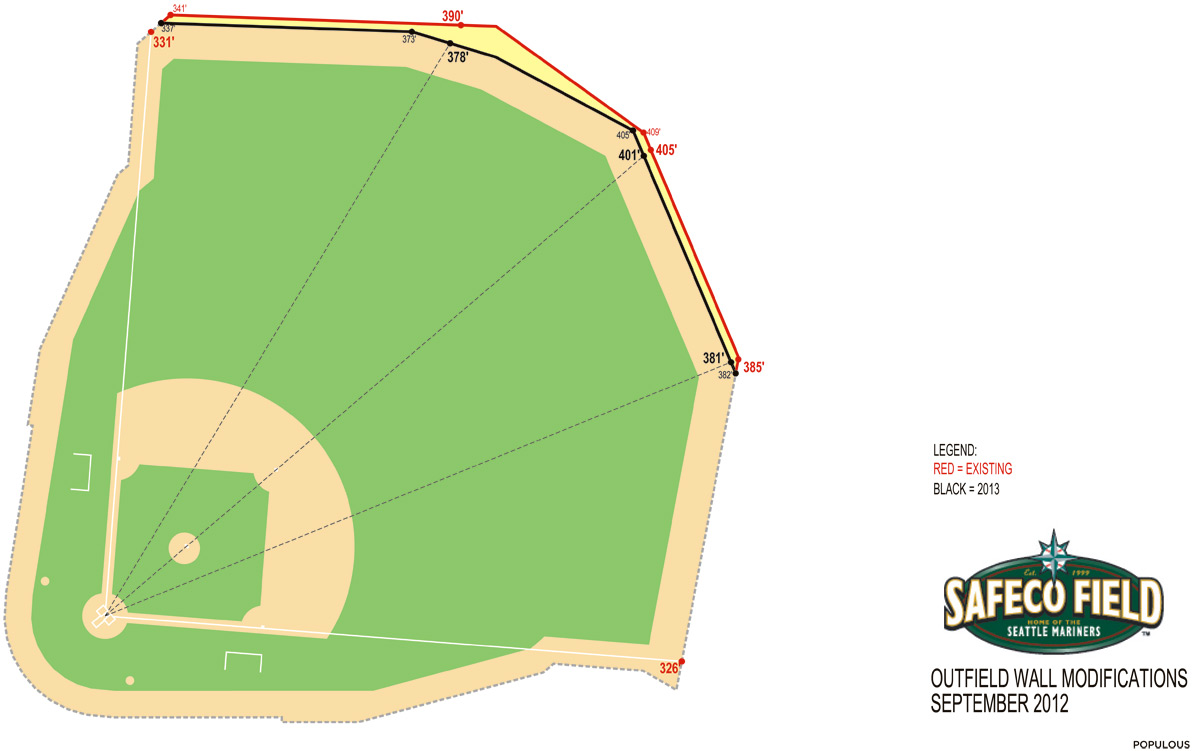
safeco-dimensions

(click to enlarge)

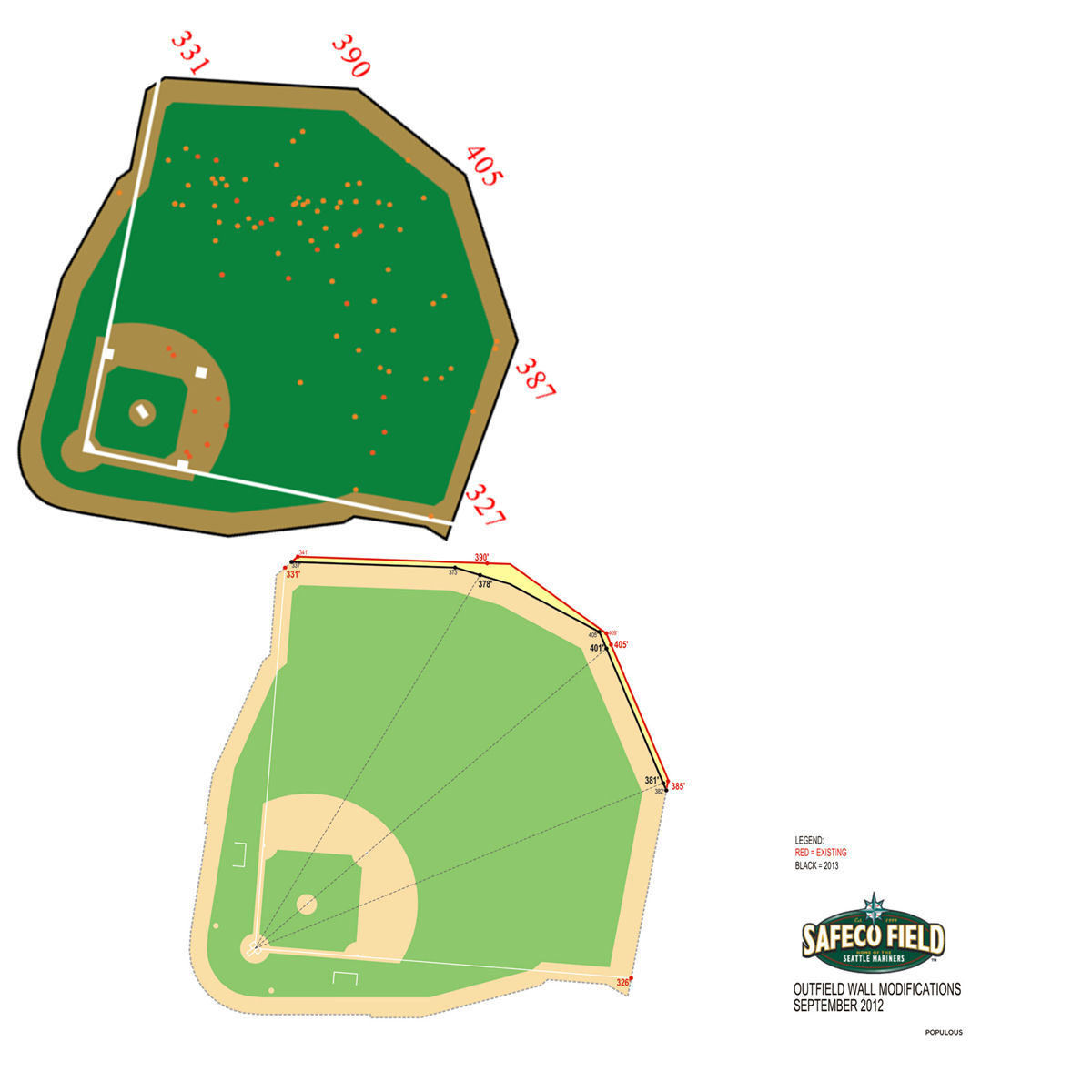
Using the Katron.org spray chart from 2012 for Seager and comparing it against the new Safeco, it doesn’t look like his current batted ball profile is set to gain massively from the move. The dots are his flyouts (lighter orange) and lineouts (darker orange). None of his doubles were anywhere near the edge of the wall so they weren’t included.
seagerspraycomp

(click to enlarge)

But as I mentioned with Alonso, this is also assumes he will have the same batted ball distribution again in 2013 and that isn’t happening. It is worth looking at though because if we saw that Seager was dotting the warning track time and time again to leftfield, we would have reason to be quite optimistic with these moved fences because even if he didn’t have the same exact distribution, he would likely hit at least a few out that way again and they’d be more likely to sail over and into the stands.

Seager, like many young left-handed batters, also struggles against lefties. Those problems, as you might guess, are you really exacerbated at home. He has a 646 OPS against lefties as a whole for his career (compared to 766 against righties), but that drops to 545 at home while sitting at a formidable 748 on the road. Another hallmark of youth is struggling with off-speed stuff and that is mostly how lefties handle him at home.

We’re slicing the data pretty thin at this point, but this is at home versus lefties by pitch:

  • Fastball: .253 AVG, .333 SLG, 14% K, 10% BB in 89 PA
  • Curveball: .176 AVG, .353 SLG, 37% K, 11% BB in 19 PA
  • Slider: .130 AVG, .130 SLG, 21% K, 0% BB in 24 PA

None of these samples are big enough to mean a ton, but it’s all we have to work with right now. These thin slices of the data won’t stabilize for some time, but there is no denying from his larger samples that Seager struggles in Safeco, with lefties, and in Safeco with lefties. The moved in fences will likely add more relief via placebo effect than in improved numbers, but Seager is just 25 years old so he still learning. If he focuses on improving against lefties regardless of venue, that will drive his biggest net positive.

As long as he continues to steal bases, his fantasy value will remain substantial aided by his 81 road games where he does his best work. Given his age, above average composite work in 2012, and the fact that the M’s just don’t have a viable backup worth sitting Seager for, he should hold the job for the duration of 2013 giving him a chance to tackle those lefty issues. He is currently slotted in the 3-hole of their lineup which is always a good thing, even in a down lineup like Seattle’s.

I love Seager as a corner infielder in a mixed league especially if you end up with a superstar 3B early on. His price could be on the rise by the time draft season hits in AL-only leagues as it thins out quickly after the superstars (Beltre, Miguel Cabrera, and Evan Longoria) and moves into the youth bracket with Seager, Moustakas, Brett Lawrie, and Will Middlebrooks.

Monday: 01.28.2013

CBS Closes Victor Martinez Catcher Loophole

Out of sight, out of mind as the idiom goes. In baseball, a player’s season can be ended in February or March leaving a 12-month gap between when you last considered him as a fantasy asset. Now most guys aren’t completely forgotten, but even high profile players will have to climb their way back into the consciousness a bit, at least to get back on the level they were at prior to their injury. One such player for 2013 is Detroit’s Victor Martinez. The sweet-swinging catcher/first base/designated hitter ripped his left knee up last March and didn’t see the field at all.

His 2013 return has brought about some controversy. He was last a full-time catcher back in 2010 with the Boston Red Sox when he put the gear on 110 times in his 127 games played. Before that, he hadn’t been a full-time backstop since 2007. Back in 2011 when he last played, he was Detroit’s full-time DH with 112 appearances there. He had 26 games behind the dish and another six appearances at first base. Most fantasy leagues require a 20-game minimum the year before to maintain eligibility at a position. With 26 in his last year of play, Martinez is a 2013 catcher.

Not so fast.

CBS Sports, easily one of the most popular fantasy hosting sites, has made their ruling on the case and they have stripped Martinez of catcher eligibility making him a DH-only qualifier in their systems. Now custom league commissioners can fix it to however they see fit (I personally will making him a catcher in my AL-only league per our rules), but it looks like any standard league format at CBS will have to abide by the ruling. I found the decision curious myself noting (to myself) that Kendrys Morales had kept his first base eligibility upon his return last year after missing all of 2011. So I took to Twitter and asked CBS fantasy expert Nando DiFino what was up with this decision.

DiFino responded, “Reverts to most appearances the previous year overwhelmingly DH in 2011: 112 at DH vs 26 at C, six at 1B. He hasn’t played primarily C since 2010, it’s disingenuous”.

He continued, “…came down to original tout rules, fairness, lots of things. But having VMart at top 5 in a position he didn’t primarily play since 2010 seemed like it wasn’t in the spirit of the game. One [guy] in the league would benefit from that.”  (the entire exchange can be found here)

And in case you didn’t click the link earlier, here is an answer from the CBS FAQ

vmartCDH

You can make a case that this also should’ve applied to Morales then since Albert Pujols was brought in to play first base, but it wasn’t hard to envision Morales getting time there even if just as a backup or to give Pujols some half-days off where they switch and Pujols DH’s while Morales mans first.

In the case of Martinez, he is not going to catch this year. That has been the word from the front office all off season and it was confirmed again recently by general manager Dave Dombrowski. They Alex Avila entrenched as the workhorse starter and while they didn’t re-sign Gerald Laird, they were ready to go with Bryan Holaday as the backup before getting Brayan Pena via free agency and trading for Ramon Cabrera who was a deep org prospect for the Pittsburgh Pirates (ranked 22nd by Baseball America in 2012).

So if you plan on countering this decision by CBS by drafting Martinez anyway and waiting for him earn eligibility via interleague or by spelling Avila, you are wasting your time. Obviously we can never say never and maybe V-Mart gets a few innings fulfilling some leagues who have a 1-game requirement, but you’re betting on a super longshot at that point and that’s a surefire way to ruin your chances at winning your league.

The closed loophole cuts a leg out of catching depth, but the position is working from a surplus and even without Martinez, it is a plentiful position. In my estimation, there are eight  star-level (for fantasy purposes) players leading the charge with another eight or so high quality options not to mention a handful of wildcards who could pan out nicely including a pair of suspended catchers: Carlos Ruiz (25 games) and Yasmani Grandal (50 games).

Martinez joins only David Ortiz as the only two high-quality DH-only assets this year. Billy Butler regained 1B eligibility playing exactly 20 games there and Adam Dunn has managed to the classification since joining the AL despite it unquestionably being his best “position”.

Update your lists accordingly.

Sunday: 01.27.2013

Countdown to Spring Training: 26 Days – Pablo Sandoval

Only 26 days until live game action…

With 30 days to go, I am going to do a hitter per day highlighting one from each team. I selected my player of note from each team and then randomized them (which was pretty interesting consider who the final two were after the randomization) so that’s the order I’ll be following. (Ed. note: I shortened the intro from previous versions and I’ll probably eliminate after this week as I’m sure you get the point)

PABLO SANDOVAL

I am way late on today’s countdown offering. In fact, it’s Monday in some places already. I just had one of those days where my body refused to stay awake so I slept through a large chunk of the afternoon after waking up early this morning. Shortly after I woke up from my nap sleep, I had a birthday dinner for my brother. At any rate, no one cares about that, so let’s talk Sandoval. If you believe in what Razzball terms “Saberhagenmetrics”, then Sandoval is a big time target for you in 2013.

In short Saberhagenmetrics is a hilarious term named after pitcher Bret Saberhagen that describes a player who has a one-up, one-down statistical “pattern” to their career. Saberhagen himself won a Cy Young in 1985 with a 20-6 record, 2.87 ERA and 1.06 WHIP inciting the following see-saw:

saberhagenmetrics

He finally snapped the pattern in 1994 (evens were the bad years) with a 14-4 record, 2.74 ERA, and 1.03 WHIP in 177.3 innings. Putting blind faith into these types of patterns will leave you burned more often than not, but if you analyze the underlying factors that led to the underperforming seasons, you should be able to determine whether or not betting on the rebound is worth your time.

Sandoval lost his rookie status in 2008 with 154 plate appearances, but calling that a season is a stretch, since then he has four seasons on his ledger: two full and two injury-shortened but still north of 440 plate appearances. As a 22-year old in 2009, he exploded onto the scene with a .330 average, 25 HR, and 90 RBIs. His 2010 follow-up was mired by fitness and conditioning issues that ate into his production yielding a .268, 13, and 63 season. He eventually lost his job resulting in just 19 playoff plate appearances including just three against Texas in the World Series.

He came back in 2011 with a vengeance and only a broken hamate bone could slow him down. Still, he almost matched his 2009 production despite 167 fewer PAs. He managed a .315 average, 23 HRs, and 70 RBIs. He broke the other hamate bone in 2012 in addition to another DL stint caused by a strained left hamstring and this time he was slowed resulting in a .283-12-63 season in 108 games which was certainly better than 2010 by a good bit (115 wRC+ to 96), yet far from the star turns in 2009 and 2011.

With no more hamate bones to break, Sandoval is poised for another big season. In his 2011 return from hamate hell, he posted a .557 slugging percentage the rest of the way in 375 PA; in 2012 it was just .419 in 338 PA. But if the 2012 playoffs are any indication, his power is already back on track and ready for 2013. Sandoval put together a .364/.386/.712(!) line in 70 playoff PAs with six home runs including three in game one of the World Series against Justin Verlander (*Paul falls to the ground and starts convulsing in a fetal position*).

Sandoval doesn’t need to top 2009’s 25 HRs to be a fantasy stalwart. He just needs to show some consistency at or around that figure and he can become an elite asset in the game. Playing a premium infield position already enhances his value, but the combination of mid-20s power with a huge batting average is rare. Since 2009, Sandoval’s first full season, he is one of just six players with two or more seasons of .315+/23+. Miguel Cabrera leads the pack, completing the feat all four times and Ryan Braun is close behind missing just once (he “only” hit .304 in 2010) while Joey Votto and Robinson Cano join Sandoval.

Those thresholds are admittedly arbitrary, they represent Sandoval’s marks in 2011, but even if you round down to .300/20 he is still in an exclusive group of just 19 players to have completed the feat twice in the last four years. A lot of big names in this list (courtesy of B-ref):


Rk                     Yrs From   To                Age

1        Robinson Cano   4 2009 2012 26-29 Ind. Seasons

2       Miguel Cabrera   4 2009 2012 26-29 Ind. Seasons

3           Ryan Braun   4 2009 2012 25-28 Ind. Seasons

4           Joey Votto   3 2009 2011 25-27 Ind. Seasons

5       Aramis Ramirez   2 2011 2012 33-34 Ind. Seasons

6          David Ortiz   2 2011 2012 35-36 Ind. Seasons

7            Matt Kemp   2 2011 2012 26-27 Ind. Seasons

8      Troy Tulowitzki   2 2010 2011 25-26 Ind. Seasons

9         Paul Konerko   2 2010 2011 34-35 Ind. Seasons

10     Carlos Gonzalez   2 2010 2012 24-26 Ind. Seasons

11       Adrian Beltre   2 2010 2012 31-33 Ind. Seasons

12      Pablo Sandoval   2 2009 2011 22-24 Ind. Seasons

13      Hanley Ramirez   2 2009 2010 25-26 Ind. Seasons

14       Albert Pujols   2 2009 2010 29-30 Ind. Seasons

15     Victor Martinez   2 2009 2010 30-31 Ind. Seasons

16       Matt Holliday   2 2009 2010 29-30 Ind. Seasons

17       Shin-Soo Choo   2 2009 2010 26-27 Ind. Seasons

18        Billy Butler   2 2009 2012 23-26 Ind. Seasons

19        David Wright   1 2012 2012 29-29 Ind. Seasons

Let’s be clear that 70 playoff PA isn’t a big enough sample to determine if a displayed skill is something to bet on with certainty, but it did show us what Sandoval is capable of when healthy. With an offseason to heal and no more hamate bones to break, I’d favor a 2009/2011-type season 2010/2012-type especially since the price to do so isn’t egregious as Sandoval is currently the 9th third basemen off the board and 100th player selected overall according to early Mock Draft Central data.

Third base has some depth to it this year so while the superstars will still go early, you needn’t rush to lock one up for fear of being left with Kevin Youkilis’ rotting corpse.

Saturday: 01.26.2013

Countdown to Spring Days: 27 Days – Yonder Alonso

Only 27 days until live game action…

OK, so the first actual Grapefruit or Cactus League game doesn’t take place until February 22nd, but the Red Sox are splitting up their squad and playing a couple of colleges on February 21st so we’re just 30 days away from organized professional baseball. So why not a countdown of this final, grueling winter month that includes some fantasy analysis?

Obviously my primary focus at this site is on pitchers and you’ll get quite a bit of my analysis on them in late February when the SP Guide drops, thus I was thinking of something surrounding hitters. With 30 days to go, I am going to do a hitter per day highlighting one from each team. I selected my player of note from each team and then randomized them (which was pretty interesting consider who the final two were after the randomization) so that’s the order I’ll be following.

YONDER ALONSO

Coming up in the minors, Yonder Alonso had a perfect comp: Sean Casey. It was fitting for a bevy of reasons: he was a Reds farmhand (the team Casey spent eight of his 12 years with), he batted left-handed, had high batting average potential (Casey hit .300), and had a power ceiling in the low-20s (Casey reached 20+ three times, topping out at 25). Comps are should never be used as 1-to-1 gauges, but if you wanted a good idea of what to expect from Alonso as a pro, Casey was a great place to start.

Then he was traded to San Diego.

He moved from one of the best home run parks for lefties to that absolute worst. The Great American Ballpark has a 137 park factor (where 100 is average) for left-handed hitters when it comes to home runs. Only Coors Field is better in the National League checking in with a 150 park factor. Meanwhile, San Diego’s Petco Park has a frightening 61 park factor. Alonso suffered the consequences immediately. In his first full season, he hit just nine home runs in 619 plate appearances including a whopping three at home. Edwin Encarnacion hit nine home runs.

In May.

Alonso was fourth among qualified first basemen in doubles, though, hitting 39. His power manifests itself in line drives as his 24 percent mark was fifth-best among qualified first basemen, but his 31.3 percent flyball rate is easily the lowest among quintet (next lowest was Prince Fielder’s 33.3 percent). Part of that is his game and part of it is his adjusting to what Petco Park will give him. Here is his 2012 spray chart:

spraychart

This is a full spray, home and away, but Alonso clearly leans away from the pull outfield and I bet it would be even starker in a home-only chart (which wasn’t available to me). He understands what he’s dealing with in Petco. His home slugging percentage is actually higher than his road (.398 to .389) because he popped 23 of his 39 doubles at home, but looking for pull power at home is a fool’s errand as a lefty Padre. He hit .290 with a .400 slugging percentage to rightfield at home, but those numbers jumped to .342 and .544 to leftfield.

Obvious next question is: Will the moved in fences help Alonso?

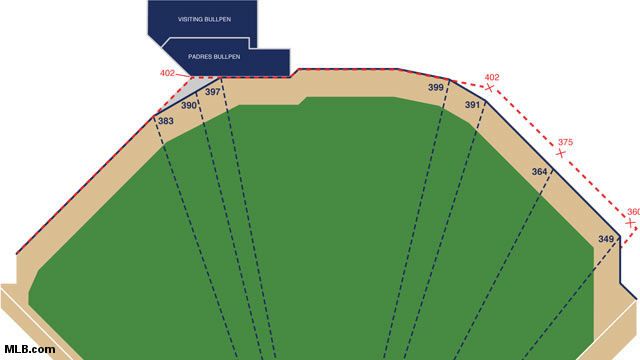
Well they should. They should ostensibly help every hitter, but I’m just being literal and anyone asking that question is actually asking how much they will help Alonso. There is no way to answer that question definitively, but let’s see if we can get some idea based on what he did in 2012. Thanks to MLB.com we know how the new fences will look once the renovations at Petco Park are finished:

petconewfence

For those of you thinking that these changes will turn Petco into Coors Jr., I hope the above picture is a wakeup call. We’re talking about a handful of 9-11 feet moves which may result in a couple extra bombs for the team’s best players. The opposition’s best players will also get a little uptick, but Petco Park is still most definitely a pitcher’s park and the best place to utilize your marginal fantasy starting pitchers. Let’s take a look at Alonso’s outfield flyball outs in Petco last year and see if those extra 10 feet would’ve turned into much.

alonsofboutsI circled a pair of outs in red that look like they might be homers in Petco2. Of course, he’d have to have the same exact hit distribution in 2013 and I highly doubt guarantee that will won’t happen. What may happen, though, is that Alonso is less fearful of pulling the ball for some power thanks to the moved in fences. At the very least, hopefully the new dimensions bring even more doubles which would then likely translate into more runs scored and driven in.

Without improved production, it is hard to justify Alonso being selected in leagues with 12 teams or fewer, even as a corner infielder or utility. He checked in as the 61st corner infielder on ESPN’s Player Rater for 2012. It was his rookie year so I’m not necessarily slamming him for finishing so poorly among corner infielders, just stating it so you’re careful not to overvalue him as he was a blue-chip prospect. And it can’t all be blamed on his home ballpark because his 723 OPS and six homers on the road were far from special.

The 26-year old Alonso is entering his physical prime and now has 746 major league plate appearances under his belt. It isn’t unreasonable to expect him to show some improvement, especially for a guy who was expected to have .300+ capability with at least high-teens power, but expecting it all at once will likely leave you disappointed. Keep him on your watch list for a standard mixed league should you need an early replacement in April or May, otherwise draft him only in NL-only leagues.

ADDENDUM

This piece was supposed to come out earlier on Saturday afternoon before I left for the movies, but I messed up the scheduling of it. So in my haste to remedy that and get it posted before it was all of a sudden Sunday, I forgot to include an instructive graphic.

yonderhmrd

Look at how his power is all to the pull field on the road (as it is with most guys, of course). This backs up the notion that he knows what he’s dealing with when it comes to Petco Park so he’s content to try and pepper doubles to leftfield instead. It will really be interesting to see if the fence move, though slight, will coax Alonso toward the pull field a bit more at home and maybe yield some extra bombs.

Friday: 01.25.2013

Countdown to Spring Training: 28 Days – Hanley Ramirez

Only 28 days until live game action…

OK, so the first actual Grapefruit or Cactus League game doesn’t take place until February 22nd, but the Red Sox are splitting up their squad and playing a couple of colleges on February 21st so we’re just 30 days away from organized professional baseball. So why not a countdown of this final, grueling winter month that includes some fantasy analysis?

Obviously my primary focus at this site is on pitchers and you’ll get quite a bit of my analysis on them in late February when the SP Guide drops, thus I was thinking of something surrounding hitters. With 30 days to go, I am going to do a hitter per day highlighting one from each team. I selected my player of note from each team and then randomized them (which was pretty interesting consider who the final two were after the randomization) so that’s the order I’ll be following.

HANLEY RAMIREZ

After the unmitigated disaster that was 2011, it wasn’t going to take much for his 2012 to be considered a rebound and it was yet he was still a disappointment. While he wasn’t going 2nd overall like 2011, he still only dipped to 20th average draft position with a high of 12 and low of 26 according to Mock Draft Central. His 20-20 season with shortstop and third base eligibility wasn’t bad, but it didn’t earn that draft position back. ESPN’s Player Rater had him 63rd overall and 42nd among batters.

The problem was that there was virtually no rebound in his paltry .243 batting average from 2011. It went up to .257, but that’s barely a dent (8 hits over a 600 AB season) and he posted the second-worst BABIP of his career at .290 (up slightly from 2011’s .275). His batted ball profile was actually somewhat conducive to a batting average increase as he added 2.5 percent to his line drives, which have the best chance to become hits. His flyball rate rose continuing a three-year trend, and those are least likely to become hits. While his flyball rate only ticked up by 1.2 percent, his infield flyball rate jumped four percent and those are all but guaranteed outs.

His BABIP based on batted ball was league average all told (he was a little low on line drives, but high on grounders & flies) so we shouldn’t be too surprised that his .257 batting average was essentially on par with the league’s .255 average as a whole. He might’ve smoked a few more at-‘em balls than normal, but nothing that would leave you saying he was quite unlucky for the performance he was delivering on the field. Batting average is really what kept his 2012 from being a “Hanley” season considering 2009 and 2010:

hanley3year

Based on my rough math estimations, a .300 average would’ve boosted Ramirez to a tie for 11th among batters in the player rater with Adam Jones and vaulted him to 18th with Jones in the overall.

“Well ya, but he was playing a lot in that cavernous monstrosity that can gives your eyes an STD if you watch too many home Marlins games!”

*Bzzz* Try again.

Ramirez raked in Marlins Stadium as did the other two superstars on that team:

homemarlins

It appears that Ramirez’s batting average issues for 2012 fit under the Occam’s razor principle: he just wasn’t good enough. No logistical pretzels about this BABIP or that venue. He simply didn’t hit the ball well enough to earn a .300+ average. I mean, we’re really only talking about a hit a week here. Another 26 hits would put right at .300 (actually .2996688, but I think MLB would go ahead and give it to him) and that feels like a lot, but there are generally around 26 weeks in the season.

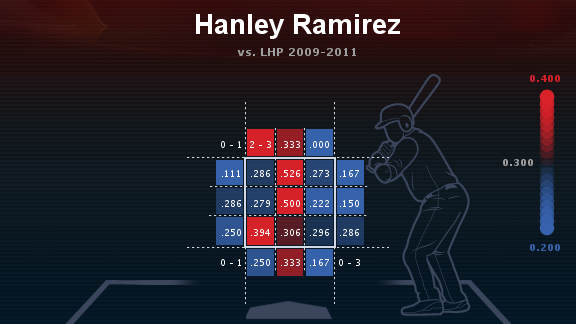
Where is going to get those hits in 2013? Ideally off of southpaws. For his two-plus seasons (92 G in ’11) from 2009-2011, he hit .305 off of lefties with a .339 BABIP. Those figures dropped to .263 and .293 in 2012. It wasn’t just one problem area either; they just handled him better than ever before. Though up and in and down and away do stand out a bit when comparing the two samples:

(click to enlarge)

(click to enlarge)

(click to enlarge)

(click to enlarge)

Ramirez remains a hot commodity for several reasons:

  • He has a track record of excellence so the potential to return to those levels is still present.
  • He is still on the right side of 30, adding to the likelihood of the first point.
  • He has dual eligibility at the hardest spot to fill (SS) and another premium infield spot (3B)
  • His “down” seasons are still 20-20 seasons with 92 RBIs. Well down seasons without injury.

Ramirez is solid “buy” target for 2013, even as a second round pick (though his ADP is a ludicrous 42 in early drafts** over at Mock Draft Central making him a huge bargain if that holds, but I doubt it will). High floors are a market inefficiency and they can sometimes be more important than a high ceiling for an early round pick. Especially if you subscribe to the notion that you can’t win your draft in the early rounds, but you can lose it.

**ADDENDUM

In the mock drafts I’ve done to date, Hanley has gone as follows:

  • 23rd overall in a 15 tm mixer w/OBP instead of AVG
  • 27th overall in a 15 tm mixer w/OBP instead of AVG
  • 21st overall in a standard 12 tm mixer
  • $31 dollars in a 14 tm auction standard 5×5

In other words: ignore that ADP because there is very little chance you’ll get him at that price.

Don’t forget the countdown continues on the weekend! 

Friday: 01.25.2013

Top 10 Leftfielders Right Now

Tonight MLB Network will continue the 2013 iteration of their “Top 10 Right Now” series at each position capped off with a “Top 100 Overall***”. They will air both the left and right field shows on Friday evening. I always enjoy this series and generally look forward to it after the New Year since I eat up just about any fresh baseball content I can as we wait for pitchers & catchers to report. Instead of putting up my lists after they air their selections, I’ll post mine ahead of time and then compare notes after the shows air.

This is not a fantasy list!!

***I will not be doing a top 100

I felt I was getting a little verbose on these lists given that they’re really just about having some off-season fun, so I’ve cut the explanations down a bit on these.

The leftfield list was one of the easier ones as the 10 came pretty easily to me. Mike Trout and Bryce Harper will not be included because they were included on the centerfielder list. We saw MLB Network put Shin-Soo Choo on the centerfielder list as well, so they’re going with where guys are expected to play in 2013 thus you won’t see Martin Prado on the list, either, as he will now play third base for the D’Backs. Nor will you see Desmond Jennings as he shifts over to center to replace B.J. Upton. Oddly enough, MLBN was counting new position for guys like Choo and Aroldis Chapman yet they still included Trout with the CFs and he is slated to play left with Peter Bourjos in center.

HONORABLE MENTION

Jason Kubel (ARI) is the only leftfielder who was close for me. His NL debut was impressive, but he just missed out as he lags a bit behind defensively and his bat was good, but not overwhelmingly so.

THE LIST

10. Alfonso Soriano (CHC) – A punching bag for many fans, Soriano hasn’t been the 40-40 guy from his Washington season, but he’s not exactly Vernon Wells, either. In fact, by fWAR he’s earned $98.5mm ($5mm/WAR) on the field while being paid $97mm. Even if you don’t buy the defensive gains, he’s been a plus-hitter for five of six seasons with the Cubs.

9. Melky Cabrera (TOR) – How much do you think PEDs helped Melky? And do you think he’s taken them consistently for two years? Those are the two questions to be asked when analyzing him. I lean toward “some, but not overwhelmingly so” and “no”, so he makes my list. I doubt he’d be the 2012 version of himself even if he kept using, so look at 2011 as a guidepost for his performance.

8. Brett Gardner (NYY) – Speculating a bit here since Gardner missed most of 2012, but when he plays he does everything except hit for power. He plays incredible defense, has game-changing speed, and he’s the Van Gogh of walks—he draws ‘em like crazy!

7. Josh Willingham (MIN) – Staying on the field has been the only real issue with Willy during his career and he’s improving in that avenue improving his games played from 114 in 2010 to 136 and 145 the last two years. Regardless of how often he plays, he’s always raked at the dish and done so enough to cancel out his below average defense.

6. Yoenis Cespedes (OAK) – What an incredible debut! I don’t think anyone saw that coming. He was the commensurate five-tool player hitting .292 with a .505 slugging percentage, playing elite defense in left using his arm to terrify runners into staying put, and stealing 16 out of 20 attempts while also taking extra bases at an above average clip. Imagine if he tops 130 games this year.

5. Justin Upton (ATL) – New to both his team and his position, Upton was finally traded after approximately 212 years of speculation. The potential is overwhelming, but we need to see it more consistently and since we don’t yet, he lands lower than you probably would’ve expected to see him.

4. Matt Holliday (StL) – Only two LF, both regarded among baseball’s best, have topped him with the bat at the position. He pairs the first-rate bat with better defense than you think. Unless you think he plays good-not-great defense boosted by his solid arm and ability to freeze runners.

3. Carlos Gonzalez (COL) – He’s failed to repeat that stunning 2010, but he hasn’t exactly been a slouch in the meantime and his rising walk rate bodes well for his late-20s. He’s yet to play more than 145 games in a season which only make his three straight 20-20 (all w/22+ HR) seasons that much more impressive.

2. Alex Gordon (KC) – The unquestioned best leftfielder in the game defensively speaking whether you trust the metrics or simply use your eyeballs. Mind you, that’s not the only reason he rated this well, he’s also come around big time with the bat including an MLB-best 51 doubles last year. Took him a while, but he’s finally paying dividends on the savior tag that was slapped on him before the ink dried on his contract in 2005.

1. Ryan Braun (MIL) – Duh-doy!

Friday: 01.25.2013

Top 10 RP – Review

Last Friday night, MLB Network unleashed their Top 10 Relief Pitchers Right Now along with input from host Brian Kenny, co-host and human bobblehead (click that & also see below) Mitch Williams, and special guest to the series Bill James. The results were a bit annoying. For one, they did what I feared they might do: lean far too heavily on closers. One list had exactly zero middle relievers and the maker of said list is a huge surprise. I know these lists are for s’s & g’s and despite how it may read, I’m not getting that worked up over it, I’m just trying to have some fun as we move closer toward real baseball!

HumanBobble2

Here are all four lists from MLB Network-related folks and then I’ll address them separately:

top10RPlists

The Shredder

I’ll say straight out front that The Shredder did much better with the relievers than with starters. I’ll also admit that Grant Balfour was a nice pick. I probably didn’t give him enough consideration. The dude hates letting guys hit the ball (4.9 H/9 last year), misses a good amount of bats (25% K rate), and Oakland has the perfect stadium for his flyball tendencies. That adds up to a helluva reliever. My love for strikeouts probably kept Jim Johnson and Eric O’Flaherty off of my list or it was just the overwhelming amount of depth at the position making it nearly impossible to whittle it down to 10. O’Flaherty has been insane the last four years with a 1.95 ERA and like a 2 million percent groundball rate. Seriously, it’s been 55-57-56-66(!!) percent the last four years meanwhile he has struck out 20% or more guys in three of the four years so he isn’t completely incapable of bat-missing. I was also impressed that The Shredder didn’t overrate Jonathan Papelbon and gave Koji Uehara some big love. All told, this was probably my favorite list because they gave middle relievers deserved love and their differences from my list were pretty strong. That said, Motte was a huge miss.

My inclusions he didn’t list: David Hernandez, Joe Nathan, David Robertson, and Jason Motte

Middle relievers: 4 (Kenley Jansen isn’t starting the year as the closer)

Bill James

Bill, Bill, Bill. You’re my dawg, but Papelbon #2?? No, just no. I pretty much blocked out everything else at that point: the inclusions of Motte and Nathan, the Rodney love, the Sergio Romo exclusion, all of it was forgotten for better or worse because the godfather of sabermetrics and objective analysis threw Jonathan Papelbon second on his list of relievers RIGHT NOW showing a clear bias toward his Red Sox (for whom Bill works as an advisor). John Axford was a little high for me, but his inclusion isn’t too problematic. This is a dude who fans 30% of the batters he’s faced for three years running. He gave up a quarter of his 2012 runs (36) in three games with a trio of three-run outings from June 10th to July 29th. And he was also saddled with a 19% HR/FB rate, it’s probably not a bad idea to bet on some improvement for 2013.

My inclusions he didn’t list: Hernandez, Uehara, Robertson, and Romo

Middle relievers: 1 (and maybe two if Ryan Madson closes for LAA) 

Mitch Williams

Everyone else worked under the assumption that Aroldis Champan is going to be a starter (primarily because he is), but not ol’ Bobbles. OK, so you’re trying to make a big call, but why not just work under the same conecit everyone else did and add a disclaimer that you have Chapman second and think he’ll be closing by Memorial Day or something? Apart from that, his list isn’t too bad despite five disagreements between us. It’d really only be four without the Chapman thing because as he mentioned in the video linked in the opening, Motte was his #11. Finally, someone gives Robertson some attention, which he richly deserves.

My inclusions he didn’t list: Hernandez, Nathan, Motte, Jansen, and Romo

Middle relievers: 3

Starting pitchers: 1

Brian Kenny

How could you do this to me, Brian? You’re my boy, blue! The critical thinker himself, Mr. Next Level Stats who firmly believes the closer mentality is garbage (I don’t fully agree, btw) chimes in with ZERO middle relievers in his list. Or maybe one with Ernesto Frieri, but he’s an assumed closer in many circles at this point. I’m not suggesting you should shoehorn non-closers in if you don’t think they belong, I’m just wondering how he thinks they don’t belong?! Papelbon at 4? Are Soriano and Johnson really better than all middle relievers? He pointed out multiple times how Mitch had more middle relievers than James only to come to the table with a goose egg himself. I was surprised for sure!

My inclusions he didn’t list: Hernandez, Uehara, Robertson, and Jansen (all 4 of my MRs of course)

Middle relievers: 0

I’ll reiterate once more that I know these are just fun and any exasperation I show is reasoned exasperation. I’m not taking these lists too seriously or cultivating hate for any of the panelists. I truly enjoy this series quite a bit and I’ve had fun agonizing over my own lists.

Thursday: 01.24.2013

Countdown to Spring Training: 29 Days – Carlos Santana

Only 29 days until live game action…

30: Desmond Jennings

OK, so the first actual Grapefruit or Cactus League game doesn’t take place until February 22nd, but the Red Sox are splitting up their squad and playing a couple of colleges on February 21st so we’re just 30 days away from organized professional baseball. So why not a countdown of this final, grueling winter month that includes some fantasy analysis?

Obviously my primary focus at this site is on pitchers and you’ll get quite a bit of my analysis on them in late February when the SP Guide drops, thus I was thinking of something surrounding hitters. With 30 days to go, I am going to do a hitter per day highlighting one from each team. I selected my player of note from each team and then randomized them (which was pretty interesting consider who the final two were after the randomization) so that’s the order I’ll be following.

CARLOS SANTANA

If you just randomly poll some fantasy baseball managers asking them how Carlos Santana did in 2012, I think you’ll end up with answers suggesting it was a “down” or “poor” season. After all, he did drop nine home runs from his 2011 total, but the perception is likely built around the fact that he ended June with a .220 batting average and 673 OPS. It wasn’t so much that he got off to a poor start, either, he had an 863 OPS in April, but May and June were complete washouts as he put a 592 mark during the two months clearly playing at far less than 100 percent health and the concussion at the end of May certainly didn’t help.

In fact, from the concussion date (May 25th) to the All-Star break, he hit .172 with 527 OPS. With that in mind, how much more impressive are his final numbers of a .252 batting average and 785 OPS? The four days off served him well and he hit .281 with an 887 OPS the rest of the way. Throughout the year he continued to take his walks, but it felt like it was passivity during his May-June slump and he was missing worthwhile pitches opting for the free pass instead. That is based on probably 10-12 games of watching the Indians including some series against my Tigers so if you don’t want to lock that down in stone, I understand. Just letting you know what I saw.

Despite losing essentially two months where he was playing, but struggling majorly, Santana still had a very nice season. He sustained his OPS by raising his on-base percentage to account for the drop in slugging percentage. And he had just three fewer runs batted in despite 49 fewer plate appearances. Lost in the shuffle was the improved strikeout rate dropping from 20.2 to 16.6 percent while lightly boosting his walk rate from 14.7 to 14.9 percent.

Going into 2013, Santana is part a very deep catcher pool and analysts can’t seem to agree exactly where he belongs. There is plenty of established star power at the position with a handful of up-and-comers poised for breakouts, too. For me, he is an easy top three behind no more than Buster Posey and Yadier Molina, but the early rankings have him anywhere from two to seven:

It looks like drafters are following Steve Gardner at USAToday the most early on as his current average draft position has him as the seventh backstop off the board. In an OBP league, he’s easily behind only Posey, but most leagues still use batting average where he has a bit of a deficiency against righties. He is a switch-hitter who fares better against lefties, but he isn’t exactly crushing them, either. He had a .272 average against them last year which isn’t too far from his .278 career mark against southpaws.

An attribute to consider with Santana is his first base & DH playing time. It allows him to get those extra plate appearances that other catchers won’t accumulate and keeps some of the wear-and-tear off of him. This has allowed him to join Joe Mauer as the only two catchers with 600+ plate appearances the last two seasons. Meanwhile his 658 from 2011 is the second-highest total from a catcher since 2006 topped only by former Indian Victor Martinez who had 672 in 2009 with Cleveland and Boston.

Speaking of Martinez, he is another guy who deserves a boost because of playing time. He should still be catcher-eligible in any league worth its salt because of his 26 games there in 2011 when he last played and he won’t have to crouch at all in 2013. He should be the exclusive DH for the Tigers with maybe a couple of 1B starts mixed in to give Prince Fielder the proverbial half day off.

A healthy Santana can bring a .275-90-30-100 season to the table. And yes, I do think he can reach 100 RBIs with Michael Brantley, Jason Kipnis, Asdrubal Cabrera, and Nick Swisher ahead of him in the lineup.

Wednesday: 01.23.2013

Countdown to Spring Training: 30 Days – Desmond Jennings

OK, so the first actual Grapefruit or Cactus League game doesn’t take place until February 22nd, but the Red Sox are splitting up their squad and playing a couple of colleges on February 21st so we’re just 30 days away from organized professional baseball. So why not a countdown of this final, grueling winter month that includes some fantasy analysis?

Obviously my primary focus at this site is on pitchers and you’ll get quite a bit of my analysis on them in late February when the SP Guide drops, thus I was thinking of something surrounding hitters. With 30 days to go, I am going to do a hitter per day highlighting one from each team. I selected my player of note from each team and then randomized them (which was pretty interesting consider who the final two were after the randomization) so that’s the order I’ll be following.

DESMOND JENNINGS

Always a tantalizing prospect, the Rays slow-cooked Jennings to the tune of 1004 plate appearances in Triple-A including 397 in 2011 despite the fact that his predecessor, Carl Crawford, had left for Boston via free agency that offseason. When he finally came up that year, he hit the ground running with a 1000 OPS in his first 175 plate appearances which included eight homers, 20 RBIs, 14 SBs, 24 runs scored, and 19 walks. He was doing everything.

Regression, which was probably inevitable, hit and hit hard as he shaved nearly 200 points off of that OPS down to 805 with a .162/.259/.253 line in his final 112 plate appearances. He still scored 20 runs and maintained his 11 percent walk rate, but the hot start caught up to him a bit and since the production came in two so distinct halves of amazing and crap, it generated discussion. It would be an interesting experiment to (travel back in time and) mix up the distribution of his production to small ups and downs that eventually land on the 805 OPS and see if it generates a different discussion. I’m sure it would.

He followed it up with a 2012 that looked more like the 112 PA sample than the 175 PA sample. He was a viable power-speed combo, only one of five players to reach or top 13 home runs and 31 steals*, but the walk rate fell nearly three percent to 8.2 while the strikeout rate remain steady at 21 percent. His home total was well off the 2011 pace which would’ve seen him hit 20 had he amassed the same 563 plate appearances he got in 2012. The doubles and triples held essentially even for those curious. So what happened?

*the other four were Mike Trout, teammate B.J. Upton, Carlos Gomez, and Jason Kipnis. All but Kipnis lapped him with either a lot more home runs or steals (or more of both in the Trout & Gomez cases). 

It is a bit too simplistic to just say that his home run per flyball rate regressed and that ate up his home runs. To a degree, that is exactly what happened, but without digger deeper it isn’t a helpful bit of information. He actually hit a larger percentage flyballs in 2012 moving from 35 to 38 percent and improved his line drive rate by 2.5 percent up to 20.1 percent.  Both of those factors can be good for a power spike, but the flyball contact was far less effective in 2012 as his infield flyball rate nearly doubled from 9.4 to 18.1 percent.

In his short 2011 sample, his flyballs hit off the inner third of the strikezone yielded a 5-for-12 (.417) mark with all five hits leaving the yard. He hit .297 (11-for-37) off the inner third as a whole in 2011. In 2012, he hit just four home runs off the inner third accounting for all four of his flyballs hit in nearly twice as many tries as he went 4-for-23 (.174). He still did plenty of damage off the inner third as a whole going 26-for-76 (.342), but pitchers got better at jamming inside to limit the damage to mostly singles (15 of the 26 hits). He wasn’t turning on those inner third meatballs like this one from 2011:

djennings

It’s one thing to drop your HR/FB rate because you are crushing warning track shots on gusty days or hitting the base of the wall for doubles and triples, but Jennings saw his HR/FB rate evaporate and shift into infield flies, the least successful contact a batter can make thus aiding a 61-point drop in slugging percentage and 47-point drop in isolated power (slugging minus average).

At 26, he is just about to enter his prime and doing so with 874 plate appearances under his belt should give him enough of a base to work from to make adjustments in order to fulfill his immense promise. The potential and youth will keep his price high, but the payoff is massive and even the downside was at least somewhat palatable despite massively underperforming his cost (51st ranked OF; 23rd most expensive) thanks to the steals.

He was the 92nd player drafted last year and his 2012, though under expectations, hasn’t really deterred anyone as he is tracking at 90th overall early on this winter. The composition of my team to that point would determine whether or not I’m willing to pay that eight round price tag.

If I have a foundation of guys with three-four years of track record, maybe Robinson Cano in the first, Adrian Beltre in the second, plus a Billy Butler, Cole Hamels, you get my point, proven veteran rocks; then I’d be more inclined to take Jennings. If you have team centered around Andrew McCutchen (just the one transcendent first round year), Jason Heyward, and Chase Headley, then you should probably go with Austin Jackson or Alex Rios who are being drafted 88th and 91st, respectively.

Tuesday: 01.22.2013

Top 10 SP – Review

On Friday night, MLB Network unleashed their Top 10 Starting Pitchers Right Now along with input from host Brian Kenny, co-host John Smoltz, and special guest to the series Bill James. The results were interesting and perhaps unsurprisingly, I had more gripes with this list than I have any of the previous ones.

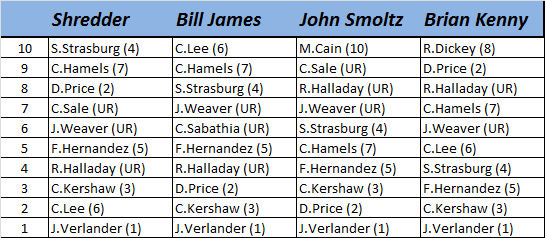
Here are all four lists from MLB Network-related folks and then I’ll address them separately:

top10SPListsThe Shredder

Let’s start with the list that comes from their objective machine they call “The Shredder”. Kenny suggests that it is cold and calculated in its evaluation relying heavily on the most recent season, but also not forgetting track record. I have to call heaping amounts of BS on it. It just doesn’t add up. First off, it you’re focusing on “RIGHT NOW”, then how does Roy Halladay still finish fourth? There has to be a lot of subjectivity used to get him there. But that’s far from the most egregious infraction.

If this is supposed to be the most objective tool relying on data only for projection analysis, how does Chris Sale not only make the list, but finish ahead of Stephen Strasburg, Cole Hamels, and reigning Cy Young winner David Price? It had to rely heavily on track record (or pure subjectivity) to get Halladay that high, so then track record would send Hamels and Price rocketing past Sale. Meanwhile, Sale wasn’t better than them last year, either.

Strasburg is probably skewed because he threw just 160 innings, but he was so stellar in that allotted time that it is still a surprise to see him so low. Plus, since I think they had to finagle things to get Halladay that high, surely they could’ve just done the same to get Strasburg into a more reasonable slot. Whatever the case is, I’m done believing that The Shredder is purely objective on any level. And if it is coming to these conclusions based on the data it is being fed, it’s broken and Master Splinter does in fact need to take over.

Maybe I got too caught up in Jered Weaver’s peripherals when leaving him out because I didn’t even give him an honorable mention. I recognize the fact that he is a damn fine pitcher, but I am a strikeout whore and looking over the numbers again I think I focused too much on the plummeting strikeout rate and not enough on his incredible ability to keep runners off the bases, specifically by preventing hits. I still think six is a little high, but I can see how he would fit nicely at 10 bumping the NL version of him (Matt Cain) up to nine and Gio Gonzalez getting moved to an honorable mention.

My inclusions they didn’t list: Cain, Gonzalez, and R.A. Dickey

Bill James

Without treading over well-worn ground too much again, I just can’t see how on a “RIGHT NOW” list James saw fit to put teammates Cliff Lee and Hamels so far below Halladay who is 36 and coming off of an injury-marred season. Plus there’s the fact that he and the Phillies were going to start discussing an extension, but worries about his shoulder scared them off a bit. I still love Halladay as an undervalued fantasy commodity, but as the #4 pitcher right now, I’m a bit more skeptical.

James was the only one to list C.C. Sabathia which I think says more about the depth at the top of the pitching heap than anything else. I certainly don’t fault James for including him nor would I have faulted any of the other participants. He was basically tied with Adam Wainwright on my list at that 13/14 spot, but I gave Waino the mention because I honestly thought CC would appear on most of the lists and didn’t need the extra love.

My inclusions he didn’t list: Cain, Gonzalez, and Dickey

John Smoltz

Smoltzie’s list was close to being my favorite list but including Sale at the expense of Lee was just too much to overlook. Frankly, it doesn’t even matter if Lee wasn’t 11th, just the inclusion of Sale over many more deserving (at least in my estimation) candidates is tough for me. I’m not anti-Sale overall, just when it comes to ranking him this high among the best pitchers right now. Another big season in 2013 could elevate him onto my list next winter, but he hasn’t done enough to pass enough all of these guys just yet.

My inclusions he didn’t list: Gonzalez, Dickey, and Lee

Brian Kenny

I guess by sheer virtue of the fact that we had the most matches (eight), Kenny’s list should be my favorite, but it boggles my mind how he could wind up with Price at nine. Apart from that, our lists are pretty close on the matches we had usually off by just a spot, maybe two, and we had three direct matches (JV, Strasburg, and Hamels). He was adamant about getting Dickey on his list and was the only one to do so which obviously I support, but I just kept coming back to the Price thing. If you go off of mostly last year, then Price has to go above Weaver (and obviously Halladay) and even when you factor in track record, it’s not like Price is without one. You’d have to weigh track record pretty heavily to Halladay above Price which I thought went against the conceit of these lists.

My inclusions he didn’t list: Cain and Gonzalez

All in all, I know these lists are still just fun and filled with opinion (yes, even yours Shredder), but I can’t make sense of it sometimes when arguments supporting guys contradict where you rated them or others.

I’ve still got my reliever review upcoming and then the LF and RF lists are due this week before Friday night’s airings.