Archive for ‘Player Focus’

Tuesday: 05.8.2012

Trolling the Wire: Week 7

I spent of the first month of the season debating a different distribution method for the Trolling the Wire column that appeared weekly last year.  After deliberation, I’m just going to continue distributing as I did last year, through this site.  Some leagues allow same-day pickups so I’ll cover some guys for tonight along with the rest of the week.

(pitchers are ranked in order of confidence on a given day)

TUESDAY

Joe Blanton (PHI) – Those dismissing his complete game shutout against the Braves because it came after the marathon barn-burner the night before are missing out with Blanton.  He looked great before that start.  His strikeout rate is down to 5.4 which I don’t love, but his walk rate is on a five-year decline down to 0.8 BB/9.  (vs. NYM)

Edwin Jackson (WAS) – Last year’s TTW most used arm, Jackson is least available of the four listed (41% available at ESPN), but he is still underutilized.  Both his strikeouts and groundballs are at career-best marks (8.2 and 52%, respectively) while his walk rate is down to a career-low 2.3 BB/9.  Some people refuse to believe in E-Jax, but I remain steadfastly loyal.  (@ PIT)

Danny Duffy (KC) – I expected to see Duffy’s profile raise after a five-plus strong innings against the Yankees, but he remains widely available.  He needs to exhibit more control (4.8 BB/9), but he has built himself a solid margin for error with a 10.3 K/9 in his 23 innings.  (vs. BOS)

AJ Burnett (PIT) – Yes, St. Louis absolutely obliterated him and your fantasy team’s ERA, but you already sustained the worst of him so why jump off the train now?  He was excellent in his two starts prior to that massacre (btw, why the hell did Clint Hurdle leave him out there for that long?) and he has the stuff to get back on track again.  (vs. WAS)

Jarrod Parker (OAK) – The heralded rookie who was acquired in the Trevor Cahill deal has looked sharp in his first two outings in the American League including great work last week in Fenway.  He has a passable 6.2 K/9 rate in his first two starts, but I think we can expect to see that number rise as the season progresses.  Pitching in Oakland always helps, especially with mega-talented arms like Parker.  (vs. TOR)  — Parker was originally scheduled for Tuesday, then flipped with McCarthy for Wednesday and then flipped BACK again to Tuesday.  Thanks for the heads up from commenter Brad.

WEDNESDAY

Erik Bedard (PIT) – I’m going right back to the Pitt-Wash series well for Wednesday.  I guess the history of these two teams makes it difficult for fantasy managers to buy in on their starters and the early season success they are enjoying.  As I’ve said repeatedly, it’s never been about talent with Bedard, just health, so get everything you can out of him while he is whole.  He’s been great this year, though I’d like to see some more pitch efficiency.  Even in his last two starts where he only walked a pair in each, he has been able to go just five innings both times.  (vs. WAS)

Drew Smyly (DET) – What more does Smyly need to do for fantasy folks to buy in?  He has deftly handled Tamp Bay, Texas and the Yankees in New York yet his ownership rate is 45% at ESPN and somehow 32% at Yahoo!.  The added bonus is that he has shown some great strikeout potential, too, with 7 Ks in each of his last three outings (TEX, @ NYY, CHW).  He will have some ups and downs, but I’m buying in on the big picture.  (@ SEA)

Anthony Bass (SD) – Bass is an even more unheralded version of Smyly.  He started 2012 in the bullpen and after a pair of appearances in relief, he has moved into the rotation and looked fantastic.  Of course pitching in San Diego always enhances a pitcher’s value, but his two starts out of PETCO Park have been just fine, too.  He is missing bats (10.6 K/9 in his 5 starts) and getting tons of groundballs (55%).  His BABIP is a bit low (.247), but his 3.19 xFIP says he should be even better than his 3.51 ERA.  (vs. COL)

Ross Detwiler (WAS) – I have been a fan of Detwiler for a while and I’m glad that he is starting to display his talents at the major league level.  In limited time the last three years, he showed incremental improvements, but this year at age 26 he has taken a major step forward.  His secondary pitches are yielding both more strikeouts (career-high 6.7 K/9) and groundballs (career-high 58%) which has driven his success.  His .215 BABIP will certainly regress at some point, but there is enough to believe in with Detwiler and he shouldn’t be available in 52% of ESPN leagues.  (@ PIT)

THURSDAY

Henderson Alvarez (TOR) – Limited options with six games on Thursday and a handful of aces going, but Alvarez is coming off of a complete game shutout yet remains on the wire in many, many leagues.  The problem is that he couldn’t strike me out.  His 2.6 K/9 is frighteningly bad.  His game is to induce weak contact and let his fielders do the work (57% groundball rate), but you have to strikeout SOME batters.  He is going to have a game where several balls find the holes and he gets BABIP’d to death, but I think he will best Minnesota here.  (@ MIN)

FRIDAY

James McDonald (PIT) – Yes, another Pirates starter.  Unlike last year when their starters were drastically outperforming their peripherals, this year’s rotation actually has some strikeout arms doing pretty well yet not getting the love for it.  McDonald wasn’t missing bats early on (6 Ks through his first 3 starts) and I was concerned, but he has 25 Ks in 21 IP across three starts since without giving back the walk rate gains we saw at the start of the season.  A longtime favorite of mine, don’t be surprised if McDonald appears repeatedly on TTW as long as he remains available in many leagues.

Felipe Paulino (KC) – He’s back!  Unfortunately, Paulino started the season on the DL, but he returned last week with six shutout innings against the Yankees as he picked up where 2011 left off.  I really liked Paulino last year and I like him even more this year.  As with the Pirates starter, he is unlikely to get much love even with sustained success so jump in now.  (@ CHW)

Chris Capuano (LAD) – Fantasy managers are catching on with each passing start, but Capuano is still out there in 30% of ESPN leagues and 44% of Y! leagues so I thought he was worth mentioning.  That 2.21 ERA is going to regress a bit as home run issues have always been there with Capuano, but the strikeouts and mid-3.00s ERA by season’s end are well worth it.

Weekend picks on Friday

Wednesday: 05.2.2012

The Best Pitches of April

We are a month into another great season of baseball and we have seen plenty of great pitching already both unexpected and expected starting most notably with Phil Humber’s perfect game continuing on with Jeff Samardzija and Jason Hammel’s out-of-nowhere emergence and Joe Saunders’ MLB-best 0.90 ERA on the unexpected side ranging over to the expected of Roy Halladay, Justin Verlander and Stephen Strasburg mowing through their opponents with little to no resistance.

With all of that great pitching in mind, I wanted to look at the best pitches of the month.  This idea was at least partially influenced by BP colleague Sam Miller’s ridiculously excellent series highlighting the best pitches of the week.  I was wanting to do something like this last year, but lacked the means to acquire GIFs such as those you’ll see below and reading Sam’s work on the week’s best pitches jogged my memory and ended up as the impetus to make my computer GIF-ready and introduce the series.

To determine the “best” pitches of the month, I will be using FanGraphs Pitch Values and then supplying GIF-based examples of those of pitches.  FanGraphs offers pitch values on fastball, slider, cutter, curveball, changeup, split-finger and knuckleball pitches, but for this exercise, we will be looking at the first five as so few actually throw a split-finger and only R.A. Dickey throws a knuckleball among qualified starting pitchers.

I’ll list the top overall value for each pitch, the top value in the other league (so if 1st place is from an NL guy, I’ll list the top AL guy even if he’s further down the list) and also the top surprise listing which is of course arbitrary to my own tastes.  GIFs will be included for the Top Overall in each pitch only.

FASTBALL

  • Top Overall – Lance Lynn (Value 8.5, Usage 64%, Velocity 92.3 MPH)
  • Top Other League – Jon Lester (6.0 [7th-best], 56%, 92.3 MPH)
  • Top Surprise – Joe Saunders (7.1 [3rd-best], 69%, 89.2 MPH)

Lynn is using his fastball almost 10% less than he did last year when he was coming out of the bullpen shifting that pitch mix over to his slider and changeup as he has made a seamless transition and almost made Cardinals fans forget Chris Carpenter, who is shelved with an injury.

Perhaps most impressive of all is that Lynn’s heater lost just 0.9 MPH in the shift.  Oftentimes since relievers are max effort hurlers used an inning at a time, their velocity will be higher than it would as a starter, but Lynn has maintained his heat almost entirely.  Lynn is 4-0 with a 1.33 ERA, 0.81 WHIP, 8.0 K/9 and 4.0 K/BB in 27 IP.

Here is a look at some Lynn fastballs from his April 14th home start against the Chicago Cubs.  He is facing off against Marlon Byrd in the top of the 5th inning.  Byrd is befuddled.  (Please excuse the very amateur GIF’ing as these are literally my first GIFs ever on a program that is brand new to me.  Hopefully you see improvement as the list progresses as I started to get the hang of it by the time I was working on the changeup leader.)

SLIDER

  • Top Overall – Madison Bumgarner (Value 5.9, Usage 40%, Velocity 87.4 MPH)
  • Top Other League – Brandon Morrow (3.5 [7th-best], 22%, 86.8 MPH)
  • Top Surprise – Barry Zito (4.4 [3rd-best], 37%, 78.7 MPH)

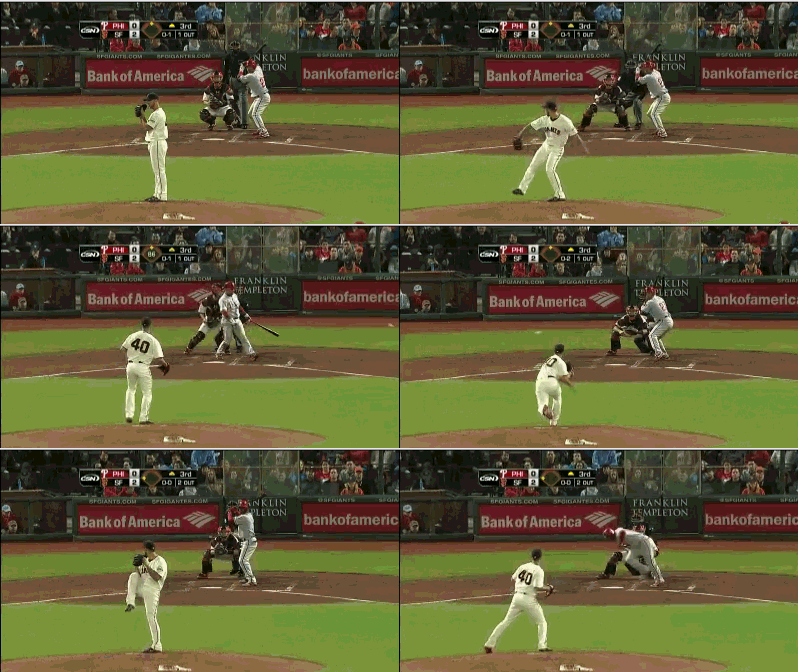
If sliders do eat up a starter’s arm then Bumgarner could be in trouble in the future.  He is throwing his fastball 14% less than last year (down to 39%) and 8% of that workload has gone to his devastating slider which is serving him quite well to start the season as he has a 2.53 ERA and 1.09 WHIP in his 32 IP of work.  His groundball rate is up to a career-best 55% (not counting the 58% in 10 IP from 2009), but his strikeout rate is way down thanks to just 7 K in his first three starts spanning 17.3 IP.

Since, he has 10 K in 14.7 IP across two starts for a much more palatable 6.1 K/9 compared to his season mark of 4.8 K/9.  The surface results are there, but the peripherals are lagging behind a bit save the groundball rate and I’m at least a tick concerned about the escalating slider workload (from 20% in 2010 to this year’s 40%).  Of course, then I watch him throw it and understand why he wants to rely on it so much.

Here he is throwing the beautiful breaker in his April 17th start against the Philadelphia Phillies in the top of the 3rd inning against both Placido Polanco and Jimmy Rollins.

CUTTER

  • Top Overall – Tommy Hunter (Value 5.1, Usage 28%, Velocity 85.2 MPH)
  • Top Other League – Roy Halladay (4.2 [2nd-best], 23%, 76.5 MPH)
  • Top Surprise – Carlos Zambrano (3.0 [3rd-best], 26%, 88.5 MPH)

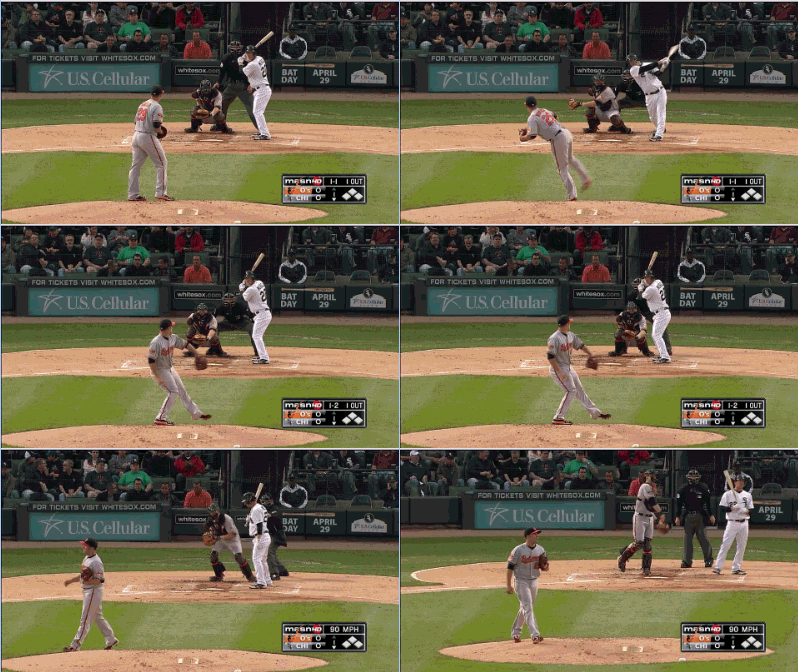
Hunter atop any of these lists might be a bit of a surprise to some as he is a league average pitcher at best who hasn’t reached 130 IP in any of his three major league seasons, but last year his cutter netted a 6.6 value which was good for 8th in all of baseball among pitchers with 80+ IP.

Hunter hasn’t parlayed his big cutter into any real success thus far toting a 4.26 ERA and 1.33 WHIP in 32 innings across five starts.  His control is at a career-worst 3.1 BB/9 pairing with his 5.1 K/9 to yield a meager 1.6 K/BB.

Here is Hunter taking care of Brent Morel in the bottom of the 1st inning of his April 18th start against the Chicago White Sox.

CURVEBALL

  • Top Overall – Jonathan Niese/Erik Bedard-tie (Value 4.1, Usage 22%/27%, Velocity 74.3 MPH/75.0 MPH)
  • Top Other League – Jake Arrieta (2.3 [6th-best], 17%, 78.9 MPH)
  • Top Surprise – Bronson Arroyo (2.4 [5th-best], 16%, 72.4 MPH)

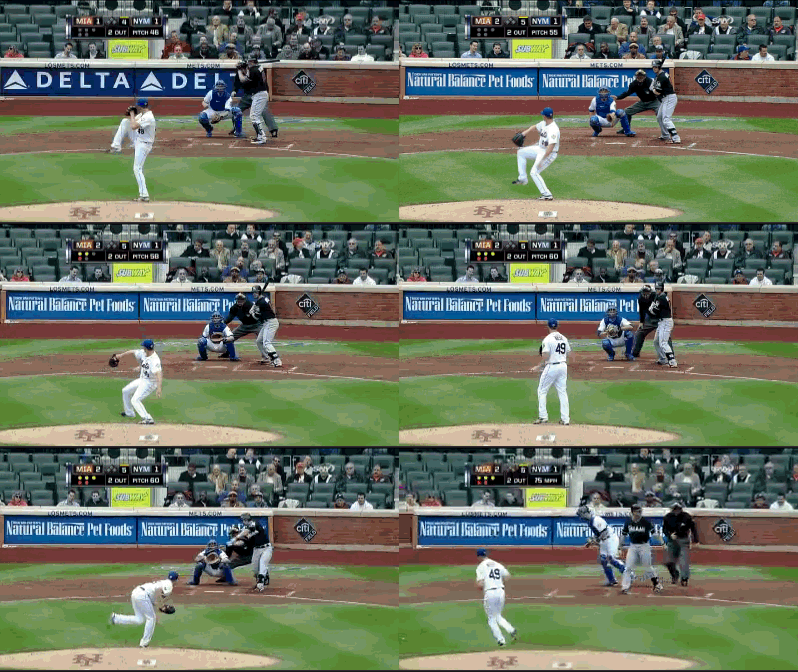
Niese continues his quest to get his ERA below 4.00 and down to the level of his xFIP (ranging from 3.28 to 3.80 since 2010) and currently sits on the precipice with a 4.08 ERA.  He is dogged by a 15% HR/FB thus far as his 3.45 xFIP is much more palatable.  Meanwhile his curveball has heavily aided his 7.5 K/9 thus far with 47% of plate appearances that end on curveballs resulting in a strikeout.

It has never been about talent with Bedard, rather health as he hasn’t reached 130 IP since 2007 so it isn’t too surprising that his first five starts with the Pirates have gone pretty well.  He has a 2.48 ERA, but a 1.41 WHIP thanks to his .337 BABIP.  He has an 8.1 K/9 and 2.2 K/BB in 29 IP.  His curveball has been his calling card throughout his injury-addled career along with a strong fastball, but this year’s fastball value is being eaten up by a .396 BABIP resulting in a -1.6 value thus far.

Here is Niese’s curve from his April 26th start against the Miami Marlins with a splicing of pitches from a faceoff with Austin Kearns in the top of the 4th and Brett Hayes in the top of the 6th.  Also you will see Bedard’s curveball from a pair of at-bats against Dan Uggla on April 28th in the bottom of the 3rd and 5th innings.

CHANGEUP

  • Top Overall – Tommy Milone (Value 5.1, Usage 28%, Velocity 79.5 MPH)
  • Top Other League – Anibal Sanchez (4.2 [2nd-best], 19%, 83.3 MPH)
  • Top Surprise – Jake Peavy (4.1 [3rd-best], 9%, 83.6 MPH)

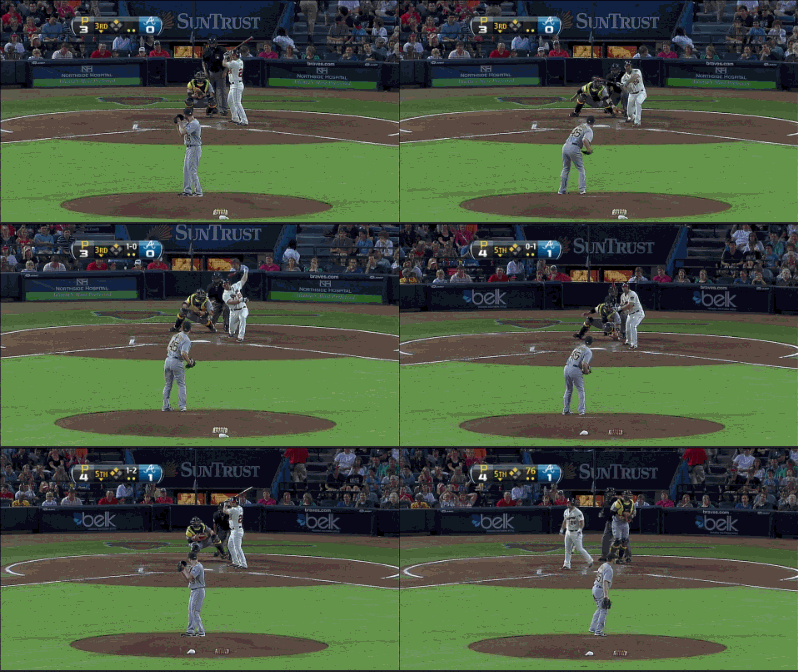
Milone entered his Monday night start against the Boston Red Sox with a 2.00 ERA and 0.87 WHIP impressing along the way despite a modest opponent list of Kansas City, Seattle, Los Angeles and Chicago (the bookends both at home).  The Red Sox would be his first real challenge, especially in Fenway.

They greeted him and his 87 MPH fastball rather rudely as he allowed 7 ER in 4.7 IP pushing his ERA to 3.69 in the process. Milone is a command and control lefty who doesn’t generate many strikeouts due to a lack of overpowering stuff and needs to effectively change speeds to have success so it isn’t entirely surprising to see him atop the changeup list.

Here he is during his April 24th start, a much more successful outing against the Chicago White Sox during which he threw eight scoreless innings of ball.  Take a look at four changeups across two at-bats, first against Paul Konerko in the top of the 1st and then against Tyler Flowers in the top of the 2nd.

Monday: 04.30.2012

Maddening Max

I remember seeing the news across the crawl on TV, “Detroit Tigers option RHP Max Scherzer to AAA Toledo…” and kind of doing a double take.  “Wow, that’s a shock!”  He had posted a 2.12 ERA in his first three starts, twice against Kansas City and once against Seattle, but his skills (10 K, 5 BB) weren’t particularly special.  He was better against Texas in his fourth start (7 IP, 3 ER, 7 K, 2 BB) before things came completely unhinged.  In his next four starts, he failed to go more than five innings posting a 13.50 ERA, 2.33 WHIP, 9 K and 9 BB in 18 innings.

It was mid-May of 2010 and the Tigers had little choice but to send the talented, but flailing hurler down to the minors for a spell.  Two weeks later he returned to the majors and went on to enjoy the best run of his professional career pitching like one of baseball’s best pitchers from May 30th through the end of the season with a 2.46 ERA, 1.13 WHIP, 158 K and 54 BB in 154 innings giving up 0 or 1 run in 15 of his 23 starts.  Could a similar move be in the offing for the 2012 version of Scherzer?

He was a complete mess on Sunday in Yankee Stadium walking a career-high seven, allowing seven hits as well and ending up very lucky to come away allowing just three runs in his 4.7 innings of work.  His ERA for the season is now at 7.77 and his league-leading 10.0 K/9 is completely cancelled out by the 4.8 BB/9 and 13.7 (!!!) H/9 rates.  His WHIP is an astronomical 2.06.  So what’s wrong?

Would you accept “everything” as an answer?

OK, maybe not everything, but “plenty” is definitely a viable answer.  Max himself said that fastball command was a huge issue on Sunday suggesting the ball felt like a “cue ball” as he struggled to find the zone with any amount of consistency.  The numbers bore out his assessment as he hit the strike zone a meager 52% of the time with his 74 fastballs.  He has always been what you might call effectively wild, but it was excessive on Sunday.  The outing in Yankee Stadium was more like things coming to a head for Scherzer as he hasn’t really been crisp at all this year, even when he struck out 11 in Chicago a few weeks back.

He has a 62% strike rate with the fastball on the year, down from 64% last year.  He was at 65% during that 2010 run.  While the lack of fastball strikes are contributing to his control issues, it is really the lack of reliable secondary stuff that is fueling his struggles so far this year.  He has a devastating wipeout slider when he is right as well as a strong changeup that often carries ~10 MPH split from his fastball which he buries down and away to neutralize lefties.

Just as with the fastball, he isn’t throwing nearly enough strikes with the secondary stuff as his slider is crossing the dish just 59% of the time, down from 63% in 2011.  Meanwhile, when it does go for a strike it is often being obliterated as hitters have a 1.224 OPS in plate appearances that end on a slider.  That is nearly twice the .617 OPS from last year.  Furthermore, the change is doing nothing to stifle southpaws.  He has a 59% strike rate on the changeup against lefties and they are battering it to the tune of a 1.065 OPS, numbers that were at 66% and .721 a season ago, respectively.

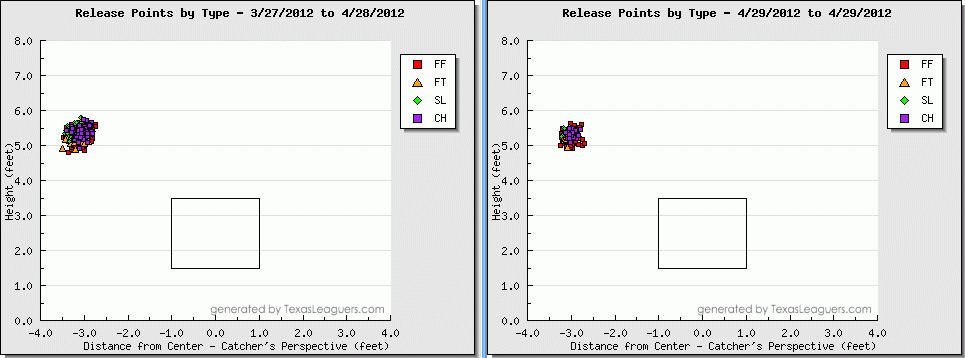
Scherzer has always had something of a violent delivery making consistency a constant challenge, especially with his release point.  On Sunday, the only thing that was consistent was Scherzer dropping his arm and throwing across his body as he continually flew open and finished all but falling off the mound.  The silver lining to these early issues is that they can be ironed out as the 2010 season showed.  You can refine and work on a pitcher’s mechanics.  You cannot, however, teach an arm to be as electric as Scherzer’s.  It’s subtle (and to me more evident in watching the starts), but you can see the difference in Scherzer’s release point yesterday when compared to his other starts this year.

(click to enlarge)

Another tick on the plus side would be that his velocity isn’t diminished during this tough time.  In fact, it’s up.  He has averaged 93.1 MPH with his fastball the last two years, but he is up to 93.7 MPH so far this year.  Often when a pitcher is struggling, analysts eye fastball velocity as an indicator to potential injury.  Scherzer is at his best mark since his 2008 debut (94.2 MPH) when he worked a lot out of the bullpen.  He has lost some of the velocity split on his changeup, though, which is currently averaging 85.6 MPH, up 3 MPH from last year.  His slider velocity is also up to a career high 86.6 MPH after sitting 82.7 MPH last year.

He appears to be overthrowing both secondary pitches helping explaining the velocity gains as well as his inability to consistently draw strikes with either pitch.  In short, Scherzer is a mess right now and that is obvious.  Even when he gets ahead of batters, they are still pounding him for a .751 OPS (.514 last year, .525 career).  What isn’t so obvious right now is what to do if you’re the Tigers.  Do you see if another stint in AAA does the trick a la 2010?  Or do you let him ride it out with the big league club?

If you choose the former, you probably have to wait until Doug Fister is ready to come back from the disabled list as you’re already working shorthanded.  Drew Smyly has been incredible in the early going and he is the only thing holding up the non-Verlander end of the starting pitching bargain as Rick Porcello has hardly been any better than Schezer (6.45 ERA, 1.48 WHIP) while Adam Wilk was forced into duty after the Fister injury and subsequently batted around for an 8.18 ERA in just 11 innings across three starts.  Duane Below will take his spot this week drawing a pair of starts and hoping to bring his bullpen success (12 scoreless IP) into the rotation.

How about handling Scherzer from a fantasy perspective?  Any AL-only league manager has to keep him, he is simply too talented and anyone you replace him with is likely a flavor of the month with nowhere near the upside.  Cutting him after just 24 innings would be hasty and likely end up backfiring.  I would say the same goes for deep mixed leaguers (14+ teams) and it is rare that a mixed league doesn’t allow a bench so I would just reserve before I would ever decide to cut him.  What about 10-12 mixed leaguers?  That is where a decision gets a bit more dicey.

There are no doubt a throng of options with better stats than Scherzer (not a tough bar to clear) and while I would personally practice some patience with him, I could understand making a move for a new pitcher in those types of leagues.  Looking at some of the names available in a 12-team mixer that I am playing, I see some nice options beyond the flashes in the pan like Joe Saunders and Bruce Chen, who I don’t trust at all.  Names like Jeff Niemann, Chris Capuano and the aforementioned Smyly among others.

I would assume a 10-teamer would have even better names in addition to those.  So while I would still recommend reserving Scherzer ahead of anything that involves cutting him, there is a case for releasing him for a better performing arm if that is your only choice or if you utilize Matthew Berry‘s Wandy Line Method for streaming starters.

Tuesday: 04.24.2012

Justin Verlander After 125+ Pitches

On Monday April 16th, Justin Verlander threw his first complete game of the season in a 3-2 win against the Kansas City Royals.  Five days earlier, he entered the 9th inning with just 81 pitches thrown, but came a bit unraveled and couldn’t close out the Tampa Bay Rays.  To do so against Kansas City, he needed 131 pitches, a figure that drew the ire of some fans and analysts largely because of the time of season we are in right now (in addition, of course, to the general overreaction and misunderstanding of pitch counts).  When will people stop treating Verlander like just another pitcher?  He has proven beyond a shadow of a doubt that he is on a different level especially when it comes to workload concerns.

This has been clear for the last couple of years and of course last year, he showed that his talent is on a different plane as well.  We live in a hypersensitive era when it comes to the handling of pitchers, but that doesn’t mean that every pitcher should be subjected to the same standards when it comes to pitch counts and workloads.  The most important thing to remember is that it isn’t the number of pitches thrown, it is the number of pitches thrown when tired that causes issues.  Racking up laborious pitches are the ones that will destroy a pitcher over time.  Nothing about Verlander’s 9th inning last Monday appeared fatigued and anyone that knows anything about the ace understands that he gets stronger as the game progresses, not weaker.

Your eyes don’t deceive you: Verlander threw 19 fastballs of 95+ MPH to close out the game including four of his final five pitches at 100 MPH (not seen in the chart: an 88 MPH changeup).  And while the numbers might be a tick inflated because there is some dispute around the readings at Kaufmann Stadium, he was still pumping crazy heat in 110+ pitches into the game.  As FanGraphs’ Bill Petti showed last week in a great breakdown, hot gun or not this is the norm with Verlander and he is in a class by himself.

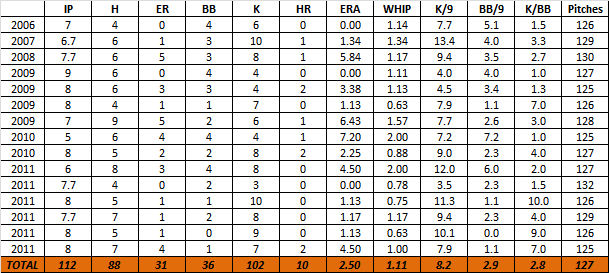
It is generally believed that any ill effects from a heavy workload start will be felt in the subsequent two or three starts.  So how does Verlander perform after outings of 125 or more pitches?  I decided to look at the three starts immediately following a 125+ outing for Verlander over his entire career.  He has 17 such outings in his career (including six a season ago), but only 15 fit the study as two of his final three starts in 2009 saw him meet the threshold, but he didn’t have a subsequent trio of starts to measure and carrying over to the next season wouldn’t have made sense.  Unsurprisingly, his work in those outings is nothing short of excellent.

There are some meltdowns sprinkled in there, but the bottom line is incredible with a 2.50 ERA and 1.11 WHIP in 112 innings averaging 127 pitches per outing and peaking at 132 during a May 29th start last year.  So what happens in the subsequent starts?  Surely he should see some degradation after posting such strong numbers in the big pitch count starts, right?

Or not.  Incredibly he actually gets better.  Yes, the ERA does jump 0.40 to 2.90, but the WHIP dips below 1.00, the strikeout and walk rates improve by 1.0 resulting in an eye-popping 5.0 K/BB.  He also manages 20+ innings in 13 of the 15 trios meaning he is going 6.7 innings or more on average and 11 of the 15 saw him averaging 7+ innings per outing (21+ IP in the trio).  In fact in the six instances from 2011, he threw no fewer than 22 innings in any of the trios and averaged nearly 24 innings (23.8 IP).

In the eight instances since 2010, he has yet to post an ERA of 2.75 or worse, only once topped 0.91 WHIP (1.10) and dipped below 9.4 K/9 just once (7.2), too.  The bottom line is that on the whole he shows no discernible ill effects from an outing of 125+ pitches.  Furthermore, he has no problem going deep into the games following the big pitch count game averaging 112 pitches per over the six year span and 115 pitches per in the last two years.

Following the well-established trend, Verlander showed no discernible degradation in his stuff in his first follow up start over the weekend against the Texas Rangers.  His six innings were his fewest of the season, but he allowed just four hits and struck out eight while walking three.  It was the 5th time since 2009 that he went six or fewer in one of the three starts after a 125+ pitch outing and part of that may have been Jim Leyland pandering to the unnecessary outrage against the high pitch count for Verlander last Monday.  He ended up with 115 pitches as the Rangers, arguably baseball’s best offense, ran up his count a bit by racking up 29 foul balls (25%) after he had yielded 56 (17% of his 340 pitches) in his first three starts.

His next start is Friday night in Yankees Stadium and then he draws the Royals again, this time at home.  Verlander isn’t some run-of-the-mill third starter who needs to be coddled and immediately pulled once he hits the century mark.  Of course, that doesn’t mean he should be used recklessly either, but I didn’t see anything reckless with letting him finish out the game in Kansas City last Monday.  If you were one of those who saw it as egregious and now fear it will impact Verlander going forward, I would encourage you to relax.  The data is on your side.  Oh and the fact that Verlander is a gordita loving-robot (and proof) doesn’t hurt, either.

Monday: 04.23.2012

Jordan Zimmermann and His Tiny K Rate

Coming into the 2012 season, the Washington Nationals were a chic pick to improve upon last year and even contend for a playoff spot for some (I gave them top NL wildcard with 87 wins), especially in light of the added wildcard.  On the heels of their 80-81 record a year ago, they added two big time arms in Gio Gonzalez and Edwin Jackson via trade and free agency, respectively.  Perhaps even more importantly, they have Stephen Strasburg for most of the year (likely being capped around 160 innings) and Jordan Zimmermann for the entire season after his successful 161-inning return from Tommy John Surgery.

Zimmermann, a big time prospect in his own right though definitely a cut below Strasburg in terms of hype and pedigree, is building off of a solid foundation with 284 innings under his belt coming into the year during which he has posted a 3.84 ERA, 1.23 WHIP, 7.7 K/9 and 3.5 K/BB.  With the reins off in terms of an innings limit, he is poised for a breakout in what should be his first full season of action.  He is off to great start already with a 1.29 ERA, 0.71 WHIP and 5.0 K/BB in his 21 innings spread across three starts (he has exactly three 7-inning, 1-run outings).

The gaudy 5.0 K/BB rate catches the eye, but it is spurred by his allowing just two walks (0.9 BB/9) as his 4.3 K/9 is far from special.  The first thought when strikeouts are down against expectations or track record is to check velocity, but Zimmerman’s fastball velocity is exactly the same as last year’s at 93.4 MPH so there is nothing amiss in that realm.  In lieu of the strikeouts, he is inducing plenty of weak contact with a sky-high 52% groundball rate off of which batters have a meager .121 batting average.  We saw something like this from him last April when he had a 4.3 K/9 while posting his best groundball rate of any month at 45% in 30 innings.

In fact, his two best groundball months were easily his worst strikeout months by a significant margin.  In June, he had a 41% groundball rate while striking out just 5.7 K/9.  In the other months (excluding April), his strikeout rate was 8.1 or better while the groundball rate failed to top 37%.  Can he get back to inducing groundballs and missing bats simultaneously?  In the first 23 starts of his career spanning 2009-2010, he had an 8.8 K/9 with a 46% groundball rate so he has the ability to combine the two skills.

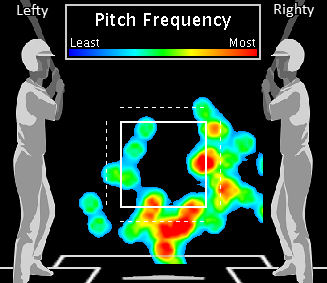
A sharp difference early on has been his curveball and Zimm’s ability to generate swings-and-misses with it.  In 2011, he was at a 15% swing-and-miss rate with it and for his career coming into 2012, he was at 21%.  The curve has definitely been his knockout finisher in the past.  This year he has just a 7% swing-and-miss rate on his bender due in large part to batters laying off of it as he tries to get them to chase out of the zone.  Just 29% of his benders have even hit the zone compared to a healthy 51% coming into this season.

Courtesy of MLB.ESPNTrueMedia.com

With hitters laying off the low, out-of-the-zone curveball, Zimmermann will need to change his approach if he wants his strikeout rate to return to previously established levels.  Of course, we are just three starts into the season, too, so while there is definitely a difference between what we have seen from Zimm in the past, it could just be him getting a feel for the curve as the season starts.

Another difference we have seen in the early (and small) sample is that he isn’t afraid of contact with two strikes.  Batters have put it in play during 21 of Zimm’s 34 two strike plate appearances (62%) with just a 29% strikeout rate while last year those rates were at 57% and 37%, respectively (meanwhile his career rates coming into ’12 are 55% and 38%).

It has served him well thus far with a .191 average and .491 OPS against in two strike situations, but in the long term he would be better served to start hitting the zone more (specifically with his curve as previously mentioned) and generating strikeouts instead of trusting his defense so often.  Based on both his talent and stuff, I think we will see Zimmermann start putting away more hitters as the season progresses.

Batters will start to get more hits off of him going forward (5.6 H/9, .200 BABIP), but hopefully he is able to counter that with an improvement in punch-outs.  You can’t argue with the outstanding results in his first three starts (though I’m sure he isn’t thrilled with the 8 runs of support from his offense across the three games) and I think we will see an even better Zimmermann going forward though the gaudy results (1.29 ERA, 0.71 WHIP) are sure to rise.

If anyone in your league is trying to “sell high” on Zimm in fear of the miniscule strikeout rate, take them up on it as long as the price isn’t egregious (Justin Verlander/Roy Halladay).  I don’t think any reasonable fantasy manager expects a leaguemate to pay for a 1.29 ERA and 0.71 WHIP knowing full well that neither is sustainable, but if they are thinking of buying low on Josh Johnson or Tim Lincecum, for example, and offering Zimmermann as a foundation, then I would entertain such a move without question.

Thursday: 04.19.2012

Mat Latos and His Slow Start

Well before the Joey Votto and Brandon Phillips contracts this season, the Reds announced their intent to contend (or try to, at least) in the near term by trading a significant haul of prospect value and major league arm Edinson Volquez to the San Diego Padres for top starter Mat Latos back in mid-December.  While he benefitted from the favorable PETCO Park, Latos was hardly a product of the pitcher’s haven seeing minimal (if any in some cases) degradation in his numbers away from home.

He posted a 3.22 ERA in 190 innings at home while toting a 3.57 ERA in 249 road innings.  His WHIP was actually a tick better while his strikeout and walk rates were nearly identical regardless of venue.  Armed with a bat-missing arsenal and a groundball lean, I was definitely on the high end of the spectrum when it came to projecting Latos for 2012.  After three starts, things aren’t looking so good.  Time to readjust expectations or simply a slow start for an ultra-talented arm?  Let’s take a closer look.

Slow Starter

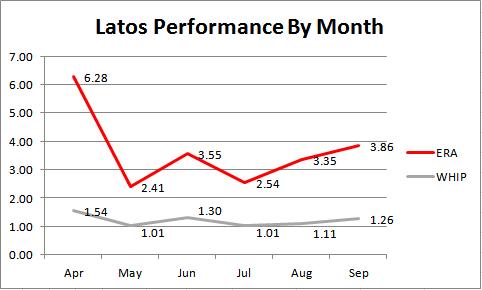
Latos is starting his third full year as a major leaguer in 2012 and in his two 31-start seasons the last two years, he has shown himself to be a perennial slow starter posting a 5.57 ERA and 1.40 WHIP in 42 April innings.  Adding in his three starts from this year, the numbers balloon to a 6.28 ERA and 1.54 WHIP in 57 April innings.  Meanwhile, May is his best month from an ERA and WHIP standpoint.

Regardless of whether or not you include his 2012 numbers, April is far and away the worst month for Latos.  History alone suggests he should improve once the calendar turns or rather, as he accumulates more work to iron out the kinks.

Velocity

With Pitch F/X data more prevalent than ever, the first data point most people check when a pitcher is struggling is fastball velocity.  It can often be an explanation for a downgrade in performance as well as be an indication of potential injury in some instances.  In the case of Latos, velocity doesn’t appear to be tied to his struggles in any way whatsoever.

In 2010, his April velocity (93.8 MPH) was actually better than his velocity the rest of the way (93.6 MPH), though just marginally.  He got a late start to 2011 accumulating just 10 Spring Training innings and then not starting until the 9th game of the year due to a strained right shoulder.  Thus it wasn’t really a surprise that his April velocity (92.0 MPH) was a tick below his 92.8 MPH mark from May on.  Through his three starts this year, his fastball velocity is right in line with 2011’s at 92.7 MPH.  In fact, he was at 93.7 MPH on Wednesday night and 76 of 112 pitches were heaters.  Velocity isn’t the problem for Latos.

Pitch Performance

While the velocity isn’t askew, the quality of his fastball early on has been in question.  Batters are tattooing the pitch to the tune of a 1.197 OPS and it hasn’t been nearly the put away pitch it was last year when he generated a 13.6% strikeout rate with it compared to just 7.5% this year (just to clear up any potential confusion, this means plate appearances that end with a fastball are yielding a strikeout 7.5% of time).  Even with the lowered velocity, his fastball was more effective last April though it was still not to the level he would enjoy from May on.  It yielded an .815 OPS last April but dipped to .752 the rest of the way.

More important than the fastball, his slider (which is easily his best pitch) hasn’t been as effective as usual thus far in terms of inducing poor contact.  The pitch earned 13.2 and 10.5 pitch values at FanGraphs in 2010 and 2011, but it’s at -1.3 through his first two starts and will likely go down once they factor in the results from Wednesday night’s start in St. Louis.  In 2010 and 2011 combined, the slider yielded a paltry .409 OPS while amassing an insane 41.8% strikeout rate.  It’s his finisher and while he has an excellent 42.9% strikeout rate with it so far this year, it is also being hit around to a .714 OPS, astronomical for that pitch when you compare it to rest of Latos’ career.

Perhaps he needs to start incorporating more sliders into his pitch mix.  He has thrown it 15.8% of the time so far this season, down a bit from the 18.6% rate in 2010 and 2011 combined.  Last April his changeup was getting blasted to a 1.214 OPS.  He was using it 12.4% and cut that by 5% from May on giving all of the excess to his slider (going from 15.2% to 20%) and it clearly spurred his success as batters had a video game-esque .338 OPS against it from May on.

He is currently throwing his changeup at an equal rate to the slider (15.8%) and while it’s not being pummeled like last year, it isn’t faring too well at .819 OPS.

Conclusion

The information available seems to suggest that Latos simply takes a while to get going.  There is nothing that jumps out in his data that points toward a prolonged degradation in performance or worse, an injury.  Some pitchers just stumble out of the block before turning it on.  While I’m not comparing the two directly, Justin Verlander had notoriously awful Aprils heading into 2011.

He made a concerted effort to work harder in Spring Training and treat those like important games instead of just tune ups so he would be ready on Opening Day.  The results were immediate as he posted 3.64 ERA, 1.02 WHIP and 9.2 K/9 in 42 April innings last year.  Even with the strong April last year and great start this year, his April line is still ugly compared to the rest of his numbers: 4.45 ERA, 1.22 WHIP and 7.7 K/9.

If you have Latos on your team, you have to stay the course and give him time otherwise you are doing yourself a disservice and wasting your draft day investment.  The peripherals are weak and the surface stats are even worse, but weathering April before breaking through is Latos’ modus operandi.  As for those of you who don’t currently have him on the roster, he makes a nice trade target who may even come at a discounted price.

I don’t like the practice of looking at struggling stars in April and labeling every single one a “buy low” as I don’t think anyone with any knowledge of how to play this game is actually putting a severe discount on Tim Lincecum or Matt Holliday to name a couple.  The price was simply too high on draft day and cutting bait for pennies on the dollar after half a month is just stupid for the current manager and a pipedream if you’re the buying manager.

Latos isn’t exactly on the level of those two (24th and 36th picks, respectively), but he’s star-ish as a top 70 pick in average draft position and so you shouldn’t go in expecting someone to completely cut their losses and take Joe Saunders or Omar Infante for him.  Maybe they will take someone in the 90-105 ADP range which would be a nice little discount, but even at draft day cost (someone in the 65-75 ADP range), Latos is worth buying in on because it is plenty reasonable to expect him to improve soon and stay good for the remainder of the season.

Thursday: 04.12.2012

Josh Johnson Thru Two Starts

Josh Johnson labored a bit through his Opening Day start last Wednesday against the St. Louis Cardinals allowing three runs on 10 hits and two walks while striking out four.  He threw mostly fastballs (74% of his 91 pitches) while his velocity continued its downward trend sitting at 92.7 MPH (95 in ’09; 94.9 in ’10; 93.8 in ’11), though he did max out at 95.4 MPH.  Was it rust as he returns from injury or is something amiss?  Johnson excited fantasy players with his Spring Training numbers that included a 2.42 ERA and 24 strikeouts against 10 walks in 22 innings of work.  At the same time, he did allow 21 hits.

I don’t put much stock into Spring Training numbers at all.  There are some instances where they matter a bit.  If a pitcher is returning from injury, I’m checking to make sure he is getting his allotted work in without incident.  I don’t even really care if he is getting knocked around, but if they say Johan Santana is supposed to go four innings or X-amount of pitches today, I want to see that fulfilled.  The other instance is in a job battle.  It doesn’t matter if marginal player X hit .904/.998/1.964 in his 20-something at-bats as that’s not at all indicative of his future performance, but it matters that he excelled if that is securing him a job for at least the near future.

Johnson was getting in his allotted work which was encouraging, but I didn’t change his ranking based on the numbers we saw.  I don’t know who the 24 Ks came against nor do I know if the 21 hits were tons of line drives or bloops and bleeders.  After seeing what can only be classified as a mediocre outing in last Wednesday’s opener, I looked forward to seeing Johnson face off against Roy Halladay Wednesday night in Philly for their second starts of the year.  Here are my observations from the outing:

  • 40 of his 80 pitches were fastballs (50%); down from his first start when he threw 74% heaters
  • His fastball averaged 92.4 MPH; down slightly from the 92.7 MPH mark in his first start
  • He threw almost only fastballs & changeups (68 of 80 pitches; 85%)
  • He only threw breaking balls 14% of the time and didn’t even throw a curveball until the 3rd
  • He threw just 6 sliders and 6 curveballs
  • He struggled to get ahead of batters going just 9-for-21 in first pitch strikes
  • That no doubt contributed to his struggles Wednesday including 11 H allowed & just 1 K
  • For his career, Johnson has a 7.4 K/BB after 0-1 counts; just 1.2 K/BB after 1-0 counts
  • For his career, Johnson allows a .220 AVG & .558 OPS after 0-1; .245 AVG & .739 OPS after 1-0
  • He failed to put away batters w/just the 1 K despite 9 batters (of 23) facing counts w/2 strikes
  • For his career, Johnson has struck out 43% of the batters who are faced w/2 strikes during a PA

This clearly wasn’t Johnson’s best outing.  The fact that it came near the beginning of the season tends to give it more weight in the eyes of some since it is 50% of his entire sample so far.  That is always dangerous for obvious reasons.  Adding it all up, he has two starts that aren’t exactly Josh Johnson-esque and given his injury history, it does raise the antennae a bit.  Right now the velocity is down and he isn’t getting the swing-throughs (just 1 on Wednesday) we’re used to seeing.  The lack of breaking pitches thrown could be an indication that he is being timid with his breaking stuff in an effort to avoid getting hurt again.  In the previous four years, he threw sliders more than a quarter of the time so he needs it to be successful.

For now, you can only stay the course with Johnson unless a full value trade comes along which is unlikely in most leagues.  I look forward to his upcoming starts to see how (if?) he progresses back toward the Johnson we are used to seeing.  I will post another update before the month is out.  He faces the Cubs at home, Nationals on the road and Diamondbacks at home in his next three starts.

Thursday: 12.15.2011

Trevor Cahill’s 2012 Outlook in Arizona

For a few days it seemed certain that Oakland A’s lefty starting pitcher Gio Gonzalez would be dealt in a blockbuster deal this winter.  The rumors were running rampant and frequent and had names attached to them like Jesus Montero and Dellin Betances from the Yankees, Mike Stanton or Logan Morrison as a centerpiece from the Marlins and Jacob Turner and Nick Castellanos from the Tigers.

Unfortunately for Oakland, none of those came to pass (the packages from New York and Detroit or even just Stanton from Florida would’ve been an excellent return for Gonzalez), but then out of nowhere it was their other budding star pitcher, Trevor Cahill who was dealt.  He was sent to the Arizona Diamondbacks with Craig Breslow for prospects Jarrod Parker, Collin Cowgill and Ryan Cook on December 10th.

The deal gives the reigning NL West champs a front three of Ian Kennedy, Daniel Hudson and Cahill without sacrificing any of the pieces they used to win 94 games and push Milwaukee to the brink in the first round of the playoffs back in October.  What will the move from the American League’s version of the west to the National League’s mean for Cahill?

He enters his age 24 season having pitched three full campaigns (at least 30 starts in each) that have yielded a mixed bag of results.  He was an All-Star and down ballot Cy Young candidate in 2010, but has sandwiched that breakout with two seasons of essentially league average work (96 and 97 ERA+ totals in 2009 and 2011).  Pitchers are generally expected to see an improvement when shifting to the National League just by virtue of the fact that they get to face their mound counterparts, but might Cahill have some natural growth within his talent profile, too?

His Pedigree

Cahill came up through the minors as a highly touted prospect for Oakland after being taken in the 2nd round of the 2006 draft.  He squeezed in nine professional innings after signing as an 18-year old and then proceeded to show why he was such a high pick in 2007 and 2008.  He made three stops in the two years (A, High-A and AA) throwing 230 innings with a 2.66 ERA, 1.09 WHIP, 9.9 K/9 and 2.8 K/BB.

His major league debut saw less than half of that strikeout rate show up as he fanned just 4.5 batters per game in 179 innings.  That said, the strikeout rate has crept up yearly since he reached the majors and last year’s 6.4 K/9 in his high watermark for now.  Perhaps given where he established that minor league strikeout rate, his progression in the majors should be less surprising.  More on that later.

His primary asset has been the ability to induce groundballs at an elite rate (56% the last two years) which the usually sure-handed defense of the A’s* translates into plenty of outs.  Combine that with a scant flyball rate in a spacious park and you can see why Cahill has enjoyed league average or better success in each of his first three seasons despite not yet topping 2.0 in his strikeout-to-walk ratio.

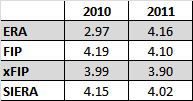
*The A’s defense had far and away its worst year since Cahill joined the team and not surprisingly his numbers suffered in concert.  His BABIP during the 2010 season was at .236 yielding a 2.97 ERA against a 4.19 FIP while his BABIP soared to .302 in 2011 pushing his ERA to 4.16 against a 4.10 FIP.  In other words, he was essentially the same guy each of the last two years, but he counts an exemplary defense for improved results.  Later we will see how Arizona’s defense might suit him in 2012.

The National League

When discussing strategy with mixed league fantasy baseball managers, you will often hear someone say they lean heavily toward starting pitchers in the National League as a general principle, especially if their other choice is a pitcher in the American League East.  Even if the NL pitcher is slightly less talented, a lot of times the deciding factor will be the league in which he pitches.  Is it worth it?  In general does leaning toward NL starting pitchers pay off?

Looking at the last three years, the answer is yes, but only marginally so.  Not enough to where I would knowingly take a less talented pitcher just because he is in the assumed safe haven of the National League.

As you can see, the difference in starting pitcher strikeout rates from league to league is about 0.2-0.3 in favor of the National League while walk rates are dead even.  The difference over 200 innings is a whopping three strikeouts (147 to 150).  So there isn’t a major difference in strikeout rate from one league to the other even with pitchers batting and striking out 33% of the time.  We saw this come to fruition in 2011 as the big pitchers who switched leagues saw inconsistent changes in their strikeout rates.
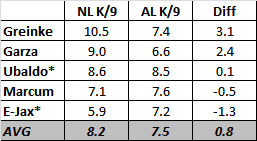
*Ubaldo Jimenez and Edwin Jackson both switched during the 2011 season resulting in smaller innings samples for each column while the others are all comparing their 2010 and 2011 full seasons.

Both Jackson and Shaun Marcum actually lost something on their strikeout rate when joining the National League while Marcum’s teammate Zack Greinke and their central division foe Matt Garza saw significant gains in their first season’s as National Leaguers.  Jimenez held firm moving from Colorado to Cleveland midseason.  It is a limited sample of pitchers for sure, but the point is simply that the National League doesn’t automatically yield a better strikeout rate.

What about the actual results?  Do we see a discernible difference in starting pitcher ERAs from league to league?
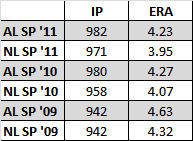
Overall, the league ERA in the National League has been 0.20 to 0.31 better during the last three years including 0.28 better in 2011.  So again there is a slight enhancement for National League-based  starting pitchers over their equal American League counterparts, but keep in mind that over 200 innings, it is a seven earned run difference and just five earned runs in a 150-inning sample.

There is still no compelling case to be made for taking a lesser talented NL pitcher over even a slightly more talent AL one.  If you use league home as a tiebreaker between two comparable players, then it makes sense to lean toward the National League as you should expect incremental gains in strikeout rate and ERA results.

Using Cahill’s 2011 results, he would stand to gain five strikeouts up to 152 and his ERA would shave seven runs off and move down to 3.86.  Those are simple quick and dirty estimates using his 2011 results against 2011 league standards.  This removes all of his context-based factors and assumes no growth.

His Home Park

Cahill leaves a park in Oakland well known for favoring pitchers and heads to Arizona to play in a park equally well known for its opposite effect on pitchers.  Neither is the best at what it is known for, but Cahill will now play in the division with the most renowned stadiums for each end of the spectrum: San Diego’s PetCo Park for pitchers and Colorado’s Coors Field for hitters.

Here is comprehensive look at the park factors for the divisions Cahill is leaving and joining using Baseball-Reference’s Park Factors for just 2011 as well as the last three years combined:

(-b refers to park factor for batters; -p for pitchers)

Overall the change is minimal with the biggest difference being his less favorable home park, but his severe groundball tendency combined with the boost from the National League should mitigate most of it, especially since that doesn’t even take into account his potential to improve as a pitcher.  Meanwhile, he essentially trades Texas for Colorado.  Of course, Texas never really bothered him as he posted a 2.23 ERA and 2.1 K/BB rate in 40 innings (his highest count outside of Oakland) there.

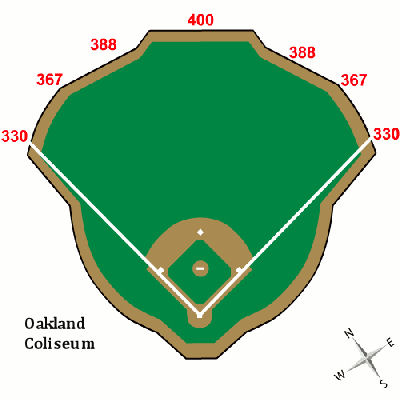
The outfield dimensions of Chase Field as compared Oakland Coliseum are unlikely to impact Cahill negatively.  In fact, Chase Field is deeper in almost every respect.  Where Oakland Coliseum derives a great deal of its love from pitchers is in the foul territory.  The expansive room available to make plays on balls that would otherwise be souvenirs in most other stadiums has saved many an Oakland pitcher.  It is hard to derive how much of an impact, if any, that will have on Cahill in 2012.  While I can find how many of his pitches turn into foul balls, I can’t find how many of those foul balls result in outs.

His Defense

As I mentioned earlier, Cahill relies heavily on his defense.  With a 56% groundball rate, a sharp infield offense is key to his success.  In 2010, the top four fielders in UZR on the A’s were Cahill’s infielders: Kevin Kouzmanoff 16.1 at 3B, Daric Barton 12.1 at 1B, Mark Ellis and Cliff Pennington at 9.9 apiece at 2B and SS, respectively.  Of the four, only Ellis played fewer than 1231 innings (986) and the most important cog, Pennington, played 1304.

On the 2011 A’s, Ellis and Kouzmanoff were the top two rated infielders in UZR with 2.1 and 2.0 marks in 501 and 365 innings, respectively.  Ellis was traded to Colorado to make way for youngster Jemile Weeks while Kouzmanoff was only in the lineup throughout 2010 because of his glove (.296 wOBA) and yet somehow got worse with the bat in 2011 (.271 wOBA) before eventually being traded to Colorado as well, though in a separate deal from Ellis.  Meanwhile Pennington regressed to previous defensive levels with a -5.2 UZR in 1272 innings, which is more in line with his -4.7 and -4.5 marks from 2008 and 2009.

The aforementioned Weeks had a -4.1 UZR as the primary second baseman and Scott Sizemore was a team worst -6.0 UZR at third base.  Both added a Bondsian level of offense compared to their predecessors, though, so the offensively-starved A’s had to overlook their defensive shortcomings.  This no doubt affected Cahill en route to a career-worst .302 BABIP.  While that isn’t too far off of the average (.299 in the AL), Cahill needs to be above average there until his base skills (missing bats and limiting free passes) improve.

The Diamondbacks were first in baseball in UZR at 55.8 in 2011.  Good news for Cahill, right?  Yes, but not as good as that one piece of information suggests.  The bulk of Arizona’s UZR goodness is built off of their strong outfield defense: Chris Young 14.1 in CF, Gerardo Parra 9.8 in LF and Justin Upton 7.7 in RF.

But right behind those three is shortstop Stephen Drew at 4.5.  His season was cut short by injury, but backup shortstop John McDonald turned in a 4.0 UZR, too.  Drew has been above average each of the last three years including an 8.7 UZR in 2010.  Keeping him healthy will be essential because he not only picks it, but he is a far better with the bat than McDonald.

Aaron Hill has a very strong defensive track record with a 21.7 UZR in six seasons of work and just one season below average (-4.9 in 2009).  Ryan Roberts broke out in his first full season of play both at the dish and in the field.  He spent the bulk of his time (902 of 1132 innings) at third base and acquitted himself well enough with a 1.7 UZR.

Defensive numbers can fluctuate year-to-year so while the Diamondbacks might not finish first in the league again in 2012, it is nice to know that all of Cahill’s new infielders have track records to back up their 2011 performance.  This is a net gain for Cahill, especially with the A’s placing a premium on bat production in lieu of quality fielding (and who can blame them?).  Lucky for Cahill and Arizona, their slick fielders can handle the bat, too.

His Bullpen & Offense

These two factors only really contribute to his potential win count, the predicting of which is generally foolish because of how inconsistently they correlate to quality pitching.  More to the point, wins aren’t really something that starting pitchers can control because even if they pitch well for their allotment of innings, they need the bullpen to hang on.  And even if the bullpen keeps their masterpiece intact, the offense needs to have earned enough runs off of the opposition’s starter and bullpen, too.

For the sake of full disclosure, let’s quickly look at both aspects.  The bullpens were equal for intents and purposes in 2011 and both have the talent to do the same again in 2012.  Any major differences between the two would come from fluctuating luck or a change in personnel.  As it stands right now, Cahill will see no discernible gain or loss in bullpen support with the trade.  Projecting forward he was more likely to lose out by staying in Oakland as they continue to discuss potential trades involving Andrew Bailey.

There seems to be a real improvement in his team offense with the move to Arizona as evidenced by the 2011 numbers of the two units:

Of course, that still doesn’t mean he will have an increase in wins.  Consider his 2010 season.  He went 18-8 and while the Oakland offense was better than the dreadful 2011 iteration, they still only scored 4.1 runs per game.  Logic and wins don’t mingle well.  Yes, you can probably afford to pitch a bit worse and register an above average win total with an offensive stalwart like the Yankees supporting you, but then you see Aaron Harang win 14 games with the Padres who scored a whopping 3.7 runs per game in 2011.

Cahill’s bullpen support remains strong and his offensive support is improved, but don’t let either have a significant impact in your 2012 analysis for him.

His Improvement

We have taken a look at all of the outside factors that could contribute to Cahill’s success or failure in 2012, so what about the factors he can handle?  He showed during his minor league career that he can be a dominant strikeout pitcher, but you have to consider that the bulk of that work was done in the lower minors.

He skipped AAA before making his debut (subsequently logged 9 AAA IP in 2010) and posted a career-low 8.0 K/9 in a quick 37-inning stint in AA at the end of 2008.  So while the gaudy 9.9 K/9 in 247 minor league innings is nice, you have to adjust more than you would normally take off for a pitcher who had a strikeout rate like that with some significant work in AA and AAA.  Going from 9.9 to the 4.5 of his rookie year would have been hard to project, but he deserves credit for not crumbling under the pressure as a 21-year old who essentially came from High-A.

His improved strikeout rate seems to correlate well with the effectiveness of his curveball.  I took a look at him early this season after just two starts because I noticed that his curve was generating a lot of swinging strikes.  In fact, he continued to use his curveball effectively throughout the season.  He used it 4% more than in 2010 (24%) and it generated a swing 5% more often (52%) resulting in strikes 5% more often (67%), 1% of which were swing-through strikes or whiffs (14%).  His 2011 data; 2010 data.

This piece by David Golebiewski at Baseball Analysts looks at Cahill’s year on the whole and examines both his curveball and slider together leading to a similar conclusion that they are the key to an elevated strikeout rate for him. More to point, keeping them down so that hitters swing over the top of them will allow Cahill to generate more strikeouts as he continues to mature.  Plus, the worst case scenario on a well-placed breaking pitch low in the zone is weak contact in the infield which shouldn’t be too problematic for the Diamondbacks fielders to handle.

He has posted a 3.6 BB/9 in two of his first three seasons which is in line with his 3.7 BB/9 mark as a minor leaguer, but the 2.9 BB/9 shows that there is room for improvement.  He is unlikely to become Cliff Lee with his control whether now or in the future, but even incremental improvement toward that 2010 mark would be help his gaudy 1.43 WHIP.

His 2012

I really like Cahill’s outlook for 2012.  I would have liked it in Oakland, too, but the move to Arizona only helps matters.  Despite the bouncing ERA from 2.97 to 4.16, he was virtually the same exact pitcher in 2010 and 2011.  In fact, his secondary numbers say just that:
It is hard not to be impressed with what he has accomplished as a 21 to 23 year old in his 583 career innings.  He only has the one standout season from a fantasy aspect, but there is a burgeoning skill set worth buying into just as the Diamondbacks did with the trade.

I see him with a ceiling of around seven and a half strikeouts per game, though we may only see another incremental gain in 2012.  We have probably already seen his best walk rate at 2.9 in 2010, but he can get there again and it could be as soon as 2012.    Add in the improved defense closer to what he enjoyed in 2010 and I think we see something like in the following ranges for Cahill in 2012:

ERA: 3.60 – 3.92 (a spread of 7 ER in 200 IP)

WHIP: 1.24 – 1.30 (a spread of 13 base runners in 200 IP)

K/9: 6.7 – 7.5 (149-167 Ks in 200 IP)

BB/9: 2.9 – 3.4 (65-76 BBs in 200 IP)

W: these projections are enough to net 15+, but always remember that wins are unpredictable

I chose to do ranges because the accuracy of firm numbers is so low and the difference in actual performance between those ranges is pretty reasonable across a 26-week season as you can see from the information in parentheses next to each category.  Cahill is currently the 44th starting pitcher off the board in early mock drafts at MockDraftCentral.com which puts him in the 13th round at 164 overall.

Right now I don’t hate him at that 164th spot, but I think that is full price and I would opt to wait for some of the names behind him Doug Fister (180), Jaime Garcia (193), Derek Holland (197), Matt Moore (203), Javier Vazquez-assuming he doesn’t retire (246) and Ricky Nolasco (258) to name a few.  I see some, if not all, of those names eventually passing Cahill in ADP along with Yu Darvish (206) depending where he ends up.

In a mock draft (14-team mixed league) I’m currently involved in, I got him in the 21st round with pick 286 which I thought was a steal.  I suspect as more players get signed and we get closer to draft season his ADP will dip lower than 164 making him something of a bargain.

Tuesday: 09.20.2011

Trolling the Wire: The Finish Line

(Ed. note: – That’s embarrassing… this was supposed to go up at 11:30 AM yet it was scheduled for 11:30 PM by accident… sorry for those of you who needed guys today.  However I’ve used Holland and E-Jax so often that you probably could’ve guessed they would be the picks. )

Just about a week left (season ends Wednesday, September 28th) and while there might not be a lot of undecided races in Major League Baseball, there are still plenty of undecided winners in fantasy leagues everywhere.  Just within my own leagues there is one where five teams are split by just 6.0 points and another where three teams split by 6.5 points.  And of course any head-to-head league comes right down to the wire.

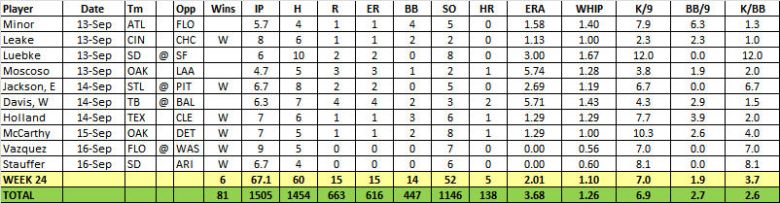
Last week’s spot starter picks did quite well if I may shed any modesty for a moment as they posted a 2.01 ERA and 1.10 WHIP in 67 innings.  Just one of the 10 pitchers gave up more than three runs (Wade Davis, 4) and six gave up one or none so in a week when getting the best out your last remaining starts is especially crucial, these guys came through.

The Hail Mary picks

In theory every game counts the same, but in April or even August you have time overcome nightmarish starts, but with nine days left in the season it’s do or die.  One implosion can end your chances depending on the league standings.

With precious little time left, I’m focusing only on prime picks.  If you’re in Hail Mary mode just about anyone with a pulse will qualify so I don’t think I need to highlight those guys.  I’m going for the best and best (or best of the rest as it were since these are guys on many waiver wires).

TUESDAY:

Derek Holland (TEX @ OAK) – Holland has been mostly good to us and a start in Oakland is pretty close to a no-brainer with someone of his talent.

Edwin Jackson (STL v. NYM) – He’s been a stalwart for those who stream pitchers because no matter how well he pitched, he couldn’t seem to get any real respect this year.

WEDNESDAY:

No one of noteJavier Vazquez finally had his ownership rate move up significantly and it is now 73% so he is no longer available to us spot start players.  Some marginal guys I considered that would be upper tier Hail Marys include Brad Peacock, Brandon McCarthy and Wade Miley

THURSDAY:

Still no onePhilip Humber and Jeff Niemann are among the few longshot options, but Humber has been very inconsistent since the All-Star break and Niemann has the Yankees. 

FRIDAY:

Josh Collmenter (ARI v. SF) – A favorable matchup against a weak lineup (in a huge game for both teams, of course) and he has walked just three in his last five starts (all in one start against San Diego).

Matt Harrison (TEX v. SEA) – An even better matchup than Collmenter and while his control isn’t as sharp, his propensity for strikeouts is a bit higher.

SATURDAY:

Aaron Harang (SD v. LAD) – I have covered Harang at home on more than one occasion, he’s money at home.

Joe Saunders (ARI v. SF) – I know what you’re thinking, you thought I wasn’t going with risky plays here down the stretch, but Saunders has been money for a nice stretch and I like him against a weak lineup even if the game means a ton for both teams.

SUNDAY:

Mike Minor (ATL @ WAS), Edwin Jackson (STL v. CHC), Bud Norris (HOU v. COL), Derek Holland (TEX v. SEA) – All four have been staples on the Trolling so I don’t feel I really need to sell you on them with commentary.  If you have been streaming for any period of time, chances are you have used one or more of these guys on multiples occasions.

Monday-Wednesday later this week when the spots become official.

Monday: 09.12.2011

Trolling the Wire: Week 24 Tuesday-Friday

I didn’t love anyone for tonight’s games so this week’s Trolling will focus on Tuesday through Friday.  As with Sunday’s picks, I will mention some Hail Mary picks throughout that you can consider if you’re desperately trying to make a move.  I’m not counting these in my actual tally because while they are calculated picks that have enough upside to deliver, they are only being mentioned for the most dire of situations.

I will show you the weekly results with and without them just for fun, but note that the official numbers at year’s end will not include the longshot picks from Sunday and the rest of the season.


TUESDAY

Standard:

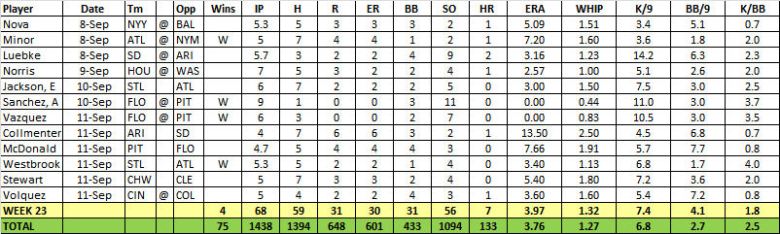
Mike Minor (ATL v. FLO) – He has gotten some dirty wins and his 3.58 ERA the last month (28 IP) isn’t off-the-charts great, but I love the strikeout potential with 30 in those 28 IP & 8.2 K/9 for the year.

Mike Leake (CIN v. CHC) – He just threw a complete game giving up two runs on three hits against these Cubs and he has a 2.74 ERA and 3.5 K/BB in 23 innings (3 starts) against them this year.

Cory Luebke (SD @ SF) – Up and down lately as the rookie seems to be hitting a bit of a wall (no more than 6 IP in last 6 starts).  Alas he remains a strong strikeout asset.  Despite three straight losses, he is still a worthy option, especially against the Giants.

Guillermo Moscoso  (OAK v. LAA) – Home: 6-2, 2.26 ERA, 0.92 WHIP and 2.5 K/BB; road: 2-6, 4.82, 1.43 and 1.2.  Let’s play the numbers here.

Hail Mary:

Dillon Gee (NYM v. WAS) – He has been too inconsistent lately as he too may be suffering from the proverbial rookie wall, but he has three straight outings with six strikeouts and he is markedly better at home with a 3.18 ERA against 5.59 on the road.


WEDNESDAY

Standard:

Edwin Jackson (STL @ PIT) – I don’t understand how someone can be as good as he has been this season yet still have ownership rates below 50% at multiple outlets.

Wade Davis (TB @ BAL) – On the heels of a complete game effort with two earned runs against the Red Sox, Davis earns a look against an inferior opponent by comparison.

Derek Holland (TEX v. CLE) – The human rollercoaster.  Someone this inconsistent might be best suited for a Hail Mary, but I believe in his immense talent.  He laid an egg last time out against the Indians, but I think he gets them back.

Hail Mary:

Randall Delgado (ATL v. FLO) – Ultra-talented rookie against a lame Marlins team could end well.  He has been limited innings-wise in his first couple of starts since the recall, but he has also looked strong.

Bud Norris (HOU v. PHI) – Normally a standard pick, but against Roy Halladay his chances at a win are severely limited while the Phillies offense has become more imposing as the season has developed.

Rich Harden (OAK v. LAA) – He has crazy strikeout potential, but I think everyone has had him on their team at one point or another and knows just how maddening it can be.  Tread cautiously.


THURSDAY

Anibal Sanchez is still only on 72% of teams at ESPN.  I won’t count him as a pick because he isn’t widely available, but check your league just in case.  He should be back at 100% the way he has been throwing the last month.

Standard:

Brandon McCarthy (OAK v. DET) – Hate to go against my Tigers not only because they are my favorite team, but also because they have been rolling lately.  However, McCarthy has also been rolling and he could stop the locomotive known as the Tigers, especially at home.

Hail Mary:

Homer Bailey (CIN v. CHC) – Strong skills, but gopheritis continues to bite Bailey year after year.  A career-best 3.2 K/BB is worth buying into and it’s been even better the last month with a 5.8 K/BB powered by his 8.2 K/9 in 38 innings.


FRIDAY

Standard:

Javier Vazquez (FLO @ WAS) – I have been rolling him out weekly and it continues this week, though his ownership rate has finally crept above 60%.  Still too low.

Tim Stauffer (SD v. ARI) – Another hometown hero with a 2.76 in PETCO against a 4.95 mark on the road.  The skills are significantly better, too, with 6.5 K/9 and 3.4 K/BB marks at home against 5.7 and 1.7 on the road.  I thought he could be an any venue kind of guy, but it hasn’t played out that way in 2011.

Hail Mary:

Felipe Paulino (KC v. CHW) – A microcosm of his inconsistency can be seen in his last two starts: shuts down the Mariners in Seattle and gets crushed by the A’s in Oakland.  Strikeout potential is significant.