Archive for ‘Statistical Analysis’

Friday: 01.11.2013

FakeTeams Guest Post on Homer Bailey

The fantasy site over at SBNation, FakeTeams, is wrapping up Starting Pitcher Week and Bret Sayre asked if I could contribute a guest post on a starting pitcher-related topic of my choice. With the release of their 51-100 rankings, I decided to choose a favorite of mine from that segment. The result was a breakdown on Homer Bailey that turned out pretty well if I may say so myself.

Here’s an excerpt:

In 2012, [Bailey] had just five implosion starts, or 15 percent of his 33 outings. He also cut down the damage from his worst outing of the year. Last year he had a nine earned run shellacking that did a number on his ERA (accounted for 14 percent of his total earned runs), but this year his worst outing was six earned runs. Everyone is going to have a bad outing (Justin Verlander had an eight run disaster last year), but mitigating the overall damage helps stem the tide on a poor composite ERA. Bailey isn’t Verlander so he will have trouble recovering from an eight earned run outing. Whereas Verlander put up a 1.93 ERA in his next six starts.

Some highlights from week of Starting Pitchers:

Plus so much more including other profiles similar to the Bailey on guys like Jarrod ParkerJordan Zimmermann, and C.J. Wilson

Friday: 12.14.2012

Josh Hamilton in Offensively-Challenged Los Angeles

Josh Hamilton signed a surprise five year deal with the Los Angeles Angels worth $125 million dollars as they hope to out-hit their opponents on the heels of losing two important cogs from their rotation in Dan Haren and Zack Greinke. Forecasting a player’s career is one of the toughest things to do even when you have a guy who appears to be growing linearly at each level in the minors and then as a major leaguer. When you take one of the most unique cases ever like Hamilton, it gets a helluva lot harder, so I’m going to punt to a degree.

To guess how his body will age after what he put it through contains so much guesswork that it’s not even really worth it. Virtually every player has some sort of comparable within history to rely on or at least seek guidance from, but not Hamilton. Instead, let’s focus on the biggest change for Hamilton: his home ballpark. I think that will have a major effect on his production as he leaves one of the best ballparks in the game and enters a sneaky-tough one.

HamiltonTexRoad

To the surprise of nobody, I hope, Hamilton does significantly better at the Ballpark in Arlington. Part of that is because virtually every player does better at home (unless you play in cavernous confines like Petco Park) and more importantly because TBIA is a very favorable park for hitters. It rated in favor of hitters across all major categories including 4th in runs according to ESPN Park Factors. Baseball-Reference does composite park factors, one for batters and one for pitchers, where over 100 favors batters. Texas hasn’t been under 100 on either side of the ledger since 1994. In other words, it’s a hitter’s paradise.

And still a third outlet gets to the heart of how much Hamilton enjoyed his home park. Stat Corner shows park factors by batter handedness and they show Texas with a 117 home run factor for lefties. The same goes for doubles and triples while singles are still favorable at 103. Again, 100 is even so lefty batters get a 17 percent advantage on home runs in Texas. Just for a point of reference, we all know Yankee Stadium offers a very generous home run edge to lefties because we see it with our eyes every night, but the numbers back it up as well with a 146 factor. Keep in mind that these numbers from Stat Corner are three-year rolling averages.

So that is what he is leaving behind.

We saw in the figure above that he is still a mighty capable hitter elsewhere. If you average the home run and RBI totals over his average plate appearance count the last three years (582), he’s a 27-89 guy. So .294 average, 870 OPS, 27 home runs and 89 RBIs? That’s basically Andrew McCutchen the last three years. McCutchen’s 863 OPS is the closest match to Hamilton’s road numbers over the last three years. I used three years to approximate the plate appearances. Cutch had 2004 in that span.

Next closest was Evan Longoria, but I had to drop the plate appearance threshold to 1500. Longo has an 872 OPS in 1547 plate appearances as his 2011 and 2012 were injury-shortened. I’m not using these two as comps, rather using them to show what an 870 OPS guy looks like. The problem with using these two is their trajectories are a lot different than Hamilton. We can’t just expect Hamilton to put up a reasonable facsimile of his road work with the Angels because that doesn’t factor in his career trajectory or aging. Nor does it take into account the fact that he will be playing 81 games in Angels Stadium. That might actually be more important than anything his body does, at least in the short-term.

Going through our resources again, we see that ESPN had Angels Stadium as the 4th-worst for runs scored and they didn’t register a favorable mark for hitters in any of the major categories, except for triples which isn’t exactly a major part of Hamilton’s game. In fact, they were 4th-worst for hits in general, 6th-worst for home runs, 8th-worst for doubles, and 17th-worst for triples. Baseball-Reference shows that they’ve gone from neutral/slightly pitcher’s park to heavy pitcher’s park just recently posting 92 batter and pitcher park factors each of the past two seasons.

Digging deeper with our third resource shows the real trouble. Or at least, potential trouble. Stat Corner given Angels Stadium a home run park factor of just 82 for left-handed batters! In other words, that park is suppressing lefty longballs 18 percent more than a “normal” park. Remember he was getting a 17 percent advantage in Arlington so this move constitutes a potential 35 percent dip in home run production for 81 of his games. His new ballpark also stifles double/triples to the tune of a 92 park factor while it is essentially neutral on singles with a 99 factor. Adding to chorus, Brian Cartwright, creator of Oliver, confirmed what we saw from Stat Corner.

How has Hamilton done in these confines through his career thus far? Glad you asked. Obviously with Rangers he has had plenty of exposure (his 166 PA there are his second-most in any park) to the ballpark, though it hasn’t exactly gone well on the whole. He has a .260/.325/.440 line with five home runs, 19 RBIs, 8 percent walk rate, and 17 percent strikeout rate in Anaheim. The story is bit different when you look at the five slices of the pie that make up these numbers, but does it tell us anything?

HamiltonLAbyYrThere is a small sample size alert in effect for the entire 166 plate appearances, so of course any one of the five slices receives the same alert, even louder to be honest. It is at least somewhat interesting that the composite is really brought down by a rough go in LA this past year. The Angels completely shut him down. To that point, he’d put together a .287/.367/.500 line in 128 plate appearances. Of course his big problem from 2012 at large rears its head here, too. His strikeout rate was enormous in Los Angeles last year just as it was with a career-worst 26 percent rate for the year. If that trend continues, his work in LA prior to 2012 won’t matter because the overwhelming swing-and-miss will continue to eat into his production.

I don’t necessarily expect him to crumble into a league average player because of his home park, but the impact should be significant even though he won’t be facing the Angels pitching anymore. He hasn’t really enjoyed success in any of the renowned pitcher’s parks in the American League where he has something of a sample (70+ plate appearances) except Cleveland.

HamiltonPitchParks

I’ll reiterate again that these are all small samples. I’m not disclosing that so they can be ignored, just to point that I’m not putting an egregious amount of weight into them and you shouldn’t either as I’m sure many great players struggle in these parks. Conversely, they aren’t entirely meaningless either. In other words: the mean a lil’ somethin’. And let’s keep in mind that he has 18 games in the top two venues. So that’s 99 games in three venues where he hasn’t posted better than a 765 OPS for his career.

It should be noted that he will get a benefit of 18 games in the state of Texas to pad the road numbers we saw at the very beginning. He’s removing the LA ones and replacing them with nine in Arlington and nine in the home of the new AL West foe, Houston. He has been remarkably successful in Houston no doubt due to both the park and the fact that they haven’t exactly been awesome of late. Nor will they be in 2013, so that should continue. He has a .344/.400/.525 line with seven extra-base hits including a pair of home runs and nine RBIs in 70 plate appearances.

Where does all of this leave us?

Barring some serious changes from what we’ve seen to date, Hamilton’s production is a virtual lock to decrease and not just marginally.  As far as the contract goes, the baseball community has wins valued at about $5 million dollars per meaning Hamilton would have to be a five win player on average over the life of the contract to “earn” it. Of course there is other value to bringing in someone like Hamilton (listed lowest to highest, IMO) in terms of attendance, apparel sales, potential playoff earnings, etc… I honestly don’t believe I have the capability to calculate the exact impact for all of them, but I think you could reasonably slice a win per year ($5 million) off of “expectation” and it wouldn’t be completely out of bounds. In other words, I don’t think owner Arte Moreno and GM Jerry DiPoto signed this deal saying, “we absolutely, unequivocally think Hamilton will deliver 25+ wins during these five years, so we’ll go ahead and do this deal!” They are hoping for star-level production for the first two-three years resulting in no worse than some playoff appearances and ideally a title. If that occurs, they’ll consider the deal a success.

Slicing off the win from his expectation would then mean he has to be a 4.0 win player for five years, or net 20 wins however he wants to disperse them. Considering that his most favorable of the three win metrics (fWAR, rWAR, & WARP) was at Fangraphs and he was still “only” a 4.4 win player with an amazing year at the dish, I think he will be hard-pressed to fully “earn” the contract from a wins standpoint, at least in terms of how we calculate wins in the sabermetrics community. A lot of that seemingly low (when you consider his offensive output) win total from last year (btw, his rWAR was 3.4 & WARP was 3.9) is because he was a net negative in the field. Will he get better moving back to a corner outfield spot? Even if he does, will his bat stay on par with 2012 so that he’s then a 4-5 win player?

In a word: no. I just can’t see it happening. Hamilton is one of the most talented players in all of baseball so no one would lose their minds if he chased down a 1000 OPS again, but that would be an upset and fantasy folks should probably forget about the days of Hamilton’s MVP season (1044 OPS) and last year (930 OPS), instead focusing on his 2011 as a potential peak (882 OPS). The power output could be stunted to sub-30 levels, too. He hit 58 percent of his home runs in Arlington from the last years (that also happened to be 58 home runs as he hit exactly 100). He will struggle to keep that record going in Angels Stadium.

And again, all of this doesn’t even begin to try to factor his aging curve and his past troubles with drug addiction will play in his mid-30s. Hamilton is still a star-caliber player, but not necessarily superstar-caliber in his new digs so if your league doesn’t allow a discount for his switch in home ballparks, then bow out immediately. Tread cautiously.

Monday: 12.10.2012

Allen Craig in 2013

The 2012 season is officially over.  Whether your line of demarcation is the World Series or the awards season, the bow is now on another excellent season of baseball.  With my beloved Detroit Tigers taking the crushing loss in the World Series, I was ready to put an eye toward 2013 immediately.  So naturally I have already started three drafts, two mocks and one actual league.

The first came in Arizona when I attended the BaseballHQ.com First Pitch Forums (a must event for baseball nut, so much fun).  I actually participated in simultaneous drafts out there, but one was a Scoresheet league (my first!) so I’ll focus on the trio of 15-team mixed leagues for the purposes of this piece.  The other two are mock drafts I set up with podcast group members.  I’ll discuss those in more detail later.  For now, I want to discuss a staple across all of my teams: Allen Craig.

The Wrench landed on all three of my teams due in large part to my aggressive approach to acquiring him.  The league in Phoenix was a standard 15-team NFBC-style draft.  We do 23 rounds live and finish the rest online.  I drew the 10th pick which wasn’t my ideal spot, but I have no real complaints with it, either.  Once Matt Kemp and Carlos Gonzalez went sixth and seventh, I began to think I could get insanely lucky and end up with Joey Votto.  Instead, he went eighth.

I passed on the likes of Albert Pujols, Buster Posey, or Prince Fielder and went with Giancarlo Stanton.  He put up a full season of power in 501 plate appearances with a career-high 37 home runs.  Frankly, I was kind of surprised he was there.  It was round two where I made my move.  Knowing I would have to wait another 18 picks for my third round pick and feeling plenty comfortable with him here, I took Craig with the 21st pick in the draft.  Many believed it was a bit crazy.

The thing with drafts is that it only takes one of your other 14 competitors to sink your plan to roster someone.  With nine of those competitors getting two picks apiece, it was a risk I was unwilling to take even though he may well have made it back to me.  In the two mock drafts, I got the third and sixth picks respectively and ended up waiting a tick longer for Craig nabbing him with the 33rd and 36th overall picks in the third round of both leagues.  The CouchManagers  engine allows drafters to vote picks as “good” or “bad” giving users some instant feedback on how leaguemates view their selections.  Across the two leagues, Craig received three good and nine bad votes.

I get it.  It is unconventional and because many people seem to disagree with the pick both as outsiders looking in and even within the leagues where I selected him, I probably could’ve gotten him later.  Probably doesn’t work for me, though.  I took him where I valued him as I see him as a quality upside pick.  He finished top ten among first basemen in home runs (ninth* with 22), runs scored (tied for seventh with 76), and runs batted in (seventh with 92) despite logging just 514 plate appearances.  He was also second among qualified first basemen with a .307 batting average and fifth with a .354 on-base percentage.

The upside with Craig is simply playing time.  Injuries have limited him to 733 plate appearances the last two seasons with four stints on the disabled list.  It started with a strained left groin in April of 2011 that cost him 13 games.  A bruised right knee from 2011 cost him essentially two months (54 games).  While he did return and closed out the season with a bang (.290 average, .901 OPS and seven home runs in 97 plate appearances), the injury bled into 2012 as the resultant surgery cost him all of April.  I would rather bet on a player who has displayed the skills and needs to stay healthy as opposed to someone with potential who are we are waiting on to see if they can “put it all together” and deliver on minor league promise.  Mind you, health is a skill so while I say the upside is “simply” playing time, there are some who never bring that facet to their game and we are left with a bunch of “could’ve been” seasons.

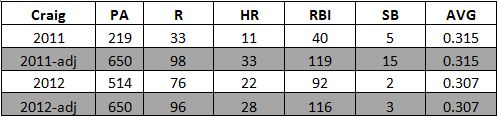
In fact, look what Craig’s last two seasons could’ve been with a full allotment of plate appearances:

Allen Craig 2013

The only real difference between those two adjusted seasons is the stolen base total.  That is about the furthest thing from the mind of someone drafting him so even if he does manage a full season of playing time and only steals a couple bags, it doesn’t dent his value.

Take the average of the other four numbers (97, 30, 118, .309) and over the past two seasons only two players have hit all four benchmarks: Kemp in 2011 and Miguel Cabrera this year.  Of course, these are just theoretical thresholds for Craig as he hasn’t yet proven the health piece, but the production in four of the five standard categories is excellent and definitely worthy a high pick especially as first base thins out a bit at the top.

Known as a position of depth, there were far few elite level options in 2012 compared to 2011.  Using ESPN’s Player Rater, it took 6.9 rating to make the top 50, which I think we could all agree is the upper echelon of offensive players.  Of that 50, only nine were first basemen.  Of those nine, four were no doubt not utilized primarily at first with Cabrera and Edwin Encarnacion qualifying at third base while Posey and Joe Mauer are best deployed at catcher.  Adrian Gonzalez is on the fence as a first base/outfield qualifier, but we can leave him at first.

In 2011, the top 50 threshold was at 6.7 on the Player Rater and 12 of those were first basemen.  Of those 12, only Michael Young (third base) and Mike Napoli (catcher) were best deployed at another qualifying position.  Lance Berkman and Michael Morse were like Gonzalez with their outfield qualification.  I definitely didn’t tab Craig with an early selection with the thought of position scarcity front of mind, but it shouldn’t be ignored, either.  Craig also carries the dual eligibility in the outfield adding flexibility to the pick, too.

Craig has been one of the best hitters in baseball the past two seasons ranking 17th in OPS+ among batters with 700 or more plate appearances.  That is my primary reason for selecting him where I have been; he’s a great hitter.  Additionally, in order to put up an elite season, he isn’t waiting on talent develop, rather he needs his body to cooperate.  While that certainly isn’t a given, it is a much sounder investment than betting on someone’s talents to shine through or for them to “get it”.

*Craig logged the ninth-highest total at 22, but there were players tied at 30 and 23 leaving 11 players with more homeruns than him. 

Friday: 12.7.2012

Joe Blanton in Los Angeles… er… Anaheim

After declining Dan Haren’s $15.5 million dollar team option and letting Washington pay him $13 million for one year, the Los Angeles Angels signed Joe Blanton for $15 million dollars over the next two years. Blanton, heading into his age 32 season, is essentially a Haren-lite in that he has strong K/BB rates and struggles with home runs. Home runs have been especially problematic for Blanton of late as he has posted a 1.4 HR/9 rate in each of his last three full seasons spanning 2009-2012 (he had a 1.1 in just 41 IP in 2011).

In that same time, he has a 3.4 K/BB that his risen yearly topping out at 4.9 last year. His sharply declining walk rate is primary factor as it has dipped yearly since 2008 when he tied a career-high 3.0 BB/9 all the way down to last year’s excellent 1.6 mark. His newly discovered strikeout success has been a bit overlooked. He carried a 5.1 K/9 in 761 innings with Oakland, but then moved over to the National League and saw a rise of more than two strikeouts per game up to 7.3 K/9 in 674 innings. There is a benefit in moving over to the NL, but it’s about 0.3 strikeouts per game so it wasn’t just that for Blanton.

His whiff rate (swinging strikes) rose dramatically in that time suggesting his stuff got better. The data only goes back to 2007 which only covers about a year and a half of his Oakland work, but you can see the sharp rise in that time:

   Year IP Whiff Rate
2007 230 6.8%
2008 198 6.6%
2009 195 8.4%
2010 176 9.8%
2011 41 10.4%
2012 191 10.4%

The dramatic rise has been driven mostly by improvements in his breaking stuff. For the data set we have, his slider whiff rate jumped from 13% in the two years with Oakland to 17% in the four in the National League (mostly with Philly before last year’s trade to LA). His curveball jumped from 12% to 20% and it has been at 22% the last three years. It will be interesting to see if he can maintain the strikeout gains upon returning to the American League.

Unlike Haren, who he is ostensibly replacing, Blanton gets a nice boost in home ballpark when it comes to his biggest problem: home runs. Citizen’s Bank Ballpark in Philly actually suppressed righty home runs a bit last year with a 94 rating (where 100 is average), but lefties had a field day at 126. Dodger Stadium is often thought of as a pitcher’s park (and it has been on the whole rating 100 or lower since 1962), but you can hit some home runs there and last year it had a 108 rating for righties and a 117 mark for southpaws.

Blanton gave up 14 home runs in Citizen’s Bank a year ago, seven to each side. He actually only gave up three bombs in 38 innings in Dodger Stadium last year (2-1 favoring righties for those wondering). His new home, Angels Stadium, hasn’t yielded a favorable home run park factor to either side of the dish since 2009 including last year’s extremely stingy 80 to righties and 82 to lefties. Though the entire sample dates back to his Oakland days, Blanton has allowed just one home run in 48 innings of work there en route to a 2.61 ERA in six starts and two relief appearances.

Blanton doesn’t have the upside of Haren at all. The comparison is meant only between the similarities in strong K/BB rates and trouble with home runs. Blanton hasn’t been on the ride side of a 4.00 ERA since 2007, but his last three full season xFIP totals are encouraging at 4.01 in 2009, 3.87 in 2010, and 3.39 last year (his 3.15 in 2011 came in just 41 innings).

The xFIP totals are so favorable because they balanced out his gaudy home run problems with a league average HR/FB rate whereas Blanton has been above 12% the last four years (including the partial 2011) topping out with last year’s 15.3%. If you aren’t confident that he can utilize the park to make major strides in the home run department, then FIP would be a better indicator for you. It still tells a positive story about how he has pitched the last three full season declining from 4.45 in 2009 to 3.91 last year.

Though going back to the AL isn’t a positive indicator for ERA in general (NL starters have a 0.28 advantage the last four years), this specific case represents an opportunity for a pitcher to buck the trend and slice some fat off of his ERA going the other way. I like Blanton as a late dollar days target to round an AL-only or deep mixed league staff. His unimpressive numbers from last year (4.71 ERA, 10-13 record) combined with the general assumption that moving to the AL is a net negative for a pitcher will leave his price tag lower than it should be for this talent profile.

Saturday: 08.18.2012

On James McDonald

James McDonald had a better season in 2011 than his 4.21 ERA might lead you to believe.  While “breakout” might be a stretch as a definition, “breakthrough” probably works.  He labored through his first four starts in April posting a 10.16 ERA in 18.2 innings.  He threw six shutout innings against the Giants on April 27th and took off from there with a 3.49 ERA in his final 152.3 innings of the season.  Even trimming those first four starts from his record, he still had his flaws in 2010, specifically walks (3.9 BB/9 in the 152.3 IP) and home runs (1.1 HR/9).

He started his 2012 season off much better with a 2.97 ERA in April.  And he only got better from there.  After seven innings of one run ball on July 7th against the Giants (with 10 Ks and 0 BBs), his season ERA was down to 2.37 and he had 100 strikeouts in 110 innings.  More importantly, his walk rate was at 2.5 BB/9 and he allowed just 0.6 HR/9.  In other words, he was having his breakout season.  Then the wheels came off.  A rough start in Milwaukee wasn’t really any reason to panic.  After all, everyone has an off day.  Even his six earned run outing in Colorado that followed wasn’t ringing alarms because Coors has destroyed pitchers all year.

But when he followed those two outings with two more awful ones against the likes of the Cubs and Astros, panic set in.  He bounced back with a baseline quality start (6 IP/3 ER) in Cincinnati to start August, but then got torched for seven earned in just four and a third at home against the lowly Padres.  For those keeping score at home, that’s three duds out of four against three of the worse offenses in all of baseball.

All told, he posted an 8.71 ERA in 31 innings across six starts pushing his ERA up nearly a run and a half (from 2.37 to 3.77).  He still has 26 strikeouts (7.6 K/9), but also had 21 walks (6.1 BB/9) and eight (!) home runs (2.3 HR/9).  His only homer-less outing in the stretch was the one in Cincinnati against the Reds.  So what happened?  Obviously his old issues came back to haunt him and wiped away a lot of the good work he had done in his breakout season.  Let’s see what the data tells us.

VELOCITY

The first place most people look when a pitcher is struggling is the radar gun.  Has his velocity changed significantly?  If so, why?  Oftentimes a major velocity dip will signify a dead arm period or perhaps even a more severe injury that the pitcher is trying to work through on his own.  With McDonald, there was no such change whatsoever with his fastball.  His breaking pitches saw a velocity change, but they both increased.

In short, velocity wasn’t the root cause of his issues.  The added speed to his breaking pitches might’ve flattened them out a bit and robbed them of some effectiveness, but his fastball velocity holding firm means he was likely plenty healthy and that there was some other reason for his ineffectiveness.

FASTBALL

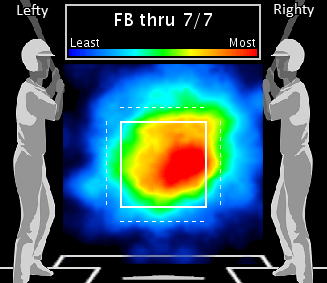
We looked at the velocity splits of his fastball from when he was on as compared to his run of bad starts.  However, we know that velocity isn’t the only thing that makes a fastball effective.  In the major leagues, even the hardest fastball has to have some wiggle or be placed perfectly otherwise it will eventually be caught up to and subsequently tattooed.  The movement on McDonald’s heater didn’t vary much in the two samples which leaves his command.  Was there is a difference in placement, specifically within the zone, of his fastball between his good and bad runs?

He was actually in the zone more during his hot stretch (56% to 52%), but look at how red it is down the middle of the zone during his poor stretch.  No wonder batters went from a .707 OPS on plate appearances that ended on a fastball up to 1.092 while striking out less (12.3% to 9.4%) and hitting more home runs (1.7% to 6.7%).  Hitting the fat part of the zone more often made hitters more aggressive and cut into his called strike percentage on the pitch, too, going from 33% down to 27%.

These fastball issues explain a lot of what went wrong for McDonald.

BREAKING PITCHES

The curveball went from overwhelmingly dominant to very good and from what I saw it was because he would lose it for stretches at a time.  For three innings it would look as sharp as it did in April through early July when it yielded an absurd .291 OPS and 34 strikeouts in the 79 plate appearances that ended on the pitch and then all of a sudden it would start flattening out in the fourth without warning.

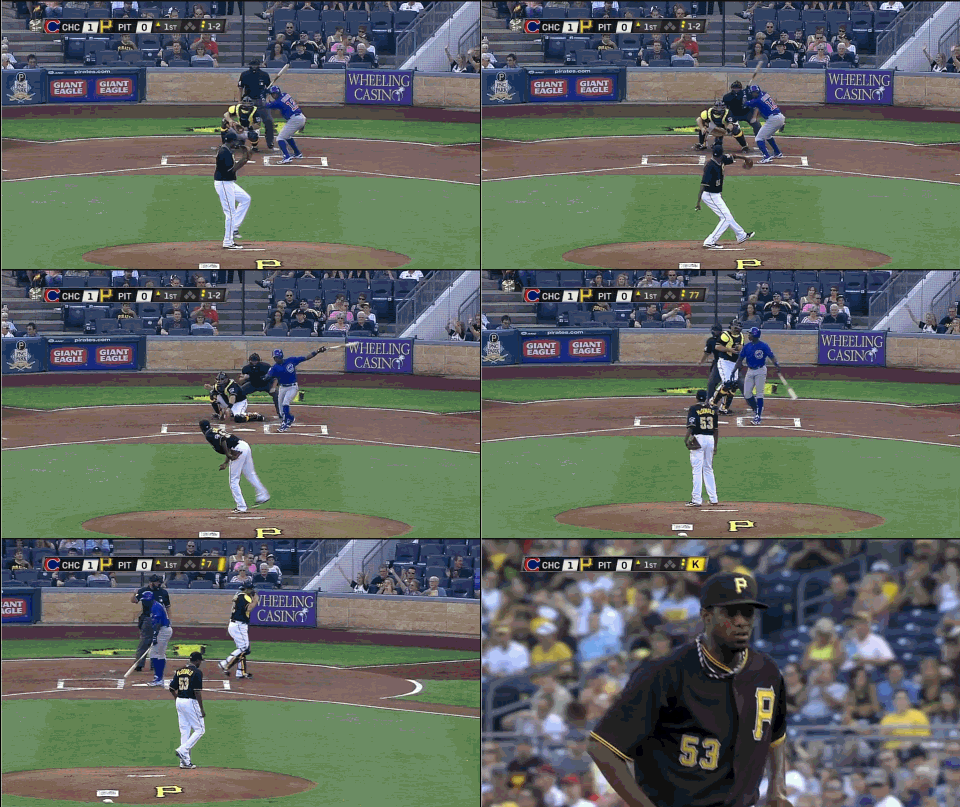
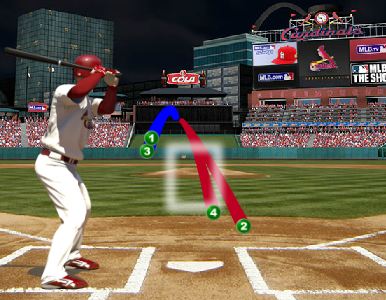
I don’t think I have the eye or general know-how to say why or explain what was going on with his mechanics when it went from good to bad.  I know a ridiculous, devastating curveball when I see one and I know a hanger that will be crushed by a historically bad hitter* against breaking balls.  Exhibits A & B:

*Soriano has a paltry .595 OPS against curve since 2009

FRIDAY NIGHT IN ST. LOUIS

Given his recent trajectory, it was difficult to be psyched about McDonald heading into St. Louis for the series opener Friday night.  They simply crush everybody even as they seemingly have three or four starters on the disabled list at any given moment.  Alas, that’s why they play the games.

McDonald was excellent against the Cards getting back to what made him so successful for the first three-plus months of the season.  His fastball command was the best it’s been in weeks while his breaking stuff was just dominant.  Four of his seven strikeouts came on breaking balls (2 apiece for the slider and curve) and 23 of his 36 breaking balls went for strikes including nine called strikes (six on the curve).  He ended up throwing six scoreless allowing just two hits and walking three.


He walked Jon Jay on five pitches to start the game and it was hard not to think, “oh boy, here we go again”, but he then induced a double play out of Allen Craig and a groundout from Matt Holliday to avoid any trouble.  His other two walks both came with two outs.  The sixth inning walk to Craig came on four straight balls with nobody on and perhaps he was pitching around him since Craig came into the game 3-for-8 with a double and a homer off of him while Holliday was just 2-for-9 with three strikeouts.  Yes, I realize there is very little difference between those two minuscule samples and I don’t even know how often pitchers work on that level especially with such short samples against both, but it’s simply a (halfhearted theory).  It could just be that he threw three lame pitches and one close one to Craig.

This was a very encouraging outing against a great opponent on the road so hopefully it spurs McDonald to be his April-early July self the rest of the way.  In fact, it is imperative to the team’s success that he is that version at least skills-wise even if the ERA is closer to 3.37 than 2.37.

Wednesday: 08.8.2012

Starting Pitching Rankings for Remainder of ’12

I apologize for the tumbleweeds blowing around here the last week-plus.  I’ve been adjusting to my new sleep schedule as a gainfully employed citizen and it has limited my time to post.  That said, I have definitely been working on baseball projects in the limited spare time I’ve had and the primary project has been my rest of season SP rankings.  I did a top 80 for each league as well as an overall top 100 which includes commentary.  I did it in Excel and you can find the file below for the latest version of Excel as well as a 1997-2003 compatible version.  To whet your appetite a bit, here are the top 24 sans commentary:

And here are the files for your perusal.  I encourage comments if you have questions about guys or anything of that nature.

Top 100 from Aug to EOS

Top 100 from Aug to EOS-Old Excel

The commentary is listed on the first sheet and then you have the league-by-league ranks on the second sheet.

Tuesday: 07.24.2012

Is Pitching More Plentiful Today?

If you randomly placed a 4.00ish ERA starting pitching into the free agent pool back in 2007, that guy would go for a mint during FAAB with more than half of the league placing a bid.  The final bid would likely be someone’s entire budget.  Of course a 4.00ish ERA starter would never just sit out there when the league’s starters were pitching to a 4.64 ERA.  The league followed up with a pair of 4.46 seasons before the first “Year of the Pitcher” in 2010 when average ERA for starters was 4.16, including a 4.07 in the National League.

Last year was the apex of this run with the league turning in a 4.08 mark and the NL actually going sub-4.00 at a seemingly insane 3.95 given what we became accustomed to in the late-90s and early-00s.  In fact, this piece is about what we have become accustomed to and how that shades our view of this drastic change in run environment.  Placing our 2007 example in this year’s free agent pool leaves him there for the foreseeable future with nary a bid as his 4.00ish ERA simply doesn’t make much of a dent in a mixed league except for maybe the worst team or two in the league.

In this heavy-pitching era we’re dealing with, you will often hear “there is plenty of pitching so…” followed by a strategy to eschew pitching in some form or fashion.  But is there plenty of pitching?  Is this new environment offering more individual chances to secure above average pitching or does the rising tide lift all boats and simply change the benchmarks?  And since those benchmarks changed so drastically in short order, has the fantasy community at large simply not quite adjusted their eyesight in turn?

That doesn’t mean that every guy with a 4.00 or greater ERA should be cut instantly, but those carrying ERAs up in that range should be offering something else of note since that figure has gone from “all formats must-start option” in the late-90s to “solid mid-rotation option” in the mid-00s to “better have very positive indicators for the future, a gaudy strikeout rate or a good WHIP” today.

So let’s take a quick look at ERA specifically and see how it has evolved in the last six seasons including so far in 2012 and get a better feel for whether or not the changed run environment has indeed made pitching plentiful or simply altered the view of what good is for a pitcher.

First, a simple look at ERA by league and as a whole since 2007 for all starting pitchers:

This shows us how ERA standards have changed both by league and as a whole in the last six seasons.  The sharp uptick in the AL this year is definitely interesting.  Not entirely sure what to make of that increase.

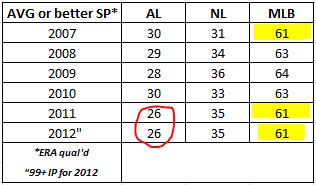
Next, let’s look at how many pitchers there are who have an average or better ERA with a qualifying amount of innings (at least 162 IP).  Obviously not all of these guys would be getting used in every fantasy league as formats vary greatly, but this gives an idea of how many generally acceptable options there are in the pool by year.

The first takeaway is the fact that the number of average or better SPs by ERA has been the exact same the last two years as it was in 2007 which lends credence to the notion that pitching isn’t exactly plentiful so much as our benchmarks are vastly different.

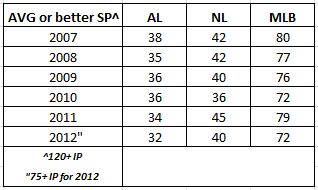
Since plenty of non-ERA qualified starters get used at any point during the year, I lowered the threshold to 120+ innings and again looked at those with average or better ERAs.  This gets all of those fantasy all-stars who come out of nowhere in June and excel yet don’t register enough innings to become ERA qualified by season’s end.

We see here that not only are there not more above average ERA options in the pool, but that 2010 and so far this year deliver the two smallest outputs of the six seasons analyzed.   In the first three years, there was an average of 78 pitchers with an average or better ERA and 120 or more innings of work.  The last three years have an average of 74 propped up by last year’s 79.  This year is obviously incomplete, but we would need to see 10 more pitchers meet the thresholds this year to get the average up to 78 over the last three years.

This study, while far from extensive, does seem to suggest that we aren’t in a pitching rich environment in terms of quantity.  The quality may be higher especially with seemingly every other pitcher carry 95+ velocity, but the idea that you can wait deeper into your draft to start composing your staff appears to be misguided.  If you waited until the 9th-10th round before getting your first starter back in 2007, you can still employ that strategy, but the improved league ERAs don’t make it easier to wait until the 12th-13th round for that first starter.

Wednesday: 07.18.2012

The All Legitimate Team

Content has been light this week as I prepare for a job interview.  Might sound weird as a standard interview is usually a 20-30 minute Q&A.  This one is a 3-hour extravaganza, my third round with this company in which I’ll be presenting a demo so that’s why this is the first piece of the week.   I’ll have plenty the remainder of the month including a planned top x SP list after the trade deadline.  I’m not sure if I’m going to go 50, 100 or >100.  I’m waiting until the trade deadline is completed because I don’t want to do some detailed list I’m proud of only to have it change drastically if 7-10 pitchers change locales.

I gave you the Hail Mary Team last week and now I’ve got a team of players who had great first halves whom I believe in and would have no problem targeting via trade which would essentially be “buying high” or simply holding onto them the remainder of this year as opposed to getting out from under a potential regression.  I am not going to go in-depth with the reasoning as I did on the Hail Mary team in large part because their numbers speak volumes for the player.

HITTERS

Catcher – Yadier Molina – I covered him in depth at the end of June and he hasn’t slowed down since with three more bombs in the subsequent 10 games.  Plus this isn’t an out-of-nowhere season, he’s been building up to this for years save a 2010 blip.

First Base – Allen Craig – Yes, I am going to list the entire Cardinals team.  The return of Lance Berkman has some freaked that Craig will lose gobs of playing time, but I just can’t see how the Cards could bench their best hitter statistically (specifically by OPS+) for any more than a day here and there.

By the way Berkman is right on Craig’s heels for that OPS+ title on the team at 152 (Craig is 154) so he is hardly the one headed to the pine, either.  Honestly, they should just take the defensive hit and put Craig at 2B.  His bat is so far ahead of Daniel Descalso’s that it would be worth it.  Maybe see if Craig has another off-day mixed in soon and then pounce in hopes of catching someone a bit fearful.

Second Base – Jason Kipnis – Through 124 games of his career, he is pacing toward a .275-101-24-91-33 line.  That’s incredible regardless of position, but definitely gets an added bit of greatness at second base.  He is one of those cases where his ranks in things like OPS, wOBA and wRC+ don’t tell the story of his fantasy value.  Robinson Cano is first in those and first in 2B fantasy value, but Kipnis if around fifth or sixth in those stats yet second in fantasy value because obviously his R, RBI and SB contributions aren’t encapsulated in those metrics.

Shortstop – Asdrubal Cabrera – Kip’s double play mate is putting a season comparable to his 2011 breakout in terms of pure production (OPS, wOBA, wRC+), but his fantasy value is down thanks in large part to evaporation of his speed component.  After matching his career-high with 17 a year ago, he’s down to just two this year and a horrible rate at 2-for-5.  Having swiped 17 in 2009, maybe he only steals in odd-numbered years.  Beyond that, he is a safe bet for power production at short.

Third Base – Todd Frazier – I composed this list prior to Joey Votto’s injury, but now Frazier’s inclusion is even more of a no-brainer since his path to playing time is no longer reliant upon Dusty Baker realizing how cooked Scott Rolen is, at least temporarily with Votto done for 4-6 weeks (and we all now how lame injury estimates have been this season).  Frazier has one of the better home run rates among batters with 210+ plate appearances (he has 212).  His rate is on par with the likes of Adrian Beltre and Yoenis Cespedes and he’s tracking ahead of Carlos Gonzalez.

Outfielder – Austin Jackson – An improved approach, advancing power and inclusion on a strong offense leading to plenty of runs scored (8th highest total in baseball despite playing 69 games… of course, Trout is 2nd in 69 games so there’s that) make Jackson a reliable, yet unspectacular option.  I watch him day in and day out and I’m a complete believer.  I was an early adopter here as I legitimately saw differences in his approach back in April.  I know that’s sort of a backpat, but I’m proud that my amateur scouting eye appears to be progressing, plus if you listen to the podcast, you know I’m not above a backpat or 12, lol.  I try to do it tastefully!  He’s unspectacular in that he doesn’t do any singular thing extremely well (‘cept defense, which doesn’t count in 99.8% of leagues).  He’s quite Chooish in that respect.  More on that in a bit.

Outfielder – Shin-Soo Choo – It’s been a bit!  Choo is back.  After a disastrous 2011 that included an embarrassing off-the-field event with a DUI and an injury-marred poor performance on field, he is back to being the steady .300-20-20 guy.  He actually isn’t pacing to hit any of those marks, but I’m using that as more of a descriptor since it paints a cleaner picture than .296-18-18.  Batting leadoff, he has traded some RBIs for runs, just as you would expect with that kind of move.

Outfielder – Josh Willingham – When you put up 29-98 on Oakland in 136 games, a move to Minnesota isn’t scaring anybody in terms of production.  His power plays anywhere and the perception of Target Field eating up all power is a bit misguided fueled by the struggles of Justin Morneau and Joe Mauer there.  It dominates lefties, but its 95 home run park factor for right-handers isn’t awful.  Below average sure, but not suffocating like Oakland’s 82 factor.  A trade out to a contender would seemingly only help matters.

Outfielder – Jason Kubel – A little nicked with a hamstring, but set to avoid the DL and return Wednesday night.  I didn’t love the signing this winter if only because they had a perfectly capable outfielder in Gerardo Parra who was less of a bat than Kubel, but a much better fielder.  Kubel’s bat has always intrigued me and return of his 2009-level batting average has made him a very strong outfield contributor who does everything but run.  As a lefty, his move from Target Field to Chase Field (114 LH HR factor) has been a huge boon.

Outfielder – Tyler Colvin – Let me qualify this a bit.  With this “team” of players, I have been endorsing their current level of production or at least a reasonable facsimile (90-95%) of it.  I feel the same way about Colvin’s power which is what earns him a spot on this list, but his .294 batting average is definitely susceptible to plummeting.

He is an incredibly free-swinger which can work quite well especially in somewhere like Coors Field, but he can go ice cold, too, as he did in pretty much all of 2011.  He hasn’t been a complete product of Coors (.833 OPS on the road) which definitely helps, but having half of his games in Coors keeps his floor at a palatable level.

PITCHERS

Several of the pitchers to make this “team” were covered in my 24 to Target piece a while back, so I’ll reference you to that piece for the likes of Johnny Cueto, James McDonald and Cole Hamels who are all part of this team (what, Hamels? WEIRD!!!!).  Here are the other six candidates:

R.A. Dickey – Duh.  I’m not breaking ground here, is anyone not bought in on Dickey?  Despite giving up five in three of his last four outings, I’m not particularly worried and maybe it presents a better opportunity to buy if the guy who has him is skittish.  He still had a 7.0 K/9 and 2.3 K/BB in those games.

Gio Gonzalez – I didn’t include him in the 24 to Target list because I didn’t want to just litter it with studs because you’re going to pay a pretty penny with stud arms like that in the trade market.  That I said, I do believe in his step forward this year and I think there is even more to his game as he continues to refine his control.

Chris Capuano – A sleeper-type for me coming into the season, he has exceeded expectations and I see no reason he can’t remain incredibly effective for the duration of the season.  Home run suppression is the key between Capuano having a solid ERA and a great one.  He’s at a career-best 0.9 HR/9 resulting in a career-best 2.75 ERA.  Though his ERA is nearly two full runs lower than last year’s effort, I don’t think he is a complete fluke you should be fearful of in trade talks.

Ryan Dempster – I don’t think he’ll maintain his scoreless innings streak the rest of the season or even pitch at a 1.86 clip for his ERA, but he has a great base of skills that have been remarkably consistent and even seen a nice uptick this year so he should be a bankable starter with a low-3.00s ERA or better the rest of the way.  Obviously a deal to a contender should improve his chances to scoop more wins, too.

Vance Worley – WHIP is the “runs scored” of pitching.  I think it gets overlooked by many.  If it’s incredible, like sub-1.00 great, then it is noticed and same on the opposite end of the spectrum if it’s at 1.40ish or higher, but anything in between is kinda igored.  Not by everyone, but it certainly doesn’t stand out like wins, ERA and strikeouts.  Worley’s WHIP is his downside right now at 1.38 while everything else has been pretty solid (wins are light, but that’s because Philly has been broken for most of the year) and worth buying in on.

You can’t just chalk his WHIP up to a .315 BABIP and call it bad luck.  A lot of that is the fact that hitters can square his sub-90s heater up and get a good rip (evidenced by his 26% line drive rate) so if those aren’t at-‘em balls that the defense can turn into outs, his WHIP will be susceptible.  I think he can chisel it down a little bit to around 1.30, so if WHIP is a sore spot, then this isn’t someone for you.  But I think he’s a legitimate, bankable mid-level starter as his regression from 2011’s breakout is about what I figured we’d see.

Mark Buehrle – As a strikeout-lover, I rarely invest in Buehrle types especially inning or start cap leagues, but you cannot deny how incredibly consistent he has been throughout his career.  Now in the generally easier league with a pitcher’s park for half of his games, he has been able to post his best ERA since 2005 thanks also to some improvements in his skills.  He isn’t flashy and you don’t want to invest if strikeouts are your need obviously, but otherwise he is your guy.

Thursday: 07.12.2012

The Second Half Hail Mary Team

Your team sucks.  Way to go, idiot.  You are wallowing near or at the bottom of the standings with seemingly no hope.  It’s a redraft league so you don’t even have the option of trading for the 2013 which can be a fun exercise once you realize a season is lost.  So what do you do with the second half?  Hint: ignore your team and start looking for sleepers who will definitely fail in fantasy football is not the answer.  No, the answer is you throw conservatism out the window and chuck some Hail Marys to see if you can make a run.  Cross-sport reference!!!!

As dire as the situation may look now, there is time.  It’s not exactly the halfway point, four teams have played 87 games and all but two have (Washington & Kansas City at 83 & 84, respectively) played 85 or more, but a lot of baseball is still going to be played.  There will be plenty of Cinderella stories in October about a team that was buried at the All-Star Break only to surge through the standings in the dog days of summer en route to an improbable victory.  Let’s make that your story.

Presenting the Hail Mary Team for 2012.  This group of strugglers contain a ton of upside if they can reach previously established heights in the coming months.  Honestly, if you are one of the teams looking up at most of the league in your standings, you probably have a couple of these guys on your team.  They came into the season with elevated expectations and have failed to meet them for a bevy of reasons.  Their price tags have lowered (and if they haven’t, just pass, because there’s no sense paying full price) and with nothing to lose, they could be your ticket to a much better slot in your standings.

CATCHER Carlos Santana

He’s been wretched this year after a great 2011 season.  And it’s not just the concussion that sidelined him near the end of May as he was horrible in that whole month leading up to the injury (.233/.314/.344).  The concussion may be exacerbating the situation, but it’s just been a rough go since a solid .262/.417/.446 line April suggesting that maybe something other than the concussion is in play.  Nevertheless, this is a power force at a scarce position who can be a big time run producer if he gets back to the guy we saw in his first 201 games spanning part of 2010 and all of 2011: .244/.362/.459 with 33 HR and 101 RBI.  Brian McCann got some consideration, but his surge before the break (.421, 4 game HR streak w/11 RBI) likely allayed the fears of many and ate into any discount you could’ve gotten previously.

FIRST BASE – Ike Davis, Eric Hosmer

Both guys have been hot of late, but such wretched starts have their overall lines still in shambles resulting in their appearance on waiver wires in shallower leagues and making them available for little more than a song in leagues where they are on a roster.  Davis has a very healthy .294/.351/.635 line with 7 HR and 28 RBI in the last month so his price might be one of the higher ones on this list comparatively speaking, but I’d be willing to pay it as long as it still represented a discount against preseason expectations.  He’s been a bit Dan Uggla-esque circa 2011 where the batting average was just awful, but the power was still present.  I’m not sure he’s going to run off a 33-game hit streak like Uggla did, but who cares?

Hosmer ripped off a 3-hit game in Yankee Stadium in late May, his first of the year, and that seemed to be something of a turning point for his season.  From that game on: .289/.352/.430 with 4 HR, 19 RBI and 7 SB in 165 plate appearances.  He is still toting a .231/.299/.371 season line, though, which is why he still qualifies for this team.  Like Davis, he will be on the higher end of the cost spectrum among this list of players, but he should still be available at a sharp discount compared to the preseason which is what makes him a worthy Hail Mary target.

SECOND BASE – The Weekeseseseses, Rickie & Jemile

The Brothers Weeks have been awful this year lending to the decimation of the second base this year which could’ve been a plentiful position had players met or at least been near expectations.  Surges from Aaron Hill, Neil Walker, Jason Kipinis and Jose Altuve are only masking failures of the brothers, Dustin Pedroia, Ian Kinsler and Dustin Ackley instead of adding depth.  Back to these two, though, with Rickie first.

Injuries have always been a problem as he has just one season with more than 129 games played, otherwise he has usually performed quite well as long as he is on the field.  Until this year.  Even a depressed offensive environment can’t mask his woes as he checks in just under the Mendoza Line at .199 with just 8 HR and 6 SB in 81 games.  He hit 20 HR in 118 games last year, so even doubling his current output would be short of expectations.  He’s running at the same clip as last year, but he’s not really a speed asset these days anyway, that’s his brother’s area of expertise.

Speaking of Jemile, he has been an abomination thus far.  Imagine he were even average, the A’s might be above .500.  As it is, they are right at the mark and his return could help them stay there or exceed the level going forward.  The real bummer is that his poor half has overshadowed the huge gains in walk rate (up from 5% last year to 11% this year) paired with a small improvement in strikeout (down 1% to 13%).  If Dee Gordon can lead baseball in stolen bases (30) with a .280 on-base percentage, Weeks should have more than 12 with a more palatable .312 OBP.  He is an easy target if steals is a category where you’re severely lagging.

SHORTSTOP – Alexei Ramirez

When Ramirez ended up April with a paltry .498 OPS, some may have seen that as a prime buying opportunity as he routinely takes a while to get going.  Over his career, April is easily his worth month checking in with a .561 OPS compared to .721 or better in every other month peaking with .822 in July.  He sputtered to a .581 mark this May.  He improved to .678 in June so he is progressing, but not nearly as rapidly as usual.  In a scant 7-game sample for July, he is at 1.057 so maybe he finally ready to let loose.

The power has been noticeably absent throughout with just two home runs.  He has run a bit more to help alleviate a bit of the damage checking in with 10 SB, three more than all of last year in a full season.  He has long been one of those guys who is much better as a fantasy asset than as a real life one with only one season over 99 OPS+ (104 as a rookie).  He had become a bankable 15-70-10-80 with an average around .270.  It will take a helluva rally to get there this year, but if he just performs to the levels we have seen in the past, he will be a positive asset at shortstop at a nothing cost.

THIRD BASE – Ryan Zimmerman

I was surprised the other day when I heard some fantasy analysts dismissing him as a non-entity.  The basic premise was essentially that he’s never been any good so why are folks still hung up on him?  That’s just crazy talk.  He was excellent in 2009-2010 and was tracking toward another great season last year when injuries cut it short.  He hasn’t been good this year and I think injuries are a big reason again as he had a DL stint back in late April through early May and then he took a while to get going once he was back.

I’ll grant that he isn’t the sturdiest guy around.  That seems to come with territory when dealing with defensive stalwarts like Zimmerman, but he is definitely a damn fine hitter capable of big numbers.  In fact, he has been hot of late starting with a Coors Field trip (always a nice remedy for a hitter) totaling 14 games in all during which he has hit .333/.394/.683 with 5 HR and 18 RBI.  He has a 1.003 OPS with 3 HR in the non-Coors part, so don’t worry that he is Brandon Mossing us.  His bottom line is still gruesome (.694 OPS) enough that the price won’t be too steep.

OUTFIELD – Cameron Maybin

Proponents of Maybin’s are pointing toward last year’s second half dash to the finish that saw him swipe 28 bases after the break with an improved .268 average (up from .259) and hoping he has another such run (pun fully intended) in him.  The talent is there in glimpses, but those are all too brief because even when he’s hitting the longest home run in Chase Field, he’s still only carrying a .212 average.

Ichiro Suzuki

This is probably just the decline of a 38-year old former star, but it’s hard not to look at his 39 SBs from just a year ago and dream of him stealing 20+ in the second half.

Shane Victorino

He has been a far cry from what we expect in the slugging department thanks to a precipitous drop in triples as he has just two after leading baseball two of the last three years and notching 10 in the third of those seasons.  Aside from that, he hasn’t been awful save a little batting average misfortune.  I think the perception of his struggling is stronger than the truth of it as he already has as many steals (19) as he did in all of last year and his eight homers are just off of last year’s pace.  Try to prey on the trade rumors swirling about and his benching the other day for not liking his slot in the order as well as the general Phillie malaise that has seemingly stunk up every non-Hamels entity.

Bes Jond Unnings and D.J. Jupton

Paired together for obvious reason, Desmond Jennings and B.J. Upton have been colossal disappointments this year, though like others in the list they have run enough to stem the tide a bit on their being fantasy sinkholes.  Both have 15 SBs, impressive more so for Jennings coming in eight fewer games, but both are still on the wrong side of .680 OPS to date.  It looks even worse if you extend back into September for Jennings as he jumped off a cliff after a blazing hot run from late July through August.

Meanwhile, no one is expecting anything batting average-wise from Upton, but what is with the power outage?  He’s been around a 20 HR hitter the last two years which combined with his speed and 80ish runs driven in and scored made the batting average plenty palatable.  He’s now on pace for 13, down 10 from last year, but he can string together some 4-5 HR months and rally to or above 20 if he’s right.  Both of these Rays have plenty of upside that make gambling on them easy, especially at a discount.

Nelson Cruz

He has been lying in wait just ready for a Cruzian streak.  It may be bubbling up near the surface, too, as he entered the break with three multi-hit games including four doubles, but no homers.  When he gets hot he can carry a fantasy team so he is an easy inclusion even though he hasn’t been as rotten as the others with a 99 OPS+.  You may have to package one of your few worthwhile assets to get him and someone else on this list.  It could pay major dividends with a monster like Cruz.

PITCHING

Tim Lincecum

Duh.  Just look at the track record, I don’t really need to tell you why he’s a Hail Mary candidate.

Dan Haren

Currently injured making it a nice time to strike.  For the purposes of this exercise it also helps that he was terrible for five starts (8.67 ERA) before finally hitting the DL with a balky back.  His brilliant track record and the glimpses of greatness this year when healthy make it clear that he is still someone worth targeting.  The rest will hopefully get him back to 100% and he will return to his previously established level of excellence.

Rickey Romero

Let’s be honest, he didn’t really earn a 2.92 ERA last year from a skills standpoint. He still got the 2.92 ERA and I’m sure it helped many a fantasy team, but expecting that this year would’ve been silly.  Similarly, he isn’t a 5.22 ERA pitcher, either.  The skills have deteriorated this year without question, but not 5.22 deterioration.  His control is all out whack with a career-worst 4.7 BB/9.  That points to a potential mechanical issue which hopefully can be identified and corrected.

Unfortunately, the bubonic plague is sweeping across the Toronto rotation so injury could be an issue, too, but he doesn’t seem to be laboring or hurting when I view his starts with my amateur scouting eye.  A 3.50 ERA from a workhorse who will put himself in position for decisions (and ideally wins given their stout offense) can go a long way toward fixing your flailing staff.

Derek Holland

We saw last year, specifically in the second half and playoffs, what he can do when he is click.  His skills are in line with last year’s save a bit of home run trouble which has no doubt led to his inflated 5.05 ERA.  He quietly came off the DL just before the break and had a quality start, strike quickly before he strings a few together and saps up any discount via trade or starts getting scooped up off the waiver wires.

Doug Fister

The infield defense has struggled as planned and Fister has been a prime casualty, but that isn’t the only factor as a 17% HR/FB rate has led to a 1.2 HR/9 rate.  That factor should regress, especially for a groundball artist (2.2 GB/FB ratio), and that will cut into his 4.75 ERA.  Completing the Hail Mary pass would be a tightening up of the defense allowing him to pitch to a level on par with his skills which would be around 3.45 or better.

Francisco Liriano

Personally, I don’t think he should be trusted, but we are talking Hail Marys here.  He has a 3.12 ERA and a strikeout per inning in his seven starts since returning to the rotation.  We know the upside he has when everything is going perfectly.

Ubaldo Jimenez

Is he the next Liriano after his fall from grace last year?  Probably so, but like Liriano he is streaking in his last seven with a 2.93 ERA and 44 Ks in 46 innings.  In fact, they both started their streaks on June 5th so they are even more similar this year.  They both have ace upside.  Doesn’t mean they’ll will reach it, but the chance is there.

Ervin Santana

He likes to throw a stinker season in every once in a while to keep everyone honest I guess, but his capability is a commodity as proven in three of the previous four years from 2008-2011.  Unsurprisingly home runs were his issue in 2009, too, so figuring that out will be the key to his potential success going forward.  He doesn’t quite have ace potential because he peaks around 6.8-7.0 K/9, but with the Angels clicking, he can run off a bunch of wins with quality ratios if he gets himself figured out.

Clay Buchholz

Another guy I don’t really buy into, but people I respect do and besides, I’m trying to fix your crappy team not mine.  Even including the thrashing he suffered right before hitting the DL, he had 3.35 ERA and 5-1 record (including 4 straight Ws) in eight starts whittling his ERA from 9.09 to 5.53 in the process.  He is currently sitting on the DL with terrible bottom line numbers making now the best time to strike if you are interested.

Tuesday: 07.10.2012

For Sale: Quality Arms

The Colorado Rockies pitching staff is a mess right now.  They have a league-worst 5.26 ERA which eclipses second-worst Minnesota by 0.40 thanks in large part to their home ballpark ignoring the current state of baseball as a pitcher’s dreamland and playing like the early 2000s Coors Field.  To wit, their home ERA is 5.87, nearly a full run worse than Minnesota 4.91 (yikes, I thought they had a pitcher’s park?).  They are more than two runs worse than the 3.78 NL average at home.

While they are better on the road at 4.57, they are still nowhere near the 4.19 NL (and league, in this case) average.  So we can’t just pin the blame on Coors Field and be done with it.  That environment certainly isn’t helping matters, but an overwhelming lack of talent is the real problem here.  Yet I can’t help but think that perhaps they would be better off if they stopped giving away talent for absolutely nothing.

FELIPE PAULINO

The Rockies acquired Paulino from the Houston Astros for Clint Barmes in November of 2010.  It was a small move, but definitely one where they got the upside even before the 20/15 hindsight.  Paulino labored a bit through 92 innings (5.11 ERA, 1.54 WHIP), but the upside was there in a 27-year old who averaged 95.5 MPH on his fastball with a groundball lean.  He needed to learn how to work with runners on (59% LOB in ’10), but the 4.36 xFIP pointed to promise.

Barmes, meanwhile, was a glove-only shortstop as he followed up his 23 home run season of 2009 with just eight.  In fact, his OPS+ of 82 showed that even the 23 HR season wasn’t terribly special and his 67 OPS+ in 2010 only punctuated that fact.  Even before either suited up for their new teams, this looked like a strong move for Colorado with the potential to be a truly great one if Paulino could figure it out.

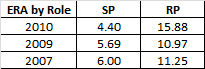
Something stood out from Paulino’s time in Houston: he seemed to really struggle as a reliever.  Granted the samples were tiny (21 total innings across three years), but he was just insanely bad compared to when he was starting.

Something about relieving just didn’t seem to sit right with Paulino.  You might think that slotting him in relief would work, maybe add a tick or two to his 95 MPH heat and allow him to become a dominant force out of the bullpen, but at the same time it was probably best to explore the starting option with him given the aforementioned velocity he carried as a starter.

The Rockies were set on the relief role for Paulino and in 18 outings he posted an ugly 7.36 ERA and 2.05 WHIP across 14.7 innings.  Outings of five and two runs in 0.3 of work for each definitely inflated the numbers of his small sample, but alas the Rockies had seen enough.  In fact the 2 ER/0.3 IP outing was his last as with the team, they were done with him

OK, so find another team willing to take a shot on the 95 MPH flamethrower and get an upside prospect or team-controlled major leaguer in return, right?  Or just sell him to the Kansas City Royals.  After 4.3 innings of scoreless mop up work in his first outing for the Royals, they made him a starter full-time and immediately saw glimpses of his potential.

Including the relief outing, Paulino opened his KC tenure with 12.3 scoreless innings and had a 1.29 ERA in 21 innings through the relief outing and his first three starts.  He was up and down the rest of the way, but more good than bad with only a couple of true flameout starts (including one in Oakland, oddly enough).  He closed the season with four really strong starts yielding a 3.75 ERA and 1.17 ERA in 24 innings, but more importantly an 11.6 K/9 and 4.4 K/BB.

Unfortunately injuries delayed the start of his 2012 season and then ended it way too prematurely, but he was headed for a breakout season posting a 1.67 ERA, 1.22 WHIP, 9.3 K/9 and 2.6 K/BB in 37.7 innings of work before succumbing to an elbow injury that many believe will end up being a Tommy John Surgery.

That doesn’t change the fact that the Rockies gave up on him after less than 15 innings of crappy relief and got nothing in return.  He may have eventually gotten injured in Colorado, too, but that outcome of an injury doesn’t change the fact that their process was horrible especially since they started off on the right foot by trading a piece that they had no use for in Barmes to get Paulino..

FRANKLIN MORALES

Morales was a product of the Rockies system and was heavily lauded as a future star.  Kevin Goldstein had him first in the system in 2008 as a five-star prospect and slotted him 13th overall on his top 100 list that year.  Baseball America also had him first in the organization and liked him even more on the bigger scale tabbing him as the 8th-best prospect in baseball that year.

Control was a major issue for Morales coming up with walk rates ranging from 4.2 to 6.9 BB/9 in his five stops en route to his 2007 big league debut (a year before the glowing ratings from prospect mavens).  In eight starts down the stretch, Morales was great for the Rockies including a stretch of 20-scoreless than spanned three outings (of 5, 6, and 6 IP) and three innings of a fourth.  His peripherals weren’t flashy (5.9 K/9, 1.9 K/BB), but a 55% groundball rate aided him to a 3.43 ERA.

He opened 2008 with an outing of six scoreless innings before imploding and walking four or more in three of his next four starts.  The Rockies pulled the plug in April after a 6.39 ERA in 25.3 innings and sent him to the minors where he finished the implosion (5.47 ERA, 6.8 K/9, 1.0 K/BB).  He opened 2009 with another gem, but left his second start with a shoulder strain.

He wouldn’t start another game for the Rockies.  He spent some time in the minors in 2009 before coming back as a reliever.  He wasn’t too bad to close out 2009 and even closed for a spell.  He would pitch another 42.7 innings in 49 appearances over 2010 and 2011 with rather awful results: 5.48 ERA, 1.64 WHIP, 8.0 K/9 and 1.2 K/BB.  Nevertheless, he was a 25-year old lefty throwing 94+ MPH so there was still some hope.  Alas, the Rockies jettisoned him to the Red Sox.

That’s OK, surely they picked up a nice upside lottery ticket of their own in return given Morales’ youth, handedness and velocity.  What’s that?  They got actual lottery tickets?  Like Paulino, Morales was sold and unsubstantiated reports suggest that the Rockies spent the money on Powerball tickets during the last big drawing.

He was instantly better with the Red Sox slicing two walks off of his rate down to 3.1 in 32.3 innings out of their bullpen late last year.  He pumped his strikeout rate up to 8.6 K/9 as well.  After getting 23.7 more innings of solid relief out of him this year (3.04 ERA, 20 Ks), the Red Sox have given him another shot at starting.

The early returns are encouraging.  He brilliant through the first three before stumbling against the Yankees against whom he allowed four home runs in just 3.3 innings.  Even still, he has a 4.22 ERA as a starter (not bad especially when considering the 6 ER dud vs. NYY) with a ridiculously impressive 1.17 WHIP, 11.0 K/9 and 5.2 K/BB in 21.3 innings.  And the Rockies got nothing for this guy.  OK, not nothing, they got cash, but that’s really nothing on the baseball landscape.

Rotoworld posted an update (I don’t see a way to link to individual updates from RW) under both Morales and Paulino’s profiles around the time they were being shopped that included this nugget: “The Rox are fed up with both pitchers, but they’re both out of options and they don’t want to lose them without getting anything in return.”  Whoops.  Didn’t quite achieve that.

The real question is why were they so fed up with the two?  It seems both were given awfully short leashes before being cast out for some money.  For an organization that has long been starved for pitching, how can you really justify giving up on one of the hardest throwers in baseball (Paulino) and a young lefty with his own incredible velocity (Morales)?

While that issue likely falls at the feet of Dan O’Dowd and his front office team, the coaching staff doesn’t get off scot-free as both pitchers began exhibiting some of their potential immediately after they left Colorado.  First off, I think they improperly deployed both.  But even when the Red Sox used Morales as a reliever, he was much better with them.  How did they instantly cut his walk rate like that?  That can’t be blamed on Coors Field.

I don’t have all the answers here, but these look like a couple of inexcusably bad moves on the part of the Rockies.  And I didn’t even dive into the case of Esmil Rogers who was recently sold to the Indians and instantly turned into a far better pitcher than he was with Colorado.

His scant 13.3 inning sample isn’t enough to make any sweeping judgments from, but again, how does he go from a 4.5 BB/9 (and 6.3 in 25.7 IP this year) with the Rockies to 0.7 with the Indians?  How is a 96 MPH hurler just sold away for no talent in return?  I realize there are more hard throwers available these days (seems every pen has a 95+ guy or three), but that doesn’t mean they should be given away.

Maybe it is time for a full scale regime change within the Rockies from top to bottom as they simply don’t seem to be making the most of their talent whether when deploying it on the field (coaching) or when turning into assets once they deem it to no longer worthy of the organization’s time (front office).