Friday: 01.25.2013

Top 10 RP – Review

Last Friday night, MLB Network unleashed their Top 10 Relief Pitchers Right Now along with input from host Brian Kenny, co-host and human bobblehead (click that & also see below) Mitch Williams, and special guest to the series Bill James. The results were a bit annoying. For one, they did what I feared they might do: lean far too heavily on closers. One list had exactly zero middle relievers and the maker of said list is a huge surprise. I know these lists are for s’s & g’s and despite how it may read, I’m not getting that worked up over it, I’m just trying to have some fun as we move closer toward real baseball!

HumanBobble2

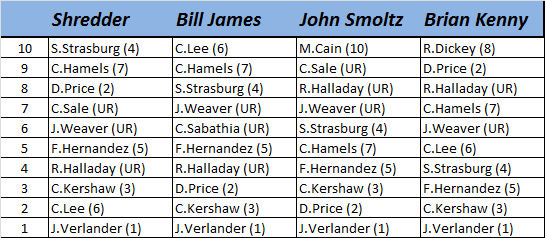
Here are all four lists from MLB Network-related folks and then I’ll address them separately:

top10RPlists

The Shredder

I’ll say straight out front that The Shredder did much better with the relievers than with starters. I’ll also admit that Grant Balfour was a nice pick. I probably didn’t give him enough consideration. The dude hates letting guys hit the ball (4.9 H/9 last year), misses a good amount of bats (25% K rate), and Oakland has the perfect stadium for his flyball tendencies. That adds up to a helluva reliever. My love for strikeouts probably kept Jim Johnson and Eric O’Flaherty off of my list or it was just the overwhelming amount of depth at the position making it nearly impossible to whittle it down to 10. O’Flaherty has been insane the last four years with a 1.95 ERA and like a 2 million percent groundball rate. Seriously, it’s been 55-57-56-66(!!) percent the last four years meanwhile he has struck out 20% or more guys in three of the four years so he isn’t completely incapable of bat-missing. I was also impressed that The Shredder didn’t overrate Jonathan Papelbon and gave Koji Uehara some big love. All told, this was probably my favorite list because they gave middle relievers deserved love and their differences from my list were pretty strong. That said, Motte was a huge miss.

My inclusions he didn’t list: David Hernandez, Joe Nathan, David Robertson, and Jason Motte

Middle relievers: 4 (Kenley Jansen isn’t starting the year as the closer)

Bill James

Bill, Bill, Bill. You’re my dawg, but Papelbon #2?? No, just no. I pretty much blocked out everything else at that point: the inclusions of Motte and Nathan, the Rodney love, the Sergio Romo exclusion, all of it was forgotten for better or worse because the godfather of sabermetrics and objective analysis threw Jonathan Papelbon second on his list of relievers RIGHT NOW showing a clear bias toward his Red Sox (for whom Bill works as an advisor). John Axford was a little high for me, but his inclusion isn’t too problematic. This is a dude who fans 30% of the batters he’s faced for three years running. He gave up a quarter of his 2012 runs (36) in three games with a trio of three-run outings from June 10th to July 29th. And he was also saddled with a 19% HR/FB rate, it’s probably not a bad idea to bet on some improvement for 2013.

My inclusions he didn’t list: Hernandez, Uehara, Robertson, and Romo

Middle relievers: 1 (and maybe two if Ryan Madson closes for LAA) 

Mitch Williams

Everyone else worked under the assumption that Aroldis Champan is going to be a starter (primarily because he is), but not ol’ Bobbles. OK, so you’re trying to make a big call, but why not just work under the same conecit everyone else did and add a disclaimer that you have Chapman second and think he’ll be closing by Memorial Day or something? Apart from that, his list isn’t too bad despite five disagreements between us. It’d really only be four without the Chapman thing because as he mentioned in the video linked in the opening, Motte was his #11. Finally, someone gives Robertson some attention, which he richly deserves.

My inclusions he didn’t list: Hernandez, Nathan, Motte, Jansen, and Romo

Middle relievers: 3

Starting pitchers: 1

Brian Kenny

How could you do this to me, Brian? You’re my boy, blue! The critical thinker himself, Mr. Next Level Stats who firmly believes the closer mentality is garbage (I don’t fully agree, btw) chimes in with ZERO middle relievers in his list. Or maybe one with Ernesto Frieri, but he’s an assumed closer in many circles at this point. I’m not suggesting you should shoehorn non-closers in if you don’t think they belong, I’m just wondering how he thinks they don’t belong?! Papelbon at 4? Are Soriano and Johnson really better than all middle relievers? He pointed out multiple times how Mitch had more middle relievers than James only to come to the table with a goose egg himself. I was surprised for sure!

My inclusions he didn’t list: Hernandez, Uehara, Robertson, and Jansen (all 4 of my MRs of course)

Middle relievers: 0

I’ll reiterate once more that I know these are just fun and any exasperation I show is reasoned exasperation. I’m not taking these lists too seriously or cultivating hate for any of the panelists. I truly enjoy this series quite a bit and I’ve had fun agonizing over my own lists.

Friday: 01.25.2013

Productive Outs – Ep. 34 (feat. Paul Sporer)

The brilliant minds behind Productive OutsRiley Breckenridge and Ian Miller (REAL rockstars!! Thrice, Kowloon Walled City), were kind enough to invite me on for some spoken words and it was wondrous. If you’re not familiar with the Productive Outs Tumblr (which I linked at the beginning of this post), their Twitter feed, or their Prodcast, then your life isn’t as good as it could be just yet. These are two of my favorite people whom I’ve yet to meet in real life and I commend all of their doings to you. 

Thursday: 01.24.2013

Countdown to Spring Training: 29 Days – Carlos Santana

Only 29 days until live game action…

30: Desmond Jennings

OK, so the first actual Grapefruit or Cactus League game doesn’t take place until February 22nd, but the Red Sox are splitting up their squad and playing a couple of colleges on February 21st so we’re just 30 days away from organized professional baseball. So why not a countdown of this final, grueling winter month that includes some fantasy analysis?

Obviously my primary focus at this site is on pitchers and you’ll get quite a bit of my analysis on them in late February when the SP Guide drops, thus I was thinking of something surrounding hitters. With 30 days to go, I am going to do a hitter per day highlighting one from each team. I selected my player of note from each team and then randomized them (which was pretty interesting consider who the final two were after the randomization) so that’s the order I’ll be following.

CARLOS SANTANA

If you just randomly poll some fantasy baseball managers asking them how Carlos Santana did in 2012, I think you’ll end up with answers suggesting it was a “down” or “poor” season. After all, he did drop nine home runs from his 2011 total, but the perception is likely built around the fact that he ended June with a .220 batting average and 673 OPS. It wasn’t so much that he got off to a poor start, either, he had an 863 OPS in April, but May and June were complete washouts as he put a 592 mark during the two months clearly playing at far less than 100 percent health and the concussion at the end of May certainly didn’t help.

In fact, from the concussion date (May 25th) to the All-Star break, he hit .172 with 527 OPS. With that in mind, how much more impressive are his final numbers of a .252 batting average and 785 OPS? The four days off served him well and he hit .281 with an 887 OPS the rest of the way. Throughout the year he continued to take his walks, but it felt like it was passivity during his May-June slump and he was missing worthwhile pitches opting for the free pass instead. That is based on probably 10-12 games of watching the Indians including some series against my Tigers so if you don’t want to lock that down in stone, I understand. Just letting you know what I saw.

Despite losing essentially two months where he was playing, but struggling majorly, Santana still had a very nice season. He sustained his OPS by raising his on-base percentage to account for the drop in slugging percentage. And he had just three fewer runs batted in despite 49 fewer plate appearances. Lost in the shuffle was the improved strikeout rate dropping from 20.2 to 16.6 percent while lightly boosting his walk rate from 14.7 to 14.9 percent.

Going into 2013, Santana is part a very deep catcher pool and analysts can’t seem to agree exactly where he belongs. There is plenty of established star power at the position with a handful of up-and-comers poised for breakouts, too. For me, he is an easy top three behind no more than Buster Posey and Yadier Molina, but the early rankings have him anywhere from two to seven:

It looks like drafters are following Steve Gardner at USAToday the most early on as his current average draft position has him as the seventh backstop off the board. In an OBP league, he’s easily behind only Posey, but most leagues still use batting average where he has a bit of a deficiency against righties. He is a switch-hitter who fares better against lefties, but he isn’t exactly crushing them, either. He had a .272 average against them last year which isn’t too far from his .278 career mark against southpaws.

An attribute to consider with Santana is his first base & DH playing time. It allows him to get those extra plate appearances that other catchers won’t accumulate and keeps some of the wear-and-tear off of him. This has allowed him to join Joe Mauer as the only two catchers with 600+ plate appearances the last two seasons. Meanwhile his 658 from 2011 is the second-highest total from a catcher since 2006 topped only by former Indian Victor Martinez who had 672 in 2009 with Cleveland and Boston.

Speaking of Martinez, he is another guy who deserves a boost because of playing time. He should still be catcher-eligible in any league worth its salt because of his 26 games there in 2011 when he last played and he won’t have to crouch at all in 2013. He should be the exclusive DH for the Tigers with maybe a couple of 1B starts mixed in to give Prince Fielder the proverbial half day off.

A healthy Santana can bring a .275-90-30-100 season to the table. And yes, I do think he can reach 100 RBIs with Michael Brantley, Jason Kipnis, Asdrubal Cabrera, and Nick Swisher ahead of him in the lineup.

Thursday: 01.24.2013

On Upton

Well, that was rude of you Atlanta & Arizona! I was working on something outlining the teams that would have a legitimate trade package worthy of Justin Upton for the Diamondbacks, but they went ahead and traded him this afternoon. I imagine that happens a lot to baseball writers. They plan something and they’re working on it then circumstances change to render it irrelevant. The trade for those unaware sends Upton and Chris Johnson to Atlanta for Martin Prado, Randall Delgado, Nick Ahmed, Zeke Spruill, and Brandon Drury. And at long lost the D’Backs ditch that scrub Upton. Their eagerness to trade Upton was absolutely absurd, but they got what they wanted and he’s gone. He joins brother BJ Upton in the Braves outfield with Jason Heyward making a ridiculous trio for the NL East contender.

The trade happened about 5 7 hours ago so there is already a ton written about it. I don’t have anything particularly to special to add. I love it for Atlanta, Upton still has superstar potential and it’s never a bad idea to add superstars. The brothers give them right-handed pop to split up Heyward, Freddie Freeman, and Brian McCann (once he returns). Arizona got a nice return, I guess. At least it wasn’t centered around Julio Teheran. Not because I dislike Teheran, but because a blue chip pitching prospect is the last thing they need, even after trading Trevor Bauer. It’s just been a horrible off-season for Kevin Towers and Co. over in the desert. Methinks a meddling owner is behind a lot of this, though.

Want me on the trade? Go here:

Wednesday: 01.23.2013

Countdown to Spring Training: 30 Days – Desmond Jennings

OK, so the first actual Grapefruit or Cactus League game doesn’t take place until February 22nd, but the Red Sox are splitting up their squad and playing a couple of colleges on February 21st so we’re just 30 days away from organized professional baseball. So why not a countdown of this final, grueling winter month that includes some fantasy analysis?

Obviously my primary focus at this site is on pitchers and you’ll get quite a bit of my analysis on them in late February when the SP Guide drops, thus I was thinking of something surrounding hitters. With 30 days to go, I am going to do a hitter per day highlighting one from each team. I selected my player of note from each team and then randomized them (which was pretty interesting consider who the final two were after the randomization) so that’s the order I’ll be following.

DESMOND JENNINGS

Always a tantalizing prospect, the Rays slow-cooked Jennings to the tune of 1004 plate appearances in Triple-A including 397 in 2011 despite the fact that his predecessor, Carl Crawford, had left for Boston via free agency that offseason. When he finally came up that year, he hit the ground running with a 1000 OPS in his first 175 plate appearances which included eight homers, 20 RBIs, 14 SBs, 24 runs scored, and 19 walks. He was doing everything.

Regression, which was probably inevitable, hit and hit hard as he shaved nearly 200 points off of that OPS down to 805 with a .162/.259/.253 line in his final 112 plate appearances. He still scored 20 runs and maintained his 11 percent walk rate, but the hot start caught up to him a bit and since the production came in two so distinct halves of amazing and crap, it generated discussion. It would be an interesting experiment to (travel back in time and) mix up the distribution of his production to small ups and downs that eventually land on the 805 OPS and see if it generates a different discussion. I’m sure it would.

He followed it up with a 2012 that looked more like the 112 PA sample than the 175 PA sample. He was a viable power-speed combo, only one of five players to reach or top 13 home runs and 31 steals*, but the walk rate fell nearly three percent to 8.2 while the strikeout rate remain steady at 21 percent. His home total was well off the 2011 pace which would’ve seen him hit 20 had he amassed the same 563 plate appearances he got in 2012. The doubles and triples held essentially even for those curious. So what happened?

*the other four were Mike Trout, teammate B.J. Upton, Carlos Gomez, and Jason Kipnis. All but Kipnis lapped him with either a lot more home runs or steals (or more of both in the Trout & Gomez cases). 

It is a bit too simplistic to just say that his home run per flyball rate regressed and that ate up his home runs. To a degree, that is exactly what happened, but without digger deeper it isn’t a helpful bit of information. He actually hit a larger percentage flyballs in 2012 moving from 35 to 38 percent and improved his line drive rate by 2.5 percent up to 20.1 percent.  Both of those factors can be good for a power spike, but the flyball contact was far less effective in 2012 as his infield flyball rate nearly doubled from 9.4 to 18.1 percent.

In his short 2011 sample, his flyballs hit off the inner third of the strikezone yielded a 5-for-12 (.417) mark with all five hits leaving the yard. He hit .297 (11-for-37) off the inner third as a whole in 2011. In 2012, he hit just four home runs off the inner third accounting for all four of his flyballs hit in nearly twice as many tries as he went 4-for-23 (.174). He still did plenty of damage off the inner third as a whole going 26-for-76 (.342), but pitchers got better at jamming inside to limit the damage to mostly singles (15 of the 26 hits). He wasn’t turning on those inner third meatballs like this one from 2011:

djennings

It’s one thing to drop your HR/FB rate because you are crushing warning track shots on gusty days or hitting the base of the wall for doubles and triples, but Jennings saw his HR/FB rate evaporate and shift into infield flies, the least successful contact a batter can make thus aiding a 61-point drop in slugging percentage and 47-point drop in isolated power (slugging minus average).

At 26, he is just about to enter his prime and doing so with 874 plate appearances under his belt should give him enough of a base to work from to make adjustments in order to fulfill his immense promise. The potential and youth will keep his price high, but the payoff is massive and even the downside was at least somewhat palatable despite massively underperforming his cost (51st ranked OF; 23rd most expensive) thanks to the steals.

He was the 92nd player drafted last year and his 2012, though under expectations, hasn’t really deterred anyone as he is tracking at 90th overall early on this winter. The composition of my team to that point would determine whether or not I’m willing to pay that eight round price tag.

If I have a foundation of guys with three-four years of track record, maybe Robinson Cano in the first, Adrian Beltre in the second, plus a Billy Butler, Cole Hamels, you get my point, proven veteran rocks; then I’d be more inclined to take Jennings. If you have team centered around Andrew McCutchen (just the one transcendent first round year), Jason Heyward, and Chase Headley, then you should probably go with Austin Jackson or Alex Rios who are being drafted 88th and 91st, respectively.

Tuesday: 01.22.2013

Top 10 SP – Review

On Friday night, MLB Network unleashed their Top 10 Starting Pitchers Right Now along with input from host Brian Kenny, co-host John Smoltz, and special guest to the series Bill James. The results were interesting and perhaps unsurprisingly, I had more gripes with this list than I have any of the previous ones.

Here are all four lists from MLB Network-related folks and then I’ll address them separately:

top10SPListsThe Shredder

Let’s start with the list that comes from their objective machine they call “The Shredder”. Kenny suggests that it is cold and calculated in its evaluation relying heavily on the most recent season, but also not forgetting track record. I have to call heaping amounts of BS on it. It just doesn’t add up. First off, it you’re focusing on “RIGHT NOW”, then how does Roy Halladay still finish fourth? There has to be a lot of subjectivity used to get him there. But that’s far from the most egregious infraction.

If this is supposed to be the most objective tool relying on data only for projection analysis, how does Chris Sale not only make the list, but finish ahead of Stephen Strasburg, Cole Hamels, and reigning Cy Young winner David Price? It had to rely heavily on track record (or pure subjectivity) to get Halladay that high, so then track record would send Hamels and Price rocketing past Sale. Meanwhile, Sale wasn’t better than them last year, either.

Strasburg is probably skewed because he threw just 160 innings, but he was so stellar in that allotted time that it is still a surprise to see him so low. Plus, since I think they had to finagle things to get Halladay that high, surely they could’ve just done the same to get Strasburg into a more reasonable slot. Whatever the case is, I’m done believing that The Shredder is purely objective on any level. And if it is coming to these conclusions based on the data it is being fed, it’s broken and Master Splinter does in fact need to take over.

Maybe I got too caught up in Jered Weaver’s peripherals when leaving him out because I didn’t even give him an honorable mention. I recognize the fact that he is a damn fine pitcher, but I am a strikeout whore and looking over the numbers again I think I focused too much on the plummeting strikeout rate and not enough on his incredible ability to keep runners off the bases, specifically by preventing hits. I still think six is a little high, but I can see how he would fit nicely at 10 bumping the NL version of him (Matt Cain) up to nine and Gio Gonzalez getting moved to an honorable mention.

My inclusions they didn’t list: Cain, Gonzalez, and R.A. Dickey

Bill James

Without treading over well-worn ground too much again, I just can’t see how on a “RIGHT NOW” list James saw fit to put teammates Cliff Lee and Hamels so far below Halladay who is 36 and coming off of an injury-marred season. Plus there’s the fact that he and the Phillies were going to start discussing an extension, but worries about his shoulder scared them off a bit. I still love Halladay as an undervalued fantasy commodity, but as the #4 pitcher right now, I’m a bit more skeptical.

James was the only one to list C.C. Sabathia which I think says more about the depth at the top of the pitching heap than anything else. I certainly don’t fault James for including him nor would I have faulted any of the other participants. He was basically tied with Adam Wainwright on my list at that 13/14 spot, but I gave Waino the mention because I honestly thought CC would appear on most of the lists and didn’t need the extra love.

My inclusions he didn’t list: Cain, Gonzalez, and Dickey

John Smoltz

Smoltzie’s list was close to being my favorite list but including Sale at the expense of Lee was just too much to overlook. Frankly, it doesn’t even matter if Lee wasn’t 11th, just the inclusion of Sale over many more deserving (at least in my estimation) candidates is tough for me. I’m not anti-Sale overall, just when it comes to ranking him this high among the best pitchers right now. Another big season in 2013 could elevate him onto my list next winter, but he hasn’t done enough to pass enough all of these guys just yet.

My inclusions he didn’t list: Gonzalez, Dickey, and Lee

Brian Kenny

I guess by sheer virtue of the fact that we had the most matches (eight), Kenny’s list should be my favorite, but it boggles my mind how he could wind up with Price at nine. Apart from that, our lists are pretty close on the matches we had usually off by just a spot, maybe two, and we had three direct matches (JV, Strasburg, and Hamels). He was adamant about getting Dickey on his list and was the only one to do so which obviously I support, but I just kept coming back to the Price thing. If you go off of mostly last year, then Price has to go above Weaver (and obviously Halladay) and even when you factor in track record, it’s not like Price is without one. You’d have to weigh track record pretty heavily to Halladay above Price which I thought went against the conceit of these lists.

My inclusions he didn’t list: Cain and Gonzalez

All in all, I know these lists are still just fun and filled with opinion (yes, even yours Shredder), but I can’t make sense of it sometimes when arguments supporting guys contradict where you rated them or others.

I’ve still got my reliever review upcoming and then the LF and RF lists are due this week before Friday night’s airings.

Monday: 01.21.2013

2013 Starting Pitcher Guide Announcement

title1

It is with great excitement that today I announce details regarding the 2013 Starting Pitcher Guide. This is the sixth year of the guide and it has grown exponentially since that first iteration which actually started on a message board (the now-defunct Rotojunkie.com which has morphed into RJ Bullpen). In the 2008 debut, I ranked 100 guys (or 112 if you consider “12 Under 30” add-on) in about 11,000 words growing to last year’s 400 player/76,000 word epic that spiked download count by 2x over 2011 and was even mentioned by Bill Simmons on his podcast. We’re ready for another step forward in 2013.

The first big piece of news related to the 2013 Guide is the addition of Doug Thorburn (Twitter) as a contributor. Doug is my colleague over at Baseball Prospectus and does some of the most amazing work on the site analyzing pitcher mechanics. He has also co-authored a book with Tom House on the mechanics of pitching. He has worked at the National Pitching Association (NPA), too, adding yet another impressive notch on his pitching resume (and those are just the highlights!). Both this 2008 interview with him at BP (before he started working there) and his latest article on Gio Gonzalez are free to view.

Take a look at the Gonzalez piece especially because that will give you a feel for what he will be contributing to the guide (and because it’s amazing). In addition to an essay on pitch mechanics to help us better understand them he will also be contributing a series of Mechanics Report Cards similar to the one you saw in the article. The report card list will be hand-selected by Doug with each team being represented by at least a couple players, though some teams will have a more robust offering. There will also be insight attached to the report cards crystalizing the information found within the card. We are still fleshing out some details, but this gives you a general idea and the one thing I can promise is that it will be awesome.

The next big news is the addition of bullpen coverage! Closers, for better or worse depending on your view, are a big part of fantasy baseball and having a firm handle on how to evaluate those who have a beat on the role as well as (and perhaps more importantly in some cases) those who might end up in the role can be extremely helpful to your success. It will also create an avenue to discuss the Middle Reliever Methodology that I have long been a fan of utilizing, especially in AL/NL-Only auction leagues.

Essays are returning to the 2013 guide! In 2011, the front of the guide contained a series of essays on various pitching-related topics, but they were absent a year ago. They are coming back with a vengeance this year with the only difference from 2011 being that I will be writing all of them (except for Doug’s pitching mechanics one, obviously). Topics will include strikeouts, prospects, bold predictions (often found here yearly, but this time tied to the guide), and park factors, plus much more. I have some other ideas, but they aren’t as set in stone so I’ll go with “plus much more” instead so you can dream about what might be included (you’re welcome!).

Projections are returning for 2013! Last year was my first attempt at putting together a projection set and it went well so I’m going to do it again this year. The ERA ranges will be used again spanning four to seven earned runs. I think it gives a better idea of what I’m expecting out of the pitcher, plus it covers a bit of luck on both ends. The ranges aren’t too wide over 185-200 innings and that’s another reason I do it. When you see 3.29-3.60, it feels quite significant, but it’s a seven run difference or one every five or so starts.

Of course this is all in addition to the player capsules you’ve grown accustomed to year in and year out. There isn’t a set number of capsules and there won’t be an announced number ahead of time so I don’t paint myself into an unnecessary corner by excluding someone to stay under an arbitrary round number. Instead, I’ll just say that it will likely be a number between 400 and 600. I have over 700 names on the initial list to be pared down as some situations became clearer and some low upside far-from-the-majors minor leaguers are eliminated.

Like last year, the focus will be on plentiful profiles of those with the most impact and upside, so Jason Hammel is going to get more attention than Carlos Martinez (Cardinals prospect at Double-A), but Martinez is going to get more attention than Nick Blackburn. Hammel is impacting 2013 and Martinez is impacting 2014 & beyond for dynasty/keeper leaguers. Blackburn, by costing the Twins $5.5 million dollars this year, is only impacting their ability to buy a free agent better than Kevin Correia. Blackburn isn’t even on the 40-man roster. That’s a foolproof sign that your signing has gone awry.

sp2

With the continued enhancements to a product you’ve hopefully already come to enjoy, we are moving to a very affordable pay model. The guide will available in late-February just in time for the fantasy season and is available for $12.

The guide comes via email in PDF form.

Order now!

btn_buynowCC_LG

Questions & comments can be directed to thespguide@gmail.com

Monday: 01.21.2013

2013 Starting Pitcher Guide Now Available

title1

Full details on the 2013 Starting Pitcher Guide

With the continued enhancements to a product you’ve hopefully already come to enjoy, we are moving to a very affordable pay model. You can order for $12! The guide, which comes via email in PDF form, is now available.

We now have a sample entry available for you to peruse so you have an idea of what you’re getting in the 2013 Guide. Click below to see both mine and Doug’s thoughts on Oakland A’s youngster, Jarrod ParkerDownload the Sample Here.

Available Now

btn_buynowCC_LG

Questions & comments can be directed to thespguide@gmail.com

Friday: 01.18.2013

Top 10 Starting Pitchers Right Now

Tonight MLB Network will continue the 2013 iteration of their “Top 10 Right Now” series at each position capped off with a “Top 100 Overall”. They will air both the relief and starting pitcher shows on Friday evening. I always enjoy this series and generally look forward to it after the New Year since I eat up just about any fresh baseball content I can as we wait for pitchers & catchers to report. Instead of putting up my lists after they air their selections, I’ll post mine ahead of time and then compare notes after the shows air.

This is not a fantasy list!!

(Ed. note: I swore my DVR said the reliever episode was first which is why I posted that list first. Sorry about that!)

This list was even harder than the relievers one as I just want to include so many guys. To spare you, the reader, I’m only going to include a few of honorable mentions.

Roy Halladay (PHI) – Since it is “right now”, I couldn’t justify his inclusion coming off of an injury-marred season that was easily his worst since 2004. From a fantasy angle (which isn’t entirely relevant in this NON FANTASY list) I still think he’s being criminally underrated early on in mock drafts and rankings I’ve seen, but he’s not a top 10 guy right now.

C.C. Sabathia (NYY) – This has a lot more to do with how deep the top of the starting pitcher pool is than anything Sabathia hasn’t done. There are no obviously flaws in his games, he’s absolutely amazing, but there are only 10 spots, so he’s on the outside.

Yu Darvish (TEX) – I couldn’t just play favorites and put Darvish in ahead of more deserving candidates. He took a while to get his feet under him last year and while I think he will show his top 10 worthiness this year, this list is about right now as opposed to projection. So it is with great pain that I leave Darvish out.

Also: Adam Wainwright (he was great coming off of TJ, but not great enough to include just yet.)

MLBNtopSP

THE LIST

10. Matt Cain (SF) – See what I mean? Leaving Cain off would’ve felt silly yet that’s what I would have to do to get Darvish included. Track record doesn’t weigh heavily on a “right now” list, but even just the 2012 track record favors Cain in terms of pure results. He’s awesome and he’s getting better each year. He doesn’t post the gaudy strikeout totals I drool over, but he’s proven you can be great with just a solid 20ish percent rate.

9. Gio Gonzalez (WAS) – If you think this rating is crazy, you haven’t watched him pitch enough. He keeps adding to his strikeout rate going from 20 percent in 2010 to an NL-best 25 percent last year. Meanwhile he made his first real dent in his walk rate last year dropping it a full percentage point to nine, which isn’t great, but easier to overlook when a quarter of the guys you face are walking back to the dugout after three strikes.

8. R.A. Dickey (TOR) – Absurd. Just completely absurd. His 2012 season was so freaking incredible. Seemingly out of nowhere, he ups his strikeout rate from 15.3 to 24.8 percent while actually incrementally improving his walk rate from 6.2 to 5.8 percent. Just bananas. He deservingly won the NL Cy Young and now gets to peddle his wares in the AL East with Toronto. I basically had Dickey and the next two guys neck and neck so I used track record as the tiebreaker. I’d still take these next two over him in a one-game situation.

7. Cole Hamels (PH) – When you factor out how much I’m responsible for myself, Hamels just doesn’t get enough love as an ace-level pitcher. Part of it is that he’s obscured by his rotation mates, but part of it is just that I think some fail to recognize how great he’s been the last three years. He had the 8th-best strikeout rate (24.9 percent) in the majors last year among qualified starters and only Dickey bested his 6.0 percent walk rate among those eight and it was by 0.1 percent.

6. Cliff Lee (PHI) – How did he win six games and fan 207 batters last year? I know wins and strikeouts don’t exactly go together, but the point is that he was just too good to be saddled with such a lame record (6-9). He walked a laughable 28 guys in all last year, too. His 3.3 percent walk rate was baseball’s best by nearly a full percent over Bronson Arroyo and Joe Blanton (4.2) and then of course there is the fact that he was also light years better than them in every other skill-based metric.

5. Felix Hernandez (SEA) – The top five were pretty easy for me in terms of who belonged in it. You can quibble over the order, but the group should be pretty consistent among anyone making such a list. Listing Felix fifth just doesn’t feel right, but I don’t see how I could get him any higher even as he continues to dominate. A career-best six percent walk rate accompanied fifth straight spike in strikeout rate, though just a small bit from 23 percent in 2011 to 23.8 last year. Oh, and he threw a perfect game.

4. Stephen Strasburg (WAS) – There is little doubt in my mind that he could’ve gone well past his innings limit without issue, but the Nats painted themselves into a corner. In the 159 innings he did throw, he was simply amazing. If he had qualified (requires 162 innings), his 30.2 percent strikeout rate would’ve topped Max Scherzer’s gaudy 29.4 mark for baseball’s best. He has three excellent pitches that he uses to devastate hitters. His changeup might be the best of the bunch generating a ridiculous 29 percent swing-and-miss rate. It was accountable 53 percent of his 197 strikeouts, too.

3. Clayton Kershaw (LAD) – As I mentioned earlier, I thought Dickey was a deserving Cy Young winner, but he wasn’t the only deserving candidate. Kershaw was right there and you can probably argue that wins and a great story are the only things that cost Kershaw a repeat. He led baseball in ERA for a second straight season, posted the same 6.7 H/9 mark which not only led the NL like it did in 2011, but all of baseball this time, and he led the NL in WHIP for the second straight season 1.02. His 14-9 record plus not being a knuckleball journeyman likely did him in.

2. David Price (TB) – Price showed flashes of greatness in 2010, though his 2.72 ERA was probably a bit more favorable than his numbers seemed to “deserve”. Then in 2011, he went the other way improving his underlying numbers and likely should’ve ended up with a result better than his 3.49 ERA. He finally found the right potion in 2012 repeating his 2011 base skills (24% Ks, 7% BBs) while adding a crapton of groundballs (moving 44 to 53% groundball rate) and sharpening up with runners on (moving from 73 to 81%, second to only Jeremy Hellickson at 83%) to turn in a Cy Young performance. His curveball was the driving force yielding a meager 368 OPS and generating 44 percent of his 205 strikeouts.

1. Justin Verlander (DET) – Verlander had an amazing follow up campaign to his Cy Young/MVP season in 2011 and like Kershaw, he had a very strong case for a repeat at Cy Young, but it wasn’t to be for him. He lost out by four points (whereas Dickey inexplicably crushed Kershaw, whose repeat case was probably stronger than JV’s). He again paced the entire league in innings and total strikeouts, but dropped seven wins off that flashy 24 count from last year dropping below the famed 20-mark.

By the way, Verlander is an instructive case for why I’m referencing strikeout percentage a lot more these days. He had an 8.96 K/9 in 2011 and 9.03 K/9 last year so there’ll be plenty of analysis stating that “he even raised his strikeouts!!!”, but he didn’t actually do that. He fanned 25.8 percent of batters in his dream season of 2011, compared to a flat 25 percent last year. Small difference, but important nonetheless.

Despite not winning any end of season awards, I doubt you will get much argument on Verlander as the best pitcher in the game, though the latest chic thing to do is to project a 2013 injury for him based on these recent workloads. It’s the most risk-less “bold” prediction you can make, so don’t fall into the trap of doing so to appear ballsy. Predicting any pitcher to get hurt is like guessing that Lindsay Lohan will be arrested soon. Both are ticking time bombs. Always.

Friday: 01.18.2013

Top 10 Relief Pitchers Right Now

Tonight MLB Network will continue the 2013 iteration of their “Top 10 Right Now” series at each position capped off with a “Top 100 Overall”. They will air both the relief and starting pitcher shows on Friday evening. I always enjoy this series and generally look forward to it after the New Year since I eat up just about any fresh baseball content I can as we wait for pitchers & catchers to report. Instead of putting up my lists after they air their selections, I’ll post mine ahead of time and then compare notes after the shows air.

This is not a fantasy list!!

My guess is that MLBN will rely a bit too heavily on saves here and lean toward closers, but I’m going for the best relievers regardless of role. This was pretty tough because I could’ve made a legitimate case for quite a few guys who didn’t wind up on my 10. In fact, my honorable mention list could’ve run 10-15 deep. Instead, here are just a few.

Sean Marshall (CIN) – Since these lists stress the “Right Now” aspect, considering Marshall’s track record too heavily would go against the conceit of the lists. And since he is coming off of his worst year against righties (750 OPS), he lost out on a spot. He obliterates lefties (410 OPS) and has plenty of previous success against righties to avoid the LOOGY status, but his rough start likely cost him a spot here. He had a 4.15 ERA in 17.3 innings through May, but then just a 1.85 ERA the rest of the way in 43.7 innings.

Jonathan Papelbon (PHI) – He was hardly bad in 2012, but some chinks in the armor did pop up (namely the home runs and the margins are so thin here that any small ding could cost you a spot on the list. I will state clearly that this has nothing to do with my disdain for Papelbon. I want to make the best list possible and I ended choosing my #10 over Papelbon after a couple flips back-and-forth between the two.

Jake McGee (TB) – A lefty who throws 96? How the hell is that fair? To say he dominated right-handers last year is a gross understatement. They managed a .098/.157/.134 line–that’s a 291 OPS for those keeping score–all while striking out 36 percent of the time. With these honorable mentions, there really aren’t reasons why they didn’t make the list. The top 10 was just so rich that the runoff seems entirely snubbed given how deserving they are on their own merits.

Tyler Clippard (WAS) – Remember when he stranded 96 percent of runners in 2011? So sick. He’s still awesome, just not quite top 10 awesome. Hell, neither are his bullpen mates, Drew Storen and Rafael Soriano.

Darren O’Day (BAL) – If we were doing A-Rod’s list, he might be number one. O’Day was 5th in win probability added for relievers last year while teammate Jim Johnson was tops by a good margin. O’Day just missed and Johnson wasn’t given much consideration ranking around 20 or so. It’s probably my whorishness for strikeouts. Sorry, Jimmy-J.

Sorry as well to: Jason Grilli (homers), Rafael Betancourt (drop in Ks), Al Alburquerque (innings), Kelvin Herrera (Ks didn’t stack up), Ernesto Frieri (walks), and Joel Peralta (homers).

MLBNtopRP

THE LIST

10. David Hernandez (ARI) – The D’Backs better not even consider giving the 8th inning to Heath Bell setting up J.J. Putz as Hernandez handled it masterfully last year and continues to get better each year. He is a flyball pitcher, but maintains a 0.5 HR/9 because 15 percent of his flyball stays in the infield. In the mortal division (non-Kimbrel & Aroldis), his 35 percent strikeout rate was good 5th while his 7.9 percent walk rate was best among those five.

9. Koji Uehara (BOS) – How does he only get $4.25 million from Boston this offseason? That is a steal, especially juxtaposed against the 2/$28 mil that Washington is paying Soriano (and I like Sori). Even missing two months, he deserved more than a $250,000 dollar raise for his work. He had a 14.3 K/BB! He hates walks. In fact, he hates walking. He moves briskly everywhere he goes often breaking into a trot or jog. He walked three batters in 36 innings last year. Carlos Marmol walked three batters in a game three times last year.

8. Joe Nathan (TEX) – Homers ate him up a bit at home (1.7 HR/9) or his sparkling numbers (2.80 ERA, 1.06 WHIP) would’ve been even better. And he was 37 years old.

7. Fernando Rodney (TB) – Who would have bet that Rodney would appear on a list like this… ever? Chalk one up for the “change of scenery” factor working and how. The Rays remade Rodney and he became one of baseball’s best relievers recapturing his strikeout-per-inning stuff while walking next to nobody (far and away a career-best 5 percent BB rate and 1.8 BB/9; previous best was 9 & 3.5). His velo even spiked a bit up to a career high 98.2 MPH on his four-seamer making his 83 MPH changeup that much more devastating.

6. David Robertson (NYY) – He experienced the worst timed injury ever going down in early May shortly after getting the closer’s role once Mariano Rivera went down. Robertson had been missing bats like crazy for four years, but it was always paired with a walk rate of 12 percent or worse. That changed last year when he cut it to just 7.7 percent with little cost to his strikeouts (dipped from an obscene 37 percent to a still-excellent 33 percent). He’s added a groundball element to his game the last two years only adding to his effectiveness.

5. Kenley Jansen (LAD) – An irregular heartbeat could barely tame Jansen, though it did cost him about half of September. He’s usually the one doling out irregular heartbeats, terrifying batters into submission with his filthy cutter which he throws almost exclusively (93 percent of the time). When a pitch is that good, why throw anything else? Sounds like another reliever we all know pretty well.

4. Jason Motte (StL) – Completely embraced the closer’s role en route his best across-the-board season yet in a career-high 72 innings. His 2.75 ERA was up from 2011’s 2.25, but the WHIP dropped from 0.96 to 0.92 while his strikeout rate spiked majorly to 31 percent without impacting his 6 percent walk rate. I think he is one of the more underrated relievers in the game, but that could just be my perception of him. I guess we’ll see tonight on the lists of those involved in the show.

3. Sergio Romo (SF) – While I’m constantly annoyed at how much the Giants baby Romo, I understand it. It’s probably not a surprise that he posted his best year in 2011 when they limited him to just 48 innings (1.50 ERA, 0.71 WHIP, 40% K rate, 14.0 K/BB). I’m just being selfish because I want to see flat-out embarrass grown men with his NSFW slider, rated second best in the majors last year per pitch values. His arm may one day accompany the ball to the plate, but until then, enjoy this diminutive badass.

2. Mariano Rivera (NYY) – This was obviously the toughest ranking. He had to be included despite throwing just eight innings last year before tearing his ACL, but how high? It wasn’t a leg injury and he hasn’t seen his dominance diminish at all yet, so I felt comfortable slotting the 43-year old right here. He doesn’t have the same gaudy numbers as a lot of these guys, but he is still fanning a quarter of the batters he faces and his walk rate was actually on the decline from 4.8 in 2010 to 3.4 in 2011, though it ticked up a bit to 6.3 (still great) last year in his tiny sample.

1. Craig Kimbrel (ATL) – He’s on a different plane. If you put up his numbers in a video game, your friends would tell you to get real and up the difficulty. He’s doing it on All-Madden (mixed sport metaphors FTW!). His 40+ percent strikeout rate dropped our jaws, but he wasn’t satisfied so he dropped a 50 burger on our faces fanning precisely 50.2 percent of the batters he faced last year. Major league batters. And for good measure, he nearly sliced his walk rate in half dropping from 10.5 to 6.1 percent.

No one stood a prayer against him evidenced obviously by everything I’ve already shared, but also his .126 batting average against. His 19.2 swinging strike rate was tops in baseball to the surprise of absolutely nobody. He got 40 percent of his strikeouts on three pitches. If he got two strikes on a batter, they hit .068/.112/.105 and struck out 68 percent of the time. I could keep going, but I think you get the point. This was an easy choice.