Tuesday: 07.10.2012

For Sale: Quality Arms

The Colorado Rockies pitching staff is a mess right now.  They have a league-worst 5.26 ERA which eclipses second-worst Minnesota by 0.40 thanks in large part to their home ballpark ignoring the current state of baseball as a pitcher’s dreamland and playing like the early 2000s Coors Field.  To wit, their home ERA is 5.87, nearly a full run worse than Minnesota 4.91 (yikes, I thought they had a pitcher’s park?).  They are more than two runs worse than the 3.78 NL average at home.

While they are better on the road at 4.57, they are still nowhere near the 4.19 NL (and league, in this case) average.  So we can’t just pin the blame on Coors Field and be done with it.  That environment certainly isn’t helping matters, but an overwhelming lack of talent is the real problem here.  Yet I can’t help but think that perhaps they would be better off if they stopped giving away talent for absolutely nothing.

FELIPE PAULINO

The Rockies acquired Paulino from the Houston Astros for Clint Barmes in November of 2010.  It was a small move, but definitely one where they got the upside even before the 20/15 hindsight.  Paulino labored a bit through 92 innings (5.11 ERA, 1.54 WHIP), but the upside was there in a 27-year old who averaged 95.5 MPH on his fastball with a groundball lean.  He needed to learn how to work with runners on (59% LOB in ’10), but the 4.36 xFIP pointed to promise.

Barmes, meanwhile, was a glove-only shortstop as he followed up his 23 home run season of 2009 with just eight.  In fact, his OPS+ of 82 showed that even the 23 HR season wasn’t terribly special and his 67 OPS+ in 2010 only punctuated that fact.  Even before either suited up for their new teams, this looked like a strong move for Colorado with the potential to be a truly great one if Paulino could figure it out.

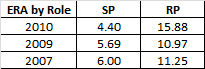
Something stood out from Paulino’s time in Houston: he seemed to really struggle as a reliever.  Granted the samples were tiny (21 total innings across three years), but he was just insanely bad compared to when he was starting.

Something about relieving just didn’t seem to sit right with Paulino.  You might think that slotting him in relief would work, maybe add a tick or two to his 95 MPH heat and allow him to become a dominant force out of the bullpen, but at the same time it was probably best to explore the starting option with him given the aforementioned velocity he carried as a starter.

The Rockies were set on the relief role for Paulino and in 18 outings he posted an ugly 7.36 ERA and 2.05 WHIP across 14.7 innings.  Outings of five and two runs in 0.3 of work for each definitely inflated the numbers of his small sample, but alas the Rockies had seen enough.  In fact the 2 ER/0.3 IP outing was his last as with the team, they were done with him

OK, so find another team willing to take a shot on the 95 MPH flamethrower and get an upside prospect or team-controlled major leaguer in return, right?  Or just sell him to the Kansas City Royals.  After 4.3 innings of scoreless mop up work in his first outing for the Royals, they made him a starter full-time and immediately saw glimpses of his potential.

Including the relief outing, Paulino opened his KC tenure with 12.3 scoreless innings and had a 1.29 ERA in 21 innings through the relief outing and his first three starts.  He was up and down the rest of the way, but more good than bad with only a couple of true flameout starts (including one in Oakland, oddly enough).  He closed the season with four really strong starts yielding a 3.75 ERA and 1.17 ERA in 24 innings, but more importantly an 11.6 K/9 and 4.4 K/BB.

Unfortunately injuries delayed the start of his 2012 season and then ended it way too prematurely, but he was headed for a breakout season posting a 1.67 ERA, 1.22 WHIP, 9.3 K/9 and 2.6 K/BB in 37.7 innings of work before succumbing to an elbow injury that many believe will end up being a Tommy John Surgery.

That doesn’t change the fact that the Rockies gave up on him after less than 15 innings of crappy relief and got nothing in return.  He may have eventually gotten injured in Colorado, too, but that outcome of an injury doesn’t change the fact that their process was horrible especially since they started off on the right foot by trading a piece that they had no use for in Barmes to get Paulino..

FRANKLIN MORALES

Morales was a product of the Rockies system and was heavily lauded as a future star.  Kevin Goldstein had him first in the system in 2008 as a five-star prospect and slotted him 13th overall on his top 100 list that year.  Baseball America also had him first in the organization and liked him even more on the bigger scale tabbing him as the 8th-best prospect in baseball that year.

Control was a major issue for Morales coming up with walk rates ranging from 4.2 to 6.9 BB/9 in his five stops en route to his 2007 big league debut (a year before the glowing ratings from prospect mavens).  In eight starts down the stretch, Morales was great for the Rockies including a stretch of 20-scoreless than spanned three outings (of 5, 6, and 6 IP) and three innings of a fourth.  His peripherals weren’t flashy (5.9 K/9, 1.9 K/BB), but a 55% groundball rate aided him to a 3.43 ERA.

He opened 2008 with an outing of six scoreless innings before imploding and walking four or more in three of his next four starts.  The Rockies pulled the plug in April after a 6.39 ERA in 25.3 innings and sent him to the minors where he finished the implosion (5.47 ERA, 6.8 K/9, 1.0 K/BB).  He opened 2009 with another gem, but left his second start with a shoulder strain.

He wouldn’t start another game for the Rockies.  He spent some time in the minors in 2009 before coming back as a reliever.  He wasn’t too bad to close out 2009 and even closed for a spell.  He would pitch another 42.7 innings in 49 appearances over 2010 and 2011 with rather awful results: 5.48 ERA, 1.64 WHIP, 8.0 K/9 and 1.2 K/BB.  Nevertheless, he was a 25-year old lefty throwing 94+ MPH so there was still some hope.  Alas, the Rockies jettisoned him to the Red Sox.

That’s OK, surely they picked up a nice upside lottery ticket of their own in return given Morales’ youth, handedness and velocity.  What’s that?  They got actual lottery tickets?  Like Paulino, Morales was sold and unsubstantiated reports suggest that the Rockies spent the money on Powerball tickets during the last big drawing.

He was instantly better with the Red Sox slicing two walks off of his rate down to 3.1 in 32.3 innings out of their bullpen late last year.  He pumped his strikeout rate up to 8.6 K/9 as well.  After getting 23.7 more innings of solid relief out of him this year (3.04 ERA, 20 Ks), the Red Sox have given him another shot at starting.

The early returns are encouraging.  He brilliant through the first three before stumbling against the Yankees against whom he allowed four home runs in just 3.3 innings.  Even still, he has a 4.22 ERA as a starter (not bad especially when considering the 6 ER dud vs. NYY) with a ridiculously impressive 1.17 WHIP, 11.0 K/9 and 5.2 K/BB in 21.3 innings.  And the Rockies got nothing for this guy.  OK, not nothing, they got cash, but that’s really nothing on the baseball landscape.

Rotoworld posted an update (I don’t see a way to link to individual updates from RW) under both Morales and Paulino’s profiles around the time they were being shopped that included this nugget: “The Rox are fed up with both pitchers, but they’re both out of options and they don’t want to lose them without getting anything in return.”  Whoops.  Didn’t quite achieve that.

The real question is why were they so fed up with the two?  It seems both were given awfully short leashes before being cast out for some money.  For an organization that has long been starved for pitching, how can you really justify giving up on one of the hardest throwers in baseball (Paulino) and a young lefty with his own incredible velocity (Morales)?

While that issue likely falls at the feet of Dan O’Dowd and his front office team, the coaching staff doesn’t get off scot-free as both pitchers began exhibiting some of their potential immediately after they left Colorado.  First off, I think they improperly deployed both.  But even when the Red Sox used Morales as a reliever, he was much better with them.  How did they instantly cut his walk rate like that?  That can’t be blamed on Coors Field.

I don’t have all the answers here, but these look like a couple of inexcusably bad moves on the part of the Rockies.  And I didn’t even dive into the case of Esmil Rogers who was recently sold to the Indians and instantly turned into a far better pitcher than he was with Colorado.

His scant 13.3 inning sample isn’t enough to make any sweeping judgments from, but again, how does he go from a 4.5 BB/9 (and 6.3 in 25.7 IP this year) with the Rockies to 0.7 with the Indians?  How is a 96 MPH hurler just sold away for no talent in return?  I realize there are more hard throwers available these days (seems every pen has a 95+ guy or three), but that doesn’t mean they should be given away.

Maybe it is time for a full scale regime change within the Rockies from top to bottom as they simply don’t seem to be making the most of their talent whether when deploying it on the field (coaching) or when turning into assets once they deem it to no longer worthy of the organization’s time (front office).


Friday: 07.6.2012

Kate Upton in Detroit at Comerica Park

Coming back from break to start the bottom of the eighth, Fox Sports Detroit clued viewers in on a special guest in the ballpark as supermodel and native Michigander (born in St. Joseph) Kate Upton was shown with friends enjoying a Tigers win.  I spontaneously combusted immediately, but now I’m back.  She (unsurprisingly) looked great in her Tigers hat as she and her friends sang “Don’t Stop Believin'” by Journey… a Comerica Park (and any Detroit arena/stadium for that matter) staple.  Now, for your viewing pleasure:

Wednesday: 07.4.2012

Paul’s 24 to Target

(Ed. note – This will likely be it for the week on PaulSporer.com.  I was going to split it up, but decided to give you all 5,000+ words at once.  I may have something up for Friday, otherwise look for my stuff at BP and then back here next week.)

We have flipped the calendar to July, we’re officially beyond labeling a player’s stat line as a hot or cold “start”*, the All-Star break is right around the corner and trade season is kicking into high gear in both fantasy and real baseball.  With that, I wanted to take an opportunity to highlight my favorite starting pitcher trade targets.  Why 24?  Because it’s my favorite number, that’s really the only reason.

* let’s be honest, this probably should’ve stopped around Memorial Day, but I heard it a lot throughout June.

There is a range of talent within this list so it’s not just a bunch of aces leaving you saying, “No f’n duh!” though some will be entirely unsurprising (“what, Paul likes Hamels?? Weeeiiirrrdddd”), but they represent the group of guys I’d be buying via trade or definitely hanging onto if I already had them on my team.

They aren’t necessarily ranked in order, but look at it more as a talent spectrum with the better guys clustered near the top and the riskier, less-established arms in the 20s.  The exclusion of guys doesn’t mean I don’t like them (obviously acquire Justin Verlander if you can at a reasonable price, but he’s guaranteed to cost two arms and nine legs), these are just my 24 favorites to target.

1. Cole Hamels – I didn’t waste any time with him, did I?  I still don’t think he is universally treated like the ace that he is and that means you may not have to pay ace-level prices for him via trade.  This is especially true with Roy Halladay and Cliff Lee pitching at peak, which they obviously aren’t with the former on the disabled list and the latter struggling at times and not getting any support when he’s excelling.

This doesn’t mean you are going to steal him from a leaguemate for Carlos Lee and Justin Masterson, but he rarely costs a price commensurate with his value like a Verlander or Stephen Strasburg.  He is a four-category star (10 wins even on the Phillies, while Lee has 0 showing you just how random the stat can be) with bankable strikeouts, ERA and WHIP and pacing toward a career-high in wins after reaching 15 just once in his career.

2. Madison Bumgarner – Despite posting great ratios (2.96 ERA, 1.15 WHIP) in his first four starts, his peripherals were a bit wobbly (4.6 K/9, 1.6 K/BB) which was a bit unnerving especially for those expecting an ace-level season out of him.  Since then he has a 2.81 ERA and 1.03 WHIP backed by 8.5 K/9 and 5.4 K/BB rates in 86.3 innings of work.

That is despite giving up exactly four runs in five of the 12 outings.  He has been virtually unhittable in the other seven giving up an average of 1 run (four w/1 ER, one w/2 ER and a shutout).  He has three double-digit strikeout outings in that span as well.  In short, he has been the beast we were hoping to see in 2012.  The best part is that he is just 22 years old so he works for those trading for 2012 and those trading with an eye on 2013.

3. David Price – Price is rounding into form as the season wears on.  While his strikeout rate and WHIP improve month over month, his ERA is incrementally on the rise, though a 3.29 peak as we saw in June is hardly reason for concern.  I’m far more interested in the first two factors as he continues to miss more bats and allow fewer baserunners.

As the Rays move toward being whole again (namely getting Evan Longoria back) and stabilizing the defense, his and this next guy’s improved groundball rates will pay bigger dividends.  This franchise isn’t used to spotty D in recent years, but the shuffling in and out of reserves who were supposed to play sparingly throughout the year has compromised their usually razor-sharp defense.   Price could actually get better in the dog days and improve upon his 2.92 ERA, while this guy almost assuredly will…

4. James Shields – Another guy that anyone who has read my work for a while is completely unsurprised to see gracing a list like this.  I’m a huge Shields fan and while things haven’t gone exactly according to plan this year, I foresee improvements in the near future.  He, too, will benefit from a more solid defense as his groundball rate is at a career-high 54%, up from last year’s 46% which was a previous career-high.  Meanwhile he has improved his strikeout rate with only little harm to his walk rate (2.8 BB/9, up from 2.4).

He is the first guy on the list who you can probably acquire at a significant discount compared to his value since the 4.04 ERA and 1.40 WHIP are pretty ugly right now.  The danger is that this become a mini-2010 as his skills were great that year yet he ended up with a 5.18 ERA and 1.46 WHIP.  I don’t see a 5.18 ERA coming, but he needs the defense to start turning his groundballs into more outs and he himself needs to sharpen up with runners on.  I believe he will.

5. Johnny Cueto – Being the unabashed strikeout love I am, you might be surprised to see Cueto on this list, but I just love what he is doing these days.  I’ve watched his last few outings to get a better feel for the 2012 iteration and I came away impressed.  What he lacks in strikeouts (6.6 K/9), he makes up for in groundballs (49%) which is my second favorite skill of a pitcher.  He has a four-seamer and sinker that both sit around 93 MPH and he peppers the zone with both.  Meanwhile he pounds his 83-84 MPH changeup low in the zone, but also down out of the zone (22% of them are out of the nine square strikezone).

He continues to lower his walk rate, too, dropping down to 2.1 BB/9 this year making his strikeout rate more palatable.  He is going deeper into games this year as well averaging 6.7 innings per outing, a number on the rise yearly since 2009.  His next hurdle is a 200-inning season, a figure he is tracking toward this year (on pace for 223 innings in 33 starts).  Obviously if strikeouts are your main need, Cueto isn’t for you, but he delivers everywhere else.

6. Josh Johnson – The start of a player’s season, whether good or bad, can have a lasting effect that often skews the perception of that player for the rest of the season.  Take Johnson for example.  I think a lot of folks in the fantasy community would say he’s having kind of a “meh” season (if not worse) if you asked them their thoughts on him without showing them a stat sheet.  If you brought his 3.80 ERA and 1.37 WHIP into the mix, they would probably feel justified in their assessment.

However, a look into his game log shows that he struggled to work the kinks out after spending most of 2011 on the shelf, but turned a corner in early May and has been quite excellent since then.  The Padres tattooed him for six runs in 2.7 innings in Petco back on May 4th pushing his ERA up to 6.61.  To that point, he had gone more than six innings just twice and completed the seventh just once.  Since then he has a 2.47 ERA and 1.13 WHIP in 66 innings across 10 starts going fewer than six innings just once and going seven or more in six of the 10.

His strikeout rate is at 7.8 K/9 in that stretch with a strong 3.0 K/BB.  The strikeouts aren’t up a ton from those first six starts (7.5 K/9), but his walks are done a ton (2.2 K/BB) as he has walked 19 in the 10 starts after 12 in those first six.  He isn’t 100% back to 2010-2011 Josh Johnson, but he isn’t far off and I wouldn’t be surprised if he ran off a stretch of vintage JJ starts at some point later this season.

7. Yovani Gallardo – I know I have been beating this drum since early May, but if you lift Gallardo’s two starts against the Cardinals and look at his numbers, he has a 2.80 ERA and 1.24 WHIP.  His walk rate also drops from 4.1 BB/9 to 3.7.  I realize you can’t cherry-pick starts, but if you just avoid his St. Louis starts (he’s always struggled against them), then Gallardo is still the stud we expected him to be this year.

Even with the Cardinals starts, his bottom line numbers are palatable (3.87 ERA, 1.39 WHIP), though hardly star level.  His walk rate has regressed severely after he showed tons of improvement down to a very strong 2.6 BB/9 last year.  He can be successful walking that many, but it obviously eats into his margin for error.  He can be a star if he just gets it back to 3.5 or better.  I am still all-in on Gallardo.

8. Mat Latos – I have stood by Latos all season long and it is finally paying big dividends with back-to-back complete games (1 ER in each).  Home runs look like the primary culprit for his 4.42 ERA as he has allowed 1.6 HR/9, however it isn’t really a consistent issue so much as it is a few bouts of gopheritis really hampering him.  He has allowed 2+ home runs three times this year and those are three of his four worst outings (the other was against those blasted Cardinals).

He allowed five solo shots to the Rockies (not in Coors believe it or not), three in Cleveland and a pair to the Astros at home.  In those outings, he gave up five, seven and five earned runs.  Also of note is that his problems are incorrectly being tied to his shift into the Great American Ballpark.  He has actually fared much better at home (3.47 ERA) than on the road (5.92) despite a better strikeout rate (9.7 compared to 7.4 at home) and nearly equal K/BB rate (3.2 compared to 3.3 at home).

His 3.61 road xFIP suggest brighter days ahead away from home.  Meanwhile, after an ugly 5.7 K/9 in April, he has a 9.4 K/9 in 69 innings since so he could be in for a huge second half as an across-the-board contributor.  On the heels of those complete games, his price has likely risen, but you may also have the effect of some wanting to parlay the outings into an opportunity to dump Latos at a peak.  I think there are more peaks in his future.

9. Adam Wainwright – Getting pummeled by the Pirates (7 ER on 11 H in 5 IP) might seem like the end of the world for someone of Wainwright’s caliber, but you might be surprised to learn that the Pirates scored the most runs in baseball during the month of June (146) and led the NL in home runs (39).  So it’s not as bad as it would seem at first blush.  Wainwright has been a rollercoaster ride during his return from Tommy John Surgery, which shouldn’t be too surprising.

Expected him to be vintage Wainwright right out of the gate would be stupid.  So while the peripheral skills have been pretty close to 2009-2010 Wainwright, he still has his off games.  For example, he had a stretch of four starts in June where he posted a 2.70 ERA with 27 Ks in 27 innings, but he sandwiched that run with a pair of 7 ER outings (including the most recent one against the Pirates).

He is still a work in progress in terms getting back to his elite level, but I think the flameout starts will be fewer and farther between as the season wears on.  I think the Cardinals have handled him masterfully with just two starts over 110 pitches and only seven over 100.  He didn’t even hit the century mark until his sixth start.  As much as they need him with Chris Carpenter and Jaime Garcia on the shelf, they know that pushing him beyond his limits will only result in him joining his fallen teammates on the disabled list.

10. Ian Kennedy – Kennedy was amazing last year, there is no denying that: 2.88 ERA, 1.09 WHIP and a 21-4 record in 222 innings.  He had an 8.0 K/9 and 2.2 BB/9.  His BABIP, LOB and HR/FB rates all beat league averages which aided his 2.88 ERA compared to his 3.50 xFIP.  His skills have actually been a tick better this year (8.1 K/9, 2.0 BB/9) yet his ERA has skyrocketed to 4.20 thanks in part to a leveling out of his BABIP, LOB and HR/FB rates.  His 3.96 xFIP says the ERA probably regressed a bit too far.

These are skills to invest in and now is the optimal time with his ERA up over 4.00.  You’re unlikely to find someone selling him at a bargain basement price, but there is no way you still have to pay for 2011 Kennedy and he could be that guy from here on out.  We even saw glimpses of it in June, but he was just inconsistent as you can see from earned runs allowed in the month: 0, 6, 2, 5, 1.

He seems to have worked through the home run issue that got him throughout May as he allowed 2 HR in three of his six outings.  And as a flyball pitcher in that home ballpark, home runs will be a big key to his success for better or worse.  I’m betting on better.

11. Matt Garza – Cherry-pick alert.  Garza was brilliant through his first seven starts (2.58 ERA, 1.04 WHIP) before suffering through his worst two outings of the years during which he allowed 13 runs (12 earned) in eight innings thanks in large part to five home runs.  Since then, he has been solid with a 3.72 ERA and 1.09 WHIP in 36.3 innings.  The kicker?  Those two outings were against Houston and Pittsburgh, both on the road so you can’t blame the wind in Wrigley.  Minute Maid can be prone to longballs, but PNC Park is a pitcher’s haven.

I know boiling it down to two starts seems simplistic, but he allowed five of his 12 home runs in that outing and he has been a 3.09 ERA, 1.09 WHIP pitcher outside of those outings.  He basically had a bad week.  A couple of rough outings can still skew the bottom line enough to distort how good someone has been as I mentioned with Gallardo and his St. Louis starts, and also Garza in these two starts.

12. Matt Moore – I know better than to jump on the hype train with unproven pitchers, but I still fell victim to it with Moore.  His incredible stretch at the end of last year was a limited sample, but he was so good and those flawless mechanics are hypnotizing.  As much as I bought in on him, I was at all surprised to see him stumble out of the gate because that’s just how it goes so often with inexperienced pitchers.  That said, he is immensely talented and even while struggling he was showing positive signs.  I firmly believed early on that he would get better as the season progressed.

So far that is how it has played out.  He sprinkled a few good starts in during his first nine, but still finished the run with an ERA slightly north of 5.00 at an ugly 5.07 in 49.7 innings.  He hadn’t completed seven innings to that point.  He did so for the first time in his 10th start (the incredible Memorial Day showdown between he and Chris Sale) and has done so three other times since then, too.  In those seven starts, he has a 3.18 ERA in 45.3 innings with 45 strikeouts and just 18 walks (compared to 27 in those first 49.7 innings).

Moore still has room for growth this year, specifically with the walk rate as a 3.6 BB/9 (his rate in the 45.3 IP sample) is hardly special.  You aren’t going to see Moore discounted even a little bit in keeper leagues (which doesn’t deter me from buying), but the ERA north of 4.00 after 95 innings has very likely lowered his price (which was sky-high on draft day) in re-draft leagues and I’d be ready to take advantage of that.

13. James McDonald – I am not averse to buying high on guys when I believe they are for real and as the driver of the James McDonald Bandwagon, I obviously believe in him, but his inclusion is as much about letting fantasy managers know they don’t have to sell high for fear of a second half implosion.  There were 16 pitchers with a sub-3.00 ERA last year and there are 21 in the 2012 group.  There is no reason McDonald can’t be one of the 2012 group by season’s end.

For me, command and control were the missing ingredients for McDonald to reach his potential so it’s no surprise that chief among his improvements this year include a career-best 2.7 BB/9, down from 4.1 BB/9 a year ago.  Meanwhile, his breaking stuff has been downright unhittable, especially his curveball.  In the 73 plate appearances ending on a curveball, batters have a .096/.096/.192 line with 31 strikeouts.  They haven’t fared much better against his slider: .143/.194/.222 with 29 strikeouts.

This isn’t smoke and mirrors.  He has made some real improvements as a pitcher and should remain a quality asset for the remainder of the season.

14. Jonathon Niese – Niese is posting a career-high strikeout rate thus far at 8.6 K/9 aiding career-bests in ERA (3.55) and WHIP (1.27), too.  The intriguing part is that he is some home run bad luck (19% HR/FB rate) away from an even lower ERA as we see from his 3.36 xFIP.  Always a groundball pitcher, Niese has taken it to new heights the last two years at 52% and 51% the last two years (identical 1.8 GB/FB rates).

Niese is hovering around 50% availability at ESPN and Yahoo! and I just don’t get it.  This lefty seems to be improving year over and year, plus at 25-years old, he has keeper potential, too.  He is someone to invest in regardless of league type.  By the way, I typed the Niese portion on Tuesday afternoon and then he went out and threw eight innings of 1-run ball against the Phillies.  Not the stiffest competition, but that should cut into his availability at ESPN and Yahoo!, so act quickly.

15. Dan Haren – I know, you’re surprised that Haren wasn’t listed immediately after Hamels.  I haven’t completely lost faith in my boy Haren, but I am at least a bit concerned.  I know he was dealing with some back soreness early in May when he labored through a trio of starts that he would normally cut through with ease (6.61 ERA at Min, vs. Oak and at SD).  He bounced back with a 1.29 ERA in his next three including outings against the Yankees and Rangers.

Since then he has just been bad (7.94 ERA in four starts) and while you can give him a break for going into Coors, that one was actually his best outing in terms of earned runs (4).  He allowed five earned runs to the Dodgers which I believe accounted for 68% of their June runs.  Through it all, he is still fanning more than last year (7.7 K/9) and maintaining an elite K/BB ratio (3.7) and I just can’t quit him.

His value may never be lower so now is the time to buy in if you’re a believer like me.  I also typed Haren’s piece Tuesday afternoon and he went out and had yet another garbage outing further depressing his value.  You may have to hold your nose while proposing a trade to acquire him, but I don’t think we’re at Tim Lincecum levels with him.  The All-Star break will hopefully help him get right.

16. Jordan Zimmermann – I put some lofty expectations on Zimm heading into the 2012 season and he has essentially delivered.  No one is complaining about a 2.77 ERA and 1.15 WHIP, but a meager 4-6 record and modest 6.0 K/9 have kept him from a truly special season.  The former is hardly his fault as the Nats don’t have a great offense and have often scratched out wins late in the game.  The latter seems to be more of a choice by Zimmermann.

He seems to be one of those guys who will go for the strikeouts when he needs them and take them when hitters are vulnerable, otherwise he is plenty happy to induce weak contact and conserve pitches through shorter at-bats. He has outings with 9,7, 6, 6, 6, 6 & 5 Ks all in seven or fewer innings.  He also has a pair of 1 K outings during which he induced 16 and 14 groundballs, including his start in Colorado where keeping the ball down is paramount to succeeding (to wit he threw seven 1-run innings).

He is probably going to be a guy in the 6.0-6.5 K/9 range, which I can live with if he maintains a 50% or better groundball and sub-2.0 BB/9 rates to go with it.  He essentially becomes a Cueto-type at that point.  These kinds of guys have to be seen to get a better handle on their game because those who just look at the stats will be unsatisfied and automatically assume regression is coming since their ERAs have such big splits from their xFIPs.

17. Edwin Jackson – He was in the midst of a special first half before falling victim to Coors Field (8 ER in 3 IP).  In his other 14 starts, he allowed more than three runs just twice.  He continues to develop as a pitcher and get incrementally better.  For the first time since his season in Detroit, he has a WHIP that doesn’t hurt you, in fact it is very helpful at 1.13.  He has become a rather reliable asset since 2009 and at 28, there is still a bit of upside, too.  That is exactly the kind of guy to invest in, especially since he never carries an exorbitant price tag.

18. Phil Hughes – Home runs are really the only thing keeping Hughes from a great season.  He gave up at least one in each of his first 12 starts, snapped the streak for just a game and then gave up four to the Braves during a home run derby in Yankee Stadium with temps pushing up toward 100.  He doesn’t get a reprieve just because of the park and weather, though, if for no other reason than the fact that he will have to deal with both all season long.

He has finally had back-to-back homer-less games and unsurprisingly he has managed 16 innings of 2-run ball with 12 strikeouts and just two walks.  And both games were at home, so that is also encouraging.  He came out of his May 1st start with a 7.46 ERA, but has a 3.34 ERA since despite that stretch including outings with seven and six earned runs.  In other words, he has been great in his last 11 starts.

A heavy flyball pitcher with home run issues in that ballpark means there is probably a cap on how low his ERA can go (probably around 3.70 or so).  To reach that mark for the season he would be around 3.00-3.10 the rest of the way, but even if he is just a 3.70 guy for the remainder of 2012, he still has plenty of value with his strikeouts (8.5 K/9) and heightened win potential as a Yankee (9 W already this year).

19. Gavin Floyd – Despite the best strikeout rate of his career (8.3 K/9) and a walk rate right in line with what we have come to expect from Floyd (2.7 BB/9), he has posted his worst ERA since 2007 (4.91).  He just hasn’t been consistent this year.  Every time he appears to get going, he flames out for a start or three.  So why am I buying?  Well, apart from the quality skills profile (which also includes a consistent groundball lean; 1.1 GB/FB this year), Floyd has also shown himself to be a better pitcher later in the season.

For his career, he has a 4.87 ERA, 6.8 K/9 and 2.0 K/BB in 620 first half innings and a 4.06 ERA, 7.4 K/9 and 3.1 K/BB in 435 second half innings.  Half-season trends aren’t the most stable splits so I don’t trust them blindly, but Floyd’s skills are such that I would be buying anyway and his penchant for turning it up in the second half only adds to the desire to acquire him.

20. Doug Fister – One of the worries for the 2012 season was that the infield defense of the Tigers would heavily impact both Fister and Rick Porcello negatively as groundball pitchers.  Unfortunately, that has played out as both have bloated .339 BABIPs with Fister allowing 10.7 H/9 and Porcello at 11.2 H/9.  Still, I look at Fister’s peripherals and see someone who has to be better than his 4.61 ERA.  He has a 7.6 K/9 and 3.8 K/BB in 54.7 innings, but the hits just pile up and lead to meltdown innings.

Anecdotally, the defense has extended approximately 53 of the 55 innings he has pitched in with poor defense giving the opposition a fourth, fifth or twelfth out.  Rumors are swirling that the Tigers will look to address second base during the trade deadline and hopefully they look for a defense-first option.  Jhonny Peralta has been fine at shortstop, not great and not awful (-0.1 UZR), but the corners have been as bad as feared with both Miguel Cabrera and Prince Fielder posting -3.6 and -3.9 UZRs.

UZRs aren’t terribly trustworthy in full year samples let alone three month samples, but as someone who has watched every Tigers game, those numbers feel pretty accurate.  All that said, the defense was garbage during his first eight starts and he had a 2.72 ERA.

His start in Texas was the worst of his career and that can’t be laid at the feet of the defense and he followed that up with an outing that just went off the rails after three excellent innings.  He was singled to death in fourth inning some of which was poor defense.  Anyway, I’m rambling at this point.  On the heels of two of the worst starts in his career, now is the time to buy.  He will be fine with these skills.

21. Jarrod Parker – A hard-throwing super prospect with great stuff and a favorable home park is easy to get behind.  Walks are an issue (4.4 BB/9), but he showed some improvement there from May to June (he only had six innings in April).  I think they will remain his biggest issue this year, but that park can cover a lot of mistakes so the key to his success will be keeping his head afloat on the road which he has done with aplomb thus far including seven shutout innings in Coors Field.

He has given up more than two runs just twice this year (though both were 6 ER outings) leading to a 1.54 ERA in seven home starts.  Both of the ugly outings are on the road, but he has still maintained a 3.74 on the road.  At the very least, he is a worthy home-only spot starter for those of you in leagues where such roster management is possible (10/12 mixers, ideally with daily transactions).  I also see him adding strikeouts as the season wears on, too.

22. Michael Fiers – Where the heck did this guy come from?  At 27, Fiers feels like a journeyman, but he was drafted at 24 so it’s not like he has labored through the minors year after year.  He raced through the minors with impressive numbers at each level, though his age kept him from being much of a prospect and likely had some discounting the performance.

He doesn’t have overly impressive stuff, either, which is another reason he wasn’t exactly a blue chip prospect for the Brewers.  You can’t argue with the major league results, though.  It has been a tiny 39-inning sample, but he is striking out 9.4 per game and walking just 1.8 leading to a 2.29 ERA and 1.07 WHIP.  He has been a good bit below average with his HR/FB rate (4%), especially as a flyball pitcher so we can probably expect some regression there.

But the skills are rock solid and he should be usable across all formats even if he is more a 3.60ish ERA pitcher the rest of the way.  He has shown to have strong command and control throughout his pro career and a deception in his delivery that keeps hitters guessing.  Those elements do a lot to cover up a lack of raw stuff.

23. Brandon McCarthy – It’s not about skill with McCarthy, it’s all about health.  And right now, his health simply cannot be relied upon.  That makes him a worthy trade target though because it lowers the price.  By the way, if for some reason it doesn’t lower the price in your league, then just move on.  Love the pitcher, love the potential, hate the shoulder.  I didn’t deep dive into the numbers here because there is no real need, they’re great and they will likely continue to be great when he is pitching.  It’s just a matter of keeping him on the field consistently.

24. Joe Blanton – Maybe I’m just being sucked in by an NL-best 5.9 K/BB (OK, not maybe, I am), but I think Blanton’s best work is still ahead of him.  He doesn’t walk anyone (1.3 BB/9, also an NL-best) and he misses plenty of bats with a 7.7 K/9.  His 9.6% swinging strike rate is on a four year rise, too.  On the downside, perhaps he is finding his pitches in the zone too often as his 19 home runs and 115 hits are also “lead” the NL.  Of course, you don’t want to be leading those categories.

The control is there, he can miss bats and he limits walks, but in order to push these skills into better results, he needs to show some better command and put the ball where he wants it more often within the zone as opposed to where the hitters want it.  He is a speculative play worthy of NL-only leagues or deeper mixed leagues.  If you’re in dire need of WHIP with few options available to you, you could do worse than Blanton (1.25) especially since he brings some potential ERA upside along with him.

This will likely be it for the week on PaulSporer.com.  I was going to split it up, but decided to give you all 5,000+ words at once.  I may have something up for Friday, otherwise look for my stuff at BP and then back here next week.

Tuesday: 07.3.2012

Lids.com Now Predicting MLB Trades

And I certainly hope they are on to something here:

I can’t imagine Carlos Quentin costing the Tigers a lot to acquire him from the Padres which only makes the prospects of a deal more appealing.  He loves Comerica Park, too, with a .292/.370/.611 line including 10 HR, and 26 RBI in 127 plate appearances.  I’ve been the Delmon Young fan for a few years now, but I want my favorite team to get better and Quentin is significantly better than Young or Brennan Boesch and he understands the value of a walk.  Here’s hoping the Lids.com webmaster has an inside track on MLB trades.  Dodgers fans, keep refreshing in hopes of seeing a Cole Hamels jersey.

Thursday: 06.28.2012

The 2002 Draft: The East in Review

A while back I took a look at the first round of the 2002 draft and reviewed the picks of each team.  With 10 years in the bank, it is fair to look back and judge how everything went for the teams.  I would also like to review each team and will do so by division starting with the west.  Here are the 10 east teams and their 2002 performance.

Other divisions: WEST

THE EAST

A look at the 2002 drafts of the East division teams by the numbers.

*player in minors, but played in MLB recently

BALTIMORE ORIOLES

Picks: 50

Played in the majors: 6 (12%)

Combined WAR: -0.7

Best Pick: John Maine (3.7 WAR) in the 6th round

Still Playing in MLB: Adam Loewen*, Val Majewski* and Antoan Richardson*

Notable Picks: Hayden Penn and Brandon Fahey

Grade: F

Comments: Richardson was drafted in four of five years from 2001 to 2005 including in back-to-back years in the 27th round by the O’s before eventually winding up with the Giants in 2005.  He has toured the minors since getting a sniff with the Braves last year (4 PA) and has come full circle landing back in the Orioles organization.  This was a busted draft with a failed 1st rounder and the only notable pick getting traded for 30 below league average starts from Kris Benson (4.82 ERA, 94 ERA+).


BOSTON RED SOX

Picks: 49

Played in the majors: 5 (10%)

Combined WAR: 35.9

Best Pick: Jon Lester (22.1 WAR) in the 2nd round

Still Playing in MLB: Lester, Brandon Moss, Ricky Romero (didn’t sign) and Brian Bannister (didn’t sign)

Notable Picks: someone named Chris Smith who pitch in the MLB as recently as 2010 & in the minors last year

Grade: B+

Comments: Didn’t get anything but Lester, but he’s a star and came in the 2nd round as they were without a 1st rounder. That’s at least a semi-successful draft, if not an overwhelmingly successful one.


NEW YORK YANKEES

Picks: 48

Played in the majors: 5 (10%)

Combined WAR: 0.4

Best Pick: Phil Coke (1.3 WAR) in the 26th round

Still Playing in MLB: Coke, Matt Carson, Eric Hacker, Dane de la Rosa

Notable Picks: Brad Halsey and Brandon Weeden, yes that Brandon Weeden

Grade: D-

Comments: I gave them a D- instead of an F+ because they were without a 1st or 3rd round pick.  Coke at least did something and aided in the Curtis Granderson trade, though I doubt it hinged on him in any way, shape or form.  Do they get additional WAR if Weeden leads the Browns to several good seasons in the NFL?


TAMPA BAY DEVIL RAYS

Picks: 50

Played in the majors: 9 (18%)

Combined WAR: 35.5

Best Pick: B.J. Upton (12.1 WAR) in the 1st round

Still Playing in MLB: Upton, Jacoby Ellsbury (didn’t sign), Mike Pelfrey (didn’t sign), Jason Hammel, Cesar Ramos, Chris Leroux* (didn’t sign)

Notable Picks: Jason Pridie, Elijah Dukes, Wes Bankston

Grade: B

Comments: It would’ve been an A+++ had they been able to get their picks to sign, but Pelf and Ells went to college.  A solid B for a potential star in Upton who is still just starting his prime, the thinking behind the Pelf and Ells picks (essentially partial credit since they didn’t sign) and Hammel who only showed flashes with the Devil Rays before breaking out in Baltimore this year.


TORONTO BLUE JAYS

Picks: 50

Played in the majors: 8 (16%)

Combined WAR: -0.5

Best Pick: Dave Bush (2.5 WAR) in the 2nd round

Still Playing in MLB: Bush, Erik Kratz, Drew Butera

Notable Picks: Russ Adams, J. Brent Cox (later a 2nd round pick of NYY in 2005)

Grade: D+

Comments: It might look like an F, but I guess 506 games from their first two picks is at least something even though they didn’t really pan out.  Bush teased and tantalized with impressive skills, mostly with Milwaukee, but could never really put it together despite his consistently strong K/BB rates.

He was actually at an NL-best 4.4 in 2006, his first year with the Brewers, but still posted a basically league average 4.41 ERA in 210 innings. Another thing that kept it from F-dom is that Bush yielded Lyle Overbay, who gave the Jays 10.9 WAR in five years.  That’s not particularly special, but enough to keep from failing.


ATLANTA BRAVES

Picks: 52

Played in the majors: 6 (11%)

Combined WAR: 27

Best Pick: Brian McCann (20 WAR) in the 2nd round

Still Playing in MLB: McCann, Jeff Francoeur, Tyler Greene (didn’t sign), Charlie Morton, Chuck James*

Notable Picks: Dan Meyer (big piece in Tim Hudson deal)

Grade: A-

Comments: They pulled a superstar talent in the second round with McCann and he is essentially the entire basis for their A- grade.  Francoeur gave them a solid four and a half years.  After a down 2008-2010, his career has been somewhat reborn in Kansas City.  Morton and James essentially cancel each other out.


FLORIDA MARLINS

Picks: 50

Played in the majors: 9 (18%)

Combined WAR: 29

Best Pick: Josh Johnson (21.8 WAR) in the 4th round

Still Playing in MLB: Johnson, Jeremy Hermida, Robert Andino, Nick Hundley (didn’t sign), Tim Wood*, Ross Wolf*

Notable Picks: Scott Olsen

Grade: A-

Comments: Like Atlanta, their grade is built on a non-1st rounder becoming a superstar and he was an even later pick than McCann.  Hermida didn’t really pan out as a 1st rounder, but he has logged 2012 at-bats, 1708 of them for Florida, as essentially an average player (101 OPS+).  No, it’s not star-level by any stretch, but it’s not a complete bust, either.

Andino has been a late-20s bloomer with the Orioles netting 2.7 of 2.0 career WAR with them.  The Marlins got Hayden Penn for him in 2009, who never emerged.  If Hundley had signed or Olsen had panned out on his rookie year promise (181 IP, 8.3 K/9 as a 22-year old), this would’ve been an incredible draft for the Marlins.


MONTREAL EXPOS

Picks: 50

Played in the majors: 5 (10%)

Combined WAR: -0.3

Best Pick: LOL

Still Playing in MLB: Mike O’Connor*, Sean White*, Jon Link*

Notable Picks: Clint Everts*

Grade: F—, even Texas thought this was a bad draft

Comments: I think I ended up giving the Rangers a Q- and the Expos were worse as they had just two guys deliver positive WAR and nobody cracked the 1.0 WAR mark.  Everts, their top pick, hasn’t made the majors yet he still plugging away in the minors at age 27.  He is now a bullpen arm in AAA for the Blue Jays.  Control has always eluded him, but he is enjoying his best stretch of finding the zone with Las Vegas albeit in just 16 innings (2.2 BB/9).  Beyond that, three relievers are still knocking around the minors from this draft, though none remain with the Expos/Nationals.


NEW YORK METS

Picks: 48

Played in the majors: 2 (4%)

Combined WAR: 18

Best Pick: Scott Kazmir (15.2 WAR) in the 1st round

Still Playing in MLB: Matt Lindstrom

Notable Picks:

Grade: C-

Comments: Kazmir was a nice 1st round pick, but the Mets netted exactly none of the profit as they dealt him for Victor Zambrano, inexplicably.  If I am going to factor the positive returns of traded prospects, then I have to factor in the negative returns like this horrific trade.  In three years, they got 202 innings of 4.42 ERA from Zambrano.  Lindstrom never made it to the majors with the Mets.  He was traded for Jason Vargas and then Vargas was part of a big deal that netted J.J. Putz and Jeremy Reed, all three of whom did nothing as Mets and two of whom (Vargs and Putz) have emerged elsewhere.


PHILADELPHIA PHILLIES

Picks: 48

Played in the majors: 7 (14%)

Combined WAR: 24.6

Best Pick: Cole Hamels (25.5 WAR) in the 1st round

Still Playing in MLB: Zack Segovia*, Bobby Korecky*, Sam LeCure (didn’t sign)

Notable Picks: Scott Mathieson, Dusty Ryan

Grade: A-

Comments: A superstar 1st rounder is the only return here, but it’s an ace-level elite pitcher who has given them 1244 innings with incredible skills and continues to get better.  Plus he was a mid-round pick, it wouldn’t be as impressive if he was a top five star who panned out.  Of course, this is likely their last year with him as they are unlikely to re-sign him.  If things don’t turn around for the team there are rumors they could trade Hamels in July.

Wednesday: 06.27.2012

Yadier Molina’s Superstar Season

In “Year of the Pitcher: Part 3”, the headlines are being grabbed by R.A. Dickey, Matt Cain, Chris Sale, Yu Darvish, Brandon Beachy before his injury, Stephen Strasburg (and actually the Nats rotation as a whole) and whoever is six-plus innings into a no-hitter or perfect game on a given night.  And rightfully so given how incredible those guys have been.  Apart from the wunderkinds (Bryce Harper & Mike Trout), Josh Hamilton and Matt Kemp before his injury, hitters aren’t really getting as much run as individual story makers.

This attention on pitchers isn’t a problem, but it has left some hitters in the midst of great seasons off the radar including the brilliant season that Yadier Molina has had thus far.  The 29-year old backstop signed a five-year, $75 million dollar extension in early March that includes a mutual option for a sixth year that would keep him in St. Louis through 2018.

Instead of signing Albert Pujols, they essentially doled the money out to Molina, Carlos Beltran (2/$26mm) Rafael Furcal (2/$14mm) and Lance Berkman (1/$12mm) with Molina as the obvious centerpiece to be paired with Matt Holliday through the 2000-teens.  They are hoping that Molina can be their Jorge Posada in terms of longevity.

The challenge in that comparison is that Molina was up at 21-years old and full-time by 22 while Posada first saw significant time at 25-years old and that lack of wear and tear applied in his early 20s allowed him to remain an offensive force through his 30s with only two seasons below 101 OPS+ and zero below 90 (he was at 90 last year w/a .714 OPS).

However the story worthy of attention right now is that present-day Molina has become the best all-around catcher in baseball.  He has long been the league’s gold standard when it comes to the defensive discipline of catching, but he took a major step forward offensively last year and has not only continued it in 2012, but amped it yet another several notches.

When I saw Yahoo!’s Scott Pianowski tweet on the matter, I found myself nodding in agreement as I had just recently looked at Molina’s stat line over the weekend and marveled at the fact that he is ridiculously close to career-highs almost across the board in only 276 plate appearances.

He achieved career-bests in home runs (14), RBIs (65), runs (55), batting average (.305) and slugging percentage (.465) last year in 518 plate appearances.  He is already exceeding both rate stats (.319 and .512) to go with his 12 home runs, 44 RBIs and 33 runs scored in just 53% of last year’s plate appearance total.  His .369 on-base percentage is also tracking to be a career-best.  After an embarrassing 4-for-9 (44%) stolen base rate last year, he is just two away from his career-high with seven so far in eight attempts (88%).

It is a generally accepted fact that catcher’s develop later offensively speaking because the early part of their career is spent learning the finer points of handling a pitching staff and taming a running game, but that development is usually confined to a power spike.  Molina’s entire game is reaching new heights.

He is currently on pace for 26 HR, 95 RBI and 15 SB with his .317 batting average.  Only one catcher has ever reached or exceeded all four of those marks: Ivan Rodriguez in 1999 when he had 35 HR, 113 RBI and 25 SB with a .332 batting average en route to an MVP.  Of course the offensive environment was much different back then so while Pudge’s dream season netted a 125 OPS+, Molina’s carrying a 142 so far.

None of this offensive explosion is coming at the expensive of the defensive work that made him famous in the first place and earned him four Gold Glove Awards.  GGs aren’t a perfect measure of defensive prowess so you can’t just use them blindly, but I think it is universally agreed upon that Molina has deserved every single one he has earned.

In fact, a major & valid complaint of the awards is that they are often offensively driven for some ungodly reason, but Molina bucked that trend with his 2010 win as he was rather putrid at the dish netting a meager 84 OPS+, but even voters couldn’t ignore his MLB-best 49% caught stealing rate as he threw out a career-high 33 runners (against 35 steals).

So far this year he is popping runners at a 37% clip (13-of-35), but that doesn’t even tell the full story.  He is so good that he stops the running game before it even starts.  The opposition is running at a clip of nearly once per two games, easily baseball’s best rate.  There is currently an attempt once every 16 innings against Molina.  Compare that with San Diego’s Nick Hundley who doesn’t see six innings pass without someone attempt larceny on his watch.  Molina’s rate was even better a year ago when base runners ran just once every 17.7 innings.

The closest catcher to Molina this year is John Buck who is two innings behind (1 every 14 innings) and right behind him is Yadier’s brother, Jose Molina (13.8).  Yadier remains the most feared catcher in the game defensively speaking and with good reason.  The other bias usually associated with Gold Gloves is that multiple winners seem to get favored and ties usually go their way.  Arizona’s Miguel Montero is having a helluva year cutting down runners (22-of-42, 52%), but that might not be enough to trump Molina’s reputation.

I’d be remiss if I didn’t also mention that Carlos Ruiz is another catcher also having a truly brilliant year at the dish (and behind it).  His .361 average is the best in baseball and his 10 home runs are already a career-best while his 41 RBIs in 67 games have already topped the 40 he amassed in 132 games last year.  He has been no slouch behind the dish, either, with a career-best 39% caught stealing rate stopping 22 of the 56 would-be thieves.  Runners are testing him exactly once per game, but he is meeting the challenge.  At 33 years old, his 171 OPS+ is fourth in baseball behind just Joey Votto (198), David Wright (180) and Mark Trumbo (174).

When I was first gathering data and thinking about this piece, I was thinking of suggesting that Molina could be a longshot MVP candidate based on his excellent all-around season and he may be, but if he is then Ruiz definitely has to garner some consideration and likely even more than Molina as he is out-hitting him and playing sharp defense that is at least in the county of Molina’s, if not in the same ballpark.  I still give Molina the edge as baseball’s best all-around catcher both now and going forward.

What is clear is that these two plus the out-of-nowhere breakout from A.J. Ellis, the insane offensive surge from A.J. Pierzynski, the emergence of Jonathan LuCroy before his hand injury and the continued dominance of guys like Buster Posey, Miguel Montero, Joe Mauer (not 2009 levels, but still very good) and Matt Wieters, perhaps we are in the midst of “The Year of the Catcher” as well as the third edition of TYotP.  Given the return to earth by Mike Napoli and the struggles of Carlos Santana, Brian McCann and Alex Avila, who’d have thought we would be talking about superlative catchers this year?

For the Cardinals, it is still very early (in fact, the extension for Molina hasn’t even kicked in), but it certainly looks like he is trending in the right direction (improved OPS+ in five of the last six years) offensively without losing anything in the defensive game that went a long toward earning him the contract in the first place.

Friday: 06.22.2012

The 2002 Draft: The West in Review

A while back I took a look at the first round of the 2002 draft and reviewed the picks of each team.  With 10 years in the bank, it is fair to look back and judge how everything went for the teams.  I would also like to review each team and will do so by division starting with the west.  Here are the nine west teams and their 2002 performance.

THE WEST

A look at the 2002 drafts of the West division teams by the numbers.

*player in minors, but played in MLB recently


ANAHEIM ANGELS

Picks: 50

Played in the majors: 5 (10%)

Combined WAR: 21.1

Best Pick: Howie Kendrick (14.9 WAR) in the 10th round

Still Playing in MLB: Kendrick, Joe Saunders, Kevin Jepsen, Bobby Wilson and Steve Delabar

Grade: B

Comments: They got a first round pick contributed nearly 700 league average innings before (with prospects) turning into Dan Haren.  Additionally, they got a late-round gem in Kendrick who has developed into one of the better second basemen in the league save his currently monstrosity of a season (84 OPS+ in 215 PA).  Plus there is the faintest outside hope that Jepsen and Wilson could still offer some plus value as they remain on the Angels roster.  Delabar is currently with the Mariners.


OAKLAND ATHLETICS

Picks: 51

Played in the majors: 14 (27%)

Combined WAR: 49.8 (artificially inflated by Jonathan Papelbon’s 16.2; they took him in the 40th rd.)

Best Pick: Nick Swisher (14.2 WAR) in the 1st round

Still Playing in MLB: Swisher, Papelbon, Joe Blanton, Mark Teahen*, John Baker, Jared Burton, Trevor Crowe*, Brad Ziegler

Grade: C-

Comments: They had seven picks in the top 39 and two other top 100 picks yet returned just 23.6 WAR on those picks.  I realize baseball prospecting is difficult, but for a team that was supposed to be on the cutting edge of scouting and analysis, that is not good.  There were five others guys in rounds two through four who netted 20+ WAR and they had so many cracks at those guys.

I would’ve given them a D, but Swisher netted Gio Gonzalez, Ryan Sweeney and Fautino de los Santos (who is still with them).  Gonzalez turned into a host of talent this past offseason while Sweeney was part of the deal that brought Josh Reddick and minor leaguers Miles Head and Raul Alcantara.  The former has a 1.074 OPS in High-A.  So ostensibly they are still adding to the WAR total delivered from this draft even with Swish and Blanton (and even Gio) long gone.


SEATTLE MARINERS

Picks: 50

Played in the majors: 6 (12%)

Combined WAR: 7.0 (6.0 of which came from guys they didn’t sign)

Best Pick: Bryan LaHair (0.7 WAR, but -0.5 for Seattle) in the 39th round

Still Playing in MLB: John Mayberry Jr. (didn’t sign), Gaby Sanchez (didn’t sign), Travis Buck (didn’t sign)

Grade: F

Comments: They got 166 plate appearances out of the 2002 draft.  That’s it.  LaHair gave them 150 (w/a .661 OPS) while some guy name T.J. Bohn (30th round) gave them another 16 of .607 OPS.  Their first five picks were all high schoolers before they took a JuCo guys, followed by a Cuban and then two more high schoolers and another JuCo guy.  They didn’t take a four year collegian until the 11th round.  Not sure what that means, just pointing it.  This was a bad, bad draft.


TEXAS RANGERS

Picks: 46

Played in the majors: 4 (8%)

Combined WAR: 0.1 (not a misprint)

Best Pick: Get real

Still Playing in MLB: Kameron Loe and Jesse Chavez

Grade: What is worse than F?  Q-

Comments: Holy hell.  I originally gave the Mariners an F- until I saw the Rangers draft.  This is what happens when you don’t pick in rounds two through five.  That’s because they signed Chan Ho Park, Juan Gonzalez, Todd Van Poppel and Jay Powell.  Those guys delivered a whopping 0.6 WAR to the Rangers.  That was the re-signing of JuanGone as he of course delivered 27.5 WAR from 1989 to 1999.  Why did they wait three more years to hire Jon Daniels as their GM?  The 2003 draft delivered John Danks, Ian Kinsler and Scott Feldman, but 2004 was another shitshow.


ARIZONA DIAMONDBACKS

Picks: 50

Played in the majors: 5 (10%)

Combined WAR: 4.2

Best Pick: Chris Snyder (4.0 WAR) in the 2nd round

Still Playing in MLB: Snyder and Sergio Santos

Notable Picks: Dustin Nippert (2-time top 100 prospect), Lance Cormier and Brian Barden

Grade: C-

Comments: One pick after the sixth round (Nippert) made the majors for this draft.  Santos, originally drafted as a shortstop, was traded with Troy Glaus to Toronto for Orlando Hudson and Miguel Batista which netted the D’Backs 11.6 WAR going forward.  That saved them from a D grade.  The Blue Jays have clearly coveted Santos for some time as they traded for him twice.


COLORADO ROCKIES

Picks: 51

Played in the majors: 11 (21%)

Combined WAR: 25.1

Best Pick: Jeff Francis (8.6 WAR) in the 1st round

Still Playing in MLB: Francis, Micah Owings (didn’t sign as 2nd rounder, went in the 3rd round three years later), Matt Garza (didn’t sign), Jeff Baker, Ryan Spilborghs, Ryan Mattheus and Drew Sutton (didn’t sign)

Notable Picks: Ryan Shealy

Grade: C+

Comments: Strong 1st round pick and some decent fringe players that were basically league average (Spilborghs and Baker) for about 1100 games.  Baker turned into Al Alburquerque which would have been a coup as he was great in his pro debut, but it was with the Tigers.  Garza was a 40th round gamble out of high school, but stuck with his commitment to Fresno State and became a 1st round pick for Minnesota three years later.


LOS ANGELES DODGERS

Picks: 52

Played in the majors: 9 (17%)

Combined WAR: 37.6

Best Pick: Russell Martin (18.1 WAR) in the 17th round

Still Playing in MLB: Martin, James Loney, Jonathan Broxton, James McDonald, Eric Stults, Robert Ray, Doug Mathis* (didn’t sign), Luke Hochevar (didn’t sign)

Notable Picks: Delwyn Young, Greg Miller (#8 prospect in 2004)

Grade: A+

Comments: Solid 1st rounder in Loney, plus another hit in the 2nd round with Broxton and then their best pick 15 rounds later.  Not to mention the fact that McDonald and Stults were picked in the 11th and 15th rounds and they are still contributing in the majors, although not with the Dodgers.  They should’ve been more patient with McDonald, but they still get credit for the pick.  While not a draft or prospect maven, I feel like four impact players and another contributor in Stults is an excellent return.


SAN DIEGO PADRES

Picks: 50

Played in the majors: 7 (14%)

Combined WAR: 7.9

Best Pick: Khalil Greene (7.4 WAR) in the 1st round

Still Playing in MLB: George Kottaras, Paul McAnulty, Lance Pendleton, Andy LaRoche (didn’t sign), Jared Wells*,

Grade: D-

Comments: After Greene, the 2nd through 11th rounders didn’t even make the majors and when you consider that McAnulty (12th) and Pendelton (13th) have been negative contributors as major leaguers, there was no positive value from the 2nd round until Kottaras in the 20th round.  LaRoche was taken in the 21st round, but stuck around at his JuCo for another year and ended up going in the 39th round of the 2003 draft to the Dodgers.


SAN FRANCISCO GIANTS

Picks: 50

Played in the majors: 9 (18%)

Combined WAR: 38.3

Best Pick: Matt Cain (27.6 WAR) in the 1st round

Still Playing in MLB: Cain, Fred Lewis*, Kevin Correia, Clay Hensley, Travis Ishikawa, Alex Hinshaw* and Matt Palmer*

Notable Picks: Daniel Ortmeier

Grade: A+

Comments: When you get a star, the draft is a success.  And it’s a resounding success when you supplement that star with a handful of contributors as the Giants did here.  All of their top four picks (Cain, Lewis, Ortmeier, Correia) made the majors.  Most of Hensley’s positive value came elsewhere, but now, at age 32, he’s dealing out of the Giants’ bullpen with a sub-2.00 ERA.  Sharp draft here for the Giants.

Thursday: 06.21.2012

2012 Futures Games Rosters Announced

I have been an avid watcher of the Futures Game for several years now.  In fact, I can only vaguely remember the time when I didn’t care about prospects.  I probably knew of the very best, say the 3-4 high impact prospects on the verge, but I certainly didn’t have decent or better knowledge of 80% of the Futures rosters as I do these days.  This year’s game is sure to display some incredible talent likely to be making waves in the big leagues very soon, especially the United States roster.

I don’t know if it is the best US roster in Futures Game history, but it wouldn’t surprise me if it was and it is definitely a contender.  The pitching staff is just filthy with only Jameson Taillon toting a sub-9.0 K/9 and his 8.1 K/9 is hardly poor.  Plus his 1.17 WHIP is one of the best on the squad.  The staff has 704 innings with a 9.7 K/9 and 3.2 K/BB.

Along with Taillon, they will roll out stud arms Taijuan Walker, Trevor Bauer, Dylan Bundy and Gerrit Cole among others.  Three of those four were drafted just last year.  Just an absurd amount of talent.  The World roster is hardly bereft of talent with Jose Fernandez and Chris Reed standing out on their staff, both of whom were also drafted in last year’s insane first round.

On the hitting side, viewers will be treated to Billy Hamilton, the blazing fast infielder in the Cincinnati Reds organization (who plays for the Bakersfield Blaze… pun wasn’t originally intended, but then when I noticed it I kept it on purpose so it became intended).  Hamilton stole 103 bases in 135 games last year.  With 80 in 66 games, he is on pace to steal 163 bases if he plays that many games again.  That’s reminiscent of the first Billy Hamilton.

Additionally, the US is trotting out Nick Castellanos from the Tigers organization who put together a ridiculous .405/.461/.553 line in 55 games at High-A before getting promoted to AA earlier this month.  He had three 0-fers in High-A.  Three.  He also had 27 multi-hit games including a stretch of five in a row.  He has come back to earth a bit in AA having already posted four 0-fers in his 11 games.

Other names to focus on include Nolan Arenado, Travis d’Arnaud, Kolten Wong, Wil Myers, Christian Yelich, Mike Olt and Manny Machado.  Those are just some of my favorite names, they all merit watching.

Jurickson Profar is the standout hitter on the World roster (well, standout among standouts).  The 19-year old shortstop for Texas is battering AA to the tune of .295/.374/.481 with 30 extra-base hits (out of 79 total hits) and an advanced approach especially when you consider his age.  After posting 65 walks against just 63 strikeouts at High-A last year, he has remained strong with a 35/45 ratio.  He is a special glove in the middle of the infield, too, giving the Rangers an embarrassment of riches that will likely result in Ian Kinsler moving once Profar is ready.

The Cardinals haven’t missed a beat in their lineup this year despite the departure of Albert Pujols, but the core of Matt Holliday, Carlos Beltran and Lance Berkman is hardly young so they have to be thrilled to have 20-year old Oscar Tavares tearing apart AA after a superb season in High-A last year.  I got a chance to see Tavares in the Arizona Fall League last November and only Arenado impressed me more among the players I saw.

He has an aggressive approach, but it’s controlled aggression.  While he doesn’t walk a ton (8% BB rate), he doesn’t flail wildly, either (13% K rate).  He has a .323/.380/.579 line with 86 hits, 38 which are extra-base hits including 13 bombs.  Keep a close eye on him when he bats.

Additionally, I am really excited to see Francisco Lindor (Cleveland) as I haven’t seen him at all yet.  I desperately hope he goes to AFL this November so I can get in a few games of his as I’m really excited about him going forward except for the fact that he plays for one of the rivals of my Tigers.

Just to give you an idea of how well these rosters are put together in terms of future major leaguers, check out the 2011 entrees who have since played in the majors whether later in 2011 or sometime this year:

World – Henderson Alvarez, Kelvin Herrera, Liam Hendriks, Julio Teheran, Arodys Vizcaino, Wilin Rosario, Yonder Alonso, Jose Altuve*, Alex Liddi, Dayan Viciedo

US – Matt Moore, Brad Peacock, Drew Pomeranz, Tyler Thornburg, Jacob Turner, Devin Mesoraco, Paul Goldschmidt, Jason Kipnis*, Will Middlebrooks, Bryce Harper*, Mike Trout*

* could make this year’s All-Star roster

Going back a few years, 35 of the 55 (five were injury or MLB promotion replacements) players on the 2010 rosters have reached the big leagues.  Looking even deeper, a full 80% (40 of 50) of the 2008 rosters have reached the majors.

Meanwhile, Profar, Arenado, Machado and Myers are headed to their second Futures Game after making the 2011 game as well.

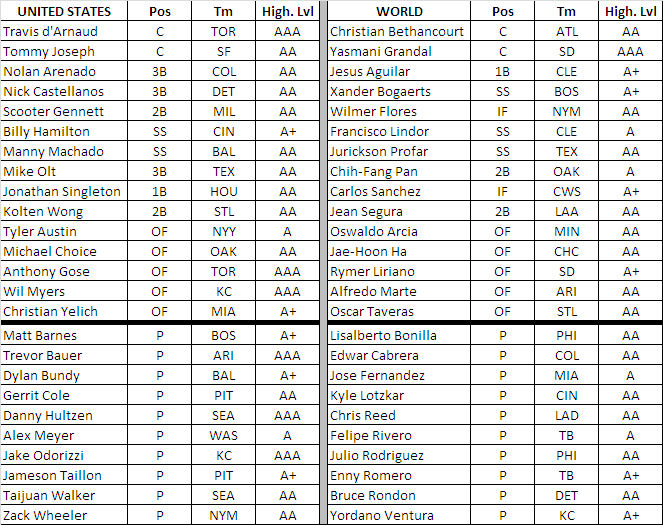
Here are the full 2012 rosters including each player’s highest level reached to date:

This year’s Futures Game is on Sunday, July 8th at 4 PM Central on ESPN2 and MLB.tv.

Jonathan Mayo’s Preview

Baseball Prospectus’ Stat Sheet

Futures Game Wiki

Wednesday: 06.20.2012

Best Pitches Feature On Hold

Quick note about the Best Pitches of the Month feature.  I really enjoyed doing it for April, but it is a big undertaking for a crappy computer which mine has unfortunately become in its seventh year of existence.  It is a labor intensive project that wouldn’t be so problematic on a better unit, so I’m going to suspend the feature until I can afford a new laptop.  Between having MLB.tv and the GIF-making program up (as well as any others not related to the project), the computer would freeze and skip and I often had to remake GIFs that were jumpy or skippy during recording.  I’ll still make GIFs in one-off situations where I think they are really necessary, but since the Best Pitches project was more of a luxury, I’m just going to hold off for now.  Once I get a job, I’ll get a new computer and it will return (and I’m sure I’ll do a ton of random GIF’ing… watch out for beagle GIFs!).

Tuesday: 06.19.2012

Trout and Harper in 2013: The Industry Weighs In

Though we are in the midst of our third straight “year of the pitcher” (maybe it should be an “era of the pitcher”?), two hitters are capturing the attention of the baseball world.  Rookie hitters at that.  Mike Trout and Bryce Harper, the consensus top prospects in baseball this preseason, have lived up to their hype thus far leaving the baseball community drooling in anticipation of what will come next.  The fantasy baseball community might be drooling most of all, especially those with the wunderkinds on their teams.  Those playing in keeper leaguers are giddiest of the bunch.

Trout is on pace to produce one of the five best age 20 seasons since the expansion era (1961), in fact the 2nd-best if he maintains his current pace of production.  Only A-Rod’s insane age 20 season tops Trout’s current pace from an OPS and OPS+  standpoint.  Harper is on pace to be just the 2nd 19-year old to qualify for the batting title and post an OPS+ over 100.  Not 2nd-best, 2nd at all in the expansion era (and subsequently the best at his current pace).

(data courtesy of Baseball-Reference.com)

We got a 40-game taste of Trout at age 19 a season and it was less than impressive.  He hit .220 with a  .672 OPS including five home runs and four stolen bases.  In exactly 60 more at-bats than he had last year, he has a .328 average, .907 OPS, six home runs and 19 (!) stolen bases.

Harper, meanwhile, spent his first pro season between A and AA last year.  He crushed the former, posting a .977 OPS with 14 home runs and 19 stolen bases in 258 at-bats before getting a promotion.  He faltered upon arrival posting a .628 OPS in his first 80 at-bats, but closed the year with an .878 OPS in his final 49.

It looked like he was going to need a similar adjustment to AAA as he had a .708 OPS in 72 at-bats before getting the call to the majors as the decimated Nationals needed his potentially impactful bat.  Using arbitrary endpoints again, he seemed to need an adjustment period again posting a meager .650 OPS in his first 13 games.  However, since May 13th he has hit .325 with 15 extra-base hits include seven home runs leading to a .988 OPS in 123 at-bats.

The two are on pace for some pretty impressive seasons even if you don’t factor in their ages:

Harper’s RBI total is pacing a bit low, but it won’t take much to boost that up.  In fact, if you just added five to his current mark, he would move from 59 to 75 in a snap.  By the way, a quick note about the pacing.  I built in five off days for both of them just to be a bit conservative.  I also included an 85% pace which builds in some regression should they fall off their current production pace yet maintain the same amount of at-bats.  It’s kind of a wet blanket/reality check as they are likely at or very near the peak production of their seasons right now.

With the hysteria surrounding the two, I wondered about the future.  Specifically next spring.  I have my own ideas about their 2013 value, but I wanted to know where some of the top fantasy minds in the industry saw them going so I reached out to them with that very question.  Here are the results:

Derek Carty (Twitter) – I imagine both Harper and Trout will be drafted higher than they should — fantasy players love drafting on hype, so much so that they’ll draft a guy who has to make good on his ceiling just in order to break even on the pick (see: Brett Lawrie, 2012) — although both should be quite good.  Harper will offer more in terms of power while Trout will offer more in terms of speed.

A true 80 runner, Trout could swipe 40 bags next year (although some scouts feel he’ll slow quickly as he ages, given his body type).  Harper could challenge 30 HR. and both could provide solid averages, although Trout’s power/speed combo will likely be superior to Harper’s, giving him the edge (especially leading off for the Angels).  I’ll take Trout in the seventh and Harper in the 10th (subject to change, of course, based upon rest-of-2012 performance).

Eno Sarris (Twitter) We asked this of analysts in the online scouting community going into the year for FanGraphs+ ($) and they were all split.  Like right down the middle split.  Dave Cameron writes a piece about how impressive Bryce Harper has been in the early going, and then Wendy Thurm writes that we shouldn’t forget about how good Mike Trout has been.

It seems clear that both will be great, and quickly, and so we’re left with the quintessential question: do you prefer to have power first, or speed?  I’ll take the speedy guy, even if it’s a year older, and here’s why: 1) This speedy guy with power is more likely to add value in all five offensive roto categories. 2) This speedy guy comes with a great contact rate.

There’s nothing worse than a contact problem, and though Harper has a nice strikeout rate, his swinging strike rate (12.5%) is way above average and the sample is almost robust enough to worry about it (Ed. note: this was turned in before Harper’s 5 K performance, which Sarris subsequently wrote about).

Along with Trout’s speed, his better contact rate (9.6% better) should mean that his batting average will be better than Harper’s most years.  It’s as simple as that, but there’s a little more.  If stolen bases by themselves are rare, the true five-cat performer is even rarer, and if you can get your speed from guys with power, you avoid ever having to Juan Pierre it up. I know Harper has the ability to steal some bags now, but I see it more like athleticism and taking advantage of situations — a la Brandon Belt — than Trout-like wheels.

Both of these guys have upside — in one corner, you have a guy who could hit .280 with 25+ homers and 10+ steals as soon as next year, and in the other you have a guy that could hit .300 with 15+ homers and 40+ steals next year. The thing is, there’s an outside shot that Trout’s current batted ball mix (1.22 gb/fb, 12.2% HR/FB) and ISO (.192) are sustainable, in which case he might hit closer to 20 home runs and push the needle further in his favor.

I chose Trout over Harper when they came up and I’ll do it again. Oh, and round? I’ll take him as early as the third or fourth, depending on how the hype works out going into the season next year.  If Harper gets more of the attention, I might gamble on taking Trout in the fifth or sixth in order to really pump him for value.

Joel Henard (Twitter) – Looking at Trout and Harper next season, it’s going to be a tough call.  I definitely see them going way too early in drafts with owners drafting them in the 2nd round.  I see both guys as later 3rd and early 4th round guys.  I am a Harper fanatic and will probably draft him way too early, with that being said I would rank them in 3rd and 4th round.

Riley Breckenridge (Personal Twitter; PO Twitter) Mike Trout: late 2nd round, early 3rd – Updated ZiPS projections have Trout pegged for a 90/15/60/33/.290 output in 2012. I think we’ll see an uptick in all five categories in 2013, (~95/18/70/38/.295), which brought to mind the 2011 model of Andrew McCutchen with more speed, a better batting average, and slightly fewer home runs. McCutchen’s ADP this year sat in the mid-20s, so I’d project Trout as a late 2nd rounder in most leagues.

Bryce Harper: late 3rd round, early 4th – Harper is a tougher call than Trout.  His real value will come when he can give a fantasy owner 30+ bombs and ~20 steals. While I’m fairly certain that day will come, I’m not sure it’ll be in 2013.

Jason Collette (Twitter) – Along where Desmond Jennings and Brett Lawrie were this year both round and dollar wise to be honest.

Nando Di Fino (Twitter) – I actually ran numbers with Harper, Griffey, Yount, Mantle, and A-Rod — their 19-year old season vs. their 20-year old seasons.  All but Yount put up insane numbers. Trout is essentially a year ahead of them right now, so it’s a sneak preview, to a degree. I look at them like this:

Harper: $32 roto player, with lots of power, great average, and some speed.

Trout: $34 roto player, with some power, great average, and a little more speed, which will get his value a tick above Harper’s.

In points leagues, I bet Harper is a little more valuable in 2013 when it’s all said and done, and I would wager that Harper would go in the first round in most drafts, while Trout falls to 2/3. In reality, they should probably both be late first-rounders in both formats next season, and will likely finish with late first-round value.

Al Melchior (Twitter) – Trout probably won’t maintain a .300-plus batting average going into next season, but he should have some Shane Victorino-type value with his speed/power combo. With the added hype of having been a top prospect boosting his value, I see him going as a 4th or 5th rounder.

Harper will hit for more power than Trout, and that will offset his relative shortcomings in batting average and steals. Think of him as Hunter Pence, but with more stolen bases and walks. Also likely to be drafted in the 4th or 5th rounds on average.

Cory Schwartz (Twitter) – Assuming both of these phenoms continue to produce at their current pace and rates, they’ll both be highly coveted in re-draft leagues next year.  Personally I’d go after Trout first, because his edge in the stolen base category will likely outweigh the value of Harper’s superior power.  He’s not likely to hit in the .320’s next year as he is right now, but I think his other production is realistic and projects to high teens in homers and 35-40 steals with an average in the .280’s and nearly 100 runs.

In a 12-team re-draft league, that type of player would probably go in the third round and possibly even sooner… think about Andrew McCutchen this year in terms of value; he’ll certainly go ahead of where Desmond Jennings did this year.  Harper projects for a slightly higher average and could challenge 30 homers next year, while stealing 12-15 bases.

He’ll probably go a half-dozen or so picks after Trout, comparable to or before someone like Hunter Pence. Either way, both have clearly established themselves as potential impact players next year and, based on their production so far this year and expected growth going forward, neither will last very long on draft day.

Derek VanRiper (Twitter) – Valuing Trout and Harper for 2013 requires an unscientific calculation of their expected adjustment period as big league pitchers find ways to get them out. As we’ve learned through the first two-plus months of Brett Lawrie‘s 2012 season, elite tools don’t immediately lead to elite results over the first 500-600 plate appearances.

Trout should run enough to steal at least 25 bases while providing double-digit power, while Harper seems to be a better bet for 15-20 homers and double-digit steals, albeit with a lower batting average because of his ongoing development against left-handed pitching.  In Trout, I think we’re looking at a player who will be valued as a third or fourth-round pick in many drafts next season (similar to Desmond Jennings in 2012), while with Harper it seems as though a Round 4-5 ADP seems more likely.

Chris Liss (Twitter) – Off the top of my head – mixed league, Trout will be a 2nd round pick, Harper 3rd. That is if we drafted for 2013 today. But obviously that could change a lot.

Scott Pianowski (Twitter) – I can’t see Trout lasting longer than two rounds, perhaps getting into the Top 12 or 15. He’s capable of being a dominant speed player right away and he has good (not elite) power, so we might have a five-category player here. It will be interesting to see how the league changes its pitching approach to him, and how the kid reacts.

Harper I don’t like as much as everyone else seems to for the immediate future. Down the road, of course, we can all see the superstar potential. I doubt I’d get him where I’m likely to slot him, maybe fourth or fifth-round value. And before anyone drafts either of these guys in 2013, remember all the sophomores that have broken our hearts.

Ray Flowers (Twitter) – If I was drafting today for the 2013 season I’d roster Trout for the reason many others are saying Trout would be their choice – it’s the speed component. I don’t doubt that Harper could make a run at 20 steals, but if Trout is swiping 40 bags as is obviously possible, Harper is going to have to hit a who lot more dingers to make up that difference in the fantasy game. Plus, I’m not sure that Harper is going to be a .300 hitter right off the hop, which will make his need for a major home run driven effort exceedingly important if he is going to outpace Trout next season.

Speaking of sophomore slumps, notice the 4th-place hitter on that age 20 list from above.  Jason Heyward.  Just two years ago he took the league by storm with a five-tool game worthy of the #1 prospect ranking he earned that preseason.  Since then things haven’t necessarily gone as planned.  He labored through injuries dropping 50 points on his batting average and 141 points on his OPS a season ago.  He has been better on the whole so far this year, but his walk rate has dipped again while his strikeout rate is at a career-high 23%.

He serves as the most ready-made example of what Pianowski is talking about as does Brett Lawrie, a name elicited often by our panelists.  I know what you’re thinking, “Harper and Trout aren’t Heyward and Lawrie!”  And that may be true, but they were both elite, blue-chip prospects who took the league by storm in their debuts and have since struggled by comparison.

Trout didn’t take the league by storm initially (87 OPS+ in that 40-game sample last year) which is maybe why he feels different meanwhile Harper seems to be a generational, once-in-a-lifetime-type talent to whom rules of history don’t apply, unless we’re talking about the rules of Ken Griffey Jr.’s early career.  While Trout matches up somewhat with A-Rod (who struggled in 17 and 48-game samples as an 18 and 19-year old before storming the league at 20).

Nevertheless, if they maintain these incredible paces, no one is going to care about cautionary tales from history and the pair will be very highly drafted in 2013 (like top 10 if they keep their current paces up).  For me, I have Trout higher than Harper.  His speed changes the fantasy game and when paired with his run production ability and batting average potential makes him my favorite type of player.  I would value him as a 2nd rounder in 12-team mixed leagues and I can legitimately see him creeping into the 1st round.

Harper, meanwhile, is of course no slouch.  He oozes with ability and his power could be transcendent in a hurry.  In the lowered offensive era, that is huge.  The Hunter Pence comparison given by a few of the analysts makes sense, but I would give him more pop (30+ HRs) while taking away some of the batting average (closer to .265-.270, compared Pence’s .280-.290 range with a couple of .300s mixed in), at least initially.  Harper has .300/35 capability, I’m just not sure it shows up in year two.  I would value him as a 3rd rounder.

Loosely averaging everyone’s thoughts and opinions yields Trout as a late second/early third round pick and Harper as a mid-to-late third round pick.  They will continue to garner a ton of attention the rest of this season and their draft position will be written about a ton during the upcoming winter and early next spring at the various internet outlets and in every magazine that hits newsstands.