Posts tagged ‘MLB’

Thursday: 04.14.2011

Prospect Spotlight: Keyvius Sampson

We already know that anyone pitching in San Diego’s PETCO is instantly a bit better thanks to the spacious dimensions of the yard.  The Padres are grooming some legitimately talented arms that can pitch anywhere to the point that the Petco Push will make them nearly unbeatable.  Most recently it has been ace Mat Latos while Simon Castro and Casey Kelly are rocketing through the minor leagues, but one of the prospect we might soon see destroying hitters regardless of venue is Keyvius Sampson.

The diminutive (6’0) 20-year old is currently a second tier prospect in the Padres organization, but his talent has top 100 potential.  The 2009 4th round pick out of high school struggled with injuries in his first full season last year pitching just 43 innings in 10 starts.  However, he did impress in the limited sample with mid-90s velocity (sits 91-93, touches 95) that drove his gaudy 12.1 K/9.  The secondary stuff is behind the heater right now which is why he’s an org prospect right now as opposed to a top 100 guy, but it’s on the come.

He has good feel for both a curveball and changeup so while neither is terribly consistent just yet, at least both are in the arsenal as opposed to needing that third pitch which would leave him on the fence between starter and reliever.  Some reports have the changeup a bit ahead of the curve, but then others suggest the curve is a bit better.

So far in 2011, it would appear that the three pitches are firing on all cylinders as he has put together two truly excellent starts amassing 19 strikeouts in 11 shutout innings walking just one and allowing a mere two hits.  His first outing included six no hit innings with 10 Ks while Wednesday’s was nearly as impressive with five innings of 2-hit ball with nine Ks and the lone walk he’s allowed.  His next hurdle is proving health.

Elbow soreness got him shutdown last year and it likely stemmed from a tear in his right labrum, but so far he looks 100% healthy.  I think the Padres would just like to see him stay healthy and spend the season in A-Fort Wayne of the Midwest League as opposed to worrying about a promotion as the next step if the California League where pitchers routinely get destroyed regardless of talent.

If he can pitch a full season in A-ball and continue to excel, then he might be in line to skip High-A and go straight to AA-San Antonio for 2012.  The Padres did just that with Latos and Castro, allowing them to skip the pitcher’s hell that is the Cal League.

He is one to keep on the radar from a fantasy standpoint, but this white-hot start is definitely worth noting.

Wednesday: 03.23.2011

2011 Bold Predictions-Part 1

One of the more exciting things to think about as the season approaches is which players are going to have the break through seasons?  Who are going to be this year’s Carlos Gonzalez, Joey Votto and Jose Bautista or David Price, Jaime Garcia and Ubaldo Jimenez?  For the past few years I have tried to answer that question with “Bold Prediction” columns over at Fanball.  I could’ve sworn I posted at least the 2009 iteration here, too, but I can’t seem to find after an extensive search.

I’m hardly the only one undertaking this task as Ron Shandler and crew have their Longshot Caucus over at BaseballHQ.com and Matthew Berry has his You Heard Me! piece over at his page on ESPN.  I believe he will be releasing that soon and it’s always a fun read.  Both are, in fact.  Hopefully I am able to deliver to that end as well.

In case you don’t remember from previous versions over at Fanball, the bold predictions column isn’t a bunch of aimless predictions, but rather it looks at a player’s whole profile, in the pros and minors, and tries to project out some best case scenarios for them.  These aren’t surefire bets, they are longshots that need a myriad of factors to go right if they are to happen.  You should reasonably expect between 15% and 20% of them to come to fruition.  The point is to get you thinking outside of the box(score) and not focus so much on what we’ve seen, rather entertain what we could see.

I am not going to have the Brady Anderson 50 home run season-type prediction in here because nothing in his profile would’ve told me that was possible so I wouldn’t project it.  Some of these may be “duhs” to you which simply means you’re already looking at possible outcomes beyond what we’ve seen to date.  In the end if there is a prediction you agree with and it causes you to go the extra buck on a guy and outperforms his cost, but doesn’t necessarily meet the exact figure in the prediction, it’s still a win (i.e. I had Gio Gonzalez projected for 175 Ks last year coming off of a season in which he had a near-6.00 ERA.  He finished with 171 and a 3.23 ERA.  If you bought in, you certainly profited significantly).

Some of the other calls from last year include:

  • Shaun Marcum will pick up right where 2008 left off
  • Luis Valbuena will hit 18 HR and steal 18 bases
  • Juan Pierre will steal 70 bases
  • Kelly Johnson will hit 21 HR and .300
  • Manny Ramirez will hit 40 HR
  • Nate Schierholtz will hit .320 with 15 HR
  • Ubaldo Jimenez wins 20 games
  • Billy Wagner will save 40 games (“And might very well be the league’s best closer.”)
  • Mike Stanton will hit 17 HR
  • Mike Jacobs will hit 35 HR
  • Lastings Milledge will hit 20 HR, steal 20 bases
  • Joey Votto will hit 35 HR, drive in 120 runs

That’s a decent sample of wins and losses.  As you can see, some were incredibly far off the mark by October, but you could have envisioned a scenario where they came true and you wouldn’t have have been utterly baffled as to how like you probably were after Ben Zobrist’s 2009 line of .297, 27 HR, 91 RBI, 91 R and 17 SB.  Yes, I highlighted some of the big wins there.  I definitely did not have a 58% success rate as this sample of 12 might lead you to believe.  In fact, I went 18-for-73 yielding a 25% success rate.  Let’s see if we can top that for 2011:

AL East

Baltimore Orioles:

J.J. Hardy hits a career-high 33 home runs – A bum wrist (and other various bumps & bruises) have sapped his power the last two years after a pair of mid-20s home run seasons in Milwaukee back in 2007 and 2008.  He moves to a very hitter-friendly ballpark and he is reportedly finally 100% healthy and clear of the wrist issues.  He is in the midst of his prime and I’m buying the clean bill of health.  He is going very late in fantasy drafts at the most scarce position on the diamond.  If you out on the “studs” at short in an AL-Only, wait on Hardy.

Zach Britton pitches 120+ quality innings at the big leagues – His absurd sinker and devastating slider are major league ready while his changeup is catching up quickly.  He will almost certainly start the season in AAA, but he shouldn’t be there long.  The O’s rotation is hardly stable as it currently stands so once the Super 2 Deadline passes, he should be inserted into the big league rotation where I think he will be an instant success.  “Quality innings” is a bit vague so to clarify, I’m thinking he can net a 3.50ish ERA (give or take .15 for random variance) with 6.5 K/9 and 2.0+ K/BB.  The strikeouts will rise as he gains experience, but he will utilize that sinker to induce a ton of groundballs as he gains his feel for the big leagues.

Nick Markakis finally has the .300-30-100 season – I made this one last year and I’m headed to the well again.  I was only off by 18 home runs and 40 RBIs last year!  Joking aside, he is just too good of a player to be hitting 12 home runs in a season.  A 30-home run season would be seven higher than his previous career high and 10 more than his last three seasons.  He is still at the front end of his prime so don’t rule out an explosion that would shock the narrow-minded.

Jake Fox’s regular season home run total won’t match his Spring Training total… – … because he’s not good.  He has eight as of this writing and even if he doesn’t hit another one this spring, he still won’t top that figure in the 2011 regular season.  Don’t waste your money.

Boston Red Sox:

Jacoby Ellsbury hits .320 with 16 HR – The speed will be there, too, but with a career high of 70 there is nothing that would be all that bold.  If he met this projection, he would be a Carl Crawford-lite.

Jon Lester posts a 2.50-2.75 ERA with 24 wins en route to an AL Cy Young – I had too many wins-based predictions for pitchers last year which was dumb because I’m always beating the “skill doesn’t always translate to wins” drum so I was leaving the projection in the hands of the offenses, defenses and bullpens when I was really trying to comment on the pitcher’s skill.  I included the 24-win mark in Lester’s prediction because I think he has the appropriate backing of offense, defense and bullpen to reward his increasingly excellent skill.

New York Yankees:

Alex Rodriguez hits 52 home runs – It’s hard to really predict anything that can reasonably be considered bold with A-Rod, but he’s 35 years old and has back-to-back 30 home run seasons leading many to believe he is firmly into his decline phase.  There is some skill erosion, but the decline is much smoother with transcendent players like A-Rod and I think he has at least one more MVP-type season in him.  He is a bona fide bargain at a very thin position as he goes mid-to-late second round in many leagues.  The best part about A-Rod, other than the fact that he’s finally healthy again, is that there’s a very high floor so why not invest?

Nick Swisher hits 38 home runs – He’s actually getting better the deeper he goes into his prime and though he hasn’t topped 29 in the last four seasons and 38 would be a career-high, the potential is there especially in that park.  He’s another guy with a high floor having played 150+ games each of the last five seasons.  The batting average isn’t quite the risk that many make it out to be as his .219 season in 2008 is now the clear outlier of his career.

Tampa Bay Rays:

Evan Longoria hits .324-41-133 – No, I’m not among those freaking out about his 11 homer  drop from 2009 to 2010.  After all, his OPS dropped a whopping .010 to .879.  This guy is a superstar and as such he will have some truly excellent seasons in his career.  I am looking at his age 25 in 2011 as the first such season.  All three figures would be career highs and while it wouldn’t necessarily come out of nowhere as he’s a clear first round pick, it would definitely be a profit-laden season.  Some outlets have questioned his mid-first round status, but I think it’s justified even if he “just” repeats 2010 because third base is so lame after the star cut.

James Shields posts a 3.25 ERA – His base skills actually showed significant improvement in 2010 yet his surface stats were the worst of his career because of an atrocious 1.5 home run rate.  He’s not a flyball-heavy pitcher, in fact he’s had a sub-40% flyball rate each of the last three years, yet when someone got a hold of one it was gone.  His skills are just too damn good for a 5.18 ERA or even the 4.14 ERA from 2009. I’m seeing a major course correction.

Toronto Blue Jays:

Ricky Romero shaves nearly a full walk off of his control rate and takes his ERA below 3.00 – I could see the strikeouts rising up above eight per game, but I’m not betting on it just yet as he seems to understand that inducing groundballs is the more efficient way of pitching.  I love that he has the groundball and strikeout in his arsenal.

Travis Snider completes his Adam Lind Path to Stardom – I hope he doesn’t take every step Adam Lind has after Lind’s 2010.  Both had a strong call up, then regressed in their true rookie season and bounced back to average in another half season of play.  Lind followed it up with an explosive 2009 hitting .305 with 35 HR and 114 RBIs.  I’m not sure Snider will hit .305, but he could also top the 35 homers that Lind hit.  I think a big season is in the offing and he’s two years younger than Lind was during his ascension.  Put Snider down for .270 and 38 bombs.  His RBIs will be determined by batting order.

Brandon Morrow improves his walk rate and cuts over a run off of his ERA – With his incredibly electric stuff, Morrow could accelerate his progression with improved command.  Regardless of how much he can improve his walk rate, I think there is a legitimate ceiling on Morrow’s 2011 because the Jays will cap his innings.  I could see the cap ending up somewhere around 175.  In a surprise announcement today, he will start the season on the disabled list with elbow inflammation.  Hopefully this curbs his value a few days before one of the biggest draft/auction weekends of the season.  As I mentioned re: Kevin Slowey yesterday, don’t draft for April.  If anything, take advantage of any inherent discount brought on by his missing a start or maybe two.

Next Up: AL Central

The goal is to put these up throughout the day tomorrow.  I didn’t realize how lengthy they were going to get as I originally intended to go AL/NL in a two-parter.  That would’ve been too long (that’s what she said) so I’m breaking it up by division.  I will also have my Middle Reliever Guide out this week.  I was hoping for today, but again this project expanded a bit more than I expected.

Tuesday: 03.22.2011

Walking the Walk

Have you ever wondered how much analysts follow the advice they dole out?  I get curious sometimes when I’m listening to various podcasts or reading different sites.  In case that is something you have wondered about me, I wanted to share some information from a 15-team mixed league draft I just completed.

All told, I drafted five of the pitchers from the list of 18 favorites for 2011:

Chad Billingsley (95th overall, 7th round)

Ricky Romero (176th overall, 12th round)

Edwin Jackson (245th overall, 17th round)

James McDonald (296th overall, 20th round)

Tim Stauffer (326th overall, 22nd round)

I had a few others queued up and watched as they were swiped right before I could take them.   Of the many interesting picks throughout the draft, one that is pertinent to this discussion was Brandon Morrow being taken 101st overall (7th round).  Remember what I said about him yesterday, “I think he is getting a little trendy raising his value, but that doesn’t dissuade me.”

Going that early does dissuade me.  I like him a lot, but I have my limits.  Notable names taken shortly after him that I value higher include: Shaun Marcum, Wandy Rodriguez, Colby Lewis, Brett Anderson, Hiroki Kuroda and Romero.  And that was just in the subsequent two rounds.  In a 15-team draft, you will have to extend out at times to get your target, but that was a bit egregious as far as I’m concerned.

Even though there is a near-100% chance nobody cares, here’s how my whole team turned out.  I picked 5th and it’s a hold + saves league otherwise standard 5×5 categories:

C – J.P. Arencibia

C – A.J. Pierzynski

1B – Billy Butler

2B – Omar Infante

3B – Evan Longoria

SS – Derek Jeter

CI – Gaby Sanchez

MI – Danny Espinosa

OF – Shin-Soo Choo

OF – Ichiro Suzuki

OF – Jay Bruce

OF – Nick Markakis

OF – J.D. Drew

UT – Adam Lind

BE – Juan Uribe

BE – Mark DeRosa

BE – Bill Hall


P1 – Chad Billingsley

P2 – Ricky Romero

P3 – John Lackey

P4 – Edwin Jackson

P5 – James McDonald

P6 – Tim Stauffer

P7 – Aroldis Chapman

P8 – Mike Adams

P9 – J.J. Putz

BE – Rick Porcello

BE – Randy Wells

BE – Jordan Walden

BE – Bobby Jenks

Miguel Cabrera was available at 5, but I went with Longoria because third base dries up in a hurry and I didn’t think Ryan Zimmerman would make it back to me in the 2nd round (I was right, he went 5 picks before me in that round).  I was going to build my infield with Dustin Pedroia in the 2nd round, but he went the pick before more so I shifted to outfield with Choo.  The same exact thing happened in the 3rd round as I was looking infield again with Jose Reyes and he went three picks before me so I shifted again to the outfield.

I think the depth/scarcity of outfield is consistently misperceived in these leagues with five outfield spots.  I do think there is some scarcity within the position in that middle area so I decided to build a beastly outfield since I covered the two scarcest positions very well (Longoria) and pretty well (Jeter).

I trust myself enough with pitching that I can work with this group and on the wire to put together a strong staff.  I would rather have enough offense at the outset and have to work on the pitching aspect than vice versa.  Consider one team that has Roy Halladay, C.C. Sabathia, Tommy Hanson, Chris Carpenter, Carlos Marmol, Brian Wilson and Jonathan Papelbon giving them the makings of a tremendous staff, but a severely lagging offense after Miguel Cabrera including an outfield “highlighted” by Brett Gardner along with Franklin Gutierrez, Johnny Damon, Matt Joyce and Seth Smith.

That’s just one example, of course.  But I got “my guys” on that pitching staff and if they perform as I expect/hope, I may not have to do much work on the wire, anyway.

Tuesday: 03.22.2011

18 of My Favorite Pitchers for 2011, Part 2

Here is the second half of my favorites for this year:

Part 1

10. Kevin Slowey – Without a spot in the rotation his value is going to plummet, but it’s a buying opportunity.  Don’t draft solely for April.  It’s a 6-month grind and skills almost always win out.  Slowey has more talent than Nick Blackburn and Brian Duensing, but to start the season both will have rotation spots while Slowey will work out of the bullpen.  Slowey will be an afterthought even in AL-Only leagues and I would be more than willing to slot in him as your 8th or 9th pitcher for a few bucks and wait for him to win a spot that he deserves.  A 4.6 K/BB rate doesn’t lie.  He’s long been one of my favorite pitchers and a poor decision by Minnesota at the beginning of the season isn’t going to change that.

11. Tim Stauffer – The former #4 pick overall took a while (29 y/o in 2011), but it looks like he’s finally paying dividends on that lofty draft status.  He plays in the perfect park for pitchers, showed a major uptick in groundballs last year (up to 55%) and has seen his team add strong middle infielders (Jason Bartlett & Orlando Hudson) to field those grounders adding up to a potential breakout season.  There is a slight premium on anyone in PETCO for obvious reasons, but Stauffer seems to be firmly entrenched off the radar in most standard drafts.  He went for $8 in NL Tout Wars and could easily return twice that when you consider what PETCO did for someone with lesser skills than Stauffer in Jon Garland.

12. Chris Narveson – His near-5.00 ERA from 2010 (4.99 in 168 IP) is sure to scare most away, but he pitched much better than that.  He doesn’t have the groundball tilt I usually like out of my pitchers, but with Milwaukee’s horrendous infield defense, that might not be such a bad thing.  He has nice base skills, the next step is learning to work with runners on so he can strand a few more guys.  Part of that is cutting down the long balls, too.  I think he takes a step forward in 2011 and ends up as one of those $1-3 glue guys instrumental in a team’s success.

13. Bud Norris – Like Narveson, his skills were better than his 4.92 ERA indicates, but many will pass based on that figure and the team name on his jersey.  I’d caution strongly against that as Norris has the kind of stuff that “out-of-nowhere” seasons are made of starting with his 9.3 K/9 rate being overshadowed by unimportant factors.  Are you one of those owners dying for an upside pick?  Norris is your guy.  The lofty strikeout rate is matched with an average groundball rate and a BABIP and LOB% combo worse than league norms that could be in for positive regression.  Even if he doesn’t take that major step forward this year, his sub-$5 price tag is at worst an even investment with all of the strikeouts.

14. Carlos Carrasco – We could have a budding Sporer Trifecta of Excellence (patent pending) profile on our hands.  It was only 45 innings of work last year, so temper the expectations a bit, but he had a 7.7 K/9 with an elite 57% groundball rate and his changeup was the best pitch in his arsenal.  This is a 3-time top 54 prospect (2007: 41, 2008: 54, 2009: 52) according to Baseball America so the pedigree is there, too.  Like Norris, his jersey will have some shying away or ignoring him completely, but his first full season in the majors could be a big one.

15. Derek Holland – It seems like I have been touting Holland for so long that he should be older than 24.  Alas, he doesn’t even have 200 major league innings under his belt yet here I am again espousing the virtues of this man’s abilities.  He started to come together in a 57-inning sample last year, but the loss of Cliff Lee opens an opportunity for him to finally prove it over a full season.  Although the sample was tiny, it was nice to see him greatly improve on 2009’s ugly 1.7 HR/9 down to 0.9 a season ago.  That’s about the limit for him if he is to have that breakthrough season many see as a possibility.  He’s one of those popular sleepers so be careful if his value gets too high in your league.

16. Jason Hammel – Similar to several guys on the list whereby he has above average base skills, but is missing one ingredient that keeps him from legitimate success.  For Hammel, it’s an ability to work with runners on as he his LOB% actually got further from league average 2010 leaving him with an ERA a half run higher despite improved skills.  You could easily be looking at $10+ profit out of Hammel if leaves a few extra men on base and continues or improves his already impressive skill set.

17. Chris Tillman – Remember when Tillman was the 22nd-ranked prospect in all of baseball?  It was alllll the way back in 2009.  He then proceeded to dominate AAA for 97 innings posting a 2.70 ERA and 1.15 WHIP with 9.2 K/9 and a 3.8 K/BB.  Later that season he was knocked around in 12 starts in his major league debut resulting in an ugly 5.40 ERA and 1.55 WHIP.  The skills were nothing like his minor league pedigree at 5.4 K/9 and 1.6 K/BB.  It was essentially rinse & repeat for 2010 with 121 strong innings at AAA then 54 ugly ones in the majors.  He turns 23 on Tax Day this year.  Too often the fantasy community gives up on top prospects if they don’t set the world afire right away a la Ryan Braun or Jered Weaver.  This is a post-hype play going for as little as a dollar in some AL-Only leagues who could end up as a tremendous keeper for 2012 and beyond.  Worst case is he is still not ready in 2011 and you cut bait with little invested.

18. Ross Detwiler – This is my biggest spec play of the bunch.  I just think there could be something here with Detwiler.  He has 278 innings of minor league success suggesting he is better than the 106 innings of major league work thus far.  He is the left-handed Tillman with less fanfare and a few years older (OK, I guess there are a enough differences to make that a bad comp).  Point being he showed enough in the minors to be something of a top prospect and though he hasn’t put it all together at the major league level yet, there is reason to believe he still can and will.  Furthering his spec play status is the fact that he’s not going to have a rotation spot on Opening Day, but the four surrounding Jordan Zimmermann are neither bastions of health, nor particularly skilled at pitching so he will get a shot at some point.  If he doesn’t win a bullpen spot, just monitor him.  But if he does make the team out of camp, he could be a high strikeout $1 reliever as he bides his time for a rotation chance.

So there they are, my favorite 18 for 2011.  There is something in here for everyone regardless of what kind of league format you play in.  I guess the only thing missing is minor league prospects, but I posted 50 from each league just a few weeks ago, so you know who I like there.  I know it’s a big draft/auction week for everybody so I’m trying to get as much material out as possible for your last minute prep.  I have a draft tonight, but hopefully I can get another piece up shortly after it finishes.

Tuesday: 03.8.2011

Baseball Podcast Recommendation List

This will serve as the 3/8 Daily Dose

I grew up loving sports radio.  I used to listen to WDFN in Detroit all the time and eventually I began calling in.  The evening show in Detroit was hosted by a guy named Mega Man Ike Griffin and I loved the show.  I would write down all of my points, wait on hold for 30+ minutes and then deliver my thoughts in 1-2 minute spurts almost nightly.

One of my best sports radio memories was going to an on-site of Griffin’s show with my mom, best friend and sister.  Detroit Lions defensive end Robert Porcher was a guest and they had a Porcher-related trivia question for his tickets at the upcoming game against the Packers.  You had to name the mascot of Porcher’s alma mater, South Carolina State.  I instantly raised my hand despite the fact that I really didn’t have a clue what the answer was for this question.

I knew South Carolina was the Gamecocks, but that knowledge would be useless to me here.  Thankfully my mom was on hand.  It was her idea to just guess Bulldogs, seeing as it was a popular enough nickname that we might get it right.  And we sure did!  A few weeks later I was sitting 7th row in Porcher’s seats enjoying an excellent game that the Lions won (it was pretty rare back then, too).

We moved to Harlingen, TX when I was 14 and it took me a while to even find the lone sports talk radio station there.  For the years I lived there (3, sophomore-senior years of high school) it was purely an affiliate with no local stuff.  That made sense as there wasn’t a pro or even a viable college team anywhere in the area so there was no real need for a local flavor for the national stuff.  Might as well just stick with the pros.  We had Sporting News Radio then Fox Sports Radio followed finally by ESPN Radio.

I listened to it a lot in high school.  My dad and I would listen every day when he drove me to school and I would listen on summer nights when I stayed up late playing baseball simulators online (Jeez, I was [am?] a dork!).  Just like when I was in Detroit, I loved to call in.  Sometimes I’d wait even longer on the national shows, especially during peak hours, but I had my handy notes and an inexplicable amount of patience just so I could be heard.  I’d get most excited when I could actually respond to the host’s response instead of saying my initial piece and then having to listen to them offline.

I have taken the long way of showing how far back my love for sports talk goes with the point being that I didn’t just happen upon podcasts.  After loving sports talk radio for years, podcasts were a natural step in the process.  First off, the local stuff here in Austin isn’t very good even with two stations now.  Secondly, I cannot stand the fact that it feels like 43 minutes of every hour is commercial-laden.  So when I discovered podcasts were essentially commercial-less sports talk radio, I was immediately hooked.  Not only did they cut out my least favorite part of sports radio, but the content is often much better, too.

This all leads to my podcast recommendation list.  I listen to sports-related podcasts almost exclusively with a few general topic ones sprinkled in, but for the sake of this list, I’m going to whittle it down to baseball only.  There are different types and formats here so I’m sure there is something for everyone.  Or at least everyone who enjoys listening to baseball talk on some level.

By the way, if there is something missing on this list that you think needs to be a part of it, please don’t hesitate to leave a comment or hit me on Twitter because I’m always up to give a podcast a shot.

(UPDATED: MAY 23rd-Podcasts added and some commentary to previously listed podcasts has been added, too.  That commentary can be found in italics at the end of the original write up.)

FanGraphs Audio – Mix the usually sharp insights of FanGraphs.com analysts with the irreverent wit of host Carson Cistulli and it’s a winning combination.  Cistulli also brings in non-FanGraphs guests which only improves the show.  Check out a recent episode with player Matt Antonelli and I dare you not to become a fan of his almost instantly.  Oh and while it may not be for everybody, I for one love the intro music with Herb Alpert and the Tijuana Brass.  Yes, I even bought it on iTunes.  It’s called “The Charmer” and it’s available for a scant $0.99, iTunes giftcard FTW!

As for frequency of the show, I think it will ramp it up as the season gets nearer.  There were four in February and there were two right off the bat in March, so while they don’t keep a regular schedule I’d expect four-five per month during the season.  It checks in between 35 and 50 minutes per show.

MLB.com Fantasy 411 – This is one of the first shows I started listening to years ago.  It used to be a daily show that could be podcasted, but it has evolved into a television show on the MLB Network that will likely start soon and I believe runs 4:30-5:00 (new time!) 1:30 PM central when it’s not preempted and podcast-only.  I think they podcast most episodes, but like ESPN’s PTI, it’s better to watch since it’s a show with graphics and highlights.  Still, hosts Mike Siano and Cory Schwartz will do an episode every once in a while that is podcast only.  Great content and analysis with humor thrown is what you can expect to find on this show.  I would definitely keep it in your iTunes feed, but also set your DVR to record daily.

Baseball America PodcastAttention prospect mavens and wannabe prospect mavens, this is your podcast.  It runs often with a college rundown focusing on the Top 25 each week, draft podcasts throughout May and prospect roundup episodes all throughout the season.  Of course they do top 100 prospect stuff around this time each year (which they ran back on Feb. 23rd with the recent list), too.

They stay busy in the offseason as well with 18 podcasts since the season ended through today and if you want to only count mid-October to mid-February as kind of the dead period, 14 of the 18 came in that 4-month timeframe.  Time fluctuates based on the topic.  They are usually at least 30 minutes, but bigger topics stretch past an hour (top 100 coverage, draft report cards, signing deadline, etc…).

If you don’t have time to subscribe and digest all the fantastic writing on their site and in the bi-weekly (I believe) magazine, then this is a great substitute.  If you do subscribe to the site and/or the mag, this is the perfect supplement for your commute, dog walks or whenever you like to listen to podcasts.

The Jonah Keri Podcast – This one isn’t purely baseball, but it skews baseball enough to be included.  I’ve already recommended this in a previous Daily Dose, so I won’t just rehash everything again.  It’s a great podcast that has quickly become one of my favorites.  Keri reels in brilliant guests weekly (oftentimes more than once a week) and discusses a range of topics touching sports, pop culture, technology and the writing profession among others.  Baseball and college hoops seem to be his favorite sports with the podcast leaning toward the former thus far.  As he is Canadian, he also likes hockey a good bit and isn’t afraid to do a full episode on it either.  As a native Detroiter, I like hockey plenty but the coverage is scant here in Austin, TX.

The show is a must-listen for anyone who likes podcasts and likes sports.

Up & In: The Baseball Prospectus PodcastIf you’re not a fan of long-form podcasts, then you’re out on this one from the jump.  They routinely run two hours and sometimes push the two and a half hour mark.  Hosts Kevin Goldstein and Jason Parks are the opinionated minds behind this operation and if you’re easily offended, you may want to pass.  So now that I’ve given you two reasons not to listen, here are two reasons you would want to listen.  The long-form is awesome to me so it’s a plus in my book, but I know it can go either way toward attracting or dissuading listeners.  And the fact that Goldstein and Parks are direct with their opinions is another plus for me that can put off some.

They are prospect guys from the scouting side of the ledger when it comes to their baseball knowledge, but they understand stats and incorporate at times (they aren’t afraid to dismiss them entirely, though, either).  I think they give deep and interesting perspectives on a wide range of topics in the game and that’s what drew me in from the start (I’m a point-9’er).  They segment the show so if you only want the baseball portion or only want, as Kevin calls it, the goofy stuff, then you can pick the spots you want with his handy timed segment guide attached to each episode.

Sometimes I find their music snobbery a bit overbearing as it seems they like some of the stuff just because it’s not popular.  Honestly a lot of it is utter trash to me.  But that’s my opinion and I don’t mind that they like it.  I just think they should be the same way about mainstream music they don’t like… just move on.  No one cares that you don’t like it.  That aside, the baseball talk is plentiful and rich enough to easily overlook the slight annoyance that their condescension toward most things popular triggers (Jason does make a good point that they can’t be pegged as hating all things popular as he loves the Beatles more than anything).

If you want good baseball talk, great guests and colorful language, then you need to be listening to this show.

ESPN Fantasy Focus: Baseball – Another ESPN offering, Matthew Berry and Nate Ravitz are well-known in the industry far beyond the reaches of this podcast.  They also both play in Tout Wars leagues, too.  As for the show, it appeals to a more broad fantasy baseball player.  The standard league they discuss is a 10-team mixed which just isn’t my cup of tea.  That said, there is still some good discussion of players that range beyond standard league value and it’s worth a listen.

At times they can veer off topic a bit too much for my liking, but they are upfront that it’s a part of the show so if you don’t like it, it’s more of a “you problem” than something with them.  It’s a fun listen and a worthwhile way to pass 30-40 minutes a day.  I’ve also heard from some of my friends that both guys are really cool in person so even if you don’t love their on-air personas, they seem to be relatively well-liked guys within the industry.

I always keep them on the iTunes list.  I love when they debate and you get both sides of a player, though.  That, to me, is very useful.  Give it a shot and see how they sit with you.  Plus, the theme song is awesome.  Gets in my head every day and I don’t mind.  Update 5/23 – This is arguably their best season, in my opinion. They’ve done a great job branching out their coverage from just 10-team league-relevant information.  They’ve got some funny segments that they have added and they have just the right amount of silly stuff, again in my opinion.  It’s been a must-listen for me this season.  

Beyond the Box Score Podcast* – Another recent feature of the Podcast Recommendation of a past Daily Dose, the BTBS podcast is quickly climbing the list as one of my favorites.  It’s another long-form podcast (1.5-2 hours) filled with guests and plenty of banter between hosts Dave Gershman and Matt Klassen.  I’ve told the two before that I think sometimes Matt steamrolls Dave a bit too much and comes across too eager to get his point across, but they let me know that Matt was encouraged to speak up when he saw fit.  But they are just seven episodes in (eight should come out today sometime) so they are still getting into their groove.

Gershman is booking great guests and they usually have a couple per episode, but even a guest-less episode with just Gershman and Klassen riffing on a variety of topics would be worth listening to as well.  I’m not a fan of the bumper music between segments (The Bare Necessities), but something like that isn’t going to drive me away from a show or else I’d almost never listen to Up & In.  Update 5/23 – Dave wins, the bumper music has grown on me. 

* (Now in iTunes!)

ESPN Baseball TodayI’ve been listening to this show since it started waaaaaaay back in 2006 when Alan Schwarz was hosting.  I absolutely loved the show when Schwarz hosted it.  That’s nothing against the hosts since, but he was just fantastic.  There was a lull last season and I wasn’t listening much as I didn’t love Seth Everett partnering with Eric Karabell, but Karabell has added Keith Law and contributor turned co-host Mark Simon for the 2011 season making it a must-listen once again.

ESPN likes to keep their podcasts under an hour and most check in around 30 minutes.  Baseball Today tops 30 most days, but rarely goes much longer than 40.  I think it’s probably the wheelhouse amount of time for most.  With Law and Simon joining Karabell, I’d love if they went long-form for an hour-plus a day, but that’s not going to happen so I’ll have to take my 30-40 minutes.  Update 5/23 – I was looking a lot more forward to this earlier in the preseason, but Law’s overwhelming negativity, which comes across as shtick at this point, is just too much.  It is making it hard to listen to on some days.  You literally expect him to take the negative angle to every single topic.  I think Karabell worries about what Law thinks a little too much, too.  He also worries way too much about going into “extra innings”, which is over an allotted time set by his producer Podvader.  First off, most people don’t mind if pods run long, but more to the point, settle that off-air with your co-host and producer.  Considering that it happens more often than not, what is the point of mentioning it at this point? 

Baseball Daily Digest – My good friend Joel Henard hosts a twice-a-week show with one as a general baseball show with co-host Albert Lang and the other covering his favorite team, the Chicago White Sox, with co-host Mike Rudd.  I only listen to the general one every week, but since I like Joel’s style so much I will tune into the White Sox one every once in a while, too.  Joel also just finished his excellent Fantasy February series where he had several guests from the industry to cover a host of topics.  This is a passion of Joel’s and that comes through in the shows.  They are hosted at Blog Talk Radio so they are hour-long timeslots and I highly recommend tuning in, especially because sometimes you can hear yours truly doing a special co-hosting spot.

Betting Dork w/Gil Alexander – Another niche podcast, the topic of this one is pretty obvious in the title and I haven’t been listening to it long, but I really liked the football betting analysis and Gil’s favorite sport to bet on is baseball so I’m anticipating liking this even more as we approach the season.  To be honest, I don’t even bet much these days, but I just enjoy hearing him and his guests uncover angles and discuss trends.  Sometimes he just has guests on talk about a particular sport without the betting angle.  He does that with Marc Spears of Yahoo! to talk about basketball and I’m hoping he has baseball guests on like that during the summer.

Baseball HQ RadioIf you like the insightful numbers-based analysis of the BaseballHQ.com writing staff, then chances are you will enjoy this podcast.  It’s essentially an hour-long version of the website.  Host Patrick Davitt starts by bringing on Harold Nichols and Matt Beagle to discuss the NL and AL, respectively.  They each cover a handful of guys in their league going into the second and third level of their stats and giving you the scoop on whether they are worth owning, trading or acquiring in your league.  After that Davitt has on his guest of the week which is someone from the fantasy baseball industry (sometimes part of the HQ family) and they have a 20-30 minute chat.

The main guest spot is followed by weekly segments that include a prospect round up, Beagle on again for Market Pulse, a new segment on keeper leagues and finally Ron Shandler’s Master Notes to close out the show.  It’s different from a lot of the shows on this list, but I find it enjoyable and it is definitely ripe with worthwhile information.

Broken Bat SingleRight off the bat, this is a Kansas City Royals-themed show so if you have no interest in the goings on of that team, then you probably think that you don’t want to listen to this show.  I would encourage you to at least give it a shot if you’re a fan of baseball podcasts.  I don’t have great interest in the Royals (as y’all probably know, I’m a Tigers fan), but I do love good baseball talk and that’s what Nick Scott offers on his show.  Scott books strong guests (I really enjoyed the episode with the GM of the Northwest Arkansas Naturals, the AA team for KC) and covers the team top to bottom while also mixing in some general MLB and non-KC Central Division coverage as well.  The shows run an hour to an hour-plus, but like all of these long-form ones, it is easy to pick up where you left off if you can’t listen to it all at once.

The Detroit Tigers Podcast – While we are on the topic of team-specific podcasts, I will plug one for my favorite team.  Ian Casselberry and Mike McClary essentially do what Broken Bat Single does only for the Tigers, so of course I love it.  Again, if you’re not into team-centric shows, then you’re not going to like this, BBS or Joel’s White Sox show (it’s purely coincidental that all three are AL Central teams).

Baseball Press Podcast – Are you looking for a quicker baseball fix?  The Baseball Press Podcast is right up your alley.  The guys over at BaseballPress.com over a sub-30 minute (most of the time) covering the goings on of the game around once a week during the season.  They are in the midst of their team preview episodes right now with guests from various blogs and other outlets to talk about the team of the night.

CBS Fantasy Baseball PodcastI used to really dislike this podcast because one of the co-hosts was just insufferable.  I couldn’t listen to his trite pet theories and terrible analysis so I had to abandon ship on this one.  A few weeks ago when I was going through iTunes looking at stuff, I came across it again and decided to look through and see what new episodes they had done.  I saw they had started their positional preview episodes and this person was no longer a part of the show so I gave it a shot again.  I’m glad I did because it’s pretty enjoyable.  A three man booth with essentially a mediator and then the two analysts going back and forth, they went in depth at every single position and have followed that up with episodes dedicated to sleepers, breakouts and busts.

In season they do a few different shows each week: the weekly preview, the most added/dropped players and a recap/injury show on either Monday or Tuesday and sometimes both.  Episodes vary from 30-50 minutes long depending on what they need to cover.  They won’t cut time if the topic is meaty, but they won’t fluff it up if there isn’t anything to talk about, either (a mid-September add/drop show was 15’ long).  This is just hardcore fantasy analysis and it’s pretty enjoyable.

Bloomberg Sports’ Behind the NumbersI really enjoyed this show during the season, but there hasn’t been a new episode since October 15th so I’m not sure if it will be back for season 2.  Last year it didn’t start until March 26th, so I won’t write it off for 2011 until April.  I’d put it in your iTunes for now and just wait and see.  They get great guests and it’s a show that generally checks in under 30 minutes, if I remember correctly.  Update 5/23: A few random episodes popped up a few weeks ago, but only one would download and it was a preview episode that included a Jonah Keri interview.  I guess this isn’t coming back full-time this year. 

CBS Baseball PodcastThis podcast in its current iteration as Ear on Baseball is just five episodes old and I’ve only heard two.  One was with Kevin Goldstein, who believes C. Trent Rosencrans (the host) and others with recent baseball podcasts have lifted their format from Up & In, and the other was with some band called The Baseball Project that I just couldn’t get through.  The guys in the band sounded nice enough, but it wasn’t something I was particularly interested in and I jumped to a few spots to see if it was the entire episode or just part of it and it was the whole thing.

I realize Goldstein is kinda joking with his friend when he says he stole the format, but he’s also kinda serious.  I didn’t see anything from Goldstein’s format in Rosencrans’ show.  Nor did Goldstein make up the format for long-form podcasts.  They have a very enjoyable show that I have liked since it came out, but podcasts were out loooong before Up & In started!

At this point, I’d have to give this show an incomplete grade because I’ve only really listened to one full episode.  Update: 5/23 – They did a handful of strong episodes February-April, but then there hasn’t been an update since April 7th so I guess it’s done. 

The New Additions: (May 23rd)

The Baseball Show with Rany & JoeRany Jazayerli and Joe Sheenan are long-time friends and industry stalwarts when it comes to baseball.  As Joe tells it, they used to have extended phone calls where they would just talk about everything that was going on in baseball so given the rise in podcasts, they decided to just start recording these calls and sharing them with the world.  If you enjoyed the writing of these two back at Baseball Prospectus or currently enjoy them either at Rany on the Royals or in Sheehan’s Newsletter, then you’ll definitely like this show.

Sports Poscast with Joe Posnanski – I was absolutely thrilled to learn that Joe Posnanski was starting a podcast and 11 episodes in, it has not disappointed.  It isn’t a pure baseball podcast, but there is enough baseball content for it to crack the list especially as we inch closer to summer.  He has done three episodes (technically four as one was a two-parter) with the creator of the best show on TV, Michael Schur (Parks & Rec.), including one where they did a fantasy draft of baseball books which was amazing.  He’s also had Bob Costas, Bill James, Ian O’Connor (who recently released a book about Derek Jeter) and Giants announcer Duane Kuiper for his baseball-centric episodes.  The only no-baseball episode was with Kevin Harlan.  This is quickly becoming one of my favorites.

Hot Clicks Podcast with Jimmy Traina Another one that isn’t all baseball, but eminently listenable regardless of the guest.  I discovered the podcast this weekend and listened to all nine episodes.  The Logan Morrison and C.J. Wilson episodes are must-listens from a baseball perspective.  I also enjoyed the James Andrew Miller (co-author of Those Guys Have All the Fun: Inside the World of ESPN which releases May 24th), Erin Andrews and Chris Cooley episodes quite a bit.  If you enjoy Traina’s twice-daily link roundup at Sports Illustrated, you will probably like his podcast.

Bizball Radio – If you enjoy Maury Brown’s great work on the business of sports network (and specifically baseball) then you will no doubt enjoy this podcast where Brown speaks with some of the most intriguing guests in the sports business field.  Like some of these additions, it isn’t all baseball all the time especially with a topic like the NFL Lockout to speak about, but all except one of his guests (George Atallah from the NFLPA) was either mostly baseball talk or at least some within their episode.

Podcast To Be Named LaterJason Collette and company from DRaysBay.com have resurrected this Tampa Bay-centric podcast.  Like the other team-focused podcasts on the list, it is best if you are a fan of that team, but if you are a diehard baseball fan in need of more podcasts then you will enjoy listening to this roundtable discussion of one of the league’s best teams.

Fantasy Pros 911 PodcastRich Wilson, Tony Cincotta and Tim McLeod get together every Sunday night for an hour to talk about the week that was and the one coming up in fantasy baseball.  They cover plenty of topics in their hour-plus (the first hour is always live on BlogTalkRadio while anything additional bleeds over onto the podcast only) with information for all fantasy players regardless of league size and format.  They engage their chatroom very well, too, and also respond to emails the following week.  The sound quality leaves a little to be desired, but I believe the only way to go truly live on BTR is over the phone which precludes them from recording on Skype and then posting a cleaner recording to the site.  I might trade the live aspect for better sound, but that would take away their interactive with the chatroom which is a key aspect to the show.

Friday: 03.4.2011

Donation Jersey Contest Update

I got a couple of emails the last day or two asking about the Donation Jersey Contest related to the Starting Pitcher Guide.  Instead of charging, I wanted to give users of the SP Guide the option to donate to the Guide if they saw fit.  In exchange for the donation, you not only get the Guide of course, but you also get entered into a drawing for a Tim Lincecum or Justin Verlander jersey.  I will do the drawing shortly after Opening Day (which is March 31st).  This gives everyone a legitimate chance to read through the Guide and truly decide if they want to donate and enter the contest.

I wanted to sincerely thank all of you who have already donated.  I am truly grateful that you deemed the project worthy of your hard-earned money.  It’s a really cool feeling when people make that kind of commentary on your work by choosing to give their money for the product.  So all of you who have donated, thank you very much and also sit tight as you are entered into the drawing.  Anyone still interested, there is time and there is no threshold donation to get you in.  If you donate, you’re in.  I will probably record the drawing on my FlipCam and throw it up on YouTube.  Like I said, that will be in early April sometime so enjoy the book and good luck in your drafts & auctions that are coming up.

Upcoming on the site there will be:

  • Podcast Recommendation List
  • Top Pitching Prospect List
  • Sleepers List
  • Positional Tiers List
  • Hitter Capsules (provided by BaseballGuys.com‘s Ray Flowers)
  • Middle Reliever Methodology
  • Some stuff on Closers
  • More 3 Questions entries
  • Bold Predictions column
  • and of course Daily Doses
Thursday: 03.3.2011

Daily Dose – March 3rd

I feel like days should extend to 26 or 27 hours in late February then into March as there is just so much going on.  I’ve got nearly 30 hours of podcasts to catch up on and the oldest one is about a week old so it’s not like I’ve let it accumulate.  My Read It Later app is bubbling over with content.  My “to do” writing list has plenty to take care of on it.  My book list is growing (and adding another next week when Jonah Keri’s Extra 2% comes out).  The release of MLB 2K11 is next week.  Plus I’ve got a 30 Clubs in 30 Days (Kansas City) on the DVR as well as some Spring Training baseball I’d like to check out.

And all that is before fantasy draft prep which will begin in earnest next week as keeper lists start to roll in.  Jeez.  So much to do and so little time.  Especially when you factor in my regular job and sleeping.  Oh well, no need to complain.  It’s better than being bored out of your mind.   February to Opening Day is one of my favorite times of the year despite the fact that I hate winter weather.  It’s not really that bad in Texas plus it’s usually done by the beginning of March.

Ian Casselberry has a very perceptive post on willful ignorance and how it is oftentimes downright annoying.  I deal with the dismissiveness of Twitter a lot when discussing sports with people.  They always say some derivation of “I don’t care who’s eating a sandwich on their couch” as if that’s all you can find on Twitter.  Yes, it started as essentially a place of Facebook statuses, but it’s become SO MUCH more.

Yet despite how often they dismiss it as useless, they come to me just as often for news on trade deadline action and various other breaking news because they know I’ll read about it on Twitter well before it’s up on ESPN.com.  For some of the dissenters, I’ve watched them morph from Twitter hater to Twitter user.  Instead of rubbing it in, I just nod to myself quietly.  As Ian says, it’s not for everybody, but anyone dismissing it as useless out of hand has no idea what they are talking about and comes across as pretty stupid.

Are you trying to curb your enthusiasm for your baseball team, but struggling to do so as you read countless glowing and optimistic reports about them from Spring Training?  Grey Papke does the dirty work for you with his “Why Your Baseball Team Sucks” piece.  It’s a perfect dose of reality to temper your expectations for the upcoming season.

After reading up more on the Zach Sanders piece I shared yesterday on Fantasy Value Above Replacement, I realized it is essentially an extension of something our friends at FB Junkie threw out earlier last month with “Why Not Fantasy VORP?”.  So if you read FB Junkie’s piece back on February 1st, use Sanders’ as a fleshing out of their notion behind fantasy value.

Justin Bopp of Beyond the Boxscore has put together an easy to use Baseball Stat Acronym Pronunciation Guide.  I disagree with the BABIP as I just say it like a work “Ba-bip”, but otherwise he’s pretty spot on.

Sticking at BtB for a moment, Chris Spurlock has offered a great article covering in detail the changes to the bats in college baseball and making it easily digestible whether you’re a math novice or hardcore mathlete.  As mentioned in the article, this should be good news for MLB, primarily from a scouting angle.  While it would suck if it really hurt the college game which is a niche sport already, I am glad it is an improvement for MLB.  Prospect scouting will still be an inexact science rife with failure even at the high end of the draft, but at least it’s a step in the right direction.  Plus I’ve always been someone who enjoys a 3-2 game, so a lowered offensive output in the college game won’t keep me away from following my Longhorns and watching them live a couple times a year.

Ray Guilfoyle of FakeTeams released his catcher rankings today and there were some surprises to be sure.  Regardless of whether or not you agree with his ranking of the top guys, one thing remains clear to me: catcher has some depth to it.  Sure there are still stars at the top, but if you miss out on the Mauers and Poseys, you’re not toast.

Mike Fast from Baseball Prospectus has a cool piece up (for free) looking at the accuracy of Baseball Info Solutions pitch locations.  If you like second, third and even fourth level baseball analysis, in other words really detailed stuff, then you’ll love Fast’s work.  This particular piece has a stunning revelation about the data and specifically it’s usage at FanGraphs.

The San Diego Padres are going to have a tough time replicating their 2010 success (success being relative here as they fell short of the NL West crown on the last day of the season despite leading for quite some time throughout the season) with the loss of their one great hitter Adrian Gonzalez, but there is reason for optimism in the future.  John Sickels breaks down their top two pitching prospects, Simon Castro and Casey Kelly (acquired in the Gonzalez trade), in his Prospect Smackdown series.

This one is nearly a month old, but it got put on the back-burner once I went into full SP guide mode there in early-to-mid February, so in case you missed Jon Weisman’s look at the upcoming “Moneyball” movie, I suggest you take a read.  I have been in the minority with him in that I have been very excited about the movie from the moment I heard it was being made.  It’s gone through a lot, but I think it can be good.  I hadn’t thought of the links to a very popular 2010 movie that Weisman mentions in the piece.  I’d love to see it emulate the success of that film, but even if it doesn’t I think it can be a success in its own right.

One of the best guys over at CBS as far as I’m concerned is Al Melchior.  He’s definitely a stats-heavy guy which is something I inherently lean toward (though he favors taking pitching relatively early so we disagree heavily there), but also the interactive graphics used in his pieces at CBS are fantastic.  The latest is one on positional scarcity and it has a really fun chart to play with at the bottom.  Al is part of the CBS podcasts, too and they just recently finished their positional previews.  They have moved onto Sleepers and Breakouts.  I’d presume that a Busts episode is next as each of the positional podcasts had a Sleepers, Breakouts and Busts portion within it.

One of my favorite things of the fantasy preseason is articles where industry members participate in a mock and then do a write up on their team with the thought process behind each pick.  I find them more helpful than just seeing a list of where everyone went.  In fact, I find the latter next to useless as the flow of a draft, while not as dynamic as that of an auction, is still dynamic nonetheless and it’s hard to get a feel for why things happened without some commentary.  Cory Schwartz participated in a mock picking from the 9-spot and breaks down his draft for us.

Come Chat Tonight: I am still planning on a hosting a chat here at paulsporer.com soon, but tonight I will be chatting at Rotojunkie at 7 PM Eastern.  It will have a pitcher tilt to it of course, but as with my first chat here at the site, I will answer anything fantasy baseball-related.

Baseball Apps: Need to get your iPhone and iPad baseball ready for the season?  Take a look at these baseball apps that should get you well equipped to enjoy the season on the go.

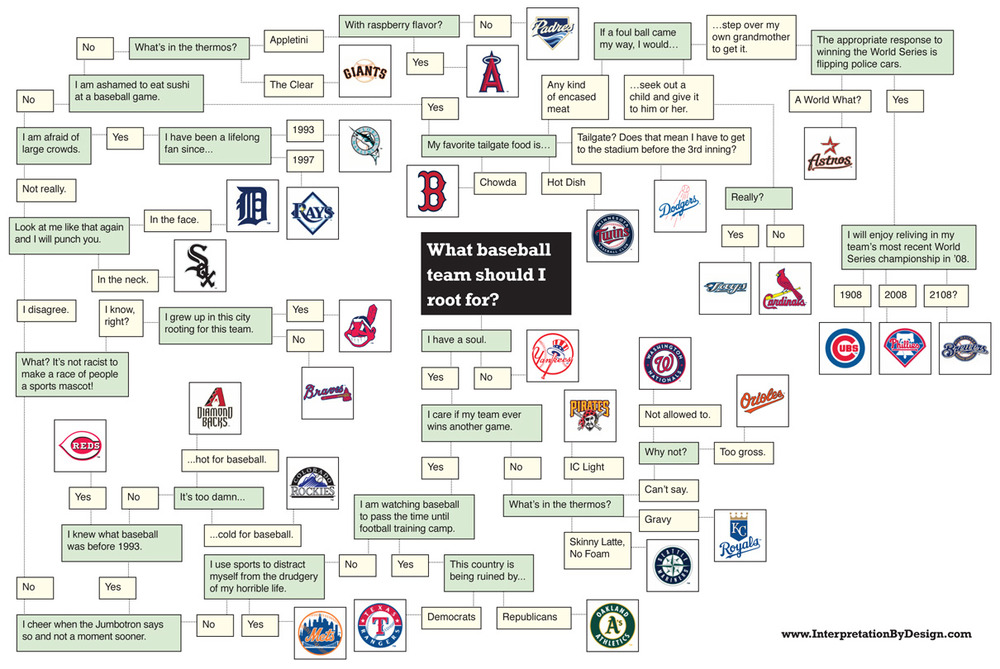
You’ve No Doubt Seen This: But just in case, the baseball fan flowchart is a funny image floating around the blogosphere and Twitterverse.

Remember When…Lance Johnson was a triples machine?  From 1991-1996, Johnson led the league in triples for five of six seasons and hit 12 in the off year (1995, when he had an absurd power surge with 10 HR after never topping 3 before).  I was upset when he left the AL before the 1996 season (10 team AL-Only league) because he had a career year including 50 stolen bases, 117 runs scored, .333 average and 69 RBIs, all career highs.  His nine homers were close to a career high.

It’s purely coincidental that the first two of these segments happen to be about Chicago White Sox, but “One Dog” was a key cog of my early fantasy teams (probably explains why I didn’t win any titles as a kid) and again because I watched a lot of WGN when the Tigers weren’t on, I was very familiar with Johnson and the Sox.

Despite playing three fewer seasons, Johnson has one more career triple than Kenny Lofton (117 to 116).  I found that pretty surprising, but Lofton only had two double-digit seasons in triples and they were 11 years apart (league-high 13 in ’95 and then 12 in ’06).  Of course Lofton has nearly twice as many stolen bases (622/327), nearly four times as many home runs (130/34) and had a significantly higher success rate on the base paths (80%/76%), though both were really good.

Knowledge Bomb: Here is an absurd statistic from Mike Axisa about Hall of Famer Greg Maddux.  Absurd might even be an understatement.  It’s just unfathomably great.  Are you ready for this?  You may have already seen it, but it resonates even on second and third viewing:


As Scott Van Pelt & Ryen Russillo say on their radio show, “let that soak in your mentals for a minute”.  That’s so amazing.  Only another 160 saw a 2-0 count.  Maddux was just not a fan of getting behind.  He only retired in 2008 so he is still a few years from getting on the Hall of Fame ballot and while it’s already a joke, the HoF voters would thoroughly embarrass themselves yet again if they made Maddux sit through another round of voting instead of putting him in on the first ballot.

Friday: 02.11.2011

Daily Dose – February 11th

A link-less, abbreviated Dose heading into the weekend as I drop some first base-related knowledge bombs on y’all:

Knowledge Bomb 1: A couple days ago, I released my top 25 catcher rankings to kick off my positional rankings.  Let’s continue our way around the diamond and head over to the ultra-deep first base.  On the offensive side of things, first base is hands down the deepest position with several superstars and plenty of talent to go around.  The best way to utilize the depth is to also grab your corner infielder (in leagues that use the spot) from this pool.  Some feel that the depth at first base allows you to wait on the position altogether, but I don’t think that is the right play at all.

I think you should be ready to double and perhaps triple dip (1B, CI, DH) into the plentiful bounty of first base.  There are other strategies to be employed, but my feeling is that with the excess of power potential at the position compared with the dwindling power supplies in the league at large, why not maximize the position and its four-category contribution: power (HR, RBI, R and AVG as each HR contributes a hit, too)?

Even if you played up position scarcity and chose a shortstop in the first round and an outfielder in the second round (it’s thinner than you think, folks), you will still have stud potential available in the next two or three rounds.  Let me show you what I mean (guys who have dual-eligibility at first base aren’t going to be included in the actual top 25 as they don’t have nearly the value at first that they do at their normal position.  That means there won’t be any Victor Martinez, Buster Posey, Pablo Sandoval, etc.. Kevin Youkilis will show up because he won’t start the season with 3B eligibility after playing just 2 games there last year.):

  1. Albert Pujols
  2. Miguel Cabrera
  3. Joey Votto
  4. Mark Teixeira
  5. Kevin Youkilis
  6. Adrian Gonzalez
  7. Prince Fielder
  8. Adam Dunn
  9. Ryan Howard
  10. Kendry Morales
  11. Justin Morneau
  12. Paul Konerko
  13. Billy Butler
  14. Derrek Lee
  15. Gaby Sanchez
  16. Adam LaRoche
  17. Aubrey Huff
  18. Ike Davis
  19. Carlos Pena
  20. Lance Berkman
  21. Kila Ka’aihue
  22. Justin Smoak
  23. James Loney
  24. Daric Barton
  25. Matt LaPorta

Overvalued: Ryan Howard – this one is relative as I still think he is plenty valuable as a major power source, but I’m not sure he returns to his truly elite power self as some of the warning signs are to be taken seriously.  He’s been going off the board as the 5th or 6th first baseman in a lot of industry mock drafts that I have seen and his ADP (average draft position) is 6th and 7th at Mock Draft Central and Couch Managers, respectively.  I’ve got him 9th, so it’s not a huge dip, but I wouldn’t make him down for 40-140 automatically in 2011.

Undervalued: None – no one being seriously overlooked, at least not by more than a slot or two which isn’t enough to get up in arms.  There is some value at the position because the depth pushes some guys down, but no one is being criminally passed over in lieu of lesser options.

Target: Kendry Morales – Yes, he is coming off of the big leg injury, but that isn’t something that will sap his power or hamper him at all this year.  He had a breakout 2009 and was in the midst of an excellent follow-up in 2010 when the accident happened, I expect him to pick up right where he left off and continue as one of the best first basemen in the league.  Even if you already locked up an elite first baseman in the first or second round, there would be nothing wrong with coming back in the fifth round and slotting Morales’ 30-home run power into your corner infield spot.

Best of the Rest: Adam Lind – he doesn’t yet qualify at first base in standard league formats, but as his assumed position for Opening Day, your league may allow you to draft him there.  Even if that isn’t the case, he will earn his eligibility there quickly and he has elite power potential with the ability to hit .275+ yet he is going behind LaRoche and Pena (who he is a rich man’s version of) according to current ADP numbers.  If he were first base eligible right now, I would slot him between Konerko and Butler.

Rookie to Watch: Freddie Freeman – He strikes me as James Loney-esque right now lacking enough power to be a starting first baseman.  He could be a .280 hitter with mid-teens power, though, which is still worth rostering even in mixed leagues given the late round cost attached.  He’s really the only rookie 1B with a chance to start in 2011.

Knowledge Bomb 2: There were 13 first basemen to hit at least 20 home runs and drive in at least 80 runs:

  • 10 of the 13 scored 85+ runs
  • 5 of the 13 scores 100+ runs
  • 6 of the 13 hit .290+
  • 10 of the 13 hit .260+ (a .260 AVG will cost a team just .002 in team AVG over a full season)
  • 4 of the 13 chipped in 7+ stolen bases (Votto [16] & Pujols [14] doubled the contribution)

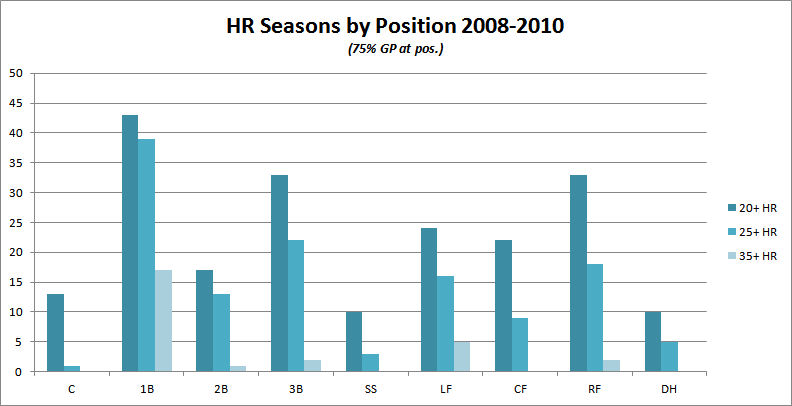
Knowledge Bomb 3: Check out the home run season totals at three key thresholds broken down by position:

Few leagues use each outfield position individually, but even if I had lumped all three together the point of first base’s power prowess would have still held.  You need three to five outfielders in all leagues whereas you need just one first baseman (but could feasibly roster up to three with corner and DH).  First base is the only elite power source on the diamond.  If you leave your draft or auction with Billy Butler (who I really like, so don’t get me wrong there) as your starting first baseman, you have messed up and you will likely be struggling for power all year long.

I will reiterate that you needn’t take a first baseman in the first or even the second round to cash in on the power surplus.  So if you wanted to go shortstop and third baseman to attack some of the scarcity around the infield, that would be a feasible strategy and you would still have plenty of power first basemen available to you in the third and fourth rounds.  However, if you’re looking at a blank 1B spot on your roster in the back end of the fifth round, chances are you are well behind your leaguemates at the position.

Thursday: 02.10.2011

Daily Dose – February 10th

You don’t have to read complaints about the weather today, let’s instead jump right into the Daily Dose:

The Los Angeles Angels beat writer for the LA Times, Bill Shaikin (@BillShaikin) quoted GM Tony Reagins on the likelihood of Mike Trout making it to Anaheim this year: “I would say it’s unlikely”, which is definitely the right thing to say right now.  There’s no reason to put undue pressure on the top prospect and get him worrying about playing up to a standard that will earn him a trip to the show.

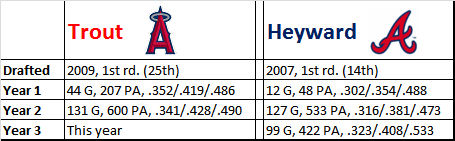
Do not take Reagins’ comments as a definitive guarantee that Trout won’t be up all year, though, because things can and will change as the season evolves.  Looking at two of the best prospects to make their mark on the league last year, Jason Heyward and Buster Posey, they each elevated through minors pretty quickly.  Posey was a college star at Florida State, though, so he’s a bit different than Heyward and Trout so let’s just look at Heyward.

Trout and Heyward both signed early as mid-to-late first round picks, but Trout signed earlier got 32 more games in than Heyward.  Both sample sizes are too small to draw much from, but a nice taste for fans to see what their team’s first pick garnered.  Both exploded in their second season and became top five prospects across baseball (Heyward 5th, Trout 1st).  And that brings us to this year, Trout’s third.  In his third, Heyward, after crushing A-ball with a taste in High-A, went back to High-A for 49 games and acquitted himself quite well.  Trout crushed A-ball last year, too, but 50 of his 131 games were at High-A unlike Heyward who only had seven in his first go-round.

Is Trout ready to make the jump to AA after 50 High-A games?  Heyward needed just 56.  Of course Heyward only played 99 games in his third professional hampered by injuries so he only saw another 50 games between AA (57) and AAA (3) before reaching the majors last year.  Barring injury for himself, Trout could start AA and play 60-70 games there.  If he continues to mash as he has thus far, he could get another 50-60 at AAA before possibly earning a late season call-up to the majors.

I’m not saying it’s going to happen, but I wouldn’t rule it out, either.  That said, anyone in a re-draft league needn’t waste their time drafting Trout in March, not even if there is a reserve roster.  There is no reason to tie up a roster spot on a slim chance.  Besides, even if he comes up this year there is no guarantee he would be a contributor.  I can’t wait to see how Trout progresses after his explosive 2010, but we will likely be waiting until Opening Day 2012 to see him suit up in Anaheim.

RotoAuthority has released their second basemen rankings for 2011 and they are veeeerrrry interesting to say the least.  I’m already on record about the depth at second base, which I think is significant, and looking at this list only reinforces that belief.  I don’t, however, fully agree with the ordering of the players.  It starts off with a bang by not having Robinson Cano atop the list.

I like Chase Utley and Dustin Pedroia plenty, but why you’d take either ahead of Cano is beyond me.  Tsuyoshi Nishioka at #7 and Sean Rodriguez at #9 ahead of Brandon Phillips at #10?  I wish there were projections tied to this list because I’d love to see the fall off in production that puts Martin Prado at #15 behind Danny Espinosa (#13) and Howie Kendrick (#14).  If we all drafted using the same lists and valuations then this game wouldn’t be much fun, but some of these are real head-scratchers to me.

Second base was a hot topic today as Ross Tremblay over at Fake Teams compared Utley and Cano and their projections for the 2011 season.  He ended up with Utley ahead of Cano in terms of who he would want.  The biggest problem I see in Tremblay’s analysis is that he vastly underrates the injury risk and age-related decline of Utley.  He compares the two at full health which is already a bit of a hypothetical stretch meant to strengthen the Utley side.

Second base, as Tremblay correctly points out, is a position that shows age-related attrition more than any except catcher.  Add in that Utley has three significant injuries (hand, hip, finger) in the last three years (though he didn’t miss time due to the hip surgery in the offseason) and there is legitimate risk.  Utley’s biggest statistical edge for Tremblay’s projections is in the stolen base department.  Again, I find this somewhat tenuous as his running could be in danger in order to mitigate some of the injury risk.

He’s a remarkably efficient base-stealer and ran plenty in September, his first full month after the injury, but Tremblay has him down for 15-20 bags which strikes me as the high end best case scenario.  He has topped 15 just once in the last five years, three of which were full seasons.  A year older and coming off of a season in which he played just 115 games, I would have him down for 12-15 bags.

Tremblay concedes that Cano is slightly better than Utley on the whole, but the cost of each sways him toward Utley.  Cano is a bona fide first round pick while Utley is going somewhere in the second round.  I’m all for value, but I’m more for mitigating risk, especially in the early rounds.  That reason alone is enough for me to value Cano a good bit higher than Utley, even if he costs my first round pick.  I didn’t like the hypothetical comparison Tremblay used to show Utley had higher value.

He paired each with a first baseman and determined that the Utley and Mark Teixeira/Adrian Gonzalez combo is better than a Cano and Ryan Howard/Prince Fielder pairing.  I don’t necessarily agree with that statement on its own, but more to the point, who says you have to take a first basemen in the first two rounds?  It’s the deepest position along with starting pitcher.  It’d be great to get a stud, but I think he is once again using a hypothetical device to strengthen his Utley position.  When you’re talking about a one round difference at most, you definitely want the best player, especially when he is less risky, too.  That is Cano.

Knowledge Bomb: I want to share something I learned yesterday that you may already know.  I absolutely love MLB.tv.  I love how it works across many platforms and you can choose your broadcast and they are working to improve it yearly.  One issue I always had was the fact that when you made it full-screen in your dual monitor setup, you couldn’t work on the other screen without it shrinking back down to regular size.  I made this known to the @MLBtv Twitter feed yesterday and whoever runs it promptly messaged me letting me know that this feature is in place and I had just been missing it this whole time!!

If you go to this MLB.tv FAQ page, it will show you that the dual monitor feature is in the Settings able to be toggled on and off and allow you to have your game on one screen in full mode while you  work on the other.  This seriously (or sadly?) made my day yesterday.  I knew the technology was available because Netflix Instant allows it.  I’m just glad it’s now part of one of my favorite products.  Sorry if you already knew this, but if you didn’t and have been clamoring for it, then it’s about as explosive as these knowledge bombs can get.

Thursday: 02.3.2011

Three Questions – San Diego Padres

With the 2011 Starting Pitcher Guide set to come out in a few weeks, I have a jam packed volume covering all the ins and outs of starting pitching in the 2011 season for your viewing pleasure.  Of course that doesn’t do much to address the offensive side of things so I decided to start this “Three Questions” where I will cover some key offensive issues for each of the 30 teams.  There will be more content here dealing with offense, but this is the beginning.

What happens to this offense without Adrian Gonzalez?

Oh don’t worry, new first baseman Brad Hawpe will fill in so well that you will barely notice Gonzalez left.  A .298/.393/.511 line with 31 bombs and 101 RBIs shouldn’t be a problem for Hawpe.  OK that’s obviously an egregious lie that I don’t believe in the least.  Do you want to know how important Gonzalez was to an offense that still only finished 22nd with him?  Look at this:

Gonzalez led them in five key offensive categories and no one was really close.  Chase Headley was the 2nd-highest qualifying batting average at .264, Will Venable’s 13 home runs were 2nd to Gonzalez, Headley had a whopping 58 RBIs to finish 2nd on the team, Yorvit Torrealba was 50 points behind Gonzalez with a .343 OBP, but that came in just 325 at-bats.  The 2nd-highest qualifying on-base percentage was again Headley with a paltry .327 mark.  And in the most hotly contest of the five categories, Headley finished 14 hits behind Gonzalez with 161 on the season.

Counting stats for Padres hitters are likely to be even worse than they were last year cutting into the already stunted value of the group.  Headley managed those 58 RBIs despite hitting behind Gonzalez, who was getting on base 40% of the time for him.  The team added some pieces in addition Hawpe including a brand new double play duo with Orlando Hudson at second base and Jason Bartlett at shortstop as well as former super-prospect Cameron Maybin, but the loss of Gonzalez is still a major blow to an offense that was already pretty poor.

The power-sapping ways of PETCO park are nothing new and Padres hitters have long been evaluated with that impact built in, but without their superstar cog in the middle the entire group takes another hit to their value.  The chances of the six year streak of a non-Gonzalez entity topping 100 R or 100 RBI being broken seem slim.  The last two players to do it were in 2004 when Mark Loretta scored 108 runs and Phil Nevin drove in 105.

Following up a career year with one of his worst, what’s in store for Jason Bartlett in 2011?

The 2010 season was a rough one for Bartlett especially in light of his breakout 2009 in which he hit 14 home runs, drove in 66 runs, scored 90 runs, stolen 30 bases and hit .320, all career highs.  Lucky for him, he plays shortstop which is a barren wasteland after the top tier so he will have some value no matter what.  How much exactly is going to be tied to how many stolen bases he rack up.  He had a string of 23, 20 and 30 before last year’s 11, so the ability is there and San Diego was the 6th-runningest (so surprised that didn’t get a red squiggly line under it in Word) team last year with 124 stolen bases.

Additionally, he can offer some batting average value or at least not be a drag for a team.  Last year his .254 was a drag as regression bit back hard from 2009 and instead of falling back to career norms, he was actually a bit unlucky.  He is .281 hitter for his career and there is no reason to think he shouldn’t bounce back to that in 2011 and if luck breaks his way again, it wouldn’t be tough for him to top .300 again.  So as a late round speed/average shortstop, he has some value.  As I mentioned already, counting numbers will be tough to come by on this team.  Especially for Bartlett who isn’t particularly adept at getting on base.  Though he has a career .345 OBP, it is propped up by the standout 2009 and a .367 mark in 372 plate appearances back in 2006.

One last thing to consider with him is that he has only averaged 135 games played in the last four years with a high watermark of 140 and a low of 128.  That means you’re going to need a replacement for around 27 games, or 16% of the season.  Given the dearth of talent at shortstop, this can be a problematic proposition.  His backup is likely to be Kevin Frandsen or Everth Cabrera.  You could fill one of Bartlett’s strengths depending on who fills in, Frandsen for average and Cabrera for speed.  If you’re left hitting the wire, you may find that the remains are somehow even less appealing than Frandsen and Cabrera.

Is Cameron Maybin ready to pay dividends on his blue chip prospect status?

The problem is we might not even notice if he does improve because of his home ballpark.  He has certainly proven everything he can in the minor leagues so it is time for the three-time top 8 Baseball America prospect to start showing the talent at the big league level.  At 24 with just a season’s worth of big league plate appearances (610) under his belt, even a poor 2011 wouldn’t be enough to write him off completely but it would put closer to Brandon Wood territory.

The biggest issue right now is the striking out.  He has struck out in 31% of his major league at-bats despite the significant gains in K% in the minors.  After striking out in 32% of his AA at-bats in 2008, he cut down to 20% in his first run through AAA in 2009 followed by 19% in 130 AAA at-bats last year.  Any contact would be better than striking out for Maybin at this point.  At the very least, he could maybe use his excellent speed to turn some of his groundballs into base hits.

Better pitch recognition can increase his value another way as more walks would again allow him to add value by way of his speed.  As noted in the Bartlett section above, the Padres aren’t afraid to run, but it is hard to do much running with a .302 on-base percentage.

I don’t think Maybin will magically fix the strikeout and walk issues all at once in 2011, but I think we will see incremental gains in his first full season which should yield a 20+ stolen base season and low-teens power.  You can do much worse than that for a low dollar late outfield option in NL-Only leagues.  I don’t think he is quite a dollar days guy just yet, especially if your league has any guys who love grabbing the next big thing, but his price tag shouldn’t be pushing double digits.  As a single digit buy, I would highlight him as a quality end-game play perfect for rounding out a team.