Archive for ‘GIFtastic’

Monday: 04.8.2013

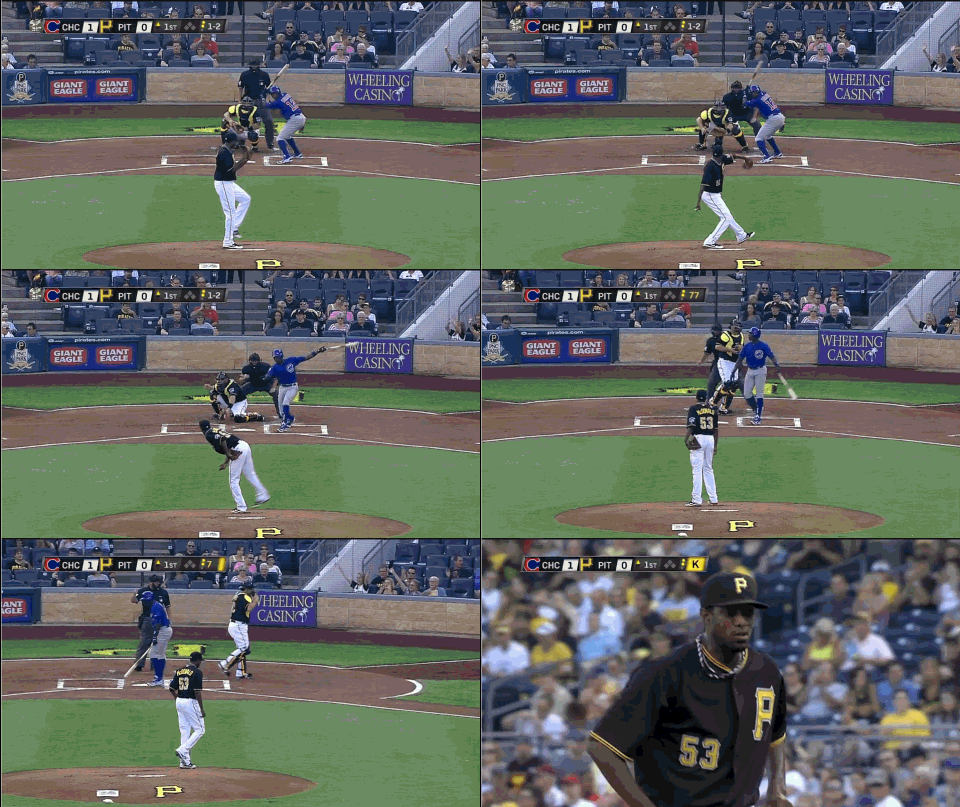
Worst Strike Call Ever?

The game-ending call in Arlington on Monday night was undoubtedly one of the worst strike calls I’ve ever seen. Even closer Joe Nathan knows they got away with one they most certainly did not deserve.

worstcallever


Edit to add: Excellent stuff here by MLB.com posting it with all four calls (home and away TV and radio). Hat tip to my co-host Jason Collette for posting that on Facebook.

Wednesday: 04.3.2013

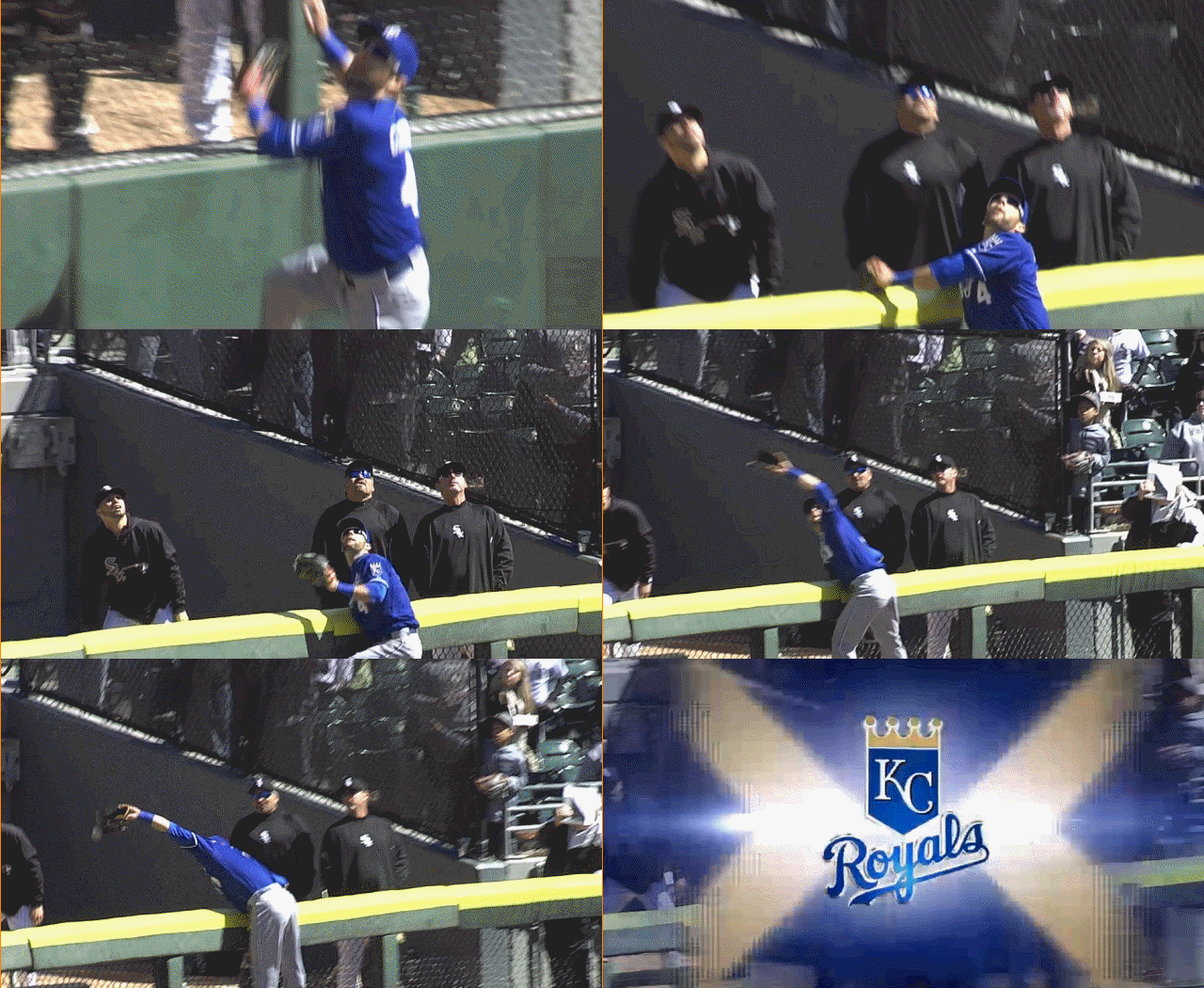
Alex Gordon Nearly Robs Dayan Viciedo

gordonneargrab


So close!

Tuesday: 04.2.2013

Rosenthal Gasses Two Diamondbacks

In his 2013 debut, Trevor Rosenthal pops 100 MPH twice with strikeouts against Paul Goldschmidt and Miguel Montero.

rosy100

Monday: 02.25.2013

Today Was a Good Day

Neck-deep in the SP Guide so no time to post much today, but I do have three things worth sharing.

First, if you follow me on Twitter, you know I love Jennifer Lawrence (who doesn’t?). So here’s essentially a primer on her awesomeness courtesy of Jezebel. She looked wonderful at the Oscars last night:

jlawdress

Edit to add this 26 Faces of Derp that my friend sent me shortly after I posted. This link crystallizes the point from the first link that she’s perfect because she’s not.

And then there was this:

craigHR

That was his day today against the Astros. Wrench got his rake on.

And then finally:

(courtesy of FanGraphs.com)

Miguel Cabrera destroying Jonathan Papelbon‘s life. I’m just not a Papelbon fan on any level whatsoever so to see my favorite team crush him today was great. Jeff Sullivan over at FanGraphs broke it down.

Only Jennifer Lawrence can top Allen Craig AND Cabrera at this site.

Saturday: 02.23.2013

Spring Training GIFs!!

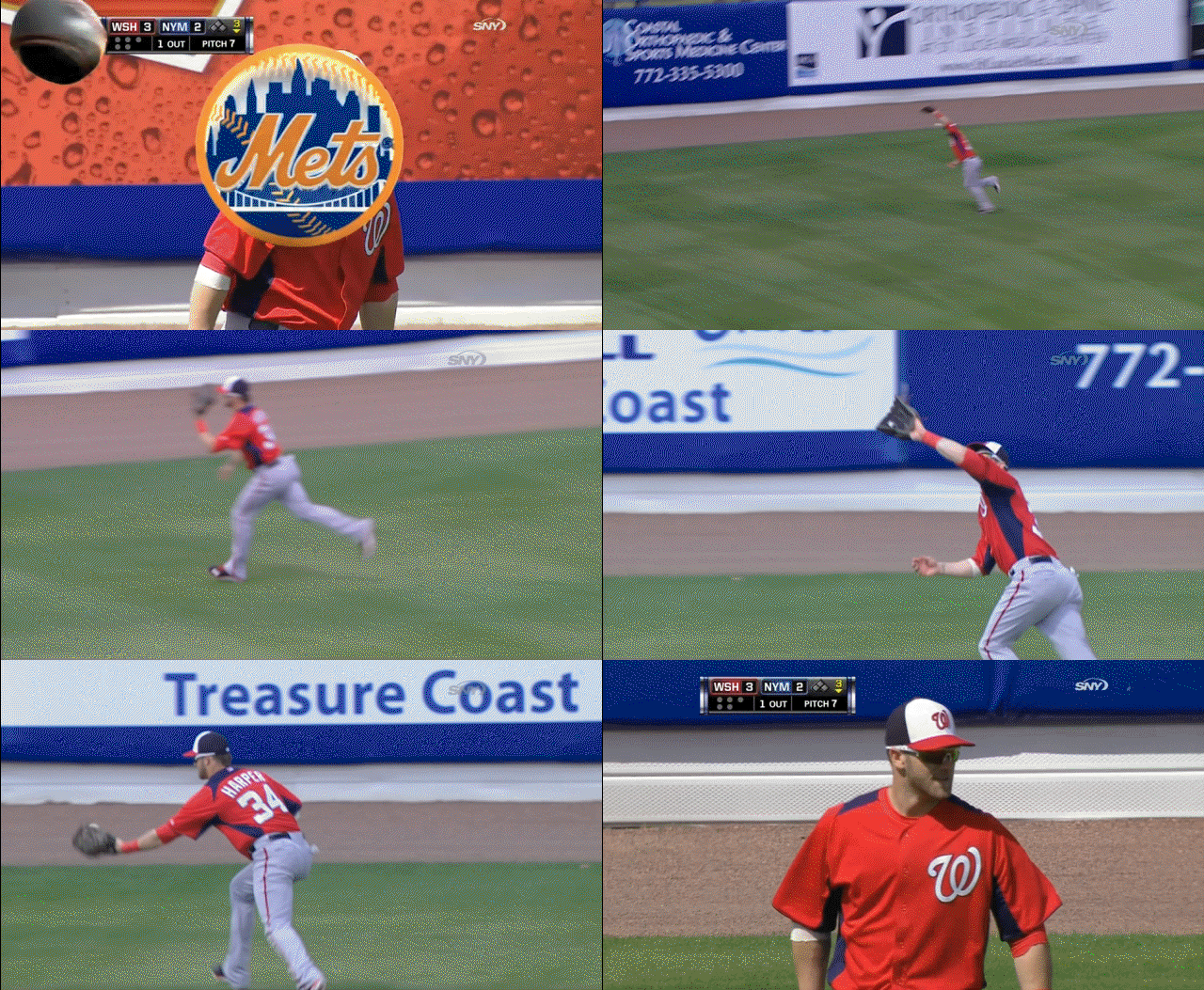
Bryce Harper starting off his Spring Training with some nice concentration.

harperstcatch1


And Prince Fielder wastes no time displaying his massive power with his first swing of the 2013 season.

fielderstbomb1

Monday: 02.11.2013

Countdown to Spring Training: 11 Days – Denard Span

Only 11 days until live game action…

DENARD SPAN

It isn’t too difficult to be excited about the Denard Span move to Washington. He was traded there this offseason for prospect Alex Meyer. Here is big reason why the Nationals were high enough on Span to trade their 2012 #6 prospect who now becomes Minnesota’s 2013 #4:

spandefense

His sparkling defense is ever-present and adds a lot to his value. He gives the Nats the true centerfielder they’ve been after for years. Bryce Harper and Roger Bernadina turned a strong combined effort last year, but the five years before were mediocre or worse:

span1

Compare that with Span producing fWAR totals of 3.1, 4.1, 2.6, 2.2, and 3.9 from 2008 through last year with the 3.1, 2.2, and 3.9 coming in 94, 70, and 128 games, respectively. The primary challenge will be staying healthy enough to give the Nats a full season so he can return to his 4-win levels. While he gets plenty of value from his defense in center, he also has a solid bat, especially for a leadoff man. His walk rate started at 11 percent over his first two seasons before dipping a bit, but it has held steady in the eights every year since with last year’s 8.3 still holding above the 8.0 league average.

Span isn’t special in either of the flashy offensive categories in fantasy: homers or steals, but he has a chance to deliver big value in the two overlooked categories: batting average and runs scored, especially the later. He is a career .284 hitter and he hit .283 a year ago, but his line drive rate is on the rise moving from 18 percent in 2010 to 21.3 percent a year ago and he is speedster with a heavy groundball lean posting a career high of 54.4 percent last year (compared to 53.8 for his career) so he has the makings of a greater than .300 average. Last year he was just 10 hits from a .302 average. It’s not a stretch to see him hitting or exceeding .300 as soon as 2013.

He could be ready for his first 100-run season in 2013, too. His career-best was 97 back in 2009 in just 145 games. Last year, the Nationals leadoff spot scored 96 runs which were right about league average ranking 14th in baseball despite the fact that only Jayson Werth carried an OBP over .312 in that role. This bodes well for Span.

(Courtesy of ESPN)

(Courtesy of ESPN)

Even at his worst, Span carried a .328 OBP (2011) and the heart of the Nats order is stacked this year. Even if you factor in some regression for Adam LaRoche on the heels of his second-best season, it is offset by a full seasons of Harper and Ryan Zimmerman. Harper started 2012 in the minors while Zimm started 2012 like he was in the minors carrying a sub-700 OPS into the All-Star break, though he eventually finished with a strong 824. Now batting fifth again, it wouldn’t be surprising to see Werth focus on bringing the power aspect back into his game in full force. It all adds up to one of the deepest groups of 2-5 hitters in the league.

A healthy Span – and he seems to have finally put the frightening concussions issues behind him – is looking at a .300-100-7-55-15 season with the high-powered Nats.

Sunday: 02.10.2013

Countdown to Spring Training: 12 Days – Chris Carter

Only 12 days until live game action…

CHRIS CARTER

I mentioned when I wrote about Carter on Monday that this would probably be the Houston entry for the Countdown. Writing about Jose Altuve would be too obvious (though I do have obvious selections in the Countdown *cough* Wrench *cough*) and frankly there just aren’t any other Houston hitters I’m particularly interested in writing about, sorry Marwin Gonzalez. Instead of a straight regurgitation, I do have some new commentary about Carter.

Don’t be afraid of his batting average. It’s going to be bad, that’s a lock. There have been nine instances of someone posting a 30 percent or higher strikeout rate in a full season of work the last three years and only twice did their average top .244 (Chris Davis at .270 last year, Adam Dunn at .260 in 2010). Five of the 10 were at .221 and below. But you can afford to draft one anchor, maybe even two if you have two virtual certainties for .315 or better like Joey Votto and Joe Mauer. I usually only recommend the one, though. So if you want to target Carter (and you should given his massive power) then you are taking Dunn, Dan Uggla, Ryan Howard, and Mark Reynolds types off the table unless you want a batting average deficit that you will struggle with all year.

Meanwhile, the Astros confirmed that they are considering trying Carter at leftfield which is where MLB Depth Charts had him from the jump so that really enhances his chances at a full season of playing time. He is also slotted into the cleanup spot in the lineup which is good even on a terrible team. He is still going to struggle for RBIs because of his team environment, but at least he has a chance to maximize his RBI opportunities.

Playing for such a bad team should keep Carter’s reasonable even as the hype starts to build after this trade. Though far from a unique skill set, it is still a desirable one. As we see more and more leagues shift to on-base percentage, we see players like Carter get more appreciated for their overall value so definitely bump him up a considerable amount if you do play with OBP.

Now here is Monday’s initial piece and the addendum together.

The Astros have a front office that understands how to rebuild. The best way to do it is to truly burn it to the ground and start over. In their latest such move, they traded Jed Lowrie and Fernando Rodriguez for Chris CarterBrad Peacock, and Max Stassi. A 29-year old shortstop who is on the team until at least 2015 isn’t a bad asset for a rebuilding team like Houston, but a 26-year old slugger (who is probably a DH, but ostensibly can play first base or maybe leftfield which is where MLB Depth Charts has him as of now) and a 24-year old prospect arm who are under team control until 2019 are much better. This move is perfect for Carter.

Carter got his first real shot last year and popped 16 homers along with a .239/.350/.514 line in 260 plate appearances. He did strikeout 32 percent of the time, but also carried a strong 15 percent walk rate. He’s a classic three true outcome player and his new home is tailor-made for his game. His power plays anywhere so even in his cavernous home ballpark with Oakland he still had a .458 slugging percentage (the A’s as a team had a .392 slugging percentage at home) and five home runs despite the 89 home run park factor for right-handers. His move to Houston brings a major improvement to home venue as Minute Maid Park yields a 109 park factor to righties on home runs.

Plus, with Houston’s move to the AL West, Carter’s favorite venue from 2012 is still in play as he hit three of his 11 road homers in Texas in just six games. When you are dealing with a 260 plate appearance season, any parsing of that data is going to be subject to small sample size issues as the whole is already just a half season so keep that in mind, but it’s not like this power appeared out of nowhere for Carter. It’s always been his calling card so even with the scant samples, I’m confident in projecting that this move is a huge benefit for him. Consider also that his 182 home runs in 3647 plate appearances as a minor leaguer translate to about 30 per 600 plate appearances (29.9 to be exact). He hit 65 of those home runs in 1277 PAs in Triple-A which actually tops that overall rate checking in at 30.5 per 600 PA.

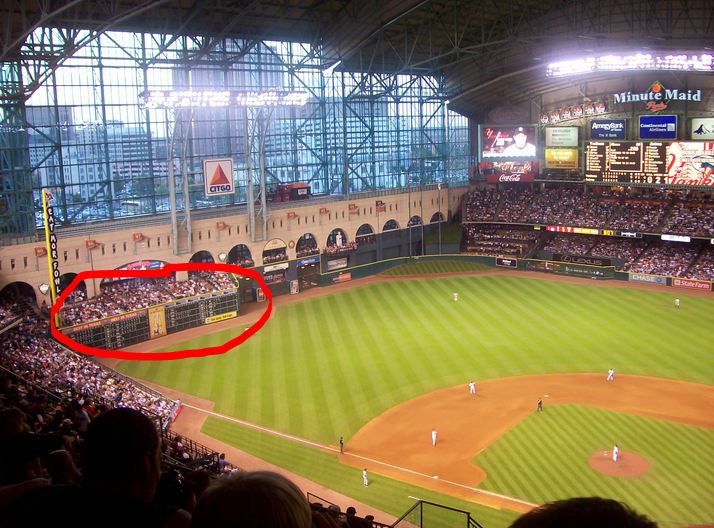
Thanks to Katron.org’s balls in play project, we can get a sense of how Carter might fare in Houston, or at least how he would’ve fared in Houston with last year’s batted ball distribution. The following is a mapping of Carter’s batted balls in Oakland on a Minute Maid Park overlay. You will see three leftfield batted ball outcomes labeled for what they were in Oakland, which would’ve likely gone for home runs in Houston. There is also a handful of warning track shots in left centerfield that might’ve gotten out in Houston depending on various circumstances. Meanwhile the five home runs were all no doubters on the Minute Maid overlay. Be mindful that this is all academic as he won’t have the exact same batted ball distribution in 2013, but it gives some sense of how his power production can improve with his new club.
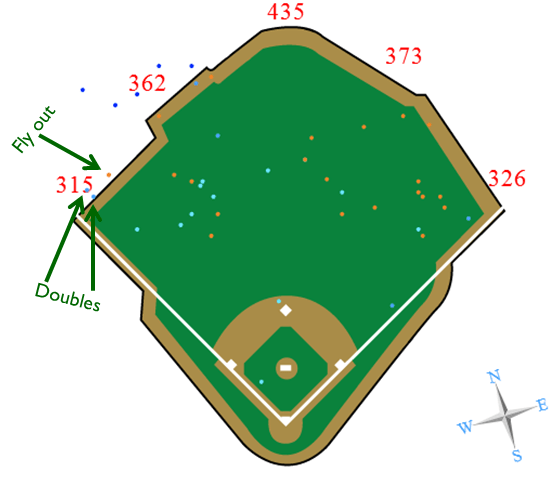
CarterinMMP

By the way, Jed Lowrie was my Houston pick for the Countdown to Spring Training so don’t be surprised if this re-runs for the Houston CtST entry down the road. If I can find someone else I’m interested in, I’ll definitely go another way, but Carter is someone I really like so this fits pretty well, too. I didn’t really want to hold this analysis until Houston’s day, either. Meanwhile, Lowrie is unlikely to hold a spot in the Countdown as I had my eye on someone else for Oakland and don’t know if I want to switch it up.

Addendum:

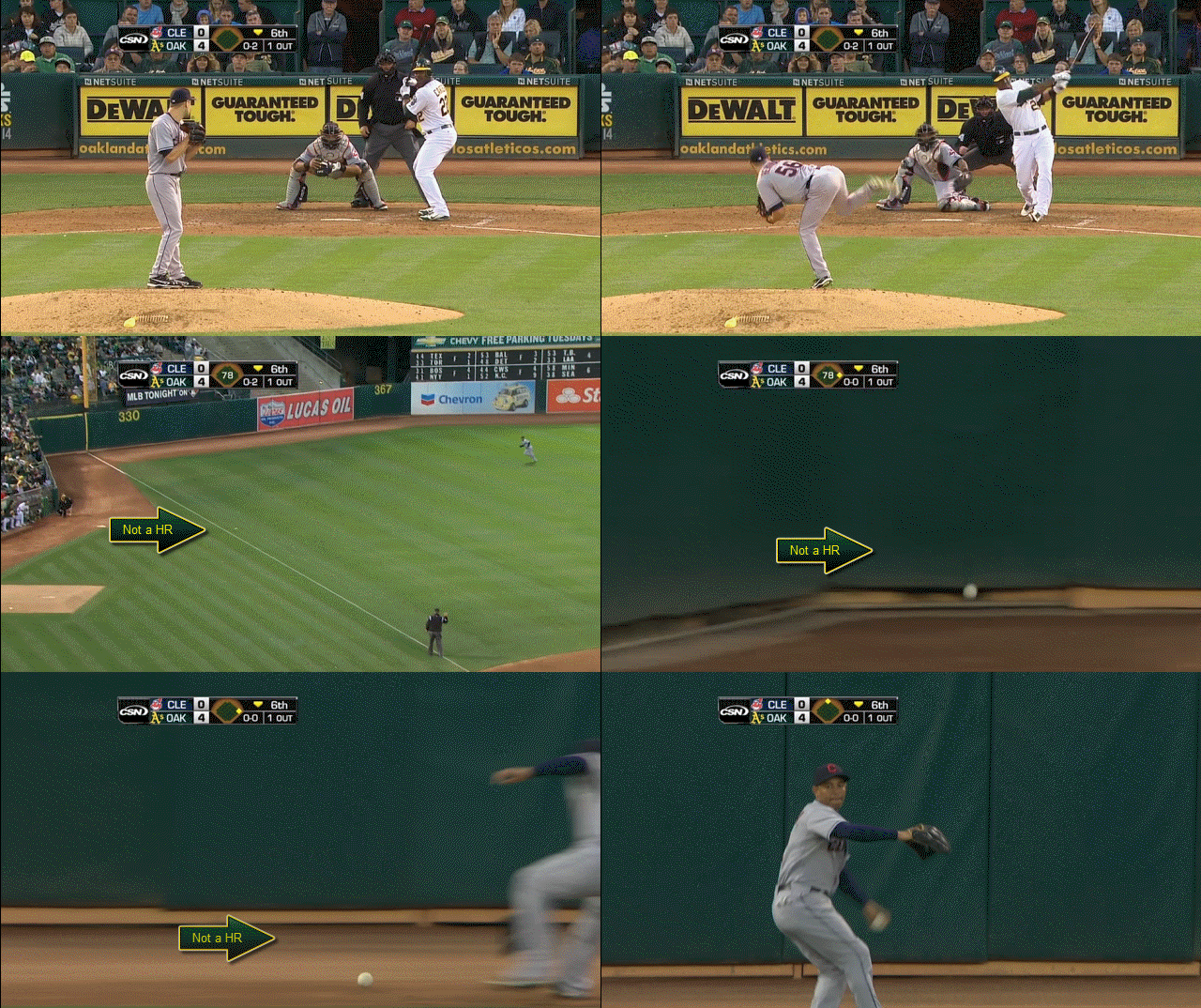
Earlier today after he was dealt to Houston, I did a piece on Chris Carter and how his power should spike with his new home ballpark. I used the Katron.org balls in play information to outline three batted balls from Carter that would’ve been home runs in Minute Maid Park. It was meant to accentuate the point regarding his likely power improvements in his much friendly environs, but it was greatly flawed. You see, the Katron dots are where the ball is fielded not where it landed. I knew this in the recesses of my mind, but I never gave full thought to the notion and what it means when analyzing this kind of data.

Here is the legend for the Katron data:
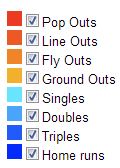
katronkey

The problem comes in that we don’t know the hit type of singles, doubles, triples, and home runs. So I absent-mindedly assumed (never assume, kids) that the doubles were hit in the air either as line drives or flies. They were not. After getting some education about Katron and the potential flaws with using the data as I did, I went back to the video and found out that my particular examples show just how dangerous using the data as I did can be when the dots represent where the ball is fielded and not where it first hits the ground.

First, let’s look at the doubles:
ccarter1a

ccarter2a

See the problem now? I apologize for that, I simply didn’t put together the inherent flaws of using the data like that. It’s 100% my fault, though, so I’m not crapping on the folks over at Katron.org as it’s even there in bold below the charts:

Every location is where the ball was fielded by a player, not where it landed. You better read this Paul Sporer you stupid dummy. 

That may not be a fully accurate quote from their site.

Perhaps if I had been reading my now-BP-colleague Sam Miller a year ago when he was writing at the OC Register, this all could’ve been prevented.

Hey, at least the flyball I highlighted doesn’t have the same issues. There is no guarantee it would’ve been out in Minute Maid, but we see the 367 sign behind Josh Hamilton when he catches it and we know that Minute Maid is 315 for a large portion of leftfield known as the Crawford Boxes.

ccarter3

(click for huge version)

(click for huge version)


Monday: 02.4.2013

Chris Carter Addendum

Earlier today after he was dealt to Houston, I did a piece on Chris Carter and how his power should spike with his new home ballpark. I used the Katron.org balls in play information to outline three batted balls from Carter that would’ve been home runs in Minute Maid Park. It was meant to accentuate the point regarding his likely power improvements in his much friendly environs, but it was greatly flawed. You see, the Katron dots are where the ball is fielded not where it landed. I knew this in the recesses of my mind, but I never gave full thought to the notion and what it means when analyzing this kind of data.

Here is the legend for the Katron data:

katronkey

The problem comes in that we don’t know the hit type of singles, doubles, triples, and home runs. So I absent-mindedly assumed (never assume, kids) that the doubles were hit in the air either as line drives or flies. They were not. After getting some education about Katron and the potential flaws with using the data as I did, I went back to the video and found out that my particular examples show just how dangerous using the data as I did can be when the dots represent where the ball is fielded and not where it first hits the ground.

First, let’s look at the doubles:

ccarter1a

ccarter2a

See the problem now? I apologize for that, I simply didn’t put together the inherent flaws of using the data like that. It’s 100% my fault, though, so I’m not crapping on the folks over at Katron.org as it’s even there in bold below the charts:

Every location is where the ball was fielded by a player, not where it landed. You better read this Paul Sporer you stupid dummy. 

That may not be a fully accurate quote from their site.

Perhaps if I had been reading my now-BP-colleague Sam Miller a year ago when he was writing at the OC Register, this all could’ve been prevented.

Hey, at least the flyball I highlighted doesn’t have the same issues. There is no guarantee it would’ve been out in Minute Maid, but we see the 367 sign behind Josh Hamilton when he catches it and we know that Minute Maid is 315 for a large portion of leftfield known as the Crawford Boxes.
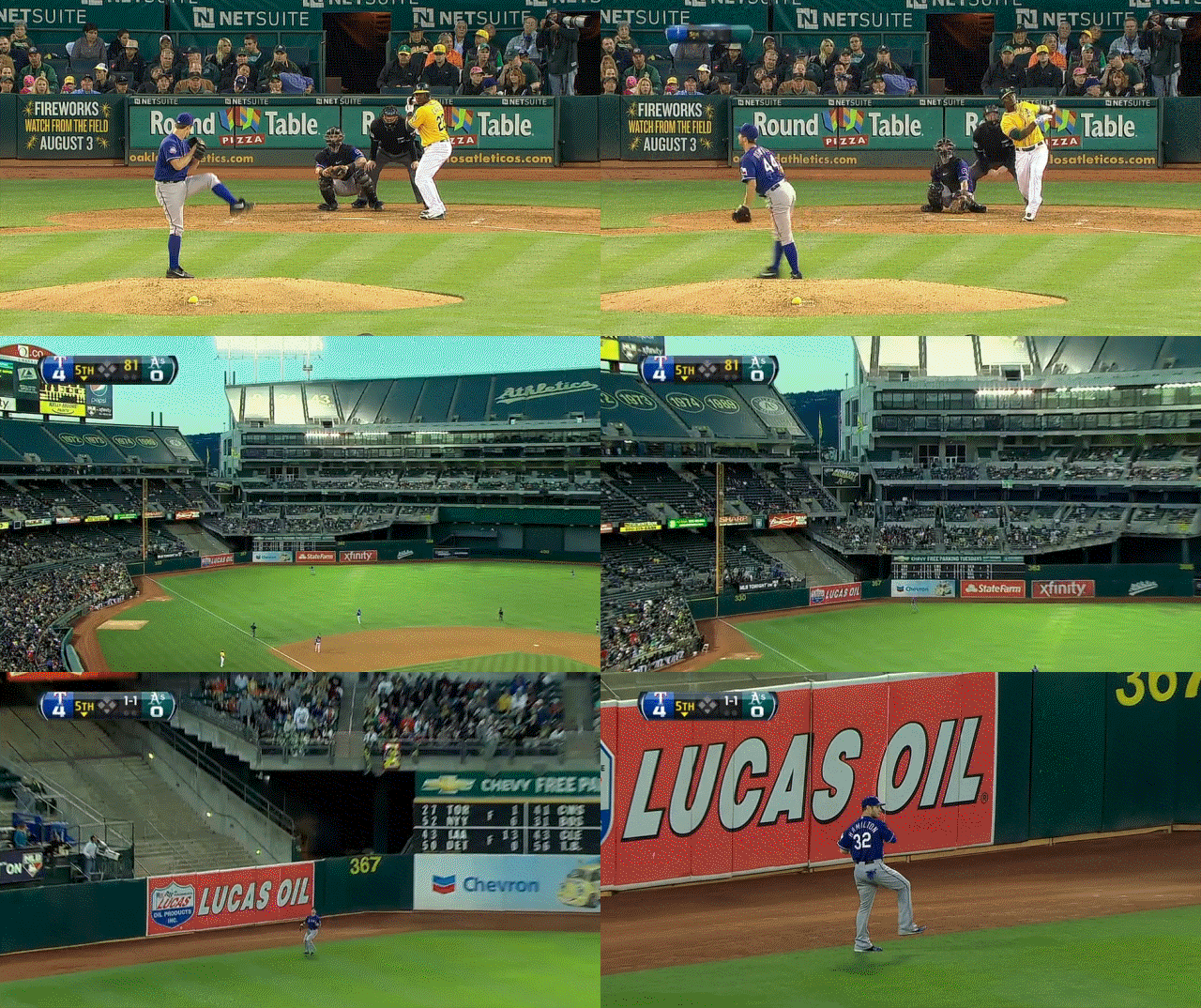
ccarter3

click for huge picture

click for huge picture

Wednesday: 01.23.2013

Countdown to Spring Training: 30 Days – Desmond Jennings

OK, so the first actual Grapefruit or Cactus League game doesn’t take place until February 22nd, but the Red Sox are splitting up their squad and playing a couple of colleges on February 21st so we’re just 30 days away from organized professional baseball. So why not a countdown of this final, grueling winter month that includes some fantasy analysis?

Obviously my primary focus at this site is on pitchers and you’ll get quite a bit of my analysis on them in late February when the SP Guide drops, thus I was thinking of something surrounding hitters. With 30 days to go, I am going to do a hitter per day highlighting one from each team. I selected my player of note from each team and then randomized them (which was pretty interesting consider who the final two were after the randomization) so that’s the order I’ll be following.

DESMOND JENNINGS

Always a tantalizing prospect, the Rays slow-cooked Jennings to the tune of 1004 plate appearances in Triple-A including 397 in 2011 despite the fact that his predecessor, Carl Crawford, had left for Boston via free agency that offseason. When he finally came up that year, he hit the ground running with a 1000 OPS in his first 175 plate appearances which included eight homers, 20 RBIs, 14 SBs, 24 runs scored, and 19 walks. He was doing everything.

Regression, which was probably inevitable, hit and hit hard as he shaved nearly 200 points off of that OPS down to 805 with a .162/.259/.253 line in his final 112 plate appearances. He still scored 20 runs and maintained his 11 percent walk rate, but the hot start caught up to him a bit and since the production came in two so distinct halves of amazing and crap, it generated discussion. It would be an interesting experiment to (travel back in time and) mix up the distribution of his production to small ups and downs that eventually land on the 805 OPS and see if it generates a different discussion. I’m sure it would.

He followed it up with a 2012 that looked more like the 112 PA sample than the 175 PA sample. He was a viable power-speed combo, only one of five players to reach or top 13 home runs and 31 steals*, but the walk rate fell nearly three percent to 8.2 while the strikeout rate remain steady at 21 percent. His home total was well off the 2011 pace which would’ve seen him hit 20 had he amassed the same 563 plate appearances he got in 2012. The doubles and triples held essentially even for those curious. So what happened?

*the other four were Mike Trout, teammate B.J. Upton, Carlos Gomez, and Jason Kipnis. All but Kipnis lapped him with either a lot more home runs or steals (or more of both in the Trout & Gomez cases). 

It is a bit too simplistic to just say that his home run per flyball rate regressed and that ate up his home runs. To a degree, that is exactly what happened, but without digger deeper it isn’t a helpful bit of information. He actually hit a larger percentage flyballs in 2012 moving from 35 to 38 percent and improved his line drive rate by 2.5 percent up to 20.1 percent.  Both of those factors can be good for a power spike, but the flyball contact was far less effective in 2012 as his infield flyball rate nearly doubled from 9.4 to 18.1 percent.

In his short 2011 sample, his flyballs hit off the inner third of the strikezone yielded a 5-for-12 (.417) mark with all five hits leaving the yard. He hit .297 (11-for-37) off the inner third as a whole in 2011. In 2012, he hit just four home runs off the inner third accounting for all four of his flyballs hit in nearly twice as many tries as he went 4-for-23 (.174). He still did plenty of damage off the inner third as a whole going 26-for-76 (.342), but pitchers got better at jamming inside to limit the damage to mostly singles (15 of the 26 hits). He wasn’t turning on those inner third meatballs like this one from 2011:

djennings

It’s one thing to drop your HR/FB rate because you are crushing warning track shots on gusty days or hitting the base of the wall for doubles and triples, but Jennings saw his HR/FB rate evaporate and shift into infield flies, the least successful contact a batter can make thus aiding a 61-point drop in slugging percentage and 47-point drop in isolated power (slugging minus average).

At 26, he is just about to enter his prime and doing so with 874 plate appearances under his belt should give him enough of a base to work from to make adjustments in order to fulfill his immense promise. The potential and youth will keep his price high, but the payoff is massive and even the downside was at least somewhat palatable despite massively underperforming his cost (51st ranked OF; 23rd most expensive) thanks to the steals.

He was the 92nd player drafted last year and his 2012, though under expectations, hasn’t really deterred anyone as he is tracking at 90th overall early on this winter. The composition of my team to that point would determine whether or not I’m willing to pay that eight round price tag.

If I have a foundation of guys with three-four years of track record, maybe Robinson Cano in the first, Adrian Beltre in the second, plus a Billy Butler, Cole Hamels, you get my point, proven veteran rocks; then I’d be more inclined to take Jennings. If you have team centered around Andrew McCutchen (just the one transcendent first round year), Jason Heyward, and Chase Headley, then you should probably go with Austin Jackson or Alex Rios who are being drafted 88th and 91st, respectively.

Saturday: 08.18.2012

On James McDonald

James McDonald had a better season in 2011 than his 4.21 ERA might lead you to believe.  While “breakout” might be a stretch as a definition, “breakthrough” probably works.  He labored through his first four starts in April posting a 10.16 ERA in 18.2 innings.  He threw six shutout innings against the Giants on April 27th and took off from there with a 3.49 ERA in his final 152.3 innings of the season.  Even trimming those first four starts from his record, he still had his flaws in 2010, specifically walks (3.9 BB/9 in the 152.3 IP) and home runs (1.1 HR/9).

He started his 2012 season off much better with a 2.97 ERA in April.  And he only got better from there.  After seven innings of one run ball on July 7th against the Giants (with 10 Ks and 0 BBs), his season ERA was down to 2.37 and he had 100 strikeouts in 110 innings.  More importantly, his walk rate was at 2.5 BB/9 and he allowed just 0.6 HR/9.  In other words, he was having his breakout season.  Then the wheels came off.  A rough start in Milwaukee wasn’t really any reason to panic.  After all, everyone has an off day.  Even his six earned run outing in Colorado that followed wasn’t ringing alarms because Coors has destroyed pitchers all year.

But when he followed those two outings with two more awful ones against the likes of the Cubs and Astros, panic set in.  He bounced back with a baseline quality start (6 IP/3 ER) in Cincinnati to start August, but then got torched for seven earned in just four and a third at home against the lowly Padres.  For those keeping score at home, that’s three duds out of four against three of the worse offenses in all of baseball.

All told, he posted an 8.71 ERA in 31 innings across six starts pushing his ERA up nearly a run and a half (from 2.37 to 3.77).  He still has 26 strikeouts (7.6 K/9), but also had 21 walks (6.1 BB/9) and eight (!) home runs (2.3 HR/9).  His only homer-less outing in the stretch was the one in Cincinnati against the Reds.  So what happened?  Obviously his old issues came back to haunt him and wiped away a lot of the good work he had done in his breakout season.  Let’s see what the data tells us.

VELOCITY

The first place most people look when a pitcher is struggling is the radar gun.  Has his velocity changed significantly?  If so, why?  Oftentimes a major velocity dip will signify a dead arm period or perhaps even a more severe injury that the pitcher is trying to work through on his own.  With McDonald, there was no such change whatsoever with his fastball.  His breaking pitches saw a velocity change, but they both increased.

In short, velocity wasn’t the root cause of his issues.  The added speed to his breaking pitches might’ve flattened them out a bit and robbed them of some effectiveness, but his fastball velocity holding firm means he was likely plenty healthy and that there was some other reason for his ineffectiveness.

FASTBALL

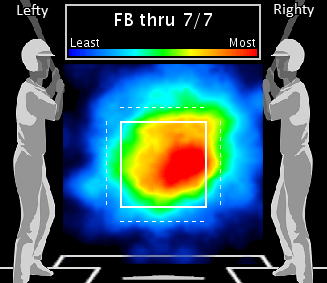
We looked at the velocity splits of his fastball from when he was on as compared to his run of bad starts.  However, we know that velocity isn’t the only thing that makes a fastball effective.  In the major leagues, even the hardest fastball has to have some wiggle or be placed perfectly otherwise it will eventually be caught up to and subsequently tattooed.  The movement on McDonald’s heater didn’t vary much in the two samples which leaves his command.  Was there is a difference in placement, specifically within the zone, of his fastball between his good and bad runs?

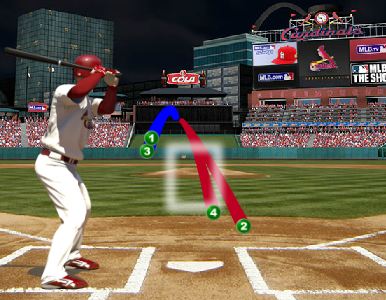
He was actually in the zone more during his hot stretch (56% to 52%), but look at how red it is down the middle of the zone during his poor stretch.  No wonder batters went from a .707 OPS on plate appearances that ended on a fastball up to 1.092 while striking out less (12.3% to 9.4%) and hitting more home runs (1.7% to 6.7%).  Hitting the fat part of the zone more often made hitters more aggressive and cut into his called strike percentage on the pitch, too, going from 33% down to 27%.

These fastball issues explain a lot of what went wrong for McDonald.

BREAKING PITCHES

The curveball went from overwhelmingly dominant to very good and from what I saw it was because he would lose it for stretches at a time.  For three innings it would look as sharp as it did in April through early July when it yielded an absurd .291 OPS and 34 strikeouts in the 79 plate appearances that ended on the pitch and then all of a sudden it would start flattening out in the fourth without warning.

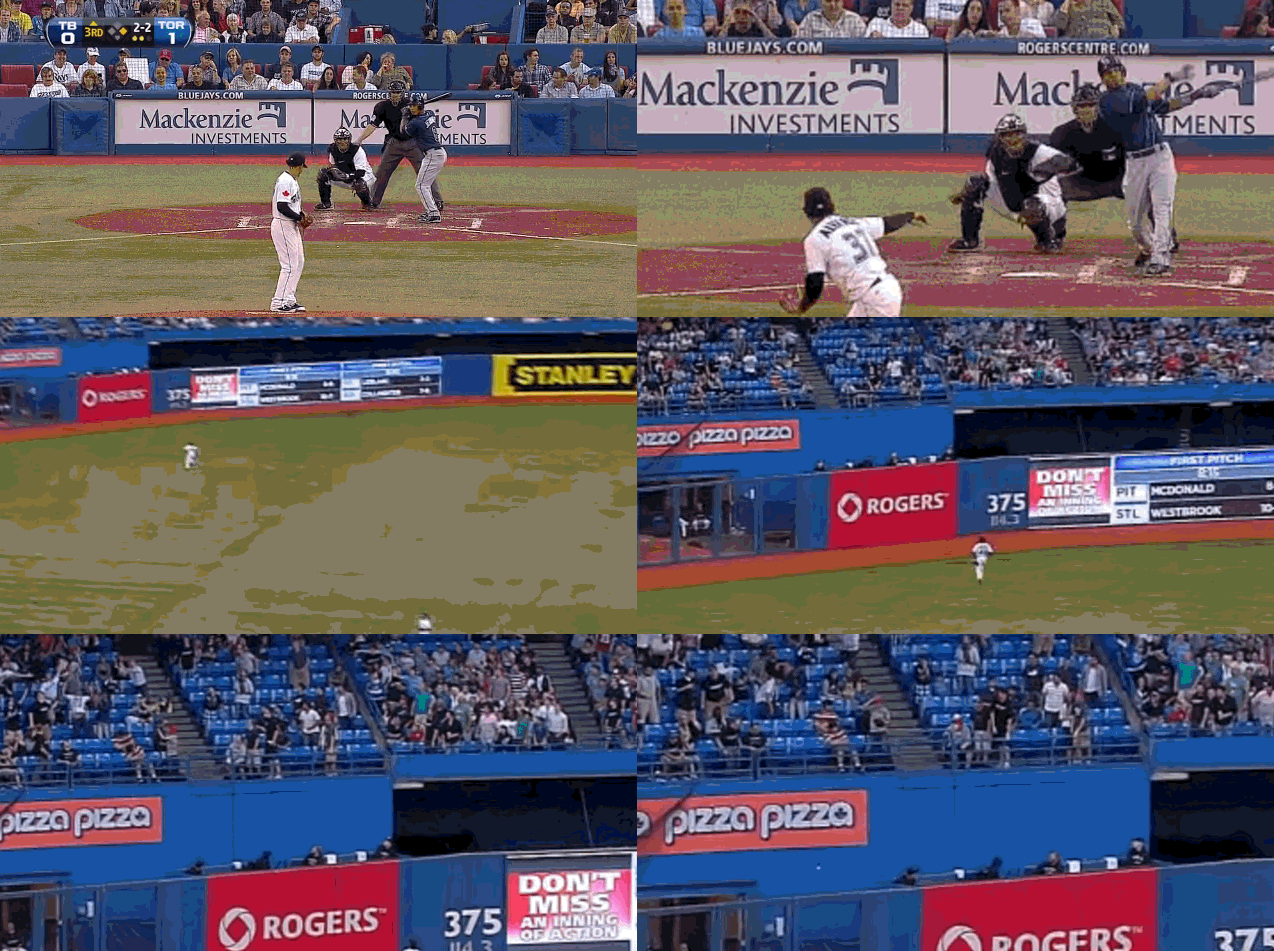
I don’t think I have the eye or general know-how to say why or explain what was going on with his mechanics when it went from good to bad.  I know a ridiculous, devastating curveball when I see one and I know a hanger that will be crushed by a historically bad hitter* against breaking balls.  Exhibits A & B:

*Soriano has a paltry .595 OPS against curve since 2009

FRIDAY NIGHT IN ST. LOUIS

Given his recent trajectory, it was difficult to be psyched about McDonald heading into St. Louis for the series opener Friday night.  They simply crush everybody even as they seemingly have three or four starters on the disabled list at any given moment.  Alas, that’s why they play the games.

McDonald was excellent against the Cards getting back to what made him so successful for the first three-plus months of the season.  His fastball command was the best it’s been in weeks while his breaking stuff was just dominant.  Four of his seven strikeouts came on breaking balls (2 apiece for the slider and curve) and 23 of his 36 breaking balls went for strikes including nine called strikes (six on the curve).  He ended up throwing six scoreless allowing just two hits and walking three.


He walked Jon Jay on five pitches to start the game and it was hard not to think, “oh boy, here we go again”, but he then induced a double play out of Allen Craig and a groundout from Matt Holliday to avoid any trouble.  His other two walks both came with two outs.  The sixth inning walk to Craig came on four straight balls with nobody on and perhaps he was pitching around him since Craig came into the game 3-for-8 with a double and a homer off of him while Holliday was just 2-for-9 with three strikeouts.  Yes, I realize there is very little difference between those two minuscule samples and I don’t even know how often pitchers work on that level especially with such short samples against both, but it’s simply a (halfhearted theory).  It could just be that he threw three lame pitches and one close one to Craig.

This was a very encouraging outing against a great opponent on the road so hopefully it spurs McDonald to be his April-early July self the rest of the way.  In fact, it is imperative to the team’s success that he is that version at least skills-wise even if the ERA is closer to 3.37 than 2.37.