Archive for ‘Starting Pitchers’

Monday: 04.23.2012

Jordan Zimmermann and His Tiny K Rate

Coming into the 2012 season, the Washington Nationals were a chic pick to improve upon last year and even contend for a playoff spot for some (I gave them top NL wildcard with 87 wins), especially in light of the added wildcard.  On the heels of their 80-81 record a year ago, they added two big time arms in Gio Gonzalez and Edwin Jackson via trade and free agency, respectively.  Perhaps even more importantly, they have Stephen Strasburg for most of the year (likely being capped around 160 innings) and Jordan Zimmermann for the entire season after his successful 161-inning return from Tommy John Surgery.

Zimmermann, a big time prospect in his own right though definitely a cut below Strasburg in terms of hype and pedigree, is building off of a solid foundation with 284 innings under his belt coming into the year during which he has posted a 3.84 ERA, 1.23 WHIP, 7.7 K/9 and 3.5 K/BB.  With the reins off in terms of an innings limit, he is poised for a breakout in what should be his first full season of action.  He is off to great start already with a 1.29 ERA, 0.71 WHIP and 5.0 K/BB in his 21 innings spread across three starts (he has exactly three 7-inning, 1-run outings).

The gaudy 5.0 K/BB rate catches the eye, but it is spurred by his allowing just two walks (0.9 BB/9) as his 4.3 K/9 is far from special.  The first thought when strikeouts are down against expectations or track record is to check velocity, but Zimmerman’s fastball velocity is exactly the same as last year’s at 93.4 MPH so there is nothing amiss in that realm.  In lieu of the strikeouts, he is inducing plenty of weak contact with a sky-high 52% groundball rate off of which batters have a meager .121 batting average.  We saw something like this from him last April when he had a 4.3 K/9 while posting his best groundball rate of any month at 45% in 30 innings.

In fact, his two best groundball months were easily his worst strikeout months by a significant margin.  In June, he had a 41% groundball rate while striking out just 5.7 K/9.  In the other months (excluding April), his strikeout rate was 8.1 or better while the groundball rate failed to top 37%.  Can he get back to inducing groundballs and missing bats simultaneously?  In the first 23 starts of his career spanning 2009-2010, he had an 8.8 K/9 with a 46% groundball rate so he has the ability to combine the two skills.

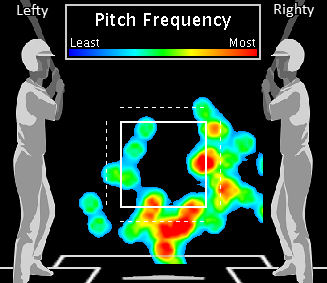
A sharp difference early on has been his curveball and Zimm’s ability to generate swings-and-misses with it.  In 2011, he was at a 15% swing-and-miss rate with it and for his career coming into 2012, he was at 21%.  The curve has definitely been his knockout finisher in the past.  This year he has just a 7% swing-and-miss rate on his bender due in large part to batters laying off of it as he tries to get them to chase out of the zone.  Just 29% of his benders have even hit the zone compared to a healthy 51% coming into this season.

Courtesy of MLB.ESPNTrueMedia.com

With hitters laying off the low, out-of-the-zone curveball, Zimmermann will need to change his approach if he wants his strikeout rate to return to previously established levels.  Of course, we are just three starts into the season, too, so while there is definitely a difference between what we have seen from Zimm in the past, it could just be him getting a feel for the curve as the season starts.

Another difference we have seen in the early (and small) sample is that he isn’t afraid of contact with two strikes.  Batters have put it in play during 21 of Zimm’s 34 two strike plate appearances (62%) with just a 29% strikeout rate while last year those rates were at 57% and 37%, respectively (meanwhile his career rates coming into ’12 are 55% and 38%).

It has served him well thus far with a .191 average and .491 OPS against in two strike situations, but in the long term he would be better served to start hitting the zone more (specifically with his curve as previously mentioned) and generating strikeouts instead of trusting his defense so often.  Based on both his talent and stuff, I think we will see Zimmermann start putting away more hitters as the season progresses.

Batters will start to get more hits off of him going forward (5.6 H/9, .200 BABIP), but hopefully he is able to counter that with an improvement in punch-outs.  You can’t argue with the outstanding results in his first three starts (though I’m sure he isn’t thrilled with the 8 runs of support from his offense across the three games) and I think we will see an even better Zimmermann going forward though the gaudy results (1.29 ERA, 0.71 WHIP) are sure to rise.

If anyone in your league is trying to “sell high” on Zimm in fear of the miniscule strikeout rate, take them up on it as long as the price isn’t egregious (Justin Verlander/Roy Halladay).  I don’t think any reasonable fantasy manager expects a leaguemate to pay for a 1.29 ERA and 0.71 WHIP knowing full well that neither is sustainable, but if they are thinking of buying low on Josh Johnson or Tim Lincecum, for example, and offering Zimmermann as a foundation, then I would entertain such a move without question.

Thursday: 04.19.2012

Mat Latos and His Slow Start

Well before the Joey Votto and Brandon Phillips contracts this season, the Reds announced their intent to contend (or try to, at least) in the near term by trading a significant haul of prospect value and major league arm Edinson Volquez to the San Diego Padres for top starter Mat Latos back in mid-December.  While he benefitted from the favorable PETCO Park, Latos was hardly a product of the pitcher’s haven seeing minimal (if any in some cases) degradation in his numbers away from home.

He posted a 3.22 ERA in 190 innings at home while toting a 3.57 ERA in 249 road innings.  His WHIP was actually a tick better while his strikeout and walk rates were nearly identical regardless of venue.  Armed with a bat-missing arsenal and a groundball lean, I was definitely on the high end of the spectrum when it came to projecting Latos for 2012.  After three starts, things aren’t looking so good.  Time to readjust expectations or simply a slow start for an ultra-talented arm?  Let’s take a closer look.

Slow Starter

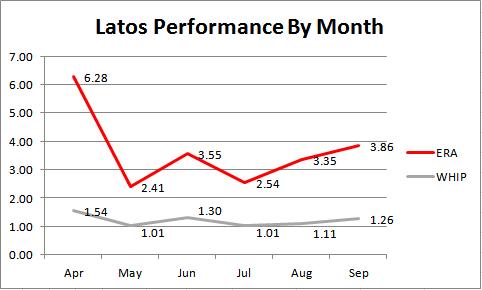
Latos is starting his third full year as a major leaguer in 2012 and in his two 31-start seasons the last two years, he has shown himself to be a perennial slow starter posting a 5.57 ERA and 1.40 WHIP in 42 April innings.  Adding in his three starts from this year, the numbers balloon to a 6.28 ERA and 1.54 WHIP in 57 April innings.  Meanwhile, May is his best month from an ERA and WHIP standpoint.

Regardless of whether or not you include his 2012 numbers, April is far and away the worst month for Latos.  History alone suggests he should improve once the calendar turns or rather, as he accumulates more work to iron out the kinks.

Velocity

With Pitch F/X data more prevalent than ever, the first data point most people check when a pitcher is struggling is fastball velocity.  It can often be an explanation for a downgrade in performance as well as be an indication of potential injury in some instances.  In the case of Latos, velocity doesn’t appear to be tied to his struggles in any way whatsoever.

In 2010, his April velocity (93.8 MPH) was actually better than his velocity the rest of the way (93.6 MPH), though just marginally.  He got a late start to 2011 accumulating just 10 Spring Training innings and then not starting until the 9th game of the year due to a strained right shoulder.  Thus it wasn’t really a surprise that his April velocity (92.0 MPH) was a tick below his 92.8 MPH mark from May on.  Through his three starts this year, his fastball velocity is right in line with 2011’s at 92.7 MPH.  In fact, he was at 93.7 MPH on Wednesday night and 76 of 112 pitches were heaters.  Velocity isn’t the problem for Latos.

Pitch Performance

While the velocity isn’t askew, the quality of his fastball early on has been in question.  Batters are tattooing the pitch to the tune of a 1.197 OPS and it hasn’t been nearly the put away pitch it was last year when he generated a 13.6% strikeout rate with it compared to just 7.5% this year (just to clear up any potential confusion, this means plate appearances that end with a fastball are yielding a strikeout 7.5% of time).  Even with the lowered velocity, his fastball was more effective last April though it was still not to the level he would enjoy from May on.  It yielded an .815 OPS last April but dipped to .752 the rest of the way.

More important than the fastball, his slider (which is easily his best pitch) hasn’t been as effective as usual thus far in terms of inducing poor contact.  The pitch earned 13.2 and 10.5 pitch values at FanGraphs in 2010 and 2011, but it’s at -1.3 through his first two starts and will likely go down once they factor in the results from Wednesday night’s start in St. Louis.  In 2010 and 2011 combined, the slider yielded a paltry .409 OPS while amassing an insane 41.8% strikeout rate.  It’s his finisher and while he has an excellent 42.9% strikeout rate with it so far this year, it is also being hit around to a .714 OPS, astronomical for that pitch when you compare it to rest of Latos’ career.

Perhaps he needs to start incorporating more sliders into his pitch mix.  He has thrown it 15.8% of the time so far this season, down a bit from the 18.6% rate in 2010 and 2011 combined.  Last April his changeup was getting blasted to a 1.214 OPS.  He was using it 12.4% and cut that by 5% from May on giving all of the excess to his slider (going from 15.2% to 20%) and it clearly spurred his success as batters had a video game-esque .338 OPS against it from May on.

He is currently throwing his changeup at an equal rate to the slider (15.8%) and while it’s not being pummeled like last year, it isn’t faring too well at .819 OPS.

Conclusion

The information available seems to suggest that Latos simply takes a while to get going.  There is nothing that jumps out in his data that points toward a prolonged degradation in performance or worse, an injury.  Some pitchers just stumble out of the block before turning it on.  While I’m not comparing the two directly, Justin Verlander had notoriously awful Aprils heading into 2011.

He made a concerted effort to work harder in Spring Training and treat those like important games instead of just tune ups so he would be ready on Opening Day.  The results were immediate as he posted 3.64 ERA, 1.02 WHIP and 9.2 K/9 in 42 April innings last year.  Even with the strong April last year and great start this year, his April line is still ugly compared to the rest of his numbers: 4.45 ERA, 1.22 WHIP and 7.7 K/9.

If you have Latos on your team, you have to stay the course and give him time otherwise you are doing yourself a disservice and wasting your draft day investment.  The peripherals are weak and the surface stats are even worse, but weathering April before breaking through is Latos’ modus operandi.  As for those of you who don’t currently have him on the roster, he makes a nice trade target who may even come at a discounted price.

I don’t like the practice of looking at struggling stars in April and labeling every single one a “buy low” as I don’t think anyone with any knowledge of how to play this game is actually putting a severe discount on Tim Lincecum or Matt Holliday to name a couple.  The price was simply too high on draft day and cutting bait for pennies on the dollar after half a month is just stupid for the current manager and a pipedream if you’re the buying manager.

Latos isn’t exactly on the level of those two (24th and 36th picks, respectively), but he’s star-ish as a top 70 pick in average draft position and so you shouldn’t go in expecting someone to completely cut their losses and take Joe Saunders or Omar Infante for him.  Maybe they will take someone in the 90-105 ADP range which would be a nice little discount, but even at draft day cost (someone in the 65-75 ADP range), Latos is worth buying in on because it is plenty reasonable to expect him to improve soon and stay good for the remainder of the season.

Thursday: 04.12.2012

The Road Soon Travelled?

20120412-185911.jpg

The Diamondbacks will take this road soon and I think there is a pot of gold at the end of it.

Thursday: 04.12.2012

How’d You Do That?

(click for more)

I love this kind of stuff.  Probably because I’m a nerd.  This is Felix Doubront and Daniel Bard discussing pitching in the Red Sox dugout during Wednesday afternoon’s game in Toronto.  I know this probably happens in every dugout from the Majors to Single-A ball so I’m not pretending it’s rare, I just like when they show us on camera.  I’m already a huge Doubront fan and while I was down on Bard coming into the season, his debut against the Jays was impressive as it included 17 swing-and-misses.  One start isn’t enough to completely change my opinion, but I’m at least slightly more intrigued than I was during Spring Training.

Thursday: 04.12.2012

Josh Johnson Thru Two Starts

Josh Johnson labored a bit through his Opening Day start last Wednesday against the St. Louis Cardinals allowing three runs on 10 hits and two walks while striking out four.  He threw mostly fastballs (74% of his 91 pitches) while his velocity continued its downward trend sitting at 92.7 MPH (95 in ’09; 94.9 in ’10; 93.8 in ’11), though he did max out at 95.4 MPH.  Was it rust as he returns from injury or is something amiss?  Johnson excited fantasy players with his Spring Training numbers that included a 2.42 ERA and 24 strikeouts against 10 walks in 22 innings of work.  At the same time, he did allow 21 hits.

I don’t put much stock into Spring Training numbers at all.  There are some instances where they matter a bit.  If a pitcher is returning from injury, I’m checking to make sure he is getting his allotted work in without incident.  I don’t even really care if he is getting knocked around, but if they say Johan Santana is supposed to go four innings or X-amount of pitches today, I want to see that fulfilled.  The other instance is in a job battle.  It doesn’t matter if marginal player X hit .904/.998/1.964 in his 20-something at-bats as that’s not at all indicative of his future performance, but it matters that he excelled if that is securing him a job for at least the near future.

Johnson was getting in his allotted work which was encouraging, but I didn’t change his ranking based on the numbers we saw.  I don’t know who the 24 Ks came against nor do I know if the 21 hits were tons of line drives or bloops and bleeders.  After seeing what can only be classified as a mediocre outing in last Wednesday’s opener, I looked forward to seeing Johnson face off against Roy Halladay Wednesday night in Philly for their second starts of the year.  Here are my observations from the outing:

  • 40 of his 80 pitches were fastballs (50%); down from his first start when he threw 74% heaters
  • His fastball averaged 92.4 MPH; down slightly from the 92.7 MPH mark in his first start
  • He threw almost only fastballs & changeups (68 of 80 pitches; 85%)
  • He only threw breaking balls 14% of the time and didn’t even throw a curveball until the 3rd
  • He threw just 6 sliders and 6 curveballs
  • He struggled to get ahead of batters going just 9-for-21 in first pitch strikes
  • That no doubt contributed to his struggles Wednesday including 11 H allowed & just 1 K
  • For his career, Johnson has a 7.4 K/BB after 0-1 counts; just 1.2 K/BB after 1-0 counts
  • For his career, Johnson allows a .220 AVG & .558 OPS after 0-1; .245 AVG & .739 OPS after 1-0
  • He failed to put away batters w/just the 1 K despite 9 batters (of 23) facing counts w/2 strikes
  • For his career, Johnson has struck out 43% of the batters who are faced w/2 strikes during a PA

This clearly wasn’t Johnson’s best outing.  The fact that it came near the beginning of the season tends to give it more weight in the eyes of some since it is 50% of his entire sample so far.  That is always dangerous for obvious reasons.  Adding it all up, he has two starts that aren’t exactly Josh Johnson-esque and given his injury history, it does raise the antennae a bit.  Right now the velocity is down and he isn’t getting the swing-throughs (just 1 on Wednesday) we’re used to seeing.  The lack of breaking pitches thrown could be an indication that he is being timid with his breaking stuff in an effort to avoid getting hurt again.  In the previous four years, he threw sliders more than a quarter of the time so he needs it to be successful.

For now, you can only stay the course with Johnson unless a full value trade comes along which is unlikely in most leagues.  I look forward to his upcoming starts to see how (if?) he progresses back toward the Johnson we are used to seeing.  I will post another update before the month is out.  He faces the Cubs at home, Nationals on the road and Diamondbacks at home in his next three starts.

Tuesday: 03.27.2012

BS Report and Betting Dork!

My primary goal for the 2012 Starting Pitcher Guide was to make it better than last year’s offering which I considered a resounding success.  I am feeling confident that the goal will be met as the 2012 version has already had more downloads than last year’s and that number is likely to go up after today.  Today’s BS Report during which Bill Simmons discussed baseball with his buddy Jack-O and Grantland head baseball writer Jonah Keri included a plug of the SP guide.   You can and should listen to the entire podcast at the BS Report link in the previous sentence, but I’ve also included my name check here because why not?!

Simmons Plug

Additionally, I recorded my second stint on the Betting Dork podcast with Gill Alexander from Pregame.com.  Last week we covered pitchers (naturally) and this week we dove into position players discussing a handful of over and under valued guys.  Gill is an excellent baseball handicapper and while we’d both love to add the other’s primary hobby (mine being fantasy baseball, of course), the time needed to succeed at both is just too much.  At least too much to enjoy it and maintain any semblance of a life during the summer.

Part 1 talking pitchers (I come in at the 30-minute mark, but listen to it all if you love baseball)

Part 2 talking hitters (I come in at the 43:30 mark, but again I recommend the entire show)

Wednesday: 03.14.2012

The 2012 Starting Pitcher Guide

It’s finally here!

-400 Pitchers

-76,300 Words

-190 Words Per Pitcher (on average)

-151 Pages

Please enjoy the 2012 Guide and feel free to direct any questions and comments either here in the comments section, on Twitter @sporer or via email through sporer at g mail.  As was the case last year, you can donate to show your appreciation in the upper right corner of this page.  I sincerely appreciate any and all donations and I’m beyond flattered at the fact that I’ve already received a handful of donations AHEAD of the release.

2012 SP Guide with 400 Player Capsules

Tuesday: 03.6.2012

Update #2: 2012 SP Guide

Last week I announced that I would be releasing the 2012 Starting Pitcher Guide today, but that isn’t going to happen just yet.  It was an aggressive date that I thought I could hit, but I didn’t get everything done in time.  I’m working extremely hard and even around the clock on some days to get everything done as I know draft season is ready to fire up in earnest pretty quickly.  At the same time, I pride myself on putting together a quality product and I don’t want to rush a lesser product out just to have it done in time for the early March drafts and auctions.

I hope everyone can understand my desire to put out the best product possible as a one man crew and I apologize for those who were looking forward to today’s proposed release date.  In light of a second push-back (originally I wanted to hit March 1st), I’m not going to pressure myself into a specific date, rather I will continue working day and night to get the product ready for consumption in a timely manner that should still have plenty of utility for the overwhelming majority of drafts and auctions.  I’m confident that the product will be worth the wait.  Thanks in advance for your patience.

Monday: 02.27.2012

Update: 2012 SP Guide

The 2012 Starting Pitcher Guide is still being worked on and it is currently on track to be released a week from Tuesday.  I was hoping to have it out no later than March 1st which I could maybe make by rushing it, but I would rather the product be complete and of higher quality than rush it out to hit a target date that doesn’t have any real significance other than it being the start of a month.  As I mentioned in the preview piece, there are fewer players capsuled this year (don’t worry, still over 400), but in lieu of that there is a lot more analysis on the players who matter.  Instead of covering fringy prospects with 5th starter ceilings in the bottom of Baltimore’s organization, I’m spending more time on major leaguers who are going to impact fantasy teams this year and can do so in a significant way.

Last year’s book checked in around 73,000 words and this year’s is already on pace to hit 87,000.  I am not trying to be unnecessarily wordy by any stretch of the imagination, but if a player merits a deep dive, he is getting it this year.  Another difference for this year is the lack of the feature pieces at the front of the guide, but again, the sort of analysis found within those pieces is now peppered throughout the guide with the longer capsules.  To give you a rough idea of what to expect, last year’s guide had an average of about 110 words per player.  This year’s average so far is about 180 words per player.  There isn’t a specific target or sweet spot for the word count per player and I’m not just dragging on about a guy if he doesn’t merit it, but I felt that you, the readers, would be better served by deeper analysis of the core of pitchers that will matter in 2012 (whether major leaguers or the prime prospects).

I will have some pitcher-related articles up on this site after the release of the book which will cover my favorites for 2012 and who I see making the leap forward, things of that nature.  I just wanted to update everyone as I have been getting tweets and emails (which I have no problem with and am completely flattered by) about the release date. I’m also planning a special supplement that I will keep the details of quiet for now as I have to decide if it something worth going through with from a value standpoint for readers.   Better to marinate on it for now in private than to talk about it, get some people hyped and then not follow through.

So March 6th.  I apologize to anyone who has already had their draft or is having it this weekend and I realize the guide loses utility the deeper into March it is released, but I still think a March 6th release gets out in time for the majority of drafts and auctions.  One other reason for the pushed release date is that I did a poor job of editing last year and there were typos (mostly missed words) because I didn’t take time to proof the entire guide after it was completed.  I will be doing that this time around to hopefully cut down on the errors found within the book.  I’m also looking for a job at the same time and so I can’t devote all of my time to the book as I would like to be gainfully employed again some time soon.  Feel free to tweet or email me with questions or comments, especially if you are drafting before March 6th and have questions about certain pitchers.

Friday: 02.3.2012

2011 Starting Pitching Guide Review (and 2012 Announcement)

Well, that dopey groundhog saw his shadow and saddled us with six more weeks of winter allegedly (it was 76 degrees today in Austin), but that’s neither here nor there because the calendar turning to February means baseball is once again on the horizon.  Spring Training will start mid-month and from there we will soon have meaningless Spring Training game stats to ascribe far too much meaning to as we prepare for our fantasy drafts and auctions.

My annual Starting Pitcher Guide is also on the horizon.  Last year’s edition was a resounding success and while it may be difficult to top, I plan to do so in 2012.  While the number of pitchers covered is unlikely to grow for the first year since I started back in 2008, the analysis of those included in the guide will be expanded.  Make no mistake, it will still be a robust offering covering names all the way down to the short season minor leagues, but there just won’t be as many of those project types included in 2012.

What you can expect is another guide that will have utility regardless of your league type.  Whether you play in an 8-team mixed league or 20-team dynasty league with 50-man rosters, you will be well equipped to tackle the 2012 pitching pool with aplomb.

Last year’s guide

…nailed the rebound of James Shields, “He is likely to be dirt cheap and I can’t recommend buying in enough. The downside if his luck just bounces back to average is 2009 while the upside is 2008 or better.”

…outlined the immense upside of Clayton Kershaw (though admittedly it takes all of one time seeing him pitch to understand his greatness), “He has more brilliance in his future including a 20-win season and/or a Cy Young award.  Buy.”

…pegged the sleeper status of Ian Kennedy, “He deserved better than his 9-10 record even with the gopheritis, but that may depress his value again in 2011 making him a sleeper albeit a much different kind of sleeper than prior to the 2010 season” and also offered a solid expectation for teammate Daniel Hudson’s first full season, “I would use Kennedy’s 2010 line (194 IP-3.80 ERA-1.20 WHIP-168 K) as a guide for Hudson’s 2011 (222 IP-3.49 ERA-1.20 WHIP-169 K) and bid accordingly”.

…encouraged aggressively buying into a 2011 rebound for Josh Beckett, “With his BABIP, LOB% and HR/FB rate all working against him, he is ripe for a significant bounce-back in 2011, which may also come at a measurable discount. This is a buy profile regardless of the size discount, because he certainly won’t cost what he did heading into last year.”

…really liked the prospects of Washington’s Jordan Zimmermann even with a reduced workload on the heels of Tommy John Surgery, “[Innings] Limit or not, I love Zimmerman’s skills and will do what I can to acquire his services for my teams.  He has strikeout-per-inning stuff with above average control.  In his 91-inning debut, he pitched like a mid-3.00s starter, but bad luck cost him more than a run rendering him a 4.63 ERA. Buy now on this budding star, especially in keeper leagues.”

…loved Ricky Romero for 2011, “He’s a bit under the radar for some reason. In ESPN’s top 75 starting pitcher list, he’s behind Jeremy Hellickson, Trevor Cahill and Jhoulys Chacin among others. All three of those guys have their merits, but I wouldn’t take any of them ahead of Romero.  He could take another step forward in 2011, but even a 2010 repeat is very valuable.”

…stayed the course with Derek Holland for a second year & reaped the benefits of his 16-5, 3.95 ERA season, “One of my favorites for a little while now, Holland flashed real skill in his 57 innings, but an injured shoulder cost him 55 games in the middle of the summer. He has a good chance of locking up spot in the rotation heading into 2011 and I’m looking for the full breakout.”

…liked Bud Norris for a solid year, especially at his price (next to nothing, even in NL-Only leagues), “If I’m going to buy into an imperfect profile, there has to be a legitimate upside and Norris has it. With his strikeout-per-inning stuff, Norris isn’t far from being an impact arm at the major league level.  The biggest hurdle remaining is his control. If he can get his walk rate under four per game (4.5 BB/9 in ’10; 4.4 career), he could have a big season.”

…suggested keeping Cory Luebke on your watch list for the first opening in San Diego, “If he doesn’t win a job in Spring Training, he will be on call if any of the non-Latos entities falters as they all come with their own special brand of risk. Keep an eye on him. He still qualifies for minor league drafts and he’s almost certain to contribute at some point in 2011.”  Luebke pitched well out of the pen (39 IP, 43 K, 3.23 ERA, 1.00 WHIP) through mid-June before finally getting a start on June 26th and holding a rotation spot the rest of the way (101 IP, 111 K, 3.31 ERA, 1.09 WHIP).

…pointed out that Scott Baker’s skills were much better than his >4.00 ERAs in three of the last four years heading into 2011, “Still, the skills beyond the flyballs are so appealing that it’s hard to stay away. Be prepared to walk if the price climbs too much, but there is value and upside lingering in this profile.”

…preached caution with youngster Kyle Drabek, “Even if he wins the job, I would suggest tempering expectations of a youngster who has skipped AAA. Keeper leaguers invest; re-draft leaguers invest only at the right price.”  Even that tepid endorsement probably wasn’t enough as he was absolutely brutal in any format.

…warned that Clay Buchholz wasn’t a 2.33 ERA pitcher with his skill set, “He continued to be successful because a strong 51% groundball rate was supplemented by very favorable BABIP, LOB% and HR/FB rates that turned a 3.50-4.00 season into a 2.33 one. I love profiles with elite groundball rates and above average or better strikeout rates, but you will pay a premium for Buchholz’s 2010 in most leagues making it tough to invest for profit. I would pass unless his value is commensurate with his true skill.”  He had almost equal strikeout and walk rates, yielding a 3.48 ERA in 83 innings before injuries cut his season short.

…had Jonathan Sanchez’s 2009 season as the barometer for his 2011 forecast, “Use that [2009] season (4.24 ERA, 1.37 WHP, 9.8 K/9) as your guide and bid accordingly.  His price may escalate because of 2010 so don’t be afraid to bow out; let others pay the unnecessary premium.”  Sanchez toted a 4.26 ERA, 1.44 WHIP and 9.1 K/9 in 101 innings.

…didn’t buy Mike Pelfrey’s 2010 artificial breakout at all, “He’s not a legitimate mid-3.00s [ERA pitcher] with his current skills profile. I don’t think he’s going to all of a sudden develop an above average strikeout rate after 683 major league innings at 5.1, so his key to pushing the strikeout-to-walk rate above 2.0 (for the first time ever) is his walk rate. If the record (15-9) and ERA (3.66) inflate his value, step away.”

…virtually nailed Mat Latos’s 2011 performance, “Look for a 3.25-3.50 ERA, a 1.20 WHIP or better and 8-9 Ks per game for the budding star.”  Latos pitched to a 3.47 ERA and 1.18 WHIP with 8.6 K/9 in 194 innings.

…wasn’t deterred by Hiroki Kuroda’s age, instead focusing on his consistent year-to-year performance since coming over to the States, “Though 36, he shows no signs of slowing down (including significant 2nd-half improvement in 2010) yet the elevated age generally brings an unnecessary but welcomed discount.”

…saw improved control mitigating the impact of a worse infield defense for Jaime Garcia, “A 180 inning season with a 3.50ish ERA, 1.30ish WHIP and 140 strikeouts is very good. The worsening defense with the departure of Brendan Ryan will hurt a groundballer like Garcia, but improved control after getting 163 innings under his belt isn’t out of the question either, which would help offset Ryan.”  Garcia threw 195 innings with a 3.56 ERA, 1.32 WHIP and 156 K (7.2 K/9).

…was actually a little on high side when it came to Javier Vazquez’s rebound even though his season started off about as poorly as possible, “I’m less concerned [about his velocity dip in the Bronx] as a one year drop doesn’t automatically make it a certainty and though he is 35, I think he will rebound nicely out of the limelight with the Marlins. We almost certainly won’t see 2009, but 200 innings of 3.80 ERA, 1.25 WHIP and a heap of strikeouts has plenty of value.”  On June 11th, 13 starts into his season, Vazquez had a 7.09 ERA and 1.65 WHIP in 66 innings, but pitched to a 1.92 ERA and 0.94 WHIP in his final 127 innings to end the season with a 3.69 ERA and 1.18 WHIP in 193 innings (as well as a solid 7.6 K/9).

Of course those 18 success stories were but a sample of the insightful analysis found in the 2011 guide and in the interest of full disclosure, there were some duds which is to be expected when putting out 546 player profiles.  I was way too high on Kevin Slowey, who managed just 59 innings of work and while his 6.8 K/BB ratio was a career best, his 1.5 HR/9 led to a 6.67 ERA and 0-8 record.

I also thought buying in on John Lackey was wise.

I saw an implosion for Mark Buehrle, who enjoyed his best ERA since 2005.

I thought Derek Lowe was a low-risk investment (5.05 ERA, 1.51 WHIP).

I vastly underestimated his teammate, Tim Hudson, who showed plenty left in the tank at 35 improving his K and BB rates.

I fell for Ricky Nolasco… again.

I jumped off the Matt Garza Bandwagon before reaping the dividends after loving him in 2010.

I stayed the course with Jason Hammel whose skills were much better than his ERA for two straight years until last year when he decided to regress his skills toward his ERA instead of vice versa.

I thought AJ Burnett could rebound from his dreadful 2010 thanks to a solid track record & big time strikeout ability… whoops (Burnett lowered his ERA just 0.11 to 5.15).

I dismissed the signing of Bartolo Colon by the Yankees, lumping him in with Mark Prior, “even the best Spring Training in the world couldn’t convince to lay a dollar on either, but they are in Tampa and could feasibly pull off a miracle… I guess.”

I overrated Brett Cecil suggesting “he definitely merits heavy consideration in most league formats” as he went on to post a 4.73 ERA in 124 innings thanks in large part to a 1.6 HR/9.

I gave Justin Masterson merely a tepid endorsement which may have caused some to miss out on the 26-year old’s breakout season, “There is still to work to be done, especially against lefties. Invest on the cheap in AL-Only leagues and deeper mixed leagues, but maybe reserve (if applicable) or just monitor him in standard 10-12 team mixers.”  I should’ve stayed the course with him after recommending him in the 2010 guide.

I was duped by Bruce Chen again, who lowered his undeserved 2010 ERA by 0.40 despite a strikeout rate below 6.0, “If you are falling for the 4.17 ERA last year and actually consider rostering Chen in any league format, I’d rather you just send me your money since burning it is illegal.”

I thought Joel Pineiro could continue to offer value as a low strikeout, control artist after back-to-back sub-4.00 ERA seasons in 2009 and 2010.  I was so very wrong.  His already miniscule strikeout rate plummeted to 3.8 K/9 and his ERA rose significantly to a completely unusable 5.19 in 146 innings.

In any sort of undertaking like the 2011 Starting Pitching Guide, there are going to be hits and misses, but overall I am happy with how everything turned out both when I published it last winter and now as I look back on how the prognostications panned out.  You can expect more quality analysis in the 2012 guide as well as feature pieces diving into a bevy of starting pitcher-related topics yet to be determined.

Apart from knowing there will be profiles and some articles, details are scant on the 2012 guide because I have several decisions to make in terms of both content and distribution.  I am flattered with how many inquiries I’ve received on Twitter and via email asking if there will be a guide this year so I wanted to make it known that there will be one which also explains why coverage has been scant at paulsporer.com through January.

I’ll post updates throughout the month especially as I get a strong handle on a release date.